Roadmap To Graduate School: Tools
and Data To Help You Find Your Way
0
20
40
60
80
%Admitted
Roadmap To Graduate School
A blog-series hosted on the APA’s Psych
Learning Curve
 Getting Into Graduate School: Your Roadmap to Success
 http://psychlearningcurve.org/graduate-school-roadmap/
 Roadmap To Graduate School: Planning Your Route
 http://psychlearningcurve.org/planning-your-route-to-graduate-school/
 Roadmap to Graduate School: Finding Fit
 http://psychlearningcurve.org/finding-fit/
 Roadmap to Graduate School: Navigating Interviews
 http://psychlearningcurve.org/navigating-interviews/
Graduate Study in Psychology
 Graduate Study in Psychology is an annual survey of
psychology graduate programs in the US and Canada
 Degrees offered & program descriptions (MS/MA vs PhD vs PsyD)
 Admission requirements & application information (GPAs, letters,
essays)
 Financial aid, tuition, housing and contact information
 Program level student demographics
 APA provides analysis of this data –
describing the competiveness, costs, and
requirements of graduate school in
psychology.
 Use this information for assessing your
options and picking which programs best fit
your needs!
0
10
20
30
40
50
60
70
Graduate Programs: What are your
options?
 Nearly 1500 programs offered at over 400
schools/departments of psychology, and they
differ in the type of training offered:
 Disciplinary – create scientists that establish and maintain
knowledge base
 Professional – create practitioners that provide services
to people or groups
 Applied Research – create scientists that study and refine
how to apply psychology to health, law, education, business, etc.
 First way to refine you search – know
WANT you to do after graduate school.
Graduate Programs: What are your
options?
 Read Descriptions of Programs on
Department Websites
 Look At the Research Papers and
Publications of the Faculty & Students
 Ask What Alumni of Programs are
Doing Now?
 Use your Institution’s Advising Office,
and consult your mentor/advisor.
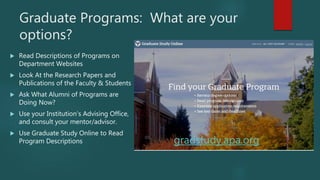
 Use Graduate Study Online to Read
Program Descriptions gradstudy.apa.org
Graduate Programs: What are your
options?
Q1: What Do Graduate Programs Look
For in an Applicant?
 Graduate programs are assessing your FIT for the type of training and degree they offer. In other
words, they want to know:
 Your career interest match the type of training and education they offer
 Your previous experience (work and/or education) prepare you for the RIGOR of graduate school
 That you will be successful – have the skills, knowledge, and previous course work to make it successfully through the program (and
graduate and go on to do GREAT things).
 The Admission Requirements are their way of looking for answers – and your opportunity to
demonstrate you understand:
 Different programs look at different criteria. For example, programs might place
 .. more emphasis on research experience (PhD or Disciplinary Programs)
 .. more emphasis on work experience or career interest (Applied Research)
 .. more emphasis on volunteer work and clinical experience (Health Service Psychology)
A1: Admission Criteria
0
0.5
1
1.5
2
2.5
3
ImportanceRating(Mean)
High Importance = 3; No Importance = 0
Masters
Doctorate
This data represents the median answers of all psychology masters and doctoral programs found in Graduate Study in
Psychology. You can compare the rank of criteria for programs that interest you with the entire population.
A1: Admission Criteria
Q2: How Competitive Are Programs?
 The number of applications, admission
and enrollments let you know how
competitive a program is. However,
remember:
 Competitive programs are not
necessarily better. It is all about fit.
 The admission rate does not predict
whether YOU get in or not. It is all
about fit.
 Use acceptance rates to help you
create a portfolio of programs that
first match your interest, you have
the credentials, and you understand
how many other people are also
considering that program
60.3 59.0
42.9 42.1
36.4
50.3
38.4
50.0
33.3
61.1
13.0
30.0
12.5
10.4
14.3
8.1
14.3 13.6
7.8
24.6
0
10
20
30
40
50
60
70
%Admitted
Master's
Doctorate
Q2: How Competitive Are Programs?
 The number of applications, admission
and enrollments let you know how
competitive a program is. However,
remember:
 Competitive programs are not
necessarily better. It is all about fit.
 The admission rate does not predict
whether YOU get in or not. It is all
about fit.
 Use acceptance rates to help you
create a portfolio of programs that
first match your interest, you have
the credentials, and you understand
how many other people are also
considering that program
Q3: What Will it Cost? What Financial
Assistance is There?
 Many factors will determine the overall cost and how much (if any) debt you
will have after graduate school:
 Tuition, Fees, and costs of living: See our Video on understanding cost and paying for graduate school
 Financial Assistance Options – different programs and schools have different
ways they help you cover the cost of graduate school.
 Teaching Assistantships (TA): You help with teaching students (usually undergraduates)
 Research Assistantship (RA): You help conduct research in a lab or center
 Fellowships/Scholarship (FS): You receive (free) money based upon your credentials or other
qualifications
 Tuition Remission: As part of your TA, RA or FS, part or all of your tuition is covered
Q3: What Will it Cost? What Financial
Assistance is There?
All departments
(n=476) Departments Offering (%) Median Stipend Offered ($)
Department Offering Full
Remission (%)
Teaching Assistant 80.0 13,418 55.9
Research Assistant 74.2 14,000 59.8
Fellowship/Scholarship 66.6 10,200 46.4
Master’s-only departments
(n=102) Departments Offering (%) Median Stipend Offered ($)
Department Offering Full
Remission (%)
Teaching Assistant 63.7 6,800 32.3
Research Assistant 54.9 5,280 30.4
Fellowship/Scholarship 36.3 2,200 16.2
All departments (n=476) Departments Offering
(%)
Median Stipend
Offered ($)
Department
Offering Full
Remission (%)
Teaching Assistant 80.0 13,418 55.9
Research Assistant 74.2 14,000 59.8
Fellowship/Scholarship 66.6 10,200 46.4
Master’s-only
departments (n=102)
Departments Offering
(%)
Median Stipend
Offered ($)
Department
Offering Full
Remission (%)
Teaching Assistant 63.7 6,800 32.3
Research Assistant 54.9 5,280 30.4
Fellowship/Scholarship 36.3 2,200 16.2
Q3: What Will it Cost? What Financial
Assistance is There?
Howard University PhD Counseling
More Resources from APA
Frequently Asked Questions About Graduate School
https://www.apa.org/education/grad/faqs.aspx
Psychology Learning Curve
http://psychlearningcurve.org/
Graduate Study Online
http://gradstudy.apa.org/landing
PSYCAS: The Psychology Centralized Application Service
https://psycas.liaisoncas.com
APA Center for Workforce Studies Data Tools
https://www.apa.org/workforce/data-tools/degrees-pathways.aspx

Roadmap & Data to Help You Apply to Graduate Programs

  • 1.
    Roadmap To GraduateSchool: Tools and Data To Help You Find Your Way 0 20 40 60 80 %Admitted
  • 2.
    Roadmap To GraduateSchool A blog-series hosted on the APA’s Psych Learning Curve  Getting Into Graduate School: Your Roadmap to Success  http://psychlearningcurve.org/graduate-school-roadmap/  Roadmap To Graduate School: Planning Your Route  http://psychlearningcurve.org/planning-your-route-to-graduate-school/  Roadmap to Graduate School: Finding Fit  http://psychlearningcurve.org/finding-fit/  Roadmap to Graduate School: Navigating Interviews  http://psychlearningcurve.org/navigating-interviews/
  • 3.
    Graduate Study inPsychology  Graduate Study in Psychology is an annual survey of psychology graduate programs in the US and Canada  Degrees offered & program descriptions (MS/MA vs PhD vs PsyD)  Admission requirements & application information (GPAs, letters, essays)  Financial aid, tuition, housing and contact information  Program level student demographics  APA provides analysis of this data – describing the competiveness, costs, and requirements of graduate school in psychology.  Use this information for assessing your options and picking which programs best fit your needs! 0 10 20 30 40 50 60 70
  • 4.
    Graduate Programs: Whatare your options?  Nearly 1500 programs offered at over 400 schools/departments of psychology, and they differ in the type of training offered:  Disciplinary – create scientists that establish and maintain knowledge base  Professional – create practitioners that provide services to people or groups  Applied Research – create scientists that study and refine how to apply psychology to health, law, education, business, etc.  First way to refine you search – know WANT you to do after graduate school.
  • 5.
    Graduate Programs: Whatare your options?  Read Descriptions of Programs on Department Websites  Look At the Research Papers and Publications of the Faculty & Students  Ask What Alumni of Programs are Doing Now?  Use your Institution’s Advising Office, and consult your mentor/advisor.  Use Graduate Study Online to Read Program Descriptions gradstudy.apa.org
  • 6.
    Graduate Programs: Whatare your options?
  • 8.
    Q1: What DoGraduate Programs Look For in an Applicant?  Graduate programs are assessing your FIT for the type of training and degree they offer. In other words, they want to know:  Your career interest match the type of training and education they offer  Your previous experience (work and/or education) prepare you for the RIGOR of graduate school  That you will be successful – have the skills, knowledge, and previous course work to make it successfully through the program (and graduate and go on to do GREAT things).  The Admission Requirements are their way of looking for answers – and your opportunity to demonstrate you understand:  Different programs look at different criteria. For example, programs might place  .. more emphasis on research experience (PhD or Disciplinary Programs)  .. more emphasis on work experience or career interest (Applied Research)  .. more emphasis on volunteer work and clinical experience (Health Service Psychology)
  • 9.
    A1: Admission Criteria 0 0.5 1 1.5 2 2.5 3 ImportanceRating(Mean) HighImportance = 3; No Importance = 0 Masters Doctorate This data represents the median answers of all psychology masters and doctoral programs found in Graduate Study in Psychology. You can compare the rank of criteria for programs that interest you with the entire population.
  • 10.
  • 11.
    Q2: How CompetitiveAre Programs?  The number of applications, admission and enrollments let you know how competitive a program is. However, remember:  Competitive programs are not necessarily better. It is all about fit.  The admission rate does not predict whether YOU get in or not. It is all about fit.  Use acceptance rates to help you create a portfolio of programs that first match your interest, you have the credentials, and you understand how many other people are also considering that program 60.3 59.0 42.9 42.1 36.4 50.3 38.4 50.0 33.3 61.1 13.0 30.0 12.5 10.4 14.3 8.1 14.3 13.6 7.8 24.6 0 10 20 30 40 50 60 70 %Admitted Master's Doctorate
  • 12.
    Q2: How CompetitiveAre Programs?  The number of applications, admission and enrollments let you know how competitive a program is. However, remember:  Competitive programs are not necessarily better. It is all about fit.  The admission rate does not predict whether YOU get in or not. It is all about fit.  Use acceptance rates to help you create a portfolio of programs that first match your interest, you have the credentials, and you understand how many other people are also considering that program
  • 13.
    Q3: What Willit Cost? What Financial Assistance is There?  Many factors will determine the overall cost and how much (if any) debt you will have after graduate school:  Tuition, Fees, and costs of living: See our Video on understanding cost and paying for graduate school  Financial Assistance Options – different programs and schools have different ways they help you cover the cost of graduate school.  Teaching Assistantships (TA): You help with teaching students (usually undergraduates)  Research Assistantship (RA): You help conduct research in a lab or center  Fellowships/Scholarship (FS): You receive (free) money based upon your credentials or other qualifications  Tuition Remission: As part of your TA, RA or FS, part or all of your tuition is covered
  • 14.
    Q3: What Willit Cost? What Financial Assistance is There? All departments (n=476) Departments Offering (%) Median Stipend Offered ($) Department Offering Full Remission (%) Teaching Assistant 80.0 13,418 55.9 Research Assistant 74.2 14,000 59.8 Fellowship/Scholarship 66.6 10,200 46.4 Master’s-only departments (n=102) Departments Offering (%) Median Stipend Offered ($) Department Offering Full Remission (%) Teaching Assistant 63.7 6,800 32.3 Research Assistant 54.9 5,280 30.4 Fellowship/Scholarship 36.3 2,200 16.2
  • 15.
    All departments (n=476)Departments Offering (%) Median Stipend Offered ($) Department Offering Full Remission (%) Teaching Assistant 80.0 13,418 55.9 Research Assistant 74.2 14,000 59.8 Fellowship/Scholarship 66.6 10,200 46.4 Master’s-only departments (n=102) Departments Offering (%) Median Stipend Offered ($) Department Offering Full Remission (%) Teaching Assistant 63.7 6,800 32.3 Research Assistant 54.9 5,280 30.4 Fellowship/Scholarship 36.3 2,200 16.2 Q3: What Will it Cost? What Financial Assistance is There? Howard University PhD Counseling
  • 16.
    More Resources fromAPA Frequently Asked Questions About Graduate School https://www.apa.org/education/grad/faqs.aspx Psychology Learning Curve http://psychlearningcurve.org/ Graduate Study Online http://gradstudy.apa.org/landing PSYCAS: The Psychology Centralized Application Service https://psycas.liaisoncas.com APA Center for Workforce Studies Data Tools https://www.apa.org/workforce/data-tools/degrees-pathways.aspx