GETTING READY FOR COLLEGE
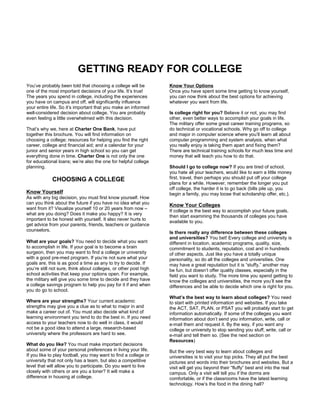
You’ve probably been told that choosing a college will be
one of the most important decisions of your life. It’s true!
The years you spend in college, including the experiences
you have on campus and off, will significantly influence
your entire life. So it’s important that you make an informed
well-considered decision about college. You are probably
even feeling a little overwhelmed with this decision.
That’s why we, here at Charter One Bank, have put
together this brochure. You will find information on
choosing a college; resources for helping you find the right
career, college and financial aid; and a calendar for your
junior and senior years in high school so you can get
everything done in time. Charter One is not only the one
for educational loans; we’re also the one for helpful college
planning.
CHOOSING A COLLEGE
Know Yourself
As with any big decision, you must first know yourself. How
can you think about the future if you have no idea what you
want from it? Visualize yourself 10 or 20 years from now –
what are you doing? Does it make you happy? It is very
important to be honest with yourself. It also never hurts to
get advice from your parents, friends, teachers or guidance
counselors.
What are your goals? You need to decide what you want
to accomplish in life. If your goal is to become a brain
surgeon, then you may want to find a college or university
with a good pre-med program. If you’re not sure what your
goals are, this is as good a time as any to try to decide. If
you’re still not sure, think about colleges, or other post high
school activities that keep your options open. For example,
the military will give you some time to decide and they have
a college savings program to help you pay for it if and when
you do go to school.
Where are your strengths? Your current academic
strengths may give you a clue as to what to major in and
make a career out of. You must also decide what kind of
learning environment you tend to do the best in. If you need
access to your teachers now to do well in class, it would
not be a good idea to attend a large, research-based
university where the professors are hard to see.
What do you like? You must make important decisions
about some of your personal preferences in living your life.
If you like to play football, you may want to find a college or
university that not only has a team, but also a competitive
level that will allow you to participate. Do you want to live
closely with others or are you a loner? It will make a
difference in housing at college.
Know Your Options
Once you have spent some time getting to know yourself,
you can now think about the best options for achieving
whatever you want from life.
Is college right for you? Believe it or not, you may find
other, even better ways to accomplish your goals in life.
The military offer some great career training programs, so
do technical or vocational schools. Why go off to college
and major in computer science where you’ll learn all about
computer programming and system analysis, when what
you really enjoy is taking them apart and fixing them?
There are technical training schools for much less time and
money that will teach you how to do that.
Should I go to college now? If you are tired of school,
you hate all your teachers, would like to earn a little money
first, travel, then perhaps you should put off your college
plans for a while. However, remember the longer you put
off college, the harder it is to go back (bills pile up, you
begin a family, you may loose that scholarship offer, etc.).
Know Your Colleges
If college is the best way to accomplish your future goals,
then start examining the thousands of colleges you have
available to you.
Is there really any difference between these colleges
and universities? You bet! Every college and university is
different in location, academic programs, quality, size,
commitment to students, reputation, cost and in hundreds
of other aspects. Just like you have a totally unique
personality, so do all the colleges and universities. One
may have a great reputation but it is “stuffy,” another may
be fun, but doesn’t offer quality classes, especially in the
field you want to study. The more time you spend getting to
know the colleges and universities, the more you’ll see the
differences and be able to decide which one is right for you.
What’s the best way to learn about colleges? You need
to start with printed information and websites. If you take
the ACT, SAT, PLAN, or PSAT you will probably start to get
information automatically. If some of the colleges you want
information about don’t send you information, write, call or
e-mail them and request it. By the way, if you want any
college or university to stop sending you stuff, write, call or
e-mail and tell them so. (See the next section on
Resources)
But the very best way to learn about colleges and
universities is to visit your top picks. They all put the best
pictures and words into their brochures and websites. But a
visit will get you beyond their “fluffy” best and into the real
campus. Only a visit will tell you if the dorms are
comfortable, or if the classrooms have the latest learning
technology. How’s the food in the dining hall?
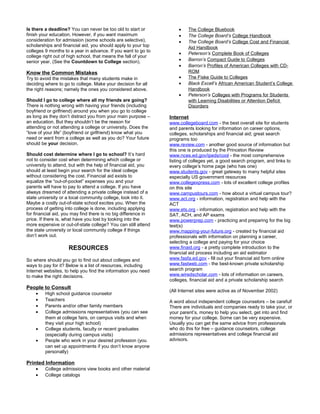
Is there a deadline? You can never be too old to start or
finish your education. However, if you want maximum
consideration for admission (some schools are selective),
scholarships and financial aid, you should apply to your top
colleges 9 months to a year in advance. If you want to go to
college right out of high school, that means the fall of your
senior year. (See the Countdown to College section).
Know the Common Mistakes
Try to avoid the mistakes that many students make in
deciding where to go to college. Make your decision for all
the right reasons; namely the ones you considered above.
Should I go to college where all my friends are going?
There is nothing wrong with having your friends (including
boyfriend or girlfriend) around you when you go to college
as long as they don’t distract you from your main purpose –
an education. But they shouldn’t be the reason for
attending or not attending a college or university. Does the
“love of your life” (boyfriend or girlfriend) know what you
need or want from a college as well as you do? Your future
should be your decision.
Should cost determine where I go to school? It’s hard
not to consider cost when determining which college or
university to attend, but with the help of financial aid, you
should at least begin your search for the ideal college
without considering the cost. Financial aid exists to
equalize the “out-of-pocket” expenses you and your
parents will have to pay to attend a college. If you have
always dreamed of attending a private college instead of a
state university or a local community college, look into it.
Maybe a costly out-of-state school excites you. When the
process of getting into college is done, including applying
for financial aid, you may find there is no big difference in
price. If there is, what have you lost by looking into the
more expensive or out-of-state college? You can still attend
the state university or local community college if things
don’t work out.
RESOURCES
So where should you go to find out about colleges and
ways to pay for it? Below is a list of resources, including
Internet websites, to help you find the information you need
to make the right decisions.
People to Consult
• High school guidance counselor
• Teachers
• Parents and/or other family members
• College admissions representatives (you can see
them at college fairs, on campus visits and when
they visit your high school)
• College students, faculty or recent graduates
(especially during campus visits)
• People who work in your desired profession (you
can set up appointments if you don’t know anyone
personally)
Printed Information
• College admissions view books and other material
• College catalogs
• The College Bluebook
• The College Board’s College Handbook
• The College Board’s College Cost and Financial
Aid Handbook
• Peterson’s Complete Book of Colleges
• Barron’s Compact Guide to Colleges
• Barron’s Profiles of American Colleges with CD-
ROM
• The Fiske Guide to Colleges
• Black Excell’s African American Student’s College
Handbook
• Peterson’s Colleges with Programs for Students
with Learning Disabilities or Attention Deficit
Disorders
Internet
www.collegeboard.com - the best overall site for students
and parents looking for information on career options,
colleges, scholarships and financial aid; great search
programs too
www.review.com - another good source of information but
this one is produced by the Princeton Review
www.nces.ed.gov/ipeds/cool - the most comprehensive
listing of colleges yet, a good search program, and links to
every college’s home page (who has one)
www.students.gov - great gateway to many helpful sites
especially US government resources
www.collegexpress.com - lots of excellent college profiles
on this site
www.campustours.com - how about a virtual campus tour?
www.act.org - information, registration and help with the
ACT
www.ets.org - information, registration and help with the
SAT, ACH, and AP exams
www.powerprep.com - practicing and preparing for the big
test(s)
www.mapping-your-future.org - created by financial aid
professionals with information on planning a career,
selecting a college and paying for your choice
www.finaid.org - a pretty complete introduction to the
financial aid process including an aid estimator
www.fasfa.ed.gov - fill out your financial aid form online
www.fastweb.com - the best-known private scholarship
search program
www.wiredscholar.com - lots of information on careers,
colleges, financial aid and a private scholarship search
(All Internet sites were active as of November 2002)
A word about independent college counselors – be careful!
There are individuals and companies ready to take your, or
your parent’s, money to help you select, get into and find
money for your college. Some can be very expensive.
Usually you can get the same advice from professionals
who do this for free – guidance counselors, college
admissions representatives and college financial aid
advisors.
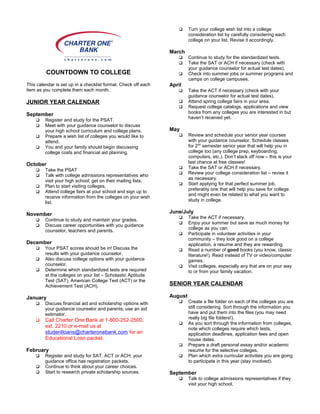
COUNTDOWN TO COLLEGE
This calendar is set up in a checklist format. Check off each
item as you complete them each month.
JUNIOR YEAR CALENDAR
September
 Register and study for the PSAT.
 Meet with your guidance counselor to discuss
your high school curriculum and college plans.
 Prepare a wish list of colleges you would like to
attend.
 You and your family should begin discussing
college costs and financial aid planning.
October
 Take the PSAT
 Talk with college admissions representatives who
visit your high school; get on their mailing lists.
 Plan to start visiting colleges.
 Attend college fairs at your school and sign up to
receive information from the colleges on your wish
list.
November
 Continue to study and maintain your grades.
 Discuss career opportunities with you guidance
counselor, teachers and parents.
December
 Your PSAT scores should be in! Discuss the
results with your guidance counselor.
 Also discuss college options with your guidance
counselor.
 Determine which standardized tests are required
at the colleges on your list – Scholastic Aptitude
Test (SAT), American College Test (ACT) or the
Achievement Test (ACH).
January
 Discuss financial aid and scholarship options with
your guidance counselor and parents; use an aid
estimator.
 Call Charter One Bank at 1-800-252-2500,
ext. 2210 or e-mail us at
studentloans@charteronebank.com for an
Educational Loan packet.
February
 Register and study for SAT, ACT or ACH; your
guidance office has registration packets.
 Continue to think about your career choices.
 Start to research private scholarship sources.
 Turn your college wish list into a college
consideration list by carefully considering each
college on your list. Revise it accordingly.
March
 Continue to study for the standardized tests.
 Take the SAT or ACH if necessary (check with
your guidance counselor for actual test dates).
 Check into summer jobs or summer programs and
camps on college campuses.
April
 Take the ACT if necessary (check with your
guidance counselor for actual test dates).
 Attend spring college fairs in your area.
 Request college catalogs, applications and view
books from any colleges you are interested in but
haven’t received yet.
May
 Review and schedule your senior year courses
with your guidance counselor. Schedule classes
for 2nd
semester senior year that will help you in
college too (any college prep, keyboarding,
computers, etc.). Don’t slack off now – this is your
last chance at free classes!
 Take the SAT or ACH if necessary.
 Review your college consideration list – revise it
as necessary.
 Start applying for that perfect summer job,
preferably one that will help you save for college
and might even be related to what you want to
study in college.
June/July
 Take the ACT if necessary.
 Enjoy your summer but save as much money for
college as you can.
 Participate in volunteer activities in your
community – they look good on a college
application, a resume and they are rewarding.
 Read a number of good books (you know, classic
literature!). Read instead of TV or video/computer
games.
 Visit colleges, especially any that are on your way
to or from your family vacation.
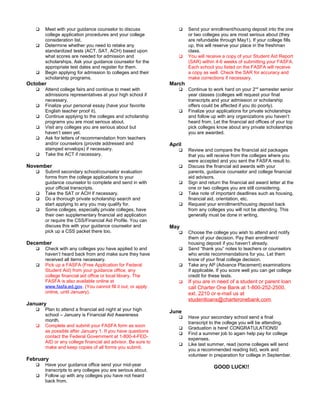
SENIOR YEAR CALENDAR
August
 Create a file folder on each of the colleges you are
still considering. Sort through the information you
have and put them into the files (you may need
really big file folders!).
 As you sort through the information from colleges,
note which colleges require which tests,
application deadlines, application fees and open
house dates.
 Prepare a draft personal essay and/or academic
resume for the selective colleges.
 Plan which extra curricular activities you are going
to participate in this year (stay involved).
September
 Talk to college admissions representatives if they
visit your high school.
 Meet with your guidance counselor to discuss
college application procedures and your college
consideration list.
 Determine whether you need to retake any
standardized tests (ACT, SAT, ACH) based upon
what scores are needed for admission and
scholarships. Ask your guidance counselor for the
appropriate test dates and register for them.
 Begin applying for admission to colleges and their
scholarship programs.
October
 Attend college fairs and continue to meet with
admissions representatives at your high school if
necessary.
 Finalize your personal essay (have your favorite
English teacher proof it).
 Continue applying to the colleges and scholarship
programs you are most serious about.
 Visit any colleges you are serious about but
haven’t seen yet.
 Ask for letters of recommendation from teachers
and/or counselors (provide addressed and
stamped envelops) if necessary.
 Take the ACT if necessary.
November
 Submit secondary school/counselor evaluation
forms from the college applications to your
guidance counselor to complete and send in with
your official transcripts.
 Take the SAT or ACH if necessary.
 Do a thorough private scholarship search and
start applying to any you may qualify for.
 Some colleges, especially private colleges, have
their own supplementary financial aid application
or require the CSS/Financial Aid Profile. You can
discuss this with your guidance counselor and
pick up a CSS packet there too.
December
 Check with any colleges you have applied to and
haven’t heard back from and make sure they have
received all items necessary.
 Pick up a FASFA (Free Application for Federal
Student Aid) from your guidance office, any
college financial aid office or local library. The
FASFA is also available online at
www.fasfa.ed.gov. (You cannot fill it out, or apply
online, until January).
January
 Plan to attend a financial aid night at your high
school – January is Financial Aid Awareness
month.
 Complete and submit your FASFA form as soon
as possible after January 1. If you have questions
contact the Federal Government at 1-800-4-FED-
AID or any college financial aid advisor. Be sure to
make and keep copies of all forms you submit.
February
 Have your guidance office send your mid-year
transcripts to any colleges you are serious about.
 Follow up with any colleges you have not heard
back from.
 Send your enrollment/housing deposit into the one
or two colleges you are most serious about (they
are refundable through May1). If your college fills
up, this will reserve your place in the freshman
class.
 You will receive a copy of your Student Aid Report
(SAR) within 4-6 weeks of submitting your FASFA.
Each school you listed on the FASFA will receive
a copy as well. Check the SAR for accuracy and
make corrections if necessary.
March
 Continue to work hard on your 2nd
semester senior
year classes (colleges will request your final
transcripts and your admission or scholarship
offers could be affected if you do poorly).
 Finalize your applications for private scholarships
and follow up with any organizations you haven’t
heard from. Let the financial aid offices of your top
pick colleges know about any private scholarships
you are awarded.
April
 Review and compare the financial aid packages
that you will receive from the colleges where you
were accepted and you sent the FASFA result to.
 Discuss the financial aid awards with your
parents, guidance counselor and college financial
aid advisors.
 Sign and return the financial aid award letter at the
one or two colleges you are still considering.
 Take note of important deadlines such as housing,
financial aid, orientation, etc.
 Request your enrollment/housing deposit back
from any colleges you will not be attending. This
generally must be done in writing.
May
 Choose the college you wish to attend and notify
them of your decision. Pay their enrollment/
housing deposit if you haven’t already.
 Send “thank you” notes to teachers or counselors
who wrote recommendations for you. Let them
know of your final college decision.
 Take any AP (Advance Placement) examinations
if applicable. If you score well you can get college
credit for these tests.
 If you are in need of a student or parent loan
call Charter One Bank at 1-800-252-2500,
ext. 2210 or e-mail us at
studentloans@charteronebank.com.
June
 Have your secondary school send a final
transcript to the college you will be attending.
 Graduation is here! CONGRATULATIONS!
 Find a summer job to again help pay for college
expenses.
 Like last summer, read (some colleges will send
you a recommended reading list), work and
volunteer in preparation for college in September.
GOOD LUCK!!
GETTING READY FOR COLLEGE 2

GETTING READY FOR COLLEGE 2

  • 1.
    GETTING READY FORCOLLEGE You’ve probably been told that choosing a college will be one of the most important decisions of your life. It’s true! The years you spend in college, including the experiences you have on campus and off, will significantly influence your entire life. So it’s important that you make an informed well-considered decision about college. You are probably even feeling a little overwhelmed with this decision. That’s why we, here at Charter One Bank, have put together this brochure. You will find information on choosing a college; resources for helping you find the right career, college and financial aid; and a calendar for your junior and senior years in high school so you can get everything done in time. Charter One is not only the one for educational loans; we’re also the one for helpful college planning. CHOOSING A COLLEGE Know Yourself As with any big decision, you must first know yourself. How can you think about the future if you have no idea what you want from it? Visualize yourself 10 or 20 years from now – what are you doing? Does it make you happy? It is very important to be honest with yourself. It also never hurts to get advice from your parents, friends, teachers or guidance counselors. What are your goals? You need to decide what you want to accomplish in life. If your goal is to become a brain surgeon, then you may want to find a college or university with a good pre-med program. If you’re not sure what your goals are, this is as good a time as any to try to decide. If you’re still not sure, think about colleges, or other post high school activities that keep your options open. For example, the military will give you some time to decide and they have a college savings program to help you pay for it if and when you do go to school. Where are your strengths? Your current academic strengths may give you a clue as to what to major in and make a career out of. You must also decide what kind of learning environment you tend to do the best in. If you need access to your teachers now to do well in class, it would not be a good idea to attend a large, research-based university where the professors are hard to see. What do you like? You must make important decisions about some of your personal preferences in living your life. If you like to play football, you may want to find a college or university that not only has a team, but also a competitive level that will allow you to participate. Do you want to live closely with others or are you a loner? It will make a difference in housing at college. Know Your Options Once you have spent some time getting to know yourself, you can now think about the best options for achieving whatever you want from life. Is college right for you? Believe it or not, you may find other, even better ways to accomplish your goals in life. The military offer some great career training programs, so do technical or vocational schools. Why go off to college and major in computer science where you’ll learn all about computer programming and system analysis, when what you really enjoy is taking them apart and fixing them? There are technical training schools for much less time and money that will teach you how to do that. Should I go to college now? If you are tired of school, you hate all your teachers, would like to earn a little money first, travel, then perhaps you should put off your college plans for a while. However, remember the longer you put off college, the harder it is to go back (bills pile up, you begin a family, you may loose that scholarship offer, etc.). Know Your Colleges If college is the best way to accomplish your future goals, then start examining the thousands of colleges you have available to you. Is there really any difference between these colleges and universities? You bet! Every college and university is different in location, academic programs, quality, size, commitment to students, reputation, cost and in hundreds of other aspects. Just like you have a totally unique personality, so do all the colleges and universities. One may have a great reputation but it is “stuffy,” another may be fun, but doesn’t offer quality classes, especially in the field you want to study. The more time you spend getting to know the colleges and universities, the more you’ll see the differences and be able to decide which one is right for you. What’s the best way to learn about colleges? You need to start with printed information and websites. If you take the ACT, SAT, PLAN, or PSAT you will probably start to get information automatically. If some of the colleges you want information about don’t send you information, write, call or e-mail them and request it. By the way, if you want any college or university to stop sending you stuff, write, call or e-mail and tell them so. (See the next section on Resources) But the very best way to learn about colleges and universities is to visit your top picks. They all put the best pictures and words into their brochures and websites. But a visit will get you beyond their “fluffy” best and into the real campus. Only a visit will tell you if the dorms are comfortable, or if the classrooms have the latest learning technology. How’s the food in the dining hall?
  • 2.
    Is there adeadline? You can never be too old to start or finish your education. However, if you want maximum consideration for admission (some schools are selective), scholarships and financial aid, you should apply to your top colleges 9 months to a year in advance. If you want to go to college right out of high school, that means the fall of your senior year. (See the Countdown to College section). Know the Common Mistakes Try to avoid the mistakes that many students make in deciding where to go to college. Make your decision for all the right reasons; namely the ones you considered above. Should I go to college where all my friends are going? There is nothing wrong with having your friends (including boyfriend or girlfriend) around you when you go to college as long as they don’t distract you from your main purpose – an education. But they shouldn’t be the reason for attending or not attending a college or university. Does the “love of your life” (boyfriend or girlfriend) know what you need or want from a college as well as you do? Your future should be your decision. Should cost determine where I go to school? It’s hard not to consider cost when determining which college or university to attend, but with the help of financial aid, you should at least begin your search for the ideal college without considering the cost. Financial aid exists to equalize the “out-of-pocket” expenses you and your parents will have to pay to attend a college. If you have always dreamed of attending a private college instead of a state university or a local community college, look into it. Maybe a costly out-of-state school excites you. When the process of getting into college is done, including applying for financial aid, you may find there is no big difference in price. If there is, what have you lost by looking into the more expensive or out-of-state college? You can still attend the state university or local community college if things don’t work out. RESOURCES So where should you go to find out about colleges and ways to pay for it? Below is a list of resources, including Internet websites, to help you find the information you need to make the right decisions. People to Consult • High school guidance counselor • Teachers • Parents and/or other family members • College admissions representatives (you can see them at college fairs, on campus visits and when they visit your high school) • College students, faculty or recent graduates (especially during campus visits) • People who work in your desired profession (you can set up appointments if you don’t know anyone personally) Printed Information • College admissions view books and other material • College catalogs • The College Bluebook • The College Board’s College Handbook • The College Board’s College Cost and Financial Aid Handbook • Peterson’s Complete Book of Colleges • Barron’s Compact Guide to Colleges • Barron’s Profiles of American Colleges with CD- ROM • The Fiske Guide to Colleges • Black Excell’s African American Student’s College Handbook • Peterson’s Colleges with Programs for Students with Learning Disabilities or Attention Deficit Disorders Internet www.collegeboard.com - the best overall site for students and parents looking for information on career options, colleges, scholarships and financial aid; great search programs too www.review.com - another good source of information but this one is produced by the Princeton Review www.nces.ed.gov/ipeds/cool - the most comprehensive listing of colleges yet, a good search program, and links to every college’s home page (who has one) www.students.gov - great gateway to many helpful sites especially US government resources www.collegexpress.com - lots of excellent college profiles on this site www.campustours.com - how about a virtual campus tour? www.act.org - information, registration and help with the ACT www.ets.org - information, registration and help with the SAT, ACH, and AP exams www.powerprep.com - practicing and preparing for the big test(s) www.mapping-your-future.org - created by financial aid professionals with information on planning a career, selecting a college and paying for your choice www.finaid.org - a pretty complete introduction to the financial aid process including an aid estimator www.fasfa.ed.gov - fill out your financial aid form online www.fastweb.com - the best-known private scholarship search program www.wiredscholar.com - lots of information on careers, colleges, financial aid and a private scholarship search (All Internet sites were active as of November 2002) A word about independent college counselors – be careful! There are individuals and companies ready to take your, or your parent’s, money to help you select, get into and find money for your college. Some can be very expensive. Usually you can get the same advice from professionals who do this for free – guidance counselors, college admissions representatives and college financial aid advisors.
  • 3.
    COUNTDOWN TO COLLEGE Thiscalendar is set up in a checklist format. Check off each item as you complete them each month. JUNIOR YEAR CALENDAR September  Register and study for the PSAT.  Meet with your guidance counselor to discuss your high school curriculum and college plans.  Prepare a wish list of colleges you would like to attend.  You and your family should begin discussing college costs and financial aid planning. October  Take the PSAT  Talk with college admissions representatives who visit your high school; get on their mailing lists.  Plan to start visiting colleges.  Attend college fairs at your school and sign up to receive information from the colleges on your wish list. November  Continue to study and maintain your grades.  Discuss career opportunities with you guidance counselor, teachers and parents. December  Your PSAT scores should be in! Discuss the results with your guidance counselor.  Also discuss college options with your guidance counselor.  Determine which standardized tests are required at the colleges on your list – Scholastic Aptitude Test (SAT), American College Test (ACT) or the Achievement Test (ACH). January  Discuss financial aid and scholarship options with your guidance counselor and parents; use an aid estimator.  Call Charter One Bank at 1-800-252-2500, ext. 2210 or e-mail us at studentloans@charteronebank.com for an Educational Loan packet. February  Register and study for SAT, ACT or ACH; your guidance office has registration packets.  Continue to think about your career choices.  Start to research private scholarship sources.  Turn your college wish list into a college consideration list by carefully considering each college on your list. Revise it accordingly. March  Continue to study for the standardized tests.  Take the SAT or ACH if necessary (check with your guidance counselor for actual test dates).  Check into summer jobs or summer programs and camps on college campuses. April  Take the ACT if necessary (check with your guidance counselor for actual test dates).  Attend spring college fairs in your area.  Request college catalogs, applications and view books from any colleges you are interested in but haven’t received yet. May  Review and schedule your senior year courses with your guidance counselor. Schedule classes for 2nd semester senior year that will help you in college too (any college prep, keyboarding, computers, etc.). Don’t slack off now – this is your last chance at free classes!  Take the SAT or ACH if necessary.  Review your college consideration list – revise it as necessary.  Start applying for that perfect summer job, preferably one that will help you save for college and might even be related to what you want to study in college. June/July  Take the ACT if necessary.  Enjoy your summer but save as much money for college as you can.  Participate in volunteer activities in your community – they look good on a college application, a resume and they are rewarding.  Read a number of good books (you know, classic literature!). Read instead of TV or video/computer games.  Visit colleges, especially any that are on your way to or from your family vacation. SENIOR YEAR CALENDAR August  Create a file folder on each of the colleges you are still considering. Sort through the information you have and put them into the files (you may need really big file folders!).  As you sort through the information from colleges, note which colleges require which tests, application deadlines, application fees and open house dates.  Prepare a draft personal essay and/or academic resume for the selective colleges.  Plan which extra curricular activities you are going to participate in this year (stay involved). September  Talk to college admissions representatives if they visit your high school.
  • 4.
     Meet withyour guidance counselor to discuss college application procedures and your college consideration list.  Determine whether you need to retake any standardized tests (ACT, SAT, ACH) based upon what scores are needed for admission and scholarships. Ask your guidance counselor for the appropriate test dates and register for them.  Begin applying for admission to colleges and their scholarship programs. October  Attend college fairs and continue to meet with admissions representatives at your high school if necessary.  Finalize your personal essay (have your favorite English teacher proof it).  Continue applying to the colleges and scholarship programs you are most serious about.  Visit any colleges you are serious about but haven’t seen yet.  Ask for letters of recommendation from teachers and/or counselors (provide addressed and stamped envelops) if necessary.  Take the ACT if necessary. November  Submit secondary school/counselor evaluation forms from the college applications to your guidance counselor to complete and send in with your official transcripts.  Take the SAT or ACH if necessary.  Do a thorough private scholarship search and start applying to any you may qualify for.  Some colleges, especially private colleges, have their own supplementary financial aid application or require the CSS/Financial Aid Profile. You can discuss this with your guidance counselor and pick up a CSS packet there too. December  Check with any colleges you have applied to and haven’t heard back from and make sure they have received all items necessary.  Pick up a FASFA (Free Application for Federal Student Aid) from your guidance office, any college financial aid office or local library. The FASFA is also available online at www.fasfa.ed.gov. (You cannot fill it out, or apply online, until January). January  Plan to attend a financial aid night at your high school – January is Financial Aid Awareness month.  Complete and submit your FASFA form as soon as possible after January 1. If you have questions contact the Federal Government at 1-800-4-FED- AID or any college financial aid advisor. Be sure to make and keep copies of all forms you submit. February  Have your guidance office send your mid-year transcripts to any colleges you are serious about.  Follow up with any colleges you have not heard back from.  Send your enrollment/housing deposit into the one or two colleges you are most serious about (they are refundable through May1). If your college fills up, this will reserve your place in the freshman class.  You will receive a copy of your Student Aid Report (SAR) within 4-6 weeks of submitting your FASFA. Each school you listed on the FASFA will receive a copy as well. Check the SAR for accuracy and make corrections if necessary. March  Continue to work hard on your 2nd semester senior year classes (colleges will request your final transcripts and your admission or scholarship offers could be affected if you do poorly).  Finalize your applications for private scholarships and follow up with any organizations you haven’t heard from. Let the financial aid offices of your top pick colleges know about any private scholarships you are awarded. April  Review and compare the financial aid packages that you will receive from the colleges where you were accepted and you sent the FASFA result to.  Discuss the financial aid awards with your parents, guidance counselor and college financial aid advisors.  Sign and return the financial aid award letter at the one or two colleges you are still considering.  Take note of important deadlines such as housing, financial aid, orientation, etc.  Request your enrollment/housing deposit back from any colleges you will not be attending. This generally must be done in writing. May  Choose the college you wish to attend and notify them of your decision. Pay their enrollment/ housing deposit if you haven’t already.  Send “thank you” notes to teachers or counselors who wrote recommendations for you. Let them know of your final college decision.  Take any AP (Advance Placement) examinations if applicable. If you score well you can get college credit for these tests.  If you are in need of a student or parent loan call Charter One Bank at 1-800-252-2500, ext. 2210 or e-mail us at studentloans@charteronebank.com. June  Have your secondary school send a final transcript to the college you will be attending.  Graduation is here! CONGRATULATIONS!  Find a summer job to again help pay for college expenses.  Like last summer, read (some colleges will send you a recommended reading list), work and volunteer in preparation for college in September. GOOD LUCK!!