TRAFFIC
ACCIDENT
S
WE ALL IN IT…
Statistics
 Traffic accident cases 2846
 Number of people get killed 1164
 Number of people get injured 2948
(2013)
Statistics
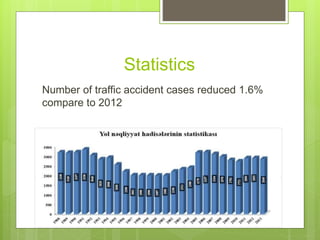
Number of traffic accident cases reduced 1.6%
compare to 2012
Statistics
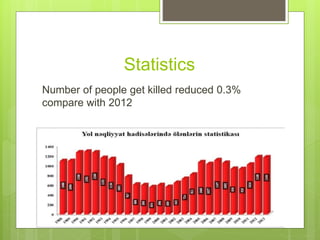
Number of people get killed reduced 0.3%
compare with 2012
Statistics
Number of people get injured reduced 1.6%
compare with 2012
Percentage of Reasons of Traffic
Accidents in Azerbaijan
 92,8% drivers not to obey rules
 29,1% overspeeding
 31,2% while overtaking the other vehicles
 8,4% not obeying to the rules of passing cross
roads
 2,7% drunk driving
Traffic accidents participation of
pedestrians
 38.5% (1097) of traffic accidents is crashing
the pedestrians, as a result
 398 pedestrians get killed
 784 pedestrians get injured
 4.2% (119)traffic accidents happened
because of the fault of pedestrians
Statistics of Road Traffic
Accidents
 As a result of traffic accidents in our country
81 child and teenager get killed, 268 injured.
 914 out of 1164 killed people are men and
250 are women, 2229 out of 2948 injured
people are men and 719 are women.
Most common causes of traffic
accidents
 Speeding
 Drink Driving
 Seat Belt Wearing
 Careless Driving (aggressive driving)
 At-work
 Inexperience
 Failed to Look Properly
 Loss of Control
 Failed to Judge Other Person’s Path/Speed
 Mobile Phones
 Young Drivers
 Cyclers
Distracted Driving
 Driver fatigue
 Looking at scenery
 Other passengers or children
 Adjusting the radio, cassette or CD player
 Reading the newspaper, books, maps or other
documents
Distracted Driving
Distracted driving continues to be the number one leading
cause of car accidents. Talking on the phone, texting,
eating, reading, grooming, and talking are just some of
the ways drivers get distracted behind the wheel. Drivers
who use a hand-held device are 4 times more likely to get
into a car accident than drivers that pay attention to the
road ahead. Individuals who text message while driving
are 23 times more likely to get into an accident. Do not
risk your safety or your life. Put everything down and pay
attention to the road ahead. It’s the single most important
thing you can do today to reduce your risk of getting into a
car accident.
Other forms of Distracted Driving
Some of the most common types of distractions
resulting in high incidences of traffic accidents
include, eating, smoking, listening to loud music
or changing the dial, reaching for objects in the
vehicle, and looking or talking with other
passengers in the vehicle.
Driver Fatigue
 The risk is greatest from 11 p.m. to 8 a.m., the
time when most people are used to sleeping,
however some people also become drowsy from
noon to 2 p.m.
 Symptoms of driver fatigue include heavy eyelids,
frequent yawning, a drifting vehicle that wanders
over road lines, varying vehicle speed for no
reason, misjudging traffic situations, seeing things
"jump out" in the road, feeling fidgety or irritable
and daydreaming.
How to Avoid Driver Fatigue
 Take a break from driving at least every two
hours.
 Get a good night's sleep before a long trip.
 Share the driving whenever possible.
 Avoid long drives after work.
 Avoid drinking before driving.
 Pull over and stop when drowsiness, discomfort or
loss of concentration occurs.
 Find out whether any medicine you are taking
may affect your driving.
Drunk Driving
 The only way to prevent this type of accident
is to not drink and drive. Whenever alcohol is
involved, choose a designated driver in
advance. This person should not drink at all
before driving.
Speeding
 Speeding is a multi-tiered threat because not only
does it reduce the amount of time necessary to
avoid a crash, it also increases the risk of crashing
and makes the crash more severe if it does occur.
In fact, according to the Insurance Institute for
Highway Safety (IIHS), when speed increases
from 40 mph to 60 mph, the energy released in a
crash more than doubles. Simply slowing down
and obeying posted speed limits can go a long
way toward making the roads safer.
Aggressive Driving
 An aggressive driver is who Operates a motor vehicle in a selfish, bold or
pushy manner, without regard for the rights or safety of the other users of
the streets and highways.
This includes behaviors such as:
 Aggressive tailgating
 Flashing lights at other drivers because you're irritated at them
 Aggressive or rude gestures
 Deliberately preventing another driver from moving their vehicle
 Verbal abuse
 Physical assaults
 Disregarding traffic signals
 Changing lanes frequently or in an unsafe manner
 Failure to yield the right of way
Tips to Protect Yourself from an
Aggressive Driver
 Remain calm
 Keep your distance
 Do not pass unless you have to
 Change lanes once it is safe
 If you cannot change lanes and an aggressive
driver is behind you, stay where you are, maintain
the proper speed and do not respond with hostile
gestures
 If the situation is serious, you may call to report an
aggressive driver
Weather
 Inclement weather, including heavy rain, hail,
snowstorms, ice, high winds and fog can make
driving more difficult. You'll need more time to stop
and may have trouble seeing the road clearly, so
when the weather gets bad be sure to leave extra
room between the car in front of you and slow
down. If necessary, pull off the road to a rest stop
(or to the side of the road, well out of the traffic
lanes) until conditions improve.
Rubber-necking
Rubbernecking is another type of distracted
driving and takes place when drivers look other
things on the road not linked to their driving.
Examples include watching other accidents,
looking at sunsets, and nice views.
Defective Automobile and
Automobile Parts
Common auto defects that can cause severe
injuries to occupants include, tire defects,
defective design of Sport Inutility Vehicles
resulted in vehicles being more prone to
rollovers, seatbelt defects and defective
airbags.
Defects on Roadway
Construction
The improper design of roadways result in
hundreds of auto accident fatalities each year.
Liable parties can include CALTRANS and
construction contractors for improper installment
of traffic lights and roadway signals.
Improper Coning off of
Construction Zones
Road work is needed to maintain and built the
countries transportation infrastructure. However
in many cases road construction crews fail to
safely cordon off construction zones resulting in
an increased probability of auto accidents.
Common Injuries
 Brain and Head Injuries
 Neck Injuries
 Spinal Cord Injuries
 Back Injuries
 Facial Injuries
 Internal Injuries
 Psychological Injuries
Brain and Head Injuries
One of the most common and debilitating injuries
suffered by drivers and passengers is an acquired
brain injury caused by the head being hit or hitting
an object violently (called a traumatic brain injury) .
Symptoms can be mild, moderate or severe,
depending on the extent of damage to the brain and
the area effected. Even when there is no visible
sign of trauma (i.e. cuts or bruises), the brain may
have been jostled inside the skull due to the force of
impact causing bruising, bleeding and swelling of
the brain.
Neck Injuries
 Another common form of injury from a car
accident is neck injuries, which can occur in
more mild forms such as whiplash and neck
strain, to more serious injuries like cervical
dislocation and disc injury.
 A neck injury may also be the result of a blow
that crushes the larynx or trachea. A broken
neck suffered in a car accident could result in
instant death.
Spinal Cord Injuries
The damage to the spinal cord is caused when
displaced bone fragments, disc material, or
ligaments bruise or tear into spinal cord tissue,
destroying axons, the part of our nerve cells that
carry signals up and down the spinal cord
between the brain and the rest of the body.
Damage to the spinal cord often results in a loss
of function or feeling.
Back Injuries
The lower back is the most common site of back
injuries, including sprains and strains, herniated
discs and fractured vertebrae. These injuries
can cause pain and limit your mobility
Sometimes the symptoms of even the most
serious back injuries can take some time to
show up after an accident. Unfortunately, back
injury can cause long lasting pain and
discomfort.
Facial Injuries
In a car accident, injuries to the face are
common and can be caused by the steering
wheel, dashboard, airbag, windshield, side
window, car seats or shattered glass. These
injuries range in severity from scrapes and
bruises, to laceration and fractures, even
serious disorders affecting the jaw and serious
dental injuries.
Internal Injuries
The impact of a motor vehicle accident can
cause internal injuries including, injuries to
bowels, kidneys, the spleen, liver, lungs, heart
or aorta. Fractured ribs are also quite common,
causing puncture lungs and other internal
organs. Internal injuries are life threatening and
should be treated by a medical professional
immediately.
Chest Injuries
 The crushing impact of a collision can break ribs and/or
the sternum (breast bone), particularly if a driver or
passenger was not restrained by seat belts This
severity of chest injuries has been greatly reduced by
the standard placement of airbags in dashboards and
steering wheels, but fractures and injuries to organs still
occur.
 A diaphragm rupture (a tear of the muscle across the
bottom of the rib cage that is crucial to respiration) is a
common result of blunt or penetrating trauma to the
trunk or lower chest.
Pelvis /abdominal injuries
Compressive pelvic injuries (hip fracture) and
injury to abdominal organs are common in
motor vehicle accidents. The liver, spleen and
kidneys are frequently injured in front- and side-
impact collisions.
Leg and knee injuries
Most leg and knee injuries in car accidents are
impact or crush injuries caused by smashing
into a part of the car. This can result in wounds
that range from contusions (bruises) to a
fracture or multiple fractures. Knees are also
susceptible to meniscus tear (tearing of
cartilage in the knee) if they are abruptly twisted
or turned.
Psychological Injuries
Motor vehicle accidents involving severe injuries
and even loss of life, can result in drivers and
passengers suffering short or long-term
psychological injuries such as emotional
distress, posttraumatic stress disorder,
persistent anxiety and depression. These
psychological injuries can affect every facet of a
person’s life and have long-lasting effects.
Emotional Harm
The most difficult injury to spot and diagnose after a car
accident can be emotional or psychological damage.
Aside from more catch-all pain and suffering damages,
the most common emotional harm linked to car accidents
is post-traumatic stress disorder (PTSD), which (to sum it
up in a very general sense) involves misplaced situational
anxiety following a traumatic event. As with a concussion,
a person with PTSD may suffer depression, anxiety, or
other disruptions of their normal personality. PTSD may
not arise until as long as several months after an
accident. Get more information on Pain and Suffering and
PTSD in car accident cases.
Soft Tissue Injuries and Whiplash
 The most common delayed injuries are soft tissue injuries. “Whiplash” is an informal
descriptor of soft tissue injuries in the neck, and it’s a useful term mostly because of
the public’s familiarity with it. Whiplash is commonly understood as pain in the neck,
but can affect any neural pathway, including into the extremities and down the spine.
Other possible symptoms of whiplash include:
 difficulty moving or reduced range of motion
 stiffness in arms and shoulders
 headaches
 dizziness
 muscle spasms
 slowed reflexes, and
 numbness or weakness in afflicted areas
 With these symptoms, whiplash can not only make life unpleasant, it can make
everyday tasks around the home and at work considerably more difficult. Treatment
can include physical therapy, and chiropractic manipulation may be beneficial in
some cases. Learn more about Soft Tissue Injuries and Whiplash after a car
accident.
Concussions
In addition to whiplash, concussions are another
common injury that may not be immediately evident,
especially if you do not have an acquaintance with
you who is familiar with you and can judge your
post-accident behaviour. A concussion is a
traumatic brain injury in which the brain strikes the
inside of the skull. This can happen either as a result
of the skull impacting something or by sudden
deceleration -- when the head is in motion and
suddenly stops. With these acceleration-
deceleration concussions, whiplash is also a serious
concern.
Concussions
 Concussions present in a variety of ways. A key defining characteristic of
concussions are that they cause some sort of (temporary) loss of brain function. This
can manifest in a variety of forms, including:
 headaches
 loss of balance
 blurred or double vision
 tinnitus (ringing in the ears)
 convulsion
 vomiting
 disorientation
 confusion
 amnesia
 difficulty reasoning or concentrating
 depression or anxiety
 irritability
 lethargy, insomnia, or other altered sleep cycles
Concussions
 About 5 to 7 percent of people who are hospitalized with a
concussion will have a post-traumatic seizure at some
point in their lives, even as much as 15 years after an
accident. Children and the elderly are most susceptible to
post-traumatic seizures. The most severe concussions,
which include bleeding into the brain, can also lead to
post-traumatic epilepsy, a permanent condition. Even in
more routine cases, a concussion can alter the brain’s
activity for a time period anywhere between a few hours to
weeks.
 Treatment for concussions generally treats the symptoms
rather than the injury itself, except in very rare cases
where surgery is necessary. Learn more about Brain
Injuries After a Car Accident.
How to Avoid Traffic Accidents
 Modifying your driving
 Avoiding Distractions
 Keeping your car safe
Modifying Your Driving
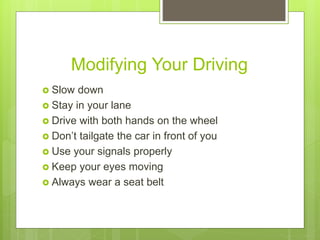
 Slow down
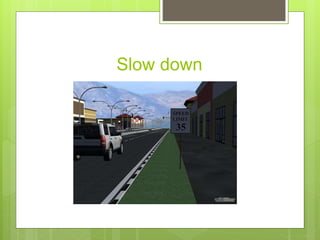
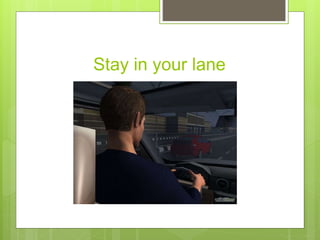
 Stay in your lane
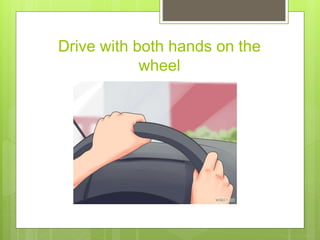
 Drive with both hands on the wheel
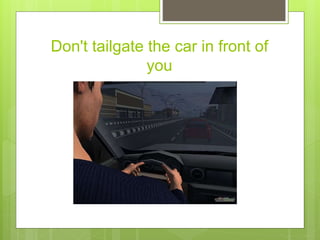
 Don’t tailgate the car in front of you
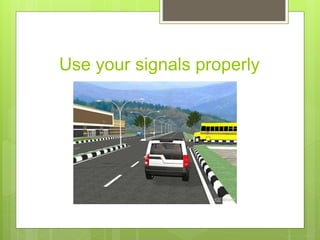
 Use your signals properly
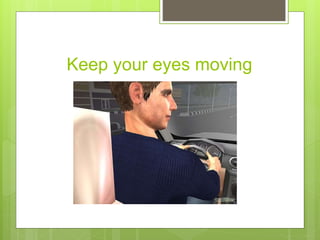
 Keep your eyes moving
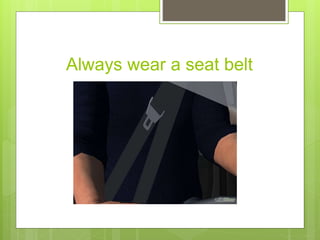
 Always wear a seat belt
Slow down
Stay in your lane
Drive with both hands on the
wheel
Don't tailgate the car in front of
you
Use your signals properly
Keep your eyes moving
Always wear a seat belt
Avoiding Distractions
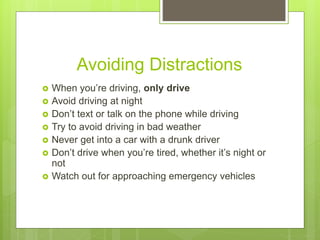
 When you’re driving, only drive
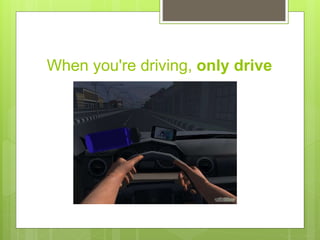
 Avoid driving at night
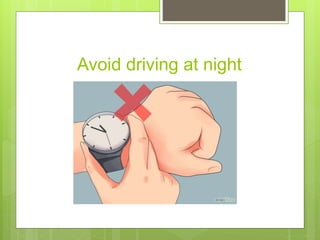
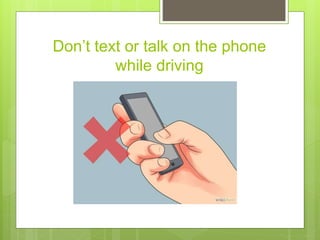
 Don’t text or talk on the phone while driving
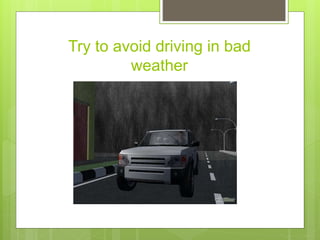
 Try to avoid driving in bad weather
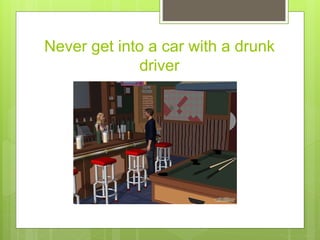
 Never get into a car with a drunk driver
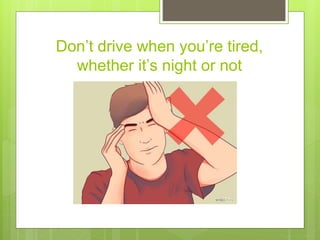
 Don’t drive when you’re tired, whether it’s night or
not
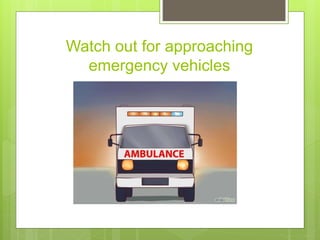
 Watch out for approaching emergency vehicles
When you're driving, only drive
Avoid driving at night
Don’t text or talk on the phone
while driving
Try to avoid driving in bad
weather
Never get into a car with a drunk
driver
Don’t drive when you’re tired,
whether it’s night or not
Watch out for approaching
emergency vehicles
Keep Your Car Safe
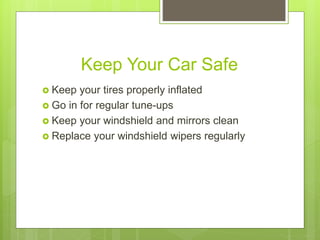
 Keep your tires properly inflated
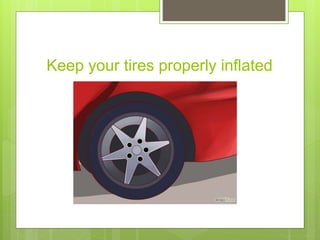
 Go in for regular tune-ups
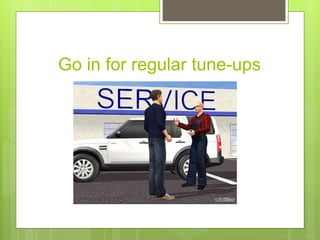
 Keep your windshield and mirrors clean
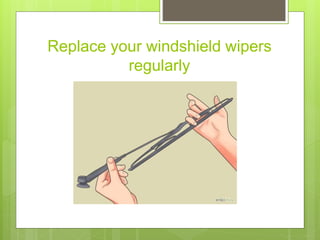
 Replace your windshield wipers regularly
Keep your tires properly inflated
Go in for regular tune-ups
Keep your windshield and mirrors
clean
Replace your windshield wipers
regularly
Wish you live safe
Respect everyone's trip…

Road Safety Awareness

  • 1.
  • 2.
    Statistics  Traffic accidentcases 2846  Number of people get killed 1164  Number of people get injured 2948 (2013)
  • 3.
    Statistics Number of trafficaccident cases reduced 1.6% compare to 2012
  • 4.
    Statistics Number of peopleget killed reduced 0.3% compare with 2012
  • 5.
    Statistics Number of peopleget injured reduced 1.6% compare with 2012
  • 6.
    Percentage of Reasonsof Traffic Accidents in Azerbaijan  92,8% drivers not to obey rules  29,1% overspeeding  31,2% while overtaking the other vehicles  8,4% not obeying to the rules of passing cross roads  2,7% drunk driving
  • 7.
    Traffic accidents participationof pedestrians  38.5% (1097) of traffic accidents is crashing the pedestrians, as a result  398 pedestrians get killed  784 pedestrians get injured  4.2% (119)traffic accidents happened because of the fault of pedestrians
  • 8.
    Statistics of RoadTraffic Accidents  As a result of traffic accidents in our country 81 child and teenager get killed, 268 injured.  914 out of 1164 killed people are men and 250 are women, 2229 out of 2948 injured people are men and 719 are women.
  • 9.
    Most common causesof traffic accidents  Speeding  Drink Driving  Seat Belt Wearing  Careless Driving (aggressive driving)  At-work  Inexperience  Failed to Look Properly  Loss of Control  Failed to Judge Other Person’s Path/Speed  Mobile Phones  Young Drivers  Cyclers
  • 10.
    Distracted Driving  Driverfatigue  Looking at scenery  Other passengers or children  Adjusting the radio, cassette or CD player  Reading the newspaper, books, maps or other documents
  • 11.
    Distracted Driving Distracted drivingcontinues to be the number one leading cause of car accidents. Talking on the phone, texting, eating, reading, grooming, and talking are just some of the ways drivers get distracted behind the wheel. Drivers who use a hand-held device are 4 times more likely to get into a car accident than drivers that pay attention to the road ahead. Individuals who text message while driving are 23 times more likely to get into an accident. Do not risk your safety or your life. Put everything down and pay attention to the road ahead. It’s the single most important thing you can do today to reduce your risk of getting into a car accident.
  • 12.
    Other forms ofDistracted Driving Some of the most common types of distractions resulting in high incidences of traffic accidents include, eating, smoking, listening to loud music or changing the dial, reaching for objects in the vehicle, and looking or talking with other passengers in the vehicle.
  • 13.
    Driver Fatigue  Therisk is greatest from 11 p.m. to 8 a.m., the time when most people are used to sleeping, however some people also become drowsy from noon to 2 p.m.  Symptoms of driver fatigue include heavy eyelids, frequent yawning, a drifting vehicle that wanders over road lines, varying vehicle speed for no reason, misjudging traffic situations, seeing things "jump out" in the road, feeling fidgety or irritable and daydreaming.
  • 14.
    How to AvoidDriver Fatigue  Take a break from driving at least every two hours.  Get a good night's sleep before a long trip.  Share the driving whenever possible.  Avoid long drives after work.  Avoid drinking before driving.  Pull over and stop when drowsiness, discomfort or loss of concentration occurs.  Find out whether any medicine you are taking may affect your driving.
  • 15.
    Drunk Driving  Theonly way to prevent this type of accident is to not drink and drive. Whenever alcohol is involved, choose a designated driver in advance. This person should not drink at all before driving.
  • 16.
    Speeding  Speeding isa multi-tiered threat because not only does it reduce the amount of time necessary to avoid a crash, it also increases the risk of crashing and makes the crash more severe if it does occur. In fact, according to the Insurance Institute for Highway Safety (IIHS), when speed increases from 40 mph to 60 mph, the energy released in a crash more than doubles. Simply slowing down and obeying posted speed limits can go a long way toward making the roads safer.
  • 17.
    Aggressive Driving  Anaggressive driver is who Operates a motor vehicle in a selfish, bold or pushy manner, without regard for the rights or safety of the other users of the streets and highways. This includes behaviors such as:  Aggressive tailgating  Flashing lights at other drivers because you're irritated at them  Aggressive or rude gestures  Deliberately preventing another driver from moving their vehicle  Verbal abuse  Physical assaults  Disregarding traffic signals  Changing lanes frequently or in an unsafe manner  Failure to yield the right of way
  • 18.
    Tips to ProtectYourself from an Aggressive Driver  Remain calm  Keep your distance  Do not pass unless you have to  Change lanes once it is safe  If you cannot change lanes and an aggressive driver is behind you, stay where you are, maintain the proper speed and do not respond with hostile gestures  If the situation is serious, you may call to report an aggressive driver
  • 19.
    Weather  Inclement weather,including heavy rain, hail, snowstorms, ice, high winds and fog can make driving more difficult. You'll need more time to stop and may have trouble seeing the road clearly, so when the weather gets bad be sure to leave extra room between the car in front of you and slow down. If necessary, pull off the road to a rest stop (or to the side of the road, well out of the traffic lanes) until conditions improve.
  • 20.
    Rubber-necking Rubbernecking is anothertype of distracted driving and takes place when drivers look other things on the road not linked to their driving. Examples include watching other accidents, looking at sunsets, and nice views.
  • 21.
    Defective Automobile and AutomobileParts Common auto defects that can cause severe injuries to occupants include, tire defects, defective design of Sport Inutility Vehicles resulted in vehicles being more prone to rollovers, seatbelt defects and defective airbags.
  • 22.
    Defects on Roadway Construction Theimproper design of roadways result in hundreds of auto accident fatalities each year. Liable parties can include CALTRANS and construction contractors for improper installment of traffic lights and roadway signals.
  • 23.
    Improper Coning offof Construction Zones Road work is needed to maintain and built the countries transportation infrastructure. However in many cases road construction crews fail to safely cordon off construction zones resulting in an increased probability of auto accidents.
  • 24.
    Common Injuries  Brainand Head Injuries  Neck Injuries  Spinal Cord Injuries  Back Injuries  Facial Injuries  Internal Injuries  Psychological Injuries
  • 25.
    Brain and HeadInjuries One of the most common and debilitating injuries suffered by drivers and passengers is an acquired brain injury caused by the head being hit or hitting an object violently (called a traumatic brain injury) . Symptoms can be mild, moderate or severe, depending on the extent of damage to the brain and the area effected. Even when there is no visible sign of trauma (i.e. cuts or bruises), the brain may have been jostled inside the skull due to the force of impact causing bruising, bleeding and swelling of the brain.
  • 26.
    Neck Injuries  Anothercommon form of injury from a car accident is neck injuries, which can occur in more mild forms such as whiplash and neck strain, to more serious injuries like cervical dislocation and disc injury.  A neck injury may also be the result of a blow that crushes the larynx or trachea. A broken neck suffered in a car accident could result in instant death.
  • 27.
    Spinal Cord Injuries Thedamage to the spinal cord is caused when displaced bone fragments, disc material, or ligaments bruise or tear into spinal cord tissue, destroying axons, the part of our nerve cells that carry signals up and down the spinal cord between the brain and the rest of the body. Damage to the spinal cord often results in a loss of function or feeling.
  • 28.
    Back Injuries The lowerback is the most common site of back injuries, including sprains and strains, herniated discs and fractured vertebrae. These injuries can cause pain and limit your mobility Sometimes the symptoms of even the most serious back injuries can take some time to show up after an accident. Unfortunately, back injury can cause long lasting pain and discomfort.
  • 29.
    Facial Injuries In acar accident, injuries to the face are common and can be caused by the steering wheel, dashboard, airbag, windshield, side window, car seats or shattered glass. These injuries range in severity from scrapes and bruises, to laceration and fractures, even serious disorders affecting the jaw and serious dental injuries.
  • 30.
    Internal Injuries The impactof a motor vehicle accident can cause internal injuries including, injuries to bowels, kidneys, the spleen, liver, lungs, heart or aorta. Fractured ribs are also quite common, causing puncture lungs and other internal organs. Internal injuries are life threatening and should be treated by a medical professional immediately.
  • 31.
    Chest Injuries  Thecrushing impact of a collision can break ribs and/or the sternum (breast bone), particularly if a driver or passenger was not restrained by seat belts This severity of chest injuries has been greatly reduced by the standard placement of airbags in dashboards and steering wheels, but fractures and injuries to organs still occur.  A diaphragm rupture (a tear of the muscle across the bottom of the rib cage that is crucial to respiration) is a common result of blunt or penetrating trauma to the trunk or lower chest.
  • 32.
    Pelvis /abdominal injuries Compressivepelvic injuries (hip fracture) and injury to abdominal organs are common in motor vehicle accidents. The liver, spleen and kidneys are frequently injured in front- and side- impact collisions.
  • 33.
    Leg and kneeinjuries Most leg and knee injuries in car accidents are impact or crush injuries caused by smashing into a part of the car. This can result in wounds that range from contusions (bruises) to a fracture or multiple fractures. Knees are also susceptible to meniscus tear (tearing of cartilage in the knee) if they are abruptly twisted or turned.
  • 34.
    Psychological Injuries Motor vehicleaccidents involving severe injuries and even loss of life, can result in drivers and passengers suffering short or long-term psychological injuries such as emotional distress, posttraumatic stress disorder, persistent anxiety and depression. These psychological injuries can affect every facet of a person’s life and have long-lasting effects.
  • 35.
    Emotional Harm The mostdifficult injury to spot and diagnose after a car accident can be emotional or psychological damage. Aside from more catch-all pain and suffering damages, the most common emotional harm linked to car accidents is post-traumatic stress disorder (PTSD), which (to sum it up in a very general sense) involves misplaced situational anxiety following a traumatic event. As with a concussion, a person with PTSD may suffer depression, anxiety, or other disruptions of their normal personality. PTSD may not arise until as long as several months after an accident. Get more information on Pain and Suffering and PTSD in car accident cases.
  • 36.
    Soft Tissue Injuriesand Whiplash  The most common delayed injuries are soft tissue injuries. “Whiplash” is an informal descriptor of soft tissue injuries in the neck, and it’s a useful term mostly because of the public’s familiarity with it. Whiplash is commonly understood as pain in the neck, but can affect any neural pathway, including into the extremities and down the spine. Other possible symptoms of whiplash include:  difficulty moving or reduced range of motion  stiffness in arms and shoulders  headaches  dizziness  muscle spasms  slowed reflexes, and  numbness or weakness in afflicted areas  With these symptoms, whiplash can not only make life unpleasant, it can make everyday tasks around the home and at work considerably more difficult. Treatment can include physical therapy, and chiropractic manipulation may be beneficial in some cases. Learn more about Soft Tissue Injuries and Whiplash after a car accident.
  • 37.
    Concussions In addition towhiplash, concussions are another common injury that may not be immediately evident, especially if you do not have an acquaintance with you who is familiar with you and can judge your post-accident behaviour. A concussion is a traumatic brain injury in which the brain strikes the inside of the skull. This can happen either as a result of the skull impacting something or by sudden deceleration -- when the head is in motion and suddenly stops. With these acceleration- deceleration concussions, whiplash is also a serious concern.
  • 38.
    Concussions  Concussions presentin a variety of ways. A key defining characteristic of concussions are that they cause some sort of (temporary) loss of brain function. This can manifest in a variety of forms, including:  headaches  loss of balance  blurred or double vision  tinnitus (ringing in the ears)  convulsion  vomiting  disorientation  confusion  amnesia  difficulty reasoning or concentrating  depression or anxiety  irritability  lethargy, insomnia, or other altered sleep cycles
  • 39.
    Concussions  About 5to 7 percent of people who are hospitalized with a concussion will have a post-traumatic seizure at some point in their lives, even as much as 15 years after an accident. Children and the elderly are most susceptible to post-traumatic seizures. The most severe concussions, which include bleeding into the brain, can also lead to post-traumatic epilepsy, a permanent condition. Even in more routine cases, a concussion can alter the brain’s activity for a time period anywhere between a few hours to weeks.  Treatment for concussions generally treats the symptoms rather than the injury itself, except in very rare cases where surgery is necessary. Learn more about Brain Injuries After a Car Accident.
  • 40.
    How to AvoidTraffic Accidents  Modifying your driving  Avoiding Distractions  Keeping your car safe
  • 41.
    Modifying Your Driving Slow down  Stay in your lane  Drive with both hands on the wheel  Don’t tailgate the car in front of you  Use your signals properly  Keep your eyes moving  Always wear a seat belt
  • 42.
  • 43.
  • 44.
    Drive with bothhands on the wheel
  • 45.
    Don't tailgate thecar in front of you
  • 46.
  • 47.
  • 48.
    Always wear aseat belt
  • 49.
    Avoiding Distractions  Whenyou’re driving, only drive  Avoid driving at night  Don’t text or talk on the phone while driving  Try to avoid driving in bad weather  Never get into a car with a drunk driver  Don’t drive when you’re tired, whether it’s night or not  Watch out for approaching emergency vehicles
  • 50.
  • 51.
  • 52.
    Don’t text ortalk on the phone while driving
  • 53.
    Try to avoiddriving in bad weather
  • 54.
    Never get intoa car with a drunk driver
  • 55.
    Don’t drive whenyou’re tired, whether it’s night or not
  • 56.
    Watch out forapproaching emergency vehicles
  • 57.
    Keep Your CarSafe  Keep your tires properly inflated  Go in for regular tune-ups  Keep your windshield and mirrors clean  Replace your windshield wipers regularly
  • 58.
    Keep your tiresproperly inflated
  • 59.
    Go in forregular tune-ups
  • 60.
    Keep your windshieldand mirrors clean
  • 61.
    Replace your windshieldwipers regularly
  • 62.
    Wish you livesafe Respect everyone's trip…