Defensive Driving
The Sad Facts
Traffic crashes are the leading cause of all work place
fatalities.
• Leading cause of death for those aged 5 to 24
• Two out of every five people will be involved in an
alcohol related crash in their lifetime
• In 4 hours roughly 20 people will be killed in motor
vehicle crashes
The Statistics
• Every 11 minutes in the USA a person dies as a
result of injuries sustained in a crash
• In four hours 1,040 will be injured
• In one year more than?
• 44,000
• 24,000
• 124,000
• Have you ever said this or heard this comment
before?
• Are you the other driver?
• Are you part of the solution?
• If you are a defensive driver you are part of the
solution.
It’s the Other Driver I’m Worried About…
Part of the Problem
• In the last 20, years the number of registered drivers
has doubled
• The number of registered vehicles tripled...yet our
roads have not
• 60 to 90% of us feel we are better drivers than every
one else…yet accident numbers are remaining the
same…
Still Part of the Problem
• Drivers surveyed admitted to the following:
• 30% ran yellow / red lights
• 26% slowed but did not come to a complete stop at
stop signs
• 23% drove 10 mph over interstate speed limit
• 22% drove 10 mph faster than flow of traffic
• 8% drove when affected by alcohol
Defensive Driving, the Solution
• Driving to SAVE LIVES, TIME and MONEY, in spite
of the conditions around you and the actions of
others.
• We just heard from the other driver their actions and
in some cases their condition.
• NOW lets learn how to deal with them and other
issues.
Defensive Driving Course is About:
• Developing safe driving habits / attitudes
• Improving the way you see the road
• Improving the way you respond to hazards
• Taking control over your actions behind the wheel
• Learning to recognize hazards, avoid crashes,
violations, and road rage
The Goal!!!
• Develop driving skills that may one day save your life
and the lives of others
• Remember those statistics
• The more you drive the more potential
What are…
• The most hazardous issue you see daily?
• The hazard you deal with most often?
• The conditions you deal with?
• The driver conditions you deal with?
• How do you handle these hazardous?
• Do you talk to management about them, other
drivers?
• At the end we will talk about some of these.
Defensive Driving Involves…
• Making effective, safety and legal choices
• Creating safe, stress free driving conditions
• Getting to place without ticket or crash
• Practicing courtesy, common sense, cooperation
• Understanding the hazards of conditions and
behaviors around you
DDC Collision Prevention Formula
• Recognize the hazard /
scan
• Past, present, and future
• Use the what If
strategy….
– What if that car does
not stop, what will I
do?
• Understand the defense
• Know what to do to avoid
a hazard
• Know the consequences
of your choices
• Know the defense
• Scanning
DDC Collision Prevention Formula
• SLOWING DOWN
• Safe Following Distance
• Act correctly, in time…
• Be alert, pay attention to
driving
• Concentrate on hazards
Driver Actions you Witness
• Eating, drinking meal
• Reading
• Speeding
• Tailgating
• On cell phone
• Stopping
• Passing on right
• Passing
• Fail to yield
• Driving aggressively
• Sleeping
• Signal kept on
• Did not use signal
• Poor vehicle condition
• Too fast for conditions
• Too fast for vehicle
Road
• Snow, ice, fog, rain, sand,
leaves…
• Traffic
• Construction
• School zone
• Motorcycles
• Too much light
• Not enough
• Glare
Driver
• Angry
• Upset
• Rushed
• Stressed out
• Under influence of
drugs, alcohol
• Under influence of
peers
Road and Driver Conditions
• Control your emotions
• Leave late be late
• Get calm, wait
• Time is the only way to sober up
• Driver is responsible
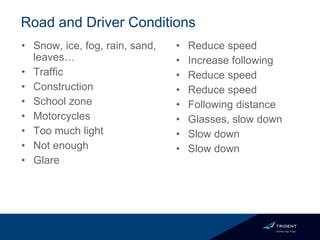
Road and Driver Conditions
• Snow, ice, fog, rain, sand,
leaves…
• Traffic
• Construction
• School zone
• Motorcycles
• Too much light
• Not enough
• Glare
• Reduce speed
• Increase following
• Reduce speed
• Reduce speed
• Following distance
• Glasses, slow down
• Slow down
• Slow down
Dealing with other Driver Actions
• Followed to closely - Let them go
• Speeding - Let them go
• Passing - Ask yourself why
• Failure to yield - Watch for them
• Rolling Stops - Bad habit, eye scan
Jeff Gibson
Accident vs. Collision
• You run a yellow turning to red light and hit a car is it
an accident?
• You fail to reduce your speed when it is raining and
skid off road, is it an accident
• You fail to pay attention and rear end the vehicle in
front of you is it an accident?
• 90% are driver error
• Less then 10% acts of God, mechanical failure
No, No, and No
These are preventable collisions where the driver did
not take reasonable actions to reduce the potential for a
crash.
• Is it reasonable to slow down approaching an
intersection?
• Is it reasonable to slow down in rain, snow or other
weather hazards?
• Is it reasonable to focus attention to vehicles around
your vehicle?
An Accident is an Unplanned Event
• We know we should not run lights, follow too close,
and that we should slow down in poor weather.
• Why don’t we… Its not me I am worried about, it’s
the other guy….
• We think it won’t happen to us
• Other reasons!
• Drive to save lives, time and money
At Intersections
• White lines
• Signal
• Cover the brake
• Point wheels straight
• Right on red
• Right of way
• 40% of all traffic crashes occur at intersections
How NOT to Get Hit at an Intersection
• Look Left
• Look Right
• Look ahead
• Look Left Again
• If the first car don’t jump
the light
• 30% of drivers reported
they ran a red light
• Window down, look and
listen
• Be able to see tires of
vehicle in front on ground
At an Intersection…
• Next to a bus or large truck
• Light turns green, do you go immediately?
• Can you see the intersection completely?
• Don’t pull up stop, and then roll closer to the car in
front of you.
• Get boxed in, hit from behind, hit vehicle
in front
Intersections - Fail to Stop
Play the what if game….
• What if the vehicle does not stop…what will I do?
• Reduce your speed by covering the brake
• Cover the horn with you hand
• Last -- don’t count on them stopping
Rail Road Crossings
• They are intersections too
• Expect a train any time
• Never drive around gate
• Never stop on tracks
• Never race the train
• Don’t rely on warning
signs
• If you are stuck or
stalled – GET OUT
• Run toward the train not
from it
• Never get into middle of
intersection if you can
not get all the way
through regardless of
light
Unsafe Behaviors
• Passing – why do we pass?
• What will I gain from this pass?
• 3 types of crashes- head on, side swipe, run off the
road…
• # of vehicles on the road today
• Next intersection, stop light, sign, or construction site…
who do we see?
Passing
• Is it safe to speed to
pass?
• Is it legal to speed to
complete a pass?
• Remember DDC
• Safe and Legal
• Save time, money, and
lives
• What do you think?
The Sinister Six
• 6 unsafe driving habits we just discussed
• Speeding
• Right of way errors or violators
• Improper turning
• Driving left of center
• Improper passing
• Following too closely
Speed Kills
• Every 10 mph over 50 the
risk of death is doubled
• When there is a car
accident that makes the
newspaper what are some
of the comments in the
paper concerning the
cause?
• What are the common
causes listed in the
paper?
• Why do you think
drivers speed?
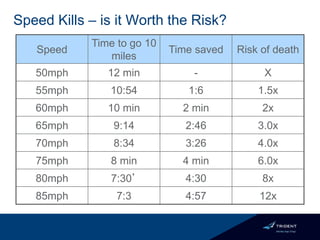
Speed Kills – is it Worth the Risk?
Speed
Time to go 10
miles
Time saved Risk of death
50mph 12 min - X
55mph 10:54 1:6 1.5x
60mph 10 min 2 min 2x
65mph 9:14 2:46 3.0x
70mph 8:34 3:26 4.0x
75mph 8 min 4 min 6.0x
80mph 7:30’ 4:30 8x
85mph 7:3 4:57 12x
Is it Safer to Speed with the “Flow of
Traffic,” or do the Speed Limit?
• Risk of Death
• Save, Time, Lives and Money
• Tickets
• # of vehicles on the road
• Using a 2 second following distance 150 cars would
have to pass you to lose five minutes of time
Drinking and Driving
• Check you local paper, all ages of drivers affected or
caught
• Don’t do it
• Don’t follow charts weight/time/# of drinks
• Chose a designated driver
• Medications can have same effect
• Time is the only thing that sobers one up, NOT
COFFEE
Collision Prevention Formula
• Recognize the hazard: by scanning
• In front, behind, on sides
• Check mirrors every 3 to 5 seconds
• Use the “What If” game…..
• What if that car does not stop, get back into their
lane, complete their pass,
• What will I do?
Collision Prevention Formula
What if that car does not stop, get back into their lane,
complete their pass...
• What will I do?
• Read the road (recognize hazard)
• Reduce your speed
• Ride to the Right
• Ride off onto should or more if have to
Understand the Defense
• See hazard….
• Ask what can I do to avoid this
• Reduce speed as soon as possible
• Increase following distance
• WHAT IS THE RECOMMENDED FOLLOWING
DISTANCE?
• 2,3,4, or 5 seconds
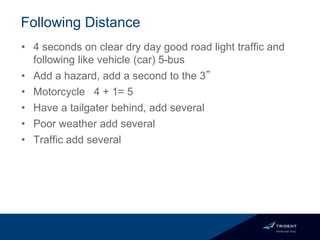
Following Distance
• 4 seconds on clear dry day good road light traffic and
following like vehicle (car) 5-bus
• Add a hazard, add a second to the 3”
• Motorcycle 4 + 1= 5
• Have a tailgater behind, add several
• Poor weather add several
• Traffic add several
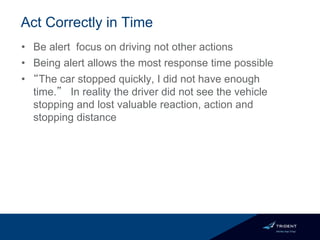
Act Correctly in Time
• Be alert focus on driving not other actions
• Being alert allows the most response time possible
• “The car stopped quickly, I did not have enough
time.” In reality the driver did not see the vehicle
stopping and lost valuable reaction, action and
stopping distance
Passing, Avoiding Head on Crash
• The Four R’s….
• Read the road ahead
• Drive to the Right
• Reduce your speed immediately
• Ride off the road or to the far right of your lane.
• NEVER GO INTO THEIR LANE
• Gorham Maine – bus accident
Emergency Vehicles
• Scan mirrors every 3 to 5 seconds to see them.
• Be able to hear them
• Pull over and stop
• If can’t acknowledge and when can pull over and stop
• What is the following distance 500’, 250’ 3 seconds?
Aggressive Drivers
• It takes two….
• Don’t participate
• Stay calm
• Different time, different route
• Leave late, will be late (number of vehicles)
• Be courteous
What are Some Aggressive Driving
Behaviors you Have Seen?
• Speeding
• Tailgating
• Fail to yield
• Blocking traffic
• Lane changes
• Gestures
• Verbal
• Throwing things
• Slamming on brakes
• Others!
“Road Rage”
• Decisions –
Consequences
• Get emotions in control
• Leave late will be late
• Call and let them know
you will be late – defuse
anxiety
• Your life depends on it
• Give other drives benefit
of doubt-wave
• You make mistakes too
• Different route or time
Bad Driving Behaviors
• Blocking left most lane on highway
• Tailgating – 3 seconds or more
• Signal use, lack of it, forget to shut off
• Horn use – for emergency
• Blocking traffic at an intersection
• Merging, allow other vehicles to merge
Save Lives, Time and Money in Spite of the
Actions and Conditions
• Take reasonable actions…..
• What if game
• Increase following distances
• Reduce speed
• Cover the break
• Drive at posted limit or below
• Make driving number one activity
Save a Life, Time or Money
• Be at your best, rested, awake, sober
• Check your vehicle before leaving on trip
• Check the weather
• Check traffic reports
• Check for construction projects
Area Road Hazards
• Name them
• Discuss what to do
• Determine best course of action
• Develop a solution
• Act on it
Driver Experience
• Turn a rounds
• Cul De Sacs (circles and telephone poles)
• Overhanging branches
• Obstruction in my lane, or other lane
• Cargo Security!
From my (you) Perspective
• An unsafe habit I have that I want to change is….
• The defense technique I am going to use…
• One thing I learned today is…
• Any questions you still have…
Thank you for Attending
• Drive Defensively
• There are others that want you around, need you,
depend on you.

Trident_Defensive_Driver_Training.ppt

  • 1.
  • 2.
    The Sad Facts Trafficcrashes are the leading cause of all work place fatalities. • Leading cause of death for those aged 5 to 24 • Two out of every five people will be involved in an alcohol related crash in their lifetime • In 4 hours roughly 20 people will be killed in motor vehicle crashes
  • 3.
    The Statistics • Every11 minutes in the USA a person dies as a result of injuries sustained in a crash • In four hours 1,040 will be injured • In one year more than? • 44,000 • 24,000 • 124,000
  • 4.
    • Have youever said this or heard this comment before? • Are you the other driver? • Are you part of the solution? • If you are a defensive driver you are part of the solution. It’s the Other Driver I’m Worried About…
  • 5.
    Part of theProblem • In the last 20, years the number of registered drivers has doubled • The number of registered vehicles tripled...yet our roads have not • 60 to 90% of us feel we are better drivers than every one else…yet accident numbers are remaining the same…
  • 6.
    Still Part ofthe Problem • Drivers surveyed admitted to the following: • 30% ran yellow / red lights • 26% slowed but did not come to a complete stop at stop signs • 23% drove 10 mph over interstate speed limit • 22% drove 10 mph faster than flow of traffic • 8% drove when affected by alcohol
  • 7.
    Defensive Driving, theSolution • Driving to SAVE LIVES, TIME and MONEY, in spite of the conditions around you and the actions of others. • We just heard from the other driver their actions and in some cases their condition. • NOW lets learn how to deal with them and other issues.
  • 8.
    Defensive Driving Courseis About: • Developing safe driving habits / attitudes • Improving the way you see the road • Improving the way you respond to hazards • Taking control over your actions behind the wheel • Learning to recognize hazards, avoid crashes, violations, and road rage
  • 9.
    The Goal!!! • Developdriving skills that may one day save your life and the lives of others • Remember those statistics • The more you drive the more potential
  • 10.
    What are… • Themost hazardous issue you see daily? • The hazard you deal with most often? • The conditions you deal with? • The driver conditions you deal with? • How do you handle these hazardous? • Do you talk to management about them, other drivers? • At the end we will talk about some of these.
  • 11.
    Defensive Driving Involves… •Making effective, safety and legal choices • Creating safe, stress free driving conditions • Getting to place without ticket or crash • Practicing courtesy, common sense, cooperation • Understanding the hazards of conditions and behaviors around you
  • 12.
    DDC Collision PreventionFormula • Recognize the hazard / scan • Past, present, and future • Use the what If strategy…. – What if that car does not stop, what will I do? • Understand the defense • Know what to do to avoid a hazard • Know the consequences of your choices • Know the defense • Scanning
  • 13.
    DDC Collision PreventionFormula • SLOWING DOWN • Safe Following Distance • Act correctly, in time… • Be alert, pay attention to driving • Concentrate on hazards
  • 14.
    Driver Actions youWitness • Eating, drinking meal • Reading • Speeding • Tailgating • On cell phone • Stopping • Passing on right • Passing • Fail to yield • Driving aggressively • Sleeping • Signal kept on • Did not use signal • Poor vehicle condition • Too fast for conditions • Too fast for vehicle
  • 15.
    Road • Snow, ice,fog, rain, sand, leaves… • Traffic • Construction • School zone • Motorcycles • Too much light • Not enough • Glare Driver • Angry • Upset • Rushed • Stressed out • Under influence of drugs, alcohol • Under influence of peers Road and Driver Conditions
  • 16.
    Road and DriverConditions • Control your emotions • Control your emotions • Leave late be late • Get calm, wait • Time is the only way to sober up • Driver is responsible
  • 17.
    Road and DriverConditions • Snow, ice, fog, rain, sand, leaves… • Traffic • Construction • School zone • Motorcycles • Too much light • Not enough • Glare • Reduce speed • Increase following • Reduce speed • Reduce speed • Following distance • Glasses, slow down • Slow down • Slow down
  • 18.
    Dealing with otherDriver Actions • Followed to closely - Let them go • Speeding - Let them go • Passing - Ask yourself why • Failure to yield - Watch for them • Rolling Stops - Bad habit, eye scan Jeff Gibson
  • 19.
    Accident vs. Collision •You run a yellow turning to red light and hit a car is it an accident? • You fail to reduce your speed when it is raining and skid off road, is it an accident • You fail to pay attention and rear end the vehicle in front of you is it an accident? • 90% are driver error • Less then 10% acts of God, mechanical failure
  • 20.
    No, No, andNo These are preventable collisions where the driver did not take reasonable actions to reduce the potential for a crash. • Is it reasonable to slow down approaching an intersection? • Is it reasonable to slow down in rain, snow or other weather hazards? • Is it reasonable to focus attention to vehicles around your vehicle?
  • 21.
    An Accident isan Unplanned Event • We know we should not run lights, follow too close, and that we should slow down in poor weather. • Why don’t we… Its not me I am worried about, it’s the other guy…. • We think it won’t happen to us • Other reasons! • Drive to save lives, time and money
  • 22.
    At Intersections • Whitelines • Signal • Cover the brake • Point wheels straight • Right on red • Right of way • 40% of all traffic crashes occur at intersections
  • 23.
    How NOT toGet Hit at an Intersection • Look Left • Look Right • Look ahead • Look Left Again • If the first car don’t jump the light • 30% of drivers reported they ran a red light • Window down, look and listen • Be able to see tires of vehicle in front on ground
  • 24.
    At an Intersection… •Next to a bus or large truck • Light turns green, do you go immediately? • Can you see the intersection completely? • Don’t pull up stop, and then roll closer to the car in front of you. • Get boxed in, hit from behind, hit vehicle in front
  • 25.
    Intersections - Failto Stop Play the what if game…. • What if the vehicle does not stop…what will I do? • Reduce your speed by covering the brake • Cover the horn with you hand • Last -- don’t count on them stopping
  • 26.
    Rail Road Crossings •They are intersections too • Expect a train any time • Never drive around gate • Never stop on tracks • Never race the train • Don’t rely on warning signs • If you are stuck or stalled – GET OUT • Run toward the train not from it • Never get into middle of intersection if you can not get all the way through regardless of light
  • 27.
    Unsafe Behaviors • Passing– why do we pass? • What will I gain from this pass? • 3 types of crashes- head on, side swipe, run off the road… • # of vehicles on the road today • Next intersection, stop light, sign, or construction site… who do we see?
  • 28.
    Passing • Is itsafe to speed to pass? • Is it legal to speed to complete a pass? • Remember DDC • Safe and Legal • Save time, money, and lives • What do you think?
  • 29.
    The Sinister Six •6 unsafe driving habits we just discussed • Speeding • Right of way errors or violators • Improper turning • Driving left of center • Improper passing • Following too closely
  • 30.
    Speed Kills • Every10 mph over 50 the risk of death is doubled • When there is a car accident that makes the newspaper what are some of the comments in the paper concerning the cause? • What are the common causes listed in the paper? • Why do you think drivers speed?
  • 31.
    Speed Kills –is it Worth the Risk? Speed Time to go 10 miles Time saved Risk of death 50mph 12 min - X 55mph 10:54 1:6 1.5x 60mph 10 min 2 min 2x 65mph 9:14 2:46 3.0x 70mph 8:34 3:26 4.0x 75mph 8 min 4 min 6.0x 80mph 7:30’ 4:30 8x 85mph 7:3 4:57 12x
  • 32.
    Is it Saferto Speed with the “Flow of Traffic,” or do the Speed Limit? • Risk of Death • Save, Time, Lives and Money • Tickets • # of vehicles on the road • Using a 2 second following distance 150 cars would have to pass you to lose five minutes of time
  • 33.
    Drinking and Driving •Check you local paper, all ages of drivers affected or caught • Don’t do it • Don’t follow charts weight/time/# of drinks • Chose a designated driver • Medications can have same effect • Time is the only thing that sobers one up, NOT COFFEE
  • 34.
    Collision Prevention Formula •Recognize the hazard: by scanning • In front, behind, on sides • Check mirrors every 3 to 5 seconds • Use the “What If” game….. • What if that car does not stop, get back into their lane, complete their pass, • What will I do?
  • 35.
    Collision Prevention Formula Whatif that car does not stop, get back into their lane, complete their pass... • What will I do? • Read the road (recognize hazard) • Reduce your speed • Ride to the Right • Ride off onto should or more if have to
  • 36.
    Understand the Defense •See hazard…. • Ask what can I do to avoid this • Reduce speed as soon as possible • Increase following distance • WHAT IS THE RECOMMENDED FOLLOWING DISTANCE? • 2,3,4, or 5 seconds
  • 37.
    Following Distance • 4seconds on clear dry day good road light traffic and following like vehicle (car) 5-bus • Add a hazard, add a second to the 3” • Motorcycle 4 + 1= 5 • Have a tailgater behind, add several • Poor weather add several • Traffic add several
  • 38.
    Act Correctly inTime • Be alert focus on driving not other actions • Being alert allows the most response time possible • “The car stopped quickly, I did not have enough time.” In reality the driver did not see the vehicle stopping and lost valuable reaction, action and stopping distance
  • 39.
    Passing, Avoiding Headon Crash • The Four R’s…. • Read the road ahead • Drive to the Right • Reduce your speed immediately • Ride off the road or to the far right of your lane. • NEVER GO INTO THEIR LANE • Gorham Maine – bus accident
  • 40.
    Emergency Vehicles • Scanmirrors every 3 to 5 seconds to see them. • Be able to hear them • Pull over and stop • If can’t acknowledge and when can pull over and stop • What is the following distance 500’, 250’ 3 seconds?
  • 41.
    Aggressive Drivers • Ittakes two…. • Don’t participate • Stay calm • Different time, different route • Leave late, will be late (number of vehicles) • Be courteous
  • 42.
    What are SomeAggressive Driving Behaviors you Have Seen? • Speeding • Tailgating • Fail to yield • Blocking traffic • Lane changes • Gestures • Verbal • Throwing things • Slamming on brakes • Others!
  • 43.
    “Road Rage” • Decisions– Consequences • Get emotions in control • Leave late will be late • Call and let them know you will be late – defuse anxiety • Your life depends on it • Give other drives benefit of doubt-wave • You make mistakes too • Different route or time
  • 44.
    Bad Driving Behaviors •Blocking left most lane on highway • Tailgating – 3 seconds or more • Signal use, lack of it, forget to shut off • Horn use – for emergency • Blocking traffic at an intersection • Merging, allow other vehicles to merge
  • 45.
    Save Lives, Timeand Money in Spite of the Actions and Conditions • Take reasonable actions….. • What if game • Increase following distances • Reduce speed • Cover the break • Drive at posted limit or below • Make driving number one activity
  • 46.
    Save a Life,Time or Money • Be at your best, rested, awake, sober • Check your vehicle before leaving on trip • Check the weather • Check traffic reports • Check for construction projects
  • 47.
    Area Road Hazards •Name them • Discuss what to do • Determine best course of action • Develop a solution • Act on it
  • 48.
    Driver Experience • Turna rounds • Cul De Sacs (circles and telephone poles) • Overhanging branches • Obstruction in my lane, or other lane • Cargo Security!
  • 49.
    From my (you)Perspective • An unsafe habit I have that I want to change is…. • The defense technique I am going to use… • One thing I learned today is… • Any questions you still have…
  • 50.
    Thank you forAttending • Drive Defensively • There are others that want you around, need you, depend on you.