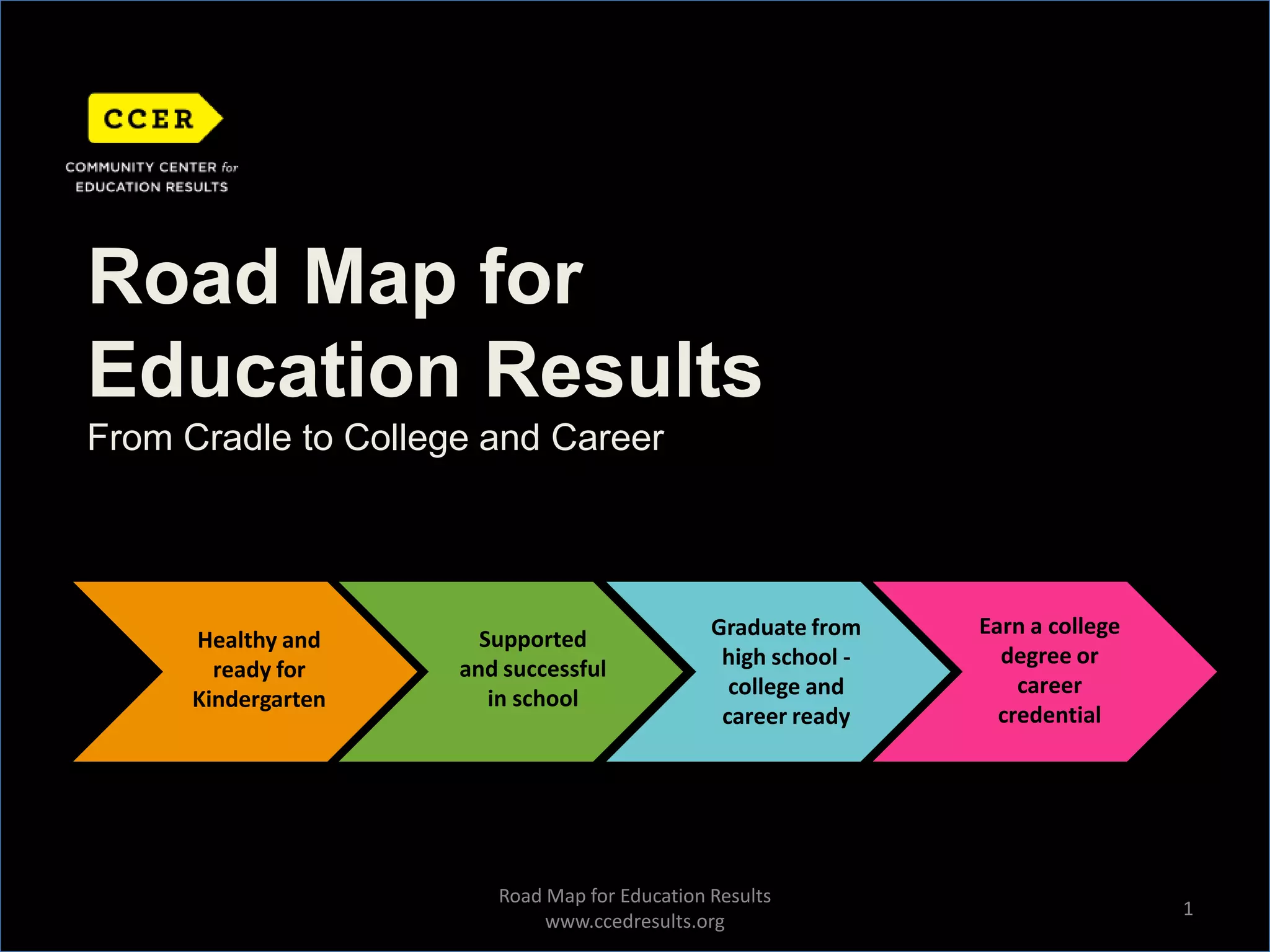
Road Map for Education ResultsFrom Cradle to College and Career 1Earn a college degree or  career credentialGraduate from high school - college and career readySupported  and successful in schoolHealthy and ready for KindergartenRoad Map for Education Resultswww.ccedresults.org
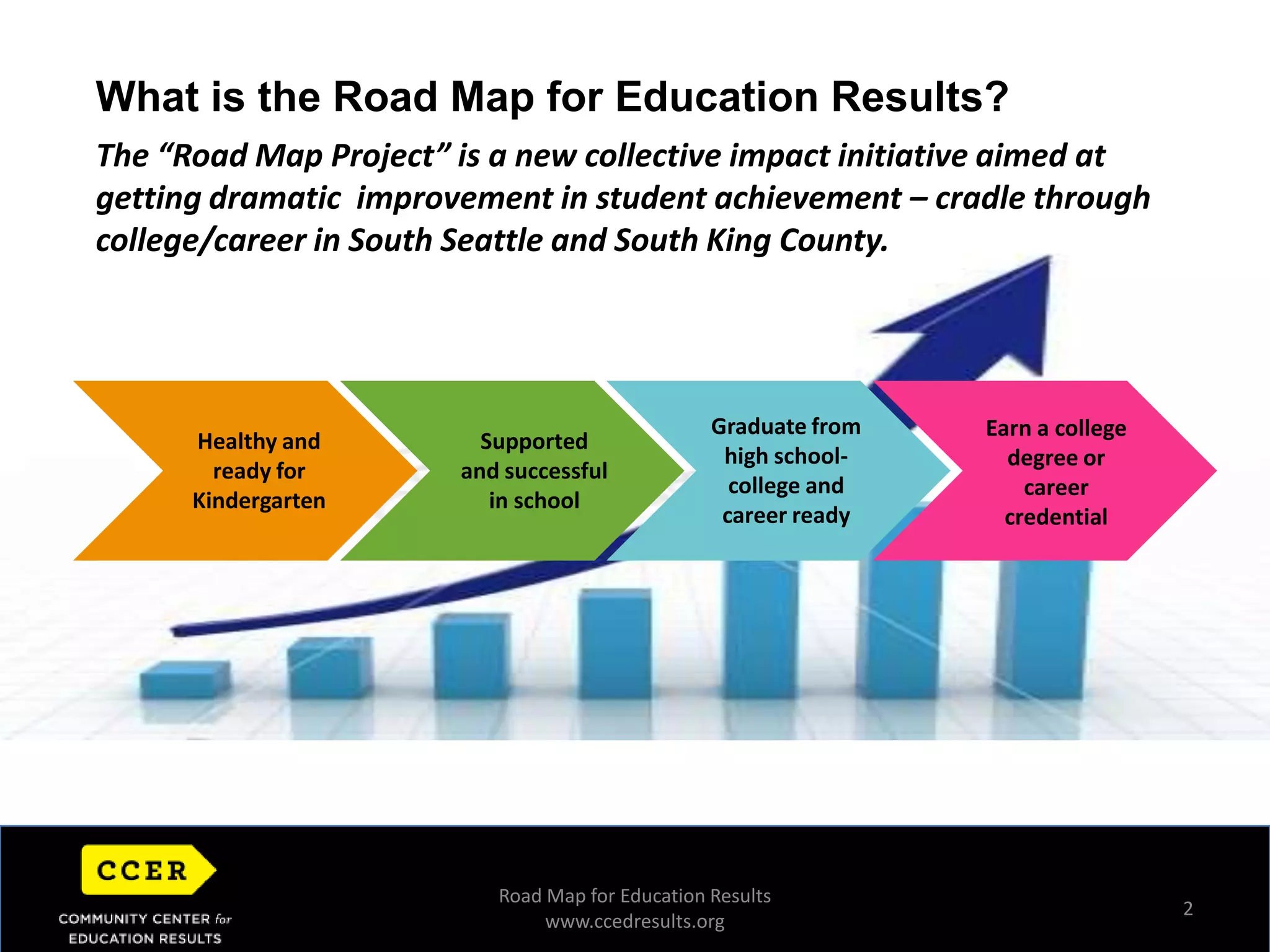
2What is the Road Map for Education Results?The “Road Map Project” is a new collective impact initiative aimed at getting dramatic  improvement in student achievement – cradle through college/career in South Seattle and South King County. Horizontal Image AreaGraduate from high school- college and career readyEarn a college degree or  career credentialHealthy and ready for KindergartenSupported  and successful in schoolRoad Map for Education Resultswww.ccedresults.org
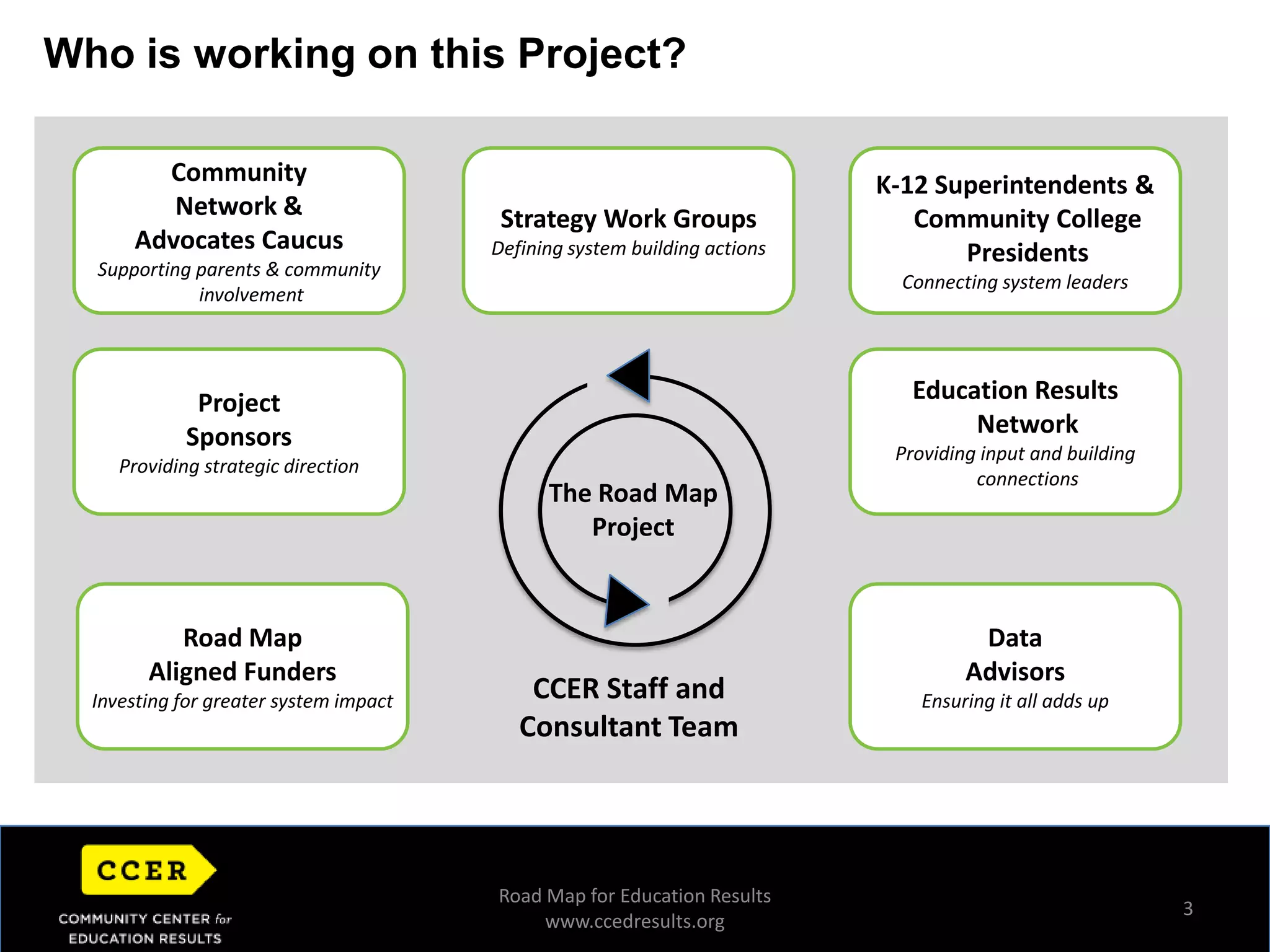
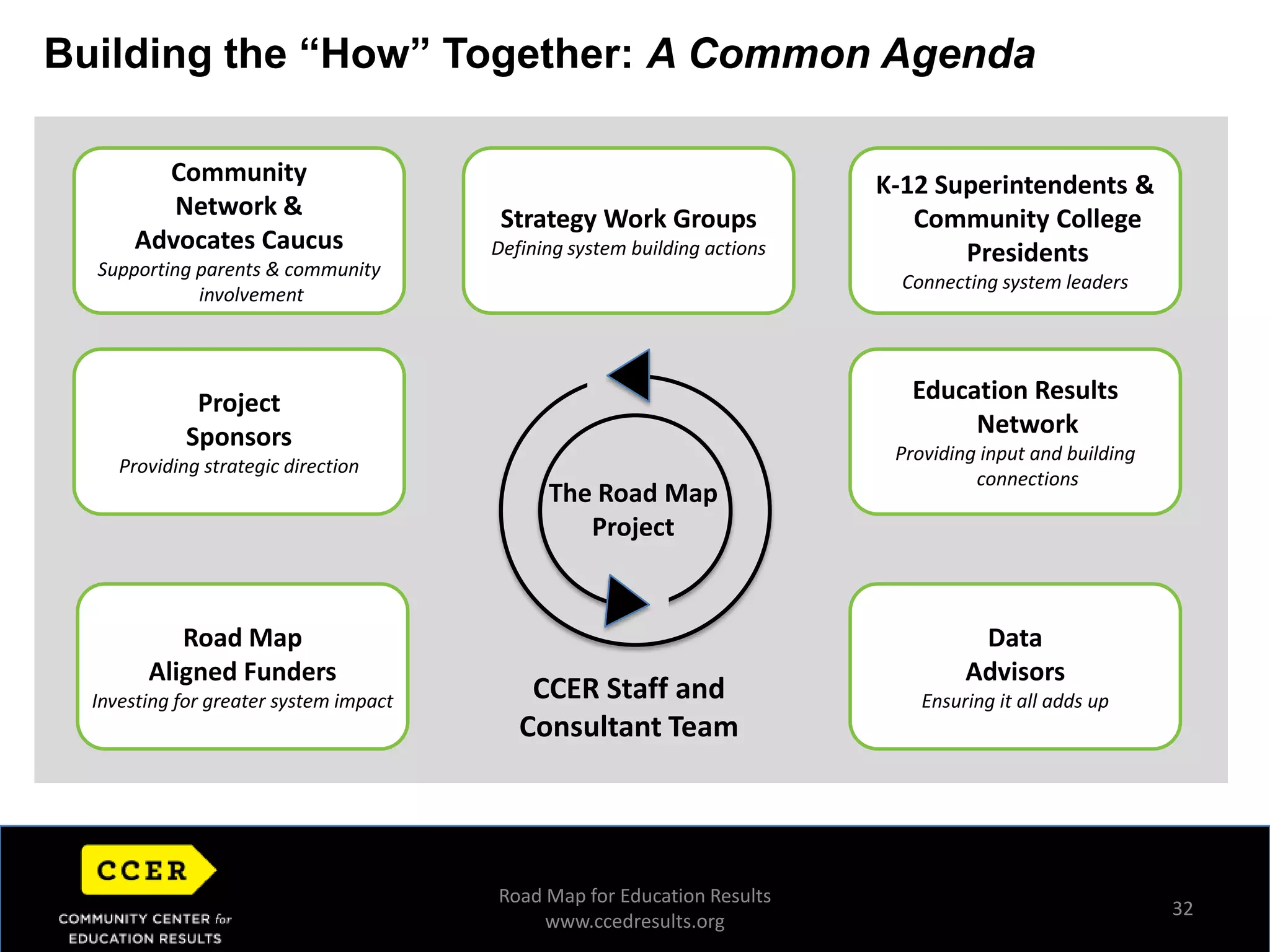
3Who is working on this Project?Strategy Work GroupsDefining system building actionsCommunity Network & Advocates CaucusSupporting parents & community involvementK-12 Superintendents & Community College PresidentsConnecting system leadersEducation Results NetworkProviding input and building connectionsProject SponsorsProviding strategic directionThe Road Map ProjectData AdvisorsEnsuring it all adds up Road Map Aligned FundersInvesting for greater system impactCCER Staff and Consultant TeamRoad Map for Education Resultswww.ccedresults.org
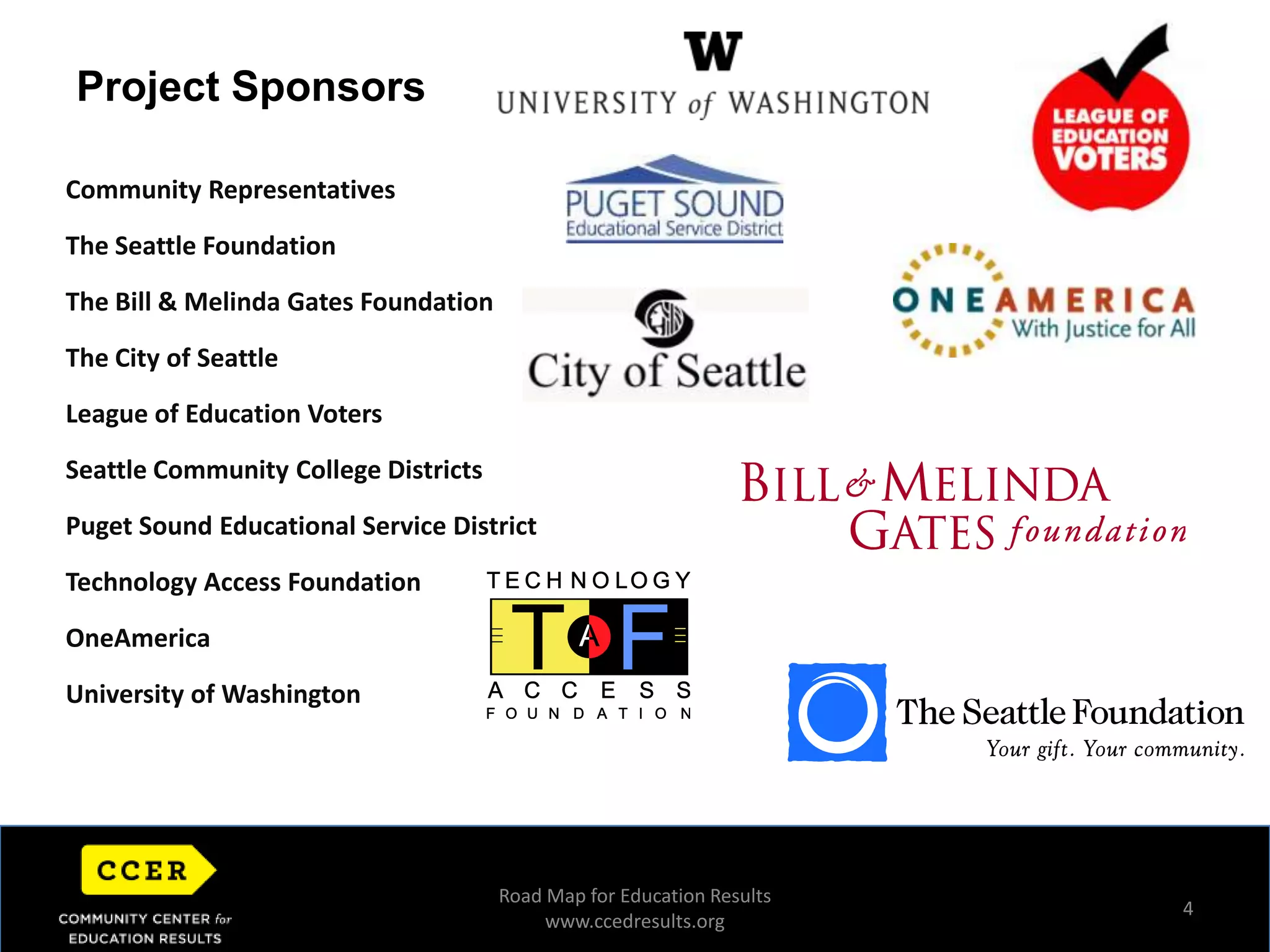
4Project SponsorsCommunity RepresentativesThe Seattle FoundationThe Bill & Melinda Gates FoundationThe City of SeattleLeague of Education VotersSeattle Community College Districts Puget Sound Educational Service District Technology Access Foundation OneAmericaUniversity of Washington Road Map for Education Resultswww.ccedresults.org
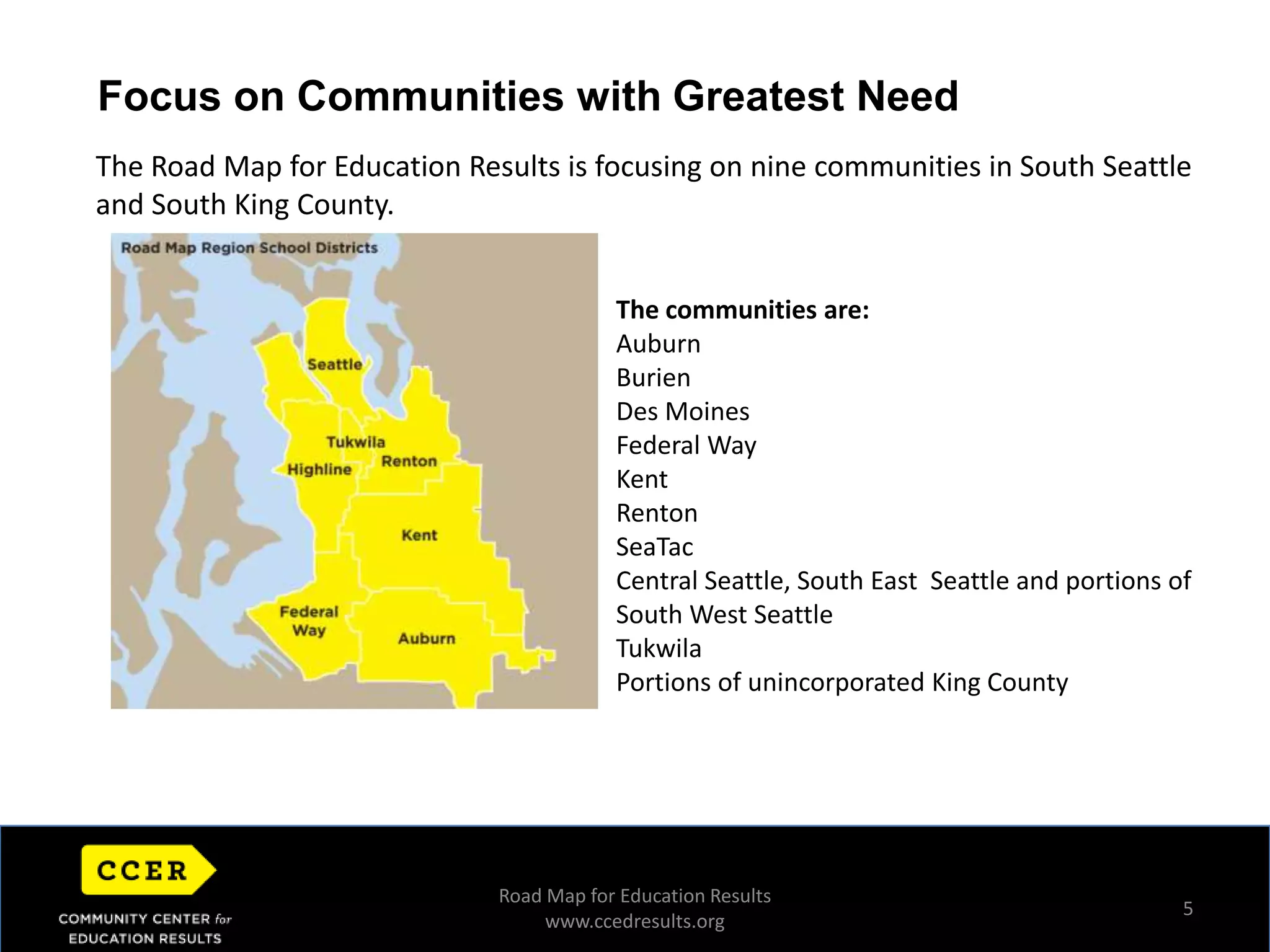
5Focus on Communities with Greatest NeedThe Road Map for Education Results is focusing on nine communities in South Seattle and South King County. The communities are:AuburnBurienDes MoinesFederal WayKentRentonSeaTacCentral Seattle, South East  Seattle and portions of South West SeattleTukwilaPortions of unincorporated King CountyHorizontal Image AreaRoad Map for Education Resultswww.ccedresults.org
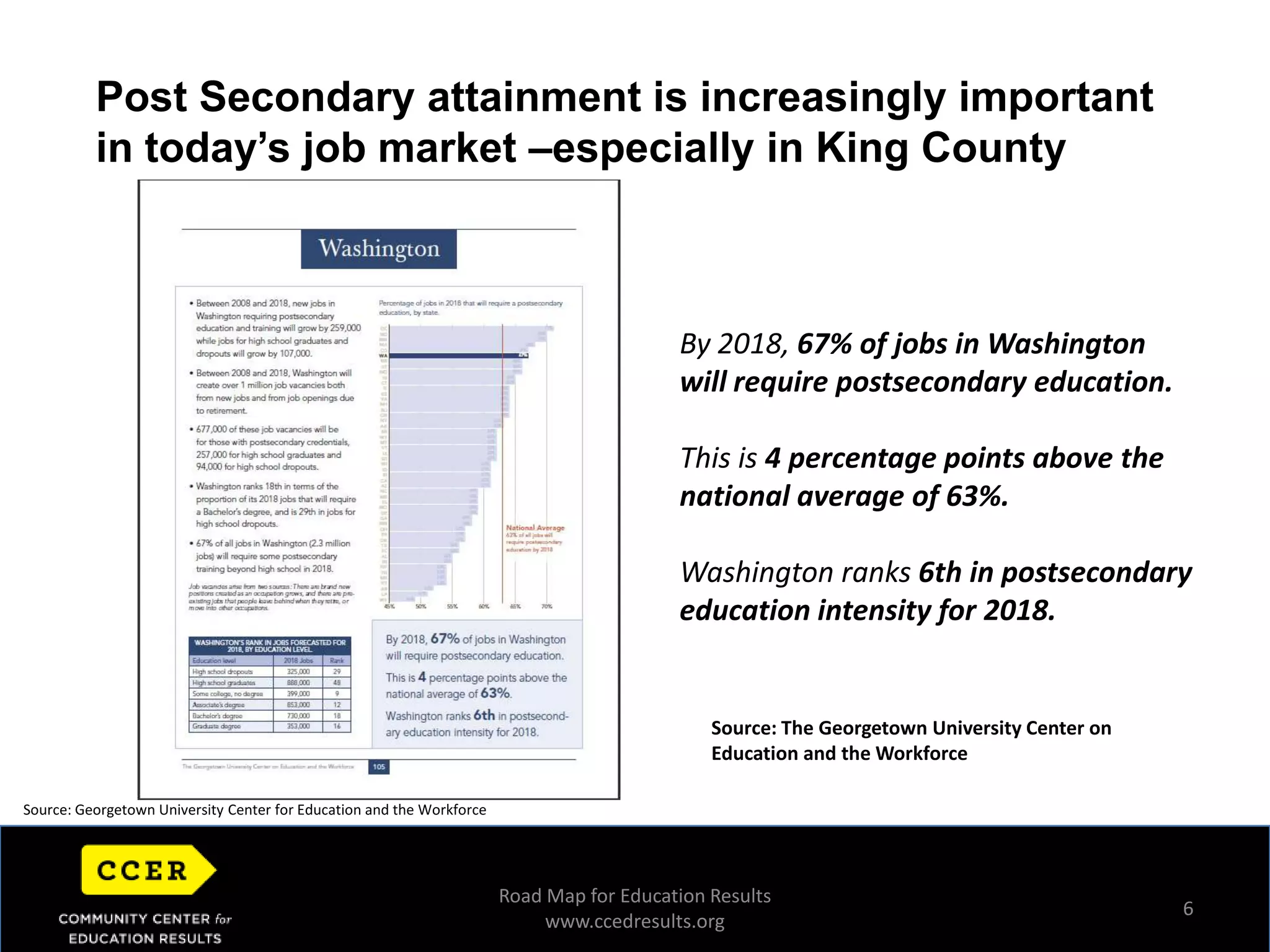
Post Secondary attainment is increasingly important in today’s job market –especially in King CountyHorizontal Image AreaBy 2018, 67% of jobs in Washington will require postsecondary education.This is 4 percentage points above the national average of 63%.Washington ranks 6th in postsecondary education intensity for 2018.Source: The Georgetown University Center on Education and the Workforce Source: Georgetown University Center for Education and the WorkforceRoad Map for Education Resultswww.ccedresults.org6
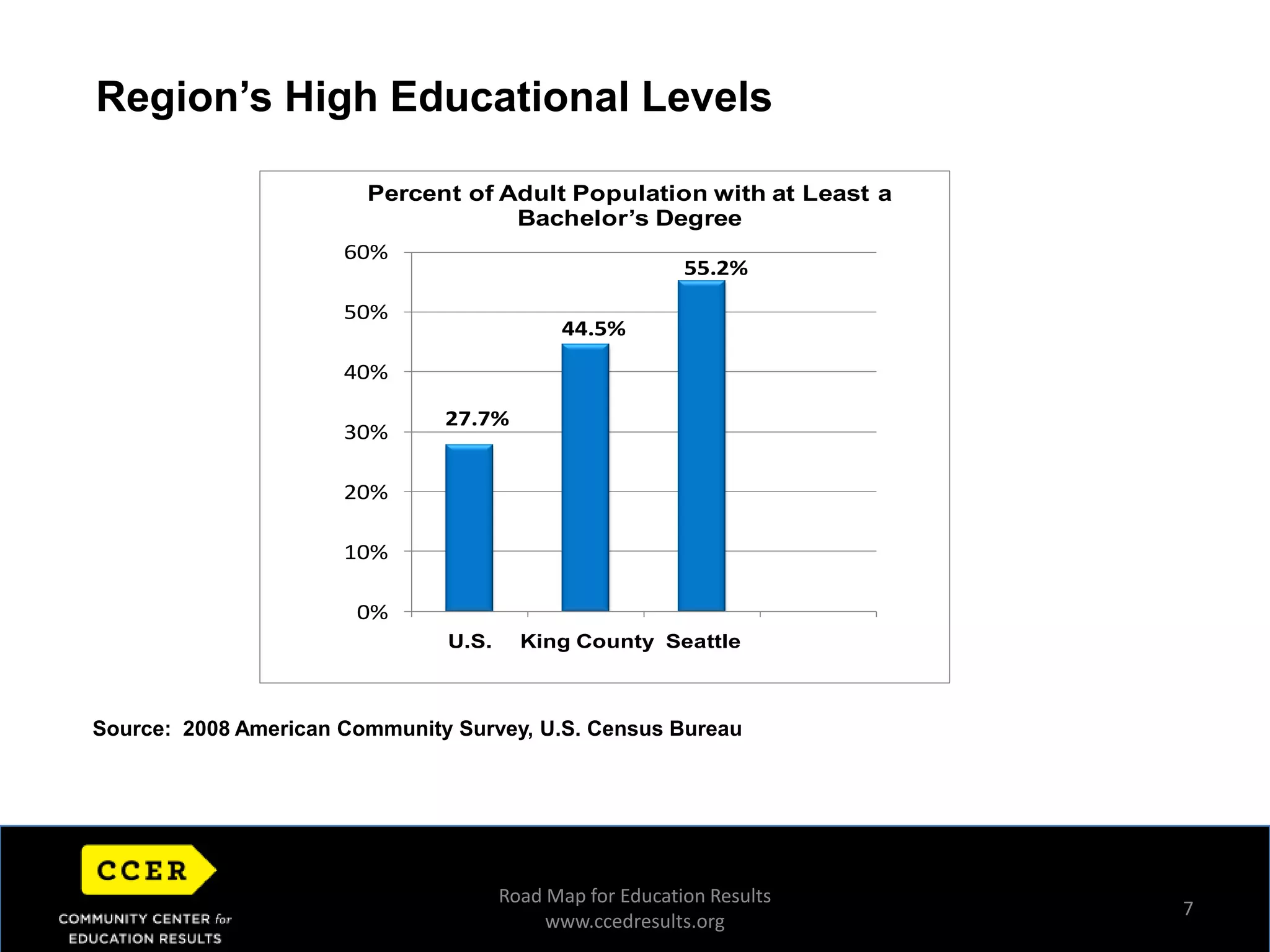
Region’s High Educational LevelsHorizontal Image Area Source:  2008 American Community Survey, U.S. Census BureauRoad Map for Education Resultswww.ccedresults.org7
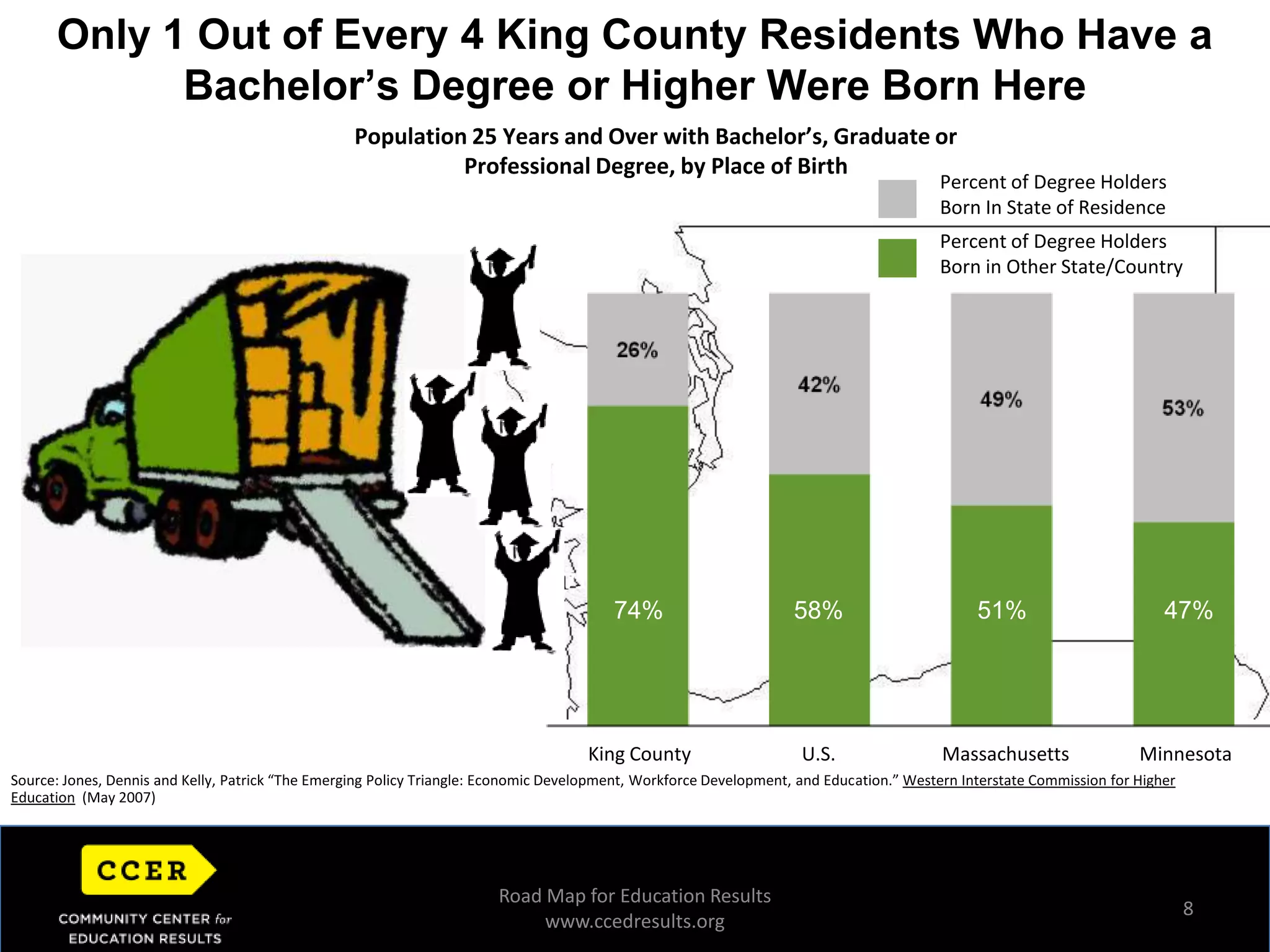
8Only 1 Out of Every 4 King County Residents Who Have a Bachelor’s Degree or Higher Were Born HerePopulation 25 Years and Over with Bachelor’s, Graduate or Professional Degree, by Place of BirthPercent of Degree Holders Born In State of ResidencePercent of Degree Holders Born in Other State/Country74%71%74%74%58%51%47%71%58%U.S.King CountyMassachusettsMinnesotaSource: Jones, Dennis and Kelly, Patrick “The Emerging Policy Triangle: Economic Development, Workforce Development, and Education.” Western Interstate Commission for Higher Education  (May 2007)Road Map for Education Resultswww.ccedresults.org
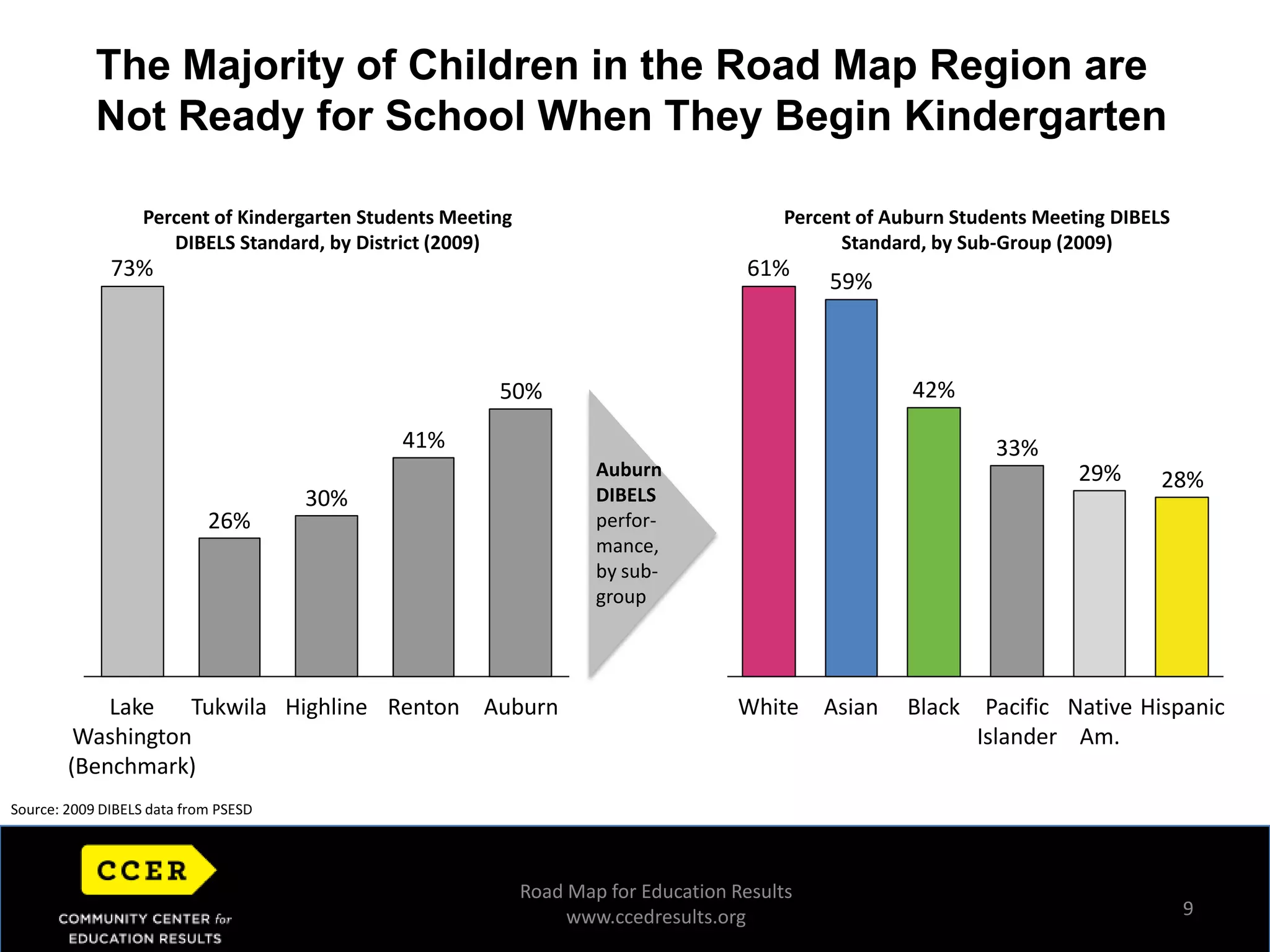
n9The Majority of Children in the Road Map Region are Not Ready for School When They Begin KindergartenPercent of Kindergarten Students Meeting DIBELS Standard, by District (2009)Percent of Auburn Students Meeting DIBELS Standard, by Sub-Group (2009)73%61%59%42%50%41%33%Auburn DIBELS perfor-mance, by sub-group29%28%30%26%AuburnTukwilaHighlineLake Washington (Benchmark)RentonHispanicAsianPacific IslanderWhiteNative Am.BlackSource: 2009 DIBELS data from PSESDRoad Map for Education Resultswww.ccedresults.org
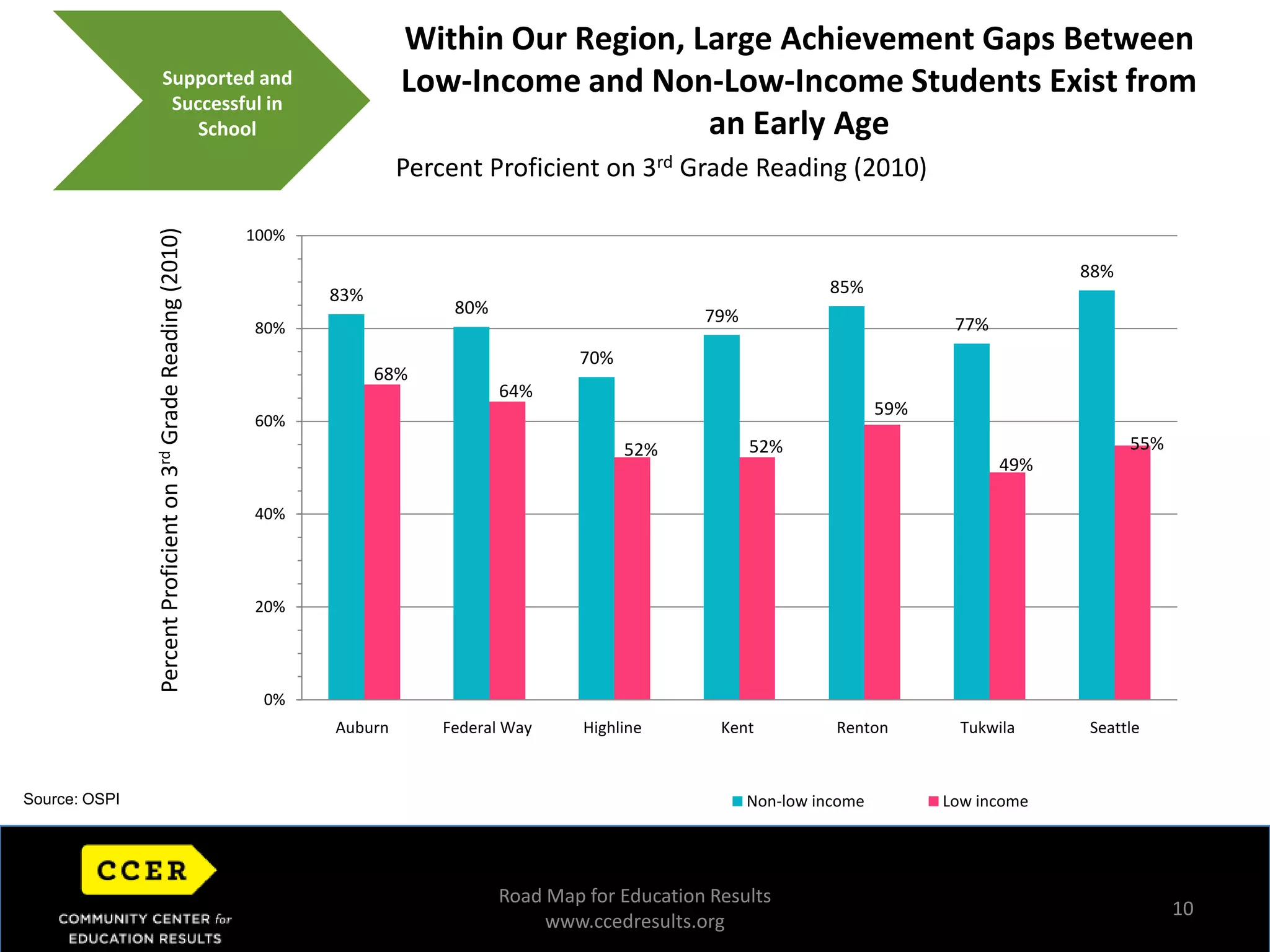
10Within Our Region, Large Achievement Gaps Between Low-Income and Non-Low-Income Students Exist from an Early AgeSupported and Successful in SchoolPercent Proficient on 3rd Grade Reading (2010)Percent Proficient on 3rd Grade Reading (2010)Source: OSPIRoad Map for Education Resultswww.ccedresults.org
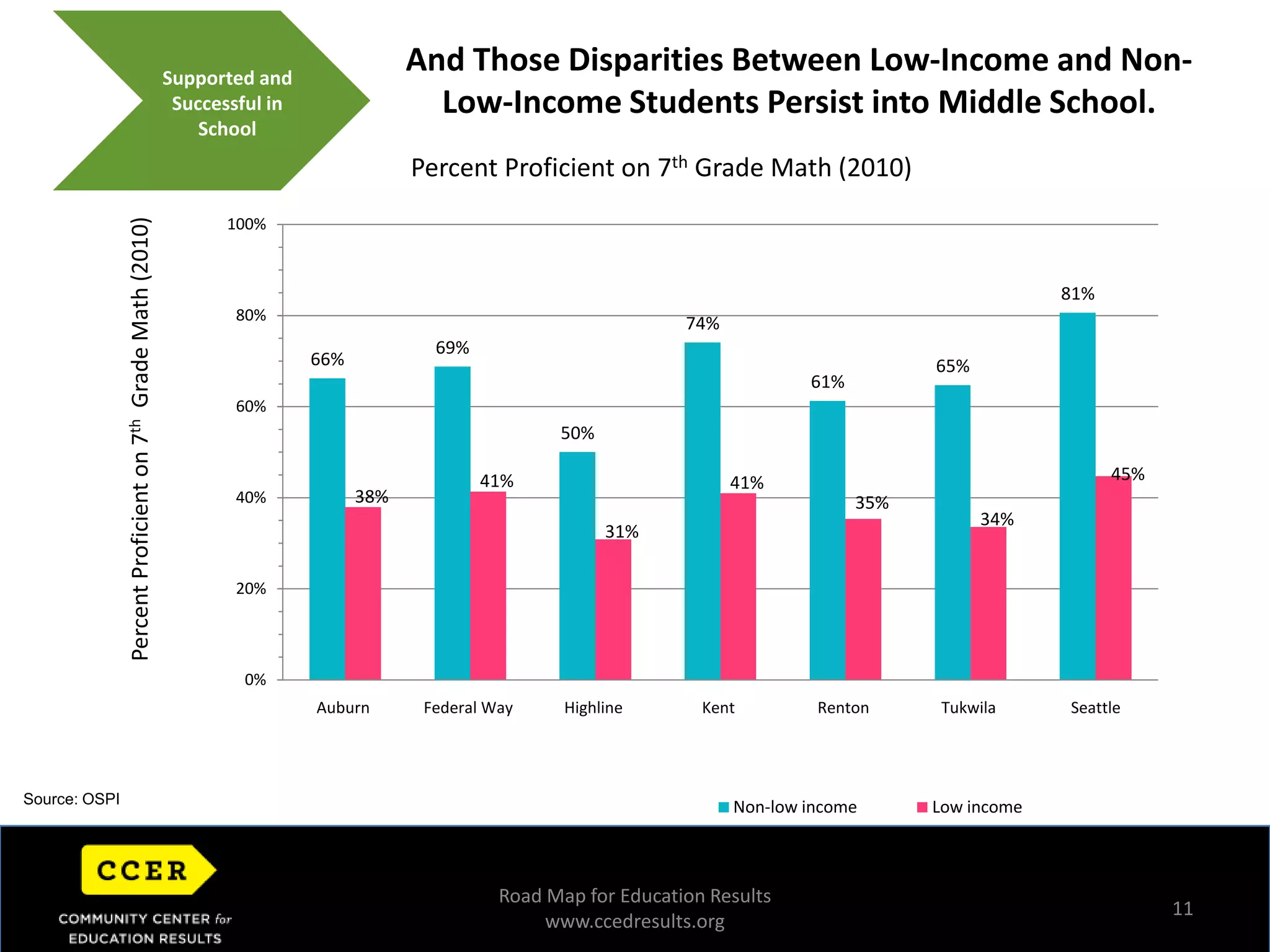
11And Those Disparities Between Low-Income and Non-Low-Income Students Persist into Middle School.Supported and Successful in SchoolPercent Proficient on 7th Grade Math (2010)Percent Proficient on 7th  Grade Math (2010)Source: OSPIRoad Map for Education Resultswww.ccedresults.org
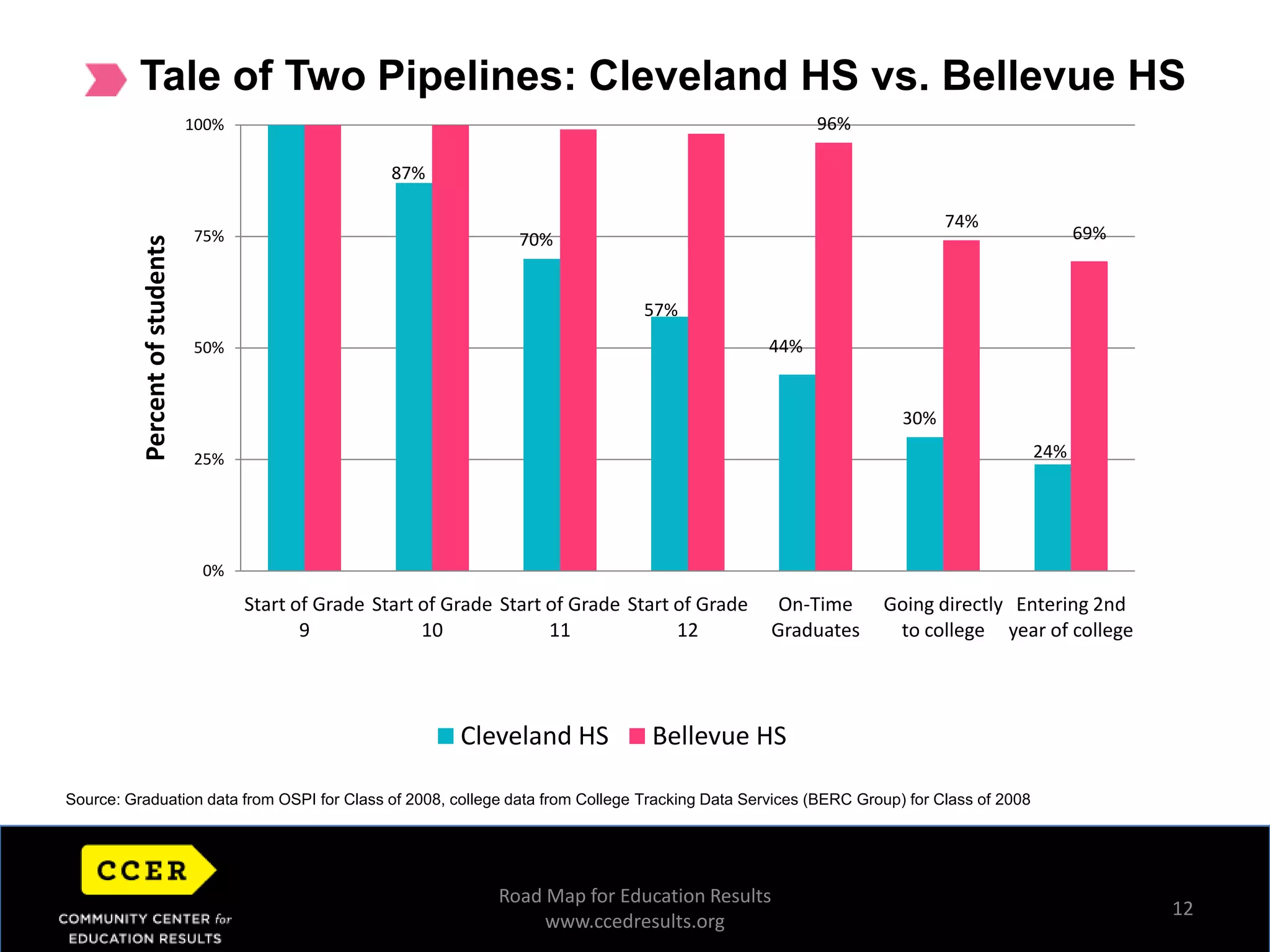
Tale of Two Pipelines: Cleveland HS vs. Bellevue HS12Source: Graduation data from OSPI for Class of 2008, college data from College Tracking Data Services (BERC Group) for Class of 2008Road Map for Education Resultswww.ccedresults.org
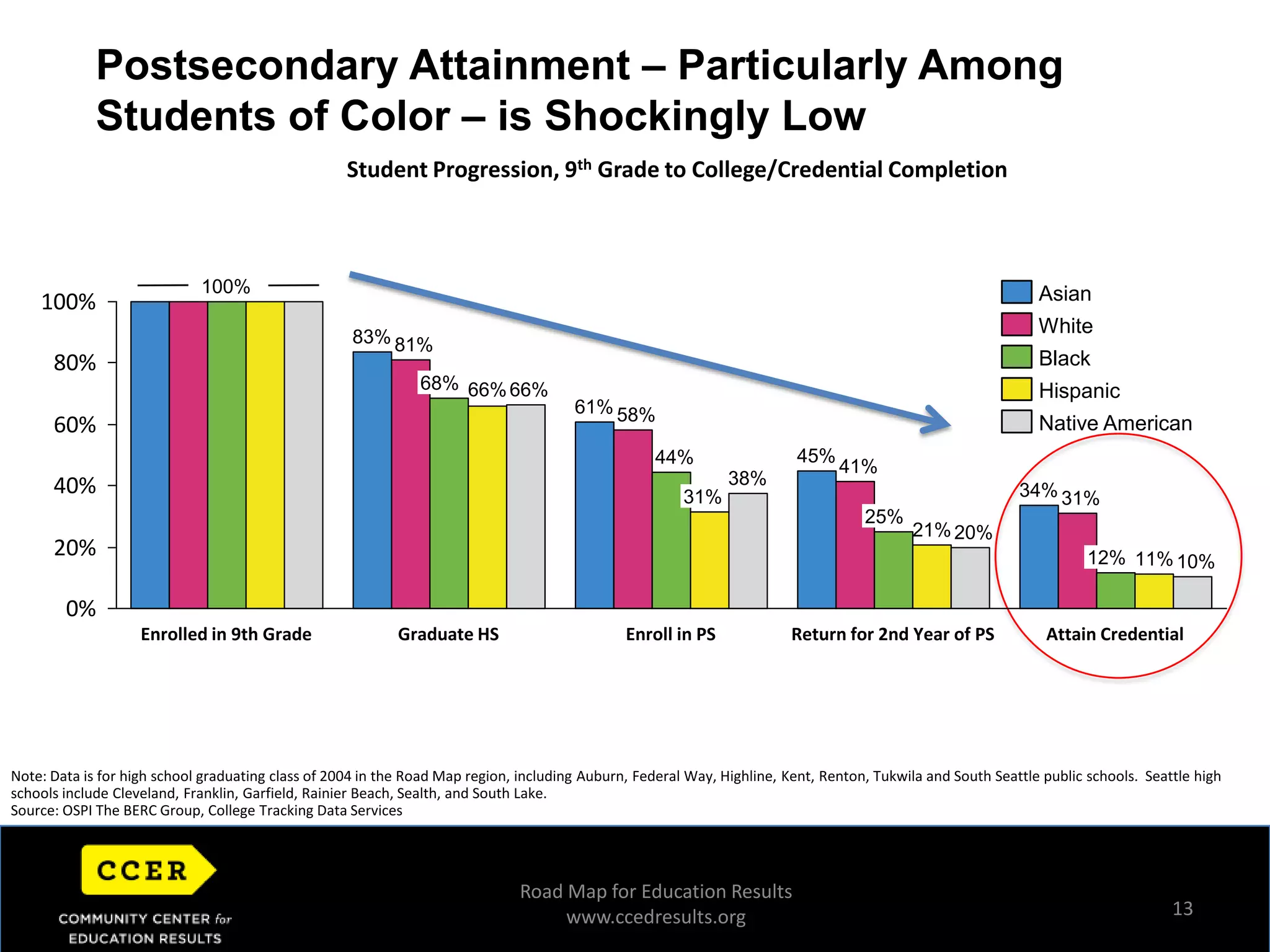
213Postsecondary Attainment – Particularly Among Students of Color – is Shockingly LowStudent Progression, 9th Grade to College/Credential Completion100%Asian100%White83%81%Black80%68%66%66%Hispanic61%58%60%Native American45%44%41%38%40%34%31%31%25%21%20%20%12%11%10%0%Graduate HSEnroll in PSAttain CredentialReturn for 2nd Year of PSEnrolled in 9th GradeNote: Data is for high school graduating class of 2004 in the Road Map region, including Auburn, Federal Way, Highline, Kent, Renton, Tukwila and South Seattle public schools.  Seattle high schools include Cleveland, Franklin, Garfield, Rainier Beach, Sealth, and South Lake. Source: OSPI The BERC Group, College Tracking Data ServicesRoad Map for Education Resultswww.ccedresults.org
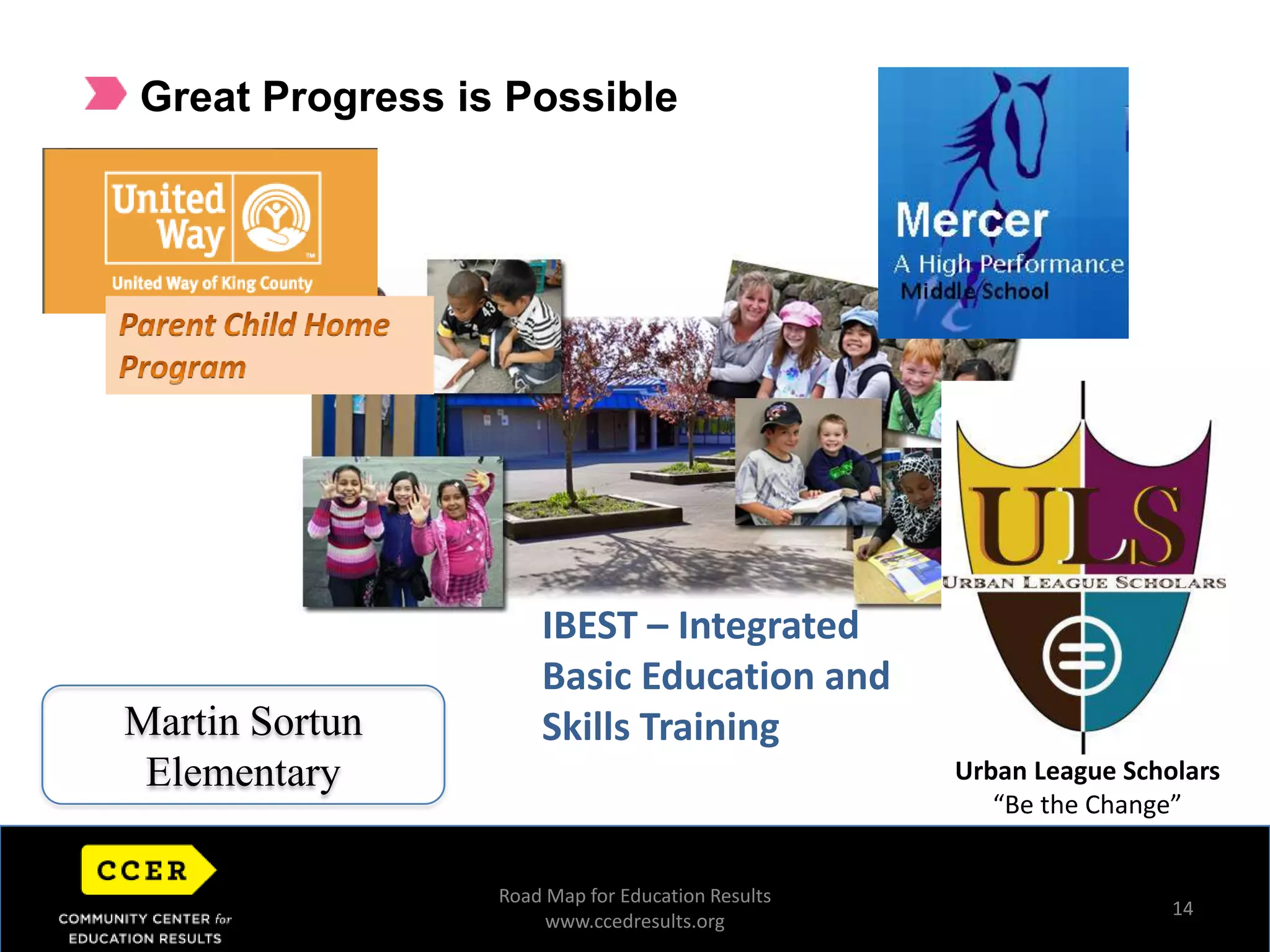
Great Progress is Possible14Parent Child Home Program IBEST – Integrated Basic Education and Skills TrainingMartin Sortun Elementary Urban League Scholars“Be the Change”Road Map for Education Resultswww.ccedresults.org
STRIVE – Cincinnati Bridging Richmond – Richmond, VA 55,000 Degrees – Louisville, KYThe Portland Schools Foundation – PortlandE3 Alliance – Austin Promise Neighborhood  Harlem/National ReplicationReady by 21Say Yes to Education - Syracuse15Other communities are organizing for action tooRoad Map for Education Resultswww.ccedresults.org
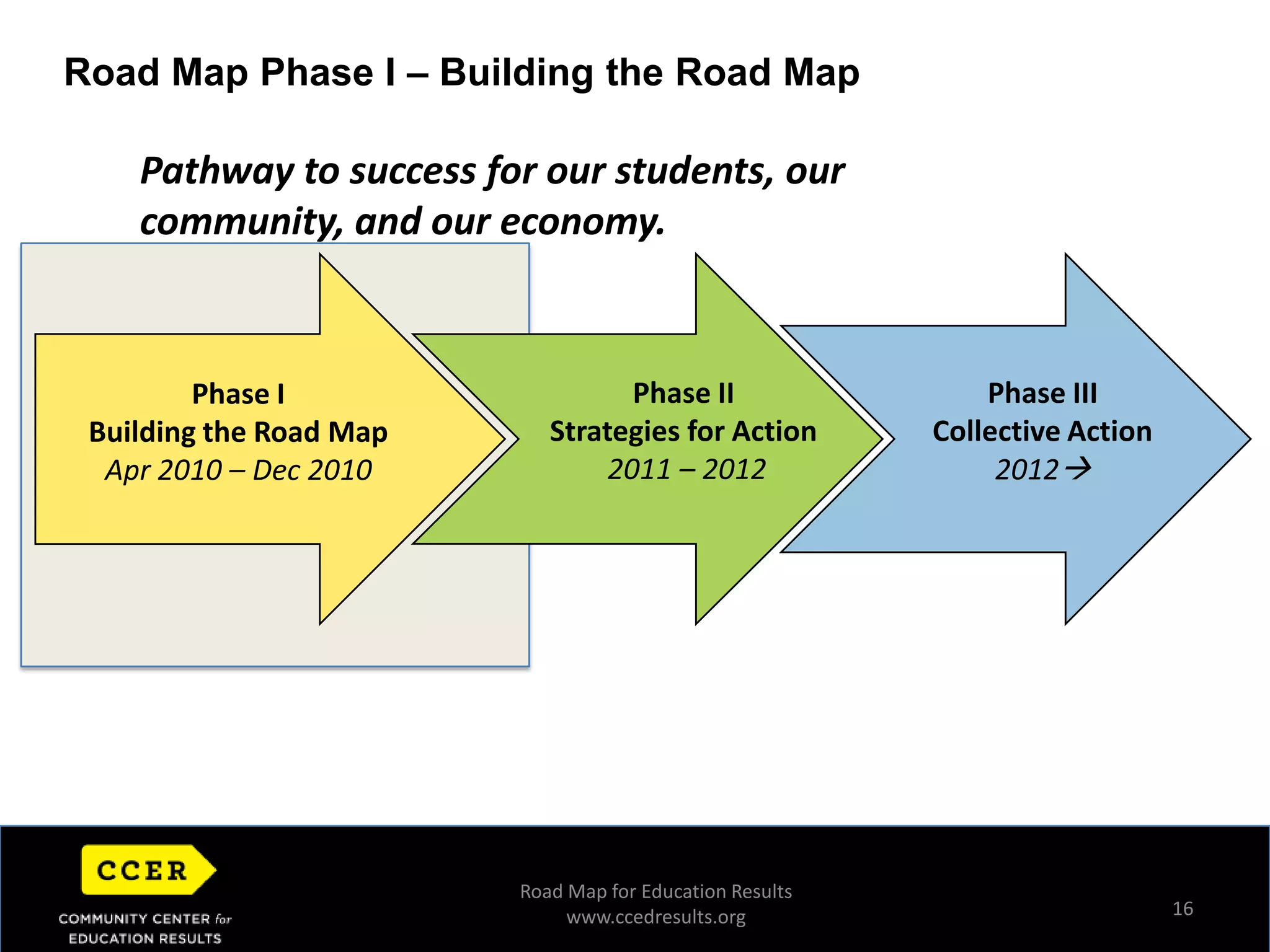
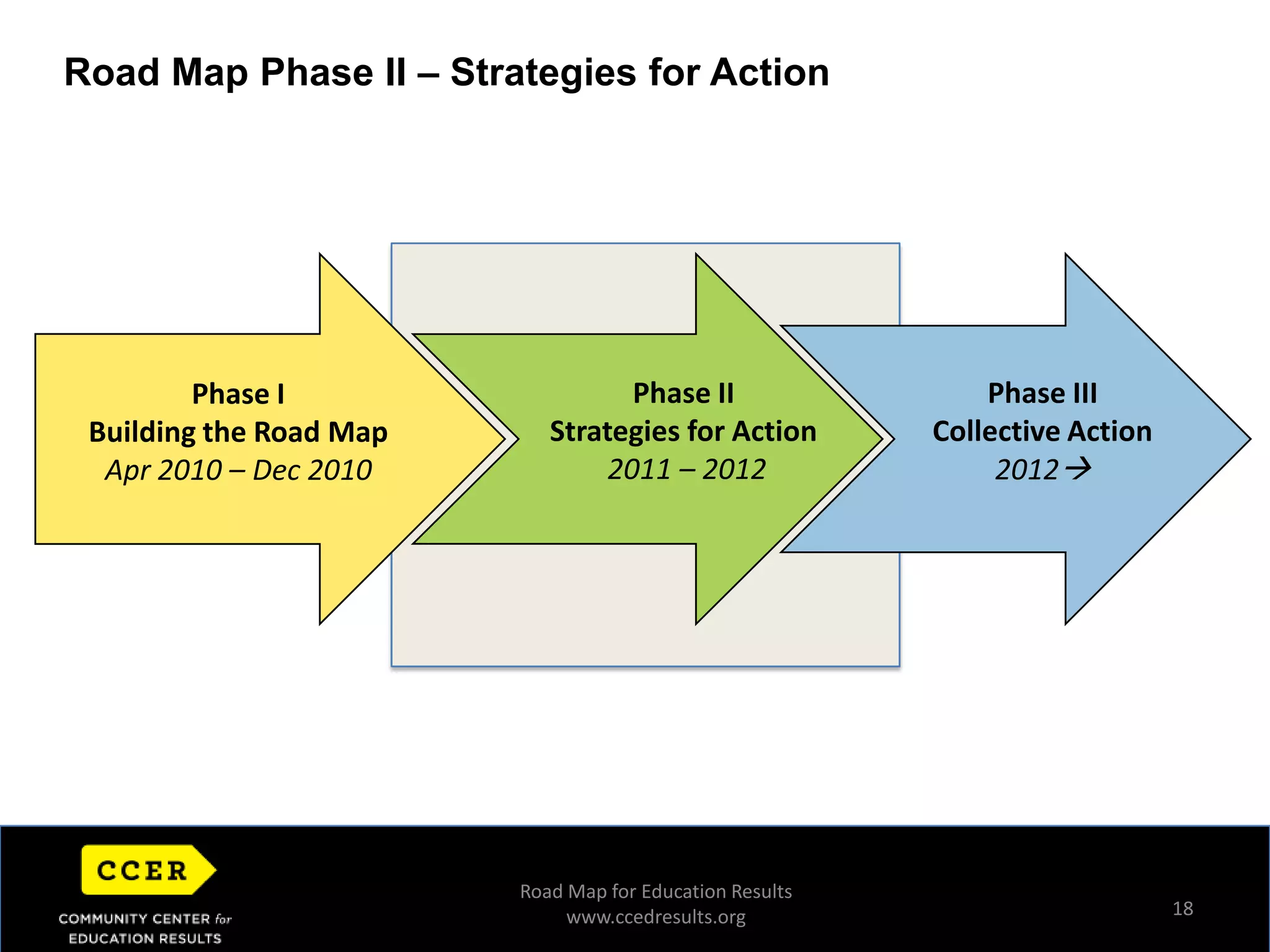
16Road Map Phase I – Building the Road Map Pathway to success for our students, our community, and our economy. Phase IIStrategies for Action 2011 – 2012Phase IIICollective Action2012 Phase IBuilding the Road MapApr 2010 – Dec 2010Road Map for Education Resultswww.ccedresults.org
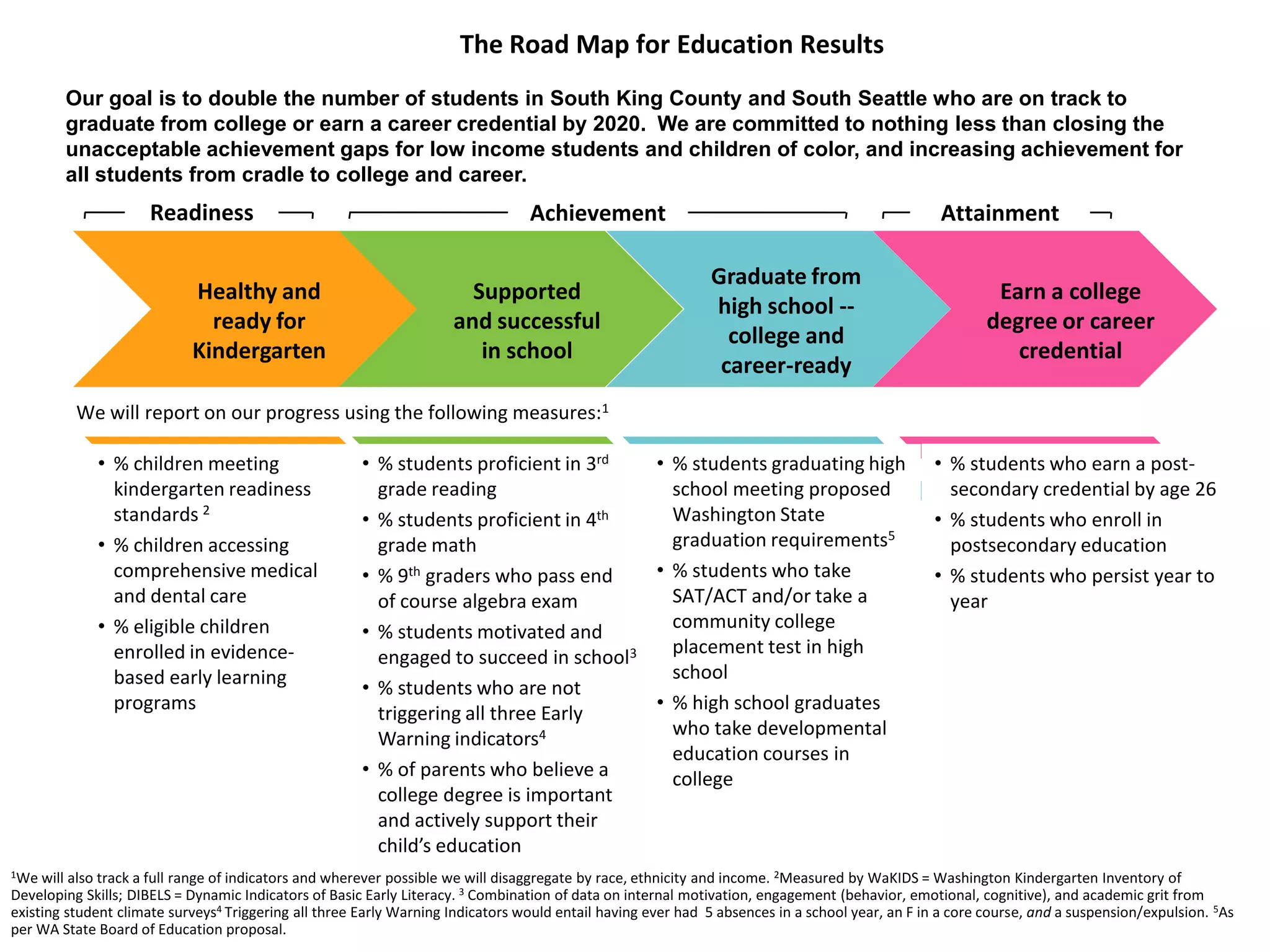
The Road Map for Education ResultsOur goal is to double the number of students in South King County and South Seattle who are on track to graduate from college or earn a career credential by 2020.  We are committed to nothing less than closing the unacceptable achievement gaps for low income students and children of color, and increasing achievement for all students from cradle to college and career.  ReadinessAttainmentAchievementGraduate from high school --college and career-readyHealthy and ready for KindergartenSupported  and successful in schoolEarn a college degree or career credentialWe will report on our progress using the following measures:1% students proficient in 3rdgrade reading
% students proficient in 4thgrade math
% 9th graders who pass end    of course algebra exam
% students motivated and engaged to succeed in school3
% students who are not triggering all three Early Warning indicators4
% of parents who believe a college degree is important and actively support their child’s education
% students graduating high school meeting proposed Washington State graduation requirements5
% students who take SAT/ACT and/or take a community college placement test in high school
% high school graduates who take developmental education courses in college
% students who earn a post-secondary credential by age 26
% students who enroll in postsecondary education
% students who persist year to year
% children meeting kindergarten readiness standards 2
% children accessing comprehensive medical and dental care
% eligible children enrolled in evidence-based early learning programs1We will also track a full range of indicators and wherever possible we will disaggregate by race, ethnicity and income. 2Measured by WaKIDS= Washington Kindergarten Inventory of Developing Skills; DIBELS = Dynamic Indicators of Basic Early Literacy. 3 Combination of data on internal motivation, engagement (behavior, emotional, cognitive), and academic grit from existing student climate surveys4 Triggering all three Early Warning Indicators would entail having ever had  5 absences in a school year, an F in a core course, and a suspension/expulsion. 5As per WA State Board of Education proposal.
18Road Map Phase II – Strategies for ActionPhase IIStrategies for Action 2011 – 2012Phase IIICollective Action2012 Phase IBuilding the Road MapApr 2010 – Dec 2010Road Map for Education Resultswww.ccedresults.org
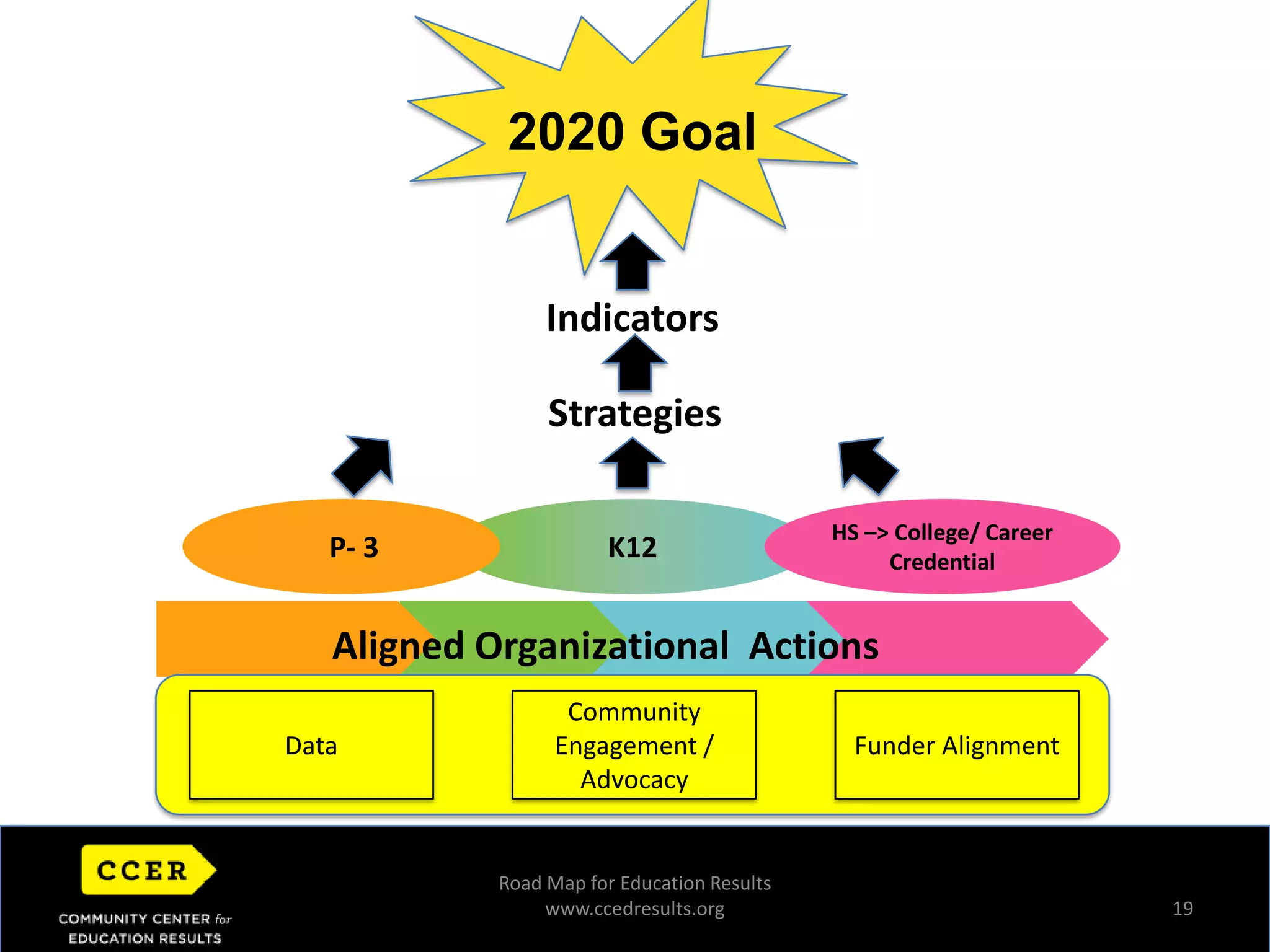
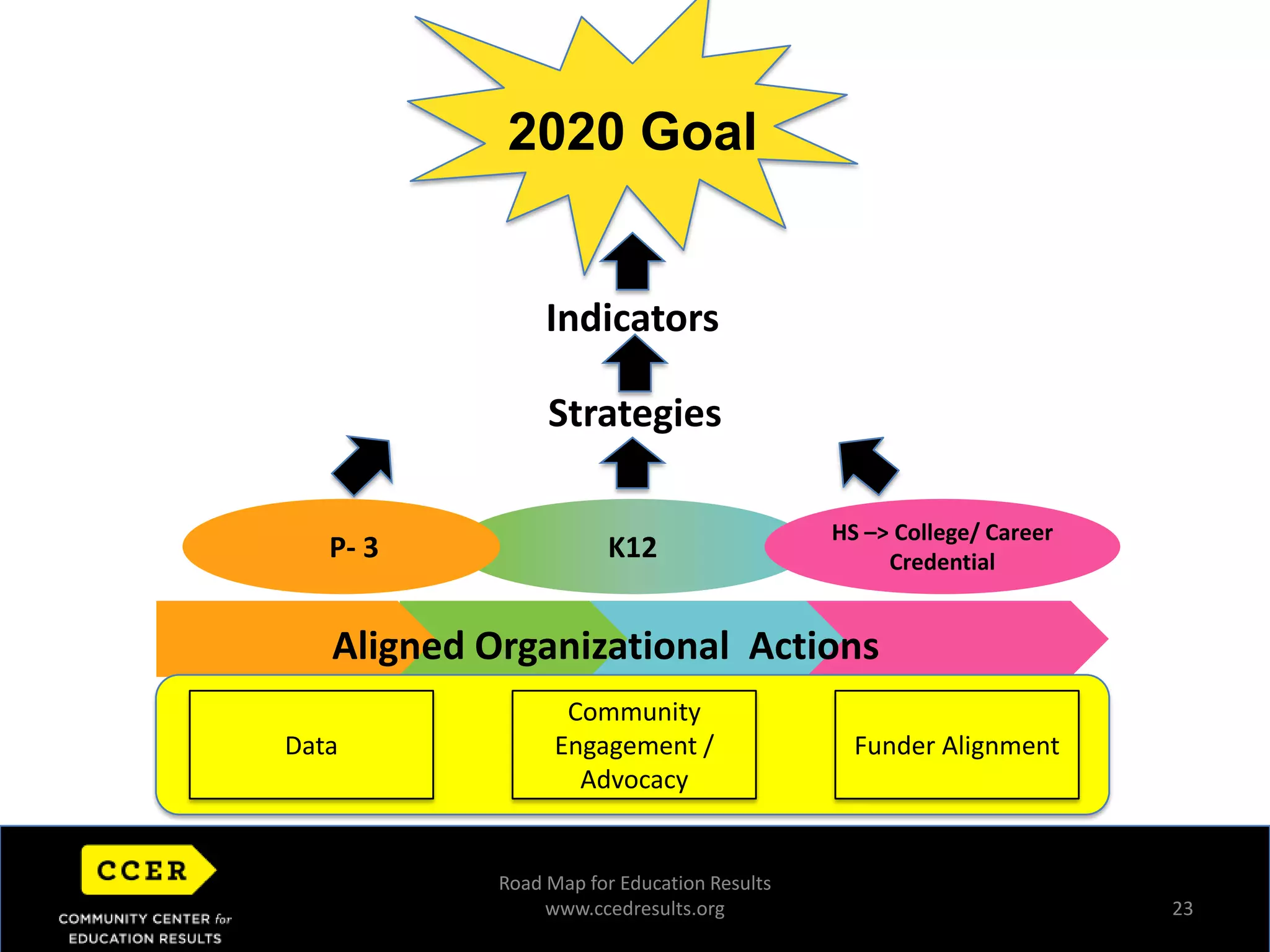
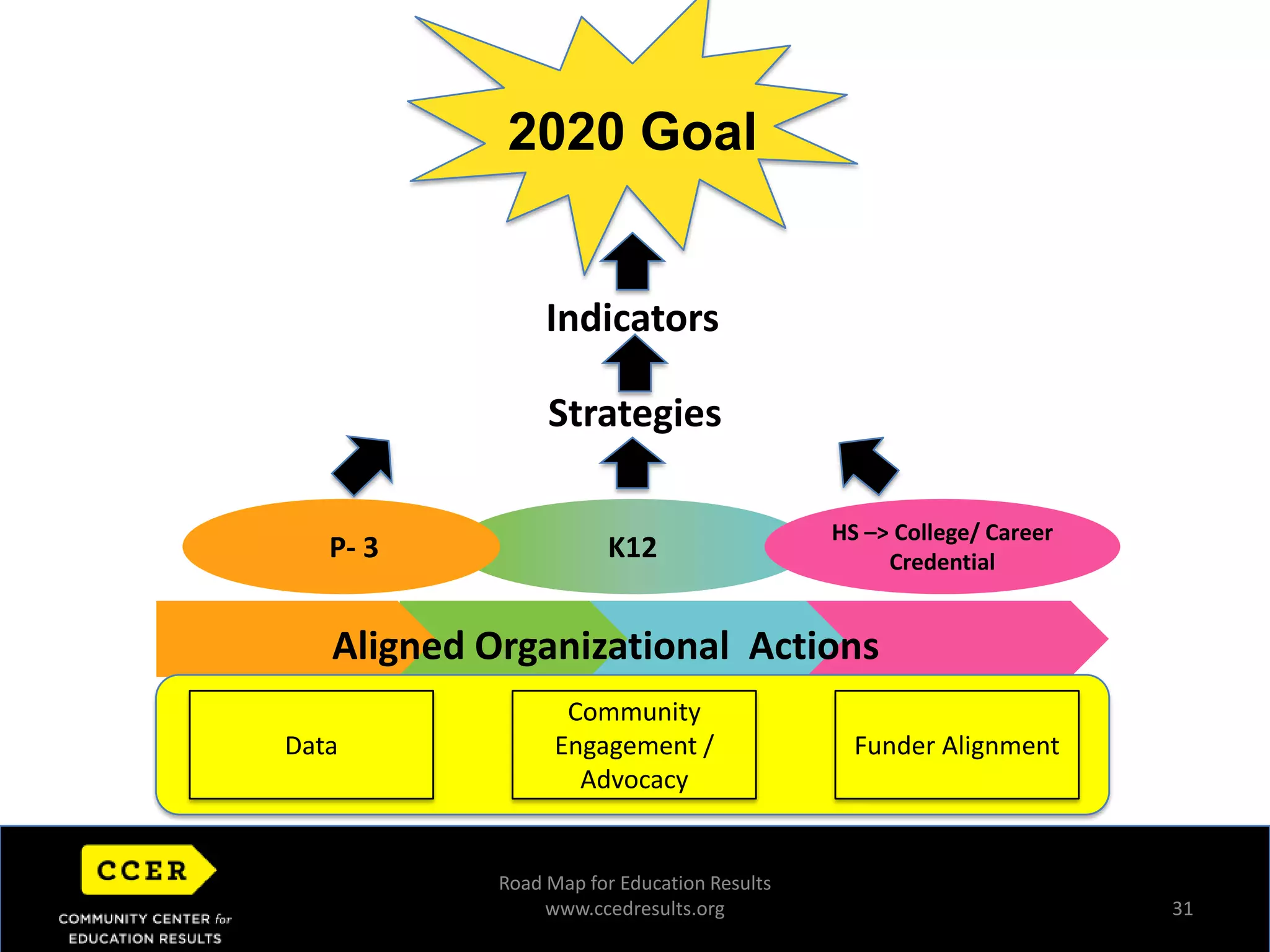
192020 Goal IndicatorsStrategiesK12 P- 3 HS –> College/ Career Credential  Aligned Organizational  ActionsData Community Engagement / AdvocacyFunder AlignmentRoad Map for Education Resultswww.ccedresults.org

Road map for_education_results(ccer)_may

  • 1.
    Road Map forEducation ResultsFrom Cradle to College and Career 1Earn a college degree or career credentialGraduate from high school - college and career readySupported and successful in schoolHealthy and ready for KindergartenRoad Map for Education Resultswww.ccedresults.org
  • 2.
    2What is theRoad Map for Education Results?The “Road Map Project” is a new collective impact initiative aimed at getting dramatic improvement in student achievement – cradle through college/career in South Seattle and South King County. Horizontal Image AreaGraduate from high school- college and career readyEarn a college degree or career credentialHealthy and ready for KindergartenSupported and successful in schoolRoad Map for Education Resultswww.ccedresults.org
  • 3.
    3Who is workingon this Project?Strategy Work GroupsDefining system building actionsCommunity Network & Advocates CaucusSupporting parents & community involvementK-12 Superintendents & Community College PresidentsConnecting system leadersEducation Results NetworkProviding input and building connectionsProject SponsorsProviding strategic directionThe Road Map ProjectData AdvisorsEnsuring it all adds up Road Map Aligned FundersInvesting for greater system impactCCER Staff and Consultant TeamRoad Map for Education Resultswww.ccedresults.org
  • 4.
    4Project SponsorsCommunity RepresentativesTheSeattle FoundationThe Bill & Melinda Gates FoundationThe City of SeattleLeague of Education VotersSeattle Community College Districts Puget Sound Educational Service District Technology Access Foundation OneAmericaUniversity of Washington Road Map for Education Resultswww.ccedresults.org
  • 5.
    5Focus on Communitieswith Greatest NeedThe Road Map for Education Results is focusing on nine communities in South Seattle and South King County. The communities are:AuburnBurienDes MoinesFederal WayKentRentonSeaTacCentral Seattle, South East Seattle and portions of South West SeattleTukwilaPortions of unincorporated King CountyHorizontal Image AreaRoad Map for Education Resultswww.ccedresults.org
  • 6.
    Post Secondary attainmentis increasingly important in today’s job market –especially in King CountyHorizontal Image AreaBy 2018, 67% of jobs in Washington will require postsecondary education.This is 4 percentage points above the national average of 63%.Washington ranks 6th in postsecondary education intensity for 2018.Source: The Georgetown University Center on Education and the Workforce Source: Georgetown University Center for Education and the WorkforceRoad Map for Education Resultswww.ccedresults.org6
  • 7.
    Region’s High EducationalLevelsHorizontal Image Area Source: 2008 American Community Survey, U.S. Census BureauRoad Map for Education Resultswww.ccedresults.org7
  • 8.
    8Only 1 Outof Every 4 King County Residents Who Have a Bachelor’s Degree or Higher Were Born HerePopulation 25 Years and Over with Bachelor’s, Graduate or Professional Degree, by Place of BirthPercent of Degree Holders Born In State of ResidencePercent of Degree Holders Born in Other State/Country74%71%74%74%58%51%47%71%58%U.S.King CountyMassachusettsMinnesotaSource: Jones, Dennis and Kelly, Patrick “The Emerging Policy Triangle: Economic Development, Workforce Development, and Education.” Western Interstate Commission for Higher Education (May 2007)Road Map for Education Resultswww.ccedresults.org
  • 9.
    n9The Majority ofChildren in the Road Map Region are Not Ready for School When They Begin KindergartenPercent of Kindergarten Students Meeting DIBELS Standard, by District (2009)Percent of Auburn Students Meeting DIBELS Standard, by Sub-Group (2009)73%61%59%42%50%41%33%Auburn DIBELS perfor-mance, by sub-group29%28%30%26%AuburnTukwilaHighlineLake Washington (Benchmark)RentonHispanicAsianPacific IslanderWhiteNative Am.BlackSource: 2009 DIBELS data from PSESDRoad Map for Education Resultswww.ccedresults.org
  • 10.
    10Within Our Region,Large Achievement Gaps Between Low-Income and Non-Low-Income Students Exist from an Early AgeSupported and Successful in SchoolPercent Proficient on 3rd Grade Reading (2010)Percent Proficient on 3rd Grade Reading (2010)Source: OSPIRoad Map for Education Resultswww.ccedresults.org
  • 11.
    11And Those DisparitiesBetween Low-Income and Non-Low-Income Students Persist into Middle School.Supported and Successful in SchoolPercent Proficient on 7th Grade Math (2010)Percent Proficient on 7th Grade Math (2010)Source: OSPIRoad Map for Education Resultswww.ccedresults.org
  • 12.
    Tale of TwoPipelines: Cleveland HS vs. Bellevue HS12Source: Graduation data from OSPI for Class of 2008, college data from College Tracking Data Services (BERC Group) for Class of 2008Road Map for Education Resultswww.ccedresults.org
  • 13.
    213Postsecondary Attainment –Particularly Among Students of Color – is Shockingly LowStudent Progression, 9th Grade to College/Credential Completion100%Asian100%White83%81%Black80%68%66%66%Hispanic61%58%60%Native American45%44%41%38%40%34%31%31%25%21%20%20%12%11%10%0%Graduate HSEnroll in PSAttain CredentialReturn for 2nd Year of PSEnrolled in 9th GradeNote: Data is for high school graduating class of 2004 in the Road Map region, including Auburn, Federal Way, Highline, Kent, Renton, Tukwila and South Seattle public schools. Seattle high schools include Cleveland, Franklin, Garfield, Rainier Beach, Sealth, and South Lake. Source: OSPI The BERC Group, College Tracking Data ServicesRoad Map for Education Resultswww.ccedresults.org
  • 14.
    Great Progress isPossible14Parent Child Home Program IBEST – Integrated Basic Education and Skills TrainingMartin Sortun Elementary Urban League Scholars“Be the Change”Road Map for Education Resultswww.ccedresults.org
  • 15.
    STRIVE – CincinnatiBridging Richmond – Richmond, VA 55,000 Degrees – Louisville, KYThe Portland Schools Foundation – PortlandE3 Alliance – Austin Promise Neighborhood Harlem/National ReplicationReady by 21Say Yes to Education - Syracuse15Other communities are organizing for action tooRoad Map for Education Resultswww.ccedresults.org
  • 16.
    16Road Map PhaseI – Building the Road Map Pathway to success for our students, our community, and our economy. Phase IIStrategies for Action 2011 – 2012Phase IIICollective Action2012 Phase IBuilding the Road MapApr 2010 – Dec 2010Road Map for Education Resultswww.ccedresults.org
  • 17.
    The Road Mapfor Education ResultsOur goal is to double the number of students in South King County and South Seattle who are on track to graduate from college or earn a career credential by 2020. We are committed to nothing less than closing the unacceptable achievement gaps for low income students and children of color, and increasing achievement for all students from cradle to college and career. ReadinessAttainmentAchievementGraduate from high school --college and career-readyHealthy and ready for KindergartenSupported and successful in schoolEarn a college degree or career credentialWe will report on our progress using the following measures:1% students proficient in 3rdgrade reading
  • 18.
    % students proficientin 4thgrade math
  • 19.
    % 9th graderswho pass end of course algebra exam
  • 20.
    % students motivatedand engaged to succeed in school3
  • 21.
    % students whoare not triggering all three Early Warning indicators4
  • 22.
    % of parentswho believe a college degree is important and actively support their child’s education
  • 23.
    % students graduatinghigh school meeting proposed Washington State graduation requirements5
  • 24.
    % students whotake SAT/ACT and/or take a community college placement test in high school
  • 25.
    % high schoolgraduates who take developmental education courses in college
  • 26.
    % students whoearn a post-secondary credential by age 26
  • 27.
    % students whoenroll in postsecondary education
  • 28.
    % students whopersist year to year
  • 29.
    % children meetingkindergarten readiness standards 2
  • 30.
    % children accessingcomprehensive medical and dental care
  • 31.
    % eligible childrenenrolled in evidence-based early learning programs1We will also track a full range of indicators and wherever possible we will disaggregate by race, ethnicity and income. 2Measured by WaKIDS= Washington Kindergarten Inventory of Developing Skills; DIBELS = Dynamic Indicators of Basic Early Literacy. 3 Combination of data on internal motivation, engagement (behavior, emotional, cognitive), and academic grit from existing student climate surveys4 Triggering all three Early Warning Indicators would entail having ever had 5 absences in a school year, an F in a core course, and a suspension/expulsion. 5As per WA State Board of Education proposal.
  • 32.
    18Road Map PhaseII – Strategies for ActionPhase IIStrategies for Action 2011 – 2012Phase IIICollective Action2012 Phase IBuilding the Road MapApr 2010 – Dec 2010Road Map for Education Resultswww.ccedresults.org
  • 33.
    192020 Goal IndicatorsStrategiesK12P- 3 HS –> College/ Career Credential Aligned Organizational ActionsData Community Engagement / AdvocacyFunder AlignmentRoad Map for Education Resultswww.ccedresults.org
  • 34.
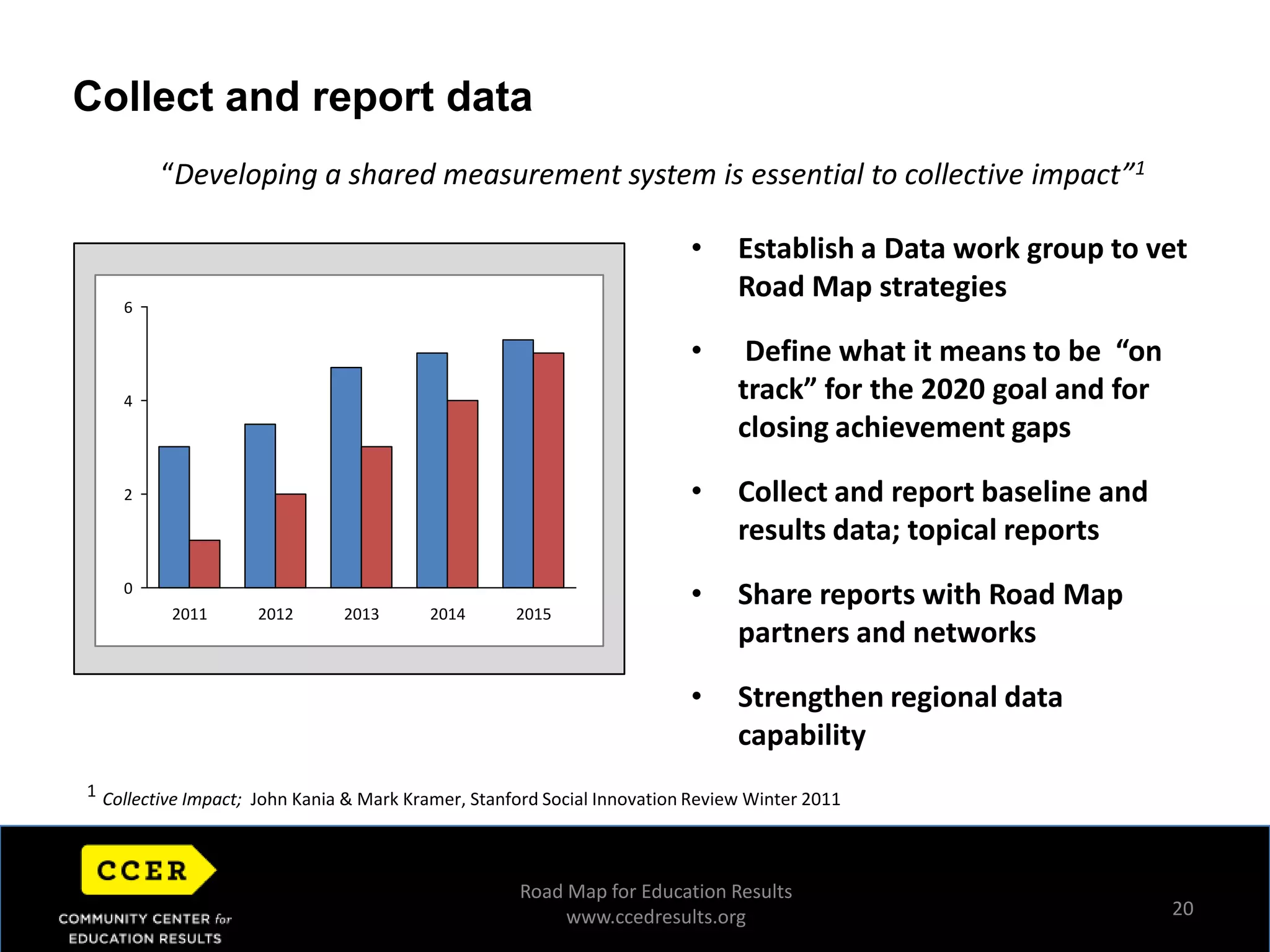
    120Collect and reportdata“Developing a shared measurement system is essential to collective impact”1Establish a Data work group to vet Road Map strategies
  • 35.
    Define whatit means to be “on track” for the 2020 goal and for closing achievement gaps
  • 36.
    Collect and reportbaseline and results data; topical reports
  • 37.
    Share reports withRoad Map partners and networks
  • 38.
    Strengthen regional datacapability201520142013201220111Collective Impact; John Kania & Mark Kramer, Stanford Social Innovation Review Winter 2011Road Map for Education Resultswww.ccedresults.org
  • 39.
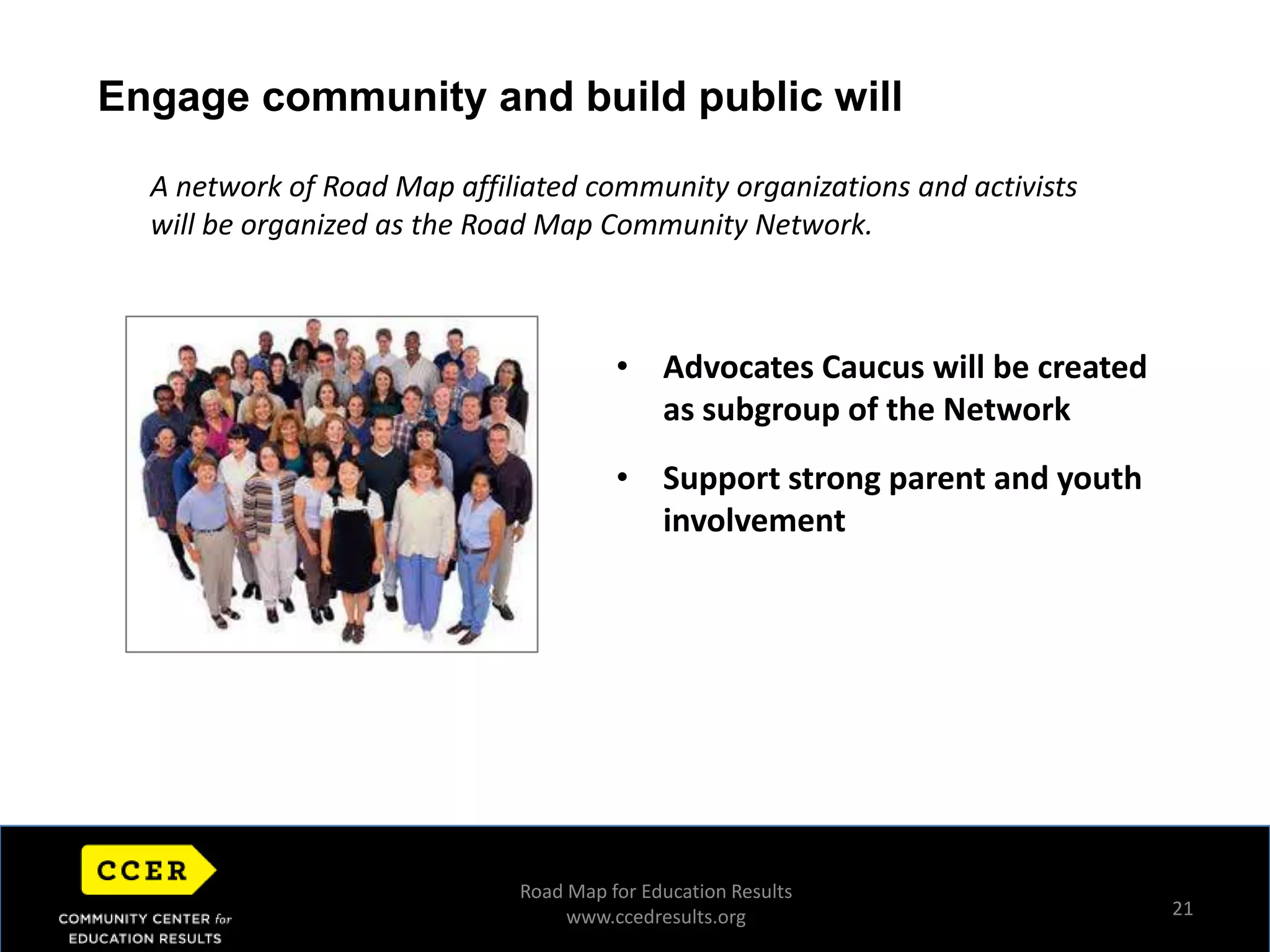
    21Engage community andbuild public willA network of Road Map affiliated community organizations and activists will be organized as the Road Map Community Network.Advocates Caucus will be created as subgroup of the Network
  • 40.
    Support strong parentand youth involvementRoad Map for Education Resultswww.ccedresults.org
  • 41.
  • 42.
    Encourage funder’s useof Road Map goals and indicators in grant making
  • 43.
    Support opportunities forleverage and collaboration
  • 44.
    Analyze existing RoadMap resources – work on funder alignment and improved collective returnsRoad Map for Education Resultswww.ccedresults.org
  • 45.
    232020 Goal IndicatorsStrategiesK12P- 3 HS –> College/ Career Credential Aligned Organizational ActionsData Community Engagement / AdvocacyFunder AlignmentRoad Map for Education Resultswww.ccedresults.org
  • 46.
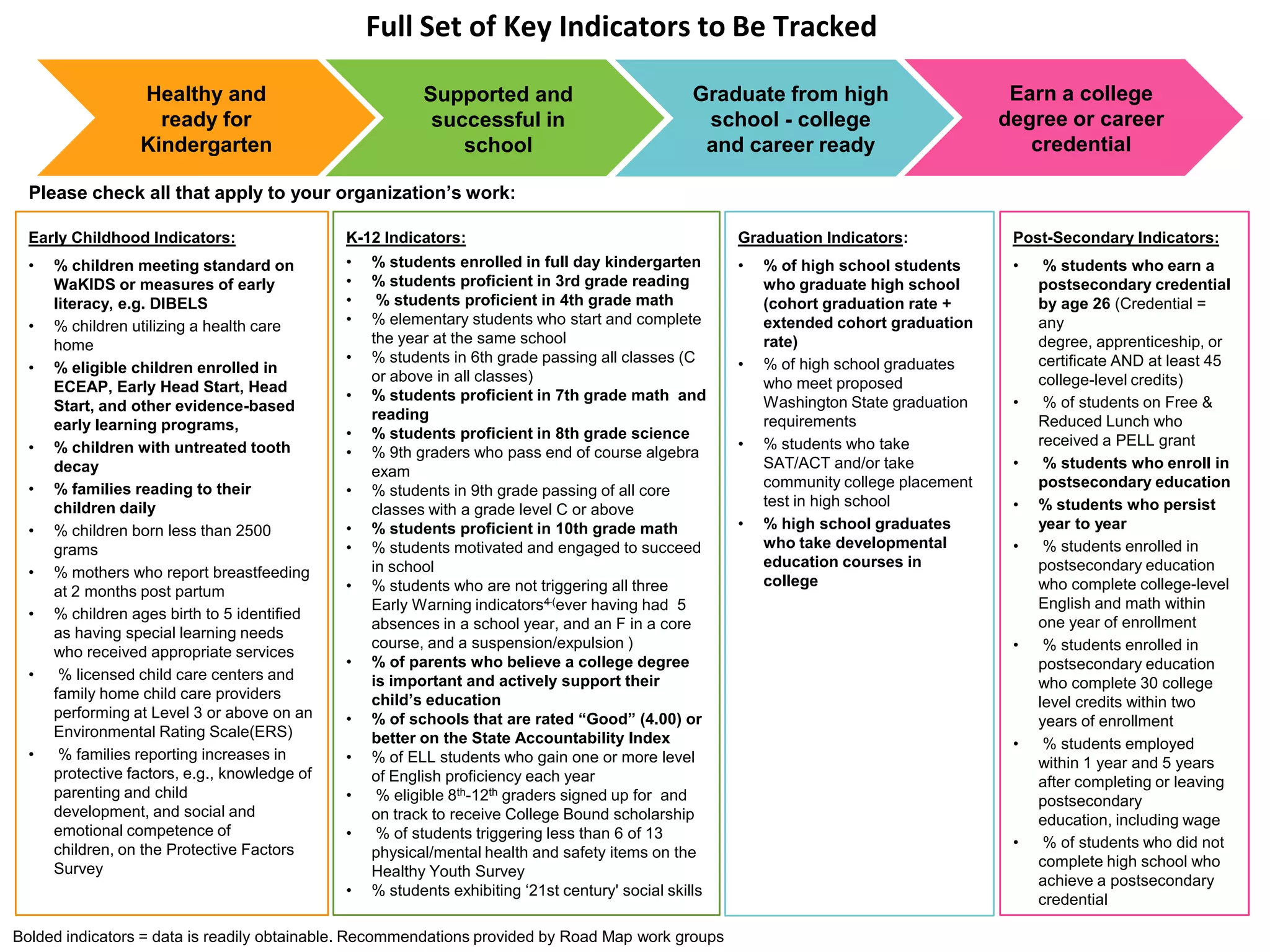
    Full Set ofKey Indicators to Be TrackedSupported and successful in schoolEarn a college degree or career credentialHealthy and ready for KindergartenGraduate from high school - college and career readyPlease check all that apply to your organization’s work:Graduation Indicators:% of high school students who graduate high school (cohort graduation rate + extended cohort graduation rate)
  • 47.
    % of highschool graduates who meet proposed Washington State graduation requirements
  • 48.
    % students whotake SAT/ACT and/or take community college placement test in high school
  • 49.
    % high schoolgraduates who take developmental education courses in collegeK-12 Indicators:% students enrolled in full day kindergarten
  • 50.
    % students proficientin 3rd grade reading
  • 51.
    % studentsproficient in 4th grade math
  • 52.
    % elementary studentswho start and complete the year at the same school
  • 53.
    % students in6th grade passing all classes (C or above in all classes)
  • 54.
    % students proficientin 7th grade math and reading
  • 55.
    % students proficientin 8th grade science
  • 56.
    % 9th graderswho pass end of course algebra exam
  • 57.
    % students in9th grade passing of all core classes with a grade level C or above
  • 58.
    % students proficientin 10th grade math
  • 59.
    % students motivatedand engaged to succeed in school
  • 60.
    % students whoare not triggering all three Early Warning indicators4 (ever having had 5 absences in a school year, and an F in a core course, and a suspension/expulsion )
  • 61.
    % of parentswho believe a college degree is important and actively support their child’s education
  • 62.
    % of schoolsthat are rated “Good” (4.00) or better on the State Accountability Index
  • 63.
    % of ELLstudents who gain one or more level of English proficiency each year
  • 64.
    % eligible8th-12th graders signed up for and on track to receive College Bound scholarship
  • 65.
    % ofstudents triggering less than 6 of 13 physical/mental health and safety items on the Healthy Youth Survey
  • 66.
    % students exhibiting‘21st century' social skillsEarly Childhood Indicators:% children meeting standard on WaKIDS or measures of early literacy, e.g. DIBELS
  • 67.
    % children utilizinga health care home
  • 68.
    % eligible childrenenrolled in ECEAP, Early Head Start, Head Start, and other evidence-based early learning programs,
  • 69.
    % children withuntreated tooth decay
  • 70.
    % families readingto their children daily
  • 71.
    % children bornless than 2500 grams
  • 72.
    % mothers whoreport breastfeeding at 2 months post partum
  • 73.
    % children agesbirth to 5 identified as having special learning needs who received appropriate services
  • 74.
    % licensed childcare centers and family home child care providers performing at Level 3 or above on an Environmental Rating Scale(ERS)
  • 75.
    % familiesreporting increases in protective factors, e.g., knowledge of parenting and child development, and social and emotional competence of children, on the Protective Factors SurveyPost-Secondary Indicators: % students who earn a postsecondary credential by age 26 (Credential = any degree, apprenticeship, or certificate AND at least 45 college-level credits)
  • 76.
    % ofstudents on Free & Reduced Lunch who received a PELL grant
  • 77.
    % studentswho enroll in postsecondary education
  • 78.
    % students whopersist year to year
  • 79.
    % studentsenrolled in postsecondary education who complete college-level English and math within one year of enrollment
  • 80.
    % studentsenrolled in postsecondary education who complete 30 college level credits within two years of enrollment
  • 81.
    % studentsemployed within 1 year and 5 years after completing or leaving postsecondary education, including wage
  • 82.
    % ofstudents who did not complete high school who achieve a postsecondary credentialBolded indicators = data is readily obtainable. Recommendations provided by Road Map work groups
  • 83.
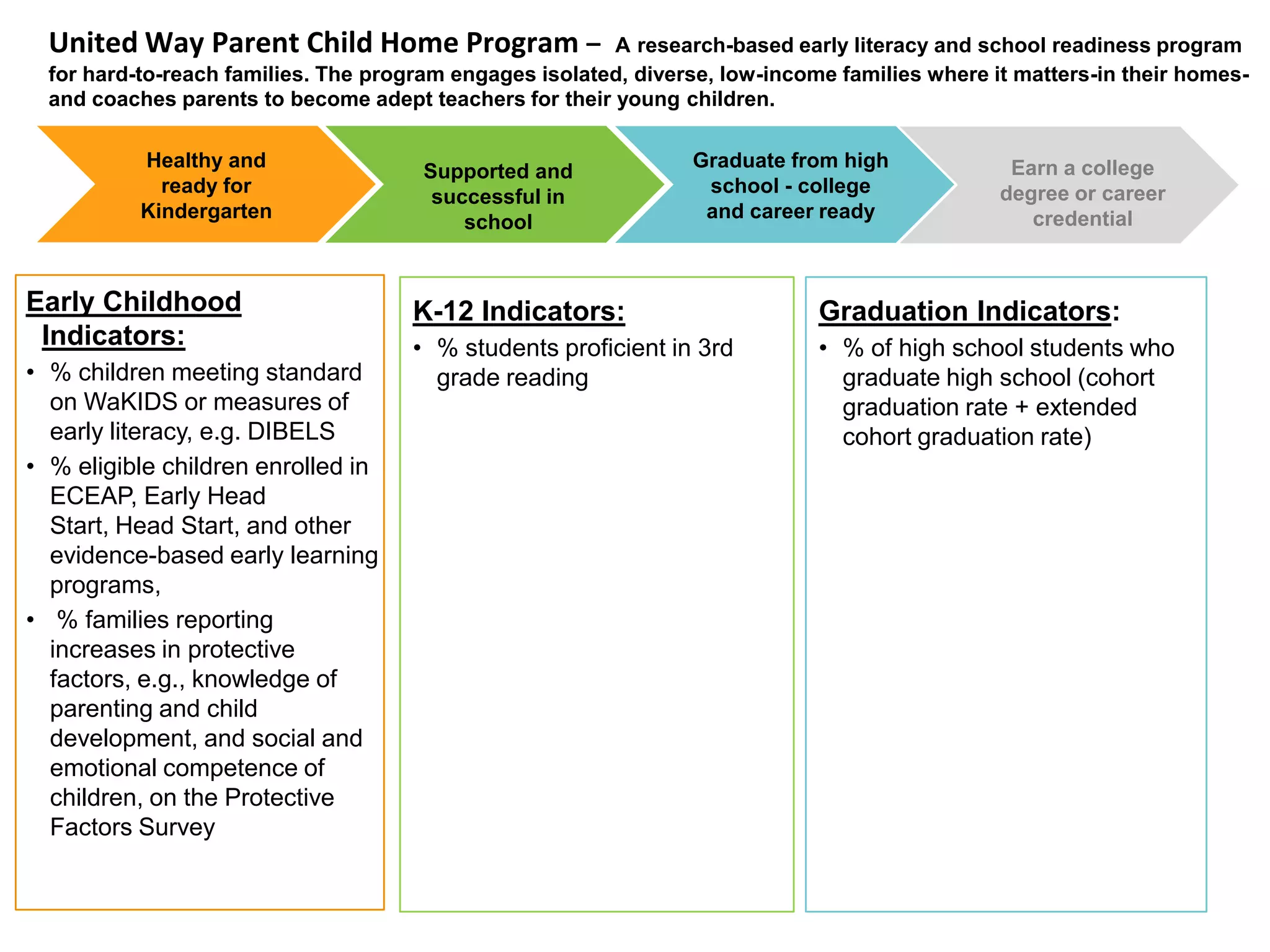
    United Way ParentChild Home Program –Aresearch-based early literacy and school readiness program for hard-to-reach families. The program engages isolated, diverse, low-income families where it matters-in their homes-and coaches parents to become adept teachers for their young children. Healthy and ready for KindergartenSupported and successful in schoolGraduate from high school - college and career readyEarn a college degree or career credentialK-12 Indicators:% students proficient in 3rd grade readingGraduation Indicators:% of high school students who graduate high school (cohort graduation rate + extended cohort graduation rate)Early Childhood Indicators:% children meeting standard on WaKIDS or measures of early literacy, e.g. DIBELS
  • 84.
    % eligible childrenenrolled in ECEAP, Early Head Start, Head Start, and other evidence-based early learning programs,
  • 85.
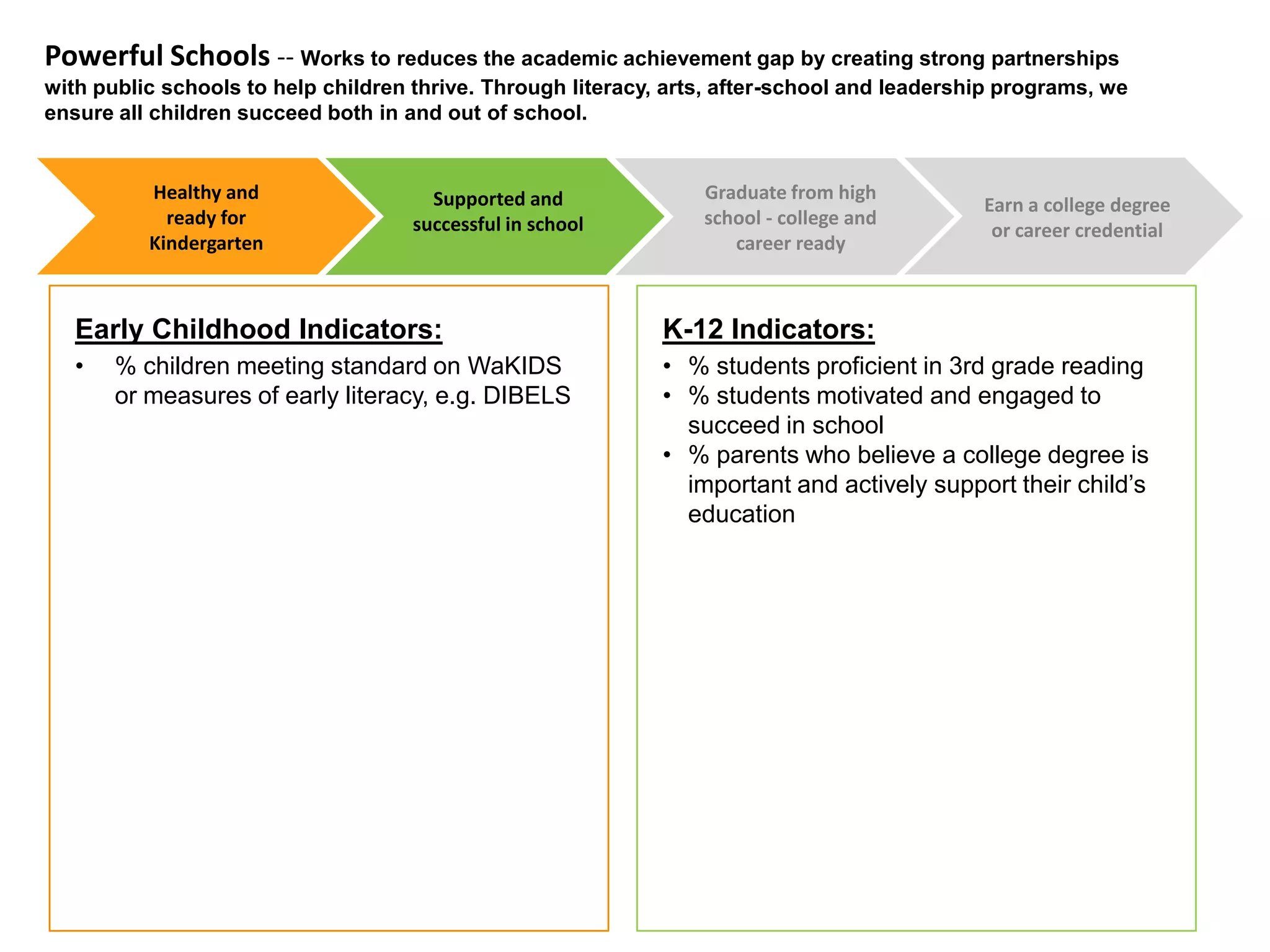
    % familiesreporting increases in protective factors, e.g., knowledge of parenting and child development, and social and emotional competence of children, on the Protective Factors SurveyPowerful Schools -- Works to reduces the academic achievement gap by creating strong partnerships with public schools to help children thrive. Through literacy, arts, after-school and leadership programs, we ensure all children succeed both in and out of school.Healthy and ready for KindergartenGraduate from high school - college and career readyEarn a college degree or career credentialSupported and successful in schoolK-12 Indicators:% students proficient in 3rd grade reading
  • 86.
    % students motivatedand engaged to succeed in school
  • 87.
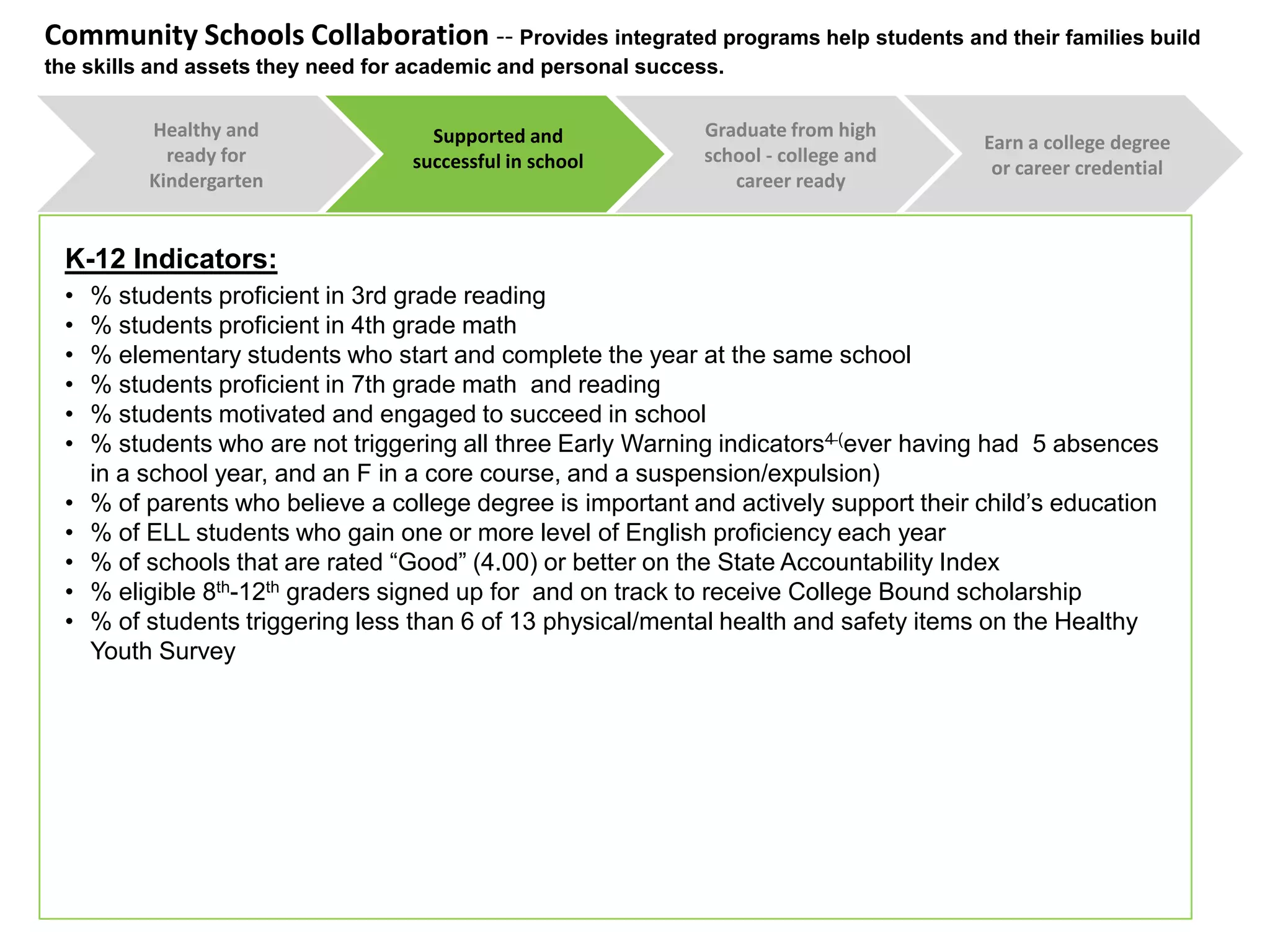
    % parents whobelieve a college degree is important and actively support their child’s educationEarly Childhood Indicators:% children meeting standard on WaKIDS or measures of early literacy, e.g. DIBELSCommunity Schools Collaboration -- Provides integrated programs help students and their families build the skills and assets they need for academic and personal success.Supported and successful in schoolHealthy and ready for KindergartenGraduate from high school - college and career readyEarn a college degree or career credentialK-12 Indicators:% students proficient in 3rd grade reading
  • 88.
    % students proficientin 4th grade math
  • 89.
    % elementary studentswho start and complete the year at the same school
  • 90.
    % students proficientin 7th grade math and reading
  • 91.
    % students motivatedand engaged to succeed in school
  • 92.
    % students whoare not triggering all three Early Warning indicators4 (ever having had 5 absences in a school year, and an F in a core course, and a suspension/expulsion)
  • 93.
    % of parentswho believe a college degree is important and actively support their child’s education
  • 94.
    % of ELLstudents who gain one or more level of English proficiency each year
  • 95.
    % of schoolsthat are rated “Good” (4.00) or better on the State Accountability Index
  • 96.
    % eligible 8th-12thgraders signed up for and on track to receive College Bound scholarship
  • 97.
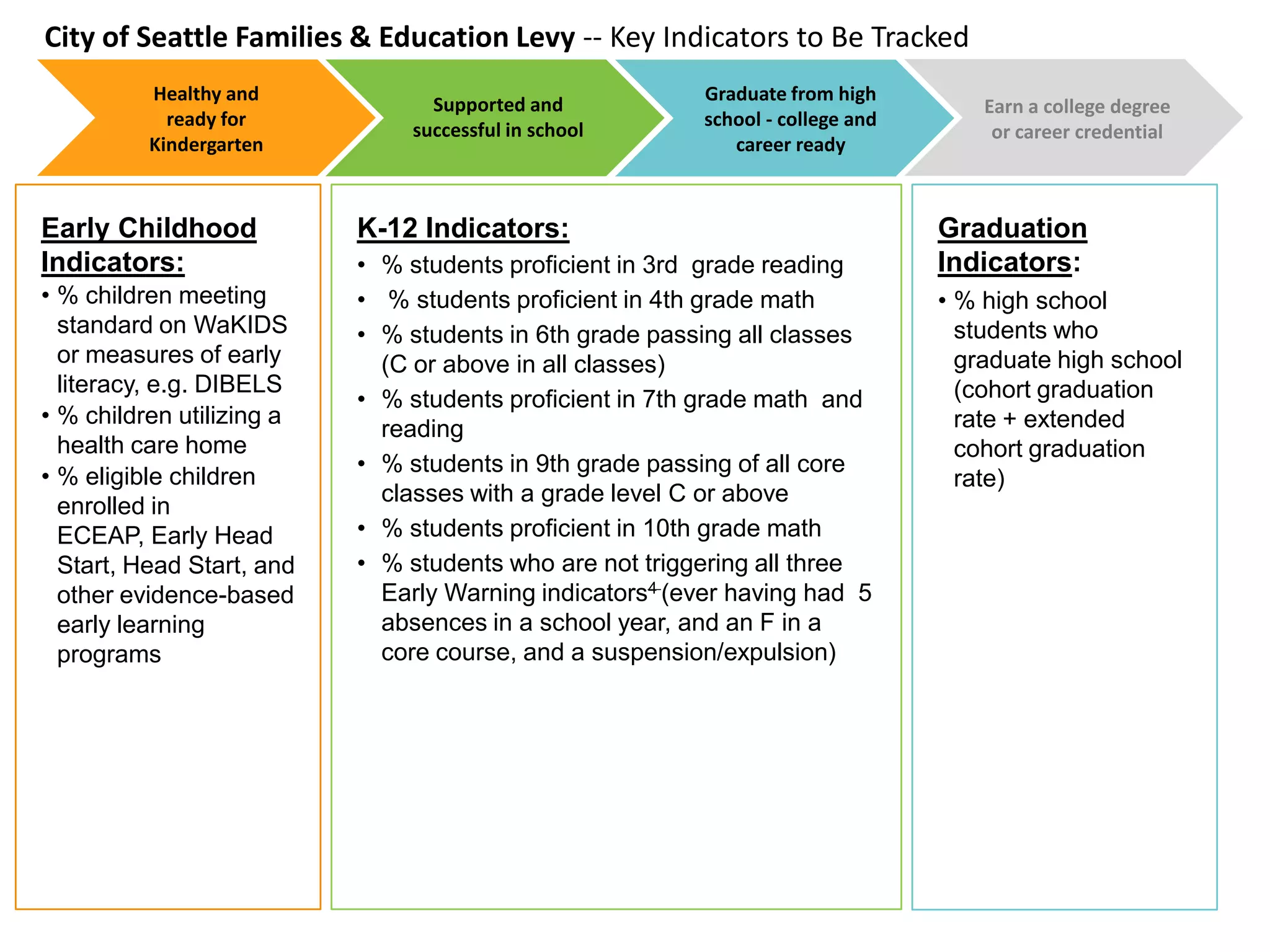
    % of studentstriggering less than 6 of 13 physical/mental health and safety items on the Healthy Youth SurveyCity of Seattle Families & Education Levy-- Key Indicators to Be TrackedSupported and successful in schoolHealthy and ready for KindergartenGraduate from high school - college and career readyEarn a college degree or career credentialK-12 Indicators:% students proficient in 3rd grade reading
  • 98.
    % studentsproficient in 4th grade math
  • 99.
    % students in6th grade passing all classes (C or above in all classes)
  • 100.
    % students proficientin 7th grade math and reading
  • 101.
    % students in9th grade passing of all core classes with a grade level C or above
  • 102.
    % students proficientin 10th grade math
  • 103.
    % students whoare not triggering all three Early Warning indicators4 (ever having had 5 absences in a school year, and an F in a core course, and a suspension/expulsion)Early Childhood Indicators:% children meeting standard on WaKIDS or measures of early literacy, e.g. DIBELS
  • 104.
    % children utilizinga health care home
  • 105.
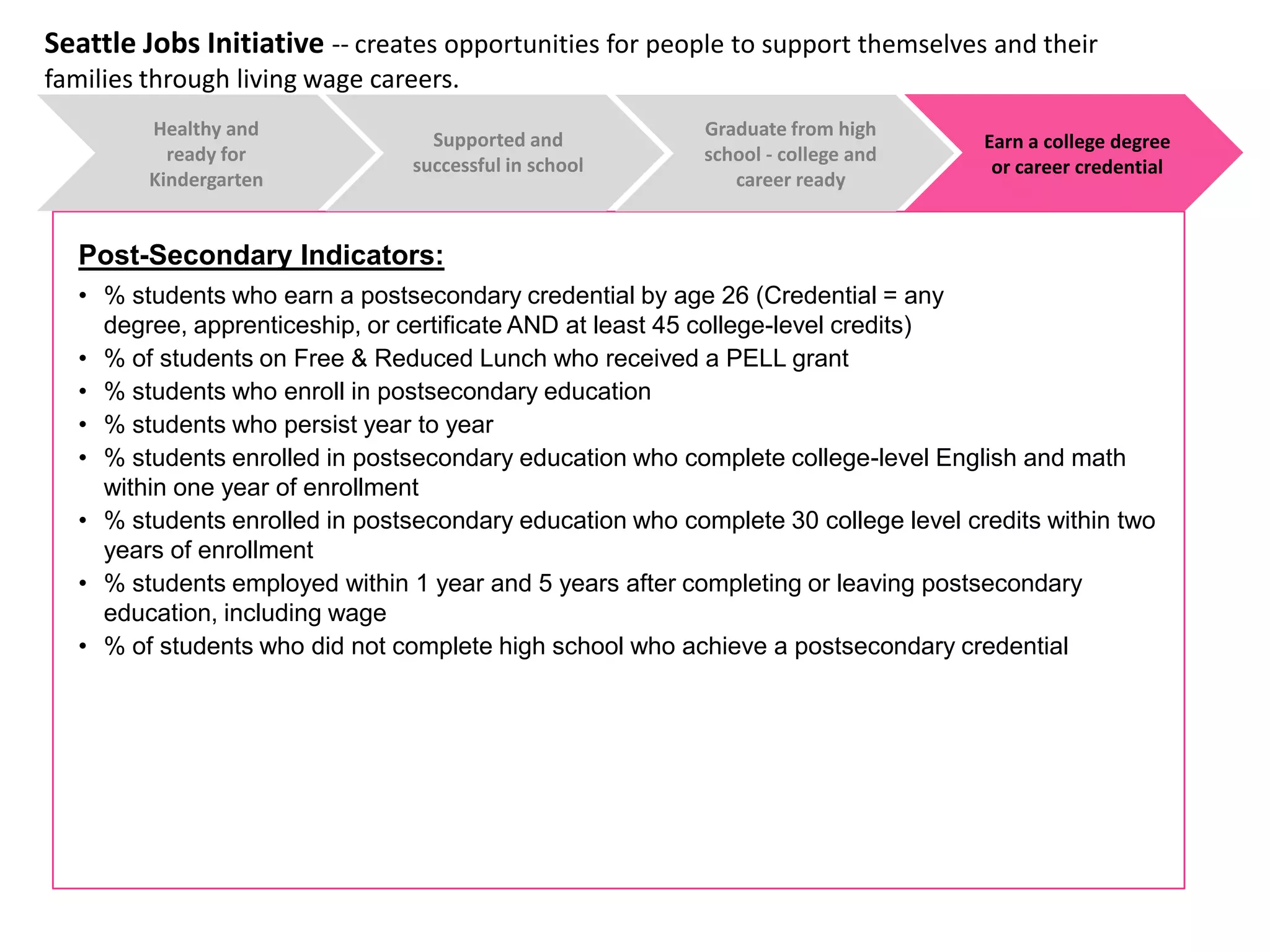
    % eligible childrenenrolled in ECEAP, Early Head Start, Head Start, and other evidence-based early learning programsGraduation Indicators:% high school students who graduate high school (cohort graduation rate + extended cohort graduation rate)Seattle Jobs Initiative -- creates opportunities for people to support themselves and their families through living wage careers.Supported and successful in schoolHealthy and ready for KindergartenGraduate from high school - college and career readyEarn a college degree or career credentialPost-Secondary Indicators:% students who earn a postsecondary credential by age 26 (Credential = any degree, apprenticeship, or certificate AND at least 45 college-level credits)
  • 106.
    % of studentson Free & Reduced Lunch who received a PELL grant
  • 107.
    % students whoenroll in postsecondary education
  • 108.
    % students whopersist year to year
  • 109.
    % students enrolledin postsecondary education who complete college-level English and math within one year of enrollment
  • 110.
    % students enrolledin postsecondary education who complete 30 college level credits within two years of enrollment
  • 111.
    % students employedwithin 1 year and 5 years after completing or leaving postsecondary education, including wage
  • 112.
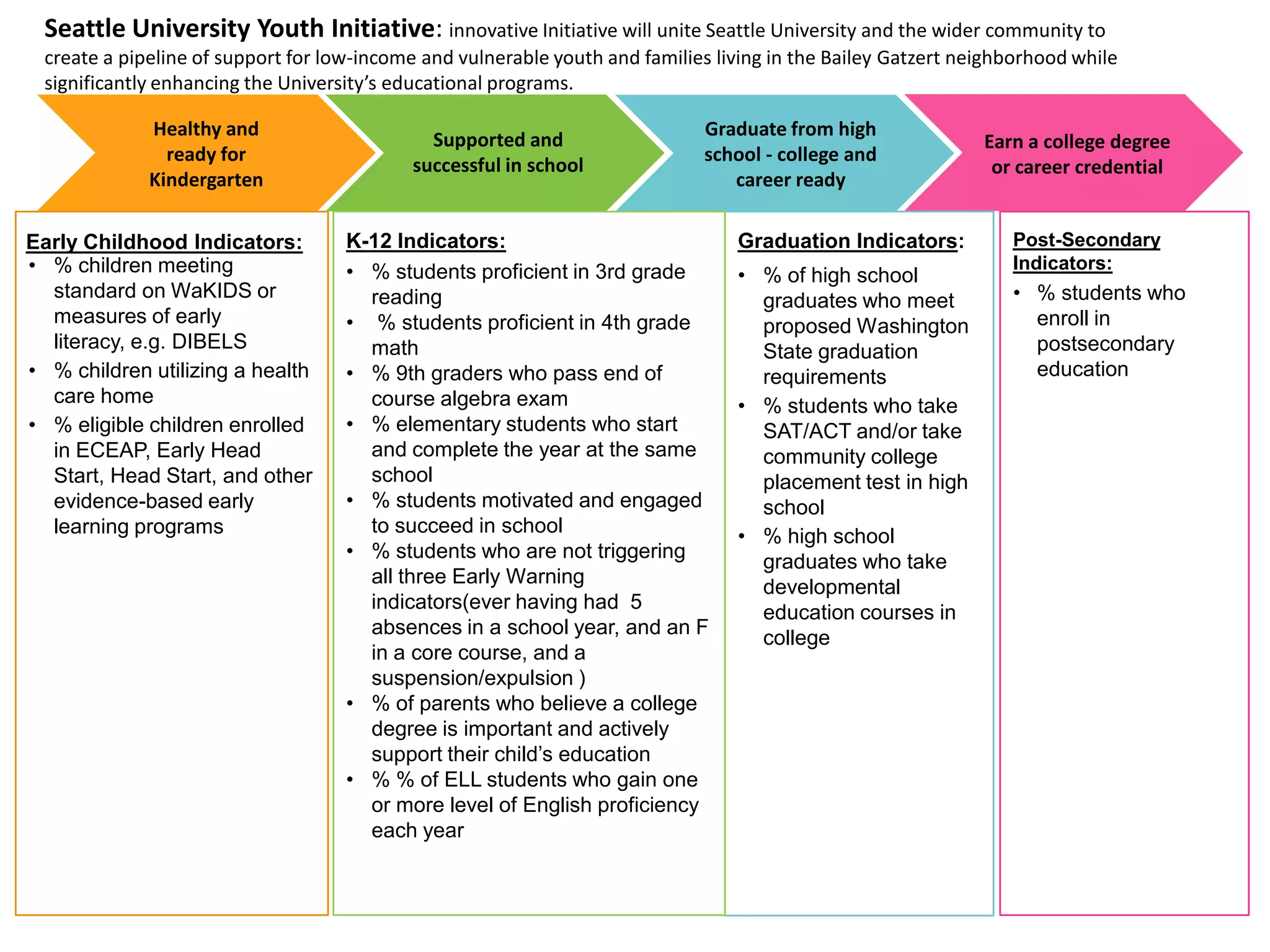
    % of studentswho did not complete high school who achieve a postsecondary credentialSeattle University Youth Initiative: innovative Initiative will unite Seattle University and the wider community to create a pipeline of support for low-income and vulnerable youth and families living in the Bailey Gatzert neighborhood while significantly enhancing the University’s educational programs. Supported and successful in schoolHealthy and ready for KindergartenGraduate from high school - college and career readyEarn a college degree or career credentialK-12 Indicators:% students proficient in 3rd grade reading
  • 113.
    % studentsproficient in 4th grade math
  • 114.
    % 9th graderswho pass end of course algebra exam
  • 115.
    % elementary studentswho start and complete the year at the same school
  • 116.
    % students motivatedand engaged to succeed in school
  • 117.
    % students whoare not triggering all three Early Warning indicators(ever having had 5 absences in a school year, and an F in a core course, and a suspension/expulsion )
  • 118.
    % of parentswho believe a college degree is important and actively support their child’s education
  • 119.
    % % ofELL students who gain one or more level of English proficiency each year
  • 120.
    % children meetingstandard on WaKIDS or measures of early literacy, e.g. DIBELS
  • 121.
    % children utilizinga health care home
  • 122.
    % eligible childrenenrolled in ECEAP, Early Head Start, Head Start, and other evidence-based early learning programsPost-Secondary Indicators:% students who enroll in postsecondary educationGraduation Indicators:% of high school graduates who meet proposed Washington State graduation requirements
  • 123.
    % students whotake SAT/ACT and/or take community college placement test in high school
  • 124.
    % high schoolgraduates who take developmental education courses in collegeEarly Childhood Indicators:
  • 125.
    312020 Goal IndicatorsStrategiesK12P- 3 HS –> College/ Career Credential Aligned Organizational ActionsData Community Engagement / AdvocacyFunder AlignmentRoad Map for Education Resultswww.ccedresults.org
  • 126.
    32Building the “How”Together: A Common Agenda Strategy Work GroupsDefining system building actionsCommunity Network & Advocates CaucusSupporting parents & community involvementK-12 Superintendents & Community College PresidentsConnecting system leadersEducation Results NetworkProviding input and building connectionsProject SponsorsProviding strategic directionThe Road Map ProjectData AdvisorsEnsuring it all adds up Road Map Aligned FundersInvesting for greater system impactCCER Staff and Consultant TeamRoad Map for Education Resultswww.ccedresults.org
  • 127.
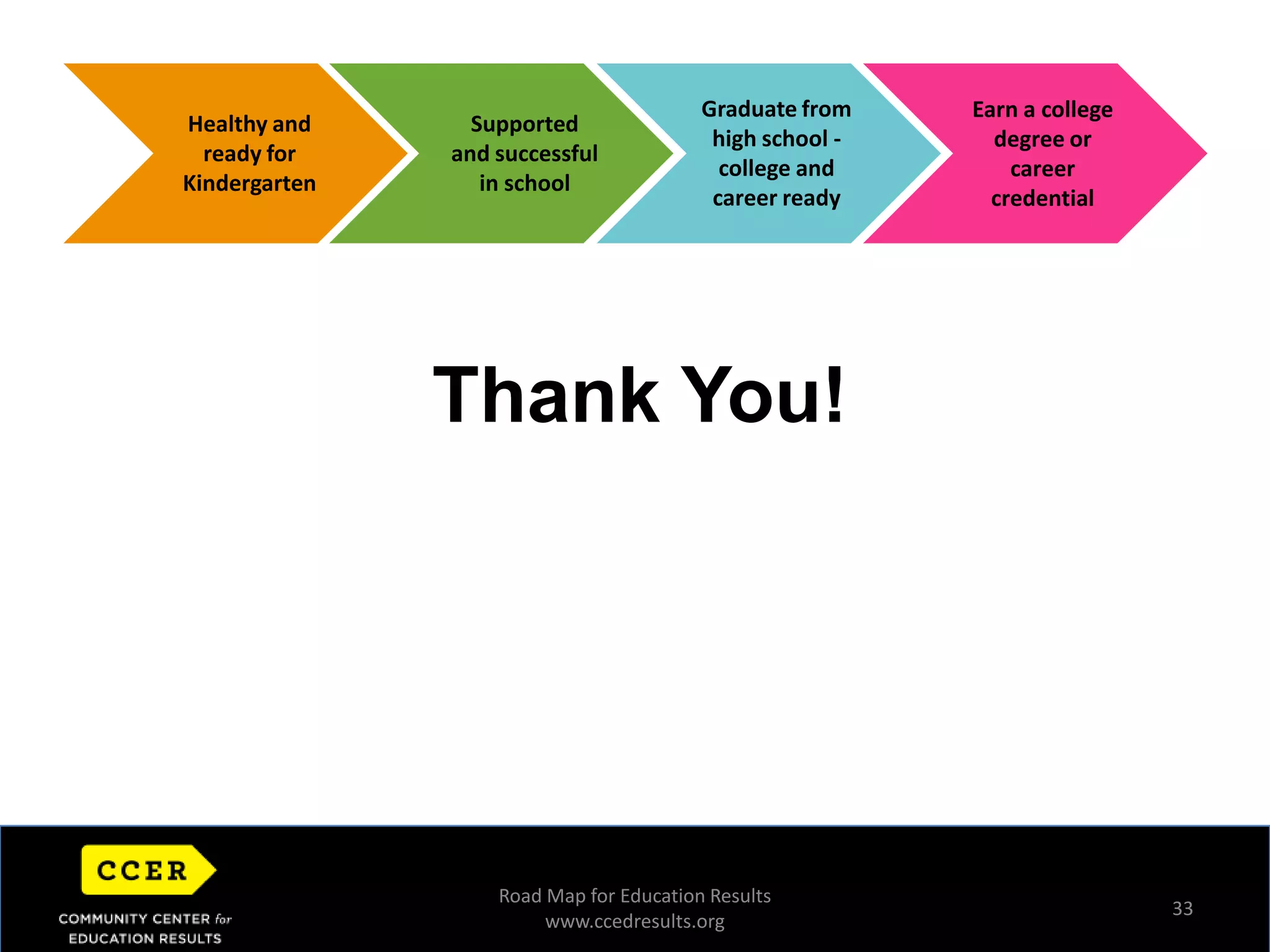
    33Graduate from highschool - college and career readyEarn a college degree or career credentialHealthy and ready for KindergartenSupported and successful in schoolThank You!Road Map for Education Resultswww.ccedresults.org

Editor's Notes

  • #4 Engaging the community and Road Map partners will be critical to vetting and selecting priority actionsAs work groups recommend priority actions, there will be a process for vetting their recommendations and gathering input from a range of Road Map partners.The Ed Results Network will play a critical role in this process, and we will anticipate having work products on priority action selections at the June and September meetings
  • #8 Our goal should be doing as well for the children raised here as other communities do for those who move here- the migration here of BA’s and AA’s is off the charts.Grow up- Show up
  • #33 Engaging the community and Road Map partners will be critical to vetting and selecting priority actionsAs work groups recommend priority actions, there will be a process for vetting their recommendations and gathering input from a range of Road Map partners.The Ed Results Network will play a critical role in this process, and we will anticipate having work products on priority action selections at the June and September meetings