Key Findings   American Institute of Architects    Nationwide Voter Survey 2009 Thinking about energy in the United States -- how would you characterize the energy situation right now in this country?  Would you say that:   2009  2007 We are doing well   4  5 We are doing okay 17 19 We are having some problems 29 34 We are on the verge of a crisis 28 28 We are in an energy crisis 21 13 COMMENT : Voters see the energy problem more negatively than they did two years ago, but not by large margins. Doing “well” and “okay” combined has declined from 24% to 21% and “verge of a crisis” combined with “in an energy  crisis” has increased from 41% to 49%. All responses of a negative nature total  78% indicating that Americans believe that the energy situation is a problem of one  degree or another.
Key Findings American Institute of Architects  Nationwide Voter Survey 2009 Issue importance (10-point scale):    9s and 10s   2009 Mean  2009  2007  2004 Making U.S. less dependent on foreign oil  8.60     65 61  51 Controlling medical insurance costs 8.33     64 67 Protecting against air and water pollution 7.89     44  48   41* Increasing # of energy efficient buildings  7.67   39 36   Holding down the price of gasoline   7.55   47  51 Controlling electricity and utility rates 7.51     41  46  47 Reducing greenhouse gas emissions  that may cause global warming   6.85     35 42 COMMENT : Energy dependence and increasing the number of energy efficient buildings are the only two issues that increased in importance among respondents who gave them 9 or 10 ratings. All the other issues declined somewhat in importance. Notably, reducing greenhouse emissions declined 7 points.


Maintenance of a building’s site is a fundamental component of comprehensive, sustainable building operation. Sustainable Sites
 
Sustainable Sites
Sustainable Sites
Americans extract 3700 billion gallons per year more than they return to the natural water system to recharge aquifers and other water sources.  Water Efficiency
Source USGS
 
Water Efficiency
Dr. Nocera said human activities, in energy terms, right now are essentially a “12.8 trillion watt light bulb.” Our energy thirst will probably be 30 trillion watts, or 30 terrawatts, by 2050 with the human population heading toward 9 billion. Energy and Atmosphere
- Cut down every plant on Earth and make it into a fuel. You get 7 terawatts, but you need 30. And you don’t eat. - Build nuclear plants. Around 8 terawatts could be gotten from nuclear power if you built a new billion-watt plant every 1.6 days until 2050. - Take all the wind energy available close to Earth’s surface and you get 2 terawatts. - You get 1 more terawatt if you dam every other river on the planet and reach 30. Then he turned to the sun, his research focus, which bathes the planet in 800 terawatts of energy continually. “We only need 18 of those terawatts,” he said. But the current level of investment in pursuing that energy, he said, isn’t even close to sufficient .
 
Energy & Atmosphere
Energy & Atmosphere
Energy & Atmosphere June 21 st  Summer Solstice 9:00 am to 5:00 pm
Energy & Atmosphere Sept 21 st  Autumnal Equinox 9:00 am to 5:00 pm
The credits in this section focus on two main issues: (1) the environmental impact of each material brought into the project building and (2) the minimization of landfill and incinerator disposal for each material taken out of the project building. Materials & Resources
 
Materials & Resources
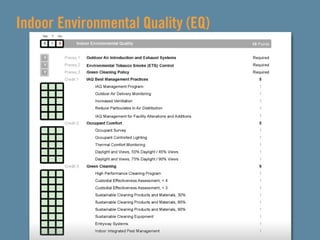
Americans spend an average of 90% of their time indoors, and the quality of the indoor environment therefore has a significant influence on their well-being, productivity and quality of life. Indoor Environmental Quality
 
Indoor Environmental Quality


66.9%  waste diverted 16.7%  water savings green power 12.9%  Projected savings


RMPF Presentation 3-31-09

  • 1.
  • 2.
  • 3.
  • 4.
  • 5.
  • 6.
  • 7.
  • 8.
  • 9.
    Key Findings American Institute of Architects Nationwide Voter Survey 2009 Thinking about energy in the United States -- how would you characterize the energy situation right now in this country? Would you say that: 2009 2007 We are doing well 4 5 We are doing okay 17 19 We are having some problems 29 34 We are on the verge of a crisis 28 28 We are in an energy crisis 21 13 COMMENT : Voters see the energy problem more negatively than they did two years ago, but not by large margins. Doing “well” and “okay” combined has declined from 24% to 21% and “verge of a crisis” combined with “in an energy crisis” has increased from 41% to 49%. All responses of a negative nature total 78% indicating that Americans believe that the energy situation is a problem of one degree or another.
  • 10.
    Key Findings AmericanInstitute of Architects Nationwide Voter Survey 2009 Issue importance (10-point scale): 9s and 10s 2009 Mean 2009 2007 2004 Making U.S. less dependent on foreign oil 8.60 65 61 51 Controlling medical insurance costs 8.33 64 67 Protecting against air and water pollution 7.89 44 48 41* Increasing # of energy efficient buildings 7.67 39 36 Holding down the price of gasoline 7.55 47 51 Controlling electricity and utility rates 7.51 41 46 47 Reducing greenhouse gas emissions that may cause global warming 6.85 35 42 COMMENT : Energy dependence and increasing the number of energy efficient buildings are the only two issues that increased in importance among respondents who gave them 9 or 10 ratings. All the other issues declined somewhat in importance. Notably, reducing greenhouse emissions declined 7 points.
  • 11.
  • 12.
  • 13.
  • 14.
  • 15.
  • 16.
  • 17.
  • 18.
  • 19.
  • 20.
  • 21.
    Maintenance of abuilding’s site is a fundamental component of comprehensive, sustainable building operation. Sustainable Sites
  • 22.
  • 23.
  • 24.
  • 25.
    Americans extract 3700billion gallons per year more than they return to the natural water system to recharge aquifers and other water sources. Water Efficiency
  • 26.
  • 27.
  • 28.
  • 29.
    Dr. Nocera saidhuman activities, in energy terms, right now are essentially a “12.8 trillion watt light bulb.” Our energy thirst will probably be 30 trillion watts, or 30 terrawatts, by 2050 with the human population heading toward 9 billion. Energy and Atmosphere
  • 30.
    - Cut downevery plant on Earth and make it into a fuel. You get 7 terawatts, but you need 30. And you don’t eat. - Build nuclear plants. Around 8 terawatts could be gotten from nuclear power if you built a new billion-watt plant every 1.6 days until 2050. - Take all the wind energy available close to Earth’s surface and you get 2 terawatts. - You get 1 more terawatt if you dam every other river on the planet and reach 30. Then he turned to the sun, his research focus, which bathes the planet in 800 terawatts of energy continually. “We only need 18 of those terawatts,” he said. But the current level of investment in pursuing that energy, he said, isn’t even close to sufficient .
  • 31.
  • 32.
  • 33.
  • 34.
    Energy & AtmosphereJune 21 st Summer Solstice 9:00 am to 5:00 pm
  • 35.
    Energy & AtmosphereSept 21 st Autumnal Equinox 9:00 am to 5:00 pm
  • 36.
    The credits inthis section focus on two main issues: (1) the environmental impact of each material brought into the project building and (2) the minimization of landfill and incinerator disposal for each material taken out of the project building. Materials & Resources
  • 37.
  • 38.
  • 39.
    Americans spend anaverage of 90% of their time indoors, and the quality of the indoor environment therefore has a significant influence on their well-being, productivity and quality of life. Indoor Environmental Quality
  • 40.
  • 41.
  • 42.
  • 43.
  • 44.
  • 45.
  • 46.
  • 47.
    66.9% wastediverted 16.7% water savings green power 12.9% Projected savings
  • 48.
  • 49.
  • 50.