Winning Performance Challenges
in Oracle MultitenantProduct Manager for Database Tools
February 22nd , 2018
Pini Dibask
RMOUG
Training Days
2018
Confidential2
• Pini Dibask, Product Manager for Database Tools, Quest Software
• Oracle ACE
• Oracle Certified Professional DBA (OCP)
• Public Speaker: Oracle OpenWorld, IOUG Collaborate, DOAG, OUGN, AOUG
• Blogger: OracleDBPro.BlogSpot.com
Pini.Dibask@Quest.com
http://Linkedin.com/in/pinidibask
@pini_dibask
About the Speaker
Confidential3
Who is Quest Software?
9 0 % o f
F o r t u n e 1 0 0
using our
software
1 , 5 0 0
engineers building
quality products
4 M
c o m m u n i t y
m e m b e r s
sharing best practices
3 , 5 0 0
employees focused
on customers
Quest is a global software provider trusted by
100,000 customers and 6,000 partners in 100
countries.
We help IT organizations spend less time on
administration and more time on innovation.
6 , 0 0 0
partners selling
our software
Confidential4
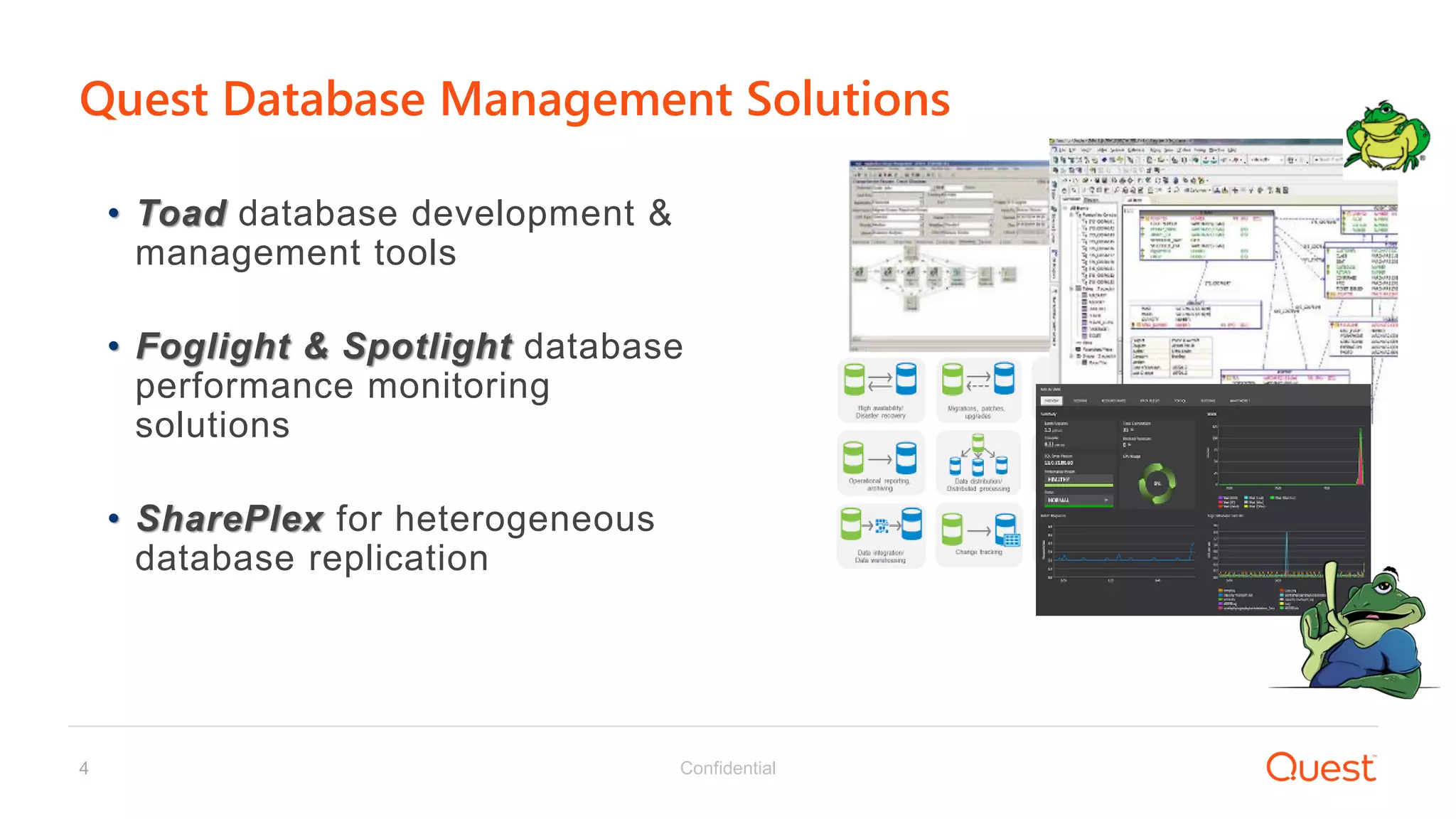
• Toad database development &
management tools
• Foglight & Spotlight database
performance monitoring
solutions
• SharePlex for heterogeneous
database replication
Quest Database Management Solutions
Confidential5
• Introduction to Database Consolidation
• Oracle Multitenant Concepts
• Ensuring QoS in Multitenant Environments
• RAC and Multitenant
• Performance Monitoring for Multitenant Environments
Agenda
Introduction to
Database
Consolidation
01
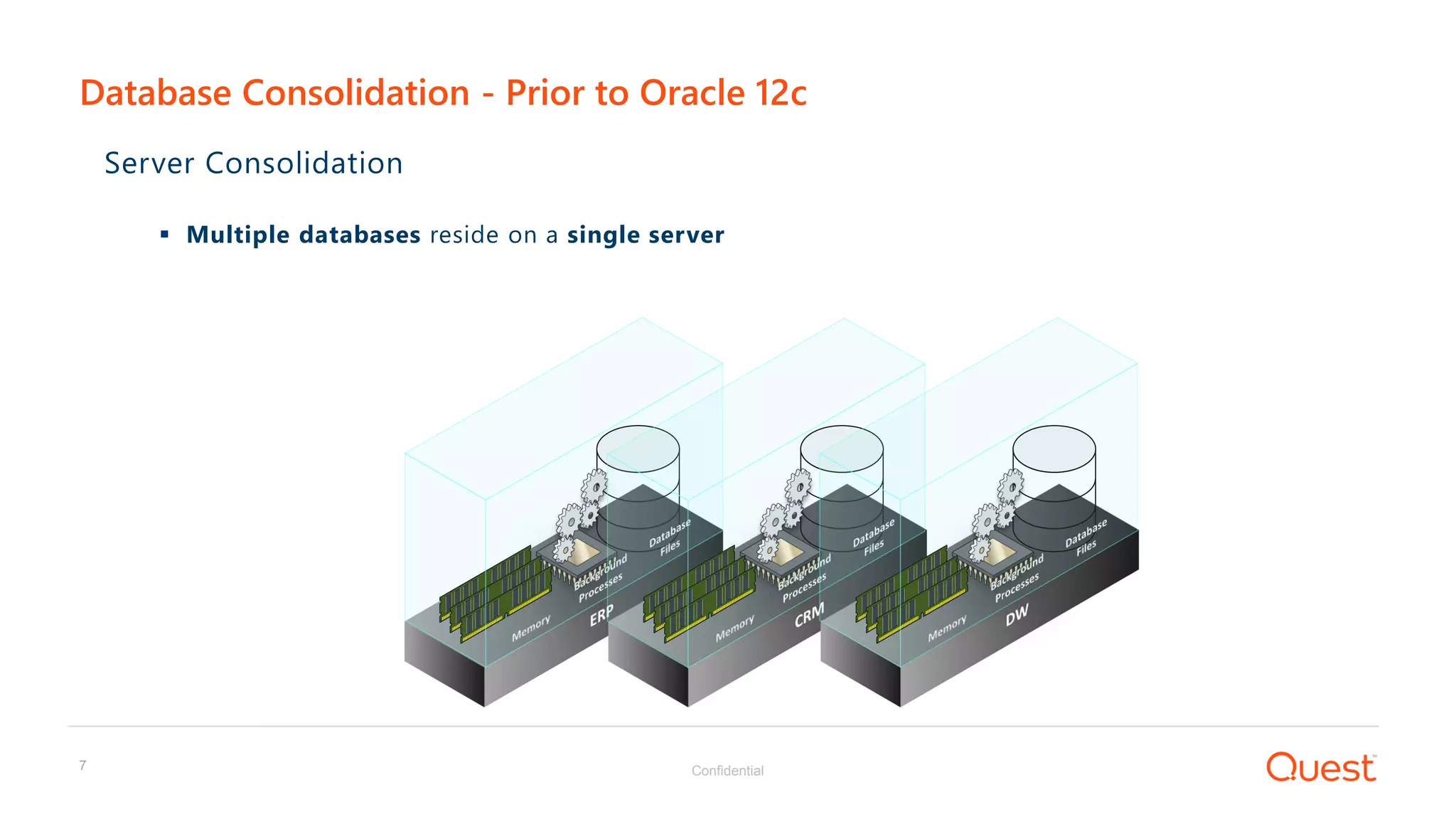
Confidential7
Server Consolidation
 Multiple databases reside on a single server
Database Consolidation - Prior to Oracle 12c
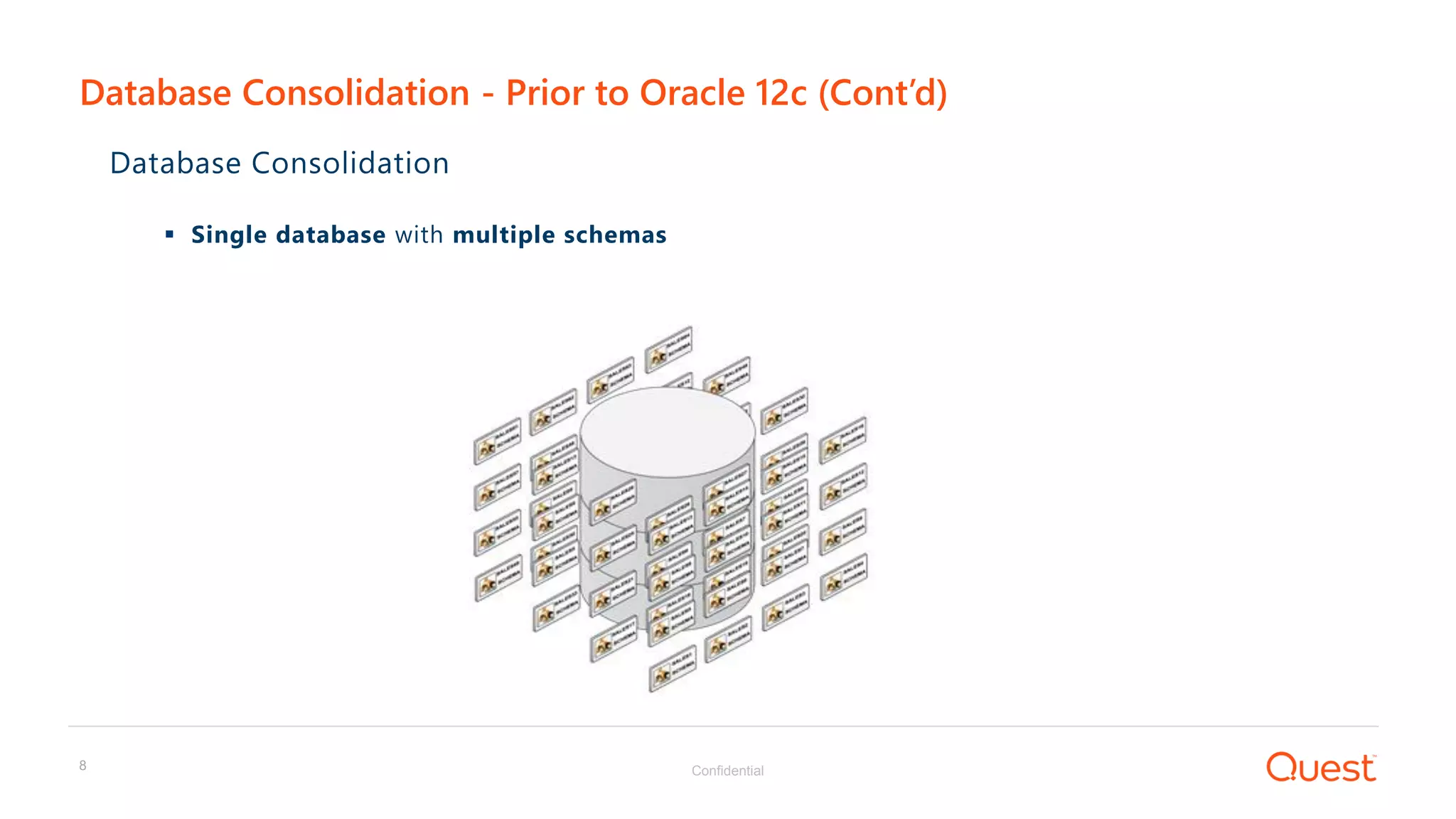
Confidential8
Database Consolidation
 Single database with multiple schemas
Database Consolidation - Prior to Oracle 12c (Cont’d)
Confidential9
 Name Collisions
 Same schema name or same public synonym name
 Security
 DBA can access data of both applications
 Upgrades
 You cannot patch/upgrade only one schema
 Point-In-Time Recovery
 Impossible to perform schema level point-in-time recovery
Database Consolidation with Schema Separation - Challenges
Multitenant
Architecture
02
Confidential11
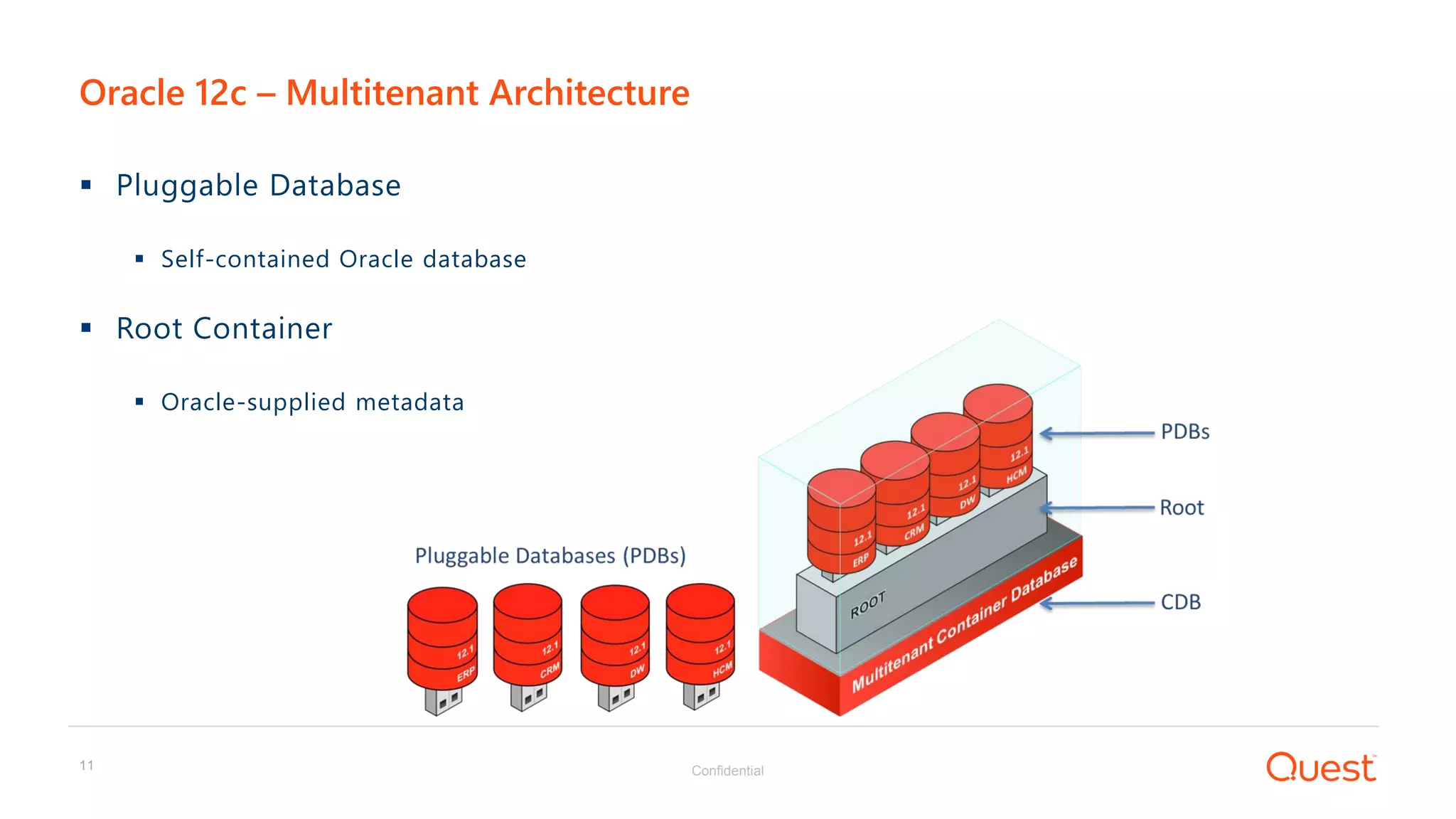
 Pluggable Database
 Self-contained Oracle database
 Root Container
 Oracle-supplied metadata
Oracle 12c – Multitenant Architecture
Confidential12
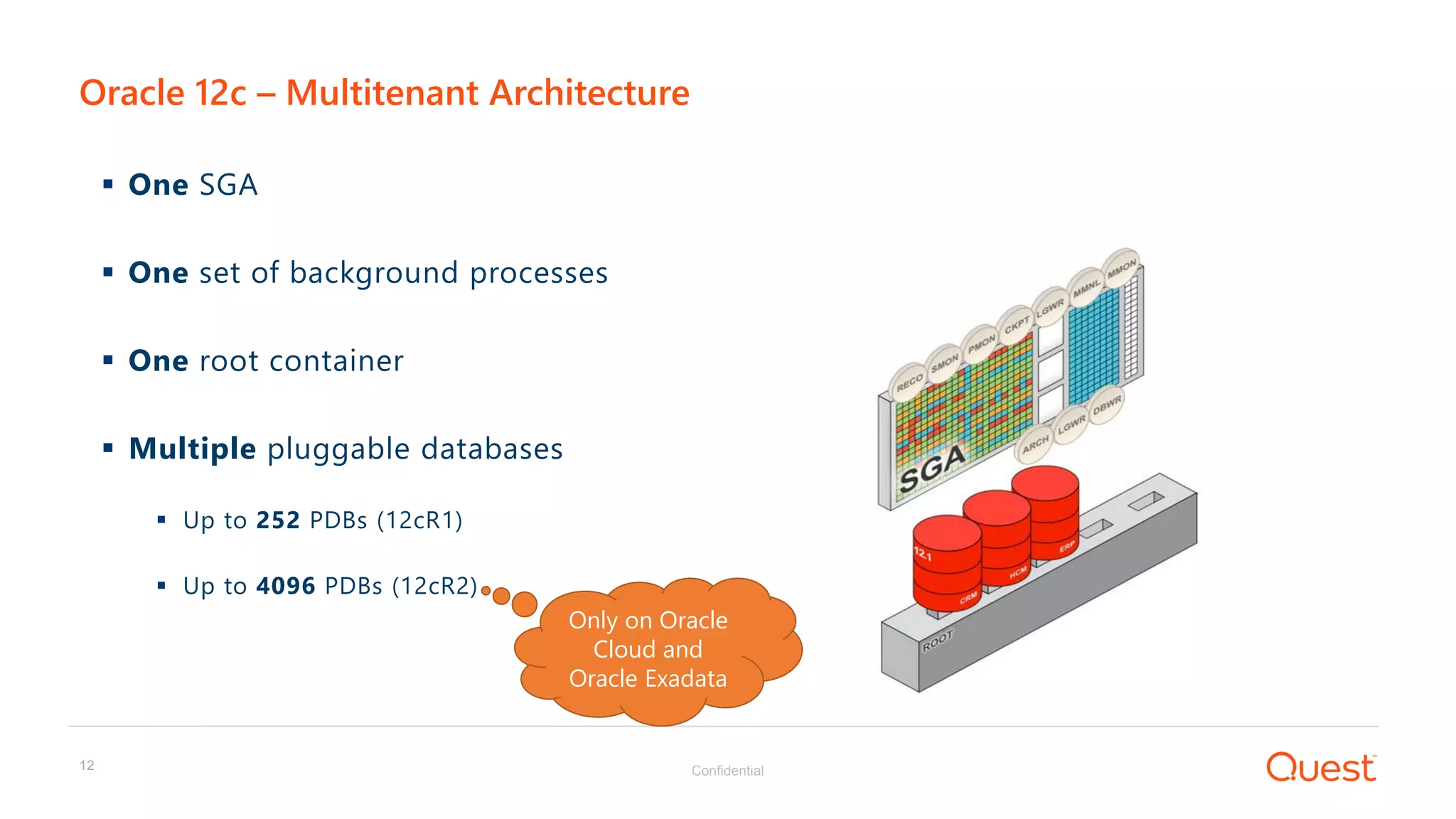
 One SGA
 One set of background processes
 One root container
 Multiple pluggable databases
 Up to 252 PDBs (12cR1)
 Up to 4096 PDBs (12cR2)
Oracle 12c – Multitenant Architecture
Only on Oracle
Cloud and
Oracle Exadata
Confidential13
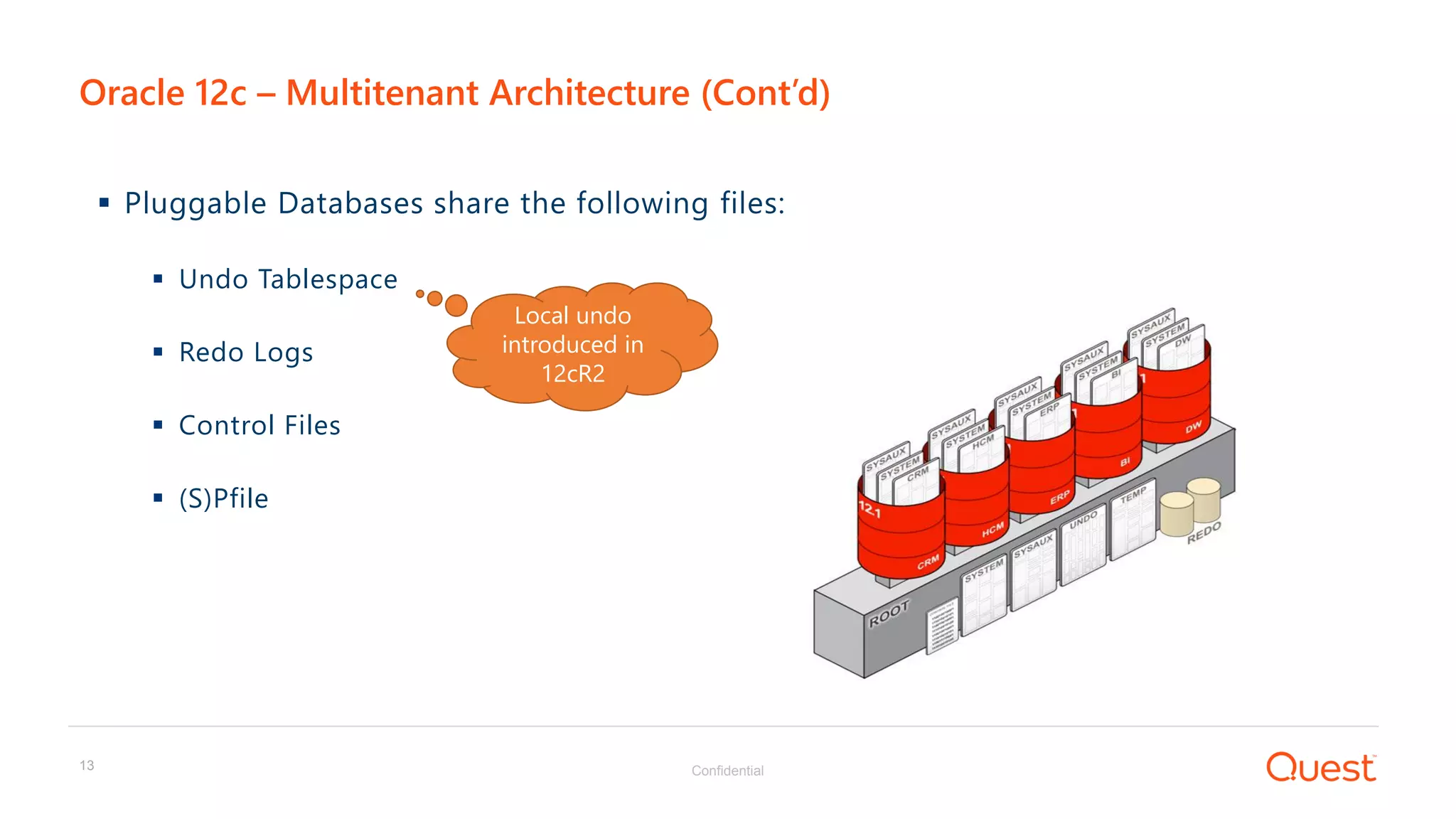
 Pluggable Databases share the following files:
 Undo Tablespace
 Redo Logs
 Control Files
 (S)Pfile
Oracle 12c – Multitenant Architecture (Cont’d)
Local undo
introduced in
12cR2
Confidential14
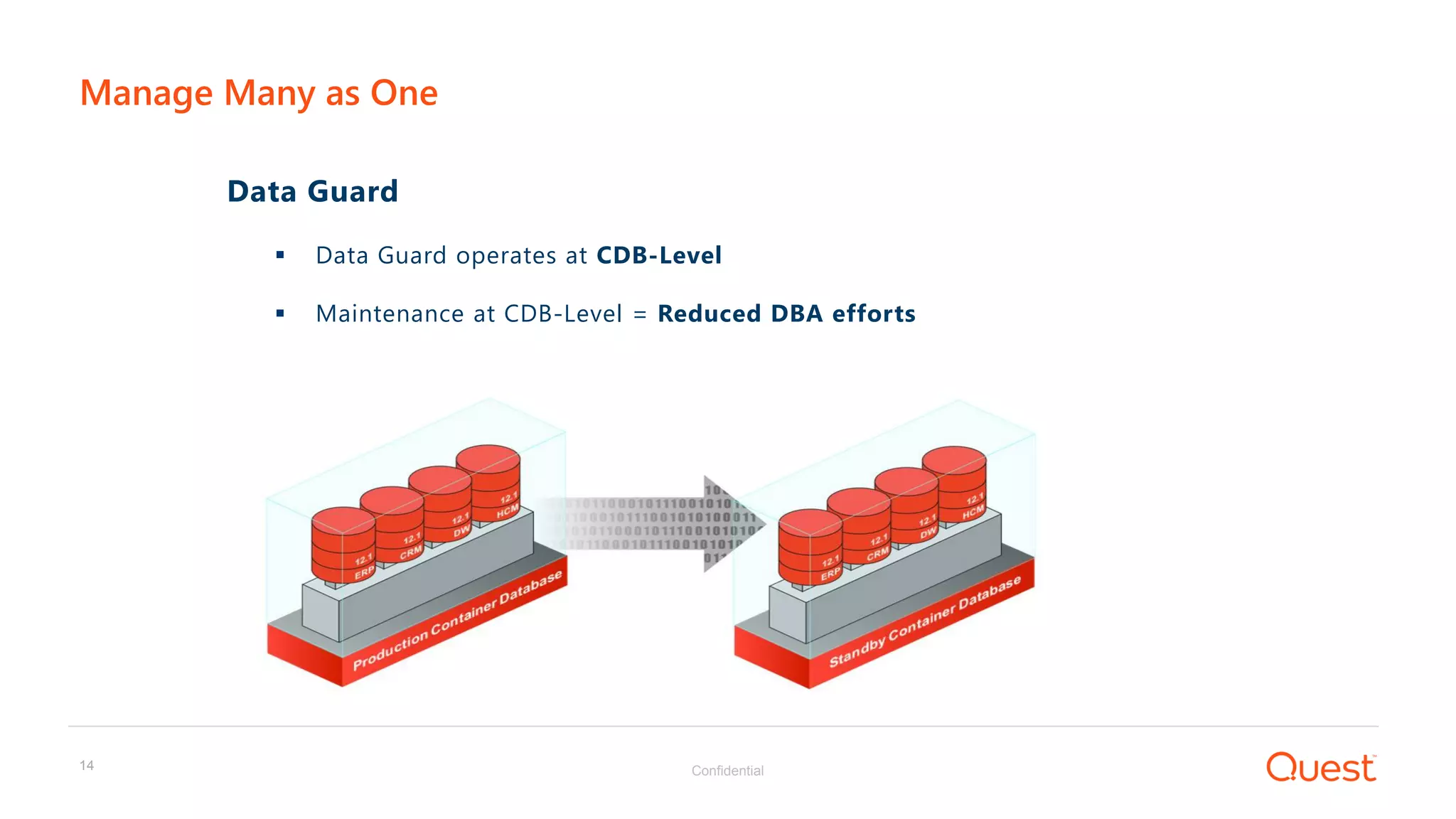
Data Guard
 Data Guard operates at CDB-Level
 Maintenance at CDB-Level = Reduced DBA efforts
Manage Many as One
Confidential15
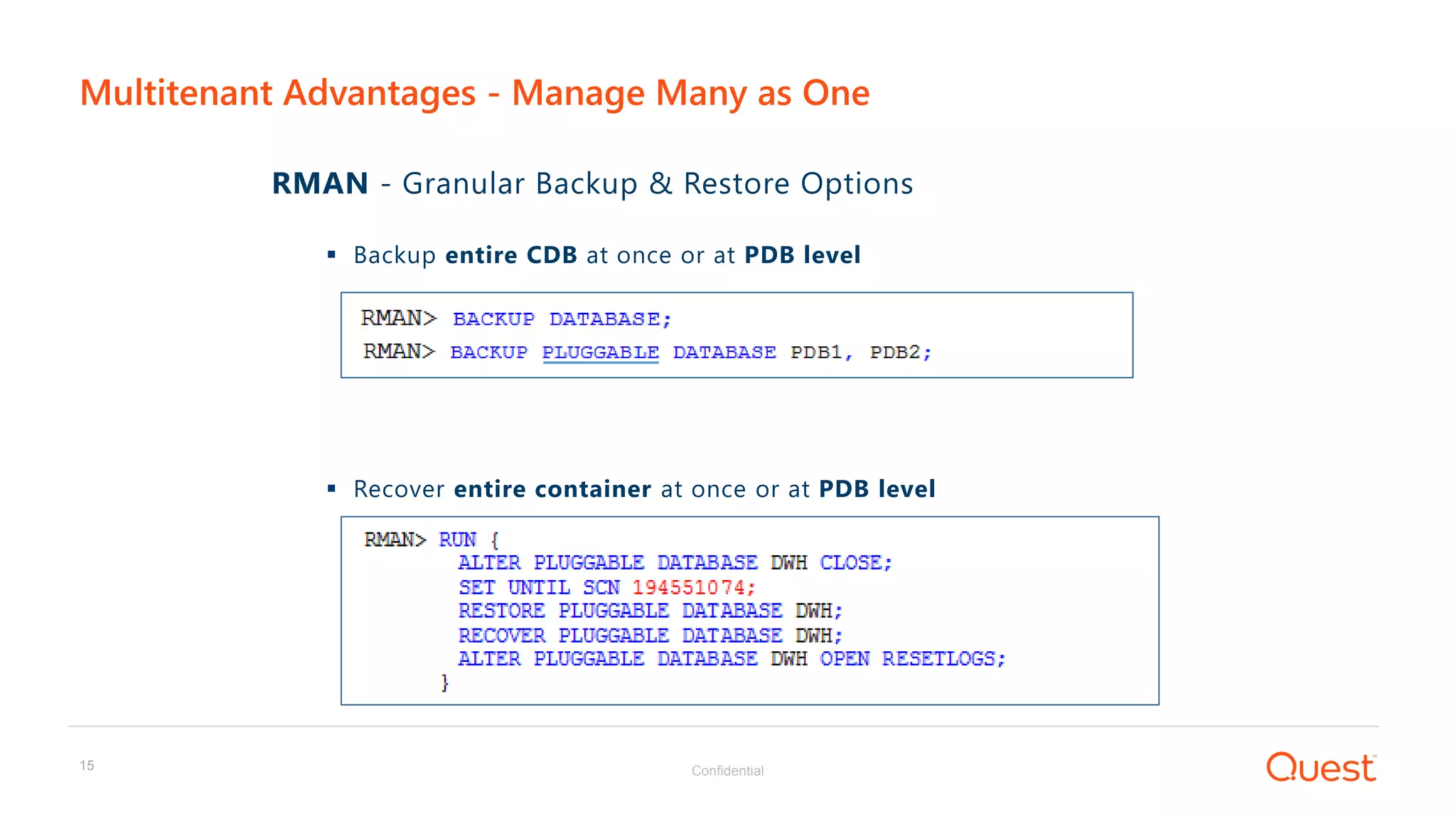
RMAN - Granular Backup & Restore Options
 Backup entire CDB at once or at PDB level
 Recover entire container at once or at PDB level
Multitenant Advantages - Manage Many as One
s
s
Confidential16
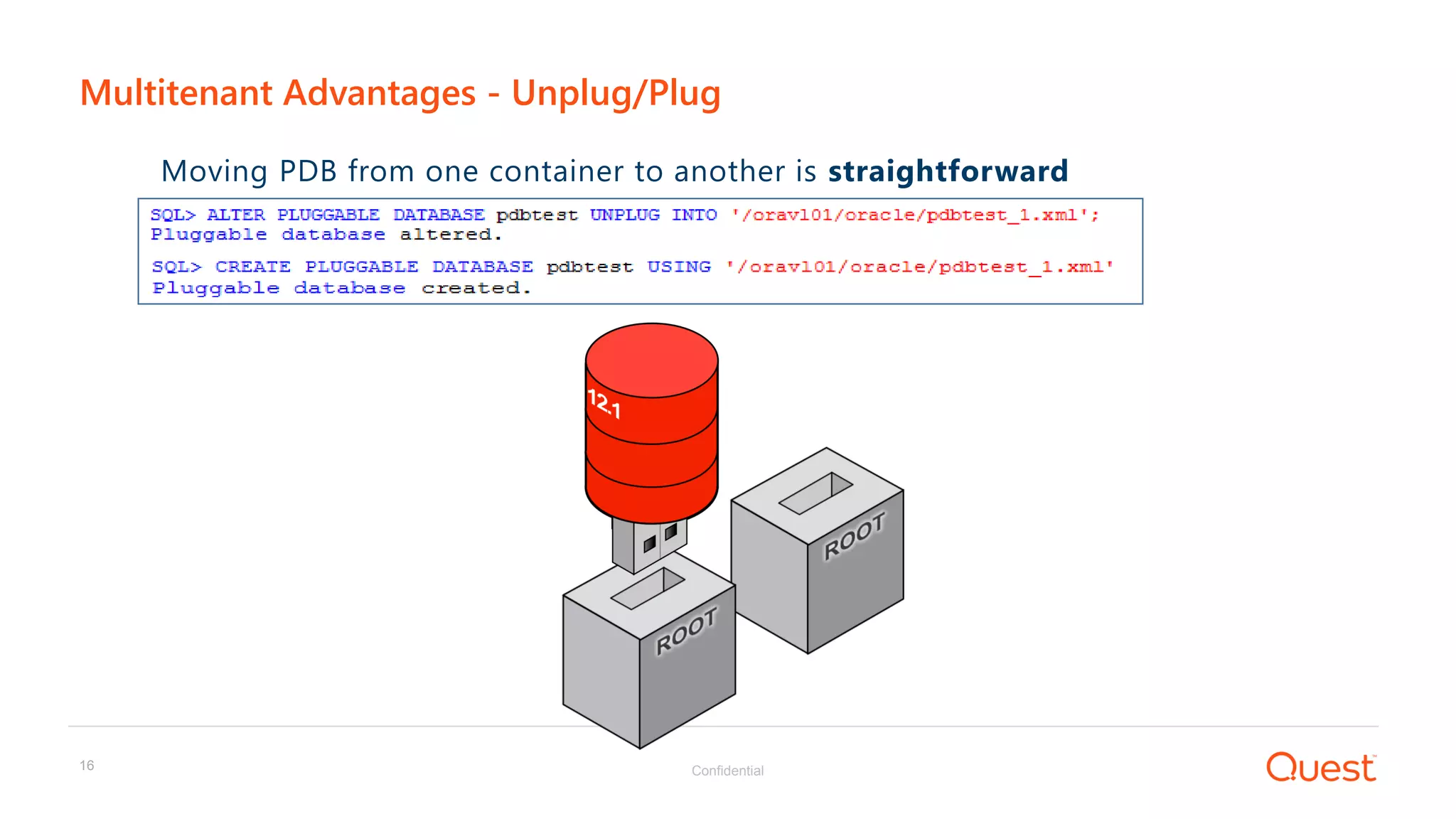
Moving PDB from one container to another is straightforward
Multitenant Advantages - Unplug/Plug
s
Confidential17
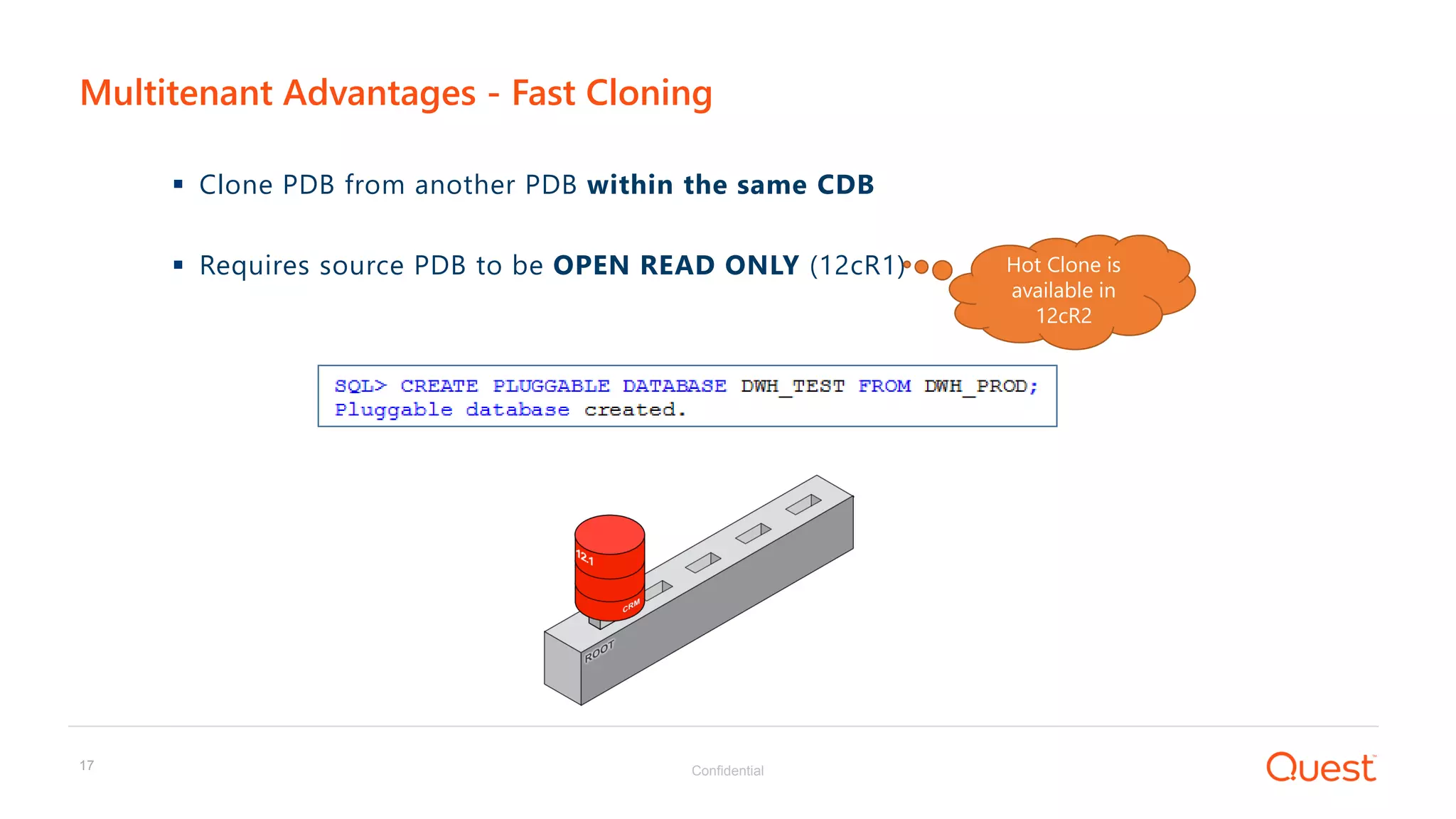
 Clone PDB from another PDB within the same CDB
 Requires source PDB to be OPEN READ ONLY (12cR1)
Multitenant Advantages - Fast Cloning
s
Hot Clone is
available in
12cR2
Confidential18
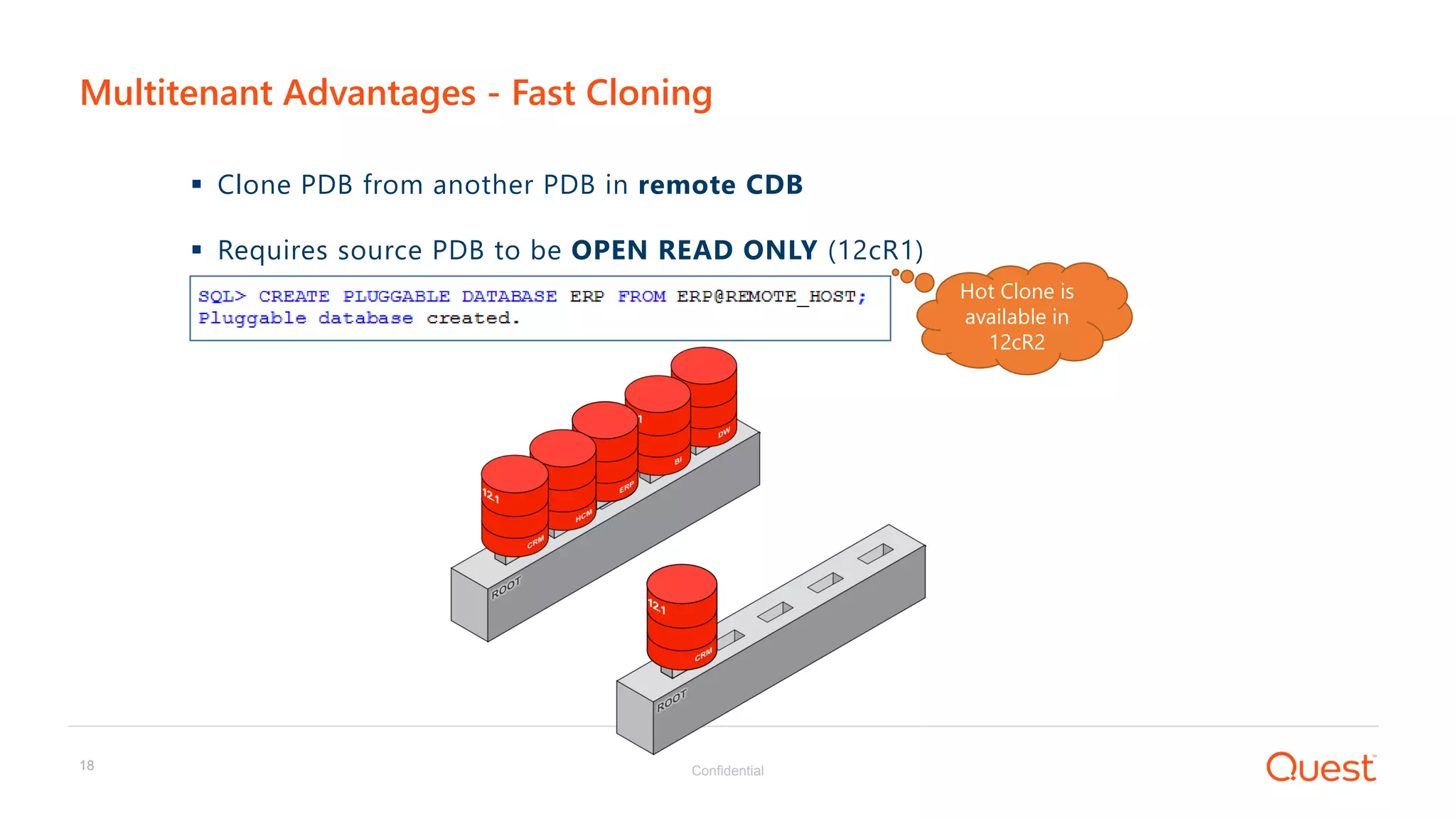
 Clone PDB from another PDB in remote CDB
 Requires source PDB to be OPEN READ ONLY (12cR1)
Multitenant Advantages - Fast Cloning
Hot Clone is
available in
12cR2
s
Confidential19
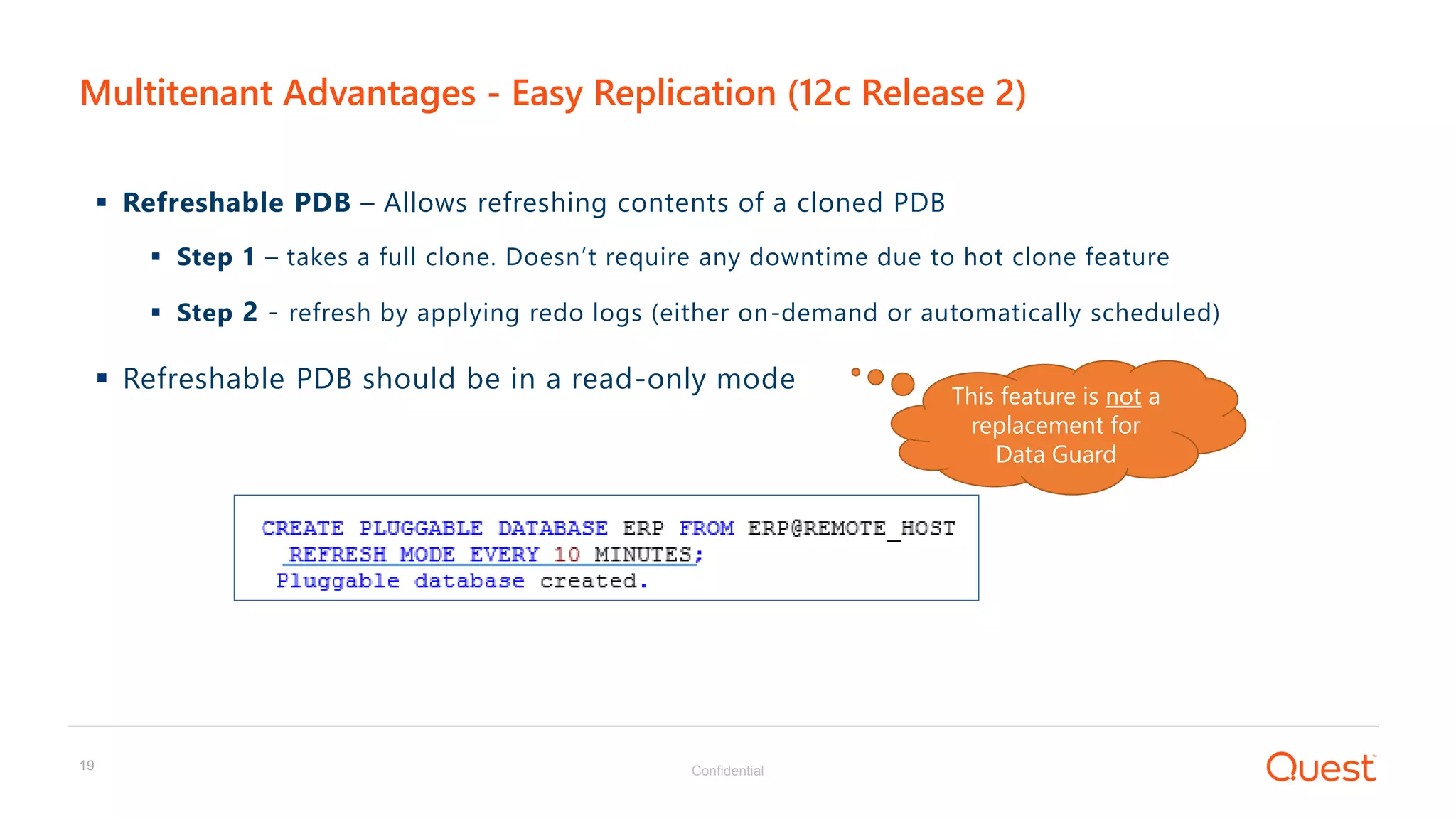
 Refreshable PDB – Allows refreshing contents of a cloned PDB
 Step 1 – takes a full clone. Doesn’t require any downtime due to hot clone feature
 Step 2 - refresh by applying redo logs (either on-demand or automatically scheduled)
 Refreshable PDB should be in a read-only mode
Multitenant Advantages - Easy Replication (12c Release 2)
s
This feature is not a
replacement for
Data Guard
Confidential20
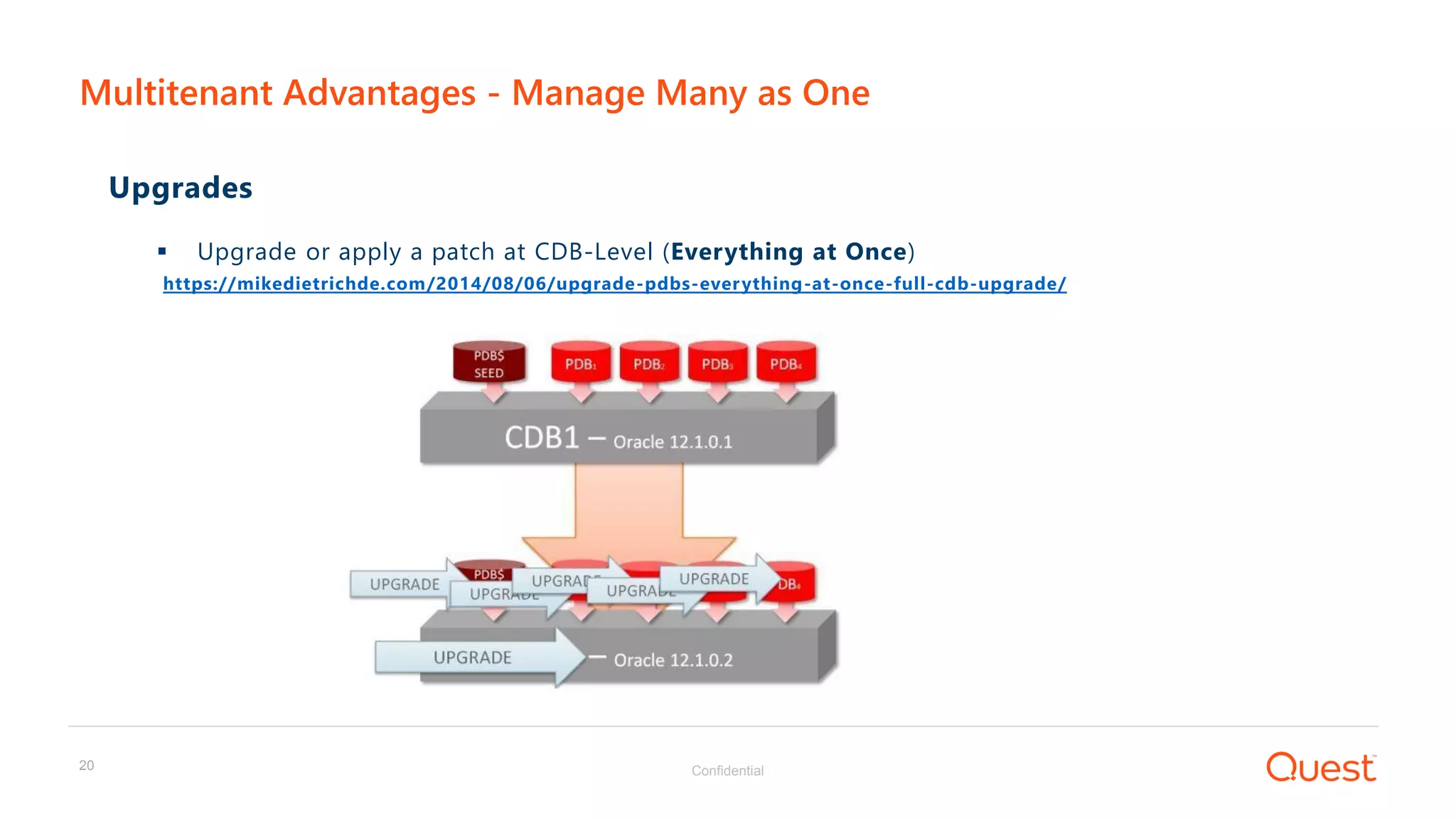
Upgrades
 Upgrade or apply a patch at CDB-Level (Everything at Once)
https://mikedietrichde.com/2014/08/06/upgrade-pdbs-everything-at-once-full-cdb-upgrade/
Multitenant Advantages - Manage Many as One
Confidential21
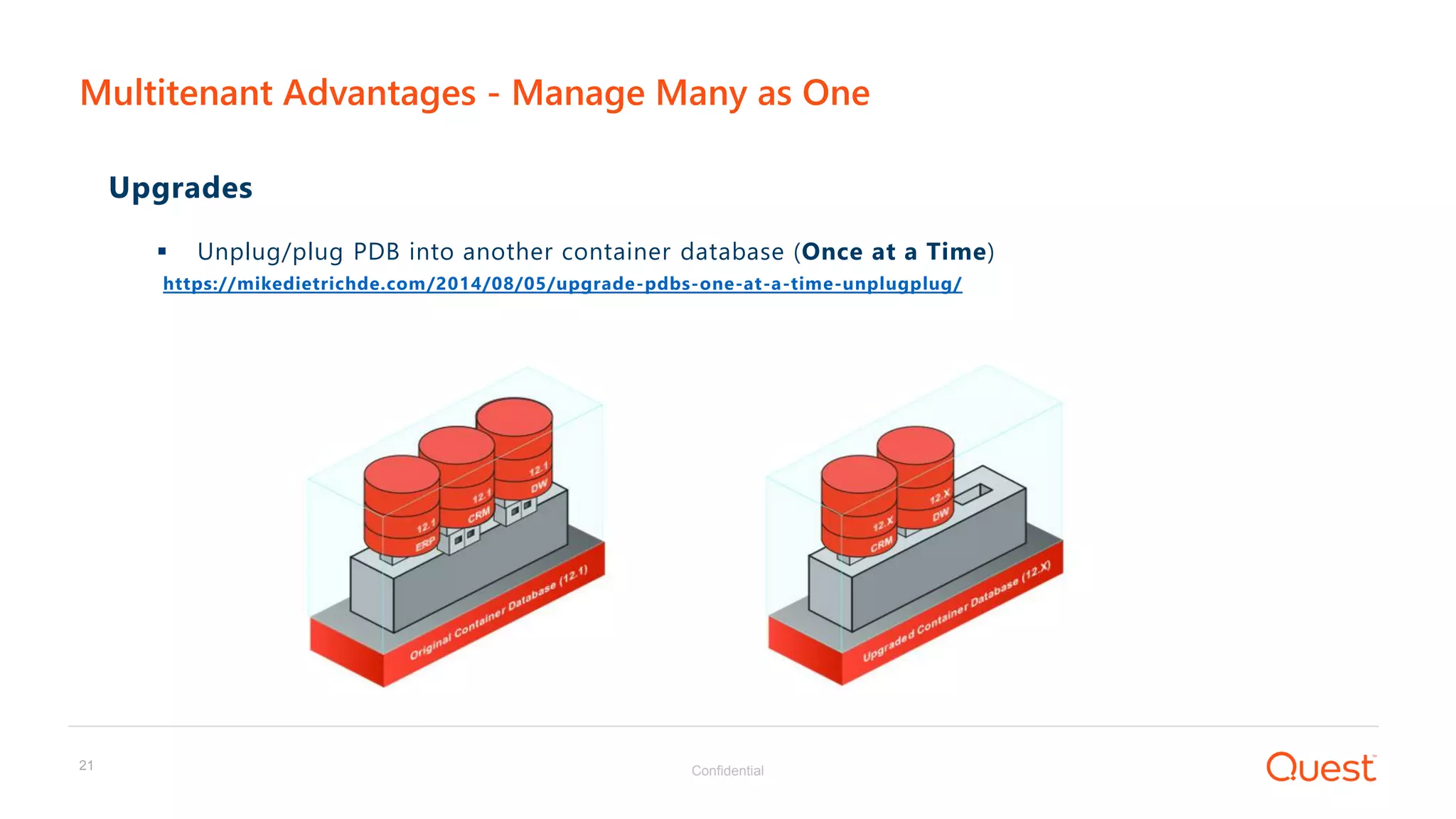
Upgrades
 Unplug/plug PDB into another container database (Once at a Time)
https://mikedietrichde.com/2014/08/05/upgrade-pdbs-one-at-a-time-unplugplug/
Multitenant Advantages - Manage Many as One
Confidential22
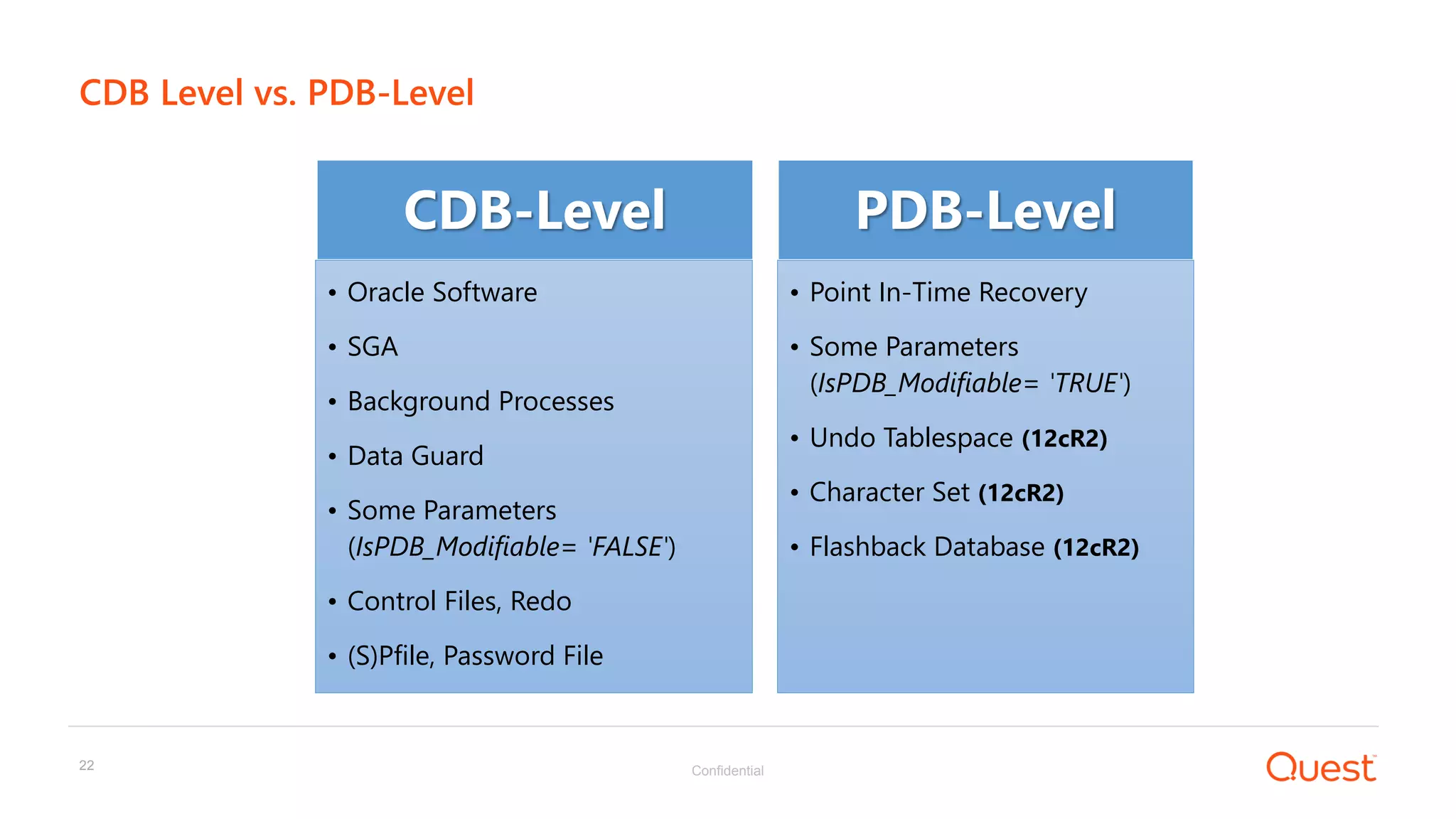
CDB Level vs. PDB-Level
CDB-Level
• Oracle Software
• SGA
• Background Processes
• Data Guard
• Some Parameters
(IsPDB_Modifiable= 'FALSE')
• Control Files, Redo
• (S)Pfile, Password File
PDB-Level
• Point In-Time Recovery
• Some Parameters
(IsPDB_Modifiable= 'TRUE')
• Undo Tablespace (12cR2)
• Character Set (12cR2)
• Flashback Database (12cR2)
Confidential23
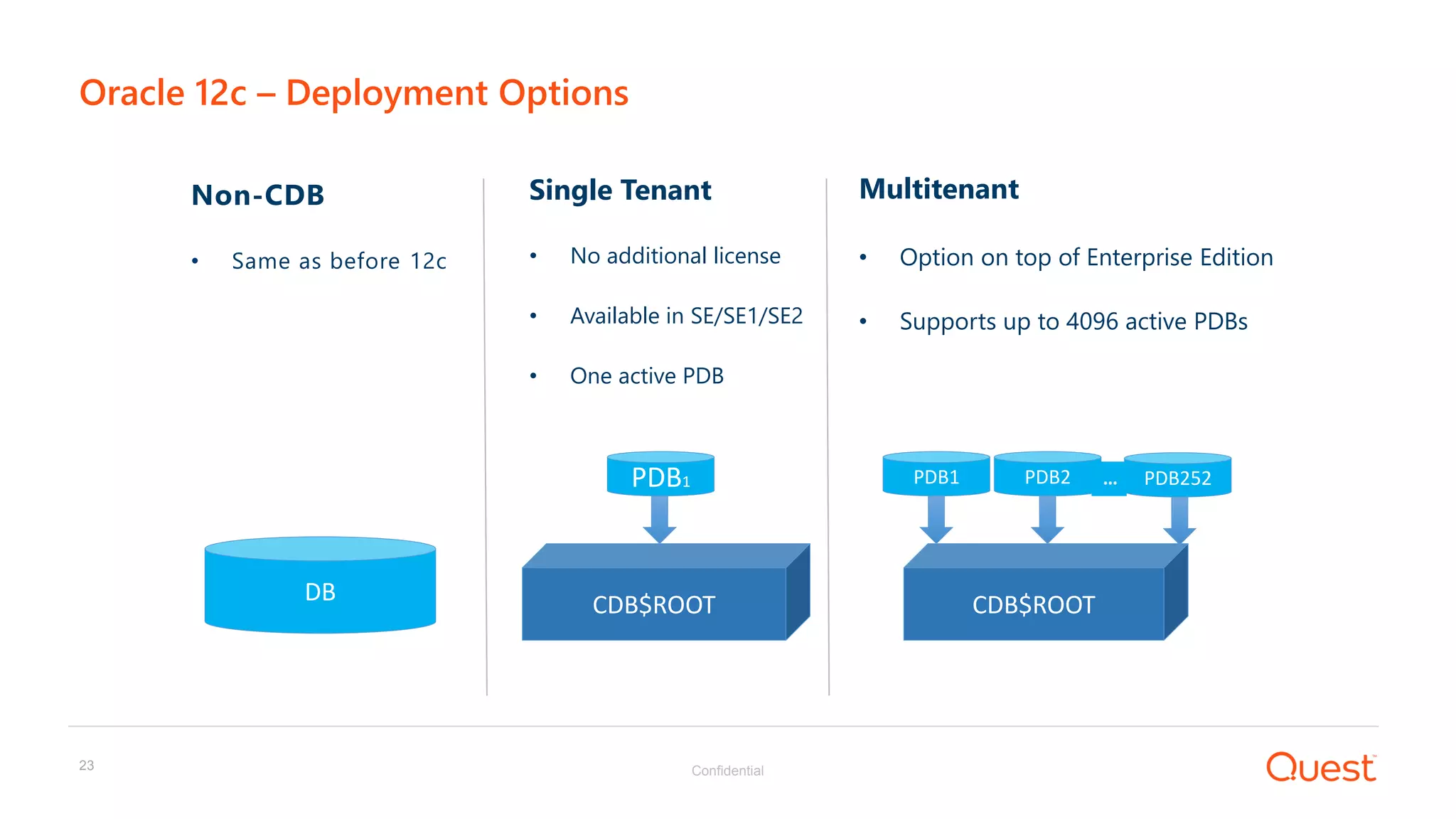
Non-CDB
• Same as before 12c
Oracle 12c – Deployment Options
DB CDB$ROOT CDB$ROOT
PDB1 PDB1 PDB2 PDB252
Single Tenant
• No additional license
• Available in SE/SE1/SE2
• One active PDB
Multitenant
• Option on top of Enterprise Edition
• Supports up to 4096 active PDBs
…
Confidential24
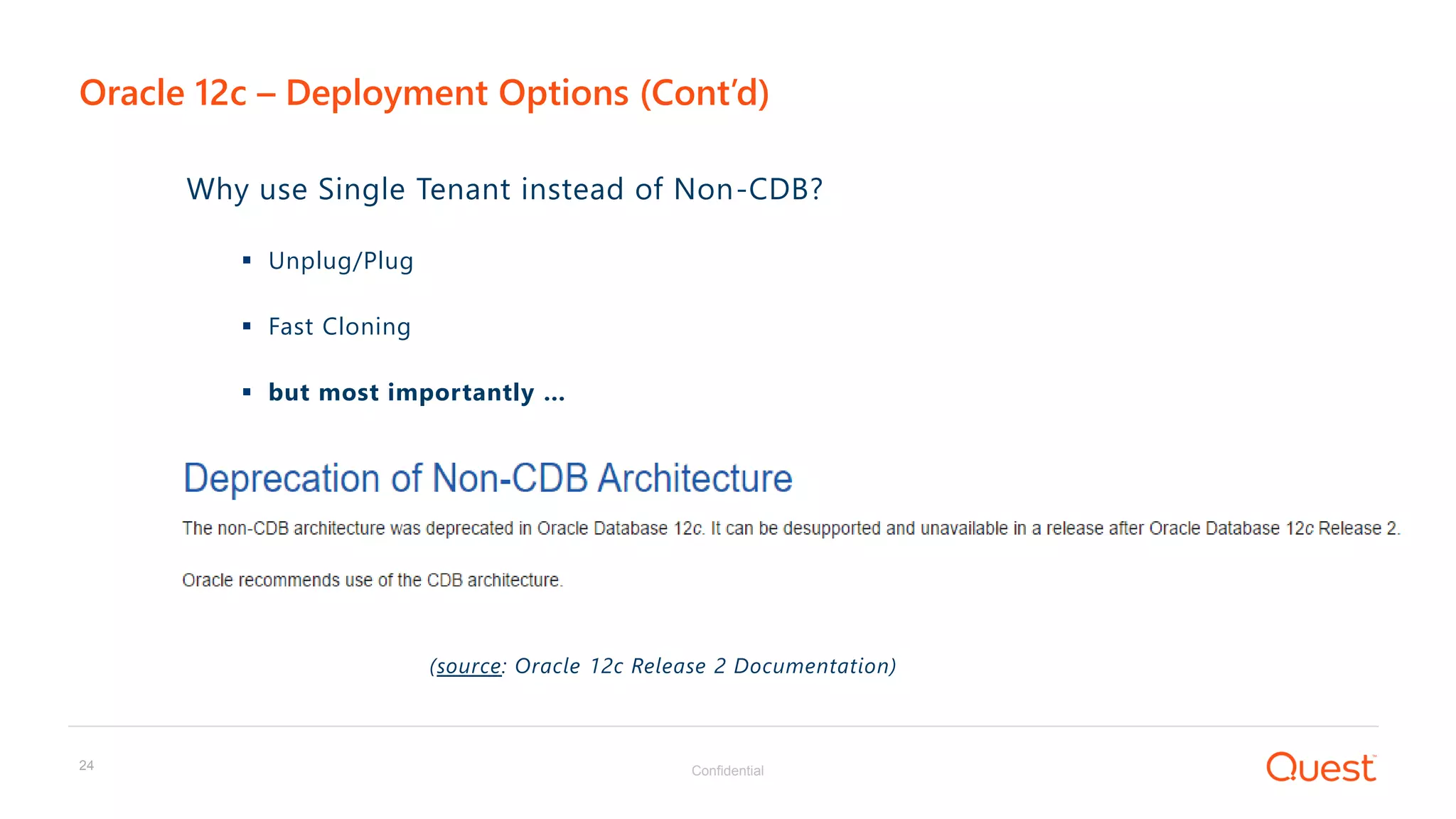
Why use Single Tenant instead of Non-CDB?
 Unplug/Plug
 Fast Cloning
 but most importantly …
(source: Oracle 12c Release 2 Documentation)
Oracle 12c – Deployment Options (Cont’d)
Confidential25
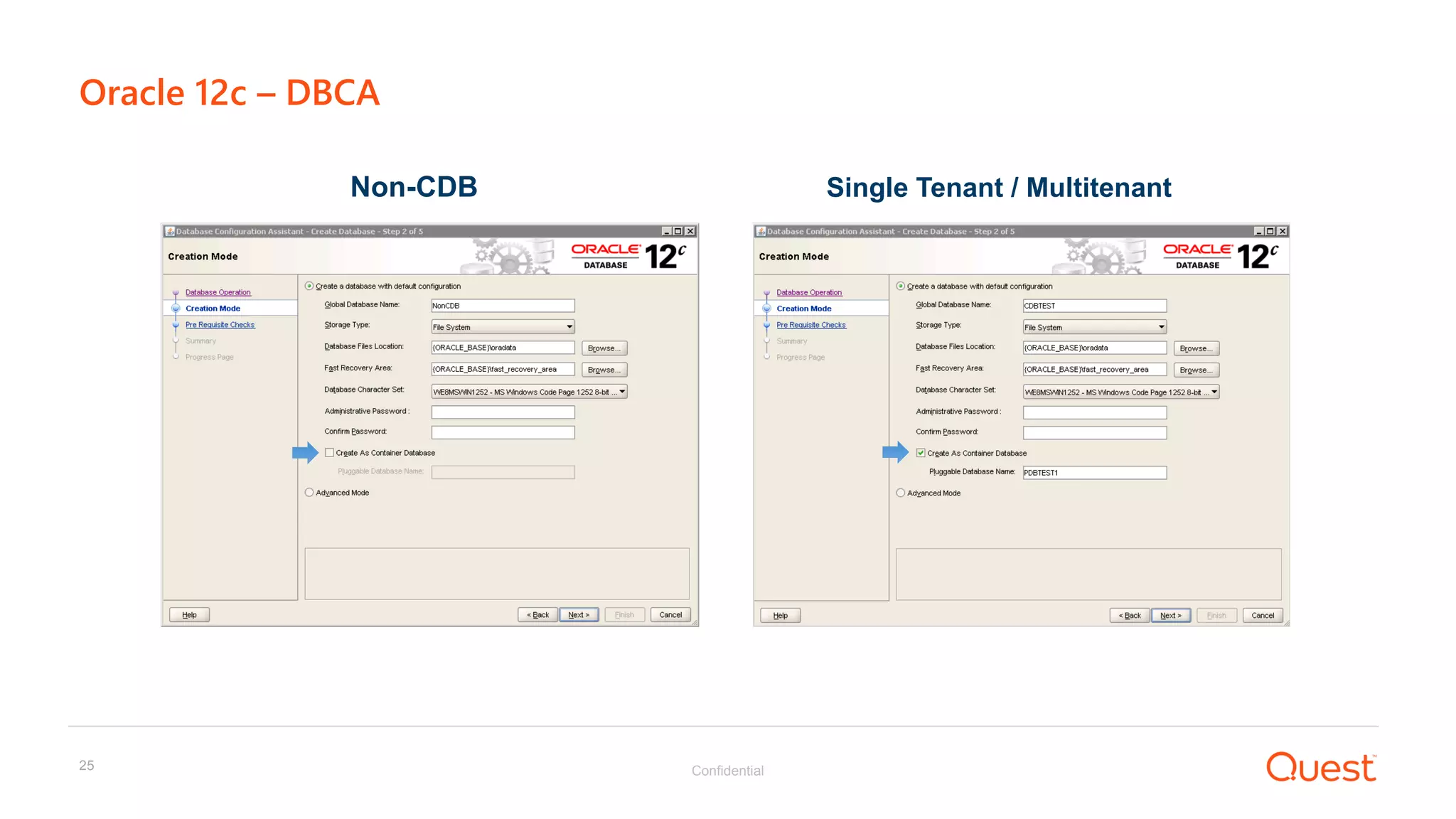
Oracle 12c – DBCA
Non-CDB Single Tenant / Multitenant
Ensuring High Level
of QoS in Multitenant
Environments
03
Confidential27
 CDB-Level QoS challenge
 Allocation of resources among competing PDBs
 Example: One PDB consumes too many resources
QoS Challenges – Multitenant Environments
Confidential28
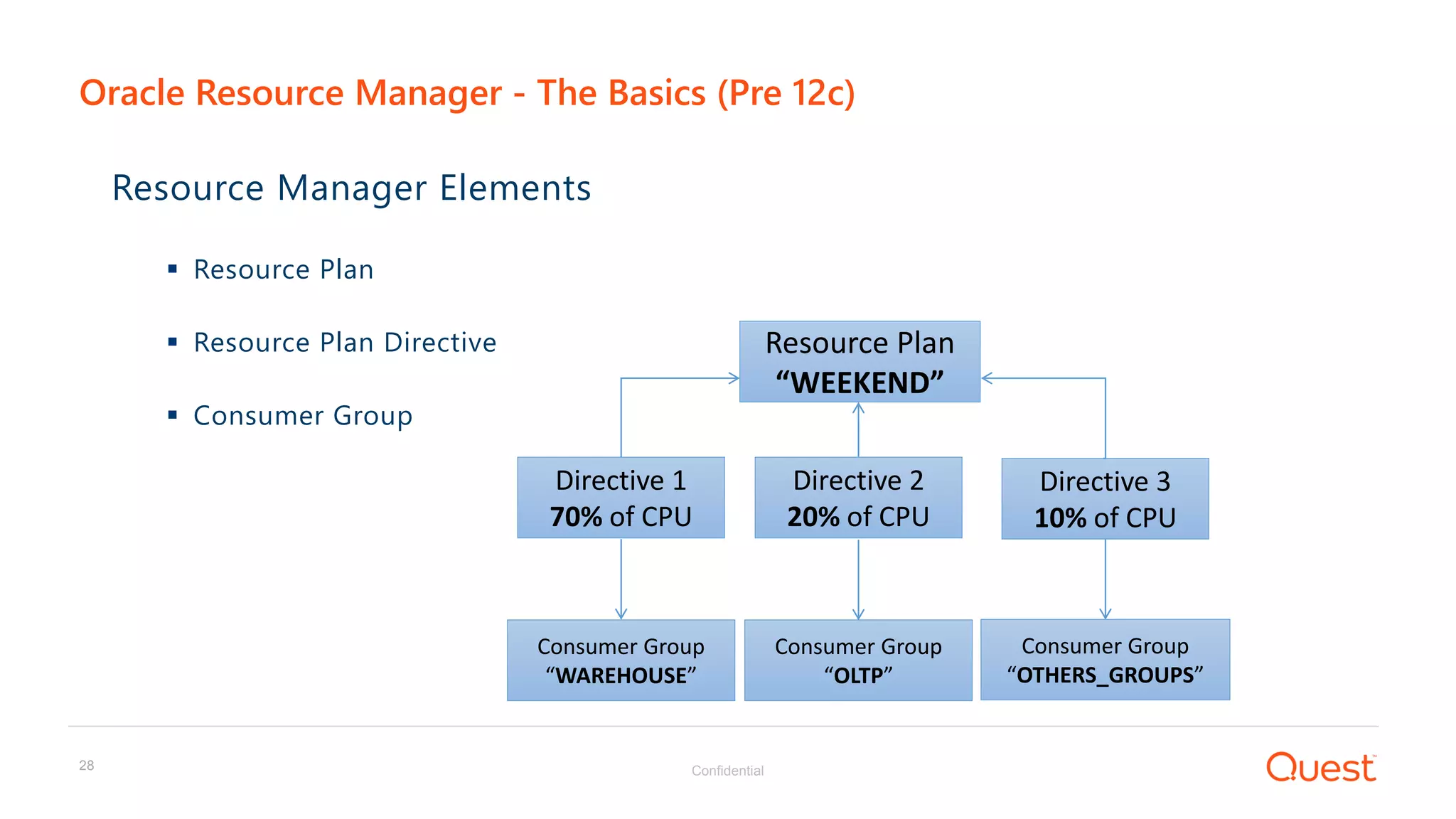
Resource Manager Elements
 Resource Plan
 Resource Plan Directive
 Consumer Group
Oracle Resource Manager - The Basics (Pre 12c)
Resource Plan
“WEEKEND”
Directive 1
70% of CPU
Directive 2
20% of CPU
Directive 3
10% of CPU
Consumer Group
“WAREHOUSE”
Consumer Group
“OLTP”
Consumer Group
“OTHERS_GROUPS”
Confidential29
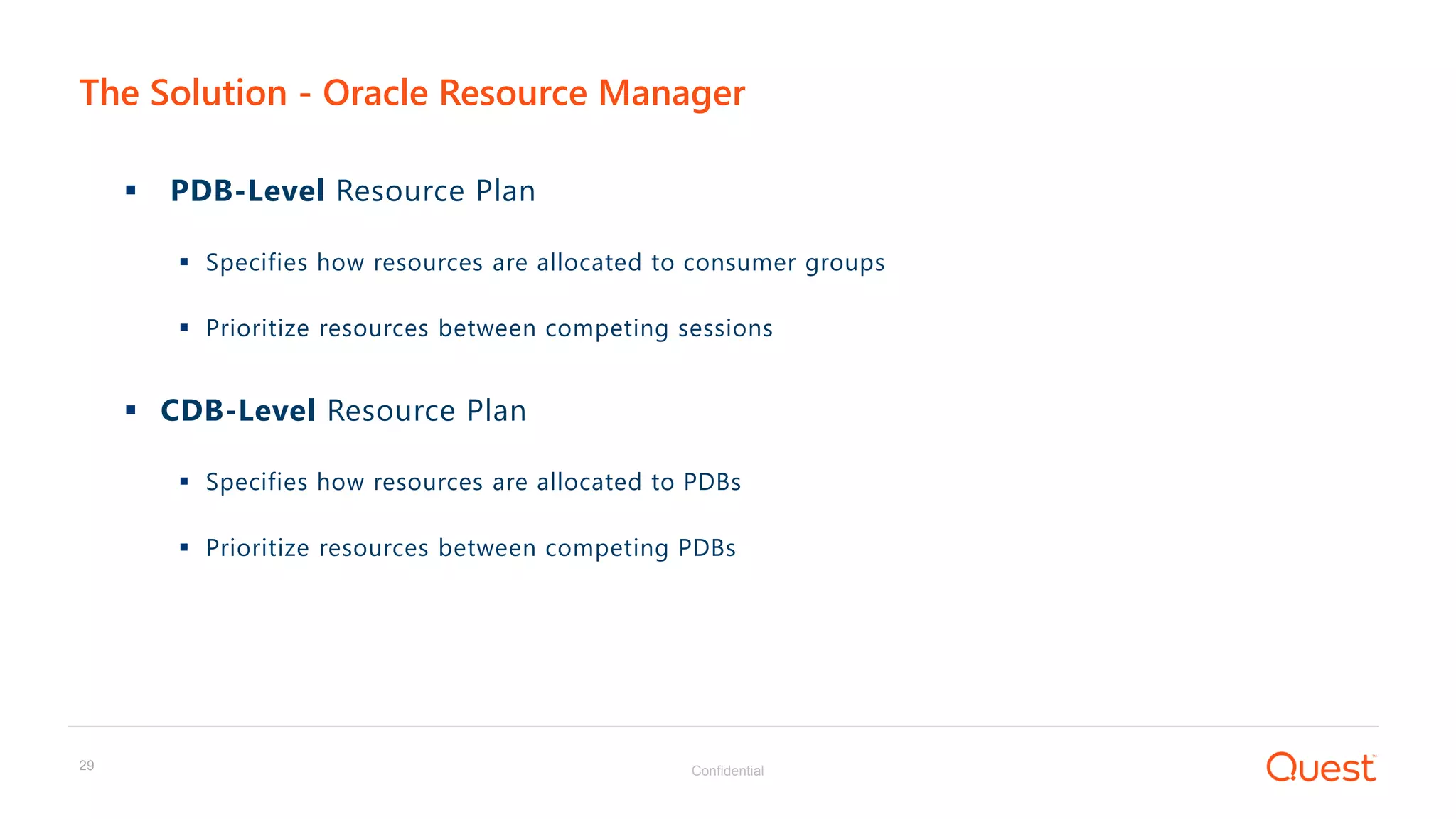
 PDB-Level Resource Plan
 Specifies how resources are allocated to consumer groups
 Prioritize resources between competing sessions
 CDB-Level Resource Plan
 Specifies how resources are allocated to PDBs
 Prioritize resources between competing PDBs
The Solution - Oracle Resource Manager
Confidential30
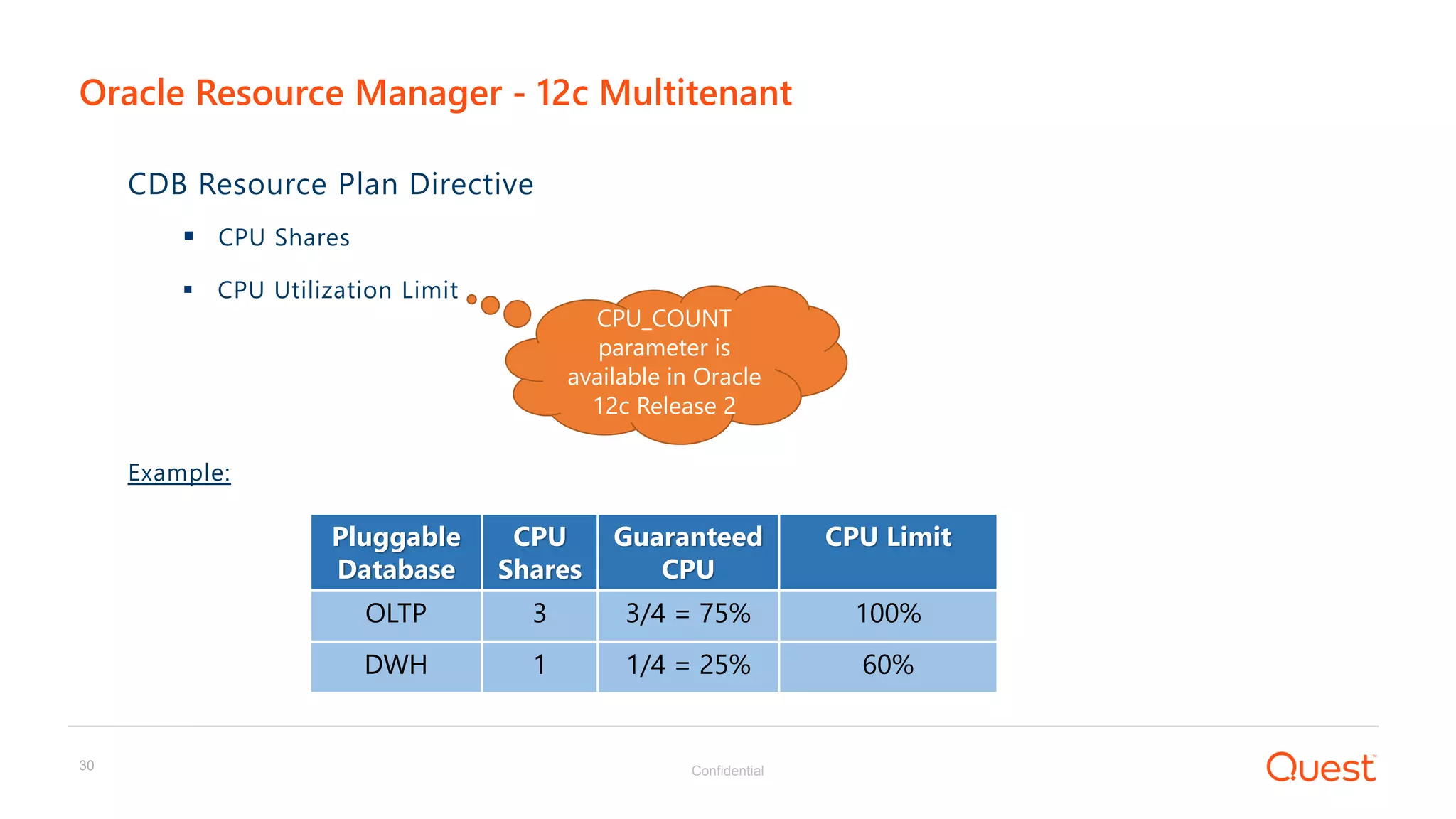
Oracle Resource Manager - 12c Multitenant
CDB Resource Plan Directive
 CPU Shares
 CPU Utilization Limit
Example:
Pluggable
Database
CPU
Shares
Guaranteed
CPU
CPU Limit
OLTP 3 3/4 = 75% 100%
DWH 1 1/4 = 25% 60%
CPU_COUNT
parameter is
available in Oracle
12c Release 2
Confidential31
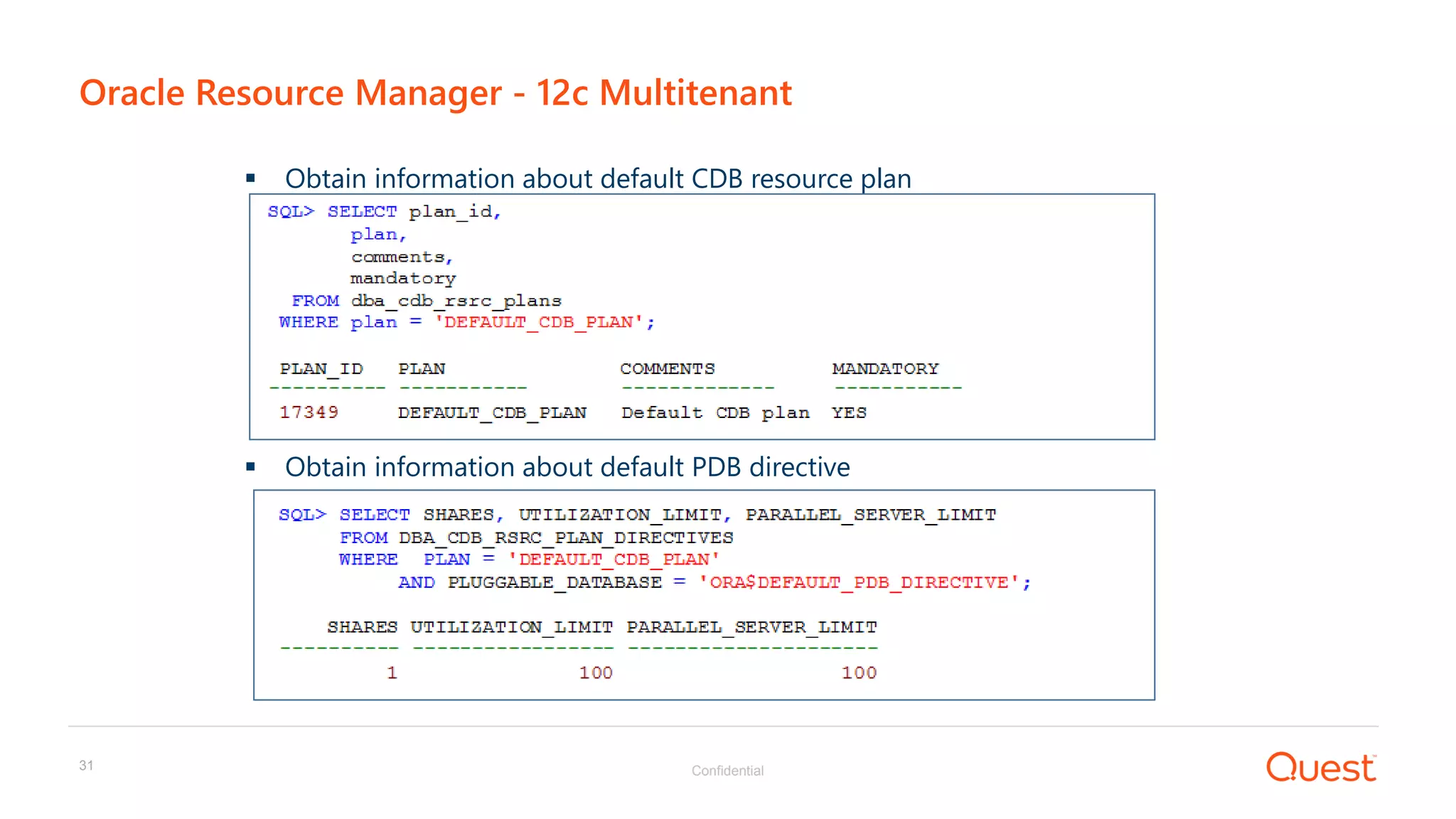
Oracle Resource Manager - 12c Multitenant
 Obtain information about default CDB resource plan
 Obtain information about default PDB directive
s
s
Confidential32
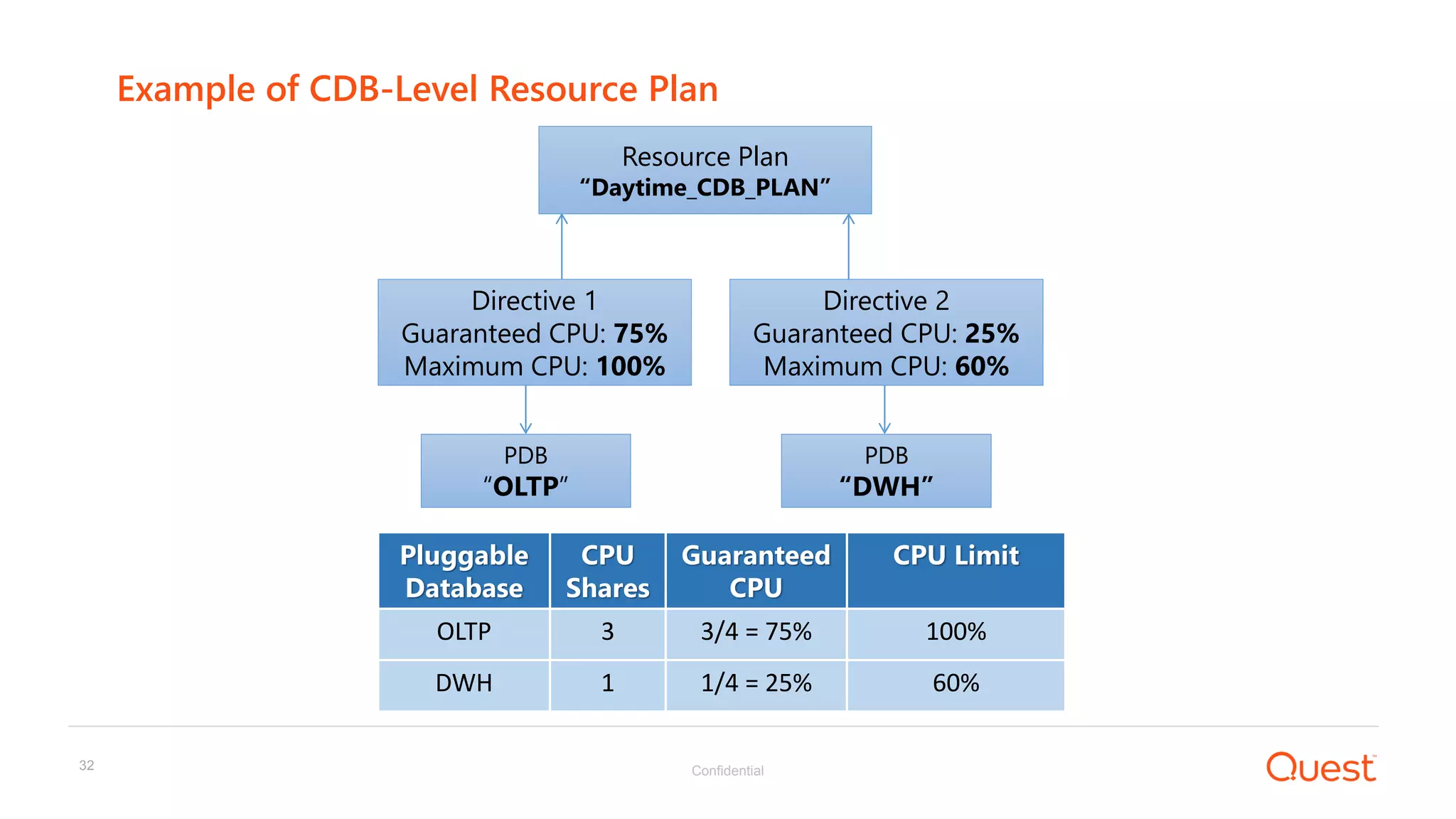
Example of CDB-Level Resource Plan
Resource Plan
“Daytime_CDB_PLAN”
PDB
“OLTP”
PDB
“DWH”
Directive 2
Guaranteed CPU: 25%
Maximum CPU: 60%
Directive 1
Guaranteed CPU: 75%
Maximum CPU: 100%
Pluggable
Database
CPU
Shares
Guaranteed
CPU
CPU Limit
OLTP 3 3/4 = 75% 100%
DWH 1 1/4 = 25% 60%
Confidential33
s
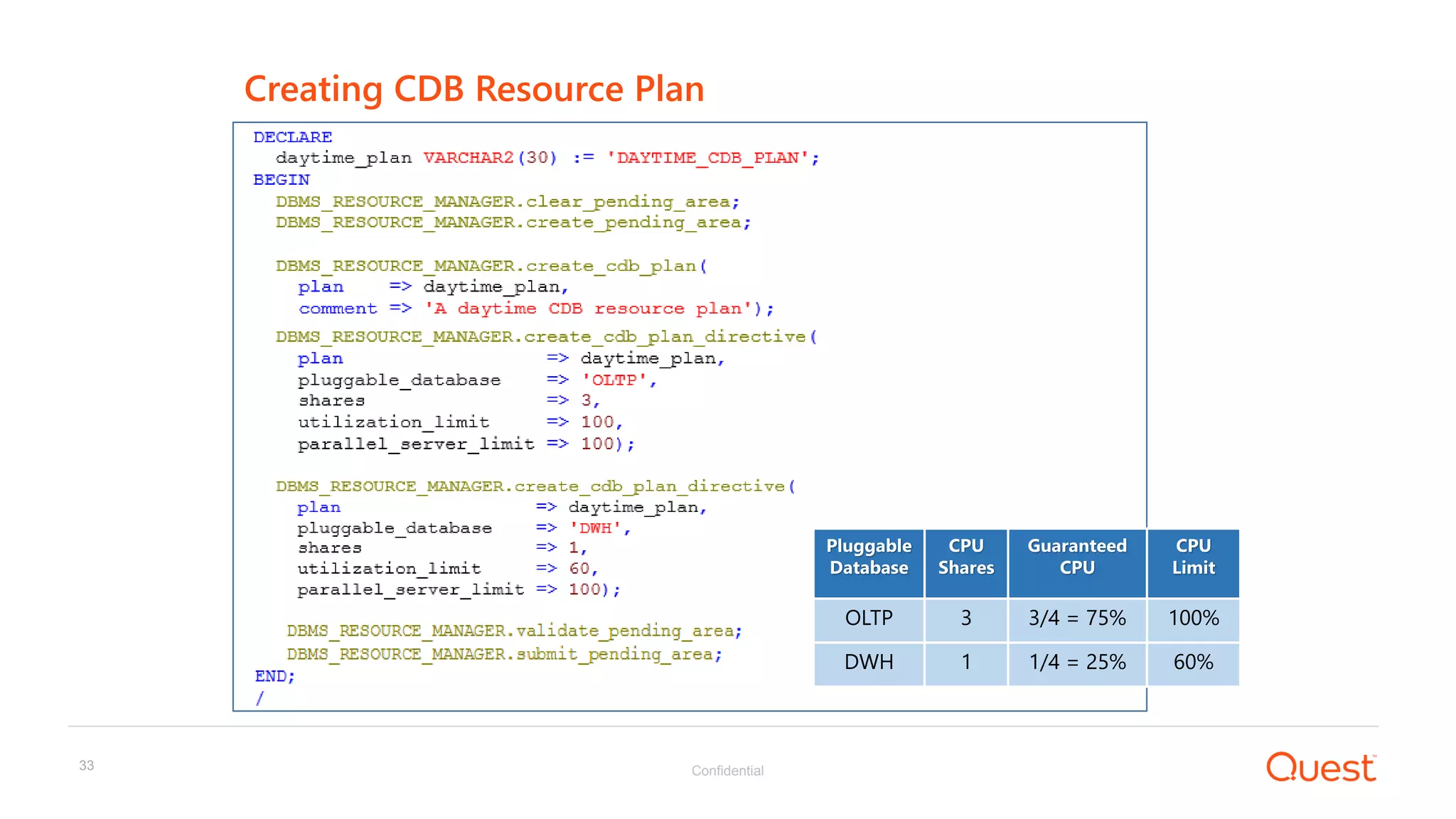
Creating CDB Resource Plan
Pluggable
Database
CPU
Shares
Guaranteed
CPU
CPU
Limit
OLTP 3 3/4 = 75% 100%
DWH 1 1/4 = 25% 60%
Confidential34
s
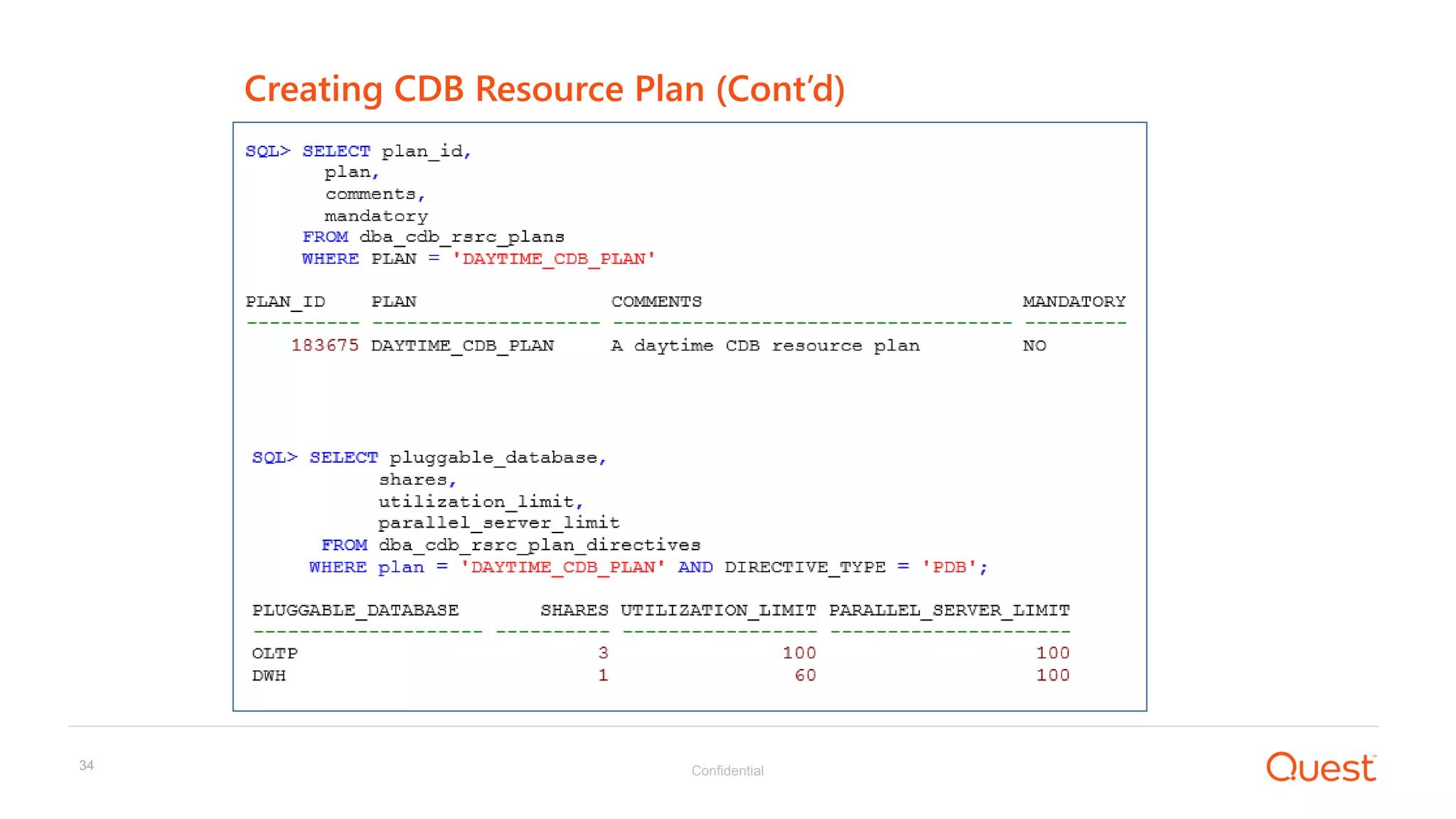
Creating CDB Resource Plan (Cont’d)
Confidential35
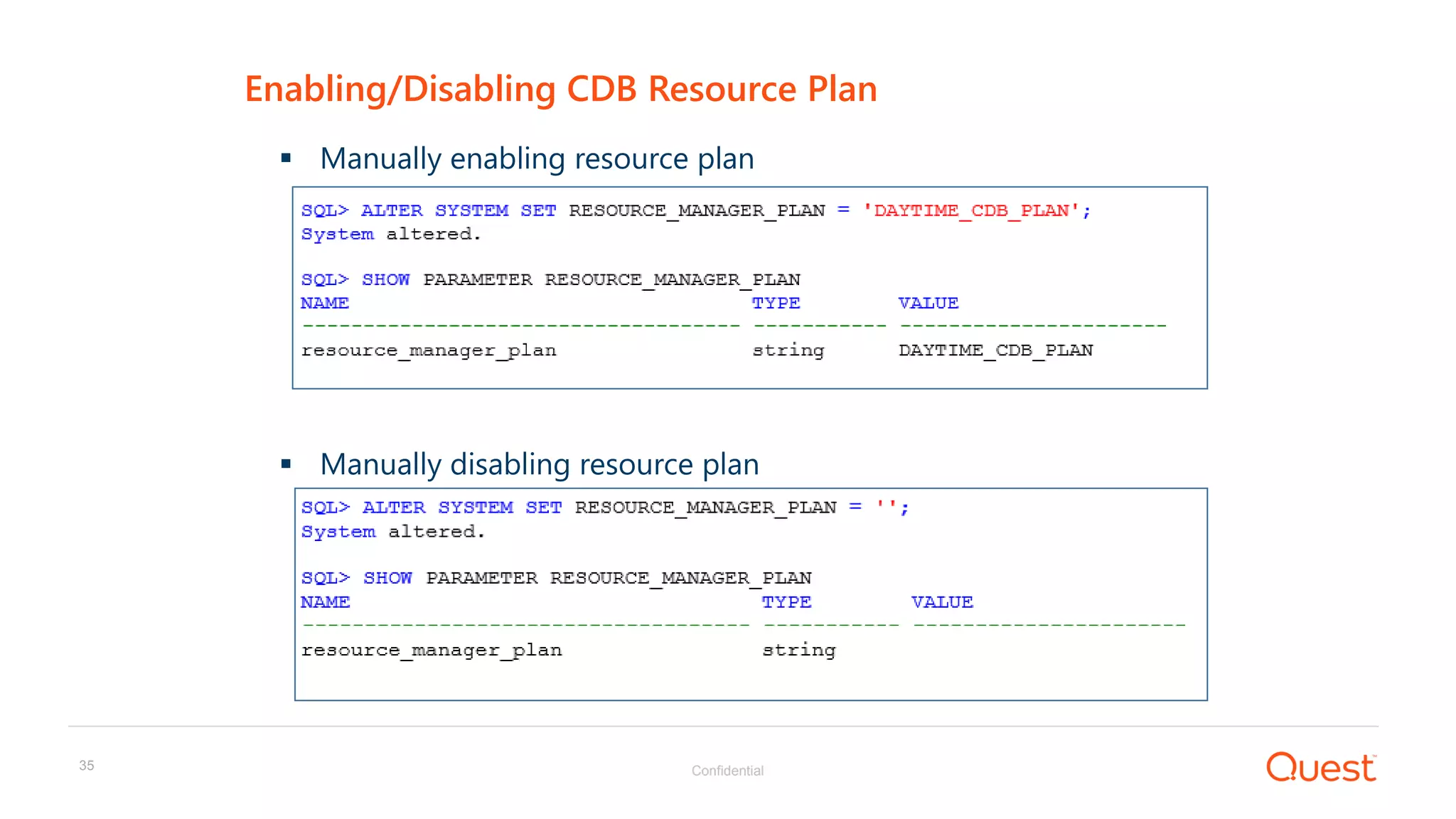
Enabling/Disabling CDB Resource Plan
 Manually enabling resource plan
 Manually disabling resource plan
s
s
Confidential36
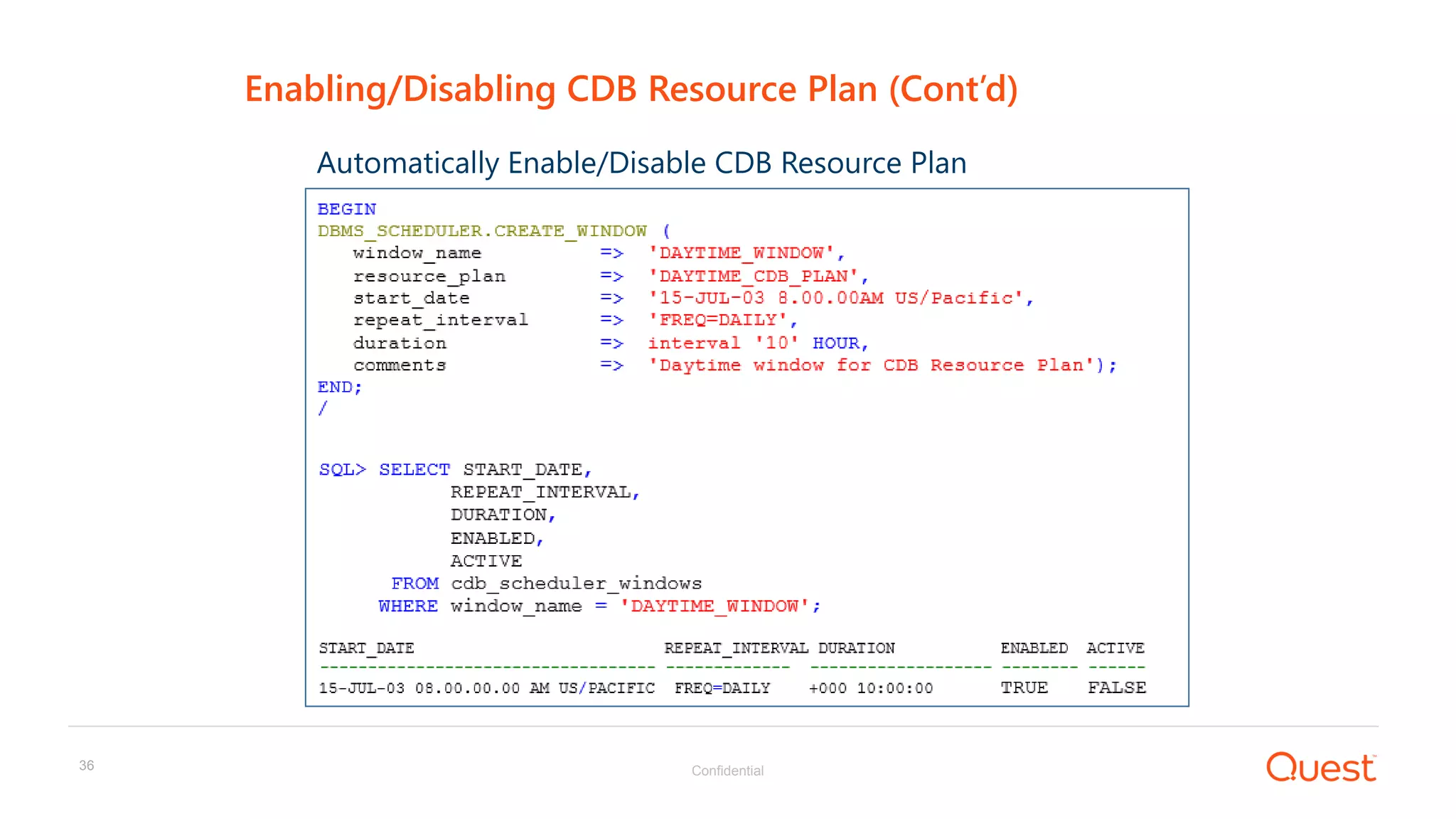
Enabling/Disabling CDB Resource Plan (Cont’d)
s
Automatically Enable/Disable CDB Resource Plan
Confidential37
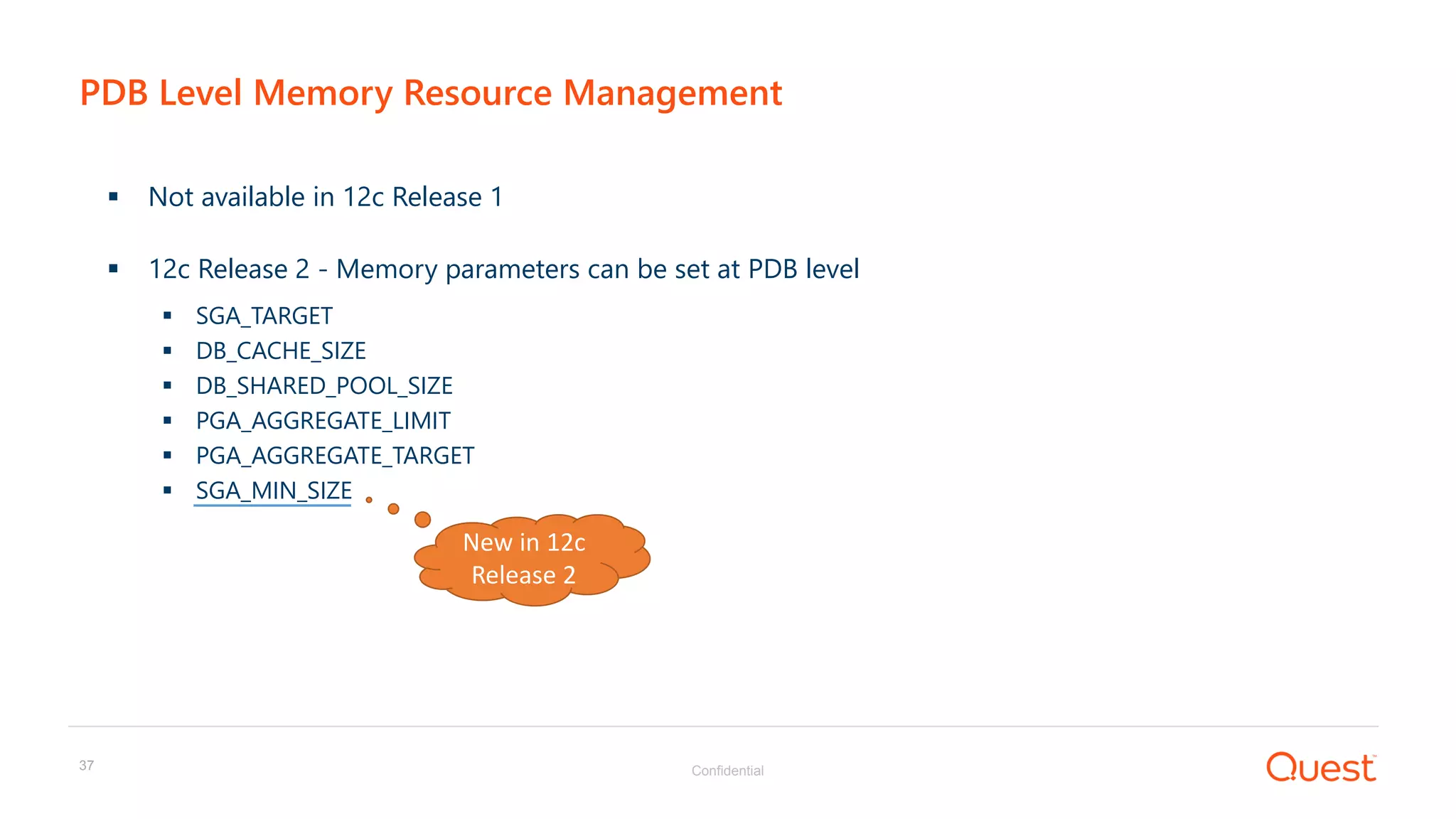
PDB Level Memory Resource Management
 Not available in 12c Release 1
 12c Release 2 - Memory parameters can be set at PDB level
 SGA_TARGET
 DB_CACHE_SIZE
 DB_SHARED_POOL_SIZE
 PGA_AGGREGATE_LIMIT
 PGA_AGGREGATE_TARGET
 SGA_MIN_SIZE
New in 12c
Release 2
Confidential38
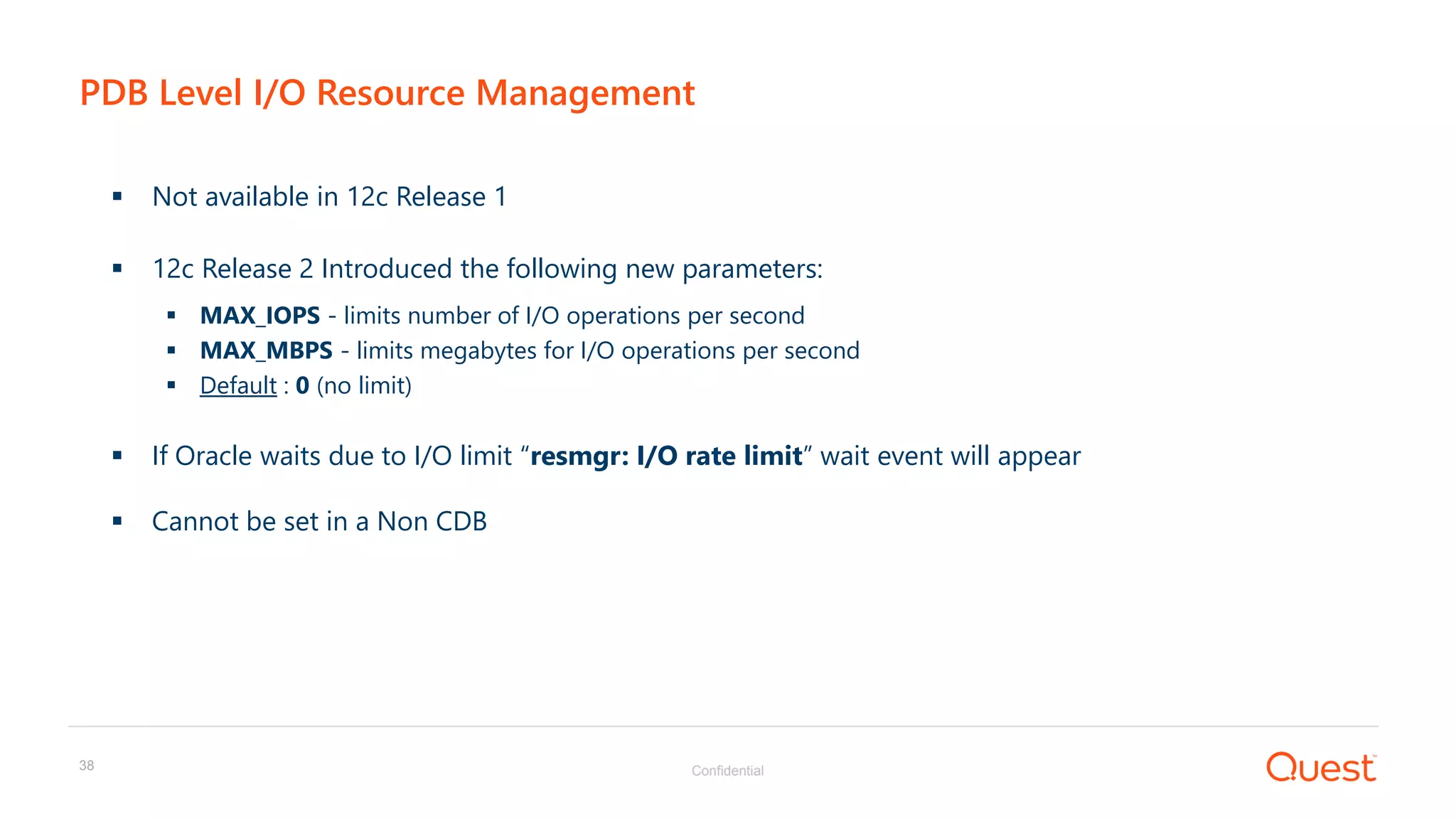
PDB Level I/O Resource Management
 Not available in 12c Release 1
 12c Release 2 Introduced the following new parameters:
 MAX_IOPS - limits number of I/O operations per second
 MAX_MBPS - limits megabytes for I/O operations per second
 Default : 0 (no limit)
 If Oracle waits due to I/O limit “resmgr: I/O rate limit” wait event will appear
 Cannot be set in a Non CDB
Confidential39
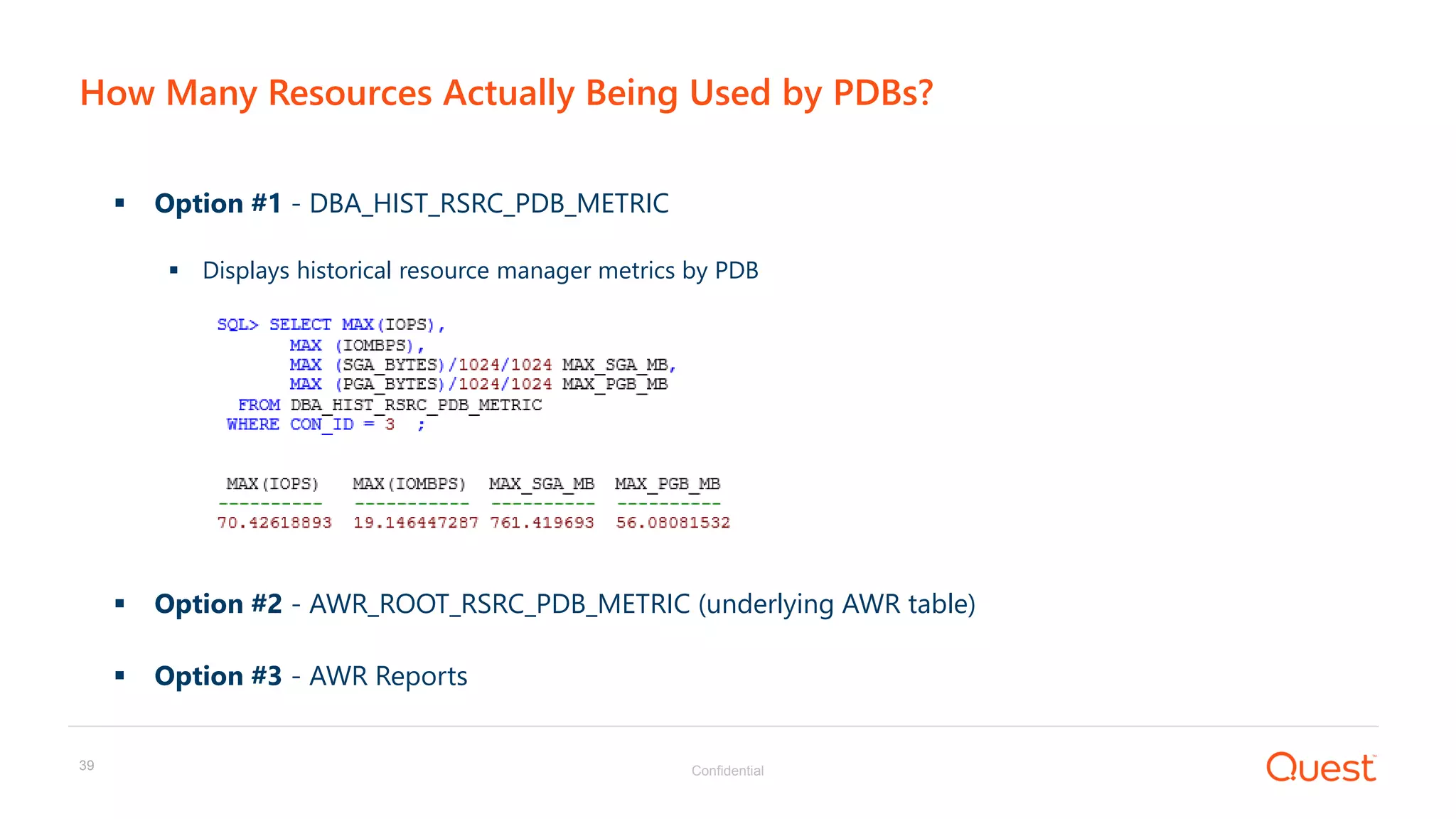
How Many Resources Actually Being Used by PDBs?
 Option #1 - DBA_HIST_RSRC_PDB_METRIC
 Displays historical resource manager metrics by PDB
 Option #2 - AWR_ROOT_RSRC_PDB_METRIC (underlying AWR table)
 Option #3 - AWR Reports
Confidential40
Maintenance Tasks in Oracle Multitenant
 ENABLE_AUTOMATIC_MAINTENANCE_PDB parameter
 Can be used to enable/disable running of maintenance tasks
 Default: true
 Can be set at either CDB or PDB levels
 AUTOTASK_MAX_ACTIVE_PDBS parameter
 Maximum number of PDBs that can schedule maintenance tasks concurrently
 Can be set at CDB level only
 Default: 2 (two PDBs and the CDB root can run tasks at the same time)
 Both parameters introduced in 12c Release 2
RAC & Multitenant
04
Confidential42
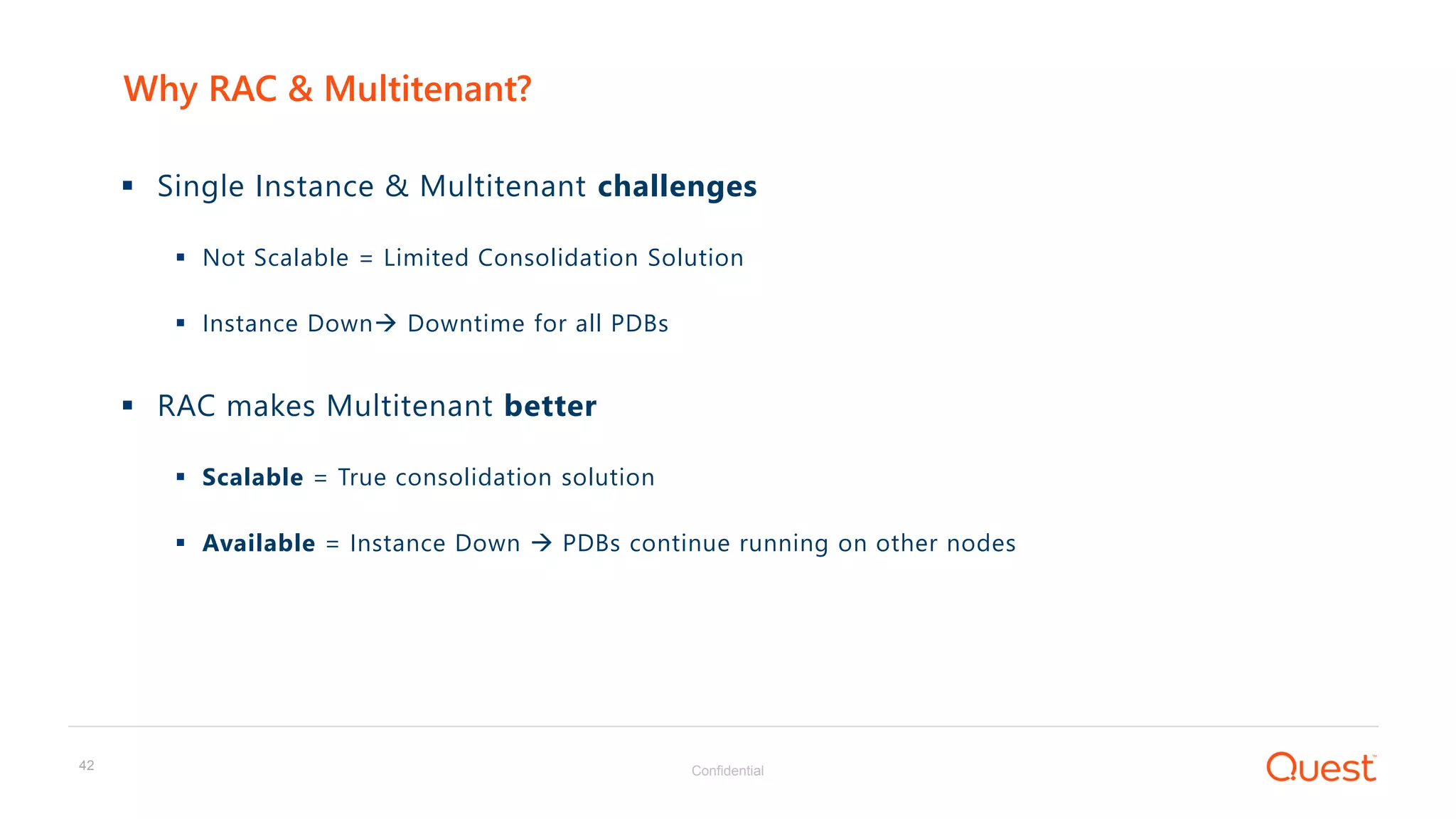
 Single Instance & Multitenant challenges
 Not Scalable = Limited Consolidation Solution
 Instance Down Downtime for all PDBs
 RAC makes Multitenant better
 Scalable = True consolidation solution
 Available = Instance Down  PDBs continue running on other nodes
Why RAC & Multitenant?
Confidential43
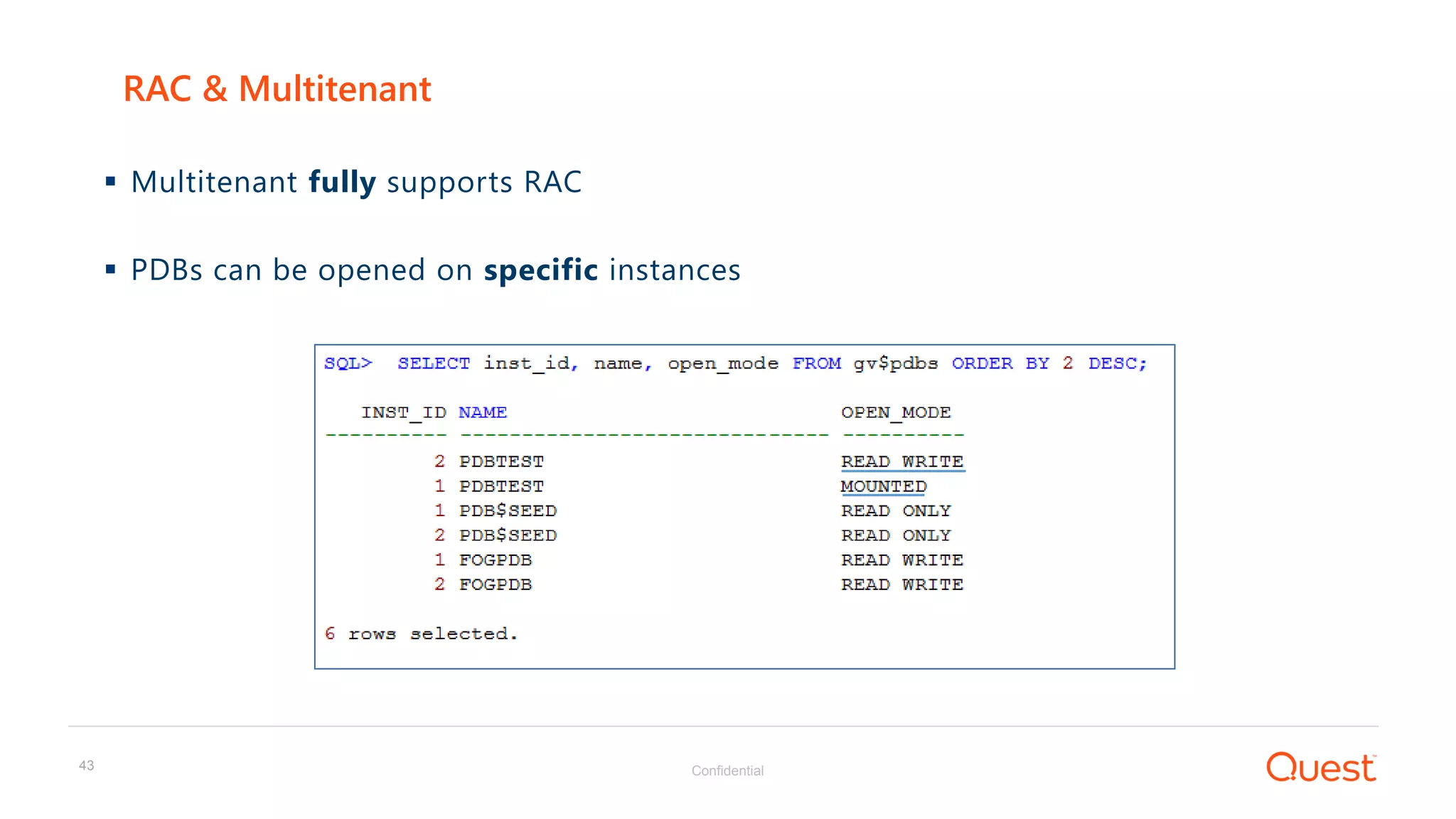
 Multitenant fully supports RAC
 PDBs can be opened on specific instances
RAC & Multitenant
s
Confidential44
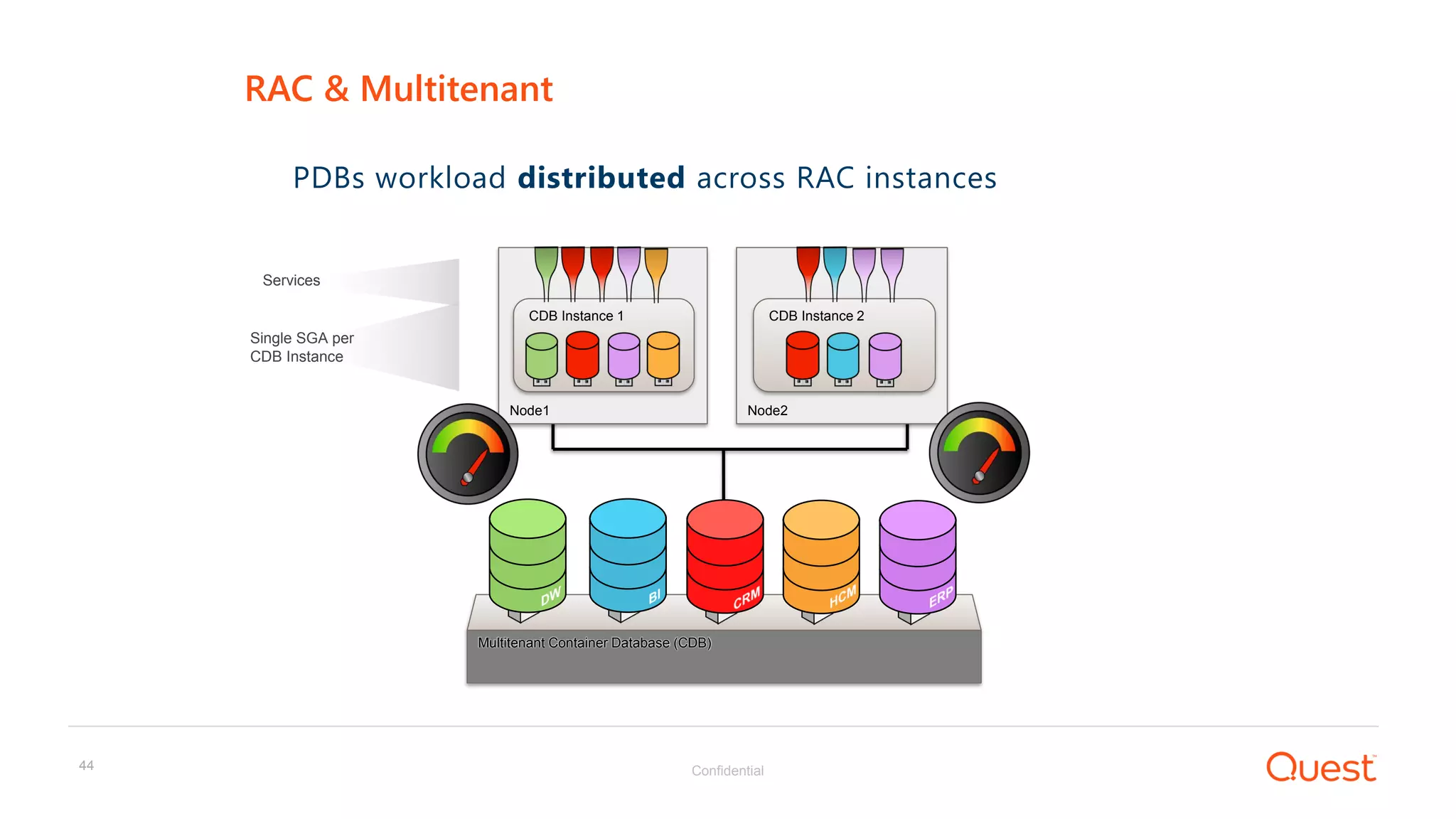
PDBs workload distributed across RAC instances
RAC & Multitenant
Services
Single SGA per
CDB Instance
Node1
CDB Instance 1
Node2
CDB Instance 2
Multitenant Container Database (CDB)
Confidential45
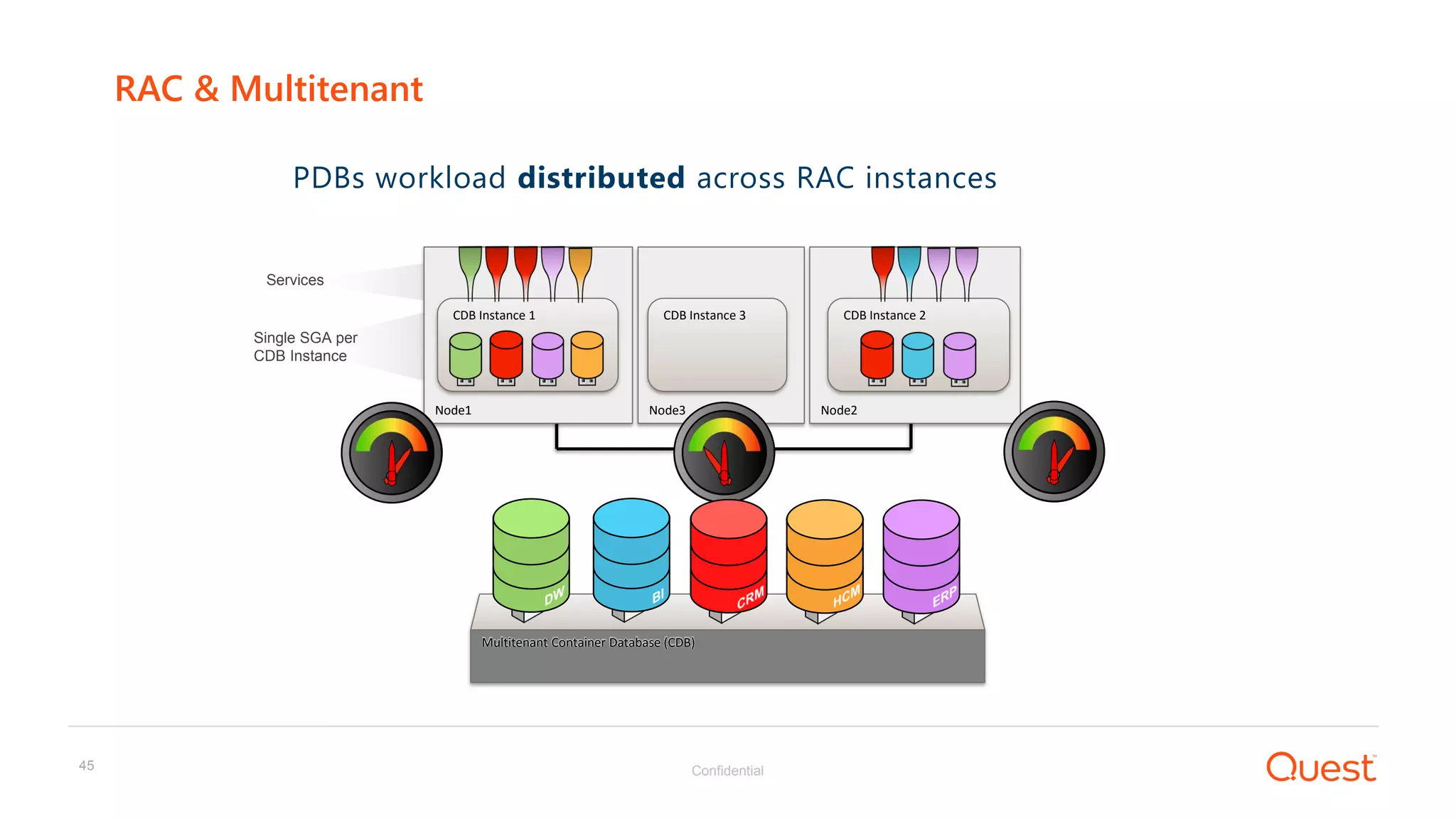
PDBs workload distributed across RAC instances
RAC & Multitenant
Services
Single SGA per
CDB Instance
Node1
CDB Instance 1
Node2
CDB Instance 2
Node3
CDB Instance 3
Multitenant Container Database (CDB)
Confidential46
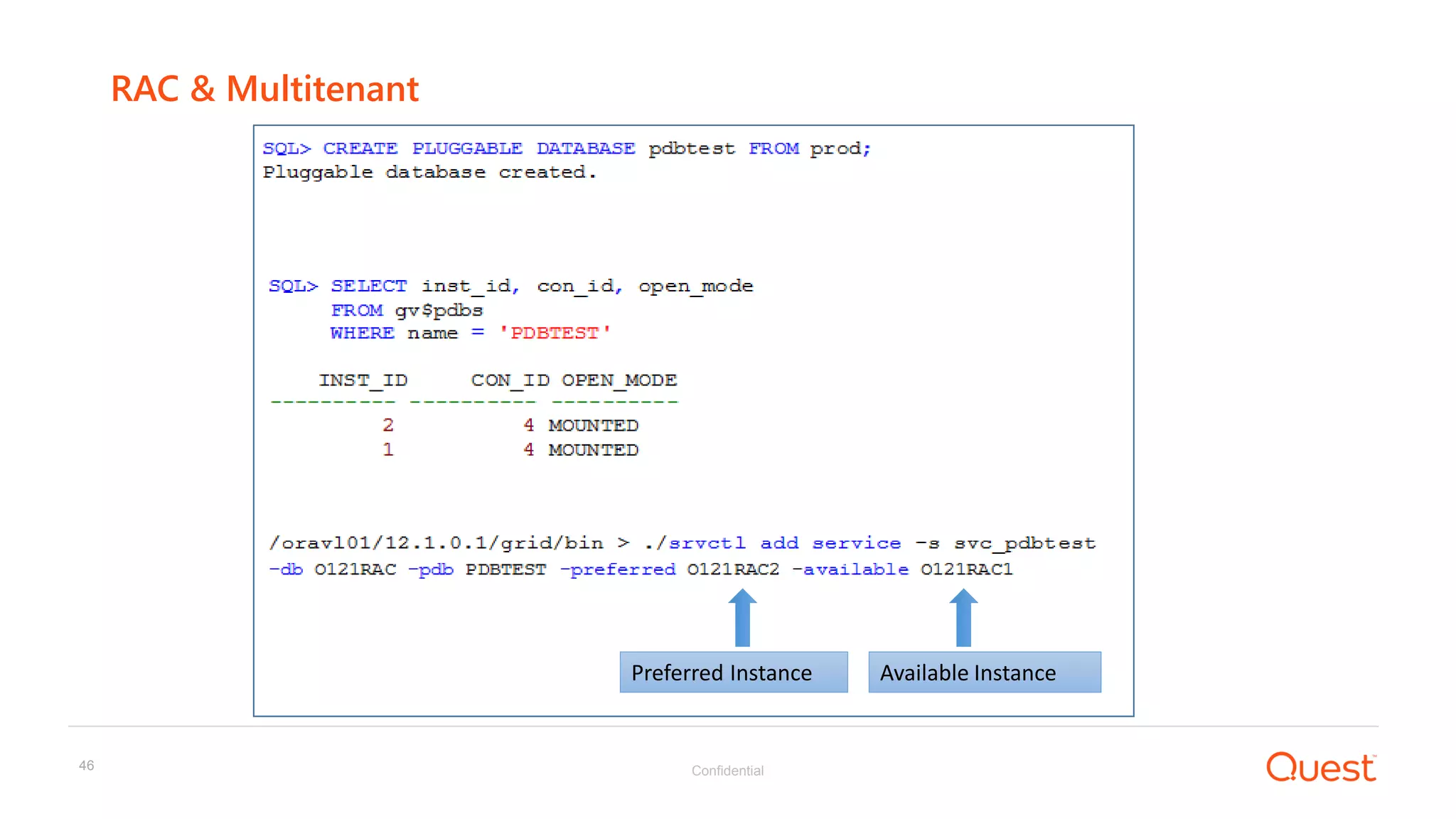
RAC & Multitenant
s
Preferred Instance Available Instance
Confidential47
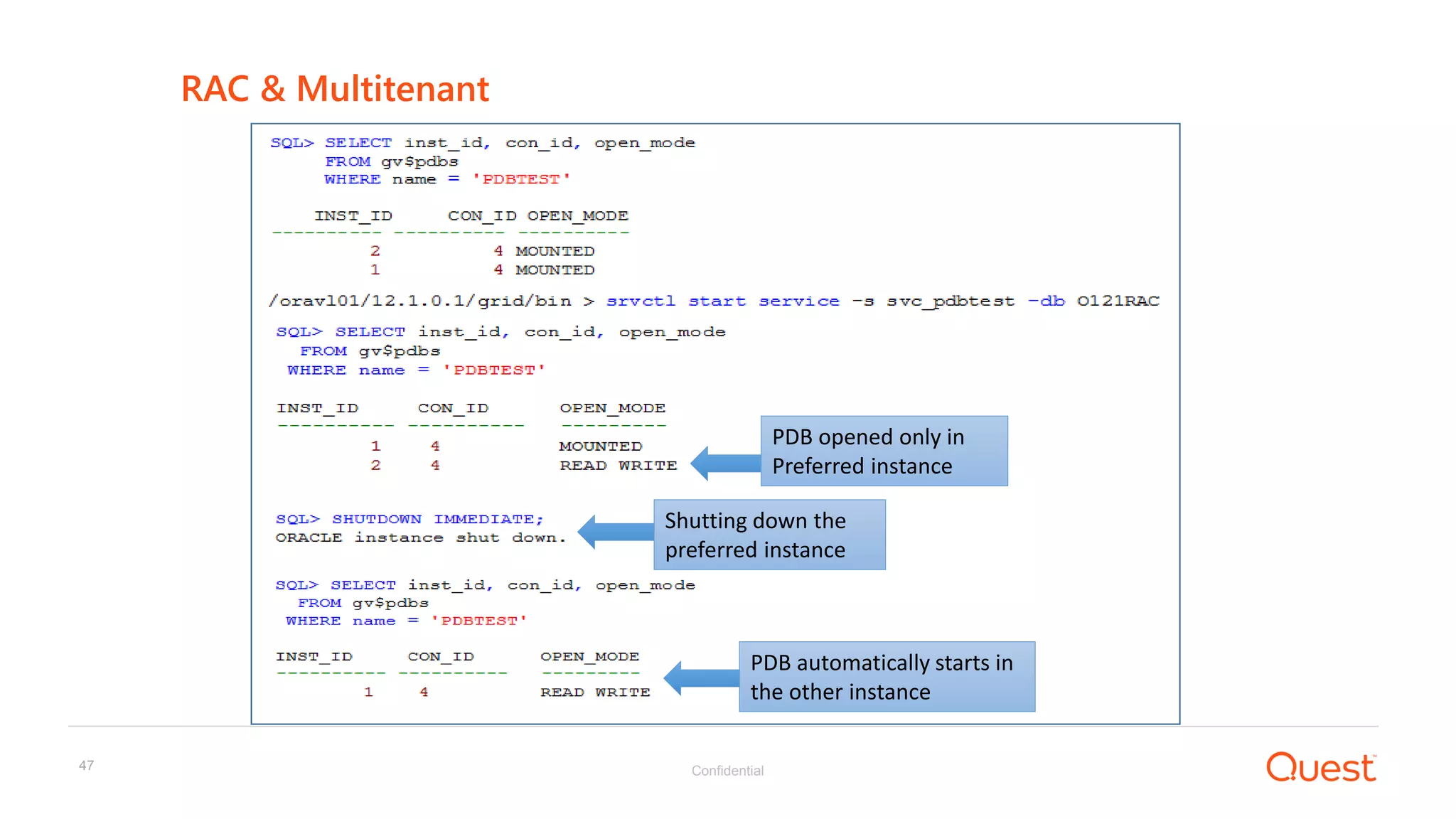
RAC & Multitenant
s
PDB opened only in
Preferred instance
PDB automatically starts in
the other instance
Shutting down the
preferred instance
Performance
Monitoring
05
Confidential49
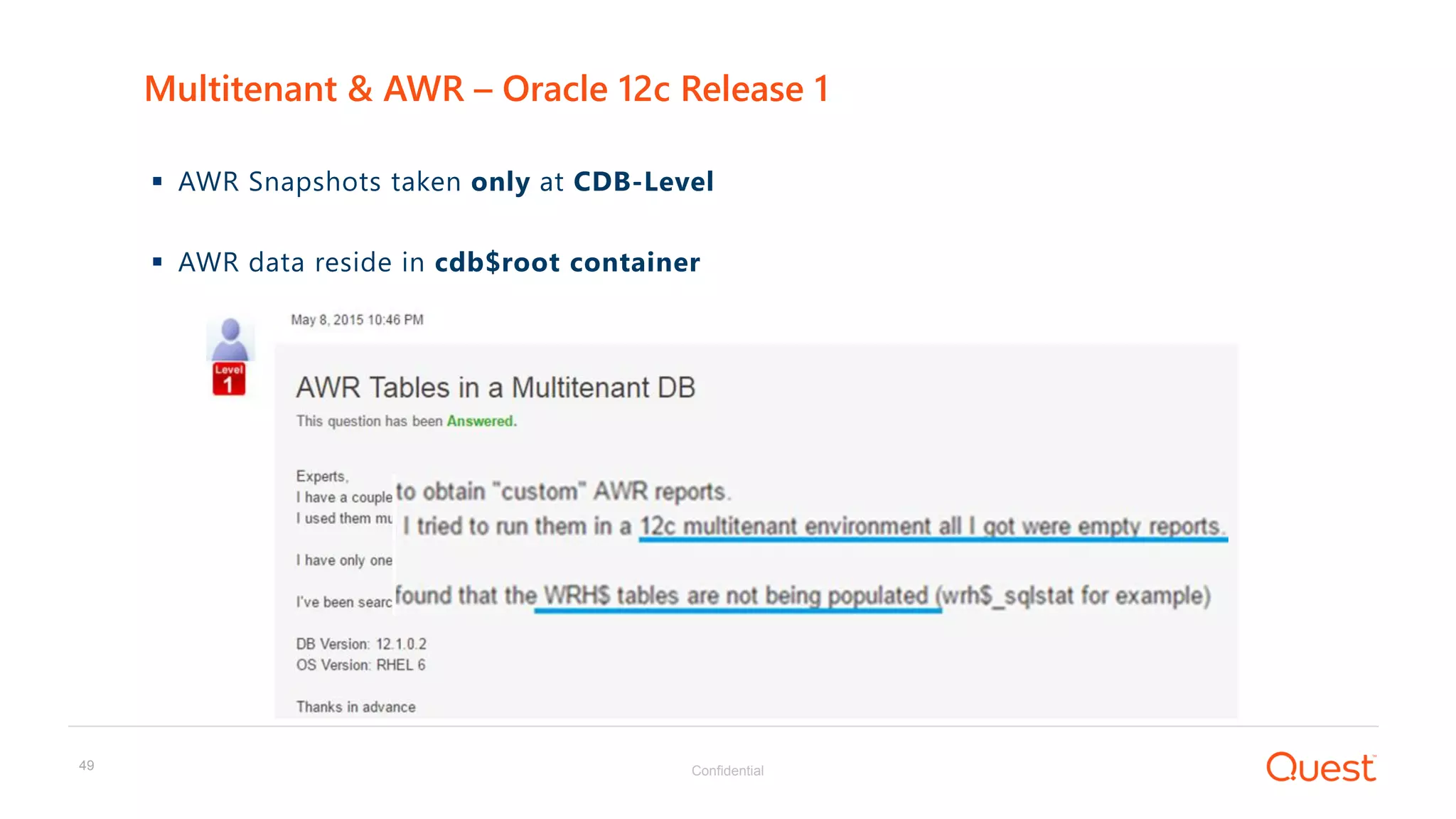
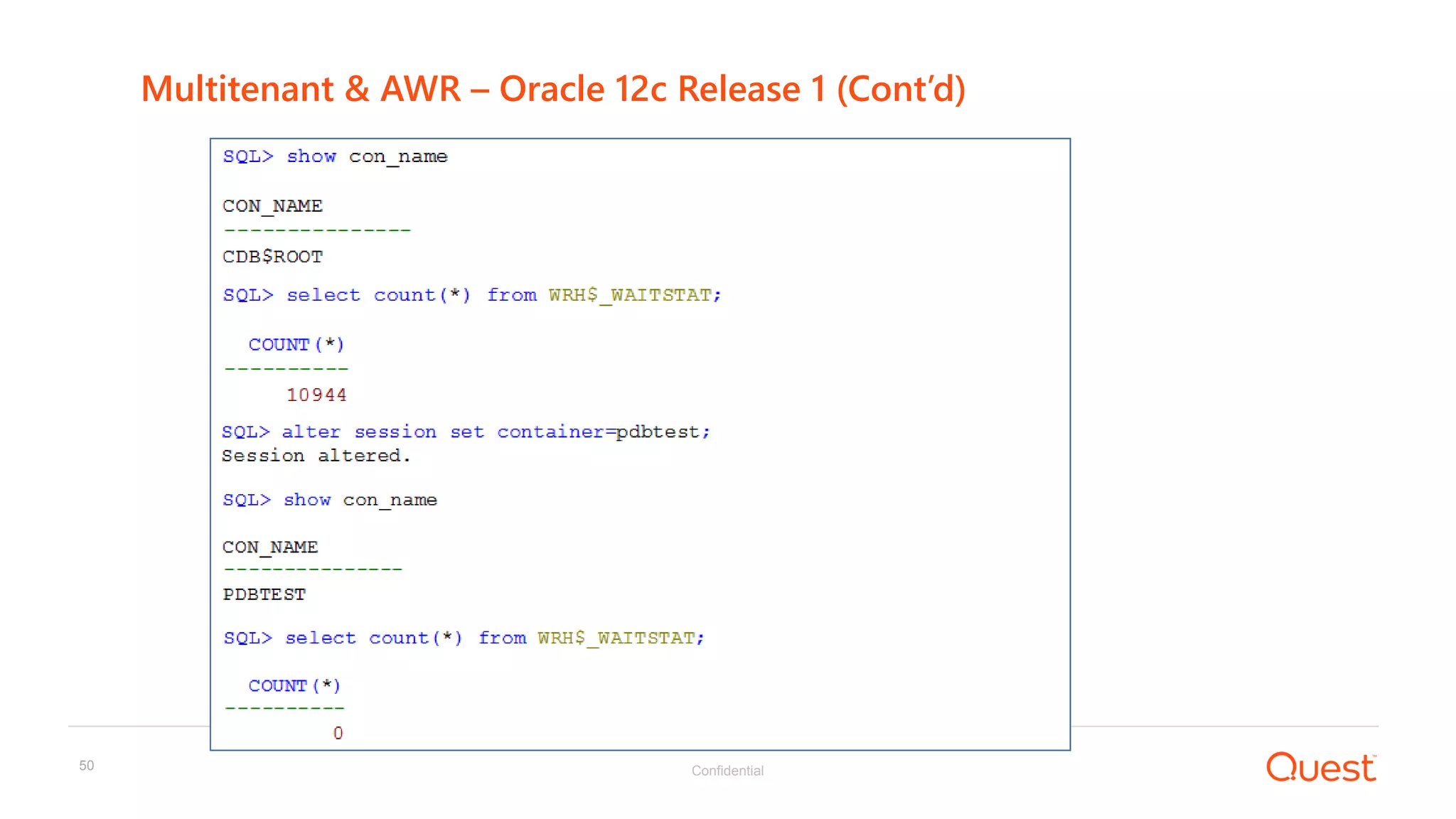
 AWR Snapshots taken only at CDB-Level
 AWR data reside in cdb$root container
Multitenant & AWR – Oracle 12c Release 1
Confidential50
Multitenant & AWR – Oracle 12c Release 1 (Cont’d)
s
Confidential51
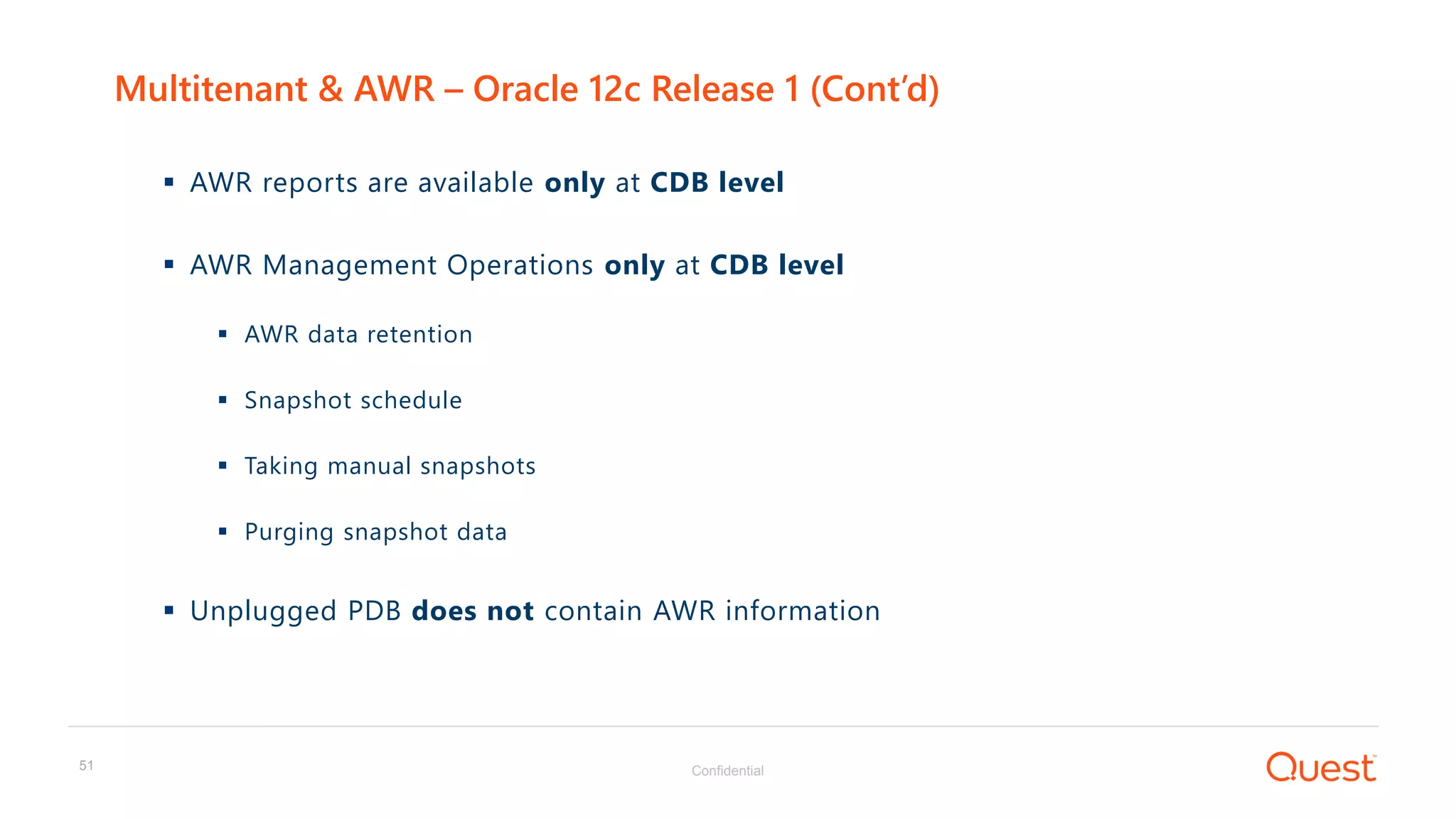
 AWR reports are available only at CDB level
 AWR Management Operations only at CDB level
 AWR data retention
 Snapshot schedule
 Taking manual snapshots
 Purging snapshot data
 Unplugged PDB does not contain AWR information
Multitenant & AWR – Oracle 12c Release 1 (Cont’d)
Confidential52
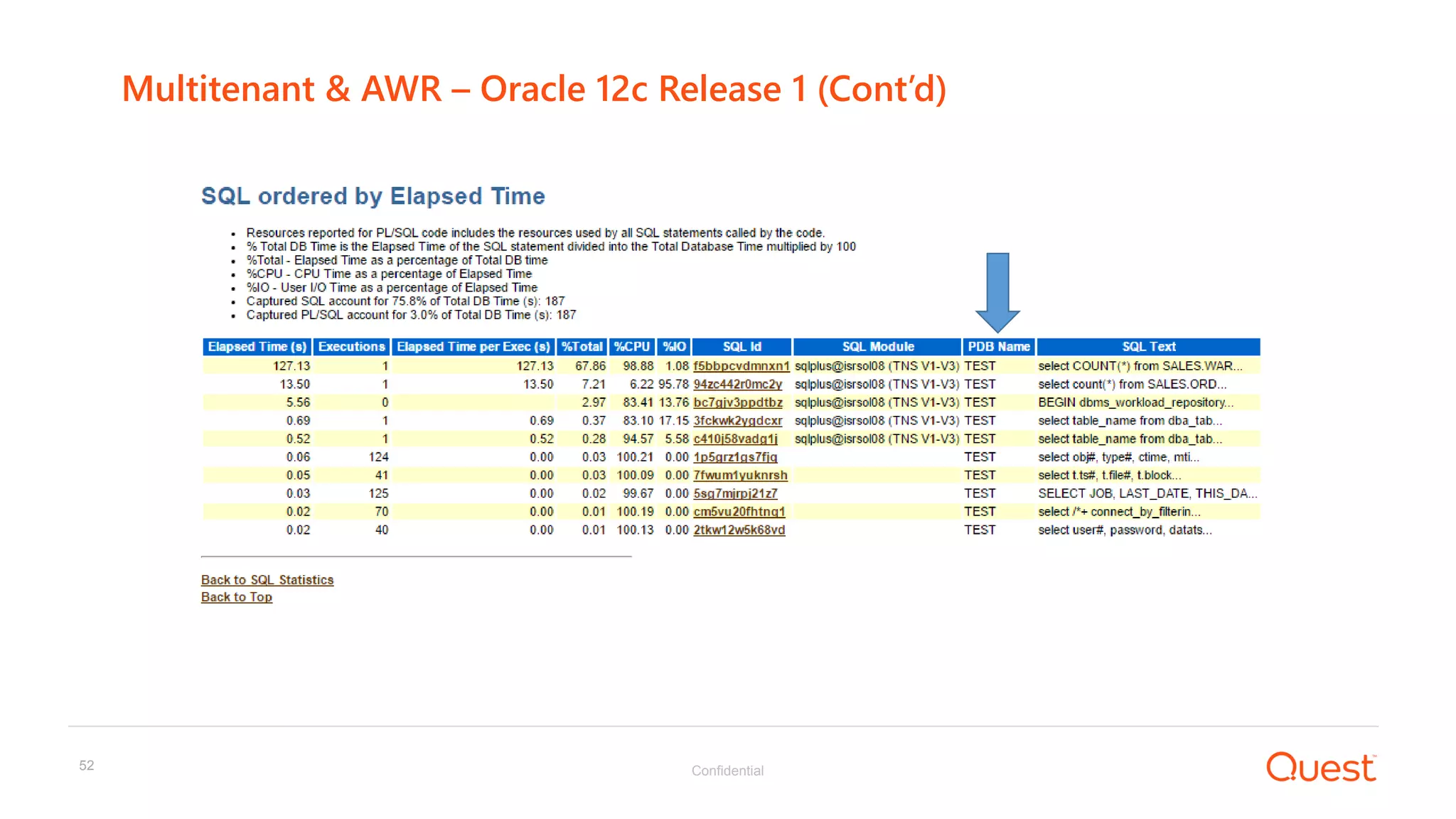
Multitenant & AWR – Oracle 12c Release 1 (Cont’d)
Confidential53
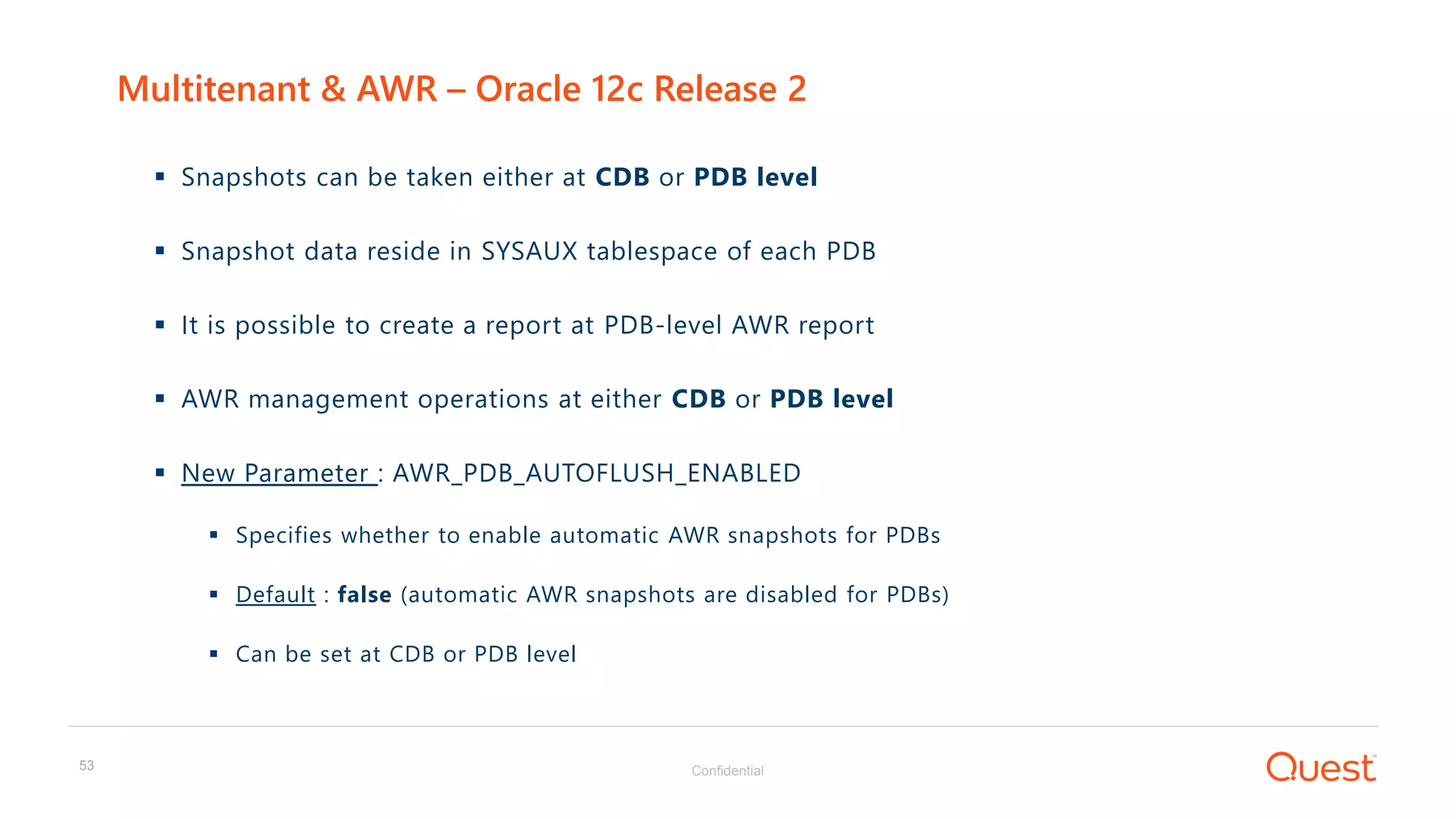
 Snapshots can be taken either at CDB or PDB level
 Snapshot data reside in SYSAUX tablespace of each PDB
 It is possible to create a report at PDB-level AWR report
 AWR management operations at either CDB or PDB level
 New Parameter : AWR_PDB_AUTOFLUSH_ENABLED
 Specifies whether to enable automatic AWR snapshots for PDBs
 Default : false (automatic AWR snapshots are disabled for PDBs)
 Can be set at CDB or PDB level
Multitenant & AWR – Oracle 12c Release 2
Confidential54
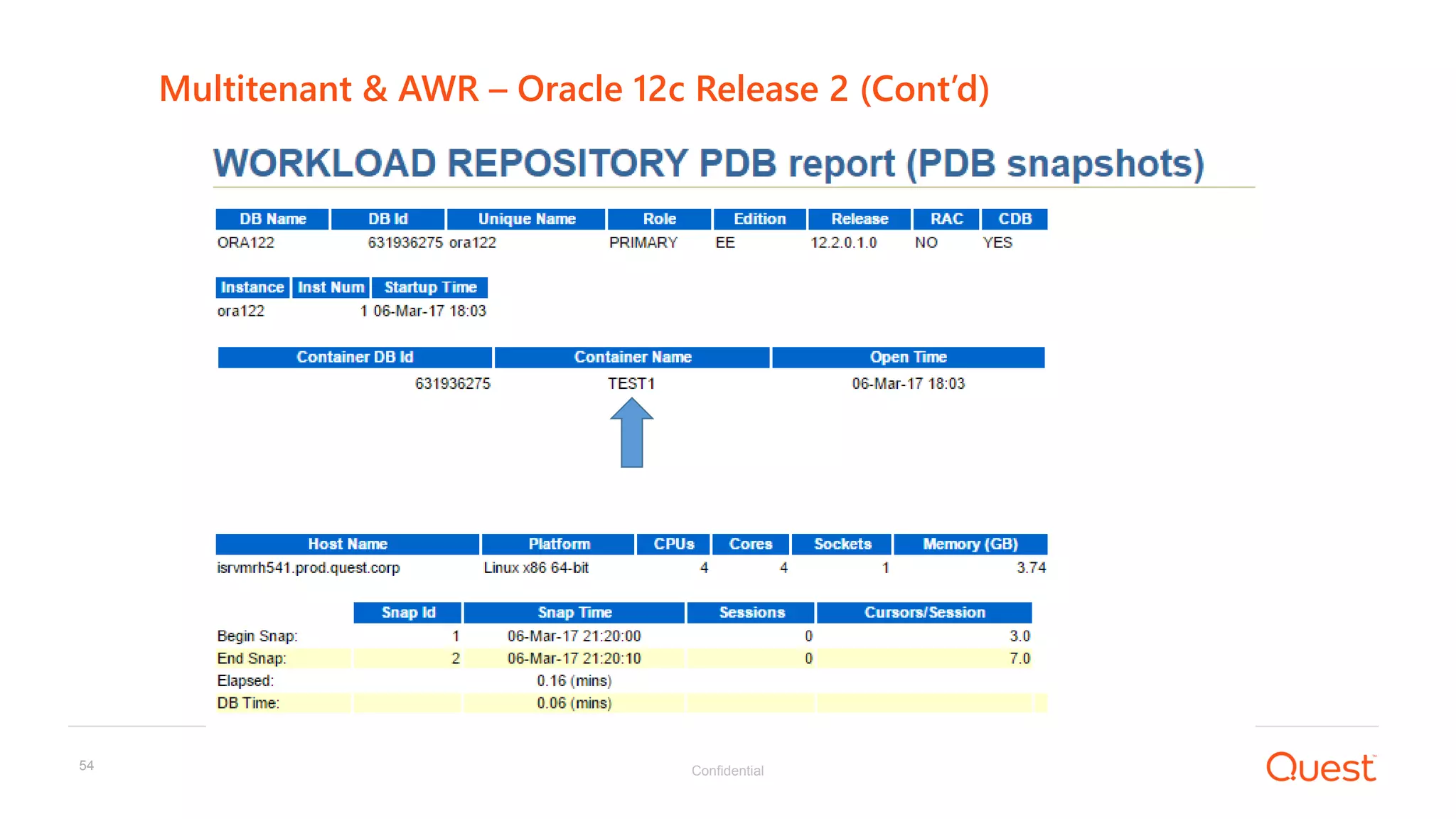
Multitenant & AWR – Oracle 12c Release 2 (Cont’d)
Confidential55
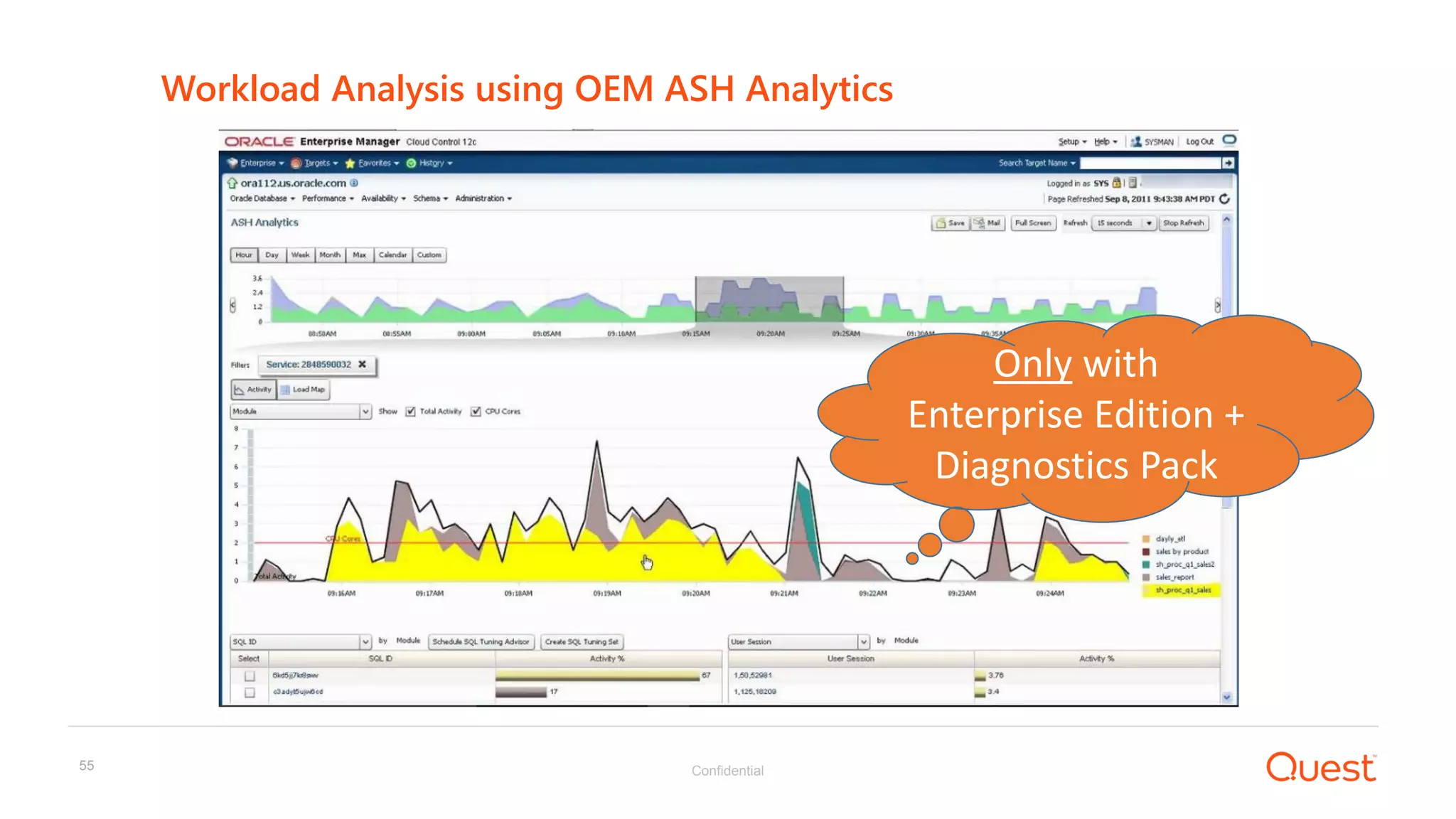
Workload Analysis using OEM ASH Analytics
Only with
Enterprise Edition +
Diagnostics Pack
Confidential56
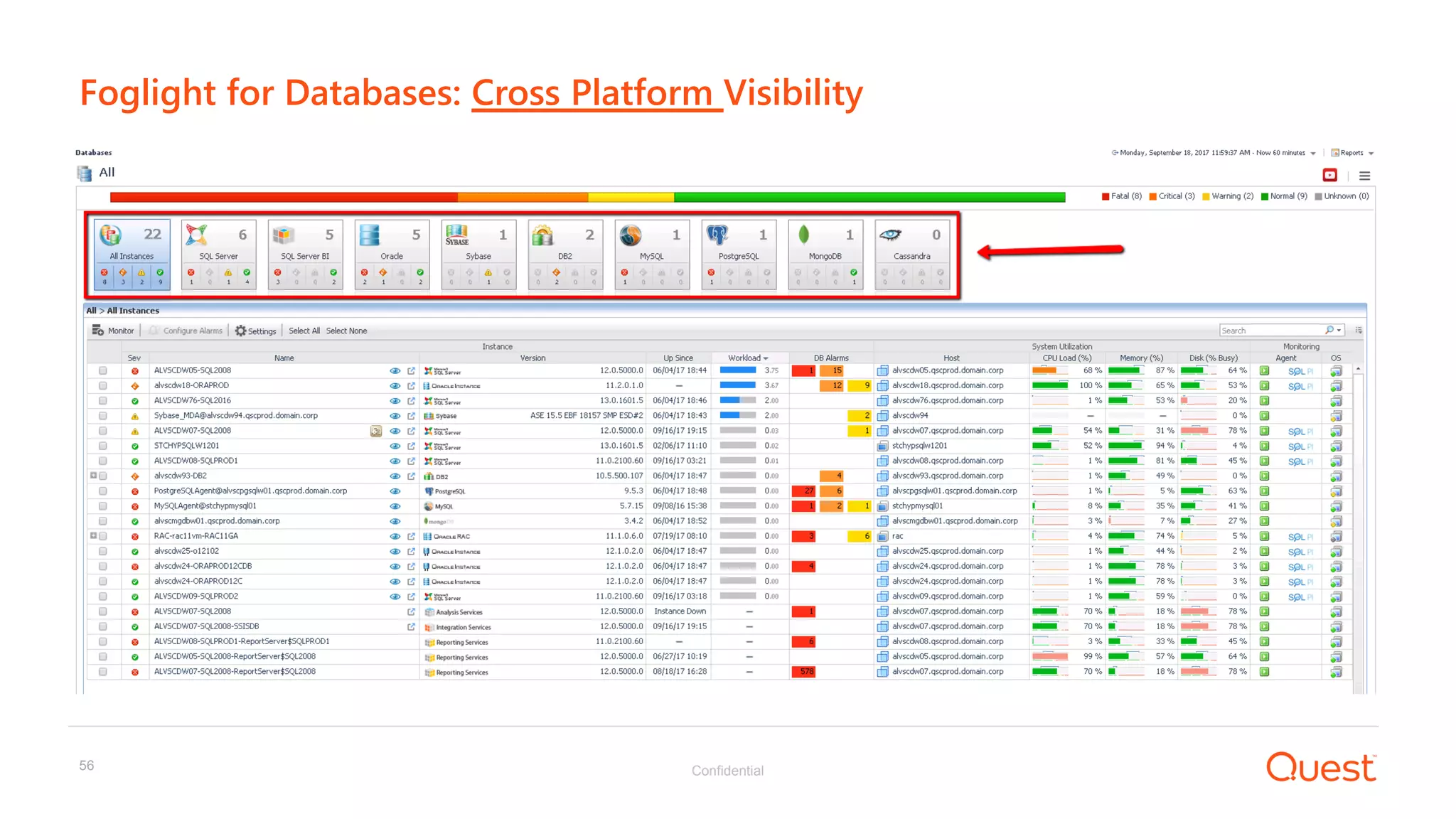
Foglight for Databases: Cross Platform Visibility
Confidential57
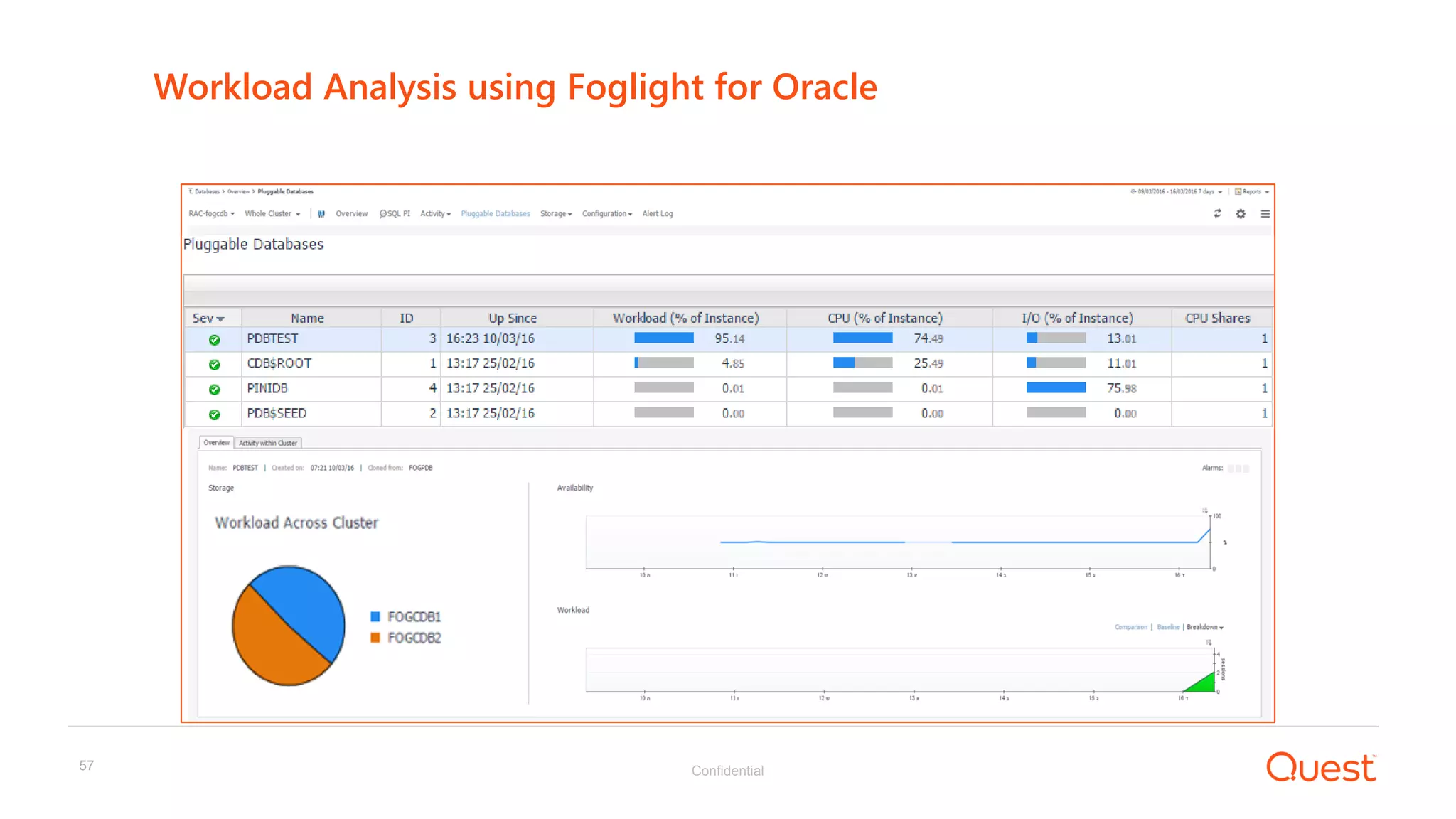
Workload Analysis using Foglight for Oracle
Confidential58
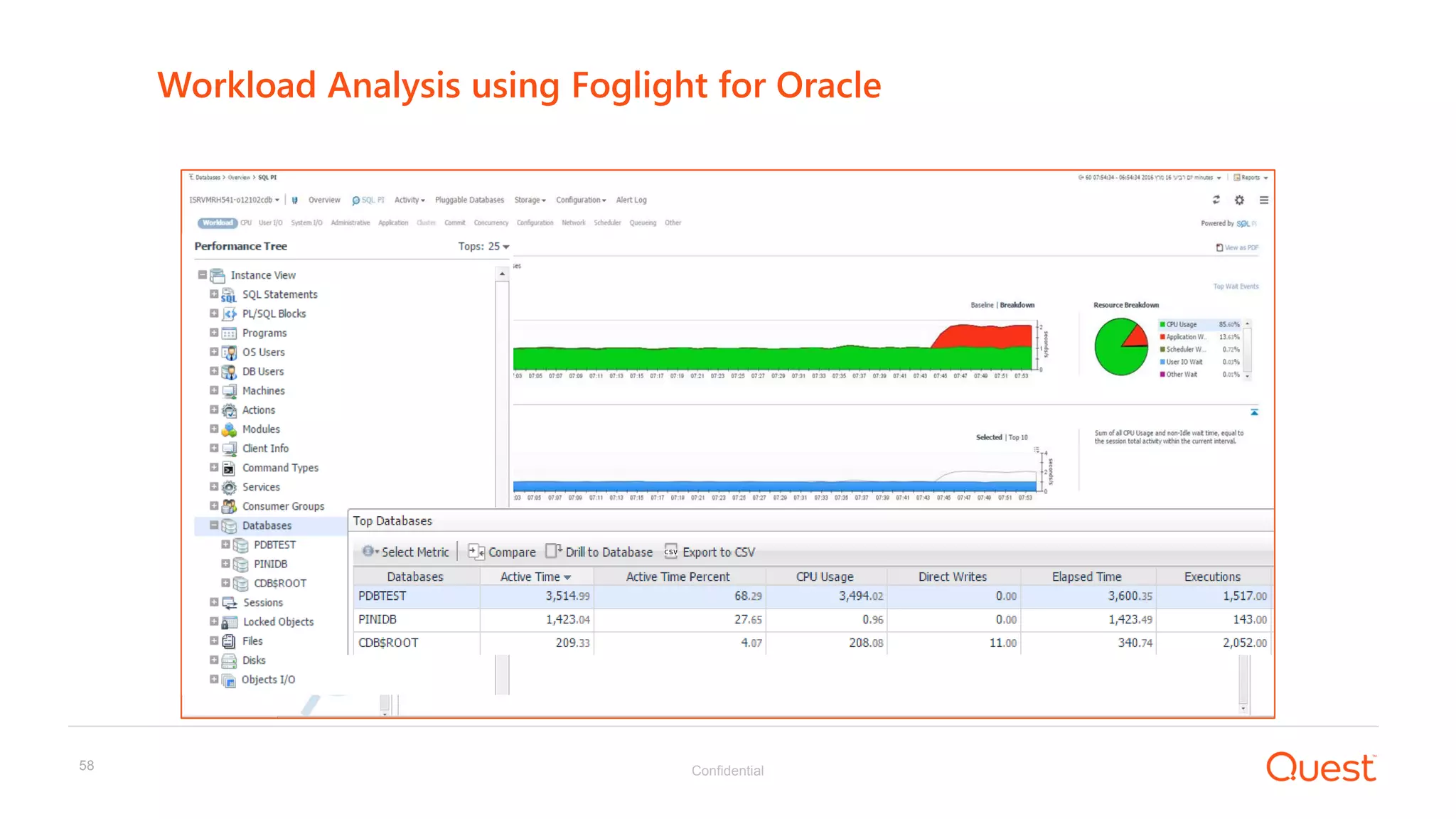
Workload Analysis using Foglight for Oracle
Confidential59
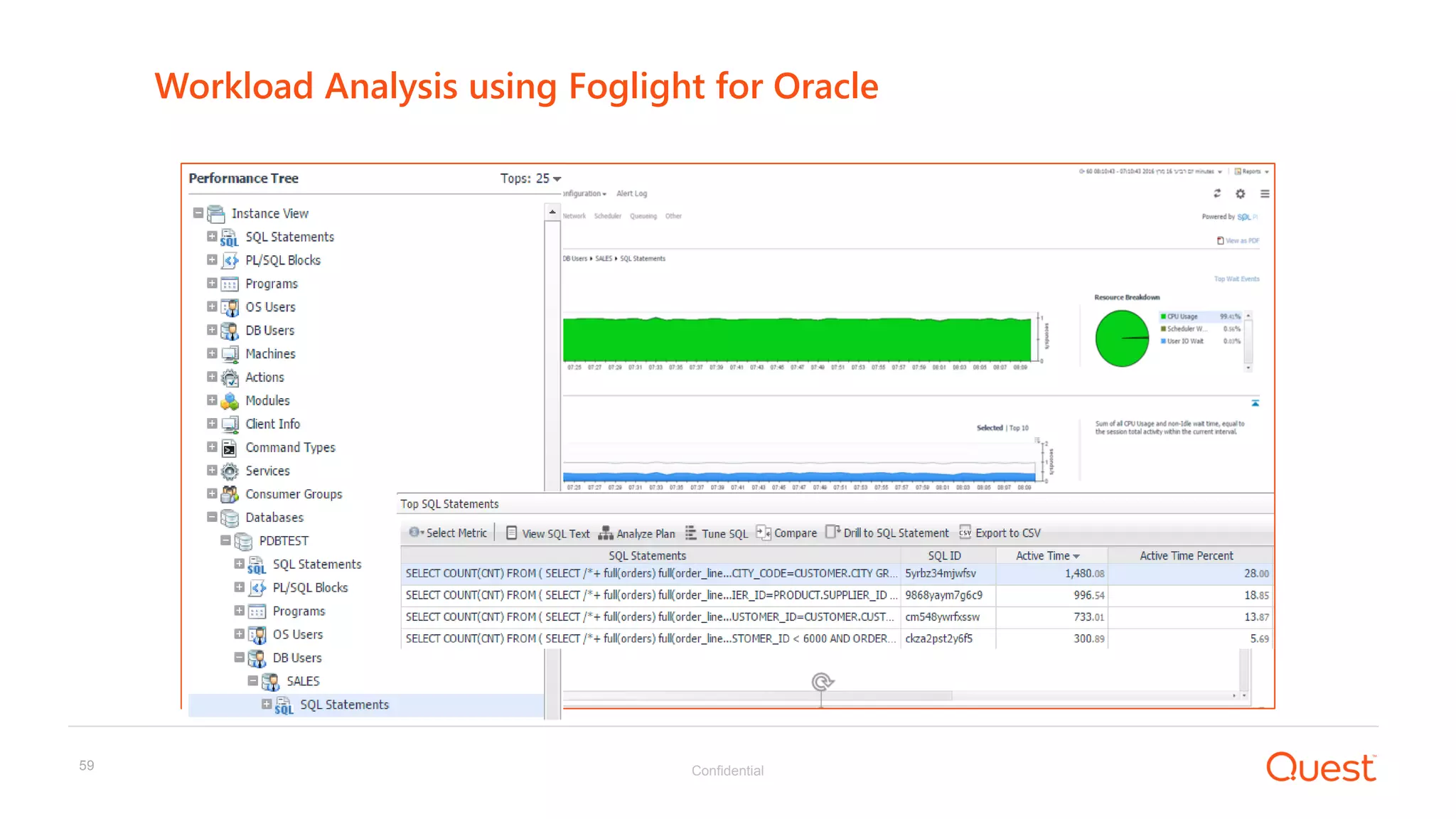
Workload Analysis using Foglight for Oracle
Confidential60
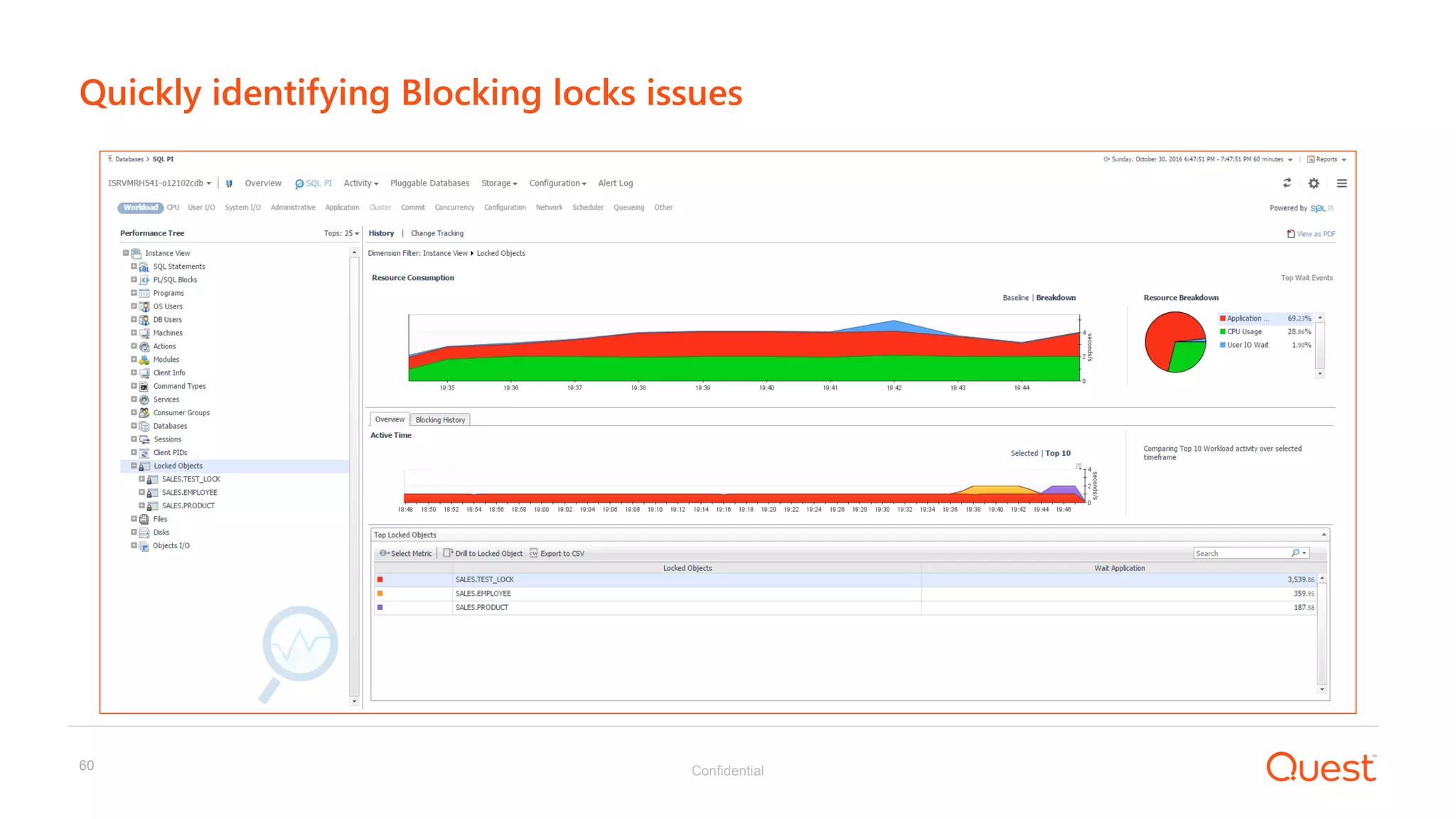
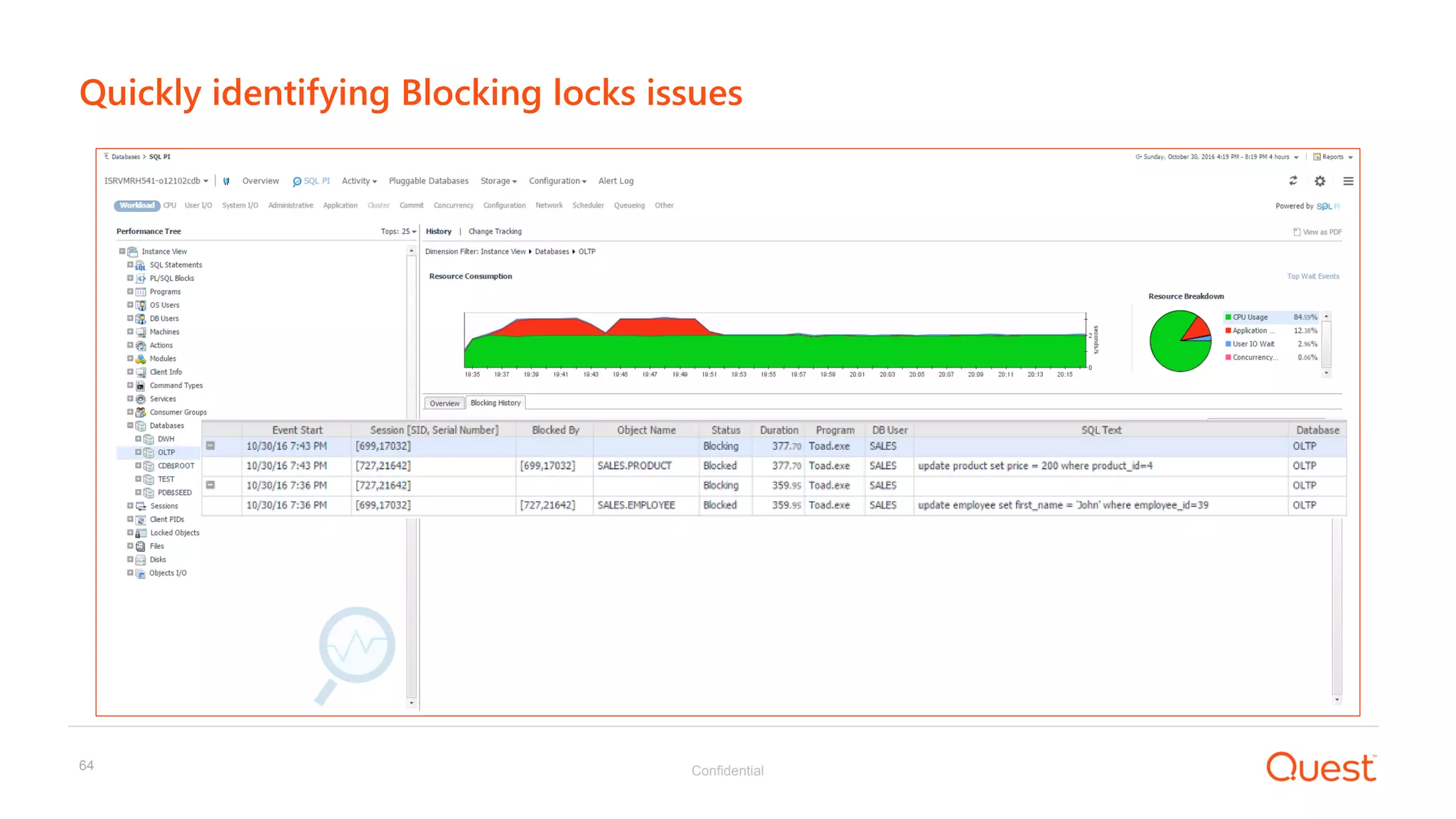
Quickly identifying Blocking locks issues
Confidential61
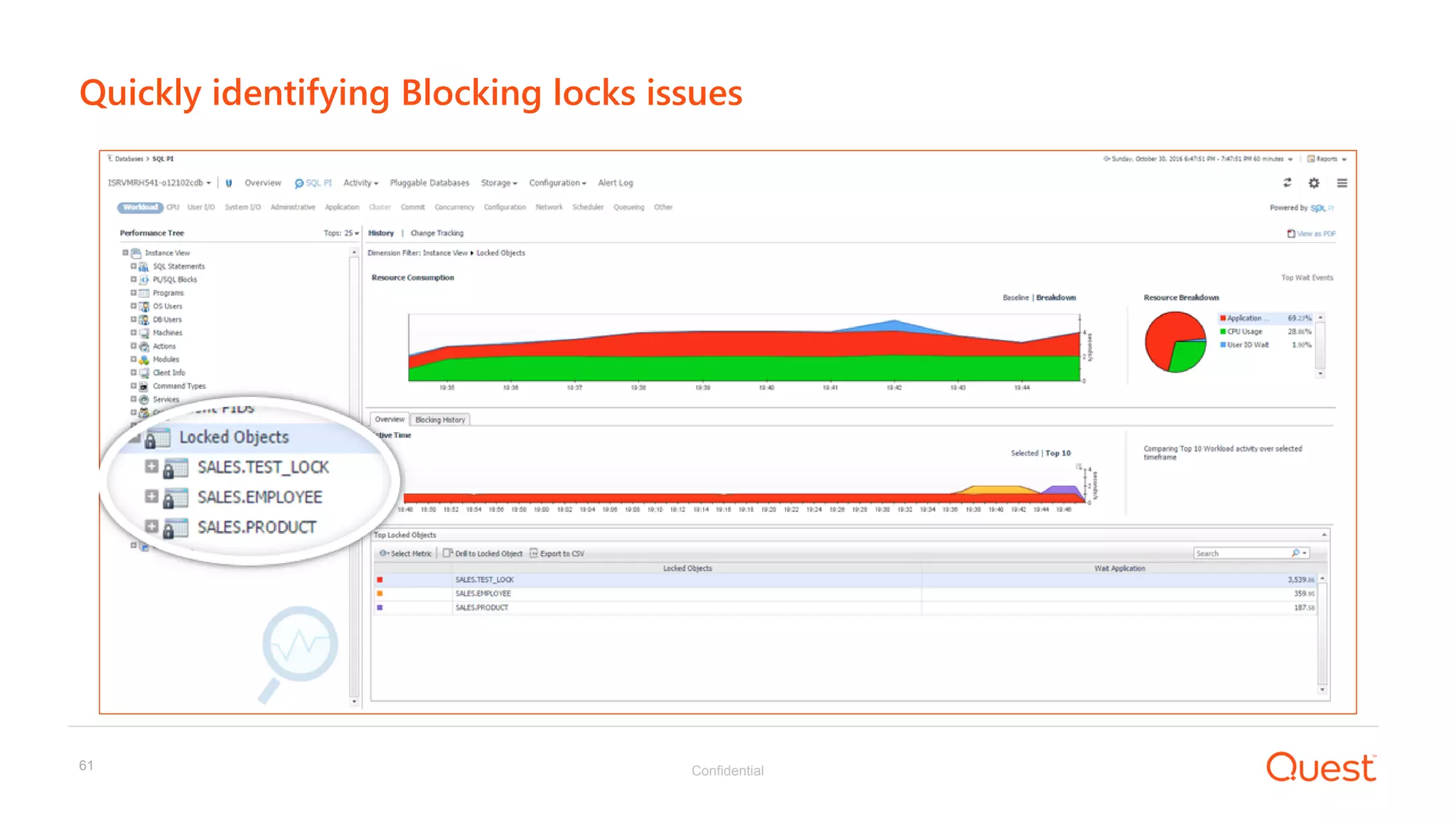
Quickly identifying Blocking locks issues
Confidential62
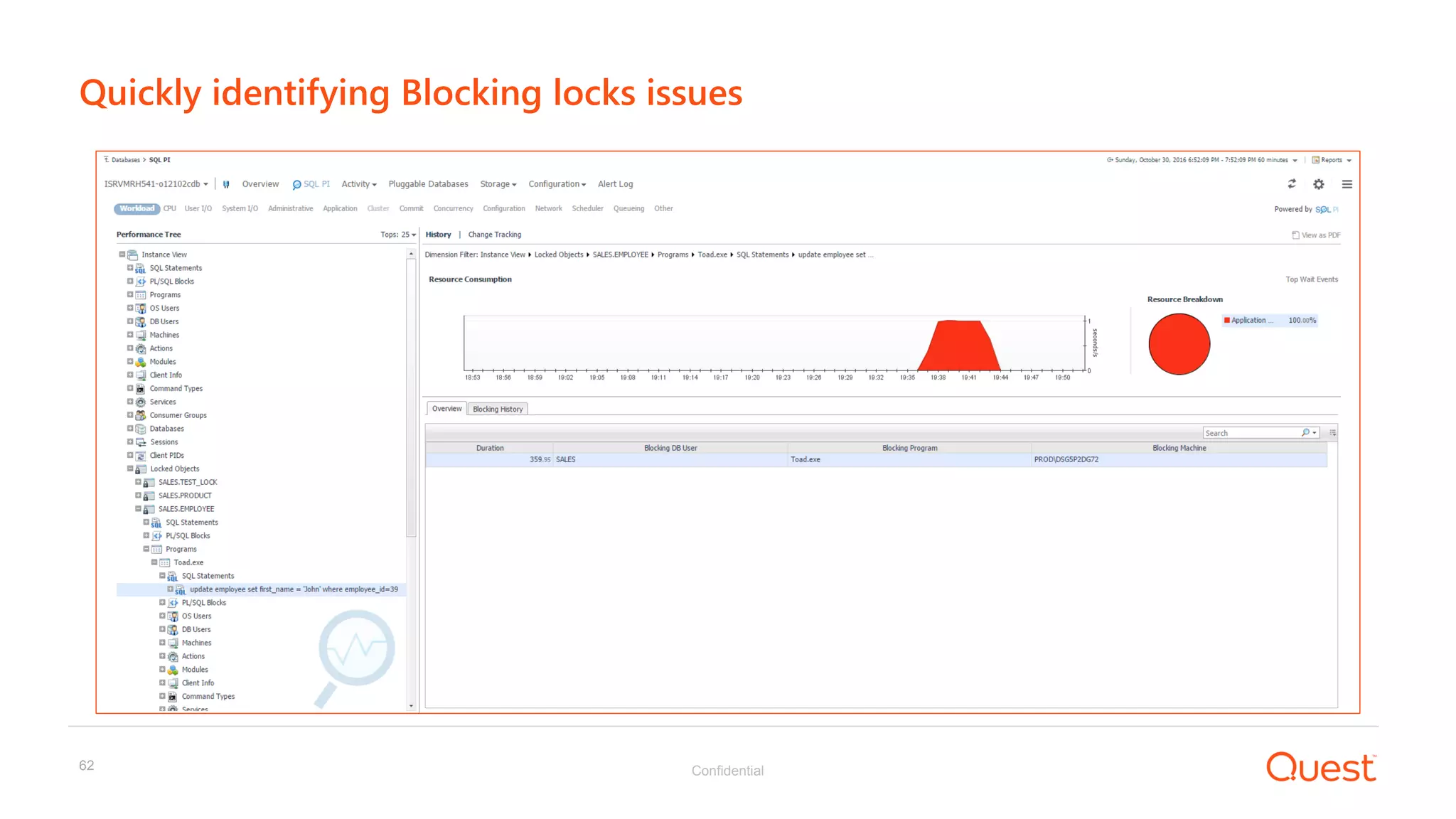
Quickly identifying Blocking locks issues
Confidential63
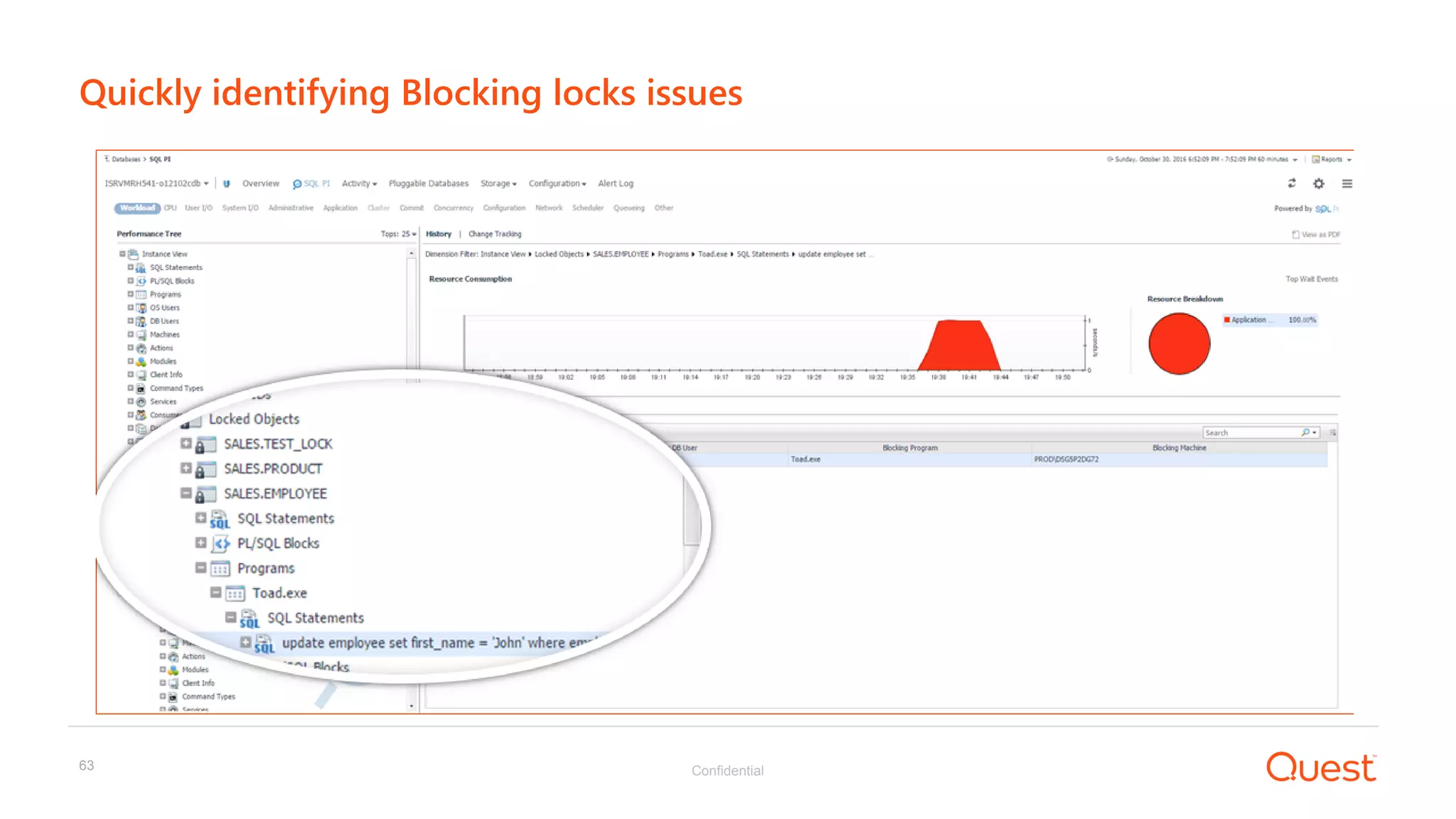
Quickly identifying Blocking locks issues
Confidential64
Quickly identifying Blocking locks issues
Confidential65
Quest provides your team with the tools to cover all of your
database platforms…
* Platform support varies from tool to tool
Confidential66
 Introduction to the Multitenant: Architecture (Documentation)
http://docs.oracle.com/database/122/CNCPT/introduction-to-the-multitenant-architecture.htm#CNCPT89234
 Oracle Multitenant (White Paper)
http://www.oracle.com/technetwork/database/multitenant-wp-12c-1949736.pdf
 Oracle Multitenant: New Features in Oracle Database 12c Release 12 (White Paper)
http://www.oracle.com/technetwork/database/multitenant/overview/multitenant-wp-12c-2078248.pdf
 Mike Dietrich Blog
https://mikedietrichde.com/
Note: All diagrams and illustrations are used by permission of Oracle
References
Questions?
Thank you

RMOUG 18 - Winning Performance Challenges in Oracle Multitenant

  • 1.
    Winning Performance Challenges inOracle MultitenantProduct Manager for Database Tools February 22nd , 2018 Pini Dibask RMOUG Training Days 2018
  • 2.
    Confidential2 • Pini Dibask,Product Manager for Database Tools, Quest Software • Oracle ACE • Oracle Certified Professional DBA (OCP) • Public Speaker: Oracle OpenWorld, IOUG Collaborate, DOAG, OUGN, AOUG • Blogger: OracleDBPro.BlogSpot.com Pini.Dibask@Quest.com http://Linkedin.com/in/pinidibask @pini_dibask About the Speaker
  • 3.
    Confidential3 Who is QuestSoftware? 9 0 % o f F o r t u n e 1 0 0 using our software 1 , 5 0 0 engineers building quality products 4 M c o m m u n i t y m e m b e r s sharing best practices 3 , 5 0 0 employees focused on customers Quest is a global software provider trusted by 100,000 customers and 6,000 partners in 100 countries. We help IT organizations spend less time on administration and more time on innovation. 6 , 0 0 0 partners selling our software
  • 4.
    Confidential4 • Toad databasedevelopment & management tools • Foglight & Spotlight database performance monitoring solutions • SharePlex for heterogeneous database replication Quest Database Management Solutions
  • 5.
    Confidential5 • Introduction toDatabase Consolidation • Oracle Multitenant Concepts • Ensuring QoS in Multitenant Environments • RAC and Multitenant • Performance Monitoring for Multitenant Environments Agenda
  • 6.
  • 7.
    Confidential7 Server Consolidation  Multipledatabases reside on a single server Database Consolidation - Prior to Oracle 12c
  • 8.
    Confidential8 Database Consolidation  Singledatabase with multiple schemas Database Consolidation - Prior to Oracle 12c (Cont’d)
  • 9.
    Confidential9  Name Collisions Same schema name or same public synonym name  Security  DBA can access data of both applications  Upgrades  You cannot patch/upgrade only one schema  Point-In-Time Recovery  Impossible to perform schema level point-in-time recovery Database Consolidation with Schema Separation - Challenges
  • 10.
  • 11.
    Confidential11  Pluggable Database Self-contained Oracle database  Root Container  Oracle-supplied metadata Oracle 12c – Multitenant Architecture
  • 12.
    Confidential12  One SGA One set of background processes  One root container  Multiple pluggable databases  Up to 252 PDBs (12cR1)  Up to 4096 PDBs (12cR2) Oracle 12c – Multitenant Architecture Only on Oracle Cloud and Oracle Exadata
  • 13.
    Confidential13  Pluggable Databasesshare the following files:  Undo Tablespace  Redo Logs  Control Files  (S)Pfile Oracle 12c – Multitenant Architecture (Cont’d) Local undo introduced in 12cR2
  • 14.
    Confidential14 Data Guard  DataGuard operates at CDB-Level  Maintenance at CDB-Level = Reduced DBA efforts Manage Many as One
  • 15.
    Confidential15 RMAN - GranularBackup & Restore Options  Backup entire CDB at once or at PDB level  Recover entire container at once or at PDB level Multitenant Advantages - Manage Many as One s s
  • 16.
    Confidential16 Moving PDB fromone container to another is straightforward Multitenant Advantages - Unplug/Plug s
  • 17.
    Confidential17  Clone PDBfrom another PDB within the same CDB  Requires source PDB to be OPEN READ ONLY (12cR1) Multitenant Advantages - Fast Cloning s Hot Clone is available in 12cR2
  • 18.
    Confidential18  Clone PDBfrom another PDB in remote CDB  Requires source PDB to be OPEN READ ONLY (12cR1) Multitenant Advantages - Fast Cloning Hot Clone is available in 12cR2 s
  • 19.
    Confidential19  Refreshable PDB– Allows refreshing contents of a cloned PDB  Step 1 – takes a full clone. Doesn’t require any downtime due to hot clone feature  Step 2 - refresh by applying redo logs (either on-demand or automatically scheduled)  Refreshable PDB should be in a read-only mode Multitenant Advantages - Easy Replication (12c Release 2) s This feature is not a replacement for Data Guard
  • 20.
    Confidential20 Upgrades  Upgrade orapply a patch at CDB-Level (Everything at Once) https://mikedietrichde.com/2014/08/06/upgrade-pdbs-everything-at-once-full-cdb-upgrade/ Multitenant Advantages - Manage Many as One
  • 21.
    Confidential21 Upgrades  Unplug/plug PDBinto another container database (Once at a Time) https://mikedietrichde.com/2014/08/05/upgrade-pdbs-one-at-a-time-unplugplug/ Multitenant Advantages - Manage Many as One
  • 22.
    Confidential22 CDB Level vs.PDB-Level CDB-Level • Oracle Software • SGA • Background Processes • Data Guard • Some Parameters (IsPDB_Modifiable= 'FALSE') • Control Files, Redo • (S)Pfile, Password File PDB-Level • Point In-Time Recovery • Some Parameters (IsPDB_Modifiable= 'TRUE') • Undo Tablespace (12cR2) • Character Set (12cR2) • Flashback Database (12cR2)
  • 23.
    Confidential23 Non-CDB • Same asbefore 12c Oracle 12c – Deployment Options DB CDB$ROOT CDB$ROOT PDB1 PDB1 PDB2 PDB252 Single Tenant • No additional license • Available in SE/SE1/SE2 • One active PDB Multitenant • Option on top of Enterprise Edition • Supports up to 4096 active PDBs …
  • 24.
    Confidential24 Why use SingleTenant instead of Non-CDB?  Unplug/Plug  Fast Cloning  but most importantly … (source: Oracle 12c Release 2 Documentation) Oracle 12c – Deployment Options (Cont’d)
  • 25.
    Confidential25 Oracle 12c –DBCA Non-CDB Single Tenant / Multitenant
  • 26.
    Ensuring High Level ofQoS in Multitenant Environments 03
  • 27.
    Confidential27  CDB-Level QoSchallenge  Allocation of resources among competing PDBs  Example: One PDB consumes too many resources QoS Challenges – Multitenant Environments
  • 28.
    Confidential28 Resource Manager Elements Resource Plan  Resource Plan Directive  Consumer Group Oracle Resource Manager - The Basics (Pre 12c) Resource Plan “WEEKEND” Directive 1 70% of CPU Directive 2 20% of CPU Directive 3 10% of CPU Consumer Group “WAREHOUSE” Consumer Group “OLTP” Consumer Group “OTHERS_GROUPS”
  • 29.
    Confidential29  PDB-Level ResourcePlan  Specifies how resources are allocated to consumer groups  Prioritize resources between competing sessions  CDB-Level Resource Plan  Specifies how resources are allocated to PDBs  Prioritize resources between competing PDBs The Solution - Oracle Resource Manager
  • 30.
    Confidential30 Oracle Resource Manager- 12c Multitenant CDB Resource Plan Directive  CPU Shares  CPU Utilization Limit Example: Pluggable Database CPU Shares Guaranteed CPU CPU Limit OLTP 3 3/4 = 75% 100% DWH 1 1/4 = 25% 60% CPU_COUNT parameter is available in Oracle 12c Release 2
  • 31.
    Confidential31 Oracle Resource Manager- 12c Multitenant  Obtain information about default CDB resource plan  Obtain information about default PDB directive s s
  • 32.
    Confidential32 Example of CDB-LevelResource Plan Resource Plan “Daytime_CDB_PLAN” PDB “OLTP” PDB “DWH” Directive 2 Guaranteed CPU: 25% Maximum CPU: 60% Directive 1 Guaranteed CPU: 75% Maximum CPU: 100% Pluggable Database CPU Shares Guaranteed CPU CPU Limit OLTP 3 3/4 = 75% 100% DWH 1 1/4 = 25% 60%
  • 33.
    Confidential33 s Creating CDB ResourcePlan Pluggable Database CPU Shares Guaranteed CPU CPU Limit OLTP 3 3/4 = 75% 100% DWH 1 1/4 = 25% 60%
  • 34.
  • 35.
    Confidential35 Enabling/Disabling CDB ResourcePlan  Manually enabling resource plan  Manually disabling resource plan s s
  • 36.
    Confidential36 Enabling/Disabling CDB ResourcePlan (Cont’d) s Automatically Enable/Disable CDB Resource Plan
  • 37.
    Confidential37 PDB Level MemoryResource Management  Not available in 12c Release 1  12c Release 2 - Memory parameters can be set at PDB level  SGA_TARGET  DB_CACHE_SIZE  DB_SHARED_POOL_SIZE  PGA_AGGREGATE_LIMIT  PGA_AGGREGATE_TARGET  SGA_MIN_SIZE New in 12c Release 2
  • 38.
    Confidential38 PDB Level I/OResource Management  Not available in 12c Release 1  12c Release 2 Introduced the following new parameters:  MAX_IOPS - limits number of I/O operations per second  MAX_MBPS - limits megabytes for I/O operations per second  Default : 0 (no limit)  If Oracle waits due to I/O limit “resmgr: I/O rate limit” wait event will appear  Cannot be set in a Non CDB
  • 39.
    Confidential39 How Many ResourcesActually Being Used by PDBs?  Option #1 - DBA_HIST_RSRC_PDB_METRIC  Displays historical resource manager metrics by PDB  Option #2 - AWR_ROOT_RSRC_PDB_METRIC (underlying AWR table)  Option #3 - AWR Reports
  • 40.
    Confidential40 Maintenance Tasks inOracle Multitenant  ENABLE_AUTOMATIC_MAINTENANCE_PDB parameter  Can be used to enable/disable running of maintenance tasks  Default: true  Can be set at either CDB or PDB levels  AUTOTASK_MAX_ACTIVE_PDBS parameter  Maximum number of PDBs that can schedule maintenance tasks concurrently  Can be set at CDB level only  Default: 2 (two PDBs and the CDB root can run tasks at the same time)  Both parameters introduced in 12c Release 2
  • 41.
  • 42.
    Confidential42  Single Instance& Multitenant challenges  Not Scalable = Limited Consolidation Solution  Instance Down Downtime for all PDBs  RAC makes Multitenant better  Scalable = True consolidation solution  Available = Instance Down  PDBs continue running on other nodes Why RAC & Multitenant?
  • 43.
    Confidential43  Multitenant fullysupports RAC  PDBs can be opened on specific instances RAC & Multitenant s
  • 44.
    Confidential44 PDBs workload distributedacross RAC instances RAC & Multitenant Services Single SGA per CDB Instance Node1 CDB Instance 1 Node2 CDB Instance 2 Multitenant Container Database (CDB)
  • 45.
    Confidential45 PDBs workload distributedacross RAC instances RAC & Multitenant Services Single SGA per CDB Instance Node1 CDB Instance 1 Node2 CDB Instance 2 Node3 CDB Instance 3 Multitenant Container Database (CDB)
  • 46.
  • 47.
    Confidential47 RAC & Multitenant s PDBopened only in Preferred instance PDB automatically starts in the other instance Shutting down the preferred instance
  • 48.
  • 49.
    Confidential49  AWR Snapshotstaken only at CDB-Level  AWR data reside in cdb$root container Multitenant & AWR – Oracle 12c Release 1
  • 50.
    Confidential50 Multitenant & AWR– Oracle 12c Release 1 (Cont’d) s
  • 51.
    Confidential51  AWR reportsare available only at CDB level  AWR Management Operations only at CDB level  AWR data retention  Snapshot schedule  Taking manual snapshots  Purging snapshot data  Unplugged PDB does not contain AWR information Multitenant & AWR – Oracle 12c Release 1 (Cont’d)
  • 52.
    Confidential52 Multitenant & AWR– Oracle 12c Release 1 (Cont’d)
  • 53.
    Confidential53  Snapshots canbe taken either at CDB or PDB level  Snapshot data reside in SYSAUX tablespace of each PDB  It is possible to create a report at PDB-level AWR report  AWR management operations at either CDB or PDB level  New Parameter : AWR_PDB_AUTOFLUSH_ENABLED  Specifies whether to enable automatic AWR snapshots for PDBs  Default : false (automatic AWR snapshots are disabled for PDBs)  Can be set at CDB or PDB level Multitenant & AWR – Oracle 12c Release 2
  • 54.
    Confidential54 Multitenant & AWR– Oracle 12c Release 2 (Cont’d)
  • 55.
    Confidential55 Workload Analysis usingOEM ASH Analytics Only with Enterprise Edition + Diagnostics Pack
  • 56.
    Confidential56 Foglight for Databases:Cross Platform Visibility
  • 57.
  • 58.
  • 59.
  • 60.
  • 61.
  • 62.
  • 63.
  • 64.
  • 65.
    Confidential65 Quest provides yourteam with the tools to cover all of your database platforms… * Platform support varies from tool to tool
  • 66.
    Confidential66  Introduction tothe Multitenant: Architecture (Documentation) http://docs.oracle.com/database/122/CNCPT/introduction-to-the-multitenant-architecture.htm#CNCPT89234  Oracle Multitenant (White Paper) http://www.oracle.com/technetwork/database/multitenant-wp-12c-1949736.pdf  Oracle Multitenant: New Features in Oracle Database 12c Release 12 (White Paper) http://www.oracle.com/technetwork/database/multitenant/overview/multitenant-wp-12c-2078248.pdf  Mike Dietrich Blog https://mikedietrichde.com/ Note: All diagrams and illustrations are used by permission of Oracle References
  • 67.
  • 68.