Contents
 Introduction

 Pluggable & Container Database
 Database Cloud & Consolidation Architectures

 New Multitenant Architecture
 Managing Shared Resources

 Manage Many Databases as One

tank.infotech@gmail.com
Introduction
 Oracle announced general availability of Oracle
Database 12c on June 25, 2013.
 Oracle Database 12c introduces a new multitenant
architecture that makes it easy to deploy and
manage database clouds.
 Oracle Database 12c provide private and public cloud
deployments for the users.

tank.infotech@gmail.com
Oracle 12c Database Editions
 Oracle Database Standard Edition One

 Oracle Database Standard Edition
 Oracle Database Enterprise Edition

tank.infotech@gmail.com
Oracle Database Options
 Data Warehousing

 High Availability
 Management

 Multitenant
 Security
 Storage Management
tank.infotech@gmail.com
Pluggable Database (PDB)

tank.infotech@gmail.com
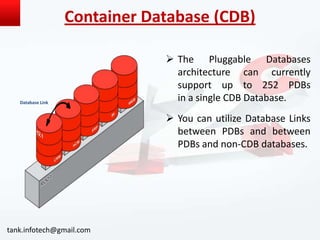
Container Database (CDB)

Database Link

 The Pluggable Databases
architecture can currently
support up to 252 PDBs
in a single CDB Database.
 You can utilize Database Links
between PDBs and between
PDBs and non-CDB databases.

tank.infotech@gmail.com
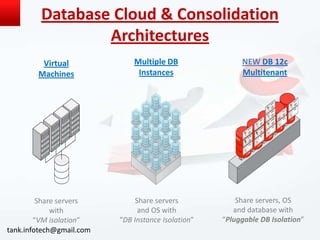
Database Cloud & Consolidation
Architectures
Virtual
Machines

Share servers
with
“VM isolation”
tank.infotech@gmail.com

Multiple DB
Instances

NEW DB 12c
Multitenant

Share servers
and OS with
“DB Instance Isolation”

Share servers, OS
and database with
“Pluggable DB Isolation”
The need for Database Consolidation
Why…?
 Customers have 100s or 1000s of databases across
their enterprise.
 They want to lower costs by operating these
databases on a centrally managed platform.

 With only hardware consolidation, each database has
an overhead, that prevents 100s of database from
being placed on the same physical server.

tank.infotech@gmail.com
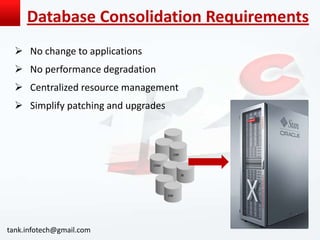
Database Consolidation Requirements
 No change to applications
 No performance degradation
 Centralized resource management
 Simplify patching and upgrades

ERP
CRM
BI

DW

tank.infotech@gmail.com
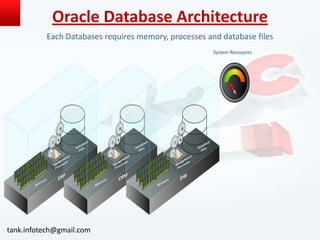
Oracle Database Architecture
Each Databases requires memory, processes and database files
System Resources

tank.infotech@gmail.com
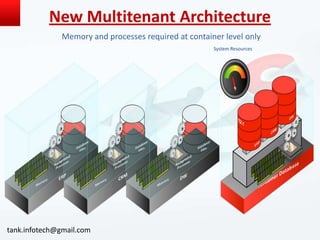
New Multitenant Architecture
Memory and processes required at container level only
System Resources

tank.infotech@gmail.com
New Multitenant Architecture
Memory and processes are shared and managed at container level
System Resources

tank.infotech@gmail.com
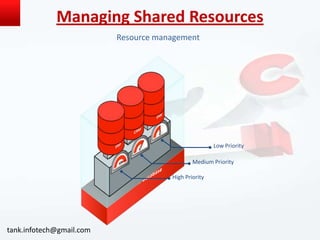
Managing Shared Resources
Resource management

Low Priority
Medium Priority
High Priority

tank.infotech@gmail.com
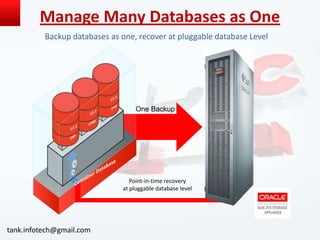
Manage Many Databases as One
Backup databases as one, recover at pluggable database Level

One Backup

Point-in-time recovery
at pluggable database level

tank.infotech@gmail.com
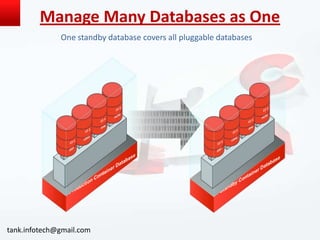
Manage Many Databases as One
One standby database covers all pluggable databases

tank.infotech@gmail.com
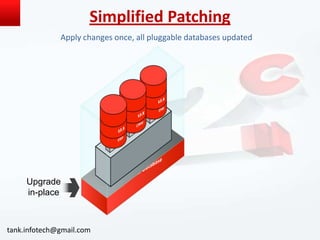
Simplified Patching
Apply changes once, all pluggable databases updated

Upgrade
in-place

tank.infotech@gmail.com
Simplified Upgrades
Flexible choice when patching & upgrading databases

tank.infotech@gmail.com
Creating Databases for Test & Development
Fast, flexible copy and snapshot of pluggable databases

tank.infotech@gmail.com
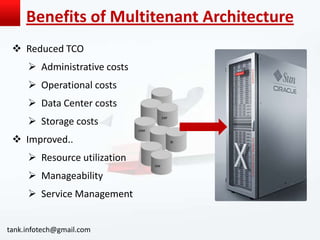
Benefits of Multitenant Architecture
 Reduced TCO
 Administrative costs

 Operational costs
 Data Center costs
 Storage costs

ERP

CRM

 Improved..

BI

 Resource utilization
DW

 Manageability

 Service Management
tank.infotech@gmail.com
Conclusion
 A new option for Oracle Database 12c,
Oracle Multitenant helps customers reduce
IT costs by simplifying consolidation,
provisioning, upgrades, and more.

tank.infotech@gmail.com
References
 http://www.oracle.com/technetwork/database/multitenant/
overview/index.html
 http://www.oracle.com/us/corporate/features/database12c/index.html
 http://www.oracle.com/technetwork/database/index.html

tank.infotech@gmail.com

Oracle 12c

  • 2.
    Contents  Introduction  Pluggable& Container Database  Database Cloud & Consolidation Architectures  New Multitenant Architecture  Managing Shared Resources  Manage Many Databases as One tank.infotech@gmail.com
  • 3.
    Introduction  Oracle announcedgeneral availability of Oracle Database 12c on June 25, 2013.  Oracle Database 12c introduces a new multitenant architecture that makes it easy to deploy and manage database clouds.  Oracle Database 12c provide private and public cloud deployments for the users. tank.infotech@gmail.com
  • 4.
    Oracle 12c DatabaseEditions  Oracle Database Standard Edition One  Oracle Database Standard Edition  Oracle Database Enterprise Edition tank.infotech@gmail.com
  • 5.
    Oracle Database Options Data Warehousing  High Availability  Management  Multitenant  Security  Storage Management tank.infotech@gmail.com
  • 6.
  • 7.
    Container Database (CDB) DatabaseLink  The Pluggable Databases architecture can currently support up to 252 PDBs in a single CDB Database.  You can utilize Database Links between PDBs and between PDBs and non-CDB databases. tank.infotech@gmail.com
  • 8.
    Database Cloud &Consolidation Architectures Virtual Machines Share servers with “VM isolation” tank.infotech@gmail.com Multiple DB Instances NEW DB 12c Multitenant Share servers and OS with “DB Instance Isolation” Share servers, OS and database with “Pluggable DB Isolation”
  • 9.
    The need forDatabase Consolidation Why…?  Customers have 100s or 1000s of databases across their enterprise.  They want to lower costs by operating these databases on a centrally managed platform.  With only hardware consolidation, each database has an overhead, that prevents 100s of database from being placed on the same physical server. tank.infotech@gmail.com
  • 10.
    Database Consolidation Requirements No change to applications  No performance degradation  Centralized resource management  Simplify patching and upgrades ERP CRM BI DW tank.infotech@gmail.com
  • 11.
    Oracle Database Architecture EachDatabases requires memory, processes and database files System Resources tank.infotech@gmail.com
  • 12.
    New Multitenant Architecture Memoryand processes required at container level only System Resources tank.infotech@gmail.com
  • 13.
    New Multitenant Architecture Memoryand processes are shared and managed at container level System Resources tank.infotech@gmail.com
  • 14.
    Managing Shared Resources Resourcemanagement Low Priority Medium Priority High Priority tank.infotech@gmail.com
  • 15.
    Manage Many Databasesas One Backup databases as one, recover at pluggable database Level One Backup Point-in-time recovery at pluggable database level tank.infotech@gmail.com
  • 16.
    Manage Many Databasesas One One standby database covers all pluggable databases tank.infotech@gmail.com
  • 17.
    Simplified Patching Apply changesonce, all pluggable databases updated Upgrade in-place tank.infotech@gmail.com
  • 18.
    Simplified Upgrades Flexible choicewhen patching & upgrading databases tank.infotech@gmail.com
  • 19.
    Creating Databases forTest & Development Fast, flexible copy and snapshot of pluggable databases tank.infotech@gmail.com
  • 20.
    Benefits of MultitenantArchitecture  Reduced TCO  Administrative costs  Operational costs  Data Center costs  Storage costs ERP CRM  Improved.. BI  Resource utilization DW  Manageability  Service Management tank.infotech@gmail.com
  • 21.
    Conclusion  A newoption for Oracle Database 12c, Oracle Multitenant helps customers reduce IT costs by simplifying consolidation, provisioning, upgrades, and more. tank.infotech@gmail.com
  • 22.
  • 23.
  • 24.

Editor's Notes

  • #8 Waiting on confirmation from Bryn