RESEARCH METHODOLOGY &
INTELLECTUAL PROPERTY RIGHTS (IPR)
Course Code: BRMK557
MODULE -2
Literature Review & Technical
Reading || Attributions & Citations
A Simplified Notes for the 5th Semester As per
VTU Syllabus - 2022 Scheme
Dr. SURESHA V
Professor, Department of E&CE
K.V.G. College of Engineering, Sullia, D.K-574 327
RM & IPR (BRMK557) - Module 2: Literature Review and Technical Reading | Attributions and Citations
Dr. Suresha V, Professor, Dept. of E&C. K V G C E, Sullia, D.K-57432 Page 1
Module 2
Literature Review & Technical Reading || Attributions & Citations
Learning Module Outcomes
After reading this Module, the student will be able to:
o To Learn the concept of Literature Review.
o To Learn the concept of Technical Reading. -
o To Understand the knowledge of Attributions and Citations.
Chapter 2: Literature Review & Technical Reading (Textbook 1: Page 9-20)
- New and Existing Knowledge
- Analysis and Synthesis of Prior Art
- Bibliographic Databases
- Effective Search: The Way Forward
- Introduction to Technical Reading
- Conceptualizing Research
- Critical and Creative Reading
- Taking Notes While Reading
- Reading Mathematics and Algorithms
- Reading a Datasheet
Chapter 3: Attributions & Citations (Textbook 1: Page 23 - 34)
- Citations: Functions and Attributes
- Impact of Title and Keywords on Citations
- Knowledge Flow Through Citation
- Citing Datasets
- Styles for Citations
- Acknowledgments and Attributions
- What Should Be Acknowledged?
- Acknowledgments in Books/Dissertations
- Dedication or Acknowledgments?
Text Book: “Engineering Research Methodology” by Dipankar Deb etal, Intelligent
Systems Reference Library, Edition 1, Springer.
RM & IPR (BRMK557) - Module 2: Literature Review and Technical Reading | Attributions and Citations
Dr. Suresha V, Professor, Dept. of E&C. K V G C E, Sullia, D.K-57432 Page 2
Chapter 2: Literature Review & Technical Reading
2.1 Literature Review: It can be defined in several ways
o A literature review is an overview of the previously published works on a topic.
o A liteview or survey is an organised write-up showing previous work done
concerning a research topic or field.
o A literature review is a critical and comprehensive analysis of existing research
and scholarly articles, books, and other sources relevant to a particular topic or
research question.
o A literature review is both a summary and explanation of the current state of
knowledge on a focused topic as found in academic books, journal articles and all
other sources connected to the subject of study.
 The primary goal of the literature review
- Summarize existing Knowledge from the state of the art.
- To define and limit the problem you are working on.
- To avoid unnecessary duplication in research.
- To evaluate promising research designs and methodologies.
- Identify trends and patterns.
- Identify gaps in the available literature
- Highlight gaps and contradictions.
- Establish a theoretical framework.
- Support hypotheses or research questions.
- Formulate questions that need further research.
2.2 New and Existing Knowledge:
o New and existing knowledge are crucial in the research process, and they play
complementary roles in advancing understanding and contributing to the body
of knowledge in a particular field.
o New knowledge in research can only be interpreted within the context of what is
already known, and cannot exist without the foundation of existing knowledge.
o The interpretation of new knowledge heavily depends on the researcher's
background and perception.
o The significance of new knowledge is often established by identifying existing
problems in the field and demonstrating the gaps in the current understanding.
RM & IPR (BRMK557) - Module 2: Literature Review and Technical Reading | Attributions and Citations
Dr. Suresha V, Professor, Dept. of E&C. K V G C E, Sullia, D.K-57432 Page 3
 Existing Knowledge:
- Foundation for New Research: Existing knowledge forms the foundation
upon which new research is built. Researchers need to understand what has
already been studied and documented to identify gaps and formulate
meaningful research questions.
- Contextualization: Existing knowledge provides the context for
understanding the current state of a field or topic.
- Theory Development: Theories and conceptual frameworks developed from
existing knowledge guide the formulation of hypotheses and research models.
- Methodological Guidance: Previous research studies offer insights into
various research methodologies. Understanding the strengths and
weaknesses of different approaches helps researchers make informed
decisions when designing their work.
 New Knowledge:
- Advancement of the Field: It- contributes to the advancement of a particular
field. It introduces fresh perspectives and challenges existing theories.
- Innovation: It often leads to innovative solutions, technologies, or
methodologies. It can result in breakthroughs that have practical applications,
improving processes or addressing real-world problems.
- Closing Gaps: New research can address gaps in existing literature by filling
those gaps with empirical evidence or novel insights.
- Critical Evaluation: It allows the scientific community to assess the
robustness of established knowledge and refine based on empirical findings.
- Contribution to Literature: Publication of new knowledge enhances
academic discourse, serving as a resource for future studies and discussions
and becoming a resource for other researchers.
2.3 Analysis and Synthesis of Prior Art
o After collecting articles for the literature review, the researcher analyzes each one
for useful content before synthesizing the entire collection.
o This process involves understanding the articles' hypotheses, models, and
experimental conditions, and drawing connections between different pieces of
information.
o The goal is to identify unsolved issues, and flaws in existing models, and propose
novel ideas.
RM & IPR (BRMK557) - Module 2: Literature Review and Technical Reading | Attributions and Citations
Dr. Suresha V, Professor, Dept. of E&C. K V G C E, Sullia, D.K-57432 Page 4
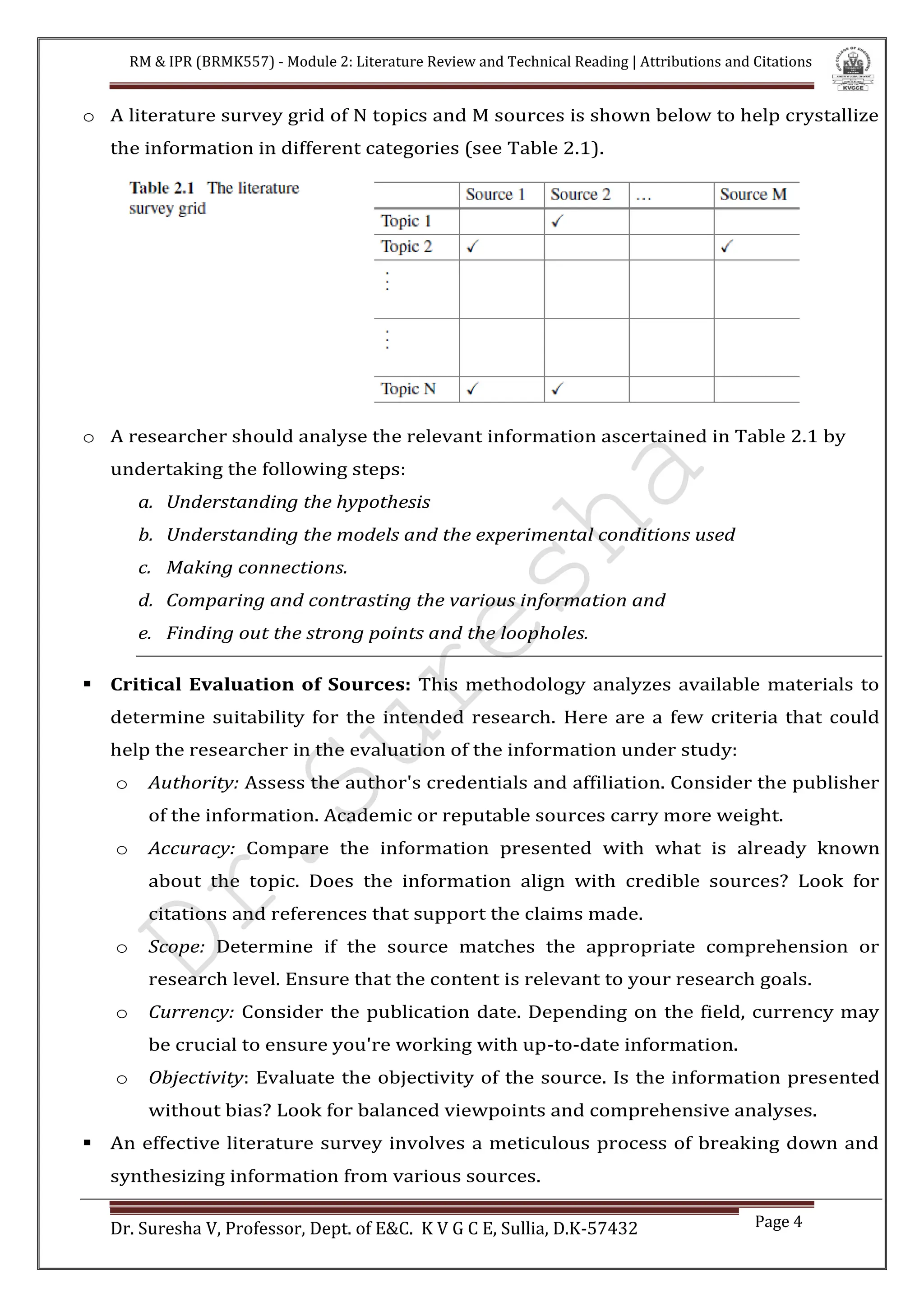
o A literature survey grid of N topics and M sources is shown below to help crystallize
the information in different categories (see Table 2.1).
o A researcher should analyse the relevant information ascertained in Table 2.1 by
undertaking the following steps:
a. Understanding the hypothesis
b. Understanding the models and the experimental conditions used
c. Making connections.
d. Comparing and contrasting the various information and
e. Finding out the strong points and the loopholes.
 Critical Evaluation of Sources: This methodology analyzes available materials to
determine suitability for the intended research. Here are a few criteria that could
help the researcher in the evaluation of the information under study:
o Authority: Assess the author's credentials and affiliation. Consider the publisher
of the information. Academic or reputable sources carry more weight.
o Accuracy: Compare the information presented with what is already known
about the topic. Does the information align with credible sources? Look for
citations and references that support the claims made.
o Scope: Determine if the source matches the appropriate comprehension or
research level. Ensure that the content is relevant to your research goals.
o Currency: Consider the publication date. Depending on the field, currency may
be crucial to ensure you're working with up-to-date information.
o Objectivity: Evaluate the objectivity of the source. Is the information presented
without bias? Look for balanced viewpoints and comprehensive analyses.
 An effective literature survey involves a meticulous process of breaking down and
synthesizing information from various sources.
RM & IPR (BRMK557) - Module 2: Literature Review and Technical Reading | Attributions and Citations
Dr. Suresha V, Professor, Dept. of E&C. K V G C E, Sullia, D.K-57432 Page 5
2.4 Bibliographic Databases
o Bibliographic databases are organized collections of references to published
literature, including books, articles, conference proceedings, and other types of
documents.
o These databases provide a systematic and searchable way to access information
about scholarly works, making it easier for researchers, academics, and other users
to find relevant sources on a particular topic.
o A researcher should be able to quickly identify the databases that are of use in the
idea or problem that one wishes to explore.
o Engineering researchers commonly seek some of the popular bibliographic
databases as follows
A. Web of Science (WoS)
B. Google and Google Scholar
A. Web of Science (WoS): The Web of Science database is one of the largest and most
valued, publications that are indexed. It is a paid-access platform that provides
access to multiple databases that provide reference and citation data from academic
journals, conference proceedings, and other documents in various academic
disciplines. It Wos Journals includes multiple databases and these databases are
recognized by the global scientific community as some of the best for publishing.
 Key Features and Usage of WoS
1. Search Capabilities: Web of Science offers an extensive search functionality,
allowing researchers to explore scholarly materials within specific topics of
interest. The search can be refined using various fields such as title, topic, author,
address, and more.
2. Sorting and Refining: Researchers can sort search results by factors such as the
number of citations or publication date. The "Refine Results" panel on the left
enables narrowing down results using keywords, phrases in quotation marks,
material type (e.g., peer-reviewed journal articles), date, language, and more.
3. Enhanced Search Strategies: The platform encourages effective search strategies
by suggesting actions such as putting quotes around phrases, adding more
keywords, and considering alternate word endings. Researchers are also advised
to break down search concepts and use the "OR" operator to connect alternate
search terms.
RM & IPR (BRMK557) - Module 2: Literature Review and Technical Reading | Attributions and Citations
Dr. Suresha V, Professor, Dept. of E&C. K V G C E, Sullia, D.K-57432 Page 6
4. Cited Reference Search: A unique feature is the "Cited Reference Search,"
enabling researchers to trace articles that have cited a previously published paper.
This option provides insights into how ideas have been applied, improved, or
extended over time.
5. Structured and Informed Results: The platform ensures efficient utilization of
time by narrowing and refining search results. Researchers can broaden or narrow
down results based on their needs using built-in fields.
6. Access to Detailed Information: Clicking on search results provides a wealth of
information about the paper, including the title, authors, journal type, volume, issue
number, publication year, abstract, and keywords. This information helps
researchers decide whether to acquire the full version of the paper.
B. Google and Google Scholar: Google and Google Scholar are valuable starting points
for research due to their accessibility and potential to find freely available
information. However, both platforms come with limitations and challenges, leading
researchers to seek alternative strategies for obtaining relevant and accurate
sources of information.
 Google's Limitations:
1. "Black Box" Nature: Google searches the entire internet without quality control,
making it difficult to determine the reliability and source of results.
2. Limited Search Functionality: Google offers limited search and refinement options.
 Google Scholar's Limitations:
1. Mixed Scholarly Content: Some results may appear scholarly but not ture.
2. Incomplete Coverage: Not all publishers make their content available on it.
3. Limited Search Capabilities: It provides fewer search options for refining results.
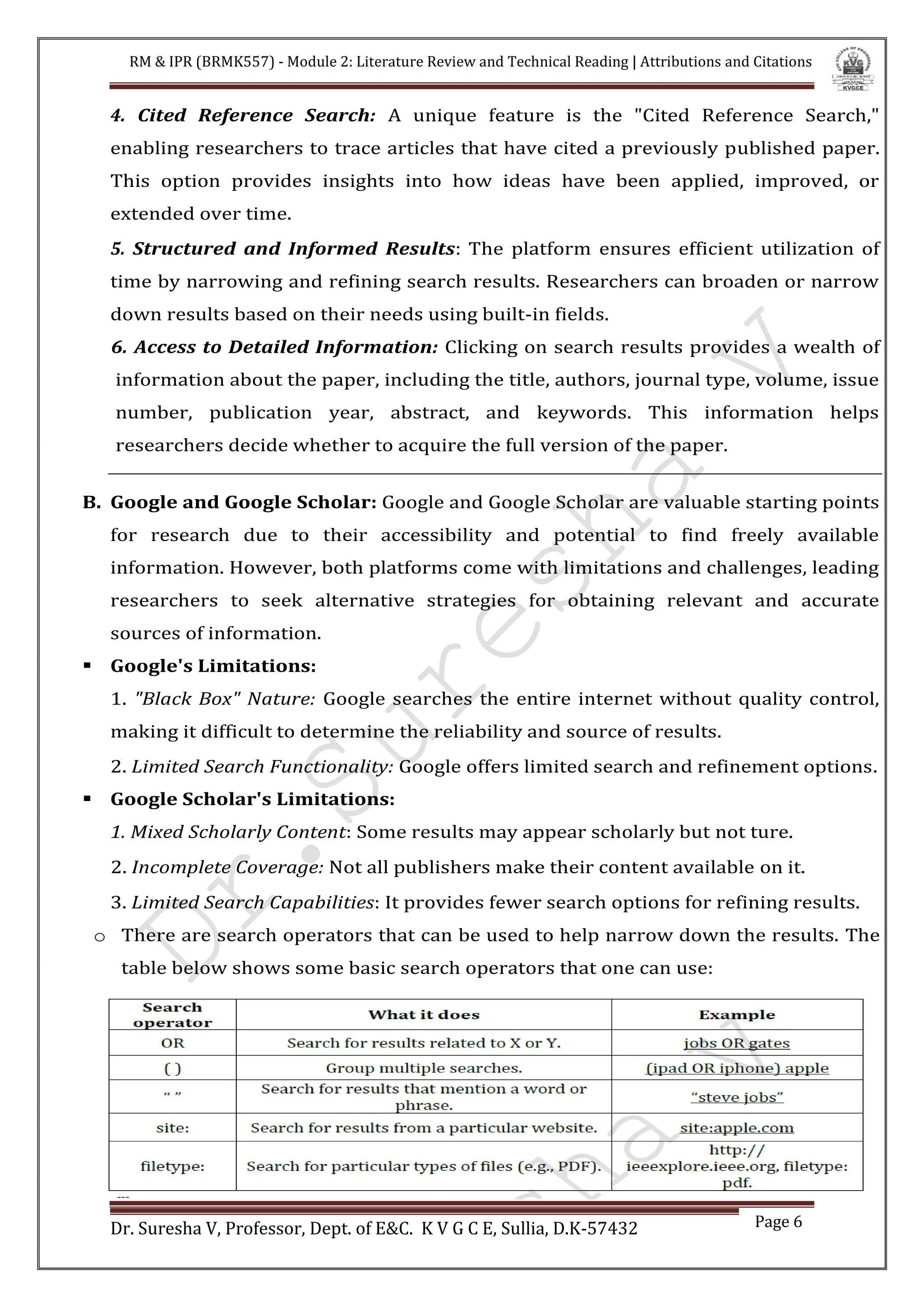
o There are search operators that can be used to help narrow down the results. The
table below shows some basic search operators that one can use:
RM & IPR (BRMK557) - Module 2: Literature Review and Technical Reading | Attributions and Citations
Dr. Suresha V, Professor, Dept. of E&C. K V G C E, Sullia, D.K-57432 Page 7
2.5 Effective Search: The Way Forward
o Most engineering researchers need to refer to articles that appear in scholarly
journals, books or other peer-reviewed sources, there is also substantially useful
content in more popular publications.
o A researcher should use all search tools for a comprehensive search. A researcher
must consider what type of information is needed, and where it could be found.
o Researchers use the following effective searching in an iterative process:
1. Experiment with different keywords and operators
2. Evaluate and assess results, use filters
3. Modify the search as needed
4. When relevant articles are found, look at their citations and references.
o Upon completion of the search, the researcher should engage in a critical and
thorough reading of the sources, identifying salient points, & summarizing findings.
o A detailed comparison and contrast of the findings is also required to be done.
o Above entire process may need to be done multiple times.
o The conclusion of a literature survey involves summarizing the important work
done and identifying any missing links or challenges in the open problems related to
the area of study.
o One must note that the literature survey is a continuous and cyclical process that
may involve the researcher going back and forth till the end of the research project.
o It is very important to not lose sight of the purpose of an extensive search or
literature survey, for it is possible to spend a very significant amount of one’s time
doing so and falsely think that one is working hard.
2.6 Introduction to Technical Reading
o Technical reading is the process of comprehending and extracting information from
highly specialized documents, such as scientific papers, technical manuals,
engineering specifications, computer code, or other materials that demand a certain
level of expertise in a particular field.
o Given the abundance of journal articles, it is useful to adopt a quick, purposeful, and
useful way of reading these manuscripts.
o A strategic and efficient approach to reading research papers is essential for
effective research.
RM & IPR (BRMK557) - Module 2: Literature Review and Technical Reading | Attributions and Citations
Dr. Suresha V, Professor, Dept. of E&C. K V G C E, Sullia, D.K-57432 Page 8
o Some of the strategies for Technical Reading (Research Papers) are as follows.
1. Selective Reading:
- Not all papers are worth reading in-depth. An initial skimming helps decide
whether a paper is worth further exploration.
2. Skimming Process:
- Read the title and keywords: Determine if the paper is interesting and
relevant.
- Read the abstract: Gain an overview of the paper's content and relevance.
- Jump to conclusions: Assess if the paper aligns with your research goals.
- Review figures, tables, and captions: Quickly understand the key results.
3. In-Depth Reading:
- Introduction: Understand the background and purpose of the study.
- Results and Discussion: Focus on the core findings and their interpretation.
- Experimental Setup/Modeling: Read if interested in detailed methodology.
4. Consider Author Reputation:
- Evaluate not only the content but also the reputation of the authors who
produced the knowledge.
5. Staying Updated:
- Continuously search for relevant literature and remain up-to-date with
developments in the field.
2.7 Conceptualizing Research
o Conceptualization is a process that involves coming up with clear, concise
definitions.
o Conceptualization is breaking and converting research ideas into common meanings
to develop an agreement among the research community.
o The process of conceptualization helps researchers define the scope, purpose, and
methodology of their study.
o At the Ph.D. level, one must continually read the literature to become an expert and
bring together the three parts.
(i) a significant problem.
(ii) the knowledge that will address it.
(iii) a possible way to make that new knowledge.
RM & IPR (BRMK557) - Module 2: Literature Review and Technical Reading | Attributions and Citations
Dr. Suresha V, Professor, Dept. of E&C. K V G C E, Sullia, D.K-57432 Page 9
o Here are key steps and considerations when conceptualising research:
- Identify the Research Problem or Question
- Review Existing Literature
- Formulate Hypotheses or Research Questions
- Define the Scope and Objectives
- Select a Research Design & Select Data Collection Methods
- Develop Measurement Instruments
- Consider Ethical Considerations
- Create a Research Timeline & Budget and Resources
- Result & Analysis
- Consider dissemination of Results & Seek Feedback
The above conceptual research process ensures that your research is focused,
feasible, and ethically conducted.
2.8 Critical and Creative Reading: Reading a research paper is a critical process.
Critical and creative reading are essential skills in the research process, playing distinct
yet complementary roles in understanding, analyzing, and generating knowledge.
 Critical Reading: This process includes
1. Analyzing Texts: Critical reading involves examining texts (research articles,
books, reports) to understand the author's main arguments, evidence, and
conclusions.
2. Evaluating Evidence: Assess the quality and relevance of the evidence presented in
the text. Consider the sources, methodology, and reliability of data.
3. Identifying Assumptions: Recognize and question underlying assumptions or
biases within the text.
4. Questioning Arguments: Challenge the logical coherence of arguments. Look for
contradictions, or unsupported claims within the text.
5. Comparing Perspectives: Consider alternative viewpoints and compare them
with the author's arguments.
6. Examining Methodology: Scrutinize the research methodology to assess its rigour
and appropriateness.
7. Synthesizing Information: Integrate information from multiple sources to build a
comprehensive understanding of the topic.
RM & IPR (BRMK557) - Module 2: Literature Review and Technical Reading | Attributions and Citations
Dr. Suresha V, Professor, Dept. of E&C. K V G C E, Sullia, D.K-57432 Page 10
 Creative Reading: This reading process includes
1. Creative learning: It involves generating new ideas or perspectives based on the
information encountered. This could include making connections between
seemingly unrelated concepts.
2. Thinking Beyond the Text: Go beyond the literal content of the text. Consider
the broader implications, applications, or potential future developments related
to the information.
3. Seeking Patterns and Trends: Identify patterns, trends, or recurring themes
within the literature. Creative readers may recognize emerging areas of interest
or gaps that can be explored.
4. Innovative Interpretation: Creative readers may bring fresh perspectives to
established ideas or challenge conventional thinking.
5. Reflecting on Implications: Consider the broader implications of the research.
Creative readers explore how the findings may impact other fields. --------
2.9 Taking Notes While Reading
o Taking effective notes while reading research papers is crucial for
understanding, retaining, and later synthesizing the information.
o Note-taking helps researchers remember and utilize valuable information,
ensuring a smoother transition from reading to writing.
o Many researchers take notes on the margins of their copies of papers or even
digitally on an article aggregator tool.
 Importance of Note-Taking:
1. Preservation of Knowledge: Taking notes prevents valuable insights from being
forgotten over time.
2. Highlighting Key Content: Important concepts, definitions, and explanations are
marked for later reference.
3. Capturing Questions and Criticisms: Queries and criticisms are documented,
aiding critical analysis and potential research directions.
4. Enhancing Recall: Notes help in quickly revisiting and recalling content during
the writing phase.
5. Marginal Annotations: Researchers often notedown notes in the margins of
paper copies or digitally using specialized tools.
RM & IPR (BRMK557) - Module 2: Literature Review and Technical Reading | Attributions and Citations
Dr. Suresha V, Professor, Dept. of E&C. K V G C E, Sullia, D.K-57432 Page 11
6. Content Highlighting: Key concepts, definitions, and noteworthy passages are
highlighted for quick reference.
7. Questions and Critiques: Noting questions, concerns, and critiques helps engage
deeply with the material.
8. Summary Sentences: Concluding the reading with a few sentences summarizing
the paper's contributions is a beneficial practice.
2.10 Reading Mathematics and Algorithms
o Mathematics and Algorithms are often the foundation of new advances, for the
evolution and development of engineering research and practice.
o Importance of Mathematical Derivations and Proofs for in-depth and sound
understanding of technical papers and these are the heart of any technical paper.
o Implementing a complex algorithm in programming languages like C, C++, or
Java is likely to result in errors.
o Even if the researcher is confident about the algorithm, there is still a possibility
that it won't work properly. Therefore, one may wish to code it quickly to verify
its functionality.
2.11 Reading a Datasheet
o A datasheet or specification sheet is a document that summarizes the
performance and other characteristics of a product, machine, or component.
o Datasheets are instruction manuals for electronic components, which detail what
a component does and how one may use it.
o Datasheets enable a researcher to design a circuit or debug any given circuit with
that component.
o The first page of the datasheet usually summarizes a part’s function and features,
and basic specifications, and usually provides a functional block diagram with
the internal functions of the part.
o Some parts also provide graphs showing performance versus various criteria
(supply voltage, temperature, etc.), and safe regions for reliable operation which
should be carefully read and noted by the researcher.
- The features of a datasheet can vary depending on the type of product, but
generally, they include Product Description, Electrical Characteristics,
Mechanical Characteristics, Pin Configuration, Functional Block Diagram,
Recommended Operating Conditions, Performance Characteristics etc.
RM & IPR (BRMK557) - Module 2: Literature Review and Technical Reading | Attributions and Citations
Dr. Suresha V, Professor, Dept. of E&C. K V G C E, Sullia, D.K-57432 Page 12
Chapter 3: Attributions and Citations
3.1 Introduction: Academic writing is governed by established rules and
conventions, with a crucial emphasis on proper attribution, referencing, and
acknowledgement of the contributions of others. These practices ensure the
integrity of scholarly work and uphold ethical standards.
 Meaning of Citation:
- It identifies for the reader the source for an idea, information, or image that is
referred to in a work.
- The primary purpose of citing is to provide evidence, support arguments, and
give context to the reader.
- Proper citation allows readers to trace back to the original source and verify the
information. Citing should be clear, accurate, and relevant to the context.
- Citing always Quoting or referring to specific content within the text.
 Meaning of Reference:
- It is the listing of the full publication details of a published work that is cited to
give background information to the readers
- It provides readers with comprehensive information about the sources and helps
them locate the cited works.
- In research papers reference is a list in a separate section at the end of the paper.
 Meaning of Acknowledgment:
- Acknowledgment acknowledges contributions and support received in the
research process.
- It expresses gratitude to individuals or entities that aided in the research, such as
funding agencies, colleagues, mentors etc.
- Acknowledgment is personal, often containing expressions of appreciation
beyond the research itself.
 Meaning of Attribution:
- Attribution in research refers to the proper acknowledgement and credit given
to sources of information, ideas, or work that have been used in the research
process.
- It is a fundamental aspect of academic integrity to show respect for the
intellectual work of those who came before.
RM & IPR (BRMK557) - Module 2: Literature Review and Technical Reading | Attributions and Citations
Dr. Suresha V, Professor, Dept. of E&C. K V G C E, Sullia, D.K-57432 Page 13
 Importance of Citations:
o Integrity: Proper citing, referencing, and acknowledgement ensure research
integrity and avoid plagiarism.
o Ethical Responsibility: Researchers have an ethical duty to acknowledge the
intellectual property of others.
o Transparency: Readers can verify claims, explore sources, and delve into
relevant literature.
o Scholarly Communication: Effective citation and referencing contribute to clear
and effective scholarly communication.
 Legal Implications:
o Failure to cite properly can lead to accusations of plagiarism and intellectual
property infringement.
o Inaccurate or inadequate attribution may result in legal challenges from original
authors or entities.
3.2 Citations: Functions and Attributes
o Citations (references) credit others for their work, while allowing the readers to
trace the source publication if needed.
o Citations help the readers verify the quality and importance of the new work and
justification of the findings.
o Citations are the currency that authors would wish to accumulate and the
technical community gives them credit for these contributions.
o It applies to all forms of written sources in the form of texts, images, sounds, etc.
 Functions and significance of Citation: There are THREE main functions are
1. Verification function:
- Citations enable readers to validate claims and verify information.
- Intentional or unintentional distortion can be identified through citations.
2. Acknowledgment Function:
- Researchers receive credit through citations, influencing their reputation.
- Citations play a role in obtaining research funding and career advancement.
3. Documentation Function:
- Citations document the progress and evolution of scientific concepts over
time.
-------- ----- ------ ----- ------ ----- ------ ----- ------ ----- ------ ----- ------ ----- ------ ----- ------ ----- ------ ----- ----- ------ ----- ------ ----- ------ ----- ------ -
RM & IPR (BRMK557) - Module 2: Literature Review and Technical Reading | Attributions and Citations
Dr. Suresha V, Professor, Dept. of E&C. K V G C E, Sullia, D.K-57432 Page 14
 Citation Pitfalls to Avoid: There are certain cases when references do not fulfil
the actual goal of citations and acknowledgements, and thus do not benefit the
reader. They are
(i) Spurious citations (iii) Self-citations
(ii) Biased citations (iv) Coercive citations
(i) Spurious citations
o Fake or bogus citations are also called spurious citations.
o Including unnecessary citations adds no value and wastes readers' time.
o In other words, these citations are not genuinely relevant to the content of the
work, and their inclusion may be intentional or unintentional.
o It refers to references or citations within a document that are either inaccurately
attributed, misleading, or falsely presented as support for particular claims.
(ii) Biased citations
o When authors cite the work of their friends or colleagues, even if there is no
significant connection between the two works, it can be considered biased.
o Similarly, when authors fail to cite work of genuine significance because they do
not want to give credit to certain individuals, it is also biased behaviour.
o Furthermore, neglecting to cite prior work that contradicts the current work's
conclusions or data is also considered biased.
(iii) Self-citations
o Self-citation occurs when an author includes references to their own previously
published work within a new document or publication.
o This practice is a common and accepted part of scholarly writing, and it serves
several purposes. It is in an attempt to inflate an individual's citation count.
o Self-citation of prior papers is natural because the latest paper is often part of a
larger research project which is ongoing.
(iv)Coercive citations
o Coercive citations, also known as forced citations or inappropriate citations,
occur when an author is compelled or pressured to include references to specific
works, often against their scholarly integrity.
o These citations are added due to external factors such as the influence of
colleagues, superiors, reviewers, or other individuals with power or authority.
RM & IPR (BRMK557) - Module 2: Literature Review and Technical Reading | Attributions and Citations
Dr. Suresha V, Professor, Dept. of E&C. K V G C E, Sullia, D.K-57432 Page 15
3.2 Impact of Title and Keywords on Citations: Both play significant and crucial
roles in attracting attention to a research paper and influencing its visibility and
accessibility within the academic community.
 Title's Importance and Impact on Citations
- The title is a key factor in attracting readers and conveying the paper's subject.
- A well-crafted title is informative and attention-grabbing, and aids in marketing
the paper.
- The title influences the paper's visibility during literature searches and
contributes to its traceability.
- The download count and citation of a research paper might be influenced by title.
Title Characteristics and Citation Rates: Three different aspects provide a particular
behaviour to the title:
1. Title length
2. Title types
3. Keyword in title
1. Title length:
- Longer titles tend to have a positive impact on the number of citations.
- Title often includes methodological details or results, attracting more attention.
1. Title type:
- Question-type titles may attract more downloads but are poorly cited.
- Titles containing a reference to a specific geographical region may result in lower
citation rates.
- Descriptive or declarative titles are generally more effective in earnering
citations.
- Additionally, review articles and original articles usually receive more citations.
2. Keywords in title:
- Titles with at least two keywords increase the chances of discovery, reading, and
citation.
- Keywords in titles assist in categorizing the research and directing it to the
relevant audience.
 Keywords and their Role:
o Keywords provide essential information about the paper's content.
RM & IPR (BRMK557) - Module 2: Literature Review and Technical Reading | Attributions and Citations
Dr. Suresha V, Professor, Dept. of E&C. K V G C E, Sullia, D.K-57432 Page 16
o Search engines, indexing services, and digital libraries use keywords to
categorize research topics. Keywords ensure the paper reaches the relevant
audience and enhances visibility.
o Keywords are often included in the abstract, title, and body of the paper.
 Impact of Keywords in Citations:
o Using the maximum allowable keywords increases the likelihood of the paper
being found.
o Overuse of new keywords should be avoided to maintain familiarity within the
research community.
o Search engines, journals, digital libraries, and indexing services use keywords for
the categorization of the research topic and direct to the readers.
o It is recommended to limit the use of new keywords in research articles to
improve visibility among the research community.
o Conclusion: The citation rate of research papers is influenced by a multitude of
factors, including the paper's title and keywords. Crafting an informative and
attention-grabbing title, incorporating relevant keywords, and following
established trends in title characteristics can positively impact the visibility,
readership, and ultimately the citation count of a research paper.
3.3 Knowledge Flow Through Citation
o In engineering research, knowledge flow is primarily in the form of books,
theses, articles, patents, and reports.
o Citing a source is important for the transmission of knowledge from previous
work to an innovation.
o Knowledge flow happens between co-authors during research collaboration,
among other researchers through their paper citation network, and also between
institutions, departments and research fields.
 Citation Network and Knowledge Flow:
o Figure 3.1 shows the relationship between citations, knowledge flow, and
elements such as researchers, papers, journal publications or conferences, and
institutions.
o When one paper A is cited by another paper B, then knowledge flows through
citation networks across institutions and researchers.
RM & IPR (BRMK557) - Module 2: Literature Review and Technical Reading | Attributions and Citations
Dr. Suresha V, Professor, Dept. of E&C. K V G C E, Sullia, D.K-57432 Page 17
Fig. 3.1 Citation-based knowledge flow
 Role of Collaboration in Knowledge Flow
o Figure 3.2 shows a relationship between co-authorship and different types of
citations. Three articles (X, Y, and Z) and five references (X1, X2, X3, Y1, and Y2) of
article X and Y, respectively, are considered.
o A, B, and C are authors of article X, and D, E, F, G, and also A are authors of article Y.
Article Z has two authors H and E.
o References X1, X2, X3, Y1, and Y2 have authors (A, P), (H, R), (D), (Q, B, F), and (R),
respectively.
RM & IPR (BRMK557) - Module 2: Literature Review and Technical Reading | Attributions and Citations
Dr. Suresha V, Professor, Dept. of E&C. K V G C E, Sullia, D.K-57432 Page 18
Fig. 3.2 Co-authorship network
o Based on the co-authorship citation network, references X1 and Y1 are considered
self-citation, reference X3 is a level-1 co-author citation because the author of article
Y is a direct collaborator of author A, reference X2 is a level-1 co-author network
because author A is a collaborator of E who collaborated with H.
3.3.1 Citing Datasets
o In modern engineering research, data plays a crucial role in substantiating claims,
providing experimental evidence, and enabling scientific advancement.
o Citing datasets involves giving proper credit to the creators or providers of a
dataset when you use it in your research, analysis, or any other work.
o Citations to datasets should include enough information so that a reader can find
the same dataset again in the future.
o Examples:
1. Historical Data, Sotavento (Wind Farm), Corunna, Spain (July 2016): [Accessed:4 Oct, 2016]
Retrieved from http://www.sotaventogalicia.com/en/real-time-data/historical
2. Deb, D (2016). [Personnel survey]. Unpublished raw data.
RM & IPR (BRMK557) - Module 2: Literature Review and Technical Reading | Attributions and Citations
Dr. Suresha V, Professor, Dept. of E&C. K V G C E, Sullia, D.K-57432 Page 19
 Styles for Citations: The most common styles for citation used by engineers are as
follows:
1. ASCE style (American Society of Civil Engineers)
2. IEEE style (Institute of Electrical and Electronics Engineers)
3. ASME style (The Association of Mechanical Engineers)
1. ASCE style (American Society of Civil Engineers)
(a) Reference list: This part is to be placed in the bibliography or references at the end
of the article or report. A template with an example for the same is given below:
(b) In-text citation for journals or books: The following part is to be placed right after the
reference to the source of the citation assignment:
RM & IPR (BRMK557) - Module 2: Literature Review and Technical Reading | Attributions and Citations
Dr. Suresha V, Professor, Dept. of E&C. K V G C E, Sullia, D.K-57432 Page 20
2. IEEE style (Institute of Electrical and Electronics Engineers): IEEE style is standard for all
IEEE journals and magazines, and is frequently used for papers and articles in the fields
of electrical engineering and computer science. The IEEE style requires endnotes and
that references be cited numerically in the text. The template example is shown below
[1] A. Rezi and Allam, “Techniques in array processing using transformations,” in Control and Dynamic
Systems, Vol. 69, Multidimensional Systems, C. T. Leondes, Ed. San Diego: Academic Press, 1995, pp.
133–180
3.4 Acknowledgments and Attributions: Acknowledgments and attributions are also very
important in the publications of journal or conference papers.
 Acknowledgments
o Classification of acknowledgement into SIX different categories like moral,
financial, editorial, institutional or technical, and conceptual support.
o In engineering research, acknowledgements are meant for participating
technicians, students, funding agencies, grant numbers, institutions, or anyone
who provides scientific inputs.
3.4.1 What Should Be Acknowledged?***
 Acknowledgments in engineering research play a crucial role in giving credit where
it's due and maintaining ethical research practices. Authors must recognize various
contributions and support that enable their research efforts.
 Types of Contributions to Acknowledge:
1. Quotation:
o Direct quotations are rarely used in technical writing
o Direct quotations must be enclosed in quotation marks and attributed
properly.
o Indirect quotations (paraphrasing) should be acknowledged with name and
date
2. Scientific and Technical Guidance:
o Acknowledge individuals who provided scientific or technical guidance.
o Include those who engaged in discussions or shared valuable information.
3. Assistants, Students, and Technicians:
o Acknowledge those who contributed experimentally and theoretically.
o Mention individuals who assisted in conducting experiments / theoretical
analyses.
RM & IPR (BRMK557) - Module 2: Literature Review and Technical Reading | Attributions and Citations
Dr. Suresha V, Professor, Dept. of E&C. K V G C E, Sullia, D.K-57432 Page 21
4. Funding Agencies:
o Acknowledge funding agencies and grant numbers if the research was supported
by grants and provide full details of the funding program.
5. Facilities and Organizations:
o Acknowledge centres or organizations that provide services or facilities.
o If not formally affiliated, acknowledge external support received.
6. Presentation Elsewhere:
o If results were presented elsewhere (journals, meetings, symposia),
acknowledge them appropriately.
o Provide citations for abstracts or relevant gatherings.
 Ethical and Professional Importance:
o Acknowledgments demonstrate integrity and ethical behaviour in research.
o Encourages continued collaboration from individuals who contributed.
 Compliance and Funding Requirements:
o Funding agencies often require acknowledgement of their support in
publications
o Ensure compliance with funding terms and conditions for proper
acknowledgement.
o Failure to acknowledge funding might lead to discontinuation of funding or
future ineligibility.
 Professional Impact and Collaboration:
o Acknowledgment is no longer just an expression of gratitude; it's a professional
impact indicator.
o Proper acknowledgement strengthens colleagues' careers and builds
collaboration.
 Conclusion: Acknowledge contributions, support, and funding appropriately in
engineering research. Proper acknowledgement demonstrates ethical conduct,
encourages collaboration, and complies with funding requirements. By attributing
ideas and contributions, authors uphold research integrity and foster a culture of
ethical and transparent scientific communication.
RM & IPR (BRMK557) - Module 2: Literature Review and Technical Reading | Attributions and Citations
Dr. Suresha V, Professor, Dept. of E&C. K V G C E, Sullia, D.K-57432 Page 22
An example of acknowledgement of a grant received is as follows:
 Acknowledgments in Books/Dissertations
o A page of acknowledgements is usually included at the beginning of a thesis/
dissertation immediately following the table of contents.
o These acknowledgements are longer than the one or two-sentence statements in
journal papers or articles in conference proceedings.
o The following are often acknowledged in these types of acknowledgements: main
supervisor, second supervisor, peers in the lab, other academic staff in the
department, technical or support staff in the department, colleagues from other
departments, other institutions, or organizations, former students, family and
friends.
 Dedication or Acknowledgments?
o Dedication is rarely used in a written document, meetings or a patent. used only
for larger documents like books, thesis, or dissertations.
o A dedication is to whomever the author would like it to be dedicated to, whether
it is the author’s mother, the best friend, the pet dog, or the god Almighty. And
yes, it is possible to dedicate something to someone while also mentioning them
in the acknowledgements.
o For example, one may dedicate a book to one’s spouse, but acknowledge them for
being the moral support and putting up with when one gets very stressed.
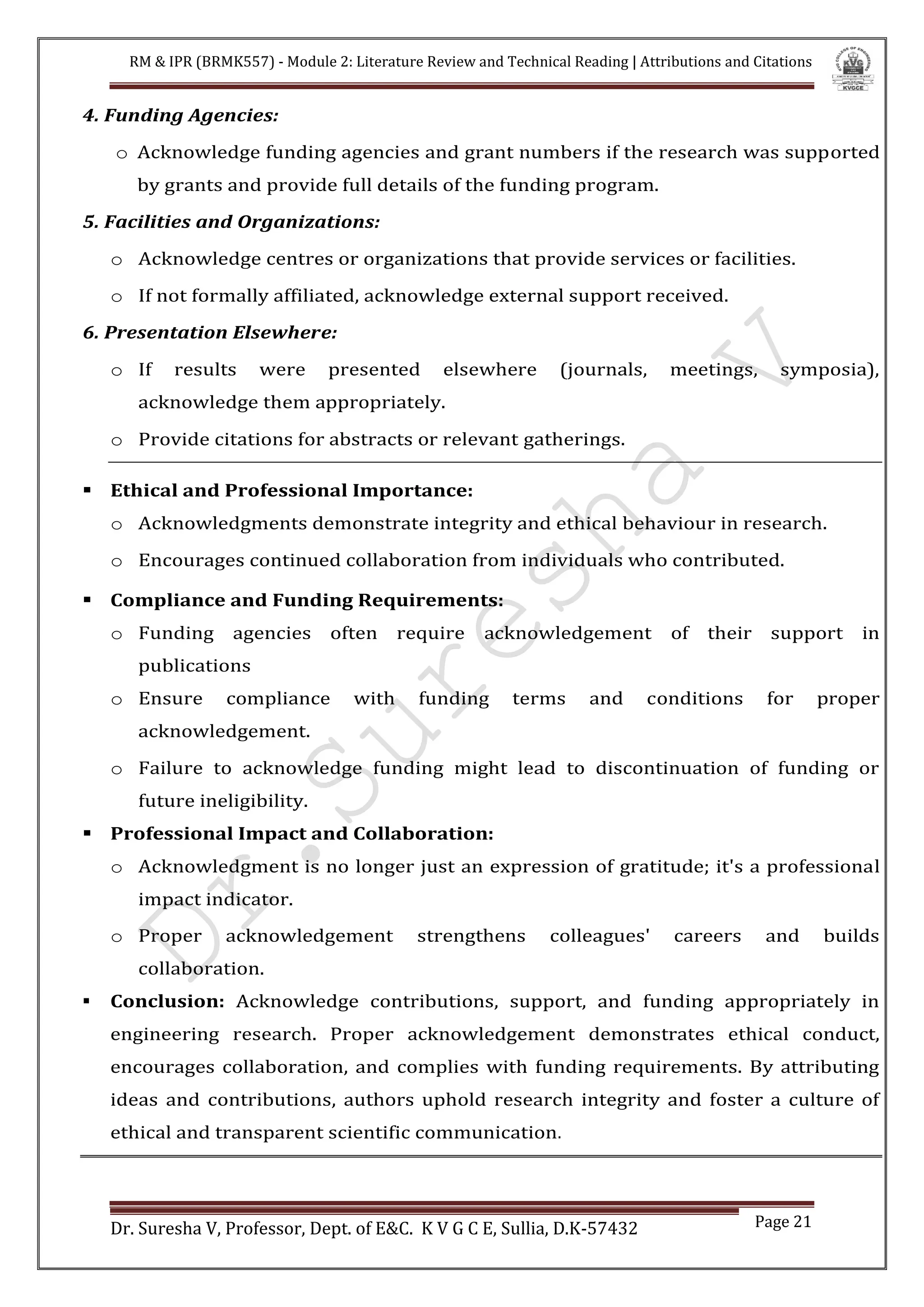
VTU QUESTIONS: MODULE 2
 DEC 2023/JAN 2024
RM & IPR (BRMK557) - Module 2: Literature Review and Technical Reading | Attributions and Citations
Dr. Suresha V, Professor, Dept. of E&C. K V G C E, Sullia, D.K-57432 Page 23
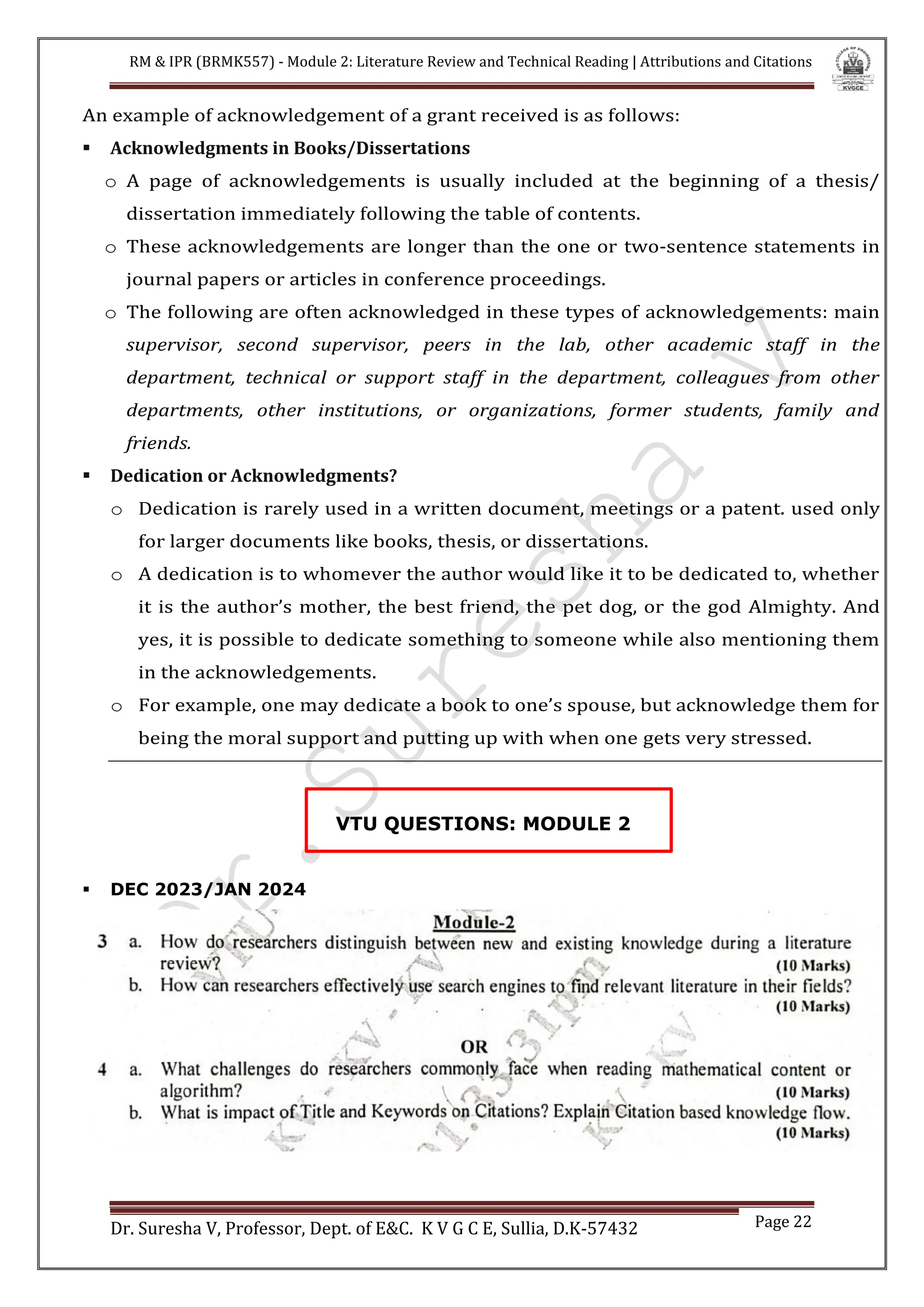
 MODEL QP 1- 2024-2025
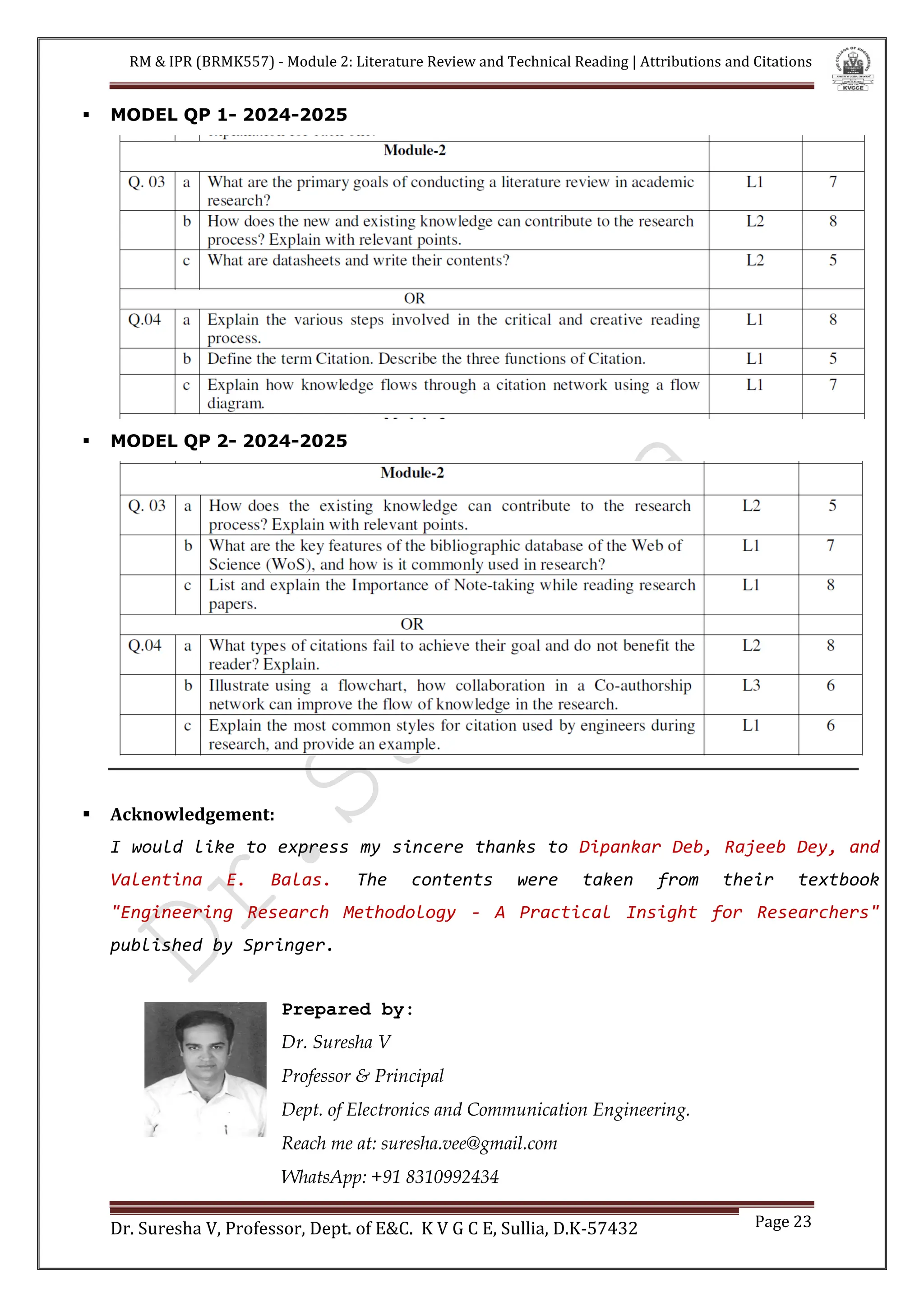
 MODEL QP 2- 2024-2025
 Acknowledgement:
I would like to express my sincere thanks to Dipankar Deb, Rajeeb Dey, and
Valentina E. Balas. The contents were taken from their textbook
"Engineering Research Methodology - A Practical Insight for Researchers"
published by Springer.
Prepared by:
Dr. Suresha V
Professor & Principal
Dept. of Electronics and Communication Engineering.
Reach me at: suresha.vee@gmail.com
WhatsApp: +91 8310992434

RM & IPR- Module 2- Final by Dr.Suresha V -BRMK557.pdf

  • 1.
    RESEARCH METHODOLOGY & INTELLECTUALPROPERTY RIGHTS (IPR) Course Code: BRMK557 MODULE -2 Literature Review & Technical Reading || Attributions & Citations A Simplified Notes for the 5th Semester As per VTU Syllabus - 2022 Scheme Dr. SURESHA V Professor, Department of E&CE K.V.G. College of Engineering, Sullia, D.K-574 327
  • 2.
    RM & IPR(BRMK557) - Module 2: Literature Review and Technical Reading | Attributions and Citations Dr. Suresha V, Professor, Dept. of E&C. K V G C E, Sullia, D.K-57432 Page 1 Module 2 Literature Review & Technical Reading || Attributions & Citations Learning Module Outcomes After reading this Module, the student will be able to: o To Learn the concept of Literature Review. o To Learn the concept of Technical Reading. - o To Understand the knowledge of Attributions and Citations. Chapter 2: Literature Review & Technical Reading (Textbook 1: Page 9-20) - New and Existing Knowledge - Analysis and Synthesis of Prior Art - Bibliographic Databases - Effective Search: The Way Forward - Introduction to Technical Reading - Conceptualizing Research - Critical and Creative Reading - Taking Notes While Reading - Reading Mathematics and Algorithms - Reading a Datasheet Chapter 3: Attributions & Citations (Textbook 1: Page 23 - 34) - Citations: Functions and Attributes - Impact of Title and Keywords on Citations - Knowledge Flow Through Citation - Knowledge Flow Through Citation - Citing Datasets - Styles for Citations - Acknowledgments and Attributions - What Should Be Acknowledged? - Acknowledgments in Books/Dissertations - Dedication or Acknowledgments? Text Book: “Engineering Research Methodology” by Dipankar Deb etal, Intelligent Systems Reference Library, Edition 1, Springer.
  • 3.
    RM & IPR(BRMK557) - Module 2: Literature Review and Technical Reading | Attributions and Citations Dr. Suresha V, Professor, Dept. of E&C. K V G C E, Sullia, D.K-57432 Page 2 Chapter 2: Literature Review & Technical Reading 2.1 Literature Review: It can be defined in several ways o A literature review is an overview of the previously published works on a topic. o A liteview or survey is an organised write-up showing previous work done concerning a research topic or field. o A literature review is a critical and comprehensive analysis of existing research and scholarly articles, books, and other sources relevant to a particular topic or research question. o A literature review is both a summary and explanation of the current state of knowledge on a focused topic as found in academic books, journal articles and all other sources connected to the subject of study.  The primary goal of the literature review - Summarize existing Knowledge from the state of the art. - To define and limit the problem you are working on. - To avoid unnecessary duplication in research. - To evaluate promising research designs and methodologies. - Identify trends and patterns. - Identify gaps in the available literature - Highlight gaps and contradictions. - Establish a theoretical framework. - Support hypotheses or research questions. - Formulate questions that need further research. 2.2 New and Existing Knowledge: o New and existing knowledge are crucial in the research process, and they play complementary roles in advancing understanding and contributing to the body of knowledge in a particular field. o New knowledge in research can only be interpreted within the context of what is already known, and cannot exist without the foundation of existing knowledge. o The interpretation of new knowledge heavily depends on the researcher's background and perception. o The significance of new knowledge is often established by identifying existing problems in the field and demonstrating the gaps in the current understanding.
  • 4.
    RM & IPR(BRMK557) - Module 2: Literature Review and Technical Reading | Attributions and Citations Dr. Suresha V, Professor, Dept. of E&C. K V G C E, Sullia, D.K-57432 Page 3  Existing Knowledge: - Foundation for New Research: Existing knowledge forms the foundation upon which new research is built. Researchers need to understand what has already been studied and documented to identify gaps and formulate meaningful research questions. - Contextualization: Existing knowledge provides the context for understanding the current state of a field or topic. - Theory Development: Theories and conceptual frameworks developed from existing knowledge guide the formulation of hypotheses and research models. - Methodological Guidance: Previous research studies offer insights into various research methodologies. Understanding the strengths and weaknesses of different approaches helps researchers make informed decisions when designing their work.  New Knowledge: - Advancement of the Field: It- contributes to the advancement of a particular field. It introduces fresh perspectives and challenges existing theories. - Innovation: It often leads to innovative solutions, technologies, or methodologies. It can result in breakthroughs that have practical applications, improving processes or addressing real-world problems. - Closing Gaps: New research can address gaps in existing literature by filling those gaps with empirical evidence or novel insights. - Critical Evaluation: It allows the scientific community to assess the robustness of established knowledge and refine based on empirical findings. - Contribution to Literature: Publication of new knowledge enhances academic discourse, serving as a resource for future studies and discussions and becoming a resource for other researchers. 2.3 Analysis and Synthesis of Prior Art o After collecting articles for the literature review, the researcher analyzes each one for useful content before synthesizing the entire collection. o This process involves understanding the articles' hypotheses, models, and experimental conditions, and drawing connections between different pieces of information. o The goal is to identify unsolved issues, and flaws in existing models, and propose novel ideas.
  • 5.
    RM & IPR(BRMK557) - Module 2: Literature Review and Technical Reading | Attributions and Citations Dr. Suresha V, Professor, Dept. of E&C. K V G C E, Sullia, D.K-57432 Page 4 o A literature survey grid of N topics and M sources is shown below to help crystallize the information in different categories (see Table 2.1). o A researcher should analyse the relevant information ascertained in Table 2.1 by undertaking the following steps: a. Understanding the hypothesis b. Understanding the models and the experimental conditions used c. Making connections. d. Comparing and contrasting the various information and e. Finding out the strong points and the loopholes.  Critical Evaluation of Sources: This methodology analyzes available materials to determine suitability for the intended research. Here are a few criteria that could help the researcher in the evaluation of the information under study: o Authority: Assess the author's credentials and affiliation. Consider the publisher of the information. Academic or reputable sources carry more weight. o Accuracy: Compare the information presented with what is already known about the topic. Does the information align with credible sources? Look for citations and references that support the claims made. o Scope: Determine if the source matches the appropriate comprehension or research level. Ensure that the content is relevant to your research goals. o Currency: Consider the publication date. Depending on the field, currency may be crucial to ensure you're working with up-to-date information. o Objectivity: Evaluate the objectivity of the source. Is the information presented without bias? Look for balanced viewpoints and comprehensive analyses.  An effective literature survey involves a meticulous process of breaking down and synthesizing information from various sources.
  • 6.
    RM & IPR(BRMK557) - Module 2: Literature Review and Technical Reading | Attributions and Citations Dr. Suresha V, Professor, Dept. of E&C. K V G C E, Sullia, D.K-57432 Page 5 2.4 Bibliographic Databases o Bibliographic databases are organized collections of references to published literature, including books, articles, conference proceedings, and other types of documents. o These databases provide a systematic and searchable way to access information about scholarly works, making it easier for researchers, academics, and other users to find relevant sources on a particular topic. o A researcher should be able to quickly identify the databases that are of use in the idea or problem that one wishes to explore. o Engineering researchers commonly seek some of the popular bibliographic databases as follows A. Web of Science (WoS) B. Google and Google Scholar A. Web of Science (WoS): The Web of Science database is one of the largest and most valued, publications that are indexed. It is a paid-access platform that provides access to multiple databases that provide reference and citation data from academic journals, conference proceedings, and other documents in various academic disciplines. It Wos Journals includes multiple databases and these databases are recognized by the global scientific community as some of the best for publishing.  Key Features and Usage of WoS 1. Search Capabilities: Web of Science offers an extensive search functionality, allowing researchers to explore scholarly materials within specific topics of interest. The search can be refined using various fields such as title, topic, author, address, and more. 2. Sorting and Refining: Researchers can sort search results by factors such as the number of citations or publication date. The "Refine Results" panel on the left enables narrowing down results using keywords, phrases in quotation marks, material type (e.g., peer-reviewed journal articles), date, language, and more. 3. Enhanced Search Strategies: The platform encourages effective search strategies by suggesting actions such as putting quotes around phrases, adding more keywords, and considering alternate word endings. Researchers are also advised to break down search concepts and use the "OR" operator to connect alternate search terms.
  • 7.
    RM & IPR(BRMK557) - Module 2: Literature Review and Technical Reading | Attributions and Citations Dr. Suresha V, Professor, Dept. of E&C. K V G C E, Sullia, D.K-57432 Page 6 4. Cited Reference Search: A unique feature is the "Cited Reference Search," enabling researchers to trace articles that have cited a previously published paper. This option provides insights into how ideas have been applied, improved, or extended over time. 5. Structured and Informed Results: The platform ensures efficient utilization of time by narrowing and refining search results. Researchers can broaden or narrow down results based on their needs using built-in fields. 6. Access to Detailed Information: Clicking on search results provides a wealth of information about the paper, including the title, authors, journal type, volume, issue number, publication year, abstract, and keywords. This information helps researchers decide whether to acquire the full version of the paper. B. Google and Google Scholar: Google and Google Scholar are valuable starting points for research due to their accessibility and potential to find freely available information. However, both platforms come with limitations and challenges, leading researchers to seek alternative strategies for obtaining relevant and accurate sources of information.  Google's Limitations: 1. "Black Box" Nature: Google searches the entire internet without quality control, making it difficult to determine the reliability and source of results. 2. Limited Search Functionality: Google offers limited search and refinement options.  Google Scholar's Limitations: 1. Mixed Scholarly Content: Some results may appear scholarly but not ture. 2. Incomplete Coverage: Not all publishers make their content available on it. 3. Limited Search Capabilities: It provides fewer search options for refining results. o There are search operators that can be used to help narrow down the results. The table below shows some basic search operators that one can use:
  • 8.
    RM & IPR(BRMK557) - Module 2: Literature Review and Technical Reading | Attributions and Citations Dr. Suresha V, Professor, Dept. of E&C. K V G C E, Sullia, D.K-57432 Page 7 2.5 Effective Search: The Way Forward o Most engineering researchers need to refer to articles that appear in scholarly journals, books or other peer-reviewed sources, there is also substantially useful content in more popular publications. o A researcher should use all search tools for a comprehensive search. A researcher must consider what type of information is needed, and where it could be found. o Researchers use the following effective searching in an iterative process: 1. Experiment with different keywords and operators 2. Evaluate and assess results, use filters 3. Modify the search as needed 4. When relevant articles are found, look at their citations and references. o Upon completion of the search, the researcher should engage in a critical and thorough reading of the sources, identifying salient points, & summarizing findings. o A detailed comparison and contrast of the findings is also required to be done. o Above entire process may need to be done multiple times. o The conclusion of a literature survey involves summarizing the important work done and identifying any missing links or challenges in the open problems related to the area of study. o One must note that the literature survey is a continuous and cyclical process that may involve the researcher going back and forth till the end of the research project. o It is very important to not lose sight of the purpose of an extensive search or literature survey, for it is possible to spend a very significant amount of one’s time doing so and falsely think that one is working hard. 2.6 Introduction to Technical Reading o Technical reading is the process of comprehending and extracting information from highly specialized documents, such as scientific papers, technical manuals, engineering specifications, computer code, or other materials that demand a certain level of expertise in a particular field. o Given the abundance of journal articles, it is useful to adopt a quick, purposeful, and useful way of reading these manuscripts. o A strategic and efficient approach to reading research papers is essential for effective research.
  • 9.
    RM & IPR(BRMK557) - Module 2: Literature Review and Technical Reading | Attributions and Citations Dr. Suresha V, Professor, Dept. of E&C. K V G C E, Sullia, D.K-57432 Page 8 o Some of the strategies for Technical Reading (Research Papers) are as follows. 1. Selective Reading: - Not all papers are worth reading in-depth. An initial skimming helps decide whether a paper is worth further exploration. 2. Skimming Process: - Read the title and keywords: Determine if the paper is interesting and relevant. - Read the abstract: Gain an overview of the paper's content and relevance. - Jump to conclusions: Assess if the paper aligns with your research goals. - Review figures, tables, and captions: Quickly understand the key results. 3. In-Depth Reading: - Introduction: Understand the background and purpose of the study. - Results and Discussion: Focus on the core findings and their interpretation. - Experimental Setup/Modeling: Read if interested in detailed methodology. 4. Consider Author Reputation: - Evaluate not only the content but also the reputation of the authors who produced the knowledge. 5. Staying Updated: - Continuously search for relevant literature and remain up-to-date with developments in the field. 2.7 Conceptualizing Research o Conceptualization is a process that involves coming up with clear, concise definitions. o Conceptualization is breaking and converting research ideas into common meanings to develop an agreement among the research community. o The process of conceptualization helps researchers define the scope, purpose, and methodology of their study. o At the Ph.D. level, one must continually read the literature to become an expert and bring together the three parts. (i) a significant problem. (ii) the knowledge that will address it. (iii) a possible way to make that new knowledge.
  • 10.
    RM & IPR(BRMK557) - Module 2: Literature Review and Technical Reading | Attributions and Citations Dr. Suresha V, Professor, Dept. of E&C. K V G C E, Sullia, D.K-57432 Page 9 o Here are key steps and considerations when conceptualising research: - Identify the Research Problem or Question - Review Existing Literature - Formulate Hypotheses or Research Questions - Define the Scope and Objectives - Select a Research Design & Select Data Collection Methods - Develop Measurement Instruments - Consider Ethical Considerations - Create a Research Timeline & Budget and Resources - Result & Analysis - Consider dissemination of Results & Seek Feedback The above conceptual research process ensures that your research is focused, feasible, and ethically conducted. 2.8 Critical and Creative Reading: Reading a research paper is a critical process. Critical and creative reading are essential skills in the research process, playing distinct yet complementary roles in understanding, analyzing, and generating knowledge.  Critical Reading: This process includes 1. Analyzing Texts: Critical reading involves examining texts (research articles, books, reports) to understand the author's main arguments, evidence, and conclusions. 2. Evaluating Evidence: Assess the quality and relevance of the evidence presented in the text. Consider the sources, methodology, and reliability of data. 3. Identifying Assumptions: Recognize and question underlying assumptions or biases within the text. 4. Questioning Arguments: Challenge the logical coherence of arguments. Look for contradictions, or unsupported claims within the text. 5. Comparing Perspectives: Consider alternative viewpoints and compare them with the author's arguments. 6. Examining Methodology: Scrutinize the research methodology to assess its rigour and appropriateness. 7. Synthesizing Information: Integrate information from multiple sources to build a comprehensive understanding of the topic.
  • 11.
    RM & IPR(BRMK557) - Module 2: Literature Review and Technical Reading | Attributions and Citations Dr. Suresha V, Professor, Dept. of E&C. K V G C E, Sullia, D.K-57432 Page 10  Creative Reading: This reading process includes 1. Creative learning: It involves generating new ideas or perspectives based on the information encountered. This could include making connections between seemingly unrelated concepts. 2. Thinking Beyond the Text: Go beyond the literal content of the text. Consider the broader implications, applications, or potential future developments related to the information. 3. Seeking Patterns and Trends: Identify patterns, trends, or recurring themes within the literature. Creative readers may recognize emerging areas of interest or gaps that can be explored. 4. Innovative Interpretation: Creative readers may bring fresh perspectives to established ideas or challenge conventional thinking. 5. Reflecting on Implications: Consider the broader implications of the research. Creative readers explore how the findings may impact other fields. -------- 2.9 Taking Notes While Reading o Taking effective notes while reading research papers is crucial for understanding, retaining, and later synthesizing the information. o Note-taking helps researchers remember and utilize valuable information, ensuring a smoother transition from reading to writing. o Many researchers take notes on the margins of their copies of papers or even digitally on an article aggregator tool.  Importance of Note-Taking: 1. Preservation of Knowledge: Taking notes prevents valuable insights from being forgotten over time. 2. Highlighting Key Content: Important concepts, definitions, and explanations are marked for later reference. 3. Capturing Questions and Criticisms: Queries and criticisms are documented, aiding critical analysis and potential research directions. 4. Enhancing Recall: Notes help in quickly revisiting and recalling content during the writing phase. 5. Marginal Annotations: Researchers often notedown notes in the margins of paper copies or digitally using specialized tools.
  • 12.
    RM & IPR(BRMK557) - Module 2: Literature Review and Technical Reading | Attributions and Citations Dr. Suresha V, Professor, Dept. of E&C. K V G C E, Sullia, D.K-57432 Page 11 6. Content Highlighting: Key concepts, definitions, and noteworthy passages are highlighted for quick reference. 7. Questions and Critiques: Noting questions, concerns, and critiques helps engage deeply with the material. 8. Summary Sentences: Concluding the reading with a few sentences summarizing the paper's contributions is a beneficial practice. 2.10 Reading Mathematics and Algorithms o Mathematics and Algorithms are often the foundation of new advances, for the evolution and development of engineering research and practice. o Importance of Mathematical Derivations and Proofs for in-depth and sound understanding of technical papers and these are the heart of any technical paper. o Implementing a complex algorithm in programming languages like C, C++, or Java is likely to result in errors. o Even if the researcher is confident about the algorithm, there is still a possibility that it won't work properly. Therefore, one may wish to code it quickly to verify its functionality. 2.11 Reading a Datasheet o A datasheet or specification sheet is a document that summarizes the performance and other characteristics of a product, machine, or component. o Datasheets are instruction manuals for electronic components, which detail what a component does and how one may use it. o Datasheets enable a researcher to design a circuit or debug any given circuit with that component. o The first page of the datasheet usually summarizes a part’s function and features, and basic specifications, and usually provides a functional block diagram with the internal functions of the part. o Some parts also provide graphs showing performance versus various criteria (supply voltage, temperature, etc.), and safe regions for reliable operation which should be carefully read and noted by the researcher. - The features of a datasheet can vary depending on the type of product, but generally, they include Product Description, Electrical Characteristics, Mechanical Characteristics, Pin Configuration, Functional Block Diagram, Recommended Operating Conditions, Performance Characteristics etc.
  • 13.
    RM & IPR(BRMK557) - Module 2: Literature Review and Technical Reading | Attributions and Citations Dr. Suresha V, Professor, Dept. of E&C. K V G C E, Sullia, D.K-57432 Page 12 Chapter 3: Attributions and Citations 3.1 Introduction: Academic writing is governed by established rules and conventions, with a crucial emphasis on proper attribution, referencing, and acknowledgement of the contributions of others. These practices ensure the integrity of scholarly work and uphold ethical standards.  Meaning of Citation: - It identifies for the reader the source for an idea, information, or image that is referred to in a work. - The primary purpose of citing is to provide evidence, support arguments, and give context to the reader. - Proper citation allows readers to trace back to the original source and verify the information. Citing should be clear, accurate, and relevant to the context. - Citing always Quoting or referring to specific content within the text.  Meaning of Reference: - It is the listing of the full publication details of a published work that is cited to give background information to the readers - It provides readers with comprehensive information about the sources and helps them locate the cited works. - In research papers reference is a list in a separate section at the end of the paper.  Meaning of Acknowledgment: - Acknowledgment acknowledges contributions and support received in the research process. - It expresses gratitude to individuals or entities that aided in the research, such as funding agencies, colleagues, mentors etc. - Acknowledgment is personal, often containing expressions of appreciation beyond the research itself.  Meaning of Attribution: - Attribution in research refers to the proper acknowledgement and credit given to sources of information, ideas, or work that have been used in the research process. - It is a fundamental aspect of academic integrity to show respect for the intellectual work of those who came before.
  • 14.
    RM & IPR(BRMK557) - Module 2: Literature Review and Technical Reading | Attributions and Citations Dr. Suresha V, Professor, Dept. of E&C. K V G C E, Sullia, D.K-57432 Page 13  Importance of Citations: o Integrity: Proper citing, referencing, and acknowledgement ensure research integrity and avoid plagiarism. o Ethical Responsibility: Researchers have an ethical duty to acknowledge the intellectual property of others. o Transparency: Readers can verify claims, explore sources, and delve into relevant literature. o Scholarly Communication: Effective citation and referencing contribute to clear and effective scholarly communication.  Legal Implications: o Failure to cite properly can lead to accusations of plagiarism and intellectual property infringement. o Inaccurate or inadequate attribution may result in legal challenges from original authors or entities. 3.2 Citations: Functions and Attributes o Citations (references) credit others for their work, while allowing the readers to trace the source publication if needed. o Citations help the readers verify the quality and importance of the new work and justification of the findings. o Citations are the currency that authors would wish to accumulate and the technical community gives them credit for these contributions. o It applies to all forms of written sources in the form of texts, images, sounds, etc.  Functions and significance of Citation: There are THREE main functions are 1. Verification function: - Citations enable readers to validate claims and verify information. - Intentional or unintentional distortion can be identified through citations. 2. Acknowledgment Function: - Researchers receive credit through citations, influencing their reputation. - Citations play a role in obtaining research funding and career advancement. 3. Documentation Function: - Citations document the progress and evolution of scientific concepts over time. -------- ----- ------ ----- ------ ----- ------ ----- ------ ----- ------ ----- ------ ----- ------ ----- ------ ----- ------ ----- ----- ------ ----- ------ ----- ------ ----- ------ -
  • 15.
    RM & IPR(BRMK557) - Module 2: Literature Review and Technical Reading | Attributions and Citations Dr. Suresha V, Professor, Dept. of E&C. K V G C E, Sullia, D.K-57432 Page 14  Citation Pitfalls to Avoid: There are certain cases when references do not fulfil the actual goal of citations and acknowledgements, and thus do not benefit the reader. They are (i) Spurious citations (iii) Self-citations (ii) Biased citations (iv) Coercive citations (i) Spurious citations o Fake or bogus citations are also called spurious citations. o Including unnecessary citations adds no value and wastes readers' time. o In other words, these citations are not genuinely relevant to the content of the work, and their inclusion may be intentional or unintentional. o It refers to references or citations within a document that are either inaccurately attributed, misleading, or falsely presented as support for particular claims. (ii) Biased citations o When authors cite the work of their friends or colleagues, even if there is no significant connection between the two works, it can be considered biased. o Similarly, when authors fail to cite work of genuine significance because they do not want to give credit to certain individuals, it is also biased behaviour. o Furthermore, neglecting to cite prior work that contradicts the current work's conclusions or data is also considered biased. (iii) Self-citations o Self-citation occurs when an author includes references to their own previously published work within a new document or publication. o This practice is a common and accepted part of scholarly writing, and it serves several purposes. It is in an attempt to inflate an individual's citation count. o Self-citation of prior papers is natural because the latest paper is often part of a larger research project which is ongoing. (iv)Coercive citations o Coercive citations, also known as forced citations or inappropriate citations, occur when an author is compelled or pressured to include references to specific works, often against their scholarly integrity. o These citations are added due to external factors such as the influence of colleagues, superiors, reviewers, or other individuals with power or authority.
  • 16.
    RM & IPR(BRMK557) - Module 2: Literature Review and Technical Reading | Attributions and Citations Dr. Suresha V, Professor, Dept. of E&C. K V G C E, Sullia, D.K-57432 Page 15 3.2 Impact of Title and Keywords on Citations: Both play significant and crucial roles in attracting attention to a research paper and influencing its visibility and accessibility within the academic community.  Title's Importance and Impact on Citations - The title is a key factor in attracting readers and conveying the paper's subject. - A well-crafted title is informative and attention-grabbing, and aids in marketing the paper. - The title influences the paper's visibility during literature searches and contributes to its traceability. - The download count and citation of a research paper might be influenced by title. Title Characteristics and Citation Rates: Three different aspects provide a particular behaviour to the title: 1. Title length 2. Title types 3. Keyword in title 1. Title length: - Longer titles tend to have a positive impact on the number of citations. - Title often includes methodological details or results, attracting more attention. 1. Title type: - Question-type titles may attract more downloads but are poorly cited. - Titles containing a reference to a specific geographical region may result in lower citation rates. - Descriptive or declarative titles are generally more effective in earnering citations. - Additionally, review articles and original articles usually receive more citations. 2. Keywords in title: - Titles with at least two keywords increase the chances of discovery, reading, and citation. - Keywords in titles assist in categorizing the research and directing it to the relevant audience.  Keywords and their Role: o Keywords provide essential information about the paper's content.
  • 17.
    RM & IPR(BRMK557) - Module 2: Literature Review and Technical Reading | Attributions and Citations Dr. Suresha V, Professor, Dept. of E&C. K V G C E, Sullia, D.K-57432 Page 16 o Search engines, indexing services, and digital libraries use keywords to categorize research topics. Keywords ensure the paper reaches the relevant audience and enhances visibility. o Keywords are often included in the abstract, title, and body of the paper.  Impact of Keywords in Citations: o Using the maximum allowable keywords increases the likelihood of the paper being found. o Overuse of new keywords should be avoided to maintain familiarity within the research community. o Search engines, journals, digital libraries, and indexing services use keywords for the categorization of the research topic and direct to the readers. o It is recommended to limit the use of new keywords in research articles to improve visibility among the research community. o Conclusion: The citation rate of research papers is influenced by a multitude of factors, including the paper's title and keywords. Crafting an informative and attention-grabbing title, incorporating relevant keywords, and following established trends in title characteristics can positively impact the visibility, readership, and ultimately the citation count of a research paper. 3.3 Knowledge Flow Through Citation o In engineering research, knowledge flow is primarily in the form of books, theses, articles, patents, and reports. o Citing a source is important for the transmission of knowledge from previous work to an innovation. o Knowledge flow happens between co-authors during research collaboration, among other researchers through their paper citation network, and also between institutions, departments and research fields.  Citation Network and Knowledge Flow: o Figure 3.1 shows the relationship between citations, knowledge flow, and elements such as researchers, papers, journal publications or conferences, and institutions. o When one paper A is cited by another paper B, then knowledge flows through citation networks across institutions and researchers.
  • 18.
    RM & IPR(BRMK557) - Module 2: Literature Review and Technical Reading | Attributions and Citations Dr. Suresha V, Professor, Dept. of E&C. K V G C E, Sullia, D.K-57432 Page 17 Fig. 3.1 Citation-based knowledge flow  Role of Collaboration in Knowledge Flow o Figure 3.2 shows a relationship between co-authorship and different types of citations. Three articles (X, Y, and Z) and five references (X1, X2, X3, Y1, and Y2) of article X and Y, respectively, are considered. o A, B, and C are authors of article X, and D, E, F, G, and also A are authors of article Y. Article Z has two authors H and E. o References X1, X2, X3, Y1, and Y2 have authors (A, P), (H, R), (D), (Q, B, F), and (R), respectively.
  • 19.
    RM & IPR(BRMK557) - Module 2: Literature Review and Technical Reading | Attributions and Citations Dr. Suresha V, Professor, Dept. of E&C. K V G C E, Sullia, D.K-57432 Page 18 Fig. 3.2 Co-authorship network o Based on the co-authorship citation network, references X1 and Y1 are considered self-citation, reference X3 is a level-1 co-author citation because the author of article Y is a direct collaborator of author A, reference X2 is a level-1 co-author network because author A is a collaborator of E who collaborated with H. 3.3.1 Citing Datasets o In modern engineering research, data plays a crucial role in substantiating claims, providing experimental evidence, and enabling scientific advancement. o Citing datasets involves giving proper credit to the creators or providers of a dataset when you use it in your research, analysis, or any other work. o Citations to datasets should include enough information so that a reader can find the same dataset again in the future. o Examples: 1. Historical Data, Sotavento (Wind Farm), Corunna, Spain (July 2016): [Accessed:4 Oct, 2016] Retrieved from http://www.sotaventogalicia.com/en/real-time-data/historical 2. Deb, D (2016). [Personnel survey]. Unpublished raw data.
  • 20.
    RM & IPR(BRMK557) - Module 2: Literature Review and Technical Reading | Attributions and Citations Dr. Suresha V, Professor, Dept. of E&C. K V G C E, Sullia, D.K-57432 Page 19  Styles for Citations: The most common styles for citation used by engineers are as follows: 1. ASCE style (American Society of Civil Engineers) 2. IEEE style (Institute of Electrical and Electronics Engineers) 3. ASME style (The Association of Mechanical Engineers) 1. ASCE style (American Society of Civil Engineers) (a) Reference list: This part is to be placed in the bibliography or references at the end of the article or report. A template with an example for the same is given below: (b) In-text citation for journals or books: The following part is to be placed right after the reference to the source of the citation assignment:
  • 21.
    RM & IPR(BRMK557) - Module 2: Literature Review and Technical Reading | Attributions and Citations Dr. Suresha V, Professor, Dept. of E&C. K V G C E, Sullia, D.K-57432 Page 20 2. IEEE style (Institute of Electrical and Electronics Engineers): IEEE style is standard for all IEEE journals and magazines, and is frequently used for papers and articles in the fields of electrical engineering and computer science. The IEEE style requires endnotes and that references be cited numerically in the text. The template example is shown below [1] A. Rezi and Allam, “Techniques in array processing using transformations,” in Control and Dynamic Systems, Vol. 69, Multidimensional Systems, C. T. Leondes, Ed. San Diego: Academic Press, 1995, pp. 133–180 3.4 Acknowledgments and Attributions: Acknowledgments and attributions are also very important in the publications of journal or conference papers.  Acknowledgments o Classification of acknowledgement into SIX different categories like moral, financial, editorial, institutional or technical, and conceptual support. o In engineering research, acknowledgements are meant for participating technicians, students, funding agencies, grant numbers, institutions, or anyone who provides scientific inputs. 3.4.1 What Should Be Acknowledged?***  Acknowledgments in engineering research play a crucial role in giving credit where it's due and maintaining ethical research practices. Authors must recognize various contributions and support that enable their research efforts.  Types of Contributions to Acknowledge: 1. Quotation: o Direct quotations are rarely used in technical writing o Direct quotations must be enclosed in quotation marks and attributed properly. o Indirect quotations (paraphrasing) should be acknowledged with name and date 2. Scientific and Technical Guidance: o Acknowledge individuals who provided scientific or technical guidance. o Include those who engaged in discussions or shared valuable information. 3. Assistants, Students, and Technicians: o Acknowledge those who contributed experimentally and theoretically. o Mention individuals who assisted in conducting experiments / theoretical analyses.
  • 22.
    RM & IPR(BRMK557) - Module 2: Literature Review and Technical Reading | Attributions and Citations Dr. Suresha V, Professor, Dept. of E&C. K V G C E, Sullia, D.K-57432 Page 21 4. Funding Agencies: o Acknowledge funding agencies and grant numbers if the research was supported by grants and provide full details of the funding program. 5. Facilities and Organizations: o Acknowledge centres or organizations that provide services or facilities. o If not formally affiliated, acknowledge external support received. 6. Presentation Elsewhere: o If results were presented elsewhere (journals, meetings, symposia), acknowledge them appropriately. o Provide citations for abstracts or relevant gatherings.  Ethical and Professional Importance: o Acknowledgments demonstrate integrity and ethical behaviour in research. o Encourages continued collaboration from individuals who contributed.  Compliance and Funding Requirements: o Funding agencies often require acknowledgement of their support in publications o Ensure compliance with funding terms and conditions for proper acknowledgement. o Failure to acknowledge funding might lead to discontinuation of funding or future ineligibility.  Professional Impact and Collaboration: o Acknowledgment is no longer just an expression of gratitude; it's a professional impact indicator. o Proper acknowledgement strengthens colleagues' careers and builds collaboration.  Conclusion: Acknowledge contributions, support, and funding appropriately in engineering research. Proper acknowledgement demonstrates ethical conduct, encourages collaboration, and complies with funding requirements. By attributing ideas and contributions, authors uphold research integrity and foster a culture of ethical and transparent scientific communication.
  • 23.
    RM & IPR(BRMK557) - Module 2: Literature Review and Technical Reading | Attributions and Citations Dr. Suresha V, Professor, Dept. of E&C. K V G C E, Sullia, D.K-57432 Page 22 An example of acknowledgement of a grant received is as follows:  Acknowledgments in Books/Dissertations o A page of acknowledgements is usually included at the beginning of a thesis/ dissertation immediately following the table of contents. o These acknowledgements are longer than the one or two-sentence statements in journal papers or articles in conference proceedings. o The following are often acknowledged in these types of acknowledgements: main supervisor, second supervisor, peers in the lab, other academic staff in the department, technical or support staff in the department, colleagues from other departments, other institutions, or organizations, former students, family and friends.  Dedication or Acknowledgments? o Dedication is rarely used in a written document, meetings or a patent. used only for larger documents like books, thesis, or dissertations. o A dedication is to whomever the author would like it to be dedicated to, whether it is the author’s mother, the best friend, the pet dog, or the god Almighty. And yes, it is possible to dedicate something to someone while also mentioning them in the acknowledgements. o For example, one may dedicate a book to one’s spouse, but acknowledge them for being the moral support and putting up with when one gets very stressed. VTU QUESTIONS: MODULE 2  DEC 2023/JAN 2024
  • 24.
    RM & IPR(BRMK557) - Module 2: Literature Review and Technical Reading | Attributions and Citations Dr. Suresha V, Professor, Dept. of E&C. K V G C E, Sullia, D.K-57432 Page 23  MODEL QP 1- 2024-2025  MODEL QP 2- 2024-2025  Acknowledgement: I would like to express my sincere thanks to Dipankar Deb, Rajeeb Dey, and Valentina E. Balas. The contents were taken from their textbook "Engineering Research Methodology - A Practical Insight for Researchers" published by Springer. Prepared by: Dr. Suresha V Professor & Principal Dept. of Electronics and Communication Engineering. Reach me at: suresha.vee@gmail.com WhatsApp: +91 8310992434