PATENT POOLR PRIYAAltacitGlobal
PATENTA patent is a legal document, granted for any novel, non-obvious and utility product or process, by a state to an inventor for a statutorily specified period of time upon the disclosure of his invention in a document known as the patent specification. The patent confers the owner/inventor with an exclusive monopoly rights over his invention, preventing others from exploiting his invention to which the patent has been issued.
Patent Barriers to access and availabilityMonopoly prices act as barrier to access.
Patents  restrict innovation .
Patents are often a  barrier to development of combination products.
The complexity of identifying, tracking and obtaining licenses for patented technologies together with fear of potential claims for infringement, act as  barriers to   generic competition.
Uncertainty over size of market/export potential also inhibits generic scale up and prevents economies of scale .DEFINITION    A “patent pool” may be defined as an agreement between two or more patent owners to aggregate (pool) their patents and to license them to one another or to third parties, whether directly by patentee to licensee or through an entity set up specifically to administer the pool (Merges, 2001)
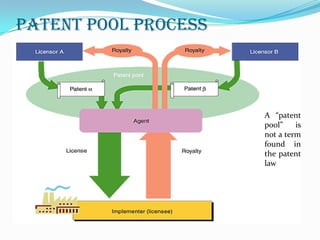
Patent pool processA “patent pool” is not a term found in the patent law
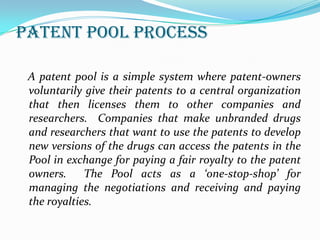
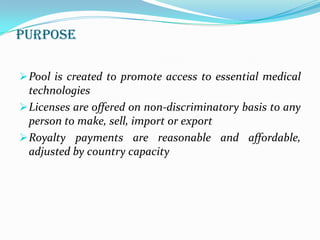
Patent pool process A patent pool is a simple system where patent-owners voluntarily give their patents to a central organization that then licenses them to other companies and researchers.  Companies that make unbranded drugs and researchers that want to use the patents to develop new versions of the drugs can access the patents in the Pool in exchange for paying a fair royalty to the patent owners.  The Pool acts as a ‘one-stop-shop’ for managing the negotiations and receiving and paying the royalties.
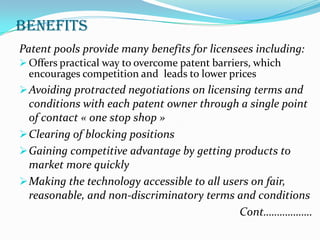
BENEFITS Patent pools provide many benefits for licensees including:Offers practical way to overcome patent barriers, which encourages competition and  leads to lower prices
Avoiding protracted negotiations on licensing terms and conditions with each patent owner through a single point of contact « one stop shop »
Clearing of blocking positions
Gaining competitive advantage by getting products to market more quickly
Making the technology accessible to all users on fair, reasonable, and non-discriminatory terms and conditions                                                                                 Cont………………
BENEFITSreduced licensing transaction costs.
Management of multiple owners and staking of royalties

Patent pool presentation

  • 1.
  • 2.
    PATENTA patent isa legal document, granted for any novel, non-obvious and utility product or process, by a state to an inventor for a statutorily specified period of time upon the disclosure of his invention in a document known as the patent specification. The patent confers the owner/inventor with an exclusive monopoly rights over his invention, preventing others from exploiting his invention to which the patent has been issued.
  • 3.
    Patent Barriers toaccess and availabilityMonopoly prices act as barrier to access.
  • 4.
    Patents restrictinnovation .
  • 5.
    Patents are oftena barrier to development of combination products.
  • 6.
    The complexity ofidentifying, tracking and obtaining licenses for patented technologies together with fear of potential claims for infringement, act as barriers to generic competition.
  • 7.
    Uncertainty over sizeof market/export potential also inhibits generic scale up and prevents economies of scale .DEFINITION A “patent pool” may be defined as an agreement between two or more patent owners to aggregate (pool) their patents and to license them to one another or to third parties, whether directly by patentee to licensee or through an entity set up specifically to administer the pool (Merges, 2001)
  • 8.
    Patent pool processA“patent pool” is not a term found in the patent law
  • 9.
    Patent pool processA patent pool is a simple system where patent-owners voluntarily give their patents to a central organization that then licenses them to other companies and researchers.  Companies that make unbranded drugs and researchers that want to use the patents to develop new versions of the drugs can access the patents in the Pool in exchange for paying a fair royalty to the patent owners.  The Pool acts as a ‘one-stop-shop’ for managing the negotiations and receiving and paying the royalties.
  • 10.
    BENEFITS Patent poolsprovide many benefits for licensees including:Offers practical way to overcome patent barriers, which encourages competition and leads to lower prices
  • 11.
    Avoiding protracted negotiationson licensing terms and conditions with each patent owner through a single point of contact « one stop shop »
  • 12.
  • 13.
    Gaining competitive advantageby getting products to market more quickly
  • 14.
    Making the technologyaccessible to all users on fair, reasonable, and non-discriminatory terms and conditions Cont………………
  • 15.
  • 16.
    Management of multipleowners and staking of royalties