Go for Launch®
Migration to the AWS Cloud
December 2016
Go for Launch®
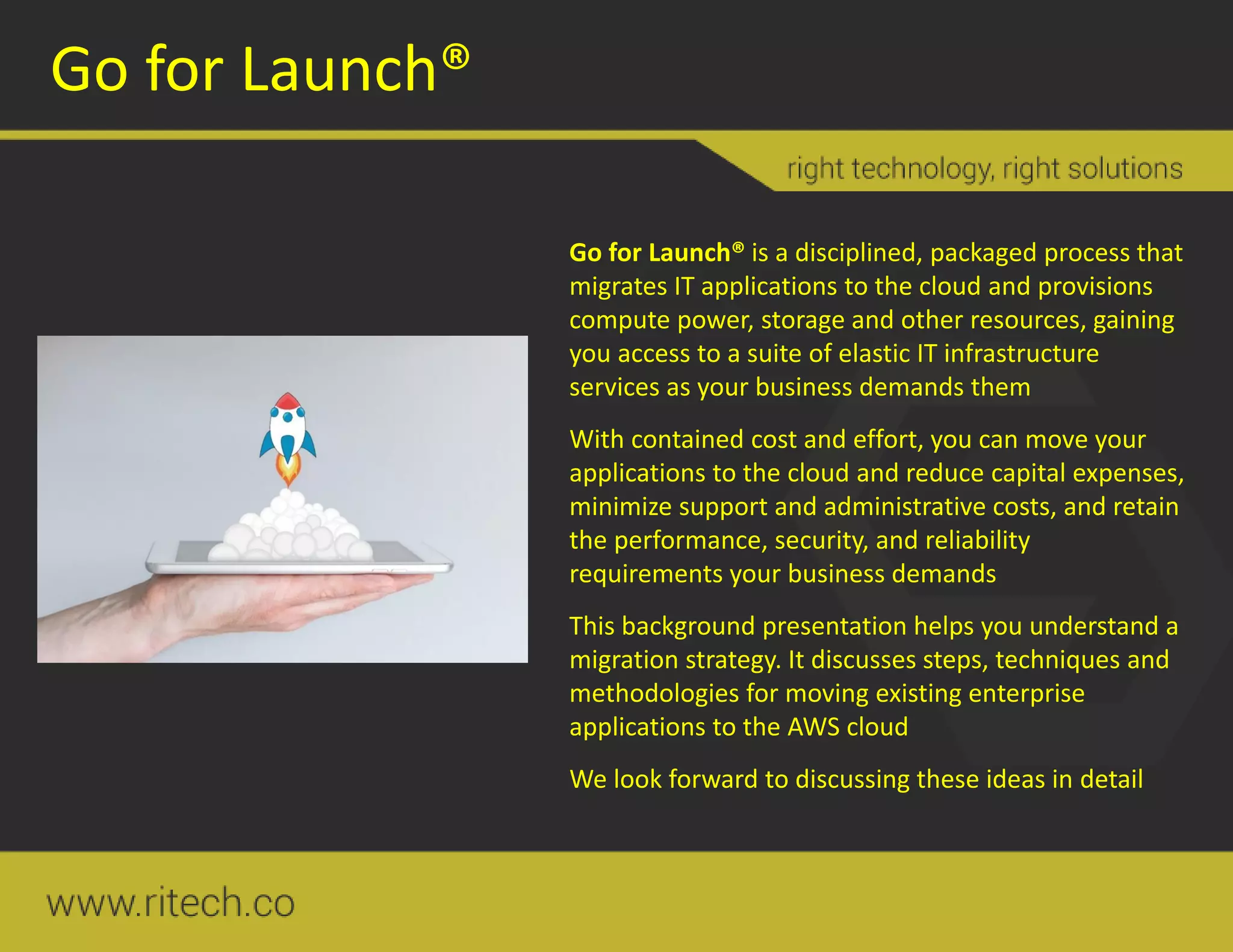
Go for Launch® is a disciplined, packaged process that
migrates IT applications to the cloud and provisions
compute power, storage and other resources, gaining
you access to a suite of elastic IT infrastructure
services as your business demands them
With contained cost and effort, you can move your
applications to the cloud and reduce capital expenses,
minimize support and administrative costs, and retain
the performance, security, and reliability
requirements your business demands
This background presentation helps you understand a
migration strategy. It discusses steps, techniques and
methodologies for moving existing enterprise
applications to the AWS cloud
We look forward to discussing these ideas in detail
What is Cloud Computing?
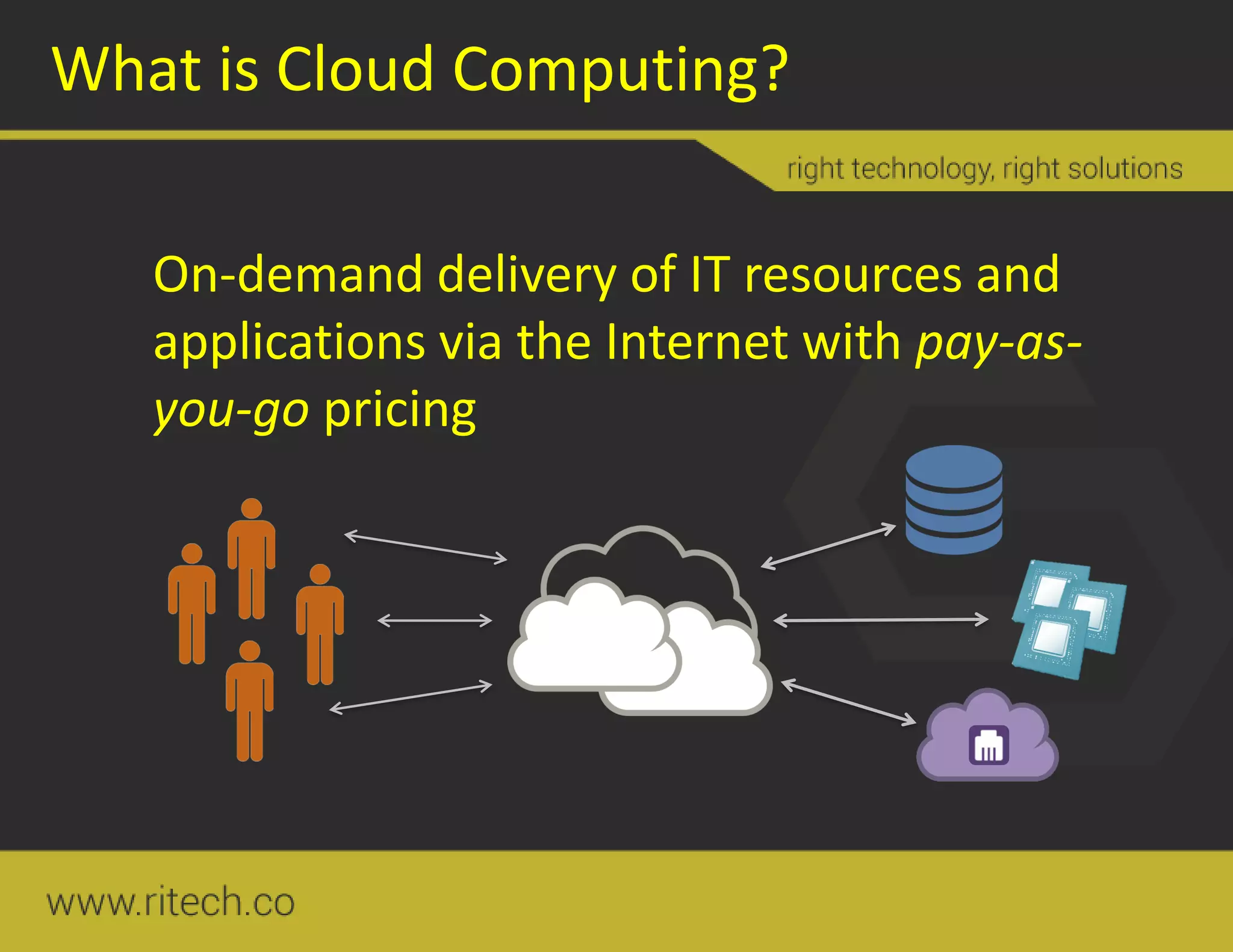
On-demand delivery of IT resources and
applications via the Internet with pay-as-
you-go pricing
What are Virtual Machines (VMs)?
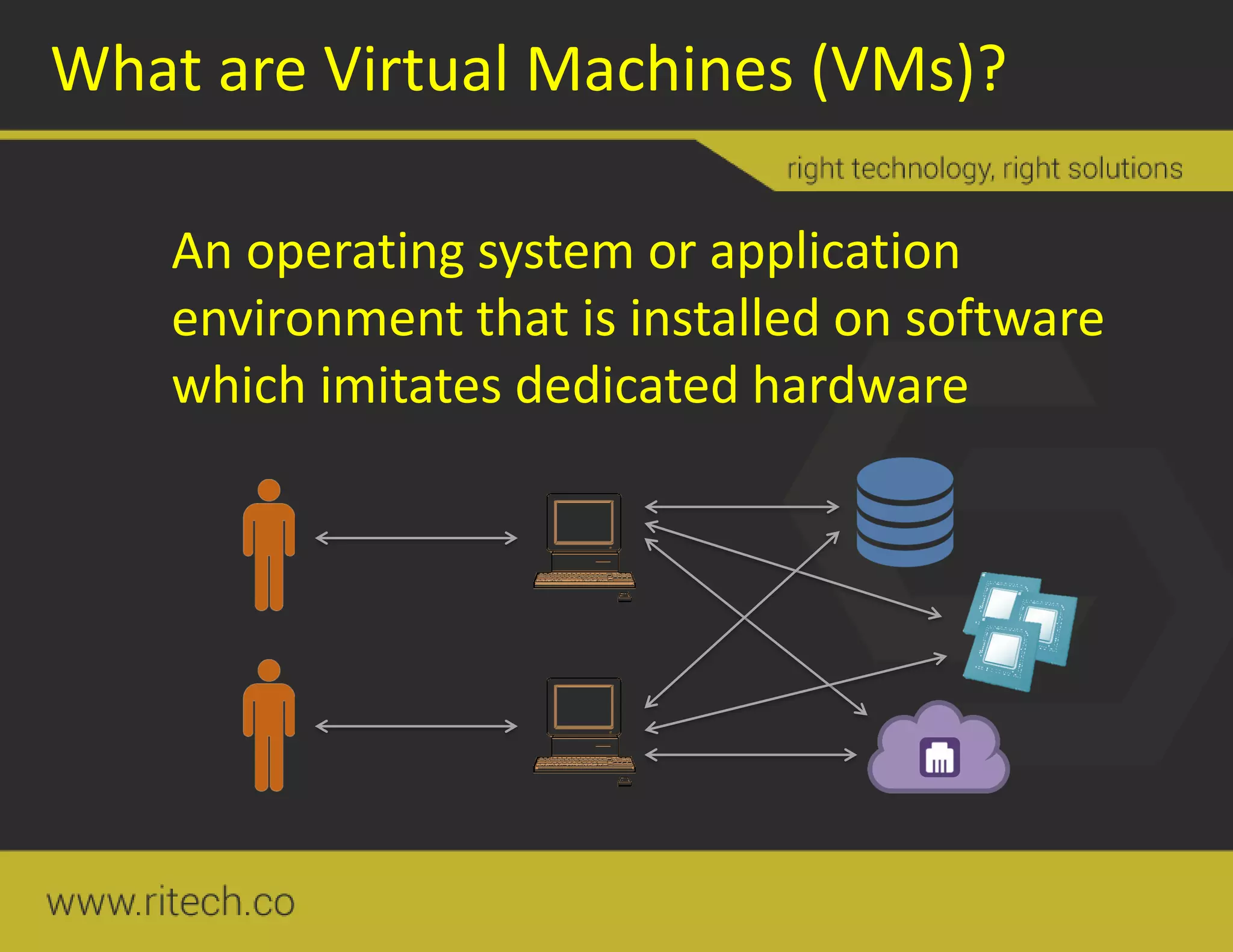
An operating system or application
environment that is installed on software
which imitates dedicated hardware
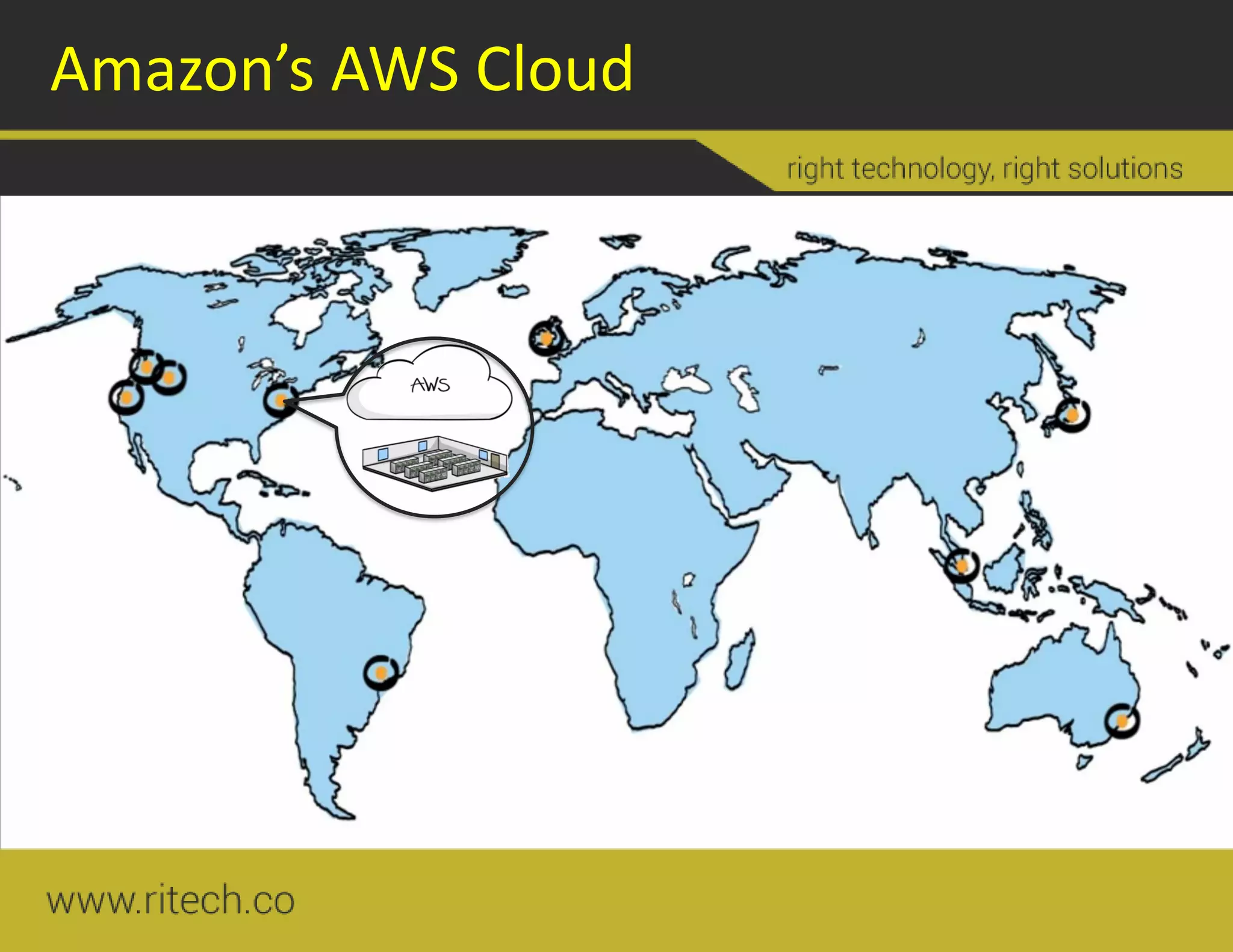
Amazon’s AWS Cloud
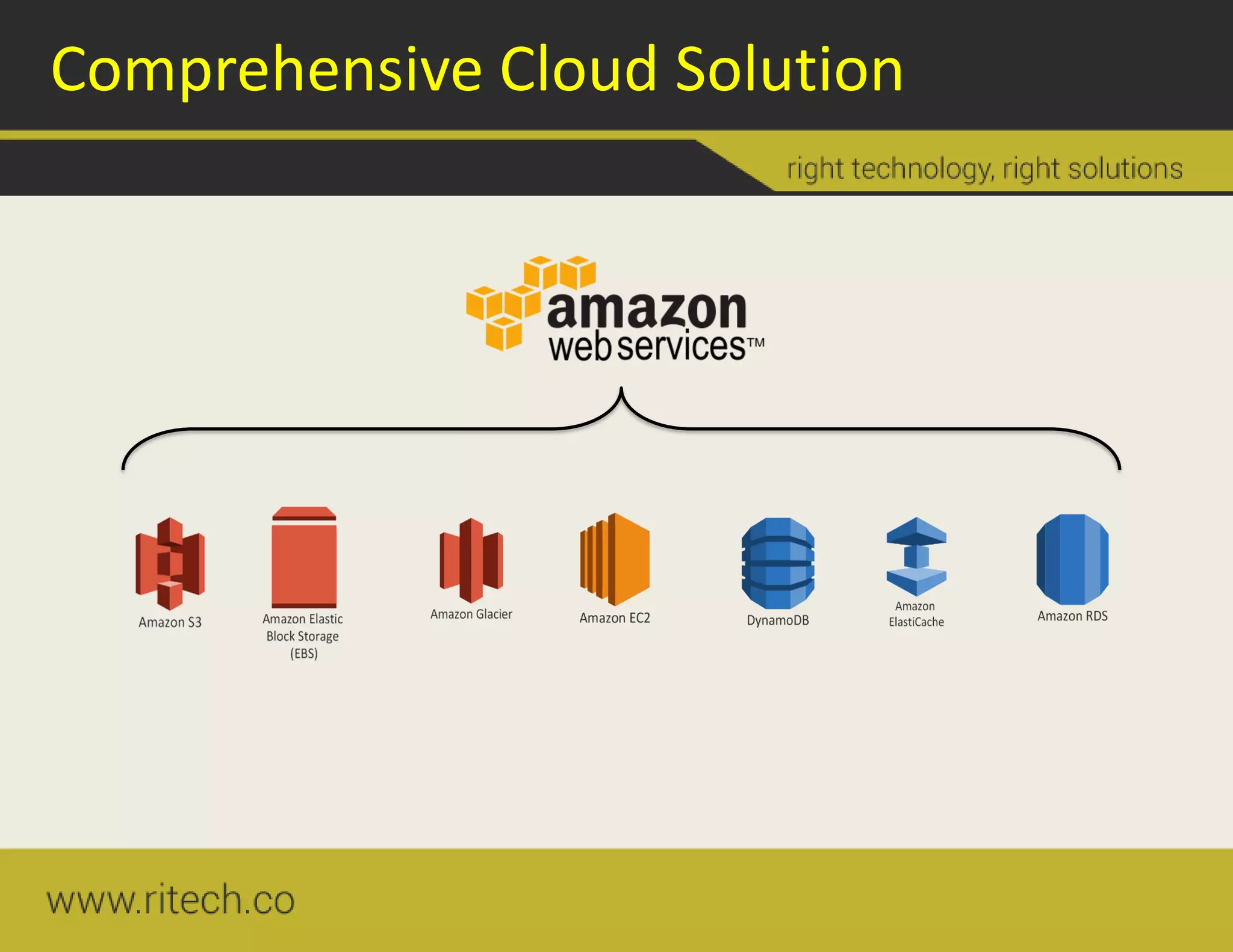
Comprehensive Cloud Solution
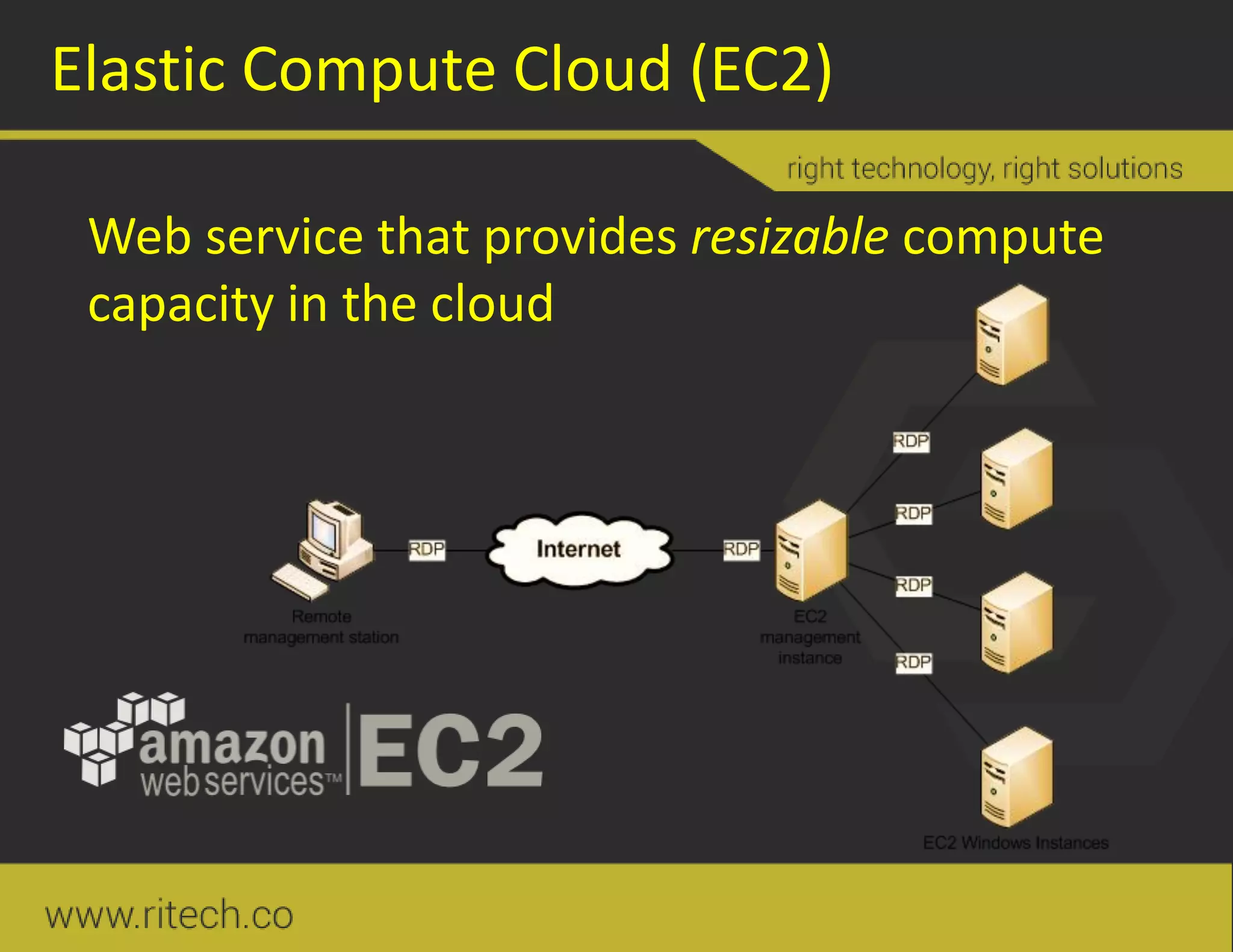
Elastic Compute Cloud (EC2)
Web service that provides resizable compute
capacity in the cloud
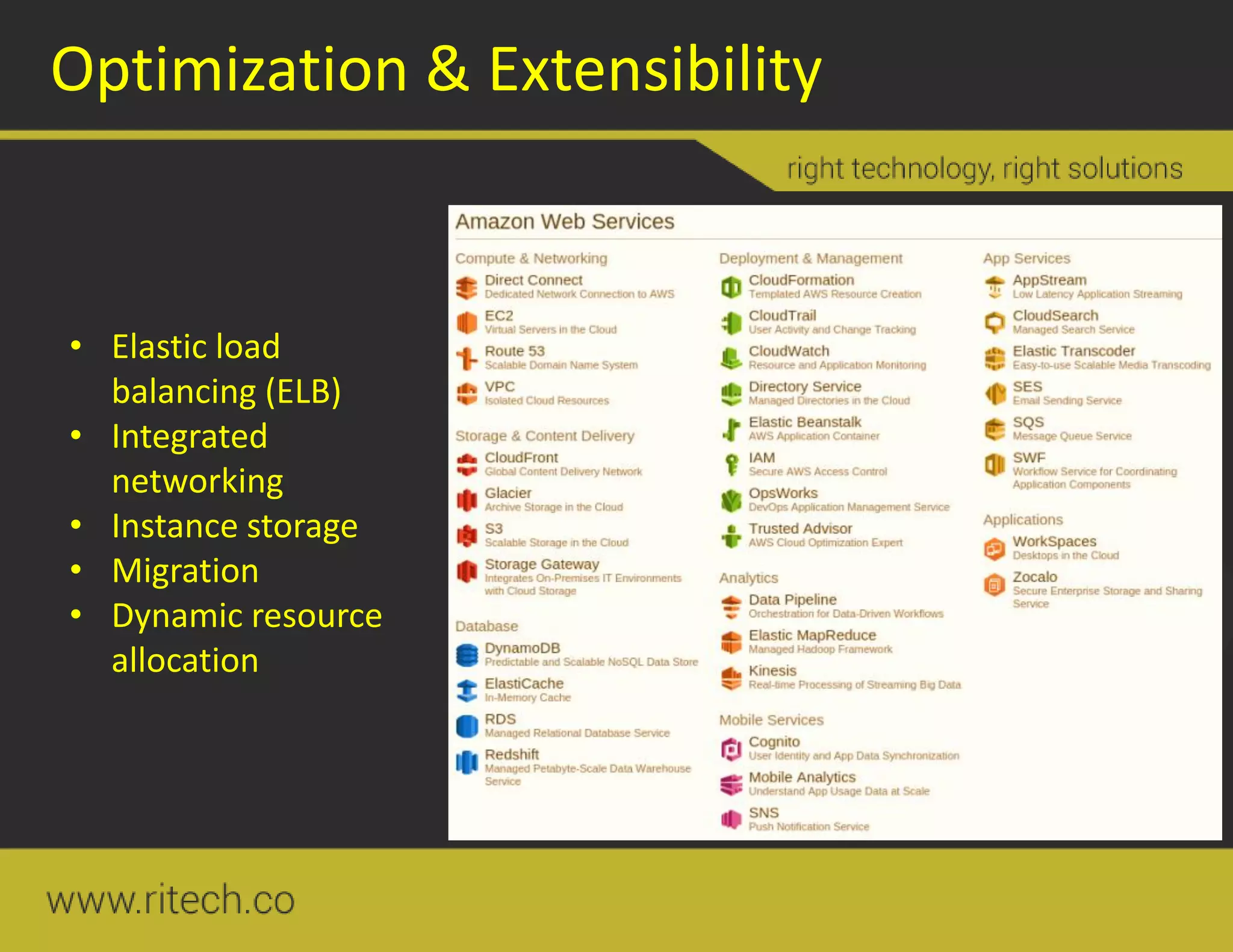
Optimization & Extensibility
• Elastic load
balancing (ELB)
• Integrated
networking
• Instance storage
• Migration
• Dynamic resource
allocation
Business Reasons
• Cloud Computing provides a simple way to access servers,
storage, databases and a broad set of application services
• Market competition continues to improve capability and
usability, and is driving down costs through scale
economies
• Varied customer and partner base introduces a range new
applications for immediate cloud utilization
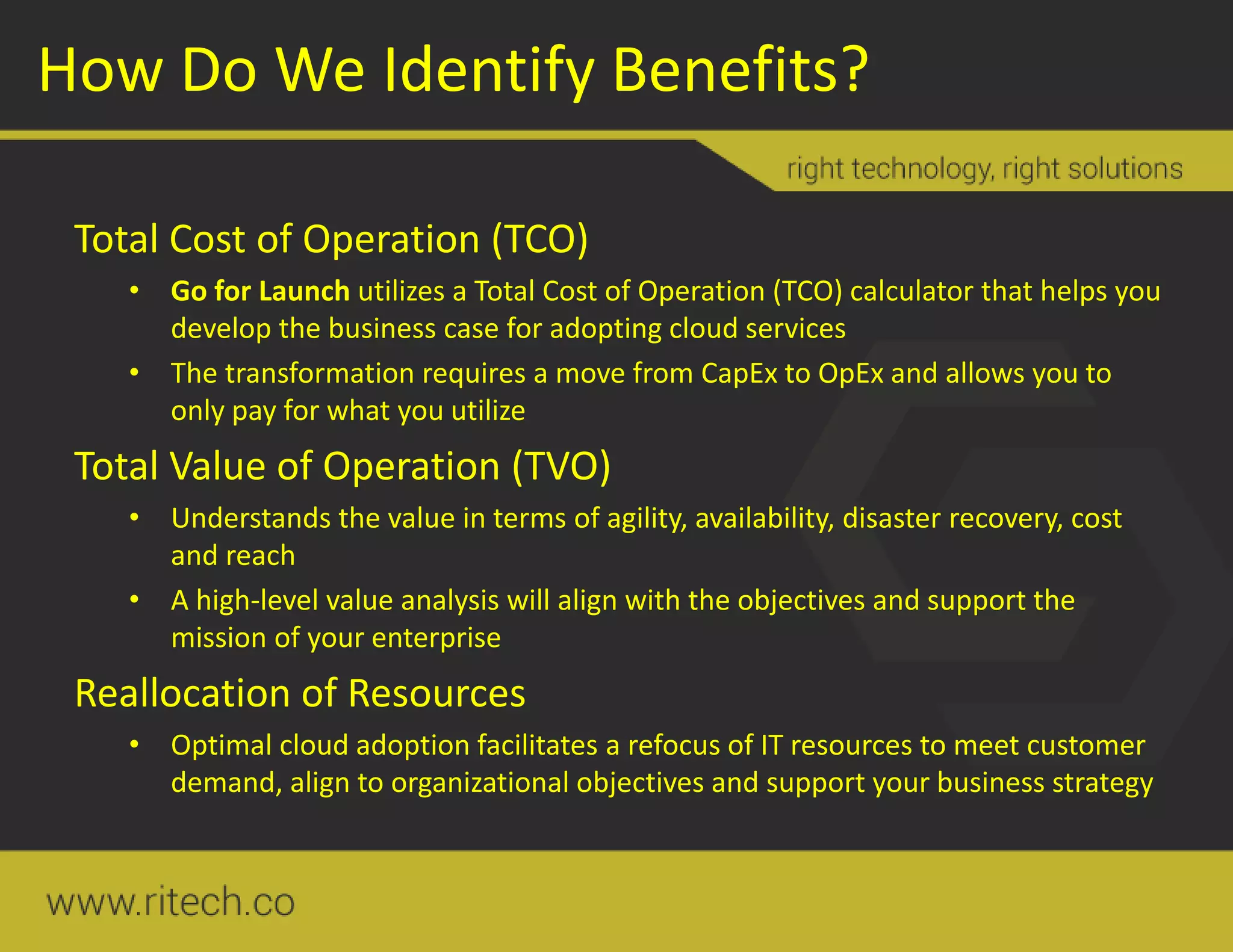
How Do We Identify Benefits?
Total Cost of Operation (TCO)
• Go for Launch utilizes a Total Cost of Operation (TCO) calculator that helps you
develop the business case for adopting cloud services
• The transformation requires a move from CapEx to OpEx and allows you to
only pay for what you utilize
Total Value of Operation (TVO)
• Understands the value in terms of agility, availability, disaster recovery, cost
and reach
• A high-level value analysis will align with the objectives and support the
mission of your enterprise
Reallocation of Resources
• Optimal cloud adoption facilitates a refocus of IT resources to meet customer
demand, align to organizational objectives and support your business strategy
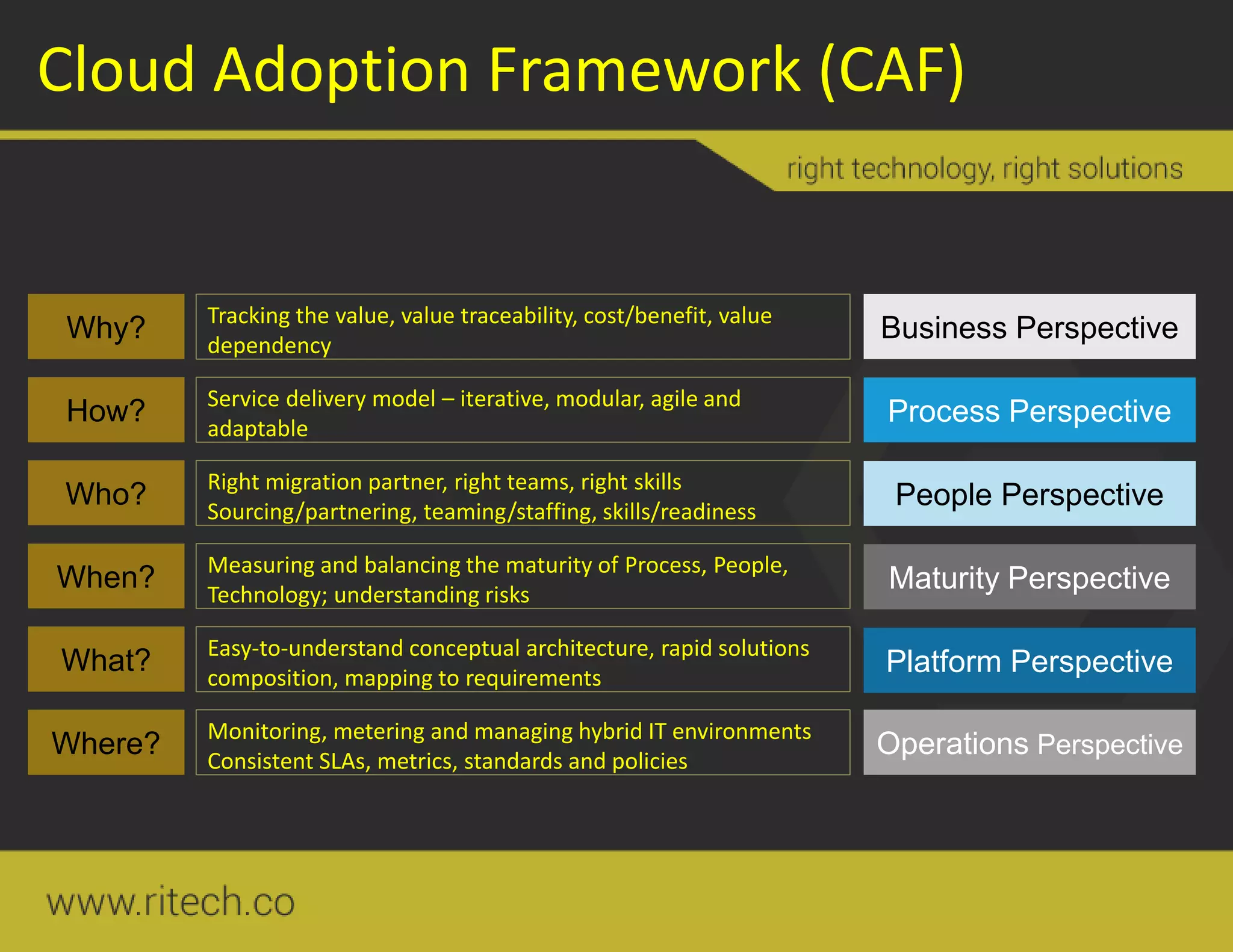
Cloud Adoption Framework (CAF)
Business Perspective
Process Perspective
People Perspective
Maturity Perspective
Platform Perspective
Operations Perspective
Why?
How?
Who?
When?
What?
Where?
Tracking the value, value traceability, cost/benefit, value
dependency
Service delivery model – iterative, modular, agile and
adaptable
Right migration partner, right teams, right skills
Sourcing/partnering, teaming/staffing, skills/readiness
Measuring and balancing the maturity of Process, People,
Technology; understanding risks
Easy-to-understand conceptual architecture, rapid solutions
composition, mapping to requirements
Monitoring, metering and managing hybrid IT environments
Consistent SLAs, metrics, standards and policies
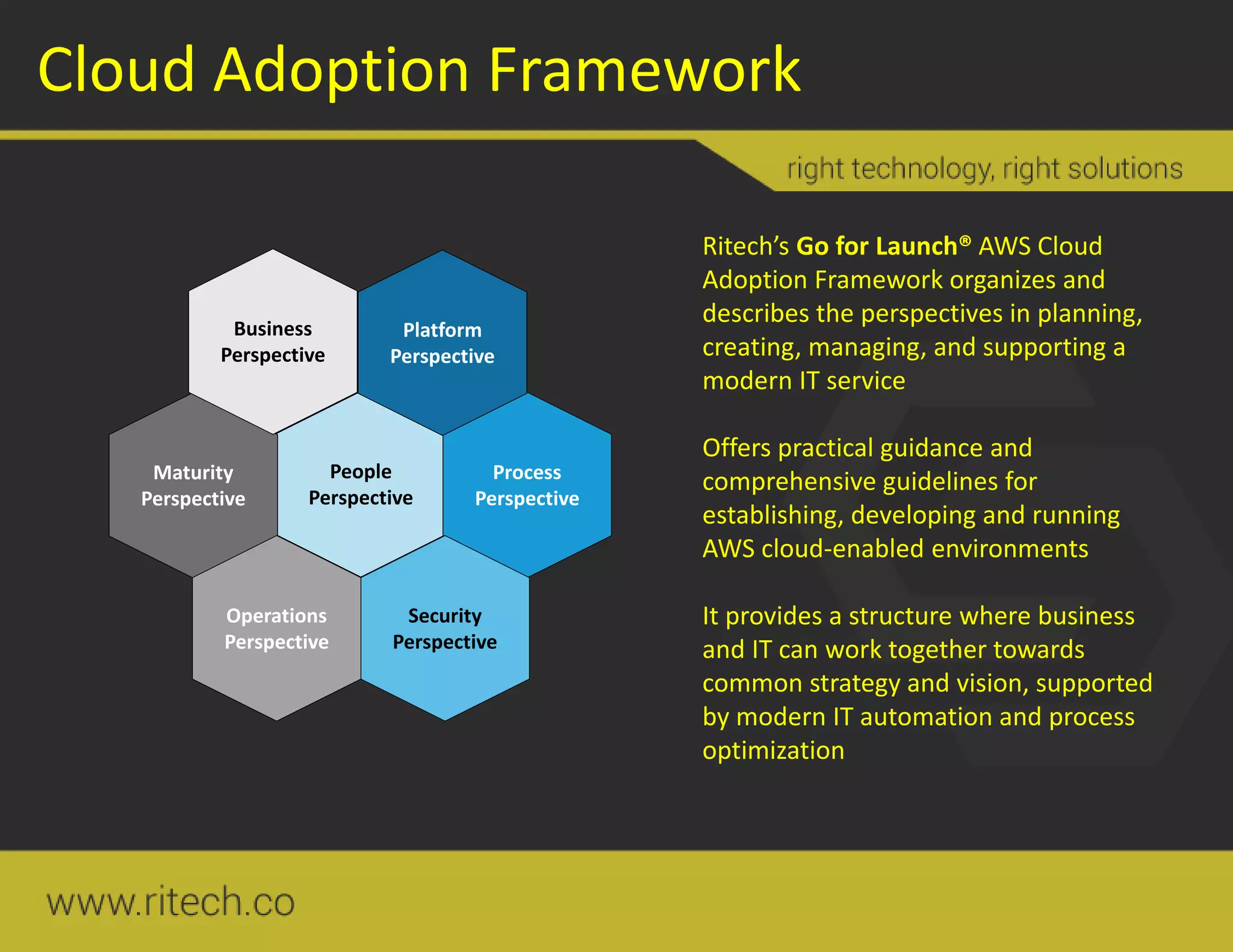
Cloud Adoption Framework
People
Perspective
Process
Perspective
Security
Perspective
Maturity
Perspective
Platform
Perspective
Operations
Perspective
Business
Perspective
Ritech’s Go for Launch® AWS Cloud
Adoption Framework organizes and
describes the perspectives in planning,
creating, managing, and supporting a
modern IT service
Offers practical guidance and
comprehensive guidelines for
establishing, developing and running
AWS cloud-enabled environments
It provides a structure where business
and IT can work together towards
common strategy and vision, supported
by modern IT automation and process
optimization
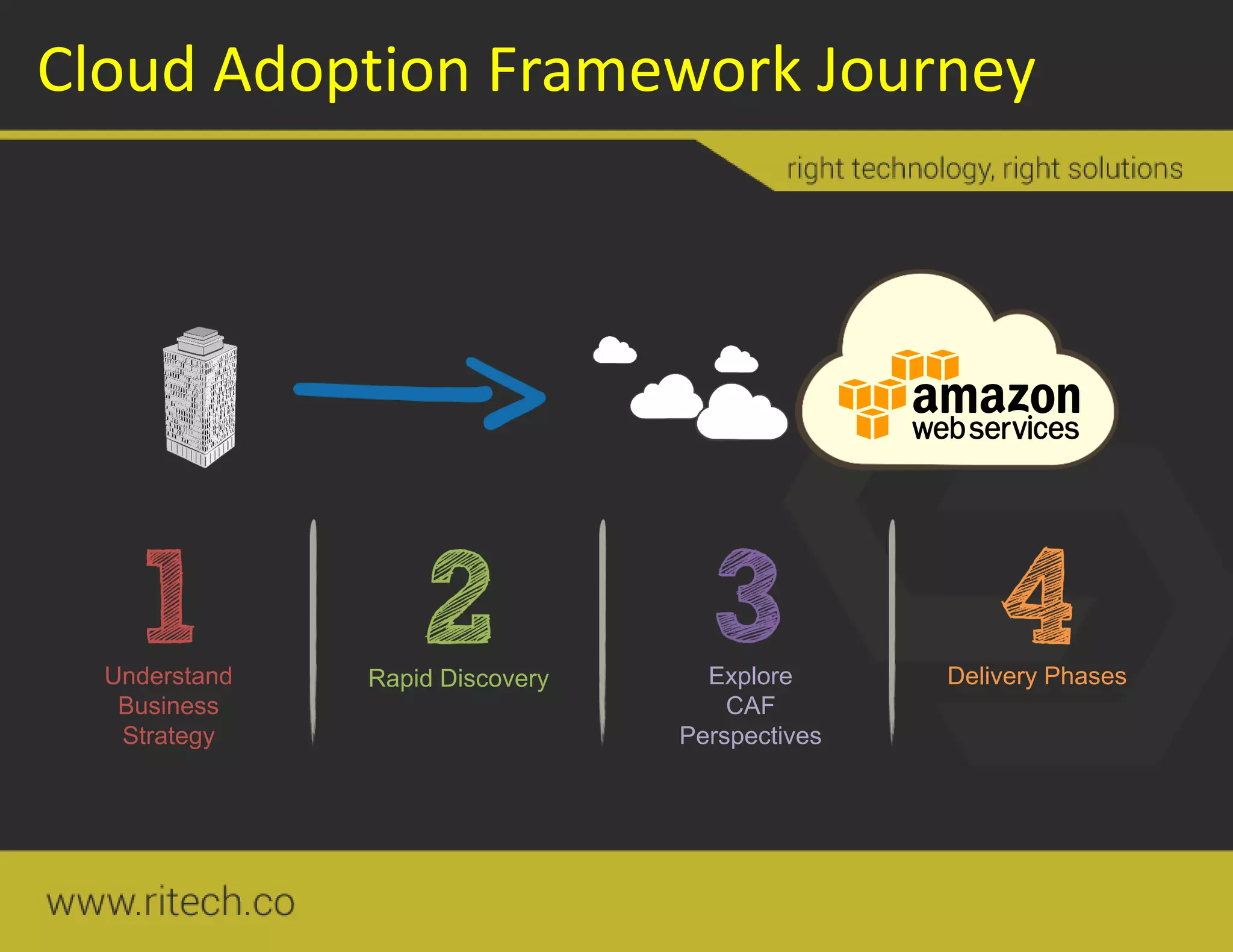
Cloud Adoption Framework Journey
Understand
Business
Strategy
Explore
CAF
Perspectives
Rapid Discovery Delivery Phases
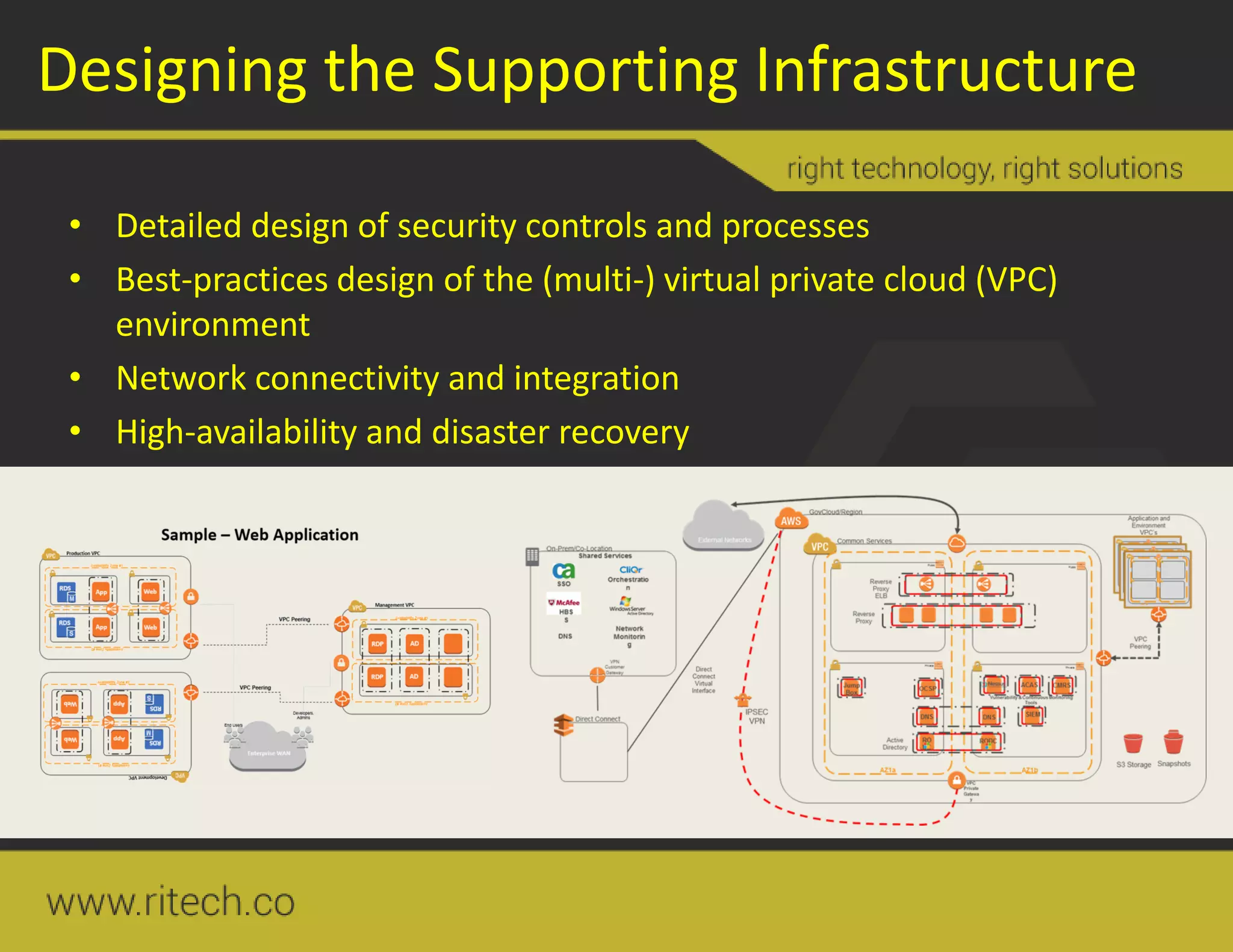
Designing the Supporting Infrastructure
• Detailed design of security controls and processes
• Best-practices design of the (multi-) virtual private cloud (VPC)
environment
• Network connectivity and integration
• High-availability and disaster recovery
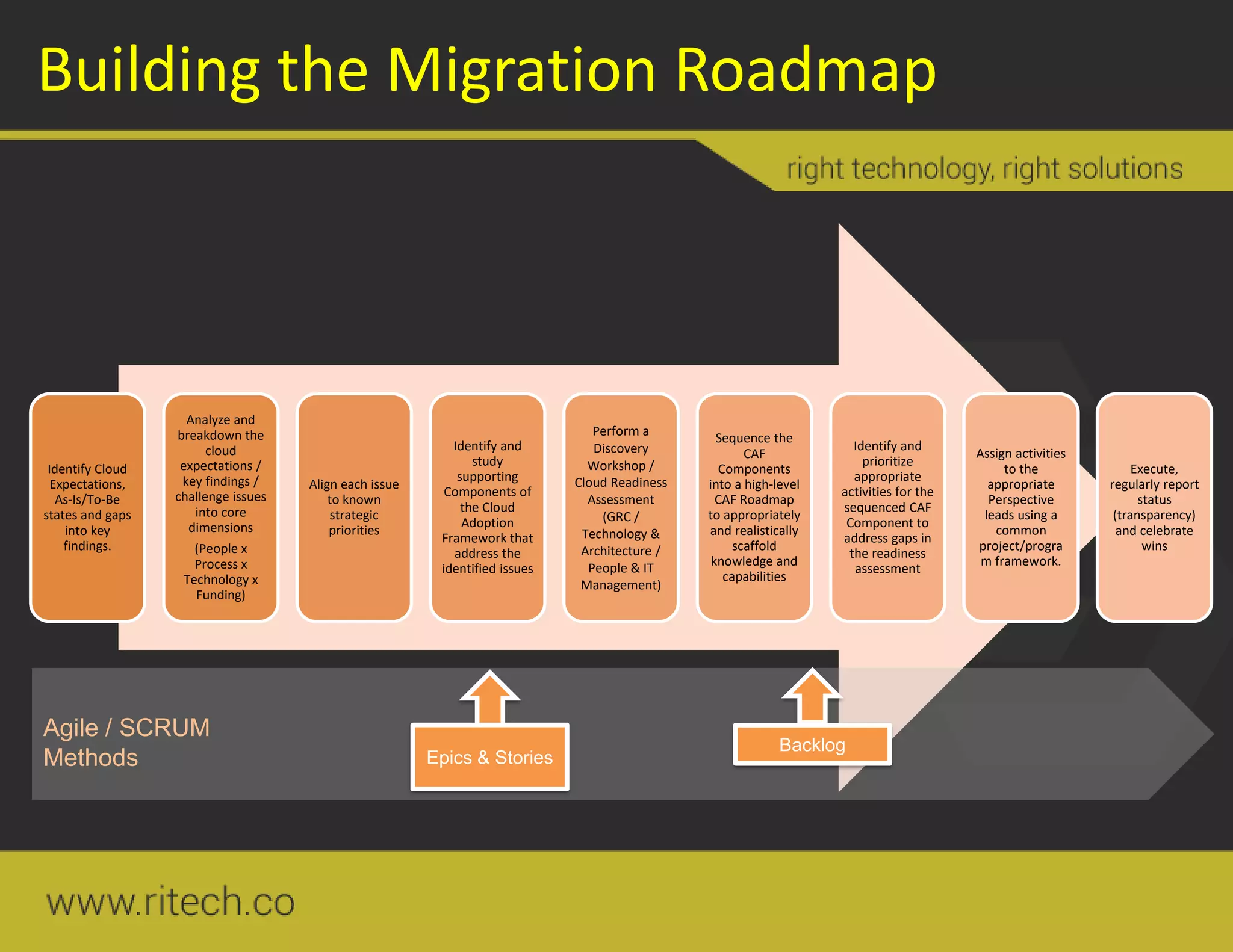
Building the Migration Roadmap
Identify Cloud
Expectations,
As-Is/To-Be
states and gaps
into key
findings.
Analyze and
breakdown the
cloud
expectations /
key findings /
challenge issues
into core
dimensions
(People x
Process x
Technology x
Funding)
Align each issue
to known
strategic
priorities
Identify and
study
supporting
Components of
the Cloud
Adoption
Framework that
address the
identified issues
Perform a
Discovery
Workshop /
Cloud Readiness
Assessment
(GRC /
Technology &
Architecture /
People & IT
Management)
Sequence the
CAF
Components
into a high-level
CAF Roadmap
to appropriately
and realistically
scaffold
knowledge and
capabilities
Identify and
prioritize
appropriate
activities for the
sequenced CAF
Component to
address gaps in
the readiness
assessment
Assign activities
to the
appropriate
Perspective
leads using a
common
project/progra
m framework.
Execute,
regularly report
status
(transparency)
and celebrate
wins
Agile / SCRUM
Methods Epics & Stories
Backlog
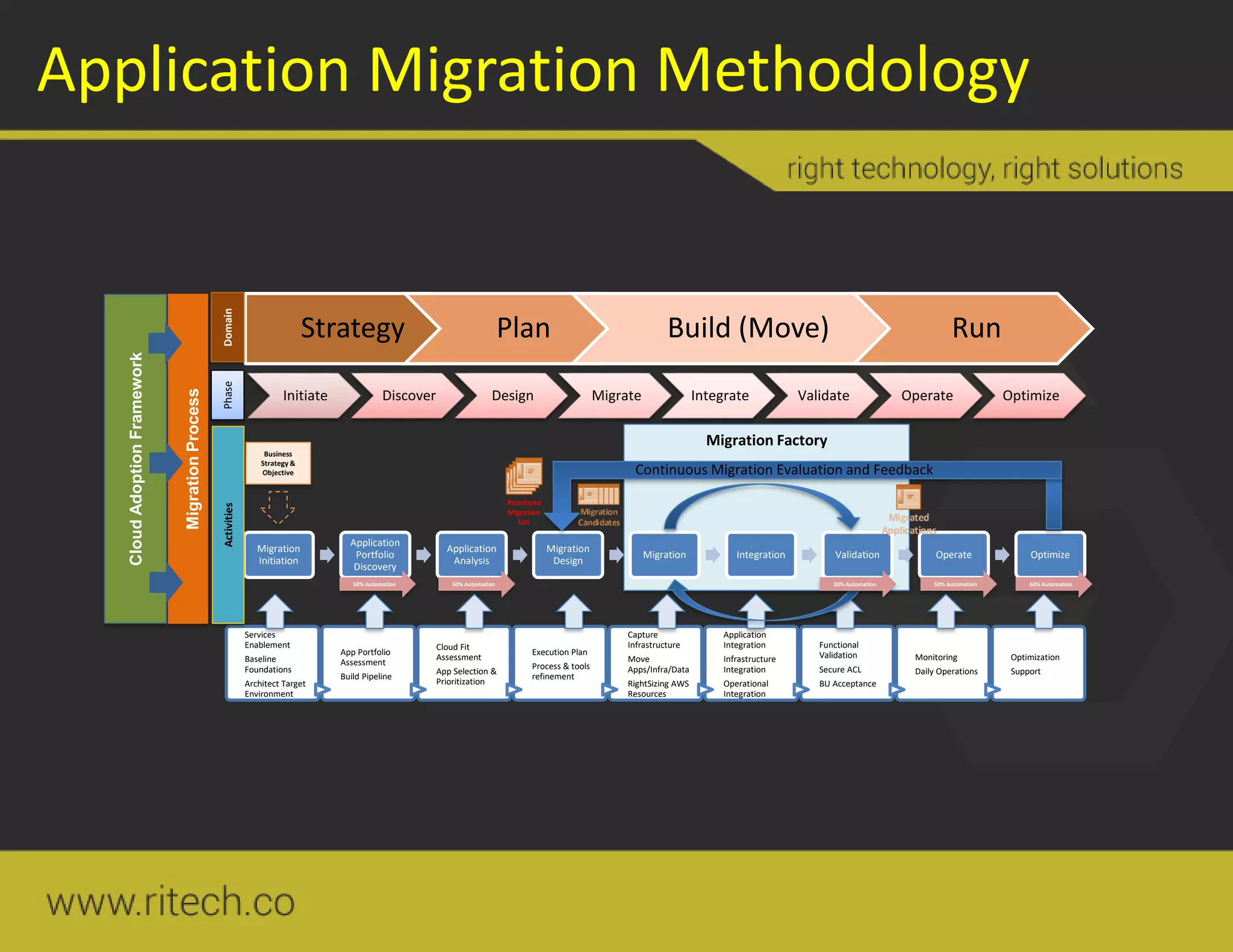
Application Migration Methodology
Migration Factory
Strategy Plan Build (Move) Run
DomainPhase
MigrationProcess
CloudAdoptionFramework
Initiate Discover Design Migrate Integrate Validate Operate Optimize
Migration
Initiation
Application
Portfolio
Discovery
Application
Analysis
Migration
Design
Migration Integration Validation Operate Optimize
Services
Enablement
Baseline
Foundations
Architect Target
Environment
App Portfolio
Assessment
Build Pipeline
Cloud Fit
Assessment
App Selection &
Prioritization
Execution Plan
Process & tools
refinement
Capture
Infrastructure
Move
Apps/Infra/Data
RightSizing AWS
Resources
Application
Integration
Infrastructure
Integration
Operational
Integration
Functional
Validation
Secure ACL
BU Acceptance
Monitoring
Daily Operations
Optimization
Support
50% Automation 50% Automation 30% Automation 50% Automation 50% Automation
Continuous Migration Evaluation and Feedback
Prioritized
Migration
List
Business
Strategy &
Objective
Activities
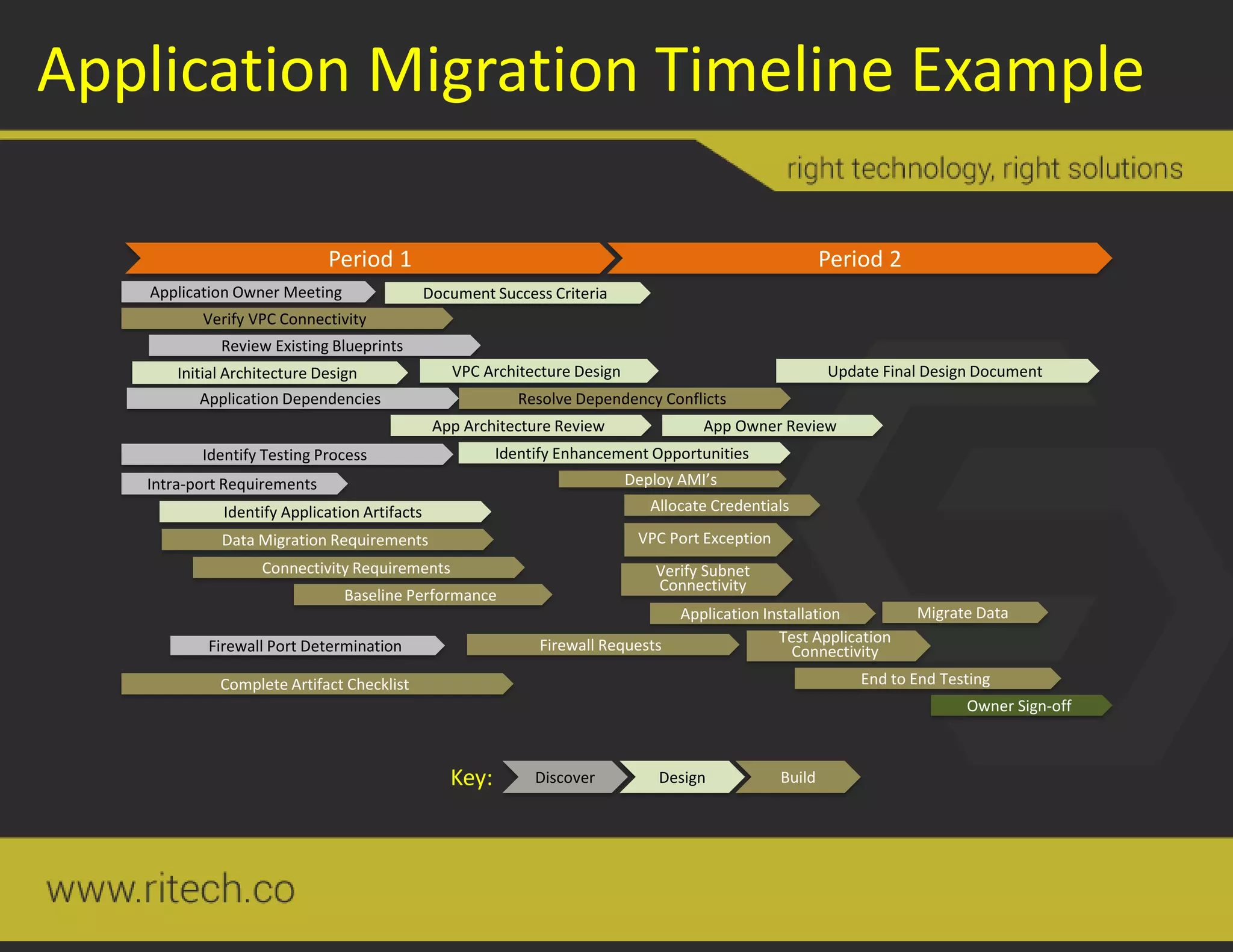
Application Migration Timeline Example
Application Owner Meeting
Connectivity Requirements
Data Migration Requirements
Identify Application Artifacts
Document Success Criteria
Identify Testing Process
Resolve Dependency ConflictsApplication Dependencies
Review Existing Blueprints
Verify VPC Connectivity
Complete Artifact Checklist
Firewall RequestsFirewall Port Determination
Intra-port Requirements
Period 1 Period 2
Initial Architecture Design
Application Installation
VPC Port Exception
Allocate Credentials
Verify Subnet
Connectivity
Deploy AMI’s
App Owner ReviewApp Architecture Review
VPC Architecture Design
Identify Enhancement Opportunities
Test Application
Connectivity
Migrate Data
End to End Testing
Owner Sign-off
Update Final Design Document
Baseline Performance
Discover Design BuildKey:
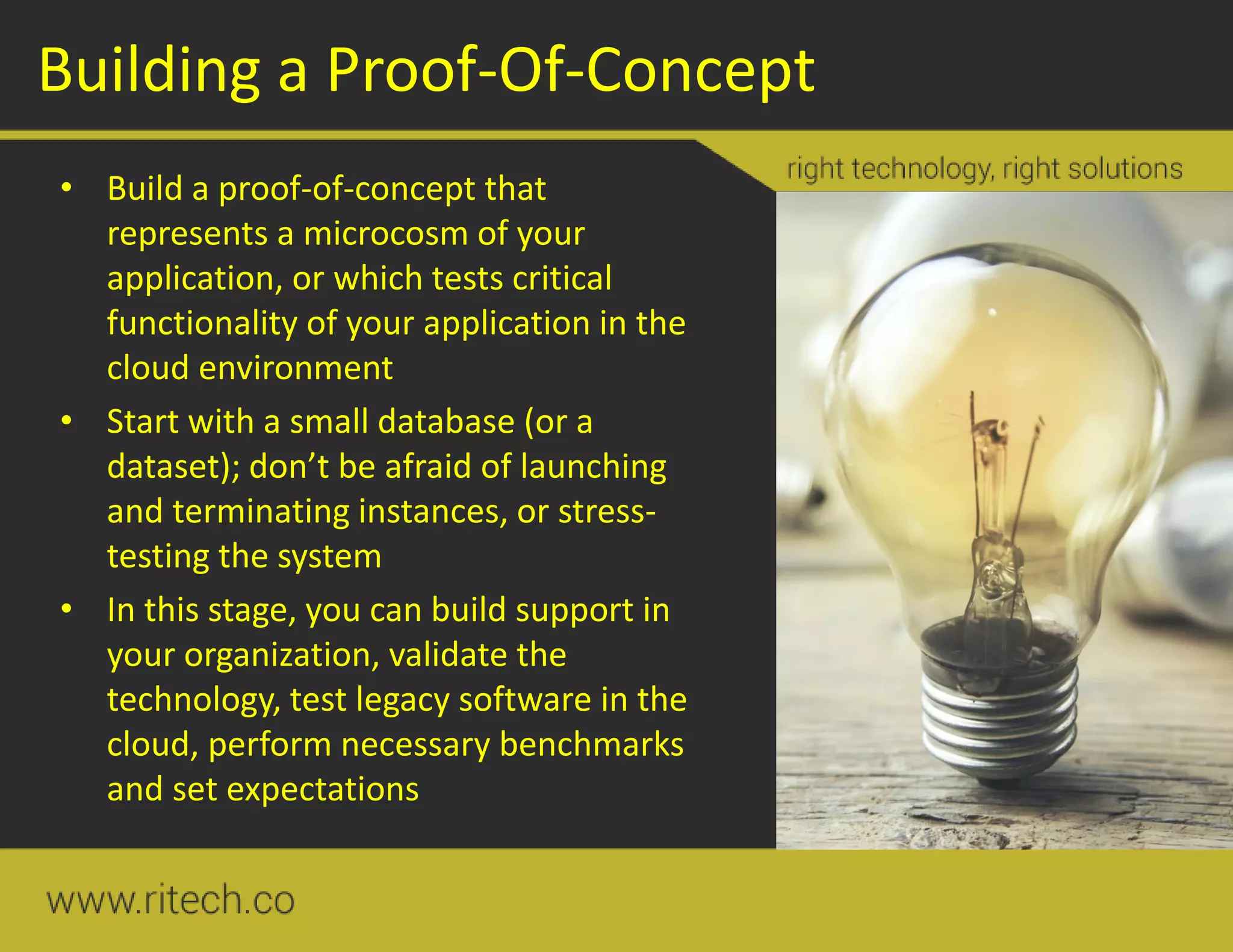
Building a Proof-Of-Concept
• Build a proof-of-concept that
represents a microcosm of your
application, or which tests critical
functionality of your application in the
cloud environment
• Start with a small database (or a
dataset); don’t be afraid of launching
and terminating instances, or stress-
testing the system
• In this stage, you can build support in
your organization, validate the
technology, test legacy software in the
cloud, perform necessary benchmarks
and set expectations
Re-engineering Applications
To build a highly scalable application, some components may need to be re-
engineered to run optimally in a cloud environment. Some existing enterprise
applications might mandate refactoring so that they can run in an elastic fashion.
Some questions that you can ask:
• Can you package and deploy your application so it can run on an Amazon EC2 instance? Can you run
multiple instances of the application on one instance, if needed? Or can you run multiple instances on
multiple Amazon EC2 instances?
• Is it possible to design the system such that in the event of a failure, it is resilient enough to automatically
re-launch and restart?
• Can you divide the application into components and run them on separate Amazon EC2 instances? For
example, can you separate a complex web application into individual components or layers of Web, App and
DB and run them on separate instances?
• Can you extract stateful components and make them stateless?
• Can you consider application partitioning (splitting the load across many smaller machines instead of fewer
larger machines)?
• Is it possible to isolate the components using Amazon SQS?
• Can you decouple code with deployment and configuration?
Conclusion
• Migrating to the cloud with Ritech’s Go for Launch® service brings scalability,
elasticity, agility and reliability to the enterprise
• To take advantage of the benefits of the cloud, organizations should adopt a
phase-driven migration strategy and try to take advantage of the cloud as early
as possible
• Whether it is a typical 3-tier web application, nightly batch process, or complex
backend processing workflow, most applications can be moved to the cloud
• Ritech’s Go for Launch® blueprint in this document offers a proven step by
step approach to cloud migration
• When customers follow this blueprint and focus on creating a proof of
concept, they immediately see value in their projects and see tremendous
potential in the cloud
Ritech Solutions - Go For Launch Overview (AWS)

Ritech Solutions - Go For Launch Overview (AWS)

  • 1.
    Go for Launch® Migrationto the AWS Cloud December 2016
  • 2.
    Go for Launch® Gofor Launch® is a disciplined, packaged process that migrates IT applications to the cloud and provisions compute power, storage and other resources, gaining you access to a suite of elastic IT infrastructure services as your business demands them With contained cost and effort, you can move your applications to the cloud and reduce capital expenses, minimize support and administrative costs, and retain the performance, security, and reliability requirements your business demands This background presentation helps you understand a migration strategy. It discusses steps, techniques and methodologies for moving existing enterprise applications to the AWS cloud We look forward to discussing these ideas in detail
  • 3.
    What is CloudComputing? On-demand delivery of IT resources and applications via the Internet with pay-as- you-go pricing
  • 4.
    What are VirtualMachines (VMs)? An operating system or application environment that is installed on software which imitates dedicated hardware
  • 5.
  • 6.
  • 7.
    Elastic Compute Cloud(EC2) Web service that provides resizable compute capacity in the cloud
  • 8.
    Optimization & Extensibility •Elastic load balancing (ELB) • Integrated networking • Instance storage • Migration • Dynamic resource allocation
  • 9.
    Business Reasons • CloudComputing provides a simple way to access servers, storage, databases and a broad set of application services • Market competition continues to improve capability and usability, and is driving down costs through scale economies • Varied customer and partner base introduces a range new applications for immediate cloud utilization
  • 10.
    How Do WeIdentify Benefits? Total Cost of Operation (TCO) • Go for Launch utilizes a Total Cost of Operation (TCO) calculator that helps you develop the business case for adopting cloud services • The transformation requires a move from CapEx to OpEx and allows you to only pay for what you utilize Total Value of Operation (TVO) • Understands the value in terms of agility, availability, disaster recovery, cost and reach • A high-level value analysis will align with the objectives and support the mission of your enterprise Reallocation of Resources • Optimal cloud adoption facilitates a refocus of IT resources to meet customer demand, align to organizational objectives and support your business strategy
  • 11.
    Cloud Adoption Framework(CAF) Business Perspective Process Perspective People Perspective Maturity Perspective Platform Perspective Operations Perspective Why? How? Who? When? What? Where? Tracking the value, value traceability, cost/benefit, value dependency Service delivery model – iterative, modular, agile and adaptable Right migration partner, right teams, right skills Sourcing/partnering, teaming/staffing, skills/readiness Measuring and balancing the maturity of Process, People, Technology; understanding risks Easy-to-understand conceptual architecture, rapid solutions composition, mapping to requirements Monitoring, metering and managing hybrid IT environments Consistent SLAs, metrics, standards and policies
  • 12.
    Cloud Adoption Framework People Perspective Process Perspective Security Perspective Maturity Perspective Platform Perspective Operations Perspective Business Perspective Ritech’sGo for Launch® AWS Cloud Adoption Framework organizes and describes the perspectives in planning, creating, managing, and supporting a modern IT service Offers practical guidance and comprehensive guidelines for establishing, developing and running AWS cloud-enabled environments It provides a structure where business and IT can work together towards common strategy and vision, supported by modern IT automation and process optimization
  • 13.
    Cloud Adoption FrameworkJourney Understand Business Strategy Explore CAF Perspectives Rapid Discovery Delivery Phases
  • 14.
    Designing the SupportingInfrastructure • Detailed design of security controls and processes • Best-practices design of the (multi-) virtual private cloud (VPC) environment • Network connectivity and integration • High-availability and disaster recovery
  • 15.
    Building the MigrationRoadmap Identify Cloud Expectations, As-Is/To-Be states and gaps into key findings. Analyze and breakdown the cloud expectations / key findings / challenge issues into core dimensions (People x Process x Technology x Funding) Align each issue to known strategic priorities Identify and study supporting Components of the Cloud Adoption Framework that address the identified issues Perform a Discovery Workshop / Cloud Readiness Assessment (GRC / Technology & Architecture / People & IT Management) Sequence the CAF Components into a high-level CAF Roadmap to appropriately and realistically scaffold knowledge and capabilities Identify and prioritize appropriate activities for the sequenced CAF Component to address gaps in the readiness assessment Assign activities to the appropriate Perspective leads using a common project/progra m framework. Execute, regularly report status (transparency) and celebrate wins Agile / SCRUM Methods Epics & Stories Backlog
  • 16.
    Application Migration Methodology MigrationFactory Strategy Plan Build (Move) Run DomainPhase MigrationProcess CloudAdoptionFramework Initiate Discover Design Migrate Integrate Validate Operate Optimize Migration Initiation Application Portfolio Discovery Application Analysis Migration Design Migration Integration Validation Operate Optimize Services Enablement Baseline Foundations Architect Target Environment App Portfolio Assessment Build Pipeline Cloud Fit Assessment App Selection & Prioritization Execution Plan Process & tools refinement Capture Infrastructure Move Apps/Infra/Data RightSizing AWS Resources Application Integration Infrastructure Integration Operational Integration Functional Validation Secure ACL BU Acceptance Monitoring Daily Operations Optimization Support 50% Automation 50% Automation 30% Automation 50% Automation 50% Automation Continuous Migration Evaluation and Feedback Prioritized Migration List Business Strategy & Objective Activities
  • 17.
    Application Migration TimelineExample Application Owner Meeting Connectivity Requirements Data Migration Requirements Identify Application Artifacts Document Success Criteria Identify Testing Process Resolve Dependency ConflictsApplication Dependencies Review Existing Blueprints Verify VPC Connectivity Complete Artifact Checklist Firewall RequestsFirewall Port Determination Intra-port Requirements Period 1 Period 2 Initial Architecture Design Application Installation VPC Port Exception Allocate Credentials Verify Subnet Connectivity Deploy AMI’s App Owner ReviewApp Architecture Review VPC Architecture Design Identify Enhancement Opportunities Test Application Connectivity Migrate Data End to End Testing Owner Sign-off Update Final Design Document Baseline Performance Discover Design BuildKey:
  • 18.
    Building a Proof-Of-Concept •Build a proof-of-concept that represents a microcosm of your application, or which tests critical functionality of your application in the cloud environment • Start with a small database (or a dataset); don’t be afraid of launching and terminating instances, or stress- testing the system • In this stage, you can build support in your organization, validate the technology, test legacy software in the cloud, perform necessary benchmarks and set expectations
  • 19.
    Re-engineering Applications To builda highly scalable application, some components may need to be re- engineered to run optimally in a cloud environment. Some existing enterprise applications might mandate refactoring so that they can run in an elastic fashion. Some questions that you can ask: • Can you package and deploy your application so it can run on an Amazon EC2 instance? Can you run multiple instances of the application on one instance, if needed? Or can you run multiple instances on multiple Amazon EC2 instances? • Is it possible to design the system such that in the event of a failure, it is resilient enough to automatically re-launch and restart? • Can you divide the application into components and run them on separate Amazon EC2 instances? For example, can you separate a complex web application into individual components or layers of Web, App and DB and run them on separate instances? • Can you extract stateful components and make them stateless? • Can you consider application partitioning (splitting the load across many smaller machines instead of fewer larger machines)? • Is it possible to isolate the components using Amazon SQS? • Can you decouple code with deployment and configuration?
  • 20.
    Conclusion • Migrating tothe cloud with Ritech’s Go for Launch® service brings scalability, elasticity, agility and reliability to the enterprise • To take advantage of the benefits of the cloud, organizations should adopt a phase-driven migration strategy and try to take advantage of the cloud as early as possible • Whether it is a typical 3-tier web application, nightly batch process, or complex backend processing workflow, most applications can be moved to the cloud • Ritech’s Go for Launch® blueprint in this document offers a proven step by step approach to cloud migration • When customers follow this blueprint and focus on creating a proof of concept, they immediately see value in their projects and see tremendous potential in the cloud