Risks versus Benefits
Using Social Media Safely
1MATTHEW KATZ, M.D. http://bit.ly/MSKSlideshare
Disclosures
• Stock: Dr. Reddy Laboratories, U.S. Physical Therapy, Mazor
Robotics, Healthcare Services Group, Inc.
• No other financial disclosures for healthcare or social media
companies
2MATTHEW KATZ, M.D. http://bit.ly/MSKSlideshare
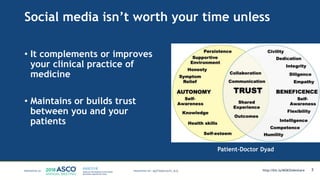
Social media isn’t worth your time unless
• It complements or improves
your clinical practice of
medicine
• Maintains or builds trust
between you and your
patients
3MATTHEW KATZ, M.D.
Patient-Doctor Dyad
http://bit.ly/MSKSlideshare
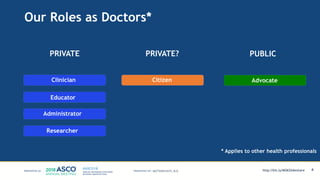
Our Roles as Doctors*
4MATTHEW KATZ, M.D.
Clinician
Educator
Administrator
Researcher
* Applies to other health professionals
Citizen
PRIVATE PUBLICPRIVATE?
Advocate
http://bit.ly/MSKSlideshare
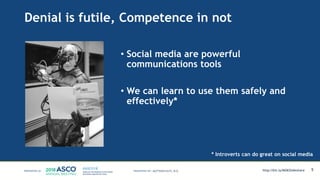
Denial is futile, Competence in not
• Social media are powerful
communications tools
• We can learn to use them safely and
effectively*
5
* Introverts can do great on social media
MATTHEW KATZ, M.D. http://bit.ly/MSKSlideshare
6MATTHEW KATZ, M.D.
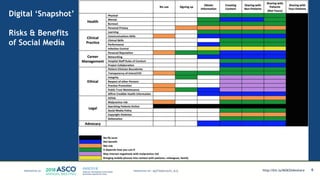
Digital ‘Snapshot’
Risks & Benefits
of Social Media
http://bit.ly/MSKSlideshare
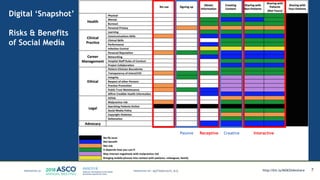
7MATTHEW KATZ, M.D.
Digital ‘Snapshot’
Risks & Benefits
of Social Media
Passive Receptive Creative Interactive
http://bit.ly/MSKSlideshare
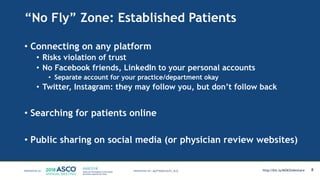
“No Fly” Zone: Established Patients
• Connecting on any platform
• Risks violation of trust
• No Facebook friends, LinkedIn to your personal accounts
• Separate account for your practice/department okay
• Twitter, Instagram: they may follow you, but don’t follow back
• Searching for patients online
• Public sharing on social media (or physician review websites)
8MATTHEW KATZ, M.D. http://bit.ly/MSKSlideshare
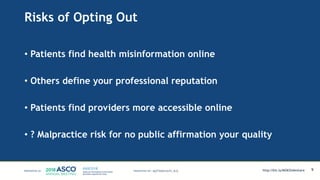
Risks of Opting Out
• Patients find health misinformation online
• Others define your professional reputation
• Patients find providers more accessible online
• ? Malpractice risk for no public affirmation your quality
9MATTHEW KATZ, M.D. http://bit.ly/MSKSlideshare
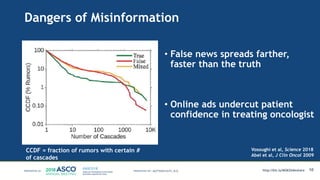
Dangers of Misinformation
• False news spreads farther,
faster than the truth
• Online ads undercut patient
confidence in treating oncologist
10MATTHEW KATZ, M.D.
Vosoughi et al, Science 2018
Abel et al, J Clin Oncol 2009
CCDF = fraction of rumors with certain #
of cascades
http://bit.ly/MSKSlideshare
Signing Up
• Give information about
• Yourself
• Who you know [usually email]
• Details about professional self
11MATTHEW KATZ, M.D. http://bit.ly/MSKSlideshare
Signing Up
12
• Avoids crossover with patients
• Risks ‘silo syndrome’
• ? HIPAA risk vs. more public sites
• More public, lose some privacy
• Establish your public presence as trustworthy
• Competes with physician ratings sites in search
engines
MATTHEW KATZ, M.D. http://bit.ly/MSKSlideshare
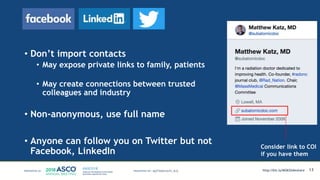
• Don’t import contacts
• May expose private links to family, patients
• May create connections between trusted
colleagues and industry
• Non-anonymous, use full name
• Anyone can follow you on Twitter but not
Facebook, LinkedIn
13
Consider link to COI
if you have them
MATTHEW KATZ, M.D. http://bit.ly/MSKSlideshare
Obtaining information
Benefits
• Learn how people discuss
disease, care
• Plain language, not ‘medical-ese’
• Keep up on new health
information
• Publications
• Academic meetings
• Policy affecting patients, practice
• Affirm accurate information over
‘fake news’
Risks
• Potential for distraction
• Exposure to misinformation
• Malware
• Tracking
14MATTHEW KATZ, M.D. http://bit.ly/MSKSlideshare
Smartphone Addiction
• Addictive social media use linked to age, gender, education, income
• Some links of addictive use to narcissism, low self-esteem
• Estimated ‘At risk’ or ‘problematic’ use in 20.5% of adults
• High frequency use linked to sleep disturbance, symptoms of depression
• Social networking linked to problematic internet use in 26-55 year olds
• Average person touches phone 2617 times, 2.42 hours/day*
15
Andreassen et al, Addictive Behaviors 2017
De-Sola et al, PLOS One 2017
Thomée et al, BMC Public Health 2011
Ioannidis et al, Addictive Behaviors 2018
* blog.dscout.com/mobile-touches
MATTHEW KATZ, M.D. http://bit.ly/MSKSlideshare
Time Management
• Avoid multitasking
• Limit/Budget time online
• Put mobile phone away from
where you sleep
• Consider turning color ‘off’
16MATTHEW KATZ, M.D.
* blog.dscout.com/mobile-touches
http://bit.ly/MSKSlideshare
Misinformation, Malware: Think Before You Link
17MATTHEW KATZ, M.D.
Pew Research, December 2016
• Only 61% believe they can identify false information online
• 23% have shared ‘fake news’ – 7% on purpose
• Restrict who you follow for health information to reliable sources
• Avoid clicking on hyperlinked material for strange URLs or bit.ly links
for possible malware
http://bit.ly/MSKSlideshare
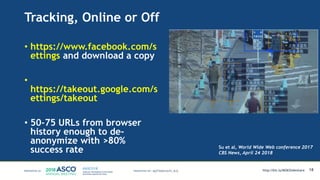
Tracking, Online or Off
• https://www.facebook.com/s
ettings and download a copy
•
https://takeout.google.com/s
ettings/takeout
• 50-75 URLs from browser
history enough to de-
anonymize with >80%
success rate
18
Su et al, World Wide Web conference 2017
CBS News, April 24 2018
MATTHEW KATZ, M.D. http://bit.ly/MSKSlideshare
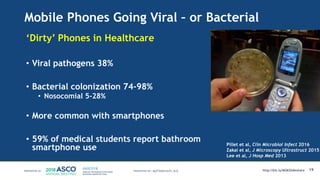
Mobile Phones Going Viral – or Bacterial
‘Dirty’ Phones in Healthcare
• Viral pathogens 38%
• Bacterial colonization 74-98%
• Nosocomial 5-28%
• More common with smartphones
• 59% of medical students report bathroom
smartphone use
19
Pillet et al, Clin Microbiol Infect 2016
Zakai et al, J Microscopy Ultrastruct 2015
Lee et al, J Hosp Med 2013
MATTHEW KATZ, M.D. http://bit.ly/MSKSlideshare
Creative and Interactive Social Media
• You are what you
• Like
• Tweet
• Post
• Nurses, pharmacists and doctors are the three most trusted
professions*
• Be the best version yourself online
20
*Gallup, December 2016
MATTHEW KATZ, M.D. http://bit.ly/MSKSlideshare
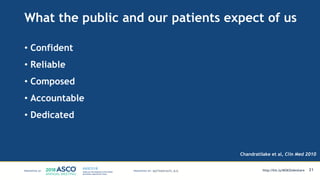
What the public and our patients expect of us
• Confident
• Reliable
• Composed
• Accountable
• Dedicated
21
Chandratilake et al, Clin Med 2010
MATTHEW KATZ, M.D. http://bit.ly/MSKSlideshare
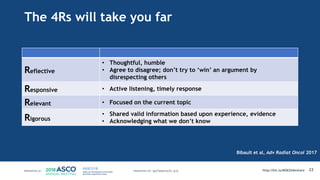
The 4Rs will take you far
Reflective
• Thoughtful, humble
• Agree to disagree; don’t try to ‘win’ an argument by
disrespecting others
Responsive • Active listening, timely response
Relevant • Focused on the current topic
Rigorous
• Shared valid information based upon experience, evidence
• Acknowledging what we don’t know
22MATTHEW KATZ, M.D.
Bibault et al, Adv Radiat Oncol 2017
http://bit.ly/MSKSlideshare
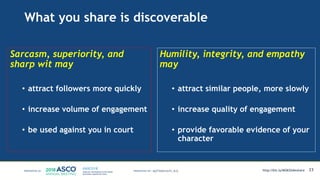
What you share is discoverable
Sarcasm, superiority, and
sharp wit may
• attract followers more quickly
• increase volume of engagement
• be used against you in court
Humility, integrity, and empathy
may
• attract similar people, more slowly
• increase quality of engagement
• provide favorable evidence of your
character
23MATTHEW KATZ, M.D. http://bit.ly/MSKSlideshare
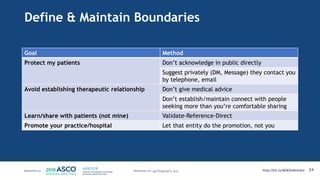
Define & Maintain Boundaries
Goal Method
Protect my patients Don’t acknowledge in public directly
Suggest privately (DM, Message) they contact you
by telephone, email
Avoid establishing therapeutic relationship Don’t give medical advice
Don’t establish/maintain connect with people
seeking more than you’re comfortable sharing
Learn/share with patients (not mine) Validate-Reference-Direct
Promote your practice/hospital Let that entity do the promotion, not you
24MATTHEW KATZ, M.D. http://bit.ly/MSKSlideshare
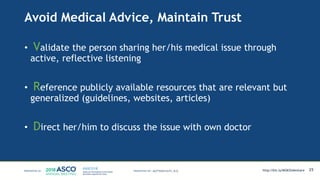
Avoid Medical Advice, Maintain Trust
• Validate the person sharing her/his medical issue through
active, reflective listening
• Reference publicly available resources that are relevant but
generalized (guidelines, websites, articles)
• Direct her/him to discuss the issue with own doctor
25MATTHEW KATZ, M.D. http://bit.ly/MSKSlideshare
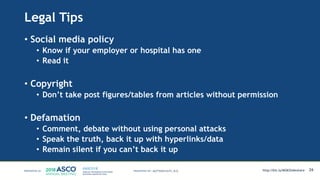
Legal Tips
• Social media policy
• Know if your employer or hospital has one
• Read it
• Copyright
• Don’t take post figures/tables from articles without permission
• Defamation
• Comment, debate without using personal attacks
• Speak the truth, back it up with hyperlinks/data
• Remain silent if you can’t back it up
26MATTHEW KATZ, M.D. http://bit.ly/MSKSlideshare
27MATTHEW KATZ, M.D. http://bit.ly/MSKSlideshare
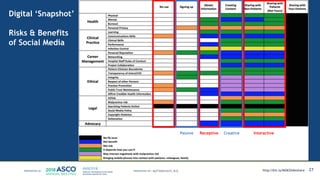
Digital ‘Snapshot’
Risks & Benefits
of Social Media
Passive Receptive Creative Interactive
28MATTHEW KATZ, M.D.
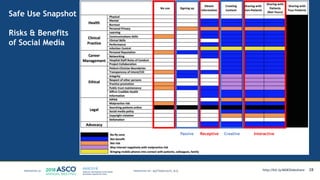
Safe Use Snapshot
Risks & Benefits
of Social Media
Passive Receptive Creative Interactive
http://bit.ly/MSKSlideshare
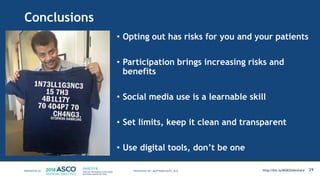
Conclusions
• Opting out has risks for you and your patients
• Participation brings increasing risks and
benefits
• Social media use is a learnable skill
• Set limits, keep it clean and transparent
• Use digital tools, don’t be one
29MATTHEW KATZ, M.D. http://bit.ly/MSKSlideshare
Thank you
• Questions? Contact me at @subatomicdoc
30MATTHEW KATZ, M.D. http://bit.ly/MSKSlideshare

Risks versus Benefits: Using Social Media Safely

  • 1.
    Risks versus Benefits UsingSocial Media Safely 1MATTHEW KATZ, M.D. http://bit.ly/MSKSlideshare
  • 2.
    Disclosures • Stock: Dr.Reddy Laboratories, U.S. Physical Therapy, Mazor Robotics, Healthcare Services Group, Inc. • No other financial disclosures for healthcare or social media companies 2MATTHEW KATZ, M.D. http://bit.ly/MSKSlideshare
  • 3.
    Social media isn’tworth your time unless • It complements or improves your clinical practice of medicine • Maintains or builds trust between you and your patients 3MATTHEW KATZ, M.D. Patient-Doctor Dyad http://bit.ly/MSKSlideshare
  • 4.
    Our Roles asDoctors* 4MATTHEW KATZ, M.D. Clinician Educator Administrator Researcher * Applies to other health professionals Citizen PRIVATE PUBLICPRIVATE? Advocate http://bit.ly/MSKSlideshare
  • 5.
    Denial is futile,Competence in not • Social media are powerful communications tools • We can learn to use them safely and effectively* 5 * Introverts can do great on social media MATTHEW KATZ, M.D. http://bit.ly/MSKSlideshare
  • 6.
    6MATTHEW KATZ, M.D. Digital‘Snapshot’ Risks & Benefits of Social Media http://bit.ly/MSKSlideshare
  • 7.
    7MATTHEW KATZ, M.D. Digital‘Snapshot’ Risks & Benefits of Social Media Passive Receptive Creative Interactive http://bit.ly/MSKSlideshare
  • 8.
    “No Fly” Zone:Established Patients • Connecting on any platform • Risks violation of trust • No Facebook friends, LinkedIn to your personal accounts • Separate account for your practice/department okay • Twitter, Instagram: they may follow you, but don’t follow back • Searching for patients online • Public sharing on social media (or physician review websites) 8MATTHEW KATZ, M.D. http://bit.ly/MSKSlideshare
  • 9.
    Risks of OptingOut • Patients find health misinformation online • Others define your professional reputation • Patients find providers more accessible online • ? Malpractice risk for no public affirmation your quality 9MATTHEW KATZ, M.D. http://bit.ly/MSKSlideshare
  • 10.
    Dangers of Misinformation •False news spreads farther, faster than the truth • Online ads undercut patient confidence in treating oncologist 10MATTHEW KATZ, M.D. Vosoughi et al, Science 2018 Abel et al, J Clin Oncol 2009 CCDF = fraction of rumors with certain # of cascades http://bit.ly/MSKSlideshare
  • 11.
    Signing Up • Giveinformation about • Yourself • Who you know [usually email] • Details about professional self 11MATTHEW KATZ, M.D. http://bit.ly/MSKSlideshare
  • 12.
    Signing Up 12 • Avoidscrossover with patients • Risks ‘silo syndrome’ • ? HIPAA risk vs. more public sites • More public, lose some privacy • Establish your public presence as trustworthy • Competes with physician ratings sites in search engines MATTHEW KATZ, M.D. http://bit.ly/MSKSlideshare
  • 13.
    • Don’t importcontacts • May expose private links to family, patients • May create connections between trusted colleagues and industry • Non-anonymous, use full name • Anyone can follow you on Twitter but not Facebook, LinkedIn 13 Consider link to COI if you have them MATTHEW KATZ, M.D. http://bit.ly/MSKSlideshare
  • 14.
    Obtaining information Benefits • Learnhow people discuss disease, care • Plain language, not ‘medical-ese’ • Keep up on new health information • Publications • Academic meetings • Policy affecting patients, practice • Affirm accurate information over ‘fake news’ Risks • Potential for distraction • Exposure to misinformation • Malware • Tracking 14MATTHEW KATZ, M.D. http://bit.ly/MSKSlideshare
  • 15.
    Smartphone Addiction • Addictivesocial media use linked to age, gender, education, income • Some links of addictive use to narcissism, low self-esteem • Estimated ‘At risk’ or ‘problematic’ use in 20.5% of adults • High frequency use linked to sleep disturbance, symptoms of depression • Social networking linked to problematic internet use in 26-55 year olds • Average person touches phone 2617 times, 2.42 hours/day* 15 Andreassen et al, Addictive Behaviors 2017 De-Sola et al, PLOS One 2017 Thomée et al, BMC Public Health 2011 Ioannidis et al, Addictive Behaviors 2018 * blog.dscout.com/mobile-touches MATTHEW KATZ, M.D. http://bit.ly/MSKSlideshare
  • 16.
    Time Management • Avoidmultitasking • Limit/Budget time online • Put mobile phone away from where you sleep • Consider turning color ‘off’ 16MATTHEW KATZ, M.D. * blog.dscout.com/mobile-touches http://bit.ly/MSKSlideshare
  • 17.
    Misinformation, Malware: ThinkBefore You Link 17MATTHEW KATZ, M.D. Pew Research, December 2016 • Only 61% believe they can identify false information online • 23% have shared ‘fake news’ – 7% on purpose • Restrict who you follow for health information to reliable sources • Avoid clicking on hyperlinked material for strange URLs or bit.ly links for possible malware http://bit.ly/MSKSlideshare
  • 18.
    Tracking, Online orOff • https://www.facebook.com/s ettings and download a copy • https://takeout.google.com/s ettings/takeout • 50-75 URLs from browser history enough to de- anonymize with >80% success rate 18 Su et al, World Wide Web conference 2017 CBS News, April 24 2018 MATTHEW KATZ, M.D. http://bit.ly/MSKSlideshare
  • 19.
    Mobile Phones GoingViral – or Bacterial ‘Dirty’ Phones in Healthcare • Viral pathogens 38% • Bacterial colonization 74-98% • Nosocomial 5-28% • More common with smartphones • 59% of medical students report bathroom smartphone use 19 Pillet et al, Clin Microbiol Infect 2016 Zakai et al, J Microscopy Ultrastruct 2015 Lee et al, J Hosp Med 2013 MATTHEW KATZ, M.D. http://bit.ly/MSKSlideshare
  • 20.
    Creative and InteractiveSocial Media • You are what you • Like • Tweet • Post • Nurses, pharmacists and doctors are the three most trusted professions* • Be the best version yourself online 20 *Gallup, December 2016 MATTHEW KATZ, M.D. http://bit.ly/MSKSlideshare
  • 21.
    What the publicand our patients expect of us • Confident • Reliable • Composed • Accountable • Dedicated 21 Chandratilake et al, Clin Med 2010 MATTHEW KATZ, M.D. http://bit.ly/MSKSlideshare
  • 22.
    The 4Rs willtake you far Reflective • Thoughtful, humble • Agree to disagree; don’t try to ‘win’ an argument by disrespecting others Responsive • Active listening, timely response Relevant • Focused on the current topic Rigorous • Shared valid information based upon experience, evidence • Acknowledging what we don’t know 22MATTHEW KATZ, M.D. Bibault et al, Adv Radiat Oncol 2017 http://bit.ly/MSKSlideshare
  • 23.
    What you shareis discoverable Sarcasm, superiority, and sharp wit may • attract followers more quickly • increase volume of engagement • be used against you in court Humility, integrity, and empathy may • attract similar people, more slowly • increase quality of engagement • provide favorable evidence of your character 23MATTHEW KATZ, M.D. http://bit.ly/MSKSlideshare
  • 24.
    Define & MaintainBoundaries Goal Method Protect my patients Don’t acknowledge in public directly Suggest privately (DM, Message) they contact you by telephone, email Avoid establishing therapeutic relationship Don’t give medical advice Don’t establish/maintain connect with people seeking more than you’re comfortable sharing Learn/share with patients (not mine) Validate-Reference-Direct Promote your practice/hospital Let that entity do the promotion, not you 24MATTHEW KATZ, M.D. http://bit.ly/MSKSlideshare
  • 25.
    Avoid Medical Advice,Maintain Trust • Validate the person sharing her/his medical issue through active, reflective listening • Reference publicly available resources that are relevant but generalized (guidelines, websites, articles) • Direct her/him to discuss the issue with own doctor 25MATTHEW KATZ, M.D. http://bit.ly/MSKSlideshare
  • 26.
    Legal Tips • Socialmedia policy • Know if your employer or hospital has one • Read it • Copyright • Don’t take post figures/tables from articles without permission • Defamation • Comment, debate without using personal attacks • Speak the truth, back it up with hyperlinks/data • Remain silent if you can’t back it up 26MATTHEW KATZ, M.D. http://bit.ly/MSKSlideshare
  • 27.
    27MATTHEW KATZ, M.D.http://bit.ly/MSKSlideshare Digital ‘Snapshot’ Risks & Benefits of Social Media Passive Receptive Creative Interactive
  • 28.
    28MATTHEW KATZ, M.D. SafeUse Snapshot Risks & Benefits of Social Media Passive Receptive Creative Interactive http://bit.ly/MSKSlideshare
  • 29.
    Conclusions • Opting outhas risks for you and your patients • Participation brings increasing risks and benefits • Social media use is a learnable skill • Set limits, keep it clean and transparent • Use digital tools, don’t be one 29MATTHEW KATZ, M.D. http://bit.ly/MSKSlideshare
  • 30.
    Thank you • Questions?Contact me at @subatomicdoc 30MATTHEW KATZ, M.D. http://bit.ly/MSKSlideshare

Editor's Notes

  • #6 If you learned enough to be a doctor, you can figure out Twitter
  • #7 Evolution is the progeny of necessity
  • #8 Evolution is the progeny of necessity
  • #19 China plans to rate its citizens using country’s 600M cameras and may restrict travel, ban buying property
  • #22 Sam Hellman: “Be a good person, a good doctor, a good oncologist, and a good radiation oncologist. In that order.”
  • #28 Evolution is the progeny of necessity
  • #29 Evolution is the progeny of necessity