CONTENTS
• Introduction toRisk
• Risk Management framework
• Categories/types of Risk in Hospitals
• Approach to risk management
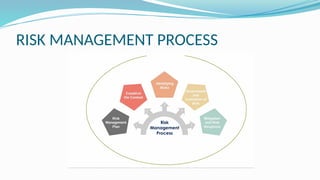
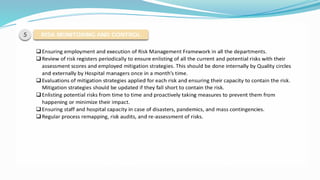
• Risk Management process
3.
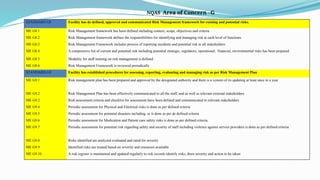
NQAS Area ofConcern –G
STANDARD G8 Facility has de defined, approved and communicated Risk Management framework for existing and potential risks.
ME G8.1 Risk Management framework has been defined including context, scope, objectives and criteria
ME G8.2 Risk Management framework defines the responsibilities for identifying and managing risk at each level of functions
ME G8.3 Risk Management Framework includes process of reporting incidents and potential risk to all stakeholders
ME G8.4 A compressive list of current and potential risk including potential strategic, regulatory, operational, financial, environmental risks has been prepared
ME G8.5 Modality for staff training on risk management is defined
ME G8.6 Risk Management Framework is reviewed periodically
STANDARD G9 Facility has established procedures for assessing, reporting, evaluating and managing risk as per Risk Management Plan
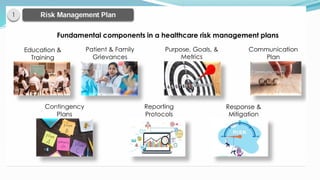
ME G9.1 Risk management plan has been prepared and approved by the designated authority and there is a system of its updating at least once in a year
ME G9.2 Risk Management Plan has been effectively communicated to all the staff, and as well as relevant external stakeholders
ME G9.2 Risk assessment criteria and checklist for assessment have been defined and communicated to relevant stakeholders
ME G9.4 Periodic assessment for Physical and Electrical risks is done as per defined criteria
ME G9.5 Periodic assessment for potential disasters including re is done as per de defined criteria
ME G9.6 Periodic assessment for Medication and Patient care safety risks is done as per defined criteria.
ME G9.7 Periodic assessment for potential risk regarding safety and security of staff including violence against service providers is done as per defined criteria
ME G9.8 Risks identified are analyzed evaluated and rated for severity
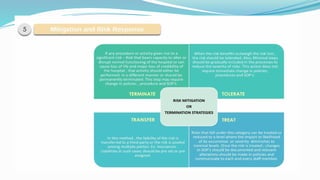
ME G9.9 Identified risks are treated based on severity and resources available
ME G9.10 A risk register is maintained and updated regularly to risk records identify risks, there severity and action to be taken
WHAT IS RISK
Asper ISO 31000:
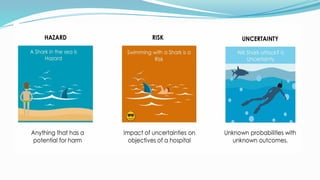
Risk is "The effect of uncertainty on objectives"
Risk in healthcare refers to the potential for harm or loss that can
affect patients, staff, and the organization, encompassing various
categories such as operational, financial, compliance, patient
handling risk, Environmental risks, behaviour etc.
Risk management is "coordinated activities to direct and control an
organization with regard to risk".
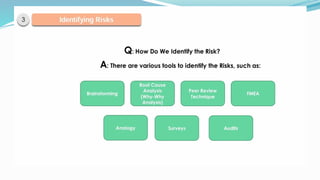
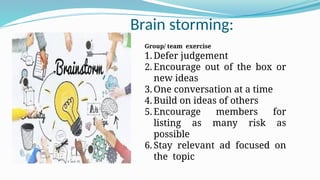
Brain storming:
Group/ teamexercise
1. Defer judgement
2. Encourage out of the box or
new ideas
3. One conversation at a time
4. Build on ideas of others
5. Encourage members for
listing as many risk as
possible
6. Stay relevant ad focused on
the topic
14.
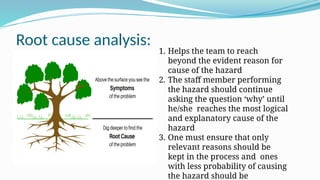
Root cause analysis:
1.Helps the team to reach
beyond the evident reason for
cause of the hazard
2. The staff member performing
the hazard should continue
asking the question ‘why’ until
he/she reaches the most logical
and explanatory cause of the
hazard
3. One must ensure that only
relevant reasons should be
kept in the process and ones
with less probability of causing
the hazard should be
15.
Peer review technique:
1.Peer are people belonging to the
same level and having a similar
work and practising in a similar
way
2. Peer review procedure is mostly
executed for risks cause under
the ambit of ‘patient and clinical
safety’
16.
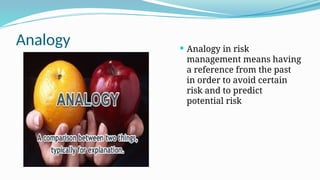
Analogy Analogyin risk
management means having
a reference from the past
in order to avoid certain
risk and to predict
potential risk
17.
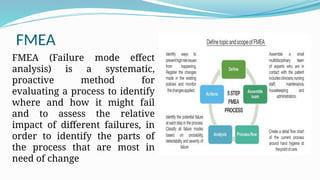
FMEA
FMEA (Failure modeeffect
analysis) is a systematic,
proactive method for
evaluating a process to identify
where and how it might fail
and to assess the relative
impact of different failures, in
order to identify the parts of
the process that are most in
need of change
18.
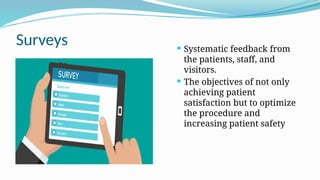
Surveys Systematicfeedback from
the patients, staff, and
visitors.
The objectives of not only
achieving patient
satisfaction but to optimize
the procedure and
increasing patient safety
19.
Audits Independent,systematic, and
documented procedure to gather
information about an event
It can be inter-departmental,
intradepartmental, or can be a
facility audit
E.g. Prescription audit
20.
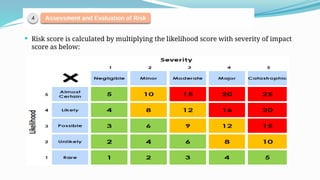
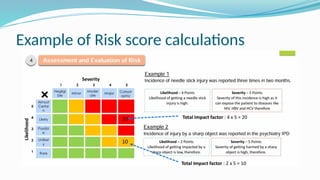
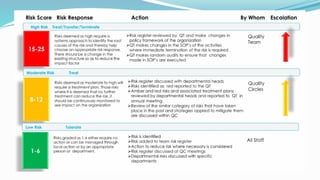
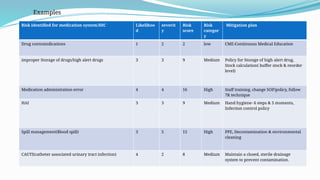
Risk scoreis calculated by multiplying the likelihood score with severity of impact
score as below:
Risk identified formedication system/HIC Likelihoo
d
severit
y
Risk
score
Risk
categor
y
Mitigation plan
Drug contraindications 1 2 2 low CME-Continuous Medical Education
improper Storage of drugs/high alert drugs 3 3 9 Medium Policy for Storage of high alert drug,
Stock calculation( buffer stock & reorder
level)
Medication administration error 4 4 16 High Staff training, change SOP/policy, follow
7R technique
HAI 3 3 9 Medium Hand hygiene- 6 steps & 5 moments,
Infection control policy
Spill management(Blood spill) 3 5 15 High PPE, Decontamination & environmental
cleaning
CAUTI(catheter associated urinary tract infection) 4 2 8 Medium Maintain a closed, sterile drainage
system to prevent contamination.
Examples
27.
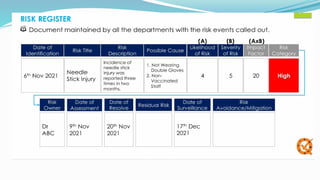
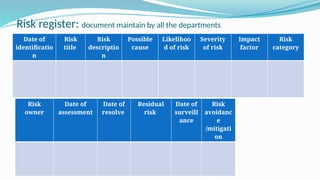
Risk register: documentmaintain by all the departments
Date of
identificatio
n
Risk
title
Risk
descriptio
n
Possible
cause
Likelihoo
d of risk
Severity
of risk
Impact
factor
Risk
category
Risk
owner
Date of
assessment
Date of
resolve
Residual
risk
Date of
surveill
ance
Risk
avoidanc
e
/mitigati
on
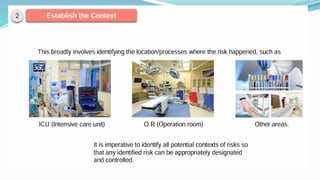
#1 To identify and evaluate potential hazards and risks in a given hospital environment or process, in order to protect individuals (pt/stff) and hospital organizations from any harm
(assessing, reporting, evaluating and managing)
#6 Risk can involve both positive and negative deviations from expected outcomes, potentially leading to opportunities or threats
Risk arises from the possibility of an event or situation deviating from the expected course.
LAWS, REGULATIONS.
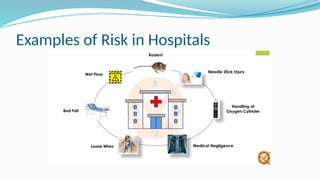
Operational Risks, Financial Risks, Compliance Risks, Patient Handling Risks, Environmental Risks, Behavioral Risks: Managing violence and aggression towards healthcare staff or other patients is a significant concern. Implementing strategies to de-escalate situations and ensure safety is vital
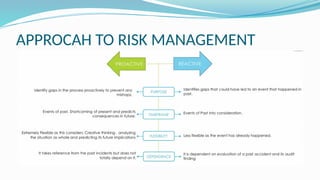
#8 Identify any hazards or risk that are present and predict the future consequences
#10 Patient grievance- through patient grievances we can enhanced the procedures for documenting and addressing patient and family complaints
Metrics- quantifiable measures Or data




![PERI-PROSTHETIC FRACTURE NAIL-PLATE CONSTRUCT [NPC].pptx](https://cdn.slidesharecdn.com/ss_thumbnails/drarunkumardrmohamedashrafperiprostheticfrasturenail-plateconstructnpc-260209164459-7e9d15a1-thumbnail.jpg?width=640&height=640&fit=bounds)

![ONFH[AVN HIP] -TRIPLE REGIME -A NOVAL SURGICAL CONCEPT .pptx](https://cdn.slidesharecdn.com/ss_thumbnails/onfhavnhip2026koaconcalicutdrgokuldevdrmashraf-260210064517-213ec005-thumbnail.jpg?width=640&height=640&fit=bounds)


![CTEV [ clubfoot] DR ARUN LAL ,DR MOHAMED ASHRAF travancore medical college k...](https://cdn.slidesharecdn.com/ss_thumbnails/ctevclubfootdrarunlaldrmohamedashraftravancoremedicalcollegekollamkeralaindia-260208063247-18fc466c-thumbnail.jpg?width=640&height=640&fit=bounds)


