Understanding The Global RISK of Business
Risk associated with going
GLOBAL
Going Global:
Becoming engaged in international
business activities, typically known as “going
global”.
Going Global:
 Becoming engaged in international business
activities, typically known as “going global”, is
a process. By definition and for sake of
simplicity it is a series of steps, which when
undertaken correctly can lead your company
towards achieving its international goals. The
process of going global will vary slightly from
company to company and by industry as well.
Why going global ?
 To off set sales declines in the domestic market.
 Increase sales and profit.
 Extend product life cycle.
 Lower manufacturing cost.
 To increase competitive position and enhance
reputation.
 Raise quality level.
 To raise capital funds.
 To find strategic partners or venture partners.
Risk associated with going
global:
 Social and cultural
 Technological
 Economic
 Legal and political
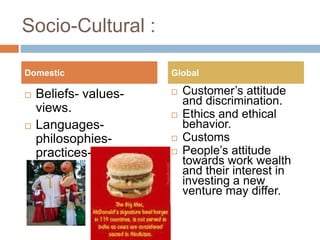
Socio-Cultural :
 Beliefs- values-
views.
 Languages-
philosophies-
practices- traditions.
 Customer’s attitude
and discrimination.
 Ethics and ethical
behavior.
 Customs
 People’s attitude
towards work wealth
and their interest in
investing a new
venture may differ.
Domestic Global
Technological:
 Standard differs.
 Uniformity changes.
 Quality differs.
 Standardize.
 Uniformity in
products.
 Consistent in quality.
Domestic Global
Economic:
 Single economic system.
 Same currency.
 Same government
regulation.
 Exchange risk
 Currency valuation.
 Government regulation
differs.
 Banking-venture capital.
 Marketing distribution
system.
 Per capita income.
Domestic International
Political and legal:
 Long term stability.
 Government trade policy
remain same for longer
period of time
 Subsidies to domestic
industries.
 Corruption
 Entry requirements- long
& time consuming
process
 Trade and Tariff barriers
Domestic Global
Thank You…!!!

risk associated in going global

  • 1.
    Understanding The GlobalRISK of Business Risk associated with going GLOBAL
  • 2.
    Going Global: Becoming engagedin international business activities, typically known as “going global”.
  • 3.
    Going Global:  Becomingengaged in international business activities, typically known as “going global”, is a process. By definition and for sake of simplicity it is a series of steps, which when undertaken correctly can lead your company towards achieving its international goals. The process of going global will vary slightly from company to company and by industry as well.
  • 4.
    Why going global?  To off set sales declines in the domestic market.  Increase sales and profit.  Extend product life cycle.  Lower manufacturing cost.  To increase competitive position and enhance reputation.  Raise quality level.  To raise capital funds.  To find strategic partners or venture partners.
  • 5.
    Risk associated withgoing global:  Social and cultural  Technological  Economic  Legal and political
  • 6.
    Socio-Cultural :  Beliefs-values- views.  Languages- philosophies- practices- traditions.  Customer’s attitude and discrimination.  Ethics and ethical behavior.  Customs  People’s attitude towards work wealth and their interest in investing a new venture may differ. Domestic Global
  • 7.
    Technological:  Standard differs. Uniformity changes.  Quality differs.  Standardize.  Uniformity in products.  Consistent in quality. Domestic Global
  • 8.
    Economic:  Single economicsystem.  Same currency.  Same government regulation.  Exchange risk  Currency valuation.  Government regulation differs.  Banking-venture capital.  Marketing distribution system.  Per capita income. Domestic International
  • 9.
    Political and legal: Long term stability.  Government trade policy remain same for longer period of time  Subsidies to domestic industries.  Corruption  Entry requirements- long & time consuming process  Trade and Tariff barriers Domestic Global
  • 10.