Risk Management for
Development Interventions:
mobilizing efforts to embrace the
change

Magda Stepanyan
m.stepanyan@risicomanagement.nl

1www.risicomanagement.nl

20 juni 2013
Who we are

Who we are

The Nederlands Adviesbureau voor Risicomanagement (NAR)
is an independent organization which is specialized and purely
focused in the field of risk management. We offer a total
package of products and services that will enable your
organization to manage its risks independently. The complete
package consists of advice, software (NARIS), together with
training and coaching (at the Risk Management Academy).
We work in many different markets within public and privet
sector. We are fully committed to support non-governmental
organizations to improve their performance by managing
uncertainties. In 2012 NAR has established a partnership with
Partos and VFI with the purpose to develop capacities within
the Dutch development/charity/humanitarian sector.

2www.risicomanagement.nl
Who we are
Magda Stepanyan, MA, MSc, CIRM

Who we are

Expertise: Over 15 years of management and consultancy
work in the field of development cooperation, disaster
and climate risk management, monitoring and
evaluation.

Worked for: EC, WB, UNDP country offices, UNDP
regional Centre in Bratislava, UNISDR, IFRC, Cordaid, etc.
Geographic focus: global with a primary focus on CIS/CEE
region.

3www.risicomanagement.nl
The only thing that is constant is
change….
Heraclitus

4www.risicomanagement.nl
How should we deal with this uncertainty?
1. Ignore: ‘planning paradox’, linear cause-effect
relationship
1. Embrace: flexible result chain, move from
stable and predictable environment to a
dynamic environment with many parties (known
and unknown), indicative planning, looking for
opportunities

5www.risicomanagement.nl
Embrassing uncertainty
‘A Country Partnership Framework and a Bank’s
reorganization without clear, explicit, and
fundamental consideration of risk and risk
management would suffer from the “planning
paradox” of making plans while ignoring uncertainty’.
Norman Loayza
Director of the World Development Report 2014
WB

6www.risicomanagement.nl
Growing attention to managing risks

Growing attention to managing risks








Busan Partnership for Effective Development Cooperation, Fourth High Level Forum on Aid Effectiveness,
2011
OECD Aid Risks in Fragile and Transitional Contexts
USAID Resilience Policy, 2012
EU Risk Mapping, 2010
WB, World Development Report 2014
UNDP, Capacity Development Facilities (CDF)
Publieke managementletter voor de Goededoelensector:
Goed doel, goed verhaal

(Aanbeveling: Doorloop in de organisatie een zorgvuldig proces voor het
juist inrichten van het risicomanagement.)

Development work must internalize risk!

7www.risicomanagement.nl
Some basic definitions

8www.risicomanagement.nl
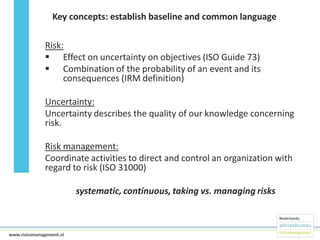
Key concepts: establish baseline and common language
Risk:
 Effect on uncertainty on objectives (ISO Guide 73)
 Combination of the probability of an event and its
consequences (IRM definition)
Uncertainty:
Uncertainty describes the quality of our knowledge concerning
risk.
Risk management:
Coordinate activities to direct and control an organization with
regard to risk (ISO 31000)
systematic, continuous, taking vs. managing risks

9www.risicomanagement.nl
10www.risicomanagement.nl

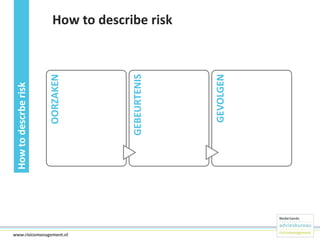
GEVOLGEN

GEBEURTENIS

OORZAKEN

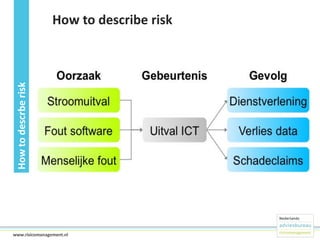
How to descrbe risk

How to describe risk
How to descrbe risk

How to describe risk

11www.risicomanagement.nl
Risk Identification

Risk Identification: typology
Risk identification categories:
One-off risks vs. Repetitive
Bruto risks vs. Netto risks (after response measures)
Strategic (speculative)risks vs. Control or Operational (project)
risks vs. Hazard (puur) risks
Risk identification areas:
Activiteis
Departments
Programme
Project phases
Partner
Network
Sector
Etc.

12www.risicomanagement.nl
Growing attention to managing risks

Growing attention to managing risks
Development work must internalize risk!

a) Institutional
(setting the development agendas, developing
and implementing policies and programming)
b) Organizational
(effective, efficient, and relevant realization of
developmental objectives)

13www.risicomanagement.nl
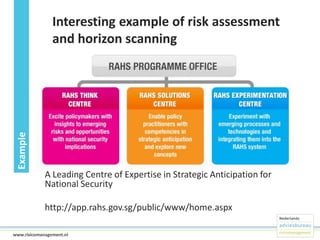
Interesting example of risk assessment
and horizon scanning

Example

Risk management for policy making

A Leading Centre of Expertise in Strategic Anticipation for
National Security

http://app.rahs.gov.sg/public/www/home.aspx
14www.risicomanagement.nl
Trending risks in development sector

Group Exercise: 15 min
What are the trending risks in the
development sector?

15www.risicomanagement.nl
Why proactive risk-taking is still a
challenge?

16www.risicomanagement.nl
Fundamental challenges

Fundamental challenges
1. A culture of blame vs. learning from failure
“I have not failed, I have found 10,000 ways that
do not work”, Thomas Edison

2. Lack of adaptive capacity on the part of
development organisations vs. embracing
opportunities
3. Lack of a shared concept of risk management
vs. institutionalizing risk management

17www.risicomanagement.nl
Why risk culture is important?

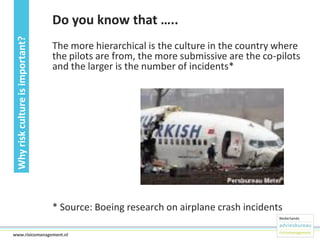
Do you know that …..
The more hierarchical is the culture in the country where
the pilots are from, the more submissive are the co-pilots
and the larger is the number of incidents*

* Source: Boeing research on airplane crash incidents
18www.risicomanagement.nl
Why risk culture is important?

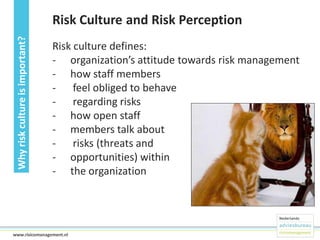
Risk Culture and Risk Perception
Risk culture defines:
- organization’s attitude towards risk management
- how staff members
- feel obliged to behave
- regarding risks
- how open staff
- members talk about
- risks (threats and
- opportunities) within
- the organization

19www.risicomanagement.nl
Why risk culture is important?

Elements of risk-aware culture:
Strong leadership
Involvement of all stakeholders (!)
Training in risk management and learning from
events
Communication and openess on all risks
Absence of an automatic blame culture

20www.risicomanagement.nl
Engagement: Mobilizing efforts:

21www.risicomanagement.nl
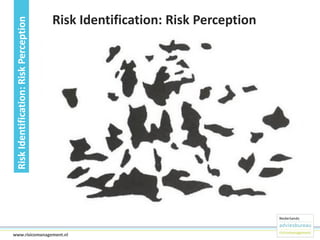
Risk Identification: Risk Perception

Risk Identification: Risk Perception

22www.risicomanagement.nl
Managing risk

Managing Risk for Better Results

Video on Marshmallow Challenge
http://marshmallowchallenge.com/Welcome.ht
ml

23www.risicomanagement.nl
Risk Capacities

Remember to ask!
 What are our risks?
 Whose risks matter: whose threats and
whose opportunities?
 Are we aware of the risks of our partners?
 What implications the risks of our partners
may have for us?

24www.risicomanagement.nl
Managing Risk for Better Results


Risk Capacities








25www.risicomanagement.nl

Ensure a policy environment that is favorable to
proactive risk management as a measns to improve
performance.
Encourage organizations to darw up their risk
overview based on an assessment of how critical the
risks are to the organization (likelihood/impact)
Allocate resources for risk management in the
organization
Develop risk management capacities among staff
members
Ensure risk-based planning and risk-based decisionmaking
integrate risk management into the overall approach
to change management.
Partnership: NAR/Partos/VFI




Risk Capacities







26www.risicomanagement.nl

Risk maturity survey: we measure the level of risk maturity in
the Dutch charity sector;
Risk Management Knowledge Hub: we set up a sector-specific
Knowledge Hub to steer and customize the application of risk
management in the sector.
Capacity development: we offer an extensive portfolio of
training programs, workshops, round-table discussions,
symposia, etc.
Trending Risks: we regularly share our understanding of the
trending risks in the sector.
Risk Management Database: we develop a sector-specific
database to enable cross-sector comparison and learning.
Risk Management Information System – NARIS: we make our
risk management software available free of charge to all Dutch
charity/development /humanitarian organizations to support
their operations and ensure effective management of their
risks.
Useful resources

Useful resources

 NAR MVO:
www.risicomanagement.nl/mvo.html
 The Broker: Blog on Risk Management
www.thebrokeronline.eu/Blogs/Riskmanagement-for-development

27www.risicomanagement.nl
Thanks!

Magda Stepanyan
m.stepanyan@risciomanagement.nl

28www.risicomanagement.nl

Risicomanagement partos plaza

  • 1.
    Risk Management for DevelopmentInterventions: mobilizing efforts to embrace the change Magda Stepanyan m.stepanyan@risicomanagement.nl 1www.risicomanagement.nl 20 juni 2013
  • 2.
    Who we are Whowe are The Nederlands Adviesbureau voor Risicomanagement (NAR) is an independent organization which is specialized and purely focused in the field of risk management. We offer a total package of products and services that will enable your organization to manage its risks independently. The complete package consists of advice, software (NARIS), together with training and coaching (at the Risk Management Academy). We work in many different markets within public and privet sector. We are fully committed to support non-governmental organizations to improve their performance by managing uncertainties. In 2012 NAR has established a partnership with Partos and VFI with the purpose to develop capacities within the Dutch development/charity/humanitarian sector. 2www.risicomanagement.nl
  • 3.
    Who we are MagdaStepanyan, MA, MSc, CIRM Who we are Expertise: Over 15 years of management and consultancy work in the field of development cooperation, disaster and climate risk management, monitoring and evaluation. Worked for: EC, WB, UNDP country offices, UNDP regional Centre in Bratislava, UNISDR, IFRC, Cordaid, etc. Geographic focus: global with a primary focus on CIS/CEE region. 3www.risicomanagement.nl
  • 4.
    The only thingthat is constant is change…. Heraclitus 4www.risicomanagement.nl
  • 5.
    How should wedeal with this uncertainty? 1. Ignore: ‘planning paradox’, linear cause-effect relationship 1. Embrace: flexible result chain, move from stable and predictable environment to a dynamic environment with many parties (known and unknown), indicative planning, looking for opportunities 5www.risicomanagement.nl
  • 6.
    Embrassing uncertainty ‘A CountryPartnership Framework and a Bank’s reorganization without clear, explicit, and fundamental consideration of risk and risk management would suffer from the “planning paradox” of making plans while ignoring uncertainty’. Norman Loayza Director of the World Development Report 2014 WB 6www.risicomanagement.nl
  • 7.
    Growing attention tomanaging risks Growing attention to managing risks        Busan Partnership for Effective Development Cooperation, Fourth High Level Forum on Aid Effectiveness, 2011 OECD Aid Risks in Fragile and Transitional Contexts USAID Resilience Policy, 2012 EU Risk Mapping, 2010 WB, World Development Report 2014 UNDP, Capacity Development Facilities (CDF) Publieke managementletter voor de Goededoelensector: Goed doel, goed verhaal (Aanbeveling: Doorloop in de organisatie een zorgvuldig proces voor het juist inrichten van het risicomanagement.) Development work must internalize risk! 7www.risicomanagement.nl
  • 8.
  • 9.
    Key concepts: establishbaseline and common language Risk:  Effect on uncertainty on objectives (ISO Guide 73)  Combination of the probability of an event and its consequences (IRM definition) Uncertainty: Uncertainty describes the quality of our knowledge concerning risk. Risk management: Coordinate activities to direct and control an organization with regard to risk (ISO 31000) systematic, continuous, taking vs. managing risks 9www.risicomanagement.nl
  • 10.
  • 11.
    How to descrberisk How to describe risk 11www.risicomanagement.nl
  • 12.
    Risk Identification Risk Identification:typology Risk identification categories: One-off risks vs. Repetitive Bruto risks vs. Netto risks (after response measures) Strategic (speculative)risks vs. Control or Operational (project) risks vs. Hazard (puur) risks Risk identification areas: Activiteis Departments Programme Project phases Partner Network Sector Etc. 12www.risicomanagement.nl
  • 13.
    Growing attention tomanaging risks Growing attention to managing risks Development work must internalize risk! a) Institutional (setting the development agendas, developing and implementing policies and programming) b) Organizational (effective, efficient, and relevant realization of developmental objectives) 13www.risicomanagement.nl
  • 14.
    Interesting example ofrisk assessment and horizon scanning Example Risk management for policy making A Leading Centre of Expertise in Strategic Anticipation for National Security http://app.rahs.gov.sg/public/www/home.aspx 14www.risicomanagement.nl
  • 15.
    Trending risks indevelopment sector Group Exercise: 15 min What are the trending risks in the development sector? 15www.risicomanagement.nl
  • 16.
    Why proactive risk-takingis still a challenge? 16www.risicomanagement.nl
  • 17.
    Fundamental challenges Fundamental challenges 1.A culture of blame vs. learning from failure “I have not failed, I have found 10,000 ways that do not work”, Thomas Edison 2. Lack of adaptive capacity on the part of development organisations vs. embracing opportunities 3. Lack of a shared concept of risk management vs. institutionalizing risk management 17www.risicomanagement.nl
  • 18.
    Why risk cultureis important? Do you know that ….. The more hierarchical is the culture in the country where the pilots are from, the more submissive are the co-pilots and the larger is the number of incidents* * Source: Boeing research on airplane crash incidents 18www.risicomanagement.nl
  • 19.
    Why risk cultureis important? Risk Culture and Risk Perception Risk culture defines: - organization’s attitude towards risk management - how staff members - feel obliged to behave - regarding risks - how open staff - members talk about - risks (threats and - opportunities) within - the organization 19www.risicomanagement.nl
  • 20.
    Why risk cultureis important? Elements of risk-aware culture: Strong leadership Involvement of all stakeholders (!) Training in risk management and learning from events Communication and openess on all risks Absence of an automatic blame culture 20www.risicomanagement.nl
  • 21.
  • 22.
    Risk Identification: RiskPerception Risk Identification: Risk Perception 22www.risicomanagement.nl
  • 23.
    Managing risk Managing Riskfor Better Results Video on Marshmallow Challenge http://marshmallowchallenge.com/Welcome.ht ml 23www.risicomanagement.nl
  • 24.
    Risk Capacities Remember toask!  What are our risks?  Whose risks matter: whose threats and whose opportunities?  Are we aware of the risks of our partners?  What implications the risks of our partners may have for us? 24www.risicomanagement.nl
  • 25.
    Managing Risk forBetter Results  Risk Capacities      25www.risicomanagement.nl Ensure a policy environment that is favorable to proactive risk management as a measns to improve performance. Encourage organizations to darw up their risk overview based on an assessment of how critical the risks are to the organization (likelihood/impact) Allocate resources for risk management in the organization Develop risk management capacities among staff members Ensure risk-based planning and risk-based decisionmaking integrate risk management into the overall approach to change management.
  • 26.
    Partnership: NAR/Partos/VFI   Risk Capacities     26www.risicomanagement.nl Riskmaturity survey: we measure the level of risk maturity in the Dutch charity sector; Risk Management Knowledge Hub: we set up a sector-specific Knowledge Hub to steer and customize the application of risk management in the sector. Capacity development: we offer an extensive portfolio of training programs, workshops, round-table discussions, symposia, etc. Trending Risks: we regularly share our understanding of the trending risks in the sector. Risk Management Database: we develop a sector-specific database to enable cross-sector comparison and learning. Risk Management Information System – NARIS: we make our risk management software available free of charge to all Dutch charity/development /humanitarian organizations to support their operations and ensure effective management of their risks.
  • 27.
    Useful resources Useful resources NAR MVO: www.risicomanagement.nl/mvo.html  The Broker: Blog on Risk Management www.thebrokeronline.eu/Blogs/Riskmanagement-for-development 27www.risicomanagement.nl
  • 28.