THE GOOD, THE
BAD, & THE UGLY
REMOTE ID NPRM
Remote ID NPRM
RID NPRM Summary
This proposed rule would establish requirements for the remote identification (RID) of
unmanned aircraft systems operated in the airspace of the United States. RID is the ability of
an unmanned aircraft in flight to provide certain identification and location information that
people on the ground and other airspace users can receive. This is an important building
block in the unmanned traffic management ecosystem. For example, the ability to identify
and locate UAS operating in the airspace of the United States provides additional situational
awareness to manned and unmanned aircraft. This will become even more important as the
number of UAS operations in all classes of airspace increases. In addition, the ability to
identify and locate UAS provides critical information to law enforcement and other officials
charged with ensuring public safety. While remote identification alone will not enable routine
expanded operations such as operations over people or beyond visual line of sight, it is a
critical element for building unmanned traffic management capabilities. The FAA envisions
that the remote identification network will form the foundation for the development of other
technologies that can enable expanded operations.
Remote ID NPRM
Items covered today:
• RID UAS Categories
• Message Elements
• RID UAS Service Providers (USS)
• Sessions
• Registration Changes
• FAA-recognized Identification Areas (FRIAs)
• Problems with RID
• How to Comment
• Q&A
Remote ID NPRM
Categories:
Standard RID UAS
Limited RID UAS
UAS without RID
Remote ID NPRM
Categories:
Standard RID UAS
Remote ID NPRM
Categories:
Standard RID UAS
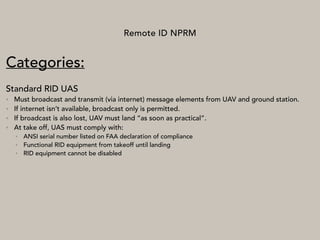
• Must broadcast and transmit (via internet) message elements from UAV and ground station.
Remote ID NPRM
Categories:
Standard RID UAS
• Must broadcast and transmit (via internet) message elements from UAV and ground station.
• If internet isn’t available, broadcast only is permitted.
Remote ID NPRM
Categories:
Standard RID UAS
• Must broadcast and transmit (via internet) message elements from UAV and ground station.
• If internet isn’t available, broadcast only is permitted.
• If broadcast is also lost, UAV must land “as soon as practical”.
Remote ID NPRM
Categories:
Standard RID UAS
• Must broadcast and transmit (via internet) message elements from UAV and ground station.
• If internet isn’t available, broadcast only is permitted.
• If broadcast is also lost, UAV must land “as soon as practical”.
• At take off, UAS must comply with:
• ANSI serial number listed on FAA declaration of compliance
• Functional RID equipment from takeoff until landing
• RID equipment cannot be disabled
Remote ID NPRM
Categories:
Standard RID UAS
• Must broadcast and transmit (via internet) message elements from UAV and ground station.
• If internet isn’t available, broadcast only is permitted.
• If broadcast is also lost, UAV must land “as soon as practical”.
• At take off, UAS must comply with:
• ANSI serial number listed on FAA declaration of compliance
• Functional RID equipment from takeoff until landing
• RID equipment cannot be disabled
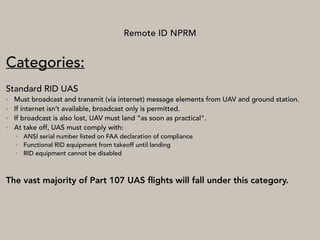
The vast majority of Part 107 UAS flights will fall under this category.
Remote ID NPRM
Categories:
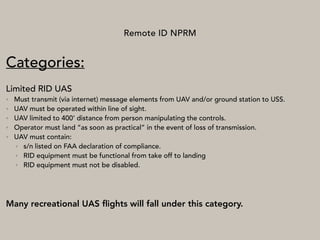
Limited RID UAS
Remote ID NPRM
Categories:
Limited RID UAS
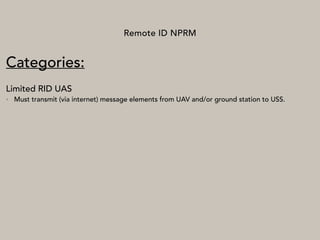
• Must transmit (via internet) message elements from UAV and/or ground station to USS.
Remote ID NPRM
Categories:
Limited RID UAS
• Must transmit (via internet) message elements from UAV and/or ground station to USS.
• UAV must be operated within line of sight.
Remote ID NPRM
Categories:
Limited RID UAS
• Must transmit (via internet) message elements from UAV and/or ground station to USS.
• UAV must be operated within line of sight.
• UAV limited to 400’ distance from person manipulating the controls.
Remote ID NPRM
Categories:
Limited RID UAS
• Must transmit (via internet) message elements from UAV and/or ground station to USS.
• UAV must be operated within line of sight.
• UAV limited to 400’ distance from person manipulating the controls.
• Operator must land “as soon as practical” in the event of loss of transmission.
Remote ID NPRM
Categories:
Limited RID UAS
• Must transmit (via internet) message elements from UAV and/or ground station to USS.
• UAV must be operated within line of sight.
• UAV limited to 400’ distance from person manipulating the controls.
• Operator must land “as soon as practical” in the event of loss of transmission.
• UAV must contain:
• s/n listed on FAA declaration of compliance.
• RID equipment must be functional from take off to landing
• RID equipment must not be disabled.
Remote ID NPRM
Categories:
Limited RID UAS
• Must transmit (via internet) message elements from UAV and/or ground station to USS.
• UAV must be operated within line of sight.
• UAV limited to 400’ distance from person manipulating the controls.
• Operator must land “as soon as practical” in the event of loss of transmission.
• UAV must contain:
• s/n listed on FAA declaration of compliance.
• RID equipment must be functional from take off to landing
• RID equipment must not be disabled.
Many recreational UAS flights will fall under this category.
Remote ID NPRM
Categories:
UAS w/o RID
Remote ID NPRM
Categories:
UAS w/o RID
• UAS without RID capabilities will only be allowed to fly at FAA-recognized indentation areas
(FRIAs)
Remote ID NPRM
Categories:
UAS w/o RID
• UAS without RID capabilities will only be allowed to fly at FAA-recognized indentation areas
(FRIAs)
• UAV must operate within the FRIA boundaries
Remote ID NPRM
Categories:
UAS w/o RID
• UAS without RID capabilities will only be allowed to fly at FAA-recognized indentation areas
(FRIAs)
• UAV must operate within the FRIA boundaries
Most homebuilt UAS flights will fall under this category.
Remote ID NPRM
Message Elements:
Remote ID NPRM
Message Elements:
All UAS and/or UAV flown outside FRIA must have the following information
included in a Message Element:
Remote ID NPRM
Message Elements:
All UAS and/or UAV flown outside FRIA must have the following information
included in a Message Element:
• s/n provided by Manufacture or Session ID assigned by USS
Remote ID NPRM
Message Elements:
All UAS and/or UAV flown outside FRIA must have the following information
included in a Message Element:
• s/n provided by Manufacture or Session ID assigned by USS
• Latitude and longitude of control station
Remote ID NPRM
Message Elements:
All UAS and/or UAV flown outside FRIA must have the following information
included in a Message Element:
• s/n provided by Manufacture or Session ID assigned by USS
• Latitude and longitude of control station
• Barometric pressure altitude of control station
Remote ID NPRM
Message Elements:
All UAS and/or UAV flown outside FRIA must have the following information
included in a Message Element:
• s/n provided by Manufacture or Session ID assigned by USS
• Latitude and longitude of control station
• Barometric pressure altitude of control station
• AGL and longitude and latitude of UAV (Standard RID UAS category only)
Remote ID NPRM
Message Elements:
All UAS and/or UAV flown outside FRIA must have the following information
included in a Message Element:
• s/n provided by Manufacture or Session ID assigned by USS
• Latitude and longitude of control station
• Barometric pressure altitude of control station
• AGL and longitude and latitude of UAV (Standard RID UAS category only)
• A time mark identifying the Coordinated Universal Time (UTC) time of applicability of a
position source output.
Remote ID NPRM
Message Elements:
All UAS and/or UAV flown outside FRIA must have the following information
included in a Message Element:
• s/n provided by Manufacture or Session ID assigned by USS
• Latitude and longitude of control station
• Barometric pressure altitude of control station
• AGL and longitude and latitude of UAV (Standard RID UAS category only)
• A time mark identifying the Coordinated Universal Time (UTC) time of applicability of a
position source output.
• Emergency status (if applicable) of UAS.
Remote ID NPRM
Message Elements:
All UAS and/or UAV flown outside FRIA must have the following information
included in a Message Element:
• s/n provided by Manufacture or Session ID assigned by USS
• Latitude and longitude of control station
• Barometric pressure altitude of control station
• AGL and longitude and latitude of UAV (Standard RID UAS category only)
• A time mark identifying the Coordinated Universal Time (UTC) time of applicability of a
position source output.
• Emergency status (if applicable) of UAS.
Again, all of these would be required to fly outside of a FRIA.
Remote ID NPRM
RID UAS Service Provider (USS)
Remote ID NPRM
RID UAS Service Provider (USS)
The NPRM would require the Message Elements be transmitted via a USS
over the internet:
Remote ID NPRM
RID UAS Service Provider (USS)
The NPRM would require the Message Elements be transmitted via a USS
over the internet:
• USS would be qualified by FAA and be under contract (MOA).
Remote ID NPRM
RID UAS Service Provider (USS)
The NPRM would require the Message Elements be transmitted via a USS
over the internet:
• USS would be qualified by FAA and be under contract (MOA).
• USS would be required to:
• Real-time access by FAA for RID
Remote ID NPRM
RID UAS Service Provider (USS)
The NPRM would require the Message Elements be transmitted via a USS
over the internet:
• USS would be qualified by FAA and be under contract (MOA).
• USS would be required to:
• Real-time access by FAA for RID
• Maintain elements securely
Remote ID NPRM
RID UAS Service Provider (USS)
The NPRM would require the Message Elements be transmitted via a USS
over the internet:
• USS would be qualified by FAA and be under contract (MOA).
• USS would be required to:
• Real-time access by FAA for RID
• Maintain elements securely
• Establish technical parameters
Remote ID NPRM
RID UAS Service Provider (USS)
The NPRM would require the Message Elements be transmitted via a USS
over the internet:
• USS would be qualified by FAA and be under contract (MOA).
• USS would be required to:
• Real-time access by FAA for RID
• Maintain elements securely
• Establish technical parameters
• Keep FAA apprised of status of service
USS would also be the organizations responsible for providing Sessions.
Remote ID NPRM
Session ID:
This is the FAA’s answer to those who require more security:
Remote ID NPRM
Session ID:
This is the FAA’s answer to those who require more security:
• Instead of a standard s/n being broadcast, a PIC would have the option to use a Session ID.
Remote ID NPRM
Session ID:
This is the FAA’s answer to those who require more security:
• Instead of a standard s/n being broadcast, a PIC would have the option to use a Session ID.
• USS would assign Session ID, and that would only be available to FAA and authorized entities.
Remote ID NPRM
Session ID:
This is the FAA’s answer to those who require more security:
• Instead of a standard s/n being broadcast, a PIC would have the option to use a Session ID.
• USS would assign Session ID, and that would only be available to FAA and authorized entities.
• Session ID would be correlated to s/n and UAS registration.
Remote ID NPRM
Session ID:
This is the FAA’s answer to those who require more security:
• Instead of a standard s/n being broadcast, a PIC would have the option to use a Session ID..
• USS would assign Session ID, and that would only be available to FAA and authorized entities.
• Session ID would be correlated to s/n and UAS registration.
• Can also be used by security and law enforcement agencies.
Remote ID NPRM
Session ID:
This is the FAA’s answer to those who require more security:
• Instead of a standard s/n being broadcast, a PIC would have the option to use a Session ID.
• USS would assign Session ID, and that would only be available to FAA and authorized entities.
• Session ID would be correlated to s/n and UAS registration.
• Can also be used by security and law enforcement agencies.
• It will be broadcast and internet transmission.
Remote ID NPRM
Session ID:
This is the FAA’s answer to those who require more security:
• Instead of a standard s/n being broadcast, a PIC would have the option to use a Session ID.
• USS would assign Session ID, and that would only be available to FAA and authorized entities.
• Session ID would be correlated to s/n and UAS registration.
• Can also be used by security and law enforcement agencies.
• It will be broadcast and internet transmission.
Session ID is the only option to fly outside FRIA w/o Serial Number
Remote ID NPRM
Registration Requirements:
Very little changes under Part 48.
• All UAS must be registered individually, recreation and commercial.
• Officially makes <250g registration exemption applicable to recreational only.
• Current registration does not fit aircraft specific registration necessary for RID
Not much changes here, but not good for hobbyists
Remote ID NPRM
FAA-recognized Identification Area (FRIA)
Remote ID NPRM
FAA-recognized Identification Area (FRIA)
The only option for flying UAS without RID ability
Remote ID NPRM
FAA-recognized Identification Area (FRIA)
The only option for flying UAS without RID ability
• Only FAA-recognized CBOs can apply for a FRIA.
Remote ID NPRM
FAA-recognized Identification Area (FRIA)
The only option for flying UAS without RID ability
• Only FAA-recognized CBOs can apply for a FRIA.
• Must apply within 12 months of effective date. No applications considered after that date.
Remote ID NPRM
FAA-recognized Identification Area (FRIA)
The only option for flying UAS without RID ability
• Only FAA-recognized CBOs can apply for a FRIA.
• Must apply within 12 months of effective date. No applications considered after that date.
• Good for 48 months.
Remote ID NPRM
FAA-recognized Identification Area (FRIA)
The only option for flying UAS without RID ability
• Only FAA-recognized CBOs can apply for a FRIA.
• Must apply within 12 months of effective date. No applications considered after that date.
• Good for 48 months.
• Must request renewal within 120 days prior to expiration.
Remote ID NPRM
FAA-recognized Identification Area (FRIA)
The only option for flying UAS without RID ability
• Only FAA-recognized CBOs can apply for a FRIA.
• Must apply within 12 months of effective date. No applications considered after that date.
• Good for 48 months.
• Must request renewal within 120 days prior to expiration.
• All existing CBO flying fields must apply.
Remote ID NPRM
FAA-recognized Identification Area (FRIA)
The only option for flying UAS without RID ability
• Only FAA-recognized CBOs can apply for a FRIA.
• Must apply within 12 months of effective date. No applications considered after that date.
• Good for 48 months.
• Must request renewal within 120 days prior to expiration.
• All existing CBO flying fields must apply.
• Closes parks and fields to all UAS outside Standard or Limited RID
Remote ID NPRM
FAA-recognized Identification Area (FRIA)
The only option for flying UAS without RID ability
• Only FAA-recognized CBOs can apply for a FRIA.
• Must apply within 12 months of effective date. No applications considered after that date.
• Good for 48 months.
• Must request renewal within 120 days prior to expiration.
• All existing CBO flying fields must apply.
• Closes parks and fields to all UAS outside Standard or Limited RID
Session ID is the only option to fly outside FRIA w/o RID
Remote ID NPRM
Major issues with the RID NPRM
Remote ID NPRM
Major issues with the RID NPRM
• Safety: PIC location will be available to anyone using a mobile app or internet access.
Remote ID NPRM
Major issues with the RID NPRM
• Safety: PIC location will be available to anyone using a mobile app or internet access.
• Cost: What is the cost of data plan? Equipage?
Remote ID NPRM
Major issues with the RID NPRM
• Safety: PIC location will be available to anyone using a mobile app or internet access.
• Cost: What is the cost of data plan? Equipage?
• Technology:
• How many cellular carriers?
Remote ID NPRM
Major issues with the RID NPRM
• Safety: PIC location will be available to anyone using a mobile app or internet access.
• Cost: What is the cost of data plan? Equipage?
• Technology:
• How many cellular carriers?
• Control Station barometer?
Remote ID NPRM
Major issues with the RID NPRM
• Safety: PIC location will be available to anyone using a mobile app or internet access.
• Cost: What is the cost of data plan? Equipage?
• Technology:
• How many cellular carriers?
• Control Station barometer?
• Legality: 50 USC § 1801?
Remote ID NPRM
Major issues with the RID NPRM
• Safety: PIC location will be available to anyone using a mobile app or internet access.
• Cost: What is the cost of data plan? Equipage?
• Technology:
• How many cellular carriers?
• Control Station barometer?
• Legality: 50 USC § 1801?
• Closes parks and fields to all UAS outside Standard or Limited RID
Remote ID NPRM
Major issues with the RID NPRM
• Safety: PIC location will be available to anyone using a mobile app or internet access.
• Cost: What is the cost of data plan? Equipage?
• Technology:
• How many cellular carriers?
• Control Station barometer?
• Legality: 50 USC § 1801?
• Closes parks and fields to all UAS outside Standard or Limited RID
• Closes off one of the main pathways to youth trying to explore the aviation industry
Remote ID NPRM
Major issues with the RID NPRM
• Safety: PIC location will be available to anyone using a mobile app or internet access.
• Cost: What is the cost of data plan? Equipage?
• Technology:
• How many cellular carriers?
• Control Station barometer?
• Legality: 50 USC § 1801?
• Closes parks and fields to all UAS outside Standard or Limited RID
• Closes off one of the main pathways to youth trying to explore the aviation industry
• Compliance will be virtually nil
Remote ID NPRM
Major issues with the RID NPRM
• Safety: PIC location will be available to anyone using a mobile app or internet access.
• Cost: What is the cost of data plan? Equipage?
• Technology:
• How many cellular carriers?
• Control Station barometer?
• Legality: 50 USC § 1801?
• Closes parks and fields to all UAS outside Standard or Limited RID
• Closes off one of the main pathways to youth trying to explore the aviation industry
• Compliance will be virtually nil
• Every drone out there at the moment does not qualify for this. FAA says 93% of
commercial fleets do or can be updated to comply. However, 20% is the number they
use for recreational fleets.
Remote ID NPRM
How to comment:
• DO NOT COPY AND PASTE!
Remote ID NPRM
How to comment:
• DO NOT COPY AND PASTE!
• Be concise.
Remote ID NPRM
How to comment:
• DO NOT COPY AND PASTE!
• Be concise.
• Be personal
Remote ID NPRM
How to comment:
• DO NOT COPY AND PASTE!
• Be concise.
• Be personal
• DON’T RANT
Remote ID NPRM
How to comment:
• DO NOT COPY AND PASTE!
• Be concise.
• Be personal
• DON’T RANT
• Offer suggestions
Remote ID NPRM
How to comment:
• DO NOT COPY AND PASTE!
• Be concise.
• Be personal
• DON’T RANT
• Offer suggestions
• Tell them if you support RID in general.
Remote ID NPRM
How to comment:
• DO NOT COPY AND PASTE!
• Be concise.
• Be personal
• DON’T RANT
• Offer suggestions
• Tell them if you support RID in general
• Use facts to back up your comments.
Remote ID NPRM
How to comment:
• DO NOT COPY AND PASTE!
• Be concise.
• Be personal
• DON’T RANT
• Offer suggestions
• Tell them if you support RID in general
• Use facts to back up your comments.
• Use page numbers for reference.
Remote ID NPRM
How to comment:
• DO NOT COPY AND PASTE!
• Be concise.
• Be personal
• DON’T RANT
• Offer suggestions
• Tell them if you support RID in general
• Use facts to back up your comments.
• Use page numbers for reference.
• Use your real name.
Remote ID NPRM
How to comment:
• DO NOT COPY AND PASTE!
• Be concise.
• Be personal
• DON’T RANT
• Offer suggestions
• Tell them if you support RID in general
• Use facts to back up your comments.
• Use page numbers for reference.
• Use your real name.
• Be professional.
Remote ID NPRM
How to comment:
• DO NOT COPY AND PASTE!
• Be concise.
• Be personal
• DON’T RANT
• Offer suggestions
• Tell them if you support RID in general
• Use facts to back up your comments.
• Use page numbers for reference.
• Use your real name.
• Be professional.
• Write it out before you comment.
Remote ID NPRM
How to comment:
• DO NOT COPY AND PASTE!
• Be concise.
• Be personal
• DON’T RANT
• Offer suggestions
• Tell them if you support RID in general
• Use facts to back up your comments.
• Use page numbers for reference.
• Use your real name.
• Be professional.
• Write it out before you comment.
• DON’T PANIC!
Remote ID NPRM
How to comment:
• DO NOT COPY AND PASTE!
• Be concise.
• Be personal
• DON’T RANT
• Offer suggestions
• Tell them if you support RID in general
• Use facts to back up your comments.
• Use page numbers for reference.
• Use your real name.
• Be professional.
• Write it out before you comment.
• DON’T PANIC!
• Read the NPRM. In most sections, the NPRM asked specific questions.
Remote ID NPRM
Questions?

Rid ppt dpf2

  • 1.
    THE GOOD, THE BAD,& THE UGLY REMOTE ID NPRM
  • 2.
    Remote ID NPRM RIDNPRM Summary This proposed rule would establish requirements for the remote identification (RID) of unmanned aircraft systems operated in the airspace of the United States. RID is the ability of an unmanned aircraft in flight to provide certain identification and location information that people on the ground and other airspace users can receive. This is an important building block in the unmanned traffic management ecosystem. For example, the ability to identify and locate UAS operating in the airspace of the United States provides additional situational awareness to manned and unmanned aircraft. This will become even more important as the number of UAS operations in all classes of airspace increases. In addition, the ability to identify and locate UAS provides critical information to law enforcement and other officials charged with ensuring public safety. While remote identification alone will not enable routine expanded operations such as operations over people or beyond visual line of sight, it is a critical element for building unmanned traffic management capabilities. The FAA envisions that the remote identification network will form the foundation for the development of other technologies that can enable expanded operations.
  • 3.
    Remote ID NPRM Itemscovered today: • RID UAS Categories • Message Elements • RID UAS Service Providers (USS) • Sessions • Registration Changes • FAA-recognized Identification Areas (FRIAs) • Problems with RID • How to Comment • Q&A
  • 4.
    Remote ID NPRM Categories: StandardRID UAS Limited RID UAS UAS without RID
  • 5.
  • 6.
    Remote ID NPRM Categories: StandardRID UAS • Must broadcast and transmit (via internet) message elements from UAV and ground station.
  • 7.
    Remote ID NPRM Categories: StandardRID UAS • Must broadcast and transmit (via internet) message elements from UAV and ground station. • If internet isn’t available, broadcast only is permitted.
  • 8.
    Remote ID NPRM Categories: StandardRID UAS • Must broadcast and transmit (via internet) message elements from UAV and ground station. • If internet isn’t available, broadcast only is permitted. • If broadcast is also lost, UAV must land “as soon as practical”.
  • 9.
    Remote ID NPRM Categories: StandardRID UAS • Must broadcast and transmit (via internet) message elements from UAV and ground station. • If internet isn’t available, broadcast only is permitted. • If broadcast is also lost, UAV must land “as soon as practical”. • At take off, UAS must comply with: • ANSI serial number listed on FAA declaration of compliance • Functional RID equipment from takeoff until landing • RID equipment cannot be disabled
  • 10.
    Remote ID NPRM Categories: StandardRID UAS • Must broadcast and transmit (via internet) message elements from UAV and ground station. • If internet isn’t available, broadcast only is permitted. • If broadcast is also lost, UAV must land “as soon as practical”. • At take off, UAS must comply with: • ANSI serial number listed on FAA declaration of compliance • Functional RID equipment from takeoff until landing • RID equipment cannot be disabled The vast majority of Part 107 UAS flights will fall under this category.
  • 11.
  • 12.
    Remote ID NPRM Categories: LimitedRID UAS • Must transmit (via internet) message elements from UAV and/or ground station to USS.
  • 13.
    Remote ID NPRM Categories: LimitedRID UAS • Must transmit (via internet) message elements from UAV and/or ground station to USS. • UAV must be operated within line of sight.
  • 14.
    Remote ID NPRM Categories: LimitedRID UAS • Must transmit (via internet) message elements from UAV and/or ground station to USS. • UAV must be operated within line of sight. • UAV limited to 400’ distance from person manipulating the controls.
  • 15.
    Remote ID NPRM Categories: LimitedRID UAS • Must transmit (via internet) message elements from UAV and/or ground station to USS. • UAV must be operated within line of sight. • UAV limited to 400’ distance from person manipulating the controls. • Operator must land “as soon as practical” in the event of loss of transmission.
  • 16.
    Remote ID NPRM Categories: LimitedRID UAS • Must transmit (via internet) message elements from UAV and/or ground station to USS. • UAV must be operated within line of sight. • UAV limited to 400’ distance from person manipulating the controls. • Operator must land “as soon as practical” in the event of loss of transmission. • UAV must contain: • s/n listed on FAA declaration of compliance. • RID equipment must be functional from take off to landing • RID equipment must not be disabled.
  • 17.
    Remote ID NPRM Categories: LimitedRID UAS • Must transmit (via internet) message elements from UAV and/or ground station to USS. • UAV must be operated within line of sight. • UAV limited to 400’ distance from person manipulating the controls. • Operator must land “as soon as practical” in the event of loss of transmission. • UAV must contain: • s/n listed on FAA declaration of compliance. • RID equipment must be functional from take off to landing • RID equipment must not be disabled. Many recreational UAS flights will fall under this category.
  • 18.
  • 19.
    Remote ID NPRM Categories: UASw/o RID • UAS without RID capabilities will only be allowed to fly at FAA-recognized indentation areas (FRIAs)
  • 20.
    Remote ID NPRM Categories: UASw/o RID • UAS without RID capabilities will only be allowed to fly at FAA-recognized indentation areas (FRIAs) • UAV must operate within the FRIA boundaries
  • 21.
    Remote ID NPRM Categories: UASw/o RID • UAS without RID capabilities will only be allowed to fly at FAA-recognized indentation areas (FRIAs) • UAV must operate within the FRIA boundaries Most homebuilt UAS flights will fall under this category.
  • 22.
  • 23.
    Remote ID NPRM MessageElements: All UAS and/or UAV flown outside FRIA must have the following information included in a Message Element:
  • 24.
    Remote ID NPRM MessageElements: All UAS and/or UAV flown outside FRIA must have the following information included in a Message Element: • s/n provided by Manufacture or Session ID assigned by USS
  • 25.
    Remote ID NPRM MessageElements: All UAS and/or UAV flown outside FRIA must have the following information included in a Message Element: • s/n provided by Manufacture or Session ID assigned by USS • Latitude and longitude of control station
  • 26.
    Remote ID NPRM MessageElements: All UAS and/or UAV flown outside FRIA must have the following information included in a Message Element: • s/n provided by Manufacture or Session ID assigned by USS • Latitude and longitude of control station • Barometric pressure altitude of control station
  • 27.
    Remote ID NPRM MessageElements: All UAS and/or UAV flown outside FRIA must have the following information included in a Message Element: • s/n provided by Manufacture or Session ID assigned by USS • Latitude and longitude of control station • Barometric pressure altitude of control station • AGL and longitude and latitude of UAV (Standard RID UAS category only)
  • 28.
    Remote ID NPRM MessageElements: All UAS and/or UAV flown outside FRIA must have the following information included in a Message Element: • s/n provided by Manufacture or Session ID assigned by USS • Latitude and longitude of control station • Barometric pressure altitude of control station • AGL and longitude and latitude of UAV (Standard RID UAS category only) • A time mark identifying the Coordinated Universal Time (UTC) time of applicability of a position source output.
  • 29.
    Remote ID NPRM MessageElements: All UAS and/or UAV flown outside FRIA must have the following information included in a Message Element: • s/n provided by Manufacture or Session ID assigned by USS • Latitude and longitude of control station • Barometric pressure altitude of control station • AGL and longitude and latitude of UAV (Standard RID UAS category only) • A time mark identifying the Coordinated Universal Time (UTC) time of applicability of a position source output. • Emergency status (if applicable) of UAS.
  • 30.
    Remote ID NPRM MessageElements: All UAS and/or UAV flown outside FRIA must have the following information included in a Message Element: • s/n provided by Manufacture or Session ID assigned by USS • Latitude and longitude of control station • Barometric pressure altitude of control station • AGL and longitude and latitude of UAV (Standard RID UAS category only) • A time mark identifying the Coordinated Universal Time (UTC) time of applicability of a position source output. • Emergency status (if applicable) of UAS. Again, all of these would be required to fly outside of a FRIA.
  • 31.
    Remote ID NPRM RIDUAS Service Provider (USS)
  • 32.
    Remote ID NPRM RIDUAS Service Provider (USS) The NPRM would require the Message Elements be transmitted via a USS over the internet:
  • 33.
    Remote ID NPRM RIDUAS Service Provider (USS) The NPRM would require the Message Elements be transmitted via a USS over the internet: • USS would be qualified by FAA and be under contract (MOA).
  • 34.
    Remote ID NPRM RIDUAS Service Provider (USS) The NPRM would require the Message Elements be transmitted via a USS over the internet: • USS would be qualified by FAA and be under contract (MOA). • USS would be required to: • Real-time access by FAA for RID
  • 35.
    Remote ID NPRM RIDUAS Service Provider (USS) The NPRM would require the Message Elements be transmitted via a USS over the internet: • USS would be qualified by FAA and be under contract (MOA). • USS would be required to: • Real-time access by FAA for RID • Maintain elements securely
  • 36.
    Remote ID NPRM RIDUAS Service Provider (USS) The NPRM would require the Message Elements be transmitted via a USS over the internet: • USS would be qualified by FAA and be under contract (MOA). • USS would be required to: • Real-time access by FAA for RID • Maintain elements securely • Establish technical parameters
  • 37.
    Remote ID NPRM RIDUAS Service Provider (USS) The NPRM would require the Message Elements be transmitted via a USS over the internet: • USS would be qualified by FAA and be under contract (MOA). • USS would be required to: • Real-time access by FAA for RID • Maintain elements securely • Establish technical parameters • Keep FAA apprised of status of service USS would also be the organizations responsible for providing Sessions.
  • 38.
    Remote ID NPRM SessionID: This is the FAA’s answer to those who require more security:
  • 39.
    Remote ID NPRM SessionID: This is the FAA’s answer to those who require more security: • Instead of a standard s/n being broadcast, a PIC would have the option to use a Session ID.
  • 40.
    Remote ID NPRM SessionID: This is the FAA’s answer to those who require more security: • Instead of a standard s/n being broadcast, a PIC would have the option to use a Session ID. • USS would assign Session ID, and that would only be available to FAA and authorized entities.
  • 41.
    Remote ID NPRM SessionID: This is the FAA’s answer to those who require more security: • Instead of a standard s/n being broadcast, a PIC would have the option to use a Session ID. • USS would assign Session ID, and that would only be available to FAA and authorized entities. • Session ID would be correlated to s/n and UAS registration.
  • 42.
    Remote ID NPRM SessionID: This is the FAA’s answer to those who require more security: • Instead of a standard s/n being broadcast, a PIC would have the option to use a Session ID.. • USS would assign Session ID, and that would only be available to FAA and authorized entities. • Session ID would be correlated to s/n and UAS registration. • Can also be used by security and law enforcement agencies.
  • 43.
    Remote ID NPRM SessionID: This is the FAA’s answer to those who require more security: • Instead of a standard s/n being broadcast, a PIC would have the option to use a Session ID. • USS would assign Session ID, and that would only be available to FAA and authorized entities. • Session ID would be correlated to s/n and UAS registration. • Can also be used by security and law enforcement agencies. • It will be broadcast and internet transmission.
  • 44.
    Remote ID NPRM SessionID: This is the FAA’s answer to those who require more security: • Instead of a standard s/n being broadcast, a PIC would have the option to use a Session ID. • USS would assign Session ID, and that would only be available to FAA and authorized entities. • Session ID would be correlated to s/n and UAS registration. • Can also be used by security and law enforcement agencies. • It will be broadcast and internet transmission. Session ID is the only option to fly outside FRIA w/o Serial Number
  • 45.
    Remote ID NPRM RegistrationRequirements: Very little changes under Part 48. • All UAS must be registered individually, recreation and commercial. • Officially makes <250g registration exemption applicable to recreational only. • Current registration does not fit aircraft specific registration necessary for RID Not much changes here, but not good for hobbyists
  • 46.
    Remote ID NPRM FAA-recognizedIdentification Area (FRIA)
  • 47.
    Remote ID NPRM FAA-recognizedIdentification Area (FRIA) The only option for flying UAS without RID ability
  • 48.
    Remote ID NPRM FAA-recognizedIdentification Area (FRIA) The only option for flying UAS without RID ability • Only FAA-recognized CBOs can apply for a FRIA.
  • 49.
    Remote ID NPRM FAA-recognizedIdentification Area (FRIA) The only option for flying UAS without RID ability • Only FAA-recognized CBOs can apply for a FRIA. • Must apply within 12 months of effective date. No applications considered after that date.
  • 50.
    Remote ID NPRM FAA-recognizedIdentification Area (FRIA) The only option for flying UAS without RID ability • Only FAA-recognized CBOs can apply for a FRIA. • Must apply within 12 months of effective date. No applications considered after that date. • Good for 48 months.
  • 51.
    Remote ID NPRM FAA-recognizedIdentification Area (FRIA) The only option for flying UAS without RID ability • Only FAA-recognized CBOs can apply for a FRIA. • Must apply within 12 months of effective date. No applications considered after that date. • Good for 48 months. • Must request renewal within 120 days prior to expiration.
  • 52.
    Remote ID NPRM FAA-recognizedIdentification Area (FRIA) The only option for flying UAS without RID ability • Only FAA-recognized CBOs can apply for a FRIA. • Must apply within 12 months of effective date. No applications considered after that date. • Good for 48 months. • Must request renewal within 120 days prior to expiration. • All existing CBO flying fields must apply.
  • 53.
    Remote ID NPRM FAA-recognizedIdentification Area (FRIA) The only option for flying UAS without RID ability • Only FAA-recognized CBOs can apply for a FRIA. • Must apply within 12 months of effective date. No applications considered after that date. • Good for 48 months. • Must request renewal within 120 days prior to expiration. • All existing CBO flying fields must apply. • Closes parks and fields to all UAS outside Standard or Limited RID
  • 54.
    Remote ID NPRM FAA-recognizedIdentification Area (FRIA) The only option for flying UAS without RID ability • Only FAA-recognized CBOs can apply for a FRIA. • Must apply within 12 months of effective date. No applications considered after that date. • Good for 48 months. • Must request renewal within 120 days prior to expiration. • All existing CBO flying fields must apply. • Closes parks and fields to all UAS outside Standard or Limited RID Session ID is the only option to fly outside FRIA w/o RID
  • 55.
    Remote ID NPRM Majorissues with the RID NPRM
  • 56.
    Remote ID NPRM Majorissues with the RID NPRM • Safety: PIC location will be available to anyone using a mobile app or internet access.
  • 57.
    Remote ID NPRM Majorissues with the RID NPRM • Safety: PIC location will be available to anyone using a mobile app or internet access. • Cost: What is the cost of data plan? Equipage?
  • 58.
    Remote ID NPRM Majorissues with the RID NPRM • Safety: PIC location will be available to anyone using a mobile app or internet access. • Cost: What is the cost of data plan? Equipage? • Technology: • How many cellular carriers?
  • 59.
    Remote ID NPRM Majorissues with the RID NPRM • Safety: PIC location will be available to anyone using a mobile app or internet access. • Cost: What is the cost of data plan? Equipage? • Technology: • How many cellular carriers? • Control Station barometer?
  • 60.
    Remote ID NPRM Majorissues with the RID NPRM • Safety: PIC location will be available to anyone using a mobile app or internet access. • Cost: What is the cost of data plan? Equipage? • Technology: • How many cellular carriers? • Control Station barometer? • Legality: 50 USC § 1801?
  • 61.
    Remote ID NPRM Majorissues with the RID NPRM • Safety: PIC location will be available to anyone using a mobile app or internet access. • Cost: What is the cost of data plan? Equipage? • Technology: • How many cellular carriers? • Control Station barometer? • Legality: 50 USC § 1801? • Closes parks and fields to all UAS outside Standard or Limited RID
  • 62.
    Remote ID NPRM Majorissues with the RID NPRM • Safety: PIC location will be available to anyone using a mobile app or internet access. • Cost: What is the cost of data plan? Equipage? • Technology: • How many cellular carriers? • Control Station barometer? • Legality: 50 USC § 1801? • Closes parks and fields to all UAS outside Standard or Limited RID • Closes off one of the main pathways to youth trying to explore the aviation industry
  • 63.
    Remote ID NPRM Majorissues with the RID NPRM • Safety: PIC location will be available to anyone using a mobile app or internet access. • Cost: What is the cost of data plan? Equipage? • Technology: • How many cellular carriers? • Control Station barometer? • Legality: 50 USC § 1801? • Closes parks and fields to all UAS outside Standard or Limited RID • Closes off one of the main pathways to youth trying to explore the aviation industry • Compliance will be virtually nil
  • 64.
    Remote ID NPRM Majorissues with the RID NPRM • Safety: PIC location will be available to anyone using a mobile app or internet access. • Cost: What is the cost of data plan? Equipage? • Technology: • How many cellular carriers? • Control Station barometer? • Legality: 50 USC § 1801? • Closes parks and fields to all UAS outside Standard or Limited RID • Closes off one of the main pathways to youth trying to explore the aviation industry • Compliance will be virtually nil • Every drone out there at the moment does not qualify for this. FAA says 93% of commercial fleets do or can be updated to comply. However, 20% is the number they use for recreational fleets.
  • 65.
    Remote ID NPRM Howto comment: • DO NOT COPY AND PASTE!
  • 66.
    Remote ID NPRM Howto comment: • DO NOT COPY AND PASTE! • Be concise.
  • 67.
    Remote ID NPRM Howto comment: • DO NOT COPY AND PASTE! • Be concise. • Be personal
  • 68.
    Remote ID NPRM Howto comment: • DO NOT COPY AND PASTE! • Be concise. • Be personal • DON’T RANT
  • 69.
    Remote ID NPRM Howto comment: • DO NOT COPY AND PASTE! • Be concise. • Be personal • DON’T RANT • Offer suggestions
  • 70.
    Remote ID NPRM Howto comment: • DO NOT COPY AND PASTE! • Be concise. • Be personal • DON’T RANT • Offer suggestions • Tell them if you support RID in general.
  • 71.
    Remote ID NPRM Howto comment: • DO NOT COPY AND PASTE! • Be concise. • Be personal • DON’T RANT • Offer suggestions • Tell them if you support RID in general • Use facts to back up your comments.
  • 72.
    Remote ID NPRM Howto comment: • DO NOT COPY AND PASTE! • Be concise. • Be personal • DON’T RANT • Offer suggestions • Tell them if you support RID in general • Use facts to back up your comments. • Use page numbers for reference.
  • 73.
    Remote ID NPRM Howto comment: • DO NOT COPY AND PASTE! • Be concise. • Be personal • DON’T RANT • Offer suggestions • Tell them if you support RID in general • Use facts to back up your comments. • Use page numbers for reference. • Use your real name.
  • 74.
    Remote ID NPRM Howto comment: • DO NOT COPY AND PASTE! • Be concise. • Be personal • DON’T RANT • Offer suggestions • Tell them if you support RID in general • Use facts to back up your comments. • Use page numbers for reference. • Use your real name. • Be professional.
  • 75.
    Remote ID NPRM Howto comment: • DO NOT COPY AND PASTE! • Be concise. • Be personal • DON’T RANT • Offer suggestions • Tell them if you support RID in general • Use facts to back up your comments. • Use page numbers for reference. • Use your real name. • Be professional. • Write it out before you comment.
  • 76.
    Remote ID NPRM Howto comment: • DO NOT COPY AND PASTE! • Be concise. • Be personal • DON’T RANT • Offer suggestions • Tell them if you support RID in general • Use facts to back up your comments. • Use page numbers for reference. • Use your real name. • Be professional. • Write it out before you comment. • DON’T PANIC!
  • 77.
    Remote ID NPRM Howto comment: • DO NOT COPY AND PASTE! • Be concise. • Be personal • DON’T RANT • Offer suggestions • Tell them if you support RID in general • Use facts to back up your comments. • Use page numbers for reference. • Use your real name. • Be professional. • Write it out before you comment. • DON’T PANIC! • Read the NPRM. In most sections, the NPRM asked specific questions.
  • 78.