RICKETS
BY
ROBERT IGBEDE
Rickets
• It is one of the most frequent deficiency
diseases in infants, the main clinical symptoms
of which are changes of the skeleton.
• Etiology of rickets: the deficiency of vitamin D
(D2-ergocalciferol, D3-cholecalciferol).
• Hypocalcemia
• hypophosphatemia
Rickets
• Clinical symptom.
• Head
• a) delayed closure of fontanels;
• b) deformed shape of the head:
• 1. the skull is flat and depressed toward middle;
• 2. a prominence of frontal bones = “Olympic
forehead”;
• 3. a prominence to the sides of the parietal bones
= “caput quadratum”;
• 4. prominence of parietal bones and
depression toward middle the suture between
these bones = caput natiforme;
• 5. craniotabes (softening of cranial bones);
• 6. softening of cranial bones may lead to
enlarging all the sizes of the head that is
called macrocephalia).
Rickets
• Chest:
• a) rachitic rosary (enlargement
of costochondral junction of ribs);
• b) Harrison’s groove (horizontal depression in
the lower portion of the rib cage);
• c) pigeon chest (depression to the middle of
lower part of sternum);
• Spine:
• kyphosis, scoliosis, lordosis.
Rickets
• Extremities:
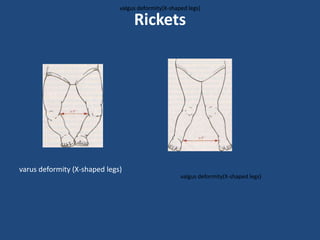
• a) bowing of the arms and legs;
• b) knock-knee (X-shaped legs);
• c) saber shins;
• d) instability of hip joints;
• e) pelvic deformity;
• f) enlargement of epiphysis at the ends of
the long bones.
Rickets
varus deformity (X-shaped legs)
valgus deformity(X-shaped legs)valgus deformity(X-shaped legs)
valgus deformity(X-shaped legs)
Rickets
• Teeth:
• a) delayed calcification, especially of
permanent teeth;
• b) maleruption of teeth.
• Abdomen: potbelly, constipation.
• Rachitis tetany: seizures.
• Symptoms of rickets are usually found in
children less than 2 years of age, some of them in
an reduced form can persist for the whole life.
THANK YOU

Rickets

  • 1.
  • 2.
    Rickets • It isone of the most frequent deficiency diseases in infants, the main clinical symptoms of which are changes of the skeleton. • Etiology of rickets: the deficiency of vitamin D (D2-ergocalciferol, D3-cholecalciferol). • Hypocalcemia • hypophosphatemia
  • 3.
    Rickets • Clinical symptom. •Head • a) delayed closure of fontanels; • b) deformed shape of the head: • 1. the skull is flat and depressed toward middle; • 2. a prominence of frontal bones = “Olympic forehead”; • 3. a prominence to the sides of the parietal bones = “caput quadratum”;
  • 4.
    • 4. prominenceof parietal bones and depression toward middle the suture between these bones = caput natiforme; • 5. craniotabes (softening of cranial bones); • 6. softening of cranial bones may lead to enlarging all the sizes of the head that is called macrocephalia).
  • 5.
    Rickets • Chest: • a)rachitic rosary (enlargement of costochondral junction of ribs); • b) Harrison’s groove (horizontal depression in the lower portion of the rib cage); • c) pigeon chest (depression to the middle of lower part of sternum); • Spine: • kyphosis, scoliosis, lordosis.
  • 6.
    Rickets • Extremities: • a)bowing of the arms and legs; • b) knock-knee (X-shaped legs); • c) saber shins; • d) instability of hip joints; • e) pelvic deformity; • f) enlargement of epiphysis at the ends of the long bones.
  • 7.
    Rickets varus deformity (X-shapedlegs) valgus deformity(X-shaped legs)valgus deformity(X-shaped legs) valgus deformity(X-shaped legs)
  • 8.
    Rickets • Teeth: • a)delayed calcification, especially of permanent teeth; • b) maleruption of teeth. • Abdomen: potbelly, constipation. • Rachitis tetany: seizures. • Symptoms of rickets are usually found in children less than 2 years of age, some of them in an reduced form can persist for the whole life.
  • 9.