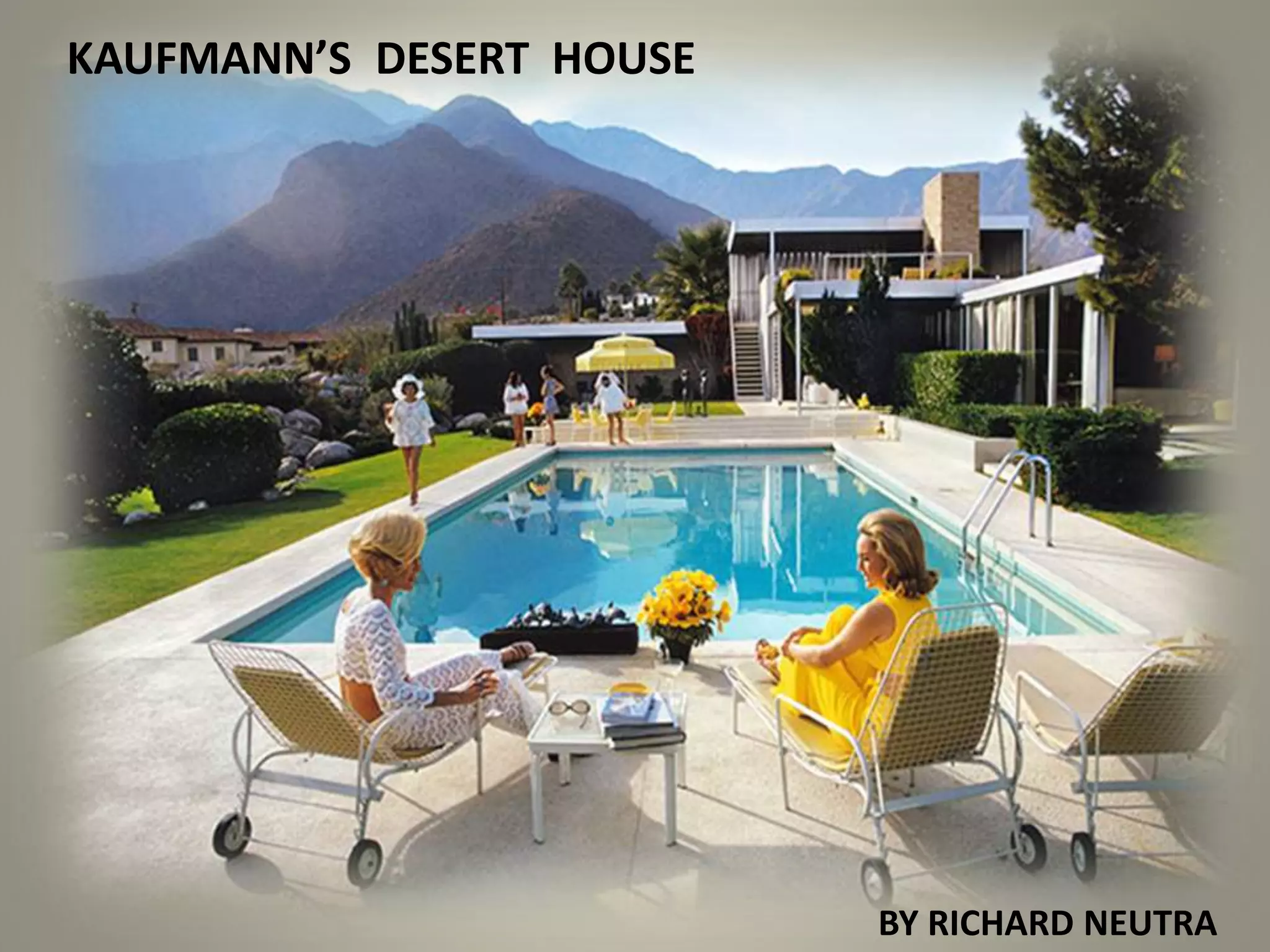
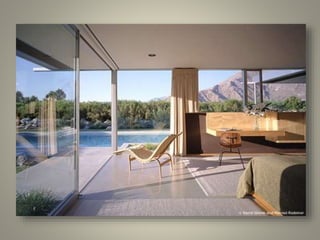
KAUFMANN’S DESERT HOUSE
BY RICHARD NEUTRA
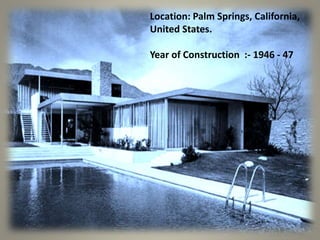
Location: Palm Springs, California,
United States.
Year of Construction :- 1946 - 47
Design of house
1) This case study examines the
architectural elements and
materials of the Kaufmann
Desert House and how they
provide natural cooling systems
in the harsh desert climate.
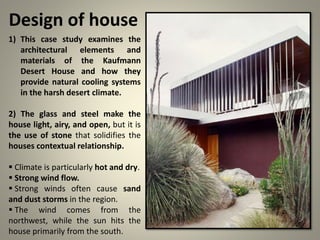
2) The glass and steel make the
house light, airy, and open, but it is
the use of stone that solidifies the
houses contextual relationship.
 Climate is particularly hot and dry.
 Strong wind flow.
 Strong winds often cause sand
and dust storms in the region.
 The wind comes from the
northwest, while the sun hits the
house primarily from the south.
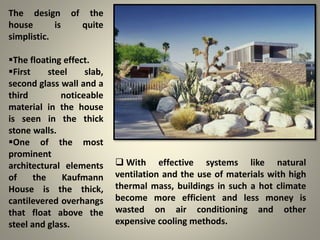
The design of the
house is quite
simplistic.
The floating effect.
First steel slab,
second glass wall and a
third noticeable
material in the house
is seen in the thick
stone walls.
One of the most
prominent
architectural elements
of the Kaufmann
House is the thick,
cantilevered overhangs
that float above the
steel and glass.
 With effective systems like natural
ventilation and the use of materials with high
thermal mass, buildings in such a hot climate
become more efficient and less money is
wasted on air conditioning and other
expensive cooling methods.
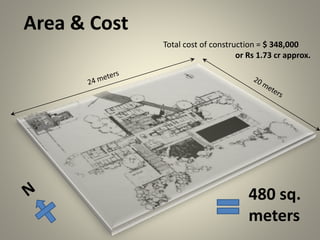
480 sq.
meters
Area & Cost
Total cost of construction = $ 348,000
or Rs 1.73 cr approx.
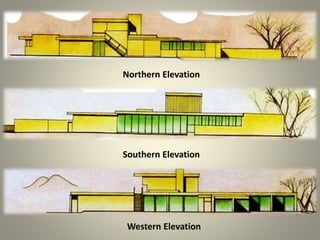
Northern Elevation
Southern Elevation
Western Elevation
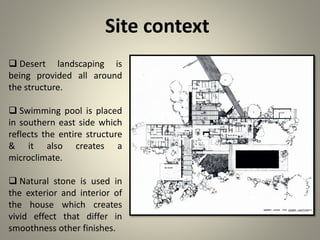
Site context
 Desert landscaping is
being provided all around
the structure.
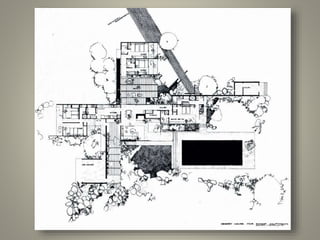
 Swimming pool is placed
in southern east side which
reflects the entire structure
& it also creates a
microclimate.
 Natural stone is used in
the exterior and interior of
the house which creates
vivid effect that differ in
smoothness other finishes.
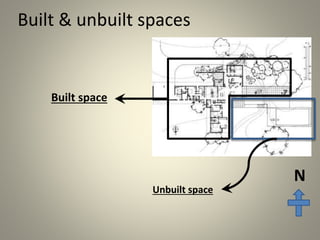
Built & unbuilt spaces
Unbuilt space
Built space
N
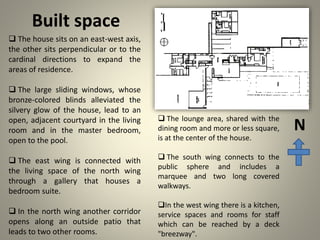
Built space
 The house sits on an east-west axis,
the other sits perpendicular or to the
cardinal directions to expand the
areas of residence.
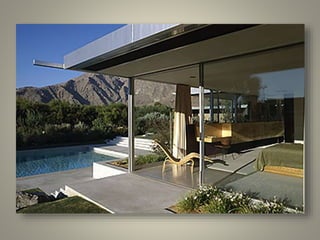
 The large sliding windows, whose
bronze-colored blinds alleviated the
silvery glow of the house, lead to an
open, adjacent courtyard in the living
room and in the master bedroom,
open to the pool.
 The east wing is connected with
the living space of the north wing
through a gallery that houses a
bedroom suite.
 In the north wing another corridor
opens along an outside patio that
leads to two other rooms.
N
 The lounge area, shared with the
dining room and more or less square,
is at the center of the house.
 The south wing connects to the
public sphere and includes a
marquee and two long covered
walkways.
In the west wing there is a kitchen,
service spaces and rooms for staff
which can be reached by a deck
"breezway".
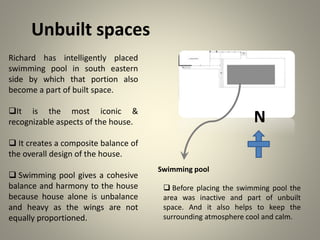
Unbuilt spaces
N
Swimming pool
Richard has intelligently placed
swimming pool in south eastern
side by which that portion also
become a part of built space.
It is the most iconic &
recognizable aspects of the house.
 It creates a composite balance of
the overall design of the house.
 Swimming pool gives a cohesive
balance and harmony to the house
because house alone is unbalance
and heavy as the wings are not
equally proportioned.
 Before placing the swimming pool the
area was inactive and part of unbuilt
space. And it also helps to keep the
surrounding atmosphere cool and calm.
Climatic Aspects
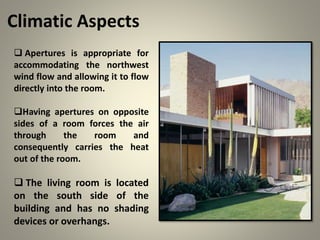
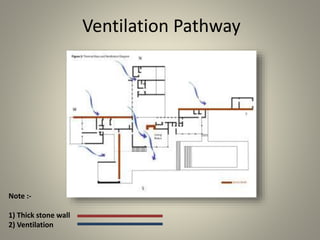
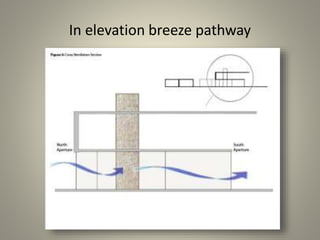
 Apertures is appropriate for
accommodating the northwest
wind flow and allowing it to flow
directly into the room.
Having apertures on opposite
sides of a room forces the air
through the room and
consequently carries the heat
out of the room.
 The living room is located
on the south side of the
building and has no shading
devices or overhangs.
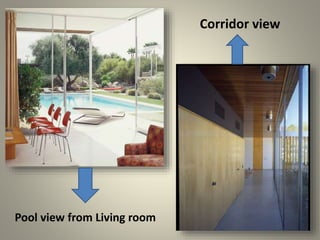
Pool view from Living room
Corridor view
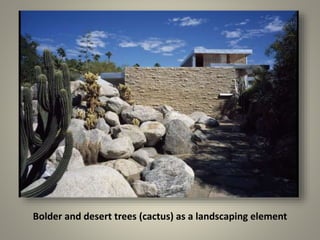
Bolder and desert trees (cactus) as a landscaping element
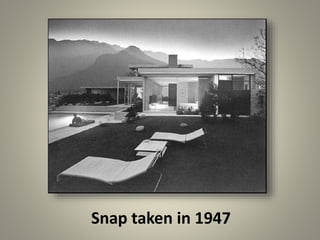
Snap taken in 1947
Ventilation Pathway
Note :-
1) Thick stone wall
2) Ventilation
In elevation breeze pathway
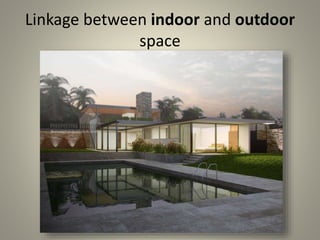
Linkage between indoor and outdoor
space
THANK YOU
SUBMITTED BY :-
SWAPNIL R. KAHAR
5TH SEM B.ARCH (C.B.S.)
1ST DESIGN
ASSIGNMENT
P.I.A.D.S. NAGPUR

Richard neutra palm spring house

  • 1.
  • 2.
    Location: Palm Springs,California, United States. Year of Construction :- 1946 - 47
  • 3.
    Design of house 1)This case study examines the architectural elements and materials of the Kaufmann Desert House and how they provide natural cooling systems in the harsh desert climate. 2) The glass and steel make the house light, airy, and open, but it is the use of stone that solidifies the houses contextual relationship.  Climate is particularly hot and dry.  Strong wind flow.  Strong winds often cause sand and dust storms in the region.  The wind comes from the northwest, while the sun hits the house primarily from the south.
  • 4.
    The design ofthe house is quite simplistic. The floating effect. First steel slab, second glass wall and a third noticeable material in the house is seen in the thick stone walls. One of the most prominent architectural elements of the Kaufmann House is the thick, cantilevered overhangs that float above the steel and glass.  With effective systems like natural ventilation and the use of materials with high thermal mass, buildings in such a hot climate become more efficient and less money is wasted on air conditioning and other expensive cooling methods.
  • 5.
    480 sq. meters Area &Cost Total cost of construction = $ 348,000 or Rs 1.73 cr approx.
  • 6.
  • 7.
    Site context  Desertlandscaping is being provided all around the structure.  Swimming pool is placed in southern east side which reflects the entire structure & it also creates a microclimate.  Natural stone is used in the exterior and interior of the house which creates vivid effect that differ in smoothness other finishes.
  • 8.
    Built & unbuiltspaces Unbuilt space Built space N
  • 9.
    Built space  Thehouse sits on an east-west axis, the other sits perpendicular or to the cardinal directions to expand the areas of residence.  The large sliding windows, whose bronze-colored blinds alleviated the silvery glow of the house, lead to an open, adjacent courtyard in the living room and in the master bedroom, open to the pool.  The east wing is connected with the living space of the north wing through a gallery that houses a bedroom suite.  In the north wing another corridor opens along an outside patio that leads to two other rooms. N  The lounge area, shared with the dining room and more or less square, is at the center of the house.  The south wing connects to the public sphere and includes a marquee and two long covered walkways. In the west wing there is a kitchen, service spaces and rooms for staff which can be reached by a deck "breezway".
  • 10.
    Unbuilt spaces N Swimming pool Richardhas intelligently placed swimming pool in south eastern side by which that portion also become a part of built space. It is the most iconic & recognizable aspects of the house.  It creates a composite balance of the overall design of the house.  Swimming pool gives a cohesive balance and harmony to the house because house alone is unbalance and heavy as the wings are not equally proportioned.  Before placing the swimming pool the area was inactive and part of unbuilt space. And it also helps to keep the surrounding atmosphere cool and calm.
  • 12.
    Climatic Aspects  Aperturesis appropriate for accommodating the northwest wind flow and allowing it to flow directly into the room. Having apertures on opposite sides of a room forces the air through the room and consequently carries the heat out of the room.  The living room is located on the south side of the building and has no shading devices or overhangs.
  • 13.
    Pool view fromLiving room Corridor view
  • 14.
    Bolder and deserttrees (cactus) as a landscaping element
  • 15.
  • 16.
    Ventilation Pathway Note :- 1)Thick stone wall 2) Ventilation
  • 17.
  • 18.
    Linkage between indoorand outdoor space
  • 21.
    THANK YOU SUBMITTED BY:- SWAPNIL R. KAHAR 5TH SEM B.ARCH (C.B.S.) 1ST DESIGN ASSIGNMENT P.I.A.D.S. NAGPUR