Maersk Group
Talent Management and Diversity & Inclusion
• Operate mainly in the shipping and energy
industries
• Approx. 104,000 employees
• Operating in over 130 countries
• 2013 revenue: USD 47 billion
Strategic investments:
1: Maersk Line
2: APM Terminals
3: Maersk Oil
4: Maersk Drilling
5: Maersk Supply
Service
6: Maersk Tankers
7: Damco
8: Svitzer
9: Maersk Container Industry
10: Dansk Supermarked
11: Danske Bank
Group Overview
3
5
2
1
7
8
6
4
9
10
11
2
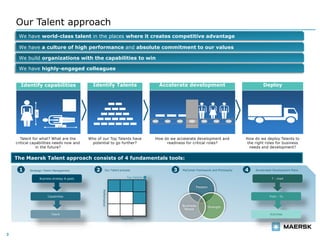
Our Talent approach
We have world-class talent in the places where it creates competitive advantage
We have a culture of high performance and absolute commitment to our values
We build organizations with the capabilities to win
We have highly-engaged colleagues
Talent for what? What are the
critical capabilities needs now and
in the future?
Identify capabilities
5’8”
5’11”
Who of our Top Talents have
potential to go further?
Identify Talents
How do we deploy Talents to
the right roles for business
needs and development?
Deploy
How do we accelerate development and
readiness for critical roles?
Accelerate development
3
The Maersk Talent approach consists of 4 fundamentals tools:
Business strategy & goals
Capabilities
Talent
Top Talents
Potential
Performance
Strategic Talent Management Our Talent process MyCareer Framework and Philosophy
Passion
StrengthBusiness
Needs
1 2 3 Accelerated Development Plans4
T - chart
From - To
Activities
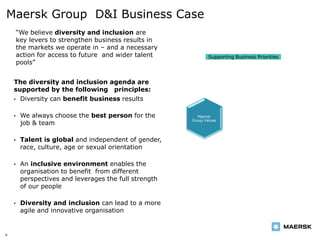
Maersk Group D&I Business Case
4
Anticipate the
future talent
market
Maersk
Group Values
Anticipate and
leverage future
changes in
demographic
workforce
Create the
environment
for new ideas
and new
thinking to
flourish
Helps Maersk
Group to
ensure focus
on growth
markets
Supporting Business Priorities
Build a
culture where
everyone can
reach their
full potential
The diversity and inclusion agenda are
supported by the following principles:
• Diversity can benefit business results
• We always choose the best person for the
job & team
• Talent is global and independent of gender,
race, culture, age or sexual orientation
• An inclusive environment enables the
organisation to benefit from different
perspectives and leverages the full strength
of our people
• Diversity and inclusion can lead to a more
agile and innovative organisation
“We believe diversity and inclusion are
key levers to strengthen business results in
the markets we operate in – and a necessary
action for access to future and wider talent
pools”
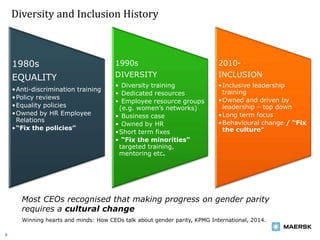
Diversity and Inclusion History
1980s
EQUALITY
•Anti-discrimination training
•Policy reviews
•Equality policies
•Owned by HR Employee
Relations
•“Fix the policies”
1990s
DIVERSITY
• Diversity training
• Dedicated resources
• Employee resource groups
(e.g. women’s networks)
• Business case
• Owned by HR
•Short term fixes
• “Fix the minorities”
targeted training,
mentoring etc.
2010-
INCLUSION
•Inclusive leadership
training
•Owned and driven by
leadership – top down
•Long term focus
•Behavioural change / “Fix
the culture”
Winning hearts and minds: How CEOs talk about gender parity, KPMG International, 2014.
Most CEOs recognised that making progress on gender parity
requires a cultural change
5
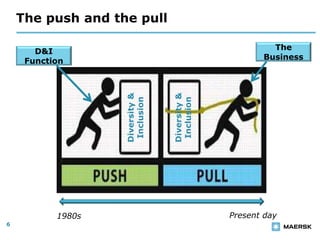
The push and the pull
6
The
Business
D&I
Function
Diversity&
Inclusion
Diversity&
Inclusion
1980s Present day
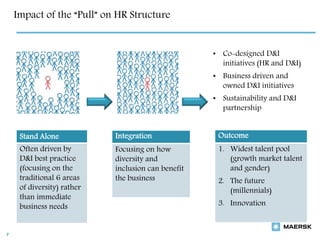
Impact of the “Pull” on HR Structure
7
• Co-designed D&I
initiatives (HR and D&I)
• Business driven and
owned D&I initiatives
• Sustainability and D&I
partnership
Stand Alone
Often driven by
D&I best practice
(focusing on the
traditional 6 areas
of diversity) rather
than immediate
business needs
Integration
Focusing on how
diversity and
inclusion can benefit
the business
Outcome
1. Widest talent pool
(growth market talent
and gender)
2. The future
(millennials)
3. Innovation
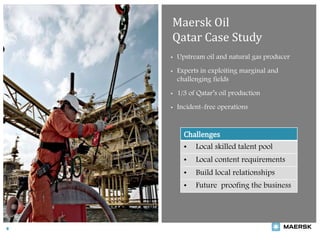
Maersk Oil
Qatar Case Study
8
• Upstream oil and natural gas producer
• Experts in exploiting marginal and
challenging fields
• 1/3 of Qatar’s oil production
• Incident-free operations
Challenges
• Local skilled talent pool
• Local content requirements
• Build local relationships
• Future proofing the business
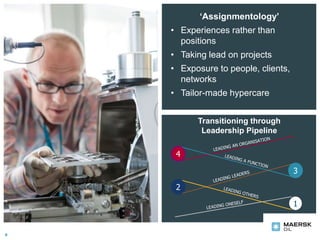
‘Assignmentology’
• Experiences rather than
positions
• Taking lead on projects
• Exposure to people, clients,
networks
• Tailor-made hypercare
Transitioning through
Leadership Pipeline
2
4
3
1
9
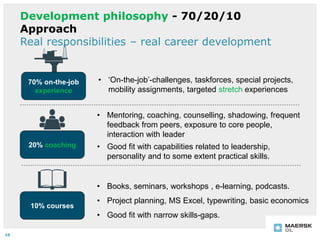
Development philosophy - 70/20/10
Approach
Real responsibilities – real career development
• Mentoring, coaching, counselling, shadowing, frequent
feedback from peers, exposure to core people,
interaction with leader
• Good fit with capabilities related to leadership,
personality and to some extent practical skills.
20% coaching
• ‘On-the-job’-challenges, taskforces, special projects,
mobility assignments, targeted stretch experiences
70% on-the-job
experience
• Books, seminars, workshops , e-learning, podcasts.
• Project planning, MS Excel, typewriting, basic economics
• Good fit with narrow skills-gaps.
10% courses
10
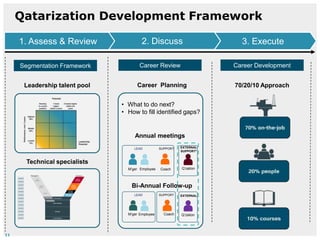
Qatarization Development Framework
Technical specialists
Job Grade 64
Job Grade 63
Job Grade 62
Job Grade 61
Job Grade 60
Job Grade 59
Job Grade 58
Job Grade 57
Job Grade 56
Job Grade 55
Job Grade 54
Job Grade 53
Job Grade 52
Advisor
Specialist
Principal
Specialist
Senior Specialist
Specialist
Senior
Principal
Specialist
Vice
President
Senior
Director
Director
Senior Lead
Specialist
Lead SpecialistTeam Leader
Team Leader
Junior Specialist
Managerial Technical
3. Execute2. Discuss1. Assess & Review
Segmentation Framework Career DevelopmentCareer Review
• What to do next?
• How to fill identified gaps?
Annual meetings
LEAD SUPPORT
EmployeeM’ger Coach
EXTERNAL
Q’zation
LEAD SUPPORT
EmployeeM’ger Coach
EXTERNAL
SUPPORT*
Q’zation
Bi-Annual Follow-up
Leadership talent pool Career Planning 70/20/10 Approach
11
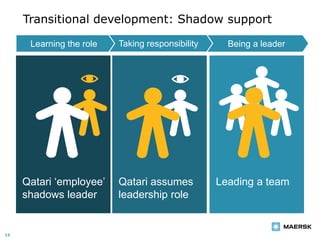
Transitional development: Shadow support
Being a leader
Qatari assumes
leadership role
Leading a teamQatari ‘employee’
shadows leader
Taking responsibilityLearning the role
12
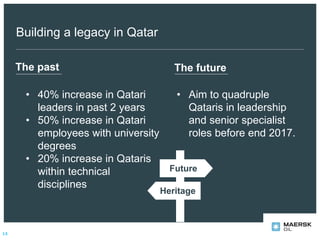
Building a legacy in Qatar
The past The future
• 40% increase in Qatari
leaders in past 2 years
• 50% increase in Qatari
employees with university
degrees
• 20% increase in Qataris
within technical
disciplines
• Aim to quadruple
Qataris in leadership
and senior specialist
roles before end 2017.
Future
Heritage
1313
Title of presentation | page 14
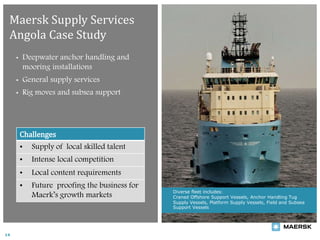
Maersk Supply Services
Angola Case Study
• Deepwater anchor handling and
mooring installations
• General supply services
• Rig moves and subsea support
Diverse fleet includes:
Craned Offshore Support Vessels, Anchor Handling Tug
Supply Vessels, Platform Supply Vessels, Field and Subsea
Support Vessels
Challenges
• Supply of local skilled talent
• Intense local competition
• Local content requirements
• Future proofing the business for
Maerk’s growth markets
14
Angola case study
15
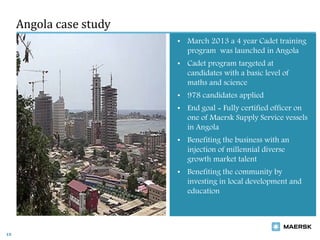
• March 2013 a 4 year Cadet training
program was launched in Angola
• Cadet program targeted at
candidates with a basic level of
maths and science
• 978 candidates applied
• End goal = Fully certified officer on
one of Maersk Supply Service vessels
in Angola
• Benefiting the business with an
injection of millennial diverse
growth market talent
• Benefiting the community by
investing in local development and
education
Angola case study
16
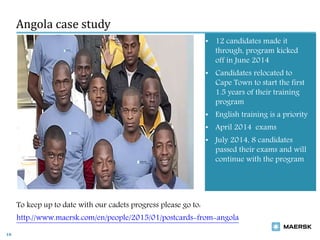
• 12 candidates made it
through, program kicked
off in June 2014
• Candidates relocated to
Cape Town to start the first
1.5 years of their training
program
• English training is a priority
• April 2014 exams
• July 2014, 8 candidates
passed their exams and will
continue with the program
To keep up to date with our cadets progress please go to:
http://www.maersk.com/en/people/2015/01/postcards-from-angola
One Young World Summit
17
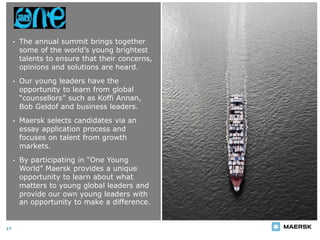
• The annual summit brings together
some of the world’s young brightest
talents to ensure that their concerns,
opinions and solutions are heard.
• Our young leaders have the
opportunity to learn from global
“counsellors” such as Koffi Annan,
Bob Geldof and business leaders.
• Maersk selects candidates via an
essay application process and
focuses on talent from growth
markets.
• By participating in “One Young
World” Maersk provides a unique
opportunity to learn about what
matters to young global leaders and
provide our own young leaders with
an opportunity to make a difference.
We are still on a journey……
• Where are our growth markets and
how are we investing in talent in those
markets?
• What will our talent pool look like in
10 years time?
• How are we investing in the future
talent?
• Are we world-class in attracting and
retaining the very best diverse talent?
18

Maersk Presentation @ 8th D&I Seminar

  • 1.
    Maersk Group Talent Managementand Diversity & Inclusion
  • 2.
    • Operate mainlyin the shipping and energy industries • Approx. 104,000 employees • Operating in over 130 countries • 2013 revenue: USD 47 billion Strategic investments: 1: Maersk Line 2: APM Terminals 3: Maersk Oil 4: Maersk Drilling 5: Maersk Supply Service 6: Maersk Tankers 7: Damco 8: Svitzer 9: Maersk Container Industry 10: Dansk Supermarked 11: Danske Bank Group Overview 3 5 2 1 7 8 6 4 9 10 11 2
  • 3.
    Our Talent approach Wehave world-class talent in the places where it creates competitive advantage We have a culture of high performance and absolute commitment to our values We build organizations with the capabilities to win We have highly-engaged colleagues Talent for what? What are the critical capabilities needs now and in the future? Identify capabilities 5’8” 5’11” Who of our Top Talents have potential to go further? Identify Talents How do we deploy Talents to the right roles for business needs and development? Deploy How do we accelerate development and readiness for critical roles? Accelerate development 3 The Maersk Talent approach consists of 4 fundamentals tools: Business strategy & goals Capabilities Talent Top Talents Potential Performance Strategic Talent Management Our Talent process MyCareer Framework and Philosophy Passion StrengthBusiness Needs 1 2 3 Accelerated Development Plans4 T - chart From - To Activities
  • 4.
    Maersk Group D&IBusiness Case 4 Anticipate the future talent market Maersk Group Values Anticipate and leverage future changes in demographic workforce Create the environment for new ideas and new thinking to flourish Helps Maersk Group to ensure focus on growth markets Supporting Business Priorities Build a culture where everyone can reach their full potential The diversity and inclusion agenda are supported by the following principles: • Diversity can benefit business results • We always choose the best person for the job & team • Talent is global and independent of gender, race, culture, age or sexual orientation • An inclusive environment enables the organisation to benefit from different perspectives and leverages the full strength of our people • Diversity and inclusion can lead to a more agile and innovative organisation “We believe diversity and inclusion are key levers to strengthen business results in the markets we operate in – and a necessary action for access to future and wider talent pools”
  • 5.
    Diversity and InclusionHistory 1980s EQUALITY •Anti-discrimination training •Policy reviews •Equality policies •Owned by HR Employee Relations •“Fix the policies” 1990s DIVERSITY • Diversity training • Dedicated resources • Employee resource groups (e.g. women’s networks) • Business case • Owned by HR •Short term fixes • “Fix the minorities” targeted training, mentoring etc. 2010- INCLUSION •Inclusive leadership training •Owned and driven by leadership – top down •Long term focus •Behavioural change / “Fix the culture” Winning hearts and minds: How CEOs talk about gender parity, KPMG International, 2014. Most CEOs recognised that making progress on gender parity requires a cultural change 5
  • 6.
    The push andthe pull 6 The Business D&I Function Diversity& Inclusion Diversity& Inclusion 1980s Present day
  • 7.
    Impact of the“Pull” on HR Structure 7 • Co-designed D&I initiatives (HR and D&I) • Business driven and owned D&I initiatives • Sustainability and D&I partnership Stand Alone Often driven by D&I best practice (focusing on the traditional 6 areas of diversity) rather than immediate business needs Integration Focusing on how diversity and inclusion can benefit the business Outcome 1. Widest talent pool (growth market talent and gender) 2. The future (millennials) 3. Innovation
  • 8.
    Maersk Oil Qatar CaseStudy 8 • Upstream oil and natural gas producer • Experts in exploiting marginal and challenging fields • 1/3 of Qatar’s oil production • Incident-free operations Challenges • Local skilled talent pool • Local content requirements • Build local relationships • Future proofing the business
  • 9.
    ‘Assignmentology’ • Experiences ratherthan positions • Taking lead on projects • Exposure to people, clients, networks • Tailor-made hypercare Transitioning through Leadership Pipeline 2 4 3 1 9
  • 10.
    Development philosophy -70/20/10 Approach Real responsibilities – real career development • Mentoring, coaching, counselling, shadowing, frequent feedback from peers, exposure to core people, interaction with leader • Good fit with capabilities related to leadership, personality and to some extent practical skills. 20% coaching • ‘On-the-job’-challenges, taskforces, special projects, mobility assignments, targeted stretch experiences 70% on-the-job experience • Books, seminars, workshops , e-learning, podcasts. • Project planning, MS Excel, typewriting, basic economics • Good fit with narrow skills-gaps. 10% courses 10
  • 11.
    Qatarization Development Framework Technicalspecialists Job Grade 64 Job Grade 63 Job Grade 62 Job Grade 61 Job Grade 60 Job Grade 59 Job Grade 58 Job Grade 57 Job Grade 56 Job Grade 55 Job Grade 54 Job Grade 53 Job Grade 52 Advisor Specialist Principal Specialist Senior Specialist Specialist Senior Principal Specialist Vice President Senior Director Director Senior Lead Specialist Lead SpecialistTeam Leader Team Leader Junior Specialist Managerial Technical 3. Execute2. Discuss1. Assess & Review Segmentation Framework Career DevelopmentCareer Review • What to do next? • How to fill identified gaps? Annual meetings LEAD SUPPORT EmployeeM’ger Coach EXTERNAL Q’zation LEAD SUPPORT EmployeeM’ger Coach EXTERNAL SUPPORT* Q’zation Bi-Annual Follow-up Leadership talent pool Career Planning 70/20/10 Approach 11
  • 12.
    Transitional development: Shadowsupport Being a leader Qatari assumes leadership role Leading a teamQatari ‘employee’ shadows leader Taking responsibilityLearning the role 12
  • 13.
    Building a legacyin Qatar The past The future • 40% increase in Qatari leaders in past 2 years • 50% increase in Qatari employees with university degrees • 20% increase in Qataris within technical disciplines • Aim to quadruple Qataris in leadership and senior specialist roles before end 2017. Future Heritage 1313
  • 14.
    Title of presentation| page 14 Maersk Supply Services Angola Case Study • Deepwater anchor handling and mooring installations • General supply services • Rig moves and subsea support Diverse fleet includes: Craned Offshore Support Vessels, Anchor Handling Tug Supply Vessels, Platform Supply Vessels, Field and Subsea Support Vessels Challenges • Supply of local skilled talent • Intense local competition • Local content requirements • Future proofing the business for Maerk’s growth markets 14
  • 15.
    Angola case study 15 •March 2013 a 4 year Cadet training program was launched in Angola • Cadet program targeted at candidates with a basic level of maths and science • 978 candidates applied • End goal = Fully certified officer on one of Maersk Supply Service vessels in Angola • Benefiting the business with an injection of millennial diverse growth market talent • Benefiting the community by investing in local development and education
  • 16.
    Angola case study 16 •12 candidates made it through, program kicked off in June 2014 • Candidates relocated to Cape Town to start the first 1.5 years of their training program • English training is a priority • April 2014 exams • July 2014, 8 candidates passed their exams and will continue with the program To keep up to date with our cadets progress please go to: http://www.maersk.com/en/people/2015/01/postcards-from-angola
  • 17.
    One Young WorldSummit 17 • The annual summit brings together some of the world’s young brightest talents to ensure that their concerns, opinions and solutions are heard. • Our young leaders have the opportunity to learn from global “counsellors” such as Koffi Annan, Bob Geldof and business leaders. • Maersk selects candidates via an essay application process and focuses on talent from growth markets. • By participating in “One Young World” Maersk provides a unique opportunity to learn about what matters to young global leaders and provide our own young leaders with an opportunity to make a difference.
  • 18.
    We are stillon a journey…… • Where are our growth markets and how are we investing in talent in those markets? • What will our talent pool look like in 10 years time? • How are we investing in the future talent? • Are we world-class in attracting and retaining the very best diverse talent? 18

Editor's Notes

  • #16 CLICK ON PICTURE for video runtime 2mins 38secs
  • #17 Click on picture for video 2mins 41secs OPTIONAL VIDEO
  • #18 Video will be added to this slide but please see: http://news.apmoller.net/Pages/20141022-One-Young-World-2014.aspx It’s the second video on the page (starts with a picture of a finger pointing to maersk logo) runs for just under 2 mins