Consumer Perspective of RFID in Apparel Retail Sanchit Tiwari VICS/AAFA RFID EPC Committee Meeting January 16th, 2007
RFID and the Consumer Consumer interaction with RFID at the retail level For higher acceptance, businesses need to: maximize consumer benefits  minimize consumer risks (price, privacy etc) Increase observability and awareness of the technology amongst consumers
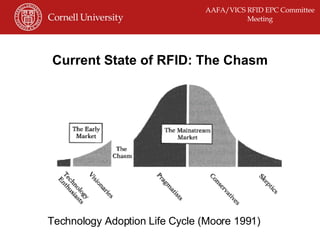
Current State of RFID: The Chasm Technology Adoption Life Cycle (Moore 1991)
Consumer Benefits of RFID Garment tracking within a store Real-time replenishment prevents stock outs Faster self-checkout due to multiple item scanning RFID loyalty cards for customer specific shopping reminders and promotions Magic mirrors and RFID closets for detailed information about the garment
Consumer Risks/Issues RFID tags can used as tracking devices Shopping information stored on RFID enabled loyalty cards invade privacy RFID infrastructure and tags lead to increased item price
Research Question Can consumer knowledge of RFID technology and applications increase the overall acceptance of the technology?
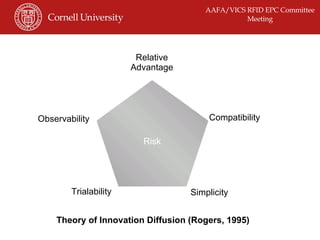
Theory of Innovation Diffusion (Rogers, 1995) Risk Relative Advantage Simplicity Trialability Observability Compatibility
Research Methods Case studies Online survey
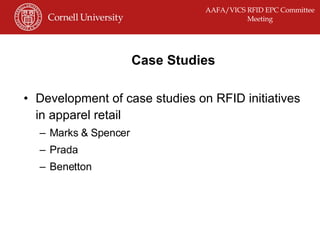
Case Studies Development of case studies on RFID initiatives in apparel retail  Marks & Spencer Prada Benetton
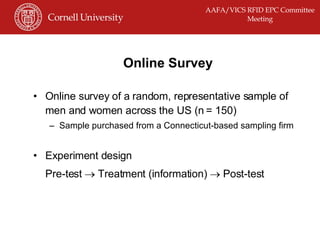
Online Survey Online survey of a random, representative sample of men and women across the US (n = 150) Sample purchased from a Connecticut-based sampling firm Experiment design Pre-test    Treatment (information)    Post-test
 
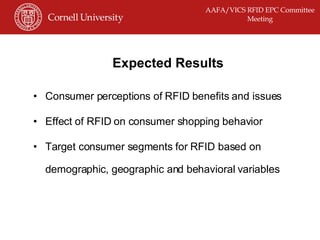
Expected Results Consumer perceptions of RFID benefits and issues Effect of RFID on consumer shopping behavior Target consumer segments for RFID based on demographic, geographic and behavioral variables
Acknowledgements Prof. Suzanne Loker Professor and J.Thomas Clarke Professor of Entrepreneurship and Personal Enterprise Department of Textiles & Apparel Cornell University Mr. Paul Chamandy V.P. New Business Development Apparel Systems Paxar Americas, Inc., Graduate Student Funding College of Human Ecology Cornell University

Rfid In Apparel Retail

  • 1.
    Consumer Perspective ofRFID in Apparel Retail Sanchit Tiwari VICS/AAFA RFID EPC Committee Meeting January 16th, 2007
  • 2.
    RFID and theConsumer Consumer interaction with RFID at the retail level For higher acceptance, businesses need to: maximize consumer benefits minimize consumer risks (price, privacy etc) Increase observability and awareness of the technology amongst consumers
  • 3.
    Current State ofRFID: The Chasm Technology Adoption Life Cycle (Moore 1991)
  • 4.
    Consumer Benefits ofRFID Garment tracking within a store Real-time replenishment prevents stock outs Faster self-checkout due to multiple item scanning RFID loyalty cards for customer specific shopping reminders and promotions Magic mirrors and RFID closets for detailed information about the garment
  • 5.
    Consumer Risks/Issues RFIDtags can used as tracking devices Shopping information stored on RFID enabled loyalty cards invade privacy RFID infrastructure and tags lead to increased item price
  • 6.
    Research Question Canconsumer knowledge of RFID technology and applications increase the overall acceptance of the technology?
  • 7.
    Theory of InnovationDiffusion (Rogers, 1995) Risk Relative Advantage Simplicity Trialability Observability Compatibility
  • 8.
    Research Methods Casestudies Online survey
  • 9.
    Case Studies Developmentof case studies on RFID initiatives in apparel retail Marks & Spencer Prada Benetton
  • 10.
    Online Survey Onlinesurvey of a random, representative sample of men and women across the US (n = 150) Sample purchased from a Connecticut-based sampling firm Experiment design Pre-test  Treatment (information)  Post-test
  • 11.
  • 12.
    Expected Results Consumerperceptions of RFID benefits and issues Effect of RFID on consumer shopping behavior Target consumer segments for RFID based on demographic, geographic and behavioral variables
  • 13.
    Acknowledgements Prof. SuzanneLoker Professor and J.Thomas Clarke Professor of Entrepreneurship and Personal Enterprise Department of Textiles & Apparel Cornell University Mr. Paul Chamandy V.P. New Business Development Apparel Systems Paxar Americas, Inc., Graduate Student Funding College of Human Ecology Cornell University