Dhikr: The polish for the heart
                                                              
                           O You who believe! Remember Allâh with much remembrance. [Ahzaab 33:41]

The Messenger () said, “Shall I not tell you the best of your deeds, the nicest to Your Owner, the highest in your
ranks, better for you than spending gold and silver, and better for you than meeting your enemy whereupon you
strike their necks and they strike your necks?” They said, “Yes, O Messenger of Allaah ( ).” He said, “The
                                1
remembrance of Allaah (dhikr).” (i.e. Dhikr is better than giving in charity, jihaad and martyrdom)

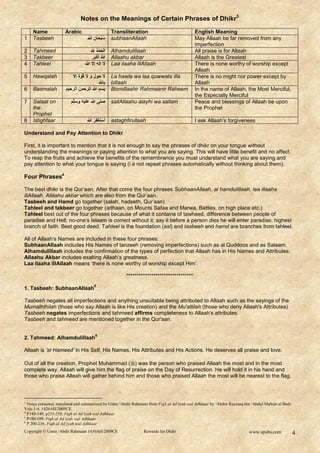
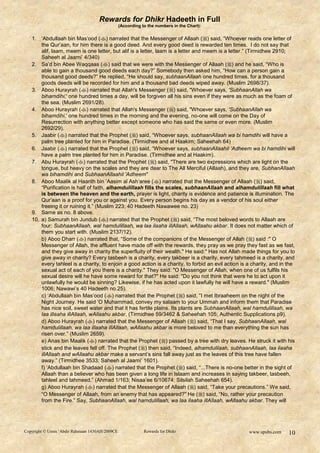
Virtue/ Reward2                   Times     English Meaning              Transliteration              Arabic
   Best dhikr is reading the Qur’aan. 10 rewards for each letter read. Approximately 321,180 letters x10 rewards = 3, 211, 800!                                            1
                             Recommended to complete the reading of whole Qur’aan every month...
1000 good deeds written or
1000 bad deeds wiped away
                                    x
                                    100
                                            May Allaah be far removed
                                            from every imperfection
                                                                         SubhaanAllaah                                                 ‫سبحان هللا‬   ُْ
                                                                                                                                                                           2


Sins wiped away even if they are
as much as the foam of the sea.
                                    x
                                    100
                                            May Allaah be far removed
                                            from every imperfection
                                                                         SubhaanAllaah wa
                                                                         bihamdihi
                                                                                                                 ِ ِ ْ ‫سبحان هللا َ بح‬
                                                                                                                            َ ِ                     ُْ
                                                                                                                                                                           3


                                    a       and may He be praised.
                                    day
None shall come on Day of
Resurrection with anything better
                                    x100 May Allaah be far removed
                                    mor     from every imperfection
                                                                         SubhaanAllaah wa
                                                                         bihamdihi
                                                                                                                  ِ ِ ْ ‫سبحان هللا َ بِح‬
                                                                                                                             َ                      ُْ
                                                                                                                                                                           4


except someone who has said the n &         and may He be praised.
same or even more.                  even
Palm tree planted for him in
Paradise.
                                            May Allaah be far removed
                                            from every imperfection
                                                                         SubhaanAllaah wa
                                                                         bihamdihi
                                                                                                                   ِ ِ ْ ‫سبحان هللا َ بح‬
                                                                                                                               َ ِ                  ُْ
                                                                                                                                                                           5


                                            and may He be praised
                                                                         * SubhaanAllaahil „adheem     ِ ِ ْ ‫سبحان هللا العظِ ٌم َ بح‬
                                                                                                             َ ِ                    َ               ُْ
Palm tree planted for him in                May Allaah the Great, be                                                                                                       6
Paradise.                                   far removed from every       wa bihamdihi
                                            imperfection and may He
                                            be praised.
2 Sayings light on the tongue,
heavy on the scales & beloved to
                                            May Allaah be far removed
                                            from every imperfection
                                                                         SubhaanAllaah wa
                                                                         bihamdihi
                                                                                                                    ِ ِ ْ ‫سبحان هللا َ بح‬
                                                                                                                                َ ِ                 ُْ
                                                                                                                                                                           7


the Most Merciful.                          and may He be praised.       Wa subhaanAllaahil                      ‫َ سبحان هللا العظِ ٌم‬
                                                                                                                          َ                      ُْ
                                            May Allaah the Great be      „adheem
                                            far removed from every
                                            imperfection
Fills what is between the heavens
and earth
                                            May Allaah be far removed
                                            from every imperfection
                                                                         SubhaanAllaah
                                                                         walhamdulillaah
                                                                                                                                       ‫سبحان هللا‬   ُْ
                                                                                                                                                                           8


                                            All praise is for Allaah                                                                  ‫الح ْ ُ هلل‬
                                                                                                                                               َ
Fills the scales                            All praise is for Allaah     Alhamdulillaah                                                   ‫الح ُ هلل‬         ْ َ
                                                                                                                                                                           9

* 4 Most beloved phrases to Allaah
* Each phrase is a Sadaqah, charity
                                                   May Allaah be far removed
                                                   from every imperfection.
                                                                                                  SubhaanAllaah
                                                                                                  Wal hamdulillaah
                                                                                                                                                 ‫سبحان هللا‬     ُْ
                                                                                                                                                                           10

* Plants in paradise
* More beloved to Prophet ( ) than                 All praise is for Allaah.                                                                      ‫َ الح ْ ُ هلل‬
                                                                                                                                                          َ
everything the sun has risen over
* sins fall away like leaves off tree
                                                   There is none worthy of
                                                   worship except Allaah.
                                                                                                  Wa laa illaaha illAllaah
                                                                                                  wAllaahu akbar
                                                                                                                                            ‫َ ال إله إال هللا‬
                                                                                                                                                     َْ
                                                                                                                                                   ‫َ هللا ُ أكبر‬
* no-one better
* save person from fire; everlasting good          Allaah is the Greatest.
deeds
* Nothing heavier in scales
Umm Haanee grew old, do something
whilst sitting:
                                            x100
                                            each
                                                   May Allaah be far removed
                                                   from every imperfection.
                                                                                                  SubhaanAllaah
                                                                                                  Wal hamdulillaah
                                                                                                                                                 ‫سبحان هللا‬ ُْ
                                                                                                                                                                           11

100 tasbeeh=freeing 100 slaves
100 tahmeed=100 horses in charity
                                                   All praise is for Allaah                       wAllaahu akbar                                  ‫َ الح ْ ُ هلل‬
                                                                                                                                                          َ
100 takbeer=100 sacrifices
                                                   Allaah is the Greatest
                                                   There is none worthy of
                                                                                                  Wa laa illaaha illAllaah
                                                                                                                                                     َْ
                                                                                                                                                   ‫َ هللا ُ أكبر‬
100 tahleel=fills between heaven and
earth                                              worship except Allaah.                                                                   ‫َ ال إله إال هللا‬
Tasbeeh, takbeer and tahleel =                     May Allaah be far removed                      SubhaanAllaah                                          ‫سبْحان هللا‬  ُ    12
for each is 20 good deeds written and              from every imperfection.                       Wal hamdulillaah                                        ‫َ الحَ ْ ُ هلل‬
20 bad deeds removed                               All praise is for Allaah.                      Wa laa illaaha illAllaah                                     ْ
                                                                                                                                                           ‫َ هللاُ أكبَر‬
Tahmeed (alhamdulillaahi rabbil
„aalameen = 30 good deeds written
                                                   There is none worthy of                        wAllaahu akbar                                    ‫َ ال إله إال هللا‬
and 30 bad deeds removed.                          worship except Allaah.
                                                   Allaah is the Greatest.
These phrases circulate the throne with            May Allaah be far removed from                 SubhaanAllaah                                          ‫سبْحان هللا‬  ُ    13
                                                   every imperfection. All praise is for
a buzzing sound and mention the one
                                                   Allaah. There is none worthy of                Wal hamdulillaah                                        ‫َ الحَ ْ ُ هلل‬
who said them.                                                                                    Wa laa illaaha illAllaah                          ‫َ ال إله إال هللا‬
                                                   worship except Allaah
* Everlasting righteous deeds                      May Allaah be far removed                      SubhaanAllaah                                       ‫س ْبحان هللا‬ُ        14
                                                   from every imperfection.                       Wal hamdulillaah
                                                   All praise is for Allaah. There is                                                                  ‫َ الح ْ ُ هلل‬
                                                                                                                                                               َ
* Forgives sins even if they were                                                                 Wa laa illaaha illAllaah
as much as the foam on the sea.
                                                   none worthy of worship except
                                                                                                  wAllaahu akbar                                 ‫َ ال إله إال هللا‬
                                                   Allaah. Allaah is the Greatest.
                                                   There is no power or might                     wa laa hawla wa laa                                     َْ
                                                                                                                                                        ‫َ هللاُ أكبر‬
                                                   except by Allaah.                              quwwata illa billaah                         ُ
                                                                                                                                 ‫َ ال ح و َ َ ال ق ّ ة إال باهلل‬
                                                                                                                                                             َ

1
    Tirmidhee 3377; Ibn Maajah 3790; Ahmad 195/5. Authentic Supplications of the Prophet () by Waleed K.S. Al-Essa.1996. pg5.
2
    See the full ahadeeth with references on pp9-13.
Copyright © Umm ‘Abdir Rahmaan 1430AH/2009CE                                 Rewards for Dhikr                                           www.spubs.com                         1
* A treasure from the treasures of
Paradise.
                                              There is no power or might
                                              except by Allaah
                                                                              Laa hawla wa laa quwwata
                                                                              illa billah
                                                                                                                 ‫ال ح و َ َ ال قُ ّ ة إال باهلل‬
                                                                                                                                           َ
                                                                                                                                                              15


* Plants in paradise.
* One of the doors of Paradise.
* Everlasting good deeds.
Said after the salaah.
Sins forgiven even if they are as
                                      x 33
                                      x 33
                                              May Allaah be far removed
                                              from every imperfection
                                                                              SubhaanAllaah
                                                                              alhamdulillaah
                                                                                                                                ‫سبحان هللا‬     ُْ
                                                                                                                                                              16


much as the foam on the sea.                                                                                                       ‫الح ْ ُ هلل‬
                                                                                                                                           َ
                                      x 33
                                      x1
                                                                              Allaahu akbar
                                                                              laa illaaha illAllaah
                                                                                                                                       َْ
                                                                                                                                    ‫هللاُ أكبر‬
                                                                              wahdahu laa shareeka lah        ‫ال إله إال هللا َ ح َ ُ ال شرٌك‬
                                                                                                                            ْ
                                                                              lahul mulk wa lahul hamd
                                                                              wa huwa „alaa kulli shay‟in
                                                                                                                   ْ ‫له له ال ُ لك َ له الح‬
                                                                                                                     َ
                                                                              qadeer                                      َ
                                                                                                                ‫َ ه َ على كو شًءٍ ق ٌِر‬
                                                                                                                                      َ ُ
Said after the salaah.
No-one will be better than you
                                      x 33
                                      x 33
                                              May Allaah be far removed
                                              from every imperfection.
                                                                              SubhaanAllaah
                                                                              Alhamdulillaah
                                                                                                                                ‫سبحان هللا‬     ُْ
                                                                                                                                                              17


except they do the same.              x 33    All praise is for Allaah.       Allaahu akbar                                        ‫الح ْ ُ هلل‬
                                                                                                                                             َ
(wealthy pray, fast but have
excess wealth to do „umrah, Hajj,
                                              Allaah is the Greatest.
                                                                                                                                       َْ
                                                                                                                                    ‫هللا ُ أكبر‬
jihaad and give in charity)
Said before sleep.
Better than having a servant.
                                      x 33
                                      x 33
                                              May Allaah be far removed
                                              from every imperfection.
                                                                              SubhaanAllaah
                                                                              Alhamdulillaah
                                                                                                                                      ‫سبحان هللا‬     ُْ
                                                                                                                                                              18


                                      x 34    All praise is for Allaah.       Allaahu akbar                                              ‫الح ْ ُ هلل‬
                                                                                                                                                 َ
                                              Allaah is the Greatest.
                                                                                                                                            َْ
                                                                                                                                          ‫هللا ُ أكبر‬
Two actions will lead to paradise.
Easy but few people do them.
                                      After
                                      sala
                                              May Allaah be far removed
                                              from every imperfection.
                                                                              SubhaanAllaah
                                                                              Alhamdulillaah
                                                                                                                                      ‫سبحان هللا‬     ُْ
                                                                                                                                                              19


Shaytaan makes them busy or fall      h       All praise is for Allaah.       Allaahu akbar                                              ‫الح ْ ُ هلل‬
                                                                                                                                                   َ
asleep.
Dhikr after salaah and before
                                      x10
                                      x10
                                              Allaah is the Greatest.
                                                                                                                                            َْ
                                                                                                                                          ‫هللاُ أكبر‬
sleep.                                x10     May Allaah be far removed
After salaah: 30x 5 prayers =         slee    from every imperfection.        SubhaanAllaah                                           ‫سبحان هللا‬   ُْ
150 on tongue and 1500 in             p       All praise is for Allaah.       Alhamdulillaah
balance                               x33     Allaah is the Greatest.         Allaahu akbar                                              ‫الح ْ ُ هلل‬
                                                                                                                                                 َ
Before sleep:                         x33                                                                                                   َْ
                                                                                                                                          ‫هللا ُ أكبر‬
100 on tongue and 1000 in             x34
balance
These 4 phrases outweigh a
person remaining in his place of
                                      x3      May Allaah be far removed
                                              from every imperfection, as
                                                                              SubhaanAllaah „adada khalqihi
                                                                              SubhaanAllaah ridaa nafsihi               ِ َْ َ
                                                                                                                        ‫هللا ع َ َ خلقِه‬          َ‫سبحن‬َ ُْ
                                                                                                                                                              20


prayer from fajr until Duhaa time             many times as the number of     SubhaanAllaah zinati „arshihi         ِ َْ َ ِ
                                                                                                                    ‫هللا رضى نفسِ ه‬             َ‫سبحن‬َ ُْ
                                                                                                                       ِ َْ ََِ
                                              His creations, a number of      SubhaanAllaah midaada
remembering Allaah.                           times corresponding to His      kalimaatihi                              ‫هللا زنة عرشِ ه‬           َ‫سبحن‬َ ُْ
                                              self-contentment, as much as
                                              the weight of His Throne and                                                    َ
                                                                                                                     ‫هللا ِ َ ا َ كلِ َ ااِه‬
                                                                                                                     ِ                         َ‫سبحن‬َ ُْ
                                              the ink of His words.
Reward of freeing 10 slaves;
100 good deeds recorded;
                                      x100    There is none worthy of
                                              worship except Allaah
                                                                              laa illaaha illAllaah
                                                                              wahdahu laa shareeka lah
                                                                                                              ‫ال إله إال هللا َ ح َ ُ ال شرٌك‬
                                                                                                                            ْ
                                                                                                                                                              21


100 bad deeds wiped away;                     alone, without partner. His     lahul mulk wa lahul hamd               ‫له له ال ُ لك َ له الح‬
                                                                                                                   ْ َ
Refuge from the devil until                   is the Dominion and all         wa huwa „alaa kulli shay‟in                 َ
                                                                                                                ‫َ ه َ على كو شًءٍ ق ٌِر‬
                                                                                                                                     َ ُ
evening.                                      praise is His and He is able    qadeer
                                              to do all things.
Like one who has freed 10 slaves
10 good deeds recorded;
                                      x10     There is none worthy of
                                              worship except Allaah
                                                                              laa illaaha illAllaah
                                                                              wahdahu laa shareeka lah
                                                                                                              ‫ال إله إال هللا َ ح َ ُ ال شرٌك‬
                                                                                                                            ْ
                                                                                                                                                              22


10 bad deeds wiped away;                      alone, without partner. His     lahul mulk wa lahul hamd             ْ ‫له له ال ُ لك َ له الح‬
                                                                                                                     َ
Refuge from the devil until                   is the Dominion and all         wa huwa „alaa kulli shay‟in                 َ
                                                                                                                ‫َ ه َ على كو شًءٍ ق ٌِر‬
                                                                                                                                     َ ُ
evening.                                      praise is His and He is able    qadeer
                                              to do all things.
Like one who has freed a slave
from Banee Ismaa‟eel.
                                      x1
                                      mor
                                              There is none worthy of
                                              worship except Allaah
                                                                              laa illaaha illAllaah
                                                                              wahdahu laa shareeka lah
                                                                                                              ‫ال إله إال هللا َ ح َ ُ ال شرٌك‬
                                                                                                                            ْ
                                                                                                                                                              23


10 good deeds recorded;               n or    alone, without partner. His     lahul mulk wa lahul hamd             ْ ‫له له ال ُ لك َ له الح‬
                                                                                                                     َ
10 bad deeds wiped away;              even    is the Dominion and all         wa huwa „alaa kulli shay‟in                 َ
                                                                                                                ‫َ ه َ على كو شًءٍ ق ٌِر‬
                                                                                                                                     َ ُ
10 degrees raised                             praise is His and He is able    qadeer
Protected from devil until evening.           to do all things.
Du‟aa on Safaa and Marwah                                                                                     ‫ال إله إال هللا َ ح َ ُ ال شرٌك‬
                                                                                                                          ْ
                                              There is none worthy of         laa illaaha illAllaah                                                           24
                                              worship except Allaah           wahdahu laa shareeka lah
                                              alone, without partner. His     lahul mulk wa lahul hamd            ْ ‫له له ال ُ لك َ له الح‬
                                                                                                                     َ
                                              is the Dominion and all
                                              praise is His. He gives life
                                                                              yuhyee wa yumeet
                                                                              wa huwa „alaa kulli shay‟in
                                                                                                              ‫ٌحًٌ َ ٌ ٌِت َ ه َ على كو‬
                                                                                                                    َ ُ            ُ      ْ ُ
                                              and causes death. He is         qadeer                                            ‫شًءٍ ق ٌِر‬ َ
                                              able to do all things.
Du‟aa for entering the market                                                                                 ‫ال إله إال هللا َ ح َ ُ ال شرٌك‬
                                                                                                                           ْ
                                              There is none worthy of         laa illaaha illAllaah                                                           25
place.                                        worship except Allaah           wahdahu laa shareeka lah
1 million rewards recorded;                   alone, without partner. His     lahul mulk wa lahul hamd                ‫له له ال ُ لك َ له الح‬
                                                                                                                    ْ َ
1 million bad deeds wiped away;
1 million degrees raised;
                                              is the Dominion and all
                                              praise is His. He gives life
                                                                              yuhyee wa yumeet wa
                                                                              huwa Hayyun laa yamoot
                                                                                                                ‫ٌحًٌ َ ٌ ٌِت ه َ حً ال‬
                                                                                                                   ٌ َ ُ            ُ       ْ ُ
(A house built in jannah).                    and causes death. He is         biyadihil khair wa huwa         ‫ٌ ُ ت بٌ ِ ِ الخٌر َ ه َ على‬
                                                                                                                 َ ُ                  َِ        َ
                                              the Ever-Living and will not    „alaa kulli shay‟in qadeer                     ‫ًءٍ ق ٌِر‬   َ‫كو ش‬
                                              die. In His hand is all good.
                                              He is able to do all things.
Best dhikr                                    There is none worthy of
                                              worship except Allaah.
                                                                              laa illaaha illAllaah                                 ‫ال إله إال هللا‬           26


Best du‟aa                                                                                                                               ‫الح ْ ُ هلل‬
                                                                                                                                                 َ
                                              All praise is for Allaah.       Alhamdulillah                                                                   27


Copyright © Umm ‘Abdir Rahmaan 1430AH/2009CE                    Rewards for Dhikr                                           www.spubs.com                      2
Master Supplication for
Forgiveness
                                                   O Allaah, You are my Lord,
                                                   there is no god worthy of
                                                                                                      allaahumma anta rabbee,
                                                                                                      laa ilaaha illaa ant,
                                                                                                                                                                   ‫اللهم أنتَ ربً ال إله إال‬
                                                                                                                                                                                         ِّ َ           ّ
                                                                                                                                                                                                                   28

                                                   worship except You. You                            khalaqtanee wa ana                                                                                ‫أنت‬
                                                                                                                                                                                                       َْ َ
                                                   created me and I am Your
If a person dies that night or that
morning after saying du‟aa for
                                                   servant. I will follow Your
                                                                                                      „abduka, wa ana „alaa
                                                                                                      „ahdika wa wa‟dika
                                                                                                                                                                     ‫خلَقانًِ َ أنا عب ُ ك َ أنا‬
                                                                                                                                                                               َ َْ
forgiveness he will enter paradise.
                                                   contract and Your promise as
                                                   much as I am able. I seek                          mastata‟tu, a‟oodhu bika                                               َ ْ
                                                                                                                                                                      ‫على عه ِ ك َ َ ع ِ ك َ ا‬َ ْ َ        َ
                                                   refuge in You from the evil that                   min sharri maa sana‟tu,
                                                                                                                                                            ِّ َ
                                                                                                                                                           ‫ُ بك ِنْ شر‬          َ ِ ُ‫اساطعتُ أَع ذ‬   َْ َْ
                                                   I have done, I acknowledge                         aboo‟u laka bini‟matika
                                                   Your blessings upon me and I                       „alayya wa aboo‟u bi                                 ‫َ ا صنعتُ أَب ء لَك بنِع َ اِك‬
                                                                                                                                                           َ ْ ِ َ ُ ُ                            ََْ
                                                   acknowledge my sin. So
                                                   forgive me for there is no-one
                                                                                                      dhanbee, faghfirlee fa                                     ‫فِر‬
                                                                                                                                                                 ْ      ْ‫علً َ أَب ء بِذنبًِ فاغ‬
                                                                                                                                                                            َ ْ َ ُ ُ َّ َ َ
                                                                                                      innahu laa
                                                   to forgive sins except You.
                                                                                                      yaghfirudhunooba illaa ant                                     َ ُ ُّ ُ ْ َ ُ َ
                                                                                                                                                           ‫لًِ فإ َِّنه ال ٌغفِر الذن ب إال‬
                                                                                                                                                                                                        ‫أنت‬  ْ
Allaah would forgive him even if
he fled during the advance of an
                                                   I seek Allaah‟s forgiveness,
                                                   besides whom, none has
                                                                                                      Astaghfirullaah aladhee laa
                                                                                                      illaha illa huwal Hayy al
                                                                                                                                                              ‫أساغفِر هللا الذي ال إلَه إال‬
                                                                                                                                                                      َ                           ُ ْ ْ
                                                                                                                                                                                                                   29


army                                               the right to be worshipped                         Qayyoom wa atoobu ilayh                                    ‫ب‬ ُ      ُ‫ه َ الحً القٌ م َ أا‬
                                                                                                                                                                                      ُّ           َ           ُ
                                                   except Him, the Ever
                                                   Living, the Self Subsisting
                                                                                                                                                                                                        ‫إلٌه‬
                                                   and Supporter of all, and I
                                                   turn to Him in repentance.
                                                   I seek Allaah‟s forgiveness
                                                                                                                                                                                               ُ ْ ْ
                                                                                                                                                                                          ‫أساغفِر هللا‬
Wealth, children, gardens and                                                                         Astaghfirullaah                                                                                              30
rivers [Soorah Nooh 71:10-12].
Protection from Allaah‟s
punishment
Conveyed to the Prophet ()                        * May the peace and
                                                   blessings of Allaah be
                                                                                                      * SallAllaahu alayhi wa
                                                                                                      sallam
                                                                                                                                                                  ‫* صلى هللا علٌه سلّم‬                             31

10 good deeds, wipes 10 bad
                                                   upon him.
deeds;
raises 10 degrees
                                                   * O Allaah send peace and                          * Allaahumma salli „alaa                             ‫* اللهم صلً على ح على آو‬
                                                   blessings upon                                     Muhammad wa „alaa aali                             ‫ح ك ا صلٌت على إبراهٌم على‬                                32
Allaah sends peace and blessings
                                                   Muhammad and his family                            Muhammad kama sallayta                                      ٌ‫آو إبراهٌم إنك ح ٌ ج‬
10 times upon the person
                                                   as You sent peace and                              „alaa Ibraaheem wa „alaa
                                                   blessings upon Ibraaheem                           aali Ibraaheem Innaka
                                                   and his family. Indeed You                         Hameedum Majeed.
                                                   are the Praiseworthy, the
                                                   Majestic.
Nothing will harm him                              In the name of Allaah, in                          Bismillaahiladthee laa                                                              َّ ْ
                                                                                                                                                             ‫بِسم هللاِ الَّذِي َال ٌضر َ ع اس ِ ه‬
                                                                                                                                                             ِ ْ َ ُّ ُ َ                                          33
                                                                                                                                                                                               ِ
                                                   whose name nothing can                             yaduruhu ma‟ ismihi                                                َ َ ِ ‫شًء فًِ ااَر‬
                                                                                                                                                           ِ‫ال فًِ الس َاء‬
                                                                                                                                                                 َّ                ْ ْ       ٌ ْ َ
                                                   harm on the earth or in the                        shayun fil ardi wa laa
                                                   heavens and He is All                              fismaa‟ wa huwas                                                      ُ َ ْ ُ َّ
                                                                                                                                                                            ‫َ ه َ الس ٌِع العلٌِم‬ُ
                                                   Hearing, All Knowing.                              Samee‟ul aleem.
Suffice a person                                                                                                                                                                                                   34
                                                        
Last two aayaat from
Soorah al Baqarah                                                                                                

                                                             

                                                           

                                                                                                                     


Aayatul Kursee before sleep                                                                                                                                                                                        35
                                                              
* Best aayah in Qur‟aan. Contains
Allaah‟s greatest name.                                    
* Allaah sends a guardian to you
and no shaytaan can come near                                                                                
till morning.
* Read after salaah – enter
Paradise.
Allaah will protect you from          x3                                                                                                                                                                           36
                                                                                                     *
everything.                           morn
                                      &
Soorah al Ikhlaas,                    even
                                      &                                                       *
Soorah al Falaq,                      b4
                                      sleep
                                                                                                                                                             

Soorah an Naas
                                                                                               *

                                                                                                                                             
Freedom from Shirk                                                                                                                                                                                                 37
                                                                          
Soorah al Kaafiroon
                                                                                                                                         


Copyright © Umm ‘Abdir Rahmaan 1430AH/2009CE                                       Rewards for Dhikr                                                                         www.spubs.com                          3
Notes on the Meanings of Certain Phrases of Dhikr3
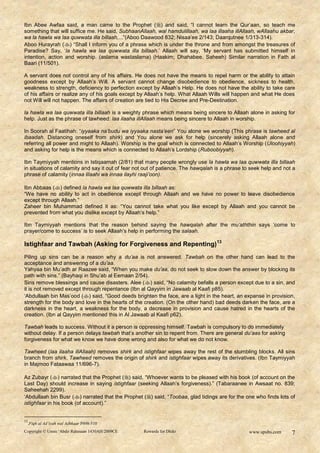
    Name              Arabic                          Transliteration                          English Meaning
1   Tasbeeh                          ‫س ْبحان هللا‬
                                                ُ     subhaanAllaah                            May Allaah be far removed from any
                                                                                               imperfection
2   Tahmeed                             ‫الح ْ ُ هلل‬
                                                َ     Alhamdulillaah                           All praise is for Allaah
3   Takbeer                                َْ
                                         ‫هللاُ أكبر‬   Allaahu akbar                            Allaah is the Greatest
4   Tahleel                        ‫ال إله إال هللا‬    Laa ilaaha illAllaah                     There is none worthy of worship except
                                                                                               Allaah
5   Hawqalah             ‫ال ح و َ َ ال قُ ّ ة إال‬
                                             َ        La hawla wa laa quwwata illa             There is no might nor power except by
                                             ‫باهلل‬    billaah                                  Allaah
6   Basmalah          ‫بسم هللا الرح ن الرحٌم‬          Bismillaahir Rahmaanir Raheem            In the name of Allaah, the Most Merciful,
                                                                                               the Especially Merciful
7   Salaat on            ‫صلى هللا علٌه سلّم‬           sallAllaahu alayhi wa sallam             Peace and blessings of Allaah be upon
    the                                                                                        the Prophet
    Prophet
8   Istighfaar                            ُ ْ ْ
                                     ‫أساغفِر هللا‬     astaghfirullaah                          I ask Allaah‟s forgiveness

Understand and Pay Attention to Dhikr

First, it is important to mention that it is not enough to say the phrases of dhikr on your tongue without
understanding the meanings or paying attention to what you are saying. This will have little benefit and no affect.
To reap the fruits and achieve the benefits of the remembrance you must understand what you are saying and
pay attention to what your tongue is saying (i.e not repeat phrases automatically without thinking about them).

Four Phrases4

The best dhikr is the Qur‟aan. After that come the four phrases SubhaanAllaah, al hamdulillaah, laa illaaha
illAllaah, Allaahu akbar which are also from the Qur‟aan.
Tasbeeh and Hamd go together (salah, hadeeth, Qur‟aan)
Tahleel and takbeer go together (adhaan, on Mounts Safaa and Marwa, Battles, on high place etc.)
Tahleel best out of the four phrases because of what it contains of tawheed, difference between people of
paradise and Hell; no-one‟s Islaam is correct without it; say it before a person dies he will enter paradise; highest
branch of faith. Best good deed. Tahleel is the foundation (asl) and tasbeeh and hamd are branches from tahleel.

All of Allaah‟s Names are included in these four phrases:
SubhaanAllaah includes His Names of tanzeeh (removing imperfections) such as al Quddoos and as Salaam.
Alhamdulillaah includes the confirmation of the types of perfection that Allaah has in His Names and Attributes.
Allaahu Akbar includes exalting Allaah‟s greatness.
Laa ilaaha illAllaah means „there is none worthy of worship except Him‟.

                                                            ********************************
                                          5
1. Tasbeeh: SubhaanAllaah

Tasbeeh negates all imperfections and anything unsuitable being attributed to Allaah such as the sayings of the
Mumaththilah (those who say Allaah is like His creation) and the Mu'attilah (those who deny Allaah's Attributes)
Tasbeeh negates imperfections and tahmeed affirms completeness to Allaah's attributes.
Tasbeeh and tahmeed are mentioned together in the Qur'aan.

                                           6
2. Tahmeed: Alhamdulillaah

Allaah is 'al Hameed' in His Self, His Names, His Attributes and His Actions. He deserves all praise and love.

Out of all the creation, Prophet Muhammad () was the person who praised Allaah the most and in the most
complete way. Allaah will give him the flag of praise on the Day of Resurrection. He will hold it in his hand and
those who praise Allaah will gather behind him and those who praised Allaah the most will be nearest to the flag.


3
  Notes extracted, translated and summarized by Umm ‘Abdir Rahmaan from Fiqh al Ad’iyah wal Adhkaar by ‘Abdur Razzaaq bin ‘Abdul Muhsin al Badr.
Vols 1-4. 1426AH/2005CE.
4
  P140-149, p255-258. Fiqh al Ad’iyah wal Adhkaar
5
  P180-199. Fiqh al Ad’iyah wal Adhkaar
6
  P 200-236. Fiqh al Ad’iyah wal Adhkaar
Copyright © Umm ‘Abdir Rahmaan 1430AH/2009CE                        Rewards for Dhikr                                   www.spubs.com          4
Those who praise Allaah in ease and in hardship and are patient with what is decreed for them will have a house
in paradise called 'House of Praise. '

The Messenger () said, "When a servant's child dies, Allaah says to His angels, 'Have you taken (the soul) of
My servant's child?' They will say, 'Yes.' He will say, 'Have you taken the apple of his eye?' They will say, 'Yes.'
He will say, 'What did My servant say?' They will say, 'He praised You and said innaa lillaahi wa innaa ilayhi
raaji'oon.‟ (To Allaah we belong and to Him is the return).So Allaah will say, „Build a house in Paradise for My
servant and call it „the House of Praise‟” (Saheehah 1408)

When is hamd required from a Muslim? It is required at all times as he is constantly enjoying Allaah‟s blessings
apparent and hidden, in his religion and his worldly life. Allaah repels evil and harm from him. Allaah deserves
praise from His servants at all times. He deserves praise due to His Great Names and perfect Attributes. There
are certain situations where praising Allaah is emphasised more. For example, when starting matters, in the
khutbah, in prayer, after eating and drinking, when getting dressed, after sneezing, when seeing someone
afflicted with a harm, etc.

Two types of praise:

     1. Praise for Allaah‟s good treatment of His servants, which is shukr (thanks).
     2. Praise for what Allaah deserves Himself due to His perfect Names and Attributes and Noble descriptions.

A servant‟s having the correct knowledge of Allaah‟s Names and Attributes is the best, most complete and
greatest way of fulfilling the duty of praising Allaah.
                                                                                7
“Praising Allaah for a blessing is a greater blessing than the blessing itself.” Allaah granting a person the ability to
give thanks and praise Allaah for a blessing is greater than the blessings of health, wealth, children etc.
                                     8
3. Takbeer: Allaahu Akbar

Takbeer means that Allaah is the greatest out of all things to the servant. It is exalting (ta‟dheem) and .... (ijlaal)
of the Lord and believing that there is nothing greater (akbar, a‟dham) than Him.

Takbeer is said hundreds of times a day in salaah, adhaan, during the two „Eids, on high places etc.
Allaahu Akbar cannot be replaced by other phrases such as Allaah „Adham in the salaah. „adham also has the
meaning of greatness but akbar is more complete in meaning „greatest‟. Our minds cannot comprehend Allaah‟s
greatness. We cannot even comprehend much of the creation, so what about the Creator.

Ibn Mas‟ood () narrated that the Prophet () said, “Between the sky of the world and the heaven that is above
that, is 500 years. Between each heaven there is 500 years. Between the seventh heaven and the Foot stool is
500 years. Between the Foot stool and the water is 500 years. The Throne is above the water and Allaah is above
                                                         9
the Throne. Nothing is hidden from him of your actions.”
                                          10
4. Tahleel: Laa ilaaha illAllaah

Tahleel is the best and greatest out of the four phrases. The creation was created because of it, Messengers
were sent and books were revealed. It makes the difference between the Muslim and the Kaafir, the people of
Paradise and the people of Hell. It is the greatest pillar of the Religion and the most important branch of faith.

It is called by different names in the Qur‟aan:

kalimah at Tayyib [Ibraaheem: 24];
al qawl ath Thaabit [Ibraaheem:27];
kalimah baaqiyyah [Zukhruf :28];
kalimat Tawheed; kalimat ash Shahaadah; Miftaah Dar as Sa‟aadah; „Urwatul Wuthqaa [Luqmaan :22], [2:256];
kalimat at Taqwaa [Fath :26];
as Sawaab [Naba‟ 79:38];
da‟watul Haqq [Ra‟d :14].

Sufyaan bin „Uyaynah () said, “Allaah has not given one of His servants a greater blessing than „laa ilaaha
           11
illAllaah”


7
  P226 Fiqh al Ad’iyah wal Adhkaar
8
   P246-254 Fiqh al Ad’iyah wal Adhkaar
9
  Daarimee in A Refutation of the Jahmiyyah p26-27; Tabaraani in al Kabeer 9/228; al Bayhaqee in The Names and Attributes 2/290; and others.
10
    P150-179. Fiqh al Ad’iyah wal Adhkaar
11
    Ibn Rajab in Kalimatul Ikhlaas p53.
Copyright © Umm ‘Abdir Rahmaan 1430AH/2009CE                       Rewards for Dhikr                                          www.spubs.com    5
It is the true connection which gathers the people of Islaam – al walaa‟ wal baraa‟, love and hate, one body, one
building supporting each other.

Shinqeetee said the phrase laa ilaaha illAllaah unites the Muslims and links the angels to Banee „Aadam. Eemaan
in Allaah links the angels to man and makes them make du‟aa for him. The connection of laa ilaaha illAllaah is
what links the inhabitants of the heavens (the angels) to the inhabitants of the earth:

                   

                                 

                                       


 “Those (angels) who bear the Throne (of Allâh) and those around it glorify the praises of their Lord, and believe in
Him, and ask forgiveness for those who believe (in the Oneness of Allâh) (saying): "Our Lord! You comprehend all
    things in mercy and knowledge, so forgive those who repent and follow Your way, and save them from the
torment of the blazing Fire! Our Lord! And make them enter the 'Adn (Eden) Paradise (everlasting Gardens) which
  you have promised them – and to the righteous among their fathers, their wives, and their offspring! Verily, You
      are the All-Mighty, the All-Wise. And save them from (the punishment for what they did of) the sins, and
   whomsoever You save from (the punishment for what he did of) the sins (i.e. pardon him) that Day, him verily,
                            You have taken into mercy." And that is the supreme success.”
                                             [Soorah al Ghaafir 40:7-9].

It is the best of the good deeds:
                                                                
      Whoever brings a good deed (i.e. belief In the Oneness of Allâh along with Every deed of righteousness), will
             have better than its worth, and they will be safe from the terror on that Day. [an Naml 27:89]

                                      
  Whosoever brings good (Islâmic Monotheism along with righteous deeds), He shall have the better thereof, and
  Whosoever brings evil (polytheism along with evil deeds) then, those who do evil deeds will Only be requited for
                                              what they used to do.
                                                  [al Qasas :84].

In part of a hadeeth the Prophet () said that the best good deed is laa ilaaha illAllaah (Ahmad 5/169).
Itbaan () narrated that the Prophet () said, “Indeed Allaah has prohibited Hell Fire for the one who says laa
ilaaha illAllaah seeking Allaah‟s Face.” (Bukhaaree 6938; Muslim 33).

There are seven conditions of laa ilaaha illAllaah that must be present for it to be correct: knowledge, certainty,
sincerity, truthfulness, love, compliance and acceptance.
It is not enough to simply say laa ilaaha illAllaah with the tongue without accompanying it with actions.
“Whoever dies and he knows that laa ilaaha illAllaah will enter Paradise.” (Muslim 26). (This shows the need for
knowledge).
laa ilaaha illAllaah means that “There is no true object worthy of worship except Allaah.” It is worshipping Allaah
alone sincerely and avoiding the worship of taaghoot (false gods). It is negation and affirmation. It is distancing
oneself from the worship of everything other than Allaah such as intercessors and partners. It is singling out
Allaah alone for worship not simply saying it. There has to be knowledge and belief in the heart, action of the
limbs and truthfulness. A hypocrite does the actions but is not truthful.

                                                   
And those whom they invoke instead of Him have no power of intercession; except those who bear witness to the
Truth (i.e. believed In the Oneness of Allâh, and obeyed his Orders), and they know (the facts about the Oneness
                                               of Allâh). [Zukhruf :86]
                                                                                                     12
5. Al Hawqalah: Laa hawla wa laa quwwata illa billaah

The Four Phrases (SubhaanAllaah, alhamdulillaah, laa illaaha illAllaah, Allaahu akbar) and the hawqalah (la
hawla wa laa quwwata illa billaah) together encompass tawheed (worshipping Allaah alone) and qadr (Pre-
Decree).
12
     P259-268. Fiqh al Ad’iyah wal Adhkaar
Copyright © Umm ‘Abdir Rahmaan 1430AH/2009CE                                            Rewards for Dhikr                                                             www.spubs.com                   6
Ibn Abee Awfaa said, a man came to the Prophet ( ) and said, “I cannot learn the Qur‟aan, so teach me
something that will suffice me. He said, SubhaanAllaah, wal hamdulillaah, wa laa illaaha illAllaah, wAllaahu akbar,
wa la hawla wa laa quwwata illa billaah,...”(Aboo Daawood 832; Nisaa‟ee 2/143; Daarqutnee 1/313-314).
Aboo Hurayrah () “Shall I inform you of a phrase which is under the throne and from amongst the treasures of
Paradise? Say, „la hawla wa laa quwwata illa billaah.‟ Allaah will say, „My servant has submitted himself in
intention, action and worship. (aslama wastaslama) (Haakim; Dhahabee. Saheeh) Similar narration in Fath al
Baari (11/501).

A servant does not control any of his affairs. He does not have the means to repel harm or the ability to attain
goodness except by Allaah‟s Will. A servant cannot change disobedience to obedience, sickness to health,
weakness to strength, deficiency to perfection except by Allaah‟s Help. He does not have the ability to take care
of his affairs or realize any of his goals except by Allaah‟s help. What Allaah Wills will happen and what He does
not Will will not happen. The affairs of creation are tied to His Decree and Pre-Destination.

la hawla wa laa quwwata illa billaah is a weighty phrase which means being sincere to Allaah alone in asking for
help. Just as the phrase of tawheed: laa ilaaha illAllaah means being sincere to Allaah in worship.

In Soorah al Faatihah: “iyyaaka na‟budu wa iyyaaka nasta‟een” You alone we worship (This phrase is tawheed al
ibaadah. Distancing oneself from shirk) and You alone we ask for help (sincerely asking Allaah alone and
referring all power and might to Allaah). Worship is the goal which is connected to Allaah‟s Worship (Uloohiyyah)
and asking for help is the means which is connected to Allaah‟s Lordship (Ruboobiyyah).

Ibn Taymiyyah mentions in Istiqaamah (2/81) that many people wrongly use la hawla wa laa quwwata illa billaah
in situations of calamity and say it out of fear not out of patience. The hawqalah is a phrase to seek help and not a
phrase of calamity (innaa lilaahi wa innaa ilayhi raaji‟oon).

Ibn Abbaas () defined la hawla wa laa quwwata illa billaah as:
“We have no ability to act in obedience except through Allaah and we have no power to leave disobedience
except through Allaah.”
Zaheer bin Muhammad defined it as: “You cannot take what you like except by Allaah and you cannot be
prevented from what you dislike except by Allaah‟s help.”

Ibn Taymiyyah mentions that the reason behind saying the hawqalah after the mu‟aththin says „come to
prayer/come to success‟ is to seek Allaah‟s help in performing the salaah.

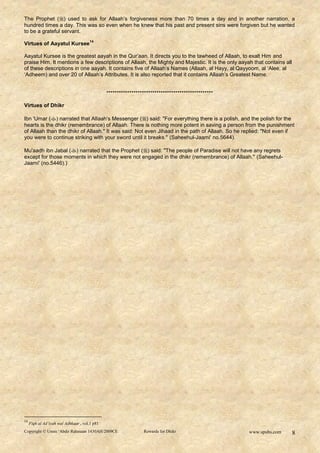
Istighfaar and Tawbah (Asking for Forgiveness and Repenting)13
Piling up sins can be a reason why a du‟aa is not answered. Tawbah on the other hand can lead to the
acceptance and answering of a du‟aa.
Yahyaa bin Mu‟adh ar Raazee said, “When you make du‟aa, do not seek to slow down the answer by blocking its
path with sins.” (Bayhaqi in Shu‟ab al Eemaan 2/54).
Sins remove blessings and cause disasters. Alee ( ) said, “No calamity befalls a person except due to a sin, and
it is not removed except through repentance (Ibn al Qayyim in Jawaab al Kaafi p85).
„Abdullaah bin Mas‟ood () said, “Good deeds brighten the face, are a light in the heart, an expanse in provision,
strength for the body and love in the hearts of the creation. (On the other hand) bad deeds darken the face, are a
darkness in the heart, a weakness for the body, a decrease in provision and cause hatred in the hearts of the
creation. (Ibn al Qayyim mentioned this in Al Jawaab al Kaafi p62).

Tawbah leads to success. Without it a person is oppressing himself. Tawbah is compulsory to do immediately
without delay. If a person delays tawbah that‟s another sin to repent from. There are general du‟aas for asking
forgiveness for what we know we have done wrong and also for what we do not know.

Tawheed (laa ilaaha illAllaah) removes shirk and istighfaar wipes away the rest of the stumbling blocks. All sins
branch from shirk. Tawheed removes the origin of shirk and istighfaar wipes away its derivatives. (Ibn Taymiyyah
in Majmoo Fataawaa 11/696-7).

Az Zubayr () narrated that the Prophet () said, “Whoever wants to be pleased with his book (of account on the
Last Day) should increase in saying istighfaar (seeking Allaah‟s forgiveness).” (Tabaraanee in Awsaat no. 839;
Saheehah 2299).
„Abdullaah bin Busr () narrated that the Prophet () said, “Toobaa, glad tidings are for the one who finds lots of
istighfaar in his book (of account).”


13
 .Fiqh al Ad’iyah wal Adhkaar P498-510
Copyright © Umm ‘Abdir Rahmaan 1430AH/2009CE       Rewards for Dhikr                             www.spubs.com     7
The Prophet () used to ask for Allaah‟s forgiveness more than 70 times a day and in another narration, a
hundred times a day. This was so even when he knew that his past and present sins were forgiven but he wanted
to be a grateful servant.
                                      14
Virtues of Aayatul Kursee

Aayatul Kursee is the greatest aayah in the Qur‟aan. It directs you to the tawheed of Allaah, to exalt Him and
praise Him. It mentions a few descriptions of Allaah, the Mighty and Majestic. It is the only aayah that contains all
of these descriptions in one aayah. It contains five of Allaah‟s Names (Allaah, al Hayy, al Qayyoom, al „Alee, al
„Adheem) and over 20 of Allaah‟s Attributes. It is also reported that it contains Allaah‟s Greatest Name.


                                               ***************************************************

Virtues of Dhikr

Ibn 'Umar () narrated that AlIaah's Messenger () said: "For everything there is a polish, and the polish for the
hearts is the dhikr (remembrance) of Allaah. There is nothing more potent in saving a person from the punishment
of Allaah than the dhikr of Allaah." It was said: Not even Jihaad in the path of Allaah. So he replied: "Not even if
you were to continue striking with your sword until it breaks." (Saheehul-Jaami' no.5644).

Mu'aadh ibn Jabal () narrated that the Prophet () said: "The people of Paradise will not have any regrets
except for those moments in which they were not engaged in the dhikr (remembrance) of Allaah." (Saheehul-
Jaami' (no.5446).)


14
     Fiqh al Ad’iyah wal Adhkaar , vol.1 p81
Copyright © Umm ‘Abdir Rahmaan 1430AH/2009CE                    Rewards for Dhikr                    www.spubs.com      8
Du’aas for Istighfaar (Seeking Forgiveness):


Source      Transliteration                           Meaning in English                                                                         Arabic
            Astaghfirullaah                           I seek Allaah‟s forgiveness
                                                                                                                                                                        ُ ْ ْ
                                                                                                                                                                  ‫أساغفِر هللا‬                                               1
                                                      I seek Allaah‟s forgiveness and repent
                                                                                                                                                           ُ ُ         ُ ْ ْ
                                                                                                                                                      ‫أساغفِر هللا َ أا ب إلٌه‬
Saheeh      Astaghrirullaah wa atoobu ilayh                                                                                                                                                                                  2
ibn
Hibbaan                                               to Him
928
Saheehah
556
            Rabbighfir lee wa tub „alayya innaka      My Lord forgive me and accept my                                     َ‫رب اغفِر لًِ َ اب علًَ إنك أنت‬
                                                                                                                             ْ َ َّ َّ َ ْ ُ       ْ ْ ِّ َ                                                                  3
            anta attawwaabur Raheem                   repentance. Indeed You are the
                                                      Acceptor of Repentance, the Especially                                                     َّ ُ َّ
                                                                                                                                             ‫الا َّ اب الرحٌِم‬
                                                      Merciful
                                                                                                                                   َ ُ َّ ُ ُ ِ ْ َ
                                                                                                                      ،ُ‫اللّهم اغفِر لًِ ذنبً كلُّه ِ قه َ جلَّه‬                    ْ ْ َّ ُ
Muslim      Allaahummaghfir lee dhanbee               O Allaah forgive all my sins: the small                                                                                                                                4
483
            kullahu, diqqahu wa jallahu, khata‟hu     and the big, those done by mistake or
            wa „amdahu wa sirrahu wa                  intentionally, secretly or openly, the first             ‫ه‬  ُ    َ‫خطأ َ ُ َ ع ْ َ ُ َ سِ ر ُ َ عَلنٌِاه َ أَ َّ ل‬
                                                                                                                                      ُ   َ َّ َ َ            ُّ                       َ                        َ َ
            „alaaniyatahu, wa awwalahu, wa                                                                                                                                                  .ُ ‫َ آخِر‬
            aakhirahu
                                                      and the last.
                                                                                                                                                                                                 َ
Bukhaaree
834
            Allaahumma innee dhalamtu nafsee          O Allaah, indeed I have wronged myself                                                      ُ
                                                                                                         ‫هللا ُ م إنِّي ظ م تُ نَ ْ ِي ظوْ ا ًا ك ٌرا َ َال‬
                                                                                                                               ‫َ ِ ًا‬                                     ْ َ‫َ و‬                   َّ                        5
            dhulman katheeran wa laa                  greatly and no-one forgives sins except
Muslim
2705        yaghfirudh dhunooba illaa anta            You. So forgive me and have mercy                   ‫يْ ر الذنُ ب إال أنْتَ ا َ ْ ر وِي م ْ رة‬
                                                                                                          ‫َ َِ ًا‬                             ِ                                  َ        ُّ ُِ َ
            faghfir lee maghfiratan min „indika
            warhamnee innaka anta al ghafoorur
                                                      upon me, indeed You are the Oft-
                                                      Forgiving, the Especially Merciful.
                                                                                                                    ‫م نْ ِ نْ ِ ك َ ار َ م نِي إنَّك أنْتَ اوْ َ ُ ر‬
                                                                                                                    ُ                                 َ             ْ ْ َ                                                ِ
            Raheem                                                                                                                                                                            ‫الر ٌِم‬               َّ
Aboo
Dawood
            Astaghfirullaah aladhee laa illaha illa
            huwal Hayy al Qayyoom wa atoobu
                                                      I seek Allaah‟s forgiveness, besides
                                                      whom, none has the right to be
                                                                                                                      ً‫أساغفِر هللا الذي ال إلَه إال ه َ الح‬
                                                                                                                             َ             ُ            َ                                    ُ ْ ْ                           6
1517
Tirmidhee   ilayh                                     worshipped except Him, the Ever Living,                                                                                                  ‫القً م‬   ُّ
                                                                                                                                                                                   ‫َ أا ب إلٌه‬ُ ُ
3577                                                  the Self Subsisting and Supporter of all,
                                                      and I turn to Him in repentance.
Bukhaaree
6306
            allaahumma anta rabbee, laa ilaaha
            illaa ant, khalaqtanee wa ana
                                                      O Allaah, You are my Lord, there is no god
                                                      worthy of worship except You. You created                                          ‫اللهم أنتَ ربً ال إله إال أنت‬        ِّ َ                            ّ              7

            „abduka, wa ana „alaa „ahdika wa          me and I am Your servant. I will follow Your                    ‫خلَقانًِ َ أنا عب ُ ك َ أنا على عه ِ ك‬
                                                                                                                        َ ْ َ                       َ            َ َْ                                   َْ َ
                                                                                                         ‫َ َ ع ِ ك َ ا اساطعتُ أَع ذ بك ِنْ شر‬
                                                                                                                                        َ ِ ُ ُ                   ْ َ َْ
                                                      contract and Your promise as much as I am
            wa‟dika mastata‟tu, a‟oodhu bika min
            sharri 9a asana‟tu, aboo‟u laka
                                                      able. I seek refuge in You from the evil that I       ِّ َ                                                                            َ ْ
            bini‟matika „alayya wa aboo‟u bi
                                                      have done, I acknowledge Your blessings
                                                      upon me and I acknowledge my sin. So              ُ ُ              َ‫َ ا صنعتُ أَب ء لَك بِنِع َ اِك علًَ َ أ‬
                                                                                                        ‫ُ ُ َ ْ َ َ َّ ب ء‬                                                                   ََْ
            dhanbee, faghfirlee fa innahu laa
            yaghfirudhunooba illaa ant
                                                      forgive me for there is no-one to forgive sins
                                                      except You.
                                                                                                                 َ ُ ُّ ُ ْ َ ُ َ
                                                                                                               ‫بذنبً فاغفِر لًِ فإ َِّنه ال ٌغفِر الذن ب‬                        ْ ْ َ ِ َِْ
                                                                                                                                                                                             ‫إال أنت‬  ْ
Ahmad
4/403
            Allaahumma innee a‟oodhu bika an
            ushrika bika wa ana a‟lam
                                                      O Allaah, I seek refuge in You in case I
                                                      commit shirk knowingly and I ask Your
                                                                                                         ‫اللهم إ ِِّنً أَع ذ بك أن أُشرك بك َ أنا‬
                                                                                                                                  َ ِ َ ِْ                   َ ِ ُ ُ                                       ُّ                8

            wastaghfiruka lima laa a‟lam              forgiveness for what I do unknowingly.                                                  ‫ْم‬َ‫أَعلَم َ أساغفِرك لِ َ ا ال أعل‬
                                                                                                                                                                      َ ُ          َْْ                                 ْ
Ahmad
1/170;
            Laa ilaaha illa anta subhaanaka           There is none worthy of worship except                                              ُْ              َ َ ُْ
                                                                                                                           َ‫ال إله إال أنتَ سب َ نك إنًِ كنتُ ِن‬                                                             9
            innee kuntu minadh dhaalimeen.            You. May You be free from all
Saheeh
Tirmidhee                                             imperfections. Indeed I was of the wrong                                                                                           ‫الظالِ ٌِن‬              َّ
3/443       [Soorah al Anbiyaa :87-88]                doers. (Du‟aa of Yunus in the whale).
            Allaahummaghfir lee khatee‟atee wa
                                                                                                          ُّ ‫اللّهم اغفِر لًِ خطِ ٌيًِ َ ع ْ ِي َ كو‬
                                                                                                                ُ                 َ     ‫َ َا‬          ْ ْ َّ ُ
Muslim                                                O Allaah forgive me all of my mistakes                                                                                                                                 10
2719
            „amdee wa kullu dhalika „indee.           and my sins. O Allaah forgive me for
            Allaahummaghfir lee maa qaddamtu          what I have done in the past and what                                  َ         ْ ْ َّ ُ              ِْ َ َ
                                                                                                                    ُ‫ذلِك عن ِي اللُّهم اغفِر لًِ َ ا ق َّ ْ ت‬
            wa maa akhkhartu wa maa asrartu
            wa maa a‟lantu wa maa „alam bihi
                                                      will come, for what I have done in secret
                                                      and in the open, for what You Know
                                                                                                                  ُ‫َ َ ا أَخرتُ َ َ ا أَسررتُ َ َ ا أَعلَنت‬
                                                                                                                       ْ ْ                ْ َ ْ            ْ َّ
            minee wa anta ilaahee laa ilaaha          about better than I. You are my Lord,              ‫تَ إِلَهً ال إله إال‬       ِ   َْ‫َ َ ا أَعلَم به ِ نً َ أن‬
                                                                                                                                                ِّ ِ ِ ْ
            illaa anta                                there is none worthy of worship except                                                                        َ‫أنت‬ ْ
                                                      You.
Muslim
771
            Allaahummaghfir lee maa qaddamtu          O Allaah forgive me for what I have                          ُ‫اللهم اغفِر لًِ َ ا ق َّ ْ تُ َ َ ا أَخرت‬
                                                                                                                        ْ َّ                 َ         ْ ْ َّ ُ ّ                                                            11
            wa maa akhkhartu wa maa asrartu           done in the past and what will come, for
            wa maa a‟lantu wa maa „alam bihi          what I have done in secret and in the                   ‫ْ م بِه‬
                                                                                                              ِ          َ‫َ َ ا أَسررتُ َ َ ا أَعلنتُ َ َ ا أَعل‬
                                                                                                                                        َْ ْ            ْ َ ْ
            minee. Antal muqaddim wa antal
            mu‟akhkhir laa ilaaha illaa anta.
                                                      open, for what You Know about better
                                                      than I. You are the One who brings
                                                                                                                ‫ِ نً َأ َْنتَ ال ُ ق ِّم أنت ال ُ َ خر ال إله‬
                                                                                                                               َّ                  َ                  ِّ
                                                      forward and the One who delays, there                                                                       ْ
                                                                                                                                                                َ‫إال أنت‬
                                                      is none worthy of worship except You.

Bukhaaree
4440
            Allaahummaghfir lee warhamnee             O Allaah forgive me, have mercy upon                               ِْ ْ                    ْ ْ َّ ُ
                                                                                                                      ًِ‫اللهم اغفِر لًِ َ ارح ْ نًِ َ ألحقن‬
                                                                                                                                      َ ْ                                                                                    12
            walhiqnee birrafeeqil a‟laa.              me and join me with the lofty
                                                      companions.                                                                             ْ َ‫بِالرفٌِق اا‬
                                                                                                                                           ‫َّ ِ علَى‬


                                                               *********************


Copyright © Umm ‘Abdir Rahmaan 1430AH/2009CE                       Rewards for Dhikr                                                                                 www.spubs.com                                           9
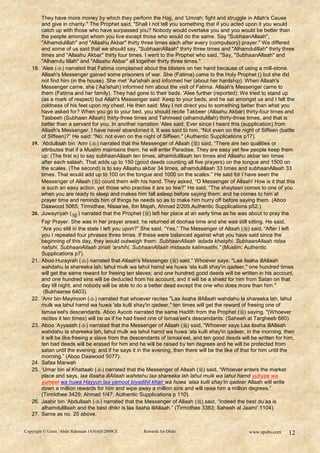
Rewards for Dhikr Hadeeth in Full
                                               (According to the numbers in the Chart):


   1. „Abdullaah bin Mas‟ood () narrated that the Messenger of Allaah () said, “Whoever reads one letter of
       the Qur‟aan, for him there is a good deed. And every good deed is rewarded ten times. I do not say that
       alif, laam, meem is one letter, but alif is a letter, laam is a letter and meem is a letter.” (Tirmidhee 2910;
       Saheeh al Jaami‟ 4/340)
   2. Sa‟d bin Abee Waqqaas () said that we were with the Messenger of Allaah () and he said, “Who is
       able to gain a thousand good deeds each day?” Somebody then asked him, “How can a person gain a
       thousand good deeds?” He replied, “He should say, subhaanAllaah one hundred times, for a thousand
       goods deeds will be recorded for him and a thousand bad deeds wiped away. (Muslim 2698/37).
   3. Aboo Hurayrah () narrated that Allah's Messenger ( ) said, "Whoever says, 'SubhaanAllah wa
       bihamdihi,' one hundred times a day, will be forgiven all his sins even if they were as much as the foam of
       the sea. (Muslim 2691/28).
   4. Aboo Hurayrah () narrated that Allah's Messenger ( ) said, "Whoever says, 'SubhaanAllah wa
       bihamdihi,' one hundred times in the morning and the evening, no-one will come on the Day of
       Resurrection with anything better except someone who has said the same or even more. (Muslim
       2692/29).
   5. Jaabir () narrated that the Prophet () said, “Whoever says, subhaanAllaah wa bi hamdihi will have a
       palm tree planted for him in Paradise. (Tirmidhee and al Haakim; Saheehah 64)
   6. Jaabir () narrated that the Prophet () said, “Whoever says, subhaanAllaahil „Adheem wa bi hamdihi will
       have a palm tree planted for him in Paradise. (Tirmidhee and al Haakim).
   7. Abu Hurayrah () narrated that the Prophet () said, "There are two expressions which are light on the
       tongue, but heavy on the scales and they are dear to The All Merciful (Allaah), and they are, SubhanAllaah
       wa bihamdihi and SubhaanAllaahil 'Adheem"
   8. Aboo Maalik al Haarith bin „Aasim al Ash‟aree () narrated that the Messenger of Allaah () said,
       “Purification is half of faith, alhamdulillaah fills the scales, subhaanAllaah and alhamdulillaah fill what
       is between the heaven and the earth, prayer is light, charity is evidence and patience is illumination. The
       Qur‟aan is a proof for you or against you. Every person begins his day as a vendor of his soul either
       freeing it or ruining it.” (Muslim 223; 40 Hadeeth Nawawee no. 23)
   9. Same as no. 8 above.
   10. a) Samurah bin Jundub () narrated that the Prophet () said, “The most beloved words to Allaah are
       four: SubhaanAllaah, wal hamdulillaah, wa laa ilaaha illAllaah, wAllaahu akbar. It does not matter which of
       them you start with. (Muslim 2137/12).
       b) Aboo Dharr () narrated that, “Some of the companions of the Messenger of Allah () said :" O
       Messenger of Allah, the affluent have made off with the rewards, they pray as we pray they fast as we fast,
       and they give away in charity the superfluity of their wealth." He said:" Has not Allah made things for you to
       give away in charity? Every tasbeeh is a charity, every takbeer is a charity, every tahmeed is a charity, and
       every tahleel is a charity, to enjoin a good action is a charity, to forbid an evil action is a charity, and in the
       sexual act of each of you there is a charity." They said: "O Messenger of Allah, when one of us fulfils his
       sexual desire will he have some reward for that?" He said: "Do you not think that were he to act upon it
       unlawfully he would be sinning? Likewise, if he has acted upon it lawfully he will have a reward." (Muslim
       1006; Nawawi‟s 40 Hadeeth no.25).
       c) „Abdullaah bin Mas‟ood () narrated that the Prophet () said, “I met Ibraaheem on the night of the
       Night Journey. He said „O Muhammad, convey my salaam to your Ummah and inform them that Paradise
       has nice soil, sweet water and that it has fertile plains. Its plants are SubhaanAllaah, wal hamdulillaah, wa
       laa illaaha illAllaah, wAllaahu akbar. (Tirmidhee 59/3462 & Saheehah 105; Authentic Supplications p9).
       d) Aboo Hurayrah () narrated that the Messenger of Allaah () said, “That I say, SubhaanAllaah, wal
       hamdulillaah, wa laa illaaha illAllaah, wAllaahu akbar is more beloved to me than everything the sun has
       risen over.” (Muslim 2659).
       e) Anas bin Maalik () narrated that the Prophet () passed by a tree with dry leaves. He struck it with his
       stick and the leaves fell off. The Prophet () then said, “Indeed, alhamdulilaah, subhaanAllaah, laa ilaaha
       illAllaah and wAllaahu akbar make a servant‟s sins fall away just as the leaves of this tree have fallen
       away.” (Tirmidhee 3533; Saheeh al Jaami‟ 1601).
       f) „Abdullaah bin Shadaad () narrated that the Prophet () said, “...There is no-one better in the sight of
       Allaah than a believer who has been given a long life in Islaam and increases in saying takbeer, tasbeeh,
       tahleel and tahmeed.” (Ahmad 1/163; Nisaa‟ee 6/10674; Silsilah Saheehah 654).
       g) Aboo Hurayrah () narrated that the Messenger of Allaah () said, “Take your precautions.” We said,
       “O Messenger of Allaah, from an enemy that has appeared?” He () said, “No, rather your precaution
       from the Fire.” Say, SubhaanAllaah, wal hamdulillaah, wa laa ilaaha illAllaah, wAllaahu akbar. They will


Copyright © Umm ‘Abdir Rahmaan 1430AH/2009CE               Rewards for Dhikr                         www.spubs.com     10
come on the Day of Resurrection to save the one who said them and will take the lead. They are the
                                       15
           everlasting good deeds.” (Saheeh al Jaami‟ 3214).
           h) Abee Salamah () said, “I heard the Messenger of Allaah () say, “Bakhin, bakhin and he indicated
                                                                                                      16

           five with his hand. There is nothing heavier in the scales than SubhaanAllaah, wal hamdulillaah, wa laa
           ilaaha illAllaah, wAllaahu akbar...” (Saheeh ibn Hibbaan 3/114 no.338).
     11.   Aasim bin Bahdah, from Abee Saalih from Umm Haanee bint Abee Taalib (Prophet‟s cousin). She said,
           “The Messenger of Allaah passed by me so I said, „I have become old and weak (or she said something
           similar) so order me with something I can do whilst sitting.‟ He said, „Say „subhaanAllaah‟ one hundred
           times, it will be equal to freeing 100 slaves from the offspring of Ismaa‟eel.
           Say „alhamdulillaah‟ one hundred times, it will be equal to giving 100 horses equipped with lights and
           bridles ready to fight for the sake of Allaah in charity.
           Say „Allaahu akbar‟ one hundred times, it will be equal to 100 garlanded sacrifices.
           Say „laa ilaaha illAllaah‟ one hundred times, (ibn Khalf, the narrator from Aasim, said I think he said) it fills
           what is between the heavens and the earth. And nobody comes on that day with anything better except
           that he does the same as you have done.” (Ahmad 6/344; Silsihah Saheehah 3/303).
     12.   Aboo Hurayrah () and Abee Sa‟eed narrated that the Messenger of Allaah ( ) said, “Allaah selected
           four phrases from speech: SubhaanAllaah, wal hamdulillaah, wa laa ilaaha illAllaah, wAllaahu akbar. So
           whoever says SubhaanAllaah will have 20 good deeds written for him and 20 bad deeds removed.
           Whoever says Allaahu akbar will get the same and whoever says laa ilaaha illAllaah will get the same.
                                                                                  17
           Whoever says alhamdulilaahi rabbil „aalameen of his own accord will have 30 good deeds written for him
           and 30 bad deeds removed.” (Ahmad 2/303; Mustadrak 1/512; Saheeh al Jaami‟ 1718).
     13.   “From that which you mention from the greatness and glory of Allaah are:
             'at-Tasbeeh' [saying „Subhaanallaah!‟: I declare Allaah free of all imperfections],
             'at-Tahleel' [saying „Laa ilaahah illallaah‟: None has the right to be worshipped except Allaah], and 'at-
             Tahmeed' [saying „al-hamdu lillaah‟: All praise is for Allaah]:
             They circulate around the Throne, and they have a buzzing sound like the bees, mentioning the person
             who uttered them. Would one of you not like that he should have - or that he should continue to have -
             someone mentioning him?” (Reported by Ibn Maajah no. 3809; Ahmad 4/271; at-Tabaraanee in „ad-
             Du`aa.‟ 3/1566/1693).
     14.   a) The Messenger of Allaah () said, “The everlasting righteous deeds are SubhaanAllaah, wal
           hamdulillaah, wa laa ilaaha illAllaah, wAllaahu akbar, wa laa hawla wa laa quwwata illaa billaah.”
             b) „Abdullaah bin Amr bin al „Aas () said, that the Prophet () said, “There is not a person on the earth
             who says, „laa ilaaha illAllaah, wAllaahu akbar, wa subhaan Allaah, wal hamdulillaah, wa laa hawla wa
             laa quwwata illaa billaah‟ except that his (minor) sins will be forgiven even if they were more than the
             foam on the sea.” (Tirmidhee 3460; Haakim 1/503; Saheeh al Jaami‟ 5636).
     15.   a) Aboo Moosaa al Ash'aree () narrated that the Prophet () started ascending a high place or hill. A
           man (amongst his companions) ascended it and shouted in a loud voice, "La ilaaha illAllaah wAllaahu
           Akbar." (At that time) Allah's Messenger () was riding his mule. He said, "You are not calling upon a deaf
           or an absent one." and added, "O Aboo Moosaa (or, O 'Abdullaah)! Shall I tell you a phrase from the
           treasures of Paradise?" I said, "Yes." He said, "La hawla wa laa quwwata illaa billaah." (Bukhaaree 4205;
           Muslim 2704/44). See also Authentic Supplications p9.
           b) Aboo Ayyoub al Ansaaree () narrated that the Prophet () passed by Ibraaheem on the Night
           Journey and he said, “O Muhammad, order your Ummah to increase the plants of Paradise. He said,
           „What are the plants of Paradise?‟ He said, „laa hawla wa laa quwwata illaa billaah.‟ (Ahmad 5/418;
           Saheeh ibn Hibbaan 821).
           c) Qays bin Sa‟d bin „Ubaadah () said that his Father offered for him to serve the Prophet (). He said,
           The Prophet () passed by me while I was praying. He touched me with his leg and said, „Shall I inform
           you of one of the doors of Paradise?‟ I said, „Yes.‟ He said, „laa hawla wa laa quwwata illaa billaah.‟
           (Ahmad 2/333; Saheehah 2527).
           d) Aboo Sa‟eed al Khudree () said that the Messenger of Allaah () said, “Increase in gaining the
           everlasting good deeds. It was said, „What are they O Messenger of Allaah?‟ He said, „Takbeer, tahleel,
           tasbeeh, hamd and laa hawla wa laa quwwata illaa billaah.‟” (Ahmad 3/75; Saheeh ibn Hibbaan 840; al
           Mustadrak 1/512).
     16.   Aboo Hurayrah () said that the Messenger of Allaah () said, “Whoever says subhaanAllaah 33 times,
           alhamdulillaah 33 times, Allaahu akbar 33 times and laa ilaaha illAllaah wahdahu laa shareeka lah, lahul
           mulk wa lahul hamd wa huwa „ala kulli shayin qadeer once, to make a total of one hundred, after each
           salaah will have his sins forgiven even if they were as much as the foam on the sea.” (Muslim 597/146;
           Authentic Supplications p51).
     17.   Aboo Hurayrah () narrated that some poor people came to the Prophet ( ) and said, "The wealthy
           people will get higher grades and will have permanent enjoyment and they pray like us and fast as we do.

15
   See [Soorah al Kahf 18:46]
16
   Said when amazed at something and to show its virtue. p147 Fiqh al Ad’iyah.
17
   Without any specific reason or blessing to praise Allaah for (p145 Fiqh al Ad’iyah).
Copyright © Umm ‘Abdir Rahmaan 1430AH/2009CE                          Rewards for Dhikr                www.spubs.com     11
They have more money by which they perform the Hajj, and 'Umrah; fight and struggle in Allah's Cause
       and give in charity." The Prophet said, "Shall I not tell you something that if you acted upon it you would
       catch up with those who have surpassed you? Nobody would overtake you and you would be better than
       the people amongst whom you live except those who would do the same. Say "SubhaanAllaah",
       "Alhamdulillah" and "Allaahu Akbar" thirty three times each after every (compulsory) prayer." We differed
       and some of us said that we should say, "SubhaanAllaah" thirty three times and "Alhamdulillah" thirty three
       times and "Allaahu Akbar" thirty four times. I went to the Prophet who said, "Say, "SubhaanAllaah" and
       "Alhamdu lillah" and "Allaahu Akbar" all together thirty three times."
   18. „Alee () narrated that Fatima complained about the blisters on her hand because of using a mill-stone.
       Allaah's Messenger gained some prisoners of war. She (Fatima) came to the Holy Prophet () but she did
       not find him (in the house). She met „Aa'ishah and informed her (about her hardship). When Allaah's
       Messenger came, she („Aa'ishah) informed him about the visit of Fatima. Allaah's Messenger came to
       them (Fatima and her family). They had gone to their beds. 'Alee further (reported): We tried to stand up
       (as a mark of respect) but Allah's Messenger said: Keep to your beds, and he sat amongst us and I felt the
       coldness of his feet upon my chest. He then said: May I not direct you to something better than what you
       have asked for? When you go to your bed, you should recite Takbeer (Allaahu Akbar) thirty-four times and
       Tasbeeh (Subhaan Allaah) thirty-three times and Tahmeed (alhamdulillah) thirty-three times, and that is
       better than a servant for you. In another narration „Alee said: Ever since I heard this (supplication) from
       Allaah's Messenger, I have never abandoned it. It was said to him, “Not even on the night of Siffeen (battle
       of Siffeen)?” He said: “No, not even on the night of Siffeen." (Authentic Supplications p17).
   19. „Abdullaah bin „Amr () narrated that the Messenger of Allaah ( ) said, “There are two qualities or
       attributes that if a Muslim maintains them, he will enter Paradise. They are easy yet few people keep them
       up: (The first is) to say subhaanAllaah ten times, alhamdulillaah ten times and Allaahu akbar ten times
       after each salaah. That adds up to 150 (good deeds counting all five prayers) on the tongue and 1500 on
       the scales. (The second) is to say Allaahu akbar 34 times, alhamdulillaah 33 times and subhaanAllaah 33
       times. That would add up to 100 on the tongue and 1000 on the scales.” He said for I have seen the
       Messenger of Allaah () count them with his hand. They asked, “O Messenger of Allaah! How is it that this
       is such an easy action, yet those who practise it are so few?” He said, “The shaytaan comes to one of you
       when you are ready to sleep and makes him fall asleep before saying them; and he comes to him at
       prayer time and reminds him of things he needs so as to make him hurry off before saying them. (Aboo
       Daawood 5065; Tirmidhee, Nisaa‟ee, Ibn Majah, Ahmad 2/205.Authentic Supplications p52.)
   20. Juwayriyah ( ) narrated that the Prophet () left her place at an early time as he was about to pray the
         Fajr Prayer. She was in her prayer aread; he returned at doohaa time and she was still sitting. He said,
         “Are you still in the state I left you upon?” She said, “Yes.” The Messenger of Allaah ( ) said, “After I left
         you I repeated four phrases three times. If these were balanced against what you have said since the
         beginning of this day, they would outweigh them: SubhaanAllaah „adada khalqihi, SubhaanAllaah ridaa
         nafsihi, SubhaanAllaah zinati „arshihi, SubhaanAllaah midaada kalimaatihi.” (Muslim; Authentic
         Supplications p7).
   21.   Aboo Hurayrah () narrated that Allaah's Messenger () said," Whoever says: "Laa ilaaha illAllaah
         wahdahu la shareeka lah, lahul mulk wa lahul hamd wa huwa 'ala kulli shay'in qadeer," one hundred times
         will get the same reward for freeing ten slaves; and one hundred good deeds will be written in his account,
         and one hundred sins will be deducted from his account, and it will be a shield for him from Satan on that
         day till night, and nobody will be able to do a better deed except the one who does more than him."
          (Bukhaaree 6403).
   22.   'Amr bin Maymoon () narrated that whoever recites "Laa ilaaha illAllaah wahdahu la shareeka lah, lahul
         mulk wa lahul hamd wa huwa 'ala kulli shay'in qadeer," ten times will get the reward of freeing one of
         Ismaa‟eel's descendants. Aboo Ayoob narrated the same Hadith from the Prophet () saying, "(Whoever
         recites it ten times) will be as if he had freed one of Ismaa‟eel's descendants. (Saheeh at Targheeb 660).
   23.   Aboo „Ayyaash () narrated that the Messenger of Allaah () said, “Whoever says Laa ilaaha illAllaah
         wahdahu la shareeka lah, lahul mulk wa lahul hamd wa huwa 'ala kulli shay'in qadeer, in the morning, then
         it will be like freeing a slave from the descendants of Ismaa‟eel, and ten good deeds will be written for him,
         ten bad deeds will be erased for him and he will be raised by ten degrees and he will be protected from
         satan until the evening; and if he says it in the evening, then there will be the like of that for him until the
         morning.” (Aboo Daawood 5077).
   24.   Safaa Marwah
   25.   „Umar bin al Khattaab () narrated that the Messenger of Allaah () said, “Whoever enters the market
         place and says, laa illaaha illAllaah wahdahu laa shareeka lah lahul mulk wa lahul hamd yuhyee wa
         yumeet wa huwa Hayyun laa yamoot biyadihil khair wa huwa „alaa kulli shay‟in qadeer Allaah will write
         down a million rewards for him and wipe away a million sins and will raise him a million degrees.”
         (Tirmidhee 3429; Ahmad 1/47; Authentic Supplications p 110).
   26.   Jaabir bin „Abdullaah () narrated that the Messenger of Allaah () said, “Indeed the best du‟aa is
         alhamdulillaah and the best dhikr is laa ilaaha illAllaah.” (Tirmidhee 3383; Saheeh al Jaami‟ 1104).
   27.   Same as no. 25 above.


Copyright © Umm ‘Abdir Rahmaan 1430AH/2009CE          Rewards for Dhikr                             www.spubs.com     12
28. Shaddaad bin Aws () narrated that the Messenger of Allaah () said, “The Master Du‟aa for
       Forgiveness is, allaahumma anta rabbee, laa ilaaha illaa ant, khalaqtanee wa ana „abduka, wa ana „alaa
       „ahdika wa wa‟dika mastata‟tu, a‟oodhu bika min sharri maa sana‟tu, aboo‟u laka bini‟matika „alayya wa
       aboo‟u bi dhanbee, faghfirlee fa innahu laa yaghfirudhunooba illaa ant. Whoever says this as he enters
       upon the evening, then dies that night will enter Paradise; and if one says this as he enters the morning,
       then dies that day, he will enter Paradise.” (Bukhaaree 6306; Authentic Supplications p13).
   29. The Messenger of Allaah said, “Whoever says Astaghfirullaah aladhee laa illaha illa huwal Hayy al Qayyoom wa atoobu
       ilayh. Allaah will forgive him even if he fled during the advance of an army.” (Aboo Dawood 1517; Tirmidhee 3577)
   30.
                                     

                                         
         "I said (to them): 'Ask Forgiveness from Your Lord; Verily, He is Oft-Forgiving; 'He will send rain to you in
         abundance and give you increase in wealth and children, and bestow on you Gardens and bestow on you
                                                  rivers.' " [Nooh 71:10-12]

                                                   
                       And Allâh will not punish them while they seek (Allâh's) Forgiveness. [Al Anfaal 8:33]

   1. Aboo Talhah al Ansaaree ( ) said, “One morning the Messenger of Allaah was in a cheerful mood and
      looked happy. They said, „O Messenger of Allaah, this morning you are in a cheerful mood and look
      happy.‟ He said, „Of course, just now someone (an angel) came to me from my Lord and said, „Whoever
      among your Ummah sends salaah upon you, Allaah will record for him ten good deeds and will erase for
      him ten evil deeds, and will raise his status by ten degrees, and will return his greeting with something
      similar to it.‟” (Ahmad 4/29). Also see Tafseer Ibn Katheer [Soorah al Ahzaab 33:56] vol. 8 p35-42.
   2. Anas () said that the Messenger of Allaah () said, “Whoever hears me mentioned should send peace
      and blessings upon me. For whoever sends peace and blessings upon me once, Allaah sends peace and
      blessings upon him ten times.” (Ibn Sunnee 374; Nisaa‟ee in „Aml al yawm walaylah no.61; Saheeh al
      Jaam‟i no. 6246).
   3.
       „Uthmaan bin () reported that Prophet Muhammad () said that (nothing will harm) the servant
      who recites these words three times every morning and evening:
      Bismillaahiladthee laa yaduruhu ma‟ ismihi shayun fil ardi wa laa fismaa‟ wa huwas Samee‟ul
      aleem. In the Name of Allaah, in whose Name nothing in the heavens and the earth can harm and
      He is the All Hearing, the All Knowing. (Tirmidhi; Authentic Supplications p14)
   4. Aboo Mas‟ood al Ansaaree () said that the Messenger of Allaah () said, “Whoever reads the last two
      verses of Soorah al Baqarah in a night they will suffice him.” (Bukhaaree 4008; Authentic Supplications
      p17)
        “The Messenger (Muhammad) believes In what has been sent down to Him from his Lord, and (so do) the
      believers. Each one believes in Allaah, His angels, His Books, and His Messengers. They say, "We make
      no distinction between one another of His Messengers" - and they say, "We hear, and we obey. (We seek)
      Your Forgiveness, Our Lord, and to You is the return (of all)."
      Allaah burdens not a person beyond his scope. He gets reward for that (good) which He has earned, and
      He is punished for that (evil) which He has earned. "Our Lord! Punish us not if we forget or fall into error,
      Our Lord! Lay not on us a burden like that which You did lay on those before us (Jews and Christians);
      Our Lord! Put not on us a burden greater than we have strength to bear. Pardon us and grant us
      Forgiveness. Have Mercy on us. You are Our Maulâ (Patron, Suppor-ter and Protector, etc.) and give us
      victory over the disbelieving people." [al Baqarah 2:285-286].
   5. a) Ubayy bin Ka‟b () “O Aboo Mundhir, do you know which aayah in Allaah‟s Book is the greatest?” He
      said, I said “Allaah and His Messenger know best. He said, “O Aboo Mundhir, do you know which aayah in
      Allaah‟s Book is the greatest?” He said, say “Allaahu laa ilaaha illaa huwal Hayyul Qayyoom.” He struck
      me on the chest and said, “May Allaah make knowledge pleasing to you Aboo al Mundhir.” (Muslim 810).
      b) Aboo Hurayrah () narrated that someone used to come to him and take from the charity which the
      Prophet () had made him responsible for. He came night after night and on the third night he said, “I will
      report you to the Messenger of Allaah ().” The man said, “Let me teach you some phrases with which
      Allaah will benefit you from.” They were very eager for good, so he said, “When you go to bed read
      Aayatul Kursee completely, for there is still a guardian over you from Allaah and no shaytaan can come
      close to you until morning.” Then he said, “He told you the truth even though he is a liar (it was a
      shaytaan).” (Authentic Supplications p16).
      c) Aboo Umaamah () said that the Messenger of Allaah () said, “Whoever reads Aayatul Kursee after
      each of the five daily prayers, nothing will prevent him from entering Paradise except death.” (Nisaa‟ee
      6/9928; Saheehah 972).
Copyright © Umm ‘Abdir Rahmaan 1430AH/2009CE                           Rewards for Dhikr                                              www.spubs.com   13
“Allah! Laa ilaaha illaa Huwa (none has the Right to be worshipped but He),
      the ever living, the one who sustains and protects All that exists.
      Neither slumber, nor sleep overtake Him.
      To Him belongs whatever is in the heavens and whatever is on earth.
      Who is He that can intercede with Him except by His Permission?
      He knows what happens to them (his creatures) in this world, and what will happen to them in the
      Hereafter.
      And they will never encompass anything of His knowledge except that which He wills.
      His Kursee extends over the heavens and the earth,
      and He feels no fatigue in guarding and preserving them.
      And He is the Most High, the Most Great. [This Verse 2:255 is called Aayat-ul-Kursee.]
   6. Mu‟adh bin „Abdillaah bin Khubayb () narrated on the authority of his Father who said that we went out
      on a very dark and rainy night searching for the Messenger of Allaah ( ) so that he could pray for us, then
      I found him and he said, “Recite.” So I said, “What should I recite?” He said, “Recite Qul huwAllaahu ahad
      and the last two soorahs (al mu‟awathatayn) in the evening and the morning, three times for it will suffice
      you for everything.” (Aboo Daawood 5082; Saheeh al Jaami‟ 4406).
      “Upon going to his bed each night, the Messenger of Allaah () would bring his palms together. Then he
      would spittle in them, then he would recite into them “Qul huwAllaahu ahad”, “Qul a‟oodhu birabbil falaq”
      and “Qul a‟oothu bi rabbin naas” (Suwar Ikhlaas, Falaq and Naas). Then he would wipe with them
      whatever he was able to of his body, he would begin with his head and face and the front of his body. He
      would do this three times.” (Authentic Supplications p16)
      Soorah al Ikhlaas:         “Say (O Muhammad (Sal-Allaahu 'alayhe Wa Sallam)): "He is Allâh, (the) One.
      "Allâh-us-Samad (the Self-Sufficient master, whom All creatures need, He neither eats nor drinks).
      "He begets not, nor was He begotten;"And there is none co-equal or comparable unto him."
      Soorah al Falaq:           “Say: "I seek Refuge with (Allâh) the Lord of the daybreak,"From the evil of what
      He has created;"And from the evil of the darkening (night) as it comes with its darkness; (or the moon as it
      sets or goes away). "And from the evil of the witchcrafts when they blow in the knots,"And from the evil of
      the envier when He envies."
      Soorah an Naas:            “Say: "I seek refuge with (Allâh) the Lord of mankind,” "The king of mankind,”
      "The Ilâh (God) of mankind,” "From the evil of the whisperer (Devil who whispers evil in the hearts of men)
      who withdraws (from his whispering In one's heart after one remembers Allâh),” "Who whispers in the
      breasts of mankind,” "Of jinns and men."
   7. Farwah bin Nawfal al Ashja‟ee () narrated from his Father that he said...The Prophet () said, “What did
      you come for?” He said, I said, “Teach me what to say upon going to sleep.” He said, “Upon going to
      sleep read “Qul yaa ayuhal kaafiroon” (Soorah al Kaafiroon) then go to sleep upon completing it for it is a
      freedom from shirk.” (Ahmad 5/456; Saheeh at Targheeb 604).
      Soorah al Kaafiroon: “Say (O Muhammad (Sal-Allaahu 'alayhe Wa Sallam) to these Mushrikûn and
      Kâfirûn): "O Al-Kâfirûn (disbelievers In Allâh, in His Oneness, in His angels, in His Books, in His
      Messengers, in the Day of Resurrection, and in Al-Qadar, etc.)!” "I Worship not that which You worship,”
      "Nor will You Worship that which I worship.” "And I shall not Worship that which You are worshipping.”
      "Nor will You Worship that which I worship.” "To You be Your religion, and to me my Religion (Islâmic
      Monotheism)."

                                          ***************************************************


                                                   Now download the
                                                 Rewards for Dhikr Quiz


References Used:

    1. Authentic Supplications of the Prophet () by Waleed K.S. Al-Essa.1996.
    2. Fiqh al Ad‟iyah wal Adhkaar by „Abdur Razzaaq bin „Abdul Muhsin al Badr. vols 1-4. 1426AH/2005CE.
    3. Al „ilm al hayyib fee Sharh al Kalim at Tayyib by Aboo Muhammad Mahmood bin Ahmad bin Moosaa
       Badr ad Deen al Aynee.(died 855AH) Maktabah ar Rushd. 1426AH/2005CE.
    4. The Translation of the Meanings of Sahih Al-Bukhari. Darussalam. 1997. Vols. 1 & 7
    5. Summarized Sahih Muslim. Darussalam. 2000. Vol. 2.


Copyright © Umm ‘Abdir Rahmaan 1430AH/2009CE           Rewards for Dhikr                        www.spubs.com   14

Rewards for Dhikr

  • 1.
    Dhikr: The polishfor the heart         O You who believe! Remember Allâh with much remembrance. [Ahzaab 33:41] The Messenger () said, “Shall I not tell you the best of your deeds, the nicest to Your Owner, the highest in your ranks, better for you than spending gold and silver, and better for you than meeting your enemy whereupon you strike their necks and they strike your necks?” They said, “Yes, O Messenger of Allaah ( ).” He said, “The 1 remembrance of Allaah (dhikr).” (i.e. Dhikr is better than giving in charity, jihaad and martyrdom) Virtue/ Reward2 Times English Meaning Transliteration Arabic Best dhikr is reading the Qur’aan. 10 rewards for each letter read. Approximately 321,180 letters x10 rewards = 3, 211, 800! 1 Recommended to complete the reading of whole Qur’aan every month... 1000 good deeds written or 1000 bad deeds wiped away x 100 May Allaah be far removed from every imperfection SubhaanAllaah ‫سبحان هللا‬ ُْ 2 Sins wiped away even if they are as much as the foam of the sea. x 100 May Allaah be far removed from every imperfection SubhaanAllaah wa bihamdihi ِ ِ ْ ‫سبحان هللا َ بح‬ َ ِ ُْ 3 a and may He be praised. day None shall come on Day of Resurrection with anything better x100 May Allaah be far removed mor from every imperfection SubhaanAllaah wa bihamdihi ِ ِ ْ ‫سبحان هللا َ بِح‬ َ ُْ 4 except someone who has said the n & and may He be praised. same or even more. even Palm tree planted for him in Paradise. May Allaah be far removed from every imperfection SubhaanAllaah wa bihamdihi ِ ِ ْ ‫سبحان هللا َ بح‬ َ ِ ُْ 5 and may He be praised * SubhaanAllaahil „adheem ِ ِ ْ ‫سبحان هللا العظِ ٌم َ بح‬ َ ِ َ ُْ Palm tree planted for him in May Allaah the Great, be 6 Paradise. far removed from every wa bihamdihi imperfection and may He be praised. 2 Sayings light on the tongue, heavy on the scales & beloved to May Allaah be far removed from every imperfection SubhaanAllaah wa bihamdihi ِ ِ ْ ‫سبحان هللا َ بح‬ َ ِ ُْ 7 the Most Merciful. and may He be praised. Wa subhaanAllaahil ‫َ سبحان هللا العظِ ٌم‬ َ ُْ May Allaah the Great be „adheem far removed from every imperfection Fills what is between the heavens and earth May Allaah be far removed from every imperfection SubhaanAllaah walhamdulillaah ‫سبحان هللا‬ ُْ 8 All praise is for Allaah ‫الح ْ ُ هلل‬ َ Fills the scales All praise is for Allaah Alhamdulillaah ‫الح ُ هلل‬ ْ َ 9 * 4 Most beloved phrases to Allaah * Each phrase is a Sadaqah, charity May Allaah be far removed from every imperfection. SubhaanAllaah Wal hamdulillaah ‫سبحان هللا‬ ُْ 10 * Plants in paradise * More beloved to Prophet ( ) than All praise is for Allaah. ‫َ الح ْ ُ هلل‬ َ everything the sun has risen over * sins fall away like leaves off tree There is none worthy of worship except Allaah. Wa laa illaaha illAllaah wAllaahu akbar ‫َ ال إله إال هللا‬ َْ ‫َ هللا ُ أكبر‬ * no-one better * save person from fire; everlasting good Allaah is the Greatest. deeds * Nothing heavier in scales Umm Haanee grew old, do something whilst sitting: x100 each May Allaah be far removed from every imperfection. SubhaanAllaah Wal hamdulillaah ‫سبحان هللا‬ ُْ 11 100 tasbeeh=freeing 100 slaves 100 tahmeed=100 horses in charity All praise is for Allaah wAllaahu akbar ‫َ الح ْ ُ هلل‬ َ 100 takbeer=100 sacrifices Allaah is the Greatest There is none worthy of Wa laa illaaha illAllaah َْ ‫َ هللا ُ أكبر‬ 100 tahleel=fills between heaven and earth worship except Allaah. ‫َ ال إله إال هللا‬ Tasbeeh, takbeer and tahleel = May Allaah be far removed SubhaanAllaah ‫سبْحان هللا‬ ُ 12 for each is 20 good deeds written and from every imperfection. Wal hamdulillaah ‫َ الحَ ْ ُ هلل‬ 20 bad deeds removed All praise is for Allaah. Wa laa illaaha illAllaah ْ ‫َ هللاُ أكبَر‬ Tahmeed (alhamdulillaahi rabbil „aalameen = 30 good deeds written There is none worthy of wAllaahu akbar ‫َ ال إله إال هللا‬ and 30 bad deeds removed. worship except Allaah. Allaah is the Greatest. These phrases circulate the throne with May Allaah be far removed from SubhaanAllaah ‫سبْحان هللا‬ ُ 13 every imperfection. All praise is for a buzzing sound and mention the one Allaah. There is none worthy of Wal hamdulillaah ‫َ الحَ ْ ُ هلل‬ who said them. Wa laa illaaha illAllaah ‫َ ال إله إال هللا‬ worship except Allaah * Everlasting righteous deeds May Allaah be far removed SubhaanAllaah ‫س ْبحان هللا‬ُ 14 from every imperfection. Wal hamdulillaah All praise is for Allaah. There is ‫َ الح ْ ُ هلل‬ َ * Forgives sins even if they were Wa laa illaaha illAllaah as much as the foam on the sea. none worthy of worship except wAllaahu akbar ‫َ ال إله إال هللا‬ Allaah. Allaah is the Greatest. There is no power or might wa laa hawla wa laa َْ ‫َ هللاُ أكبر‬ except by Allaah. quwwata illa billaah ُ ‫َ ال ح و َ َ ال ق ّ ة إال باهلل‬ َ 1 Tirmidhee 3377; Ibn Maajah 3790; Ahmad 195/5. Authentic Supplications of the Prophet () by Waleed K.S. Al-Essa.1996. pg5. 2 See the full ahadeeth with references on pp9-13. Copyright © Umm ‘Abdir Rahmaan 1430AH/2009CE Rewards for Dhikr www.spubs.com 1
  • 2.
    * A treasurefrom the treasures of Paradise. There is no power or might except by Allaah Laa hawla wa laa quwwata illa billah ‫ال ح و َ َ ال قُ ّ ة إال باهلل‬ َ 15 * Plants in paradise. * One of the doors of Paradise. * Everlasting good deeds. Said after the salaah. Sins forgiven even if they are as x 33 x 33 May Allaah be far removed from every imperfection SubhaanAllaah alhamdulillaah ‫سبحان هللا‬ ُْ 16 much as the foam on the sea. ‫الح ْ ُ هلل‬ َ x 33 x1 Allaahu akbar laa illaaha illAllaah َْ ‫هللاُ أكبر‬ wahdahu laa shareeka lah ‫ال إله إال هللا َ ح َ ُ ال شرٌك‬ ْ lahul mulk wa lahul hamd wa huwa „alaa kulli shay‟in ْ ‫له له ال ُ لك َ له الح‬ َ qadeer َ ‫َ ه َ على كو شًءٍ ق ٌِر‬ َ ُ Said after the salaah. No-one will be better than you x 33 x 33 May Allaah be far removed from every imperfection. SubhaanAllaah Alhamdulillaah ‫سبحان هللا‬ ُْ 17 except they do the same. x 33 All praise is for Allaah. Allaahu akbar ‫الح ْ ُ هلل‬ َ (wealthy pray, fast but have excess wealth to do „umrah, Hajj, Allaah is the Greatest. َْ ‫هللا ُ أكبر‬ jihaad and give in charity) Said before sleep. Better than having a servant. x 33 x 33 May Allaah be far removed from every imperfection. SubhaanAllaah Alhamdulillaah ‫سبحان هللا‬ ُْ 18 x 34 All praise is for Allaah. Allaahu akbar ‫الح ْ ُ هلل‬ َ Allaah is the Greatest. َْ ‫هللا ُ أكبر‬ Two actions will lead to paradise. Easy but few people do them. After sala May Allaah be far removed from every imperfection. SubhaanAllaah Alhamdulillaah ‫سبحان هللا‬ ُْ 19 Shaytaan makes them busy or fall h All praise is for Allaah. Allaahu akbar ‫الح ْ ُ هلل‬ َ asleep. Dhikr after salaah and before x10 x10 Allaah is the Greatest. َْ ‫هللاُ أكبر‬ sleep. x10 May Allaah be far removed After salaah: 30x 5 prayers = slee from every imperfection. SubhaanAllaah ‫سبحان هللا‬ ُْ 150 on tongue and 1500 in p All praise is for Allaah. Alhamdulillaah balance x33 Allaah is the Greatest. Allaahu akbar ‫الح ْ ُ هلل‬ َ Before sleep: x33 َْ ‫هللا ُ أكبر‬ 100 on tongue and 1000 in x34 balance These 4 phrases outweigh a person remaining in his place of x3 May Allaah be far removed from every imperfection, as SubhaanAllaah „adada khalqihi SubhaanAllaah ridaa nafsihi ِ َْ َ ‫هللا ع َ َ خلقِه‬ َ‫سبحن‬َ ُْ 20 prayer from fajr until Duhaa time many times as the number of SubhaanAllaah zinati „arshihi ِ َْ َ ِ ‫هللا رضى نفسِ ه‬ َ‫سبحن‬َ ُْ ِ َْ ََِ His creations, a number of SubhaanAllaah midaada remembering Allaah. times corresponding to His kalimaatihi ‫هللا زنة عرشِ ه‬ َ‫سبحن‬َ ُْ self-contentment, as much as the weight of His Throne and َ ‫هللا ِ َ ا َ كلِ َ ااِه‬ ِ َ‫سبحن‬َ ُْ the ink of His words. Reward of freeing 10 slaves; 100 good deeds recorded; x100 There is none worthy of worship except Allaah laa illaaha illAllaah wahdahu laa shareeka lah ‫ال إله إال هللا َ ح َ ُ ال شرٌك‬ ْ 21 100 bad deeds wiped away; alone, without partner. His lahul mulk wa lahul hamd ‫له له ال ُ لك َ له الح‬ ْ َ Refuge from the devil until is the Dominion and all wa huwa „alaa kulli shay‟in َ ‫َ ه َ على كو شًءٍ ق ٌِر‬ َ ُ evening. praise is His and He is able qadeer to do all things. Like one who has freed 10 slaves 10 good deeds recorded; x10 There is none worthy of worship except Allaah laa illaaha illAllaah wahdahu laa shareeka lah ‫ال إله إال هللا َ ح َ ُ ال شرٌك‬ ْ 22 10 bad deeds wiped away; alone, without partner. His lahul mulk wa lahul hamd ْ ‫له له ال ُ لك َ له الح‬ َ Refuge from the devil until is the Dominion and all wa huwa „alaa kulli shay‟in َ ‫َ ه َ على كو شًءٍ ق ٌِر‬ َ ُ evening. praise is His and He is able qadeer to do all things. Like one who has freed a slave from Banee Ismaa‟eel. x1 mor There is none worthy of worship except Allaah laa illaaha illAllaah wahdahu laa shareeka lah ‫ال إله إال هللا َ ح َ ُ ال شرٌك‬ ْ 23 10 good deeds recorded; n or alone, without partner. His lahul mulk wa lahul hamd ْ ‫له له ال ُ لك َ له الح‬ َ 10 bad deeds wiped away; even is the Dominion and all wa huwa „alaa kulli shay‟in َ ‫َ ه َ على كو شًءٍ ق ٌِر‬ َ ُ 10 degrees raised praise is His and He is able qadeer Protected from devil until evening. to do all things. Du‟aa on Safaa and Marwah ‫ال إله إال هللا َ ح َ ُ ال شرٌك‬ ْ There is none worthy of laa illaaha illAllaah 24 worship except Allaah wahdahu laa shareeka lah alone, without partner. His lahul mulk wa lahul hamd ْ ‫له له ال ُ لك َ له الح‬ َ is the Dominion and all praise is His. He gives life yuhyee wa yumeet wa huwa „alaa kulli shay‟in ‫ٌحًٌ َ ٌ ٌِت َ ه َ على كو‬ َ ُ ُ ْ ُ and causes death. He is qadeer ‫شًءٍ ق ٌِر‬ َ able to do all things. Du‟aa for entering the market ‫ال إله إال هللا َ ح َ ُ ال شرٌك‬ ْ There is none worthy of laa illaaha illAllaah 25 place. worship except Allaah wahdahu laa shareeka lah 1 million rewards recorded; alone, without partner. His lahul mulk wa lahul hamd ‫له له ال ُ لك َ له الح‬ ْ َ 1 million bad deeds wiped away; 1 million degrees raised; is the Dominion and all praise is His. He gives life yuhyee wa yumeet wa huwa Hayyun laa yamoot ‫ٌحًٌ َ ٌ ٌِت ه َ حً ال‬ ٌ َ ُ ُ ْ ُ (A house built in jannah). and causes death. He is biyadihil khair wa huwa ‫ٌ ُ ت بٌ ِ ِ الخٌر َ ه َ على‬ َ ُ َِ َ the Ever-Living and will not „alaa kulli shay‟in qadeer ‫ًءٍ ق ٌِر‬ َ‫كو ش‬ die. In His hand is all good. He is able to do all things. Best dhikr There is none worthy of worship except Allaah. laa illaaha illAllaah ‫ال إله إال هللا‬ 26 Best du‟aa ‫الح ْ ُ هلل‬ َ All praise is for Allaah. Alhamdulillah 27 Copyright © Umm ‘Abdir Rahmaan 1430AH/2009CE Rewards for Dhikr www.spubs.com 2
  • 3.
    Master Supplication for Forgiveness O Allaah, You are my Lord, there is no god worthy of allaahumma anta rabbee, laa ilaaha illaa ant, ‫اللهم أنتَ ربً ال إله إال‬ ِّ َ ّ 28 worship except You. You khalaqtanee wa ana ‫أنت‬ َْ َ created me and I am Your If a person dies that night or that morning after saying du‟aa for servant. I will follow Your „abduka, wa ana „alaa „ahdika wa wa‟dika ‫خلَقانًِ َ أنا عب ُ ك َ أنا‬ َ َْ forgiveness he will enter paradise. contract and Your promise as much as I am able. I seek mastata‟tu, a‟oodhu bika َ ْ ‫على عه ِ ك َ َ ع ِ ك َ ا‬َ ْ َ َ refuge in You from the evil that min sharri maa sana‟tu, ِّ َ ‫ُ بك ِنْ شر‬ َ ِ ُ‫اساطعتُ أَع ذ‬ َْ َْ I have done, I acknowledge aboo‟u laka bini‟matika Your blessings upon me and I „alayya wa aboo‟u bi ‫َ ا صنعتُ أَب ء لَك بنِع َ اِك‬ َ ْ ِ َ ُ ُ ََْ acknowledge my sin. So forgive me for there is no-one dhanbee, faghfirlee fa ‫فِر‬ ْ ْ‫علً َ أَب ء بِذنبًِ فاغ‬ َ ْ َ ُ ُ َّ َ َ innahu laa to forgive sins except You. yaghfirudhunooba illaa ant َ ُ ُّ ُ ْ َ ُ َ ‫لًِ فإ َِّنه ال ٌغفِر الذن ب إال‬ ‫أنت‬ ْ Allaah would forgive him even if he fled during the advance of an I seek Allaah‟s forgiveness, besides whom, none has Astaghfirullaah aladhee laa illaha illa huwal Hayy al ‫أساغفِر هللا الذي ال إلَه إال‬ َ ُ ْ ْ 29 army the right to be worshipped Qayyoom wa atoobu ilayh ‫ب‬ ُ ُ‫ه َ الحً القٌ م َ أا‬ ُّ َ ُ except Him, the Ever Living, the Self Subsisting ‫إلٌه‬ and Supporter of all, and I turn to Him in repentance. I seek Allaah‟s forgiveness ُ ْ ْ ‫أساغفِر هللا‬ Wealth, children, gardens and Astaghfirullaah 30 rivers [Soorah Nooh 71:10-12]. Protection from Allaah‟s punishment Conveyed to the Prophet () * May the peace and blessings of Allaah be * SallAllaahu alayhi wa sallam ‫* صلى هللا علٌه سلّم‬ 31 10 good deeds, wipes 10 bad upon him. deeds; raises 10 degrees * O Allaah send peace and * Allaahumma salli „alaa ‫* اللهم صلً على ح على آو‬ blessings upon Muhammad wa „alaa aali ‫ح ك ا صلٌت على إبراهٌم على‬ 32 Allaah sends peace and blessings Muhammad and his family Muhammad kama sallayta ٌ‫آو إبراهٌم إنك ح ٌ ج‬ 10 times upon the person as You sent peace and „alaa Ibraaheem wa „alaa blessings upon Ibraaheem aali Ibraaheem Innaka and his family. Indeed You Hameedum Majeed. are the Praiseworthy, the Majestic. Nothing will harm him In the name of Allaah, in Bismillaahiladthee laa َّ ْ ‫بِسم هللاِ الَّذِي َال ٌضر َ ع اس ِ ه‬ ِ ْ َ ُّ ُ َ 33 ِ whose name nothing can yaduruhu ma‟ ismihi َ َ ِ ‫شًء فًِ ااَر‬ ِ‫ال فًِ الس َاء‬ َّ ْ ْ ٌ ْ َ harm on the earth or in the shayun fil ardi wa laa heavens and He is All fismaa‟ wa huwas ُ َ ْ ُ َّ ‫َ ه َ الس ٌِع العلٌِم‬ُ Hearing, All Knowing. Samee‟ul aleem. Suffice a person 34                    Last two aayaat from Soorah al Baqarah                                                                     Aayatul Kursee before sleep 35                          * Best aayah in Qur‟aan. Contains Allaah‟s greatest name.                       * Allaah sends a guardian to you and no shaytaan can come near             till morning. * Read after salaah – enter Paradise. Allaah will protect you from x3 36                    * everything. morn & Soorah al Ikhlaas, even &                    * Soorah al Falaq, b4 sleep          Soorah an Naas                 *           Freedom from Shirk 37                     Soorah al Kaafiroon             Copyright © Umm ‘Abdir Rahmaan 1430AH/2009CE Rewards for Dhikr www.spubs.com 3
  • 4.
    Notes on theMeanings of Certain Phrases of Dhikr3 Name Arabic Transliteration English Meaning 1 Tasbeeh ‫س ْبحان هللا‬ ُ subhaanAllaah May Allaah be far removed from any imperfection 2 Tahmeed ‫الح ْ ُ هلل‬ َ Alhamdulillaah All praise is for Allaah 3 Takbeer َْ ‫هللاُ أكبر‬ Allaahu akbar Allaah is the Greatest 4 Tahleel ‫ال إله إال هللا‬ Laa ilaaha illAllaah There is none worthy of worship except Allaah 5 Hawqalah ‫ال ح و َ َ ال قُ ّ ة إال‬ َ La hawla wa laa quwwata illa There is no might nor power except by ‫باهلل‬ billaah Allaah 6 Basmalah ‫بسم هللا الرح ن الرحٌم‬ Bismillaahir Rahmaanir Raheem In the name of Allaah, the Most Merciful, the Especially Merciful 7 Salaat on ‫صلى هللا علٌه سلّم‬ sallAllaahu alayhi wa sallam Peace and blessings of Allaah be upon the the Prophet Prophet 8 Istighfaar ُ ْ ْ ‫أساغفِر هللا‬ astaghfirullaah I ask Allaah‟s forgiveness Understand and Pay Attention to Dhikr First, it is important to mention that it is not enough to say the phrases of dhikr on your tongue without understanding the meanings or paying attention to what you are saying. This will have little benefit and no affect. To reap the fruits and achieve the benefits of the remembrance you must understand what you are saying and pay attention to what your tongue is saying (i.e not repeat phrases automatically without thinking about them). Four Phrases4 The best dhikr is the Qur‟aan. After that come the four phrases SubhaanAllaah, al hamdulillaah, laa illaaha illAllaah, Allaahu akbar which are also from the Qur‟aan. Tasbeeh and Hamd go together (salah, hadeeth, Qur‟aan) Tahleel and takbeer go together (adhaan, on Mounts Safaa and Marwa, Battles, on high place etc.) Tahleel best out of the four phrases because of what it contains of tawheed, difference between people of paradise and Hell; no-one‟s Islaam is correct without it; say it before a person dies he will enter paradise; highest branch of faith. Best good deed. Tahleel is the foundation (asl) and tasbeeh and hamd are branches from tahleel. All of Allaah‟s Names are included in these four phrases: SubhaanAllaah includes His Names of tanzeeh (removing imperfections) such as al Quddoos and as Salaam. Alhamdulillaah includes the confirmation of the types of perfection that Allaah has in His Names and Attributes. Allaahu Akbar includes exalting Allaah‟s greatness. Laa ilaaha illAllaah means „there is none worthy of worship except Him‟. ******************************** 5 1. Tasbeeh: SubhaanAllaah Tasbeeh negates all imperfections and anything unsuitable being attributed to Allaah such as the sayings of the Mumaththilah (those who say Allaah is like His creation) and the Mu'attilah (those who deny Allaah's Attributes) Tasbeeh negates imperfections and tahmeed affirms completeness to Allaah's attributes. Tasbeeh and tahmeed are mentioned together in the Qur'aan. 6 2. Tahmeed: Alhamdulillaah Allaah is 'al Hameed' in His Self, His Names, His Attributes and His Actions. He deserves all praise and love. Out of all the creation, Prophet Muhammad () was the person who praised Allaah the most and in the most complete way. Allaah will give him the flag of praise on the Day of Resurrection. He will hold it in his hand and those who praise Allaah will gather behind him and those who praised Allaah the most will be nearest to the flag. 3 Notes extracted, translated and summarized by Umm ‘Abdir Rahmaan from Fiqh al Ad’iyah wal Adhkaar by ‘Abdur Razzaaq bin ‘Abdul Muhsin al Badr. Vols 1-4. 1426AH/2005CE. 4 P140-149, p255-258. Fiqh al Ad’iyah wal Adhkaar 5 P180-199. Fiqh al Ad’iyah wal Adhkaar 6 P 200-236. Fiqh al Ad’iyah wal Adhkaar Copyright © Umm ‘Abdir Rahmaan 1430AH/2009CE Rewards for Dhikr www.spubs.com 4
  • 5.
    Those who praiseAllaah in ease and in hardship and are patient with what is decreed for them will have a house in paradise called 'House of Praise. ' The Messenger () said, "When a servant's child dies, Allaah says to His angels, 'Have you taken (the soul) of My servant's child?' They will say, 'Yes.' He will say, 'Have you taken the apple of his eye?' They will say, 'Yes.' He will say, 'What did My servant say?' They will say, 'He praised You and said innaa lillaahi wa innaa ilayhi raaji'oon.‟ (To Allaah we belong and to Him is the return).So Allaah will say, „Build a house in Paradise for My servant and call it „the House of Praise‟” (Saheehah 1408) When is hamd required from a Muslim? It is required at all times as he is constantly enjoying Allaah‟s blessings apparent and hidden, in his religion and his worldly life. Allaah repels evil and harm from him. Allaah deserves praise from His servants at all times. He deserves praise due to His Great Names and perfect Attributes. There are certain situations where praising Allaah is emphasised more. For example, when starting matters, in the khutbah, in prayer, after eating and drinking, when getting dressed, after sneezing, when seeing someone afflicted with a harm, etc. Two types of praise: 1. Praise for Allaah‟s good treatment of His servants, which is shukr (thanks). 2. Praise for what Allaah deserves Himself due to His perfect Names and Attributes and Noble descriptions. A servant‟s having the correct knowledge of Allaah‟s Names and Attributes is the best, most complete and greatest way of fulfilling the duty of praising Allaah. 7 “Praising Allaah for a blessing is a greater blessing than the blessing itself.” Allaah granting a person the ability to give thanks and praise Allaah for a blessing is greater than the blessings of health, wealth, children etc. 8 3. Takbeer: Allaahu Akbar Takbeer means that Allaah is the greatest out of all things to the servant. It is exalting (ta‟dheem) and .... (ijlaal) of the Lord and believing that there is nothing greater (akbar, a‟dham) than Him. Takbeer is said hundreds of times a day in salaah, adhaan, during the two „Eids, on high places etc. Allaahu Akbar cannot be replaced by other phrases such as Allaah „Adham in the salaah. „adham also has the meaning of greatness but akbar is more complete in meaning „greatest‟. Our minds cannot comprehend Allaah‟s greatness. We cannot even comprehend much of the creation, so what about the Creator. Ibn Mas‟ood () narrated that the Prophet () said, “Between the sky of the world and the heaven that is above that, is 500 years. Between each heaven there is 500 years. Between the seventh heaven and the Foot stool is 500 years. Between the Foot stool and the water is 500 years. The Throne is above the water and Allaah is above 9 the Throne. Nothing is hidden from him of your actions.” 10 4. Tahleel: Laa ilaaha illAllaah Tahleel is the best and greatest out of the four phrases. The creation was created because of it, Messengers were sent and books were revealed. It makes the difference between the Muslim and the Kaafir, the people of Paradise and the people of Hell. It is the greatest pillar of the Religion and the most important branch of faith. It is called by different names in the Qur‟aan: kalimah at Tayyib [Ibraaheem: 24]; al qawl ath Thaabit [Ibraaheem:27]; kalimah baaqiyyah [Zukhruf :28]; kalimat Tawheed; kalimat ash Shahaadah; Miftaah Dar as Sa‟aadah; „Urwatul Wuthqaa [Luqmaan :22], [2:256]; kalimat at Taqwaa [Fath :26]; as Sawaab [Naba‟ 79:38]; da‟watul Haqq [Ra‟d :14]. Sufyaan bin „Uyaynah () said, “Allaah has not given one of His servants a greater blessing than „laa ilaaha 11 illAllaah” 7 P226 Fiqh al Ad’iyah wal Adhkaar 8 P246-254 Fiqh al Ad’iyah wal Adhkaar 9 Daarimee in A Refutation of the Jahmiyyah p26-27; Tabaraani in al Kabeer 9/228; al Bayhaqee in The Names and Attributes 2/290; and others. 10 P150-179. Fiqh al Ad’iyah wal Adhkaar 11 Ibn Rajab in Kalimatul Ikhlaas p53. Copyright © Umm ‘Abdir Rahmaan 1430AH/2009CE Rewards for Dhikr www.spubs.com 5
  • 6.
    It is thetrue connection which gathers the people of Islaam – al walaa‟ wal baraa‟, love and hate, one body, one building supporting each other. Shinqeetee said the phrase laa ilaaha illAllaah unites the Muslims and links the angels to Banee „Aadam. Eemaan in Allaah links the angels to man and makes them make du‟aa for him. The connection of laa ilaaha illAllaah is what links the inhabitants of the heavens (the angels) to the inhabitants of the earth:                                                              “Those (angels) who bear the Throne (of Allâh) and those around it glorify the praises of their Lord, and believe in Him, and ask forgiveness for those who believe (in the Oneness of Allâh) (saying): "Our Lord! You comprehend all things in mercy and knowledge, so forgive those who repent and follow Your way, and save them from the torment of the blazing Fire! Our Lord! And make them enter the 'Adn (Eden) Paradise (everlasting Gardens) which you have promised them – and to the righteous among their fathers, their wives, and their offspring! Verily, You are the All-Mighty, the All-Wise. And save them from (the punishment for what they did of) the sins, and whomsoever You save from (the punishment for what he did of) the sins (i.e. pardon him) that Day, him verily, You have taken into mercy." And that is the supreme success.” [Soorah al Ghaafir 40:7-9]. It is the best of the good deeds:             Whoever brings a good deed (i.e. belief In the Oneness of Allâh along with Every deed of righteousness), will have better than its worth, and they will be safe from the terror on that Day. [an Naml 27:89]                     Whosoever brings good (Islâmic Monotheism along with righteous deeds), He shall have the better thereof, and Whosoever brings evil (polytheism along with evil deeds) then, those who do evil deeds will Only be requited for what they used to do. [al Qasas :84]. In part of a hadeeth the Prophet () said that the best good deed is laa ilaaha illAllaah (Ahmad 5/169). Itbaan () narrated that the Prophet () said, “Indeed Allaah has prohibited Hell Fire for the one who says laa ilaaha illAllaah seeking Allaah‟s Face.” (Bukhaaree 6938; Muslim 33). There are seven conditions of laa ilaaha illAllaah that must be present for it to be correct: knowledge, certainty, sincerity, truthfulness, love, compliance and acceptance. It is not enough to simply say laa ilaaha illAllaah with the tongue without accompanying it with actions. “Whoever dies and he knows that laa ilaaha illAllaah will enter Paradise.” (Muslim 26). (This shows the need for knowledge). laa ilaaha illAllaah means that “There is no true object worthy of worship except Allaah.” It is worshipping Allaah alone sincerely and avoiding the worship of taaghoot (false gods). It is negation and affirmation. It is distancing oneself from the worship of everything other than Allaah such as intercessors and partners. It is singling out Allaah alone for worship not simply saying it. There has to be knowledge and belief in the heart, action of the limbs and truthfulness. A hypocrite does the actions but is not truthful.               And those whom they invoke instead of Him have no power of intercession; except those who bear witness to the Truth (i.e. believed In the Oneness of Allâh, and obeyed his Orders), and they know (the facts about the Oneness of Allâh). [Zukhruf :86] 12 5. Al Hawqalah: Laa hawla wa laa quwwata illa billaah The Four Phrases (SubhaanAllaah, alhamdulillaah, laa illaaha illAllaah, Allaahu akbar) and the hawqalah (la hawla wa laa quwwata illa billaah) together encompass tawheed (worshipping Allaah alone) and qadr (Pre- Decree). 12 P259-268. Fiqh al Ad’iyah wal Adhkaar Copyright © Umm ‘Abdir Rahmaan 1430AH/2009CE Rewards for Dhikr www.spubs.com 6
  • 7.
    Ibn Abee Awfaasaid, a man came to the Prophet ( ) and said, “I cannot learn the Qur‟aan, so teach me something that will suffice me. He said, SubhaanAllaah, wal hamdulillaah, wa laa illaaha illAllaah, wAllaahu akbar, wa la hawla wa laa quwwata illa billaah,...”(Aboo Daawood 832; Nisaa‟ee 2/143; Daarqutnee 1/313-314). Aboo Hurayrah () “Shall I inform you of a phrase which is under the throne and from amongst the treasures of Paradise? Say, „la hawla wa laa quwwata illa billaah.‟ Allaah will say, „My servant has submitted himself in intention, action and worship. (aslama wastaslama) (Haakim; Dhahabee. Saheeh) Similar narration in Fath al Baari (11/501). A servant does not control any of his affairs. He does not have the means to repel harm or the ability to attain goodness except by Allaah‟s Will. A servant cannot change disobedience to obedience, sickness to health, weakness to strength, deficiency to perfection except by Allaah‟s Help. He does not have the ability to take care of his affairs or realize any of his goals except by Allaah‟s help. What Allaah Wills will happen and what He does not Will will not happen. The affairs of creation are tied to His Decree and Pre-Destination. la hawla wa laa quwwata illa billaah is a weighty phrase which means being sincere to Allaah alone in asking for help. Just as the phrase of tawheed: laa ilaaha illAllaah means being sincere to Allaah in worship. In Soorah al Faatihah: “iyyaaka na‟budu wa iyyaaka nasta‟een” You alone we worship (This phrase is tawheed al ibaadah. Distancing oneself from shirk) and You alone we ask for help (sincerely asking Allaah alone and referring all power and might to Allaah). Worship is the goal which is connected to Allaah‟s Worship (Uloohiyyah) and asking for help is the means which is connected to Allaah‟s Lordship (Ruboobiyyah). Ibn Taymiyyah mentions in Istiqaamah (2/81) that many people wrongly use la hawla wa laa quwwata illa billaah in situations of calamity and say it out of fear not out of patience. The hawqalah is a phrase to seek help and not a phrase of calamity (innaa lilaahi wa innaa ilayhi raaji‟oon). Ibn Abbaas () defined la hawla wa laa quwwata illa billaah as: “We have no ability to act in obedience except through Allaah and we have no power to leave disobedience except through Allaah.” Zaheer bin Muhammad defined it as: “You cannot take what you like except by Allaah and you cannot be prevented from what you dislike except by Allaah‟s help.” Ibn Taymiyyah mentions that the reason behind saying the hawqalah after the mu‟aththin says „come to prayer/come to success‟ is to seek Allaah‟s help in performing the salaah. Istighfaar and Tawbah (Asking for Forgiveness and Repenting)13 Piling up sins can be a reason why a du‟aa is not answered. Tawbah on the other hand can lead to the acceptance and answering of a du‟aa. Yahyaa bin Mu‟adh ar Raazee said, “When you make du‟aa, do not seek to slow down the answer by blocking its path with sins.” (Bayhaqi in Shu‟ab al Eemaan 2/54). Sins remove blessings and cause disasters. Alee ( ) said, “No calamity befalls a person except due to a sin, and it is not removed except through repentance (Ibn al Qayyim in Jawaab al Kaafi p85). „Abdullaah bin Mas‟ood () said, “Good deeds brighten the face, are a light in the heart, an expanse in provision, strength for the body and love in the hearts of the creation. (On the other hand) bad deeds darken the face, are a darkness in the heart, a weakness for the body, a decrease in provision and cause hatred in the hearts of the creation. (Ibn al Qayyim mentioned this in Al Jawaab al Kaafi p62). Tawbah leads to success. Without it a person is oppressing himself. Tawbah is compulsory to do immediately without delay. If a person delays tawbah that‟s another sin to repent from. There are general du‟aas for asking forgiveness for what we know we have done wrong and also for what we do not know. Tawheed (laa ilaaha illAllaah) removes shirk and istighfaar wipes away the rest of the stumbling blocks. All sins branch from shirk. Tawheed removes the origin of shirk and istighfaar wipes away its derivatives. (Ibn Taymiyyah in Majmoo Fataawaa 11/696-7). Az Zubayr () narrated that the Prophet () said, “Whoever wants to be pleased with his book (of account on the Last Day) should increase in saying istighfaar (seeking Allaah‟s forgiveness).” (Tabaraanee in Awsaat no. 839; Saheehah 2299). „Abdullaah bin Busr () narrated that the Prophet () said, “Toobaa, glad tidings are for the one who finds lots of istighfaar in his book (of account).” 13 .Fiqh al Ad’iyah wal Adhkaar P498-510 Copyright © Umm ‘Abdir Rahmaan 1430AH/2009CE Rewards for Dhikr www.spubs.com 7
  • 8.
    The Prophet ()used to ask for Allaah‟s forgiveness more than 70 times a day and in another narration, a hundred times a day. This was so even when he knew that his past and present sins were forgiven but he wanted to be a grateful servant. 14 Virtues of Aayatul Kursee Aayatul Kursee is the greatest aayah in the Qur‟aan. It directs you to the tawheed of Allaah, to exalt Him and praise Him. It mentions a few descriptions of Allaah, the Mighty and Majestic. It is the only aayah that contains all of these descriptions in one aayah. It contains five of Allaah‟s Names (Allaah, al Hayy, al Qayyoom, al „Alee, al „Adheem) and over 20 of Allaah‟s Attributes. It is also reported that it contains Allaah‟s Greatest Name. *************************************************** Virtues of Dhikr Ibn 'Umar () narrated that AlIaah's Messenger () said: "For everything there is a polish, and the polish for the hearts is the dhikr (remembrance) of Allaah. There is nothing more potent in saving a person from the punishment of Allaah than the dhikr of Allaah." It was said: Not even Jihaad in the path of Allaah. So he replied: "Not even if you were to continue striking with your sword until it breaks." (Saheehul-Jaami' no.5644). Mu'aadh ibn Jabal () narrated that the Prophet () said: "The people of Paradise will not have any regrets except for those moments in which they were not engaged in the dhikr (remembrance) of Allaah." (Saheehul- Jaami' (no.5446).) 14 Fiqh al Ad’iyah wal Adhkaar , vol.1 p81 Copyright © Umm ‘Abdir Rahmaan 1430AH/2009CE Rewards for Dhikr www.spubs.com 8
  • 9.
    Du’aas for Istighfaar(Seeking Forgiveness): Source Transliteration Meaning in English Arabic Astaghfirullaah I seek Allaah‟s forgiveness ُ ْ ْ ‫أساغفِر هللا‬ 1 I seek Allaah‟s forgiveness and repent ُ ُ ُ ْ ْ ‫أساغفِر هللا َ أا ب إلٌه‬ Saheeh Astaghrirullaah wa atoobu ilayh 2 ibn Hibbaan to Him 928 Saheehah 556 Rabbighfir lee wa tub „alayya innaka My Lord forgive me and accept my َ‫رب اغفِر لًِ َ اب علًَ إنك أنت‬ ْ َ َّ َّ َ ْ ُ ْ ْ ِّ َ 3 anta attawwaabur Raheem repentance. Indeed You are the Acceptor of Repentance, the Especially َّ ُ َّ ‫الا َّ اب الرحٌِم‬ Merciful َ ُ َّ ُ ُ ِ ْ َ ،ُ‫اللّهم اغفِر لًِ ذنبً كلُّه ِ قه َ جلَّه‬ ْ ْ َّ ُ Muslim Allaahummaghfir lee dhanbee O Allaah forgive all my sins: the small 4 483 kullahu, diqqahu wa jallahu, khata‟hu and the big, those done by mistake or wa „amdahu wa sirrahu wa intentionally, secretly or openly, the first ‫ه‬ ُ َ‫خطأ َ ُ َ ع ْ َ ُ َ سِ ر ُ َ عَلنٌِاه َ أَ َّ ل‬ ُ َ َّ َ َ ُّ َ َ َ „alaaniyatahu, wa awwalahu, wa .ُ ‫َ آخِر‬ aakhirahu and the last. َ Bukhaaree 834 Allaahumma innee dhalamtu nafsee O Allaah, indeed I have wronged myself ُ ‫هللا ُ م إنِّي ظ م تُ نَ ْ ِي ظوْ ا ًا ك ٌرا َ َال‬ ‫َ ِ ًا‬ ْ َ‫َ و‬ َّ 5 dhulman katheeran wa laa greatly and no-one forgives sins except Muslim 2705 yaghfirudh dhunooba illaa anta You. So forgive me and have mercy ‫يْ ر الذنُ ب إال أنْتَ ا َ ْ ر وِي م ْ رة‬ ‫َ َِ ًا‬ ِ َ ُّ ُِ َ faghfir lee maghfiratan min „indika warhamnee innaka anta al ghafoorur upon me, indeed You are the Oft- Forgiving, the Especially Merciful. ‫م نْ ِ نْ ِ ك َ ار َ م نِي إنَّك أنْتَ اوْ َ ُ ر‬ ُ َ ْ ْ َ ِ Raheem ‫الر ٌِم‬ َّ Aboo Dawood Astaghfirullaah aladhee laa illaha illa huwal Hayy al Qayyoom wa atoobu I seek Allaah‟s forgiveness, besides whom, none has the right to be ً‫أساغفِر هللا الذي ال إلَه إال ه َ الح‬ َ ُ َ ُ ْ ْ 6 1517 Tirmidhee ilayh worshipped except Him, the Ever Living, ‫القً م‬ ُّ ‫َ أا ب إلٌه‬ُ ُ 3577 the Self Subsisting and Supporter of all, and I turn to Him in repentance. Bukhaaree 6306 allaahumma anta rabbee, laa ilaaha illaa ant, khalaqtanee wa ana O Allaah, You are my Lord, there is no god worthy of worship except You. You created ‫اللهم أنتَ ربً ال إله إال أنت‬ ِّ َ ّ 7 „abduka, wa ana „alaa „ahdika wa me and I am Your servant. I will follow Your ‫خلَقانًِ َ أنا عب ُ ك َ أنا على عه ِ ك‬ َ ْ َ َ َ َْ َْ َ ‫َ َ ع ِ ك َ ا اساطعتُ أَع ذ بك ِنْ شر‬ َ ِ ُ ُ ْ َ َْ contract and Your promise as much as I am wa‟dika mastata‟tu, a‟oodhu bika min sharri 9a asana‟tu, aboo‟u laka able. I seek refuge in You from the evil that I ِّ َ َ ْ bini‟matika „alayya wa aboo‟u bi have done, I acknowledge Your blessings upon me and I acknowledge my sin. So ُ ُ َ‫َ ا صنعتُ أَب ء لَك بِنِع َ اِك علًَ َ أ‬ ‫ُ ُ َ ْ َ َ َّ ب ء‬ ََْ dhanbee, faghfirlee fa innahu laa yaghfirudhunooba illaa ant forgive me for there is no-one to forgive sins except You. َ ُ ُّ ُ ْ َ ُ َ ‫بذنبً فاغفِر لًِ فإ َِّنه ال ٌغفِر الذن ب‬ ْ ْ َ ِ َِْ ‫إال أنت‬ ْ Ahmad 4/403 Allaahumma innee a‟oodhu bika an ushrika bika wa ana a‟lam O Allaah, I seek refuge in You in case I commit shirk knowingly and I ask Your ‫اللهم إ ِِّنً أَع ذ بك أن أُشرك بك َ أنا‬ َ ِ َ ِْ َ ِ ُ ُ ُّ 8 wastaghfiruka lima laa a‟lam forgiveness for what I do unknowingly. ‫ْم‬َ‫أَعلَم َ أساغفِرك لِ َ ا ال أعل‬ َ ُ َْْ ْ Ahmad 1/170; Laa ilaaha illa anta subhaanaka There is none worthy of worship except ُْ َ َ ُْ َ‫ال إله إال أنتَ سب َ نك إنًِ كنتُ ِن‬ 9 innee kuntu minadh dhaalimeen. You. May You be free from all Saheeh Tirmidhee imperfections. Indeed I was of the wrong ‫الظالِ ٌِن‬ َّ 3/443 [Soorah al Anbiyaa :87-88] doers. (Du‟aa of Yunus in the whale). Allaahummaghfir lee khatee‟atee wa ُّ ‫اللّهم اغفِر لًِ خطِ ٌيًِ َ ع ْ ِي َ كو‬ ُ َ ‫َ َا‬ ْ ْ َّ ُ Muslim O Allaah forgive me all of my mistakes 10 2719 „amdee wa kullu dhalika „indee. and my sins. O Allaah forgive me for Allaahummaghfir lee maa qaddamtu what I have done in the past and what َ ْ ْ َّ ُ ِْ َ َ ُ‫ذلِك عن ِي اللُّهم اغفِر لًِ َ ا ق َّ ْ ت‬ wa maa akhkhartu wa maa asrartu wa maa a‟lantu wa maa „alam bihi will come, for what I have done in secret and in the open, for what You Know ُ‫َ َ ا أَخرتُ َ َ ا أَسررتُ َ َ ا أَعلَنت‬ ْ ْ ْ َ ْ ْ َّ minee wa anta ilaahee laa ilaaha about better than I. You are my Lord, ‫تَ إِلَهً ال إله إال‬ ِ َْ‫َ َ ا أَعلَم به ِ نً َ أن‬ ِّ ِ ِ ْ illaa anta there is none worthy of worship except َ‫أنت‬ ْ You. Muslim 771 Allaahummaghfir lee maa qaddamtu O Allaah forgive me for what I have ُ‫اللهم اغفِر لًِ َ ا ق َّ ْ تُ َ َ ا أَخرت‬ ْ َّ َ ْ ْ َّ ُ ّ 11 wa maa akhkhartu wa maa asrartu done in the past and what will come, for wa maa a‟lantu wa maa „alam bihi what I have done in secret and in the ‫ْ م بِه‬ ِ َ‫َ َ ا أَسررتُ َ َ ا أَعلنتُ َ َ ا أَعل‬ َْ ْ ْ َ ْ minee. Antal muqaddim wa antal mu‟akhkhir laa ilaaha illaa anta. open, for what You Know about better than I. You are the One who brings ‫ِ نً َأ َْنتَ ال ُ ق ِّم أنت ال ُ َ خر ال إله‬ َّ َ ِّ forward and the One who delays, there ْ َ‫إال أنت‬ is none worthy of worship except You. Bukhaaree 4440 Allaahummaghfir lee warhamnee O Allaah forgive me, have mercy upon ِْ ْ ْ ْ َّ ُ ًِ‫اللهم اغفِر لًِ َ ارح ْ نًِ َ ألحقن‬ َ ْ 12 walhiqnee birrafeeqil a‟laa. me and join me with the lofty companions. ْ َ‫بِالرفٌِق اا‬ ‫َّ ِ علَى‬ ********************* Copyright © Umm ‘Abdir Rahmaan 1430AH/2009CE Rewards for Dhikr www.spubs.com 9
  • 10.
    Rewards for DhikrHadeeth in Full (According to the numbers in the Chart): 1. „Abdullaah bin Mas‟ood () narrated that the Messenger of Allaah () said, “Whoever reads one letter of the Qur‟aan, for him there is a good deed. And every good deed is rewarded ten times. I do not say that alif, laam, meem is one letter, but alif is a letter, laam is a letter and meem is a letter.” (Tirmidhee 2910; Saheeh al Jaami‟ 4/340) 2. Sa‟d bin Abee Waqqaas () said that we were with the Messenger of Allaah () and he said, “Who is able to gain a thousand good deeds each day?” Somebody then asked him, “How can a person gain a thousand good deeds?” He replied, “He should say, subhaanAllaah one hundred times, for a thousand goods deeds will be recorded for him and a thousand bad deeds wiped away. (Muslim 2698/37). 3. Aboo Hurayrah () narrated that Allah's Messenger ( ) said, "Whoever says, 'SubhaanAllah wa bihamdihi,' one hundred times a day, will be forgiven all his sins even if they were as much as the foam of the sea. (Muslim 2691/28). 4. Aboo Hurayrah () narrated that Allah's Messenger ( ) said, "Whoever says, 'SubhaanAllah wa bihamdihi,' one hundred times in the morning and the evening, no-one will come on the Day of Resurrection with anything better except someone who has said the same or even more. (Muslim 2692/29). 5. Jaabir () narrated that the Prophet () said, “Whoever says, subhaanAllaah wa bi hamdihi will have a palm tree planted for him in Paradise. (Tirmidhee and al Haakim; Saheehah 64) 6. Jaabir () narrated that the Prophet () said, “Whoever says, subhaanAllaahil „Adheem wa bi hamdihi will have a palm tree planted for him in Paradise. (Tirmidhee and al Haakim). 7. Abu Hurayrah () narrated that the Prophet () said, "There are two expressions which are light on the tongue, but heavy on the scales and they are dear to The All Merciful (Allaah), and they are, SubhanAllaah wa bihamdihi and SubhaanAllaahil 'Adheem" 8. Aboo Maalik al Haarith bin „Aasim al Ash‟aree () narrated that the Messenger of Allaah () said, “Purification is half of faith, alhamdulillaah fills the scales, subhaanAllaah and alhamdulillaah fill what is between the heaven and the earth, prayer is light, charity is evidence and patience is illumination. The Qur‟aan is a proof for you or against you. Every person begins his day as a vendor of his soul either freeing it or ruining it.” (Muslim 223; 40 Hadeeth Nawawee no. 23) 9. Same as no. 8 above. 10. a) Samurah bin Jundub () narrated that the Prophet () said, “The most beloved words to Allaah are four: SubhaanAllaah, wal hamdulillaah, wa laa ilaaha illAllaah, wAllaahu akbar. It does not matter which of them you start with. (Muslim 2137/12). b) Aboo Dharr () narrated that, “Some of the companions of the Messenger of Allah () said :" O Messenger of Allah, the affluent have made off with the rewards, they pray as we pray they fast as we fast, and they give away in charity the superfluity of their wealth." He said:" Has not Allah made things for you to give away in charity? Every tasbeeh is a charity, every takbeer is a charity, every tahmeed is a charity, and every tahleel is a charity, to enjoin a good action is a charity, to forbid an evil action is a charity, and in the sexual act of each of you there is a charity." They said: "O Messenger of Allah, when one of us fulfils his sexual desire will he have some reward for that?" He said: "Do you not think that were he to act upon it unlawfully he would be sinning? Likewise, if he has acted upon it lawfully he will have a reward." (Muslim 1006; Nawawi‟s 40 Hadeeth no.25). c) „Abdullaah bin Mas‟ood () narrated that the Prophet () said, “I met Ibraaheem on the night of the Night Journey. He said „O Muhammad, convey my salaam to your Ummah and inform them that Paradise has nice soil, sweet water and that it has fertile plains. Its plants are SubhaanAllaah, wal hamdulillaah, wa laa illaaha illAllaah, wAllaahu akbar. (Tirmidhee 59/3462 & Saheehah 105; Authentic Supplications p9). d) Aboo Hurayrah () narrated that the Messenger of Allaah () said, “That I say, SubhaanAllaah, wal hamdulillaah, wa laa illaaha illAllaah, wAllaahu akbar is more beloved to me than everything the sun has risen over.” (Muslim 2659). e) Anas bin Maalik () narrated that the Prophet () passed by a tree with dry leaves. He struck it with his stick and the leaves fell off. The Prophet () then said, “Indeed, alhamdulilaah, subhaanAllaah, laa ilaaha illAllaah and wAllaahu akbar make a servant‟s sins fall away just as the leaves of this tree have fallen away.” (Tirmidhee 3533; Saheeh al Jaami‟ 1601). f) „Abdullaah bin Shadaad () narrated that the Prophet () said, “...There is no-one better in the sight of Allaah than a believer who has been given a long life in Islaam and increases in saying takbeer, tasbeeh, tahleel and tahmeed.” (Ahmad 1/163; Nisaa‟ee 6/10674; Silsilah Saheehah 654). g) Aboo Hurayrah () narrated that the Messenger of Allaah () said, “Take your precautions.” We said, “O Messenger of Allaah, from an enemy that has appeared?” He () said, “No, rather your precaution from the Fire.” Say, SubhaanAllaah, wal hamdulillaah, wa laa ilaaha illAllaah, wAllaahu akbar. They will Copyright © Umm ‘Abdir Rahmaan 1430AH/2009CE Rewards for Dhikr www.spubs.com 10
  • 11.
    come on theDay of Resurrection to save the one who said them and will take the lead. They are the 15 everlasting good deeds.” (Saheeh al Jaami‟ 3214). h) Abee Salamah () said, “I heard the Messenger of Allaah () say, “Bakhin, bakhin and he indicated 16 five with his hand. There is nothing heavier in the scales than SubhaanAllaah, wal hamdulillaah, wa laa ilaaha illAllaah, wAllaahu akbar...” (Saheeh ibn Hibbaan 3/114 no.338). 11. Aasim bin Bahdah, from Abee Saalih from Umm Haanee bint Abee Taalib (Prophet‟s cousin). She said, “The Messenger of Allaah passed by me so I said, „I have become old and weak (or she said something similar) so order me with something I can do whilst sitting.‟ He said, „Say „subhaanAllaah‟ one hundred times, it will be equal to freeing 100 slaves from the offspring of Ismaa‟eel. Say „alhamdulillaah‟ one hundred times, it will be equal to giving 100 horses equipped with lights and bridles ready to fight for the sake of Allaah in charity. Say „Allaahu akbar‟ one hundred times, it will be equal to 100 garlanded sacrifices. Say „laa ilaaha illAllaah‟ one hundred times, (ibn Khalf, the narrator from Aasim, said I think he said) it fills what is between the heavens and the earth. And nobody comes on that day with anything better except that he does the same as you have done.” (Ahmad 6/344; Silsihah Saheehah 3/303). 12. Aboo Hurayrah () and Abee Sa‟eed narrated that the Messenger of Allaah ( ) said, “Allaah selected four phrases from speech: SubhaanAllaah, wal hamdulillaah, wa laa ilaaha illAllaah, wAllaahu akbar. So whoever says SubhaanAllaah will have 20 good deeds written for him and 20 bad deeds removed. Whoever says Allaahu akbar will get the same and whoever says laa ilaaha illAllaah will get the same. 17 Whoever says alhamdulilaahi rabbil „aalameen of his own accord will have 30 good deeds written for him and 30 bad deeds removed.” (Ahmad 2/303; Mustadrak 1/512; Saheeh al Jaami‟ 1718). 13. “From that which you mention from the greatness and glory of Allaah are: 'at-Tasbeeh' [saying „Subhaanallaah!‟: I declare Allaah free of all imperfections], 'at-Tahleel' [saying „Laa ilaahah illallaah‟: None has the right to be worshipped except Allaah], and 'at- Tahmeed' [saying „al-hamdu lillaah‟: All praise is for Allaah]: They circulate around the Throne, and they have a buzzing sound like the bees, mentioning the person who uttered them. Would one of you not like that he should have - or that he should continue to have - someone mentioning him?” (Reported by Ibn Maajah no. 3809; Ahmad 4/271; at-Tabaraanee in „ad- Du`aa.‟ 3/1566/1693). 14. a) The Messenger of Allaah () said, “The everlasting righteous deeds are SubhaanAllaah, wal hamdulillaah, wa laa ilaaha illAllaah, wAllaahu akbar, wa laa hawla wa laa quwwata illaa billaah.” b) „Abdullaah bin Amr bin al „Aas () said, that the Prophet () said, “There is not a person on the earth who says, „laa ilaaha illAllaah, wAllaahu akbar, wa subhaan Allaah, wal hamdulillaah, wa laa hawla wa laa quwwata illaa billaah‟ except that his (minor) sins will be forgiven even if they were more than the foam on the sea.” (Tirmidhee 3460; Haakim 1/503; Saheeh al Jaami‟ 5636). 15. a) Aboo Moosaa al Ash'aree () narrated that the Prophet () started ascending a high place or hill. A man (amongst his companions) ascended it and shouted in a loud voice, "La ilaaha illAllaah wAllaahu Akbar." (At that time) Allah's Messenger () was riding his mule. He said, "You are not calling upon a deaf or an absent one." and added, "O Aboo Moosaa (or, O 'Abdullaah)! Shall I tell you a phrase from the treasures of Paradise?" I said, "Yes." He said, "La hawla wa laa quwwata illaa billaah." (Bukhaaree 4205; Muslim 2704/44). See also Authentic Supplications p9. b) Aboo Ayyoub al Ansaaree () narrated that the Prophet () passed by Ibraaheem on the Night Journey and he said, “O Muhammad, order your Ummah to increase the plants of Paradise. He said, „What are the plants of Paradise?‟ He said, „laa hawla wa laa quwwata illaa billaah.‟ (Ahmad 5/418; Saheeh ibn Hibbaan 821). c) Qays bin Sa‟d bin „Ubaadah () said that his Father offered for him to serve the Prophet (). He said, The Prophet () passed by me while I was praying. He touched me with his leg and said, „Shall I inform you of one of the doors of Paradise?‟ I said, „Yes.‟ He said, „laa hawla wa laa quwwata illaa billaah.‟ (Ahmad 2/333; Saheehah 2527). d) Aboo Sa‟eed al Khudree () said that the Messenger of Allaah () said, “Increase in gaining the everlasting good deeds. It was said, „What are they O Messenger of Allaah?‟ He said, „Takbeer, tahleel, tasbeeh, hamd and laa hawla wa laa quwwata illaa billaah.‟” (Ahmad 3/75; Saheeh ibn Hibbaan 840; al Mustadrak 1/512). 16. Aboo Hurayrah () said that the Messenger of Allaah () said, “Whoever says subhaanAllaah 33 times, alhamdulillaah 33 times, Allaahu akbar 33 times and laa ilaaha illAllaah wahdahu laa shareeka lah, lahul mulk wa lahul hamd wa huwa „ala kulli shayin qadeer once, to make a total of one hundred, after each salaah will have his sins forgiven even if they were as much as the foam on the sea.” (Muslim 597/146; Authentic Supplications p51). 17. Aboo Hurayrah () narrated that some poor people came to the Prophet ( ) and said, "The wealthy people will get higher grades and will have permanent enjoyment and they pray like us and fast as we do. 15 See [Soorah al Kahf 18:46] 16 Said when amazed at something and to show its virtue. p147 Fiqh al Ad’iyah. 17 Without any specific reason or blessing to praise Allaah for (p145 Fiqh al Ad’iyah). Copyright © Umm ‘Abdir Rahmaan 1430AH/2009CE Rewards for Dhikr www.spubs.com 11
  • 12.
    They have moremoney by which they perform the Hajj, and 'Umrah; fight and struggle in Allah's Cause and give in charity." The Prophet said, "Shall I not tell you something that if you acted upon it you would catch up with those who have surpassed you? Nobody would overtake you and you would be better than the people amongst whom you live except those who would do the same. Say "SubhaanAllaah", "Alhamdulillah" and "Allaahu Akbar" thirty three times each after every (compulsory) prayer." We differed and some of us said that we should say, "SubhaanAllaah" thirty three times and "Alhamdulillah" thirty three times and "Allaahu Akbar" thirty four times. I went to the Prophet who said, "Say, "SubhaanAllaah" and "Alhamdu lillah" and "Allaahu Akbar" all together thirty three times." 18. „Alee () narrated that Fatima complained about the blisters on her hand because of using a mill-stone. Allaah's Messenger gained some prisoners of war. She (Fatima) came to the Holy Prophet () but she did not find him (in the house). She met „Aa'ishah and informed her (about her hardship). When Allaah's Messenger came, she („Aa'ishah) informed him about the visit of Fatima. Allaah's Messenger came to them (Fatima and her family). They had gone to their beds. 'Alee further (reported): We tried to stand up (as a mark of respect) but Allah's Messenger said: Keep to your beds, and he sat amongst us and I felt the coldness of his feet upon my chest. He then said: May I not direct you to something better than what you have asked for? When you go to your bed, you should recite Takbeer (Allaahu Akbar) thirty-four times and Tasbeeh (Subhaan Allaah) thirty-three times and Tahmeed (alhamdulillah) thirty-three times, and that is better than a servant for you. In another narration „Alee said: Ever since I heard this (supplication) from Allaah's Messenger, I have never abandoned it. It was said to him, “Not even on the night of Siffeen (battle of Siffeen)?” He said: “No, not even on the night of Siffeen." (Authentic Supplications p17). 19. „Abdullaah bin „Amr () narrated that the Messenger of Allaah ( ) said, “There are two qualities or attributes that if a Muslim maintains them, he will enter Paradise. They are easy yet few people keep them up: (The first is) to say subhaanAllaah ten times, alhamdulillaah ten times and Allaahu akbar ten times after each salaah. That adds up to 150 (good deeds counting all five prayers) on the tongue and 1500 on the scales. (The second) is to say Allaahu akbar 34 times, alhamdulillaah 33 times and subhaanAllaah 33 times. That would add up to 100 on the tongue and 1000 on the scales.” He said for I have seen the Messenger of Allaah () count them with his hand. They asked, “O Messenger of Allaah! How is it that this is such an easy action, yet those who practise it are so few?” He said, “The shaytaan comes to one of you when you are ready to sleep and makes him fall asleep before saying them; and he comes to him at prayer time and reminds him of things he needs so as to make him hurry off before saying them. (Aboo Daawood 5065; Tirmidhee, Nisaa‟ee, Ibn Majah, Ahmad 2/205.Authentic Supplications p52.) 20. Juwayriyah ( ) narrated that the Prophet () left her place at an early time as he was about to pray the Fajr Prayer. She was in her prayer aread; he returned at doohaa time and she was still sitting. He said, “Are you still in the state I left you upon?” She said, “Yes.” The Messenger of Allaah ( ) said, “After I left you I repeated four phrases three times. If these were balanced against what you have said since the beginning of this day, they would outweigh them: SubhaanAllaah „adada khalqihi, SubhaanAllaah ridaa nafsihi, SubhaanAllaah zinati „arshihi, SubhaanAllaah midaada kalimaatihi.” (Muslim; Authentic Supplications p7). 21. Aboo Hurayrah () narrated that Allaah's Messenger () said," Whoever says: "Laa ilaaha illAllaah wahdahu la shareeka lah, lahul mulk wa lahul hamd wa huwa 'ala kulli shay'in qadeer," one hundred times will get the same reward for freeing ten slaves; and one hundred good deeds will be written in his account, and one hundred sins will be deducted from his account, and it will be a shield for him from Satan on that day till night, and nobody will be able to do a better deed except the one who does more than him." (Bukhaaree 6403). 22. 'Amr bin Maymoon () narrated that whoever recites "Laa ilaaha illAllaah wahdahu la shareeka lah, lahul mulk wa lahul hamd wa huwa 'ala kulli shay'in qadeer," ten times will get the reward of freeing one of Ismaa‟eel's descendants. Aboo Ayoob narrated the same Hadith from the Prophet () saying, "(Whoever recites it ten times) will be as if he had freed one of Ismaa‟eel's descendants. (Saheeh at Targheeb 660). 23. Aboo „Ayyaash () narrated that the Messenger of Allaah () said, “Whoever says Laa ilaaha illAllaah wahdahu la shareeka lah, lahul mulk wa lahul hamd wa huwa 'ala kulli shay'in qadeer, in the morning, then it will be like freeing a slave from the descendants of Ismaa‟eel, and ten good deeds will be written for him, ten bad deeds will be erased for him and he will be raised by ten degrees and he will be protected from satan until the evening; and if he says it in the evening, then there will be the like of that for him until the morning.” (Aboo Daawood 5077). 24. Safaa Marwah 25. „Umar bin al Khattaab () narrated that the Messenger of Allaah () said, “Whoever enters the market place and says, laa illaaha illAllaah wahdahu laa shareeka lah lahul mulk wa lahul hamd yuhyee wa yumeet wa huwa Hayyun laa yamoot biyadihil khair wa huwa „alaa kulli shay‟in qadeer Allaah will write down a million rewards for him and wipe away a million sins and will raise him a million degrees.” (Tirmidhee 3429; Ahmad 1/47; Authentic Supplications p 110). 26. Jaabir bin „Abdullaah () narrated that the Messenger of Allaah () said, “Indeed the best du‟aa is alhamdulillaah and the best dhikr is laa ilaaha illAllaah.” (Tirmidhee 3383; Saheeh al Jaami‟ 1104). 27. Same as no. 25 above. Copyright © Umm ‘Abdir Rahmaan 1430AH/2009CE Rewards for Dhikr www.spubs.com 12
  • 13.
    28. Shaddaad binAws () narrated that the Messenger of Allaah () said, “The Master Du‟aa for Forgiveness is, allaahumma anta rabbee, laa ilaaha illaa ant, khalaqtanee wa ana „abduka, wa ana „alaa „ahdika wa wa‟dika mastata‟tu, a‟oodhu bika min sharri maa sana‟tu, aboo‟u laka bini‟matika „alayya wa aboo‟u bi dhanbee, faghfirlee fa innahu laa yaghfirudhunooba illaa ant. Whoever says this as he enters upon the evening, then dies that night will enter Paradise; and if one says this as he enters the morning, then dies that day, he will enter Paradise.” (Bukhaaree 6306; Authentic Supplications p13). 29. The Messenger of Allaah said, “Whoever says Astaghfirullaah aladhee laa illaha illa huwal Hayy al Qayyoom wa atoobu ilayh. Allaah will forgive him even if he fled during the advance of an army.” (Aboo Dawood 1517; Tirmidhee 3577) 30.                       "I said (to them): 'Ask Forgiveness from Your Lord; Verily, He is Oft-Forgiving; 'He will send rain to you in abundance and give you increase in wealth and children, and bestow on you Gardens and bestow on you rivers.' " [Nooh 71:10-12]         And Allâh will not punish them while they seek (Allâh's) Forgiveness. [Al Anfaal 8:33] 1. Aboo Talhah al Ansaaree ( ) said, “One morning the Messenger of Allaah was in a cheerful mood and looked happy. They said, „O Messenger of Allaah, this morning you are in a cheerful mood and look happy.‟ He said, „Of course, just now someone (an angel) came to me from my Lord and said, „Whoever among your Ummah sends salaah upon you, Allaah will record for him ten good deeds and will erase for him ten evil deeds, and will raise his status by ten degrees, and will return his greeting with something similar to it.‟” (Ahmad 4/29). Also see Tafseer Ibn Katheer [Soorah al Ahzaab 33:56] vol. 8 p35-42. 2. Anas () said that the Messenger of Allaah () said, “Whoever hears me mentioned should send peace and blessings upon me. For whoever sends peace and blessings upon me once, Allaah sends peace and blessings upon him ten times.” (Ibn Sunnee 374; Nisaa‟ee in „Aml al yawm walaylah no.61; Saheeh al Jaam‟i no. 6246). 3. „Uthmaan bin () reported that Prophet Muhammad () said that (nothing will harm) the servant who recites these words three times every morning and evening: Bismillaahiladthee laa yaduruhu ma‟ ismihi shayun fil ardi wa laa fismaa‟ wa huwas Samee‟ul aleem. In the Name of Allaah, in whose Name nothing in the heavens and the earth can harm and He is the All Hearing, the All Knowing. (Tirmidhi; Authentic Supplications p14) 4. Aboo Mas‟ood al Ansaaree () said that the Messenger of Allaah () said, “Whoever reads the last two verses of Soorah al Baqarah in a night they will suffice him.” (Bukhaaree 4008; Authentic Supplications p17) “The Messenger (Muhammad) believes In what has been sent down to Him from his Lord, and (so do) the believers. Each one believes in Allaah, His angels, His Books, and His Messengers. They say, "We make no distinction between one another of His Messengers" - and they say, "We hear, and we obey. (We seek) Your Forgiveness, Our Lord, and to You is the return (of all)." Allaah burdens not a person beyond his scope. He gets reward for that (good) which He has earned, and He is punished for that (evil) which He has earned. "Our Lord! Punish us not if we forget or fall into error, Our Lord! Lay not on us a burden like that which You did lay on those before us (Jews and Christians); Our Lord! Put not on us a burden greater than we have strength to bear. Pardon us and grant us Forgiveness. Have Mercy on us. You are Our Maulâ (Patron, Suppor-ter and Protector, etc.) and give us victory over the disbelieving people." [al Baqarah 2:285-286]. 5. a) Ubayy bin Ka‟b () “O Aboo Mundhir, do you know which aayah in Allaah‟s Book is the greatest?” He said, I said “Allaah and His Messenger know best. He said, “O Aboo Mundhir, do you know which aayah in Allaah‟s Book is the greatest?” He said, say “Allaahu laa ilaaha illaa huwal Hayyul Qayyoom.” He struck me on the chest and said, “May Allaah make knowledge pleasing to you Aboo al Mundhir.” (Muslim 810). b) Aboo Hurayrah () narrated that someone used to come to him and take from the charity which the Prophet () had made him responsible for. He came night after night and on the third night he said, “I will report you to the Messenger of Allaah ().” The man said, “Let me teach you some phrases with which Allaah will benefit you from.” They were very eager for good, so he said, “When you go to bed read Aayatul Kursee completely, for there is still a guardian over you from Allaah and no shaytaan can come close to you until morning.” Then he said, “He told you the truth even though he is a liar (it was a shaytaan).” (Authentic Supplications p16). c) Aboo Umaamah () said that the Messenger of Allaah () said, “Whoever reads Aayatul Kursee after each of the five daily prayers, nothing will prevent him from entering Paradise except death.” (Nisaa‟ee 6/9928; Saheehah 972). Copyright © Umm ‘Abdir Rahmaan 1430AH/2009CE Rewards for Dhikr www.spubs.com 13
  • 14.
    “Allah! Laa ilaahaillaa Huwa (none has the Right to be worshipped but He), the ever living, the one who sustains and protects All that exists. Neither slumber, nor sleep overtake Him. To Him belongs whatever is in the heavens and whatever is on earth. Who is He that can intercede with Him except by His Permission? He knows what happens to them (his creatures) in this world, and what will happen to them in the Hereafter. And they will never encompass anything of His knowledge except that which He wills. His Kursee extends over the heavens and the earth, and He feels no fatigue in guarding and preserving them. And He is the Most High, the Most Great. [This Verse 2:255 is called Aayat-ul-Kursee.] 6. Mu‟adh bin „Abdillaah bin Khubayb () narrated on the authority of his Father who said that we went out on a very dark and rainy night searching for the Messenger of Allaah ( ) so that he could pray for us, then I found him and he said, “Recite.” So I said, “What should I recite?” He said, “Recite Qul huwAllaahu ahad and the last two soorahs (al mu‟awathatayn) in the evening and the morning, three times for it will suffice you for everything.” (Aboo Daawood 5082; Saheeh al Jaami‟ 4406). “Upon going to his bed each night, the Messenger of Allaah () would bring his palms together. Then he would spittle in them, then he would recite into them “Qul huwAllaahu ahad”, “Qul a‟oodhu birabbil falaq” and “Qul a‟oothu bi rabbin naas” (Suwar Ikhlaas, Falaq and Naas). Then he would wipe with them whatever he was able to of his body, he would begin with his head and face and the front of his body. He would do this three times.” (Authentic Supplications p16) Soorah al Ikhlaas: “Say (O Muhammad (Sal-Allaahu 'alayhe Wa Sallam)): "He is Allâh, (the) One. "Allâh-us-Samad (the Self-Sufficient master, whom All creatures need, He neither eats nor drinks). "He begets not, nor was He begotten;"And there is none co-equal or comparable unto him." Soorah al Falaq: “Say: "I seek Refuge with (Allâh) the Lord of the daybreak,"From the evil of what He has created;"And from the evil of the darkening (night) as it comes with its darkness; (or the moon as it sets or goes away). "And from the evil of the witchcrafts when they blow in the knots,"And from the evil of the envier when He envies." Soorah an Naas: “Say: "I seek refuge with (Allâh) the Lord of mankind,” "The king of mankind,” "The Ilâh (God) of mankind,” "From the evil of the whisperer (Devil who whispers evil in the hearts of men) who withdraws (from his whispering In one's heart after one remembers Allâh),” "Who whispers in the breasts of mankind,” "Of jinns and men." 7. Farwah bin Nawfal al Ashja‟ee () narrated from his Father that he said...The Prophet () said, “What did you come for?” He said, I said, “Teach me what to say upon going to sleep.” He said, “Upon going to sleep read “Qul yaa ayuhal kaafiroon” (Soorah al Kaafiroon) then go to sleep upon completing it for it is a freedom from shirk.” (Ahmad 5/456; Saheeh at Targheeb 604). Soorah al Kaafiroon: “Say (O Muhammad (Sal-Allaahu 'alayhe Wa Sallam) to these Mushrikûn and Kâfirûn): "O Al-Kâfirûn (disbelievers In Allâh, in His Oneness, in His angels, in His Books, in His Messengers, in the Day of Resurrection, and in Al-Qadar, etc.)!” "I Worship not that which You worship,” "Nor will You Worship that which I worship.” "And I shall not Worship that which You are worshipping.” "Nor will You Worship that which I worship.” "To You be Your religion, and to me my Religion (Islâmic Monotheism)." *************************************************** Now download the Rewards for Dhikr Quiz References Used: 1. Authentic Supplications of the Prophet () by Waleed K.S. Al-Essa.1996. 2. Fiqh al Ad‟iyah wal Adhkaar by „Abdur Razzaaq bin „Abdul Muhsin al Badr. vols 1-4. 1426AH/2005CE. 3. Al „ilm al hayyib fee Sharh al Kalim at Tayyib by Aboo Muhammad Mahmood bin Ahmad bin Moosaa Badr ad Deen al Aynee.(died 855AH) Maktabah ar Rushd. 1426AH/2005CE. 4. The Translation of the Meanings of Sahih Al-Bukhari. Darussalam. 1997. Vols. 1 & 7 5. Summarized Sahih Muslim. Darussalam. 2000. Vol. 2. Copyright © Umm ‘Abdir Rahmaan 1430AH/2009CE Rewards for Dhikr www.spubs.com 14