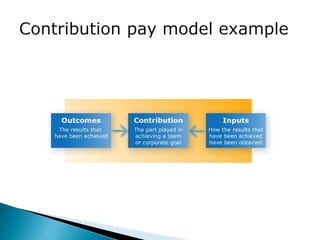
 Provides basis for making pay decisions related to
outcomes, inputs and personal competencies.
 Seen as taking the best of performance-related pay
and competency-related pay.
 Focuses on what the employee is there to do.
 It’s a holistic approach.
 Takes account of both past successes and future
potential.
 Pay awards are governed by assessments of
performance and competency; the amount is
determined by a pay matrix and is somewhat
mechanistic.
 Output is the only factor that governs cash bonuses,
but competency is the major component in determining
base pay, on the grounds that the latter is paid for
what people are capable of doing while the former
rewards them for what they achieve.
• The reference point is the maximum level of
consolidated pay a high performer can expect to attain
• A minimum level of pay for each grade is determined
and progression to the reference point depends upon
achieving defined levels of competence; there may be
three or four levels
• There is scope to reward those who perform
exceptionally well with a re-earnable cash bonus, which
could be consolidated if the level of exceptional
performance is sustained over two to three years, up to
a maximum level defined for the grade
 Performers can earn a mix of base pay increase and
bonus, which varies according to their position in the
pay range.
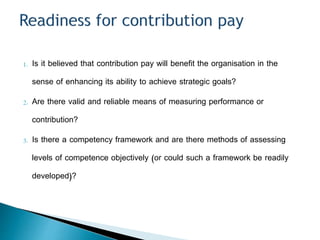
1. Is it believed that contribution pay will benefit the organisation in the
sense of enhancing its ability to achieve strategic goals?
2. Are there valid and reliable means of measuring performance or
contribution?
3. Is there a competency framework and are there methods of assessing
levels of competence objectively (or could such a framework be readily
developed)?
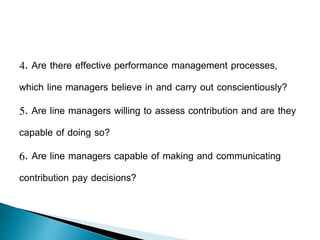
4. Are there effective performance management processes,
which line managers believe in and carry out conscientiously?
5. Are line managers willing to assess contribution and are they
capable of doing so?
6. Are line managers capable of making and communicating
contribution pay decisions?
7. Is the HR function capable of providing advice and
guidance to line managers in managing contribution pay?
8. Can procedures be developed to ensure fairness and
consistency in assessments and pay decisions?
9. Are employees and trade unions willing to accept
the scheme?
10. Do employees trust management to deliver the
deal fairly and objectively?