
Revised Schedule VI
to The Companies Act, 1956 – Features, Concepts & Disclosures


                                  A revised schedule is to business,
                                 what a new season is to an athlete
                                       or a new canvas to an artist.
                                        Norman Ralph Augustine


                                             CA. Ankur
                                             Chaplot
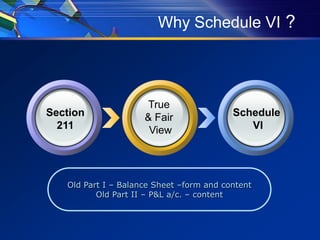
Why Schedule VI ?


                     True
Section              & Fair               Schedule
  211                 View                   VI


   Old Part I – Balance Sheet –form and content
          Old Part II – P&L a/c. – content
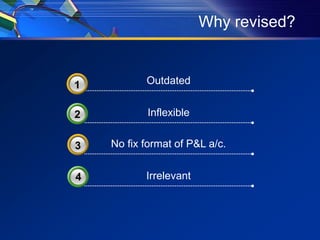
Why revised?


3
1          Outdated


2          Inflexible


3   No fix format of P&L a/c.


4          Irrelevant
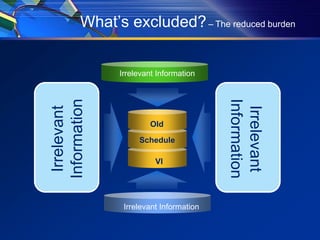
What’s excluded? – The reduced burden


               Irrelevant Information


                                         Information
Information


                                          Irrelevant
 Irrelevant


                       Old
                    Schedule

                         VI


                Irrelevant Information
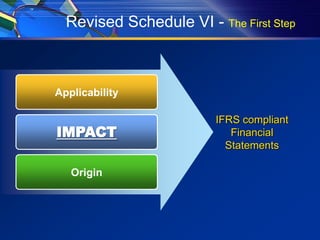
Revised Schedule VI - The First Step


Applicability

                         IFRS compliant
IMPACT                      Financial
                           Statements

   Origin
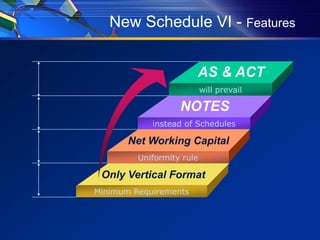
New Schedule VI - Features


                       AS & ACT
                           will prevail

                   NOTES
            instead of Schedules

       Net Working Capital
         Uniformity rule

 Only Vertical Format
Minimum Requirements
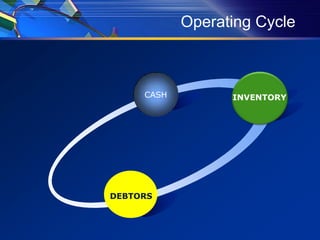
Operating Cycle


     CASH         INVENTORY


DEBTORS
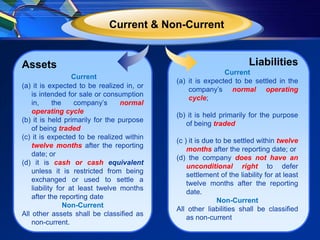
Current & Non-Current


Assets                                                               Liabilities
                                                           Current
                   Current
                                           (a) it is expected to be settled in the
(a) it is expected to be realized in, or
                                               company’s normal operating
    is intended for sale or consumption
                                               cycle;
    in,      the    company’s     normal
    operating cycle;
                                           (b) it is held primarily for the purpose
(b) it is held primarily for the purpose
                                              of being traded
    of being traded;
(c) it is expected to be realized within
                                           (c ) it is due to be settled within twelve
    twelve months after the reporting
                                               months after the reporting date; or
    date; or
                                           (d) the company does not have an
(d) it is cash or cash equivalent
                                               unconditional right to defer
    unless it is restricted from being
                                               settlement of the liability for at least
    exchanged or used to settle a
                                               twelve months after the reporting
    liability for at least twelve months
                                               date.
    after the reporting date.
                                                           Non-Current
                 Non-Current
                                           All other liabilities shall be classified
All other assets shall be classified as
                                               as non-current
    non-current.
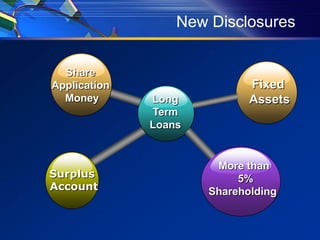
New Disclosures


  Share
Application                  Fixed
  Money       Long           Assets
              Term
              Loans


                       More than
Surplus                    5%
Account               Shareholding
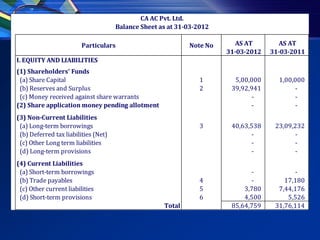
CA AC Pvt. Ltd.
                                      Balance Sheet as at 31-03-2012

                         Particulars                         Note No      AS AT        AS AT
                                                                       31-03-2012   31-03-2011
I. EQUITY AND LIABILITIES
(1) Shareholders' Funds
 (a) Share Capital                                              1        5,00,000     1,00,000
 (b) Reserves and Surplus                                       2       39,92,941          -
 (c) Money received against share warrants                                    -            -
(2) Share application money pending allotment                                 -            -
(3) Non-Current Liabilities
 (a) Long-term borrowings                                       3       40,63,538    23,09,232
 (b) Deferred tax liabilities (Net)                                           -            -
 (c) Other Long term liabilities                                              -            -
 (d) Long-term provisions                                                     -            -
(4) Current Liabilities
 (a) Short-term borrowings                                                    -            -
 (b) Trade payables                                             4             -         17,180
 (c) Other current liabilities                                  5           3,780     7,44,176
 (d) Short-term provisions                                      6           4,500        5,526
                                                     Total              85,64,759    31,76,114
II.Assets
(1) Non-current assets
 (a) Fixed assets
   (i) Tangible assets                                7    51,30,759    7,68,420
   (ii) Intangible assets                             8          -           -
   (iii) Capital work-in-progress                                -           -
   (iv) Intangible assets under development                      -           -
 (b) Non-current investments                                     -           -
 (c) Deferred tax assets (net)                              1,83,682    1,83,682
 (d) Long term loans and advances                     9      18,200      10,000
 (e) Other non-current assets                         10         -           -


(2) Current assets
 (a) Current investments                                         -           -
 (b) Inventories                                            8,79,087   20,87,081
 (c) Trade receivables                                11      7,086          -
 (d) Cash and cash equivalents                        12    1,68,211    1,26,931
 (e) Short-term loans and advances                    13   12,80,663         -
 (f) Other current assets                             14         -           -
                                              Total        76,67,688   31,76,114
Contingent liabilities and commitments
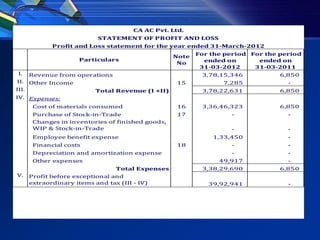
CA AC Pvt. Ltd.
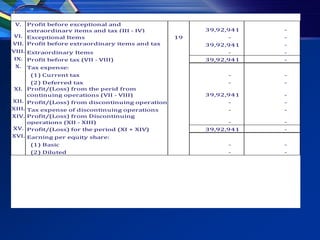
                            STATEMENT OF PROFIT AND LOSS
              Profit and Loss statement for the year ended 31-March-2012
                                                    Note   For the period For the period
                      Particulars                            ended on       ended on
                                                     No
                                                            31-03-2012     31-03-2011
 I.    Revenue from operations                              3,78,15,346           6,850
II.    Other Income                                 15            7,285             -
III.                       Total Revenue (I +II)            3,78,22,631           6,850
IV. Expenses:
        Cost of materials consumed                  16      3,36,46,323           6,850
        Purchase of Stock-in-Trade                  17              -               -
        Changes in inventories of finished goods,
        WIP & Stock-in-Trade                                        -               -
        Employee benefit expense                               1,33,450             -
        Financial costs                             18              -               -
        Depreciation and amortization expense                       -               -
        Other expenses                                           49,917             -
                                  Total Expenses            3,38,29,690           6,850
V.     Profit before exceptional and
       extraordinary items and tax (III - IV)                 39,92,941             -
V.  Profit before exceptional and
     extraordinary items and tax (III - IV)             39,92,941   -
VI. Exceptional Items                              19         -     -
VII. Profit before extraordinary items and tax          39,92,941   -
VIII. Extraordinary Items                                     -     -
 IX. Profit before tax (VII - VIII)                     39,92,941   -
  X. Tax expense:
      (1) Current tax                                         -     -
       (2) Deferred tax                                       -     -
 XI. Profit/(Loss) from the perid from
      continuing operations (VII - VIII)                39,92,941   -
XII. Profit/(Loss) from discontinuing operations              -     -
XIII. Tax expense of discontinuing operations                 -     -
XIV. Profit/(Loss) from Discontinuing
     operations (XII - XIII)                                  -     -
XV. Profit/(Loss) for the period (XI + XIV)             39,92,941   -
XVI. Earning per equity share:
      (1) Basic                                               -     -
      (2) Diluted                                             -     -
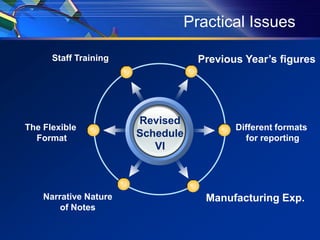
Practical Issues

      Staff Training              Previous Year’s figures


                       Revised
The Flexible                             Different formats
  Format               Schedule            for reporting
                          VI


    Narrative Nature               Manufacturing Exp.
        of Notes
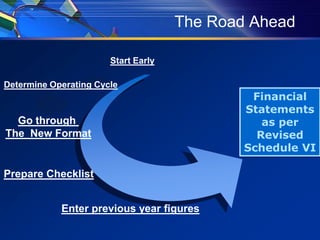
The Road Ahead

                       Start Early

Determine Operating Cycle
                                              Financial
                                             Statements
  Go through                                    as per
The New Format                                 Revised
                                             Schedule VI

Prepare Checklist


            Enter previous year figures
The only way to make sense out of change is to
         plunge into it, move with it,
             and join the dance.

                 Alan Watts


                                  CA. Ankur
                                  Chaplot

Revised Schedule VI of Companies Act, 1956

  • 1.
    Revised Schedule VI toThe Companies Act, 1956 – Features, Concepts & Disclosures A revised schedule is to business, what a new season is to an athlete or a new canvas to an artist. Norman Ralph Augustine CA. Ankur Chaplot
  • 2.
    Why Schedule VI? True Section & Fair Schedule 211 View VI Old Part I – Balance Sheet –form and content Old Part II – P&L a/c. – content
  • 3.
    Why revised? 3 1 Outdated 2 Inflexible 3 No fix format of P&L a/c. 4 Irrelevant
  • 4.
    What’s excluded? –The reduced burden Irrelevant Information Information Information Irrelevant Irrelevant Old Schedule VI Irrelevant Information
  • 5.
    Revised Schedule VI- The First Step Applicability IFRS compliant IMPACT Financial Statements Origin
  • 6.
    New Schedule VI- Features AS & ACT will prevail NOTES instead of Schedules Net Working Capital Uniformity rule Only Vertical Format Minimum Requirements
  • 7.
    Operating Cycle CASH INVENTORY DEBTORS
  • 8.
    Current & Non-Current Assets Liabilities Current Current (a) it is expected to be settled in the (a) it is expected to be realized in, or company’s normal operating is intended for sale or consumption cycle; in, the company’s normal operating cycle; (b) it is held primarily for the purpose (b) it is held primarily for the purpose of being traded of being traded; (c) it is expected to be realized within (c ) it is due to be settled within twelve twelve months after the reporting months after the reporting date; or date; or (d) the company does not have an (d) it is cash or cash equivalent unconditional right to defer unless it is restricted from being settlement of the liability for at least exchanged or used to settle a twelve months after the reporting liability for at least twelve months date. after the reporting date. Non-Current Non-Current All other liabilities shall be classified All other assets shall be classified as as non-current non-current.
  • 9.
    New Disclosures Share Application Fixed Money Long Assets Term Loans More than Surplus 5% Account Shareholding
  • 10.
    CA AC Pvt.Ltd. Balance Sheet as at 31-03-2012 Particulars Note No AS AT AS AT 31-03-2012 31-03-2011 I. EQUITY AND LIABILITIES (1) Shareholders' Funds (a) Share Capital 1 5,00,000 1,00,000 (b) Reserves and Surplus 2 39,92,941 - (c) Money received against share warrants - - (2) Share application money pending allotment - - (3) Non-Current Liabilities (a) Long-term borrowings 3 40,63,538 23,09,232 (b) Deferred tax liabilities (Net) - - (c) Other Long term liabilities - - (d) Long-term provisions - - (4) Current Liabilities (a) Short-term borrowings - - (b) Trade payables 4 - 17,180 (c) Other current liabilities 5 3,780 7,44,176 (d) Short-term provisions 6 4,500 5,526 Total 85,64,759 31,76,114
  • 11.
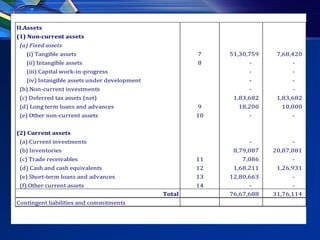
    II.Assets (1) Non-current assets (a) Fixed assets (i) Tangible assets 7 51,30,759 7,68,420 (ii) Intangible assets 8 - - (iii) Capital work-in-progress - - (iv) Intangible assets under development - - (b) Non-current investments - - (c) Deferred tax assets (net) 1,83,682 1,83,682 (d) Long term loans and advances 9 18,200 10,000 (e) Other non-current assets 10 - - (2) Current assets (a) Current investments - - (b) Inventories 8,79,087 20,87,081 (c) Trade receivables 11 7,086 - (d) Cash and cash equivalents 12 1,68,211 1,26,931 (e) Short-term loans and advances 13 12,80,663 - (f) Other current assets 14 - - Total 76,67,688 31,76,114 Contingent liabilities and commitments
  • 12.
    CA AC Pvt.Ltd. STATEMENT OF PROFIT AND LOSS Profit and Loss statement for the year ended 31-March-2012 Note For the period For the period Particulars ended on ended on No 31-03-2012 31-03-2011 I. Revenue from operations 3,78,15,346 6,850 II. Other Income 15 7,285 - III. Total Revenue (I +II) 3,78,22,631 6,850 IV. Expenses: Cost of materials consumed 16 3,36,46,323 6,850 Purchase of Stock-in-Trade 17 - - Changes in inventories of finished goods, WIP & Stock-in-Trade - - Employee benefit expense 1,33,450 - Financial costs 18 - - Depreciation and amortization expense - - Other expenses 49,917 - Total Expenses 3,38,29,690 6,850 V. Profit before exceptional and extraordinary items and tax (III - IV) 39,92,941 -
  • 13.
    V. Profitbefore exceptional and extraordinary items and tax (III - IV) 39,92,941 - VI. Exceptional Items 19 - - VII. Profit before extraordinary items and tax 39,92,941 - VIII. Extraordinary Items - - IX. Profit before tax (VII - VIII) 39,92,941 - X. Tax expense: (1) Current tax - - (2) Deferred tax - - XI. Profit/(Loss) from the perid from continuing operations (VII - VIII) 39,92,941 - XII. Profit/(Loss) from discontinuing operations - - XIII. Tax expense of discontinuing operations - - XIV. Profit/(Loss) from Discontinuing operations (XII - XIII) - - XV. Profit/(Loss) for the period (XI + XIV) 39,92,941 - XVI. Earning per equity share: (1) Basic - - (2) Diluted - -
  • 14.
    Practical Issues Staff Training Previous Year’s figures Revised The Flexible Different formats Format Schedule for reporting VI Narrative Nature Manufacturing Exp. of Notes
  • 15.
    The Road Ahead Start Early Determine Operating Cycle Financial Statements Go through as per The New Format Revised Schedule VI Prepare Checklist Enter previous year figures
  • 16.
    The only wayto make sense out of change is to plunge into it, move with it, and join the dance. Alan Watts CA. Ankur Chaplot

Editor's Notes

  • #2 Hon’ble Central Council Member Shri Fadnis Sir, Respected Chairman & Secretary of Ratlam Branch, Senior and fellow members,First of all I would like to thank the managing committee of the branch for providing me stage to share my views on the Revised Schedule VI. When I first came to know that Fadnis Sir will also be delivering speech in the same seminar, I was nervous and proud at the same moment. Sir, its an honor for me to share stage with you.The topic of Today’s Seminar “Revised Schedule VI to the companies Act, 1956” will dramatically change various things in accounting, auditing and reporting of financial information of Indian corporate world. We will not only have to update ourselves but also our staff, our client and even our client’s employees as well. As it is usually said “ Well begun is half done”, so its quite important to call books of corporate clients for audit as early as possible, so that the audit work could be completed appropriately and timely.
  • #3 Why do we need to follow Schedule VI, the answer is Section 211 of the Companies Act.Sub section 1 of section 211 makes it mandatory for a company to provide it’s Balance Sheet in the form set out in Part I of Schedule VI and Sub Section 2 mandates to comply with the requirements of Part II of Schedule VI in drawing up its profit and loss account. However, both the statements must give a true and fair view of the Company’s state of affairs, operations and the net result.Further Subsection 3A requires compliance with  accounting standards recommended by the ICAI and prescribed by the Central Government in consultation with National Advisory Council.Thus, Schedule VI is mandatory for all companies except Insurance Companies, Banking companies or Power generation or power distribution or any other specified class of company or exempted company. Now the question arises why was revision of Schedule VI required.
  • #4 The old Schedule VI used to override all other provisions and accounting standards. The new standards in respect of deferred Taxes, Intangibles assets, leases, consolidation etc required disclosures which could not be easily merged with the old schedule. For example, deferred Tax liability is a non current liability and old Schedule VI does not prescribe anything on where and how to disclose Non current assets or liabilities. Then take the case of Intangible assets they also do not find a separate place in old schedule and were mixed with tangible ones. So, as the Act or Schedule could not be changed regularly with changing times and requirements, old Schedule became outdated. Old Schedule VI could not cover all type of industries like service sector industries and hence was considered inflexible.There was no fix format of profit & loss account, it was possible for a company to conceal certain information it does not want to provide and still be compliant with the act. <Click > Further, a lot of meaningless information which were considered quite important at some point 10-20 years back but are no longer required by stake holders today were required to be reported.
  • #5 Lets take a look on some important disclosures no longer required in the Revised Schedule VILicensed capacity, installed capacity and production details.Quantitative details of each class of goods purchase or sold.Expenditure in foreign currency and CIF value of Imports.Disclosures relating to managerial remuneration and computation of net profits for calculation of commission;Balance Sheet Abstract & General Business Profile of the company given at the end of Annual Report.Exam se pehleek CA apneek article se miliaurpuchapadaikaisichalrahi he jawabmila, padai se darnahilagtasaheb, amendment se lagta he. Par abokhlimein sir de diya to muslo se kyadarna. Amendments to aatejaaterahenge. Information on investments purchased and sold during the year;(d) Investments, sundry debtors and loans & advances pertaining to companies under the same management;(e) Maximum amounts due on account of loans and advances from directors or officers of the company;(f) Commission, brokerage and non-trade discounts; and(g) Information as required under Part IV of pre-revised Schedule VI.
  • #6 As it is said “ Pride has its fall” so the old Schedule VI has to leave its place because of its supreme authority and rigidity and kind hearted flexible New Schedule VI came in its place. The process of revision started in Nov 2008 and on 28th Feb 2011 , the Ministry of Corporate Affairs (MCA) issued a revised Schedule VI.Applicability of the Revised Schedule VI The effective date of application is from Financial year commencing on or after 1st April,2011 for all the companies registered with ROC. The exemption is for Banking Companies, Insurance Companies, Electricity companies, and where format are given in their respective statute. Also, Early adoption of the same is not permitted, as Schedule VI is a statutory requirement. OriginThe coverage of Schedule VI tree is vast, but where is the root, where have the formats been derived from - it is The International Accounting Standard 1 ‘Presentation of Financial Statements’. The Schedule VI has been drawn up to meet the requirements laid out in IAS 1. So, with Revised Schedule VI, we have taken the first step towards the era of IFRS compliant Financial Statements.ImpactAs the overriding effect of Schedule VI has been removed, the importance of Accounting Standards has increased and this is going to have a big impact on our work. For all those who have been giving lesser importance to Accounting Standards, its time to wake up, update themselves, read and review all those AS.The second big effect is the peculiar feature of New schedule which requires classification of assets and liabilities into Current & Non –current. If any of you is thinking of it as a minor job considering it’s an old concept we all have been following. Let me tell you its not so simple as it seems to be. Specially for the reason that the whole classification exercise has to be done at every reporting period. Thus, it means an asset classified as non-current this year might well be classified as current next year and we will have to verify and report it as so. Thus, we will have to alter and adjust our audit procedures to carry out this task.Abhumare family members yahikehange Audit ke season me CA kodhundanamuskil hi nahi, namumkin he.
  • #7 Now, lets take a look on the features of Revised Schedule VI, which makes it different and better to its older cousin.Minimum RequirementsRevised Schedule requires the company to maintain a balance between too much information and presenting all material disclosures. Thus, it allows flexibility to provide information relevant to the particular company. The schedule only lays down the minimum requirements that needs to be complied. If further or detailed information is required for proper understanding of Financial information reported, one is always welcome to do so. On the other hand, if there are fields which are not applicable to the company, there is no need to fill up ‘Not Applicable’ ‘N.A.’, one needs to just delete the field itself. This feature makes the schedule practical for various business sectors. Vertical FormatThe new Schedule VI mandates only vertical format of statements and horizontal formats are now not allowed.Uniformity RuleThe Schedule calls for uniformity in rounding off through out the Financial Statements, this will make them user friendly and more understandable. Net Working CapitalCurrent Liabilities will now be displayed under Liabilities only, and so there will no net working capital figure on the face of Balance Sheet.Notes instead of SchedulesEarlier Balance Sheet and P&L were connected with Schedules. Now, the related information of Balance sheet and statement of profit & loss items are required to be presented in form of Notes and cross reference is required for the same. The major difference between the two is that Schedules used to cover only the numbers and calculations, while notes are required in the form of or along with narrative description. Further, if required, the information related to four items in the balance sheet can be provided through a single note or one can have five different notes for one item in balance sheet.Act and AS will prevailAs I told earlier the revised Schedule keeps itself low profile and gives higher authority to other provisions of Act and prescribed Accounting Standards. The AS can be and are relatively changed on faster pace. So we will now be seeing new developments in our work area and will be expected to learn and adopt swiftly with them. & last but one of the most important one, the current & non-current classification, for that we need to first understand the term operating cycle.
  • #8 “An operating cycle is the time between the acquisition of assets for processing and their realisation in cash or cash equivalents. Where the normal operating cycle cannot be identified, it is assumed to have duration of twelve months.”Now the question arises whether credit period allowed by the supplier be reduced in computing operating cycleIf we take the literal interpretation of the definition, such credit period is not required to be reduced. However, the more appropriate view would be to deduct the credit period allowed by the supplier in computing operating cycle, because operating cycles are computed from the date of cash outgo for acquisition of the asset to their realisation and presence of creditors results in profitable delay in date of cash outgo. In case of a company there can be different operating cycle for different segments, different products, different projects, etc.For example in case of the Financial Institutions and NBFCs, advances are provided for various terms and then realised in instalments during the period of advance.Thus, each advance has different realisation period and this makes determination of operating cycle a complex task. Under such circumstances, operating cycle is not required to be computed by looking into each transaction, rather its average period of realisation of advances is determined which shall be considered as operating cycle. Alternatively, if operating cycle is not determinable, the same may be taken as 12 months.Similarly, in case of Real Estate Project Developers the expenditure for development of the property is also incurred phase-wise and sale consideration is also realised in instalments, which are kept as advances from customers. Thus, for computing operating cycle averaging is required to be done.Another issue in computation of Operating Cycle is whether it can change from period to periodIf in previous year, the company used to provide 30 days credit to its customer but changed it to 45 days this year, there will definitely be change in operating cycle. However, special one time credit period granted to a customer should be ignored while computing the period.
  • #9 No right to defer settlement of the liabilityHowever, option to the counter party to settle a liability by issue of equity shares do not affect its classification.Audit AngleThe auditor needs to apply his judgement while verifying the current , non-current classification, specially inventories held since long and Debtors outstanding since long should be properly examined. If the debtor is outstanding for a longer period and yet company reports it as current then, substantive evidence should be to prove this fact. Also, if any provision is created against recovery from such debtor, the same must be classified as non-current.The companies should maintain proper records with it so as to establish that all the terms and conditions of the liabilities have been satisfied by it and, therefore, these liabilities are not payable on demand. The auditor has to take due care regarding the same to examine whether there is any condition which has not been complied with before the date of reporting.MCA ka favorite song – baithekyakarekarna he kuchkaam, chalobanayenaya schedule kare CA ka jinamuhal.Along with separate disclosure of current and non-current items, there are various other new disclosures to be made.
  • #10 New Disclosures1. A reconciliation of opening and closing share capital needs to be disclosed. Also, a new disclosure requirement regarding details of number of shares held by each shareholder holding more than 5% shares in the company has been inserted by the Revised Schedule VI. 2. In case of Long-term Borrowings, the Revised Schedule VI requires disclosing repayment terms of long term loans and other loans. The repayment schedule of term loans can be handy in this regard but for other loans documentary evidences like dalalpana or loan agreement need to be relied on. Term Loans from Banks and from related parties are to be separately shown under long term borrowings. Period and amount of continuing default, if any, as on the balance sheet date in repayment of loans and interest need to be separately disclosed.3. The Surplus Account will show the allocations and appropriations such as transfer to reserves, dividend, etc. Also, the debit balance of P&L a/c. is required to be shown as a negative figure under the head Surplus in Reserves & Surplus.4. In case of Tangible Fixed Assets, office equipments have been given a separate place and a new sub- group has been evolved for reporting of Intangible fixed assets. 5. Share Application Money pending allotment has to be separately disclosed with terms and conditions, as many companies were exaggerating their share capital at particular occasions like for bank loans by receiving share application money. This was increasing the chances of fraud and misappropriation by companies.As for the first time a format of Profit & Loss account has been provided, It has been renamed as Statement of Profit & Loss account and disclosures like exceptional and extra-ordinary items, profit from discontinuing operations, etc. have been separately provided for.Details of payments made to auditor – for each service provided by him need to be separately disclosed such as for auditing, taxation, etc. Also, reimbursement of expenses need to be disclosed separately.Revised Schedule aanebaad 10000/- ke general expenses ne P&L a/c. se kyakaha, “Ekchutki expenses kikimattumkyajaano P&L Babu”Any item of income / expense which exceeds one per cent of the revenue from operations or Rs. 1,00,000, which ever is higher is to be disclosed separately.
  • #11 As per Accounting Standard 22, deferred tax liability will always be taken as non-current, even if the entire amount is reversible in the next year. The terms used in Old Schedule & New Schedule are similar but yet have different meaning, For example The term ‘Sundry Creditors’ has been defined in the Guidance Note on terms used in financial statements as amount owed by an enterprise on account of goods purchased or services received or in respect of contractual obligations. Thus, the liabilities on account of purchase of fixed assets, reimbursement of expense, audit fees, contribution to PF, etc. will not be clubbed with Creditors but classified as other liabilities.Classification of security deposits (either asset or liability)Where any company has deposited or accepted any security deposit for performance of any contract or so, and deposits are receivable/payable only when the contract is complete, the estimated time of completion of the contract needs to be determined and the amount be classified accordingly. Deposits given for electricity connection or telephone services are classified as non-current as these services are expected to be used till the continuation of business.Similarly, Security deposits from agents are classified as non-current because it is expected that agents will continue to be associated with the company for a longer period. Liability related to legal cases be shown as Long-term or short-term?whether there is any evidence that will reflect it to be settled within 12 months of the reporting period, then it will be taken as a current liability, otherwise it will be considered as under non-current as other long-term liabilities.
  • #12 Taxes RefundableTaxes deposited by the company during the pendency of appeals before appellate authorities or courts will have to be examined and if decision is expected in near future then the same may be classified as current.InvestmentsInvestments which are not shown at cost are to be separately shown along with their basis of valuation.Trade ReceivablesDebtors under old schedule were classified as outstanding for more than six months and others from the date of sale. As per the revised schedule the calculation of six months is required to be done from the due date of payment. Thus, at first due date need to be ascertained and if there is no documentary evidence suggesting the due date, normal credit period allowed should be considered.Disclosure in respect of fixed depositsFixed deposits that are pledged as security deposits and have restrictions on their maturity should be taken as security deposits and not classified as cash equivalent. Now consider this, how will we disclose MAT credit likely to be reversed in next year?If it is expected by the management that a portion of MAT credit can be used/reversed in the next year then that portion can be disclosed in 'short-term loan and advances', under the head "current assets" and the remaining portion should be disclosed as 'Long-term loan and advance' under the head "non- current assets". Another view is to consider that even if the company expects to pay taxes as per normal computation for the next year and would be entitled to adjust the MAT credit against taxes, it can do so only after 31-3-2013 at the time of filing of return of income. Thus, MAT Credit cannot be adjusted within 12 months from the reporting date i.e. 31-3-2012. Hence, MAT credit receivable should be classified as non-current.
  • #13 Finance Costs will be classified into Interest expenses, Borrowing costs and Foreign exchange fluctuation gains or losses. Thus, bank charges and all other incidental borrowing expenses will be clubbed with Interest cost.Foreign Exchange Fluctuation Net foreign exchange gain should be classified as other income, as it does not arises on account of sale of goods, unless the business of the company is to deal in foreign exchange.
  • #14 As we discussed earlier, the format given in the Revised Schedule VI, can be modified to follow accounting standards, Para 15 of AS 5 ‘Net Profit or Loss for the Period, Prior Period Items and Changes in Accounting Policies’ requires that the nature and amount of prior period items should be separately disclosed in the statement of profit and loss
  • #15 Previous Year’s figuresEkbaarjomaine balance sheet banadi to mein calculator aur computer kibhinahisunta. Computer kochodiye, Revised Schedule VI ki to aapkosunani hi padegiAs, corresponding previous year’s information will have to be presented starting from the first year of application of the Revised Schedule VI, i.e. Financial Year 2011-12. This will require all companies to take an extra effort in resetting, restating and re-classification of corresponding amounts of 2010-11 for disclosing in Revised Schedule VI. The statutory auditors will also have to re-examine such corresponding figures to the verify that they are reported in accordance with New Schedule VI.Finance CostAs the figure on face of Statement of Profit & Loss account will now include bank charges as well, so the figure of interest expenses as shown in Part A of Form 3CD will not match with this figure or can we alternatively use the finance cost figure as interest expenses in Part A.Manufacturing ExpensesThe Statement of Profit & Loss does not provide for a separate place for manufacturing expenses. So, in manufacturing companies if one clubs it with other expenses, the amount will be huge and will also not be a fair presentation of financial info. So its better to add a separate line item in P&L Statement before Employees Cost.Narrative Nature of NotesThe narrative nature of notes might well take some time to be implemented properly by SMEs because of their limited available skill sets. We Chartered Accountants are also better at number work then with words.The Flexible Format The flexibility might well be a good thing about the new schedule but the fixed format had its own virtue. Fixed formats themselves work as checklists, so you don’t need to remember all the disclosures required. You just need to give details if its applicable to the given case. For example, if in 2011-12 company has incurred expenses on employee stock option scheme for the first time, then while preparing Revised Schedule VI statements one needs to first know that the particular item is required to disclosed separately and also where the same is required to be disclosed. So, checklists are quite important here. Also, making these statements without using software or without having advanced excel skills will be quite difficult.
  • #16 Inconsistencies to be removed:Listed companies require to publish information on quarterly and annual basis in the prescribed format in terms of clauses 41(l)(ea) and 41(l)(eaa) of the Listing Agreement. These formats are inconsistent with formats under the Revised Schedule VI. However, since the formats are statutory formats as per the Listing Agreement, the same will have to be followed till the time a new format is prescribed under Clause 41 of the Listing Agreement.ROADMAP TO COMPLIANCE¢ Start early…¢ Identify operating cycle¢ Review chart of accounts¢ Carry out requisite modifications in chart of accounts¢ Prepare a disclosure checklist¢ Rework comparatives¢ Draw up statements as per the Revised Schedule VIYe to sirf shuruat he, Balance Sheet banana abhi baaki hai doston.
  • #17 As Alan Watts said, The only way to make sense out of change is to plunge into it, move with it, and join the dance. It is said that every change brings opportunities. While I am talking about this change as an opportunity, I wonder how much value we are willing to get from this opportunity. Will we convert the balance sheets of previous year into the revised schedule free of cost. Will we be advising our client and coaching their staff without considering the time and cost involved. Will we do all the exercise to classify the client’s balance sheet items into current & non-current item, assuming its our responsibility to do the same. Will we even tell our clients about the increased workload or we will not even let him know about it, Why to give him tension. I end my submission putting this question to the Branch members, Will we revise our fees keeping in view the revised Schedule VI.