Revised Schedule VI.
 Presented by
 Tahira Sarkar.



Introduction:
 In recent times the Indian commercial field has undergone
  a number of significant changes . Changes in Method of
  Accounting and its financial statements of corporate
  bodies is a major outcome of this changing scenario.
  Institute of chartered accountants of India and government
  of India have joined hands to make Indian Accounting
  System convergent with International norms of accounting
  . The ministry of Corporate Affairs issued the revised
  format of Schedule VI dated 28th February,2011.For the
  year 2011-2012 every company whether public or private,
  listed or unlisted has to prepare its financial statements as
  required by the Revised Schedule VI.
 SOME BASIC POINTS & SALIENT
 FEATURES:
 􀂙 Format of Schedule VI was notified vide No. SO 447 (E), dated 28th
 February 2011 and the effective date was notified vide No. SO
 653(E), dated 30th March 2011.
 􀂙 New Schedule VI shall come into force for the Balance Sheet and
 Profit & Loss Account to be prepared for the financial year
 commencing on or after 1st April 2011.
 􀂙 It has two parts Part I and part II. Part I for Balance Sheet and Part
 II for Profit & Loss Account.
 􀂙 The Company need not prepare Part IV ie., Abstract of the
 Company’s General Business Profile.
 􀂙 New Schedule VI imports concepts from Ind AS (Indian Accounting
 Standards), which are yet to be notified. It is also retaining certain
 concepts from existing AS which are omitted in Ind AS.
SOME BASIC POINTS & SALIENT
FEATURES: (Cont…)
 􀂙 Vertical form of Balance Sheet & Profit & Loss Account is compulsory.

  􀂙 The term “Schedule” is replaced with “Note” in the new format of Schedule
VI.
  􀂙 Pre-or Rs.5,000/‐, whichever is higher should be separately
disclosed. Under the new Schedule VI, any INCOME or EXPENDITURE which
exceeds 1% of the “REVENUE FROM OPERATIONS” or Rs.1,00,000/‐,
whichever is higher. Any expenses (with some exceptions) which fall
below the category should be clubbed with “Miscellaneous Expenses”.
  􀂙 Except in the case of first Financial Year, corresponding previous year
figures (comparatives) should be furnished.
GENERAL INSTRUCTIONS: (Cont..)
 􀂙 Assets and Liabilities are classified as “Current” and “Non‐Current”.
 􀂙 “Current” (assets / liabilities) means:
– It is expected to be realized or is intended for sale or
consumption in or settled, the company’s normal operating
cycle.
– It is primarily for the purpose of being traded;
– It is expected to be realized within 12 months and
– Cash or cash equivalent unless restricted from being exchanged
or used to settle a liability for at least twelve months after the
reporting date (Current Assets)
– The Company does not have an unconditional right to defer
settlement of the liability for at least twelve months after the
reporting date. Terms of liability that could, at the option of the
counter party, result in its settlement by the issue of equity
instruments do not affect the classification. (Current Liabilities).
GENERAL INSTRUCTIONS: (Cont..)
    􀂙 “Operating Cycle” is the time between the acquisition of assets for
   processing and their realization in cash or cash equivalents. Where
   the normal operating cycle cannot be identified, it is assumed to
   have a duration of 12 months.
    􀂙􀂙 ALL other Assets / Liabilities are non‐current assets / liabilities.
    􀂙 A Receivable shall be classified as “TRADE RECEIVABLE” if it is in
   respect of the amount due on account of GOODS SOLD or SERVICES
   RENDERED in the normal course of business.
    􀂙 A Payable shall be classified as “TRADE PAYABLE” if it is in respect
   of the amount due on account of GOODS PURCHASED or SERVICES
   RECEIVED in the normal course of business.
GENERAL INSTRUCTIONS: (Cont..)
TANGIBLE ASSETS:
 􀂙 Classification:
o Land
o Building
o Plant and Equipment
o Furniture and Fixtures
o Vehicles
o Office Equipment
o Others (Specify)
 􀂙 Assets under Lease shall be separately
specified under each class of assets.
 􀂙􀂙 A reconciliation of the gross and net
carrying amounts of each class of assets at
the
beginning and end of the reporting period
showing additions, disposals, acquisitions
through
business combinations and other
adjustments and the related depreciation
and impairment
losses / reversals shall be DISCLOSED
SEPARATELY.
􀂙 Where sums have been written off on a
Reduction of Capital or revaluation of assets
or
where sums have been added on revaluation
of assets, every balance sheet subsequent to
date of such write‐off, or addition shall show
the reduced or increased figures as
applicable
and shall by way of a note also show the
amount of the reduction or increase as
applicable
together with the date thereof for the FIRST
FIVE YEARS subsequent to the date of such
reduction or increase.
NON‐CURRENT INVESTMENTS:
 􀂙 Non‐current Investments shall be classified
as TRADE INVESTMENTS and OTHER
INVESTMENTS and further classified as:
o Investment in property;*
o Equity shares
o Preference shares
o Government or trust securities
o Debentures or bonds;
o Mutual Funds
o Partnership firms
o Other non‐current investments (specify)
NON‐CURRENT INVESTMENTS:
(Cont……)
 􀂙 Under each classification, details shall be
given of NAMES of the BODIES
CORPORATE indicating separately whether
such bodies are
o Subsidiaries
o Associates
o Joint Ventures or
o Controlled Special purpose entities
 􀂙 In whom investments have been made
and the NATURE and EXTENT of the
Investments in each of such bodies
corporate. Partly paid should be shown
separately.
 􀂙 In case of PARTERSHIP FIRMS:
o Name of the Firm and the Name of all the
partners
o Total capital and
o Shares of each partners.
 􀂙􀂙 Investments carried at OTHER THAN
at COST should be separately stated
specifying the basis for valuation thereof.
GENERAL INSTRUCTIONS: (Cont..)
INVENTORIES:
Classification
– Raw material;
– Work in progress
– Finished goods
– Stock in trade (for traded goods)
– Stores and spares;
– Loose Tools
– Others (Specify)
  􀂙 Goods in Transit should be disclosed
under relevant sub‐heads.
  􀂙 Mode of valuation shall be stated.
TRADE RECEIVABLES:
  􀂙 Outstanding for a period exceeding six
months “from the date they are due for
payment” should be shown separately.
– Sub‐classification:
• Secured, considered good
• Unsecured, considered good
• Doubtful
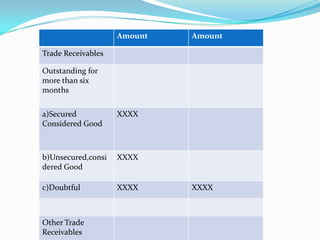
Amount   Amount

Trade Receivables

Outstanding for
more than six
months

a)Secured           XXXX
Considered Good


b)Unsecured,consi   XXXX
dered Good

c)Doubtful          XXXX     XXXX


Other Trade
Receivables
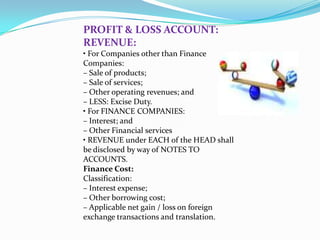
PROFIT & LOSS ACCOUNT:
REVENUE:
• For Companies other than Finance
Companies:
– Sale of products;
– Sale of services;
– Other operating revenues; and
– LESS: Excise Duty.
• For FINANCE COMPANIES:
– Interest; and
– Other Financial services
• REVENUE under EACH of the HEAD shall
be disclosed by way of NOTES TO
ACCOUNTS.
Finance Cost:
Classification:
– Interest expense;
– Other borrowing cost;
– Applicable net gain / loss on foreign
exchange transactions and translation.
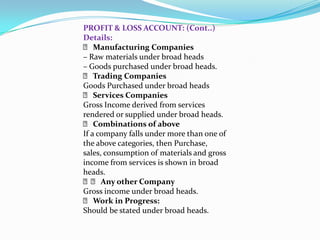
PROFIT & LOSS ACCOUNT: (Cont..)
Details:
  􀂙 Manufacturing Companies
– Raw materials under broad heads
– Goods purchased under broad heads.
  􀂙 Trading Companies
Goods Purchased under broad heads
  􀂙 Services Companies
Gross Income derived from services
rendered or supplied under broad heads.
  􀂙 Combinations of above
If a company falls under more than one of
the above categories, then Purchase,
sales, consumption of materials and gross
income from services is shown in broad
heads.
  􀂙􀂙 Any other Company
Gross income under broad heads.
  􀂙 Work in Progress:
Should be stated under broad heads.
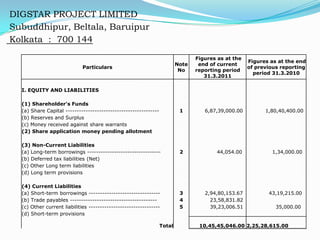
DIGSTAR PROJECT LIMITED
Subuddhipur, Beltala, Baruipur
Kolkata : 700 144

                                                                                Figures as at the
                                                                                                    Figures as at the end
                                                                         Note    end of current
                             Particulars                                                            of previous reporting
                                                                          No    reporting period
                                                                                                      period 31.3.2010
                                                                                   31.3.2011

  I. EQUITY AND LIABILITIES

  (1) Shareholder's Funds
  (a) Share Capital ------------------------------------------            1        6,87,39,000.00         1,80,40,400.00
  (b) Reserves and Surplus
  (c) Money received against share warrants
  (2) Share application money pending allotment

  (3) Non-Current Liabilities
  (a) Long-term borrowings ---------------------------------              2            44,054.00            1,34,000.00
  (b) Deferred tax liabilities (Net)
  (c) Other Long term liabilities
  (d) Long term provisions

  (4) Current Liabilities
  (a) Short-term borrowings --------------------------------              3        2,94,80,153.67          43,19,215.00
  (b) Trade payables ---------------------------------------              4          23,58,831.82
  (c) Other current liabilities --------------------------------          5          39,23,006.51             35,000.00
  (d) Short-term provisions

                                                                 Total           10,45,45,046.00 2,25,28,615.00
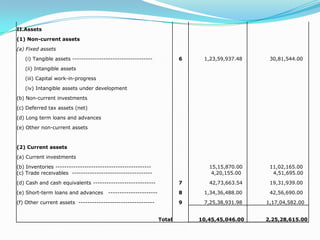
II.Assets

(1) Non-current assets

(a) Fixed assets

   (i) Tangible assets ------------------------------------             6    1,23,59,937.48    30,81,544.00

   (ii) Intangible assets

   (iii) Capital work-in-progress

   (iv) Intangible assets under development

(b) Non-current investments

(c) Deferred tax assets (net)

(d) Long term loans and advances
(e) Other non-current assets


(2) Current assets

(a) Current investments

(b) Inventories -------------------------------------------                    15,15,870.00    11,02,165.00
(c) Trade receivables ------------------------------------                      4,20,155.00     4,51,695.00
(d) Cash and cash equivalents ----------------------------              7      42,73,663.54    19,31,939.00

(e) Short-term loans and advances      ----------------------           8    1,34,36,488.00    42,56,690.00
(f) Other current assets ----------------------------------             9    7,25,38,931.98   1,17,04,582.00


                                                                Total       10,45,45,046.00   2,25,28,615.00
DIGSTAR PROJECT LIMITED

Subuddhipur, Beltala, Baruipur

Kolkata : 700 144

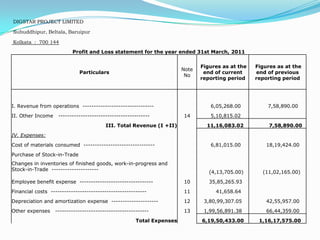
                          Profit and Loss statement for the year ended 31st March, 2011

                                                                               Figures as at the   Figures as at the
                                                                        Note
                             Particulars                                        end of current     end of previous
                                                                         No
                                                                               reporting period    reporting period


I. Revenue from operations --------------------------------                       6,05,268.00          7,58,890.00
II. Other Income    -----------------------------------------           14        5,10,815.02
                                         III. Total Revenue (I +II)              11,16,083.02           7,58,890.00
IV. Expenses:
Cost of materials consumed --------------------------------                       6,81,015.00          18,19,424.00
Purchase of Stock-in-Trade
Changes in inventories of finished goods, work-in-progress and
Stock-in-Trade ---------------------
                                                                                  (4,13,705.00)      (11,02,165.00)
Employee benefit expense ---------------------------------              10        35,85,265.93
Financial costs -------------------------------------------             11          41,658.64
Depreciation and amortization expense ---------------------             12      3,80,99,307.05         42,55,957.00
Other expenses     ------------------------------------------           13      1,99,56,891.38         66,44,359.00
                                                       Total Expenses          6,19,50,433.00       1,16,17,575.00
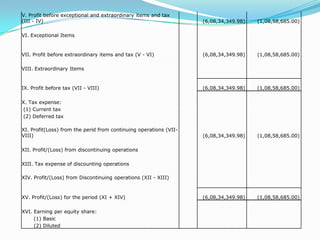
V. Profit before exceptional and extraordinary items and tax
(III - IV)                                                         (6,08,34,349.98)   (1,08,58,685.00)

VI. Exceptional Items


VII. Profit before extraordinary items and tax (V - VI)            (6,08,34,349.98)   (1,08,58,685.00)

VIII. Extraordinary Items


IX. Profit before tax (VII - VIII)                                 (6,08,34,349.98)   (1,08,58,685.00)

X. Tax expense:
(1) Current tax
(2) Deferred tax

XI. Profit(Loss) from the perid from continuing operations (VII-
VIII)                                                              (6,08,34,349.98)   (1,08,58,685.00)

XII. Profit/(Loss) from discontinuing operations

XIII. Tax expense of discounting operations

XIV. Profit/(Loss) from Discontinuing operations (XII - XIII)


XV. Profit/(Loss) for the period (XI + XIV)                        (6,08,34,349.98)   (1,08,58,685.00)

XVI. Earning per equity share:
     (1) Basic
     (2) Diluted
Conclusion:
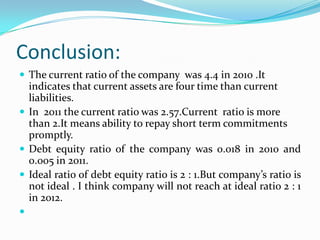
 The current ratio of the company was 4.4 in 2010 .It
  indicates that current assets are four time than current
  liabilities.
 In 2011 the current ratio was 2.57.Current ratio is more
  than 2.It means ability to repay short term commitments
  promptly.
 Debt equity ratio of the company was 0.018 in 2010 and
  0.005 in 2011.
 Ideal ratio of debt equity ratio is 2 : 1.But company’s ratio is
  not ideal . I think company will not reach at ideal ratio 2 : 1
  in 2012.

Conclusion(cont)
 Debtors Turn over ratio of the company was 1.6 in 2010
 and 1.44 in 2011.It indicates the speed of collection of
  sales. Here it indicates the speed of collection of
  credit sales.
 The company is going in loss .The company
  established few engineering colleges . For the
  establishment of college most of the fund is invested
  in fixed assets . So cash inflow is expected in future
  periods.
1.Accounting Convention
“The Financial Statement are prepared under the historical cost convention, in
accordance with applicable Accounting standards as specified under section 211(3C) of
the Companies Act, 1956, as opted by the Company. All Income & Expenditure having
material bearing on the Financial Statement is accounted for on accrual basis and
provision is made for all known losses and liabilities.”
      1.Fixed Assets & Depreciation
All fixed Assets are stated at cost of acquisition less depreciation and impairment loss.
Depreciation on Fixed Assets is provided on Written down value method based on
estimated useful lives, as estimated by the management.
      1.Investments
Long term investments are carried at cost and provision is made to recognize any
decline, other than temporary, in the carrying value of the investments. Current
investments are stated at lower of cost and net realizable value.
1.Revenue Recognition
1. Income from services is included in turnover when the contractual commitment to the customer has
  been fulfilled.
2. Interest Income is booked on time proportion basis taking into account the amounts invested and
  rate of interest.
3. Dividend income on investments is accounted for when the right to receive the payment is
   established.
       1.Employee Benefits
1. Short term employee benefits are recognized as an expense at the undiscounted amount in
the Statement of profit & loss of the year in which the related services are rendered.
       1.Income Taxes
           Income taxes are accrued in the same period in which the related revenue and expenses arise. The
       Differences that result between the taxable profit and the profit as per the financial statements are
       Identified and there after deferred tax assets or deferred tax liabilities are recorded as timing diff
       erences that originate in one accounting period and reserve in another, based on the tax affect of the
       aggregate amount being considered The tax affect is calculated on the accumulated timing differences
       at the end of an accounting period based on prevailing enacted regulations. Deferred tax assets are
      recognized only to the extent there is reasonable certainty of realization in future. Such assets are
      reviewed at each balance sheet date for reliability.
       1.Provisions, Contingent Liabilities and Contingent Assets.
Provisions involving substantial degree of estimation in measurement are recognized when there is
Present obligation as a result of past events and it is probable that there will be an outflow of resources.
contingent Liabilities are not recognized but are disclosed in the Notes. Contingent Assets
Are neither recognized nor disclosed in Financial Statesments.
Presentation1

Presentation1

  • 1.
    Revised Schedule VI. Presented by  Tahira Sarkar. 
  • 2.
    Introduction:  In recenttimes the Indian commercial field has undergone a number of significant changes . Changes in Method of Accounting and its financial statements of corporate bodies is a major outcome of this changing scenario. Institute of chartered accountants of India and government of India have joined hands to make Indian Accounting System convergent with International norms of accounting . The ministry of Corporate Affairs issued the revised format of Schedule VI dated 28th February,2011.For the year 2011-2012 every company whether public or private, listed or unlisted has to prepare its financial statements as required by the Revised Schedule VI.
  • 4.
     SOME BASICPOINTS & SALIENT  FEATURES:  􀂙 Format of Schedule VI was notified vide No. SO 447 (E), dated 28th  February 2011 and the effective date was notified vide No. SO  653(E), dated 30th March 2011.  􀂙 New Schedule VI shall come into force for the Balance Sheet and  Profit & Loss Account to be prepared for the financial year  commencing on or after 1st April 2011.  􀂙 It has two parts Part I and part II. Part I for Balance Sheet and Part  II for Profit & Loss Account.  􀂙 The Company need not prepare Part IV ie., Abstract of the  Company’s General Business Profile.  􀂙 New Schedule VI imports concepts from Ind AS (Indian Accounting  Standards), which are yet to be notified. It is also retaining certain  concepts from existing AS which are omitted in Ind AS.
  • 5.
    SOME BASIC POINTS& SALIENT FEATURES: (Cont…) 􀂙 Vertical form of Balance Sheet & Profit & Loss Account is compulsory. 􀂙 The term “Schedule” is replaced with “Note” in the new format of Schedule VI. 􀂙 Pre-or Rs.5,000/‐, whichever is higher should be separately disclosed. Under the new Schedule VI, any INCOME or EXPENDITURE which exceeds 1% of the “REVENUE FROM OPERATIONS” or Rs.1,00,000/‐, whichever is higher. Any expenses (with some exceptions) which fall below the category should be clubbed with “Miscellaneous Expenses”. 􀂙 Except in the case of first Financial Year, corresponding previous year figures (comparatives) should be furnished.
  • 6.
    GENERAL INSTRUCTIONS: (Cont..) 􀂙 Assets and Liabilities are classified as “Current” and “Non‐Current”. 􀂙 “Current” (assets / liabilities) means: – It is expected to be realized or is intended for sale or consumption in or settled, the company’s normal operating cycle. – It is primarily for the purpose of being traded; – It is expected to be realized within 12 months and – Cash or cash equivalent unless restricted from being exchanged or used to settle a liability for at least twelve months after the reporting date (Current Assets)
  • 7.
    – The Companydoes not have an unconditional right to defer settlement of the liability for at least twelve months after the reporting date. Terms of liability that could, at the option of the counter party, result in its settlement by the issue of equity instruments do not affect the classification. (Current Liabilities).
  • 8.
    GENERAL INSTRUCTIONS: (Cont..)  􀂙 “Operating Cycle” is the time between the acquisition of assets for  processing and their realization in cash or cash equivalents. Where  the normal operating cycle cannot be identified, it is assumed to  have a duration of 12 months.  􀂙􀂙 ALL other Assets / Liabilities are non‐current assets / liabilities.  􀂙 A Receivable shall be classified as “TRADE RECEIVABLE” if it is in  respect of the amount due on account of GOODS SOLD or SERVICES  RENDERED in the normal course of business.  􀂙 A Payable shall be classified as “TRADE PAYABLE” if it is in respect  of the amount due on account of GOODS PURCHASED or SERVICES  RECEIVED in the normal course of business.
  • 9.
    GENERAL INSTRUCTIONS: (Cont..) TANGIBLEASSETS: 􀂙 Classification: o Land o Building o Plant and Equipment o Furniture and Fixtures o Vehicles o Office Equipment o Others (Specify) 􀂙 Assets under Lease shall be separately specified under each class of assets. 􀂙􀂙 A reconciliation of the gross and net carrying amounts of each class of assets at the beginning and end of the reporting period showing additions, disposals, acquisitions through business combinations and other adjustments and the related depreciation and impairment losses / reversals shall be DISCLOSED SEPARATELY.
  • 10.
    􀂙 Where sumshave been written off on a Reduction of Capital or revaluation of assets or where sums have been added on revaluation of assets, every balance sheet subsequent to date of such write‐off, or addition shall show the reduced or increased figures as applicable and shall by way of a note also show the amount of the reduction or increase as applicable together with the date thereof for the FIRST FIVE YEARS subsequent to the date of such reduction or increase.
  • 11.
    NON‐CURRENT INVESTMENTS: 􀂙Non‐current Investments shall be classified as TRADE INVESTMENTS and OTHER INVESTMENTS and further classified as: o Investment in property;* o Equity shares o Preference shares o Government or trust securities o Debentures or bonds; o Mutual Funds o Partnership firms o Other non‐current investments (specify)
  • 12.
    NON‐CURRENT INVESTMENTS: (Cont……) 􀂙Under each classification, details shall be given of NAMES of the BODIES CORPORATE indicating separately whether such bodies are o Subsidiaries o Associates o Joint Ventures or o Controlled Special purpose entities 􀂙 In whom investments have been made and the NATURE and EXTENT of the Investments in each of such bodies corporate. Partly paid should be shown separately. 􀂙 In case of PARTERSHIP FIRMS: o Name of the Firm and the Name of all the partners o Total capital and o Shares of each partners. 􀂙􀂙 Investments carried at OTHER THAN at COST should be separately stated specifying the basis for valuation thereof.
  • 13.
    GENERAL INSTRUCTIONS: (Cont..) INVENTORIES: Classification –Raw material; – Work in progress – Finished goods – Stock in trade (for traded goods) – Stores and spares; – Loose Tools – Others (Specify) 􀂙 Goods in Transit should be disclosed under relevant sub‐heads. 􀂙 Mode of valuation shall be stated. TRADE RECEIVABLES: 􀂙 Outstanding for a period exceeding six months “from the date they are due for payment” should be shown separately. – Sub‐classification: • Secured, considered good • Unsecured, considered good • Doubtful
  • 14.
    Amount Amount Trade Receivables Outstanding for more than six months a)Secured XXXX Considered Good b)Unsecured,consi XXXX dered Good c)Doubtful XXXX XXXX Other Trade Receivables
  • 15.
    PROFIT & LOSSACCOUNT: REVENUE: • For Companies other than Finance Companies: – Sale of products; – Sale of services; – Other operating revenues; and – LESS: Excise Duty. • For FINANCE COMPANIES: – Interest; and – Other Financial services • REVENUE under EACH of the HEAD shall be disclosed by way of NOTES TO ACCOUNTS. Finance Cost: Classification: – Interest expense; – Other borrowing cost; – Applicable net gain / loss on foreign exchange transactions and translation.
  • 16.
    PROFIT & LOSSACCOUNT: (Cont..) Details: 􀂙 Manufacturing Companies – Raw materials under broad heads – Goods purchased under broad heads. 􀂙 Trading Companies Goods Purchased under broad heads 􀂙 Services Companies Gross Income derived from services rendered or supplied under broad heads. 􀂙 Combinations of above If a company falls under more than one of the above categories, then Purchase, sales, consumption of materials and gross income from services is shown in broad heads. 􀂙􀂙 Any other Company Gross income under broad heads. 􀂙 Work in Progress: Should be stated under broad heads.
  • 18.
    DIGSTAR PROJECT LIMITED Subuddhipur,Beltala, Baruipur Kolkata : 700 144 Figures as at the Figures as at the end Note end of current Particulars of previous reporting No reporting period period 31.3.2010 31.3.2011 I. EQUITY AND LIABILITIES (1) Shareholder's Funds (a) Share Capital ------------------------------------------ 1 6,87,39,000.00 1,80,40,400.00 (b) Reserves and Surplus (c) Money received against share warrants (2) Share application money pending allotment (3) Non-Current Liabilities (a) Long-term borrowings --------------------------------- 2 44,054.00 1,34,000.00 (b) Deferred tax liabilities (Net) (c) Other Long term liabilities (d) Long term provisions (4) Current Liabilities (a) Short-term borrowings -------------------------------- 3 2,94,80,153.67 43,19,215.00 (b) Trade payables --------------------------------------- 4 23,58,831.82 (c) Other current liabilities -------------------------------- 5 39,23,006.51 35,000.00 (d) Short-term provisions Total 10,45,45,046.00 2,25,28,615.00
  • 19.
    II.Assets (1) Non-current assets (a)Fixed assets (i) Tangible assets ------------------------------------ 6 1,23,59,937.48 30,81,544.00 (ii) Intangible assets (iii) Capital work-in-progress (iv) Intangible assets under development (b) Non-current investments (c) Deferred tax assets (net) (d) Long term loans and advances (e) Other non-current assets (2) Current assets (a) Current investments (b) Inventories ------------------------------------------- 15,15,870.00 11,02,165.00 (c) Trade receivables ------------------------------------ 4,20,155.00 4,51,695.00 (d) Cash and cash equivalents ---------------------------- 7 42,73,663.54 19,31,939.00 (e) Short-term loans and advances ---------------------- 8 1,34,36,488.00 42,56,690.00 (f) Other current assets ---------------------------------- 9 7,25,38,931.98 1,17,04,582.00 Total 10,45,45,046.00 2,25,28,615.00
  • 20.
    DIGSTAR PROJECT LIMITED Subuddhipur,Beltala, Baruipur Kolkata : 700 144 Profit and Loss statement for the year ended 31st March, 2011 Figures as at the Figures as at the Note Particulars end of current end of previous No reporting period reporting period I. Revenue from operations -------------------------------- 6,05,268.00 7,58,890.00 II. Other Income ----------------------------------------- 14 5,10,815.02 III. Total Revenue (I +II) 11,16,083.02 7,58,890.00 IV. Expenses: Cost of materials consumed -------------------------------- 6,81,015.00 18,19,424.00 Purchase of Stock-in-Trade Changes in inventories of finished goods, work-in-progress and Stock-in-Trade --------------------- (4,13,705.00) (11,02,165.00) Employee benefit expense --------------------------------- 10 35,85,265.93 Financial costs ------------------------------------------- 11 41,658.64 Depreciation and amortization expense --------------------- 12 3,80,99,307.05 42,55,957.00 Other expenses ------------------------------------------ 13 1,99,56,891.38 66,44,359.00 Total Expenses 6,19,50,433.00 1,16,17,575.00
  • 21.
    V. Profit beforeexceptional and extraordinary items and tax (III - IV) (6,08,34,349.98) (1,08,58,685.00) VI. Exceptional Items VII. Profit before extraordinary items and tax (V - VI) (6,08,34,349.98) (1,08,58,685.00) VIII. Extraordinary Items IX. Profit before tax (VII - VIII) (6,08,34,349.98) (1,08,58,685.00) X. Tax expense: (1) Current tax (2) Deferred tax XI. Profit(Loss) from the perid from continuing operations (VII- VIII) (6,08,34,349.98) (1,08,58,685.00) XII. Profit/(Loss) from discontinuing operations XIII. Tax expense of discounting operations XIV. Profit/(Loss) from Discontinuing operations (XII - XIII) XV. Profit/(Loss) for the period (XI + XIV) (6,08,34,349.98) (1,08,58,685.00) XVI. Earning per equity share: (1) Basic (2) Diluted
  • 22.
    Conclusion:  The currentratio of the company was 4.4 in 2010 .It indicates that current assets are four time than current liabilities.  In 2011 the current ratio was 2.57.Current ratio is more than 2.It means ability to repay short term commitments promptly.  Debt equity ratio of the company was 0.018 in 2010 and 0.005 in 2011.  Ideal ratio of debt equity ratio is 2 : 1.But company’s ratio is not ideal . I think company will not reach at ideal ratio 2 : 1 in 2012. 
  • 23.
    Conclusion(cont)  Debtors Turnover ratio of the company was 1.6 in 2010  and 1.44 in 2011.It indicates the speed of collection of sales. Here it indicates the speed of collection of credit sales.  The company is going in loss .The company established few engineering colleges . For the establishment of college most of the fund is invested in fixed assets . So cash inflow is expected in future periods.
  • 24.
    1.Accounting Convention “The FinancialStatement are prepared under the historical cost convention, in accordance with applicable Accounting standards as specified under section 211(3C) of the Companies Act, 1956, as opted by the Company. All Income & Expenditure having material bearing on the Financial Statement is accounted for on accrual basis and provision is made for all known losses and liabilities.” 1.Fixed Assets & Depreciation All fixed Assets are stated at cost of acquisition less depreciation and impairment loss. Depreciation on Fixed Assets is provided on Written down value method based on estimated useful lives, as estimated by the management. 1.Investments Long term investments are carried at cost and provision is made to recognize any decline, other than temporary, in the carrying value of the investments. Current investments are stated at lower of cost and net realizable value.
  • 25.
    1.Revenue Recognition 1. Incomefrom services is included in turnover when the contractual commitment to the customer has been fulfilled. 2. Interest Income is booked on time proportion basis taking into account the amounts invested and rate of interest. 3. Dividend income on investments is accounted for when the right to receive the payment is established. 1.Employee Benefits 1. Short term employee benefits are recognized as an expense at the undiscounted amount in the Statement of profit & loss of the year in which the related services are rendered. 1.Income Taxes Income taxes are accrued in the same period in which the related revenue and expenses arise. The Differences that result between the taxable profit and the profit as per the financial statements are Identified and there after deferred tax assets or deferred tax liabilities are recorded as timing diff erences that originate in one accounting period and reserve in another, based on the tax affect of the aggregate amount being considered The tax affect is calculated on the accumulated timing differences at the end of an accounting period based on prevailing enacted regulations. Deferred tax assets are recognized only to the extent there is reasonable certainty of realization in future. Such assets are reviewed at each balance sheet date for reliability. 1.Provisions, Contingent Liabilities and Contingent Assets. Provisions involving substantial degree of estimation in measurement are recognized when there is Present obligation as a result of past events and it is probable that there will be an outflow of resources. contingent Liabilities are not recognized but are disclosed in the Notes. Contingent Assets Are neither recognized nor disclosed in Financial Statesments.