REVIEWER FOR SCIENCE:
What is Science?
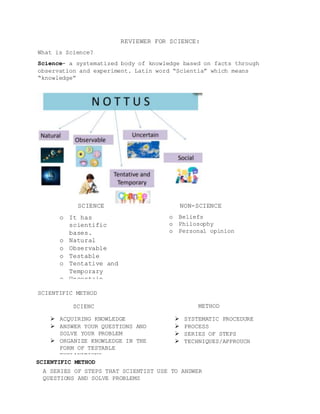
Science- a systematized body of knowledge based on facts through
observation and experiment. Latin word “Scientia” which means
“knowledge”
SCIENTIFIC METHOD
SCIENCE
o It has
scientific
bases.
o Natural
o Observable
o Testable
o Tentative and
Temporary
o Uncertain
o Social
NON-SCIENCE
o Beliefs
o Philosophy
o Personal opinion
SCIENC
E
 ACQUIRING KNOWLEDGE
 ANSWER YOUR QUESTIONS AND
SOLVE YOUR PROBLEM
 ORGANIZE KNOWLEDGE IN THE
FORM OF TESTABLE
EXPLANATIONS
METHOD
 SYSTEMATIC PROCEDURE
 PROCESS
 SERIES OF STEPS
 TECHNIQUES/APPROUCH
SCIENTIFIC METHOD
A SERIES OF STEPS THAT SCIENTIST USE TO ANSWER
QUESTIONS AND SOLVE PROBLEMS
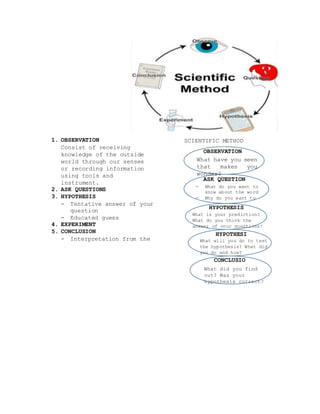
1. OBSERVATION
Consist of receiving
knowledge of the outside
world through our senses
or recording information
using tools and
instrument.
2. ASK QUESTIONS
3. HYPOTHESIS
- Tentative answer of your
question
- Educated guess
4. EXPERIMENT
5. CONCLUSION
- Interpretation from the
data obtain from the
experiment
SCIENTIFIC METHOD
OBSERVATION
What have you seen
that makes you
wonder?
ASK QUESTION
- What do you want to
know about the word
- Why do you want to
know
HYPOTHESIS
What is your prediction?
What do you think the
answer of your questions?
HYPOTHESI
S
What will you do to test
the hypothesis? What did
you do and how?
CONCLUSIO
N
What did you find
out? Was your
hypothesis correct?
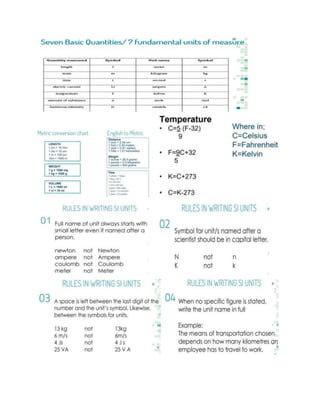
Length- It is a measure of how long an object is or the distance
between two points.
Temperature- the measure of hotness or coldness expressed in terms of
any of several scales, including Fahrenheit and Celsius.
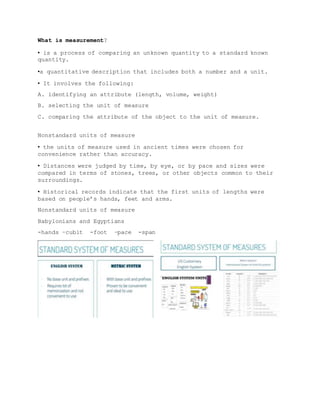
Weight- The force that gravitation exerts upon a body, equal to the
mass of the body times the local acceleration of gravity
VOLUME-the capacity of an object or how much space it occupies
What is measurement?
▪ is a process of comparing an unknown quantity to a standard known
quantity.
▪a quantitative description that includes both a number and a unit.
▪ It involves the following:
A. identifying an attribute (length, volume, weight)
B. selecting the unit of measure
C. comparing the attribute of the object to the unit of measure.
Nonstandard units of measure
▪ the units of measure used in ancient times were chosen for
convenience rather than accuracy.
▪ Distances were judged by time, by eye, or by pace and sizes were
compared in terms of stones, trees, or other objects common to their
surroundings.
▪ Historical records indicate that the first units of lengths were
based on people’s hands, feet and arms.
Nonstandard units of measure
Babylonians and Egyptians
-hands –cubit -foot –pace -span
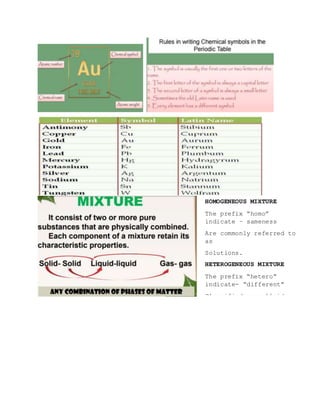
MATTER
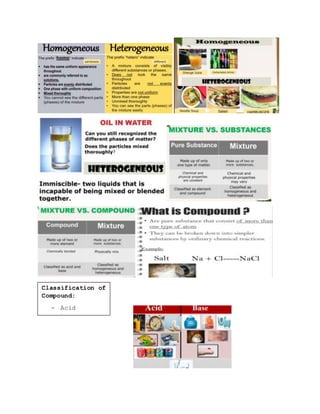
HOMOGENEOUS MIXTURE
The prefix “homo”
indicate – sameness
Are commonly referred to
as
Solutions.
HETEROGENEOUS MIXTURE
The prefix “hetero”
indicate- “different”
Classified as colloids
and suspension
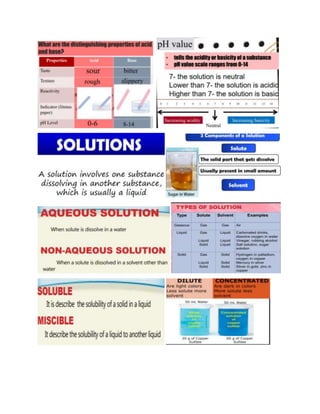
Classification of
Compound:
- Acid
- Base
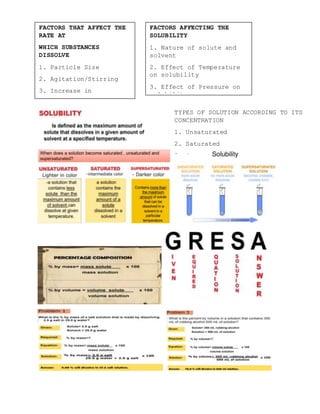
FACTORS THAT AFFECT THE
RATE AT
WHICH SUBSTANCES
DISSOLVE
1. Particle Size
2. Agitation/Stirring
3. Increase in
temperature
4. Concentration of
solution
FACTORS AFFECTING THE
SOLUBILITY
1. Nature of solute and
solvent
2. Effect of Temperature
on solubility
3. Effect of Pressure on
solubility
TYPES OF SOLUTION ACCORDING TO ITS
CONCENTRATION
1. Unsaturated
2. Saturated
3. Supersaturated
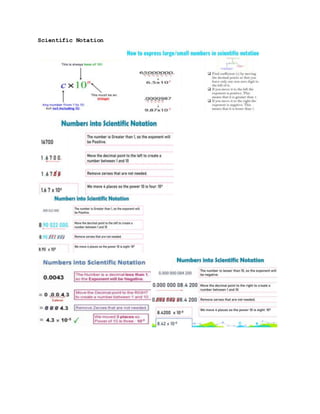
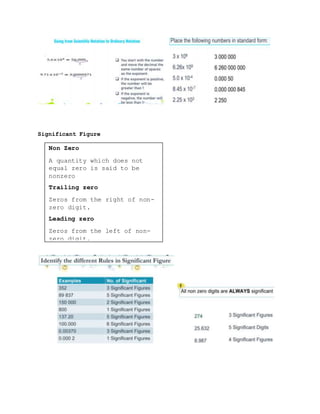
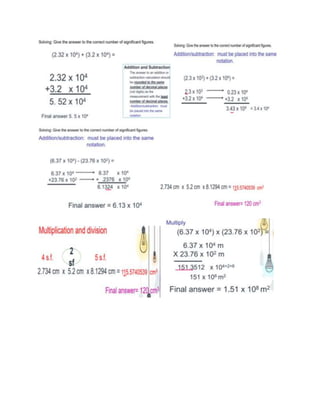
Scientific Notation
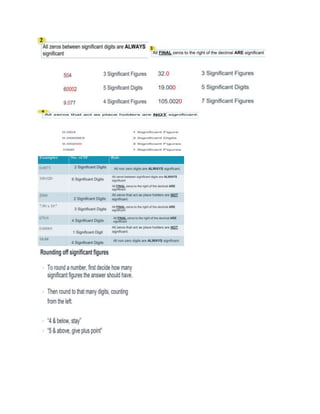
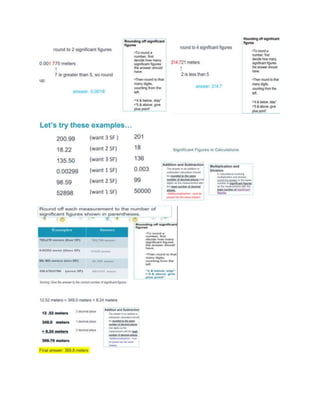
Significant Figure
Non Zero
A quantity which does not
equal zero is said to be
nonzero
Trailing zero
Zeros from the right of non-
zero digit.
Leading zero
Zeros from the left of non-
zero digit.
Reviewer for science

Reviewer for science

  • 1.
    REVIEWER FOR SCIENCE: Whatis Science? Science- a systematized body of knowledge based on facts through observation and experiment. Latin word “Scientia” which means “knowledge” SCIENTIFIC METHOD SCIENCE o It has scientific bases. o Natural o Observable o Testable o Tentative and Temporary o Uncertain o Social NON-SCIENCE o Beliefs o Philosophy o Personal opinion SCIENC E  ACQUIRING KNOWLEDGE  ANSWER YOUR QUESTIONS AND SOLVE YOUR PROBLEM  ORGANIZE KNOWLEDGE IN THE FORM OF TESTABLE EXPLANATIONS METHOD  SYSTEMATIC PROCEDURE  PROCESS  SERIES OF STEPS  TECHNIQUES/APPROUCH SCIENTIFIC METHOD A SERIES OF STEPS THAT SCIENTIST USE TO ANSWER QUESTIONS AND SOLVE PROBLEMS
  • 2.
    1. OBSERVATION Consist ofreceiving knowledge of the outside world through our senses or recording information using tools and instrument. 2. ASK QUESTIONS 3. HYPOTHESIS - Tentative answer of your question - Educated guess 4. EXPERIMENT 5. CONCLUSION - Interpretation from the data obtain from the experiment SCIENTIFIC METHOD OBSERVATION What have you seen that makes you wonder? ASK QUESTION - What do you want to know about the word - Why do you want to know HYPOTHESIS What is your prediction? What do you think the answer of your questions? HYPOTHESI S What will you do to test the hypothesis? What did you do and how? CONCLUSIO N What did you find out? Was your hypothesis correct?
  • 3.
    Length- It isa measure of how long an object is or the distance between two points. Temperature- the measure of hotness or coldness expressed in terms of any of several scales, including Fahrenheit and Celsius. Weight- The force that gravitation exerts upon a body, equal to the mass of the body times the local acceleration of gravity VOLUME-the capacity of an object or how much space it occupies
  • 4.
    What is measurement? ▪is a process of comparing an unknown quantity to a standard known quantity. ▪a quantitative description that includes both a number and a unit. ▪ It involves the following: A. identifying an attribute (length, volume, weight) B. selecting the unit of measure C. comparing the attribute of the object to the unit of measure. Nonstandard units of measure ▪ the units of measure used in ancient times were chosen for convenience rather than accuracy. ▪ Distances were judged by time, by eye, or by pace and sizes were compared in terms of stones, trees, or other objects common to their surroundings. ▪ Historical records indicate that the first units of lengths were based on people’s hands, feet and arms. Nonstandard units of measure Babylonians and Egyptians -hands –cubit -foot –pace -span
  • 6.
  • 10.
    HOMOGENEOUS MIXTURE The prefix“homo” indicate – sameness Are commonly referred to as Solutions. HETEROGENEOUS MIXTURE The prefix “hetero” indicate- “different” Classified as colloids and suspension
  • 11.
  • 13.
    FACTORS THAT AFFECTTHE RATE AT WHICH SUBSTANCES DISSOLVE 1. Particle Size 2. Agitation/Stirring 3. Increase in temperature 4. Concentration of solution FACTORS AFFECTING THE SOLUBILITY 1. Nature of solute and solvent 2. Effect of Temperature on solubility 3. Effect of Pressure on solubility TYPES OF SOLUTION ACCORDING TO ITS CONCENTRATION 1. Unsaturated 2. Saturated 3. Supersaturated
  • 14.
  • 15.
    Significant Figure Non Zero Aquantity which does not equal zero is said to be nonzero Trailing zero Zeros from the right of non- zero digit. Leading zero Zeros from the left of non- zero digit.