A Public Utility Vehicle can only be driven by a
holder of a _____
• non-professional license
• professional license
• conductor’s license
An applicant for Professional driver's
license should be at least ____
• 16 years old
• 18 years old
• 21 years old
What is the penalty if a driver is convicted of
a crime while using a motor vehicle?
 the DL will be revoked and the driver will
pay a fine
 the DL will be suspended and the driver
will pay a fine
 the DL will be confiscated
Who is a Professional Driver?
• an expert and experienced driver
• any driver who can operate any type of
motor vehicle
• any driver who is paid or hired for operating
a motor vehicle
What should you do when an oncoming vehicle deliberately crosses the
centerline to pass another vehicle?
• Be alert and be ready to slow down or stop if necessary
• blow horn and maintain speed
• switch on the headlights
If a driver is found to have a fake or counterfeit license,
his driver's license shall be _______
• confiscated and cannot secure a driver's license for a
period of 6 months in addition to a fine
• imprisoned for 6 months plus fine
• banned for getting a driver's license for life
With ABS installed on your vehicle, what should
you do while driving with maximum speed and
you have to stop suddenly?
• slam the brake pedal
• apply brakes gently with steady pressure
• pump the brake pedal
At an intersection with no traffic lights, two cars
approach at right angles to each other, which driver
must yield?
• the driver of the vehicle who arrived there first
• the driver of the vehicle that slows down first
• the driver of the vehicle that arrived there last
Upon approaching an intersection, what should you
do if you found out that the roadway beyond is
blocked with traffic?
• keep close as possible to the car ahead
• proceed slowly into the intersection until the
traffic ahead moves on
• stop before the intersection and wait until the
traffic ahead moves on
Before changing lanes in traffic, aside from
giving signal and checking your side and
rearview mirrors, what else do you need to
do?
• turn your head to check other vehicles
beside your car
• sound your horn
What should you do when another vehicle is
following you too close?
• speed up to start a road race
• slow down gradually and give him the signal
to overtake you
• slam on your brakes
How many days do you need to settle a traffic violation with
LTO?
• within 15 days
• within 10 days
• within 30 days
Where do you need to turn your wheels when parking uphill
with a curb?
• Straight
• from the curb
• to the curb
What does the law require you to do upon
approaching an intersection with a stop sign?
•slow down and proceed when its is safe to do
so
•yield right-of-way if necessary to vehicles
approaching from left to right
•stop and proceed when it is safe to do so
Where do you need to turn your wheels
when parking uphill with a curb?
•Straight
•from the curb
•to the curb
When approaching a sharp curve of the highway,
you should:
•decrease speed before entering the curve
•increase speed while negotiating the curve
•apply your brakes abruptly while taking the
curve
In case of an accident involving physical
injury, the first duty of the involved driver is:
•attend to the injured person and call for
help
•report the accident to the hospital
•report the accident to the nearest police
station
Your speed while driving at night should
depend on:
•the physical, mental condition and skill of
the driver
•the road worthiness of the motor vehicle
and weather condition
• all of the above
Drinking alcohol before driving is one of the major causes
of vehicular road crash because when a driver is drunk he
is:
•arrogant, talkative and doesn't have the judgement
and the reflexes to perform things safely
•calm, relaxed and able to perform things accordingly
•talk intelligently and coherently and give every
appearance of sobriety
This traffic sign means "Yield the right of
way":
•inverted triangle
•vertical triangle
•horizontal triangle
Night driving is difficult. We should do the following
when a vehicle comes towards us at night:
•dim your lights by switching to low beam
•brighten your light by switching to high beam
•switch on your headlights intermittently
The Temporary Operator's Permit (TOP) authorizes the
apprehended driver to operate motor vehicle for a
period not exceeding:
•72 hours
•1 week
•15 days
What is the main purpose of traffic laws, rules and
regulations?
• generate revenues for the government
• discipline the motorists
• establish an orderly movement of vehicles and
pedestrian traffic and penalize erring drivers
At night, when approaching a curve or intersection with poor
visibility, be sure to:
• switch off your headlights to enable oncoming motorists
to see you
• flash your headlights to let pedestrians and oncoming
motorists know that you are heading into the curve or
intersection
• switch on your interior lights to enable oncoming
vehicles to see your vehicle
When a driver of a PUV refuses to render
service or convey passengers, his license
shall be:
•Confiscated
•Suspended
•all of the answers
After passing or overtaking another vehicle, you can
safely move back into your original lane if:
• the driver you passed honks his horn
•you can see in the rear-view mirror the passed car
•you can see in the side-view mirror the passed car
Green light at an intersection means:
•pedestrians are allowed to cross all pedestrian
lanes
•pedestrians are not allowed to cross all
pedestrian lanes
•the vehicles on the other street are stoppped
What is the best safety rule when driving a
motor vehicle?
•never insist on your right-of-way
•sound your horn to assert your right-of-way
• always demand for the right-of-way
If you are parking uphill on a street without a
curb, turn the wheels towards the:
•center of the street
•edge of the street
•end of the street
The blind spot is the area to your right or left that you do not
see in the side view mirror, what will you do before you back
up?
•turn your head, to see that the way is clear
•turn your wheel all the way to the right and pull
up
•turn your wheel all the way to the left and pull up
Road crash can be avoided and minimized if the
drivers:
• do not disregard traffic signs installed in
particular places
• totally ignore traffic signs installed in particular
places
• overlook traffic signs installed in particular places
Whenever you are driving and you have to make or
answer a call on your cellular phone and you do not
have a hands-free attachment you should:
•make the call right away
•pull over to the side of the road at a safe location
and make the call
• answer the call while driving
What should you do whenever you are driving
on a highway having a lot of potholes?
•increase speed
•reduce speed
•always change lane
1) On long drive, you should be awake and alert. What should you do if you are tired or very sleepy?
• (Sa mahahabang biyahe, dapat gising at alisto. Ano ang dapat mong gawin kung ay pagod na at antok na antok?)
•
a. take methamphetamine or shabu
• (mag-methamphetamine o shabu)
•
a. take marijuana (mag-marijuana)
•
a. park at the safe area and take a few-minutes nap.
Sometimes, a driver passes through a busy
street with so many pedestrians. Which of
the following should a driver do?
•slowdown and check for safety when
passing through
•proceed with usual speed
•stop at all cost
Driving in heavy rains can be extremely dangerous because
visibility is limited. What should you do?
• when you cannot see more than 20 meters in front of
you, turn on your hazard lights / headlights and look for
a safe place to park
• turn on your headlights and slow down or park at a safe
place if situation is risky
• turn on your hazard lights, blow your horn and continue
driving
Flashing yellow light means:
•slowdown and proceed through the
intersection with caution
•you have the right of way over a flashing
red light
•vehicles will be crossing from the other
side
Parking is allowed if the vehicle is
____________
•beyond 4 meters of a fire hydrant
•within 3 meters of the
intersection of curve lines
•intersection
What is the maximum penalty for driving under the influence of
liquor or prohibited drugs?
• 6 months suspension
• 1 year suspension
• Perpetual revocation of license
On a two-lane road, overtaking is
allowed at the:
•shoulder or pavement of the road
• blind curve with a yellow solid
line
•left lane
If you see a ball coming from behind a
parked vehicle on city street, chances are a
kid is following it, what will you do?
•increase your speed
•slow down
•blow your horn and maintain your speed
The most effective way to deal with a
tailgater is to:
•ignore him but do not allow him to get
away
•slow down and let him pass
•increase your speed and be alert on your
brakes
When you come across a sign telling you
"ACCIDENT PRONE AREA" what should you
do?
•slow down and be more alert than usual
•increase your speed
•blow your horn and resume your normal
speed
Which of the following is not a safe
place to overtake?
• when approaching a bridge or upon a
curve
•at an intersection
What should you do when an oncoming vehicle is
forced to cross the centerline to avoid hitting another
vehicle which suddenly pulled out from the lane?
•ignore it because you have the right of way
•blow your horn and turn on your headlight
•be alert and be prepared to slow down and give
way
Drivers moving slower than other vehicles should use
the:
•outer lane
•center lane
•inner lane
Where do you need to stop at a red
traffic light?
•stop before the stop line
•stop beyond or too far from the stop
line
•stop less than 2 m behind the vehicle
in front
Ignoring traffic lights during late hours of the night
could:
•make you a good driver
•involve you in a fatal road crash
•decrease your fuel consumption
The proper hand signal for a right turn
is:
•left arm pointing left
•left arm held pointing upward
•left arm held down, hand pointing at
ground
If you are driving in a curb lane which ends ahead, what
would you do first in order to merge without interfering with
other traffic? (rule of continuity line)
• Immediately change lane to the left
• adjust your speed
• lower the speed of the vehicle
Passing sounds easy, but it takes judgment of time, distance and the
performance of your car. Which area is usually not allowed to pass?
• on highways
• multi-lane highways
• on a curve
Single white broken line on a 2-way road
means:
•passing or overtaking can be made
anytime
•it separates traffic moving in opposite
directions
•absolutely no crossing
When you intend to slow down or stop,
you should:
•blow your horn
•step on your brakes lightly to turn on
your brake lights
• stay on your lane then stop
What is the meaning of double solid yellow line?
•cross with due care
•cross anytime
•neither of the answers
We must remember that driving on the shoulder of the road is
prohibited. When driving going to the same direction, you may pass
to the right of a moving car if ______
• the highway has two or more lanes moving towards the same
direction
• the road has two lanes from opposite direction
• there is a room or space beyond the road
Upon approaching an intersection marked
with a yield sign, you are required to
________
•stop before entering the intersection
•slowdown, then enter the intersection
when the way is clear
•enter the intersection immediately
Where should you turn your wheels when
parking downhill with curb?
•into the curb or towards the side of the
road
•away from the curb
•any direction will do
What should you do when driving on mountain
roads during night time?
•blow your horn when approaching a blind
curve
•turn your lights on and increase your speed
•flick your dimmer switch every time you
approach a blind curve
When do you have to make a
complete full stop?
•at a flashing yellow light
•at a red traffic light
•at an intersection
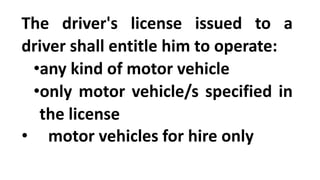
The driver's license issued to a
driver shall entitle him to operate:
•any kind of motor vehicle
•only motor vehicle/s specified in
the license
• motor vehicles for hire only
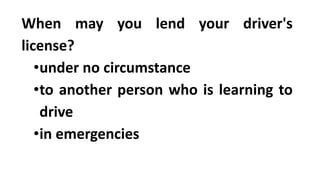
When may you lend your driver's
license?
•under no circumstance
•to another person who is learning to
drive
•in emergencies
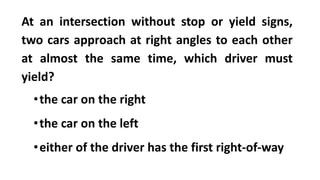
At an intersection without stop or yield signs,
two cars approach at right angles to each other
at almost the same time, which driver must
yield?
•the car on the right
•the car on the left
•either of the driver has the first right-of-way
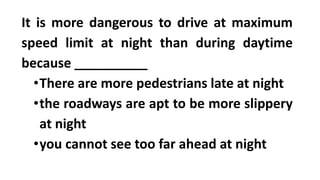
It is more dangerous to drive at maximum
speed limit at night than during daytime
because __________
•There are more pedestrians late at night
•the roadways are apt to be more slippery
at night
•you cannot see too far ahead at night
When making a U-Turn you should _________
•check for traffic behind you and indicate your
intentions with a left turn signal
•slow down a little bit and immediately execute a
u-turn and move to the fast lane
•stay on the left lane and initiate your turn as fast
as you can
Graft and corruption in the traffic enforcement system
can be eliminated by _________
•self discipline by drivers and obeying traffic rules
and regulations
•knowing exactly the message that road signs are
conveying
•allowing a certain percentage of the fines and
penalties collected on traffic violation
Motorcycle riders must exercise care and
ride prudently at all times. To do so,
they are required to wear ___________:
•a policeman cap or gloves
•helmets intended for construction
works
•standard protective helmet
A good driver in order to meet one's social
responsibilities of caring for others on the road
should:
•drive noisily to attract the attention of residents
along the road
•always exercise care for other pedestrians and
vehicles around
•blow one's horn every now and then to scare
passers-by
Some signs are called “lane-use” signs. They
appear to direct you into the correct lane as you
reach the actual intersection. They are usually
seen:
•before an intersection
•after an intersection
•on an intersection
Ambulance convey sick and injured persons to hospital, fire engines help
put out fires and police vehicles carry police personnel whose presence is
much needed in an emergency. If you encounter any of them on the road
with sirens on, what would you do?
• obstruct their passage and never allow them to pass through
• ignore them since you have no business interfering with their jobs
• give way by pulling in to the left or right side of the road depending
on the circumstances
If you are parked on the right side of the
street and intends to pull-out, you must roll
down your window and may as well use this
hand signal:
•left turn
•right turn
•left / right turn
Under R.A. 8750, Children must be properly restraint
if they are:
•10 years old
•6 years old and below
•7 years old
When the vehicle you are driving runs off the road or
hits an electric post or a parked car, your most
probable reason is:
•you are driving too fast and you lost control of
your vehicle
•you lost brake
•you are trying to overtake
If your vehicle breaks down on the road, what should you do?
• leave the vehicle and call for a mechanic
• switch on the hazard warning lights and display an EWDat least
10m behind the stalled vehicle
• turn off the engine and call for a mechanic
A driver while on a highway shall yield the
right of way to:
•pedestrians crossing within a crosswalk
•pedestrians crossing at intersection
where the movement of traffic is being
regulated by a traffic enforcer
•vehicles about to enter the highway
In driving, the most important sense the driver need
is:
•Hearing
•Smelling
•Seeing
A U-Turn is used to reverse direction.
Ideally, which of the following is permitted?
•When a motorist unintentionally entered
a one-way street
•where a no u-turn sign is posted
•if vehicle approaching on the other side
is no closer than 60 meters.
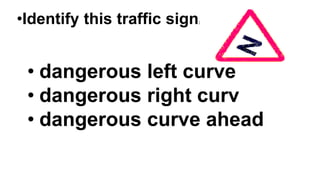
•Identify this traffic sign:
• dangerous left curve
• dangerous right curv
• dangerous curve ahead
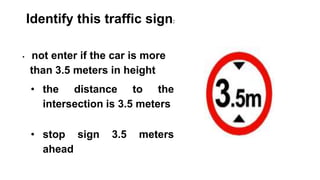
Identify this traffic sign:
• not enter if the car is more
than 3.5 meters in height
• the distance to the
intersection is 3.5 meters
• stop sign 3.5 meters
ahead
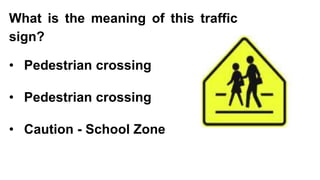
What is the meaning of this traffic
sign?
• Pedestrian crossing
• Caution - School Zone
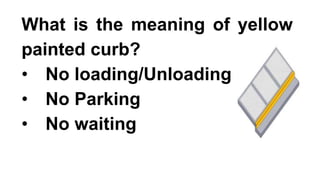
What is the meaning of yellow
painted curb?
• No loading/Unloading
• No Parking
• No waiting
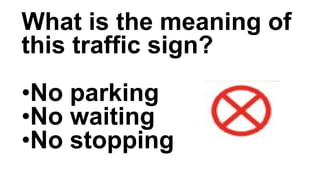
What is the meaning of
this traffic sign?
•No parking
•No waiting
•No stopping
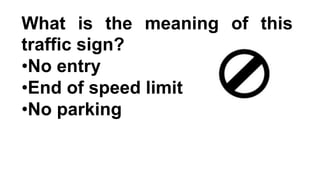
What is the meaning of this
traffic sign?
•No entry
•End of speed limit
•No parking
Reviewer

Reviewer

  • 1.
    A Public UtilityVehicle can only be driven by a holder of a _____ • non-professional license • professional license • conductor’s license
  • 2.
    An applicant forProfessional driver's license should be at least ____ • 16 years old • 18 years old • 21 years old
  • 3.
    What is thepenalty if a driver is convicted of a crime while using a motor vehicle?  the DL will be revoked and the driver will pay a fine  the DL will be suspended and the driver will pay a fine  the DL will be confiscated
  • 4.
    Who is aProfessional Driver? • an expert and experienced driver • any driver who can operate any type of motor vehicle • any driver who is paid or hired for operating a motor vehicle
  • 5.
    What should youdo when an oncoming vehicle deliberately crosses the centerline to pass another vehicle? • Be alert and be ready to slow down or stop if necessary • blow horn and maintain speed • switch on the headlights
  • 6.
    If a driveris found to have a fake or counterfeit license, his driver's license shall be _______ • confiscated and cannot secure a driver's license for a period of 6 months in addition to a fine • imprisoned for 6 months plus fine • banned for getting a driver's license for life
  • 7.
    With ABS installedon your vehicle, what should you do while driving with maximum speed and you have to stop suddenly? • slam the brake pedal • apply brakes gently with steady pressure • pump the brake pedal
  • 8.
    At an intersectionwith no traffic lights, two cars approach at right angles to each other, which driver must yield? • the driver of the vehicle who arrived there first • the driver of the vehicle that slows down first • the driver of the vehicle that arrived there last
  • 9.
    Upon approaching anintersection, what should you do if you found out that the roadway beyond is blocked with traffic? • keep close as possible to the car ahead • proceed slowly into the intersection until the traffic ahead moves on • stop before the intersection and wait until the traffic ahead moves on
  • 10.
    Before changing lanesin traffic, aside from giving signal and checking your side and rearview mirrors, what else do you need to do? • turn your head to check other vehicles beside your car • sound your horn
  • 11.
    What should youdo when another vehicle is following you too close? • speed up to start a road race • slow down gradually and give him the signal to overtake you • slam on your brakes
  • 12.
    How many daysdo you need to settle a traffic violation with LTO? • within 15 days • within 10 days • within 30 days
  • 13.
    Where do youneed to turn your wheels when parking uphill with a curb? • Straight • from the curb • to the curb
  • 14.
    What does thelaw require you to do upon approaching an intersection with a stop sign? •slow down and proceed when its is safe to do so •yield right-of-way if necessary to vehicles approaching from left to right •stop and proceed when it is safe to do so
  • 15.
    Where do youneed to turn your wheels when parking uphill with a curb? •Straight •from the curb •to the curb
  • 16.
    When approaching asharp curve of the highway, you should: •decrease speed before entering the curve •increase speed while negotiating the curve •apply your brakes abruptly while taking the curve
  • 17.
    In case ofan accident involving physical injury, the first duty of the involved driver is: •attend to the injured person and call for help •report the accident to the hospital •report the accident to the nearest police station
  • 18.
    Your speed whiledriving at night should depend on: •the physical, mental condition and skill of the driver •the road worthiness of the motor vehicle and weather condition • all of the above
  • 19.
    Drinking alcohol beforedriving is one of the major causes of vehicular road crash because when a driver is drunk he is: •arrogant, talkative and doesn't have the judgement and the reflexes to perform things safely •calm, relaxed and able to perform things accordingly •talk intelligently and coherently and give every appearance of sobriety
  • 20.
    This traffic signmeans "Yield the right of way": •inverted triangle •vertical triangle •horizontal triangle
  • 21.
    Night driving isdifficult. We should do the following when a vehicle comes towards us at night: •dim your lights by switching to low beam •brighten your light by switching to high beam •switch on your headlights intermittently
  • 22.
    The Temporary Operator'sPermit (TOP) authorizes the apprehended driver to operate motor vehicle for a period not exceeding: •72 hours •1 week •15 days
  • 23.
    What is themain purpose of traffic laws, rules and regulations? • generate revenues for the government • discipline the motorists • establish an orderly movement of vehicles and pedestrian traffic and penalize erring drivers
  • 24.
    At night, whenapproaching a curve or intersection with poor visibility, be sure to: • switch off your headlights to enable oncoming motorists to see you • flash your headlights to let pedestrians and oncoming motorists know that you are heading into the curve or intersection • switch on your interior lights to enable oncoming vehicles to see your vehicle
  • 25.
    When a driverof a PUV refuses to render service or convey passengers, his license shall be: •Confiscated •Suspended •all of the answers
  • 26.
    After passing orovertaking another vehicle, you can safely move back into your original lane if: • the driver you passed honks his horn •you can see in the rear-view mirror the passed car •you can see in the side-view mirror the passed car
  • 27.
    Green light atan intersection means: •pedestrians are allowed to cross all pedestrian lanes •pedestrians are not allowed to cross all pedestrian lanes •the vehicles on the other street are stoppped
  • 28.
    What is thebest safety rule when driving a motor vehicle? •never insist on your right-of-way •sound your horn to assert your right-of-way • always demand for the right-of-way
  • 29.
    If you areparking uphill on a street without a curb, turn the wheels towards the: •center of the street •edge of the street •end of the street
  • 30.
    The blind spotis the area to your right or left that you do not see in the side view mirror, what will you do before you back up? •turn your head, to see that the way is clear •turn your wheel all the way to the right and pull up •turn your wheel all the way to the left and pull up
  • 31.
    Road crash canbe avoided and minimized if the drivers: • do not disregard traffic signs installed in particular places • totally ignore traffic signs installed in particular places • overlook traffic signs installed in particular places
  • 32.
    Whenever you aredriving and you have to make or answer a call on your cellular phone and you do not have a hands-free attachment you should: •make the call right away •pull over to the side of the road at a safe location and make the call • answer the call while driving
  • 33.
    What should youdo whenever you are driving on a highway having a lot of potholes? •increase speed •reduce speed •always change lane
  • 34.
    1) On longdrive, you should be awake and alert. What should you do if you are tired or very sleepy? • (Sa mahahabang biyahe, dapat gising at alisto. Ano ang dapat mong gawin kung ay pagod na at antok na antok?) • a. take methamphetamine or shabu • (mag-methamphetamine o shabu) • a. take marijuana (mag-marijuana) • a. park at the safe area and take a few-minutes nap.
  • 35.
    Sometimes, a driverpasses through a busy street with so many pedestrians. Which of the following should a driver do? •slowdown and check for safety when passing through •proceed with usual speed •stop at all cost
  • 36.
    Driving in heavyrains can be extremely dangerous because visibility is limited. What should you do? • when you cannot see more than 20 meters in front of you, turn on your hazard lights / headlights and look for a safe place to park • turn on your headlights and slow down or park at a safe place if situation is risky • turn on your hazard lights, blow your horn and continue driving
  • 37.
    Flashing yellow lightmeans: •slowdown and proceed through the intersection with caution •you have the right of way over a flashing red light •vehicles will be crossing from the other side
  • 38.
    Parking is allowedif the vehicle is ____________ •beyond 4 meters of a fire hydrant •within 3 meters of the intersection of curve lines •intersection
  • 39.
    What is themaximum penalty for driving under the influence of liquor or prohibited drugs? • 6 months suspension • 1 year suspension • Perpetual revocation of license
  • 40.
    On a two-laneroad, overtaking is allowed at the: •shoulder or pavement of the road • blind curve with a yellow solid line •left lane
  • 41.
    If you seea ball coming from behind a parked vehicle on city street, chances are a kid is following it, what will you do? •increase your speed •slow down •blow your horn and maintain your speed
  • 42.
    The most effectiveway to deal with a tailgater is to: •ignore him but do not allow him to get away •slow down and let him pass •increase your speed and be alert on your brakes
  • 43.
    When you comeacross a sign telling you "ACCIDENT PRONE AREA" what should you do? •slow down and be more alert than usual •increase your speed •blow your horn and resume your normal speed
  • 44.
    Which of thefollowing is not a safe place to overtake? • when approaching a bridge or upon a curve •at an intersection
  • 45.
    What should youdo when an oncoming vehicle is forced to cross the centerline to avoid hitting another vehicle which suddenly pulled out from the lane? •ignore it because you have the right of way •blow your horn and turn on your headlight •be alert and be prepared to slow down and give way
  • 46.
    Drivers moving slowerthan other vehicles should use the: •outer lane •center lane •inner lane
  • 47.
    Where do youneed to stop at a red traffic light? •stop before the stop line •stop beyond or too far from the stop line •stop less than 2 m behind the vehicle in front
  • 48.
    Ignoring traffic lightsduring late hours of the night could: •make you a good driver •involve you in a fatal road crash •decrease your fuel consumption
  • 49.
    The proper handsignal for a right turn is: •left arm pointing left •left arm held pointing upward •left arm held down, hand pointing at ground
  • 50.
    If you aredriving in a curb lane which ends ahead, what would you do first in order to merge without interfering with other traffic? (rule of continuity line) • Immediately change lane to the left • adjust your speed • lower the speed of the vehicle
  • 51.
    Passing sounds easy,but it takes judgment of time, distance and the performance of your car. Which area is usually not allowed to pass? • on highways • multi-lane highways • on a curve
  • 52.
    Single white brokenline on a 2-way road means: •passing or overtaking can be made anytime •it separates traffic moving in opposite directions •absolutely no crossing
  • 53.
    When you intendto slow down or stop, you should: •blow your horn •step on your brakes lightly to turn on your brake lights • stay on your lane then stop
  • 54.
    What is themeaning of double solid yellow line? •cross with due care •cross anytime •neither of the answers
  • 55.
    We must rememberthat driving on the shoulder of the road is prohibited. When driving going to the same direction, you may pass to the right of a moving car if ______ • the highway has two or more lanes moving towards the same direction • the road has two lanes from opposite direction • there is a room or space beyond the road
  • 56.
    Upon approaching anintersection marked with a yield sign, you are required to ________ •stop before entering the intersection •slowdown, then enter the intersection when the way is clear •enter the intersection immediately
  • 57.
    Where should youturn your wheels when parking downhill with curb? •into the curb or towards the side of the road •away from the curb •any direction will do
  • 58.
    What should youdo when driving on mountain roads during night time? •blow your horn when approaching a blind curve •turn your lights on and increase your speed •flick your dimmer switch every time you approach a blind curve
  • 59.
    When do youhave to make a complete full stop? •at a flashing yellow light •at a red traffic light •at an intersection
  • 60.
    The driver's licenseissued to a driver shall entitle him to operate: •any kind of motor vehicle •only motor vehicle/s specified in the license • motor vehicles for hire only
  • 61.
    When may youlend your driver's license? •under no circumstance •to another person who is learning to drive •in emergencies
  • 62.
    At an intersectionwithout stop or yield signs, two cars approach at right angles to each other at almost the same time, which driver must yield? •the car on the right •the car on the left •either of the driver has the first right-of-way
  • 63.
    It is moredangerous to drive at maximum speed limit at night than during daytime because __________ •There are more pedestrians late at night •the roadways are apt to be more slippery at night •you cannot see too far ahead at night
  • 64.
    When making aU-Turn you should _________ •check for traffic behind you and indicate your intentions with a left turn signal •slow down a little bit and immediately execute a u-turn and move to the fast lane •stay on the left lane and initiate your turn as fast as you can
  • 65.
    Graft and corruptionin the traffic enforcement system can be eliminated by _________ •self discipline by drivers and obeying traffic rules and regulations •knowing exactly the message that road signs are conveying •allowing a certain percentage of the fines and penalties collected on traffic violation
  • 66.
    Motorcycle riders mustexercise care and ride prudently at all times. To do so, they are required to wear ___________: •a policeman cap or gloves •helmets intended for construction works •standard protective helmet
  • 67.
    A good driverin order to meet one's social responsibilities of caring for others on the road should: •drive noisily to attract the attention of residents along the road •always exercise care for other pedestrians and vehicles around •blow one's horn every now and then to scare passers-by
  • 68.
    Some signs arecalled “lane-use” signs. They appear to direct you into the correct lane as you reach the actual intersection. They are usually seen: •before an intersection •after an intersection •on an intersection
  • 69.
    Ambulance convey sickand injured persons to hospital, fire engines help put out fires and police vehicles carry police personnel whose presence is much needed in an emergency. If you encounter any of them on the road with sirens on, what would you do? • obstruct their passage and never allow them to pass through • ignore them since you have no business interfering with their jobs • give way by pulling in to the left or right side of the road depending on the circumstances
  • 70.
    If you areparked on the right side of the street and intends to pull-out, you must roll down your window and may as well use this hand signal: •left turn •right turn •left / right turn
  • 71.
    Under R.A. 8750,Children must be properly restraint if they are: •10 years old •6 years old and below •7 years old
  • 72.
    When the vehicleyou are driving runs off the road or hits an electric post or a parked car, your most probable reason is: •you are driving too fast and you lost control of your vehicle •you lost brake •you are trying to overtake
  • 73.
    If your vehiclebreaks down on the road, what should you do? • leave the vehicle and call for a mechanic • switch on the hazard warning lights and display an EWDat least 10m behind the stalled vehicle • turn off the engine and call for a mechanic
  • 74.
    A driver whileon a highway shall yield the right of way to: •pedestrians crossing within a crosswalk •pedestrians crossing at intersection where the movement of traffic is being regulated by a traffic enforcer •vehicles about to enter the highway
  • 75.
    In driving, themost important sense the driver need is: •Hearing •Smelling •Seeing
  • 76.
    A U-Turn isused to reverse direction. Ideally, which of the following is permitted? •When a motorist unintentionally entered a one-way street •where a no u-turn sign is posted •if vehicle approaching on the other side is no closer than 60 meters.
  • 77.
    •Identify this trafficsign: • dangerous left curve • dangerous right curv • dangerous curve ahead
  • 78.
    Identify this trafficsign: • not enter if the car is more than 3.5 meters in height • the distance to the intersection is 3.5 meters • stop sign 3.5 meters ahead
  • 79.
    What is themeaning of this traffic sign? • Pedestrian crossing • Pedestrian crossing • Caution - School Zone
  • 80.
    What is themeaning of yellow painted curb? • No loading/Unloading • No Parking • No waiting
  • 81.
    What is themeaning of this traffic sign? •No parking •No waiting •No stopping
  • 82.
    What is themeaning of this traffic sign? •No entry •End of speed limit •No parking