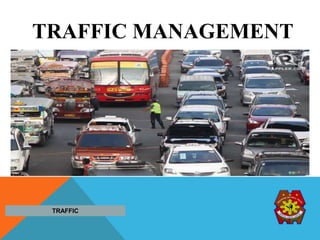
TRAFFIC MANAGEMENT
TRAFFIC
Traffic Management Defined
It is an executive function such as planning, organizing,
directing, supervising, coordinating, operating, recording,
and budgeting traffic affairs.
It also refers to all agencies having responsibilities for
ascertaining traffic flow requirements, such as planning,
approving, funding, constructing and/or maintaining public
facilities for such movement.
Further, it is also refers to all agencies responsible for
licensing, approving, restricting, stopping, prohibiting or
controlling the use of these facilities.
TRAFFIC
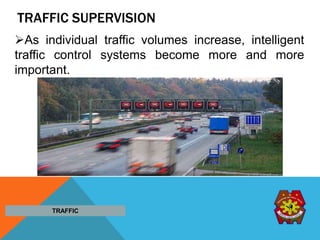
TRAFFIC SUPERVISION
As individual traffic volumes increase, intelligent
traffic control systems become more and more
important.
TRAFFIC
UPDATES
PNP Standard Operating
Procedure
No. 2011-004
(Revised Procedure in the Reporting & Disposition of Stolen and
Recovered / Impounded Motor Vehicles)
TRAFFIC
CMC 2011-001 RESPONSE TO MAJOR
ROAD TRAFFIC ACCIDENT
- The HPG will take cognizant on major
road traffic accident.
a. multiple death and injuries
b. damage of such magnitude
c. accident which gained national
attention
TRAFFIC
PRESIDENTIAL DECREE NO. 96
Law enacted during the incumbency of President Ferdinand
E. Marcos
Proclamation No. 1081, on dated September 21, 1972
Done in the City of Manila, on January 13, 1973
Declaring unlawful use or attachment of sirens, bells,
horns, whistles or similar gadget that emit exceptionally
loud or startling sounds, including dome lights and other
similar signaling or flashing devices on motor vehicles and
providing certain exceptions therefor.
TRAFFIC
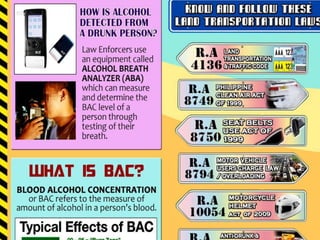
R.A 10586
"An Act Penalizing Persons Driving Under The
Influence Of Alcohol, Dangerous Drugs, And
Similar Substances, And For Other Purposes"
Otherwise known as the
"Anti-Drunk and Drugged Driving Act of 2013"
TRAFFIC
Republic Act No. 10883, or otherwise known as the
New Anti-Carnapping Act of 2016 (RA 10883) is
a law which punishes carnapping in the Philippines.
R.A 10883
THE NEW ANTI-CARNAPPING ACT OF 2016
TRAFFIC
RA 10883 - punishes the crime of carnapping which
refers to the taking with intent to gain of a motor vehicle
belonging to another without the latter’s consent, or by
means of violence against or intimidation of persons, or
by using force upon things.
 Note that the following are not embraced in the definition of a
motor vehicle under the law and thus cannot be the subject of
carnapping, to wit:
road rollers, trolley cars, street sweepers, sprinklers, lawn
mowers, bulldozers, graders, forklifts, amphibian trucks, and
cranes if not used on public highways;
vehicles which run only on rails or tracks; and
tractors, trailers and traction engines of all kinds used exclusively
for agricultural purposes
TRAFFIC
For purposes of knowing what carnapping is, one must be able to
know what Motor vehicle is, in the first place. As defined under this
law, Motor vehicle refers to any vehicle propelled by any power
other than muscular power using the public highways.
REPUBLIC ACT NO. 8750 “SEAT BELTS USE ACT OF 1999.”
AUGUST 05, 1999
An act requiring the mandatory
compliance by motorists of private and
public vehicles to use seat belt devices,
and requiring vehicle manufacturers to
install seat belt devices in all their
manufactured vehicles
TRAFFIC
•First violation: Php 1,000
•Second violation: Php 2,000
•Third violation: Php 5,000
LTO penalty for not wearing seatbelt in the
Philippine
. The seat belt law Philippines is applied for
both drivers and the passengers. Important to
note that, having 6-year-old children on the front
seat without a seat belt, drivers also have to pay
for the ticket.
TRAFFIC
LTO Fine:
The national Highway Safety Council has done
extensive testing on a newly designed seat
belt.
Results show that accidents can be reduced by
as
much as 90% when the belt is properly
installed.
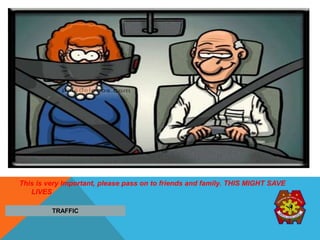
Correct installation is illustrated below...
TRAFFIC
This is very Important, please pass on to friends and family. THIS MIGHT SAVE
LIVES
TRAFFIC
RA 10913  Anti-Distracted Driving Act
(ADDA)
 is a law that prohibits a person who is
driving a motor vehicle from holding and
using mobile communication devices and
electronic entertainment gadgets.
TRAFFIC
What are the penalties
 Violators will be penalized with a fine of five thousand
pesos (Php5, 000) for the first offense
 Ten thousand pesos ((Php10, 000) for the second
offense
 Fifteen thousand pesos ((Php15, 000) for the third
offense with a three-month suspension of driver's
license.
TRAFFIC
RA 7924
 An Act Creating the Metropolitan Manila
Development Authority, defining its powers and
functions, providing funding therefor and for
other purposes
 sought to improve traffic flow and reduce
travel times, optimizing not only vehicular
movement but also that of persons, goods
and services.
TRAFFIC
RA 10054  AN ACT MANDATING ALL MOTORCYCLE
RIDERS TO WEAR STANDARD PROTECTIVE
MOTORCYCLE HELMETS WHILE DRIVING AND
PROVIDING PENALTIES THEREFOR
 Section 1. Short Title. - This Act shall be known as the
"Motorcycle Helmet Act of 2009"
 Section 3. Mandatory Use of Motorcycle Helmets. - All
motorcycle riders, including drivers and back riders, shall at
all times wear standard protective motorcycle helmets
while driving, whether long or short drives, in any type of
road and highway.
TRAFFIC
Standard protective motorcycle helmets are
appropriate types of helmets for motorcycle riders
that comply with the specifications issued by the
Department of Trade and Industry (DTI).
 Section 4. Exemption. - Drivers of tricycles shall
be exempted from complying with the mandatory
wearing of motorcycle helmets as provided in this
Act
TRAFFIC
 Section 7. Penalties. - (a) Any person caught not wearing
the standard protective motorcycle helmet in violation of
this Act shall be punished with a fine of
One thousand five hundred pesos (Php1,500.00) for
the First offense;
Three thousand pesos (Php3,000.00) for the Second
offense;
Five thousand pesos (Php5,000.00) for the Third
offense; and Ten thousand pesos (Php10,000.00)
plus confiscation of the driver's license for the Fourth
and Succeeding offenses
TRAFFIC
RA 10666 AN ACT PROVIDING FOR THE SAFETY
OF CHILDREN ABOARD MOTORCYLES
 Section 3. Definitions. -For purposes of this Act, the
following terms shall mean:
 (a) Motorcycle refers to any two (2)-wheeled motor vehicle
having one (1) or two (2) riding saddles;
 (b) Public roads refer to roads designed by the national
government or local government units as roads for public
use such as, but not limited to, national highways, provincial
roads, city, municipal and barangay streets;
TRAFFIC
 Section 1. Short Title. – This Act shall be known as
"Children’s Safety on Motorcycles Act of 2015"
 (c) Foot peg refers to a flat form attached to the
motorcycles on which to stand or brace the feet.
 (d) Rider refers to the driver of a motorcycle.
 Section 4.Prohibition. – It shall be unlawful for any person
to drive a two (2)-wheeled motorcycle with a child on board
on public roads where there is heavy volume of vehicles,
there is a high density of fast moving vehicles or where a
speed limit of more than 60/kph is imposed, unless:
TRAFFIC
 (a) The child passenger can comfortably reach his/her feet
on the standard foot peg of the motorcycle;
 (b) The child’s arms can reach around and grasp the waist
of the motorcycle rider.
 (c) The child is wearing a standard protective helmet
referred to under Republic Act No. 10054, otherwise known
the “Motorcycle Helmet Act of 2009.”
 Section 5. Exception. – Notwithstanding the prohibition
provided in the preceding section, this Act shall not apply
to cases where the child to be transported requires
immediate medical attention.
TRAFFIC
 SEC. 6. Penalties. – Any person who operates a
motorcycle in violation of Section 4 of this Act shall be fined
with an amount of three thousand pesos (P3,000.00) for
the first offense; five thousand pesos (P5,000.00) for the
second offense; and ten thousand pesos (P10,000.00)
for the third and succeeding offenses.
 Moreover, for the third offense, the driver’s license of the
offender shall be suspended for a period of one (1) month.
 Violation of these provisions beyond the third time shall
result to automatic revocation of the offender’s driver’s
license.
TRAFFIC
*Import Commodity Clearance (ICC)*
Penalty for wearing slippers while driving motorcycle
What is the penalty for wearing slippers while driving
motorcycle in the Philippines?
Wearing slippers while driving motorcycle in the Philippines
is not allowed.
Warning to motorcycle owners!
1.First Offense: Php 578.00 fine
2.Second Offense: Php 778.00 fine
3.Third Offense: Php 1,078.00 fine
TRAFFIC
E0 202 - CREATING THE LAND
TRANSPORTATION FRANCHISING AND
REGULATORY BOARD (LTFRB)
WHEREAS, the Department of Transportation and
Communications is vested with, among others, quasi –
judicial powers and functions pursuant to Executive
Order No. 125, as amended;
TRAFFIC
REPUBLIC ACT NO. 8749 - This Act shall be known as
the
“Philippine Clean Air Act of
1999.”
- is a comprehensive air quality management policy
and program which aims to achieve and maintain healthy
air for all Filipinos.
“The State shall promote and protect the global environment
to attain sustainable development while recognizing the
primary responsibility of local government units to deal
with environmental problems.”
TRAFFIC
“Air pollution" - means any alteration of the physical,
chemical and biological properties of the
atmospheric air, or any discharge thereto of any
liquid, gaseous or solid substances that will or is
likely to create or to render the air 538 resources of
the country harmful detrimental or injurious to public
health, safety or welfare or which will adversely affect
their utilization for domestic, commercial, industrial
agricultural, recreational or other legitimate
purposes;
TRAFFIC
SECTION 21. Pollution from Motor Vehicles.—
a) The DOTC shall implement the emission
standards for motor vehicles set pursuant to and as
provided in this Act.
Mandate
The Department of Transportation and Communications
(DOTC) develops, promotes, implements and maintains
integrated and strategic transportation and communications
systems that will ensure safe, reliable, responsive, and viable
services to accelerate economic development and to better
serve the transport and communications needs of the people.
TRAFFIC
What is the Emission Test?
It is a mandatory test in the Philippines as part of the car’s registration. It
is also done during the renewal of the car’s registration. This test
measures the level of fumes or pollutant released from the exhaust
manifold of a vehicle
What is the purpose of the Emission test Philippines?
The main goal of the emission test is to lessen the air
pollutants that are harmful to the environment. It detects the
level of hydrocarbons, carbon dioxide, nitrogen oxide, carbon
monoxide, and other air pollutants.
TRAFFIC
In general, the emission test aims to ensure that a vehicle is
in compliance with the set of emission standards. It is also
the requirement of a car to have a CEC or Certificate of
Emission Compliance which is needed for the renewal of the
car’s registration.
SECTION 46. Violation of Standards for Motor Vehicles.—
No motor vehicle shall be registered with the DOTC unless it
meets the emission standards set by the Department as
provided in Section 21 hereof.
TRAFFIC
Any vehicle suspected of violation of emission standards through
visual signs, such as, but not limited to smoke-belching, shall be
subjected to an emission test by a duly authorized emission testing
center. For this purpose, the DOTC or its authorized testing center
shall establish a roadside inspection system. Should it be shown
that there was no violation of emission standards, the vehicle shall
be immediately released. Otherwise, a testing result indicating an
exceedance of the emission standards would warrant the continuing
custody of the impounded vehicle unless the appropriate penalties
are fully paid, and the license plate is surrendered to the DOTC
pending the fulfillment of the undertaking by the owner/operator of
the motor vehicle to make the necessary repairs so as to comply
with the standards.
TRAFFIC
A pass shall herein be issued by the DOTC to authorize the use of the motor
vehicle within a specified period that shall not exceed seven (7) days for
the sole purpose of making the necessary repairs on the said vehicle. The
owner/operator of the vehicle shall be required to correct its defects and
show proof of compliance to the appropriate pollution control office before
the vehicle can be allowed to be driven on any public or subdivision
roads.
In addition, the driver and operator of the apprehended vehicle shall undergo
a seminar on pollution control and management conducted by the DOTC
and shall also suffer the following penalties:
(a) First offense - a fine not to exceed Two thousand pesos (₱2,000);
(b) Second offense - a fine not less than Two thousand pesos (₱2,000)
and not to exceed Four thousand pesos (₱4,000); and
TRAFFIC
(c) Third offense - one (1) year suspension of the Motor Vehicle
Registration (MVR) and a fine of not less than Four thousand pesos
(₱4,000) and not more than Six thousand pesos (₱6,000).
Any violation of the provisions of Section 21 paragraph (d) with regard to
national inspection and maintenance program, including technicians and
facility compliance shall be penalized with a fine of not less than
Thirty thousand pesos (₱30,000) or cancellation of license of both
the technician and the center, or both, as determined by the DTI.
Smoke Belching Meaning
If you have seen a jeepney on the road, chances are you have seen black
smoke coming out of its exhaust pipe. The black smoke you see coming
from a vehicle is called smoke belching. It is a forceful expulsion of thick
smoke from an exhaust system. Smoke belching is quite common to see
in Metro Manila especially from public utility vehicles that are used as
public transport.
TRAFFIC
R.A 4136 (FOUNDATION)
 Section 1. Title of Act. - This Act shall be known
as the "Land Transportation and Traffic Code."
 Section 2. Scope of Act. - The provisions of this
Act shall control, as far as they apply, the
registration and operation of motor vehicles
and the licensing of owners, dealers,
conductors, drivers, and similar matters.
TRAFFIC
LICENSING SYSTEM
-it is the system of issuing license to any person who is qualified to fulfill the
responsibilities required by the license administered by the LTO
DRIVER’S LICENSE
-issued to the drivers as privilege granted by the government providing statutory
qualification
LICENSING PROCEDURE
- At least 16 years old for student’s permit
- 17 years old for sub-professional
- 18 years old for professional
KINDS OF DRIVER’S LICENSE
1. Student permit 2. Non-professional 3. Professional
4. Militar 5.International
TRAFFIC
Student Permit is a prerequisite for both professional and non-professional
driver's licenses. Also called student driver's permit, this LTO-issued
document is a basic license authorizing a person to drive a vehicle
accompanied by a licensed driver (whether with a professional or non-pro
license).
-Filipinos at least 16 years old
-Foreigners at least 18 years old who have stayed in the Philippines for at
least one month and have proof of residence for up to six months
-People whose license has been expired for 10 years or more and have no
traffic violations
-Must be physically and mentally fit to drive vehicles
-Individuals who completed the theoretical driving course
TRAFFIC
Non-Professional Driver's License allows you to drive private
vehicles only. You may apply for a non-pro driver's license one month to one
year after the issue date ofyour student permit.
-Filipinos at least 17 years old
-Foreigners are at least 18 years old
-Holders of a valid student permit for at least one month from issuance
-Must be physically and mentally fit to operate a vehicle
-Must have attended and passed the Practical Driving Course (PDC) from an
LTO-accredited driving school, LTO DEC, or LTO-accredited TESDA training
center
-Must have passed the LTO examinations
-Must not have unsettled traffic violations
TRAFFIC
Professional Driver's License allows you to drive a vehicle for a living.
Apply for a professional license if you plan to drive any public utility vehicle (PUV)
such as a taxi, transport network vehicle service (TNVS), jeepney, tricycle, bus, etc.
Filipinos at least 17 years old
Foreigners at least 18 years old
Must be a non-pro license holder for at least six months
Must have no unsettled traffic violations
Must be physically and mentally fit to operate a vehicle
Must have completed a minimum of eight-hour practical driving lessons from any LTO
or TESDA-accredited driving school
Military Driver's License special types of license issued by the agency for
limited and special purposes Limited to drive a military vehicle.
International Driver’s License Issued by Philippine Motor Association (PMA)
TRAFFIC
TRAFFIC DEFINED
- it refers to the movement of pedestrian, motor vehicle
and goods from point of origin to point of destination.
The word traffic originates from Greco-Roman word
“TRAFICO” with reference to the movement of people
that dates back from the dawns of history. The Greek
originally called the system “TRAFRIGA” after the
early horse drawn chariots with spoke wheels.
TRAFFIC
The word TRAFFIC was derived from the
word ‘’TRAFFICARE’’ which means :
A. To Travel
B. To Traverse
C. To carry on Trade
D. To Transport
TRAFFIC
Traffic congestion - is a condition on transport that
is characterised by slower speeds, longer trip times,
and increased vehicular queueing
Traffic Jam - When vehicles are fully stopped for
periods of time
TRAFFIC
Road rage - is aggressive or angry behavior exhibited by a
driver of a road vehicle. These behaviors include rude and
offensive gestures, verbal insults, physical threats or
dangerous driving methods targeted toward another driver or
non-drivers such as pedestrians or cyclists in an effort to
intimidate or release frustration. Road rage can lead to
altercations, assaults and collisions that result in serious
physical injuries or even death. Strategies include long horn
honks, swerving, tailgating, brake checking and attempting to
fight
TRAFFIC
DEFINITION OF TERMS
 HIGHWAY - shall mean every public thoroughfare,
public boulevard, driveway, avenue, park, alley and
callejon, but shall not include roadway upon
grounds owned by private persons, colleges,
universities, or other similar institutions.
TRAFFIC
 Pedestrian - is a person travelling on foot,
whether walking or running. In modern times, the term
usually refers to someone walking on
a road or pavement, but this was not the case
historically
MOTOR VEHICLE - Shall mean any vehicle propelled by any
power other than muscular power using the public
highways, but exempting road rollers, trolley cars, street
sweepers, sprinklers, lawn mowers, bulldozers, graders,
forklifts, amphibian trucks, and cranes if not in used on
public highways, vehicles which runs only on rails or tracks,
and tractors, trailers and traction engines of all kinds used
exclusively for agricultural purposes.
TRAFFIC
 DRIVER‘S LICENSE - is an official document, often plastic
and the size of a credit card, permitting a specific individual
to operate one or more types of motorized vehicles, such as
a motorcycle, car, truck, or bus on a public road.
 OWNER – Shall mean the actual legal owner of a motor
vehicle, in whose name such vehicle is duly registered
with the land trasnportation commission
 DRIVER – Shall mean every and licensed operator of
motor vehicle
TRAFFIC
MUST- KNOW: ALL THE BASIC ROAD MARKINGS IN PH
AND WHAT EACH ONE MEANS
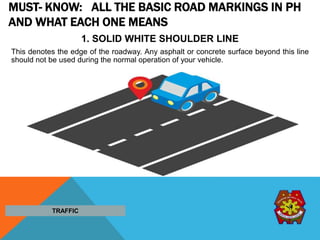
1. SOLID WHITE SHOULDER LINE
This denotes the edge of the roadway. Any asphalt or concrete surface beyond this line
should not be used during the normal operation of your vehicle.
TRAFFIC
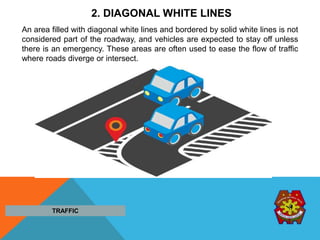
2. DIAGONAL WHITE LINES
An area filled with diagonal white lines and bordered by solid white lines is not
considered part of the roadway, and vehicles are expected to stay off unless
there is an emergency. These areas are often used to ease the flow of traffic
where roads diverge or intersect.
TRAFFIC
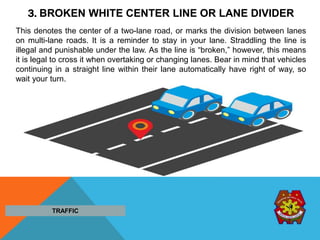
3. BROKEN WHITE CENTER LINE OR LANE DIVIDER
This denotes the center of a two-lane road, or marks the division between lanes
on multi-lane roads. It is a reminder to stay in your lane. Straddling the line is
illegal and punishable under the law. As the line is “broken,” however, this means
it is legal to cross it when overtaking or changing lanes. Bear in mind that vehicles
continuing in a straight line within their lane automatically have right of way, so
wait your turn.
TRAFFIC
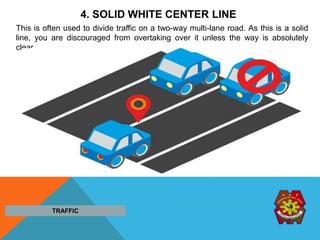
4. SOLID WHITE CENTER LINE
This is often used to divide traffic on a two-way multi-lane road. As this is a solid
line, you are discouraged from overtaking over it unless the way is absolutely
clear.
TRAFFIC
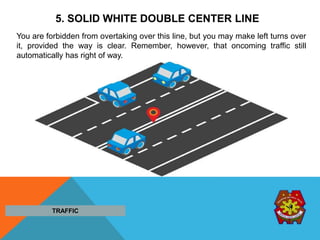
5. SOLID WHITE DOUBLE CENTER LINE
You are forbidden from overtaking over this line, but you may make left turns over
it, provided the way is clear. Remember, however, that oncoming traffic still
automatically has right of way.
TRAFFIC
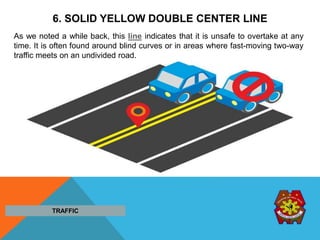
6. SOLID YELLOW DOUBLE CENTER LINE
As we noted a while back, this line indicates that it is unsafe to overtake at any
time. It is often found around blind curves or in areas where fast-moving two-way
traffic meets on an undivided road.
TRAFFIC
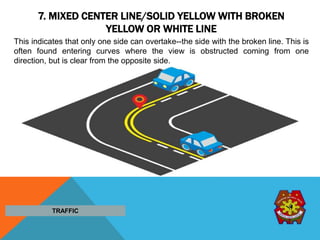
7. MIXED CENTER LINE/SOLID YELLOW WITH BROKEN
YELLOW OR WHITE LINE
This indicates that only one side can overtake--the side with the broken line. This is
often found entering curves where the view is obstructed coming from one
direction, but is clear from the opposite side.
TRAFFIC
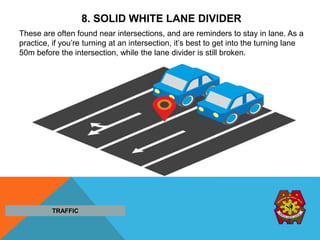
8. SOLID WHITE LANE DIVIDER
These are often found near intersections, and are reminders to stay in lane. As a
practice, if you’re turning at an intersection, it’s best to get into the turning lane
50m before the intersection, while the lane divider is still broken.
TRAFFIC
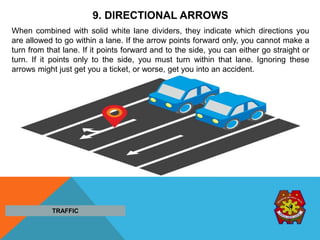
9. DIRECTIONAL ARROWS
When combined with solid white lane dividers, they indicate which directions you
are allowed to go within a lane. If the arrow points forward only, you cannot make a
turn from that lane. If it points forward and to the side, you can either go straight or
turn. If it points only to the side, you must turn within that lane. Ignoring these
arrows might just get you a ticket, or worse, get you into an accident.
TRAFFIC
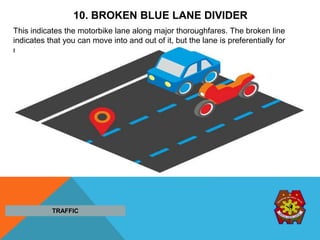
10. BROKEN BLUE LANE DIVIDER
This indicates the motorbike lane along major thoroughfares. The broken line
indicates that you can move into and out of it, but the lane is preferentially for
motorbikes.
TRAFFIC
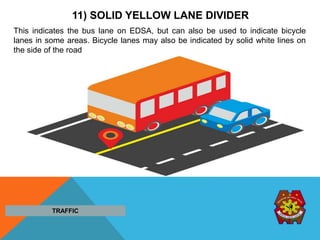
11) SOLID YELLOW LANE DIVIDER
This indicates the bus lane on EDSA, but can also be used to indicate bicycle
lanes in some areas. Bicycle lanes may also be indicated by solid white lines on
the side of the road
TRAFFIC
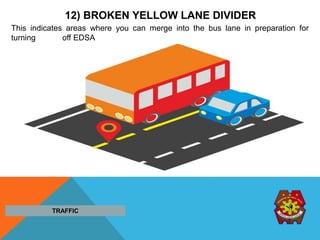
12) BROKEN YELLOW LANE DIVIDER
This indicates areas where you can merge into the bus lane in preparation for
turning off EDSA
TRAFFIC
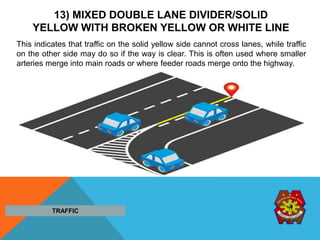
13) MIXED DOUBLE LANE DIVIDER/SOLID
YELLOW WITH BROKEN YELLOW OR WHITE LINE
This indicates that traffic on the solid yellow side cannot cross lanes, while traffic
on the other side may do so if the way is clear. This is often used where smaller
arteries merge into main roads or where feeder roads merge onto the highway.
TRAFFIC
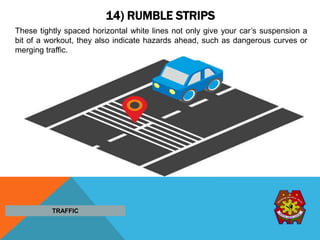
14) RUMBLE STRIPS
These tightly spaced horizontal white lines not only give your car’s suspension a
bit of a workout, they also indicate hazards ahead, such as dangerous curves or
merging traffic.
TRAFFIC
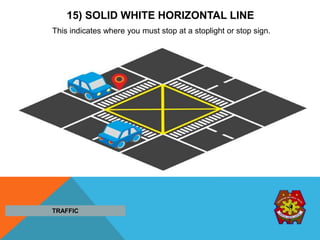
15) SOLID WHITE HORIZONTAL LINE
This indicates where you must stop at a stoplight or stop sign.
TRAFFIC
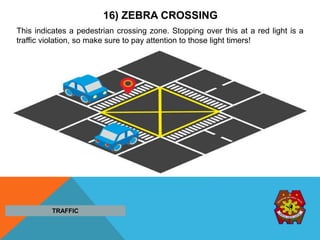
16) ZEBRA CROSSING
This indicates a pedestrian crossing zone. Stopping over this at a red light is a
traffic violation, so make sure to pay attention to those light timers!
TRAFFIC
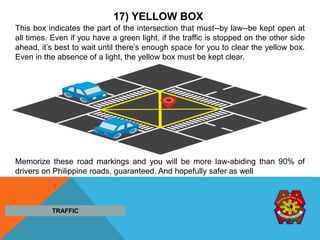
17) YELLOW BOX
This box indicates the part of the intersection that must--by law--be kept open at
all times. Even if you have a green light, if the traffic is stopped on the other side
ahead, it’s best to wait until there’s enough space for you to clear the yellow box.
Even in the absence of a light, the yellow box must be kept clear.
.
Memorize these road markings and you will be more law-abiding than 90% of
drivers on Philippine roads, guaranteed. And hopefully safer as well
TRAFFIC
FIVE (5) E’S OF TRAFFIC
a. Engineering
b. Enforcement
c. Education
d. Environment
e. Economics
TRAFFIC
GENERAL PILLARS
 ENGINEERING - is the science of
measuring traffic and travel, the study of
basic laws relative to the traffic flow and
generation, and the application of this
knowledge to the professional practice of
planning, and the operating traffic systems
to achieve safe and efficient movement of
persons and goods.
TRAFFIC
 ENFORCEMENT - refers to the action taken
by the police such as arrest, issuance of
traffic citation ticket, and giving of warning to
erring drivers for the purpose of deterring
and discouraging and preventing such
violation.
TRAFFIC
 EDUCATION - teaching children about the
broad range of transportation choices,
instructing them in important lifelong
bicycling and walking safety skills and
launching driver safety campaigns in the
vicinity of schools.
TRAFFIC
SUBSIDIARY PILLARS
 ENVIRONMENT - is the study of dealing
with potentially disastrous population
explosion, changes in the urban
environment due to scale and density of a
new urban concentration and new activities
carried out, air and water pollution, and
crowding, especially the transport
congestion resulting from it.
TRAFFIC
 ECONOMICS - on the other hand, is
the study how people choose to use
scarce or limited productive
commodities and distribute them for
consumptions.
TRAFFIC
AGENCIES INVOLVED IN THE ENFORCEMENT OF TRAFFIC
1. Land Transportation Franchising and Regulatory Board(LTFRB)
-Tasked to regulate transport route regulate franchising, prescribe fare rates,
investigate traffic cases, perform judicial function, promulgate rules,impose and
collect fees, formulate and enforce rules and regulation for transport operation
for promotion of safety and convenience of public,coordinate with concerned
agencies and enforce E.O. NO 125,124-A and E.O. 202 dated June 19,1987
2. Land Transportation Office (LTO)
- tasked to enforce laws, rules and regulation governing the registration of
motor vehicles, operation of motor vehicle and traffic rules and regulation as
provided by RA 4136 as amended
TRAFFIC
3. Department of Transportation and Communications
-In charge of planning programs coordinating implementing and perform
administrative function and promotion development and regulation of
dependable and coordinated network of transportation and communication
in order to have fast, safe, efficient and reliable postal transportation and
communication services (EO No. 125.)
4. Metro Manila Development Authority (MMDA)
-created under RA. 7924 and sets policies concerning traffic in
Metro Manila, coordinates and regulates implementation of
program related to traffic
TRAFFIC
5. Congress and Local Council
- the branch of government primarily tasked to create laws for the welfare of
the public
6. Judiciary
- the branch of government that interprets the law through adjudication of
cases
7. PNP- Traffic Management Group (TMG)
-the basis service of the PNP tasked to direct and control traffic, perform
accident investigation, enforce the laws and issue citations. NPC Resolution
No. 2008-262 Approving the renaming of the PNP - Traffic Management
Group (TMG) into PNP Highway Patrol Group (PNP-HPG) (May 5, 2008)
TRAFFIC
AGENCIES RESPONSIBLE FOR TRAFFIC ENGINEERING
1. Department of Public Works and Highways
-has responsibility of determining traffic flow planning approval of program and budget finding of
construction and maintenance of road and instrument.
2. Local Public Works and Engineering Offices
-local government units and instrumentalities that have the same function as the DPWH perform
such powers within their territorial boundary
AGENCIES INVOLVED IN TRAFFIC EDUCATION
1. Schools (Public and Private) Education
Elementary- tasked to educate children to obey traffic rules through their programmed curricula.
Secondary- tasked to educate students in obeying the traffic rules by imposing school policies
intended for the welfare of the students.
Higher Education- they offer subjects on driving and traffic safety course or any allied subjects
TRAFFIC
2. Public information Programs
-Responsibilities and conduct courses to private and public agencies and
persons, stressing traffic safety subjects
3. Citizen Support Group/Non-Government Organizations.
AGENCIES INVOLVED IN TRAFFIC EDUCATION
2. Public information Programs
-Responsibilities and conduct courses to private and public agencies and
persons, stressing traffic safety subjects
3. Citizen Support Group/Non-Government Organizations.
TRAFFIC
2. Public information Programs
-Responsibilities and conduct courses to private and public agencies and
persons, stressing traffic safety subjects
3. Citizen Support Group/Non-Government Organizations.
AGENCIES INVOLVED IN TRAFFIC ENVIRONMENT
1. Commission of Population
2. Department of Environment and Natural Resources
3. Local Government Agencies
4. Citizen Support Group/Non-Government Organizations
5. All other agencies responsible
TRAFFIC
AGENCIES INVOLVED IN TRAFFIC ECONOMICS
1. Banking Institutions
2. Citizen Support Group/Non-Government Organizations
3. All other agencies responsible
TRAFFIC
TRAFFIC DIRECTION AND CONTROL (TDC)
 Personnel will keep in mind their own safety
when manually directing traffic. All personnel
assigned or authorized to direct traffic will use
uniform signals and gestures to enhance driver
and pedestrian recognition of, and response to,
directions. The voice commands, signalling
aids, hand motions or gestures displayed by
personnel should elicit a reasonable and
immediate response from drivers and
pedestrians.
TRAFFIC
USING WHISTLES
A whistle may be used in conjunction with arm
and hand signals to gain the attention of drivers
and pedestrians in the following manner:
1. One long blast coupled with the hand signal for
STOP.
2. Two short blasts coupled with the hand signal for
GO.
3. Several short blasts to get the attention of a driver
or pedestrian who does not respond to a given
signal.
TRAFFIC
THINGS TO CONSIDER IN CONDUCTING TDC
 PROPER GESTURE/PERSONAL
APPEARANCE
 PROPER HAND SIGNAL
 TIME INTERVAL
 MAXIMUM TOLERANCE
TRAFFIC
TRAFFIC SIGNS – a device mounted or
on a portable support where a
message is conveyed by means of
words or symbols, officially erected or
installed for the purpose of regulating,
warning and guiding traffic.
TRAFFIC
Importance of Traffic Management Signals
– It ensures the safety of passengers, drivers, and pedestrian
– It ensures the order of the traffic movement at an intersection
– It helps in the reduction of the frequency and severity of some types of
accidents
– It tells people when to go or when to stop, thus making it beneficial in
maintaining the order on the road
– It prevents total gridlock on a day-to-day basis
– Reduces the number of accidents as well as fatalities.
TRAFFIC
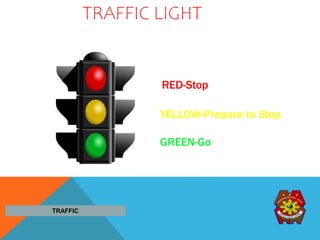
TRAFFIC LIGHT
RED-Stop
YELLOW-Prepare to Stop
GREEN-Go
TRAFFIC
What Does Each Color in a Traffic Signal Mean?
Red Traffic Signal:
- A red traffic light means stop. When approaching a red light at an
intersection, the driver should come to a complete stop at the marked stop
line. If there is not a marked stop line, the driver should stop before entering
the crosswalk. If there is no crosswalk, the driver should stop before entering
the intersection.
Flashing Red Traffic Signal:
- Stop, yield the right-of-way to traffic within the intersection or crosswalk
and proceed when safe. This sign is used at intersections when a stop
sign alone is hard to see or where additional emphasis on the stop sign is
needed. Flashing red traffic signals are also used at railroad crossings to
warn of approaching trains.
TRAFFIC
Note: Turning Right or Left on Red
If there no sign posted designating otherwise, you may make a
right turn at a red light. You also may make a left turn at a red
light when turning from a one-way street onto another one-way
street that has traffic moving to the left. In both instances,
drivers must come to a complete stop behind the stop line and
yield the right-of-way to pedestrians and cross-traffic before
turning.
Yellow Traffic Signal:
-The yellow light warns that the signal is changing from
green to red. When the red light appears, you may not enter
the intersection.
TRAFFIC
TRAFFIC
Green Traffic Signal:
- Yes, green means go, but go after yielding the right-
of-way to any pedestrians and vehicles in the intersection
or crosswalk.
Flashing Yellow Traffic Signal:
- A flashing yellow traffic signal at an intersection means
to proceed with caution.
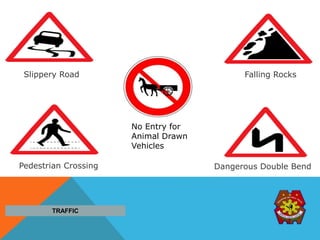
DANGER WARNING SIGNS –
intended to warn road user of a
danger on the road and to inform
them of its nature.
TRAFFIC
Slippery Road Falling Rocks
Pedestrian Crossing Dangerous Double Bend
TRAFFIC
No Entry for
Animal Drawn
Vehicles
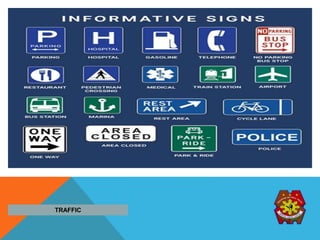
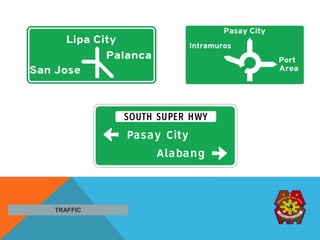
INFORMATIVE SIGNS – intended to
guide road user while they are
travelling or to provide them with
other useful information.
TRAFFIC
TRAFFIC
TRAFFIC
REGULATORY SIGNS
-intended to inform road user of
special obligation, instruction or
prohibitions which they must comply.
TRAFFIC
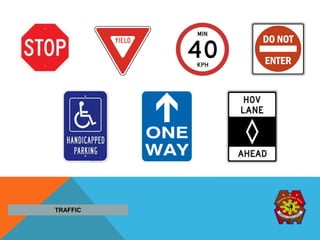
-include Stop Signs, Yield Signs, Speed
Limit Signs, Do Not Enter, Handicapped,
One Way Signs and HOV Signs
TRAFFIC
TRAFFIC MANAGEMENT AND SUPERVISION
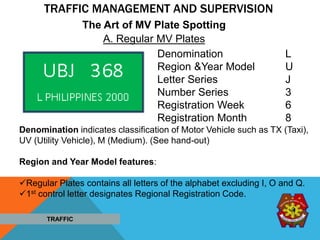
Denomination L
Region &Year Model U
Letter Series J
Number Series 3
Registration Week 6
Registration Month 8
Denomination indicates classification of Motor Vehicle such as TX (Taxi),
UV (Utility Vehicle), M (Medium). (See hand-out)
Region and Year Model features:
Regular Plates contains all letters of the alphabet excluding I, O and Q.
1st control letter designates Regional Registration Code.
A. Regular MV Plates
The Art of MV Plate Spotting
TRAFFIC
TRAFFIC MANAGEMENT AND SUPERVISION
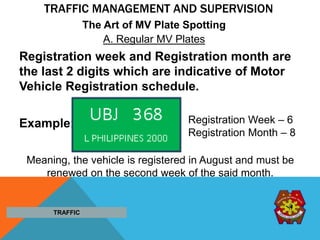
Registration week and Registration month are
the last 2 digits which are indicative of Motor
Vehicle Registration schedule.
Example:
TRAFFIC
Meaning, the vehicle is registered in August and must be
renewed on the second week of the said month.
A. Regular MV Plates
The Art of MV Plate Spotting
Registration Week – 6
Registration Month – 8
TRAFFIC
A. Newly designed license plate:
A.1. For four-wheeled vehicles ( 3 alpha characters and 4 numeric characters)
A.2. For two-wheeled vehicles ( 2 alpha characters and 5 numeric
characters)
TRAFFIC
Protocol/high-ranking government plates
These plates are green D or DD plates reserved for the top government
officials of the Republic of the Philippines.
•1 – President
•2 – Vice President
•3 – President of the Senate
•4 – Speaker of the House of Representatives
•5 – Chief Justice of the Supreme Court
•6 – Cabinet Secretaries
•7 – Senators
•8 – Representatives (Congressmen)
•9 – Associate Justices of the Supreme Court
•10 – Presiding Justice and other Justices of the Court of Appeals
TRAFFIC
•11 – Chairman, Commission on Elections
•12 – Cabinet Undersecretary
•13 – Solicitor-General
•14 – Chief of Staff of the Armed Forces of the Philippines and Chief of
the Philippine National Police
•16 – Regional Trial Court Judges (e.g. 16*NCR
•17 – First Level Courts (Metropolitan Trial Court, Municipal Trial
Court, Municipal Trial Court in Cities and Shari'ah Circuit courts),
added by Memorandum Order No. 297 signed by President Gloria
Macapagal-Arroyo on March 2, 2009, assistant city prosecutors, district
prosecutors and chief city prosecutors with initials of 17*ACP (court branch
number)
TRAFFIC
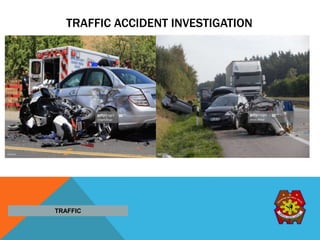
TRAFFIC ACCIDENT INVESTIGATION
TRAFFIC
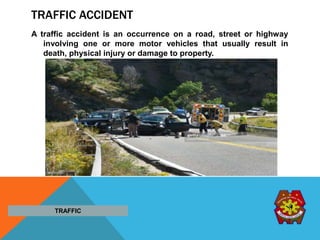
TRAFFIC ACCIDENT
A traffic accident is an occurrence on a road, street or highway
involving one or more motor vehicles that usually result in
death, physical injury or damage to property.
TRAFFIC
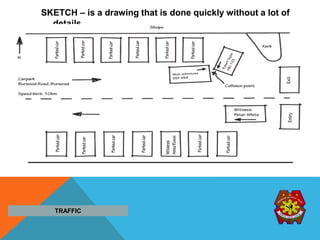
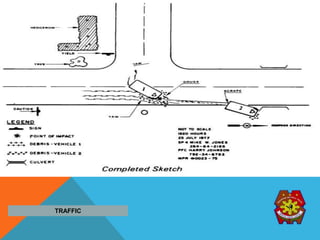
SKETCH – is a drawing that is done quickly without a lot of
details.
TRAFFIC
TRAFFIC
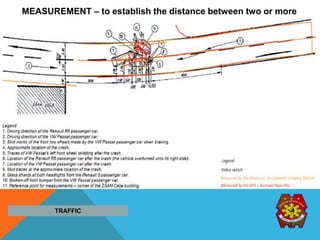
MEASUREMENT – to establish the distance between two or more
things.
TRAFFIC
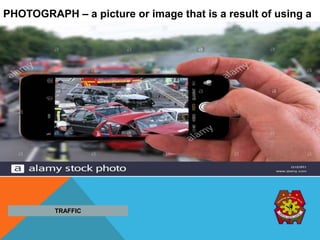
PHOTOGRAPH – a picture or image that is a result of using a
camera.
TRAFFIC
TRAFFIC ACCIDENT INVESTIGATION
3 I’s OF INVESTIGATION
 INFORMATION/INTERVIEW
 INTERROGATION
 INSTRUMENTATION
TRAFFIC
 INFORMATION – data gathered from other persons, the victim and from other records such
as public records, private records, Modus operandi which are pertinent concerning the
commission of crime or criminal activities.
 INTERROGATION – is a skillful questioning of witnesses and suspects. It is a process
of obtaining admission or confession from those suspects who have committed a crime.
It is confrontational in nature which means that the suspect is confronted about his
participation in the commission of the offense.
TRAFFIC
 Instrumentation – Also called as Criminalistics or Forensic Science. - It is a scientific
examination of real evidence, application of instrument and methods of the physical
sciences in detecting crime.
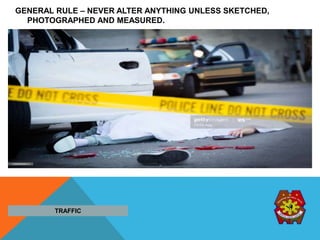
GENERAL RULE – NEVER ALTER ANYTHING UNLESS SKETCHED,
PHOTOGRAPHED AND MEASURED.
TRAFFIC
TRAFFIC
Observe the first responder’s rule – for first
responder.
First Responder is different from IOC.
INJURED PERSONS– there is PNP SOP in proper
dealing
TYPES OF COLLITION
TRAFFIC
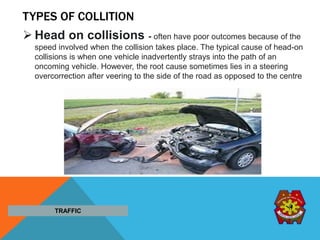
 Head on collisions - often have poor outcomes because of the
speed involved when the collision takes place. The typical cause of head-on
collisions is when one vehicle inadvertently strays into the path of an
oncoming vehicle. However, the root cause sometimes lies in a steering
overcorrection after veering to the side of the road as opposed to the centre
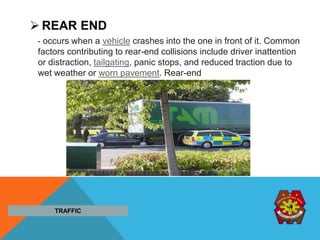
 REAR END
- occurs when a vehicle crashes into the one in front of it. Common
factors contributing to rear-end collisions include driver inattention
or distraction, tailgating, panic stops, and reduced traction due to
wet weather or worn pavement. Rear-end
TRAFFIC
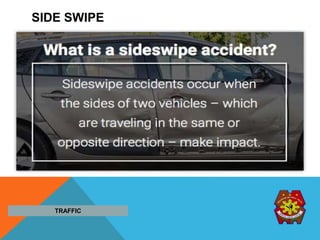
SIDE SWIPE
TRAFFIC
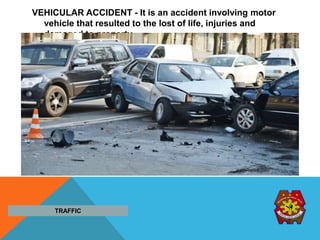
VEHICULAR ACCIDENT - It is an accident involving motor
vehicle that resulted to the lost of life, injuries and
damaged to property.
TRAFFIC
Traffic accidents are extremely confusing events.
How they occur, who or what caused them, and
why they occurred are facts that police must
determine. Every peace officer must know the
fundamentals of traffic accident investigation
and know how to prepare traffic accident
reports.
TRAFFIC
TWO EXISTING METHODS OF MEASUREMENT
COORDINATES – which consist in measuring the
shortest distance from each of two reference lines
to the spot to be located.
TRIANGULATION – which is done by measuring the
distance from each of two reference point.
TRAFFIC
DOCTRINE OF LAST CLEAR CHANCE
A driver who is in better position to
prevent the accident has the
responsibility of preventing it.
Prevention of accident is the first
responsibility of all drivers.
TRAFFIC
Initial Steps. Prompt arrival at the
scene of an accident is essential.
Safety, however, should be
emphasized at all times.
TRAFFIC
STEPS TO BE UNDERTAKEN AT THE ACCIDENT SCENE
-Cordon the area
-Evacuate injured person to the nearest hospital
-Locate for witness/es – isolate if possible
-Obtain the drivers license of both drivers
-Obtain the MV’s documents
-Sketched the accident scene – conform the drivers
TRAFFIC
Location of the Patrol Vehicle. The police vehicle should be
positioned so as not to cause further traffic congestion or
accidents. If necessary, it may, however, be used as a
roadblock. At night it should be parked so the headlights
illuminate the entire scene. At all times the emergency lights
should be on to warn approaching motorists of the hazard.
TRAFFIC
Establish Traffic Control. Traffic control is essential at the
accident scene to prevent further accidents or injury. Rerouting
vehicles around the accident scene is the most common
procedure used. Spectators or unnecessary personnel should be
cleared from the accident area.
TRAFFIC
Moving Vehicle And Marking Wheels The decision
to move a vehicle from its final position must often be
made by the police patrol arriving at the scene.
When this is done, the positions of the wheels should
be marked on the ground so they can be relocated
for investigative purposes.
Under the following conditions, a vehicle must be moved
immediately:
When an injured person is trapped in the wreckage and cannot be
treated there.
When a person is trapped in wreckage near burning material, or
an area of potential fire hazard.
When a vehicle position is an immediate hazard to oncoming
traffic and adequate traffic control cannot be established.
AFTER INVESTIGATION, THE INVESTIGATOR SHOULD
DETERMINE IF HE WILL FILE A CASE OR THE PARTIES WILL
SETTLE AMMICABLY.
TRAFFIC
TRAFFIC MANAGEMENT AND SUPERVISION
Let’s Do the Exercise !!!
(1 Hour)
GROUP WORK
1. Identify specific congested area in your
place;
2. List down problems that contributed in
traffic congestion.
3. Come up with an assessment and make a
recommendation on how to solve and
control that traffic problem.
TRAFFIC
TRAFFIC

TRAFFIC MANAGEMENT PRESENTATION AND REPORT.pptx

  • 1.
  • 2.
    Traffic Management Defined Itis an executive function such as planning, organizing, directing, supervising, coordinating, operating, recording, and budgeting traffic affairs. It also refers to all agencies having responsibilities for ascertaining traffic flow requirements, such as planning, approving, funding, constructing and/or maintaining public facilities for such movement. Further, it is also refers to all agencies responsible for licensing, approving, restricting, stopping, prohibiting or controlling the use of these facilities. TRAFFIC
  • 3.
    TRAFFIC SUPERVISION As individualtraffic volumes increase, intelligent traffic control systems become more and more important. TRAFFIC
  • 4.
    UPDATES PNP Standard Operating Procedure No.2011-004 (Revised Procedure in the Reporting & Disposition of Stolen and Recovered / Impounded Motor Vehicles) TRAFFIC
  • 5.
    CMC 2011-001 RESPONSETO MAJOR ROAD TRAFFIC ACCIDENT - The HPG will take cognizant on major road traffic accident. a. multiple death and injuries b. damage of such magnitude c. accident which gained national attention TRAFFIC
  • 6.
    PRESIDENTIAL DECREE NO.96 Law enacted during the incumbency of President Ferdinand E. Marcos Proclamation No. 1081, on dated September 21, 1972 Done in the City of Manila, on January 13, 1973 Declaring unlawful use or attachment of sirens, bells, horns, whistles or similar gadget that emit exceptionally loud or startling sounds, including dome lights and other similar signaling or flashing devices on motor vehicles and providing certain exceptions therefor. TRAFFIC
  • 7.
    R.A 10586 "An ActPenalizing Persons Driving Under The Influence Of Alcohol, Dangerous Drugs, And Similar Substances, And For Other Purposes" Otherwise known as the "Anti-Drunk and Drugged Driving Act of 2013" TRAFFIC
  • 10.
    Republic Act No.10883, or otherwise known as the New Anti-Carnapping Act of 2016 (RA 10883) is a law which punishes carnapping in the Philippines. R.A 10883 THE NEW ANTI-CARNAPPING ACT OF 2016 TRAFFIC RA 10883 - punishes the crime of carnapping which refers to the taking with intent to gain of a motor vehicle belonging to another without the latter’s consent, or by means of violence against or intimidation of persons, or by using force upon things.
  • 11.
     Note thatthe following are not embraced in the definition of a motor vehicle under the law and thus cannot be the subject of carnapping, to wit: road rollers, trolley cars, street sweepers, sprinklers, lawn mowers, bulldozers, graders, forklifts, amphibian trucks, and cranes if not used on public highways; vehicles which run only on rails or tracks; and tractors, trailers and traction engines of all kinds used exclusively for agricultural purposes TRAFFIC For purposes of knowing what carnapping is, one must be able to know what Motor vehicle is, in the first place. As defined under this law, Motor vehicle refers to any vehicle propelled by any power other than muscular power using the public highways.
  • 12.
    REPUBLIC ACT NO.8750 “SEAT BELTS USE ACT OF 1999.” AUGUST 05, 1999 An act requiring the mandatory compliance by motorists of private and public vehicles to use seat belt devices, and requiring vehicle manufacturers to install seat belt devices in all their manufactured vehicles TRAFFIC
  • 13.
    •First violation: Php1,000 •Second violation: Php 2,000 •Third violation: Php 5,000 LTO penalty for not wearing seatbelt in the Philippine . The seat belt law Philippines is applied for both drivers and the passengers. Important to note that, having 6-year-old children on the front seat without a seat belt, drivers also have to pay for the ticket. TRAFFIC LTO Fine:
  • 14.
    The national HighwaySafety Council has done extensive testing on a newly designed seat belt. Results show that accidents can be reduced by as much as 90% when the belt is properly installed. Correct installation is illustrated below... TRAFFIC
  • 15.
    This is veryImportant, please pass on to friends and family. THIS MIGHT SAVE LIVES TRAFFIC
  • 16.
    RA 10913 Anti-Distracted Driving Act (ADDA)  is a law that prohibits a person who is driving a motor vehicle from holding and using mobile communication devices and electronic entertainment gadgets. TRAFFIC
  • 17.
    What are thepenalties  Violators will be penalized with a fine of five thousand pesos (Php5, 000) for the first offense  Ten thousand pesos ((Php10, 000) for the second offense  Fifteen thousand pesos ((Php15, 000) for the third offense with a three-month suspension of driver's license. TRAFFIC
  • 18.
    RA 7924  AnAct Creating the Metropolitan Manila Development Authority, defining its powers and functions, providing funding therefor and for other purposes  sought to improve traffic flow and reduce travel times, optimizing not only vehicular movement but also that of persons, goods and services. TRAFFIC
  • 19.
    RA 10054 AN ACT MANDATING ALL MOTORCYCLE RIDERS TO WEAR STANDARD PROTECTIVE MOTORCYCLE HELMETS WHILE DRIVING AND PROVIDING PENALTIES THEREFOR  Section 1. Short Title. - This Act shall be known as the "Motorcycle Helmet Act of 2009"  Section 3. Mandatory Use of Motorcycle Helmets. - All motorcycle riders, including drivers and back riders, shall at all times wear standard protective motorcycle helmets while driving, whether long or short drives, in any type of road and highway. TRAFFIC
  • 20.
    Standard protective motorcyclehelmets are appropriate types of helmets for motorcycle riders that comply with the specifications issued by the Department of Trade and Industry (DTI).  Section 4. Exemption. - Drivers of tricycles shall be exempted from complying with the mandatory wearing of motorcycle helmets as provided in this Act TRAFFIC
  • 21.
     Section 7.Penalties. - (a) Any person caught not wearing the standard protective motorcycle helmet in violation of this Act shall be punished with a fine of One thousand five hundred pesos (Php1,500.00) for the First offense; Three thousand pesos (Php3,000.00) for the Second offense; Five thousand pesos (Php5,000.00) for the Third offense; and Ten thousand pesos (Php10,000.00) plus confiscation of the driver's license for the Fourth and Succeeding offenses TRAFFIC
  • 22.
    RA 10666 ANACT PROVIDING FOR THE SAFETY OF CHILDREN ABOARD MOTORCYLES  Section 3. Definitions. -For purposes of this Act, the following terms shall mean:  (a) Motorcycle refers to any two (2)-wheeled motor vehicle having one (1) or two (2) riding saddles;  (b) Public roads refer to roads designed by the national government or local government units as roads for public use such as, but not limited to, national highways, provincial roads, city, municipal and barangay streets; TRAFFIC  Section 1. Short Title. – This Act shall be known as "Children’s Safety on Motorcycles Act of 2015"
  • 23.
     (c) Footpeg refers to a flat form attached to the motorcycles on which to stand or brace the feet.  (d) Rider refers to the driver of a motorcycle.  Section 4.Prohibition. – It shall be unlawful for any person to drive a two (2)-wheeled motorcycle with a child on board on public roads where there is heavy volume of vehicles, there is a high density of fast moving vehicles or where a speed limit of more than 60/kph is imposed, unless: TRAFFIC
  • 24.
     (a) Thechild passenger can comfortably reach his/her feet on the standard foot peg of the motorcycle;  (b) The child’s arms can reach around and grasp the waist of the motorcycle rider.  (c) The child is wearing a standard protective helmet referred to under Republic Act No. 10054, otherwise known the “Motorcycle Helmet Act of 2009.”  Section 5. Exception. – Notwithstanding the prohibition provided in the preceding section, this Act shall not apply to cases where the child to be transported requires immediate medical attention. TRAFFIC
  • 25.
     SEC. 6.Penalties. – Any person who operates a motorcycle in violation of Section 4 of this Act shall be fined with an amount of three thousand pesos (P3,000.00) for the first offense; five thousand pesos (P5,000.00) for the second offense; and ten thousand pesos (P10,000.00) for the third and succeeding offenses.  Moreover, for the third offense, the driver’s license of the offender shall be suspended for a period of one (1) month.  Violation of these provisions beyond the third time shall result to automatic revocation of the offender’s driver’s license. TRAFFIC *Import Commodity Clearance (ICC)*
  • 26.
    Penalty for wearingslippers while driving motorcycle What is the penalty for wearing slippers while driving motorcycle in the Philippines? Wearing slippers while driving motorcycle in the Philippines is not allowed. Warning to motorcycle owners! 1.First Offense: Php 578.00 fine 2.Second Offense: Php 778.00 fine 3.Third Offense: Php 1,078.00 fine TRAFFIC
  • 27.
    E0 202 -CREATING THE LAND TRANSPORTATION FRANCHISING AND REGULATORY BOARD (LTFRB) WHEREAS, the Department of Transportation and Communications is vested with, among others, quasi – judicial powers and functions pursuant to Executive Order No. 125, as amended; TRAFFIC
  • 28.
    REPUBLIC ACT NO.8749 - This Act shall be known as the “Philippine Clean Air Act of 1999.” - is a comprehensive air quality management policy and program which aims to achieve and maintain healthy air for all Filipinos. “The State shall promote and protect the global environment to attain sustainable development while recognizing the primary responsibility of local government units to deal with environmental problems.” TRAFFIC
  • 29.
    “Air pollution" -means any alteration of the physical, chemical and biological properties of the atmospheric air, or any discharge thereto of any liquid, gaseous or solid substances that will or is likely to create or to render the air 538 resources of the country harmful detrimental or injurious to public health, safety or welfare or which will adversely affect their utilization for domestic, commercial, industrial agricultural, recreational or other legitimate purposes; TRAFFIC
  • 30.
    SECTION 21. Pollutionfrom Motor Vehicles.— a) The DOTC shall implement the emission standards for motor vehicles set pursuant to and as provided in this Act. Mandate The Department of Transportation and Communications (DOTC) develops, promotes, implements and maintains integrated and strategic transportation and communications systems that will ensure safe, reliable, responsive, and viable services to accelerate economic development and to better serve the transport and communications needs of the people. TRAFFIC
  • 31.
    What is theEmission Test? It is a mandatory test in the Philippines as part of the car’s registration. It is also done during the renewal of the car’s registration. This test measures the level of fumes or pollutant released from the exhaust manifold of a vehicle What is the purpose of the Emission test Philippines? The main goal of the emission test is to lessen the air pollutants that are harmful to the environment. It detects the level of hydrocarbons, carbon dioxide, nitrogen oxide, carbon monoxide, and other air pollutants. TRAFFIC
  • 32.
    In general, theemission test aims to ensure that a vehicle is in compliance with the set of emission standards. It is also the requirement of a car to have a CEC or Certificate of Emission Compliance which is needed for the renewal of the car’s registration. SECTION 46. Violation of Standards for Motor Vehicles.— No motor vehicle shall be registered with the DOTC unless it meets the emission standards set by the Department as provided in Section 21 hereof. TRAFFIC
  • 33.
    Any vehicle suspectedof violation of emission standards through visual signs, such as, but not limited to smoke-belching, shall be subjected to an emission test by a duly authorized emission testing center. For this purpose, the DOTC or its authorized testing center shall establish a roadside inspection system. Should it be shown that there was no violation of emission standards, the vehicle shall be immediately released. Otherwise, a testing result indicating an exceedance of the emission standards would warrant the continuing custody of the impounded vehicle unless the appropriate penalties are fully paid, and the license plate is surrendered to the DOTC pending the fulfillment of the undertaking by the owner/operator of the motor vehicle to make the necessary repairs so as to comply with the standards. TRAFFIC
  • 34.
    A pass shallherein be issued by the DOTC to authorize the use of the motor vehicle within a specified period that shall not exceed seven (7) days for the sole purpose of making the necessary repairs on the said vehicle. The owner/operator of the vehicle shall be required to correct its defects and show proof of compliance to the appropriate pollution control office before the vehicle can be allowed to be driven on any public or subdivision roads. In addition, the driver and operator of the apprehended vehicle shall undergo a seminar on pollution control and management conducted by the DOTC and shall also suffer the following penalties: (a) First offense - a fine not to exceed Two thousand pesos (₱2,000); (b) Second offense - a fine not less than Two thousand pesos (₱2,000) and not to exceed Four thousand pesos (₱4,000); and TRAFFIC
  • 35.
    (c) Third offense- one (1) year suspension of the Motor Vehicle Registration (MVR) and a fine of not less than Four thousand pesos (₱4,000) and not more than Six thousand pesos (₱6,000). Any violation of the provisions of Section 21 paragraph (d) with regard to national inspection and maintenance program, including technicians and facility compliance shall be penalized with a fine of not less than Thirty thousand pesos (₱30,000) or cancellation of license of both the technician and the center, or both, as determined by the DTI. Smoke Belching Meaning If you have seen a jeepney on the road, chances are you have seen black smoke coming out of its exhaust pipe. The black smoke you see coming from a vehicle is called smoke belching. It is a forceful expulsion of thick smoke from an exhaust system. Smoke belching is quite common to see in Metro Manila especially from public utility vehicles that are used as public transport. TRAFFIC
  • 36.
    R.A 4136 (FOUNDATION) Section 1. Title of Act. - This Act shall be known as the "Land Transportation and Traffic Code."  Section 2. Scope of Act. - The provisions of this Act shall control, as far as they apply, the registration and operation of motor vehicles and the licensing of owners, dealers, conductors, drivers, and similar matters. TRAFFIC
  • 37.
    LICENSING SYSTEM -it isthe system of issuing license to any person who is qualified to fulfill the responsibilities required by the license administered by the LTO DRIVER’S LICENSE -issued to the drivers as privilege granted by the government providing statutory qualification LICENSING PROCEDURE - At least 16 years old for student’s permit - 17 years old for sub-professional - 18 years old for professional KINDS OF DRIVER’S LICENSE 1. Student permit 2. Non-professional 3. Professional 4. Militar 5.International TRAFFIC
  • 38.
    Student Permit isa prerequisite for both professional and non-professional driver's licenses. Also called student driver's permit, this LTO-issued document is a basic license authorizing a person to drive a vehicle accompanied by a licensed driver (whether with a professional or non-pro license). -Filipinos at least 16 years old -Foreigners at least 18 years old who have stayed in the Philippines for at least one month and have proof of residence for up to six months -People whose license has been expired for 10 years or more and have no traffic violations -Must be physically and mentally fit to drive vehicles -Individuals who completed the theoretical driving course TRAFFIC
  • 39.
    Non-Professional Driver's Licenseallows you to drive private vehicles only. You may apply for a non-pro driver's license one month to one year after the issue date ofyour student permit. -Filipinos at least 17 years old -Foreigners are at least 18 years old -Holders of a valid student permit for at least one month from issuance -Must be physically and mentally fit to operate a vehicle -Must have attended and passed the Practical Driving Course (PDC) from an LTO-accredited driving school, LTO DEC, or LTO-accredited TESDA training center -Must have passed the LTO examinations -Must not have unsettled traffic violations TRAFFIC
  • 40.
    Professional Driver's Licenseallows you to drive a vehicle for a living. Apply for a professional license if you plan to drive any public utility vehicle (PUV) such as a taxi, transport network vehicle service (TNVS), jeepney, tricycle, bus, etc. Filipinos at least 17 years old Foreigners at least 18 years old Must be a non-pro license holder for at least six months Must have no unsettled traffic violations Must be physically and mentally fit to operate a vehicle Must have completed a minimum of eight-hour practical driving lessons from any LTO or TESDA-accredited driving school Military Driver's License special types of license issued by the agency for limited and special purposes Limited to drive a military vehicle. International Driver’s License Issued by Philippine Motor Association (PMA) TRAFFIC
  • 41.
    TRAFFIC DEFINED - itrefers to the movement of pedestrian, motor vehicle and goods from point of origin to point of destination. The word traffic originates from Greco-Roman word “TRAFICO” with reference to the movement of people that dates back from the dawns of history. The Greek originally called the system “TRAFRIGA” after the early horse drawn chariots with spoke wheels. TRAFFIC
  • 42.
    The word TRAFFICwas derived from the word ‘’TRAFFICARE’’ which means : A. To Travel B. To Traverse C. To carry on Trade D. To Transport TRAFFIC
  • 43.
    Traffic congestion -is a condition on transport that is characterised by slower speeds, longer trip times, and increased vehicular queueing Traffic Jam - When vehicles are fully stopped for periods of time TRAFFIC
  • 44.
    Road rage -is aggressive or angry behavior exhibited by a driver of a road vehicle. These behaviors include rude and offensive gestures, verbal insults, physical threats or dangerous driving methods targeted toward another driver or non-drivers such as pedestrians or cyclists in an effort to intimidate or release frustration. Road rage can lead to altercations, assaults and collisions that result in serious physical injuries or even death. Strategies include long horn honks, swerving, tailgating, brake checking and attempting to fight TRAFFIC
  • 45.
    DEFINITION OF TERMS HIGHWAY - shall mean every public thoroughfare, public boulevard, driveway, avenue, park, alley and callejon, but shall not include roadway upon grounds owned by private persons, colleges, universities, or other similar institutions. TRAFFIC  Pedestrian - is a person travelling on foot, whether walking or running. In modern times, the term usually refers to someone walking on a road or pavement, but this was not the case historically
  • 46.
    MOTOR VEHICLE -Shall mean any vehicle propelled by any power other than muscular power using the public highways, but exempting road rollers, trolley cars, street sweepers, sprinklers, lawn mowers, bulldozers, graders, forklifts, amphibian trucks, and cranes if not in used on public highways, vehicles which runs only on rails or tracks, and tractors, trailers and traction engines of all kinds used exclusively for agricultural purposes. TRAFFIC
  • 47.
     DRIVER‘S LICENSE- is an official document, often plastic and the size of a credit card, permitting a specific individual to operate one or more types of motorized vehicles, such as a motorcycle, car, truck, or bus on a public road.  OWNER – Shall mean the actual legal owner of a motor vehicle, in whose name such vehicle is duly registered with the land trasnportation commission  DRIVER – Shall mean every and licensed operator of motor vehicle TRAFFIC
  • 48.
    MUST- KNOW: ALLTHE BASIC ROAD MARKINGS IN PH AND WHAT EACH ONE MEANS 1. SOLID WHITE SHOULDER LINE This denotes the edge of the roadway. Any asphalt or concrete surface beyond this line should not be used during the normal operation of your vehicle. TRAFFIC
  • 49.
    2. DIAGONAL WHITELINES An area filled with diagonal white lines and bordered by solid white lines is not considered part of the roadway, and vehicles are expected to stay off unless there is an emergency. These areas are often used to ease the flow of traffic where roads diverge or intersect. TRAFFIC
  • 50.
    3. BROKEN WHITECENTER LINE OR LANE DIVIDER This denotes the center of a two-lane road, or marks the division between lanes on multi-lane roads. It is a reminder to stay in your lane. Straddling the line is illegal and punishable under the law. As the line is “broken,” however, this means it is legal to cross it when overtaking or changing lanes. Bear in mind that vehicles continuing in a straight line within their lane automatically have right of way, so wait your turn. TRAFFIC
  • 51.
    4. SOLID WHITECENTER LINE This is often used to divide traffic on a two-way multi-lane road. As this is a solid line, you are discouraged from overtaking over it unless the way is absolutely clear. TRAFFIC
  • 52.
    5. SOLID WHITEDOUBLE CENTER LINE You are forbidden from overtaking over this line, but you may make left turns over it, provided the way is clear. Remember, however, that oncoming traffic still automatically has right of way. TRAFFIC
  • 53.
    6. SOLID YELLOWDOUBLE CENTER LINE As we noted a while back, this line indicates that it is unsafe to overtake at any time. It is often found around blind curves or in areas where fast-moving two-way traffic meets on an undivided road. TRAFFIC
  • 54.
    7. MIXED CENTERLINE/SOLID YELLOW WITH BROKEN YELLOW OR WHITE LINE This indicates that only one side can overtake--the side with the broken line. This is often found entering curves where the view is obstructed coming from one direction, but is clear from the opposite side. TRAFFIC
  • 55.
    8. SOLID WHITELANE DIVIDER These are often found near intersections, and are reminders to stay in lane. As a practice, if you’re turning at an intersection, it’s best to get into the turning lane 50m before the intersection, while the lane divider is still broken. TRAFFIC
  • 56.
    9. DIRECTIONAL ARROWS Whencombined with solid white lane dividers, they indicate which directions you are allowed to go within a lane. If the arrow points forward only, you cannot make a turn from that lane. If it points forward and to the side, you can either go straight or turn. If it points only to the side, you must turn within that lane. Ignoring these arrows might just get you a ticket, or worse, get you into an accident. TRAFFIC
  • 57.
    10. BROKEN BLUELANE DIVIDER This indicates the motorbike lane along major thoroughfares. The broken line indicates that you can move into and out of it, but the lane is preferentially for motorbikes. TRAFFIC
  • 58.
    11) SOLID YELLOWLANE DIVIDER This indicates the bus lane on EDSA, but can also be used to indicate bicycle lanes in some areas. Bicycle lanes may also be indicated by solid white lines on the side of the road TRAFFIC
  • 59.
    12) BROKEN YELLOWLANE DIVIDER This indicates areas where you can merge into the bus lane in preparation for turning off EDSA TRAFFIC
  • 60.
    13) MIXED DOUBLELANE DIVIDER/SOLID YELLOW WITH BROKEN YELLOW OR WHITE LINE This indicates that traffic on the solid yellow side cannot cross lanes, while traffic on the other side may do so if the way is clear. This is often used where smaller arteries merge into main roads or where feeder roads merge onto the highway. TRAFFIC
  • 61.
    14) RUMBLE STRIPS Thesetightly spaced horizontal white lines not only give your car’s suspension a bit of a workout, they also indicate hazards ahead, such as dangerous curves or merging traffic. TRAFFIC
  • 62.
    15) SOLID WHITEHORIZONTAL LINE This indicates where you must stop at a stoplight or stop sign. TRAFFIC
  • 63.
    16) ZEBRA CROSSING Thisindicates a pedestrian crossing zone. Stopping over this at a red light is a traffic violation, so make sure to pay attention to those light timers! TRAFFIC
  • 64.
    17) YELLOW BOX Thisbox indicates the part of the intersection that must--by law--be kept open at all times. Even if you have a green light, if the traffic is stopped on the other side ahead, it’s best to wait until there’s enough space for you to clear the yellow box. Even in the absence of a light, the yellow box must be kept clear. . Memorize these road markings and you will be more law-abiding than 90% of drivers on Philippine roads, guaranteed. And hopefully safer as well TRAFFIC
  • 65.
    FIVE (5) E’SOF TRAFFIC a. Engineering b. Enforcement c. Education d. Environment e. Economics TRAFFIC
  • 66.
    GENERAL PILLARS  ENGINEERING- is the science of measuring traffic and travel, the study of basic laws relative to the traffic flow and generation, and the application of this knowledge to the professional practice of planning, and the operating traffic systems to achieve safe and efficient movement of persons and goods. TRAFFIC
  • 67.
     ENFORCEMENT -refers to the action taken by the police such as arrest, issuance of traffic citation ticket, and giving of warning to erring drivers for the purpose of deterring and discouraging and preventing such violation. TRAFFIC
  • 68.
     EDUCATION -teaching children about the broad range of transportation choices, instructing them in important lifelong bicycling and walking safety skills and launching driver safety campaigns in the vicinity of schools. TRAFFIC
  • 69.
    SUBSIDIARY PILLARS  ENVIRONMENT- is the study of dealing with potentially disastrous population explosion, changes in the urban environment due to scale and density of a new urban concentration and new activities carried out, air and water pollution, and crowding, especially the transport congestion resulting from it. TRAFFIC
  • 70.
     ECONOMICS -on the other hand, is the study how people choose to use scarce or limited productive commodities and distribute them for consumptions. TRAFFIC
  • 71.
    AGENCIES INVOLVED INTHE ENFORCEMENT OF TRAFFIC 1. Land Transportation Franchising and Regulatory Board(LTFRB) -Tasked to regulate transport route regulate franchising, prescribe fare rates, investigate traffic cases, perform judicial function, promulgate rules,impose and collect fees, formulate and enforce rules and regulation for transport operation for promotion of safety and convenience of public,coordinate with concerned agencies and enforce E.O. NO 125,124-A and E.O. 202 dated June 19,1987 2. Land Transportation Office (LTO) - tasked to enforce laws, rules and regulation governing the registration of motor vehicles, operation of motor vehicle and traffic rules and regulation as provided by RA 4136 as amended TRAFFIC
  • 72.
    3. Department ofTransportation and Communications -In charge of planning programs coordinating implementing and perform administrative function and promotion development and regulation of dependable and coordinated network of transportation and communication in order to have fast, safe, efficient and reliable postal transportation and communication services (EO No. 125.) 4. Metro Manila Development Authority (MMDA) -created under RA. 7924 and sets policies concerning traffic in Metro Manila, coordinates and regulates implementation of program related to traffic TRAFFIC
  • 73.
    5. Congress andLocal Council - the branch of government primarily tasked to create laws for the welfare of the public 6. Judiciary - the branch of government that interprets the law through adjudication of cases 7. PNP- Traffic Management Group (TMG) -the basis service of the PNP tasked to direct and control traffic, perform accident investigation, enforce the laws and issue citations. NPC Resolution No. 2008-262 Approving the renaming of the PNP - Traffic Management Group (TMG) into PNP Highway Patrol Group (PNP-HPG) (May 5, 2008) TRAFFIC
  • 74.
    AGENCIES RESPONSIBLE FORTRAFFIC ENGINEERING 1. Department of Public Works and Highways -has responsibility of determining traffic flow planning approval of program and budget finding of construction and maintenance of road and instrument. 2. Local Public Works and Engineering Offices -local government units and instrumentalities that have the same function as the DPWH perform such powers within their territorial boundary AGENCIES INVOLVED IN TRAFFIC EDUCATION 1. Schools (Public and Private) Education Elementary- tasked to educate children to obey traffic rules through their programmed curricula. Secondary- tasked to educate students in obeying the traffic rules by imposing school policies intended for the welfare of the students. Higher Education- they offer subjects on driving and traffic safety course or any allied subjects TRAFFIC
  • 75.
    2. Public informationPrograms -Responsibilities and conduct courses to private and public agencies and persons, stressing traffic safety subjects 3. Citizen Support Group/Non-Government Organizations. AGENCIES INVOLVED IN TRAFFIC EDUCATION 2. Public information Programs -Responsibilities and conduct courses to private and public agencies and persons, stressing traffic safety subjects 3. Citizen Support Group/Non-Government Organizations. TRAFFIC
  • 76.
    2. Public informationPrograms -Responsibilities and conduct courses to private and public agencies and persons, stressing traffic safety subjects 3. Citizen Support Group/Non-Government Organizations. AGENCIES INVOLVED IN TRAFFIC ENVIRONMENT 1. Commission of Population 2. Department of Environment and Natural Resources 3. Local Government Agencies 4. Citizen Support Group/Non-Government Organizations 5. All other agencies responsible TRAFFIC
  • 77.
    AGENCIES INVOLVED INTRAFFIC ECONOMICS 1. Banking Institutions 2. Citizen Support Group/Non-Government Organizations 3. All other agencies responsible TRAFFIC
  • 78.
    TRAFFIC DIRECTION ANDCONTROL (TDC)  Personnel will keep in mind their own safety when manually directing traffic. All personnel assigned or authorized to direct traffic will use uniform signals and gestures to enhance driver and pedestrian recognition of, and response to, directions. The voice commands, signalling aids, hand motions or gestures displayed by personnel should elicit a reasonable and immediate response from drivers and pedestrians. TRAFFIC
  • 79.
    USING WHISTLES A whistlemay be used in conjunction with arm and hand signals to gain the attention of drivers and pedestrians in the following manner: 1. One long blast coupled with the hand signal for STOP. 2. Two short blasts coupled with the hand signal for GO. 3. Several short blasts to get the attention of a driver or pedestrian who does not respond to a given signal. TRAFFIC
  • 80.
    THINGS TO CONSIDERIN CONDUCTING TDC  PROPER GESTURE/PERSONAL APPEARANCE  PROPER HAND SIGNAL  TIME INTERVAL  MAXIMUM TOLERANCE TRAFFIC
  • 81.
    TRAFFIC SIGNS –a device mounted or on a portable support where a message is conveyed by means of words or symbols, officially erected or installed for the purpose of regulating, warning and guiding traffic. TRAFFIC
  • 82.
    Importance of TrafficManagement Signals – It ensures the safety of passengers, drivers, and pedestrian – It ensures the order of the traffic movement at an intersection – It helps in the reduction of the frequency and severity of some types of accidents – It tells people when to go or when to stop, thus making it beneficial in maintaining the order on the road – It prevents total gridlock on a day-to-day basis – Reduces the number of accidents as well as fatalities. TRAFFIC
  • 83.
  • 84.
    What Does EachColor in a Traffic Signal Mean? Red Traffic Signal: - A red traffic light means stop. When approaching a red light at an intersection, the driver should come to a complete stop at the marked stop line. If there is not a marked stop line, the driver should stop before entering the crosswalk. If there is no crosswalk, the driver should stop before entering the intersection. Flashing Red Traffic Signal: - Stop, yield the right-of-way to traffic within the intersection or crosswalk and proceed when safe. This sign is used at intersections when a stop sign alone is hard to see or where additional emphasis on the stop sign is needed. Flashing red traffic signals are also used at railroad crossings to warn of approaching trains. TRAFFIC
  • 85.
    Note: Turning Rightor Left on Red If there no sign posted designating otherwise, you may make a right turn at a red light. You also may make a left turn at a red light when turning from a one-way street onto another one-way street that has traffic moving to the left. In both instances, drivers must come to a complete stop behind the stop line and yield the right-of-way to pedestrians and cross-traffic before turning. Yellow Traffic Signal: -The yellow light warns that the signal is changing from green to red. When the red light appears, you may not enter the intersection. TRAFFIC
  • 86.
    TRAFFIC Green Traffic Signal: -Yes, green means go, but go after yielding the right- of-way to any pedestrians and vehicles in the intersection or crosswalk. Flashing Yellow Traffic Signal: - A flashing yellow traffic signal at an intersection means to proceed with caution.
  • 87.
    DANGER WARNING SIGNS– intended to warn road user of a danger on the road and to inform them of its nature. TRAFFIC
  • 88.
    Slippery Road FallingRocks Pedestrian Crossing Dangerous Double Bend TRAFFIC No Entry for Animal Drawn Vehicles
  • 89.
    INFORMATIVE SIGNS –intended to guide road user while they are travelling or to provide them with other useful information. TRAFFIC
  • 90.
  • 91.
  • 92.
    REGULATORY SIGNS -intended toinform road user of special obligation, instruction or prohibitions which they must comply. TRAFFIC -include Stop Signs, Yield Signs, Speed Limit Signs, Do Not Enter, Handicapped, One Way Signs and HOV Signs
  • 93.
  • 94.
    TRAFFIC MANAGEMENT ANDSUPERVISION Denomination L Region &Year Model U Letter Series J Number Series 3 Registration Week 6 Registration Month 8 Denomination indicates classification of Motor Vehicle such as TX (Taxi), UV (Utility Vehicle), M (Medium). (See hand-out) Region and Year Model features: Regular Plates contains all letters of the alphabet excluding I, O and Q. 1st control letter designates Regional Registration Code. A. Regular MV Plates The Art of MV Plate Spotting TRAFFIC
  • 95.
    TRAFFIC MANAGEMENT ANDSUPERVISION Registration week and Registration month are the last 2 digits which are indicative of Motor Vehicle Registration schedule. Example: TRAFFIC Meaning, the vehicle is registered in August and must be renewed on the second week of the said month. A. Regular MV Plates The Art of MV Plate Spotting Registration Week – 6 Registration Month – 8
  • 96.
  • 97.
    A. Newly designedlicense plate: A.1. For four-wheeled vehicles ( 3 alpha characters and 4 numeric characters) A.2. For two-wheeled vehicles ( 2 alpha characters and 5 numeric characters) TRAFFIC
  • 98.
    Protocol/high-ranking government plates Theseplates are green D or DD plates reserved for the top government officials of the Republic of the Philippines. •1 – President •2 – Vice President •3 – President of the Senate •4 – Speaker of the House of Representatives •5 – Chief Justice of the Supreme Court •6 – Cabinet Secretaries •7 – Senators •8 – Representatives (Congressmen) •9 – Associate Justices of the Supreme Court •10 – Presiding Justice and other Justices of the Court of Appeals TRAFFIC
  • 99.
    •11 – Chairman,Commission on Elections •12 – Cabinet Undersecretary •13 – Solicitor-General •14 – Chief of Staff of the Armed Forces of the Philippines and Chief of the Philippine National Police •16 – Regional Trial Court Judges (e.g. 16*NCR •17 – First Level Courts (Metropolitan Trial Court, Municipal Trial Court, Municipal Trial Court in Cities and Shari'ah Circuit courts), added by Memorandum Order No. 297 signed by President Gloria Macapagal-Arroyo on March 2, 2009, assistant city prosecutors, district prosecutors and chief city prosecutors with initials of 17*ACP (court branch number) TRAFFIC
  • 100.
  • 101.
    TRAFFIC ACCIDENT A trafficaccident is an occurrence on a road, street or highway involving one or more motor vehicles that usually result in death, physical injury or damage to property. TRAFFIC
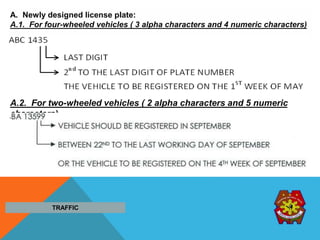
  • 102.
    SKETCH – isa drawing that is done quickly without a lot of details. TRAFFIC
  • 103.
  • 104.
    MEASUREMENT – toestablish the distance between two or more things. TRAFFIC
  • 105.
    PHOTOGRAPH – apicture or image that is a result of using a camera. TRAFFIC
  • 106.
    TRAFFIC ACCIDENT INVESTIGATION 3I’s OF INVESTIGATION  INFORMATION/INTERVIEW  INTERROGATION  INSTRUMENTATION TRAFFIC
  • 107.
     INFORMATION –data gathered from other persons, the victim and from other records such as public records, private records, Modus operandi which are pertinent concerning the commission of crime or criminal activities.  INTERROGATION – is a skillful questioning of witnesses and suspects. It is a process of obtaining admission or confession from those suspects who have committed a crime. It is confrontational in nature which means that the suspect is confronted about his participation in the commission of the offense. TRAFFIC  Instrumentation – Also called as Criminalistics or Forensic Science. - It is a scientific examination of real evidence, application of instrument and methods of the physical sciences in detecting crime.
  • 108.
    GENERAL RULE –NEVER ALTER ANYTHING UNLESS SKETCHED, PHOTOGRAPHED AND MEASURED. TRAFFIC
  • 109.
    TRAFFIC Observe the firstresponder’s rule – for first responder. First Responder is different from IOC. INJURED PERSONS– there is PNP SOP in proper dealing
  • 110.
    TYPES OF COLLITION TRAFFIC Head on collisions - often have poor outcomes because of the speed involved when the collision takes place. The typical cause of head-on collisions is when one vehicle inadvertently strays into the path of an oncoming vehicle. However, the root cause sometimes lies in a steering overcorrection after veering to the side of the road as opposed to the centre
  • 111.
     REAR END -occurs when a vehicle crashes into the one in front of it. Common factors contributing to rear-end collisions include driver inattention or distraction, tailgating, panic stops, and reduced traction due to wet weather or worn pavement. Rear-end TRAFFIC
  • 112.
  • 113.
    VEHICULAR ACCIDENT -It is an accident involving motor vehicle that resulted to the lost of life, injuries and damaged to property. TRAFFIC
  • 114.
    Traffic accidents areextremely confusing events. How they occur, who or what caused them, and why they occurred are facts that police must determine. Every peace officer must know the fundamentals of traffic accident investigation and know how to prepare traffic accident reports. TRAFFIC
  • 115.
    TWO EXISTING METHODSOF MEASUREMENT COORDINATES – which consist in measuring the shortest distance from each of two reference lines to the spot to be located. TRIANGULATION – which is done by measuring the distance from each of two reference point. TRAFFIC
  • 116.
    DOCTRINE OF LASTCLEAR CHANCE A driver who is in better position to prevent the accident has the responsibility of preventing it. Prevention of accident is the first responsibility of all drivers. TRAFFIC
  • 117.
    Initial Steps. Promptarrival at the scene of an accident is essential. Safety, however, should be emphasized at all times. TRAFFIC
  • 118.
    STEPS TO BEUNDERTAKEN AT THE ACCIDENT SCENE -Cordon the area -Evacuate injured person to the nearest hospital -Locate for witness/es – isolate if possible -Obtain the drivers license of both drivers -Obtain the MV’s documents -Sketched the accident scene – conform the drivers TRAFFIC
  • 119.
    Location of thePatrol Vehicle. The police vehicle should be positioned so as not to cause further traffic congestion or accidents. If necessary, it may, however, be used as a roadblock. At night it should be parked so the headlights illuminate the entire scene. At all times the emergency lights should be on to warn approaching motorists of the hazard. TRAFFIC Establish Traffic Control. Traffic control is essential at the accident scene to prevent further accidents or injury. Rerouting vehicles around the accident scene is the most common procedure used. Spectators or unnecessary personnel should be cleared from the accident area.
  • 120.
    TRAFFIC Moving Vehicle AndMarking Wheels The decision to move a vehicle from its final position must often be made by the police patrol arriving at the scene. When this is done, the positions of the wheels should be marked on the ground so they can be relocated for investigative purposes.
  • 121.
    Under the followingconditions, a vehicle must be moved immediately: When an injured person is trapped in the wreckage and cannot be treated there. When a person is trapped in wreckage near burning material, or an area of potential fire hazard. When a vehicle position is an immediate hazard to oncoming traffic and adequate traffic control cannot be established. AFTER INVESTIGATION, THE INVESTIGATOR SHOULD DETERMINE IF HE WILL FILE A CASE OR THE PARTIES WILL SETTLE AMMICABLY. TRAFFIC
  • 122.
    TRAFFIC MANAGEMENT ANDSUPERVISION Let’s Do the Exercise !!! (1 Hour) GROUP WORK 1. Identify specific congested area in your place; 2. List down problems that contributed in traffic congestion. 3. Come up with an assessment and make a recommendation on how to solve and control that traffic problem. TRAFFIC
  • 123.

Editor's Notes

  • #96 Registration week and Registration month are the last 2 digits which are indicative of Motor Vehicle Registration schedule.   I have shown you the sample of the regular plates before the new plates that was introduced last 2014. Here are the following samples of the new plates. Refer to your hand-out on the security features of the plates. (Refer to hand-outs)