Welcome to
Writing an equity research
report
Alan Barker
This is an updated version of an earlier
presentation on Slideshare that has enjoyed
39,463 hits since 2010.
You can now also take an online course run
by Alan Barker and Clare Lynch on Udemy.
Vital statistics: your reports in
the market
A large investment broker prints about 1,000
pages of research and about 1,000 pages of
electronic research each week.
A large fund management house receives 7,000
envelopes of research in the mail every Monday
morning.
The need to be unique
You are probably competing with up to 500
different brokers and research houses for your
reader's attention.
Every has access to the same information
(presumably).
What will make your report stand out?
Time constraints
We’re all busy.
Yet our reports are a vital element
in our client relationships.
How long do you have to create
your report?
You have longer than you think!
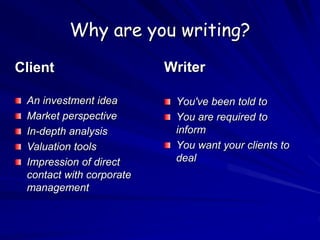
Why are you writing?
Writer
You've been told to
You are required to
inform
You want your clients to
deal
Client
An investment idea
Market perspective
In-depth analysis
Valuation tools
Impression of direct
contact with corporate
management
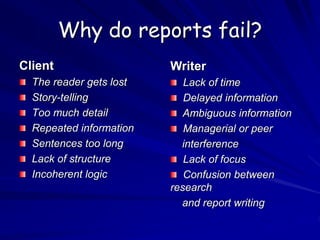
Why do reports fail?
Client
The reader gets lost
Story-telling
Too much detail
Repeated information
Sentences too long
Lack of structure
Incoherent logic
Writer
Lack of time
Delayed information
Ambiguous information
Managerial or peer
interference
Lack of focus
Confusion between
research
and report writing
An effective research report:
persuades the client to deal
An effective research
report:
delivers a clear investment
idea
structures its argument
clearly
expresses itself concisely
An effective report does not:
tell the client simply what happened
give the definitive history of the subject
act as PR for the company
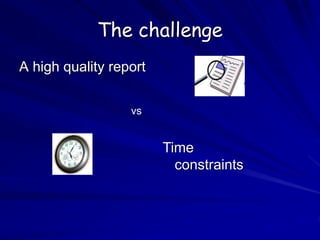
The challenge
A high quality report
vs
Time
constraints
How to square the circle?
Adopt a systematic approach
Planning
Drafting
Editing
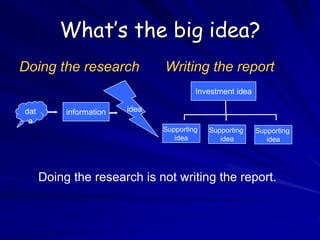
What’s the big idea?
Doing the research Writing the report
Doing the research is not writing the report.
dat
a
information idea
Investment idea
Supporting
idea
Supporting
idea
Supporting
idea
Doing the research
Know the company.
Know the industry.
Know the government views about company
and industry (national and international).
Know what the market thinks about the
company and the industry.
Know what your clients are looking for in terms
of investment ideas.
Doing the research
Know the company.
Its accounts
Its products and services
Its management
Its selling practices
How well it manages its own business
Its relations with customers and suppliers
Its R&D capacity
Doing the research
Know the industry.
Customers
Competitors
The international picture
The emerging names and new entrants
New trends, products, innovation
Who is in trouble and why
Doing the research
Know what the government thinks about the
company and the industry.
Political developments
Power shifts
New regulations
The international political dimension
Doing the research
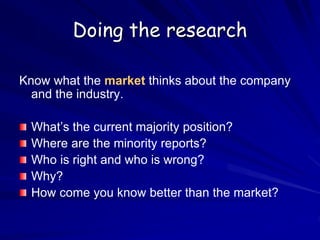
Know what the market thinks about the company
and the industry.
What’s the current majority position?
Where are the minority reports?
Who is right and who is wrong?
Why?
How come you know better than the market?
Doing the research
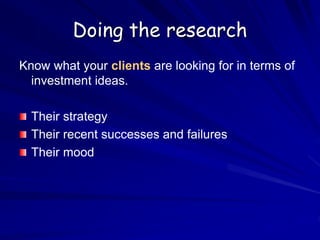
Know what your clients are looking for in terms of
investment ideas.
Their strategy
Their recent successes and failures
Their mood
Assessing risk
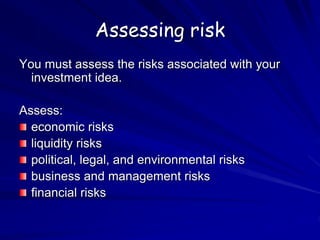
You must assess the risks associated with your
investment idea.
Assess:
economic risks
liquidity risks
political, legal, and environmental risks
business and management risks
financial risks
The birth of an investment idea
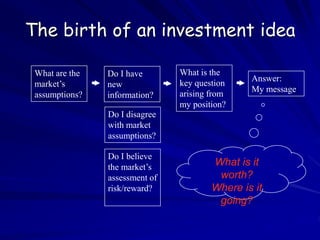
What are the
market’s
assumptions?
Do I have
new
information?
Do I disagree
with market
assumptions?
Do I believe
the market’s
assessment of
risk/reward?
What is the
key question
arising from
my position?
Answer:
My message
What is it
worth?
Where is it
going?
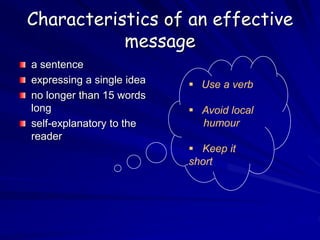
Characteristics of an effective
message
a sentence
expressing a single idea
no longer than 15 words
long
self-explanatory to the
reader
 Use a verb
 Avoid local
humour
 Keep it
short
Thinking about planning
You can structure your ideas using a logical
process.
Your thinking must be unique.
– What marks you out from the competition?
– What will make your client take notice?
Grouping and summarising
Report formats are designed to help you
group and summarise ideas.
- front page: headline; ‘black box’; summary
paragraphs
- margin comments
- headings and sub-headings
Designing the structure first will save you
time and improve the quality of the report.
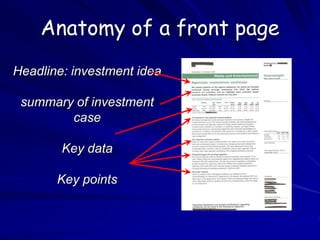
Anatomy of a front page
Headline: investment idea
summary of investment
case
Key data
Key points
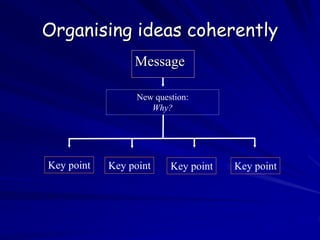
Organising ideas coherently
Message
New question:
Why?
Key point Key point Key point Key point
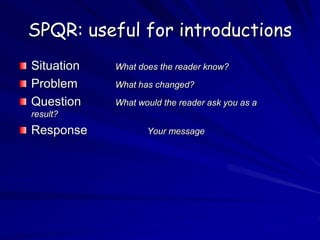
SPQR: useful for introductions
Situation What does the reader know?
Problem What has changed?
Question What would the reader ask you as a
result?
Response Your message
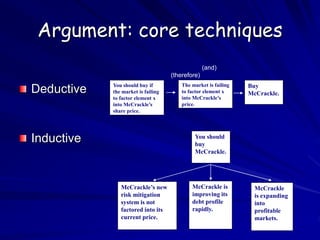
Argument: core techniques
Deductive
Inductive
You should buy if
the market is failing
to factor element x
into McCrackle’s
share price.
The market is failing
to factor element x
into McCrackle’s
price.
Buy
McCrackle.
(and)
(therefore)
You should
buy
McCrackle.
McCrackle’s new
risk mitigation
system is not
factored into its
current price.
McCrackle is
improving its
debt profile
rapidly.
McCrackle
is expanding
into
profitable
markets.
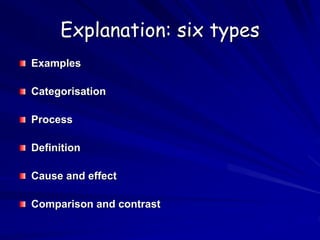
Explanation: six types
Examples
Categorisation
Process
Definition
Cause and effect
Comparison and contrast
Drafting: top tips
Write quickly.
Write in your own voice
Write without interruption.
Write without editing.
Keep to the plan of your
outline.
Why edit?
To make reading easier
To create quality more quickly
Because you must
(you can’t get it right first time)
Editing efficiently
Edit on three levels:
- paragraph
- sentence
- word
Use a colleague
Take a break
Readability statistics
Instantly indicate the quality of your writing
Give an objective measure of quality
Not absolutely reliable
Find out how to access readability statistics on Word.
Effective paragraphs:
four characteristics
Unity
Topic sentence
Coherence
Adequacy
Unity
A paragraph should be about one topic
A topic (Greek topos, ‘place; location’) is your position on
the subject of the paragraph
What do you want to say about the subject?
Topic sentences
Key characteristics:
– Single idea
– What you want to say about the paragraph’s
subject
– 15 words maximum
In a draft paragraph, look for a potential topic
sentence at the end
Coherence
Create coherence by using transitional devices
For a list of transitional devices, go to the OWL
at Purdue.
Adequacy
Use the topic sentence to identify how you will
develop the topic.
Are you arguing or explaining in the paragraph?
What type of argument or explanation are you using?
- argument: deductive or inductive?
- explanation: which of the six types?
Adequacy
To develop your topic adequately:
lay out the terms of the argument (deductive or
inductive)
use examples and illustrations
cite data (facts, statistics, evidence, details, and others)
quote testimony (what other people say or write)
use an anecdote or story (but keep it brief)
define terms
compare and contrast
explain causes and reasons, or effects and
consequences
offer the chronology of an event
Editing paragraph sequences
Topic sentences should make sense in order
Use topic sentences as
– Margin summaries
– Sequence of sentences in the summary black box
– Supporting text for graphics
Managing your sentences
Follow the ‘15-25’ rule
15 words maximum for all messages, key
points and topic sentences
25 words maximum for all other sentences
Deal with long sentences by:
cutting long sentences into separate sentences
separating ‘multiple’ sentences
cutting down long sentences
rebuilding complicated sentences
making non-sentences grammatically correct
finding strong subjects and verbs
Plain English
Make your average sentence length 15 to 20 words.
Use only the words that your reader is most likely to
understand.
Use only as many words as you need.
Use the strongest, clearest and most specific verbs you can.
Say what you mean.
Punctuate clearly and simply.
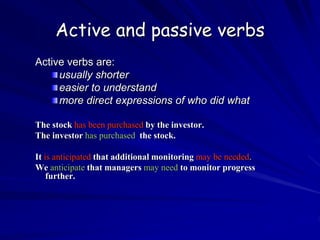
Active and passive verbs
Active verbs are:
usually shorter
easier to understand
more direct expressions of who did what
The stock has been purchased by the investor.
The investor has purchased the stock.
It is anticipated that additional monitoring may be needed.
We anticipate that managers may need to monitor progress
further.
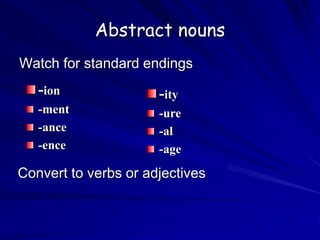
Abstract nouns
Watch for standard endings
-ion
-ment
-ance
-ence
-ity
-ure
-al
-age
Convert to verbs or adjectives
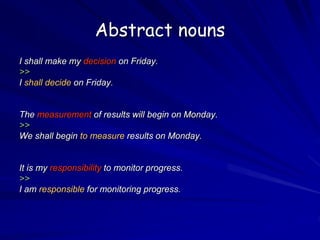
Abstract nouns
I shall make my decision on Friday.
>>
I shall decide on Friday.
The measurement of results will begin on Monday.
>>
We shall begin to measure results on Monday.
It is my responsibility to monitor progress.
>>
I am responsible for monitoring progress.
Bringing your writing to life
Be precise
Use numbers sparingly
Qualify general statements with specific information
Look forward
Indicate catalysts for change
Using numbers
Use numbers very sparingly.
Use no more than one number in any topic sentence of
a paragraph.
Try to use no more than two or three numbers in any
other sentence.
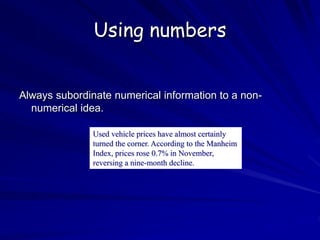
Using numbers
Always subordinate numerical information to a non-
numerical idea.
Used vehicle prices have almost certainly
turned the corner. According to the Manheim
Index, prices rose 0.7% in November,
reversing a nine-month decline.
Explaining risk
You mustn’t evade your responsibility to clarify the risks
associated with your investment idea.
Consider placing risks together in a clearly headed section
– probably towards the end of the report.
Explain:
economic risks
liquidity risks
political, legal, and environmental risks
business and management risks
financial risks
Keeping it legal
unsubstantiated rumours
unsubstantiated reports
flamboyant, gambling or tasteless language
possible compromised analysis
front-running
pre-announcements
promissory wording
Avoid:
This is an updated version of an earlier
presentation on Slideshare that has enjoyed
39,463 hits since 2010.
You can now also take an online course run
by Alan Barker and Clare Lynch on Udemy.

Writing an Equity Research Report

  • 1.
    Welcome to Writing anequity research report Alan Barker
  • 2.
    This is anupdated version of an earlier presentation on Slideshare that has enjoyed 39,463 hits since 2010. You can now also take an online course run by Alan Barker and Clare Lynch on Udemy.
  • 3.
    Vital statistics: yourreports in the market A large investment broker prints about 1,000 pages of research and about 1,000 pages of electronic research each week. A large fund management house receives 7,000 envelopes of research in the mail every Monday morning.
  • 4.
    The need tobe unique You are probably competing with up to 500 different brokers and research houses for your reader's attention. Every has access to the same information (presumably). What will make your report stand out?
  • 5.
    Time constraints We’re allbusy. Yet our reports are a vital element in our client relationships. How long do you have to create your report? You have longer than you think!
  • 6.
    Why are youwriting? Writer You've been told to You are required to inform You want your clients to deal Client An investment idea Market perspective In-depth analysis Valuation tools Impression of direct contact with corporate management
  • 7.
    Why do reportsfail? Client The reader gets lost Story-telling Too much detail Repeated information Sentences too long Lack of structure Incoherent logic Writer Lack of time Delayed information Ambiguous information Managerial or peer interference Lack of focus Confusion between research and report writing
  • 8.
    An effective researchreport: persuades the client to deal
  • 9.
    An effective research report: deliversa clear investment idea structures its argument clearly expresses itself concisely
  • 10.
    An effective reportdoes not: tell the client simply what happened give the definitive history of the subject act as PR for the company
  • 11.
    The challenge A highquality report vs Time constraints
  • 12.
    How to squarethe circle? Adopt a systematic approach Planning Drafting Editing
  • 13.
    What’s the bigidea? Doing the research Writing the report Doing the research is not writing the report. dat a information idea Investment idea Supporting idea Supporting idea Supporting idea
  • 14.
    Doing the research Knowthe company. Know the industry. Know the government views about company and industry (national and international). Know what the market thinks about the company and the industry. Know what your clients are looking for in terms of investment ideas.
  • 15.
    Doing the research Knowthe company. Its accounts Its products and services Its management Its selling practices How well it manages its own business Its relations with customers and suppliers Its R&D capacity
  • 16.
    Doing the research Knowthe industry. Customers Competitors The international picture The emerging names and new entrants New trends, products, innovation Who is in trouble and why
  • 17.
    Doing the research Knowwhat the government thinks about the company and the industry. Political developments Power shifts New regulations The international political dimension
  • 18.
    Doing the research Knowwhat the market thinks about the company and the industry. What’s the current majority position? Where are the minority reports? Who is right and who is wrong? Why? How come you know better than the market?
  • 19.
    Doing the research Knowwhat your clients are looking for in terms of investment ideas. Their strategy Their recent successes and failures Their mood
  • 20.
    Assessing risk You mustassess the risks associated with your investment idea. Assess: economic risks liquidity risks political, legal, and environmental risks business and management risks financial risks
  • 21.
    The birth ofan investment idea What are the market’s assumptions? Do I have new information? Do I disagree with market assumptions? Do I believe the market’s assessment of risk/reward? What is the key question arising from my position? Answer: My message What is it worth? Where is it going?
  • 22.
    Characteristics of aneffective message a sentence expressing a single idea no longer than 15 words long self-explanatory to the reader  Use a verb  Avoid local humour  Keep it short
  • 23.
    Thinking about planning Youcan structure your ideas using a logical process. Your thinking must be unique. – What marks you out from the competition? – What will make your client take notice?
  • 24.
    Grouping and summarising Reportformats are designed to help you group and summarise ideas. - front page: headline; ‘black box’; summary paragraphs - margin comments - headings and sub-headings Designing the structure first will save you time and improve the quality of the report.
  • 25.
    Anatomy of afront page Headline: investment idea summary of investment case Key data Key points
  • 26.
    Organising ideas coherently Message Newquestion: Why? Key point Key point Key point Key point
  • 27.
    SPQR: useful forintroductions Situation What does the reader know? Problem What has changed? Question What would the reader ask you as a result? Response Your message
  • 28.
    Argument: core techniques Deductive Inductive Youshould buy if the market is failing to factor element x into McCrackle’s share price. The market is failing to factor element x into McCrackle’s price. Buy McCrackle. (and) (therefore) You should buy McCrackle. McCrackle’s new risk mitigation system is not factored into its current price. McCrackle is improving its debt profile rapidly. McCrackle is expanding into profitable markets.
  • 29.
  • 30.
    Drafting: top tips Writequickly. Write in your own voice Write without interruption. Write without editing. Keep to the plan of your outline.
  • 31.
    Why edit? To makereading easier To create quality more quickly Because you must (you can’t get it right first time)
  • 32.
    Editing efficiently Edit onthree levels: - paragraph - sentence - word Use a colleague Take a break
  • 33.
    Readability statistics Instantly indicatethe quality of your writing Give an objective measure of quality Not absolutely reliable Find out how to access readability statistics on Word.
  • 34.
  • 35.
    Unity A paragraph shouldbe about one topic A topic (Greek topos, ‘place; location’) is your position on the subject of the paragraph What do you want to say about the subject?
  • 36.
    Topic sentences Key characteristics: –Single idea – What you want to say about the paragraph’s subject – 15 words maximum In a draft paragraph, look for a potential topic sentence at the end
  • 37.
    Coherence Create coherence byusing transitional devices For a list of transitional devices, go to the OWL at Purdue.
  • 38.
    Adequacy Use the topicsentence to identify how you will develop the topic. Are you arguing or explaining in the paragraph? What type of argument or explanation are you using? - argument: deductive or inductive? - explanation: which of the six types?
  • 39.
    Adequacy To develop yourtopic adequately: lay out the terms of the argument (deductive or inductive) use examples and illustrations cite data (facts, statistics, evidence, details, and others) quote testimony (what other people say or write) use an anecdote or story (but keep it brief) define terms compare and contrast explain causes and reasons, or effects and consequences offer the chronology of an event
  • 40.
    Editing paragraph sequences Topicsentences should make sense in order Use topic sentences as – Margin summaries – Sequence of sentences in the summary black box – Supporting text for graphics
  • 41.
    Managing your sentences Followthe ‘15-25’ rule 15 words maximum for all messages, key points and topic sentences 25 words maximum for all other sentences
  • 42.
    Deal with longsentences by: cutting long sentences into separate sentences separating ‘multiple’ sentences cutting down long sentences rebuilding complicated sentences making non-sentences grammatically correct finding strong subjects and verbs
  • 43.
    Plain English Make youraverage sentence length 15 to 20 words. Use only the words that your reader is most likely to understand. Use only as many words as you need. Use the strongest, clearest and most specific verbs you can. Say what you mean. Punctuate clearly and simply.
  • 44.
    Active and passiveverbs Active verbs are: usually shorter easier to understand more direct expressions of who did what The stock has been purchased by the investor. The investor has purchased the stock. It is anticipated that additional monitoring may be needed. We anticipate that managers may need to monitor progress further.
  • 45.
    Abstract nouns Watch forstandard endings -ion -ment -ance -ence -ity -ure -al -age Convert to verbs or adjectives
  • 46.
    Abstract nouns I shallmake my decision on Friday. >> I shall decide on Friday. The measurement of results will begin on Monday. >> We shall begin to measure results on Monday. It is my responsibility to monitor progress. >> I am responsible for monitoring progress.
  • 47.
    Bringing your writingto life Be precise Use numbers sparingly Qualify general statements with specific information Look forward Indicate catalysts for change
  • 48.
    Using numbers Use numbersvery sparingly. Use no more than one number in any topic sentence of a paragraph. Try to use no more than two or three numbers in any other sentence.
  • 49.
    Using numbers Always subordinatenumerical information to a non- numerical idea. Used vehicle prices have almost certainly turned the corner. According to the Manheim Index, prices rose 0.7% in November, reversing a nine-month decline.
  • 50.
    Explaining risk You mustn’tevade your responsibility to clarify the risks associated with your investment idea. Consider placing risks together in a clearly headed section – probably towards the end of the report. Explain: economic risks liquidity risks political, legal, and environmental risks business and management risks financial risks
  • 51.
    Keeping it legal unsubstantiatedrumours unsubstantiated reports flamboyant, gambling or tasteless language possible compromised analysis front-running pre-announcements promissory wording Avoid:
  • 52.
    This is anupdated version of an earlier presentation on Slideshare that has enjoyed 39,463 hits since 2010. You can now also take an online course run by Alan Barker and Clare Lynch on Udemy.