




REVIEW AND CRITIQUE OF
                          JOURNALS ARTICLE:

       WHY DO PEOPLE AVOID ADVERTISING ON THE INTERNET?
      Journal of Advertising. vol. 33, no. 4 (Winter 2004), pp. 89-97
                                    AND
AVOIDANCE OF ADVERTISING IN SOCIAL NETWORKING SITES: THE TEENAGE
                               PERSPECTIVE
  Journal of Interactive Advertising, Vol 10 No 2(Spring 2010), pp. 16‐27.
                                     By:
                               Noorazlin Ani
ABSTRACT
This study was designed to provide insights into why people avoid
advertising on the Internet. Recent negative trends in Internet
advertising, such as "banner blindness" and extremely low click-
through rates, make it imperative to study various factors affecting
Internee ad avoidance. Accordingly, this study builds a
comprehensive theoretical model explaining advertising avoidance
on the internet, researcher examined three latent variables of
Internet ad avoidance: perceived goal impediment, perceived ad
clutter, and prior negative experience. Researcher found that
these constructs successfully explain why people cognitively,
affectively, and behaviorally avoid advertising messages on the
Internet. Perceived goal impediment is found to be the most
significant antecedent explaining advertising avoidance on the
Internet.
PURPOSE OF STUDY
There are four purposes of this study:
1. To explore teenage attitude toward advertising in
   online social networking environment
2. To understand how people avoid advertising messages
   on the Internet
3. To detect various antecedents influencing Internet ad
   avoidance
4. To suggest ways to decrease advertising avoidance on
   the Internet.
RESEARCH PROBLEM
• This research demonstrates the consumer attitudes toward advertising. It also
  highlights work on advertising avoidance and how it has escalated with increasing
  media fragmentation, advertising clutter, and technological devices to avoid
  advertising. The gap of the research aims to fill pertains to attitudes toward
  advertising on social networking sites and whether advertising is welcomed as a
  friend or avoided as an unwelcomed guest. This exploratory study asks five
  important questions:
• RQ1: What are teenagers' perceptions of advertising on social networking sites?
• RQ2: Do teenagers avoid advertising on online social networking sites when they
  believe it disrupts their goals online?
• RQ3: Do teenagers ignore advertising on online social networking sites when they
  perceive that there is too much clutter in the medium?
• RQ4: Do teenagers avoid advertisements on online social networking sites if they
  have had negative experiences with previous online advertisements?
• RQ5: Are there other reasons why teenagers avoid advertising in online social
  networking sites?
RESEARCH PROBLEM
 While another journal focuses on Advertising on
 Internet which concerned with the speed of data access
 and retrieval downloading time), which is less
 applicable to other traditional media. Internet users
 may have negative attitudes toward Internet ads when
 they perceive that Internet ads slow down the speed of
 data access. Internet involves more two-way
 interactivity or voluntary action from consumers (e.g.,
 clicking banners, hyperlinks, etc.), and thus, Internet ad
 avoidance might encompass intentional refraining from
 any further action (e.g. ignoring ads by intentionally not
 clicking any hyperlink).
RESEARCH PROBLEM
•   Measurement items thru online survey:
•   Internet ad avoidance
•   "When I visit Web sites,"
•   Cognitive ad avoidance
•   I intentionally don't put my eyes on pop-up ads.
•   I intentionally don't put my eyes on any ads on the Web.
•   I intentionally don't pay attention to banner ads.
•   I intentionally don't pay attention to pop-up ads.
•   I intentionally don't click on any ads on the Web, even if the ads draw my attention.
•   Affective ad avoidance
•   I hate banner ads.
•   I hate pop-up ads.
•   I hate any ads on the Web.
•   It would be better if there were no banner ads on the Web.
•   Behavioral ad avoidance
•   I scroll down Web pages to avoid banner ads.
•   I close windows to avoid pop-up ads.
RESEARCH METHOD
i) Snowball sampling
   researcher made contacts with acquaintances who
   had children, through the researchers' children's
   friends and friends of friends, who fulfilled all three
   criteria. Some of the participants were known, but not
   well known, to the researchers. The acceptance rate
   was high, with a total of 23 teenagers participating in
   the mixed-gender focus groups, and a further 8
   teenagers sharing their thoughts in in-depth
   interviews.
RESEARCH METHOD
ii) On-line survey
   This study employed an on-line survey to collect the
   data relevant with paper's topic (Internet ad avoidance)
   The sample size of 266 was relatively small considering
   the nature of the study (a survey of Internet users). In
   addition, the sample was limited to college students,
   who may exhibit different ad-avoidance patterns and
   reasons than those of other consumer segments. The
   samples were collected in September 2002 from
   students enrolled in three large undergraduate courses
   at a large Southeastern university.
SIMILARITIES AND DIFFERENCES
  BETWEEN TWO JOURNALS
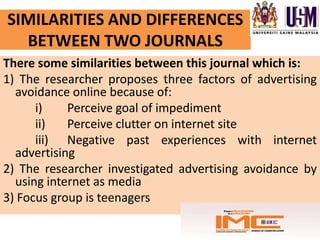
There some similarities between this journal which is:
1) The researcher proposes three factors of advertising
  avoidance online because of:
      i)    Perceive goal of impediment
      ii)   Perceive clutter on internet site
      iii) Negative past experiences with internet
  advertising
2) The researcher investigated advertising avoidance by
  using internet as media
3) Focus group is teenagers
SIMILARITIES AND DIFFERENCES
  BETWEEN TWO JOURNALS
The differences between these journals are:
1) Cho and Cheon's (2004) research investigates
  advertising avoidance in the general Internet
  environment, while Kelly, Kerr and Drennan (2010)
  specifically the online social networking
  environment.
RELATIONSHIPS BETWEEN
 CONCEPTS/THEORIES/MODELS
  WITH DATA IN AN ACADEMIC
          RESEARCH
a) Push-Pull Model of Marketing Communication Schultz's
   (2008)
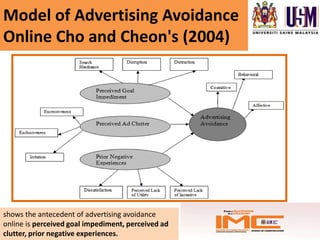
b) Model of Advertising Avoidance Online Cho and Cheon's
   (2004)
c) Theoretical Model - theory that designed to explain an entire
   situation or behaviour, with the idea that it would eventually
   be able to predict that behaviour.
d) Causal Model - an abstract model that describes the causal
   mechanisms of a system. The model must express more than
   correlation because correlation does not imply causation.
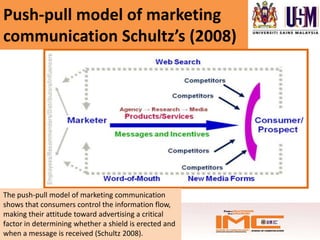
Push-pull model of marketing
communication Schultz’s (2008)


The push-pull model of marketing communication
shows that consumers control the information flow,
making their attitude toward advertising a critical
factor in determining whether a shield is erected and
when a message is received (Schultz 2008).
Model of Advertising Avoidance
Online Cho and Cheon's (2004)


shows the antecedent of advertising avoidance
online is perceived goal impediment, perceived ad
clutter, prior negative experiences.
HYPOTHESES CONSTRUCTION
WHICH IS APPROPRIATE WITH
CONCEPTS, THEORIES AND MODELS
• Perceived Goal Impediment Ad avoidance
• When Internet ads are a significant source of noise or nuisance, hindering
  consumer efforts to browse Web content, they can disrupt consumer Web
  page viewing, distract viewers from the Web page's editorial integrity, and
  intrude on their search for desired information. For instance, consumers
  might feel that the navigation process to locate desired content is difficult
  on the Internet because Internet ads disrupt or intrude on their overall
  search for desired information, which may result in a retreat from the
  source of interference (i.e., ad avoidance). Therefore hypothesize that
  perceived goal impediment, indicated by consumer search hindrance,
  disruption, and distraction, and may evoke ad avoidance on the Internet.
• H1: The greater- the perceived goal impediment, the greater the advertising
  avoidance on the Internet.
HYPOTHESES CONSTRUCTION
WHICH IS APPROPRIATE WITH
CONCEPTS, THEORIES AND MODELS
• Perceived Ad Clutter on the Internet
• Ad clutter on the Internet can be operationalized as the number of
  banner ads, pop-up ads, advertorials, text links, and so forth that
  appear on a single Web page (ad excessiveness). Consumer
  irritation with the number of ads on the Internet, or the
  perception that the Internet is exclusively an advertising medium
  (ad exclusiveness), should also logically contribute to the
  perception of advertising clutter. This perceived ad clutter might,
  in turn, lead to negative attitudes and subsequent ad avoidance.
• H2: The greater the perceived ad clutter, the greater the
  advertising avoidance on the Internet.
HYPOTHESES CONSTRUCTION
WHICH IS APPROPRIATE WITH
CONCEPTS, THEORIES AND MODELS
• Prior Negative Experiences
• With Internet ads, prior negative experience can be indicated
  by dissatisfaction and perceived lack of utility and incentive
  for clicking on those ads. This negative experience may lead
  consumers to avoid the source of the negative experience
  (i.e., Internet ad avoidance). Based on this theory of learning
  from experience, researchers hypothesize that as negative
  experiences with Internet ads increase, the tendency to avoid
  those ads also increases.
• H3: The greater the prior negative experience, the greater the
  advertising avoidance on the Internet.
HYPOTHESES CONSTRUCTION
WHICH IS APPROPRIATE WITH
CONCEPTS, THEORIES AND MODELS
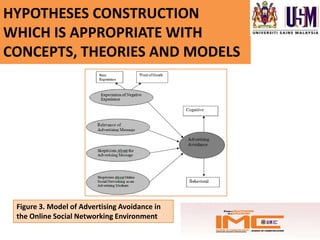
 Kelly, Kerr and Drennan (2010):
   Researcher have found that other factors have that influence and
   identify four antecedents of advertising avoidance in the online
   social networking environment (as outlined in Figure 3):
• Expectations of negative experiences: This expectation of
   advertisements in the online social networking environment can
   be as a result of prior negative experiences or the expectation of
   negative experiences due to word of mouth, including that
   received from those in authority.
• Perception of relevance of advertising message: If the advertising
   message is not of interest to the receiver of the message, the
   information is likely to not be processed.
HYPOTHESES CONSTRUCTION
WHICH IS APPROPRIATE WITH
CONCEPTS, THEORIES AND MODELS
Skepticism of advertising message claims: If consumers are
  skeptical of the claims made by the advertisement or if these
  claims are not appropriate to the media environment, they
  are likely to ignore the message and potentially disregard
  other messages in this medium.
Skepticism of online social networking sites as a credible
  advertising medium:
  Consumers do not trust the information gained from online
  social networking sites. They believe that online social
  networking sites lack credibility and perceive that there is
  little policing of advertising claims in this medium.
HYPOTHESES CONSTRUCTION
WHICH IS APPROPRIATE WITH
CONCEPTS, THEORIES AND MODELS


 Figure 3. Model of Advertising Avoidance in
 the Online Social Networking Environment
OPERATIONAL OF TWO
              JOURNALS
• Advertising Avoidance Online
   Cho and Cheon (2004) propose three factors of advertising avoidance
   online: interruption of task, perceived clutter on Internet sites, and negative
   past experiences with Internet advertising.
1) Perceived goal impediment.
   This factor is important because the Internet is considered more goal and
   task oriented than traditional media such as television. When advertising
   reduces or interrupts the speed of data retrieval and processing, consumers
   may react negatively toward the advertisement or product (Cho and Cheon
   2004). Pop-up advertisements, distracting advertisements, and
   advertisements that require consumer action before they can resume their
   online activity may encourage them to delete the message immediately and
   therefore avoid the advertising completely.
OPERATIONAL OF TWO
           JOURNALS
• 2) Perceived advertising clutter
  Which can also prove a distraction, causing
  consumers to discriminate and avoid ads that are
  not relevant or important to them (Ingram 2006). If
  this perceived clutter is excessive, consumers are
  likely to have difficulty discriminating messages,
  which could result in disregard of them all (Cho and
  Cheon 2004).
OPERATIONAL OF TWO
           JOURNALS
• 3) Prior negative experience
  Which this factor is includes instances in which
  Internet advertising is deceptive, exaggerated, or
  incorrectly targeted or leads users to inappropriate
  sites (Cho and Cheon 2004). Such marketing
  techniques have led users to believe that that the
  Internet is a distrustful medium (Grant 2005).
METHOD SIMILARITIES AND
DIFFERENCES BETWEEN TWO
JOURNALS
• these journals are using qualitative and quantitative method
  (in this journalmeasured using a seven-point Linker scale
  range from strongly disagree to strongly agree)
• Qualitative methods are ways of collecting data which are
  concerned with describing meaning, rather than with drawing
  statistical inferences. Qualitative methods (e.g. case studies
  and interviews) lose on reliability they gain in terms of
  validity. Focus group will provide a more in depth and rich
  description.
• Generally there are no differences method using in these
  journals expects for data collecting which using online
  internet question and face to face questions (interview).
POSIBLELITY FOR FUTURE
        RESEARCH
• Further research could widen the frame of
  reference by drawing on larger samples nationally
  and internationally and addressing users of
  different ages and demographic profiles.
• Could consider the issue that teenagers raised
  regarding the lack of advertising regulation on
  online social network sites.
• Need to obtain a deeper understanding of
  Internet ad avoidance.
REPLICATE IN MALAYSIA
• This study can be replicate in Malaysia because a
  lot of advertiser in Malaysia uses internet and
  social media as an advertising media. As well as
  the growth of Internet advertising companies in
  Malaysia thru Blog Advertising and Online
  Advertising such as Aductions, Advertlets (blog
  advertising),   Gokita      (Contextual     Online
  Advertising. Called "Nufflets" at one time),
  GrabMyAds (Blog Advertising), Netizens Media
  (Online Advertising), Nuffnang ("Asia's First Blog
  Advertising Community").
review and critique journals

review and critique journals

  • 1.
    REVIEW AND CRITIQUEOF JOURNALS ARTICLE: WHY DO PEOPLE AVOID ADVERTISING ON THE INTERNET? Journal of Advertising. vol. 33, no. 4 (Winter 2004), pp. 89-97 AND AVOIDANCE OF ADVERTISING IN SOCIAL NETWORKING SITES: THE TEENAGE PERSPECTIVE Journal of Interactive Advertising, Vol 10 No 2(Spring 2010), pp. 16‐27. By: Noorazlin Ani
  • 2.
    ABSTRACT This study wasdesigned to provide insights into why people avoid advertising on the Internet. Recent negative trends in Internet advertising, such as "banner blindness" and extremely low click- through rates, make it imperative to study various factors affecting Internee ad avoidance. Accordingly, this study builds a comprehensive theoretical model explaining advertising avoidance on the internet, researcher examined three latent variables of Internet ad avoidance: perceived goal impediment, perceived ad clutter, and prior negative experience. Researcher found that these constructs successfully explain why people cognitively, affectively, and behaviorally avoid advertising messages on the Internet. Perceived goal impediment is found to be the most significant antecedent explaining advertising avoidance on the Internet.
  • 3.
    PURPOSE OF STUDY Thereare four purposes of this study: 1. To explore teenage attitude toward advertising in online social networking environment 2. To understand how people avoid advertising messages on the Internet 3. To detect various antecedents influencing Internet ad avoidance 4. To suggest ways to decrease advertising avoidance on the Internet.
  • 4.
    RESEARCH PROBLEM • Thisresearch demonstrates the consumer attitudes toward advertising. It also highlights work on advertising avoidance and how it has escalated with increasing media fragmentation, advertising clutter, and technological devices to avoid advertising. The gap of the research aims to fill pertains to attitudes toward advertising on social networking sites and whether advertising is welcomed as a friend or avoided as an unwelcomed guest. This exploratory study asks five important questions: • RQ1: What are teenagers' perceptions of advertising on social networking sites? • RQ2: Do teenagers avoid advertising on online social networking sites when they believe it disrupts their goals online? • RQ3: Do teenagers ignore advertising on online social networking sites when they perceive that there is too much clutter in the medium? • RQ4: Do teenagers avoid advertisements on online social networking sites if they have had negative experiences with previous online advertisements? • RQ5: Are there other reasons why teenagers avoid advertising in online social networking sites?
  • 5.
    RESEARCH PROBLEM Whileanother journal focuses on Advertising on Internet which concerned with the speed of data access and retrieval downloading time), which is less applicable to other traditional media. Internet users may have negative attitudes toward Internet ads when they perceive that Internet ads slow down the speed of data access. Internet involves more two-way interactivity or voluntary action from consumers (e.g., clicking banners, hyperlinks, etc.), and thus, Internet ad avoidance might encompass intentional refraining from any further action (e.g. ignoring ads by intentionally not clicking any hyperlink).
  • 6.
    RESEARCH PROBLEM • Measurement items thru online survey: • Internet ad avoidance • "When I visit Web sites," • Cognitive ad avoidance • I intentionally don't put my eyes on pop-up ads. • I intentionally don't put my eyes on any ads on the Web. • I intentionally don't pay attention to banner ads. • I intentionally don't pay attention to pop-up ads. • I intentionally don't click on any ads on the Web, even if the ads draw my attention. • Affective ad avoidance • I hate banner ads. • I hate pop-up ads. • I hate any ads on the Web. • It would be better if there were no banner ads on the Web. • Behavioral ad avoidance • I scroll down Web pages to avoid banner ads. • I close windows to avoid pop-up ads.
  • 7.
    RESEARCH METHOD i) Snowballsampling researcher made contacts with acquaintances who had children, through the researchers' children's friends and friends of friends, who fulfilled all three criteria. Some of the participants were known, but not well known, to the researchers. The acceptance rate was high, with a total of 23 teenagers participating in the mixed-gender focus groups, and a further 8 teenagers sharing their thoughts in in-depth interviews.
  • 8.
    RESEARCH METHOD ii) On-linesurvey This study employed an on-line survey to collect the data relevant with paper's topic (Internet ad avoidance) The sample size of 266 was relatively small considering the nature of the study (a survey of Internet users). In addition, the sample was limited to college students, who may exhibit different ad-avoidance patterns and reasons than those of other consumer segments. The samples were collected in September 2002 from students enrolled in three large undergraduate courses at a large Southeastern university.
  • 9.
    SIMILARITIES AND DIFFERENCES BETWEEN TWO JOURNALS There some similarities between this journal which is: 1) The researcher proposes three factors of advertising avoidance online because of: i) Perceive goal of impediment ii) Perceive clutter on internet site iii) Negative past experiences with internet advertising 2) The researcher investigated advertising avoidance by using internet as media 3) Focus group is teenagers
  • 10.
    SIMILARITIES AND DIFFERENCES BETWEEN TWO JOURNALS The differences between these journals are: 1) Cho and Cheon's (2004) research investigates advertising avoidance in the general Internet environment, while Kelly, Kerr and Drennan (2010) specifically the online social networking environment.
  • 11.
    RELATIONSHIPS BETWEEN CONCEPTS/THEORIES/MODELS WITH DATA IN AN ACADEMIC RESEARCH a) Push-Pull Model of Marketing Communication Schultz's (2008) b) Model of Advertising Avoidance Online Cho and Cheon's (2004) c) Theoretical Model - theory that designed to explain an entire situation or behaviour, with the idea that it would eventually be able to predict that behaviour. d) Causal Model - an abstract model that describes the causal mechanisms of a system. The model must express more than correlation because correlation does not imply causation.
  • 12.
    Push-pull model ofmarketing communication Schultz’s (2008) The push-pull model of marketing communication shows that consumers control the information flow, making their attitude toward advertising a critical factor in determining whether a shield is erected and when a message is received (Schultz 2008).
  • 13.
    Model of AdvertisingAvoidance Online Cho and Cheon's (2004) shows the antecedent of advertising avoidance online is perceived goal impediment, perceived ad clutter, prior negative experiences.
  • 14.
    HYPOTHESES CONSTRUCTION WHICH ISAPPROPRIATE WITH CONCEPTS, THEORIES AND MODELS • Perceived Goal Impediment Ad avoidance • When Internet ads are a significant source of noise or nuisance, hindering consumer efforts to browse Web content, they can disrupt consumer Web page viewing, distract viewers from the Web page's editorial integrity, and intrude on their search for desired information. For instance, consumers might feel that the navigation process to locate desired content is difficult on the Internet because Internet ads disrupt or intrude on their overall search for desired information, which may result in a retreat from the source of interference (i.e., ad avoidance). Therefore hypothesize that perceived goal impediment, indicated by consumer search hindrance, disruption, and distraction, and may evoke ad avoidance on the Internet. • H1: The greater- the perceived goal impediment, the greater the advertising avoidance on the Internet.
  • 15.
    HYPOTHESES CONSTRUCTION WHICH ISAPPROPRIATE WITH CONCEPTS, THEORIES AND MODELS • Perceived Ad Clutter on the Internet • Ad clutter on the Internet can be operationalized as the number of banner ads, pop-up ads, advertorials, text links, and so forth that appear on a single Web page (ad excessiveness). Consumer irritation with the number of ads on the Internet, or the perception that the Internet is exclusively an advertising medium (ad exclusiveness), should also logically contribute to the perception of advertising clutter. This perceived ad clutter might, in turn, lead to negative attitudes and subsequent ad avoidance. • H2: The greater the perceived ad clutter, the greater the advertising avoidance on the Internet.
  • 16.
    HYPOTHESES CONSTRUCTION WHICH ISAPPROPRIATE WITH CONCEPTS, THEORIES AND MODELS • Prior Negative Experiences • With Internet ads, prior negative experience can be indicated by dissatisfaction and perceived lack of utility and incentive for clicking on those ads. This negative experience may lead consumers to avoid the source of the negative experience (i.e., Internet ad avoidance). Based on this theory of learning from experience, researchers hypothesize that as negative experiences with Internet ads increase, the tendency to avoid those ads also increases. • H3: The greater the prior negative experience, the greater the advertising avoidance on the Internet.
  • 17.
    HYPOTHESES CONSTRUCTION WHICH ISAPPROPRIATE WITH CONCEPTS, THEORIES AND MODELS Kelly, Kerr and Drennan (2010): Researcher have found that other factors have that influence and identify four antecedents of advertising avoidance in the online social networking environment (as outlined in Figure 3): • Expectations of negative experiences: This expectation of advertisements in the online social networking environment can be as a result of prior negative experiences or the expectation of negative experiences due to word of mouth, including that received from those in authority. • Perception of relevance of advertising message: If the advertising message is not of interest to the receiver of the message, the information is likely to not be processed.
  • 18.
    HYPOTHESES CONSTRUCTION WHICH ISAPPROPRIATE WITH CONCEPTS, THEORIES AND MODELS Skepticism of advertising message claims: If consumers are skeptical of the claims made by the advertisement or if these claims are not appropriate to the media environment, they are likely to ignore the message and potentially disregard other messages in this medium. Skepticism of online social networking sites as a credible advertising medium: Consumers do not trust the information gained from online social networking sites. They believe that online social networking sites lack credibility and perceive that there is little policing of advertising claims in this medium.
  • 19.
    HYPOTHESES CONSTRUCTION WHICH ISAPPROPRIATE WITH CONCEPTS, THEORIES AND MODELS Figure 3. Model of Advertising Avoidance in the Online Social Networking Environment
  • 20.
    OPERATIONAL OF TWO JOURNALS • Advertising Avoidance Online Cho and Cheon (2004) propose three factors of advertising avoidance online: interruption of task, perceived clutter on Internet sites, and negative past experiences with Internet advertising. 1) Perceived goal impediment. This factor is important because the Internet is considered more goal and task oriented than traditional media such as television. When advertising reduces or interrupts the speed of data retrieval and processing, consumers may react negatively toward the advertisement or product (Cho and Cheon 2004). Pop-up advertisements, distracting advertisements, and advertisements that require consumer action before they can resume their online activity may encourage them to delete the message immediately and therefore avoid the advertising completely.
  • 21.
    OPERATIONAL OF TWO JOURNALS • 2) Perceived advertising clutter Which can also prove a distraction, causing consumers to discriminate and avoid ads that are not relevant or important to them (Ingram 2006). If this perceived clutter is excessive, consumers are likely to have difficulty discriminating messages, which could result in disregard of them all (Cho and Cheon 2004).
  • 22.
    OPERATIONAL OF TWO JOURNALS • 3) Prior negative experience Which this factor is includes instances in which Internet advertising is deceptive, exaggerated, or incorrectly targeted or leads users to inappropriate sites (Cho and Cheon 2004). Such marketing techniques have led users to believe that that the Internet is a distrustful medium (Grant 2005).
  • 23.
    METHOD SIMILARITIES AND DIFFERENCESBETWEEN TWO JOURNALS • these journals are using qualitative and quantitative method (in this journalmeasured using a seven-point Linker scale range from strongly disagree to strongly agree) • Qualitative methods are ways of collecting data which are concerned with describing meaning, rather than with drawing statistical inferences. Qualitative methods (e.g. case studies and interviews) lose on reliability they gain in terms of validity. Focus group will provide a more in depth and rich description. • Generally there are no differences method using in these journals expects for data collecting which using online internet question and face to face questions (interview).
  • 24.
    POSIBLELITY FOR FUTURE RESEARCH • Further research could widen the frame of reference by drawing on larger samples nationally and internationally and addressing users of different ages and demographic profiles. • Could consider the issue that teenagers raised regarding the lack of advertising regulation on online social network sites. • Need to obtain a deeper understanding of Internet ad avoidance.
  • 25.
    REPLICATE IN MALAYSIA •This study can be replicate in Malaysia because a lot of advertiser in Malaysia uses internet and social media as an advertising media. As well as the growth of Internet advertising companies in Malaysia thru Blog Advertising and Online Advertising such as Aductions, Advertlets (blog advertising), Gokita (Contextual Online Advertising. Called "Nufflets" at one time), GrabMyAds (Blog Advertising), Netizens Media (Online Advertising), Nuffnang ("Asia's First Blog Advertising Community").