Visualizing Stakeholder Concerns
with Anchored Map
                 Takanori Ugai*
                       **               **
        Shinpei Hayashi , Motoshi Saeki
* Fujitsu Laboratories/Tokyo Institute of Technology
** Tokyo Institute of Technology
Motivation
 Software development is a cooperative work by stakeholders.
 It is important
   to understand stakeholder concerns
   to identify potential problems
     • imbalance of stakeholders
     • lack of stakeholders


                                     1              Copyright 2010 Takanori Ugai
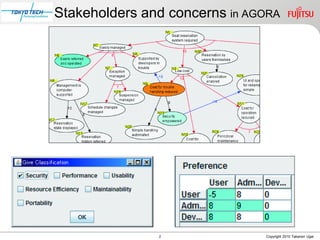
Stakeholders and concerns in AGORA


               2               Copyright 2010 Takanori Ugai
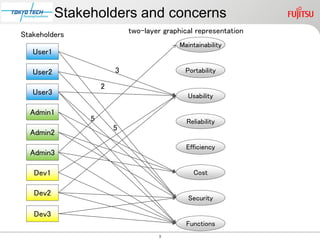
Stakeholders and concerns
Stakeholders                two-layer graphical representation
                                           Maintainability
   User1

   User2                3                    Portability

                    2
   User3                                     Usability

  Admin1
                5                            Reliability
                        5
  Admin2
                                             Efficiency
  Admin3

   Dev1                                        Cost

   Dev2
                                              Security

   Dev3
                                             Functions
                                     3
Anchored Map
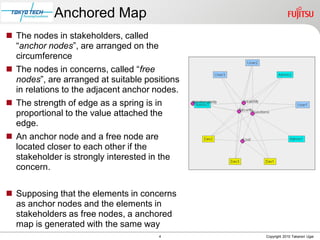
 The nodes in stakeholders, called
  “anchor nodes”, are arranged on the
  circumference
 The nodes in concerns, called “free
  nodes”, are arranged at suitable positions
  in relations to the adjacent anchor nodes.
 The strength of edge as a spring is in
  proportional to the value attached the
  edge.
 An anchor node and a free node are
  located closer to each other if the
  stakeholder is strongly interested in the
  concern.


 Supposing that the elements in concerns
  as anchor nodes and the elements in
  stakeholders as free nodes, a anchored
  map is generated with the same way
                                        4      Copyright 2010 Takanori Ugai
Example
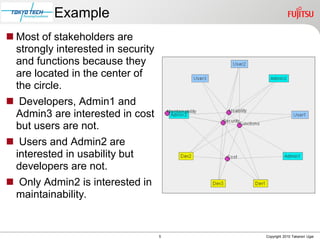
 Most of stakeholders are
  strongly interested in security
  and functions because they
  are located in the center of
  the circle.
 Developers, Admin1 and
 Admin3 are interested in cost
 but users are not.
 Users and Admin2 are
 interested in usability but
 developers are not.
 Only Admin2 is interested in
 maintainability.


                                    5   Copyright 2010 Takanori Ugai
Example2
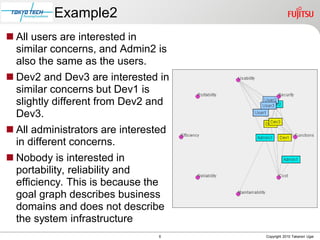
 All users are interested in
  similar concerns, and Admin2 is
  also the same as the users.
 Dev2 and Dev3 are interested in
  similar concerns but Dev1 is
  slightly different from Dev2 and
  Dev3.
 All administrators are interested
  in different concerns.
 Nobody is interested in
  portability, reliability and
  efficiency. This is because the
  goal graph describes business
  domains and does not describe
  the system infrastructure
                                6     Copyright 2010 Takanori Ugai
Summery
 This study presented a technique for visualizing stakeholders
  concerns in a project using an anchored map.
 The tool produces a graph which represents the relationship
  between stakeholders and system concerns.
 The tool can switch anchors and free nodes, and stakeholder
  preferences for goals are aggregated with semantic tags.
 Requirements analysts can easily obtain an overview of the
  analysis,
   Find which concern has high priority for end users or system
    administrators, or
   Identify the concerns which the smallest number of stakeholders are
    interested.
 A case study shows the system visualizes imbalance of
  stakeholders and lack of stakeholders and the information can
  give analysts suggestions.
                                     7                          Copyright 2010 Takanori Ugai
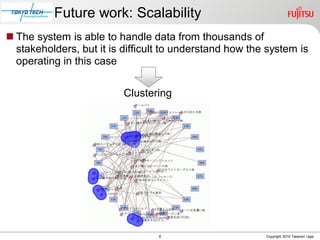
Future work: Scalability
 The system is able to handle data from thousands of
  stakeholders, but it is difficult to understand how the system is
  operating in this case


                          Clustering


                                 8                       Copyright 2010 Takanori Ugai
9   Copyright 2010 FUJITSU LIMITED

Visualizing Stakeholder Concerns with Anchored Map

  • 1.
    Visualizing Stakeholder Concerns withAnchored Map Takanori Ugai* ** ** Shinpei Hayashi , Motoshi Saeki * Fujitsu Laboratories/Tokyo Institute of Technology ** Tokyo Institute of Technology
  • 2.
    Motivation  Software developmentis a cooperative work by stakeholders.  It is important  to understand stakeholder concerns  to identify potential problems • imbalance of stakeholders • lack of stakeholders 1 Copyright 2010 Takanori Ugai
  • 3.
    Stakeholders and concernsin AGORA 2 Copyright 2010 Takanori Ugai
  • 4.
    Stakeholders and concerns Stakeholders two-layer graphical representation Maintainability User1 User2 3 Portability 2 User3 Usability Admin1 5 Reliability 5 Admin2 Efficiency Admin3 Dev1 Cost Dev2 Security Dev3 Functions 3
  • 5.
    Anchored Map  Thenodes in stakeholders, called “anchor nodes”, are arranged on the circumference  The nodes in concerns, called “free nodes”, are arranged at suitable positions in relations to the adjacent anchor nodes.  The strength of edge as a spring is in proportional to the value attached the edge.  An anchor node and a free node are located closer to each other if the stakeholder is strongly interested in the concern.  Supposing that the elements in concerns as anchor nodes and the elements in stakeholders as free nodes, a anchored map is generated with the same way 4 Copyright 2010 Takanori Ugai
  • 6.
    Example  Most ofstakeholders are strongly interested in security and functions because they are located in the center of the circle.  Developers, Admin1 and Admin3 are interested in cost but users are not.  Users and Admin2 are interested in usability but developers are not.  Only Admin2 is interested in maintainability. 5 Copyright 2010 Takanori Ugai
  • 7.
    Example2  All usersare interested in similar concerns, and Admin2 is also the same as the users.  Dev2 and Dev3 are interested in similar concerns but Dev1 is slightly different from Dev2 and Dev3.  All administrators are interested in different concerns.  Nobody is interested in portability, reliability and efficiency. This is because the goal graph describes business domains and does not describe the system infrastructure 6 Copyright 2010 Takanori Ugai
  • 8.
    Summery  This studypresented a technique for visualizing stakeholders concerns in a project using an anchored map.  The tool produces a graph which represents the relationship between stakeholders and system concerns.  The tool can switch anchors and free nodes, and stakeholder preferences for goals are aggregated with semantic tags.  Requirements analysts can easily obtain an overview of the analysis,  Find which concern has high priority for end users or system administrators, or  Identify the concerns which the smallest number of stakeholders are interested.  A case study shows the system visualizes imbalance of stakeholders and lack of stakeholders and the information can give analysts suggestions. 7 Copyright 2010 Takanori Ugai
  • 9.
    Future work: Scalability The system is able to handle data from thousands of stakeholders, but it is difficult to understand how the system is operating in this case Clustering 8 Copyright 2010 Takanori Ugai
  • 10.
    9 Copyright 2010 FUJITSU LIMITED