Tips for Writing a Great Resume
&
Preparing for your Interview
Why is a resume
important?
• Employer’s first impression of
you
• Gives you a chance to brand and
sell yourself
• Highlights your unique abilities
• Shows why you are qualified for
the job that you are applying for
• Documents your successes in
and out of the workplace
• Proves your ability to perform at
a high level
• Golden ticket to your first
interview
Components of a Great Resume
Contact Information
Name, location, phone number, email address, links to online portfolio, social media, or
virtual resume
Summary
“Strategic, analytical, and highly motivated sociology student with an economics focus.
Interested in challenging internship opportunities within the education technology
industry. Strong desire to contribute my strategic market research abilities, scholarly
aptitude, and tireless work ethic in a professional environment.”
Education
Graduation date GPA, Scholarships, Awards, etc.
Technical Skills / Social Media
HTML, MS Excel (pivot tables), Photoshop, Final Cut Pro, LinkedIn, Google+
Strengths
Project management, prioritization, problem solving, communication, etc.
Work History
As it relates to the job you’re applying for
Other
Languages, leadership roles, community involvement, notable achievements
Resume Buzz Words
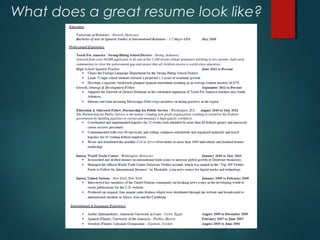
What does a great resume look like?
Do NOT Include…
 Date of Birth
 Social Security Number
 High School information
 Names and contacts of former employers
 Salary history
 Low GPA (less than 3.0)
 The wrong company/job title!
 Grammatical errors
 Positions that lasted 2-3 weeks
 Reasons why you were fired
 Religious/Political views
Use Social Media to Enhance Your Resume
Cover Letters
A great cover letter contains the following elements:
• The hiring manager or recruiter’s name
• A tailored introduction specifically for the company and position
• Your knowledge of the company
• 2-3 reasons why you want to work for the company – BE SPECIFIC!
• Any connections you may have with the company (referrals, attended an info
session, met a recruiter, etc.)
• Your accomplishments as they relate to the position you are applying for
• What value you can add to the company and position
• Your availability to interview
• A compelling closing statement that stresses your interest in the company and
position
• Contact information
Applying for the Job
 Ask yourself the following questions
 Do I meet 80% - 100% of the qualifications list in the job description?
 Am I confident in my ability to perform the functions in this role?
 How much training would I need?
 Is it in my salary range?
 Can I commit to a lengthy interview process?
 Why am I the best fit for the role?
 Do I know enough about the company to create a cover letter?
 How interested am I in this position?
 Do I have the skills and education to apply to the job?
 Do I have the ability to relocate for the position at my own expense?
Applying for the Job
• Research, Research, Research
• Begin connecting with company employees on LinkedIn & other social
media sites
• Conduct informational interviews over a coffee break
• Follow ALL instructions on the job posting
• Follow up with the recruiter via email about your application & include
your resume and cover letter
• Pick up the phone
Nailing the Interview
• The interview starts on the phone
• Confirm the interview!!
• Dress for success
• Practice interviewing
• Write down 10-15 questions you’d like to potentially ask the employer
• Know the company and the person you’re interviewing with
• Arrive 10 minutes early – not 30!
• Be friendly to everyone you encounter – even in the parking lot
• Bring several copies of your resume, a notepad, and a pen
• Don’t get too comfortable
• Be aware of your body language – eye contact and a smile!
• Make yourself the obvious choice
• Bring tangible documents of your work
• Send a hand written Thank-You note and an email
Owning Your Career
“The biggest mistake that you can make is to
believe that you are working for somebody else.
Job security is gone. The driving force of a career
must come from the individual. Remember: You
own your career!” - Earl Nightingale

Resume writing and interviewing

  • 1.
    Tips for Writinga Great Resume & Preparing for your Interview
  • 2.
    Why is aresume important? • Employer’s first impression of you • Gives you a chance to brand and sell yourself • Highlights your unique abilities • Shows why you are qualified for the job that you are applying for • Documents your successes in and out of the workplace • Proves your ability to perform at a high level • Golden ticket to your first interview
  • 3.
    Components of aGreat Resume Contact Information Name, location, phone number, email address, links to online portfolio, social media, or virtual resume Summary “Strategic, analytical, and highly motivated sociology student with an economics focus. Interested in challenging internship opportunities within the education technology industry. Strong desire to contribute my strategic market research abilities, scholarly aptitude, and tireless work ethic in a professional environment.” Education Graduation date GPA, Scholarships, Awards, etc. Technical Skills / Social Media HTML, MS Excel (pivot tables), Photoshop, Final Cut Pro, LinkedIn, Google+ Strengths Project management, prioritization, problem solving, communication, etc. Work History As it relates to the job you’re applying for Other Languages, leadership roles, community involvement, notable achievements
  • 4.
  • 5.
    What does agreat resume look like?
  • 6.
    What does agreat resume look like?
  • 7.
    What does agreat resume look like?
  • 8.
    Do NOT Include… Date of Birth  Social Security Number  High School information  Names and contacts of former employers  Salary history  Low GPA (less than 3.0)  The wrong company/job title!  Grammatical errors  Positions that lasted 2-3 weeks  Reasons why you were fired  Religious/Political views
  • 9.
    Use Social Mediato Enhance Your Resume
  • 10.
    Cover Letters A greatcover letter contains the following elements: • The hiring manager or recruiter’s name • A tailored introduction specifically for the company and position • Your knowledge of the company • 2-3 reasons why you want to work for the company – BE SPECIFIC! • Any connections you may have with the company (referrals, attended an info session, met a recruiter, etc.) • Your accomplishments as they relate to the position you are applying for • What value you can add to the company and position • Your availability to interview • A compelling closing statement that stresses your interest in the company and position • Contact information
  • 11.
    Applying for theJob  Ask yourself the following questions  Do I meet 80% - 100% of the qualifications list in the job description?  Am I confident in my ability to perform the functions in this role?  How much training would I need?  Is it in my salary range?  Can I commit to a lengthy interview process?  Why am I the best fit for the role?  Do I know enough about the company to create a cover letter?  How interested am I in this position?  Do I have the skills and education to apply to the job?  Do I have the ability to relocate for the position at my own expense?
  • 12.
    Applying for theJob • Research, Research, Research • Begin connecting with company employees on LinkedIn & other social media sites • Conduct informational interviews over a coffee break • Follow ALL instructions on the job posting • Follow up with the recruiter via email about your application & include your resume and cover letter • Pick up the phone
  • 13.
    Nailing the Interview •The interview starts on the phone • Confirm the interview!! • Dress for success • Practice interviewing • Write down 10-15 questions you’d like to potentially ask the employer • Know the company and the person you’re interviewing with • Arrive 10 minutes early – not 30! • Be friendly to everyone you encounter – even in the parking lot • Bring several copies of your resume, a notepad, and a pen • Don’t get too comfortable • Be aware of your body language – eye contact and a smile! • Make yourself the obvious choice • Bring tangible documents of your work • Send a hand written Thank-You note and an email
  • 14.
    Owning Your Career “Thebiggest mistake that you can make is to believe that you are working for somebody else. Job security is gone. The driving force of a career must come from the individual. Remember: You own your career!” - Earl Nightingale

Editor's Notes

  • #14 Ask your HR Manager to partner with you in the process. Ask for typical interview questions, do a mock interview with a recruiter, ask for feedback from your manager on your strengths and weakness.Be confident!
  • #15 Look for projects to build your skills. Ask your manager if you can participate.