Restful Web Services Cookbook 1st Edition Subbu Allamaraju
1.
Restful Web ServicesCookbook 1st Edition Subbu
Allamaraju download
https://ebookbell.com/product/restful-web-services-cookbook-1st-
edition-subbu-allamaraju-4107040
Explore and download more ebooks at ebookbell.com
2.
Here are somerecommended products that we believe you will be
interested in. You can click the link to download.
Restful Web Services 1st Edition Richardson Leonard Ruby Sam
https://ebookbell.com/product/restful-web-services-1st-edition-
richardson-leonard-ruby-sam-55278830
Restful Web Services With Dropwizard Alexandros Dallas
https://ebookbell.com/product/restful-web-services-with-dropwizard-
alexandros-dallas-5097716
Restful Web Services Leonard Richardson And Sam Ruby
https://ebookbell.com/product/restful-web-services-leonard-richardson-
and-sam-ruby-23340002
Restful Web Services With Scala 1st Edition Jos Dirksen
https://ebookbell.com/product/restful-web-services-with-scala-1st-
edition-jos-dirksen-23391590
3.
Restful Web ServicesTutorials Point
https://ebookbell.com/product/restful-web-services-tutorials-
point-12142326
Django Restful Web Services Gaston C Hillar
https://ebookbell.com/product/django-restful-web-services-gaston-c-
hillar-52556306
Django Restful Web Services 1st Edition Gaston C Hillar
https://ebookbell.com/product/django-restful-web-services-1st-edition-
gaston-c-hillar-33934172
Building Restful Web Services With Spring 5 Leverage The Power Of
Spring 50 Java Se 9 And Spring Boot 20 2nd Edition 2nd Edition Raja
Csp Raman
https://ebookbell.com/product/building-restful-web-services-with-
spring-5-leverage-the-power-of-spring-50-java-se-9-and-spring-
boot-20-2nd-edition-2nd-edition-raja-csp-raman-38560882
Developing Restful Web Services With Jersey 20 Sunil Gulabani
https://ebookbell.com/product/developing-restful-web-services-with-
jersey-20-sunil-gulabani-4680384
5.
RESTful Web ServicesCookbook
Subbu Allamaraju
Beijing • Cambridge • Farnham • Köln • Sebastopol • Taipei • Tokyo
Table of Contents
Preface. . . . . . . . . . . . . . . . . . . . . . . . . . . . . . . . . . . . . . . . . . . . . . . . . . . . . . . . . . . . . . . . . . . . . ix
1. Using the Uniform Interface . . . . . . . . . . . . . . . . . . . . . . . . . . . . . . . . . . . . . . . . . . . . . . 1
1.1 How to Keep Interactions Visible 2
1.2 When to Trade Visibility 4
1.3 How to Maintain Application State 7
1.4 How to Implement Safe and Idempotent Methods on the Server 9
1.5 How to Treat Safe and Idempotent Methods in Clients 12
1.6 When to Use GET 13
1.7 When to Use POST 14
1.8 How to Create Resources Using POST 16
1.9 When to Use PUT to Create New Resources 18
1.10 How to Use POST for Asynchronous Tasks 19
1.11 How to Use DELETE for Asynchronous Deletion 23
1.12 When to Use Custom HTTP Methods 23
1.13 When and How to Use Custom HTTP Headers 25
2. Identifying Resources . . . . . . . . . . . . . . . . . . . . . . . . . . . . . . . . . . . . . . . . . . . . . . . . . . . 29
2.1 How to Identify Resources from Domain Nouns 30
2.2 How to Choose Resource Granularity 31
2.3 How to Organize Resources into Collections 32
2.4 When to Combine Resources into Composites 34
2.5 How to Support Computing/Processing Functions 37
2.6 When and How to Use Controllers to Operate on Resources 39
3. Designing Representations . . . . . . . . . . . . . . . . . . . . . . . . . . . . . . . . . . . . . . . . . . . . . . 45
3.1 How to Use Entity Headers to Annotate Representations 46
3.2 How to Interpret Entity Headers 49
3.3 How to Avoid Character Encoding Mismatch 50
3.4 How to Choose a Representation Format and a Media Type 52
3.5 How to Design XML Representations 56
v
8.
3.6 How toDesign JSON Representations 58
3.7 How to Design Representations of Collections 59
3.8 How to Keep Collections Homogeneous 61
3.9 How to Use Portable Data Formats in Representations 62
3.10 When to Use Entity Identifiers 65
3.11 How to Encode Binary Data in Representations 66
3.12 When and How to Serve HTML Representations 67
3.13 How to Return Errors 69
3.14 How to Treat Errors in Clients 73
4. Designing URIs . . . . . . . . . . . . . . . . . . . . . . . . . . . . . . . . . . . . . . . . . . . . . . . . . . . . . . . . 75
4.1 How to Design URIs 75
4.2 How to Use URIs As Opaque Identifiers 79
4.3 How to Let Clients Treat URIs As Opaque Identifiers 81
4.4 How to Keep URIs Cool 83
5. Web Linking . . . . . . . . . . . . . . . . . . . . . . . . . . . . . . . . . . . . . . . . . . . . . . . . . . . . . . . . . . 87
5.1 How to Use Links in XML Representations 88
5.2 How to Use Links in JSON Representations 90
5.3 When and How to Use Link Headers 91
5.4 How to Assign Link Relation Types 93
5.5 How to Use Links to Manage Application Flow 95
5.6 How to Deal with Ephemeral URIs 99
5.7 When and How to Use URI Templates 101
5.8 How to Use Links in Clients 103
6. Atom and AtomPub . . . . . . . . . . . . . . . . . . . . . . . . . . . . . . . . . . . . . . . . . . . . . . . . . . . 107
6.1 How to Model Resources Using Atom 108
6.2 When to Use Atom 111
6.3 How to Use AtomPub Service and Category Documents 116
6.4 How to Use AtomPub for Feed and Entry Resources 118
6.5 How to Use Media Resources 119
7. Content Negotiation . . . . . . . . . . . . . . . . . . . . . . . . . . . . . . . . . . . . . . . . . . . . . . . . . . 123
7.1 How to Indicate Client Preferences 124
7.2 How to Implement Media Type Negotiation 126
7.3 How to Implement Language Negotiation 127
7.4 How to Implement Character Encoding Negotiation 129
7.5 How to Support Compression 130
7.6 When and How to Send the Vary Header 131
7.7 How to Handle Negotiation Failures 132
7.8 How to Use Agent-Driven Content Negotiation 133
7.9 When to Support Server-Driven Negotiation 135
vi | Table of Contents
9.
8. Queries .. . . . . . . . . . . . . . . . . . . . . . . . . . . . . . . . . . . . . . . . . . . . . . . . . . . . . . . . . . . . . 137
8.1 How to Design URIs for Queries 138
8.2 How to Design Query Responses 140
8.3 How to Support Query Requests with Large Inputs 142
8.4 How to Store Queries 144
9. Web Caching . . . . . . . . . . . . . . . . . . . . . . . . . . . . . . . . . . . . . . . . . . . . . . . . . . . . . . . . . 147
9.1 How to Set Expiration Caching Headers 148
9.2 When to Set Expiration Caching Headers 151
9.3 When and How to Use Expiration Headers in Clients 153
9.4 How to Support Caching for Composite Resources 154
9.5 How to Keep Caches Fresh and Warm 156
10. Conditional Requests . . . . . . . . . . . . . . . . . . . . . . . . . . . . . . . . . . . . . . . . . . . . . . . . . . 159
10.1 How to Generate Last-Modified and ETag Headers 161
10.2 How to Implement Conditional GET Requests in Servers 162
10.3 How to Submit Conditional GET and HEAD Requests
from Clients 165
10.4 How to Implement Conditional PUT Requests in Servers 167
10.5 How to Implement Conditional DELETE Requests in Servers 171
10.6 How to Make Unconditional GET Requests from Clients 172
10.7 How to Submit Conditional PUT and DELETE Requests
from Clients 174
10.8 How to Make POST Requests Conditional 176
10.9 How to Generate One-Time URIs 179
11. Miscellaneous Writes . . . . . . . . . . . . . . . . . . . . . . . . . . . . . . . . . . . . . . . . . . . . . . . . . . 183
11.1 How to Copy a Resource 184
11.2 How to Merge Resources 186
11.3 How to Move a Resource 188
11.4 When to Use WebDAV Methods 189
11.5 How to Support Operations Across Servers 191
11.6 How to Take Snapshots of Resources 193
11.7 How to Undo Resource Updates 196
11.8 How to Refine Resources for Partial Updates 198
11.9 How to Use the PATCH Method 201
11.10 How to Process Similar Resources in Bulk 203
11.11 How to Trigger Bulk Operations 206
11.12 When to Tunnel Multiple Requests Using POST 208
11.13 How to Support Batch Requests 211
11.14 How to Support Transactions 213
Table of Contents | vii
10.
12. Security .. . . . . . . . . . . . . . . . . . . . . . . . . . . . . . . . . . . . . . . . . . . . . . . . . . . . . . . . . . . . 217
12.1 How to Use Basic Authentication to Authenticate Clients 218
12.2 How to Use Digest Authentication to Authenticate Clients 221
12.3 How to Use Three-Legged OAuth 223
12.4 How to Use Two-Legged OAuth 228
12.5 How to Deal with Sensitive Information in URIs 231
12.6 How to Maintain the Confidentiality and Integrity
of Representations 233
13. Extensibility and Versioning . . . . . . . . . . . . . . . . . . . . . . . . . . . . . . . . . . . . . . . . . . . . 235
13.1 How to Maintain URI Compatibility 236
13.2 How to Maintain Compatibility of XML and JSON
Representations 237
13.3 How to Extend Atom 241
13.4 How to Maintain Compatibility of Links 244
13.5 How to Implement Clients to Support Extensibility 246
13.6 When to Version 247
13.7 How to Version RESTful Web Services 248
14. Enabling Discovery . . . . . . . . . . . . . . . . . . . . . . . . . . . . . . . . . . . . . . . . . . . . . . . . . . . . 251
14.1 How to Document RESTful Web Services 251
14.2 How to Use OPTIONS 254
A. Additional Reading . . . . . . . . . . . . . . . . . . . . . . . . . . . . . . . . . . . . . . . . . . . . . . . . . . . 257
B. Overview of REST . . . . . . . . . . . . . . . . . . . . . . . . . . . . . . . . . . . . . . . . . . . . . . . . . . . . . 261
C. HTTP Methods . . . . . . . . . . . . . . . . . . . . . . . . . . . . . . . . . . . . . . . . . . . . . . . . . . . . . . . . 265
D. Atom Syndication Format . . . . . . . . . . . . . . . . . . . . . . . . . . . . . . . . . . . . . . . . . . . . . . 271
E. Link Relation Registry . . . . . . . . . . . . . . . . . . . . . . . . . . . . . . . . . . . . . . . . . . . . . . . . . 277
Index . . . . . . . . . . . . . . . . . . . . . . . . . . . . . . . . . . . . . . . . . . . . . . . . . . . . . . . . . . . . . . . . . . . . . 285
viii | Table of Contents
11.
Preface
In 2000, RoyFielding, one of the key contributors to HTTP and URI, codified the
architecture of the Web in his doctoral thesis titled “Architectural Styles and the Design
of Network-Based Software Architectures.” In this thesis, he introduced an architecture
style known as Representational State Transfer (REST). This style, in abstract terms,
describes the foundation of the World Wide Web. The technologies that make up this
foundation include the Hypertext Transfer Protocol (HTTP), Uniform Resource Iden-
tifier (URI), markup languages such as HTML and XML, and web-friendly formats
such as JSON.
REST is an architectural style for networked applications. It consists of several con-
straints to address separation of concerns, visibility, reliability, scalability, perform-
ance, etc. See Appendix B for a brief overview of these constraints. What makes REST
attractive to build distributed and decentralized client/server applications is the infra-
structure of the Web. Deploying web services on this infrastructure lets you take
advantage of a wide range of existing infrastructure that includes web servers, client
libraries, proxy servers, caches, firewalls, and so on. Although, in theory, it is possible
to build RESTful applications without relying on HTTP, attempting to do so can be an
expensive proposition. In this book, RESTful web services means web services built
using HTTP, URIs, XML, JSON, Atom, etc.
Scope of the Book
This book is not a discourse on REST or its merits over other styles of architecture.
This is a cookbook for designers and developers of RESTful web services.
Plenty of material exists that describes the REST architectural style. Wikipedia’s entry
on Representational State Transfer (http://en.wikipedia.org/wiki/Representational_State
_Transfer) provides a concise description of REST’s underlying concepts, its con-
straints, and the guiding principles to design applications. Leonard Richardson and
Sam Ruby’s RESTful Web Services (O’Reilly) provides a more in-depth coverage on the
basics of this topic detailing how to use resources as the core building blocks. But how
do you find help with day-to-day design and implementation questions? This is the
book to fill that gap.
ix
12.
This book consistsof recipes to help design and implement RESTful client/server ap-
plications. It presents these recipes in a manner that lets you take advantage of the web
infrastructure and REST without having to ponder whether your web service is REST-
ful. Each recipe includes one or more problem statements and a solution, followed by
a detailed discussion with examples, commentary on implementation, and any trade-
offs involved.
Much of the material for the recipes is based on common design problems found while
developing RESTful web services. The problems include usage of HTTP, resource and
representation design, URIs, caching, concurrency control, partial updates, batch pro-
cessing, transactions, security, versioning, compatibility, etc.
This book is not programming language specific. It uses HTTP request and response
messages to illustrate implementation. You can use languages such as C#, C++, Java,
Ruby, Python, PHP, and Perl to implement these recipes. See Appendix A for a list of
programming language–specific books, or search your favorite bookstore.
This book does not also deal with installing, administering, or securing web servers,
caches, and proxies. See books such as Apache Cookbook by Ken Coar and Rich Bowen,
Apache Security by Ivan Ristic, and Squid: The Definitive Guide by Duane Wessels (all
from O’Reilly), or product manuals to learn such topics.
Companion Material
See http://www.restful-webservices-cookbook.org for additional material, errata, com-
ments, and questions about this book.
You may find the following additional resources helpful:
REST-Discuss Yahoo! Group (http://tech.groups.yahoo.com/group/rest-discuss)
If you have questions on the REST architectural style, search the archives of this
group. Better yet, join this group to post your questions and engage in conversa-
tions about the merits and demerits of REST, commonly encountered problems,
and usage of HTTP for RESTful web services.
Leonard Richardson and Sam Ruby’s RESTful Web Services (O’Reilly)
See this book to learn more about REST and how to use the Web as a platform for
building RESTful web services.
RESTwiki (http://rest.blueoxen.net/cgi-bin/wiki.pl)
This wiki contains a collection of articles written over years that describe various
aspects of REST and its application.
Chris Shiflett’s HTTP Developer’s Handbook (Sams)
See this book if you have questions about using HTTP in client or server
applications.
x | Preface
13.
Undoubtedly, there willbe additional design and implementation problems that are
not addressed by this book or the previously discussed resources. Visit http://www
.restful-webservices-cookbook.org to post your questions, suggestions, or alternative
solutions you have had success with in your experience. In due course, this site will
include additional recipes, and they will be included in the next revision of this book.
How This Book Is Organized
This book is organized into 14 chapters followed by 5 appendixes as follows:
Chapter 1, Using the Uniform Interface
This chapter describes the details of using HTTP’s uniform interface and deals with
issues such as statelessness, visibility, safety and idempotency, extensibility, new
resource creation, GET versus POST, etc. The recipes in this chapter primarily deal
with using HTTP’s uniform interface.
Chapter 2, Identifying Resources
This chapter describes how to identify resources to cover some commonly en-
countered application scenarios.
Chapter 3, Designing Representations
This chapter describes how to design representations, how to use HTTP headers
on requests and responses, how to choose media types and formats, and how to
do error handling.
Chapter 4, Designing URIs
This chapter describes common patterns for designing URIs, using URIs as iden-
tifiers, and keeping URIs cool.
Chapter 5, Web Linking
This chapter shows when and how to use links in representations and covers details
of links in the body of representations, link headers, URI templates, and applica-
tions of links.
Chapter 6, Atom and AtomPub
This chapter presents how to use Atom feeds, entries, media resources, and service
documents as resources; how to use the AtomPub protocol; and when to use Atom
to design resource representations.
Chapter 7, Content Negotiation
This chapter shows how to negotiate for representations based on media type,
character encoding, content encoding, or content language; how to use the Vary
header; and when to use content negotiation.
Chapter 8, Queries
This chapter shows some approaches for designing URIs for queries, handling large
queries, and storing queries.
Preface | xi
14.
Chapter 9, WebCaching
This chapter describes how to support expiration caching in servers and deal with
caching in clients.
Chapter 10, Conditional Requests
Thischapterdescribeshowtoimplementconditionalrequestsinserversandclients
for various HTTP methods and shows how conditional requests can help caching,
optimistic concurrency control, and idempotency.
Chapter 11, Miscellaneous Writes
This chapter shows how to solve a variety of design problems that at first glance
may seem outside the scope of REST and HTTP. Topics include copying, merging,
partial updates, batch processing, and transactions.
Chapter 12, Security
This chapter shows how to address common security needs such as authentication,
authorization, delegation, etc.
Chapter 13, Extensibility and Versioning
This chapter shows how to write extensible servers, how to keep clients resilient
to change, and how to implement versioning.
Chapter 14, Enabling Discovery
This chapter describes how to document RESTful web services.
Appendix A, Additional Reading
This appendix lists places where you can find more information about REST and
the underlying technologies.
Appendix B, Overview of REST
This appendix provides a brief introduction to REST with an example.
Appendix C, HTTP Methods
This appendix shows how to use standard HTTP methods.
Appendix D, Atom Syndication Format
This appendix provides a reference to Atom feed and entry documents.
Appendix E, Link Relation Registry
This appendix lists link relation types that you can use in links.
Conventions Used in This Book
The following typographical conventions are used in this book:
Italic
Indicates new terms, URLs, email addresses, filenames, and file extensions.
Constant width
Used for program listings, as well as within paragraphs to refer to program elements
such as variable or function names, databases, datatypes, environment variables,
statements, and keywords.
xii | Preface
15.
Constant width startingwith "#"
Used for comments in HTTP requests and response messages. For instance:
# This is a request
GET /toc
Host: www.restful-webservices-cookbook.org
# This is a response
HTTP/1.1 200 OK
Date: Sat, 07 Nov 2009 03:14:05 GMT
Last-Modified: Sat, 07 Nov 2009 03:14:05 GMT
Content-Type: text/html; charset=UTF-8
<html>...</html>
This icon signifies a tip, suggestion, or general note.
This icon indicates a warning or caution.
Using Code Examples
This book is here to help you get your job done. In general, you may use the code in
this book in your programs and documentation. You do not need to contact us for
permission unless you’re reproducing a significant portion of the code. For example,
writing a program that uses several chunks of code from this book does not require
permission. Selling or distributing a CD-ROM of examples from O’Reilly books does
require permission. Answering a question by citing this book and quoting example
code does not require permission. Incorporating a significant amount of example code
from this book into your product’s documentation does require permission.
We appreciate, but do not require, attribution. An attribution usually includes the title,
author, publisher, and ISBN. For example: “RESTful Web Services Cookbook by Subbu
Allamaraju. Copyright 2010 Yahoo!, Inc., 978-0-596-80168-7.”
If you feel your use of code examples falls outside fair use or the permission given here,
feel free to contact us at permissions@oreilly.com.
Safari® Books Online
Safari Books Online is an on-demand digital library that lets you easily
search over 7,500 technology and creative reference books and videos to
find the answers you need quickly.
Preface | xiii
16.
Withasubscription,youcanreadanypageandwatchanyvideofromourlibraryonline.
Read books onyour cell phone and mobile devices. Access new titles before they are
available for print, and get exclusive access to manuscripts in development and post
feedback for the authors. Copy and paste code samples, organize your favorites, down-
load chapters, bookmark key sections, create notes, print out pages, and benefit from
tons of other time-saving features.
O’Reilly Media has uploaded this book to the Safari Books Online service. To have full
digital access to this book and others on similar topics from O’Reilly and other pub-
lishers, sign up for free at http://my.safaribooksonline.com.
How to Contact Us
Please address comments and questions concerning this book to the publisher:
O’Reilly Media, Inc.
1005 Gravenstein Highway North
Sebastopol, CA 95472
800-998-9938 (in the United States or Canada)
707-829-0515 (international or local)
707-829-0104 (fax)
We have a web page for this book, where we list errata, examples, and any additional
information. You can access this page at:
http://www.oreilly.com/catalog/9780596801687
To comment or ask technical questions about this book, send email to:
bookquestions@oreilly.com
For more information about our books, conferences, Resource Centers, and the
O’Reilly Network, see our website at:
http://www.oreilly.com
Acknowledgments
Many people have helped this book happen. Mary Treseler, the editor for this book at
O’Reilly, helped shape the outline for this book by asking the right questions. She
provided much needed support, encouragement, and polite nudging to transform ideas
into a reality.
ManythankstoMarkNottinghamandHugoHaasforhelpingmedraftaninitialoutline
for this book.
xiv | Preface
17.
Mike Amundsen, whocontributed to parts of this book, spent countless hours and red
pens to review and comment on the book line by line. His suggestions on improving
the tone of this book were invaluable. Despite his limited availability, Mike was always
on call to discuss the merits and demerits of solutions and the real-world trade-offs.
Thanks to Havi Hoffman, who manages Yahoo! Press, for patiently guiding me through
the process of writing a proposal and for pulling the right strings to shield me from the
elaborate process. My thanks to Neal Sample, James Lok, Jay Rossiter, and Tony Ng
(all from Yahoo! Inc.) for their support during the course of writing this book. I would
also like to thank Korby Parnell for planting the seeds to write this book.
I am profoundly grateful to Mark Nottingham, Eben Hewitt, Colin Jack, Stefan Tilkov,
Norbert Lindenberg, Chris Westin, Dan Theurer, Shaunak Kashyap, Larry Cable, Alan
Dean, Surya Suravarapu, Jim D’Ambrosia, Randolph Kahle, Dhananjay Nene, and
Brian Sletten for their valuable and critical feedback on the clarity, approach, quality,
and accuracy of the material in this book.
Thanks to the members of the REST-Discuss Yahoo! Group (http://tech.groups.yahoo
.com/group/rest-discuss) for all the passionate, tough, and insightful discussions on all
things related to REST.
Thanks also to all the readers who provided feedback on the rough cuts drafts of this
book.
Mike Amundsen’s Contribution
Mike Amundsen contributed to Recipes 4.1, 4.3, 6.1, 6.4, 9.1, 9.4, 9.5, 11.8, 11.9,
11.12, and Appendix D.
Preface | xv
18.
CHAPTER 1
Using theUniform Interface
HTTP is an application-level protocol that defines operations for transferring repre-
sentations between clients and servers. In this protocol, methods such as GET, POST,
PUT, and DELETE are operations on resources. This protocol eliminates the need for you
to invent application-specific operations such as createOrder, getStatus, updateSta
tus, etc. How much you can benefit from the HTTP infrastructure largely depends on
how well you can use HTTP as an application-level protocol. However, a number of
techniques including SOAP and some Ajax web frameworks use HTTP as a protocol
to transport messages. Such usage makes poor use of HTTP-level infrastructure. This
chapter presents the following recipes to highlight various aspects of using HTTP as
an application protocol:
Recipe 1.1, “How to Keep Interactions Visible”
Visibility is one of the key characteristics of HTTP. Use this recipe to learn how to
maintain visibility.
Recipe 1.2, “When to Trade Visibility”
There are cases when you may need to forgo visibility to meet application needs.
Use this recipe to find some scenarios.
Recipe 1.3, “How to Maintain Application State”
Use this recipe to learn the best way to manage state.
Recipe 1.4, “How to Implement Safe and Idempotent Methods on the Server”
Maintaining safety and idempotency helps servers guarantee repeatability for re-
quests. Use this recipe when implementing servers.
Recipe 1.5, “How to Treat Safe and Idempotent Methods in Clients”
Follow this recipe to implement clients for safety and idempotency principles.
Recipe 1.6, “When to Use GET”
Use this recipe to learn when to use GET.
Recipe 1.7, “When to Use POST”
Use this recipe to learn when to use POST.
1
19.
Recipe 1.8, “Howto Create Resources Using POST”
Use this recipe to learn how to create new resources using the POST method.
Recipe 1.9, “When to Use PUT to Create New Resources”
You can use either POST or PUT to create new resources. This recipe will discuss
when using PUT is better.
Recipe 1.10, “How to Use POST for Asynchronous Tasks”
Use this recipe to learn how to use the POST method for asynchronous tasks.
Recipe 1.11, “How to Use DELETE for Asynchronous Deletion”
Use this recipe to learn how to use the DELETE method for asynchronous deletion
of resources.
Recipe 1.12, “When to Use Custom HTTP Methods”
Use this recipe to learn why custom HTTP methods are not recommended.
Recipe 1.13, “When and How to Use Custom HTTP Headers”
Use this recipe to learn when and how to use custom HTTP headers.
1.1 How to Keep Interactions Visible
As an application protocol, HTTP is designed to keep interactions between clients and
servers visible to libraries, servers, proxies, caches, and other tools. Visibility is a key
characteristic of HTTP. Per Roy Fielding (see Appendix A for references), visibility is
“the ability of a component to monitor or mediate the interaction between two other
components.” When a protocol is visible, caches, proxies, firewalls, etc., can monitor
and even participate in the protocol.
Problem
You want to know what visibility means and what you can do to keep HTTP requests
and responses visible.
Solution
Once you identify and design resources, use GET to get a representation of a resource,
PUT to update a resource, DELETE to delete a resource, and POST to perform a variety of
potentially nonidempotent and unsafe operations. Add appropriate HTTP headers to
describe requests and responses.
Discussion
Features like the following depend entirely on keeping requests and responses visible:
Caching
Caching responses and automatically invalidating cached responses when
resources are modified
2 | Chapter 1: Using the Uniform Interface
20.
Optimistic concurrency control
Detectingconcurrent writes and preventing resource changes when such opera-
tions are based on stale representations
Content negotiation
Selecting a representation among alternatives available for a given resource
Safety and idempotency
Ensuring that clients can repeat or retry certain HTTP requests
When a web service does not maintain visibility, such features will not work correctly.
For instance, when the server’s usage of HTTP breaks optimistic concurrency, you may
be forced to invent application-specific concurrency control mechanisms on your own.
Maintaining visibility lets you use existing HTTP software and infra-
structure for features that you would otherwise have to build yourself.
HTTP achieves visibility by virtue of the following:
• HTTP interactions are stateless. Any HTTP intermediary can infer the meaning of
any given request and response without correlating them with past or future re-
quests and responses.
• HTTP uses a uniform interface consisting of OPTIONS, GET, HEAD, POST, PUT, DELETE,
and TRACE methods. Each method in this interface operates on one and only one
resource. The syntax and the meaning of each method do not change from appli-
cation to application or from resource to resource. That is why HTTP is known as
a uniform interface.
• HTTP uses a MIME-like envelope format to encode representations. This format
maintains a clear separation between headers and the body. Headers are visible,
and except for the software that is creating the message and the software that is
processing the message, every piece of software in between can treat the body as
completely opaque.
Consider an HTTP request to update a resource:
# Request
PUT /movie/gone_with_the_wind HTTP/1.1
Host: www.example.org
Content-Type: application/x-www-form-urlencoded
summary=...&rating=5&...
# Response
HTTP/1.1 200 OK
Content-Type: text/html;charset=UTF-8
Content-Length: ...
1.1 How to Keep Interactions Visible | 3
21.
<html>
...
</html>
Request line containingHTTP method, path to the resource, and HTTP version
Representation headers for the request
Representation body for the request
Response status line containing HTTP version, status code, and status message
Representation headers for the response
Representation body for the response
In this example, the request is an HTTP message. The first line in this message describes
the protocol and the method used by the client. The next two lines are request headers.
By simply looking at these three lines, any piece of software that understands HTTP
can decipher not only the intent of the request but also how to parse the body of the
message. The same is the case with the response. The first line in the response indicates
the version of HTTP, the status code, and a message. The next two lines tell HTTP-
aware software how to interpret the message.
For RESTful web services, your key goal must be to maintain visibility to the extent
possible. Keeping visibility is simple. Use each HTTP method such that it has the same
semantics as specified by HTTP, and add appropriate headers to describe requests and
responses.
Another part of maintaining visibility is using appropriate status codes and messages
so that proxies, caches, and clients can determine the outcome of a request. A status
code is an integer, and the status message is text.
AswewilldiscussinRecipe1.2,therearecaseswhereyoumayneedtotradeoffvisibility
for other characteristics such as network efficiency, client convenience, and separation
of concerns. When you make such trade-offs, carefully analyze the effect on features
such as caching, idempotency, and safety.
1.2 When to Trade Visibility
This recipe describes some common situations where trading off visibility may be
necessary.
Problem
You want to know common situations that may require you to keep requests and re-
sponses less visible to the protocol.
4 | Chapter 1: Using the Uniform Interface
22.
Solution
Whenever you havemultiple resources that share data or whenever an operation modi-
fies more than one resource, be prepared to trade visibility for better abstraction of
information, loose coupling, network efficiency, resource granularity, or pure client
convenience.
Discussion
Visibility often competes with other architectural demands such as abstraction, loose
coupling, efficiency, message granularity, etc. For example, think of a person resource
and a related address resource. Any client can submit GET requests to obtain represen-
tationsofthesetworesources.Forthesakeofclientconvenience,theservermayinclude
data from the address resource within the representation of the person resource as
follows:
# Request to get the person
GET /person/1 HTTP/1.1
Host: www.example.org
Content-Type: application/xml;charset=UTF-8
<person>
<name>John Doe</name>
<address type="home">
<street>1 Main Street</street>
<city>Bellevue</city>
<state>WA</state>
</address>
</person>
# Request to get the address
GET /person/1/address HTTP/1.1
Host: www.example.org
Content-Type: application/xml;charset=UTF-8
<address type="home">
<street>1 Main Street</street>
<city>Bellevue</city>
<state>WA</state>
</address>
Let’s assume that the server allows clients to submit PUT requests to update these re-
sources. When a client modifies one of these resources, the state of the related resource
also changes. However, at the HTTP level, these are independent resources. Only the
server knows that they are dependent. Such overlapping data is a common cause of
reduced visibility.
One of the important consequences of reduced visibility is caching (see Chapter 9).
Since these are two independent resources at the HTTP level, caches will have two
copies of the address: one as an independent address representation and the other as
part of the person representation. This can be inefficient. Also, invalidating one
1.2 When to Trade Visibility | 5
23.
representation from thecache will not invalidate the other representation. This can
leave stale representations in the cache.
In this particular example, you can eliminate the overlap between these
resources by including a reference to the address from the person re-
source and avoid including address details. You can use links (see
Chapter 5) to provide references to other resources.
Although providing a link may minimize overlaps, it will force clients
to make additional requests.
In this example, the trade-off is between visibility and client convenience and, poten-
tially, network efficiency. A client that always deals with person resources can make a
single request to get information about the person as well as the address.
Here are some more situations where you may need to give up visibility for other
benefits:
Client convenience
Servers may need to design special-purpose coarse-grained composite resources
for the sake of client convenience (e.g., Recipe 2.4).
Abstraction
In order to abstract complex business operations (including transactions), servers
may need to employ controller resources to make changes to other resources (e.g.,
Recipe 2.6). Such resources can hide the details used to implement business
operations.
Network efficiency
In cases where a client is performing several operations in quick succession, you
may need to combine such operations into batches to reduce network latency (e.g.,
Recipes 11.10 and 11.13).
In each of these cases, if you focus only on visibility, you may be forced to design your
web service to expose all data as independent resources with no overlaps. A web service
designed in that manner may lead to fine-grained resources and poor separation of
concerns between clients and servers. For an example, see Recipe 2.6. Other scenarios
such as copying or merging resources and making partial updates (see Chapter 11) may
also require visibility trade-offs.
Provided you are aware of the consequences early during the design
process, trading off visibility for other benefits is not necessarily bad.
6 | Chapter 1: Using the Uniform Interface
24.
1.3 How toMaintain Application State
Often when you read about REST, you come across the recommendation to “keep the
application state on the client.” But what is “application state” and how can you keep
that state on the client? This recipe describes how best to maintain state.
Problem
You want to know how to manage state in RESTful web services such that you do not
need to rely on in-memory sessions on servers.
Solution
Encode application state into URIs, and include those URIs into representations via
links (see Chapter 5). Let clients use these URIs to interact with resources. If the state
is large or cannot be transported to clients for security or privacy reasons, store the
application state in a durable storage (such as a database or a filesystem), and encode
a reference to that state in URIs.
Discussion
Consider a simplified auto insurance application involving two steps. In the first step,
the client submits a request with driver and vehicle details, and the server returns a
quote valid for a week. In the second step, the client submits a request to purchase
insurance. In this example, the application state is the quote. The server needs to know
the quote from the first step so that it can issue a policy based on that quote in the
second request.
Application state is the state that the server needs to maintain between
each request for each client. Keeping this state in clients does not mean
serializing some session state into URIs or HTML forms, as web frame-
works like ASP.NET and JavaServer Faces do.
Since HTTP is a stateless protocol, each request is independent of any previous request.
However, interactive applications often require clients to follow a sequence of steps in
a particular order. This forces servers to temporarily store each client’s current position
in those sequences outside the protocol. The trick is to manage state such that you
strike a balance between reliability, network performance, and scalability.
The best place to maintain application state is within links in representations of re-
sources, as in the following example:
# Request
POST /quotegen HTTP/1.1
Host: www.example.org
Content-Type: application/x-www-form-urlencoded
1.3 How to Maintain Application State | 7
25.
fname=...&lname=...&..
# Response
HTTP/1.1 200OK
Content-Type: application/xml;charset=UTF-8
<quote xmlns:atom="http://www.w3.org/2005/Atom">
<driver>
...
</driver>
<vehicle>
...
</vehicle>
<offer>
...
<valid-until>2009-10-02</valid-until>
<atom:link href="http://www.example.org/quotes/buy?quote=abc1234"
rel="http://www.example.org/rels/quotes/buy"/>
</offer>
</html>
A link containing application state
In this example, the server stores the quote data in a data store and encodes its primary
key in the URI. When the client makes a request to purchase insurance using this URI,
the server can reinstate the application state using this key.
Choose a durable storage such as a database or a filesystem to store
application state. Using a nondurable storage such as a cache or an in-
memory session reduces the reliability of the web service as such state
may not survive server restart. Such solutions may also reduce scalability
of the server.
Alternatively, if the amount of data for the quote is small, the server can encode the
state within the URI itself, as shown in the code below.
When you store application state in databases, use database replication
so that all server instances have access to that state. If the application
state is not permanent, you may also need to clean up the state at some
point.
# Request
GET /quotegen?fname=...&lname=...&... HTTP/1.1
Host: www.example.org
# Response
HTTP/1.1 200 OK
Content-Type: application/xml;charset=UTF-8
<quote xmlns:atom="http://www.w3.org/2005/Atom">
<driver>
8 | Chapter 1: Using the Uniform Interface
26.
...
</driver>
<vehicle>
...
</vehicle>
<offer>
...
<valid-until>2009-08-02</valid-until>
<atom:link href="http://www.example.org/quotes/buy?fname=...&lname=...&..."
rel="http://www.example.org/quotes/buy"/>
</offer>
</html>
Since theclient will need to send all that data back in every request, encoding the
application state in links may reduce network performance. Yet it can improve scala-
bility since the server does not need to store any data, and it may improve reliability
since the server does not need to use replication. Depending on your specific use case
and the amount of state, use a combination of these two approaches for managing
application state, and strike a balance between network performance, scalability, and
reliability.
When you store application state in links, make sure to add checks (such
as signatures) to detect/prevent the tampering of state. See Rec-
ipe 12.5 for an example.
1.4 How to Implement Safe and Idempotent Methods
on the Server
Safety and idempotency are guarantees that a server must provide to clients in its im-
plementation for certain methods. This recipe discusses why these matter and how to
implement safety and idempotency on the server.
Problem
You want to know what idempotency and safety mean, and what you can do to ensure
that the server’s implementation of various HTTP methods maintain these two
characteristics.
Solution
While implementing GET, OPTIONS, and HEAD methods, do not cause any side effects.
When a client resubmits a GET, HEAD, OPTIONS, PUT, or DELETE request, ensure that
the server provides the same response except under concurrent conditions (see Chap-
ter 10).
1.4 How to Implement Safe and Idempotent Methods on the Server | 9
27.
Discussion
Safety and idempotencyare characteristics of HTTP methods for servers to implement.
Table 1-1 shows which methods are safe and which are idempotent.
Table 1-1. Safety and idempotency of HTTP methods
Method Safe? Idempotent?
GET Yes Yes
HEAD Yes Yes
OPTIONS Yes Yes
PUT No Yes
DELETE No Yes
POST No No
Implementing safe methods
In HTTP, safe methods are not expected to cause side effects. Clients can send requests
with safe methods without worrying about causing unintended side effects. To provide
this guarantee, implement safe methods as read-only operations.
Safety does not mean that the server must return the same response every time. It just
means that the client can make a request knowing that it is not going to change the
state of the resource. For instance, both the following requests may be safe:
# First request
GET /quote?symb=YHOO HTTP/1.1
HTTP/1.1 200 OK
Content-Type: text/plain;charset=UTF-8
15.96
# Second request 10 minutes later
GET /quote?symb=YHOO HTTP/1.1
HTTP/1.1 200 OK
Content-Type: text/plain;charset=UTF-8
16.10
In this example, the change in response between these two requests may have been
triggered by some other client or some backend operation.
Implementing idempotent methods
Idempotency guarantees clients that repeating a request has the same effect as making
a request just once. Idempotency matters most in the case of network or software
10 | Chapter 1: Using the Uniform Interface
28.
failures. Clients canrepeat such requests and expect the same outcome. For example,
consider the case of a client updating the price of a product.
# Request
PUT /book/gone-with-the-wind/price/us HTTP/1.1
Content-Type: application/x-www-form-urlencoded
val=14.95
Now assume that because of a network failure, the client is unable to read the response.
Since HTTP says that PUT is idempotent, the client can repeat the request.
# Request
PUT /book/gone-with-the-wind/price/us HTTP/1.1
Content-Type: application/x-www-form-urlencoded
val=14.95
# Response
HTTP/1.1 200 OK
Content-Type: application/xml;charset=UTF-8
<value>14.95</value>
For this approach to work, you must implement all methods except POST to be idem-
potent. In programming language terms, idempotent methods are similar to “setters.”
For instance, calling the setPrice method in the following code more than once has
the same effect as calling it just once:
class Book {
private Price price;
public void setPrice(Price price) {
this.price = price;
}
}
Idempotency of DELETE
The DELETE method is idempotent. This implies that the server must return response
code 200 (OK) even if the server deleted the resource in a previous request. But in practice,
implementing DELETE as an idempotent operation requires the server to keep track of
all deleted resources. Otherwise, it can return a 404 (Not Found).
# First request
DELETE /book/gone-with-the-wind HTTP/1.1
Host: www.example.org
# Response
HTTP/1.1 200 OK
# Second request
DELETE /book/gone-with-the-wind HTTP/1.1
Host: www.example.org
# Response
1.4 How to Implement Safe and Idempotent Methods on the Server | 11
29.
HTTP/1.1 404 NotFound
Content-Type: text/html;charset=UTF-8
<html>
...
</html>
Even when the server has a record of all the deleted resources, security policies may
require the server to return a 404 (Not Found) response code for any resource that does
not currently exist.
1.5 How to Treat Safe and Idempotent Methods in Clients
Problem
You want to know how to implement HTTP requests that are idempotent and/or safe.
Solution
Treat GET, OPTIONS, and HEAD as read-only operations, and send those requests whenever
required.
In the case of network or software failures, resubmit GET, PUT, and DELETE requests to
confirm, supplying If-Unmodified-Since and/or If-Match conditional headers (see
Chapter 10).
Do not repeat POST requests, unless the client knows ahead of time (e.g., via server’s
documentation) that its implementation of POST for any particular resource is
idempotent.
Discussion
Safe methods
Any client should be able to make GET, OPTIONS and HEAD requests as many times as
necessary. If a server’s implementation causes unexpected side effects when processing
these requests, it is fair to conclude that the server’s implementation of HTTP is in-
correct.
Idempotent methods
As discussed in Recipe 1.4, idempotency guarantees that the client can repeat a request
when it is not certain the server successfully processed that request. In HTTP, all meth-
ods except POST are idempotent. In client implementations, whenever you encounter a
software or a network failure for an idempotent method, you can implement logic to
retry the request. Here is a pseudocode snippet:
try {
// Submit a PUT request
12 | Chapter 1: Using the Uniform Interface
30.
response = httpRequest.send("PUT",...);
if(response.code == 200) {
// Success
...
}
else if(response.code >= 400) {
// Failure due to client error
...
}
else if(response.code >= 500) {
// Failure due to server error
...
}
...
}
catch(NetworkFailure failure) {
// Retry the request now or later
...
}
In this example, the client implements logic to repeat the request only in the case of
network failures, not when the server returned a 4xx or 5xx error. The client must con-
tinue to treat various HTTP-level errors as usual (see Recipe 3.14).
Since POST is not idempotent, do not apply the previous pattern for POST requests unless
told by the server. Recipe 10.8 describes a way for servers to provide idempotency for
POST requests.
1.6 When to Use GET
The infrastructure of the Web strongly relies on the idempotent and safe nature of
GET. Clients count on being able to repeat GET requests without causing side effects.
Caches depend on the ability to serve cached representations without contacting the
origin server.
Problem
You want to know when and when not to use GET and the potential consequences of
using GET inappropriately.
Solution
Use GET for safe and idempotent information retrieval.
Discussion
Each method in HTTP has certain semantics. As discussed in Recipe 1.1, the purpose
of GET is to get a representation of a resource, PUT is to create or update a resource,
DELETE is to delete a resource, and POST is either to create new resources or to make
various other changes to resources.
1.6 When to Use GET | 13
31.
Of all thesemethods, GET can take the least amount of misuse. This is because GET is
both safe and idempotent.
Do not use GET for unsafe or nonidempotent operations. Doing so could
cause permanent, unexpected, and undesirable changes to resources.
Most abuse of GET happens in the form of using this method for unsafe operations. Here
are some examples:
# Bookmark a page
GET /bookmarks/add_bookmark?href=http%3A%2F%2F
www.example.org%2F2009%2F10%2F10%2Fnotes.html HTTP/1.1
Host: www.example.org
# Add an item to a shopping cart
GET /add_cart?pid=1234 HTTP/1.1
Host: www.example.org
# Send a message
GET /messages/send?message=I%20am%20reading HTTP/1.1
Host: www.example.org
# Delete a note
GET /notes/delete?id=1234 HTTP/1.1
Host: www.example.org
For the server, all these operations are unsafe and nonidempotent. But for any HTTP-
aware software, these operations are safe and idempotent. The consequences of this
difference can be severe depending on the application. For example, a tool routinely
performing health checks on a server by periodically submitting a GET request using the
fourth URI shown previously will delete a note.
If you must use GET for such operations, take the following precautions:
• Make the response noncacheable by adding a Cache-Control: no-cache header.
• Ensure that any side effects are benign and do not alter business-critical data.
• Implement the server such that those operations are repeatable (i.e., idempotent).
These steps may help reduce the impact of errors for certain but not all operations. The
best course of action is to avoid abusing GET.
1.7 When to Use POST
This recipe summarizes various applications of POST.
Problem
You want to know the potential applications of the POST method.
14 | Chapter 1: Using the Uniform Interface
32.
Solution
Use POST forthe following:
• To create a new resource, using the resource as a factory as described in Recipe 1.8
• TomodifyoneormoreresourcesviaacontrollerresourceasdescribedinRecipe2.6
• To run queries with large inputs as described in Recipe 8.3
• To perform any unsafe or nonidempotent operation when no other HTTP method
seems appropriate
Discussion
In HTTP, the semantics of method POST are the most generic. HTTP specifies that this
method is applicable for the following.*
• Annotation of existing resources;
• Posting a message to a bulletin board, newsgroup, mailing list, or similar group of
articles;
• Providing a block of data, such as the result of submitting a form, to a data-handling
process;
• Extending a database through an append operation.
All such operations are unsafe and nonidempotent, and all HTTP-aware tools treat
POST as such:
• Caches do not cache responses of this method.
• Crawlers and such tools do not automatically activate POST requests.
• Most generic HTTP tools do not resubmit POST requests automatically.
Such a treatment gives great latitude for servers to use POST as a general-purpose method
for a variety of operations, including tunneling. Consider the following:
# An XML-RPC message tunneled over HTTP POST
POST /RPC2 HTTP/1.1
Host: www.example.org
Content-Type: text/xml;charset=UTF-8
<methodCall>
<methodName>messages.delete</methodName>
<params>
<param>
<value><int>1234</int></value>
</param>
</params>
</methodCall>
* From Sec 9.5 of RFC 2616 (http://tools.ietf.org/html/rfc2616#section-9.5).
1.7 When to Use POST | 15
33.
This is anexample of XML-RPC (http://www.xmlrpc.com/) tunneling an operation via
the POST method. Another popular example is SOAP with HTTP:
# A SOAP message tunneled over HTTP POST
POST /Messages HTTP/1.1
Host: www.example.org
Content-Type: application/soap+xml; charset=UTF-8
<soap:Envelope xmlns:soap="http://www.w3.org/2001/12/soap-envelope"
soap:encodingStyle="http://www.w3.org/2001/12/soap-encoding">
<soap:Body xmlns:ns="http://www.example.org/messages">
<ns:DeleteMessage>
<ns:MessageId>1234</ns:MessageId>
</ns:DeleteMessage>
</soap:Body>
</soap:Envelope>
Both these approaches misuse the method POST. For this example, the DELETE method
is more appropriate:
# Using DELETE
DELETE /message/1234 HTTP/1.1
Host: www.example.org
When there is no such direct mapping between the application’s operations and HTTP,
using POST has less severe consequences than overloading other HTTP methods.
In addition, the following situations force you to use POST even when GET is the right
method to use:
• HTML clients like browsers use the URI of the page as the Referer header while
making requests to fetch any linked resources. This may leak any sensitive infor-
mation contained in the URI to external servers.
In such cases, if using Transport Layer Security (TLS, a successor to SSL) or if the
encryption of any sensitive information in the URI is not possible, consider using
POST to serve HTML documents.
• As discussed in Recipe 8.3, POST may be the only option when queries from clients
contain too many parameters.
Even in these conditions, use POST only as the last resort.
1.8 How to Create Resources Using POST
One of the applications of POST is to create new resources. The protocol is similar to
using the “factory method pattern” for creating new objects.
16 | Chapter 1: Using the Uniform Interface
34.
Problem
You want toknow how to create a new resource, what to include in the request, and
what to include in the response.
Solution
Identify an existing resource as a factory for creating new resources. It is common
practice to use a collection resource (see Recipe 2.3) as a factory, although you may use
any resource.
Let the client submit a POST request with a representation of the resource to be created
to the factory resource. Optionally support the Slug header to let clients suggest a name
for the server to use as part of the URI of the resource to be created.
After creating the resource, return response code 201 (Created) and a Location header
containing the URI of the newly created resource.
If the response body includes a complete representation of the newly created resource,
include a Content-Location header containing the URI of the newly created resource.
Discussion
Consider the case of creating an address resource for a user. You can take the user
resource as a factory to create a new address:
# Request
POST /user/smith HTTP/1.1
Slug: Home Address
Host: www.example.org
Content-Type: application/xml;charset=UTF-8
Slug: Home Address
<address>
<street>1, Main Street</street>
<city>Some City</city>
</address>
# Response
HTTP/1.1 201 Created
Location: http://www.example.org/user/smith/address/home_address
Content-Location: http://www.example.org/user/smith/address/home_address
Content-Type: application/xml;charset=UTF-8
<address>
<id>urn:example:user:smith:address:1</id>
<atom:link rel="self" href="http://www.example.org/user/smith/address/home_address"/>
<street>1, Main Street</stret>
<city>Some City</city>
</address>
User resource acting as a factory to create a home address resource
1.8 How to Create Resources Using POST | 17
35.
A suggestion fornaming the URI of the new resource
URI of the newly created resource
URI of representation in the response
In this example, the request contains data to create a new resource, and a Slug header
with a suggestion for the URI of the new resource. Note that the Slug header is specified
by AtomPub (RFC 5023). This header is just a suggestion from the client. The server
need not honor it. See Chapter 6 to learn about AtomPub.
The status code of the response 201 indicates that the server created a new resource and
assigned the URI http://www.example.org/user/smith/address/home_address to it, as
indicated by the Location response header. The Content-Location header informs the
client that the body of the representation can also be accessed via the URI value of this
header.
Along with the Content-Location header, you can also include the Last-
Modified and ETag headers of the newly created resource. See Chap-
ter 10 to learn more about these headers.
1.9 When to Use PUT to Create New Resources
You can use either HTTP POST or HTTP PUT to create new resources. This recipe dis-
cusses when to use PUT to create new resources.
Problem
You want to know when to use PUT to create new resources.
Solution
Use PUT to create new resources only when clients can decide URIs of resources.
Otherwise, use POST.
Discussion
Here is an example of a client using PUT to create a new resource:
# Request
PUT /user/smith/address/home_address HTTP/1.1
Host: www.example.org
Content-Type: application/xml;charset=UTF-8
<address>
<street>1, Main Street</street>
<city>Some City</city>
</address>
18 | Chapter 1: Using the Uniform Interface
36.
# Response
HTTP/1.1 201Created
Location: http://www.example.org/user/smith/address/home_address
Content-Location: http://www.example.org/user/smith/address/home_address
Content-Type: application/xml;charset=UTF-8
<address>
<id>urn:example:user:smith:address:1</id>
<atom:link rel="self" href="http://www.example.org/user/smith/address/home_address"/>
<street>1, Main Street</street>
<city>Some City</city>
</address>
Client using PUT to create a new resource
Use PUT to create new resources only when the client can control part of the URI. For
instance, a storage server may allocate a root URI for each client and let clients create
new resources using that root URI as a root directory on a filesystem. Otherwise,
use POST.
When using POST to create new resources, the server decides the URI for the newly
created resource. It can control its URI naming policies along with any network
security-level configurations. You can still let servers use information in the represen-
tation (such as the Slug header) while generating URIs for new resources.
When you support PUT to create new resources, clients must be able to assign URIs for
resources. When using this method to create new resources, take the following into
consideration:
• To let clients assign URIs, the server needs to explain to clients how URIs on the
server are organized, what kind of URIs are valid, and what kind are not.
• You also need to consider any security and filtering rules set up on servers based
on URI patterns and may want to restrict clients to use a narrow range of URIs
while creating new URIs.
In general, any resource that can be created via PUT can equivalently be
created by using POST with a factory resource. Using a factory resource
gives the server more control without explaining its URI naming rules.
An exception is the case of servers providing a filesystem-like interface
for clients to manage documents. WebDAV (see Recipe 11.4) is an
example.
1.10 How to Use POST for Asynchronous Tasks
HTTP is a synchronous and stateless protocol. When a client submits a request to a
server, the client expects an answer, whether the answer is a success or a failure. But
this does not mean that the server must finish processing the request before returning
a response. For example, in a banking application, when you initiate an account
1.10 How to Use POST for Asynchronous Tasks | 19
37.
transfer, the transfermay not happen until the next business day, and the client may
be required to check for the status later. This recipe discusses how to use this method
to process requests asynchronously.
Problem
You want to know how to implement POST requests that take too long to complete.
Solution
On receiving a POST request, create a new resource, and return status code 202
(Accepted) with a representation of the new resource. The purpose of this resource is
to let a client track the status of the asynchronous task. Design this resource such that
its representation includes the current status of the request and related information
such as a time estimate.
When the client submits a GET request to the task resource, do one of the following
depending on the current status of the request:
Still processing
Return response code 200 (OK) and a representation of the task resource with the
current status.
On successful completion
Return response code 303 (See Other) and a Location header containing a URI of
a resource that shows the outcome of the task.
On task failure
Return response code 200 (OK) with a representation of the task resource informing
that the resource creation has failed. Clients will need to read the body of the
representation to find the reason for failure.
Discussion
Consider an image-processing web service offering services such as file conversions,
optical character recognition, image cleanup, etc. To use this service, clients upload
raw images. Depending on the nature and size of images uploaded and the current
server load, the server may take from a few seconds up to several hours to process each
image. Upon completion, client applications can view/download processed images.
Let’s start with the client submitting a POST request to initiate a new image-processing
task:
# Request
POST /images/tasks HTTP/1.1
Host: www.example.org
Content-Type: multipart/related; boundary=xyz
--xyz
Content-Type: application/xml;charset=UTF-8
20 | Chapter 1: Using the Uniform Interface
38.
...
--xyz
Content-Type: image/png
...
--xyz--
In thisexample, the client uses a multipart message, with the first part containing an
XML document describing the kind of image-processing operations the server needs
to perform and the second part containing the image to be processed.
Upon ensuring that the contents are valid and that the given image-processing request
can be honored, let the server create a new task resource:
# Response
HTTP/1.1 202 Accepted
Content-Type: application/xml;charset=UTF-8
Content-Location: http://www.example.org/images/task/1
Date: Sun, 13 Sep 2009 01:49:27 GMT
<status xmlns:atom="http://www.w3.org/2005/Atom">
<state>pending</state>
<atom:link href="http://www.example.org/images/task/1" rel="self"/>
<message xml:lang="en">Your request has been accepted for processing.</message>
<ping-after>2009-09-13T01:59:27Z</ping-after>
</status>
Response code indicating that the server accepted the request for processing
A hint to check for the status at a later time
The client can subsequently send a GET request to this task resource. If the server is still
processing the task, it can return the following response:
# Request
GET /images/task/1 HTTP/1.1
Host: www.example.org
# Response
HTTP/1.1 200 OK
Content-Type: application/xml;charset=UTF-8
<status xmlns:atom="http://www.w3.org/2005/Atom">
<state>pending</state>
<atom:link href="http://www.example.org/images/task/1" rel="self"/>
<message xml:lang="en">Your request is currently being processed.</message>
<ping-after>2009-09-13T02:09:27Z</ping-after>
</status>
1.10 How to Use POST for Asynchronous Tasks | 21
39.
See Recipe 3.9to learn the rationale behind the choice of the date-time
value for the ping-after element.
After the server successfully completes image processing, it can redirect the client to
the result. In this example, the result is a new image resource:
# Request
GET /images/task/1 HTTP/1.1
Host: www.example.org
# Response
HTTP/1.1 303 See Other
Location: http://www.example.org/images/1
Content-Location: http://www.example.org/images/task/1
<status xmlns:atom="http://www.w3.org/2005/Atom">
<state>done</state>
<atom:link href="http://www.example.org/images/task/1" rel="self"/>
<message xml:lang="en">Your request has been processed.</message>
</status>
See the target resource for the result.
The response code 303 merely states that the result exists at the URI
indicated in the Location header. It does not mean that the resource at
the request URI (e.g., http://www.example.org/images/task/1) has
moved to a new location.
This representation informs the client that it needs to refer to http://www.example.org/
images/1 for the result. If, on the other hand, the server fails to complete the task, it can
return the following:
# Request
GET /images/task/1 HTTP/1.1
Host: www.example.org
# Response
HTTP/1.1 200 OK
Content-Type: application/xml;charset=UTF-8
<status xmlns:atom="http://www.w3.org/2005/Atom">
<state>failed</state>
<atom:link href="http://www.example.org/images/task/1" rel="self"/>
<message xml:lang="en">Failed to complete the request.</message>
<detail xml:lang="en">Invalid image format.</detail>
<completed>2009-09-13T02:10:00Z</completed>
</status>
22 | Chapter 1: Using the Uniform Interface
40.
1.11 How toUse DELETE for Asynchronous Deletion
This recipe outlines an approach for using DELETE for asynchronous tasks. This recipe
is appropriate when resource deletion takes a significant amount of time for cleanup
and archival tasks in the backend.
Problem
You want to know how to implement DELETE requests that take too long to complete.
Solution
On receiving a DELETE request, create a new resource, and return 202 (Accepted) with
the response containing a representation of this resource. Let the client use this resource
to track the status. When the client submits a GET request to the task resource, return
response code 200 (OK) with a representation showing the current status of the task.
Discussion
Supporting asynchronous resource deletion is even simpler than creating or updating
resources. The following sequence of steps illustrates an implementation of this recipe:
1. To begin, a client submits a request to delete a resource.
DELETE /users/john HTTP/1.1
Host: www.example.org
2. The server creates a new resource and returns a representation indicating the status
of the task.
HTTP/1.1 202 Accepted
Content-Type: application/xml;charset=UTF-8
<status xmlns:atom="http://www.w3.org/2005/Atom">
<state>pending</state>
<atom:link href="http://www.example.org/task/1" rel="self"/>
<message xml:lang="en">Your request has been accepted for processing.</message>
<created>2009-07-05T03:10:00Z</ping>
<ping-after>2009-07-05T03:15:00Z</ping-after>
</status>
3. The client can query the URI http://www.example.org/task/1 to learn the status of
the request.
You can use the same approach for asynchronously updating a resource via the PUT
method.
1.12 When to Use Custom HTTP Methods
There were several attempts to extend HTTP with new methods. The most prominent
attempt was WebDAV (http://www.webdav.org). WebDAV defines several HTTP
1.12 When to Use Custom HTTP Methods | 23
41.
methods, such asPROPFIND, PROPPATCH, MOVE, LOCK, UNLOCK, etc., for distributed authoring
and versioning of documents (see Recipe 11.4). Other examples include PATCH (Rec-
ipe 11.9) for partial updates and MERGE (http://msdn.microsoft.com/en-us/library/
cc668771.aspx) for merging resources.
Problem
You want to know the consequences of using custom HTTP methods.
Solution
Avoid using nonstandard custom HTTP methods. When you introduce new methods,
you cannot rely on off-the-shelf software that only knows about the standard HTTP
methods.
Instead, design a controller (see Recipe 2.6) resource that can abstract such operations,
and use HTTP method POST.
Discussion
The most important benefit of extending methods is that they let servers define clear
semantics for those methods and keep the interface uniform. But unless widely sup-
ported, extension methods reduce interoperability.
For example, WebDAV defines the semantics of MOVE as a “logical equivalent of a copy
(COPY), followed by consistency maintenance processing, followed by a delete of the
source, where all three actions are performed atomically.” Any client can submit an
OPTIONS request to determine whether a WebDAV resource implements MOVE. When
necessary, if a resource supports this method, the client can submit a MOVE request to
move a resource from one location to another.
# Request to discover supported methods
OPTIONS /docs/annual_report HTTP/1.1
Host: www.example.org
# Response
HTTP/1.1. 204 No Content
Allow: GET, PUT, DELETE, MOVE
# Move
MOVE /docs/annual_report HTTP/1.1
Host: www.example.org
Destination: http://www.example.org/docs/annual_report_2009
# Response
HTTP/1.1 201 Created
Location: http://www.example.org/docs/annual_report_2009
24 | Chapter 1: Using the Uniform Interface
42.
It is certainlypossible to follow WebDAV’s approach and design a new method, say,
CLONE, to create a clone of an existing resource:
# Request to clone
CLONE /po/1234 HTTP/1.1
Host: www.example.org
# Clone created
HTTP/1.1 201 Created
Location: www.example.org/po/5678
Clients will then be able to discover support for this method and submit aCLONE request.
In reality, proxies, caches, and HTTP libraries will treat such methods as nonidempo-
tent, unsafe, and noncacheable. In other words, they apply the same rules to such
extension methods as POST, which is nonidempotent, unsafe, and most often non-
cacheable. This is because idempotency and safety are guarantees that the server must
explicitly provide. For unknown custom methods, proxies, caches, and HTTP libraries
cannot assume that the server provides such guarantees. Therefore, for most HTTP-
aware software and tools, custom HTTP methods are synonymous with POST.
# Request to clone
POST /clone-orders HTTP/1.1
Host: www.example.org
Content-Type: application/x-www-form-urlencoded
id=urn:example:po:1234
# Clone created
HTTP/1.1 201 Created
Location: www.example.org/po/5678
Moreover, not all HTTP software (including firewalls) may support arbitrary extension
methods. Therefore, use custom methods only when wide interoperability is not a
concern.
Prefer POST over custom HTTP methods. Not every HTTP software lets
you use custom HTTP methods. Using POST is a safer option.
1.13 When and How to Use Custom HTTP Headers
It is not uncommon to find HTTP servers using custom headers. Some well-known
custom headers include X-Powered-By, X-Cache, X-Pingback, X-Forwarded-For, and X-
HTTP-Method-Override. HTTP does not prohibit such extension headers, but depending
on what clients and servers use custom headers for, custom headers may impede in-
teroperability. This recipe discusses when and how to use custom HTTP headers.
1.13 When and How to Use Custom HTTP Headers | 25
43.
Problem
You want toknow the common conventions and best practices for using custom HTTP
headers.
Solution
Use custom headers for informational purposes. Implement clients and servers such
that they do not fail when they do not find expected custom headers.
Avoid using custom HTTP headers to change the behavior of HTTP methods. Limit
any behavior-changing headers to the method POST.
If the information you are conveying through a custom HTTP header is important for
the correct interpretation of the request or response, include that information in the
body of the request or response or the URI used for the request. Avoid custom headers
for such usages.
Discussion
Most websites using the WordPress blogging platform (http://wordpress.org) include
the following HTTP headers in responses:
X-Powered-By: PHP/5.2.6-2ubuntu4.2
X-Pingback: http://www.example.org/xmlrpc.php
Such headers are not part of HTTP. The first header is generated by the PHP runtime
that WordPress is built on. It indicates that the server is using a particular version of
PHP on Ubuntu. The X-Pingback header contains a URI that clients can use to notify
WordPress when a reference is made on some other server to the resource. Similarly,
HTTP caching proxy Squid uses X-Cache headers to inform clients whether the repre-
sentation in the response is being served from the cache.
Such usages are informational. Clients receiving those headers are free to ignore them
without loss of functionality. Another commonly used informational header is
X-Forwarded-By.
X-Forwarded-For: 192.168.123.10, 192.168.123.14
The purpose of this header is to convey the source of the request to the server. Some
proxies and caches add this header to report the source of the request to the server. In
this example, the server received a request from 192.168.123.10 via 192.168.123.14. If
all proxies and caches that the request is served through augment this header, then the
server can determine the IP address of the client.
Although names of some custom headers start with X-, there is no es-
tablished convention for naming these headers. When you introduce
custom headers, use a convention such as X-{company-name}-{header-
name}.
26 | Chapter 1: Using the Uniform Interface
44.
The following customHTTP headers are not informational and may be required for
the correct processing of requests or responses:
# A version number of the resource
X-Example-Version: 1.2
# An identifier for the client
X-Example-Client-Id: 12345
# An operation
X-Example-Update-Type: Overwrite
Avoid such usages. They weaken the use of URIs as resource identifiers and HTTP
methods as operations.
Another commonly used custom header is X-HTTP-Method-Override. This header was
initially used by Google as part of the Google Data Protocol (http://code.google.com/
apis/gdata/docs/2.0/basics.html). Here is an example:
# Request
POST /user/john/address HTTP/1.1
X-HTTP-Method-Override: PUT
Content-Type: application/xml;charset=UTF-8
<address>
<street>...</street>
<city>...</city>
<postal-code>...</postal-code>
</address>
In this case, the client uses X-HTTP-Method-Override with a value of PUT to override the
behavior of the method used for the request, which is POST. The rationale for this ex-
tension was to tunnel the method PUT over POST so that any firewalls configured to block
PUT will permit the request.
Instead of using X-HTTP-Method-Override to override POST, use a distinct
resource to process the same request using POST without that header.
Any HTTP intermediary between the client and the server may omit
custom headers.
1.13 When and How to Use Custom HTTP Headers | 27
45.
CHAPTER 2
Identifying Resources
Oneof the first steps in developing a RESTful web service is designing the resource
model. The resource model identifies and classifies all the resources the client uses to
interact with the server. Of all the aspects of designing a RESTful web service, such as
identification of resources, choice of media types and formats, and application of the
uniform interface, resource identification is the most flexible part.
Because of the visible nature of HTTP (see Recipe 1.1), you can use tools like Firebug
(http://getfirebug.com), Yahoo! YSlow (http://developer.yahoo.com/yslow/), or Resource
Expert Droid (http://redbot.org/) to make reasonable assertions about whether the serv-
er is implementing HTTP correctly. But you cannot do the same with resources. There
is no right or wrong resource model. All that matters is whether you can use HTTP’s
uniform interface reasonably correctly to implement your web service. This chapter
goes through the following recipes to help identify resources for a number of common
situations:
Recipe 2.1, “How to Identify Resources from Domain Nouns”
Use this recipe to identify an initial set of resources from domain entities.
Recipe 2.2, “How to Choose Resource Granularity”
Use this recipe to guide resource granularity.
Recipe 2.3, “How to Organize Resources into Collections”
When you have several resources of the same kind, use this recipe to group those
into collection resources.
Recipe 2.4, “When to Combine Resources into Composites”
Use this recipe to combine resources into composites, based on client usage
patterns.
Recipe 2.5, “How to Support Computing/Processing Functions”
Apply this recipe to identify resources that implement processing functions.
Recipe 2.6, “When and How to Use Controllers to Operate on Resources”
Use this recipe to design controller resources to make changes across several
resources.
29
46.
Designing a resourcemodel is usually an iterative process. While developing a web
service, look at backend design constraints and client needs along with other use cases,
and revisit these recipes to improve resources iteratively.
2.1 How to Identify Resources from Domain Nouns
Both object-oriented design and database modeling techniques use domain entities as
a basis for design. You can use the same technique to identify resources. But be warned.
As you shall see later in this chapter, this recipe is simplistic and can, in some cases,
provide a misleading outcome.
Problem
You want to start identifying resources from the use cases and a description of the web
service.
Solution
Analyze your use cases to find domain nouns that can be operated using “create,”
“read,” “update,” or “delete” operations. Designate each noun as a resource. Use POST,
GET, PUT, and DELETE methods to implement “create,” “read,” “update,” and “delete”
operations, respectively, on each resource.
Discussion
Consider a web service for managing photos. Clients can upload a new photo, replace
an existing photo, view a photo, or delete a photo. In this example, “photo” is an entity
in the application domain. The actions a client can perform on this entity include “cre-
ate a new photo,” “replace an existing photo,” “view a photo,” and “delete a photo.”
You can apply this recipe to identify each “photo” as a resource such that clients can
use HTTP’s uniform interface to operate on these photos as follows:
• Method GET to get a representation of each photo
• Method PUT to update a photo
• Method DELETE to delete a photo
• Method POST to create a new photo
This recipe is what gives REST the perception that REST is suitable for CRUD-style
(Create, Read, Update, Delete) applications only. If you limit yourself to identifying
resources based on domain nouns alone, you are likely to find that the fixed set of
methods in HTTP is quite a limitation. In most applications, CRUD operations make
only part of the interface. Consider some examples:
• Find traffic directions from Seattle to San Francisco.
• Generate random numbers, or convert a given distance from miles to kilometers.
30 | Chapter 2: Identifying Resources
47.
• Provide away for a client to get a user’s profile with a minimal set of properties,
list of the 10 latest photos uploaded by the user, and 10 news stories that match
the user’s interest all in one single request.
• Approve a requisition to buy software.
• Transfer money from one bank account to another bank account.
• Merge two address books.
In all these use cases, it is easy to spot the nouns. But in each case, if you designate
those nouns as resources, you will find that the corresponding actions do not map to
HTTP methods such as GET, POST, PUT, and DELETE. You will need additional resources
to tackle such use cases. See the rest of the recipes in this chapter to identify those
additional resources.
2.2 How to Choose Resource Granularity
Bluntly mapping domain entities into resources may lead to resources that are ineffi-
cient and inconvenient to use. This recipe discusses criteria that you can use to deter-
mine appropriate granularity for resources.
Problem
You want to know the criteria for determining an appropriate granularity of resources.
Solution
Use network efficiency, size of representations, and client convenience to guide re-
source granularity.
Discussion
Looking at the scenarios of your application, you may find several nouns of different
granularity. Take, for example, a social network where the interactions happen in the
context of a “user.” Each user’s data may include an activity stream, list of friends, list
of followers, links to share, etc. In such an application, should you model each user as
acoarse-grainedresourcetoencapsulateallthisdata?Orshouldyoumaketheresources
less coarse-grained and offer activity streams, friends, followers, etc., as resources as
well? The answer depends on what a typical client for your web service does. With the
former approach, user representations may be too big for clients to handle, and the
latter may be more flexible. If most of the clients download the user’s data onto
the user’s computers, store it, and then present it using some rich user interface, then
offering the user resource containing all its data makes sense.
Take a much simpler case such as a user with an address. You may want to maintain
a proxy HTTP cache to keep representations of all users in its memory so that clients
can quickly access these representations. In this example, the representation of the user
2.2 How to Choose Resource Granularity | 31
48.
resource that alsoincludes the address may be too big to fit into the cache. Offering
the address of each user as a separate resource makes more sense, although it can make
client/server interactions chatty because of the reduced granularity.
Similarly, mapping database tables or object models in your application to resources
may not produce the best results. A number of factors, such as domain modeling and
allowing for efficient data access and processing, influence the design of database tables
and object models. HTTP clients, on the other hand, access resources over the network
using HTTP’s uniform interface. Therefore, you need to design resources to suit clients’
usage patterns and not design them based on what exists in a database or the object
model.
So, how can you determine nouns that are candidate resources? How granular should
you design them? The best way to answer these questions is to think from the client’s
perspective. In the first example shown previously, coarse granularity is more conven-
ient for rich-client applications, whereas in the second example, the resources are more
fine-grained to meet caching requirements. Therefore, look from the client and network
point of view to determine resource granularity. The following factors may further
influence resource granularity:
• Cacheablility
• Frequency of change
• Mutability
Refining resource granularity to ensure that more cacheable, less frequently changing,
or immutable data is separated from less cacheable, more frequently changing, or mu-
table data can improve the efficiency of both clients and servers.
2.3 How to Organize Resources into Collections
Organizing resources into collections gives clients and servers an ability to refer to a
group of a resources as one, to perform queries on the collection, or even to use the
collection as a factory to create new resources.
Problem
You want to know how best to group together resources that share some commonality.
Solution
Identifysimilarresourcesbasedonanyapplication-specificcriteria.Commonexamples
are resources that share the same database schema or the same set of attributes or
properties or look similar to clients. Group similar resources into a collection resource
for each similarity.
32 | Chapter 2: Identifying Resources
49.
Design a representationfor each collection such that it contains information about all
or some of its member resources (see Recipe 3.7).
Discussion
Once you group several similar resources under a collection resource, you can refer to
the group as a whole, as in the following example. You can, for instance, submit a
GET request to fetch an entire collection instead of fetching individual resources one
after the other.
Consider a social network, where all user records share the same database schema.
Each user in this network has a list of friends and a list of followers. Friends and fol-
lowers are other users in the same database. Users are categorized based on personal
interests, such as running, cycling, swimming, hiking, etc. In this example, you can
identify the following collections whose members are user resources:
• Collection of user resources
• Collection of friends of any given user
• Collection of followers of a given user
• Collections of users by the same interest
Here is an example of a users collection resource returned in response to a GET request
to that collection:
# Request
GET /users HTTP/1.1
Host: www.example.org
# Response
HTTP/1.1 200 OK
Content-Type: application/xml;charset=UTF-8
<users xmlns:atom="http://www.w3.org/2005/Atom">
<atom:link rel="self" href="http://www.example.org/users"/>
<user>
<id>urn:example:user:001</id>
<atom:link rel="self" href="http://www.example.org/user/user001"/>
<name>John Doe</name>
<email>john.doe@example.org</email>
</user>
<user>
<id>urn:example:user:002</id>
<atom:link rel="self" href="http://www.example.org/user/user002"/>
<name>Jane Doe</name>
<email>jane.doe@example.org</email>
</user>
...
</users>
A collection resource
A member of the collection
2.3 How to Organize Resources into Collections | 33
50.
Note that acollection does not necessarily imply hierarchical containment. A given
resource may be part of more than one collection resource. For example, a user resource
may be part of several collections such as “users,” “friends,” “followers,” and “hikers.”
Here is a friends collection for a user:
# Request
GET /user/user001/friends HTTP/1.1
Host: www.example.org
# Response
HTTP/1.1 200 OK
Content-Type: application/xml;charset=UTF-8
<users xmlns:atom="http://www.w3.org/2005/Atom">
<atom:link rel="self" href="http://www.example.org/user/user001/friends"/>
<user>
<id>urn:example:user:002</id>
<atom:link rel="self" href="http://www.example.org/user/user002"/>
<name>Jane Doe</name>
<email>jane.doe@example.org</email>
</user>
...
</users>
You can use collection resources for the following:
• To retrieve paginated views of a collection, such as browsing through the friends
collection of a user, obtained 10 at a time (see Recipe 3.7).
• Tosearchthecollectionforitsmembersortoobtainafilteredviewofthecollection.
For instance, you could search for friends who are swimmers (see Recipe 8.2).
• To create new member resources using the collection as a factory, by submitting
HTTP POST requests to the collection resource.
• To perform the same operation on a number of resources at once (see Rec-
ipe 11.10).
2.4 When to Combine Resources into Composites
When you look at the home pages of sites like http://www.yahoo.com or http://www
.msn.com, you will notice that these pages aggregate information from a number of
sources, such as news, email, weather, entertainment, finance, etc. If you think of each
of these sources as resources, serving each of these home pages is a result of combining
those disparate resources into a single resource whose representation is an HTML page.
Such web pages are composite resources; i.e., they combine information from other
resources. This recipe uses the same technique to identify composite resources.
34 | Chapter 2: Identifying Resources
51.
Problem
You want toknow how to provide a resource whose state is made up of states from
two or more resources.
Solution
Based on client usage patterns and performance and latency requirements, identify new
resources that aggregate other resources to reduce the number of client/server
round-trips.
Discussion
A composite resource combines information from other resources. Consider a snapshot
page for each customer in an enterprise application. This page shows the customer
information, such as the name, the contact information, a summary of the latest pur-
chase orders from the customer, and any pending requests for quotes. Using the recipes
discussed in this chapter so far, you can identify the following resources:
• Customer, with name, contact information, and other details
• Collection of purchase orders for each customer
• Collection of pending quotes for each customer
Given these resources, you can make the following GET requests and, using the respon-
ses, build a customer snapshot page:
# Get the customer data
GET /customer/1234 HTTP/1.1
Host: www.example.org
# Get the 10 latest purchase orders
GET /orders?customerid=1234&sortby=date_desc&limit=10 HTTP/1.1
Host: www.example.org
# Get the 10 latest pending quotes
GET /quotes?customerid=1234&sortby=date_desc&status=pending&limit=10 HTTP/1.1
Host: www.example.org
Although this sequence of GET requests may be acceptable for the server, these requests
are very chatty. It may be more efficient for the client to send a single network request
for all the data needed to render the page.
For the customer snapshot page, you can design a “customer snapshot” composite
resource that combines all the information needed for the client to render the page.
Assign a URI of the form http://www.example.org/customer/1234/snapshot where
1234 is an identifier that identifies a customer. Here is an example of this resource in use:
# Request
GET /customer/1234/snapshot HTTP/1.1
Host: www.example.org
2.4 When to Combine Resources into Composites | 35
52.
# Response
HTTP/1.1 200OK
Content-Type: application/xml;charset=UTF-8
<snapshot xmlns:atom="http://www.w3.org/2005/Atom">
<!-- Customer info -->
<customer>
<id>1234</id>
<atom:link rel="self" href="http://www.example.org/customer/1234">
<name>...</name>
<address>...</address>
</customer>
<!-- Most 10 recent orders placed by the customer -->
<orders>
<atom:link rel="http://www.example.org/rels/orders/recent"
href="http://www.example.org/orders?customerid=1234&sortby=date_desc&"/>
<order>
<id>...</id>
...
</order>
...
</orders>
<!-- Most 10 pending quotes for the customer -->
<quotes>
<atom:link rel="http://www.example.org/rels/quotes/recent"
href="http://www.example.org/quotes?customerid=1234&sortby=date_desc&"/>
...
</quotes>
</snapshot>
This response is an aggregate of representations that the client would get by submitting
three GET requests.
Composite resources reduce the visibility of the uniform interface since their represen-
tations contain overlapping data with other resources. Therefore, before offering com-
posite resources, consider the following:
• If requests for composites are rare in your application, composites may be a poor
choice. The client may benefit from relying on a caching proxy to fetch those re-
sources from a cache instead.
• Another factor is the network cost between the client and the server and between
the server and any backend services or data stores it relies upon. If the cost of the
latter is significant, then retrieving large amounts of data and combing them on the
server into a composite may increase the latency for the client and reduce through-
put for the server.
In this case, you may be able to improve latency by adding a caching layer between
clients and servers and avoiding composites. Conduct load tests to verify whether
a composite would help.
36 | Chapter 2: Identifying Resources
53.
• Finally, creatingspecial-purpose composites for the sake of every client is not a
pragmatic task. Pick the clients that are most important for your web service, and
design composites to suit the needs of those clients.
2.5 How to Support Computing/Processing Functions
Processing functions are not uncommon. Websites like Babel Fish (http://babelfish.ya
hoo.com/), XE.com (http://www.xe.com/), and Google Maps (http://maps.google.com)
take some inputs, process them with the help of data stored in their backend servers
and some algorithms, and return results. These are all processing functions.
Problem
You want to know how to provide resource abstractions for tasks such as performing
computations or validating data.
Solution
Treat the processing function as a resource, and use HTTP GET to fetch a representation
containing the output of the processing function. Use query parameters to supply in-
puts to the processing function.
Discussion
One of the most common perceptions of REST’s architectural constraints is that they
only apply to resources that are “things” or “entities” in the application domain. Al-
though this may be true in a number of cases, scenarios that involve processing func-
tions challenge that perception. Here are some examples:
Distance between two places
A client submits latitude and longitude values of both the locations to the server.
The server then computes and returns the distance to the client.
Driving directions
A client submits two locations in free form, say, “Seattle, WA” and “San Francisco,
CA,” and the server returns the directions as a list of driving segments and turn
directions.
Validate a credit card
The client submits credit card data such as the name of the cardholder, card num-
ber, and expiry date to the server, and the server returns data to the client indicating
whether the card is valid.
All these examples share the same peculiarity. In each case, if you apply Recipe 2.1,
you will find nouns on which you cannot easily apply the uniform interface. For ex-
ample, if you identify each “place” as a resource, you will find that there is no HTTP
equivalent of the operation “compute distance.”
2.5 How to Support Computing/Processing Functions | 37
54.
One way toaddress such use cases is to treat the processing function itself as a resource.
In the first example, you can treat the distance calculator as a resource and the distance
as its representation. The following request and response illustrate this resource:
# Request
GET /distance_calc?lats=47.610&lngs=-122.333&late=37.788&lnge=-122.406 HTTP/1.1
Host: www.example.org
# Response
HTTP/1.1 200 OK
Content-Type: application/xml;charset=UTF-8
<result xmlns:atom="http://www.w3.org/2005/Atom">
<atom:link rel="self"
href="http://www.example.org/distance_calc?lats=47.610&
lngs=-122.333&late=37.788&lnge=-122.406"/>
<distance unit="miles">808.0</distance>
</result>
Similarly, “direction finder,” “points of interest finder,” and “credit card validator” can
all be resources with “directions,” “points of interest,” and “validation result” as rep-
resentations of those resources:
# Request to find directions
GET /directions?from=Seattle,WA&to=San%20Francisco HTTP/1.1
Host: www.example.org
# Response
HTTP/1.1 200 OK
Content-Type: application/xml;charset=UTF-8
<directions>
<step>
...
</step>
<step>
...
</step>
</directions>
# Request to find points of interest
GET /poi?lat=47.610&lng=-122.333 HTTP/1.1
Host: www.example.org
# Response
HTTP/1.1 200 OK
Content-Type: application/atom+xml;charset=UTF-8
<atom:feed xmlns:atom="http://www.w3.org/2005/Atom">
<atom:title>Points of Interest</title>
<atom:link href="http://www.example.org/poi?lat=47.610&lng=-122.333/" rel="self"/>
<atom:updated>2009-10-01T18:30:02Z</atom:updated>
<atom:author>
<atom:name>All Names Made Up Inc.</atom:name>
</atom:author>
38 | Chapter 2: Identifying Resources
—Oui, oui, c’estvrai!» et l’employé tourne sur ses talons et va sur
l’impériale faire sa collecte.
Pendant ce colloque j’avais pris un air de belle indifférence. J’écoutais
impassible..., j’étais sauvée. L’employé m’avait sans doute prise pour la
femme et la mère de ces messieurs.
Le lendemain je suis allée au bureau des omnibus de l’Odéon pour payer
ma place. L’employé m’a répondu franchement:
Cette restitution nous causerait plus d’ennuis que cela ne vaut, ne vous
en préoccupez pas; c’est le roulement; et j’ai déposé dans le tronc d’une
église le montant de ma place. J’ajouterai même que je l’ai triplé pour
remercier la Providence de m’avoir tirée si gentiment de ce mauvais pas.
A sept heures et demie je suis rentrée charmée de la bonne musique que
je venais d’entendre et des jolies compositions de Chaminade, parfaitement
interprétées. J’ai changé de robe à la hâte, car ma cousine réunissait ses
amis en mon honneur.
C’était mon dîner d’adieu. Parmi ses invités figurait une très élégante
jeune femme qui habite aux Champs-Elysées, dame! avoir une villa
délirante ou un hôtel somptueux aux Champs-Elysées c’est un rêve.
Beaucoup de personnes se contentent des rues adjacentes, mais cela
s’appelle quand même habiter les Champs-Elysées; et ça vous pose tout de
suite.
Les Parisiens sont ébouriffés de la vie que mènent à Paris les
Provinciaux, avides de tout voir et de tout connaître.
Deux choses sont absolument nécessaires pour visiter notre belle
capitale, de la patience et de l’argent et même en bien des circonstances, la
première l’emporte sur l’autre, l’argent ne peut remplacer la patience.
Je regrette beaucoup de n’avoir pu aller au Théâtre Français. Sans doute
le grand Opéra est une belle chose, mais j’aime à comprendre ce que
j’entends, et ceux qui n’y vont pas souvent en reviennent plus qu’étonnés,
ils en reviennent ahuris, abasourdis. C’est une série de roulades, de
vocalises, de trilles, et de ha! à perte de vue et d’haleine, on chante
indéfiniment sur deux mots par exemple: Partons, hâtons-nous, remplissent
presque un chœur. Ce départ se chante pendant plus d’un quart d’heure et le
public ne peut s’empêcher de se dire que pour des gens pressés, ils y
mettent le temps. Bref le public est bon enfant, il écoute sans s’impatienter
il y aurait de quoi cependant. Je ne pousse pas le dédain de l’Opéra au point
57.
de ce vieuxprovincial y allant pour la première fois. «C’était beau, n’est-ce
pas, lui dit-on?—«Beau! ils m’ont assourdi les oreilles; la moitié des
personnages jouaient et chantaient en même temps, sans doute pour gagner
plus vite leur salaire, quant à ceux qui chantaient seuls, que vous dirais-je!
j’en fais autant tous les matins quand je me gargarise.»
Parlez-moi du Théâtre Français, on y comprend tout ce qui s’y dit. Le
génie si clair, si harmonieux de notre belle langue s’y développe dans toute
sa magnificence. Pour ma part je trouve que la Comédie Française et
l’Opéra Comique sont les deux genres qui conviennent le mieux au
tempérament français. Pour s’émouvoir, s’enthousiasmer, il me semble que
les seuls plaisirs des yeux et des oreilles ne suffisent pas, il faut encore y
joindre ceux de l’esprit. Je regrette donc bien de n’avoir pu voir le plus
ancien théâtre de France réellement fondé en 1680. Il est considéré comme
le premier théâtre du monde entier. Tous les véritables chefs-d’œuvre de
l’esprit français y ont été mis à la scène. On l’appelait souvent la «Maison
de Molière». Mais il était aussi la maison de Corneille et de Racine.
C’est en 1689 que, par ordre de Louis XIV, «l’Hôtel des Comédiens du
roi», entretenus par Sa Majesté, prit le nom de «Comédie Française».
N’est-ce pas après la mort de Corneille que l’on adressa ce joli distique
aux Comédiens.
58.
«Puisque Corneille estmort, qui vous donnait du pain
«Faut vivre de Racine ou bien mourir de faim.»
«Corneille était mort en 1684, et Molière en 1673, ils ont donc précédé
la constitution de ce théâtre, et c’est à l’Hôtel de Bourgogne, situé alors rue
Turbigo, que leurs œuvres sauf quelques-unes, (jouées à Versailles, devant
la Cour seule) ont été offertes au public. Ces deux grands hommes sont
pourtant considérés comme les véritables créateurs de ce théâtre, dont
Napoléon Ier a dit un jour: «Le Théâtre Français est l’orgueil de la France,
l’Opéra n’en est que la vanité.»
En 1770, les artistes de la Comédie-Française furent, avec la permission
du roi, s’installer aux Tuileries et y restèrent jusqu’en 1782, à cette date, ils
allèrent dans une nouvelle salle élevée sur l’emplacement de l’Hôtel de
Condé, salle reconstruite plus tard et devenue l’Odéon.—C’est là qu’en
1784 fut joué pour la première fois le Mariage de Figaro, véritable
prologue de la Révolution. Là aussi en 1787 débuta Talma, qui, plus tard,
devait jouer à Erfurt devant le «parterre de rois» que lui avait promis
l’empereur.
«Sous l’Empire, les artistes suivent l’empereur à Saint-Cloud, à
Fontainebleau, à Trianon, à Compiègne, à la Malmaison. Ils le suivent en
Allemagne, à Dresde, à Erfurt. Ils étaient désignés sous le nom de
«Comédiens ordinaires de S. M. l’empereur et roi».
«On a gardé souvenir de la fameuse soirée du 22 octobre 1852 à laquelle
assistait le prince Louis-Napoléon, président de la République. On y joua
Cinna. On y entendit une ode d’Arsène Houssaye: L’empire c’est la paix et
un proverbe d’Alfred de Musset: Il ne faut jurer de rien. Le prince président
y fut fêté avec un indescriptible enthousiasme, et quand il remonta en
voiture pour retourner à Saint-Cloud, les cris de: «Vive l’empereur!»,
partirent tout seuls».
Cette nouvelle dynastie impériale qui allait se fonder si florissante, si
durable semblait-il n’existe plus. En 40 ans, le père et le fils sont morts.
Vraiment le monde n’a de stable que son instabilité!
Lundi 28 Octobre 1889.
A l’Exposition.—Les Etats-Unis.
59.
Les Etats-Unis ontvoté un million deux cent cinquante mille francs pour
leur installation, c’est dire qu’elle est très complète et renferme quantité
d’objets fort intéressants mais impossible à énumérer. Quinze cents
exposants sont venus. J’ai beaucoup admiré les boutiques en bois de rose
massif d’un bijoutier qui expose quantité de diamants entre autre un collier
de deux millions.
J’ai encore remarqué ce qu’à New-York on appelle le vase centenaire.
Ce vase en argent massif fort artistement travaillé est d’une hauteur de
1m28, il pèse 60 kilos et vaut 125000 francs.
Très curieux les bois pétrifiés du territoire de l’Avizola; il paraît qu’une
forêt entière a été ainsi transformée. Ces bois aux reflets de jade sont
uniques au monde.
A la section d’agriculture, j’ai remarqué le palais du maïs qui est bâti
tout en maïs et dans lequel on vous offre du maïs préparé de toutes les
façons.
Mais la suprême, mais l’éblouissante exposition des Américains dont ils
sont fiers à juste titre est celle d’Edison.
Pendant une grande heure je me suis extasiée devant ces inventions
extraordinaires illuminées le soir par vingt mille lampes électriques
incandescentes; cela suffirait pour éclairer une grande ville. Les premiers
jours de mon arrivée ici, j’avais entendu, dans je ne sais quel coin, deux
phonographes qui ne m’avaient point enthousiasmée loin de là, j’avais posé
comme tant d’autres mes oreilles contre les tubes pour écouter les paroles
emmagasinées par la roue tournante couverte de lamelles de cuivre qui ont
retenu les vibrations de la voix. La 1re fois j’avais entendu des sons très
maigres, très lointains, quelque chose comme les airs que serinent les
orgues de barbarie, la seconde fois, je n’avais entendu... que le silence, j’en
suis bien fâchée pour moi et pour les phonographes qui ont parlé à toute la
presse et dont toute la presse a parlé. C’était à me demander si je devenais
sourde puisque tout le monde avant et après moi se félicitait sur ce qu’il
venait d’entendre. Cette fois-ci cela a été bien différent; chez l’inventeur qui
ne se sert que de ses instruments très perfectionnés, c’est merveilleux.
Le bâtiment Edison présente un aspect fort singulier, son exposition
occupe à elle seule 675 mètres carrés. Dame! pour un inventeur qui se fait
admirer dans le monde entier, ce n’est pas trop. Le buste du grand
électricien apparaît à la fenêtre la plus éclairée de sa construction que
60.
domine le formidablefeu à incandescence de son invention. Il faudrait avoir
des connaissances très approfondies, très spéciales et qui ne sont point de la
compétence féminine pour parler de cette exposition dont l’installation
coûte 400.000 francs. Les Américains sont aussi forts pour la mécanique
qu’ils sont faibles pour les arts.
On dit que M. Edison conserve les premiers bégaiements de sa fille
Marguerite qu’il compte lui faire entendre à sa majorité. Cet emmagasinage
des sons et des vibrations de la voix, cela ne tient-il pas du prodige! Edison
est le magicien des temps modernes.
Voici sur Edison et sa famille des renseignements intéressants:
Les Edison sont originaires de Hollande, où ils étaient meuniers de père
en fils, lorsque le dernier émigra en Amérique vers 1730.
La longévité est exceptionnelle dans la famille. L’arrière-grand-père du
célèbre inventeur est mort à cent deux ans et son grand-père à cent trois.
Son père, qui vit encore et porte allègrement ses quatre-vingt-cinq ans,
est d’une vigueur peu commune. Il a six pieds deux pouces.
Quant au fils qui étonne le monde par ses découvertes et ses inventions,
qui, né dans une chaumière, habite aujourd’hui un palais, disons-le bien
vite, c’est à son travail seul qu’il le doit; sa vie est un conte de fée.
Excellent époux, excellent père, excellent maître, il rend tout le monde
heureux. Il mène une existence fort régulière, cependant il lui est arrivé de
rester quelquefois, hanté par le génie de l’invention, 40, 50, 60 heures
même de suite au travail sans boire, ni manger, ni parler à personne. En
temps ordinaire, il se borne à surveiller ses ouvriers au nombre de 3000.
Constamment entouré d’un état-major d’ingénieurs, Edison, avec leur aide,
est arrivé à 600 découvertes et inventions. Il est du reste bien récompensé
de ses travaux car il a su doubler sa gloire de 50 millions de fortune.
Tout captive, tout retient dans cette exposition unique et merveilleuse,
soit qu’on monte ou qu’on descende l’échelle des âges et des êtres. Que de
rayonnements partout, il est impossible de ne pas rapporter quelques
étincelles de tant de lumières.
Quel triomphe que ces conquêtes pacifiques qui apportent le bien-être et
la richesse aux peuples, n’est-ce pas la vraie gloire, celle qui crée et comme
elle laisse loin derrière elle celle qui détruit: la gloire sanglante des champs
de bataille, ce qui n’empêche que l’exposition de la guerre ne soit
61.
formidable. C’est aufrontispice de cette galerie qu’on peut mettre: «Qui
veut la paix, prépare la guerre.»
Espérons donc qu’avec cette préparation permanente de la guerre nous
garderons toujours la paix et que dans 10 ans nous assisterons à une autre
joute pacifique de l’univers. De nouveaux perfectionnements, de nouvelles
découvertes viendront nous émerveiller encore. La science est insatiable. En
Avant! c’est la devise du progrès. Oui cette nouvelle exposition deviendra
alors le magnifique berceau du XXe siècle.
Mardi, 29 Octobre.
Journée pieusement employée à visiter les églises, je ne dirai pas toutes,
car quoique Paris compte moitié moins d’églises et de chapelles que Rome
qui en possède environ trois cents, ce serait une rude tâche s’il fallait toutes
les voir le même jour. J’ai visité avec grand intérêt Saint-Sévérin, une des
plus vieilles et des plus curieuses églises de Paris.
Comme date primitive de sa fondation, elle remonte à la fin du XIe
siècle, mais elle fut réédifiée au XVIe et agrandie au XVIIe. Elle possède de
beaux vitraux, de belles peintures et beaucoup d’inscriptions funéraires.
C’est dans cette église que furent placées les premières orgues qu’on ait
entendues à Paris.
L’église Saint-Germain-des-Prés a gardé le nom de l’ancien monastère
dont elle dépendait et qui se trouvait situé au milieu de vastes prairies d’où
son nom. Voilà donc tout ce qui reste de cette puissante abbaye, qui,
plusieurs fois saccagée par les Normands et plusieurs fois reconstruite, avait
été fondée sous Childebert. Le pinceau de Flandrin a concouru à
l’embellissement de l’intérieur, les fresques et les vitraux du chœur sont de
lui. Non loin de l’abbaye, se trouvait le fameux Pré-aux-Clercs, où tous les
escholiers et basochiens de la vieille Lutèce allaient promener, s’ébaudir et
deviser.
Saint-Germain-des-Prés et Saint-Germain l’Auxerrois sont certainement
deux des plus anciennes églises de Paris, et la monographie qu’un
journaliste de loisir—mais y en a-t-il?—en pourrait faire ne serait pas sans
intérêt.
Saint-Germain l’Auxerrois, fondée par Chilpéric I, rappelle bien des
souvenirs brillants, n’était-ce pas la paroisse royale où les grandes dames et
62.
les seigneurs dela cour se pressaient quand le roi de France habitait le
Louvre et les Tuileries.
Saint-Gervais est une vieille église du XVe siècle, elle est de style
ogivale, sauf le portail remarquable dans son genre mais qui détonne avec le
reste. Elle a encore quelques beaux vitraux échappés au vandalisme de la
Terreur qui en brisa la majeure partie. Les stalles du chœur, en bois sculpté,
proviennent de Port-Royal-des-Champs, comme les chandeliers et la croix
de bronze doré du maître-autel proviennent de l’ancien abbaye de Sainte-
Geneviève. En 1795 Saint-Gervais fut concédé aux Théophilanthropes
(amis de l’homme). Cette secte née des folies révolutionnaires et qui voulait
fonder une nouvelle religion en fit le temple de la Jeunesse comme elle
avait fait de Saint-Laurent le temple de la Vieillesse, de Saint-Eustache le
temple de l’Agriculture, et de Saint-Roch le temple du Génie.
Devant sa façade existait encore au commencement du siècle, un vieil
orme sous lequel on avait rendu la Justice, d’ailleurs c’était la coutume
autrefois d’avoir à côté de l’entrée principale de l’Eglise un arbre de haute
futaie autour duquel les fidèles se réunissaient en attendant l’office.
Madame de Sévigné s’est mariée en cette église; dans la chapelle de
Scarron se trouvent aussi des souvenirs de Madame de Maintenon.
Saint-Eustache est une belle église demeurée plus d’un siècle en
chantier. Ses souvenirs historiques ne sont pas gais. Plusieurs prêtres y
furent massacrés lors de l’invasion des Pastoureaux. C’est là que se forma
la confrérie des Bouchers qui sous Charles VI causa tant de frayeur dans
Paris.
Saint-Roch est très riche en œuvres d’art. Cette église garda longtemps
sur la façade les traces de la mitraille et des balles que Bonaparte le 13
vendémiaire, à la tête d’un bataillon de volontaires lança sur les sections
insurgées qui se dirigeaient contre la Convention.
La Trinité est une superbe église toute neuve, toute jeune, elle a à peine
trente ans. On pourrait l’appeler la paroisse du beau monde. Les élégantes
en remplissent la nef, pieusement accoudées sur leur prie-Dieu de velours.
Le square qui la précède avec sa fontaine monumentale, ses perrons à
balustre, sa façade surchargée d’ornements, style renaissance lui donnent
grand air, c’est un beau monument moderne.
Notre-Dame-des-Victoires est une des églises les plus fréquentées de
Paris, ce qui prouve combien la dévotion à la Mère de Dieu est répandue
63.
dans toutes lesclasses. Louis XIII en posa la première pierre, en 1629 et
l’appela Notre-Dame-des-Victoires, en souvenir des succès remportés par
les catholiques sur les hérétiques.
Cette église servit de Bourse pendant la Révolution et fut rendue au culte
en 1809. Les boiseries du chœur sont remarquables et le nombre des ex-
voto de tous genres est infini. La province y a une large part. Ces
témoignages de reconnaissance et d’amour symbolisent bien des grâces
reçues et prouvent que la Vierge Mère comme son divin Fils aime les
Francs.
Notre-Dame-des-Victoires est une des églises qui possèdent encore le
plus de reliques; avant 1871, elle en avait un nombre considérable.
Malheureusement, la Commune visita l’église et enleva pour ainsi dire
tous les reliquaires qui étaient en or et chargés de pierres précieuses.
On vit disparaître aussi la couronne donnée en 1853 par Pie IX à la
Sainte-Vierge et qui ne valait pas moins de soixante-dix mille francs.
On a pu réunir cependant un grand nombre d’ossements qui sont
renfermés dans quatre grands reliquaires et placés au chœur et à l’autel de la
Vierge.
Quelques reliques sauvées avec leurs reliquaires sont placées sur l’autel
de saint Augustin.
Saint Merri est l’aînée des églises de Paris; elle remonte au VIIIe siècle.
Il y existe une crypte à l’endroit où se trouvait le tombeau de saint Médéric
son patron. Les magnifiques vitraux qui l’ornaient jadis ont été enlevés,
mais elle est encore très ornée de superbes peintures.
Saint-Thomas d’Aquin renferme de très belles peintures, Notre-Dame de
Lorette rappelle le style d’une basilique romaine. L’extérieur est donc
sévère et froid, mais l’intérieur rend bien la physionomie de ce quartier
mondain.
L’église Saint-Etienne du Mont est très ancienne, elle doit son nom à sa
situation sur la montagne Sainte-Geneviève. Son style se ressent un peu de
la lenteur de sa construction et des remaniements apportés par ses différents
architectes. On en rapporte quand même un bon souvenir: l’extérieur est
assez beau et l’intérieur tout à fait superbe, tableaux et vitraux sont
remarquables, mais ce qui l’est peut-être davantage parce que cela se voit
plus rarement, c’est le jubé ainsi que deux escaliers qui s’enroulent autour
des piliers et conduisent à la plate-forme. Ses clefs de voûtes le sont
64.
également ainsi quela magnifique galerie qui unit les piliers et fait le tour
de la nef et du chœur.
Saint-Etienne du Mont est contiguë à l’ancienne abbaye de Sainte-
Geneviève, dont il ne nous reste qu’une tour, la tour de Clovis, attenant au
lycée Henri IV. La chaire est un chef-d’œuvre de sculpture sur bois. Ici
reposent le Raphaël français Le Sueur, le profond philosophe Pascal, le
célèbre poète Racine, le savant écrivain Le Maistre de Sacy. L’archevêque
Mgr Sibour y fut assassiné le 3 janvier 1857.
Voilà donc les églises que j’ai le plus remarquées et que j’énumère sans
ordre comme elles se présentent à ma mémoire, j’en ai visité d’autres mais
qui m’ont moins frappée.
En sortant de Saint-Eustache, je suis entrée aux Halles centrales, où j’ai
trouvé là un nouveau spectacle; foule compacte comme partout, mais un
tout autre monde. Quel amoncellement de victuailles! Guirlandes de bœufs
entiers, étalages de poulets dodus, montagnes de beurre et d’œufs,
pyramides de légumes, colonnes de fruits, réservoirs remplis de poissons
vivants et frétillants, etc., etc., et dire que toutes ces provisions se
renouvellent chaque jour; quel gouffre que Paris, quels ogres que ses
habitants.
Mercredi 30 Octobre 1889.
Dernière journée à l’Exposition
Avant de m’y rendre j’ai voulu revoir les deux magasins du Louvre et du
Bon Marché. J’y ai entendu le cri de guerre deux sur dix, c’est-à-dire les
deux yeux des inspecteurs fixés sur les dix doigts des acheteurs qui sont
parfois des voleurs. Ce mot 2 sur 10 est le: «Sentinelle prenez garde à
vous.» Je ne l’avais point entendu et ça m’a beaucoup étonnée. Ensuite je
me suis rendue à l’Exposition.
J’ai voulu revoir une dernière fois ce spectacle unique, cet ensemble
grandiose et saisissant, encore plein de vie et de mouvement aujourd’hui et
qui bientôt ne sera plus qu’un souvenir.
Je tenais à passer une dernière journée à l’exposition. Les nuages
remplissaient le ciel de mélancolie, c’était vraiment un ciel couleur
d’adieux, et cependant elle est toujours splendide cette Exposition, elle
mourra debout!
65.
Je suis alléerevoir encore une fois tout ce que je trouvais de plus beau,
donner un dernier coup d’œil, un dernier sourire à ces monuments d’un
jour, à ces demeures éphémères, à ces palais, à ces pavillons cosmopolites
qui ont coûté tant de millions et dont la durée aura été si courte.
J’ai parcouru les boutiques, je me suis arrêtée devant les parades, les
affiches de théâtre et les clowns appelant à grands coups de tam-tam et de
quelques autres instruments aussi harmonieux, les spectateurs à la danse du
ventre, aux pantomimes d’almées plus ou moins authentiques.
J’ai revu les Odalisques et les Bayadères aux robes éclatantes, le cou
enguirlandé de sequins ayant des castagnettes d’argent aux doigts et des
grelots sonores aux chevilles, des bracelets depuis le poignet jusqu’au
coude prenant les yeux mi-clos, les bras étendus, les poses les plus
langoureuses.
J’ai revu avec plaisir les danses typiques des gitanos et des gitanas, les
pirouettes cadensées et interminables des vertigineux derviches tourneurs,
le charmeur de serpent, la danse guerrière des nègres du Kordofan.
J’ai encore croisé des gens de toutes couleurs, sans parler des Européens
blancs et roses, j’ai revu des visages jaunes, marrons, bruns clair, bruns
foncé et noirs.
En passant devant le panorama de la Compagnie Transatlantique je ne
me suis pas laissée tenter plus que les autres fois, quoi qu’on dise que
l’illusion est complète. On se croirait dit-on au milieu des flots de la haute
mer. J’ai visité sur nos côtes bretonnes à Brest, à Lorient et à Saint-Nazaire
de trop beaux navires pour chercher à revoir leur pâle reproduction. La
réalité vaut toujours mieux que son image. Par exemple j’ai traversé avec
intérêt la salle consacrée à la manufacture nationale des tabacs et j’invite
tous les chiqueurs, priseurs et fumeurs à se donner rendez-vous ici.
Avant 1870, dix-huit départements avaient le droit de cultiver le tabac;
depuis la guerre, cette autorisation a été étendue à 22 départements qui
emploient 17000 hectares à cette culture. La production du tabac est un
travail qui ne se fait pas tout seul et qui oblige ceux qui s’en chargent à
beaucoup de soins et de formalités, mais le bénéfice est rénumérateur,
environ mille francs par hectare.
J’ai regardé un instant la fabrication des cigarettes, j’ai suivi les
opérations multiples qu’elles subissent avant de passer aux lèvres des
consommateurs.
66.
Il en estdes cigarettes comme de bien des choses, des épingles, des
aiguilles que l’on considère comme des riens, sans penser au temps qu’elles
ont pris au travail qu’elles ont exigé.
J’ai salué sans un sentiment de tristesse le palais du Trocadéro, celui-là
ne sera pas détruit, il restera toujours au milieu de ses parterres ravissants
où les fleurs se montrent dans un délicieux chatoiement de couleurs, il est
acquis aux grandes auditions musicales. Et depuis six mois, il a vu aussi une
floraison complète de congrès permanents, congrès géodésique, congrès de
l’hypnotisme, du magnétisme humain appliqué à la guérison des maladies,
congrès des chemins de fer, de physiologie, etc., etc.
L’exposition a merveilleusement réussi, pas d’orage politique, et bon état
sanitaire malgré cette immense agglomération d’individus accourus de tous
les pays. Il est venu 5 millions de provinciaux dans les hôtels, sans compter
les personnes descendues chez les amis et les parents. En estimant à 100
francs en moyenne l’argent dépensé par chaque individu on arrive au chiffre
énorme de 500 millions, jetés par les départements à la capitale. Il est venu
également plus d’un million et demi d’étrangers à 500 francs seulement par
personne, cela fait 770 millions de francs, ce qui représente comme
dépenses faites à Paris pendant l’Exposition le chiffre formidable de 1
milliard 250 millions chiffres ronds.
Les Anglais et les Américains qui apprécient fort le bien-être matériel, le
talent culinaire et qui ont comme nous l’avons dit le culte du dieu Boyau,
ont fait grandement les choses, on estime que les Américains du Nord et du
Sud ont dépensé plus de 300 millions pendant leur séjour à Paris.
Il n’y a pas à dire le grand soleil de la civilisation a rayonné tout
particulièrement sur Paris cette année, ce succès, cette exposition sans
rivale nous vaudra sans doute encore quelques jalousies, quelques rancunes,
mais c’est égal l’orgueil national est satisfait et je suis ravie de mon voyage.
J’ai vu Paris, j’ai été éblouie de ses pompes, j’ai admiré ses œuvres, mais
cela ne m’a pas déprovincialisée.
N’est-ce pas d’ailleurs au milieu des plus grandes foules que le
sentiment de l’isolement se fait le plus sentir et qu’on éprouve le besoin de
revenir à son chez soi. Je regagne mon home champêtre, vraiment fière
d’être Française!
Jeudi 31 au matin. Jour du départ.
67.
J’ai donc dithier un dernier adieu à cette ville unique. l’Exposition où
toutes les nations en grandes dames qu’elles sont, accourues avec
empressement, se sont présentées dans tout l’éclat de leur beauté et de leur
splendeur, entourées de tout ce qu’elles ont de meilleur et de plus
admirable. J’ai dit avec regret un dernier adieu à toutes ces merveilles qui
bientôt vont disparaître.
La pioche du démolisseur a déjà commencé son œuvre; le sol va se
couvrir de débris informes et cet ensemble inoubliable ne présentera plus
que l’image du chaos. Tout passe, tout croule, tout fuit.
C’est la loi ici-bas, même pour les meilleures et les plus belles choses:
L’histoire est là pour nous raconter le lamentable sort des plus grandes cités
et des plus beaux monuments de l’antiquité. Le temps en a fait des ruines.
Ma cousine voulait me garder encore: «Reste, m’a-t-elle dit, reste pour la
Toussaint et pour la fête des Trépassés, tu verras quel culte, quel respect les
Parisiens professent pour les morts. Nous irons voir le cimetière du Père
Lachaise, cette nécropole incomparable où pendant deux jours, le 1er et le 2
novembre une foule considérable dans le silence et le recueillement apporte
aux chers disparus, à ceux qui sont déjà rendus au port, un tribut de fleurs et
de larmes, de regrets et de prières.»
—Je te remercie, mais je refuse.
—Tu as tort, tu verrais une ville d’une superficie de plus de 40 hectares
toute bâtie de stèles, de colonnes, de monuments splendides, toute remplie
de souvenirs historiques, puisque là reposent tant de célébrités.
—C’est ça! une ville des morts à faire envie aux vivants.
—Tu l’as dit, c’est presque un cimetière gai.... aucun aspect sombre, le
trépas se voile sous les feuillages les plus charmants, les fleurs les plus
parfumées.
—Grand merci quand même, non, non, ai-je répondu, je ne veux pas
entendre tinter un lugubre glas sur les dernières heures d’un séjour
enchanté; j’emporte un souvenir sans nuage de cette joyeuse étape, elle
restera comme un oasis délicieux rencontré sur les grandes routes
poudreuses de la vie où nous marchons tous si péniblement, j’emporte un
souvenir sans nuage de ce rêve vécu, de ce rêve idéal qui a déployé ses ailes
dans une lumineuse et sereine beauté; la malice des choses qui vous agace
parfois avec ténacité a fait trêve, je n’ai éprouvé aucun ennui, aucune
inquiétude: santé parfaite, temps superbe, réalisation momentanée de tous
68.
mes désirs, maisl’existence ne peut pas s’écouler sous le sceptre du plaisir,
les vacances ne peuvent pas durer toujours, je dois partir, la famille et le
devoir me rappellent au pays.
Au revoir et merci, merci de ton affectueuse et cordiale hospitalité et au
revoir; l’an prochain, tu viendras me rendre ma visite et passer avec nous
l’été à la campagne.
FIN
69.
TABLE
Amboise 9
Blois 14
Chaumont33
Chambord 39
Azay-le-Rideau 47
Chenonceaux 51
Autres Châteaux historiques,
L’Abbaye de Marmoutiers,
Savonnière, les Jardins Mame,
le Parc de Beaujardin, la colonie
de Mettray, coup d’œil sur la
ville de Tours 69
Journal d’une Campagnarde à
Paris pendant l’Exposition 91
Arrivée à Paris 95
Première impression 97
Le Jardin, le Musée et le Palais
du Luxembourg—Buffalo-Bill 101
Exposition. Palais et Jardin du
Trocadéro 107
Le Jardin des Plantes.—
L’Eldorado 115
Exposition. Beaux-Arts 112
Les Elections.—L’Exposition.—
Les Fêtes 126
A l’Exposition. Histoire de
l’Habitation et du Travail 131
Montmartre.—Le Musée de
Cluny 139
70.
Le Prince Soleilau Châtelet.—
Le Dôme Central.—
L’Exposition de nos
Manufactures Nationales 150
L’Hôtel de Ville 154
Le Panthéon.—Les grands
Magasins.—L’Hôtel des Ventes.
—La «famille Benoiton» à
l’Odéon 160
Le Palais des Machines 167
Grand’messe à St-Sulpice.—
Exposition.—Fontaines
lumineuses.—Embrasement de
la Tour 170
Les Ruines du Palais de la Cour
des Comptes.—Promenade en
voiture dans Paris 179
Ascension à la Tour 185
Défilé aux obsèques du Général
Faidherbe.—La Tour Eiffel 188
Parc Monceau.—Buttes
Chaumont.—Parc Montsouris 201
Repos complet.—Les Voitures à
Paris 205
La France.—Entrées à
l’Exposition 210
La France 221
Cent cinquante-quatrième
journée et vingt deuxième
dimanche de l’Exposition.—
Grand’messe à Notre-Dame.—
Promenade au bois de Boulogne 227
Exposition.—Palais des produits
alimentaires.—Exposition de
l’Agriculture 235
71.
La Tour endiamants.—Le chêne
antédiluvien.—«La Fille du
Tambour-Major» à la Gaîté 239
L’Exposition: Europe,
Angleterre et Russie 243
Famosa Corrida à la gran plaza
(cirque) di toros, rue Pergolèse 248
Exposition: L’Autriche-Hongrie,
la Belgique, la Hollande 254
L’Exposition: Europe, la Grèce,
l’Espagne, le Portugal, la Suisse 261
«L’ode triomphale» d’Augusta
Holmès.—«Excelsior» 266
Les Bouquinistes 271
Musée de Minéralogie et
Géologie.—Musée du Louvre.
—Dîner en famille avec une
nouvelle arrivée 275
Le Jardin d’Acclimatation 284
La Messe rouge.—La Sainte-
Chapelle.—Le Palais de Justice.
—Deuxième visite au Musée de
Cluny.—Carmen, Sigurd 297
Les Catacombes 303
A l’Exposition: L’Europe,
Norwège, Suède, Danemark,
Finlande, Italie 308
Grand’messe à Sainte-Clotilde.
—La grande Pantomime de
Skobeleff et le Lion cavalier 314
L’Exposition: San-Marino,
Monaco, la Serbie, la Roumanie,
Grand-duché de Luxembourg 317
La Chine et le Japon, la Perse, le
Siam, le Maroc, l’Egypte et la
rue du Caire 323
72.
Possessions françaises 331
Reposet Repas 339
Le Mexique, la République
Argentine, le Brésil, le
Nicaragua, le Guatémala.
Républiques de l’Equateur,
Dominicaine, du Salvador, la
Bolivie, le royaume d’Hawaï 350
Musée Grévin 358
Grand’messe à la Madeleine.—
L’après-midi, promenade aux
Jardins des Tuileries et du
Palais-Royal 361
A l’Exposition: les Etats-Unis 371
Visites de quelques Eglises 376
Dernière journée à l’Exposition 382
Jour du Départ 387
Errata (déjà corrigés)
Page 273, dernier alinéa, 2me ligne.—Et ils sont dans le vrai, lisez: Et
elles sont dans le vrai.
Page 276, ligne 13.—On est pas encore, lisez: On n’est pas encore.
Page 336.—Cette cour et le complément, lisez: Cette cour est le
complément.
73.
Erreurs corrigées:
sequoia=>séquoia {3}
poury subsistuer une=> pour y substituer une {pg 28}
Le plus bel édifice moderne de Blois, est l’évèché=> Le plus bel édifice
moderne de Blois, est l’évêché {pg 30}
If faut croire qu’il=> Il faut croire qu’il {pg 34}
de cette spendide demeure=> de cette splendide demeure {pg 45}
le bateau semble prêt à démarer=> le bateau semble prêt à démarrer {pg
52}
n’ai pas cherché à le combatre=> n’ai pas cherché à le combattre {pg
54}
au au milieu des plus charmants souvenirs=> au milieu des plus
charmants souvenirs {pg 55}
apprécié des des amateurs=> apprécié des amateurs {pg 56}
Qu’à m’égarer dans dans ces bocages=> Qu’à m’égarer dans ces
bocages {pg 66}
sultan à à côté du président=> sultan à côté du président {pg 67}
Il parait qu’on ne peut=> Il paraît qu’on ne peut {pg 68}
ruine qne l’on conserve respectueusement=> ruine que l’on conserve
respectueusement {pg 78}
mort de la pigure d’un serpent=> mort de la piqure d’un serpent {pg
117}
des scienses naturelles=> des sciences naturelles {pg 118}
Aussitôt après diner=> Aussitôt après dîner {pg 119}
les cerveaux surrexcités par la politique=> les cerveaux surexcités par
la politique {pg 126}
carosses=> carrosses {x4}
L’obélisque de Luxor couvert d’hiéroghyphes=> L’obélisque de Luxor
couvert d’hiéroglyphes {pg 183}
un porte-plume muni d’nne=> un porte-plume muni d’une {pg 197}
colonade de style=> colonnade de style {pg 202}
quoiqu’on dis eque l’antiquité=> quoiqu’on dise que l’antiquité {pg
212}
74.
Nous ne voudronspas le renouveller=> Nous ne voudrons pas le
renouveler {pg 226}
Les Théophilantrhopes y prêchèrent=> Les Théophilanthropes y
prêchèrent {pg 228}
L’un deux=> L’un d’eux {pg 240}
qui sépare l’arêne des=> qui sépare l’arène des {pg 248}
comment s’en débarasser=> comment s’en débarrasser {pg 252}
ilôts reliés par trois cents=> îlots reliés par trois cents {pg 258}
la Grèce aucienne=> la Grèce ancienne {pg 261}
Elle fait entendre incessament=> Elle fait entendre incessamment {pg
263}
de de ces petits=> de ces petits {pg 265}
C’est une sorte de litanie avec le répons=> C’est une sorte de litanie
avec le réponse {pg 268}
Des peintures murales réprésentent=> Des peintures murales
représentent {pg 275}
Cette fois, nous rentrons satîsfaits de notre=> Cette fois, nous rentrons
satisfaits de notre {pg 280}
le Jardin d’Acclimation=> le Jardin d’Acclimatation {pg 285}
les cen q uinze mille dépêches=> les cent quinze mille dépêches {pg
290}
Après avoir vu le desssus de Paris=> Après avoir vu le dessus de Paris
{pg 303}
un paneau de fleurs=> un panneau de fleurs {pg 310}
Danemarck.—Finlande.—Italie=> Danemark.—Finlande.—Italie {pg
308}
la chûte des neiges=> la chute des neiges {pg 311}
dont l’ensemble est imponast=> dont l’ensemble est imposant {pg 314}
T’Egypte et la Rue du Caire=> L’Egypte et la Rue du Caire {pg 323}
les mûrs ont=> les murs ont {pg 327}
potiers, tourneurs, inscrusteurs=> potiers, tourneurs, incrusteurs {pg
329}
magnifique Bouddah=> magnifique Bouddha {pg 336}
sont d’industrieux uvriers=> sont d’industrieux ouvriers {pg 337}
des omnibus se ralenti=> des omnibus se ralentit {pg 346}
75.
l’Uruguay, le Vénézuella=>l’Uruguay, le Vénézuela {pg 357}
travail qu’elle ont exigé=> travail qu’elles ont exigé {pg 384}
et cet ensemble innoubliable=> et cet ensemble inoubliable {pg 387}
Tu l’as dis=> Tu l’as dit {pg 388}
A l’Exposition: L’Europe, Norvège, Suède, Danemarck=> A
l’Exposition: L’Europe, Norwège, Suède, Danemark {table}
Dernières journée à l’Exposition=> Dernière journée à l’Exposition
{table}
NOTES:
[1] Ouvrage publié en 1661, Le Paradis de la Touraine, par le père Martin
Martineau, carme déchaussé.
[2] Rayonnant.
[3] Elles se composent de lés de toile de 3 ou 4 mètres de hauteur sur 80 de
largeur. Les unes sont à fond d’or ou d’argent, les autres à fond de couleur, enjolivées
d’arabesques, de fruits, de fleurs, d’oiseaux, quelques-unes ont des personnages, et
représentent une chasse. Le curieux, c’est que ces ornements ne sont pas le fait d’un
pinceau habile, tous les dessins sont des applications de tontures de laine, ce qui leur
donne le riche aspect du velours. Elles ont dû être fabriquées sur place. Elles ont servi
de modèle à la restauration de plusieurs châteaux de la Renaissance. C’est à Blois
qu’on les a imitées pour la première fois.
[4] Il paraît qu’on ne peut plus visiter Chenonceaux, le Crédit Foncier qui avait
acquis ce domaine l’a revendu à un Américain du Sud, Monsieur Terry, qui l’aime
passionnément, jalousement même et l’habite avec sa famille. Les Touristes ne
pouvant plus visiter Chenonceaux en sont réduits à saluer de loin la noble demeure
tout en promenant dans le parc dont l’accès n’est pas interdit.
[5] Depuis ma visite à Beaujardin, le propriétaire est mort; tous les animaux ont
été vendus, et ce domaine a changé de maître et de destination.
[6] L’exposition de 1855 qui occupa cent soixante huit mille mètres carrés, dura du
15 mai au 15 novembre. Le nombre des exposants fut de vingt-trois mille neuf cent
cinquante quatre; celui des visiteurs de cinq millions cent soixante mille. Les entrées
payantes produisirent trois millions deux cent mille francs.
L’exposition de 1867 occupa six cent quatre-vingt-sept mille mètres carrés; il y
eut trente-deux mille exposants, le nombre total des entrées payantes s’éleva à près de
76.
onze millions, larecette à dix millions sept cent soixante-cinq mille francs. Les
dépenses faites par la Commission impériale montèrent à vingt-trois millions quatre
cent quarante mille francs; les subventions et les recettes fournirent une somme totale
de vingt-six millions deux cent cinquante-sept mille francs; donc boni de deux
millions huit cent seize mille francs.
En 1878, le nombre des exposants fut plus considérable qu’en 1867. Cette fois
l’Exposition comprenait sept cent quarante-cinq mille cinq cent trente-cinq mètres
carrés; la recette fut de vingt-trois millions sept cent mille francs, avec la subvention
de la ville de Paris.
En 1889, la surface totale a été de neuf cent cinquante mille quatre-vingts mètres
carrés; le nombre des entrées s’est élevé à trente-deux millions cinq cent mille. Les
recettes ont atteint cinquante millions: boni de dix millions.
Les chiffres ont aussi leur éloquence: nous sommes loin des cent dix exposants de
1798.
[7] Trocadéro: nom donné à une colline près Paris, pour perpétuer le souvenir d’un
fait d’armes des troupes françaises qui, en 1823, sous les ordres du duc d’Angoulême,
s’emparèrent du fort du Trocadéro, dans l’île de Léon, près Cadix, ce qui entraîna la
reddition de cette ville. Depuis Paris s’est beaucoup agrandi, il a englobé la colline, et
le palais bâti dessus a pris son nom.
[8] J’ai lu depuis dans un journal cet entrefilet:
Le métier de commissaire priseur est farci d’imprévu. L’un d’eux mettait samedi
aux enchères un chêne antédiluvien. Cet arbre géant, témoin des temps préhistoriques
que l’on trouva il y a quelques années, dans le lit du Rhône, a été vendu, avec le
bateau spécial qui l’avait apporté lors de l’Exposition 4300 francs.
[9] Voilà neuf ans que j’écrivais ces lignes, mon séquoia est redevenu arbre. Je
livre aux savantes méditations des arboriculteurs ce cas de puissante végétation
absolument exceptionnelle.
[10] Les plaisants qui n’ont pu en retenir un traître mot offrent 500 fr. à la
personne capable de les retenir après dix minutes d’étude.
[11] En effet j’ai dû écrire à mon estimable ami; retourner une seconde fois chez
M. Feuardent, et enfin une troisième et dernière pour prendre la livraison des dites
médailles, en un mot cela m’a coûté 5 heures de temps et 3 courses de voiture.
77.
*** END OFTHE PROJECT GUTENBERG EBOOK VOYAGES LOIN DE
MA CHAMBRE T.2 ***
Updated editions will replace the previous one—the old editions
will be renamed.
Creating the works from print editions not protected by U.S.
copyright law means that no one owns a United States
copyright in these works, so the Foundation (and you!) can copy
and distribute it in the United States without permission and
without paying copyright royalties. Special rules, set forth in the
General Terms of Use part of this license, apply to copying and
distributing Project Gutenberg™ electronic works to protect the
PROJECT GUTENBERG™ concept and trademark. Project
Gutenberg is a registered trademark, and may not be used if
you charge for an eBook, except by following the terms of the
trademark license, including paying royalties for use of the
Project Gutenberg trademark. If you do not charge anything for
copies of this eBook, complying with the trademark license is
very easy. You may use this eBook for nearly any purpose such
as creation of derivative works, reports, performances and
research. Project Gutenberg eBooks may be modified and
printed and given away—you may do practically ANYTHING in
the United States with eBooks not protected by U.S. copyright
law. Redistribution is subject to the trademark license, especially
commercial redistribution.
START: FULL LICENSE
PLEASE READ THISBEFORE YOU DISTRIBUTE OR USE THIS WORK
To protect the Project Gutenberg™ mission of promoting the
free distribution of electronic works, by using or distributing this
work (or any other work associated in any way with the phrase
“Project Gutenberg”), you agree to comply with all the terms of
the Full Project Gutenberg™ License available with this file or
online at www.gutenberg.org/license.
Section 1. General Terms of Use and
Redistributing Project Gutenberg™
electronic works
1.A. By reading or using any part of this Project Gutenberg™
electronic work, you indicate that you have read, understand,
agree to and accept all the terms of this license and intellectual
property (trademark/copyright) agreement. If you do not agree
to abide by all the terms of this agreement, you must cease
using and return or destroy all copies of Project Gutenberg™
electronic works in your possession. If you paid a fee for
obtaining a copy of or access to a Project Gutenberg™
electronic work and you do not agree to be bound by the terms
of this agreement, you may obtain a refund from the person or
entity to whom you paid the fee as set forth in paragraph 1.E.8.
1.B. “Project Gutenberg” is a registered trademark. It may only
be used on or associated in any way with an electronic work by
people who agree to be bound by the terms of this agreement.
There are a few things that you can do with most Project
Gutenberg™ electronic works even without complying with the
full terms of this agreement. See paragraph 1.C below. There
are a lot of things you can do with Project Gutenberg™
electronic works if you follow the terms of this agreement and
help preserve free future access to Project Gutenberg™
electronic works. See paragraph 1.E below.
80.
1.C. The ProjectGutenberg Literary Archive Foundation (“the
Foundation” or PGLAF), owns a compilation copyright in the
collection of Project Gutenberg™ electronic works. Nearly all the
individual works in the collection are in the public domain in the
United States. If an individual work is unprotected by copyright
law in the United States and you are located in the United
States, we do not claim a right to prevent you from copying,
distributing, performing, displaying or creating derivative works
based on the work as long as all references to Project
Gutenberg are removed. Of course, we hope that you will
support the Project Gutenberg™ mission of promoting free
access to electronic works by freely sharing Project Gutenberg™
works in compliance with the terms of this agreement for
keeping the Project Gutenberg™ name associated with the
work. You can easily comply with the terms of this agreement
by keeping this work in the same format with its attached full
Project Gutenberg™ License when you share it without charge
with others.
1.D. The copyright laws of the place where you are located also
govern what you can do with this work. Copyright laws in most
countries are in a constant state of change. If you are outside
the United States, check the laws of your country in addition to
the terms of this agreement before downloading, copying,
displaying, performing, distributing or creating derivative works
based on this work or any other Project Gutenberg™ work. The
Foundation makes no representations concerning the copyright
status of any work in any country other than the United States.
1.E. Unless you have removed all references to Project
Gutenberg:
1.E.1. The following sentence, with active links to, or other
immediate access to, the full Project Gutenberg™ License must
appear prominently whenever any copy of a Project
Gutenberg™ work (any work on which the phrase “Project
81.
Welcome to ourwebsite – the perfect destination for book lovers and
knowledge seekers. We believe that every book holds a new world,
offering opportunities for learning, discovery, and personal growth.
That’s why we are dedicated to bringing you a diverse collection of
books, ranging from classic literature and specialized publications to
self-development guides and children's books.
More than just a book-buying platform, we strive to be a bridge
connecting you with timeless cultural and intellectual values. With an
elegant, user-friendly interface and a smart search system, you can
quickly find the books that best suit your interests. Additionally,
our special promotions and home delivery services help you save time
and fully enjoy the joy of reading.
Join us on a journey of knowledge exploration, passion nurturing, and
personal growth every day!
ebookbell.com


![RESTful Web Services Cookbook
by Subbu Allamaraju
Copyright © 2010 Yahoo!, Inc. All rights reserved.
Printed in the United States of America.
Published by O’Reilly Media, Inc., 1005 Gravenstein Highway North, Sebastopol, CA 95472.
O’Reilly books may be purchased for educational, business, or sales promotional use. Online editions
are also available for most titles (http://my.safaribooksonline.com). For more information, contact our
corporate/institutional sales department: (800) 998-9938 or corporate@oreilly.com.
Editor: Mary E. Treseler
Production Editor: Sumita Mukherji
Production Services: Molly Sharp
Cover Designer: Karen Montgomery
Interior Designer: David Futato
Illustrator: Robert Romano
Printing History:
March 2010: First Edition.
Nutshell Handbook, the Nutshell Handbook logo, and the O’Reilly logo are registered trademarks of
O’Reilly Media, Inc. RESTful Web Services Cookbook, the image of a great fringed lizard, and related
trade dress are trademarks of O’Reilly Media, Inc.
Many of the designations used by manufacturers and sellers to distinguish their products are claimed as
trademarks. Where those designations appear in this book, and O’Reilly Media, Inc., was aware of a
trademark claim, the designations have been printed in caps or initial caps.
While every precaution has been taken in the preparation of this book, the publisher and author assume
no responsibility for errors or omissions, or for damages resulting from the use of the information con-
tained herein.
TM
This book uses RepKover™, a durable and flexible lay-flat binding.
ISBN: 978-0-596-80168-7
[M]
1266619255](https://image.slidesharecdn.com/2053520-250601223315-04ddfccd/75/Restful-Web-Services-Cookbook-1st-Edition-Subbu-Allamaraju-6-2048.jpg)
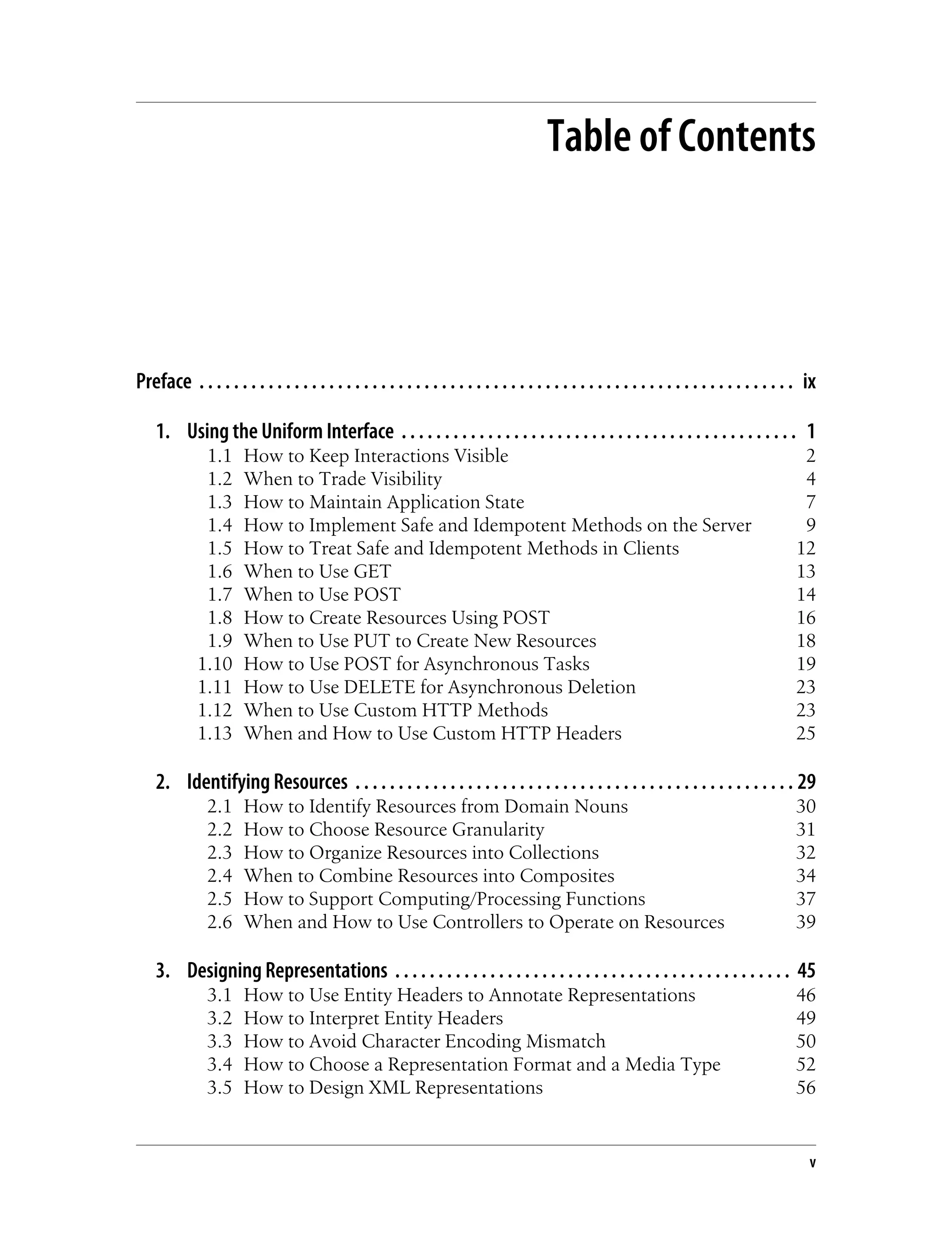
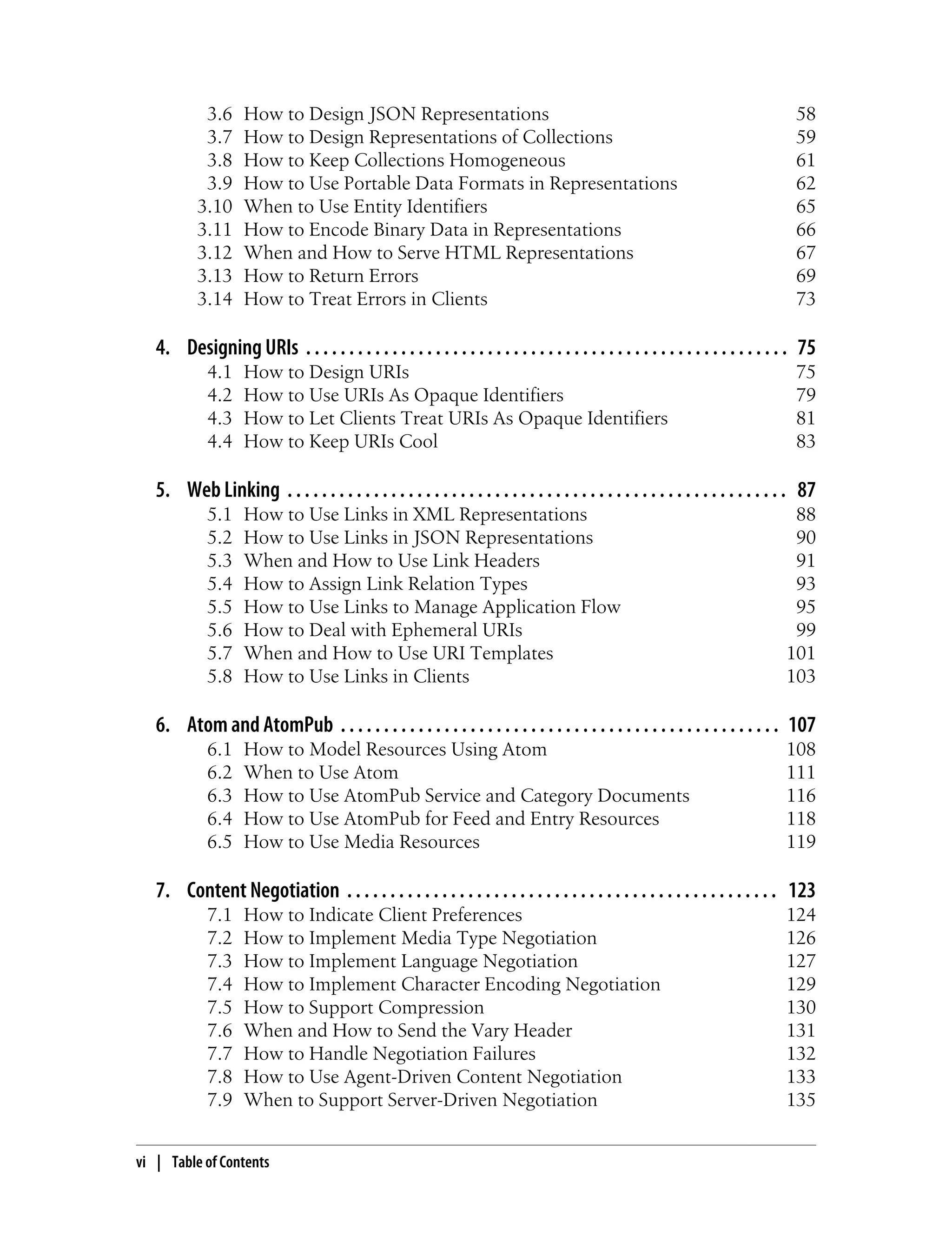


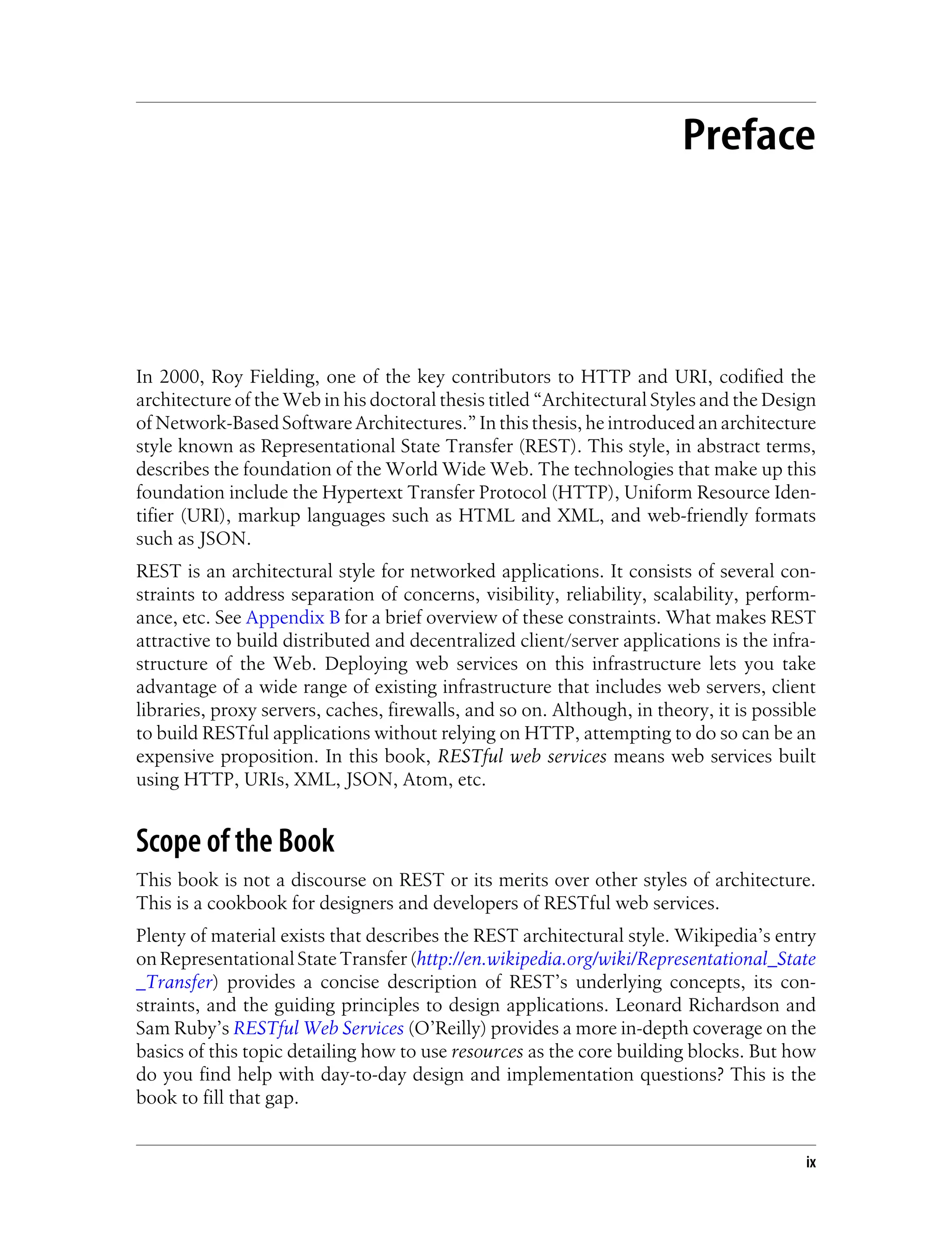
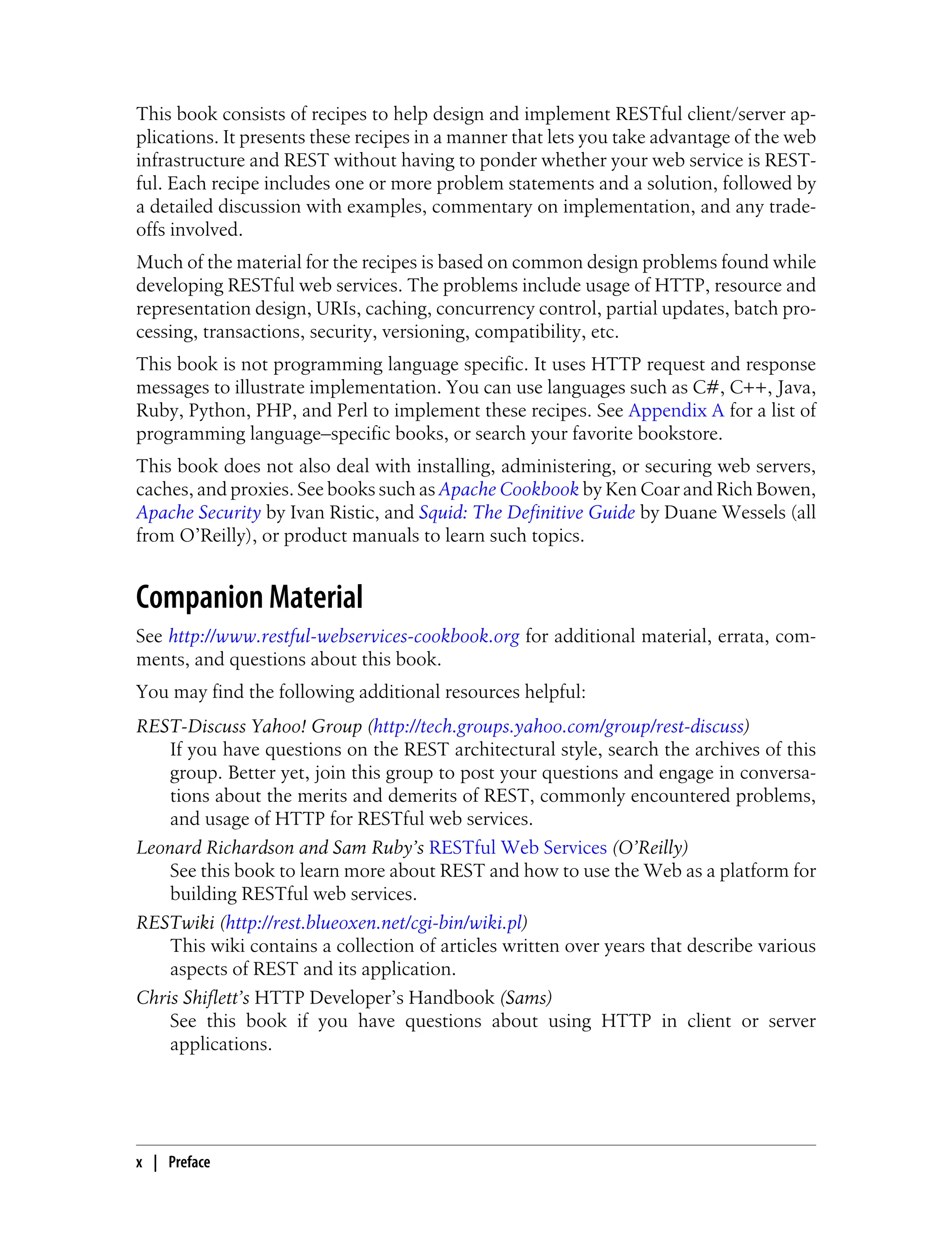

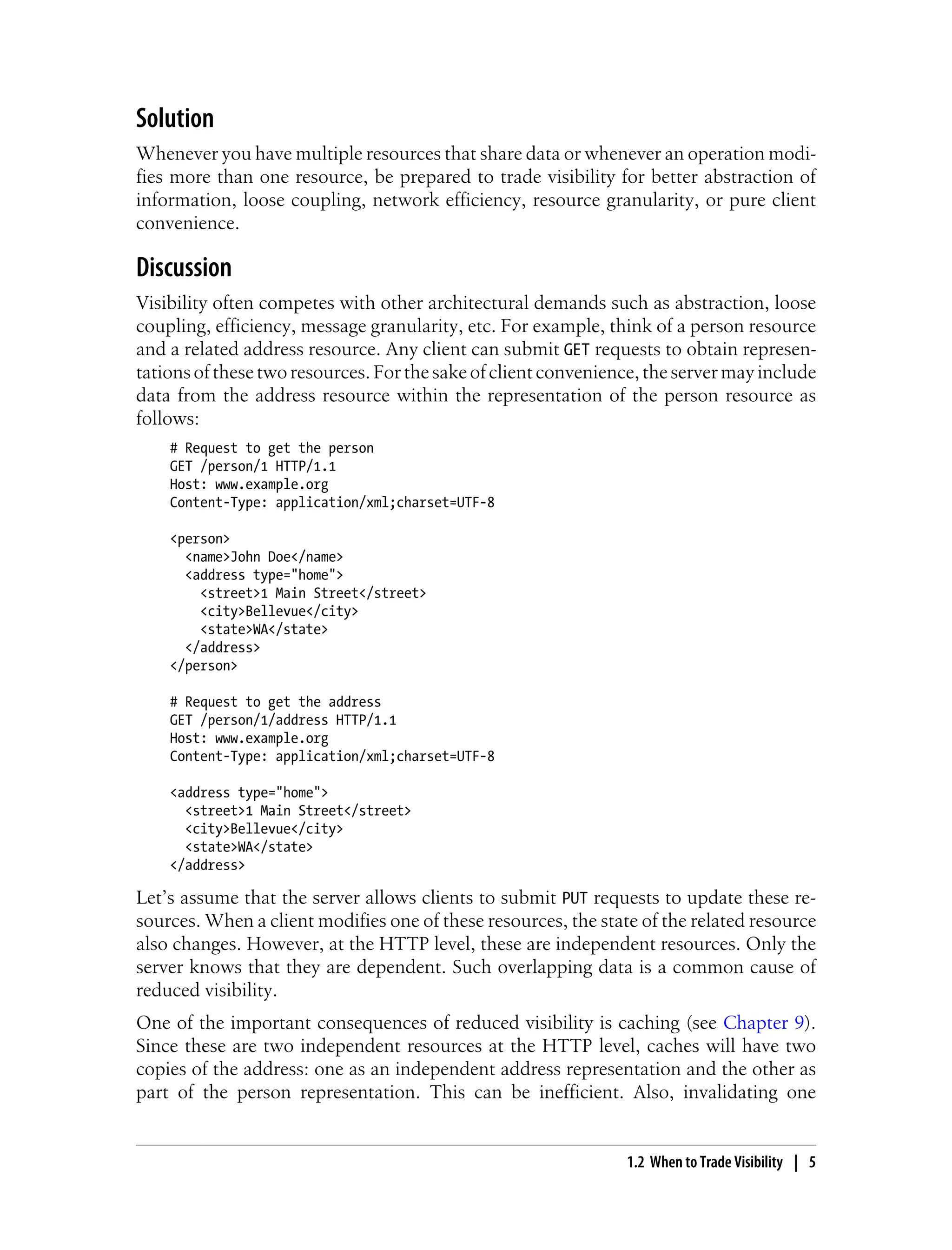
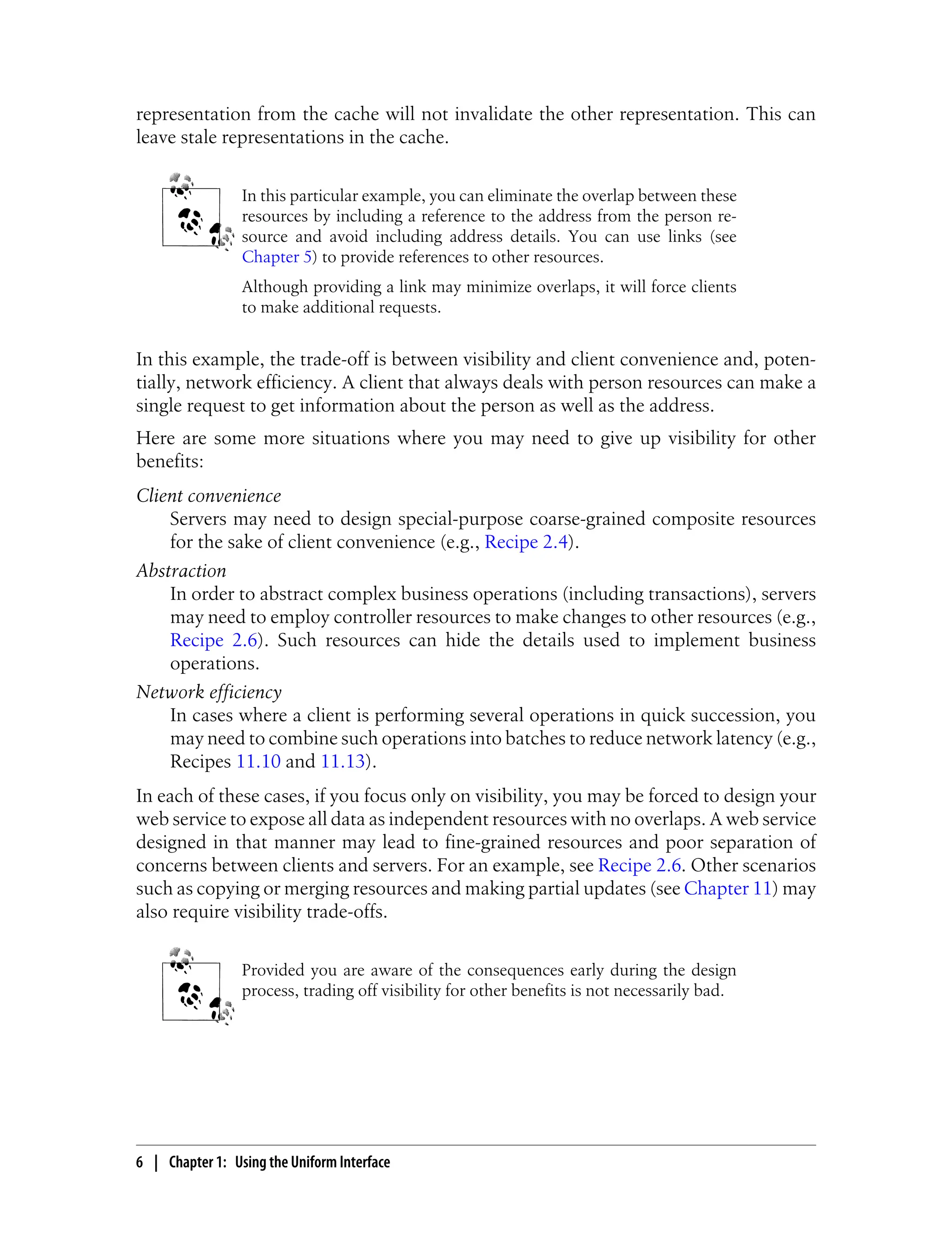
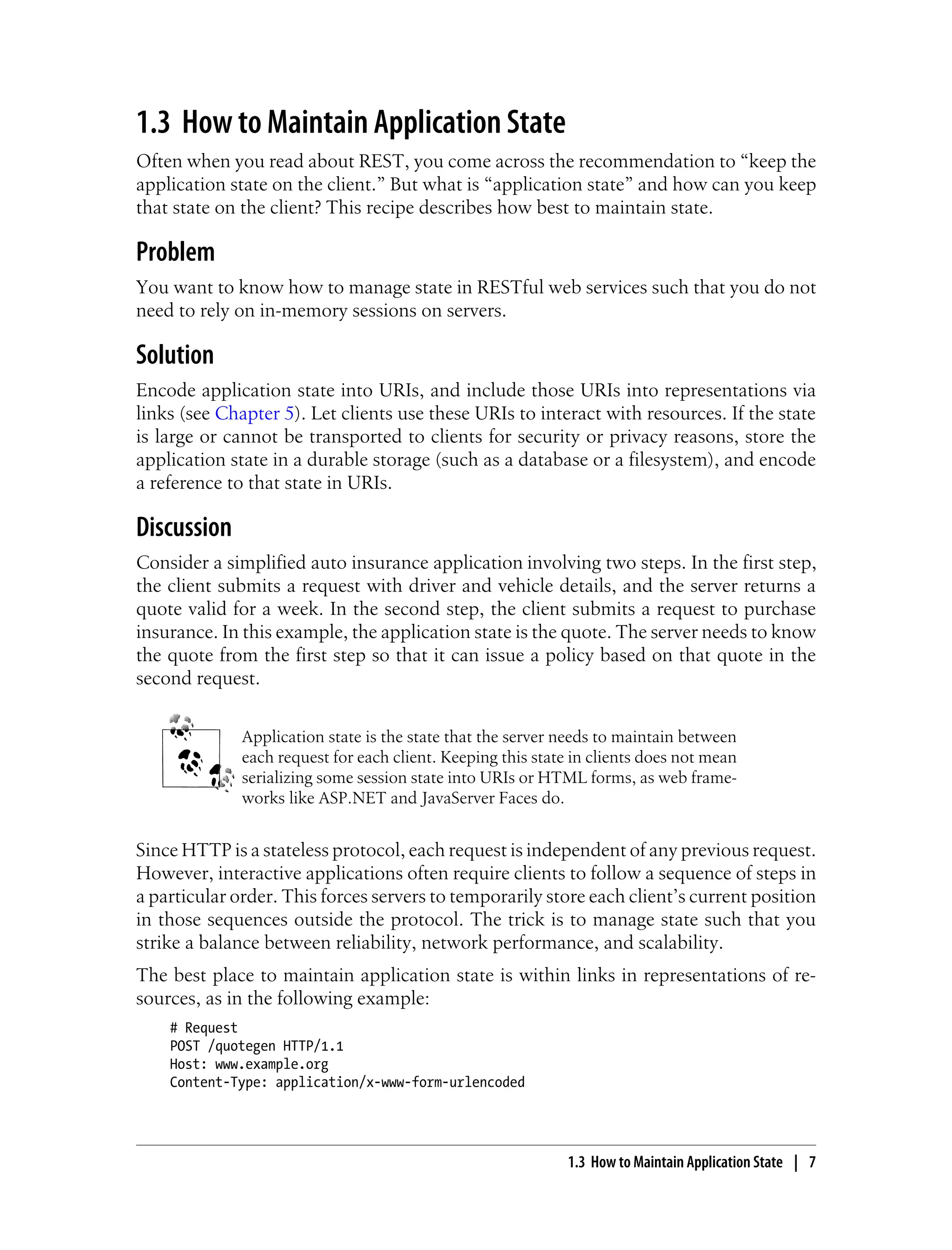
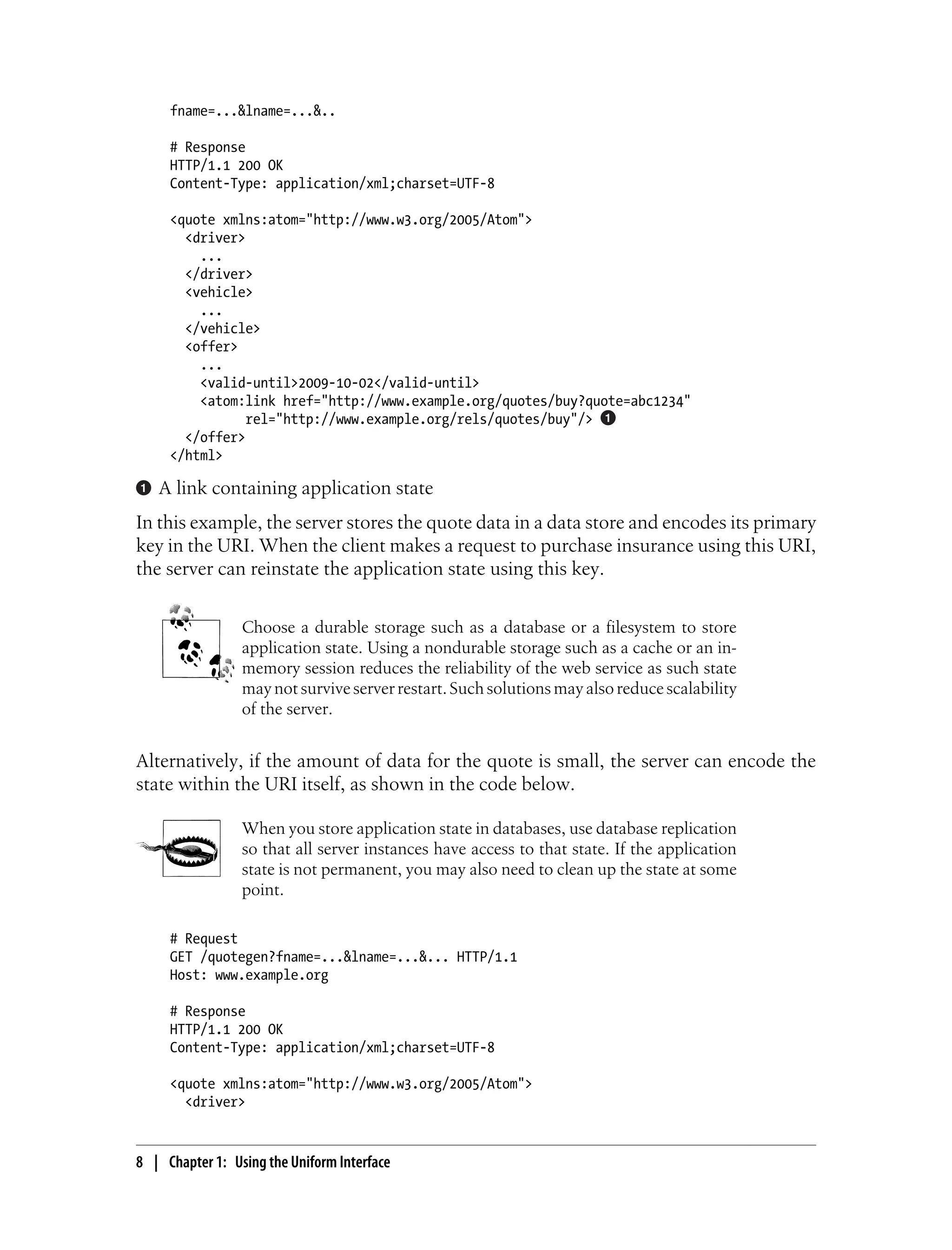
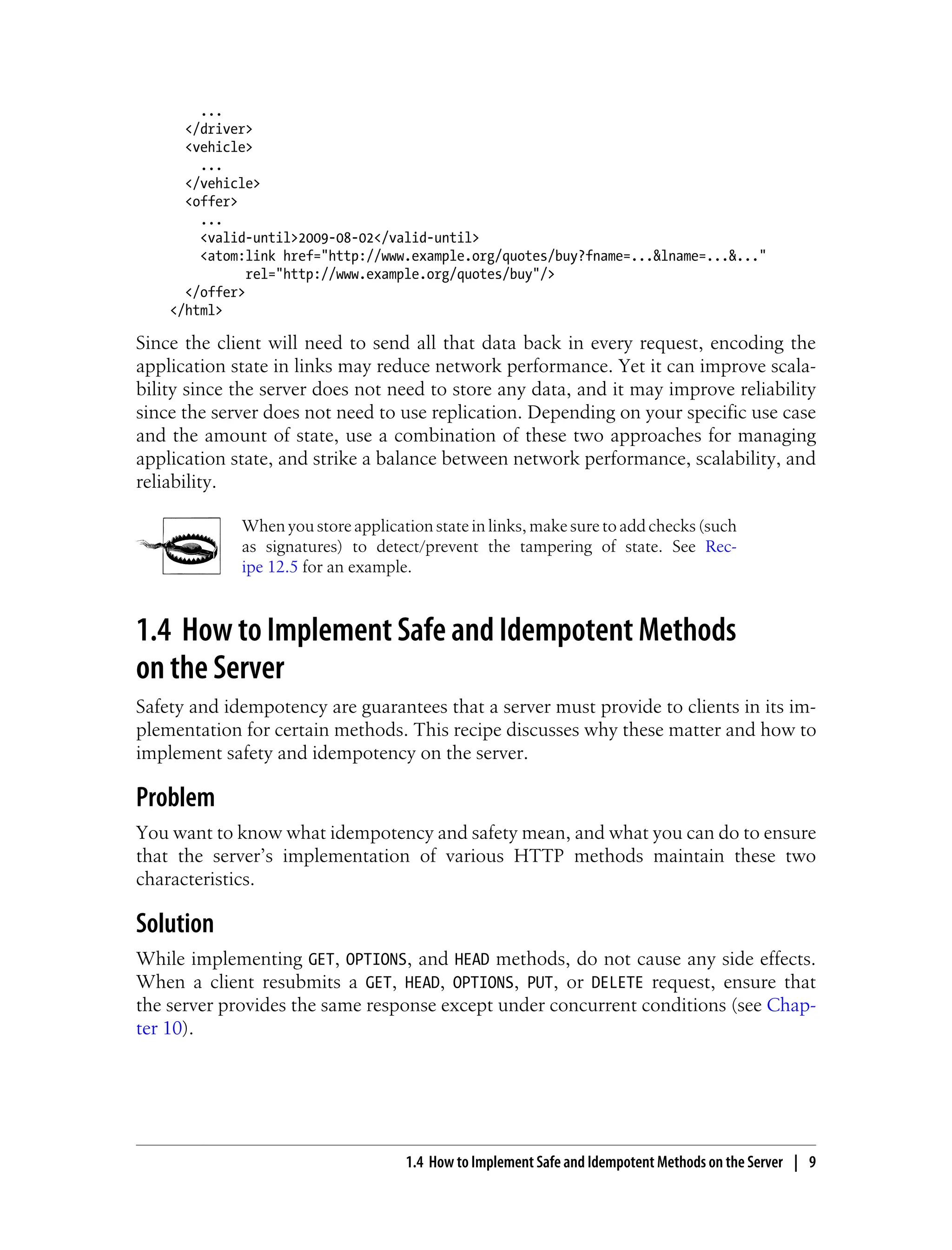
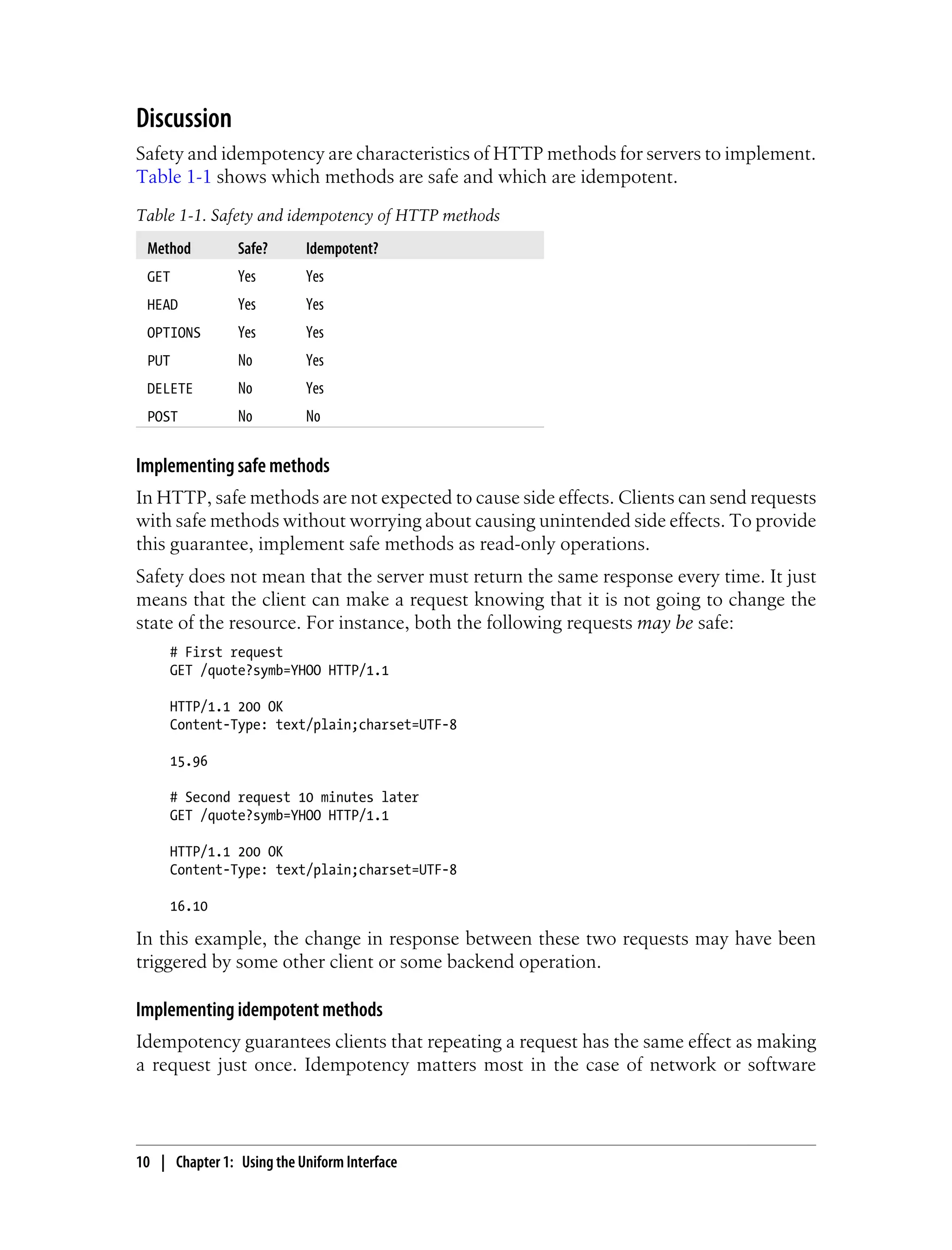
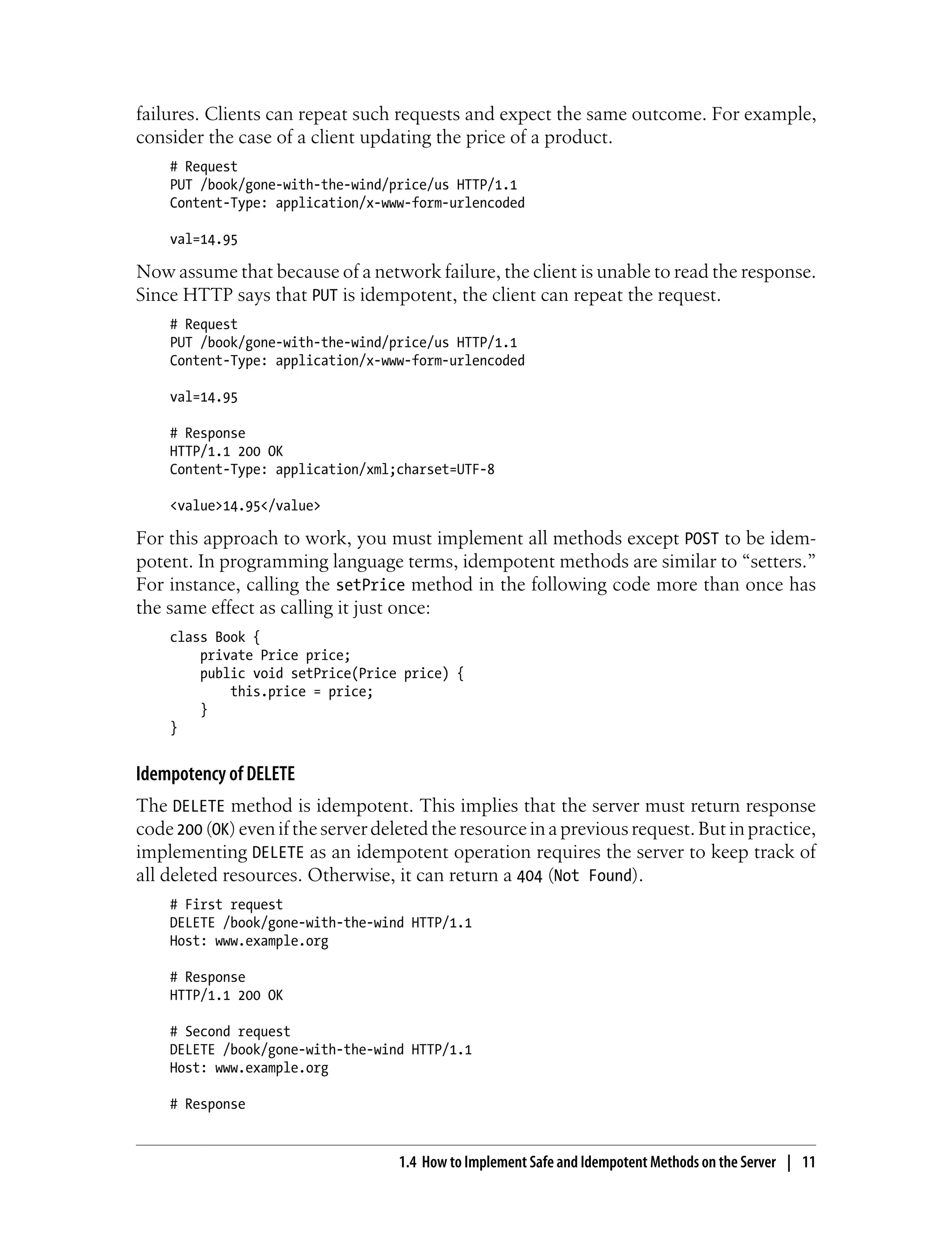
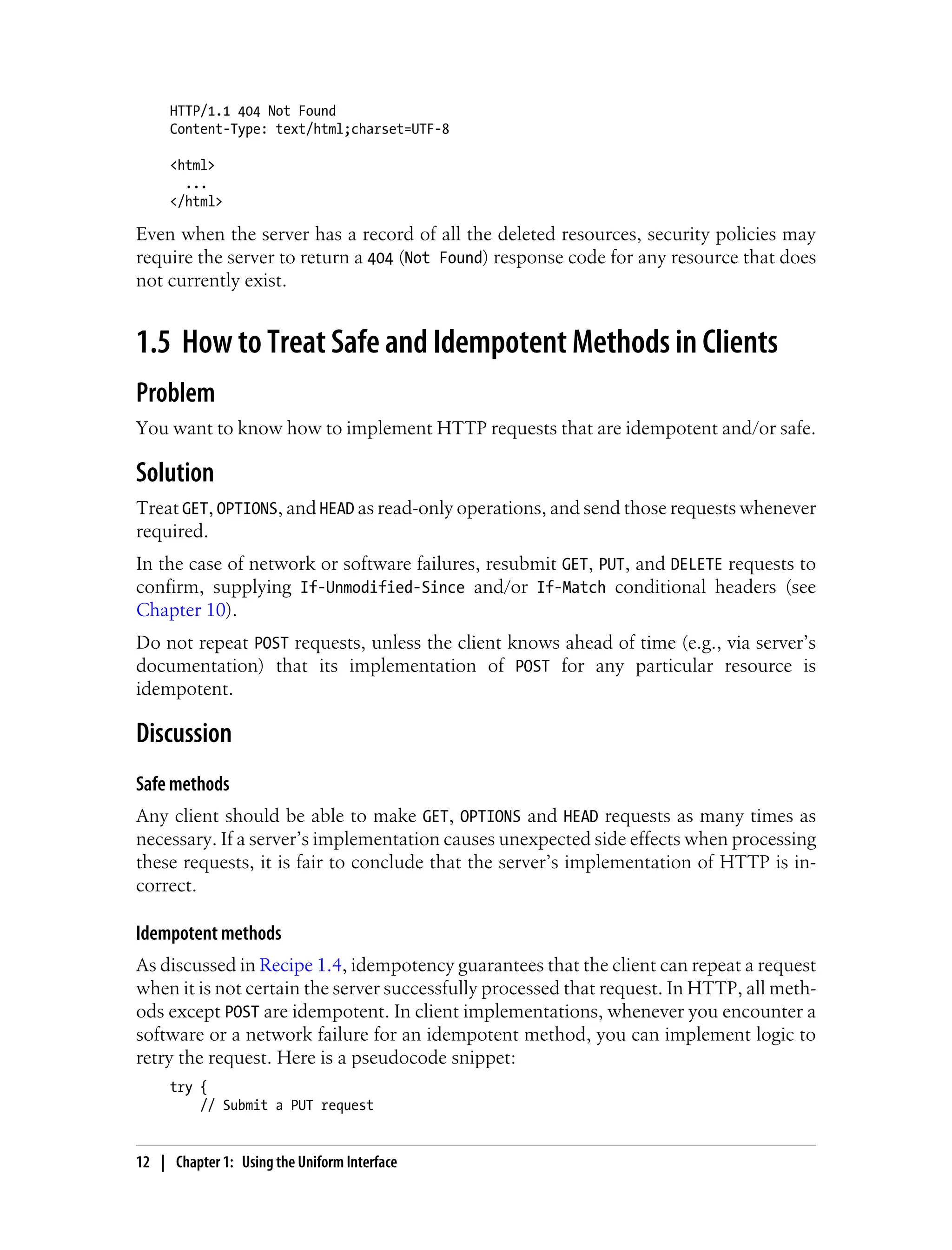
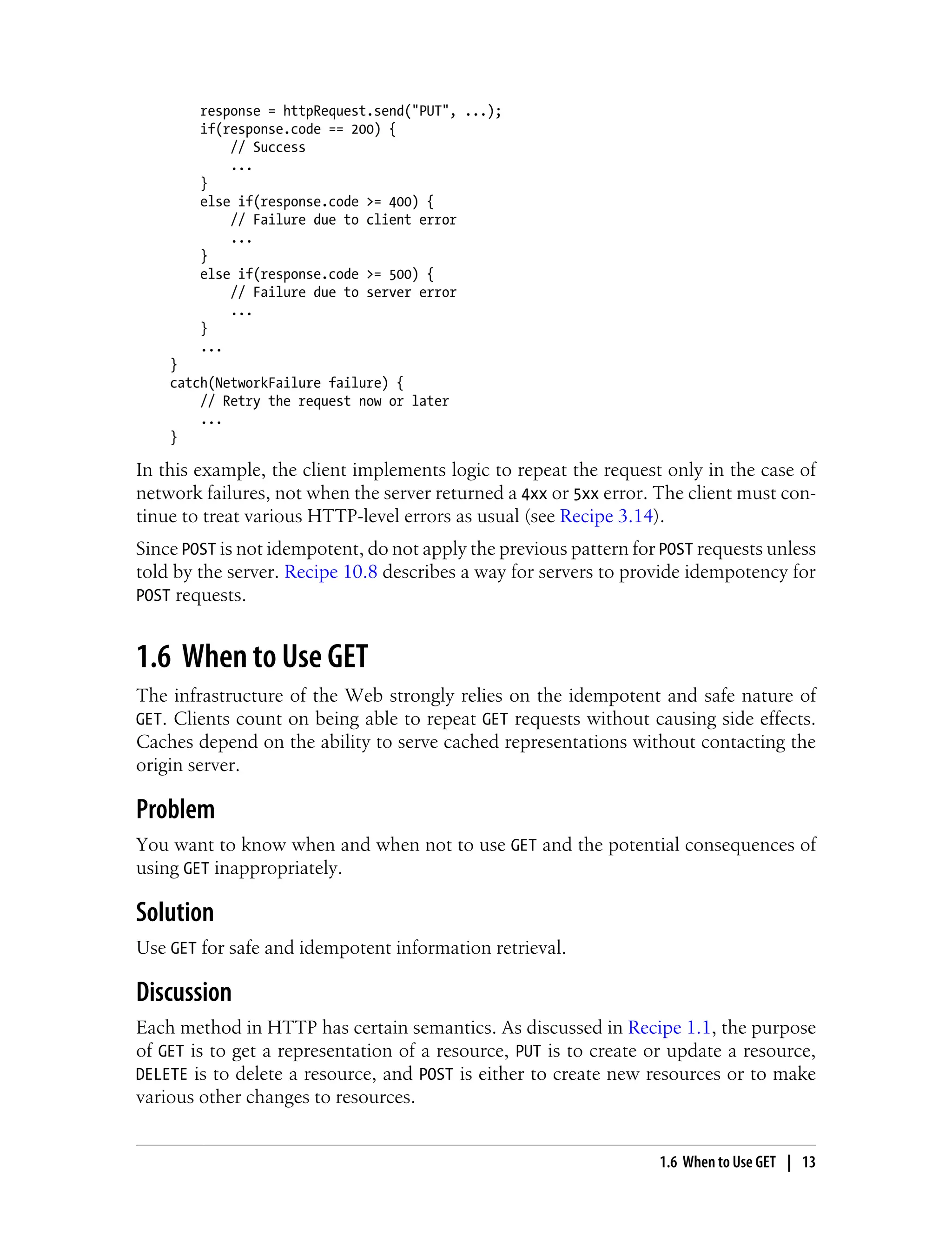
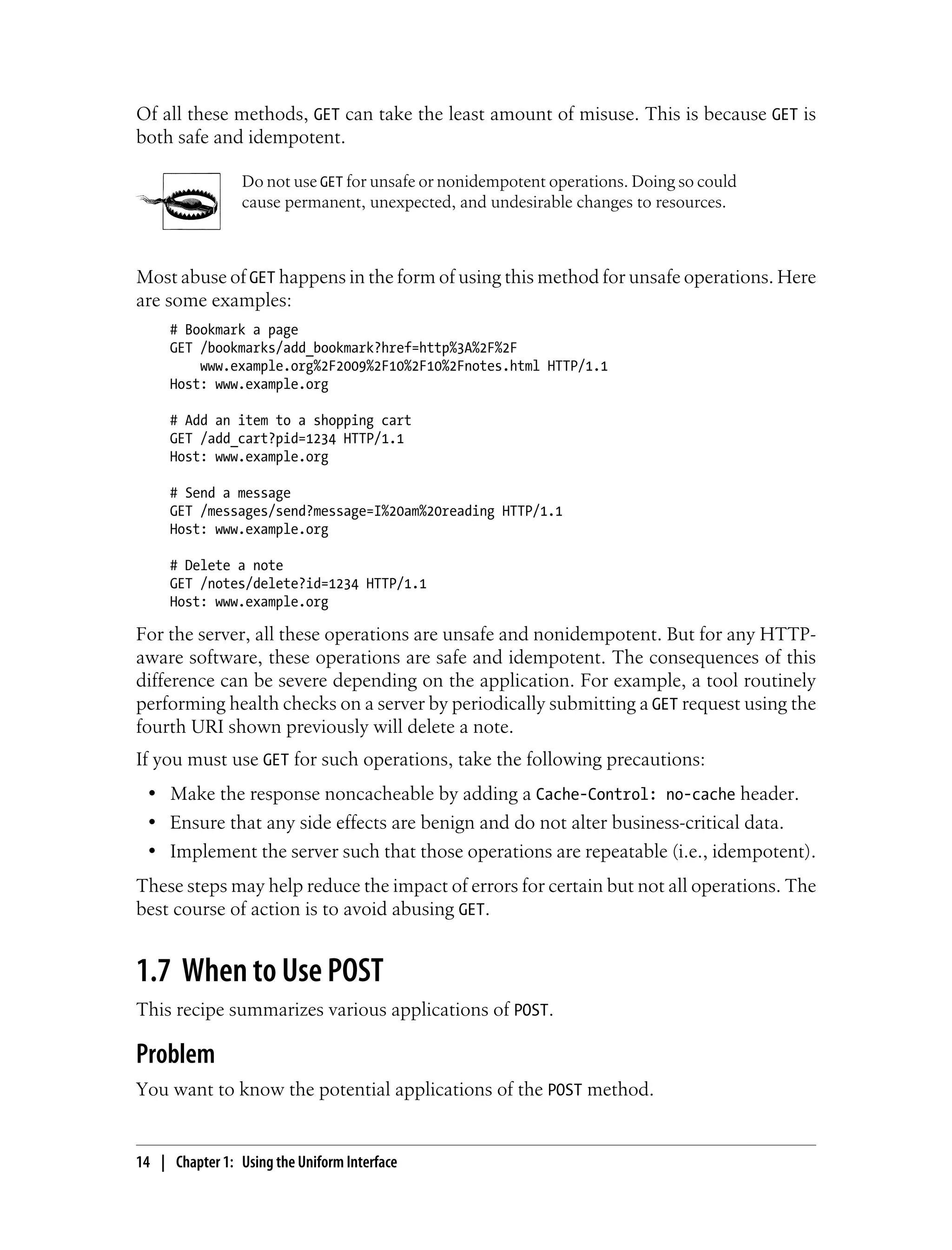
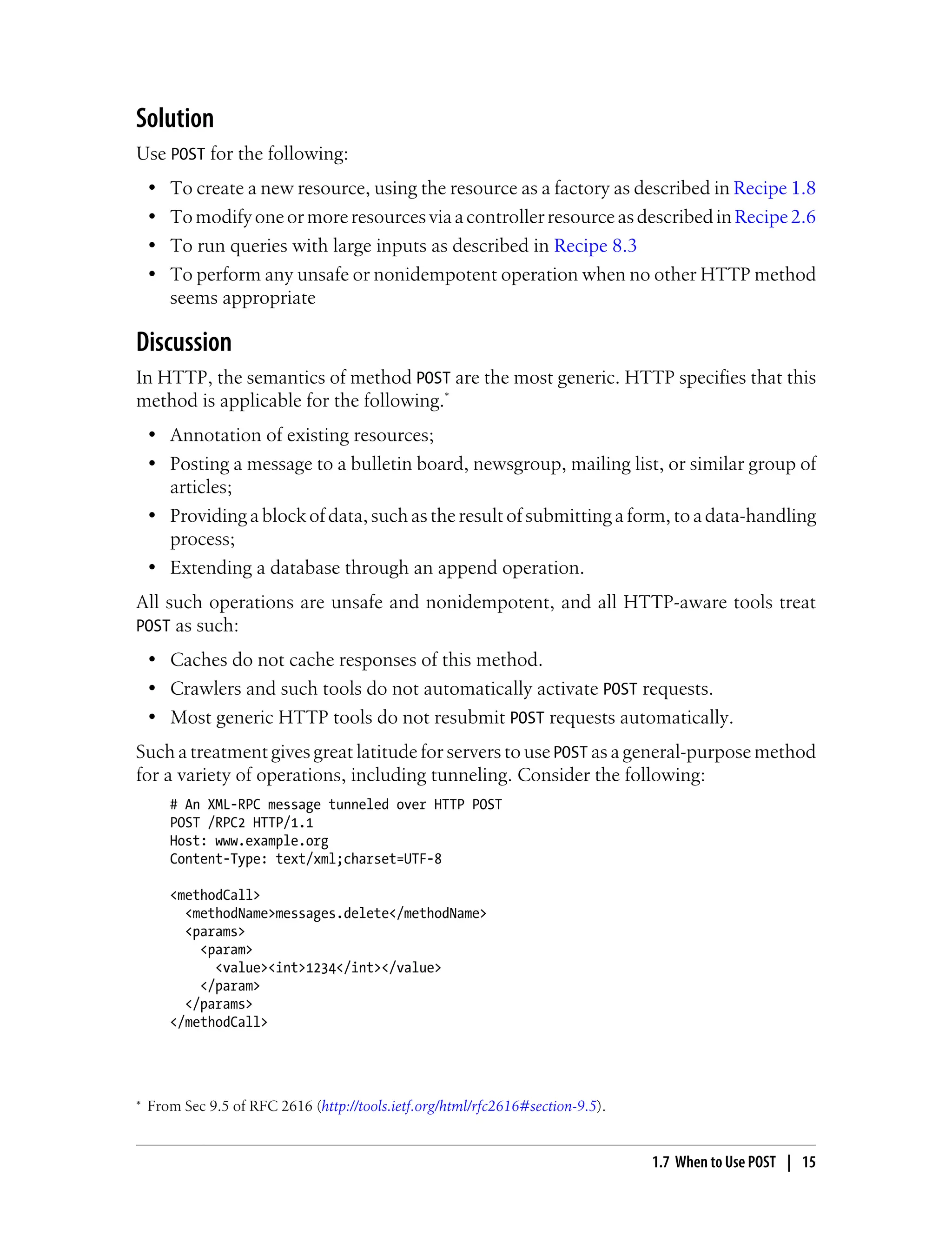
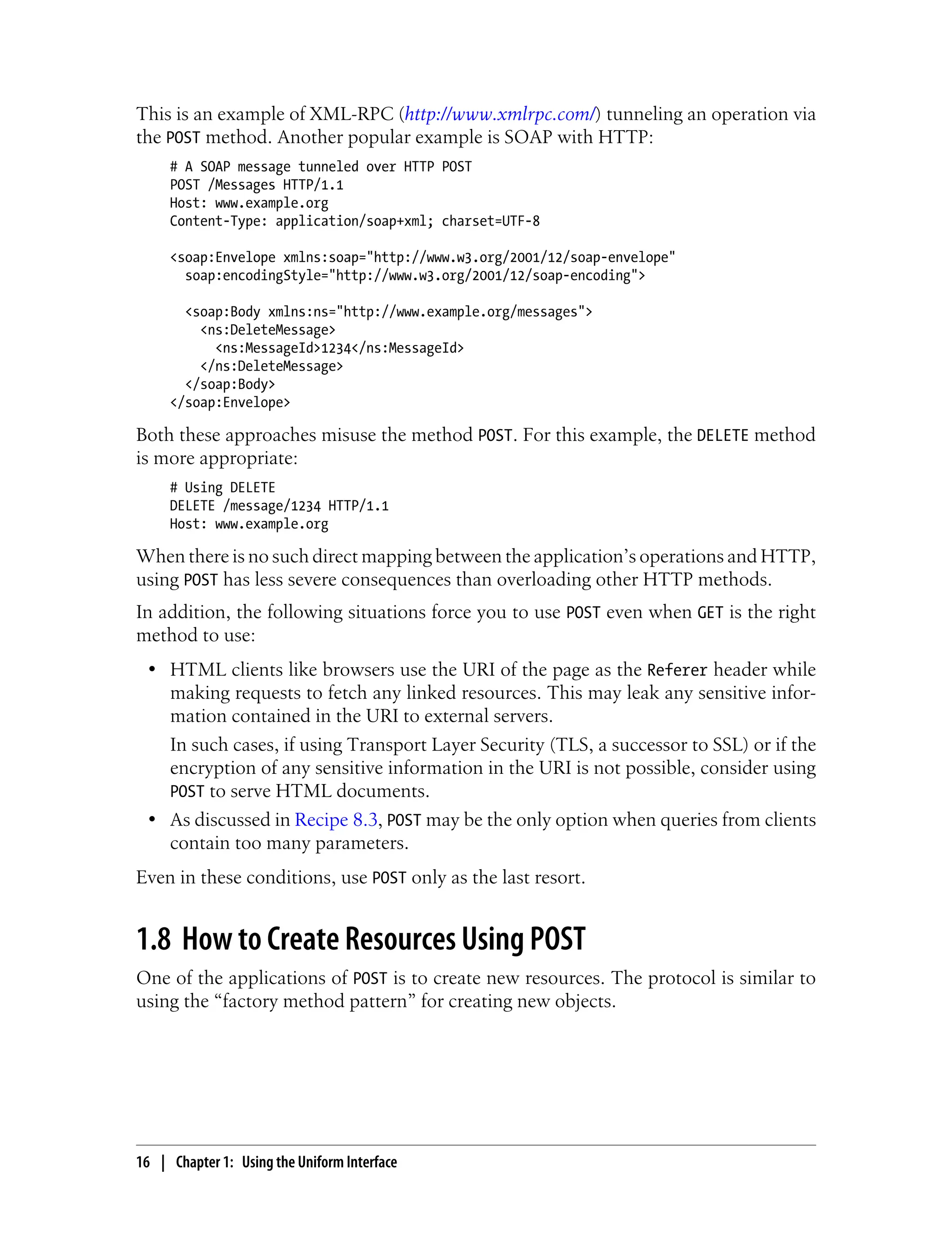
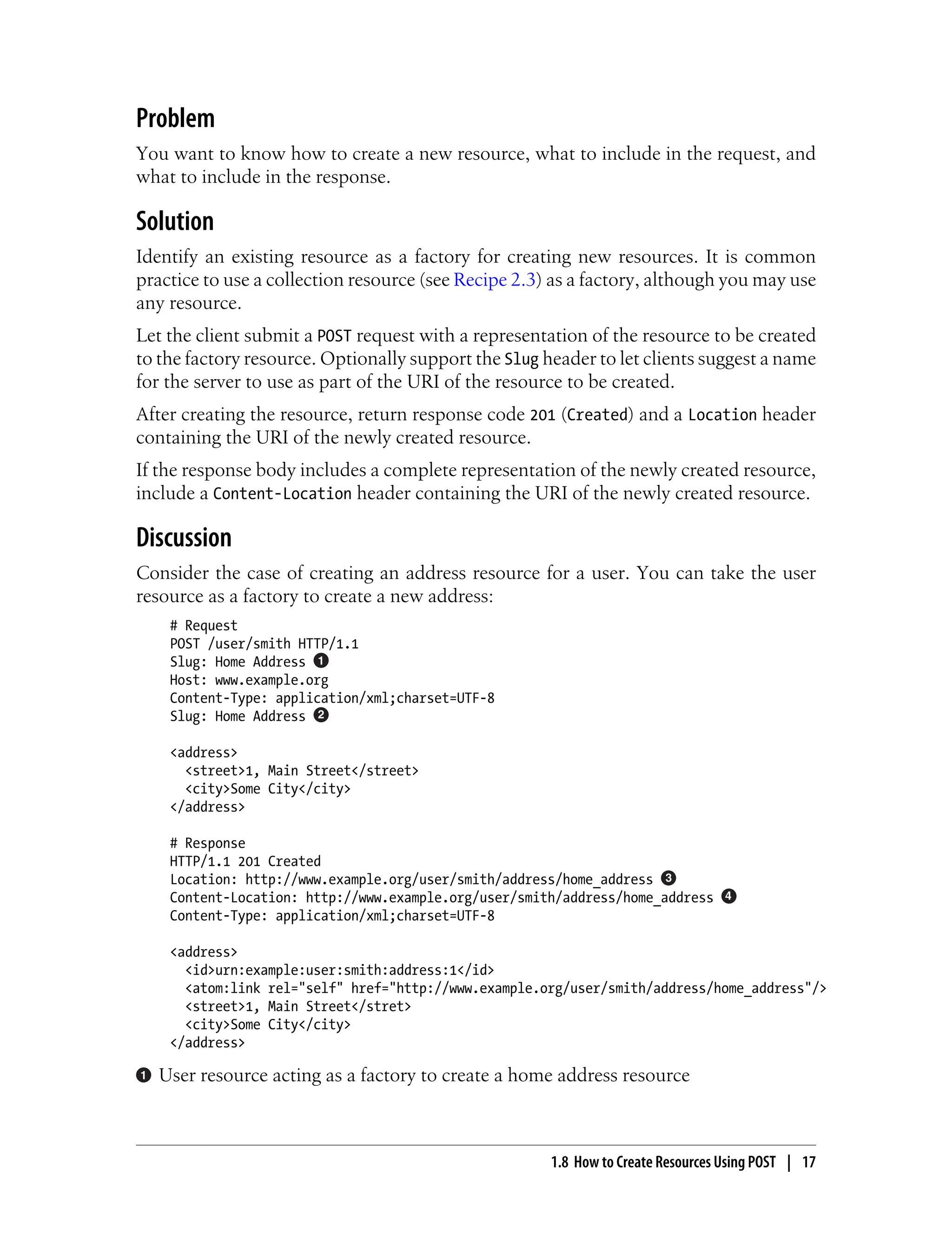
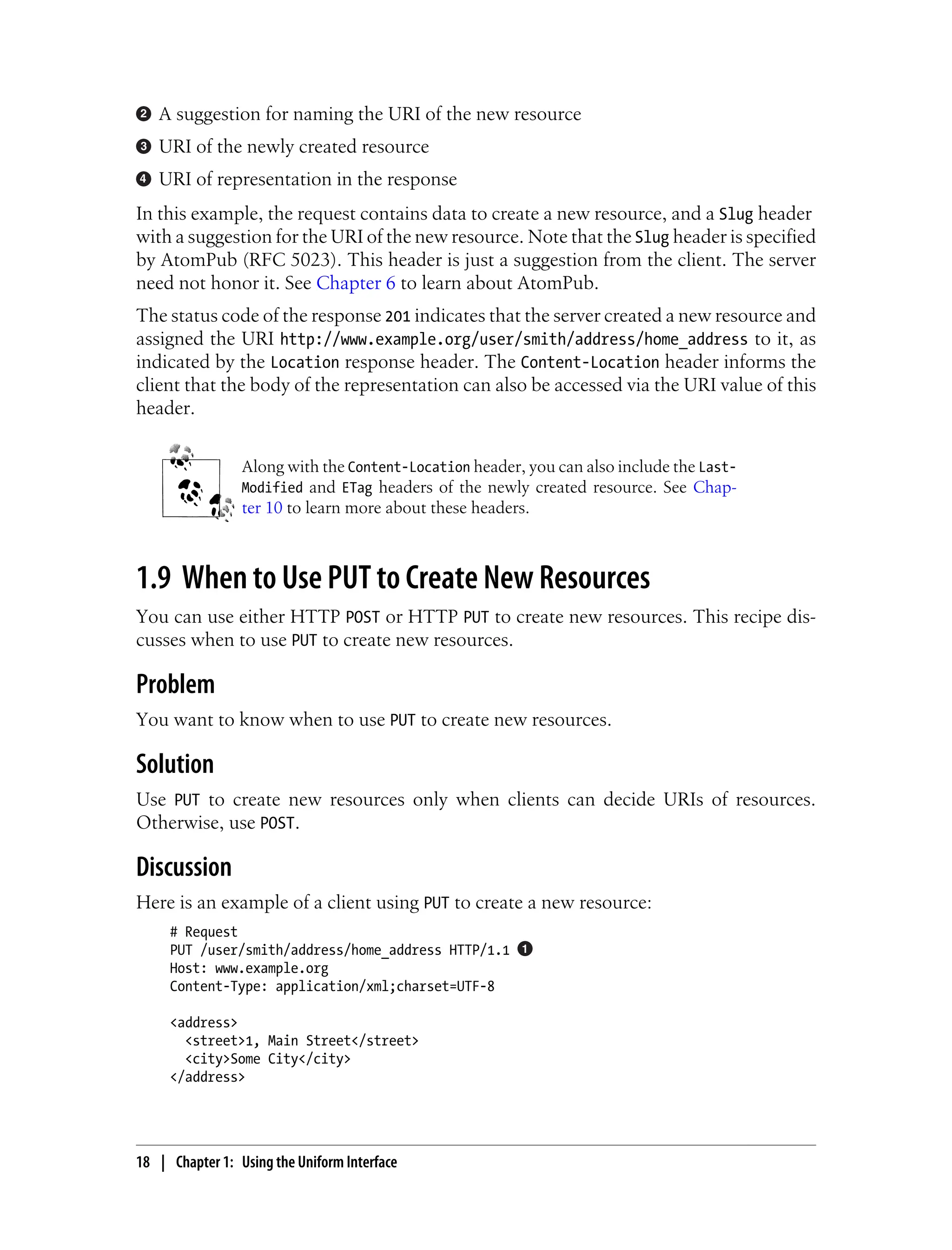
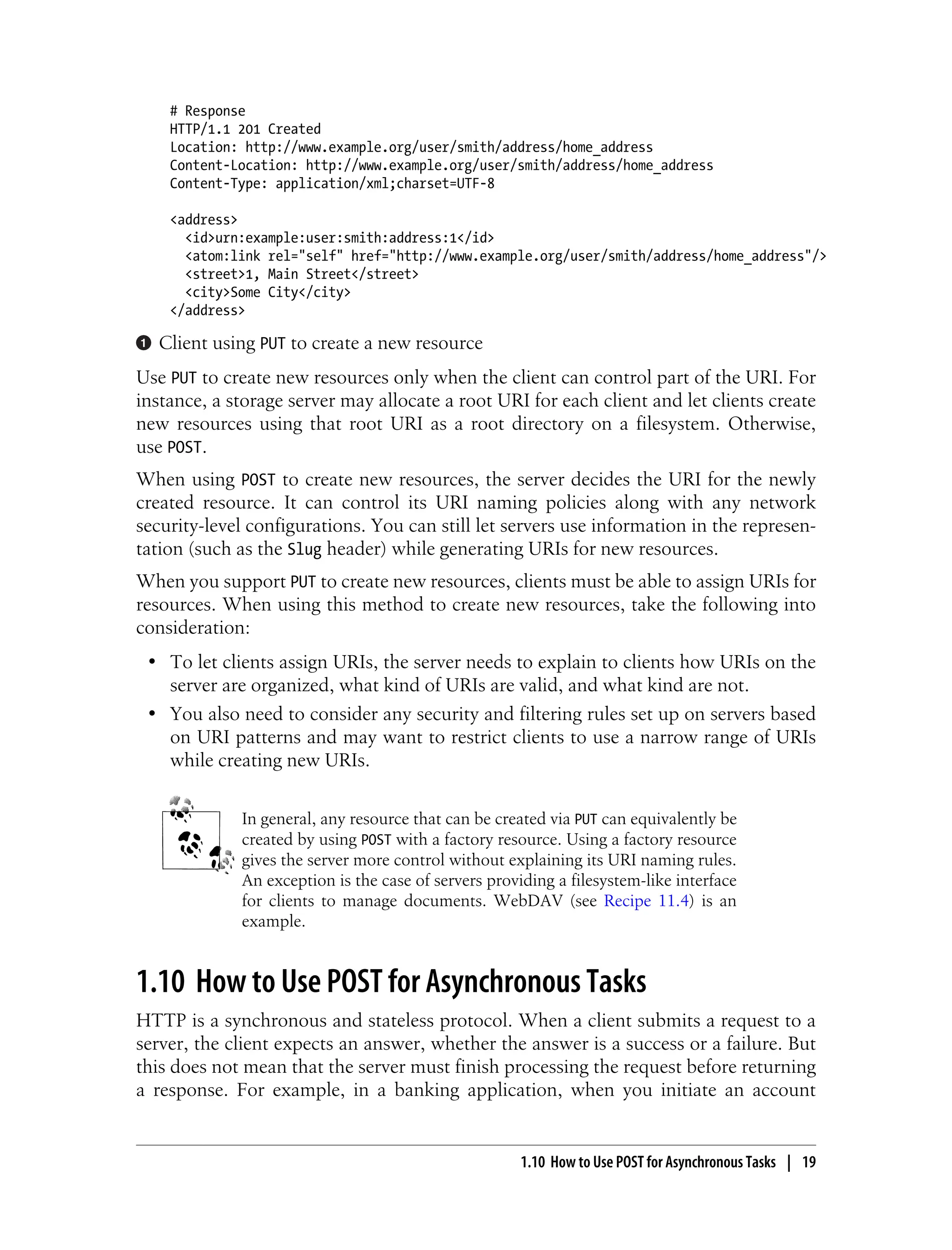
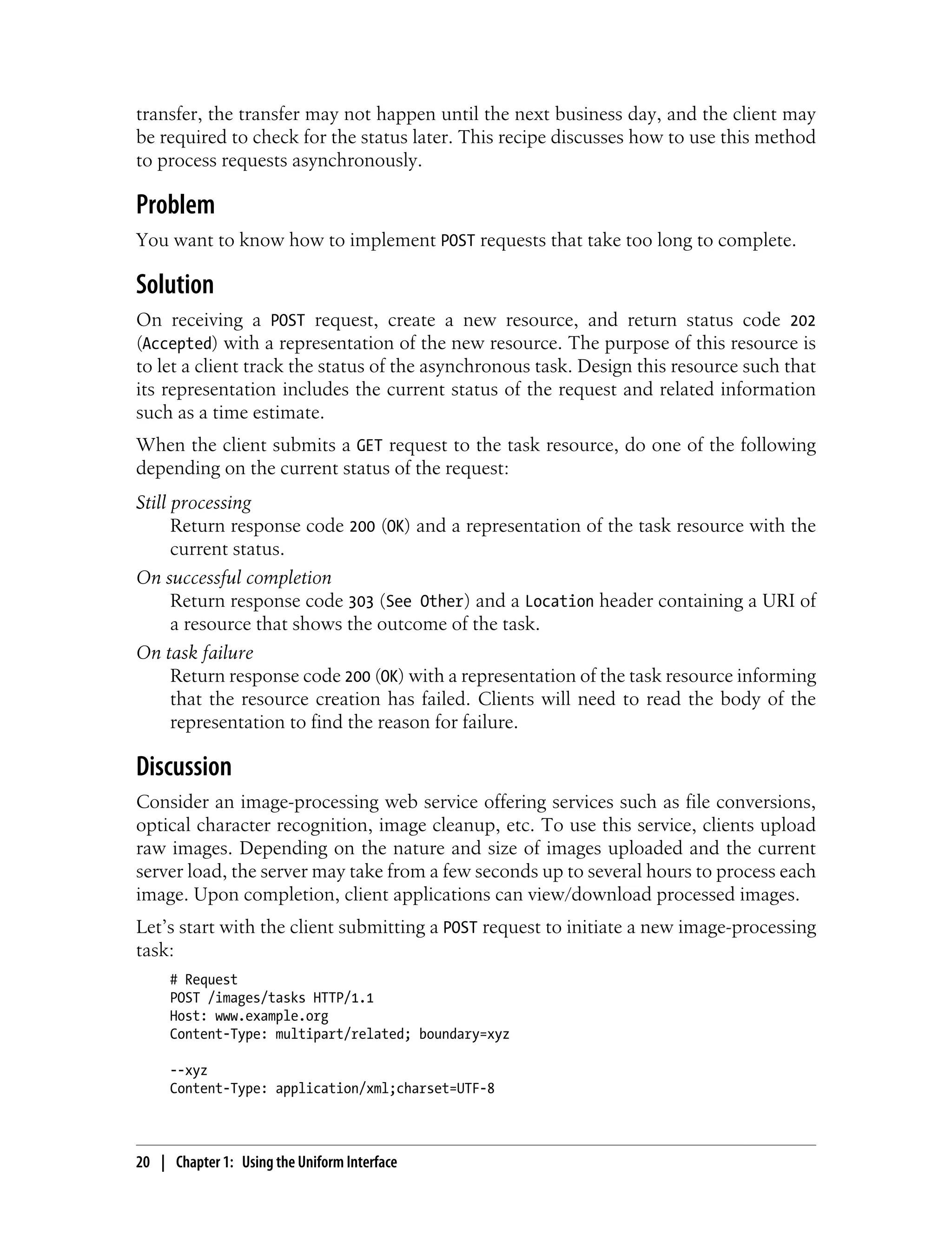
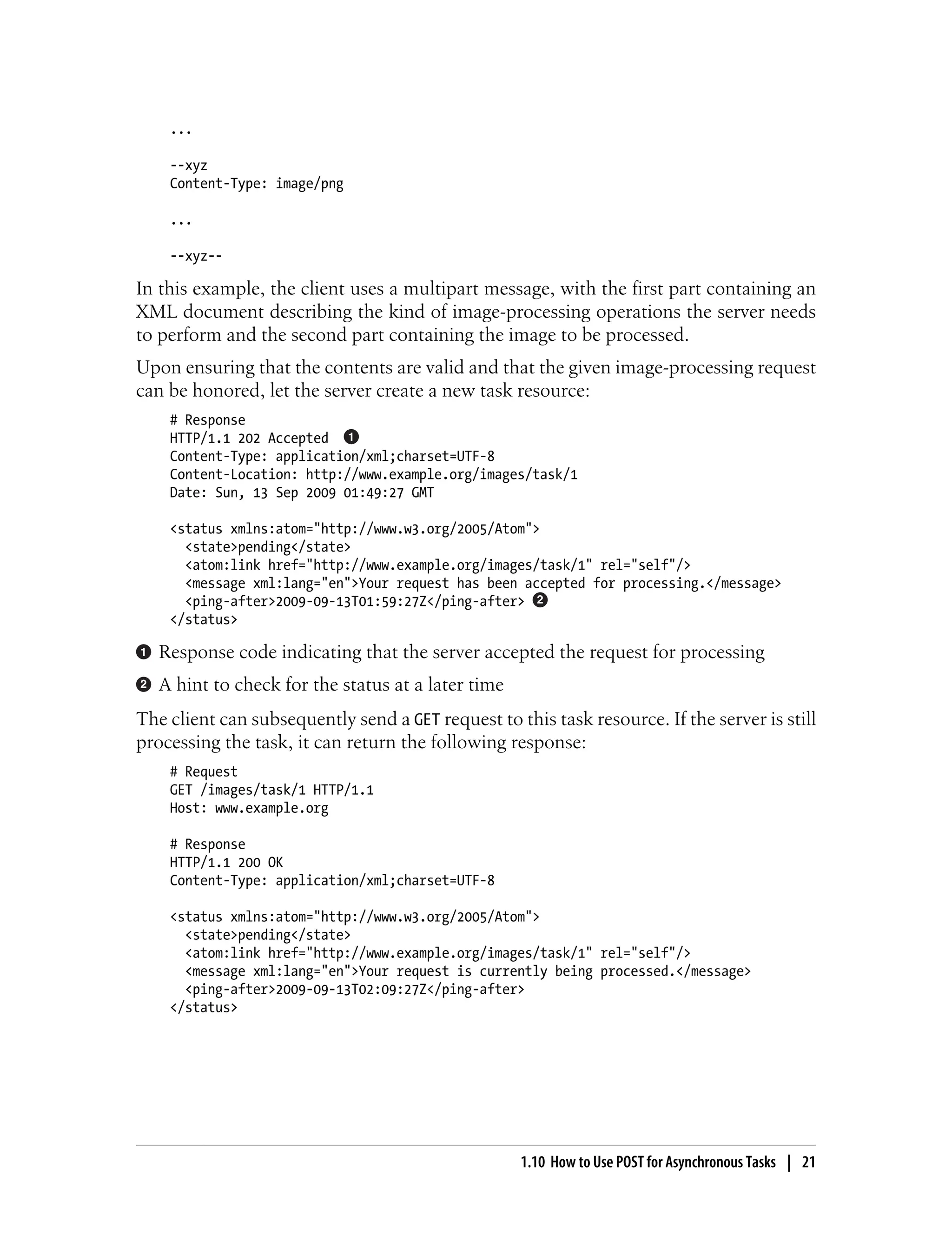
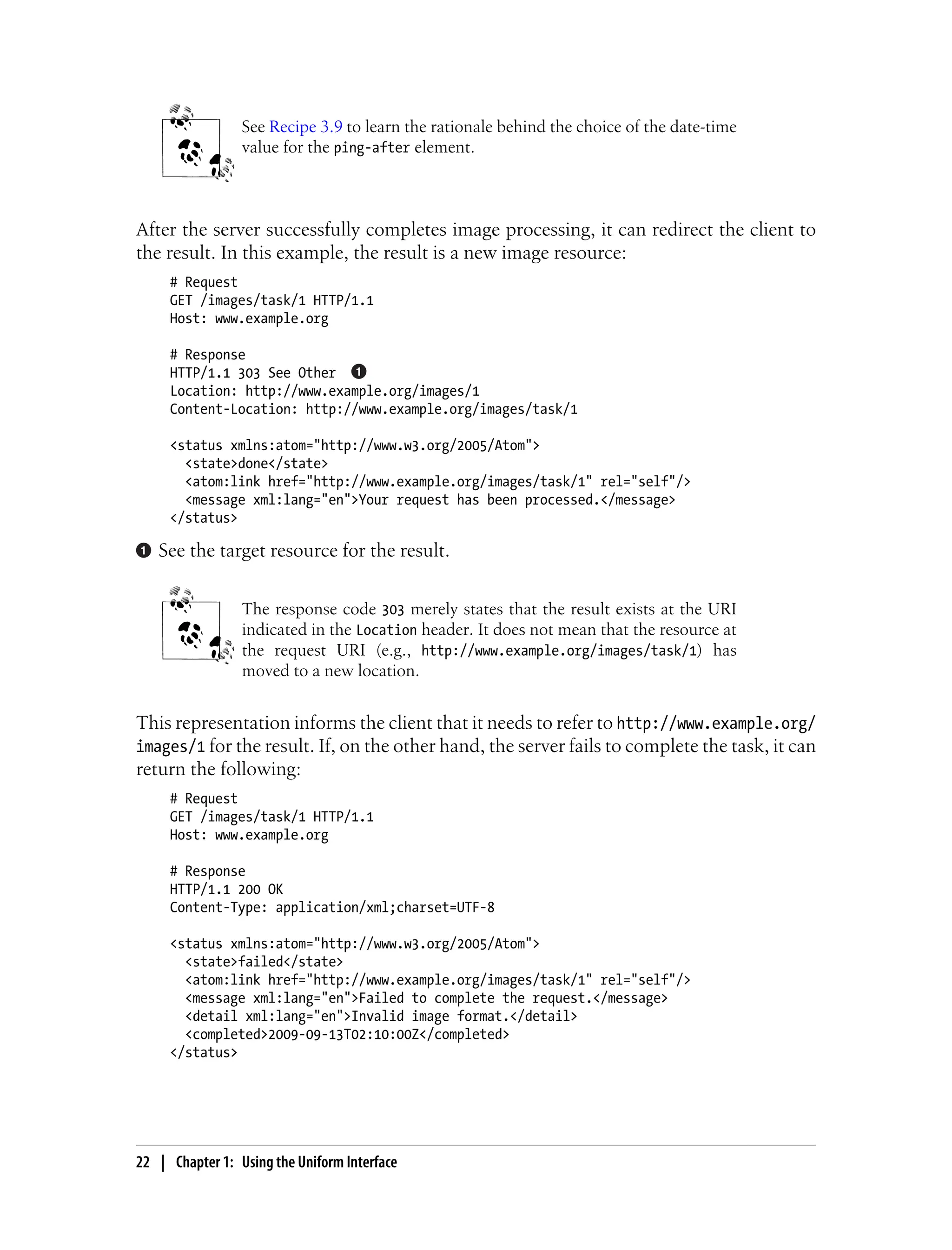
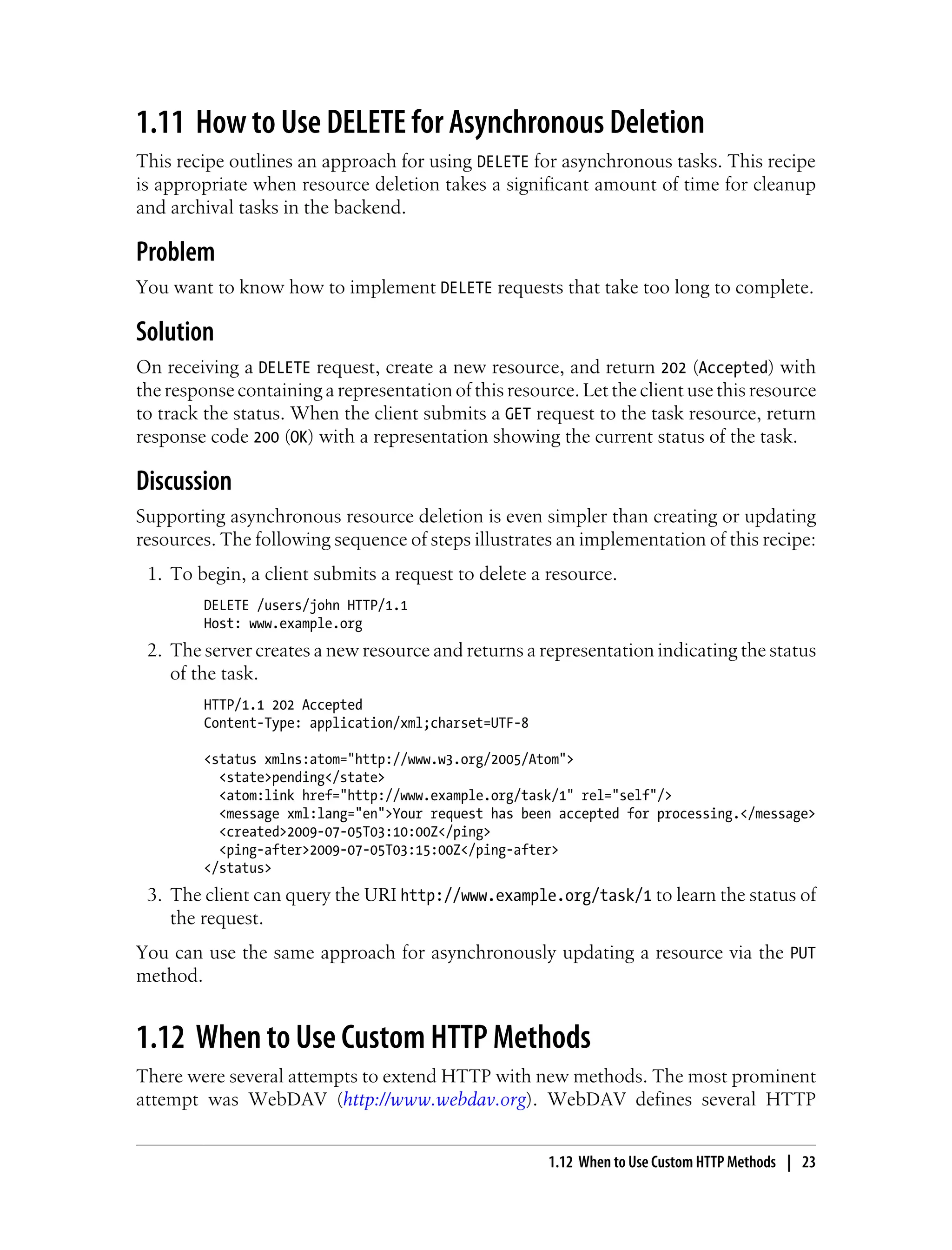
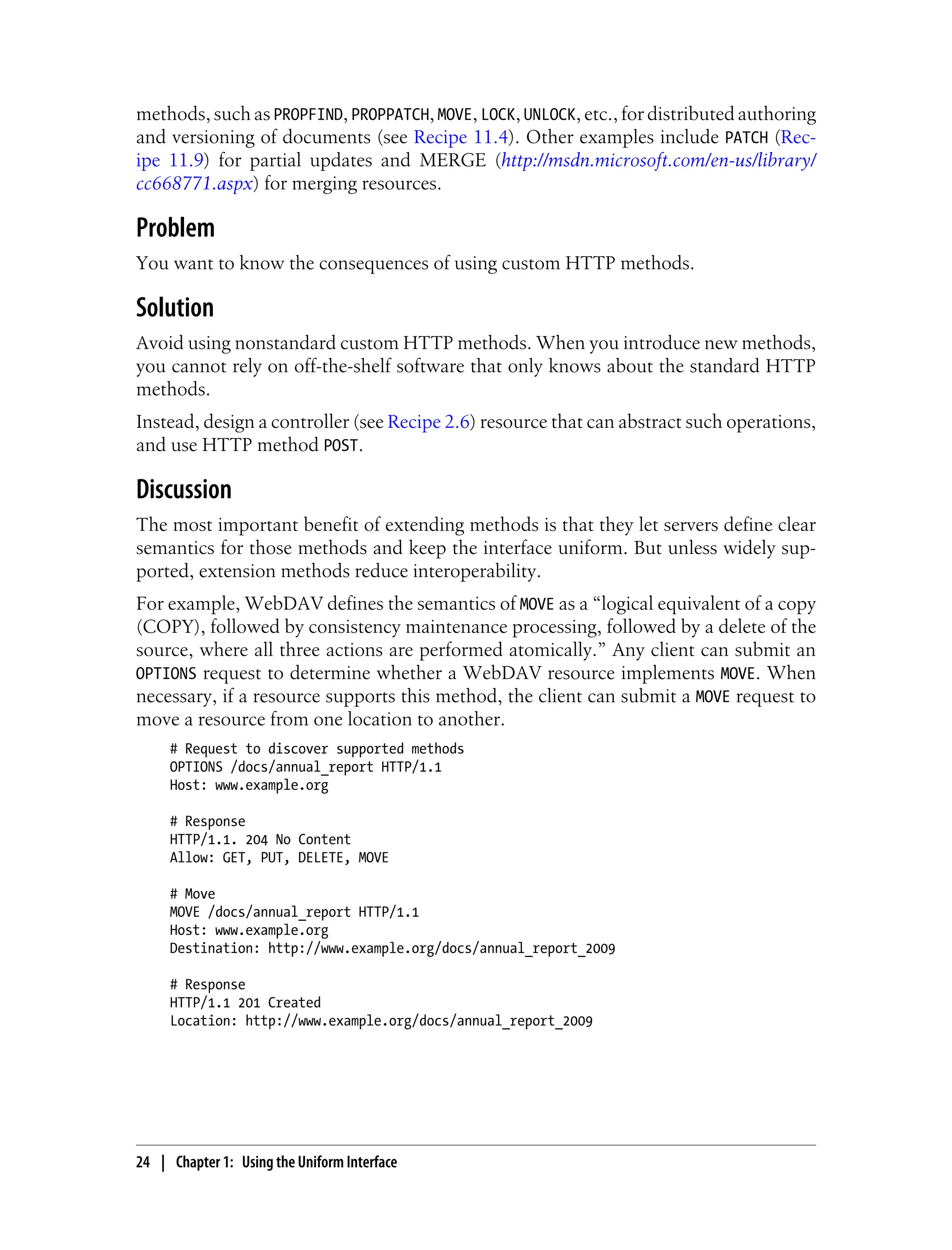
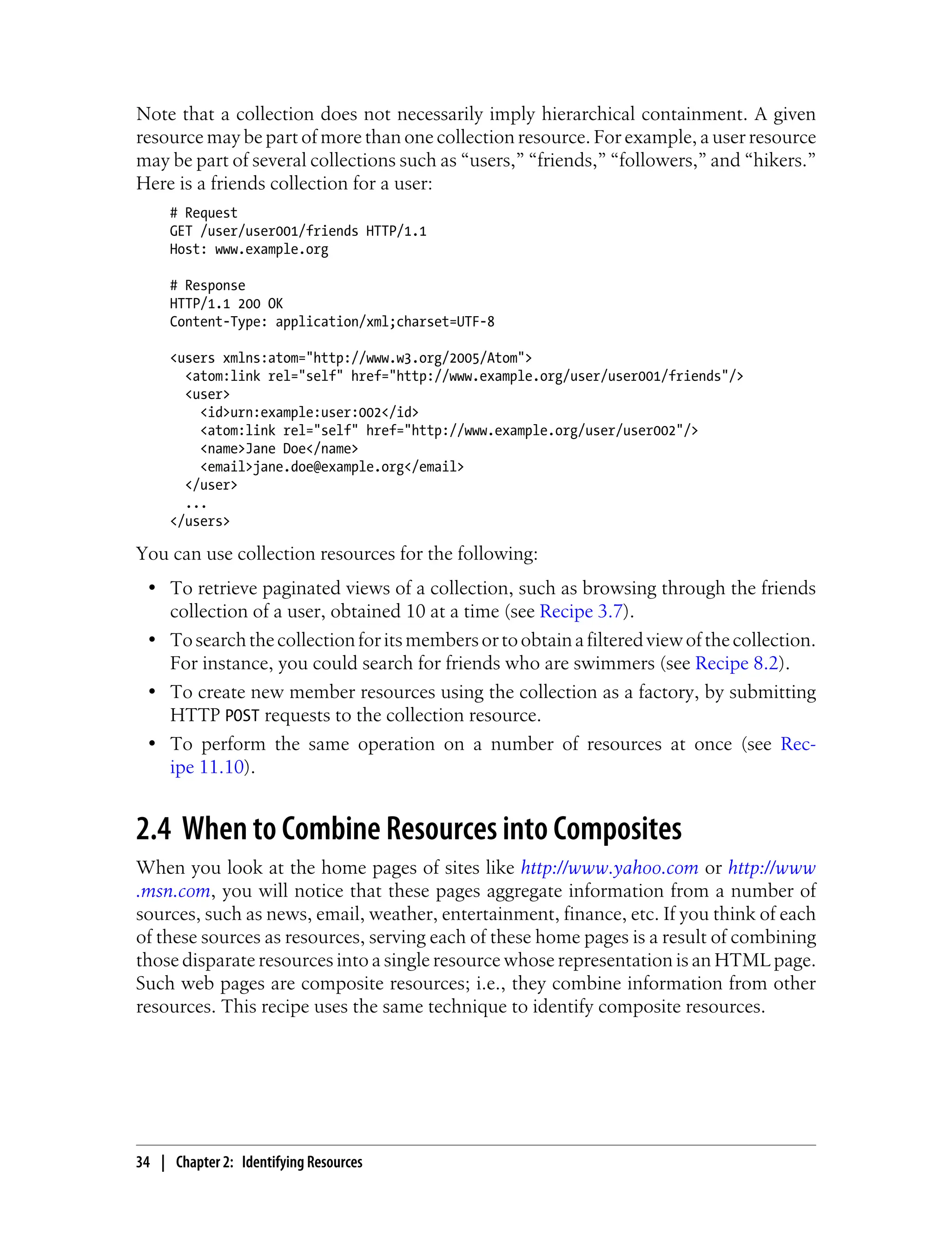
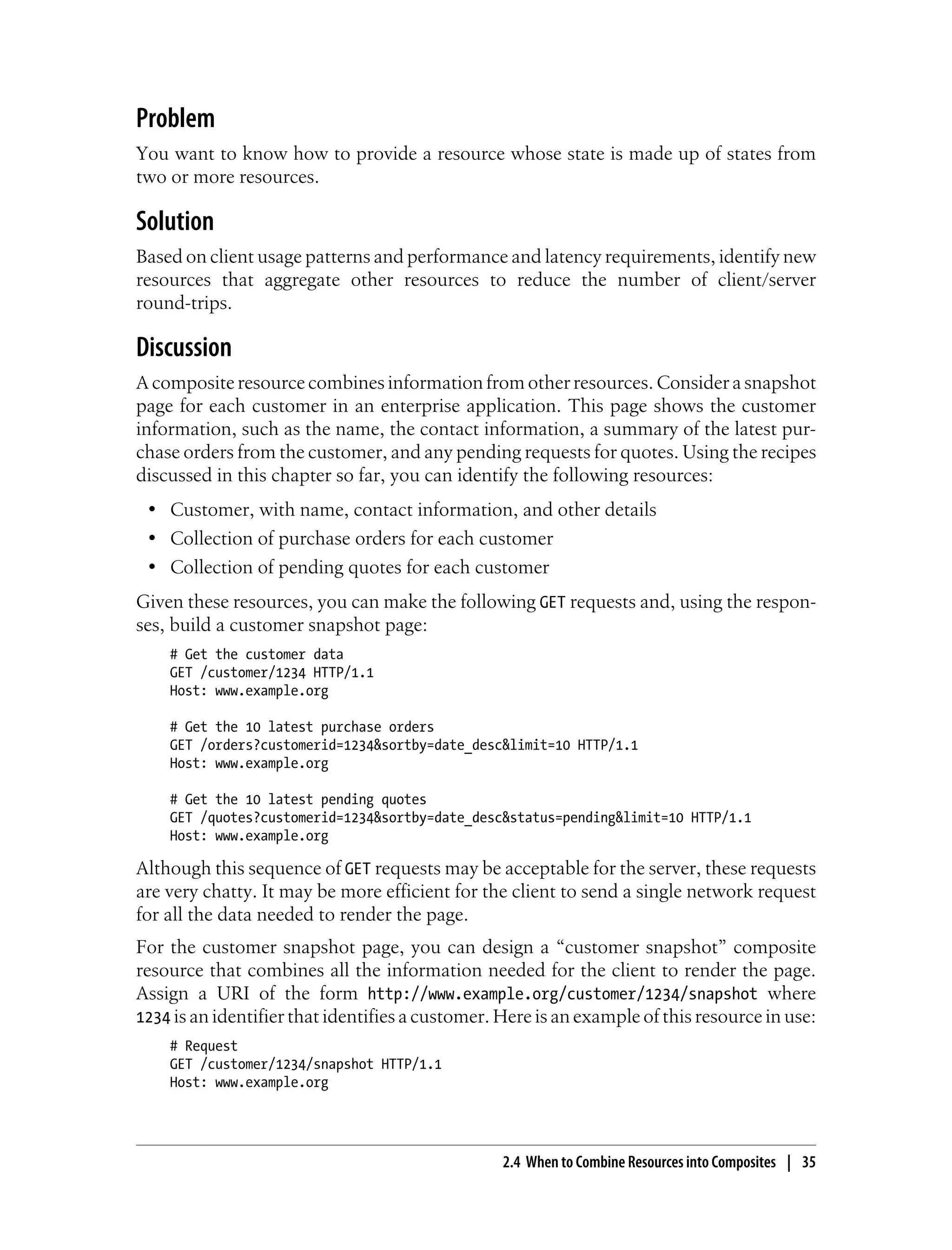
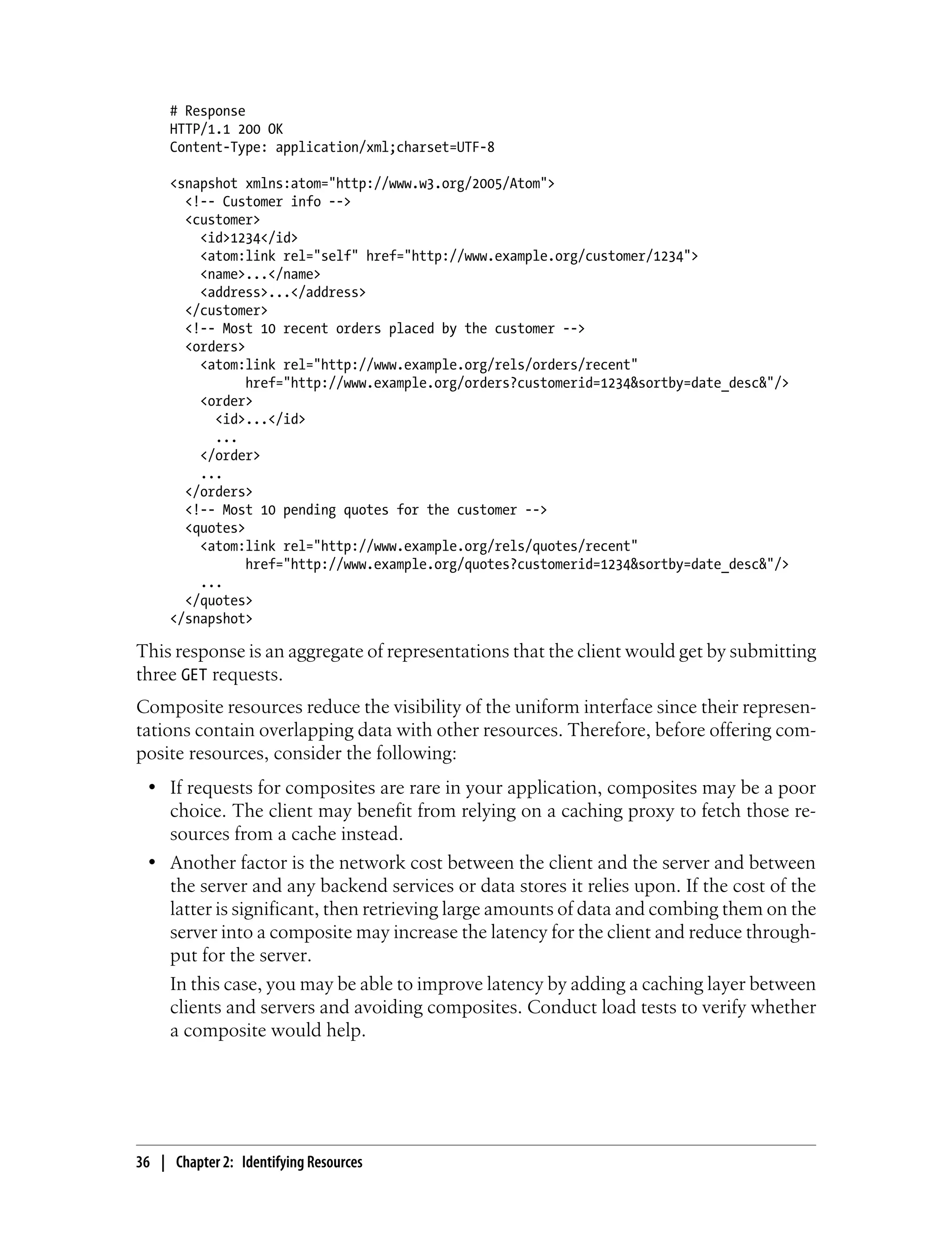
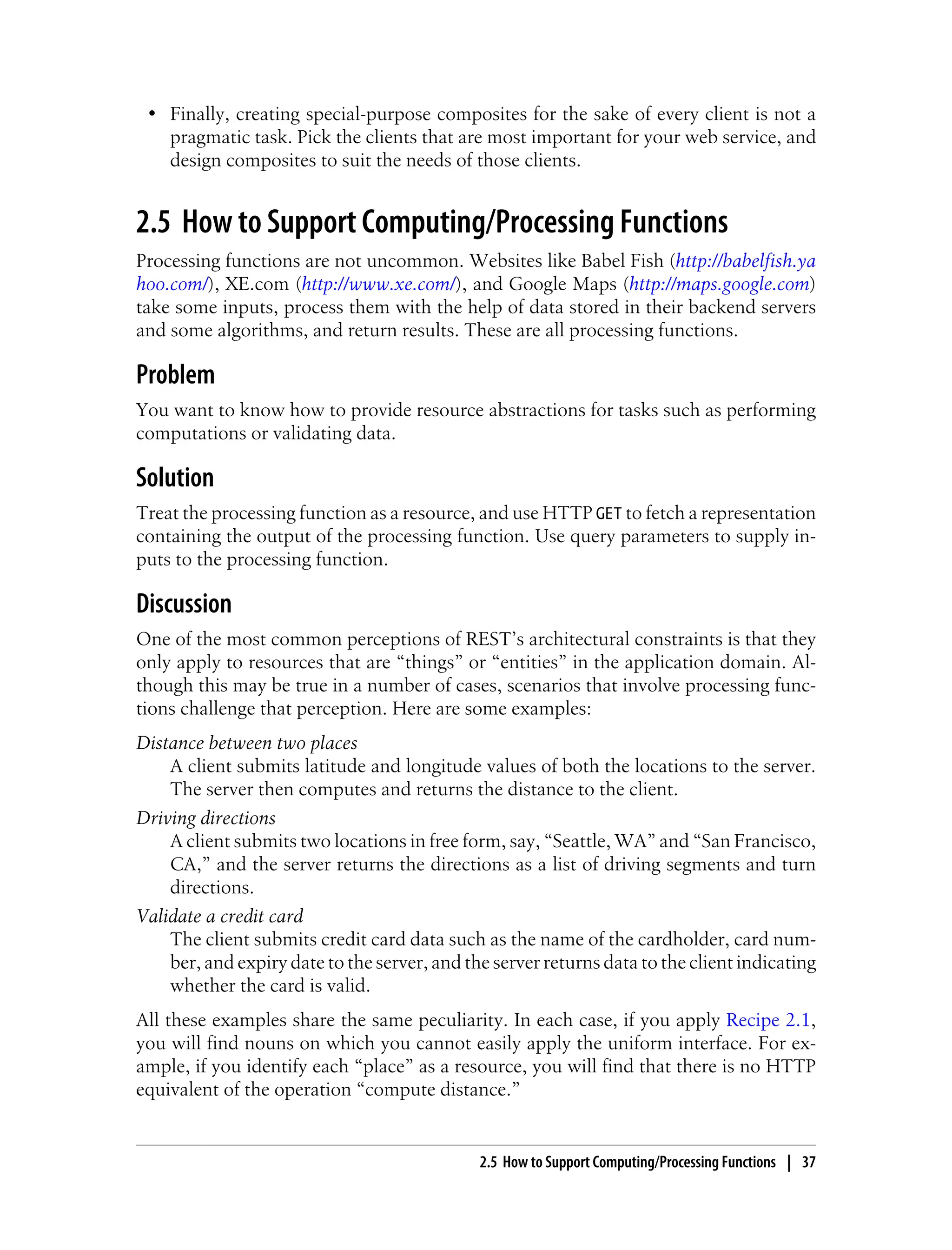
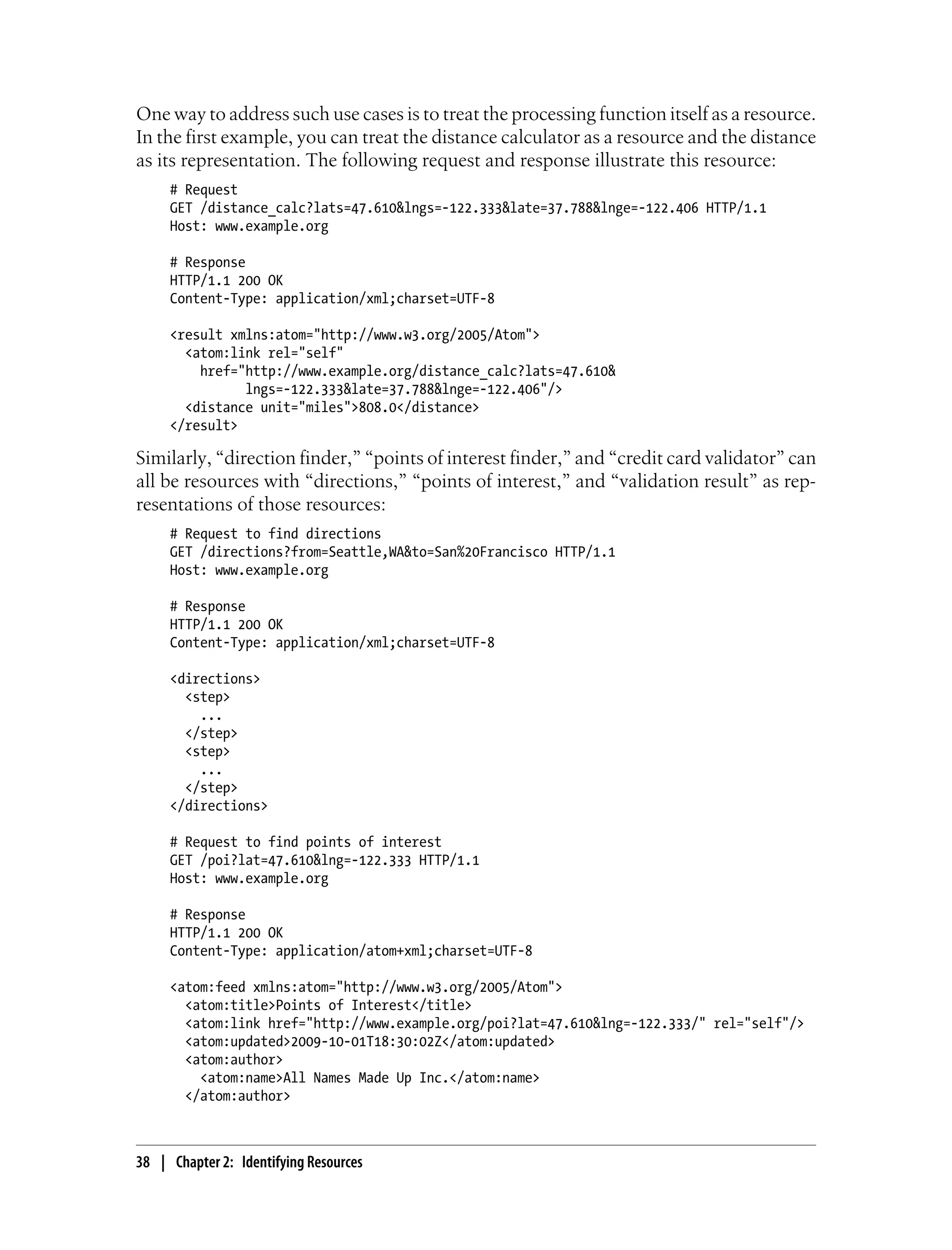


![l’Uruguay, le Vénézuella=> l’Uruguay, le Vénézuela {pg 357}
travail qu’elle ont exigé=> travail qu’elles ont exigé {pg 384}
et cet ensemble innoubliable=> et cet ensemble inoubliable {pg 387}
Tu l’as dis=> Tu l’as dit {pg 388}
A l’Exposition: L’Europe, Norvège, Suède, Danemarck=> A
l’Exposition: L’Europe, Norwège, Suède, Danemark {table}
Dernières journée à l’Exposition=> Dernière journée à l’Exposition
{table}
NOTES:
[1] Ouvrage publié en 1661, Le Paradis de la Touraine, par le père Martin
Martineau, carme déchaussé.
[2] Rayonnant.
[3] Elles se composent de lés de toile de 3 ou 4 mètres de hauteur sur 80 de
largeur. Les unes sont à fond d’or ou d’argent, les autres à fond de couleur, enjolivées
d’arabesques, de fruits, de fleurs, d’oiseaux, quelques-unes ont des personnages, et
représentent une chasse. Le curieux, c’est que ces ornements ne sont pas le fait d’un
pinceau habile, tous les dessins sont des applications de tontures de laine, ce qui leur
donne le riche aspect du velours. Elles ont dû être fabriquées sur place. Elles ont servi
de modèle à la restauration de plusieurs châteaux de la Renaissance. C’est à Blois
qu’on les a imitées pour la première fois.
[4] Il paraît qu’on ne peut plus visiter Chenonceaux, le Crédit Foncier qui avait
acquis ce domaine l’a revendu à un Américain du Sud, Monsieur Terry, qui l’aime
passionnément, jalousement même et l’habite avec sa famille. Les Touristes ne
pouvant plus visiter Chenonceaux en sont réduits à saluer de loin la noble demeure
tout en promenant dans le parc dont l’accès n’est pas interdit.
[5] Depuis ma visite à Beaujardin, le propriétaire est mort; tous les animaux ont
été vendus, et ce domaine a changé de maître et de destination.
[6] L’exposition de 1855 qui occupa cent soixante huit mille mètres carrés, dura du
15 mai au 15 novembre. Le nombre des exposants fut de vingt-trois mille neuf cent
cinquante quatre; celui des visiteurs de cinq millions cent soixante mille. Les entrées
payantes produisirent trois millions deux cent mille francs.
L’exposition de 1867 occupa six cent quatre-vingt-sept mille mètres carrés; il y
eut trente-deux mille exposants, le nombre total des entrées payantes s’éleva à près de](https://image.slidesharecdn.com/2053520-250601223315-04ddfccd/75/Restful-Web-Services-Cookbook-1st-Edition-Subbu-Allamaraju-75-2048.jpg)
![onze millions, la recette à dix millions sept cent soixante-cinq mille francs. Les
dépenses faites par la Commission impériale montèrent à vingt-trois millions quatre
cent quarante mille francs; les subventions et les recettes fournirent une somme totale
de vingt-six millions deux cent cinquante-sept mille francs; donc boni de deux
millions huit cent seize mille francs.
En 1878, le nombre des exposants fut plus considérable qu’en 1867. Cette fois
l’Exposition comprenait sept cent quarante-cinq mille cinq cent trente-cinq mètres
carrés; la recette fut de vingt-trois millions sept cent mille francs, avec la subvention
de la ville de Paris.
En 1889, la surface totale a été de neuf cent cinquante mille quatre-vingts mètres
carrés; le nombre des entrées s’est élevé à trente-deux millions cinq cent mille. Les
recettes ont atteint cinquante millions: boni de dix millions.
Les chiffres ont aussi leur éloquence: nous sommes loin des cent dix exposants de
1798.
[7] Trocadéro: nom donné à une colline près Paris, pour perpétuer le souvenir d’un
fait d’armes des troupes françaises qui, en 1823, sous les ordres du duc d’Angoulême,
s’emparèrent du fort du Trocadéro, dans l’île de Léon, près Cadix, ce qui entraîna la
reddition de cette ville. Depuis Paris s’est beaucoup agrandi, il a englobé la colline, et
le palais bâti dessus a pris son nom.
[8] J’ai lu depuis dans un journal cet entrefilet:
Le métier de commissaire priseur est farci d’imprévu. L’un d’eux mettait samedi
aux enchères un chêne antédiluvien. Cet arbre géant, témoin des temps préhistoriques
que l’on trouva il y a quelques années, dans le lit du Rhône, a été vendu, avec le
bateau spécial qui l’avait apporté lors de l’Exposition 4300 francs.
[9] Voilà neuf ans que j’écrivais ces lignes, mon séquoia est redevenu arbre. Je
livre aux savantes méditations des arboriculteurs ce cas de puissante végétation
absolument exceptionnelle.
[10] Les plaisants qui n’ont pu en retenir un traître mot offrent 500 fr. à la
personne capable de les retenir après dix minutes d’étude.
[11] En effet j’ai dû écrire à mon estimable ami; retourner une seconde fois chez
M. Feuardent, et enfin une troisième et dernière pour prendre la livraison des dites
médailles, en un mot cela m’a coûté 5 heures de temps et 3 courses de voiture.](https://image.slidesharecdn.com/2053520-250601223315-04ddfccd/75/Restful-Web-Services-Cookbook-1st-Edition-Subbu-Allamaraju-76-2048.jpg)