Restaurant
Design
Rahul Saini
" content overview
restaurant
history of restaurant
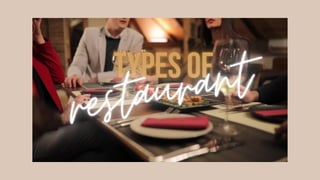
types of restaurant
spaces in restaurant
elements in interior spaces
commercial relevance
social relevance
misconception
importance of interior design in restaurants
3
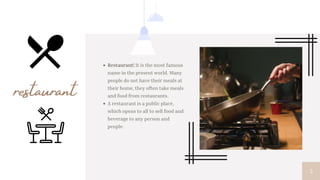
Restaurant! It is the most famous
name in the present world. Many
people do not have their meals at
their home, they often take meals
and food from restaurants.
A restaurant is a public place,
which opens to all to sell food and
beverage to any person and
people.
restaurant
4
misconception
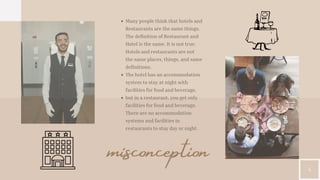
Many people think that hotels and
Restaurants are the same things.
The definition of Restaurant and
Hotel is the same. It is not true.
Hotels and restaurants are not
the same places, things, and same
definitions.
The hotel has an accommodation
system to stay at night with
facilities for food and beverage,
but in a restaurant, you get only
facilities for food and beverage.
There are no accommodation
systems and facilities in
restaurants to stay day or night.
5
An establishment
where refreshments
or meals are served
to paying guests.
Through inns and
taverns served
simple fare to
travelers for
centuries,
the first modern
restaurant where guests
could order from a varied
menu is thought to have
belonged to A. Boulanger,
a soup vendor opened his
business in Paris in 1765.
The sign above his
door advertised
restoratives, or
restaurants, referring
to his soups and
broths. By 1804 Paris
had more than 500
restaurants, and
France soon became
internationally
famous for its
cuisine.
In India, the earliest
reference of restaurants
dates back to early 250
BC when taverns or inns
provided food to hungry
travelers. Street vendors
and small stall owners
also sold food in local
markets and most Indian
towns and villages.
7
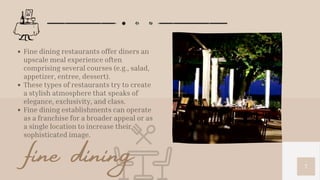
Fine dining restaurants offer diners an
upscale meal experience often
comprising several courses (e.g., salad,
appetizer, entree, dessert).
These types of restaurants try to create
a stylish atmosphere that speaks of
elegance, exclusivity, and class.
Fine dining establishments can operate
as a franchise for a broader appeal or as
a single location to increase their
sophisticated image.
fine dining
8
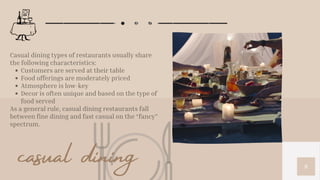
Customers are served at their table
Food offerings are moderately priced
Atmosphere is low-key
Decor is often unique and based on the type of
food served
Casual dining types of restaurants usually share
the following characteristics:
As a general rule, casual dining restaurants fall
between fine dining and fast casual on the “fancy”
spectrum.
casual dining
9
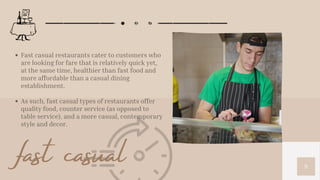
Fast casual restaurants cater to customers who
are looking for fare that is relatively quick yet,
at the same time, healthier than fast food and
more affordable than a casual dining
establishment.
As such, fast casual types of restaurants offer
quality food, counter service (as opposed to
table service), and a more casual, contemporary
style and decor.
fast casual
10
A ghost restaurant (a.k.a. virtual restaurant, delivery-
only restaurant, online-only restaurant, or dark
kitchen) is a food-service business that serves
customers exclusively through phone orders, online
orders, or both.
In a virtual restaurant — as the name rightly suggests
— the majority (if not all) of the business is conducted
via computer, tablet, or smartphone.
A ghost restaurant doesn’t have a traditional
storefront with decor, signage, and a large dining
room. Instead, this new business model only requires
a kitchen and delivery drivers.
ghost restaurant
11
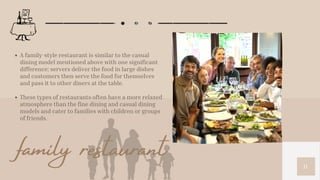
A family-style restaurant is similar to the casual
dining model mentioned above with one significant
difference: servers deliver the food in large dishes
and customers then serve the food for themselves
and pass it to other diners at the table.
These types of restaurants often have a more relaxed
atmosphere than the fine dining and casual dining
models and cater to families with children or groups
of friends.
family restaurant
12
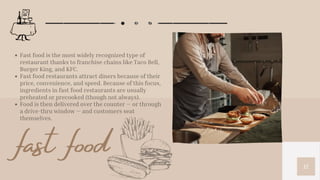
Fast food is the most widely recognized type of
restaurant thanks to franchise chains like Taco Bell,
Burger King, and KFC.
Fast food restaurants attract diners because of their
price, convenience, and speed. Because of this focus,
ingredients in fast food restaurants are usually
preheated or precooked (though not always).
Food is then delivered over the counter — or through
a drive-thru window — and customers seat
themselves.
fast food
13
Food trucks, carts, or stands are unique modern
businesses that normally specialize in a single type of
food (e.g., tacos, sandwiches, hot dogs, ice cream,
smoothies, etc.) and serve a limited menu that
revolves around those items.
They are generally categorized together with fast food
restaurants because the focus is on speed.
Additionally, seating options may be sparse or even
non-existent.
food trucks
14
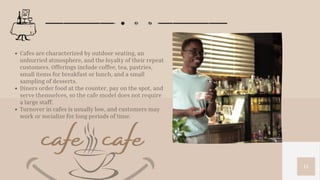
Cafes are characterized by outdoor seating, an
unhurried atmosphere, and the loyalty of their repeat
customers. Offerings include coffee, tea, pastries,
small items for breakfast or lunch, and a small
sampling of desserts.
Diners order food at the counter, pay on the spot, and
serve themselves, so the cafe model does not require
a large staff.
Turnover in cafes is usually low, and customers may
work or socialize for long periods of time.
cafe cafe
15
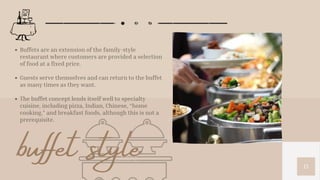
Buffets are an extension of the family-style
restaurant where customers are provided a selection
of food at a fixed price.
Guests serve themselves and can return to the buffet
as many times as they want.
The buffet concept lends itself well to specialty
cuisine, including pizza, Indian, Chinese, “home
cooking,” and breakfast foods, although this is not a
prerequisite.
buffet style
16
Pubs have a long tradition of being the place to go when
you need to unwind and enjoy a beer or other alcoholic
beverage at the end of a long day.
At first, they were little more than bars. But, in modern
times, pubs have expanded their menus to offer food
items and full meals as well as beer, liquor, and non-
alcoholic beverages.
Because of the wide range of fare and the festive
atmosphere, pubs typically provide full table- and bar
service as well as casual decor, games (e.g., darts, pool,
etc.), televisions for sports, and possibly even a dance
floor.
pub
17
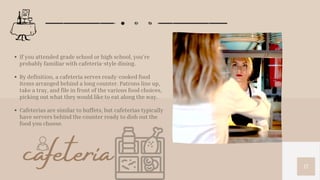
If you attended grade school or high school, you’re
probably familiar with cafeteria-style dining.
By definition, a cafeteria serves ready-cooked food
items arranged behind a long counter. Patrons line up,
take a tray, and file in front of the various food choices,
picking out what they would like to eat along the way.
Cafeterias are similar to buffets, but cafeterias typically
have servers behind the counter ready to dish out the
food you choose.
cafeteria
18
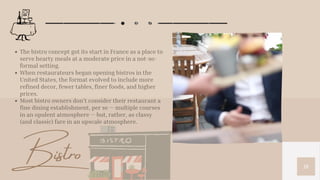
The bistro concept got its start in France as a place to
serve hearty meals at a moderate price in a not-so-
formal setting.
When restaurateurs began opening bistros in the
United States, the format evolved to include more
refined decor, fewer tables, finer foods, and higher
prices.
Most bistro owners don’t consider their restaurant a
fine dining establishment, per se — multiple courses
in an opulent atmosphere — but, rather, as classy
(and classic) fare in an upscale atmosphere.
Bistro
RESTAURANT
INTERIOR DESIGN IN
importance of
20
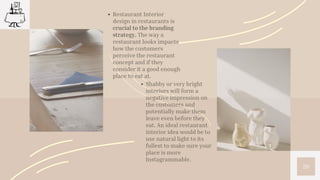
Restaurant Interior
design in restaurants is
crucial to the branding
strategy. The way a
restaurant looks impacts
how the customers
perceive the restaurant
concept and if they
consider it a good enough
place to eat at.
Shabby or very bright
interiors will form a
negative impression on
the customers and
potentially make them
leave even before they
eat. An ideal restaurant
interior idea would be to
use natural light to its
fullest to make sure your
place is more
Instagrammable.
21
In the age of Instagram,
interior design is a
restaurant’s silent
salesman, if the
restaurant looks
Instagramable, it will
make it to your
customer’s feed and
entice their entire
follower list.
Good interior design
means marketable
interior design. You can
use your interior design
for marketing your
restaurant among your
target customers. If there
is something unique
about your interiors,
make it public. People
love to think that they are
a part of something
unique and would flock to
your restaurant.
22
Most importantly,
interior design in
restaurants impacts
customer psychology.
You can make your
customers order more,
eat fast, drink more, stay
less, etc. all using interior
restaurant ideas.
Now that we know why
interior design in
restaurants is so
important, we come to
the Impact of Interior
Design on Customer
Experience and Customer
Psychology. To
understand how six
elements of interior
design in restaurants can
impact customer
experience in such a
significant manner,
23
Elements of
Restaurant
Interior Design
AND HOW THEY IMPACT CUSTOMERS
A r c h i t e c t u r e & D e s i g n
L i g h t i n g
S e a t i n g
C o l o r s
S m e l l
A c o u s t i c s
ESSENTIALS
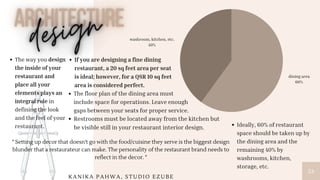
dining area
60%
washroom, kitchen, etc.
40%
Ideally, 60% of restaurant
space should be taken up by
the dining area and the
remaining 40% by
washrooms, kitchen,
storage, etc.
24
The way you design
the inside of your
restaurant and
place all your
elements plays an
integral role in
defining the look
and the feel of your
restaurant.
If you are designing a fine dining
restaurant, a 20 sq feet area per seat
is ideal; however, for a QSR 10 sq feet
area is considered perfect.
Restrooms must be located away from the kitchen but
be visible still in your restaurant interior design.
The floor plan of the dining area must
include space for operations. Leave enough
gaps between your seats for proper service.
" Setting up decor that doesn't go with the food/cuisine they serve is the biggest design
blunder that a restaurateur can make. The personality of the restaurant brand needs to
reflect in the decor. "
K A N I K A P A H W A , S T U D I O E Z U B E
25
Ambient lighting defines the
overall look and feel of your
restaurant. Is your restaurant
dimly lit or is it bright and heavy
on the lights, this is the light that
defines it. Fine dining restaurants
usually use dim ambient lighting
to create a relaxing mood and
aura.
Task lighting is the light used for
performing tasks. These are the
lights that enable servers to work
and customers to read the menu
and order.
It can be to highlight pathways or
incorporate them by putting
them on some unique features
like sushi bars or minibars to
highlight them.
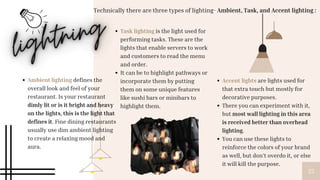
Technically there are three types of lighting- Ambient, Task, and Accent lighting :
Accent lights are lights used for
that extra touch but mostly for
decorative purposes.
There you can experiment with it,
but most wall lighting in this area
is received better than overhead
lighting.
You can use these lights to
reinforce the colors of your brand
as well, but don’t overdo it, or else
it will kill the purpose.
26
On the other hand, Starbucks
has comfortable seats,
recliners, and sofas that are
heavy and cushioned. This
prompts customers to stay
longer and keep ordering
more coffee.
Seating is another unnoticed part
of restaurant interior design. The
type of seats you use impacts
your customer’s psychology and
the experience as well. Ever
noticed how QSRs like McDonald’s
and Subway have seats that are
comfortable but not exactly the
type you would want to keep
sitting on? At the same time, they
give a very light feeling. All this
impacts the customers to be fast
eaters and not stay.
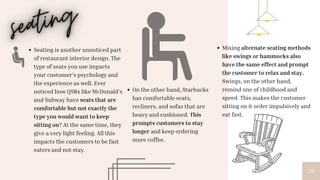
Mixing alternate seating methods
like swings or hammocks also
have the same effect and prompt
the customer to relax and stay.
Swings, on the other hand,
remind one of childhood and
speed. This makes the customer
sitting on it order impulsively and
eat fast.
27
Different colors trigger different
emotions and set different
moods. Some colors stimulate
diet while others repress it.
Warm colors like red and orange
are considered potent
stimulants, so a lot of
restaurants try to use red in
their interior.
Yellow is a bright color and can
bring out people’s appetites by
giving a lively feeling to the
place. Blue, on the other hand, is
a suppressant.
The reason why blue is
considered a suppressant is
that it relaxes the diners and
calms them; hence they order
less.
there are shades
which are big no-nos.
Gray, brown, and
purple come in this
category. While grey is
dreary and tired,
brown reminds one of
burnt food, and purple
is associated with less
popular foods like
eggplants or brinjals.
" Colour in restaurants and cafes creates a
very powerful impact on customer
experience as it helps to enhance mood and
craving for good food and drinks. Different
colors can create different moods and the
key is to tap the correct mood for your
restaurant and use it. "
V A I B H A V P A N C H O L I , D E S I G N H U T
28
Just remember never to use barbecue as your scent, even
if you run a barbeque joint. It makes the place feel small
and more stuffy while killing the appetite.
This may sound far-fetched, but
according to a study, the right
scents can increase your food
sales by 300%, so make sure you
include them in your restaurant
interior design. In fact, according
to the University of Paderborn,
scents increased impulse buying
by 6%, buying intention by 14.8%,
and the length of a customer’s
stay by 15.9%.
Psychology of Scent
Chamomile, Lavender, and Vanilla reduces stress and relaxes the mind
making them perfect for a fine-dining restaurant.
Baked bread reminds one of home and gives a comforting feeling thus
works well for the dessert section of a restaurant or a bakery.
Peppermint, cucumber, and citrus flavors makes a person feel fresh
making them ideal for restaurants catering to after-work corporate
employees
The smell of cucumber can make the customers feel that an area is
larger than it seems which makes it perfect for small-spaced
establishments.
29
Music does more than just
fill the gaps in a restaurant.
First, we come to the volume
of it. Controlling the volume
at which you will play the
music is the trickiest thing
to do.
While too loud can create noise, too soft
can make people think that other diners
can hear them and so make them
awkward. We advise that you use acoustic
control techniques like false ceilings,
carpets, or curtains.
Having a live
piano is the
best thing
you can do if
you run a fine
dining
restaurant.
Faster beats for rush
hour and relaxed,
slow tempo beats for
off-hours.
While most restaurants prefer
keeping their music between 72-75
dB, bars play it at an 85-88 dB
limit. A study proves that in a
bar people consume alcohol more
and faster when music is loud.
Acoustic
The average noise level of a
typical restaurant during a
dining rush is 80 dB (some
reach as much as 110 dB).
Restaurants traditionally
have carpeted floors and soft
furnishings and upholstered
chairs, tablecloths, and
curtains which provide
sound-absorbing qualities. 30
Human Comfort
Human comfort in an
indoor space primarily
relies on thermal
comfort and indoor air
quality (achieved by
temperature, humidity
control good and
ventilation), lighting,
and acoustic comfort.
Thermal Comfort And
Indoor Air Quality
HVAC (heating
ventilation and air
conditioning) forms an
important feature and
consideration for
achieving a functional
restaurant design.
Lighting
Lighting Design aims to
enable the occupant to
work and move arund
in safety. It provides
for our visual needs,
and also safety and
security.
I D E A L L Y , R E S T A U R A N T P L A N N I N G A N D D E S I G N S H O U L D S H O W C A S E T H A T 6 0 % A R E A I N A F L O O R P L A N M U S T G O T O T H E
D I N I N G A R E A A N D T H E O T H E R 4 0 % T O T H E K I T C H E N , S T O R A G E , F R E E Z E R , E T C .
F E A T U R E S O F A N E F F I C I E N T
R E S T A U R A N T D E S I G N A N D
F L O O R P L A N
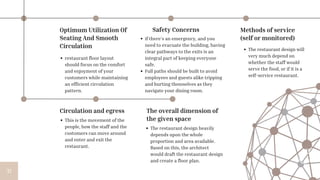
Optimum Utilization Of
Seating And Smooth
Circulation
restaurant floor layout
should focus on the comfort
and enjoyment of your
customers while maintaining
an efficient circulation
pattern.
Safety Concerns
if there’s an emergency, and you
need to evacuate the building, having
clear pathways to the exits is an
integral part of keeping everyone
safe.
Full paths should be built to avoid
employees and guests alike tripping
and hurting themselves as they
navigate your dining room.
Methods of service
(self or monitored)
The restaurant design will
very much depend on
whether the staff would
serve the food, or if it is a
self-service restaurant.
Circulation and egress
This is the movement of the
people, how the staff and the
customers can move around
and enter and exit the
restaurant.
The overall dimension of
the given space
The restaurant design heavily
depends upon the whole
proportion and area available.
Based on this, the architect
would draft the restaurant design
and create a floor plan.
31
32
I D E A L L Y , R E S T A U R A N T P L A N N I N G A N D D E S I G N S H O U L D
S H O W C A S E T H A T 6 0 % A R E A I N A F L O O R P L A N M U S T G O
T O T H E D I N I N G A R E A A N D T H E O T H E R 4 0 % T O T H E
K I T C H E N , S T O R A G E , F R E E Z E R , E T C .
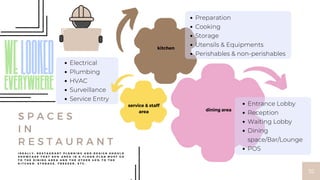
S P A C E S
I N
R E S T A U R A N T
dining area
kitchen
service & staff
area
Entrance Lobby
Reception
Waiting Lobby
Dining
space/Bar/Lounge
POS
Electrical
Plumbing
HVAC
Surveillance
Service Entry
Preparation
Cooking
Storage
Utensils & Equipments
Perishables & non-perishables
33
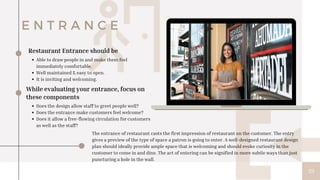
E N T R A N C E
Able to draw people in and make them feel
immediately comfortable.
Well maintained & easy to open.
It is inviting and welcoming.
Restaurant Entrance should be
While evaluating your entrance, focus on
these components
Does the design allow staff to greet people well?
Does the entrance make customers feel welcome?
Does it allow a free-flowing circulation for customers
as well as the staff?
The entrance of restaurant casts the first impression of restaurant on the customer. The entry
gives a preview of the type of space a patron is going to enter. A well-designed restaurant design
plan should ideally provide ample space that is welcoming and should evoke curiosity in the
customer to come in and dine. The act of entering can be signified in more subtle ways than just
puncturing a hole in the wall.
34
D I N I N G
R O O M
L A Y O U T S
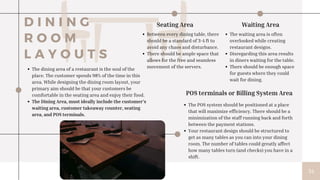
The dining area of a restaurant is the soul of the
place. The customer spends 98% of the time in this
area. While designing the dining room layout, your
primary aim should be that your customers be
comfortable in the seating area and enjoy their food.
The Dining Area, must ideally include the customer’s
waiting area, customer takeaway counter, seating
area, and POS terminals.
Seating Area
Between every dining table, there
should be a standard of 3-4 ft to
avoid any chaos and disturbance.
There should be ample space that
allows for the free and seamless
movement of the servers.
Waiting Area
The waiting area is often
overlooked while creating
restaurant designs.
Disregarding this area results
in diners waiting for the table.
There should be enough space
for guests where they could
wait for dining.
POS terminals or Billing System Area
The POS system should be positioned at a place
that will maximize efficiency. There should be a
minimization of the staff running back and forth
between the payment stations.
Your restaurant design should be structured to
get as many tables as you can into your dining
room. The number of tables could greatly affect
how many tables turn (and checks) you have in a
shift.
T H E
K I T C H E N
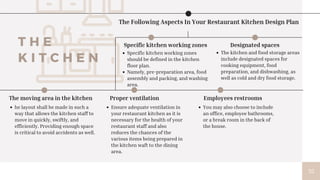
The Following Aspects In Your Restaurant Kitchen Design Plan
Specific kitchen working zones
should be defined in the kitchen
floor plan.
Namely, pre-preparation area, food
assembly and packing, and washing
area.
Specific kitchen working zones
The kitchen and food storage areas
include designated spaces for
cooking equipment, food
preparation, and dishwashing, as
well as cold and dry food storage.
Designated spaces
The moving area in the kitchen
he layout shall be made in such a
way that allows the kitchen staff to
move in quickly, swiftly, and
efficiently. Providing enough space
is critical to avoid accidents as well.
Proper ventilation
Ensure adequate ventilation in
your restaurant kitchen as it is
necessary for the health of your
restaurant staff and also
reduces the chances of the
various items being prepared in
the kitchen waft to the dining
area.
Employees restrooms
You may also choose to include
an office, employee bathrooms,
or a break room in the back of
the house.
35
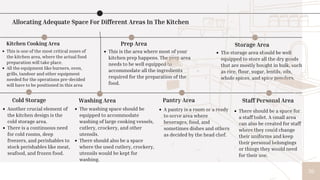
Allocating Adequate Space For Different Areas In The Kitchen
This is the area where most of your
kitchen prep happens. The prep area
needs to be well equipped to
accommodate all the ingredients
required for the preparation of the
food.
36
Prep Area
The storage area should be well
equipped to store all the dry goods
that are mostly bought in bulk, such
as rice, flour, sugar, lentils, oils,
whole spices, and spice powders.
Storage Area
Cold Storage
Another crucial element of
the kitchen design is the
cold storage area.
There is a continuous need
for cold rooms, deep
freezers, and perishables to
stock perishables like meat,
seafood, and frozen food.
Washing Area
The washing space should be
equipped to accommodate
washing of large cooking vessels,
cutlery, crockery, and other
utensils.
There should also be a space
where the used cutlery, crockery,
utensils would be kept for
washing.
Pantry Area
A pantry is a room or a ready
to serve area where
beverages, food, and
sometimes dishes and others
as decided by the head chef.
Kitchen Cooking Area
This is one of the most critical zones of
the kitchen area, where the actual food
preparation will take place.
All the equipment like burners, oven,
grills, tandoor and other equipment
needed for the operations pre-decided
will have to be positioned in this area
Staff Personal Area
There should be a space for
a staff toilet. A small area
can also be created for staff
where they could change
their uniforms and keep
their personal belongings
or things they would need
for their use.
37
The restrooms should be easy to access for the
customers without unnecessary wandering.
It is advisable that the restrooms shall also have
wheelchair access for catering to the specific
needs of physically challenged customers.
It is necessary that the restaurant restrooms
should be appropriately equipped with sanitation
facilities, especially trash disposal, and have
proper designated space on the bathroom floor
plan.
The restrooms should also be equipped with
proper lighting.
R E S T R O O M S
Restrooms leave a lasting impression on the
mind of the customer. They should have
sufficient lighting and easy to clean and
maintain. Every customer will appreciate
sparkling, clean, and large enough restrooms to
accommodate multiple guests.
Essentials
38
Restaurant floor plans are ultimately a balancing act
between various functional needs and requirements
of restaurant design.
Designing restaurant floor plan might seem a little
easier task as compared to financing, licensing, or
construction that goes along with starting a
business. But the restaurant floor plan is a critical
aspect of effective restaurant design.
E L E C T R I C A L
S E R V I C E S
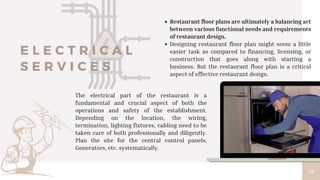
The electrical part of the restaurant is a
fundamental and crucial aspect of both the
operations and safety of the establishment.
Depending on the location, the wiring,
termination, lighting fixtures, cabling need to be
taken care of both professionally and diligently.
Plan the site for the central control panels,
Generators, etc. systematically.
39
Accessibility
There's a reason that
major reason restaurant
chains are often located
near highway and
freeway exits: It makes
them accessible to
customers. Motorists can
reach the restaurant
without fighting traffic or
driving out of their way.
Most successful
restaurant locations (but
not all) are easy to find.
Location
Target
customers
Parking base
Location matters in
restaurant design.
Thereneeds to be
enough people who live
in thearea, or pass
through the area on a
regularbasis to keep you
busy.
To determine
thepopulation base of a
particular area, you
cando a site study.
The type of customers
you want to attract to
this restaurant
should be
predetermined. That
will help you fix the
menu and the setting
of the restaurant. The
age group,
occupation, income
group, and typical
taste of the
customers should be
known
Will there be enough
parking to
accommodate all the
seats in your new
restaurant? Ideally, a
new restaurant
location should have
its parking lot. Is
there public parking
near the restaurant
location if that isn't
an option?
R E S T A U R A N T
C O M M E R C I A L
R E L E V A N C E
Restaurateurs need to create a culture of respect
and emotions full of dignity carrying forward
ethical standards throughout your restaurant
business. ​
The restaurant owners have realized the
importance of social responsibility towards
doing the right thing for employees, community
and even towards Mother Nature. It has certainly
become an important aspect for the food
business. There are various ways by which
restaurants are showing their​
concern and care for their customers.​
40
R E S T A U R A N T
S O C I A L
R E L E V A N C E
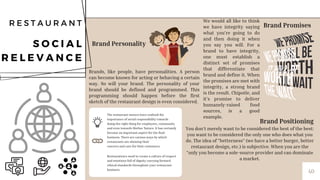
Brand Personality
Brands, like people, have personalities. A person
can become known for acting or behaving a certain
way. So will your brand. The personality of your
brand should be defined and programmed. This
programming should happen before the first
sketch of the restaurant design is even considered.
Brand Promises
We would all like to think
we have integrity saying
what you're going to do
and then doing it when
you say you will. For a
brand to have integrity,
one must establish a
distinct set of promises
that differentiate that
brand and define it. When
the promises are met with
integrity, a strong brand
is the result. Chipotle, and
it's promise to deliver
humanely-raised food
sources, is a good
example.
Brand Positioning
You don't merely want to be considered the best of the best:
you want to be considered the only one who does what you
do. The idea of "betterness" (we have a better burger, better
restaurant design, etc.) is subjective. When you are the
"only you become a sole-source provider and can dominate
a market.

RESTAURANT - Rahul Saini.pdf

  • 1.
  • 2.
    " content overview restaurant historyof restaurant types of restaurant spaces in restaurant elements in interior spaces commercial relevance social relevance misconception importance of interior design in restaurants
  • 3.
    3 Restaurant! It isthe most famous name in the present world. Many people do not have their meals at their home, they often take meals and food from restaurants. A restaurant is a public place, which opens to all to sell food and beverage to any person and people. restaurant
  • 4.
    4 misconception Many people thinkthat hotels and Restaurants are the same things. The definition of Restaurant and Hotel is the same. It is not true. Hotels and restaurants are not the same places, things, and same definitions. The hotel has an accommodation system to stay at night with facilities for food and beverage, but in a restaurant, you get only facilities for food and beverage. There are no accommodation systems and facilities in restaurants to stay day or night.
  • 5.
    5 An establishment where refreshments ormeals are served to paying guests. Through inns and taverns served simple fare to travelers for centuries, the first modern restaurant where guests could order from a varied menu is thought to have belonged to A. Boulanger, a soup vendor opened his business in Paris in 1765. The sign above his door advertised restoratives, or restaurants, referring to his soups and broths. By 1804 Paris had more than 500 restaurants, and France soon became internationally famous for its cuisine. In India, the earliest reference of restaurants dates back to early 250 BC when taverns or inns provided food to hungry travelers. Street vendors and small stall owners also sold food in local markets and most Indian towns and villages.
  • 7.
    7 Fine dining restaurantsoffer diners an upscale meal experience often comprising several courses (e.g., salad, appetizer, entree, dessert). These types of restaurants try to create a stylish atmosphere that speaks of elegance, exclusivity, and class. Fine dining establishments can operate as a franchise for a broader appeal or as a single location to increase their sophisticated image. fine dining
  • 8.
    8 Customers are servedat their table Food offerings are moderately priced Atmosphere is low-key Decor is often unique and based on the type of food served Casual dining types of restaurants usually share the following characteristics: As a general rule, casual dining restaurants fall between fine dining and fast casual on the “fancy” spectrum. casual dining
  • 9.
    9 Fast casual restaurantscater to customers who are looking for fare that is relatively quick yet, at the same time, healthier than fast food and more affordable than a casual dining establishment. As such, fast casual types of restaurants offer quality food, counter service (as opposed to table service), and a more casual, contemporary style and decor. fast casual
  • 10.
    10 A ghost restaurant(a.k.a. virtual restaurant, delivery- only restaurant, online-only restaurant, or dark kitchen) is a food-service business that serves customers exclusively through phone orders, online orders, or both. In a virtual restaurant — as the name rightly suggests — the majority (if not all) of the business is conducted via computer, tablet, or smartphone. A ghost restaurant doesn’t have a traditional storefront with decor, signage, and a large dining room. Instead, this new business model only requires a kitchen and delivery drivers. ghost restaurant
  • 11.
    11 A family-style restaurantis similar to the casual dining model mentioned above with one significant difference: servers deliver the food in large dishes and customers then serve the food for themselves and pass it to other diners at the table. These types of restaurants often have a more relaxed atmosphere than the fine dining and casual dining models and cater to families with children or groups of friends. family restaurant
  • 12.
    12 Fast food isthe most widely recognized type of restaurant thanks to franchise chains like Taco Bell, Burger King, and KFC. Fast food restaurants attract diners because of their price, convenience, and speed. Because of this focus, ingredients in fast food restaurants are usually preheated or precooked (though not always). Food is then delivered over the counter — or through a drive-thru window — and customers seat themselves. fast food
  • 13.
    13 Food trucks, carts,or stands are unique modern businesses that normally specialize in a single type of food (e.g., tacos, sandwiches, hot dogs, ice cream, smoothies, etc.) and serve a limited menu that revolves around those items. They are generally categorized together with fast food restaurants because the focus is on speed. Additionally, seating options may be sparse or even non-existent. food trucks
  • 14.
    14 Cafes are characterizedby outdoor seating, an unhurried atmosphere, and the loyalty of their repeat customers. Offerings include coffee, tea, pastries, small items for breakfast or lunch, and a small sampling of desserts. Diners order food at the counter, pay on the spot, and serve themselves, so the cafe model does not require a large staff. Turnover in cafes is usually low, and customers may work or socialize for long periods of time. cafe cafe
  • 15.
    15 Buffets are anextension of the family-style restaurant where customers are provided a selection of food at a fixed price. Guests serve themselves and can return to the buffet as many times as they want. The buffet concept lends itself well to specialty cuisine, including pizza, Indian, Chinese, “home cooking,” and breakfast foods, although this is not a prerequisite. buffet style
  • 16.
    16 Pubs have along tradition of being the place to go when you need to unwind and enjoy a beer or other alcoholic beverage at the end of a long day. At first, they were little more than bars. But, in modern times, pubs have expanded their menus to offer food items and full meals as well as beer, liquor, and non- alcoholic beverages. Because of the wide range of fare and the festive atmosphere, pubs typically provide full table- and bar service as well as casual decor, games (e.g., darts, pool, etc.), televisions for sports, and possibly even a dance floor. pub
  • 17.
    17 If you attendedgrade school or high school, you’re probably familiar with cafeteria-style dining. By definition, a cafeteria serves ready-cooked food items arranged behind a long counter. Patrons line up, take a tray, and file in front of the various food choices, picking out what they would like to eat along the way. Cafeterias are similar to buffets, but cafeterias typically have servers behind the counter ready to dish out the food you choose. cafeteria
  • 18.
    18 The bistro conceptgot its start in France as a place to serve hearty meals at a moderate price in a not-so- formal setting. When restaurateurs began opening bistros in the United States, the format evolved to include more refined decor, fewer tables, finer foods, and higher prices. Most bistro owners don’t consider their restaurant a fine dining establishment, per se — multiple courses in an opulent atmosphere — but, rather, as classy (and classic) fare in an upscale atmosphere. Bistro
  • 19.
  • 20.
    20 Restaurant Interior design inrestaurants is crucial to the branding strategy. The way a restaurant looks impacts how the customers perceive the restaurant concept and if they consider it a good enough place to eat at. Shabby or very bright interiors will form a negative impression on the customers and potentially make them leave even before they eat. An ideal restaurant interior idea would be to use natural light to its fullest to make sure your place is more Instagrammable.
  • 21.
    21 In the ageof Instagram, interior design is a restaurant’s silent salesman, if the restaurant looks Instagramable, it will make it to your customer’s feed and entice their entire follower list. Good interior design means marketable interior design. You can use your interior design for marketing your restaurant among your target customers. If there is something unique about your interiors, make it public. People love to think that they are a part of something unique and would flock to your restaurant.
  • 22.
    22 Most importantly, interior designin restaurants impacts customer psychology. You can make your customers order more, eat fast, drink more, stay less, etc. all using interior restaurant ideas. Now that we know why interior design in restaurants is so important, we come to the Impact of Interior Design on Customer Experience and Customer Psychology. To understand how six elements of interior design in restaurants can impact customer experience in such a significant manner,
  • 23.
    23 Elements of Restaurant Interior Design ANDHOW THEY IMPACT CUSTOMERS A r c h i t e c t u r e & D e s i g n L i g h t i n g S e a t i n g C o l o r s S m e l l A c o u s t i c s ESSENTIALS
  • 24.
    dining area 60% washroom, kitchen,etc. 40% Ideally, 60% of restaurant space should be taken up by the dining area and the remaining 40% by washrooms, kitchen, storage, etc. 24 The way you design the inside of your restaurant and place all your elements plays an integral role in defining the look and the feel of your restaurant. If you are designing a fine dining restaurant, a 20 sq feet area per seat is ideal; however, for a QSR 10 sq feet area is considered perfect. Restrooms must be located away from the kitchen but be visible still in your restaurant interior design. The floor plan of the dining area must include space for operations. Leave enough gaps between your seats for proper service. " Setting up decor that doesn't go with the food/cuisine they serve is the biggest design blunder that a restaurateur can make. The personality of the restaurant brand needs to reflect in the decor. " K A N I K A P A H W A , S T U D I O E Z U B E
  • 25.
    25 Ambient lighting definesthe overall look and feel of your restaurant. Is your restaurant dimly lit or is it bright and heavy on the lights, this is the light that defines it. Fine dining restaurants usually use dim ambient lighting to create a relaxing mood and aura. Task lighting is the light used for performing tasks. These are the lights that enable servers to work and customers to read the menu and order. It can be to highlight pathways or incorporate them by putting them on some unique features like sushi bars or minibars to highlight them. Technically there are three types of lighting- Ambient, Task, and Accent lighting : Accent lights are lights used for that extra touch but mostly for decorative purposes. There you can experiment with it, but most wall lighting in this area is received better than overhead lighting. You can use these lights to reinforce the colors of your brand as well, but don’t overdo it, or else it will kill the purpose.
  • 26.
    26 On the otherhand, Starbucks has comfortable seats, recliners, and sofas that are heavy and cushioned. This prompts customers to stay longer and keep ordering more coffee. Seating is another unnoticed part of restaurant interior design. The type of seats you use impacts your customer’s psychology and the experience as well. Ever noticed how QSRs like McDonald’s and Subway have seats that are comfortable but not exactly the type you would want to keep sitting on? At the same time, they give a very light feeling. All this impacts the customers to be fast eaters and not stay. Mixing alternate seating methods like swings or hammocks also have the same effect and prompt the customer to relax and stay. Swings, on the other hand, remind one of childhood and speed. This makes the customer sitting on it order impulsively and eat fast.
  • 27.
    27 Different colors triggerdifferent emotions and set different moods. Some colors stimulate diet while others repress it. Warm colors like red and orange are considered potent stimulants, so a lot of restaurants try to use red in their interior. Yellow is a bright color and can bring out people’s appetites by giving a lively feeling to the place. Blue, on the other hand, is a suppressant. The reason why blue is considered a suppressant is that it relaxes the diners and calms them; hence they order less. there are shades which are big no-nos. Gray, brown, and purple come in this category. While grey is dreary and tired, brown reminds one of burnt food, and purple is associated with less popular foods like eggplants or brinjals. " Colour in restaurants and cafes creates a very powerful impact on customer experience as it helps to enhance mood and craving for good food and drinks. Different colors can create different moods and the key is to tap the correct mood for your restaurant and use it. " V A I B H A V P A N C H O L I , D E S I G N H U T
  • 28.
    28 Just remember neverto use barbecue as your scent, even if you run a barbeque joint. It makes the place feel small and more stuffy while killing the appetite. This may sound far-fetched, but according to a study, the right scents can increase your food sales by 300%, so make sure you include them in your restaurant interior design. In fact, according to the University of Paderborn, scents increased impulse buying by 6%, buying intention by 14.8%, and the length of a customer’s stay by 15.9%. Psychology of Scent Chamomile, Lavender, and Vanilla reduces stress and relaxes the mind making them perfect for a fine-dining restaurant. Baked bread reminds one of home and gives a comforting feeling thus works well for the dessert section of a restaurant or a bakery. Peppermint, cucumber, and citrus flavors makes a person feel fresh making them ideal for restaurants catering to after-work corporate employees The smell of cucumber can make the customers feel that an area is larger than it seems which makes it perfect for small-spaced establishments.
  • 29.
    29 Music does morethan just fill the gaps in a restaurant. First, we come to the volume of it. Controlling the volume at which you will play the music is the trickiest thing to do. While too loud can create noise, too soft can make people think that other diners can hear them and so make them awkward. We advise that you use acoustic control techniques like false ceilings, carpets, or curtains. Having a live piano is the best thing you can do if you run a fine dining restaurant. Faster beats for rush hour and relaxed, slow tempo beats for off-hours. While most restaurants prefer keeping their music between 72-75 dB, bars play it at an 85-88 dB limit. A study proves that in a bar people consume alcohol more and faster when music is loud.
  • 30.
    Acoustic The average noiselevel of a typical restaurant during a dining rush is 80 dB (some reach as much as 110 dB). Restaurants traditionally have carpeted floors and soft furnishings and upholstered chairs, tablecloths, and curtains which provide sound-absorbing qualities. 30 Human Comfort Human comfort in an indoor space primarily relies on thermal comfort and indoor air quality (achieved by temperature, humidity control good and ventilation), lighting, and acoustic comfort. Thermal Comfort And Indoor Air Quality HVAC (heating ventilation and air conditioning) forms an important feature and consideration for achieving a functional restaurant design. Lighting Lighting Design aims to enable the occupant to work and move arund in safety. It provides for our visual needs, and also safety and security. I D E A L L Y , R E S T A U R A N T P L A N N I N G A N D D E S I G N S H O U L D S H O W C A S E T H A T 6 0 % A R E A I N A F L O O R P L A N M U S T G O T O T H E D I N I N G A R E A A N D T H E O T H E R 4 0 % T O T H E K I T C H E N , S T O R A G E , F R E E Z E R , E T C . F E A T U R E S O F A N E F F I C I E N T R E S T A U R A N T D E S I G N A N D F L O O R P L A N
  • 31.
    Optimum Utilization Of SeatingAnd Smooth Circulation restaurant floor layout should focus on the comfort and enjoyment of your customers while maintaining an efficient circulation pattern. Safety Concerns if there’s an emergency, and you need to evacuate the building, having clear pathways to the exits is an integral part of keeping everyone safe. Full paths should be built to avoid employees and guests alike tripping and hurting themselves as they navigate your dining room. Methods of service (self or monitored) The restaurant design will very much depend on whether the staff would serve the food, or if it is a self-service restaurant. Circulation and egress This is the movement of the people, how the staff and the customers can move around and enter and exit the restaurant. The overall dimension of the given space The restaurant design heavily depends upon the whole proportion and area available. Based on this, the architect would draft the restaurant design and create a floor plan. 31
  • 32.
    32 I D EA L L Y , R E S T A U R A N T P L A N N I N G A N D D E S I G N S H O U L D S H O W C A S E T H A T 6 0 % A R E A I N A F L O O R P L A N M U S T G O T O T H E D I N I N G A R E A A N D T H E O T H E R 4 0 % T O T H E K I T C H E N , S T O R A G E , F R E E Z E R , E T C . S P A C E S I N R E S T A U R A N T dining area kitchen service & staff area Entrance Lobby Reception Waiting Lobby Dining space/Bar/Lounge POS Electrical Plumbing HVAC Surveillance Service Entry Preparation Cooking Storage Utensils & Equipments Perishables & non-perishables
  • 33.
    33 E N TR A N C E Able to draw people in and make them feel immediately comfortable. Well maintained & easy to open. It is inviting and welcoming. Restaurant Entrance should be While evaluating your entrance, focus on these components Does the design allow staff to greet people well? Does the entrance make customers feel welcome? Does it allow a free-flowing circulation for customers as well as the staff? The entrance of restaurant casts the first impression of restaurant on the customer. The entry gives a preview of the type of space a patron is going to enter. A well-designed restaurant design plan should ideally provide ample space that is welcoming and should evoke curiosity in the customer to come in and dine. The act of entering can be signified in more subtle ways than just puncturing a hole in the wall.
  • 34.
    34 D I NI N G R O O M L A Y O U T S The dining area of a restaurant is the soul of the place. The customer spends 98% of the time in this area. While designing the dining room layout, your primary aim should be that your customers be comfortable in the seating area and enjoy their food. The Dining Area, must ideally include the customer’s waiting area, customer takeaway counter, seating area, and POS terminals. Seating Area Between every dining table, there should be a standard of 3-4 ft to avoid any chaos and disturbance. There should be ample space that allows for the free and seamless movement of the servers. Waiting Area The waiting area is often overlooked while creating restaurant designs. Disregarding this area results in diners waiting for the table. There should be enough space for guests where they could wait for dining. POS terminals or Billing System Area The POS system should be positioned at a place that will maximize efficiency. There should be a minimization of the staff running back and forth between the payment stations. Your restaurant design should be structured to get as many tables as you can into your dining room. The number of tables could greatly affect how many tables turn (and checks) you have in a shift.
  • 35.
    T H E KI T C H E N The Following Aspects In Your Restaurant Kitchen Design Plan Specific kitchen working zones should be defined in the kitchen floor plan. Namely, pre-preparation area, food assembly and packing, and washing area. Specific kitchen working zones The kitchen and food storage areas include designated spaces for cooking equipment, food preparation, and dishwashing, as well as cold and dry food storage. Designated spaces The moving area in the kitchen he layout shall be made in such a way that allows the kitchen staff to move in quickly, swiftly, and efficiently. Providing enough space is critical to avoid accidents as well. Proper ventilation Ensure adequate ventilation in your restaurant kitchen as it is necessary for the health of your restaurant staff and also reduces the chances of the various items being prepared in the kitchen waft to the dining area. Employees restrooms You may also choose to include an office, employee bathrooms, or a break room in the back of the house. 35
  • 36.
    Allocating Adequate SpaceFor Different Areas In The Kitchen This is the area where most of your kitchen prep happens. The prep area needs to be well equipped to accommodate all the ingredients required for the preparation of the food. 36 Prep Area The storage area should be well equipped to store all the dry goods that are mostly bought in bulk, such as rice, flour, sugar, lentils, oils, whole spices, and spice powders. Storage Area Cold Storage Another crucial element of the kitchen design is the cold storage area. There is a continuous need for cold rooms, deep freezers, and perishables to stock perishables like meat, seafood, and frozen food. Washing Area The washing space should be equipped to accommodate washing of large cooking vessels, cutlery, crockery, and other utensils. There should also be a space where the used cutlery, crockery, utensils would be kept for washing. Pantry Area A pantry is a room or a ready to serve area where beverages, food, and sometimes dishes and others as decided by the head chef. Kitchen Cooking Area This is one of the most critical zones of the kitchen area, where the actual food preparation will take place. All the equipment like burners, oven, grills, tandoor and other equipment needed for the operations pre-decided will have to be positioned in this area Staff Personal Area There should be a space for a staff toilet. A small area can also be created for staff where they could change their uniforms and keep their personal belongings or things they would need for their use.
  • 37.
    37 The restrooms shouldbe easy to access for the customers without unnecessary wandering. It is advisable that the restrooms shall also have wheelchair access for catering to the specific needs of physically challenged customers. It is necessary that the restaurant restrooms should be appropriately equipped with sanitation facilities, especially trash disposal, and have proper designated space on the bathroom floor plan. The restrooms should also be equipped with proper lighting. R E S T R O O M S Restrooms leave a lasting impression on the mind of the customer. They should have sufficient lighting and easy to clean and maintain. Every customer will appreciate sparkling, clean, and large enough restrooms to accommodate multiple guests. Essentials
  • 38.
    38 Restaurant floor plansare ultimately a balancing act between various functional needs and requirements of restaurant design. Designing restaurant floor plan might seem a little easier task as compared to financing, licensing, or construction that goes along with starting a business. But the restaurant floor plan is a critical aspect of effective restaurant design. E L E C T R I C A L S E R V I C E S The electrical part of the restaurant is a fundamental and crucial aspect of both the operations and safety of the establishment. Depending on the location, the wiring, termination, lighting fixtures, cabling need to be taken care of both professionally and diligently. Plan the site for the central control panels, Generators, etc. systematically.
  • 39.
    39 Accessibility There's a reasonthat major reason restaurant chains are often located near highway and freeway exits: It makes them accessible to customers. Motorists can reach the restaurant without fighting traffic or driving out of their way. Most successful restaurant locations (but not all) are easy to find. Location Target customers Parking base Location matters in restaurant design. Thereneeds to be enough people who live in thearea, or pass through the area on a regularbasis to keep you busy. To determine thepopulation base of a particular area, you cando a site study. The type of customers you want to attract to this restaurant should be predetermined. That will help you fix the menu and the setting of the restaurant. The age group, occupation, income group, and typical taste of the customers should be known Will there be enough parking to accommodate all the seats in your new restaurant? Ideally, a new restaurant location should have its parking lot. Is there public parking near the restaurant location if that isn't an option? R E S T A U R A N T C O M M E R C I A L R E L E V A N C E
  • 40.
    Restaurateurs need tocreate a culture of respect and emotions full of dignity carrying forward ethical standards throughout your restaurant business. ​ The restaurant owners have realized the importance of social responsibility towards doing the right thing for employees, community and even towards Mother Nature. It has certainly become an important aspect for the food business. There are various ways by which restaurants are showing their​ concern and care for their customers.​ 40 R E S T A U R A N T S O C I A L R E L E V A N C E Brand Personality Brands, like people, have personalities. A person can become known for acting or behaving a certain way. So will your brand. The personality of your brand should be defined and programmed. This programming should happen before the first sketch of the restaurant design is even considered. Brand Promises We would all like to think we have integrity saying what you're going to do and then doing it when you say you will. For a brand to have integrity, one must establish a distinct set of promises that differentiate that brand and define it. When the promises are met with integrity, a strong brand is the result. Chipotle, and it's promise to deliver humanely-raised food sources, is a good example. Brand Positioning You don't merely want to be considered the best of the best: you want to be considered the only one who does what you do. The idea of "betterness" (we have a better burger, better restaurant design, etc.) is subjective. When you are the "only you become a sole-source provider and can dominate a market.