GO TO CONTENTS
LITERATURE
AND
CASE STUDY
OF
RESTAURANT
GO TO CONTENTS
CONTENTS
1. WHAT IS RESTAURANT
2. CLASSIFICATION OF RESTAURANT
3. VARIOUS SPACES
4. CIRCULATION DIAGRAM
5. ENTRANCE
6. PARKING
7. RESTROOM
8. PATIO DINING
9. KITCHEN
I. SERVICE SYSTEM
II. FLOW AND KITCHEN DESIGN
III. PREPARATION AREAS
IV. PRODUCTION AREAS
V. PANTRY
VI. BAKERY
VII. WAREWASHING AREA
VIII. STORAGE AREAS
IX. KITCHEN LAYOUTS
GO TO CONTENTS
CONTENTS
10. DINING AREA
I. TABLES AND SEATING
II. CHAIRS
III. TABLES
IV. SIZES AND TABLE ARRANGEMENTS
V. SEAT GROUPINGS AROUND RECTANGULAR
AND CIRCULAR TABLES
VI. ANTHROPOMETRY
11.DESIGNINGING THE ENVIRONMENT
I. LIGHTING
a) MEASURIBNG LIGHT
b) PARKING LIGHTING
c) TYPES OF LIGHTING
II. USE OF COLOR
a) PSYCHOLOGY OF COLOR
 STRONG APPETITE STIMULANTS
 MILD APPETITE STIMULANTS
 APPETITE SUPPRESSANTS
III. NOISE CONTROL
 UNDERSTANDING NOISE
 CONTROLLING NOISE
 NOISE CONTROL MEASURES
 KITCHEN NOISE CONTROL
GO TO CONTENTS
CONTENTS
IV. VENTILATION AND AIR QUALITY
V. AIR POLLUTION CONTROL
VI. THEME DESIGN
VII. INTERIOR DESIGN
VIII. FINISHING MATERIALS
IX. PSYCHOLOGY OF SCENT
12. FIRE SAFETY
13. CASE STUDY
I. TANG PALACE, HANGZHOUl
II. +GREEN RESTAURANT, TOKYO
14.CONCLUSION
15.INFERENCE
16.SOURCES
GO TO CONTENTS
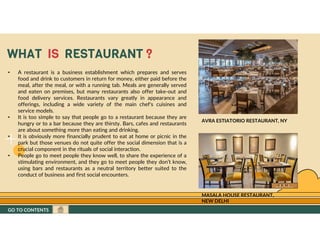
WHAT IS RESTAURANT ?
• A restaurant is a business establishment which prepares and serves
food and drink to customers in return for money, either paid before the
meal, after the meal, or with a running tab. Meals are generally served
and eaten on premises, but many restaurants also offer take-out and
food delivery services. Restaurants vary greatly in appearance and
offerings, including a wide variety of the main chef's cuisines and
service models.
• It is too simple to say that people go to a restaurant because they are
hungry or to a bar because they are thirsty. Bars, cafes and restaurants
are about something more than eating and drinking.
• It is obviously more financially prudent to eat at home or picnic in the
park but those venues do not quite offer the social dimension that is a
crucial component in the rituals of social interaction.
• People go to meet people they know well, to share the experience of a
stimulating environment, and they go to meet people they don’t know,
using bars and restaurants as a neutral territory better suited to the
conduct of business and first social encounters.
AVRA ESTIATORIO RESTAURANT, NY
MASALA HOUSE RESTAURANT,
NEW DELHI
GO TO CONTENTS
GO TO CONTENTS
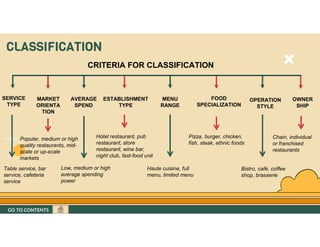
CLASSIFICATION
CRITERIA FOR CLASSIFICATION
SERVICE
TYPE
MARKET
ORIENTA
TION
OWNER
SHIP
OPERATION
STYLE
FOOD
SPECIALIZATION
MENU
RANGE
ESTABLISHMENT
TYPE
AVERAGE
SPEND
Table service, bar
service, cafeteria
service
Popular, medium or high
quality restaurants, mid-
scale or up-scale
markets
Low, medium or high
average spending
power
Hotel restaurant, pub
restaurant, store
restaurant, wine bar,
night club, fast-food unit
Haute cuisine, full
menu, limited menu
Pizza, burger, chicken,
fish, steak, ethnic foods
Bistro, café, coffee
shop, brasserie
Chain, individual
or franchised
restaurants
GO TO CONTENTS
GO TO CONTENTS
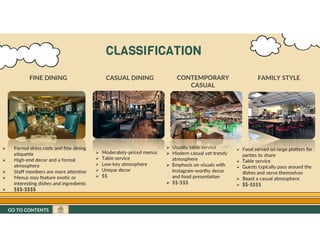
FINE DINING CASUAL DINING CONTEMPORARY
CASUAL
FAMILY STYLE
 Moderately-priced menus
 Table service
 Low-key atmosphere
 Unique decor
 $$
 Formal dress code and fine dining
etiquette
 High-end decor and a formal
atmosphere
 Staff members are more attentive
 Menus may feature exotic or
interesting dishes and ingredients
 $$$-$$$$
 Usually table service
 Modern casual yet trendy
atmosphere
 Emphasis on visuals with
Instagram-worthy decor
and food presentation
 $$-$$$
 Food served on large platters for
parties to share
 Table service
 Guests typically pass around the
dishes and serve themselves
 Boast a casual atmosphere
 $$-$$$$
CLASSIFICATION
GO TO CONTENTS
GO TO CONTENTS
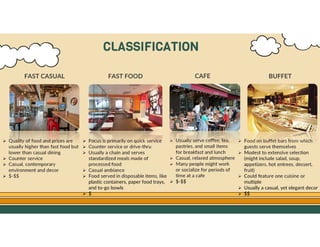
CLASSIFICATION
FAST CASUAL FAST FOOD CAFE BUFFET
 Focus is primarily on quick service
 Counter service or drive-thru
 Usually a chain and serves
standardized meals made of
processed food
 Casual ambiance
 Food served in disposable items, like
plastic containers, paper food trays,
and to-go bowls
 $
 Quality of food and prices are
usually higher than fast food but
lower than casual dining
 Counter service
 Casual, contemporary
environment and decor
 $-$$
 Usually serve coffee, tea,
pastries, and small items
for breakfast and lunch
 Casual, relaxed atmosphere
 Many people might work
or socialize for periods of
time at a cafe
 $-$$
 Food on buffet bars from which
guests serve themselves
 Modest to extensive selection
(might include salad, soup,
appetizers, hot entrees, dessert,
fruit)
 Could feature one cuisine or
multiple
 Usually a casual, yet elegant decor
 $$
GO TO CONTENTS
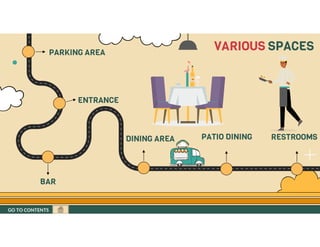
VARIOUS SPACES
PARKING AREA
ENTRANCE
PATIO DINING
DINING AREA
BAR
RESTROOMS
GO TO CONTENTS
GO TO CONTENTS
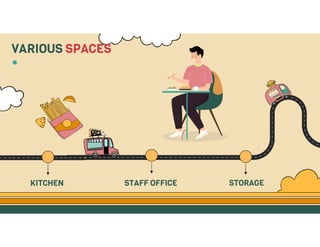
VARIOUS SPACES
KITCHEN STAFF OFFICE STORAGE
GO TO CONTENTS
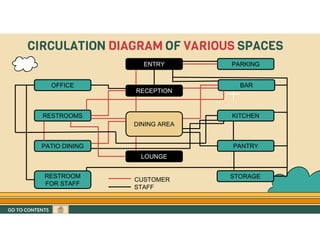
CIRCULATION DIAGRAM OF VARIOUS SPACES
ENTRY
OFFICE
RESTROOMS KITCHEN
RESTROOM
FOR STAFF
PATIO DINING PANTRY
LOUNGE
STORAGE
BAR
RECEPTION
DINING AREA
PARKING
STAFF
CUSTOMER
GO TO CONTENTS
GO TO CONTENTS
ENTRANCE
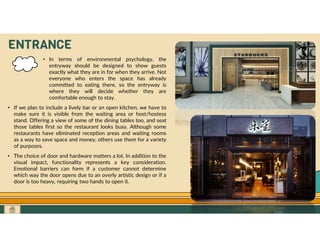
• In terms of environmental psychology, the
entryway should be designed to show guests
exactly what they are in for when they arrive. Not
everyone who enters the space has already
committed to eating there, so the entryway is
where they will decide whether they are
comfortable enough to stay.
• If we plan to include a lively bar or an open kitchen, we have to
make sure it is visible from the waiting area or host/hostess
stand. Offering a view of some of the dining tables too, and seat
those tables first so the restaurant looks busy. Although some
restaurants have eliminated reception areas and waiting rooms
as a way to save space and money, others use them for a variety
of purposes.
• The choice of door and hardware matters a lot. In addition to the
visual impact, functionality represents a key consideration.
Emotional barriers can form if a customer cannot determine
which way the door opens due to an overly artistic design or if a
door is too heavy, requiring two hands to open it.
GO TO CONTENTS
• Design of the entrance needs to express the characteristic of the restaurant and what’s more to attract more diners into the
space, which are both the results of the visual experience. Therefore, to use the composition of point, line, surface or ionic
symbols in the design of entrance could attract the diners’ attention and thus they would desire to go into the space immediately.
• Entry of a restaurant as a buffer zone will bring diners into a completely new environment, from which they could gradually get
an estimation of the dining environment; accordingly, walk routes and layout should be considered in the entrance design.
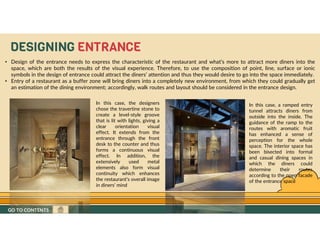
In this case, the designers
chose the travertine stone to
create a level-style groove
that is lit with lights, giving a
clear orientation visual
effect. It extends from the
entrance through the front
desk to the counter and thus
forms a continuous visual
effect. In addition, the
extensively used metal
elements also form visual
continuity which enhances
the restaurant’s overall image
in diners’ mind
In this case, a ramped entry
tunnel attracts diners from
outside into the inside. The
guidance of the ramp to the
routes with aromatic fruit
has enhanced a sense of
perception for the whole
space. The interior space has
been bisected into formal
and casual dining spaces in
which the diners could
determine their routes
according to the open facade
of the entrance space
DESIGNING ENTRANCE
GO TO CONTENTS
GO TO CONTENTS
• Entrance design directly represents the style of a restaurant. It serves as the main focal point and by means of the combination
of modelling and colour as well as texture suggests the tone of the interior space.
• When designing a street-corner entrance, the corner’s form should be considered so that the conspicuous facade can be seen
in all directions and diners can be provided with a good visual experience.
• The open entrance of a restaurant along the street also plays the role of streetscape which would attract passersby in such a
friendly and direct way. A leisure area is always built between the dining area and the entrance and filled with relaxing
atmosphere.
• Sign design of the restaurant entrance emphasises a simple plane composition to express the restaurant’s style and business
philosophy. Form, colour, texture and lighting are the main factors in entrance’s sign design, while the sign should be unified
with the image of facade.
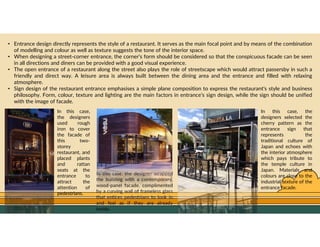
In this case,
the designers
used rough
iron to cover
the facade of
this two-
storey
restaurant, and
placed plants
and rattan
seats at the
entrance to
attract the
attention of
pedestrians.
In this case, the designer wrapped
the building with a contemporary,
wood-panel facade, complimented
by a curving wall of frameless glass
that entices pedestrians to look in
and feel as if they are already
inside.
In this case, the
designers selected the
cherry pattern as the
entrance sign that
represents the
traditional culture of
Japan and echoes with
the interior atmosphere
which pays tribute to
the temple culture in
Japan. Materials and
colours are close to the
industrial texture of the
entrance facade.
GO TO CONTENTS
PARKING
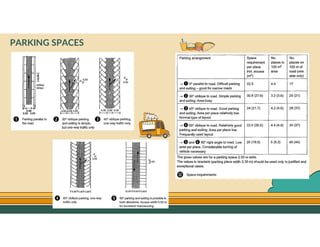
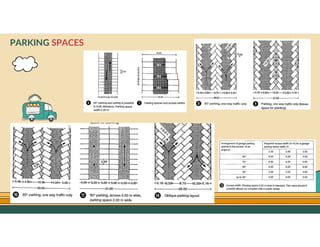
• Ease and availability of parking is a critical issue that
can make or break a restaurant. The parking area may
be both the first, and last, impression the guest has of
a place.
• In most cases, a city ordinance clearly spell out the
space needs for parking. For freestanding buildings, a
widely accepted standard is the need for one parking
space for every 100 square feet of space covered by
roof. This includes patio dining covered by permanent
awnings, for instance, but excludes areas where
umbrellas are used. The space “under roof” includes
all space: hallways, closets, kitchens, bathrooms, and
so on. So if we have a total of 3000 square feet under
roof, we need 30 parking spaces.
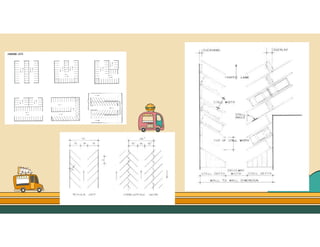
• Most ordinances specify a single parking space must
measure 71 /2 to 10 feet wide and 16 to 18 feet in
length. The shorter dimensions are for compact cars,
and a parking lot may generally allocate up to 35
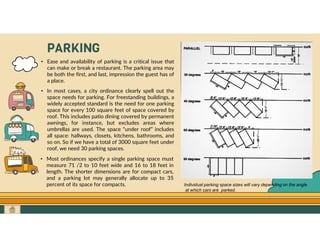
percent of its space for compacts. Individual parking space sizes will vary depending on the angle
at which cars are parked.
GO TO CONTENTS
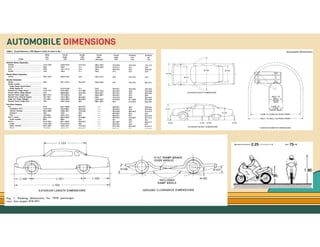
AUTOMOBILE DIMENSIONS
GO TO CONTENTS
PARKING SPACES
GO TO CONTENTS
PARKING SPACES
GO TO CONTENTS
GO TO CONTENTS
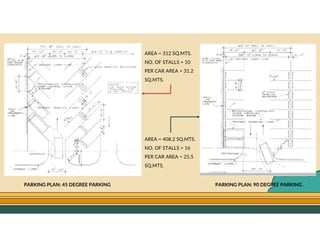
PARKING PLAN: 90 DEGREE PARKING .
PARKING PLAN: 45 DEGREE PARKING
AREA = 312 SQ.MTS.
NO. OF STALLS = 10
PER CAR AREA = 31.2
SQ.MTS.
AREA = 408.2 SQ.MTS.
NO. OF STALLS = 16
PER CAR AREA = 25.5
SQ.MTS.
GO TO CONTENTS
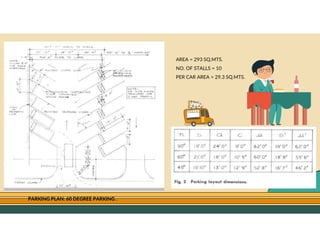
PARKING PLAN: 60 DEGREE PARKING .
AREA = 293 SQ.MTS.
NO. OF STALLS = 10
PER CAR AREA = 29.3 SQ.MTS.
GO TO CONTENTS
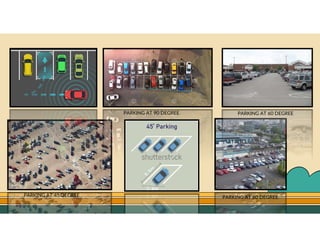
PARKING AT 90 DEGREE
PARKING AT 45 DEGREE PARKING AT 60 DEGREE
PARKING AT 60 DEGREE
GO TO CONTENTS
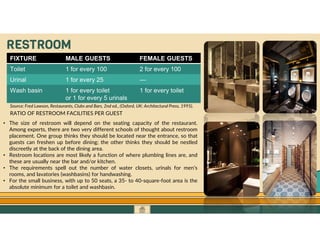
RESTROOM
FIXTURE MALE GUESTS FEMALE GUESTS
Toilet 1 for every 100 2 for every 100
Urinal 1 for every 25 —
Wash basin 1 for every toilet
or 1 for every 5 urinals
1 for every toilet
Source: Fred Lawson, Restaurants, Clubs and Bars, 2nd ed., (Oxford, UK: Architectural Press, 1995).
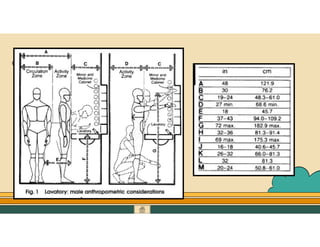
• The size of restroom will depend on the seating capacity of the restaurant.
Among experts, there are two very different schools of thought about restroom
placement. One group thinks they should be located near the entrance, so that
guests can freshen up before dining; the other thinks they should be nestled
discreetly at the back of the dining area.
• Restroom locations are most likely a function of where plumbing lines are, and
these are usually near the bar and/or kitchen.
• The requirements spell out the number of water closets, urinals for men’s
rooms, and lavatories (washbasins) for handwashing.
• For the small business, with up to 50 seats, a 35- to 40-square-foot area is the
absolute minimum for a toilet and washbasin.
RATIO OF RESTROOM FACILITIES PER GUEST
GO TO CONTENTS
RESTROOM
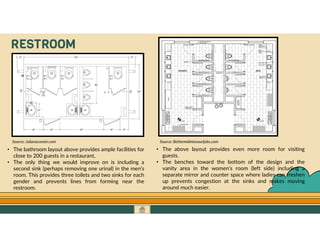
Source: Bettermidmissourijobs.com
Source: Juliavaconsin.com
• The bathroom layout above provides ample facilities for
close to 200 guests in a restaurant,
• The only thing we would improve on is including a
second sink (perhaps removing one urinal) in the men’s
room. This provides three toilets and two sinks for each
gender and prevents lines from forming near the
restroom.
• The above layout provides even more room for visiting
guests.
• The benches toward the bottom of the design and the
vanity area in the women’s room (left side) including a
separate mirror and counter space where ladies can freshen
up prevents congestion at the sinks and makes moving
around much easier.
GO TO CONTENTS
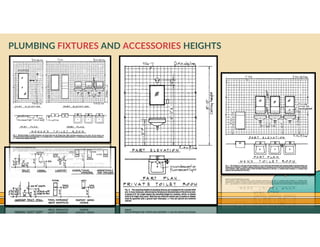
PLUMBING FIXTURES AND ACCESSORIES HEIGHTS
GO TO CONTENTS
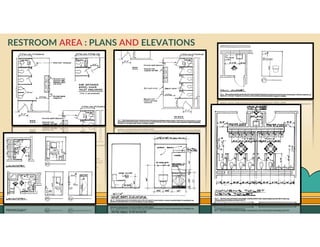
RESTROOM AREA : PLANS AND ELEVATIONS
GO TO CONTENTS
GO TO CONTENTS
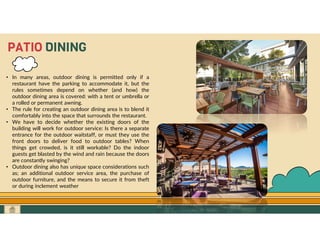
PATIO DINING
• In many areas, outdoor dining is permitted only if a
restaurant have the parking to accommodate it, but the
rules sometimes depend on whether (and how) the
outdoor dining area is covered: with a tent or umbrella or
a rolled or permanent awning.
• The rule for creating an outdoor dining area is to blend it
comfortably into the space that surrounds the restaurant.
• We have to decide whether the existing doors of the
building will work for outdoor service: Is there a separate
entrance for the outdoor waitstaff, or must they use the
front doors to deliver food to outdoor tables? When
things get crowded, is it still workable? Do the indoor
guests get blasted by the wind and rain because the doors
are constantly swinging?
• Outdoor dining also has unique space considerations such
as; an additional outdoor service area, the purchase of
outdoor furniture, and the means to secure it from theft
or during inclement weather
GO TO CONTENTS
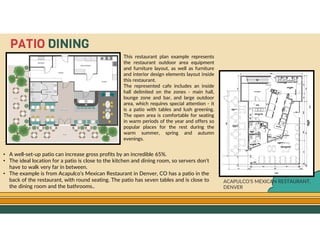
• A well-set-up patio can increase gross profits by an incredible 65%.
• The ideal location for a patio is close to the kitchen and dining room, so servers don’t
have to walk very far in between.
• The example is from Acapulco’s Mexican Restaurant in Denver, CO has a patio in the
back of the restaurant, with round seating. The patio has seven tables and is close to
the dining room and the bathrooms..
PATIO DINING
ACAPULCO’S MEXICAN RESTAURANT,
DENVER
This restaurant plan example represents
the restaurant outdoor area equipment
and furniture layout, as well as furniture
and interior design elements layout inside
this restaurant.
The represented cafe includes an inside
hall delimited on the zones - main hall,
lounge zone and bar, and large outdoor
area, which requires special attention - it
is a patio with tables and lush greening.
The open area is comfortable for seating
in warm periods of the year and offers so
popular places for the rest during the
warm summer, spring and autumn
evenings.
GO TO CONTENTS
SOME EXAMPLES
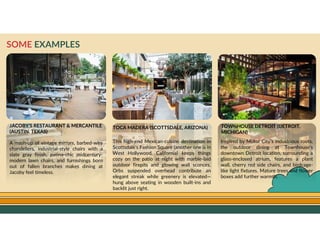
A mash-up of vintage mirrors, barbed-wire
chandeliers, industrial-style chairs with a
slate gray finish, patina-chic midcentury-
modern lawn chairs, and furnishings born
out of fallen branches makes dining at
Jacoby feel timeless.
This high-end Mexican-cuisine destination in
Scottsdale’s Fashion Square (another one is in
West Hollywood, California) keeps things
cozy on the patio at night with marble-laid
outdoor firepits and glowing wall sconces.
Orbs suspended overhead contribute an
elegant streak while greenery is elevated—
hung above seating in wooden built-ins and
backlit just right.
TOCA MADERA (SCOTTSDALE, ARIZONA)
JACOBY’S RESTAURANT & MERCANTILE
(AUSTIN, TEXAS)
TOWNHOUSE DETROIT (DETROIT,
MICHIGAN)
Inspired by Motor City’s industrious roots,
the outdoor dining at Townhouse’s
downtown Detroit location, surrounding a
glass-enclosed atrium, features a plant
wall, cherry red side chairs, and birdcage-
like light fixtures. Mature trees and flower
boxes add further warmth.
GO TO CONTENTS
SOME EXAMPLES
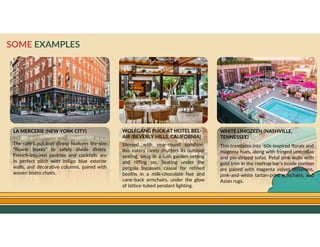
LA MERCERIE (NEW YORK CITY)
The café’s outdoor dining features life-size
“flower boxes” to safely divide diners.
French-inspired pastries and cocktails are
in perfect pitch with indigo blue exterior
walls, and decorative columns, paired with
woven bistro chairs.
WOLFGANG PUCK AT HOTEL BEL-
AIR (BEVERLY HILLS, CALIFORNIA)
Blessed with year-round sunshine,
this eatery rarely shutters its outdoor
seating, snug in a lush garden setting
and riffing on. Seating under the
pergola bypasses casual for refined
booths in a milk-chocolate hue and
cane-back armchairs, under the glow
of lattice-tubed pendant lighting.
WHITE LIMOZEEN (NASHVILLE,
TENNESSEE)
This translates into ’60s-inspired florals and
magenta hues, along with fringed umbrellas
and pin-striped sofas. Petal pink walls with
gold trim in the rooftop bar’s inside portion
are paired with magenta velvet ottomans,
pink-and-white tartan-print armchairs, and
Asian rugs.
GO TO CONTENTS
• The kitchen is the heart of any foodservice business. Like a human heart, its job is to pump
and circulate life-giving blood throughout the rest of the operation. Therefore, kitchen
placement will affect the quality of the food, the number of guests who can dine at any
particular time of day, the roles and workload of the servers as well as kitchen employees,
utility costs, and even the atmosphere of the dining area.
• A poorly designed kitchen can make food preparation and service more difficult than it
should be, and it can even undermine staff morale.
• Each of the next topics must be addressed to make the kitchen a “healthy heart.”
• Sufficient space to perform the required tasks.
1. Space requirements are generally influenced by:
 The number of persons who work in a specific area.
 The amount and types of equipment required in the work area.
 The amount of storage required for immediately accessible supplies.
 The types of products being produced in the area.
 The amount of clearance required for moving equipment, opening appliance doors, and so on.
2. Adequate aisle space.
 If an aisle is not wide enough, employees will struggle to work comfortably in the space, If the
aisle is too wide, employees add steps and fatigue to their workdays. In addition to foot
traffic, there will be rolling carts and equipment around constantly. Overall, however, kitchen
aisles should be at least 36 inches wide, and wider if they carry two-way traffic or mobile cart
traffic.
KITCHEN
GO TO CONTENTS
3. Intelligent design to minimize injury risks. Most people have to do some
reaching, twisting, lifting, and bending to perform their jobs, but if these
motions are repetitive or excessive, they become unnecessarily
strenuous and can prompt injuries, from back problems to carpal tunnel
syndrome. For instance, most culinary tasks require the use of some
type of surface space. It must be the correct height for the task, and
located within easy reach of the employees who will use it.
4. Comfortable temperatures and humidity control. Many restaurant
owners are concerned about making their guests comfortable—but
what about the employees who spend entire workdays there? The ideal
balance of fresh air, humidity, and air movement is to be maintained.
5. Adequate lighting for the required tasks. For kitchens, adequate lighting
includes attention to glare and shadows as well as light levels. Fatigue
sets in and errors multiply when lighting is insufficient; and good
lighting also is necessary to monitor the sanitation of food, surfaces,
and utensils. Ideal lighting conditions are discussed in the coming slides.
6. Noise control and abatement. Kitchens can be noisy places, from chefs
barking orders to the whirring of appliances and the clatter of dish
rooms. It is no longer sufficient just to keep the din from the kitchen
from spilling into the dining area. Proper noise control measures are
discussed in the coming slides.
KITCHEN
GO TO CONTENTS
KITCHEN SPACE FLOW
The kitchen is located away from
the entrance to allow for a large
open seating area and there is good
visual connection between the
kitchen door, the ordering station,
the take-out counter and all the
dining room seating.
For waiters, there are two
entries to the kitchen for
main dishes and a counter
for desserts and coffee.
There are multiple point-
of-service stations within
the seating areas.
A point of
service station
is located at
each end of the
patron space
for short service
distances.
The patron and staff flows are
closer together. To help mitigate
this potential problem, a counter
to the kitchen is shielded with
low partitions to allow for a staff-
only area for easy retrieval and
return of plates.
GO TO CONTENTS
SERVICE SYSTEM
• A major issue that must be addressed before deciding on a kitchen design is the
way in which food will be delivered to guests. This is known as the service system.
• Each service system has subsystems; together, they encompass every aspect of
the progression of food from kitchen, to table, and back to the dishwashing area.
This progression is called flow.
• There are two types of flow to consider when planning your kitchen design:
product flow and traffic flow.
• Product flow is the movement of all food items, from their arrival at the receiving
area, through the kitchen, to the guests.
• Traffic flow is the movement of employees through the building as they go about
their duties.
• The ideal, in both types of flow systems, is to minimize backtracking and
crossovers—again, to make sure the “streets” don’t get clogged.
• There are three basic flow patterns in every foodservice operation:
• The raw materials to create each dish have a back-to-front-to-back flow pattern.
They arrive at the back of the restaurant, in the kitchen, where they are prepared.
Then they travel to the front of the restaurant, to be served in the dining area.
Finally, they return to the back again, as waste.
• The third type of traffic pattern is the flow of the service staff as waiters pick up
food, deliver it to the guests, and clear the tables. On a busy night, the whole
system really does resemble a busy freeway.
GO TO CONTENTS
• A critical decision to be made early in the design process: Should the waitstaff come into
the kitchen to pick up food, or should it be handed to them through a pass window
between kitchen and dining area? Although the pass window is considered informal, it
can be used in a fancier restaurant, perhaps masked from public view by a wall or
partition.
• Each of these items—distance and kitchen access—helps determine your flow patterns.
In a perfect world, flow patterns would all be straight lines that do not intersect. However,
this ideal is rarely achieved. One simple rule of thumb is that the faster you want your
service to be, the more important it is that your flow patterns do not cross.
• Food flow line: the path of raw materials from the time they enter the building to the time
they become leftovers.
• The receiving area is where the food is unloaded from delivery trucks and brought into
the building. Most restaurants locate their receiving areas close to the back door.
• Storage—dry storage, refrigerated storage, or freezer storage—where large quantities of
food are held at the proper temperatures until needed. Food that emerges from storage
goes to one of several preparation, or prep, areas for vegetables, meats, or salad items.
Slicing and dicing take place here, to prepare the food for its next stop: the production
area.
• The size and function of the prep area varies widely, depending mostly on the style of
service and type of kitchen. When most people think of a restaurant kitchen, what they
imagine is the production line. Here the food is given its final form prior to serving:
Boiling, sauteing, frying, baking, broiling, and steaming are the major activities of this
area. The food is plated and garnished before it heads out the door on a serving tray.
And that’s the end of the typical food flow line.
SERVICE SYSTEM
STORAGE AREA
WORKING STAFF IN KITCHEN
GO TO CONTENTS
FLOW AND KITCHEN DESIGN
• The most basic, and most desirable, flow
plan is the straight line, also called the
assembly-line flow. Materials move steadily
from one process to another in a straight
line. This type of design minimizes
backtracking; it saves preparation time and
confusion about what’s going out of the
kitchen and what’s coming back in. The
straight-line arrangement works well for
small installations because it can be placed
against a wall and adapted to the cooks’
duties.
Straight-line arrangement
In a straight-line or assembly-line kitchen, food and materials are passed
from one work center to another in a straight line.
Source: Robert A. Modlin, ed., Commercial Kitchens, 7th ed. (Arlington, VA: American Gas Association,
1989).
• Where there is not enough space to arrange
food preparation in a straight line, a popular
and efficient choice is the parallel flow.
• There are four variations of the parallel
design:
1. Back to back
2. Face to face
3. L-shape
4. U-shape
GO TO CONTENTS
1. Back to back. Equipment is arranged in a long, central
counter or island in two straight lines that run parallel to
each other. Sometimes a four or five-foot room divider or
low wall is placed between the two lines. It’s primarily a
safety precaution, which keeps noise and clutter to a
minimum and prevents liquids spilled on one side from
spreading onto the other. However, placement of a wall
here also makes cleaning and sanitation more difficult.
• The back-to-back arrangement centralizes plumbing and
utilities; we may not have to install as many drains, sinks, or
outlets, as both sides of the counter can share the same
ones. A back-to-back arrangement in which the pass
window is parallel to (and behind one of) the production
areas is sometimes known as a California-style kitchen.
• When the pass window is located perpendicular to the
production line, it may be referred to as a European-style
kitchen design. The advantage of the European design is
that each cook on the line can see the progression of
multiple dishes that make up one table’s order.
FLOW AND KITCHEN DESIGN
In a parallel flow configuration, equipment and work centers
are arranged to save space and allow efficient movement of
product and workers.
Source: Robert A. Modlin, ed., Commercial Kitchens, 7th ed. (Arlington, VA:
American Gas Association, 1989).
GO TO CONTENTS
1. Face to face. In this kitchen configuration, a central aisle
separates two straight lines of equipment on either side of
the room. Sometimes the aisle is wide enough to add a
straight line of worktables between the two rows of
equipment. This setup works well for high volume feeding
facilities like schools and hospitals, but it does not take
advantage of single source utilities. Although it is a good
layout for supervision of workers, it forces people to work
with their backs to one another, in effect, separating the
cooking of the food from the rest of the distribution process.
Therefore, it’s probably not the best design for a restaurant.
2. L-shape. Where space is not sufficient for a straight-line or
parallel arrangement, the L-shape kitchen design is well
suited to access several groups of equipment, and is
adaptable for table service restaurants. It gives you the
ability to place more equipment in a smaller space. You’ll
often find an L-shape design in dishwashing areas, with the
dish machine placed at the center corner of the L.
3. U-shape. This arrangement is seldom used, but it is ideal for
a small space with one or two employees, such as a salad
preparation or pantry area.
The L-shape kitchen layout works well in long, rectangular
spaces and allows more equipment to be placed in a smaller
area
Source: Robert A. Modlin, ed., Commercial Kitchens, 7th ed. (Arlington, VA:
American Gas Association, 1989)
GO TO CONTENTS
PREPARATION AREAS
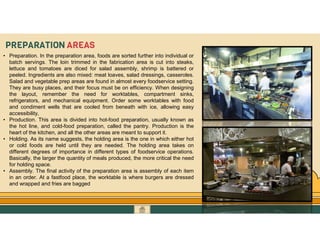
• Preparation. In the preparation area, foods are sorted further into individual or
batch servings. The loin trimmed in the fabrication area is cut into steaks,
lettuce and tomatoes are diced for salad assembly, shrimp is battered or
peeled. Ingredients are also mixed: meat loaves, salad dressings, casseroles.
Salad and vegetable prep areas are found in almost every foodservice setting.
They are busy places, and their focus must be on efficiency. When designing
the layout, remember the need for worktables, compartment sinks,
refrigerators, and mechanical equipment. Order some worktables with food
and condiment wells that are cooled from beneath with ice, allowing easy
accessibility,
• Production. This area is divided into hot-food preparation, usually known as
the hot line, and cold-food preparation, called the pantry. Production is the
heart of the kitchen, and all the other areas are meant to support it.
• Holding. As its name suggests, the holding area is the one in which either hot
or cold foods are held until they are needed. The holding area takes on
different degrees of importance in different types of foodservice operations.
Basically, the larger the quantity of meals produced, the more critical the need
for holding space.
• Assembly. The final activity of the preparation area is assembly of each item
in an order. At a fastfood place, the worktable is where burgers are dressed
and wrapped and fries are bagged
GO TO CONTENTS
PRODUCTION AREAS
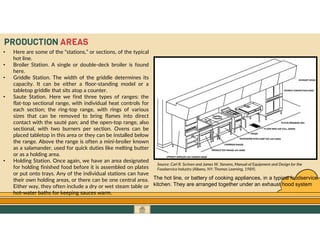
• Here are some of the “stations,” or sections, of the typical
hot line.
• Broiler Station. A single or double-deck broiler is found
here.
• Griddle Station. The width of the griddle determines its
capacity. It can be either a floor-standing model or a
tabletop griddle that sits atop a counter.
• Saute Station. Here we find three types of ranges: the
flat-top sectional range, with individual heat controls for
each section; the ring-top range, with rings of various
sizes that can be removed to bring flames into direct
contact with the sauté pan; and the open-top range, also
sectional, with two burners per section. Ovens can be
placed tabletop in this area or they can be installed below
the range. Above the range is often a mini-broiler known
as a salamander, used for quick duties like melting butter
or as a holding area.
• Holding Station. Once again, we have an area designated
for holding finished food before it is assembled on plates
or put onto trays. Any of the individual stations can have
their own holding areas, or there can be one central area.
Either way, they often include a dry or wet steam table or
hot-water baths for keeping sauces warm.
The hot line, or battery of cooking appliances, in a typical foodservice
kitchen. They are arranged together under an exhaust hood system
Source: Carl R. Scriven and James W. Stevens, Manual of Equipment and Design for the
Foodservice Industry (Albany, NY: Thomas Learning, 1989).
GO TO CONTENTS
PANTRY
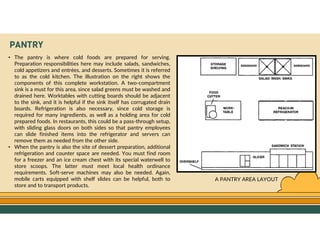
• The pantry is where cold foods are prepared for serving.
Preparation responsibilities here may include salads, sandwiches,
cold appetizers and entrées, and desserts. Sometimes it is referred
to as the cold kitchen. The illustration on the right shows the
components of this complete workstation. A two-compartment
sink is a must for this area, since salad greens must be washed and
drained here. Worktables with cutting boards should be adjacent
to the sink, and it is helpful if the sink itself has corrugated drain
boards. Refrigeration is also necessary, since cold storage is
required for many ingredients, as well as a holding area for cold
prepared foods. In restaurants, this could be a pass-through setup,
with sliding glass doors on both sides so that pantry employees
can slide finished items into the refrigerator and servers can
remove them as needed from the other side.
• When the pantry is also the site of dessert preparation, additional
refrigeration and counter space are needed. You must find room
for a freezer and an ice cream chest with its special waterwell to
store scoops. The latter must meet local health ordinance
requirements. Soft-serve machines may also be needed. Again,
mobile carts equipped with shelf slides can be helpful, both to
store and to transport products.
A PANTRY AREA LAYOUT
GO TO CONTENTS
BAKERY AREA
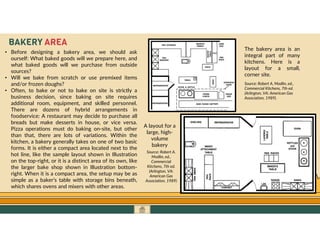
• Before designing a bakery area, we should ask
ourself: What baked goods will we prepare here, and
what baked goods will we purchase from outside
sources?
• Will we bake from scratch or use premixed items
and/or frozen doughs?
• Often, to bake or not to bake on site is strictly a
business decision, since baking on site requires
additional room, equipment, and skilled personnel.
There are dozens of hybrid arrangements in
foodservice: A restaurant may decide to purchase all
breads but make desserts in house, or vice versa.
Pizza operations must do baking on-site, but other
than that, there are lots of variations. Within the
kitchen, a bakery generally takes on one of two basic
forms. It is either a compact area located next to the
hot line, like the sample layout shown in Illustration
on the top-right, or it is a distinct area of its own, like
the larger bake shop shown in Illustration bottom-
right. When it is a compact area, the setup may be as
simple as a baker’s table with storage bins beneath,
which shares ovens and mixers with other areas.
The bakery area is an
integral part of many
kitchens. Here is a
layout for a small,
corner site.
Source: Robert A. Modlin, ed.,
Commercial Kitchens, 7th ed.
(Arlington, VA: American Gas
Association, 1989).
A layout for a
large, high-
volume
bakery
Source: Robert A.
Modlin, ed.,
Commercial
Kitchens, 7th ed.
(Arlington, VA:
American Gas
Association, 1989)
GO TO CONTENTS
WAREWASHING AREA
• Warewashing is the term for collecting soiled dishes, glasses, flatware, pots, and pans and
scraping, rinsing, sanitizing, and drying them. It is by far the most necessary, and least
exciting, part of the foodservice business. Whether dishes are done by hand or by
machine, or a combination of both, it’s a messy job with high temperatures, high humidity,
and slippery floors that require constant caution. For the restaurant owner, this is also one
of the most costly areas to operate. Labor (and high turnover), utilities, and equipment are
all expensive, and breakage can account for 10 to 15 percent of dish room expenses.
• A smooth, short flow pattern from dining room to dish room will keep breakage to a
minimum and lower labor costs. You’ll need to find the shortest route that minimizes the
natural noise and clatter of working with dishes, and also keeps them out of the guests’
sight as much as possible. In institutional settings, the dish room should be placed in the
flow pattern of outgoing guests, so as not to interfere with the incoming ones. A conveyor
belt or placement of walls or partitions can minimize contact with dish room sights and
sounds.
• In determining the size of your dish room, consider the size of the dining room. Remember
that each person served will generate six to eight dirty dish items. Calculate how many full
dish racks your dish machine can process in one hour. Finally, realize that the best dish
rooms are, on average, working at 70 percent efficiency.
• Nonslip floors and adequate drainage are necessities. Usually city ordinances also specify
lighting requirements (70 to 100 foot-candles of brightness) and govern the ventilation
system. Dish machines generate so much heat and humidity that proper ventilation is
necessary for employee comfort; as a bonus, it also helps clean dishes dry faster.
Acoustical tile for walls and ceilings is important in this area, to keep dish room noise from
spilling into the dining area.
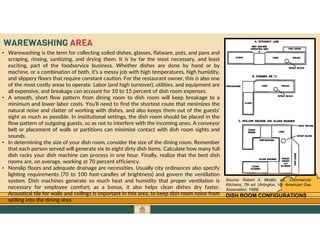
DISH ROOM CONFIGURATIONS
Source: Robert A. Modlin, ed., Commercial
Kitchens, 7th ed. (Arlington, VA: American Gas
Association, 1989)
GO TO CONTENTS
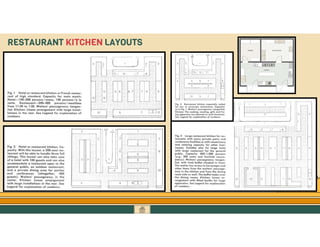
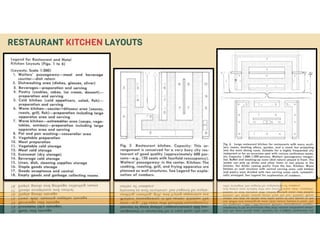
RESTAURANT KITCHEN LAYOUTS
GO TO CONTENTS
RESTAURANT KITCHEN LAYOUTS
GO TO CONTENTS
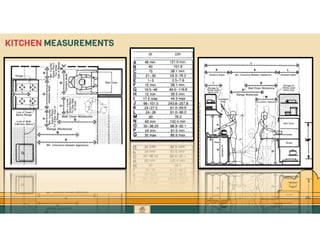
KITCHEN MEASUREMENTS
GO TO CONTENTS
DINING AREA
• When designing the dining area, a well-planned scheme carefully shapes the
customer’s perception with these components:
1. Table shapes, sizes, and positions
2. Number of seats at each table
3. Multiple floors, steps, or elevated areas of seating
4. Paintings, posters, or murals
5. Type and intensity of lighting
6. Planters, partitions, or screens
7. Attention to sight lines, to block any undesirable view (restroom, kitchen, service areas)
8. Muffling of distracting noises (clattering dishes, outside traffic, or construction)
9. Placement of service areas (coffee stations, dirty dish bins, etc.)
• Even though other facets of design can be out of the ordinary, when it comes to flow patterns, the simpler the better. Customer
and employee safety should be paramount. Remember that most of us tend to walk to the right of other, oncoming persons.
Think of the room as a neighborhood and the flow as the major streets in that neighborhood. Avoid traffic congestion, and
everybody likes living there. Consider the maximum number of seats allowed in the space as well as the average time you want
customers to spend at a table. Generally, the faster the turnover, the greater the need for clear flow patterns that do not cross.
Conversely, if dining is to be leisurely, flow should be designed mostly to make the waitstaff seem as unobtrusive as possible. In
terms of environmental psychology, most people would rather sit with some type of architectural fixture on at least one side of
them—a wall or window or column—which helps them define their space. Another design rule is that tables of different shapes
and sizes should be mixed to create visual harmony. A lineup that’s too orderly evokes more of a military mess hall image.
GO TO CONTENTS
TABLES AND SEATING
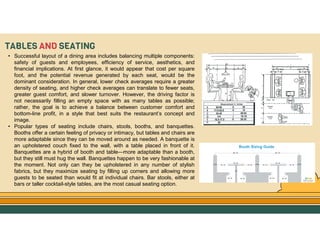
• Successful layout of a dining area includes balancing multiple components:
safety of guests and employees, efficiency of service, aesthetics, and
financial implications. At first glance, it would appear that cost per square
foot, and the potential revenue generated by each seat, would be the
dominant consideration. In general, lower check averages require a greater
density of seating, and higher check averages can translate to fewer seats,
greater guest comfort, and slower turnover. However, the driving factor is
not necessarily filling an empty space with as many tables as possible;
rather, the goal is to achieve a balance between customer comfort and
bottom-line profit, in a style that best suits the restaurant’s concept and
image.
• Popular types of seating include chairs, stools, booths, and banquettes.
Booths offer a certain feeling of privacy or intimacy, but tables and chairs are
more adaptable since they can be moved around as needed. A banquette is
an upholstered couch fixed to the wall, with a table placed in front of it.
Banquettes are a hybrid of booth and table—more adaptable than a booth,
but they still must hug the wall. Banquettes happen to be very fashionable at
the moment. Not only can they be upholstered in any number of stylish
fabrics, but they maximize seating by filling up corners and allowing more
guests to be seated than would fit at individual chairs. Bar stools, either at
bars or taller cocktail-style tables, are the most casual seating option.
GO TO CONTENTS
CHAIRS
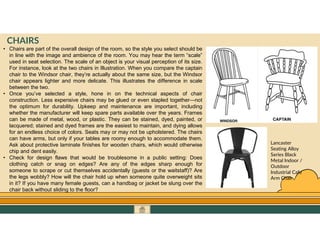
• Chairs are part of the overall design of the room, so the style you select should be
in line with the image and ambience of the room. You may hear the term “scale”
used in seat selection. The scale of an object is your visual perception of its size.
For instance, look at the two chairs in Illustration. When you compare the captain
chair to the Windsor chair, they’re actually about the same size, but the Windsor
chair appears lighter and more delicate. This illustrates the difference in scale
between the two.
• Once you’ve selected a style, hone in on the technical aspects of chair
construction. Less expensive chairs may be glued or even stapled together—not
the optimum for durability. Upkeep and maintenance are important, including
whether the manufacturer will keep spare parts available over the years. Frames
can be made of metal, wood, or plastic. They can be stained, dyed, painted, or
lacquered; stained and dyed frames are the easiest to maintain, and dying allows
for an endless choice of colors. Seats may or may not be upholstered. The chairs
can have arms, but only if your tables are roomy enough to accommodate them.
Ask about protective laminate finishes for wooden chairs, which would otherwise
chip and dent easily.
• Check for design flaws that would be troublesome in a public setting: Does
clothing catch or snag on edges? Are any of the edges sharp enough for
someone to scrape or cut themselves accidentally (guests or the waitstaff)? Are
the legs wobbly? How will the chair hold up when someone quite overweight sits
in it? If you have many female guests, can a handbag or jacket be slung over the
chair back without sliding to the floor?
Lancaster
Seating Alloy
Series Black
Metal Indoor /
Outdoor
Industrial Cafe
Arm Chair
GO TO CONTENTS
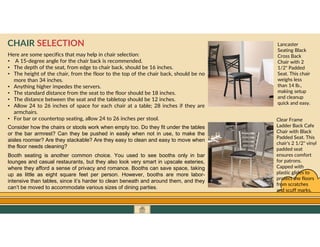
Here are some specifics that may help in chair selection:
• A 15-degree angle for the chair back is recommended.
• The depth of the seat, from edge to chair back, should be 16 inches.
• The height of the chair, from the floor to the top of the chair back, should be no
more than 34 inches.
• Anything higher impedes the servers.
• The standard distance from the seat to the floor should be 18 inches.
• The distance between the seat and the tabletop should be 12 inches.
• Allow 24 to 26 inches of space for each chair at a table; 28 inches if they are
armchairs.
• For bar or countertop seating, allow 24 to 26 inches per stool.
CHAIR SELECTION
Consider how the chairs or stools work when empty too. Do they fit under the tables
or the bar armrest? Can they be pushed in easily when not in use, to make the
aisles roomier? Are they stackable? Are they easy to clean and easy to move when
the floor needs cleaning?
Booth seating is another common choice. You used to see booths only in bar
lounges and casual restaurants, but they also look very smart in upscale eateries,
where they afford a sense of privacy and romance. Booths can save space, taking
up as little as eight square feet per person. However, booths are more labor-
intensive than tables, since it’s harder to clean beneath and around them, and they
can’t be moved to accommodate various sizes of dining parties.
Lancaster
Seating Black
Cross Back
Chair with 2
1/2" Padded
Seat. This chair
weighs less
than 14 lb.,
making setup
and cleanup
quick and easy.
Clear Frame
Ladder Back Cafe
Chair with Black
Padded Seat. This
chair's 2 1/2" vinyl
padded seat
ensures comfort
for patrons.
Capped with
plastic glides to
protect the floors
from scratches
and scuff marks.
GO TO CONTENTS
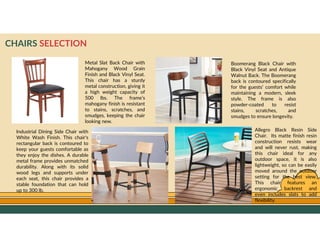
Metal Slat Back Chair with
Mahogany Wood Grain
Finish and Black Vinyl Seat.
This chair has a sturdy
metal construction, giving it
a high weight capacity of
500 lbs. The frame’s
mahogany finish is resistant
to stains, scratches, and
smudges, keeping the chair
looking new.
Boomerang Black Chair with
Black Vinyl Seat and Antique
Walnut Back. The Boomerang
back is contoured specifically
for the guests’ comfort while
maintaining a modern, sleek
style. The frame is also
powder-coated to resist
stains, scratches, and
smudges to ensure longevity.
Industrial Dining Side Chair with
White Wash Finish. This chair's
rectangular back is contoured to
keep your guests comfortable as
they enjoy the dishes. A durable
metal frame provides unmatched
durability. Along with its solid
wood legs and supports under
each seat, this chair provides a
stable foundation that can hold
up to 300 lb.
Allegro Black Resin Side
Chair. Its matte finish resin
construction resists wear
and will never rust, making
this chair ideal for any
outdoor space, it is also
lightweight, so can be easily
moved around the outdoor
setting for the best view.
This chair features an
ergonomic backrest and
even includes slats to add
flexibility.
CHAIRS SELECTION
GO TO CONTENTS
TABLE SELECTION
• Deciding on your overall dining atmosphere will help greatly in table selection. Space usually dictates how many tables you will
need, and, in most cases, you can get more square tables than round ones in the same square footage. Research shows square
tables also seem to produce faster turnover, while round ones prompt guests to linger a bit longer. Attention to aesthetics may
require that you blend both square and round tables in your dining area, arranging them at different angles to avoid that mess
hall look. The more upscale a restaurant is, the more elbow room you allocate for each customer. A fine-dining establishment
should allow 15 to 18 square feet per guest; a moderately priced restaurant, 12 feet per guest; for banquets, a minimum of 10
square feet per person. When purchasing tables, check for sturdy construction. You want long use and solid service from them.
Self-leveling legs or bases allow you to adjust for wobbles and also permit the table to glide easily along the floor if it needs to be
moved.
• Think about whether you will cover the tables with linens, butcher paper, or nothing at all. but you must make an early decision
about the type of finish you want on your tables, especially if you won’t be using tablecloths. There’s a world of choices, from
marble, wood, and ceramic to the durable plastic laminates such as Formica and Corian, which are stain-resistant and easy to
maintain. Nowadays they come in many patterns, including faux marble, which would work even in an upscale restaurant setting.
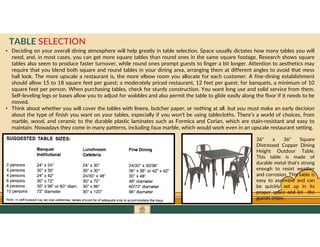
36" x 36" Square
Distressed Copper Dining
Height Outdoor Table.
This table is made of
durable metal that's strong
enough to resist weather
and corrosion. This table is
easy to assemble and can
be quickly set up in its
proper space and let the
guests enjoy.
GO TO CONTENTS
• No matter what you decide, a table should have a
waterproof top, and its base should be placed to give
your customers a comfortable amount of legroom
beneath. If lighting will be low and your tables will be
draped, a simple pedestal-style base is appropriate.
However, if the dining space is airy and open and the
tables will not have cloths, the style of the table base
can be part of your design. Tables should be chosen in
tandem with chairs, since they will be used together.
For example, tables that are 26 inches tall work best
with chairs that measure 16 inches from seat to floor;
30-inch tall tables work best with chairs that measure
18 inches from seat to floor.
• Table bases don’t just come in chrome, brass, or black
enamel anymore. Today’s trends range from fire engine
red and deep evergreen to plated finishes of copper,
pewter, or bronze. Those little feet at the bottom of the
base that hold the table steady also come in different
styles. You’ll probably choose between the so-called
four-pronged spider base and the cylindrical mushroom
base.
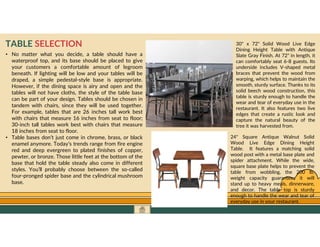
TABLE SELECTION 30" x 72" Solid Wood Live Edge
Dining Height Table with Antique
Slate Gray Finish. At 72" in length, it
can comfortably seat 6-8 guests. Its
underside includes V-shaped metal
braces that prevent the wood from
warping, which helps to maintain the
smooth, sturdy surface. Thanks to its
solid beech wood construction, this
table is sturdy enough to handle the
wear and tear of everyday use in the
restaurant. It also features two live
edges that create a rustic look and
capture the natural beauty of the
tree it was harvested from.
24" Square Antique Walnut Solid
Wood Live Edge Dining Height
Table. It features a matching solid
wood post with a metal base plate and
spider attachment. While the wide,
square base plate helps to prevent the
table from wobbling, the 200 lb.
weight capacity guarantees it will
stand up to heavy meals, dinnerware,
and decor. The table top is sturdy
enough to handle the wear and tear of
everyday use in your restaurant.
GO TO CONTENTS
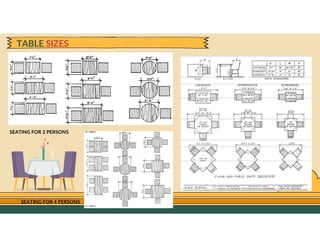
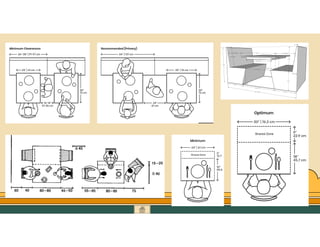
The table, from floor to tabletop, should be 30
inches in height. Here are some basic table sizes
and uses:
• For one or two guests: a 24-by-30-inch square
table, also known as a two-top or deuce.
• For three or four guests: a 36-by-36-inch
square table; a 30-by-48-inch rectangular table,
commonly called a four-top; or a 42-inch-
diameter round table. (There are 36-inch-
diameter round tables, but they’re a tight fit for
four persons.)
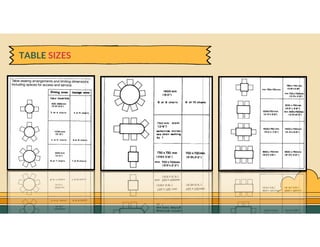
• For five or six guests: a two-top and four-top
can be joined to create seating for up to six; or
use a 48-inch-diameter or 54-inch-diameter
round table.
• For seven or eight guests: two four-top tables
can be joined; or use a 72-inchdiameter round
table.
• For cocktail lounges: a 20-by-20-inch square
table; or a 20-inch-diameter round table.
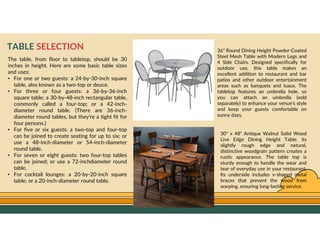
36" Round Dining Height Powder-Coated
Steel Mesh Table with Modern Legs and
4 Side Chairs. Designed specifically for
outdoor use, this table makes an
excellent addition to restaurant and bar
patios and other outdoor entertainment
areas such as banquets and luaus. The
tabletop features an umbrella hole, so
you can attach an umbrella (sold
separately) to enhance your venue's style
and keep your guests comfortable on
sunny days.
30" x 48" Antique Walnut Solid Wood
Live Edge Dining Height Table. its
slightly rough edge and natural,
distinctive woodgrain pattern creates a
rustic appearance. The table top is
sturdy enough to handle the wear and
tear of everyday use in your restaurant.
Its underside includes v-shaped metal
braces that prevent the wood from
warping, ensuring long-lasting service.
TABLE SELECTION
GO TO CONTENTS
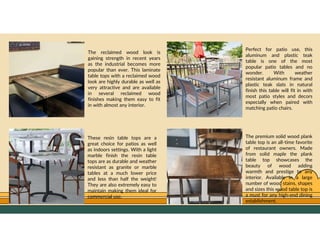
The premium solid wood plank
table top is an all-time favorite
of restaurant owners. Made
from solid maple the plank
table top showcases the
beauty of wood adding
warmth and prestige to any
interior. Available in a large
number of wood stains, shapes
and sizes this wood table top is
a must for any high-end dining
establishment.
These resin table tops are a
great choice for patios as well
as indoors settings. With a light
marble finish the resin table
tops are as durable and weather
resistant as granite or marble
tables at a much lower price
and less than half the weight!
They are also extremely easy to
maintain making them ideal for
commercial use.
The reclaimed wood look is
gaining strength in recent years
as the industrial becomes more
popular than ever. This laminate
table tops with a reclaimed wood
look are highly durable as well as
very attractive and are available
in several reclaimed wood
finishes making them easy to fit
in with almost any interior.
Perfect for patio use, this
aluminum and plastic teak
table is one of the most
popular patio tables and no
wonder. With weather
resistant aluminum frame and
plastic teak slats in natural
finish this table will fit in with
most patio styles and decors
especially when paired with
matching patio chairs.
GO TO CONTENTS
SEATING FOR 2 PERSONS
SEATING FOR 4 PERSONS
TABLE SIZES
GO TO CONTENTS
TABLE SIZES
GO TO CONTENTS
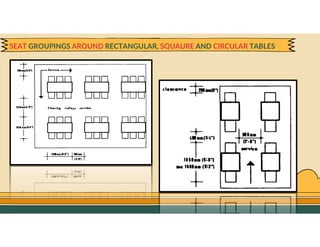
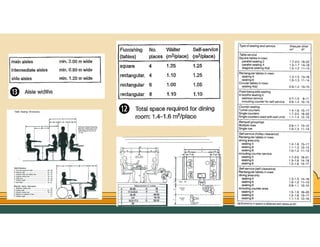
SEAT GROUPINGS AROUND RECTANGULAR, SQUAURE AND CIRCULAR TABLES
GO TO CONTENTS
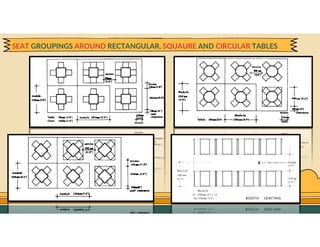
SEAT GROUPINGS AROUND RECTANGULAR, SQUAURE AND CIRCULAR TABLES
GO TO CONTENTS
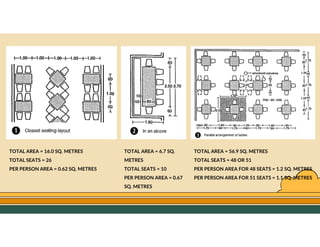
TOTAL AREA = 16.0 SQ. METRES
TOTAL SEATS = 26
PER PERSON AREA = 0.62 SQ. METRES
TOTAL AREA = 6.7 SQ.
METRES
TOTAL SEATS = 10
PER PERSON AREA = 0.67
SQ. METRES
TOTAL AREA = 56.9 SQ. METRES
TOTAL SEATS = 48 OR 51
PER PERSON AREA FOR 48 SEATS = 1.2 SQ. METRES
PER PERSON AREA FOR 51 SEATS = 1.1 SQ. METRES
GO TO CONTENTS
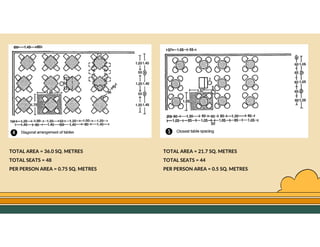
TOTAL AREA = 36.0 SQ. METRES
TOTAL SEATS = 48
PER PERSON AREA = 0.75 SQ. METRES
TOTAL AREA = 21.7 SQ. METRES
TOTAL SEATS = 44
PER PERSON AREA = 0.5 SQ. METRES
GO TO CONTENTS
GO TO CONTENTS
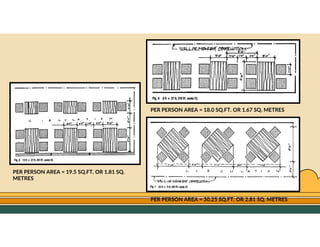
PER PERSON AREA = 19.5 SQ.FT. OR 1.81 SQ.
METRES
PER PERSON AREA = 30.25 SQ.FT. OR 2.81 SQ. METRES
PER PERSON AREA = 18.0 SQ.FT. OR 1.67 SQ. METRES
GO TO CONTENTS
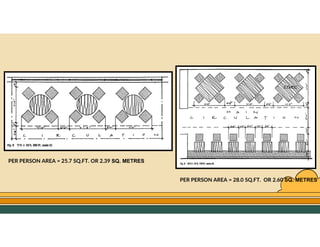
PER PERSON AREA = 28.0 SQ.FT. OR 2.60 SQ. METRES
PER PERSON AREA = 25.7 SQ.FT. OR 2.39 SQ. METRES
GO TO CONTENTS
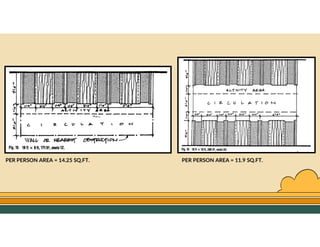
PER PERSON AREA = 14.25 SQ.FT. PER PERSON AREA = 11.9 SQ.FT.
GO TO CONTENTS
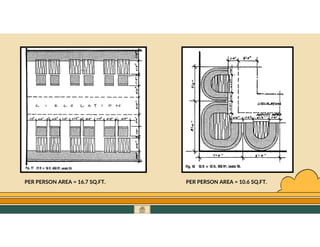
PER PERSON AREA = 10.6 SQ.FT.
PER PERSON AREA = 16.7 SQ.FT.
GO TO CONTENTS
GO TO CONTENTS
GO TO CONTENTS
DESIGNING THE ENVIRONMENT
• For the guest, a restaurant’s environment refers to the things that make him or
her feel welcome, comfortable, and secure. For the employee, environment
means a safe, comfortable, and productive work setting. And today’s
foodservice business owner has yet another critical consideration: the
environment of the planet. More attention than ever is being paid to energy
conservation, waste reduction, and pollution control in our industry. In some
cases, restaurants that don’t heed these important trends face legal penalties,
or even closure.
• Luckily, with some forethought and expert advice, every component of the
dining environment can be designed with conservation in mind as well as safety
and atmosphere.
• In the coming slides we’ll discuss about the below listed considerations, their
ideal ranges and importance in designing the ideal environment for a restaurant.
1. Lighting
2. Color
3. Noise levels
4. Temperature and humidity
5. Ventilation and indoor air quality
6. Air pollution control
7. Theme and interior design
8. Finishing materials
GO TO CONTENTS
LIGHTING
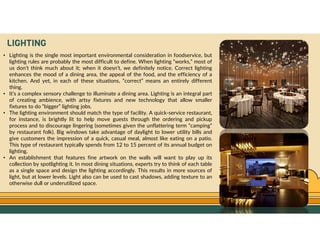
• Lighting is the single most important environmental consideration in foodservice, but
lighting rules are probably the most difficult to define. When lighting “works,” most of
us don’t think much about it; when it doesn’t, we definitely notice. Correct lighting
enhances the mood of a dining area, the appeal of the food, and the efficiency of a
kitchen. And yet, in each of these situations, “correct” means an entirely different
thing.
• It’s a complex sensory challenge to illuminate a dining area. Lighting is an integral part
of creating ambience, with artsy fixtures and new technology that allow smaller
fixtures to do “bigger” lighting jobs.
• The lighting environment should match the type of facility. A quick-service restaurant,
for instance, is brightly lit to help move guests through the ordering and pickup
process and to discourage lingering (sometimes given the unflattering term “camping”
by restaurant folk). Big windows take advantage of daylight to lower utility bills and
give customers the impression of a quick, casual meal, almost like eating on a patio.
This type of restaurant typically spends from 12 to 15 percent of its annual budget on
lighting.
• An establishment that features fine artwork on the walls will want to play up its
collection by spotlighting it. In most dining situations, experts try to think of each table
as a single space and design the lighting accordingly. This results in more sources of
light, but at lower levels. Light also can be used to cast shadows, adding texture to an
otherwise dull or underutilized space.
GO TO CONTENTS
LIGHTING
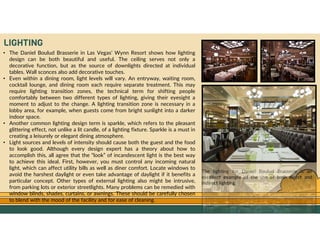
• The Daniel Boulud Brasserie in Las Vegas’ Wynn Resort shows how lighting
design can be both beautiful and useful. The ceiling serves not only a
decorative function, but as the source of downlights directed at individual
tables. Wall sconces also add decorative touches.
• Even within a dining room, light levels will vary. An entryway, waiting room,
cocktail lounge, and dining room each require separate treatment. This may
require lighting transition zones, the technical term for shifting people
comfortably between two different types of lighting, giving their eyesight a
moment to adjust to the change. A lighting transition zone is necessary in a
lobby area, for example, when guests come from bright sunlight into a darker
indoor space.
• Another common lighting design term is sparkle, which refers to the pleasant
glittering effect, not unlike a lit candle, of a lighting fixture. Sparkle is a must in
creating a leisurely or elegant dining atmosphere.
• Light sources and levels of intensity should cause both the guest and the food
to look good. Although every design expert has a theory about how to
accomplish this, all agree that the “look” of incandescent light is the best way
to achieve this ideal. First, however, you must control any incoming natural
light, which can affect utility bills as well as diner comfort. Locate windows to
avoid the harshest daylight or even take advantage of daylight if it benefits a
particular concept. Other types of external lighting also might be intrusive,
from parking lots or exterior streetlights. Many problems can be remedied with
window blinds, shades, curtains, or awnings. These should be carefully chosen
to blend with the mood of the facility and for ease of cleaning.
The lighting for Daniel Boulud Brasserie is an
excellent example of the use of both direct and
indirect lighting.
GO TO CONTENTS
LIGHTING
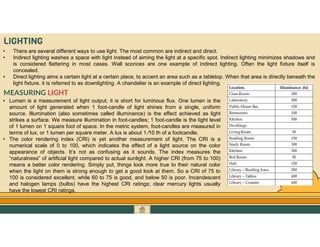
• There are several different ways to use light. The most common are indirect and direct.
• Indirect lighting washes a space with light instead of aiming the light at a specific spot. Indirect lighting minimizes shadows and
is considered flattering in most cases. Wall sconces are one example of indirect lighting. Often the light fixture itself is
concealed.
• Direct lighting aims a certain light at a certain place, to accent an area such as a tabletop. When that area is directly beneath the
light fixture, it is referred to as downlighting. A chandelier is an example of direct lighting.
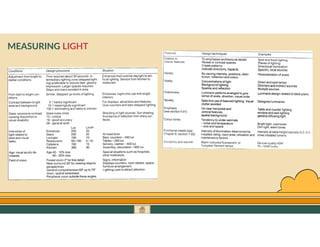
MEASURING LIGHT
• Lumen is a measurement of light output; it is short for luminous flux. One lumen is the
amount of light generated when 1 foot-candle of light shines from a single, uniform
source. Illumination (also sometimes called illuminance) is the effect achieved as light
strikes a surface. We measure illumination in foot-candles; 1 foot-candle is the light level
of 1 lumen on 1 square foot of space. In the metric system, foot-candles are measured in
terms of lux, or 1 lumen per square meter. A lux is about 1 10 th of a footcandle.
• The color rendering index (CRI) is yet another measurement of light. The CRI is a
numerical scale of 0 to 100, which indicates the effect of a light source on the color
appearance of objects. It’s not as confusing as it sounds. The index measures the
“naturalness” of artificial light compared to actual sunlight. A higher CRI (from 75 to 100)
means a better color rendering. Simply put, things look more true to their natural color
when the light on them is strong enough to get a good look at them. So a CRI of 75 to
100 is considered excellent, while 60 to 75 is good, and below 50 is poor. Incandescent
and halogen lamps (bulbs) have the highest CRI ratings; clear mercury lights usually
have the lowest CRI ratings.
GO TO CONTENTS
MEASURING LIGHT
GO TO CONTENTS
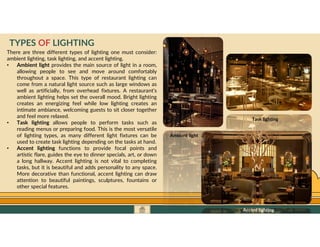
There are three different types of lighting one must consider:
ambient lighting, task lighting, and accent lighting.
• Ambient light provides the main source of light in a room,
allowing people to see and move around comfortably
throughout a space. This type of restaurant lighting can
come from a natural light source such as large windows as
well as artificially, from overhead fixtures. A restaurant’s
ambient lighting helps set the overall mood. Bright lighting
creates an energizing feel while low lighting creates an
intimate ambiance, welcoming guests to sit closer together
and feel more relaxed.
• Task lighting allows people to perform tasks such as
reading menus or preparing food. This is the most versatile
of lighting types, as many different light fixtures can be
used to create task lighting depending on the tasks at hand.
• Accent lighting functions to provide focal points and
artistic flare, guides the eye to dinner specials, art, or down
a long hallway. Accent lighting is not vital to completing
tasks, but it is beautiful and adds personality to any space.
More decorative than functional, accent lighting can draw
attention to beautiful paintings, sculptures, fountains or
other special features.
TYPES OF LIGHTING
Ambient light
Task lighting
Accent lighting
GO TO CONTENTS
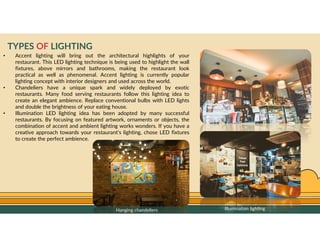
TYPES OF LIGHTING
• Accent lighting will bring out the architectural highlights of your
restaurant. This LED lighting technique is being used to highlight the wall
fixtures, above mirrors and bathrooms, making the restaurant look
practical as well as phenomenal. Accent lighting is currently popular
lighting concept with interior designers and used across the world.
• Chandeliers have a unique spark and widely deployed by exotic
restaurants. Many food serving restaurants follow this lighting idea to
create an elegant ambience. Replace conventional bulbs with LED lights
and double the brightness of your eating house.
• Illumination LED lighting idea has been adopted by many successful
restaurants. By focusing on featured artwork, ornaments or objects, the
combination of accent and ambient lighting works wonders. If you have a
creative approach towards your restaurant’s lighting, chose LED fixtures
to create the perfect ambience.
Hanging chandeliers Illumination lighting
GO TO CONTENTS
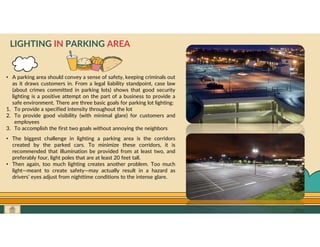
• A parking area should convey a sense of safety, keeping criminals out
as it draws customers in. From a legal liability standpoint, case law
(about crimes committed in parking lots) shows that good security
lighting is a positive attempt on the part of a business to provide a
safe environment. There are three basic goals for parking lot lighting:
1. To provide a specified intensity throughout the lot
2. To provide good visibility (with minimal glare) for customers and
employees
3. To accomplish the first two goals without annoying the neighbors
• The biggest challenge in lighting a parking area is the corridors
created by the parked cars. To minimize these corridors, it is
recommended that illumination be provided from at least two, and
preferably four, light poles that are at least 20 feet tall.
• Then again, too much lighting creates another problem. Too much
light—meant to create safety—may actually result in a hazard as
drivers’ eyes adjust from nighttime conditions to the intense glare.
LIGHTING IN PARKING AREA
GO TO CONTENTS
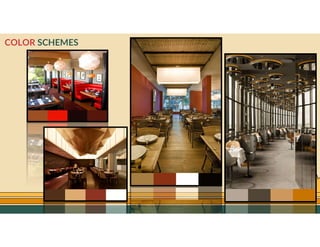
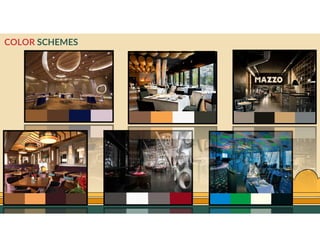
USE OF COLOR
• In the dining room, the lighting system and color scheme must work together
to enhance the environment. Colors depend on their light source because, as
we know, the same color can look completely different when seen under
different types or intensities of light. Color and light together can also be used
to make space seem larger or smaller and more intimate.
• Color can be used to convey a theme, a style, a geographic region, a way of
life, or even a climate.
• Color psychology is the study of color’s impact on people’s moods and buying
habits, based on the principle that certain colors evoke certain feelings. Warm
colors—orange and yellow tones, such as peach and terra cotta—are
considered inviting; white denotes cleanliness and purity; black is
sophisticated and dramatic; and so on. Some very basic color “rules” follows:
1. Use light tones and cool colors to make small spaces look larger.
2. Use darker tones and warm colors to “shrink” rooms, creating a greater sense
of intimacy in a large space.
3. Dark colors also can be used to mask structural features, such as ductwork,
that may otherwise interfere with the design of a room.
4. Bright, primary colors can be combined in contrasting combinations for a super
modern feel. Think bright blue or lime green and white, or black and red.
5. Muted colors have a soothing effect on a room.
6. If more than one color is used for walls, one must be dominant and the other
subordinate.
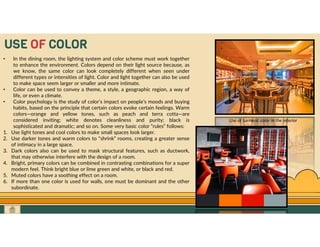
Use of turmeric color in the interior
GO TO CONTENTS
GO TO CONTENTS
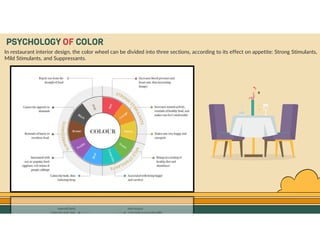
PSYCHOLOGY OF COLOR
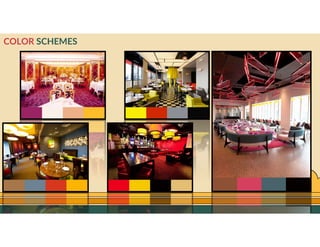
In restaurant interior design, the color wheel can be divided into three sections, according to its effect on appetite: Strong Stimulants,
Mild Stimulants, and Suppressants.
GO TO CONTENTS
STRONG APPETITE STIMULANTS
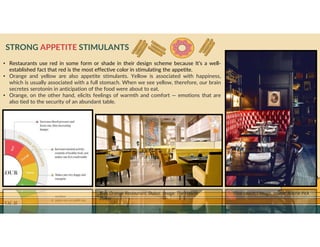
• Restaurants use red in some form or shade in their design scheme because It’s a well-
established fact that red is the most effective color in stimulating the appetite.
• Orange and yellow are also appetite stimulants. Yellow is associated with happiness,
which is usually associated with a full stomach. When we see yellow, therefore, our brain
secretes serotonin in anticipation of the food were about to eat.
• Orange, on the other hand, elicits feelings of warmth and comfort — emotions that are
also tied to the security of an abundant table.
Blue Orange Restaurant, Dubai. Image: The Westin
Dubai
That couch, though. Image: Aubrie Pick
GO TO CONTENTS
MILD APPETITE STIMULANTS
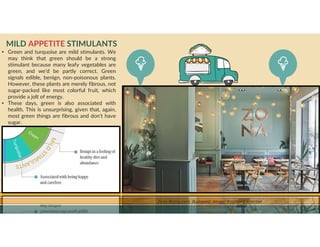
Zona Restaurant, Budapest. Image: Position Collective
• Green and turquoise are mild stimulants. We
may think that green should be a strong
stimulant because many leafy vegetables are
green, and we’d be partly correct. Green
signals edible, benign, non-poisonous plants.
However, these plants are merely fibrous, not
sugar-packed like most colorful fruit, which
provide a jolt of energy.
• These days, green is also associated with
health. This is unsurprising, given that, again,
most green things are fibrous and don’t have
sugar.
GO TO CONTENTS
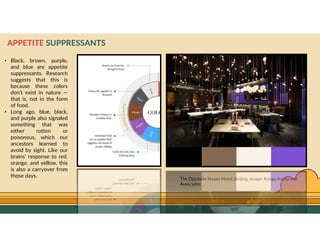
The Opposite House Hotel, Beijing. Image: Kengo Kuma and
Associates
APPETITE SUPPRESSANTS
• Black, brown, purple,
and blue are appetite
suppressants. Research
suggests that this is
because these colors
don’t exist in nature —
that is, not in the form
of food.
• Long ago, blue, black,
and purple also signaled
something that was
either rotten or
poisonous, which our
ancestors learned to
avoid by sight. Like our
brains’ response to red,
orange, and yellow, this
is also a carryover from
those days.
GO TO CONTENTS
COLOR SCHEMES
GO TO CONTENTS
COLOR SCHEMES
GO TO CONTENTS
COLOR SCHEMES
GO TO CONTENTS
USE OF ARTWORK
• Making a real statement with your décor by using murals and other forms
of art is an idea worth exploring. The walls aren’t going to be bare, are
they? What you choose to put there will add personality and flair to your
public areas.
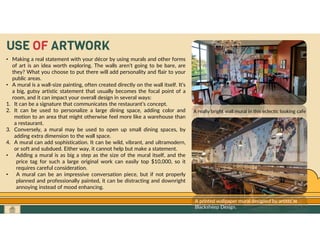
• A mural is a wall-size painting, often created directly on the wall itself. It’s
a big, gutsy artistic statement that usually becomes the focal point of a
room, and it can impact your overall design in several ways:
1. It can be a signature that communicates the restaurant’s concept.
2. It can be used to personalize a large dining space, adding color and
motion to an area that might otherwise feel more like a warehouse than
a restaurant.
3. Conversely, a mural may be used to open up small dining spaces, by
adding extra dimension to the wall space.
4. A mural can add sophistication. It can be wild, vibrant, and ultramodern,
or soft and subdued. Either way, it cannot help but make a statement.
• Adding a mural is as big a step as the size of the mural itself, and the
price tag for such a large original work can easily top $10,000, so it
requires careful consideration.
• A mural can be an impressive conversation piece, but if not properly
planned and professionally painted, it can be distracting and downright
annoying instead of mood enhancing.
A really bright wall mural in this eclectic looking cafe
A printed wallpaper mural designed by artists at
Blacksheep Design.
GO TO CONTENTS
• A less permanent and less expensive way to add color to your dining area
is to display the work of local artists, galleries, or art dealers. Depending
on your arrangements with the art supplier, the works are priced and the
restaurant may receive a small commission when one is sold. This allows
you to change the décor with the seasons, by the month, or whenever you
think the place needs a change. Whenever a new artist or selection is
featured, you have a nice reason to invite guests and members of the
local news media to an “opening” reception.
• Showcasing local talent is not without risks, but it has a satisfying,
community-minded spirit as a side benefit. It decorates your walls, boosts
your business, and nurtures goodwill— all inexpensively.
• Finally, when thinking about artwork, don’t forget the restrooms. Many
restaurants decorate all other areas to the max but leave their restroom
walls completely bare.
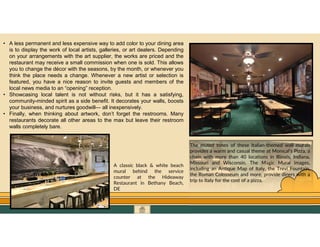
The muted tones of these Italian-themed wall murals
provides a warm and casual theme at Monical’s Pizza, a
chain with more than 40 locations in Illinois, Indiana,
Missouri and Wisconsin. The Magic Mural images,
including an Antique Map of Italy, the Trevi Fountain,
the Roman Colosseum and more, provide diners with a
trip to Italy for the cost of a pizza.
A classic black & white beach
mural behind the service
counter at the Hideaway
Restaurant in Bethany Beach,
DE
GO TO CONTENTS
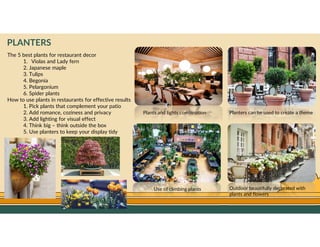
PLANTERS
The 5 best plants for restaurant decor
1. Violas and Lady fern
2. Japanese maple
3. Tulips
4. Begonia
5. Pelargonium
6. Spider plants
How to use plants in restaurants for effective results
1. Pick plants that complement your patio
2. Add romance, coziness and privacy
3. Add lighting for visual effect
4. Think big – think outside the box
5. Use planters to keep your display tidy
Plants and lights combination
Use of climbing plants Outdoor beautifully decorated with
plants and flowers
Planters can be used to create a theme
GO TO CONTENTS
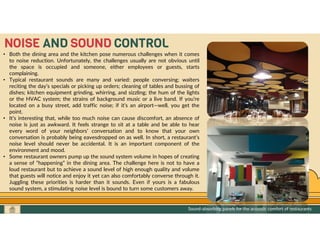
NOISE AND SOUND CONTROL
• Both the dining area and the kitchen pose numerous challenges when it comes
to noise reduction. Unfortunately, the challenges usually are not obvious until
the space is occupied and someone, either employees or guests, starts
complaining.
• Typical restaurant sounds are many and varied: people conversing; waiters
reciting the day’s specials or picking up orders; cleaning of tables and bussing of
dishes; kitchen equipment grinding, whirring, and sizzling; the hum of the lights
or the HVAC system; the strains of background music or a live band. If you’re
located on a busy street, add traffic noise; if it’s an airport—well, you get the
point.
• It’s interesting that, while too much noise can cause discomfort, an absence of
noise is just as awkward. It feels strange to sit at a table and be able to hear
every word of your neighbors’ conversation and to know that your own
conversation is probably being eavesdropped on as well. In short, a restaurant’s
noise level should never be accidental. It is an important component of the
environment and mood.
• Some restaurant owners pump up the sound system volume in hopes of creating
a sense of “happening” in the dining area. The challenge here is not to have a
loud restaurant but to achieve a sound level of high enough quality and volume
that guests will notice and enjoy it yet can also comfortably converse through it.
Juggling these priorities is harder than it sounds. Even if yours is a fabulous
sound system, a stimulating noise level is bound to turn some customers away.
Sound-absorbing panels for the acoustic comfort of restaurants
GO TO CONTENTS
• In controlling noise, we need first to be aware that it has two
basic characteristics: intensity and frequency. Intensity, or
loudness, is measured in decibels, abbreviated dB. The lowest
noise an average person can hear close to his or her ear is
assigned the level of 1 decibel, while a 150-decibel level would
cause pain to the average ear. A “noisy” restaurant averages
70 to 80 decibels.
• Frequency is the number of times per second that a sound
vibration occurs. One vibration per second is a hertz
(abbreviated Hz). Humans hear vibrations that range all the
way from 20 per second (low frequency) to 20,000 per second
(high frequency). In a restaurant setting, a high-frequency
sound is more objectionable than a low-frequency sound. Even
sounds that are low intensity may be objectionable to guests if
they are also high frequency. Sound travels from the source to
the listener and back again in very speedy fashion—about
1100 feet per second.
• Inside a building, sound can be either absorbed or reflected by
all the other things in that space: walls, ceilings, floors,
furniture, or equipment. If it reflects or “bounces off” of surfaces
(called reverberant sound), the area can build up a sound level
that is much higher than if the space was not enclosed.
UNDERSTANDING NOISE
Sound-absorbing panels for the acoustic comfort of restaurants
GO TO CONTENTS
• It is not just dining areas where noise is problematic. At the back of the house,
everything seems to conspire to create noise. Dishes clatter, chefs bark their
orders, dishwashers whoosh, toilets flush, refrigerators hum, and the kitchen
exhaust system drones on and on. It can become a real cacophony. Your goal
is not only to keep it from reaching the guests but to keep it from driving your
own staff crazy.
• To determine problem areas, the primary concerns of the designer are those
points at which noise is most likely to emerge from the kitchen. This means the
pass window area, where expediters and/or waitstaff are positioned to call out
orders and pick up food. Computerized ordering systems have already
improved and quieted this process. The other problem site is the dishwashing
area, where doors that are too thin or opened too frequently permit the clatter
to emanate into the dining room.
• One simple noise control strategy, often overlooked, is to make equipment
operate more quietly by keeping it properly maintained. This includes careful
examination of basic mechanical systems. The heating, ventilation, and air
conditioning (HVAC) system has ducts that can act as chambers for sound
transmission, amplifying the motor noise from the system’s fan and condenser
and sending it throughout the building. Metal plumbing pipes also transmit
noises, as rushing water makes them vibrate and trapped air creates knocking
sounds.
CONTROLLING NOISE
GO TO CONTENTS
NOISE CONTROL MEASURES
General sound control can be accomplished in two ways: Either suppress the sounds from their source, or reduce the amount of
reverberant sound by cutting the travel direction of the sound waves. Sound engineers use hard concave surfaces to concentrate sound.
The hard surface traps the sound, then sends it in the desired direction. If a soft convex surface is used, the sound is absorbed and
deadened. These principles can be adapted to the ceilings, walls, and furnishings of any room.
The ceiling of a room is a natural choice for sound control treatment, because
there is not much on the ceiling that would get in the way. Spray-on acoustic
surfaces, acoustical tile, fiberglass panels padded with fabric, wooden slats, or
perforated metal facings are less noisy alternatives to plain plaster or
concrete ceilings. Panels and slats should be at least [3 /4] inch to one inch
thick and suspended instead of being directly attached to the ceiling. Be sure
not to paint acoustical tile, or it will lose its sound-absorbent effect.
Covering walls with padding, fabric, or carpet helps a great deal to muffle
sound. Organizing the dining room on different levels also helps somewhat.
And the use of movable partitions, which can be purchased up to 5 feet in
height, can contain sound as well as create intimacy by breaking up a large
dining area into smaller spaces. Walls and partitions can even be decorative
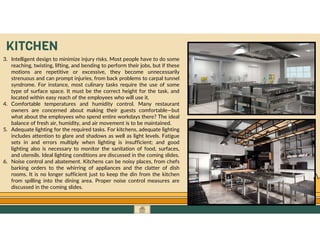
and see-through, to maintain the open feeling of a room.
CEILING
WALLS
GO TO CONTENTS
KITCHEN NOISE CONTROL
• Controlling loudness in the kitchen begins with the idea of
having doors that separate the kitchen from the dining room.
Some kitchens don’t have doors, but passageways, making it
especially important to have acoustical treatments on both
walls and ceilings in these transition zones.
• Of course, some restaurateurs believe that having customers
witness kitchen sights, sounds, and smells is part of the
mystique and excitement of eating out. In the open or display
kitchen, noise levels are part of the atmosphere.
• Inside a kitchen, consider these noise abatement options:
1. Installing acoustical tile ceilings
2. Undercoating all work surfaces
3. Putting the dishroom in an enclosed area
4. Installing all refrigerator compressors in a separate
“mechanical room” or area outside the kitchen
5. Properly installing and maintaining exhaust fans to reduce
humming and vibration
6. Using plastic or fiberglass dish carts and bus containers
instead of metal ones
Acoustic ceiling
GO TO CONTENTS
VENTILATION AND AIR QUALITY
• Ventilation is part of the overall ambience. At best, it’s hard to do perfectly. At worst, it may be jeopardizing the health of the workers
and customers. Indoor air quality (IAQ) has become a huge concern, prompting lawsuits and legislation on the state level.
• The ASHRAE standards for proper ventilation are shown in the table below. The ventilation rate is the amount of cubic feet of air per
minute that must be replaced per person, and it varies somewhat with the function of the room itself. The four overall principles that
can improve indoor air quality are:
1. Bring in a sufficient amount of outdoor air.
2. Manage the flow of air within your interior spaces.
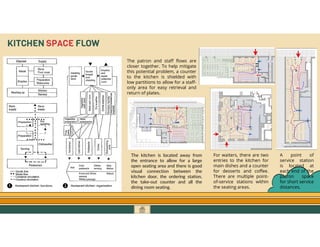
3. Use high-quality filtration systems.
4. Keep the HVAC equipment clean and in good working order.
• Demand control ventilation (DCV) is a technology option that allows you to adjust the amount of outdoor air that comes into your
system, much like a thermostat allows you to control temperature. DCV systems are popular in foodservice, because the number of
guests varies greatly at different times of the day. Computerized sensors vary the amounts of air supplied and exhausted, depending
on the occupancy of the space. The sensors are stationed in each zone of the building, and they “sense” occupancy by detecting the
carbon dioxide levels in the air. Other sensors monitor the air pressure of the system. Installing this type of ventilation system is
expensive, and the sensors and controls must be calibrated on a regular basis, but it will save energy and money in the long run by
freshening and exhausting air automatically, only as needed.
Source: American Society of Heating, Refrigeration and
Air Conditioning Engineers, Atlanta, Georgia.
GO TO CONTENTS
AIR POLLUTION CONTROL
• What exactly is air pollution? Smoke and gases, grease, airborne dirt, and germs
begin as individual particles, too small to see until thousands of them are grouped
together. One particle is measured in microns—one micron is 1/25,400 of an inch
long—and that’s what air pollution control equipment must remove from the air
system.
• A single particle of restaurant kitchen smoke is 0.3 to 0.8 microns in size, so it is
much easier to measure it in terms of its density or opacity—the degree to which
the smoke blocks the flow of light in a room. An opacity level of 100 percent would
be solid black; 0 percent would be completely smoke-free. The cities that have
adopted smoke pollution ordinances usually require an opacity level of no more
than 20 percent.
• Cooking odors are molecules generated by the combustion of animal or vegetable
products during the cooking process to make an extremely complex mixture of
reactive organic gases (referred to by experts as ROGs). Grease absorbs a small
percentage of odor ROGs, but most of them float around in the air, much too small
to be removed by any type of filter. One popular method to remove odor ROGs is
to push them through a layer of activated charcoal, which absorbs and retains
them. Unfortunately, charcoal is highly flammable, and, when it becomes fully
saturated, it begins to release odors—sometimes worse than the original odors! A
second common method of odor removal is to use potassium permanganate, which
oxidizes and actually solidifies the molecules, then retains them. Either charcoal or
oxidation can remove 85 to 90 percent of odor molecules from the air
GO TO CONTENTS
THEME DESIGN
ECO THEME DESIGN
• Eco theme design is particularly about backing to nature and
contrasting with the work environment sharply, in order to provide
diners with a simulated dining environment and help them enjoying
the green plants, fresh air and textures of materials.
• In this case, the designers used natural stones, wood and plants to
create a unique dining environment, and applied plants and palms to
separate the terrace dining area from the street. Lights, waterscape,
green space, old plank and dark stones come together to create a
natural dining atmosphere.
• Green planters were added into some walls, as well as trees and
palms to separate the main facade from the street.
• The whole atmosphere provides an impression of light and dramatic
context full of textures, light and shadows, in which the food
becomes the natural focus of attention.
• The ceiling is painted in black and by separating the perimeter from
the walls, the light enters provoking a sense of continuity to the
stone walls.
• The wood has a look of old plank which very nicely contrasts with
the dark stones. The stones provoke a changing texture; not only
light and shadow emerge from their surface, but also natural
vegetation grows and changes with time
All the images are from D’Amico, Mexico
GO TO CONTENTS
THEME DESIGN
CEDAR THEME DESIGN
• Cedar in the Semitic language means “white pine”
which refers to the power of spirit and is considered as
the faithful symbol of Sumerian. Historically, cedar is
also one of the earliest used aromatic substances and
is used in temples for burning incense, for which
reason it has been given a mysterious impression.
• In this case, the designers used hundreds of cedar
planks to decorate the walls and together with the
head-height lights behind the slats to create a warm
dining space; what’s more, the texture of cedar as well
as its organisation suggested the traditional culture of
Japan.
All the images are from Zama, Philadelphia, PA, USA
GO TO CONTENTS
INTERIOR DESIGN
CONCRETE SPACE THEME RESTAURANT
The design like this is very modern yet simple
and cosy since the majority of the style is
using concrete with a little bit of touch with
greenery and woods colours.The style like this
is definitely suitable as the working space
restaurant, really comfortable for hanging out
with friends!
MARBLE CHIC STYLE
RESTAURANT
Marble is the most well-known
style in the interior design, it
gives the elegant and
temporary looks to the area.
RESTAURANT LIKE PRISON DESIGN
Another unique design for a unique
restaurant. Make the customer experience
the prison atmosphere while enjoying your
food.
.
GO TO CONTENTS
INTERIOR DESIGN
INDUSTRIAL DESIGN RESTAURANT
Another manly vibe for your
restaurant inspiration. The restaurant
inspired by industrial style like this
created by Luchetti Krelle. This style
like this proves that the combination
of woods and metal can also give the
modern touch result
ECLETIC STYLE RESTAURANT
Bring art with a combination of
colours for your restaurant design
is also a very brilliant idea to have.
Don’t be scared to play with
plenty of colours to decorate your
restaurant, People actually enjoy
being in a unique area like this.
The design that closes to manly
vibe like a hipster is definitely a
great style choice. To achieve the
look like this all you need is an
Aztec pattern for the rug and
leather chairs.
HIPSTER INSPIRED INTERIOR
DESIGN RESTAURANT
GO TO CONTENTS
FINISHING MATERIALS
WALL FINISHES
BAMBOO WALL FINISHES
Bamboo has been a number one choice
of commercial interior designer for its
environmental qualities. It is also very
strong and lasts forever and that is just a
couple of reasons why we think bamboo
proved to be an excellent wall finish
material.
3D WALL TILES
t is an ideal way to bring more texture
and character to otherwise ordinary
spaces. These concrete 3D tiles are ideal
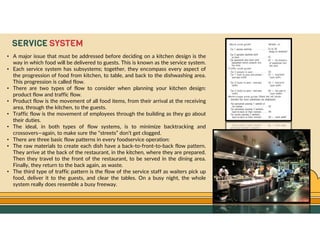
in places where the sun or artificial
lighting will accent their pattern.
LARGE PRINT WALLPAPER
Applying large size prints on walls of any
commercial interior will create an instant
environment and bring out emotional
responses. Large size flower prints can
add a cozy feeling in any restaurant or a
café interior design. It makes any wall
look larger and more festive.
GO TO CONTENTS
FINISHING MATERIALS
FLOORING MATERIALS
LAMINATE
When it comes to laminate flooring, the
benefits include strength and durability.
The surface is smooth and level and
resists stains, scratches, and wearing out.
One of the other excellent benefits for a
restaurant or bar is that it resists fading.
This gives you a look that stays like new
for longer.
LUXURY VINYL TILE (LVT) STONE FLOORING
Stone flooring is another more elegant
choice. Each type of stone has its own
durability level, but on average it is durable
and provides a natural texture. This texture
helps with a grip so it is ideal for kitchen
areas or non-slip bar flooring where slips
and falls can be prevalent.
This is a type of flooring that is durable, yet
allows for many aesthetic ideas. It’s ideal for
spills, heavy foot traffic, and abrasions. It
can even be placed to mimic other types of
flooring and at a lower cost for some.
GO TO CONTENTS
FINISHING MATERIALS
CEILING DESIGN
IKIBANA RESTAURANT IN BARCELONA
A fusion of Japanese and Brazilian
elements which applies to both the menu
served and the interior décor. The ceiling’s
design became the perfect compromise.
It’s a design statement that symbolizes the
landscapes of both regions in a simplified
and abstract way.
NOODLE RESTAURANT IN CHANGSHA
Inspired by the traditional noodle-
making technique, this restaurant in
Changshau, China features a ceiling
defined by a multitude of hanging
lighting fixtures draped across to
resemble noodle strands.
TEDDY BEAR-THEMED
RESTAURANT IN BANGKOK
Villa de Bear is a restaurant in Bangkok.
The main concept of its design is based on
the idea of a European teddy bear factory.
The ceiling in particular is eye-catching,
mainly because of the contrast created by
comparison with the simplistic furniture
and decor in general.
GO TO CONTENTS
PSYCHOLOGY OF SCENT
• Smell is the most primal of our five senses; that is, smell is the most
basic and primitive method of collecting information from our
surroundings.
• The sense of smell is very closely linked to memory, probably more so
than any of our other senses.
• There are many scents that trigger similar responses in most people.
Lavender, for example, relaxes the brain. Vanilla and chamomile reduce
stress, anxiety, and depression. Citrus and peppermint increase
alertness.
• Those silver plate domes we often see in movies depicting fine dining
restaurants? Not only do they keep the food clean and create a sense
of mystery and surprise, they also allow the food’s smell to build up
and concentrate. As soon as the waiter lifts that dome, the scent of the
food hits us in the face with its full strength.
• Kitchens also pump scents into the dining area through scent.
• it’s worth noting that the right smells can increase food sales up to
300%.
• According to a study by the University of Paderborn, scents increased
impulse buying by 6%, buying intention by 14.8%, and the length of a
customer’s stay by 15.9%.
GO TO CONTENTS
RESTAURANT FIRE SAFETY TIPS
• Restaurants are some of the most fire hazardous places in the world,
especially in the kitchen. The fact that a restaurant is usually a busy place with
many costumers makes it even more dangerous. That’s why it’s very
important to install fire extinguishing systems in all restaurants.
• the way you design your restaurant seating layout, as well as the placement of
the other restaurant furniture, could be a matter of life and death. First of all,
to ensure a safe way out if a fire starts, make absolutely sure that the path to
the restaurant’s main door isn’t blocked by anything! You must realize that
when a fire breaks loose and the fire alarm starts ringing, people usually panic
and seek the way out of the burning structure. Therefore you must ensure a
clear, safe path for them to do so!
• This doesn’t mean you shouldn’t have wood restaurant furniture it only means
you need to be careful not to keep wooden furniture close to fire sources. If
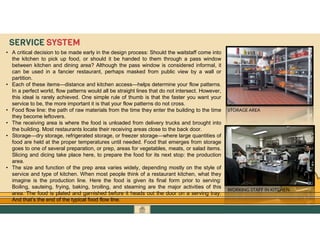
your layout and design are done properly this is easily achieved and in the
long term it might save your restaurant and somebody’s life.
• In kitchens there is always the risk of fire, and most of it is caused by food
that was forgotten on the stove or in the oven and from kitchen towels and
rags that were left near an open fire. The biggest risk though, is in the
ventilation system of the kitchen.
• And finally, make sure there is a clear path from the dining and working areas
to the exits.
GO TO CONTENTS
GO TO CONTENTS
TANG PALACE,
HANGZHOUl,
CHINA
ARCHITECTS: ATELIER
FEICHANG JIANZHU
AREA: 2460 SQ.METRES
YEAR: 2010
GO TO CONTENTS
• The restaurant is located on the 9m (291⁄2 ft) high sixth and
top floor of a superstore in a new area of this rapidly
expanding Chinese city.
• Some of its private rooms, a traditional component of
restaurants in China, are suspended from the roof of the
original building shell. Detailing makes generous use of
bamboo, traditionally in lengths of the natural material and,
less familiarly, in the flat strips of reconstituted bamboo used
to make up the serpentine wall and interwoven to make the
perforated and continuous planes of screens and ceilings.
GO TO CONTENTS
• A staggered bank of banquette seating and tables
makes a transition between the rectangular blocks
of the reception desk and the freestanding tables in
the middle of the floor, but the pervasive bamboo
theme is already established in the curved walls of
the entrance area and taken up comprehensively in
the perforated curved walls that mask the
rectilinear walls of the service core and the new
kitchen.
• This serpentine wall gives structure to the central
dining spaces and evolves into the undulating mesh
of the ceiling, which hangs between the two levels
and permits appreciation of the full height of the
original shell. Where straight walls, such as those to
the kitchen are not softened by a mesh screen, their
surfaces are broken by panelled surfaces that are
illuminated, on their upper levels.
• The entrance hall also follows the theme of
bamboo. The wall is covered with bamboo material
which follows the original outline of the wall,
turning it into a wavy surface. In this way, the
surface echoes the hall ceiling as well as performs a
guiding function for customers.
GO TO CONTENTS
• The real drama of the interior, however, is provided by the
private dining rooms, suspended from the existing structure and
accessed by suspended walkways. Their circular soffits provide a
light source for tables in the central space, which draws attention
to their existence. Their circular plans are echoed in the curved
screens that begin to enclose five tables in the lower central
space. The bigger wholly enclosed and self-contained private
rooms use the staggered plan motif of the banquettes, which
effectively incorporates their service elements, to make the
transition to the curved mesh that surrounds the central space.
• The original building condition has a core column and several
semi-oval blocks which essentially disorganized the space.
Hence, the design wants to reshape the space with a large
hollowed-out ceiling which is made from interweaved thin
bamboo boards; and extending from the wall to the ceiling. The
waved ceiling creates a dramatic visual expression within the
hall. The hollowed-out bamboo net maintains the original story
height and thereby creates an interactive relation between the
levels.
• Wrapped core column with light-transmitting bamboo boards to
form a light-box, which transforms the previously heavy concrete
block into a light and lively focus object.
GO TO CONTENTS
A mesh of reconstituted bamboo strips makes a perforated
ceiling plane between the two levels and provides a smooth
transition into the vertical screens that mask existing wall
surfaces. The glass block wall to the bar servery offers a
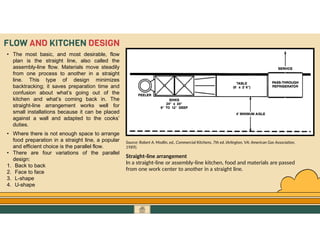
variation on the mesh pattern.
The ceiling mesh allows views of the suspended rooms on
the upper level and their illuminated soffits provide the
principal light source to the central dining area. The mass of
the wall to the stair and service area behind is broken by
illuminated panels.
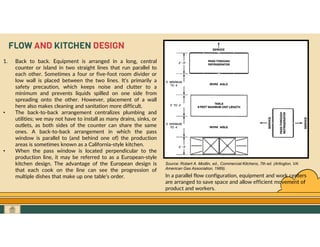
GO TO CONTENTS
• The different folding angles and engraved patterns make each room different
from one another.
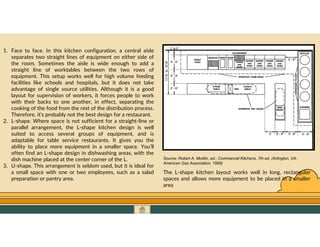
• The rooms above on the south are smaller and feature a special waved ceiling
pattern and simple bamboo wall surface, which creates interesting and
spacious room features.
• The key design concept of the space is that the suspended rooms are
connected with suspended bridges and sideway aisles.
• The semi-transparent wall provides a subtle relationship between the inner
and outer spaces, bestowing people with a special spatial experience.
• Usages of the new bamboo material can be seen, responding to the local
culture while seeking intriguing spatial effects.
• Structural elements like concrete column and block walls are made light by
the parametric lattice, which was gently sourced and fastidiously erected.
GO TO CONTENTS
• The entrance first exposes the bamboo lattice as it rises from the
floor and curls along the sweep of the wall.
• Private rooms in the back are partitioned by vertical bamboo reeds,
creating a separation from the large dining room but still allowing
for an airy space.
• A suspended stairway leads up to the second floor.
• From above guest can see the lower floor and the top side of the
bamboo lattice.
• Small private dining rooms dot the upper recesses like glowing
lanterns.
• The rooms are suspended from the ceiling, providing a very unique
experience while casting a faint glow over the spaces below.
GO TO CONTENTS
SUSPENDED PRIVATE
ROOMS
SUPPORTING STRUCTURE
STACKED PRIVATE ROOMS
HORIZONTAL MESH
BETWEEN FLOORS
VOID FOR STACKED PRIVATE
ROOMS
PRIVATE ROOMS
GLASS BALUSTRADE CIRCULATION AND SERVICE
CORE
GO TO CONTENTS
PLAN, SCALE 1:400
1. ENTRANCE
2. RECEPTION
3. AQUARIUM
4. BAR
5. BANQUETTES
6. TABLES
7. PRIVATE ROOMS
8. LATTICE WALL
9. STAIR
10. LIGHTBOX
11. KITCHEN
12. WCS
13. CIRCULATION AND
SERVICE CORE
PLAN: LOWER
LEVEL
GO TO CONTENTS
1. SUSPENDED PRIVATE ROOMS
2. PRIVATE ROOM SUPPORTED ON
ROOM BELOW
3. SUSPENDED WALKWAY
4. PRIVATE ROOM
5. STAIR
6. WCS
7. OFFICE
8. CIRCULATION AND SERVICE CORE
PLAN, SCALE 1:400
PLAN: UPPER LEVEL
GO TO CONTENTS
SUSPENDED PRIVATE ROOM
STACKED PRIVATE ROOM
PRIVATE ROOM
TABLES
SECTION A-A, SCALE 1:300
GO TO CONTENTS
+GREEN
RESTAURANT,
TOKYO
ARCHITECTS: SINATO INC.
PROJECT: +GREEN
LOCATION: TOKYO, JAPAN
AREA: 1153 sq. mts.
YEAR: 2011
GO TO CONTENTS
• This organic restaurant, shop and takeaway
is appropriately located close to Komazawa
Park, one of the biggest outdoor spaces in
the city. The site presents particular
challenges. The overall height of the shell
is 4.39m (14 ft 4 in), not quite enough to
allow the insertion of two levels with
conventional floor-to-ceiling heights, and
this restriction radically influenced plans
and sections. The takeaway and reception
is at the street level. Three steps lead up to
the shop, which is 0.56m (1 ft 8 in) above
entrance level, and nine lead down 1.61m
(5 ft 3 in) to the restaurant.
• The designers have used clever
partitioning, neutral materials and subdued
colors to create a space that appears both
intimate and large, and despite its
underground location, has a refreshing, airy
feel.
• original floor, wall and ceiling are not
decorated, so they are all skeleton and not
so beautiful.
GO TO CONTENTS
• The choice of materials gives coherence to the
complex organization. The existing smooth,
poured concrete planes of walls, floor and
ceiling, together with the service pipes they
support, are left exposed. Insertions of
rectangular brick boxes, which rise to the level of
the shop floor and to knee height in the
entrance, create small shared and some more
private dining areas at the bottom level. The
boxes also contain the kitchen, which is tucked
beneath the shop, and are spaces for storage.
Brick construction lends itself easily to, and
prescribes dimensions for, the perforated pattern
making
• The 111.5 square meter (1,200 sq.ft.) space is
exceptionally high (about 4.4 meters or 14.4 feet)
and much of it is underground but customers —
and light – can move freely between the three
levels.
• The hall space is divided into three places, but at
the same time they are connected.
• Plants are arranged here and there so that
people can see them from anywhere.
GO TO CONTENTS
• A smooth white, steel-framed serpentine wall sits lightly on the
brick rectangles, creating a central atrium, the upper part of which
has a plan quite different from the lower. It also screens the
existing concrete walls but is pierced with variously sized
rectangular openings that frame views of the restaurant from the
entrance level. The sides of the single, centrally located stair that
connects the three levels are clad in horizontal timber strips that
match the layering and colour of the brickwork but the quality of
detailing and execution of junctions throughout the interior is
such that all elements clearly retain their visual autonomy.
• In upper space, brick wall looks like a knee-high base of white
wall.
• In upper space, white wall hides original wall and equipment like
air conditioning system or piping. And the wall can serve as
frames which show some graphic, plants and scenery of the
restaurant. In addition, it surround stairs space and make big void.
• In lower space, you can slightly feel the border (plan) of white wall
above your head and it is quite different from the plan of the
restaurant floor partitioned by brick wall.
GO TO CONTENTS
GO TO CONTENTS
The stair makes minimum contact with floor and wall. Its horizontal
layering and colour relate to the brickwork and its curve to the white
wall
GO TO CONTENTS
A view from the landing at entrance level up to the shop. The
brick threshold between takeaway space and stair illustrates
how floor levels respond precisely to brick coursing. Translucent
glass screens with glued joints in the takeaway and shop
contrast with the brick’s solidity
GO TO CONTENTS
The major elements touch but
remain visually intact. The white
wall rests on but does not
intersect the brickwork. Brick
dimensions and construction
techniques determine
perforations in the brick wall
Brick coursing determines
variations in floor levels, here to
a private room. The curved
white wall ties private and
communal spaces together. The
timber strips that clad the walls
to the stairs also form treads and
risers.
GO TO CONTENTS
GO TO CONTENTS
GO TO CONTENTS
PLAN AT ENTRANCE LEVEL
1. ENTRANCE
2. TERRACE
3. TAKEAWAY (PRIVATE ROOM UNDER)
4. STAIR
5. SHOP (KITCHEN UNDER)
6. MAIN RESTAURANT
7. PRIVATE ROOM (LOWER LEVEL)
8. PERFORATED BRICK WALL (LOWER LEVEL)
9. CURVED WALL
10. PLANTING BOXES
11. ORIGINAL CONCRETE WALLS
PLAN, SCALE 1:200
GO TO CONTENTS
SECTION THROUGH CURVED WALL
1. EXISTING CONCRETE SLAB
2. STEEL EXPANSION ANCHOR AND 9MM (3 ⁄8 IN) BOLT
3. CURVED PAINTED TIMBER BOARD
4. TIMBER FRAMING
5. PAINTED FIBRE-REINFORCED GYPSUM BOARD
6. 9MM (3 ⁄8 IN) BOLT
7. TIMBER FRAMING
8. NEW BRICK WALL
SECTION D-D, SCALE 1:200
GO TO CONTENTS
Terrace Takeaway Window Curved wall Planting box
Private room Stair Hall Private room
SECTION A-A, SCALE 1:100
GO TO CONTENTS
SECTION B-B, SCALE 1:100
Takeaway
Curved wall
Window
Hall
Private room (restricted height)
Store
GO TO CONTENTS
Curved wall Shop
Hall
Kitchen
Planting box
Hall
SECTION C-C, SCALE 1:100
GO TO CONTENTS
SECTION D-D, SCALE 1:100
Curved wall Shop
Hall
Kitchen
Planting box
Store
GO TO CONTENTS
CONCLUSION
This literature study about restaurants illustrates and narrates the means and tactics required to successfully design a
restaurant. Ranging from furniture selection to space planning and much more. Starting from the meaning of restaurant and why
people go to a restaurant instead they can eat meals at home too, different types of restaurants and their parking area are
discussed. It provides the information about how to design parking area so as to make full use of space without discomforting
customers, staff and neighbours. Entrance designing is one of the most crucial part of designing as it gives the impression of
overall space to customers. Restroom design is as essential as any other part of the restaurant, it must be designed keeping in
mind the comfort of the users. Outdoor dining designing is as important as indoor dining, the type of furniture required, it is
much spacious than indoor dining area and different decorating elements required for patios are also discussed. Kitchen design
requires different areas such as cold and dry storage areas, dishwashing area, it is the busiest area in a restaurant as whole
restaurant depends on the efficiency of kitchen, a short delay in food serving can cost a heavy loss to the owner, therefore
we’ve discussed different layouts and flows and identified the efficient ones in this study. Dining area is where the customer
spends most of his/her time, so it is thoroughly discussed in this study, how to choose furniture ranging from their dimensions to
material, how to decorate the area with artwork and what particular arrangement of tables and chairs to follow and what their
results are. The use of different lighting types and techniques to highlight or darken particular areas and the level and intensity
of light required for the utmost comfort of the customers and staff in a particular area are also discussed. The importance of
understanding and applying the psychology of colour and many examples of different colour schemes are also illustrated so as
to give the reader an idea of the feeling one gets by seeing particular colours, whether they are giving a sense of hunger to a
person and whether there is a colour in dining area which is appetite suppressant, such as black in large use. The use of plants in
decorating patios and interiors, as well as their combination with lighting, though briefly, is also discussed. Air pollution being
one of the major problems in our country and needs proper attention while designing.
GO TO CONTENTS
CONCLUSION
Proper ventilation and desired air circulation importance and requirements are also discussed. Noise control and regulating
measures, the use of sound-absorbing materials, and different ways of controlling noise are also discussed. Use of different
finishing materials for walls, ceilings, and floors and fire safety measures are also discussed. Finally, a case study of +Green
restaurant and Tang Palace restaurant is discussed.
GO TO CONTENTS
INFERENCE
• From this literature and case study, it can be inferred that
• Restaurants are much more than eating places. People associate memories with them. If the memories are pleasant, they'll
visit again. If they aren't, they won't.
• Restaurants are classified based on a variety of factors, including the type of food served, the style of operation, the type of
service, etc.
• The various spaces of the restaurant need to be connected properly.
• The entrance way should be designed keeping in mind that it is where the guests will decide whether they are comfortable
eating there.
• The parking area is the first impression of a guest; therefore, it must be designed keeping in mind the area, suitable
angle, and proper access width to minimise traffic in the parking area.
• Restrooms should be designed according to the seating capacity of the restaurant, and there should be a sufficient number
of toilets and washbasins for the guests.
• A restaurant kitchen should be designed while considering many factors, such as the dining capacity of the restaurant, type
of service, etc., and selecting the layout accordingly. The flow should be as simple as possible and should not cause
problems for any staff member, because a bad flow means slow service, and slow service means customer anger, and it can
cause a huge loss to the owner. The layout should be selected depending upon the area. The ware washing area needs
proper ventilation and soundproofing. There should also be proper illumination in the kitchen (500 lux).
GO TO CONTENTS
INFERENCE
• Because the dining room is where guests spend the most of their time, it needs to be carefully arranged. Everything from
the seating arrangement to the furnishings to the colour scheme should be carefully considered. The type of furniture, the
amount of space allocated to each table, the proper aisle width for staff and diners, and the lighting for each table, as well as
selection of scent, floor finishing, ceiling selection, indoor air quality, colours, and so on, should all give diners the impression
of being in a pleasant and appealing environment. Finally, we talked about Tang Palace, a Chinese restaurant, and +Green, a
Japanese restaurant.
GO TO CONTENTS
SOURCES USED
• https://pos.toasttab.com/blog/on-the-line/restaurant-floor-plans
• These Are the Most Beautifully Designed Outdoor Dining Experiences in America | Architectural Digest
• Cafe and Restaurant Floor Plan Solution | ConceptDraw.com | Restaurant Furniture Layout
• Restaurant Table and Chair Sets: Shop Dining Sets & More (webstaurantstore.com)
• Restaurant Soundproofing - Bar Soundproofing (memtechacoustical.com)
• Best Plants for Restaurants: Planter Decor And Patio Design (jayscotts.com)
• 4 Styles of Restaurant Lighting and Modern Ideas - Seascape Lamps
• The Psychology of Restaurant Interior Design, Part 3: Lighting | Fohlio
• Wall Finishes Trends in Commercial Interior Design (mindfuldesignconsulting.com)
• 10 Flooring Options for Your Restaurant | Modern Restaurant Management | The Business of Eating & Restaurant
Management News
• Best types of Flooring for a Restaurant or Bar (Ultimate Guide 2019) (expressflooring.com)
• 17 Amazing Restaurant Interior Design Ideas (thedestinyformula.com)
• What does restaurant mean? (definitions.net)
• The Psychology of Restaurant Interior Design, Part 2: Scent | Fohlio
• Restaurants With Striking Ceiling Designs (homedit.com)
• Restaurant Safety Tips - Fire | Restaurant Seating Blog
• https://rddmag.com/design/how-to/142-make-an-entrance
• https://www.archdaily.com/442110/green-sinato
• Restaurant Table Sizes & Dimensions - Seating Capacity Guide (restaurantfurniture.net)
GO TO CONTENTS
• Time-Saver Standards for Building Types Second Edition
• Time-Saver Standards for Interior Design and Space Planning
• Neufert Architect’s Data Fourth Edition
• Detail in Contemporary Bar and Restaurant Design, Drew Plunkett and Olga Reid
• Design and Equipment for Restaurants and Foodservice, Third Edition, Costas Katsigris and Chris Thomas
• 100 Restaurant Design Principles
• Restaurants, Clubs And Bars, Second Edition, Fred Lawson
BOOKS USED
GO TO CONTENTS
• https://olsonkundig.com/wp-content/uploads/2015/06/08042_00_Mistral_Kitchen_BB_N2-1249x1440.jpg
• https://www.decorationlove.com/wp-content/uploads/2016/07/Industrial-Kitchen-Design-Ideas-1-840x473.jpg
• http://www.patriquinarchitects.com/wp-content/uploads/2016/11/FLOW-ZINC-PATHS.jpg
• https://www.contemporist.com/wp-content/uploads/2010/08/vr_240810_01-630x502.jpg
• http://www.patriquinarchitects.com/wp-content/uploads/2016/11/FLOW-ROIA-PATHS.jpg
• https://igx.4sqi.net/img/general/600x600/WTV-jFQgpiuH50ROBvGrYYPl_Et8KS5REUViKjMPTEI.jpg
• http://www.patriquinarchitects.com/wp-content/uploads/2016/11/FLOW-KITCHEN-ZINC-PATHS.jpg
• https://1x12gs5mivd268ltk1c9vi3x-wpengine.netdna-ssl.com/wp-content/uploads/2013/07/208-duecento-otto-autoban-dpages-blog-0.png
• http://www.patriquinarchitects.com/wp-content/uploads/2016/11/FLOW-SUBITO-PATHS.jpg
• https://www.capriottis.com/wp-content/uploads/2018/05/05_3355NovatStreet_Ste150_2005_HiRes-768x512.jpg
• https://i.pinimg.com/originals/20/88/c9/2088c91124be0854c70840d64411a727.jpg
• https://media-cdn.tripadvisor.com/media/photo-s/1d/00/78/af/sikia-fine-dining-restaurant.jpg
• https://media-cdn.tripadvisor.com/media/photo-s/1a/50/91/6a/dining-area.jpg
• https://media-cdn.tripadvisor.com/media/photo-s/1c/12/29/a8/vive-l-ete.jpg
• https://media-cdn.tripadvisor.com/media/photo-s/16/af/f9/d5/photo1jpg.jpg
• https://media-cdn.tripadvisor.com/media/photo-s/07/a9/1a/1a/harbour-buffet-restaurant.jpg
• https://media-us.camilyo.software/media-us/blog/10/10547/41152.jpg
• https://media-us.camilyo.software/media-us/blog/10/10547/41151.jpg
• https://media-us.camilyo.software/media-us/blog/10/10547/41149.jpg
• https://thedestinyformula.com/wp-content/uploads/2019/01/restaurant-interior-design2.jpg
• https://thedestinyformula.com/wp-content/uploads/2019/01/restaurant-interior-design.jpg
• https://thedestinyformula.com/wp-content/uploads/2019/01/restaurant-interior-design4.jpg
• https://thedestinyformula.com/wp-content/uploads/2019/01/Moscow-Bratya-Karavaevi-restaurant-5.png
• https://cdn.newsapi.com.au/image/v1/1fa17626f00c859e8be7d55eb8f818ac?width=650
• https://thedestinyformula.com/wp-content/uploads/2019/01/Poczekalnia-restaurant-imagined-like-a-prison-by-Karina-Wiciak_dezeen_1.jpg
IMAGES USED
GO TO CONTENTS
• https://media.architecturaldigest.com/photos/5fa9a38029dcfd6754c7dbba/master/w_1600%2Cc_limit/White%2520Limozeen%2520CommercialPhotograph
y_DigitalLove_Nashville_GraduateHotel_WhiteLimousine-33%2520Photo%2520Credit%2520Digital%2520Love.jpg
• https://media.architecturaldigest.com/photos/5fa9a3751985d5aebcf4b4b6/master/w_1600%2Cc_limit/Jacoby%25E2%2580%2599s%2520Restaurant%252
0Mercantile%2520-8.jpg
• https://media.architecturaldigest.com/photos/5fa9a3b9813f69fae77d56a3/master/w_1600%2Cc_limit/Le%2520Farfelle%2520Patio%2520setup%2520Phot
o%2520Credit%2520Rachel%2520Venter.jpg
• https://media.architecturaldigest.com/photos/5fa9a3fb2c35d22a8ff82e0f/master/w_1600%2Cc_limit/Townhouse%2520Detroit_9348.jpg%2520Photo%2520
Credit%2520Aly%2520Sasson.jpg
• https://media.architecturaldigest.com/photos/5fa9a51e3a27a2ea90ed3ae9/master/w_1600%2Cc_limit/Toca%2520Madera%2520Scottsdale%2520Patio%2
520Overview%2520Day.jpg
• https://media.architecturaldigest.com/photos/5fa9a5a5dbb5682b8b2b4369/master/w_1600%2Cc_limit/LaMerceriexJoeThomas.jpg
• https://img-aws.ehowcdn.com/600x400/cpi.studiod.com/www_ehow_com/photos.demandstudios.com/getty/article/103/113/94502417_XS.jpg
• https://static.epermittest.com/media/filer_public/75/4d/754d246c-7521-40e4-93a1-a4923447deec/angle-parking.jpg
• https://th.bing.com/th/id/OIP.-8w1qPNFiXLsArBFVmmodgHaEw?pid=ImgDet&rs=1
• https://imgix.ranker.com/user_node_img/50066/1001317407/original/60-degrees-the-middle-ground-photo-u1?w=650&q=50&fm=pjpg&fit=crop&crop=faces
• https://static.epermittest.com/media/filer_public/29/e2/29e2acbb-f775-419f-b6b9-c1bcc0d10190/reverse-perpendicular-parking.jpg
• https://www.conceptdraw.com/solution-park/resource/images/solutions/cafe-and-restaurant-plans/Building-Cafe-Restaurant-Plans-Restaurant-Outdoor-
Area,-Patio-Plan.png
• https://cdnimg.webstaurantstore.com//images/products/large/185371/643723.jpg
• https://www.webstaurantstore.com/images/products/medium/557859/2087682.jpg
• https://cdnimg.webstaurantstore.com/images/products/xxl/413388/2137989.jpg
• https://cdnimg.webstaurantstore.com/images/products/large/503919/1931540.jpg
• https://cdnimg.webstaurantstore.com/images/products/large/579107/2137852.jpg
• https://cdnimg.webstaurantstore.com/images/products/extra_large/404728/1931927.jpg
• https://cdnimg.webstaurantstore.com/images/products/large/460473/1786066.jpg
IMAGES USED
GO TO CONTENTS
• https://data1.ibtimes.co.in/cache-img-640-0/en/full/534846/imgopen-fire-wood-burning-stove.jpg
• https://www.aau.edu/sites/default/files/AAU-Images/Research-and-Scholarship/shutterstock_1066763171-chef-stirring-vegetables-in-wok-700x394.jpg
• https://toiib.com/wp-content/uploads/2020/06/Restaurant-ventilation.jpeg
• https://www.acustico.com/en/img/acoustic-comfort-restaurants/Officina-Mediterranea-Catania-Prisma-baffles.jpg
• https://www.acustico.com/en/images/gallery/Acoustics-and-Design-Restaurant-Piattofondo-Lido-di-Camaiore-Aural.jpg
• https://www.magicmurals.com/blog/wp-content/uploads/2020/03/Hideaway-Restaurant-Bethany-Beach-DE-by-Marnie-Oursler6.jpg
• https://www.magicmurals.com/blog/wp-content/uploads/2020/03/SteveHeino_62119-3fix1.jpg
• https://www.magicmurals.com/blog/wp-content/uploads/2020/03/jamiestrattoriarichmondsurreyengland-from-we-heart-dot-com.jpg
• https://www.magicmurals.com/blog/wp-content/uploads/2020/03/RobinKoozer_101515-3.jpg
• https://turf.design/wp-content/uploads/2017/06/01_crease_edit2.jpg
• https://i.pinimg.com/originals/6c/de/b5/6cdeb5641dfc4609d32d176e0f10f3db.jpg
• https://jayscotts.com/wp-content/uploads/2021/11/383112631.jpg.webp
• https://jayscotts.com/wp-content/uploads/2021/11/538566358.jpg.webp
• https://jayscotts.com/wp-content/uploads/2021/11/1672197700.jpg.webp
• https://i.pinimg.com/originals/1d/2b/59/1d2b596314f106bf3869f03c2d0595de.jpg
• https://i.pinimg.com/originals/ff/b1/a2/ffb1a2e4caea3eaa6b6727e61aa283fd.png
• https://cdn.vox-cdn.com/thumbor/pFS2esKfdOHt0HELvxKm12YMMW8=/52x0:897x634/1200x800/filters:focal(52x0:897x634)/cdn.vox-
cdn.com/uploads/chorus_image/image/38824112/db-brasserie-vegas-inside-0414.0.jpg
• https://www.modern.place/wp-content/uploads/2018/01/bubble-light-fixture-dining.jpg
• https://www.fohlio.com/blog/wp-content/uploads/2017/08/The-Psychology-of-Restaurant-Interior-Design-Part-2-Lighting-Fohlio-ZONA-wine-bar-
restaurant-Budapest.jpg
• https://www.fohlio.com/blog/wp-content/uploads/2017/08/The-Psychology-of-Restaurant-Interior-Design-Part-3-Lighting-Fohlio-ABC-Kitchen-and-
Restaurant-restaurant-lighting-accent-lighting.jpg
• https://www.ranjanpal.com/wp-content/uploads/2016/01/013.jpg
• https://www.fohlio.com/blog/wp-content/uploads/2017/08/The-Psychology-of-Restaurant-Interior-Design-Part-2-Scent-Fohlio-scent-diagram.png
IMAGES USED
GO TO CONTENTS
• https://www.fohlio.com/blog/wp-content/uploads/2017/08/The-Psychology-of-Restaurant-Interior-Design-Part-3-Lighting-Fohlio-Fera-London-
restaurant-lighting-accent-lighting.jpg
• https://spectrum-ny.com/wp-content/uploads/2019/08/Parking-Lot-Lighting-768x432.jpg
• https://curcioenterprises.com/wp-content/uploads/2018/12/Curcio-Let-There-Be-Light-Parking-Lot-Lighting-Winter-Maintenance-.jpg
• https://images.adsttc.com/media/images/5268/691f/e8e4/4e88/a000/0382/large_jpg/05.jpg?1382574339
• https://images.adsttc.com/media/images/5268/6a16/e8e4/4ee8/e100/03a1/slideshow/lower_floor_plan.jpg?1382574581
• https://images.adsttc.com/media/images/5268/6a12/e8e4/4ef4/c200/03a5/slideshow/diagram.jpg?1382574585
• https://th.bing.com/th/id/OIP.c24kjMcxSyllx4tEtjkM2gHaD3?w=294&h=180&c=7&r=0&o=5&pid=1.7
• https://th.bing.com/th/id/OIP.1QUSRBJmSh5rNNl2WoFhSAAAAA?w=204&h=157&c=7&r=0&o=5&pid=1.7
• https://i.pinimg.com/originals/00/34/48/003448614dbe143b839b14b60d8aa87f.jpg
• https://th.bing.com/th/id/OIP.R1KZY6sEbc30xVZX8BxohwHaE7?w=302&h=180&c=7&r=0&o=5&pid=1.7
• https://th.bing.com/th/id/OIP.FzMdwvg2zj-iRnG-EiaqXAHaE8?w=244&h=180&c=7&r=0&o=5&pid=1.7
• https://i.pinimg.com/originals/81/96/97/819697677ae9c8a685a5b994ae636875.jpg
• https://i.pinimg.com/originals/f0/ef/0e/f0ef0ec542bed2391ae6deaf609cc161.jpg
• https://th.bing.com/th/id/OIP.-C31KwV7flvQ6GOQORcamQHaFj?w=233&h=180&c=7&r=0&o=5&pid=1.7
• https://th.bing.com/th/id/OIP.VfESJlSz0GVOKe6zWnKo_QAAAA?w=131&h=180&c=7&r=0&o=5&pid=1.7
• https://th.bing.com/th/id/OIP.26tusTzdw3RqTPvPZdhUHQHaFj?w=233&h=180&c=7&r=0&o=5&pid=1.7
• https://th.bing.com/th/id/OIP.C8keZbwlX4vfMuoI1pdodwHaJ3?w=128&h=180&c=7&r=0&o=5&pid=1.7
• https://images.adsttc.com/media/images/5268/69d9/e8e4/4e88/a000/0385/medium_jpg/PORTADA.jpg?1382574525
• https://th.bing.com/th/id/OIP.GPMKmN9Zqop9AnhoRIdVRgHaJ4?pid=ImgDet&w=2000&h=2667&rs=1
• https://mindfuldesignconsulting.com/wp-content/uploads/2019/01/Wall-finishes-trends-in-2019-1030x661.jpg
• https://mindfuldesignconsulting.com/wp-content/uploads/2019/01/Wall-finish-bamboo-2-1030x773.jpg
• https://mindfuldesignconsulting.com/wp-content/uploads/2019/01/Wall-finish-concrete-3d-tile-2.jpg
• https://cdn.vox-cdn.com/thumbor/I6G7lklb1SCKAKiM96zPjvtczDE=/0x0:2000x1335/1400x1050/filters:focal(797x665:1117x985):no_upscale()/cdn.vox-
cdn.com/uploads/chorus_image/image/59521309/avradiningroom.0.jpg
IMAGES USED
GO TO CONTENTS
• https://cdn.homedit.com/wp-content/uploads/2015/11/Ikibana-Restaurant-by-El-Equipo-Creativo.jpg
• https://cdn.homedit.com/wp-content/uploads/2015/11/Teddy-bear-themed-restaurant-in-Bangkok.jpg
• https://cdn.homedit.com/wp-content/uploads/2015/11/dining-under-a-noodle-rack-in-this-Chinese-noodle-restaurant.jpg
• https://uniquekiosk.com/wp-content/uploads/2019/06/5c164061e5f40.jpg
• https://uniquekiosk.com/wp-content/uploads/2019/06/0401.jpg_wh1200.jpg
• https://images.restaurantfurniture.net/dpr_1.0,f_auto,q_auto/h_600,w_600/rfnet/media/wysiwyg/guides/tmftl-12.jpg
• https://images.restaurantfurniture.net/dpr_1.0,f_auto,q_auto/h_600,w_600/rfnet/media/wysiwyg/guides/AFTT-SET.jpg
• https://images.restaurantfurniture.net/dpr_1.0,f_auto,q_auto/h_600,w_600/rfnet/media/wysiwyg/guides/swpl-1.jpg
• https://images.restaurantfurniture.net/dpr_1.0,f_auto,q_auto/h_600,w_600/rfnet/media/wysiwyg/guides/oure-nv-1.jpg
IMAGES USED
GO TO CONTENTS
CREDITS: This presentation template was
created by Slidesgo, including icons by Flaticon,
and infographics & images by Freepik
SUBMITTED BY –
SAUD AHMAD
20ARB566
B. ARCH. III – SEMESTER
AMU , ALIGARH
Edited and arranged by Saud Ahmad
THANK
YOU

RESTAURANT DESIGN

  • 1.
  • 2.
    GO TO CONTENTS CONTENTS 1.WHAT IS RESTAURANT 2. CLASSIFICATION OF RESTAURANT 3. VARIOUS SPACES 4. CIRCULATION DIAGRAM 5. ENTRANCE 6. PARKING 7. RESTROOM 8. PATIO DINING 9. KITCHEN I. SERVICE SYSTEM II. FLOW AND KITCHEN DESIGN III. PREPARATION AREAS IV. PRODUCTION AREAS V. PANTRY VI. BAKERY VII. WAREWASHING AREA VIII. STORAGE AREAS IX. KITCHEN LAYOUTS
  • 3.
    GO TO CONTENTS CONTENTS 10.DINING AREA I. TABLES AND SEATING II. CHAIRS III. TABLES IV. SIZES AND TABLE ARRANGEMENTS V. SEAT GROUPINGS AROUND RECTANGULAR AND CIRCULAR TABLES VI. ANTHROPOMETRY 11.DESIGNINGING THE ENVIRONMENT I. LIGHTING a) MEASURIBNG LIGHT b) PARKING LIGHTING c) TYPES OF LIGHTING II. USE OF COLOR a) PSYCHOLOGY OF COLOR  STRONG APPETITE STIMULANTS  MILD APPETITE STIMULANTS  APPETITE SUPPRESSANTS III. NOISE CONTROL  UNDERSTANDING NOISE  CONTROLLING NOISE  NOISE CONTROL MEASURES  KITCHEN NOISE CONTROL
  • 4.
    GO TO CONTENTS CONTENTS IV.VENTILATION AND AIR QUALITY V. AIR POLLUTION CONTROL VI. THEME DESIGN VII. INTERIOR DESIGN VIII. FINISHING MATERIALS IX. PSYCHOLOGY OF SCENT 12. FIRE SAFETY 13. CASE STUDY I. TANG PALACE, HANGZHOUl II. +GREEN RESTAURANT, TOKYO 14.CONCLUSION 15.INFERENCE 16.SOURCES
  • 5.
    GO TO CONTENTS WHATIS RESTAURANT ? • A restaurant is a business establishment which prepares and serves food and drink to customers in return for money, either paid before the meal, after the meal, or with a running tab. Meals are generally served and eaten on premises, but many restaurants also offer take-out and food delivery services. Restaurants vary greatly in appearance and offerings, including a wide variety of the main chef's cuisines and service models. • It is too simple to say that people go to a restaurant because they are hungry or to a bar because they are thirsty. Bars, cafes and restaurants are about something more than eating and drinking. • It is obviously more financially prudent to eat at home or picnic in the park but those venues do not quite offer the social dimension that is a crucial component in the rituals of social interaction. • People go to meet people they know well, to share the experience of a stimulating environment, and they go to meet people they don’t know, using bars and restaurants as a neutral territory better suited to the conduct of business and first social encounters. AVRA ESTIATORIO RESTAURANT, NY MASALA HOUSE RESTAURANT, NEW DELHI GO TO CONTENTS
  • 6.
    GO TO CONTENTS CLASSIFICATION CRITERIAFOR CLASSIFICATION SERVICE TYPE MARKET ORIENTA TION OWNER SHIP OPERATION STYLE FOOD SPECIALIZATION MENU RANGE ESTABLISHMENT TYPE AVERAGE SPEND Table service, bar service, cafeteria service Popular, medium or high quality restaurants, mid- scale or up-scale markets Low, medium or high average spending power Hotel restaurant, pub restaurant, store restaurant, wine bar, night club, fast-food unit Haute cuisine, full menu, limited menu Pizza, burger, chicken, fish, steak, ethnic foods Bistro, café, coffee shop, brasserie Chain, individual or franchised restaurants GO TO CONTENTS
  • 7.
    GO TO CONTENTS FINEDINING CASUAL DINING CONTEMPORARY CASUAL FAMILY STYLE  Moderately-priced menus  Table service  Low-key atmosphere  Unique decor  $$  Formal dress code and fine dining etiquette  High-end decor and a formal atmosphere  Staff members are more attentive  Menus may feature exotic or interesting dishes and ingredients  $$$-$$$$  Usually table service  Modern casual yet trendy atmosphere  Emphasis on visuals with Instagram-worthy decor and food presentation  $$-$$$  Food served on large platters for parties to share  Table service  Guests typically pass around the dishes and serve themselves  Boast a casual atmosphere  $$-$$$$ CLASSIFICATION GO TO CONTENTS
  • 8.
    GO TO CONTENTS CLASSIFICATION FASTCASUAL FAST FOOD CAFE BUFFET  Focus is primarily on quick service  Counter service or drive-thru  Usually a chain and serves standardized meals made of processed food  Casual ambiance  Food served in disposable items, like plastic containers, paper food trays, and to-go bowls  $  Quality of food and prices are usually higher than fast food but lower than casual dining  Counter service  Casual, contemporary environment and decor  $-$$  Usually serve coffee, tea, pastries, and small items for breakfast and lunch  Casual, relaxed atmosphere  Many people might work or socialize for periods of time at a cafe  $-$$  Food on buffet bars from which guests serve themselves  Modest to extensive selection (might include salad, soup, appetizers, hot entrees, dessert, fruit)  Could feature one cuisine or multiple  Usually a casual, yet elegant decor  $$
  • 9.
    GO TO CONTENTS VARIOUSSPACES PARKING AREA ENTRANCE PATIO DINING DINING AREA BAR RESTROOMS GO TO CONTENTS
  • 10.
    GO TO CONTENTS VARIOUSSPACES KITCHEN STAFF OFFICE STORAGE
  • 11.
    GO TO CONTENTS CIRCULATIONDIAGRAM OF VARIOUS SPACES ENTRY OFFICE RESTROOMS KITCHEN RESTROOM FOR STAFF PATIO DINING PANTRY LOUNGE STORAGE BAR RECEPTION DINING AREA PARKING STAFF CUSTOMER GO TO CONTENTS
  • 12.
    GO TO CONTENTS ENTRANCE •In terms of environmental psychology, the entryway should be designed to show guests exactly what they are in for when they arrive. Not everyone who enters the space has already committed to eating there, so the entryway is where they will decide whether they are comfortable enough to stay. • If we plan to include a lively bar or an open kitchen, we have to make sure it is visible from the waiting area or host/hostess stand. Offering a view of some of the dining tables too, and seat those tables first so the restaurant looks busy. Although some restaurants have eliminated reception areas and waiting rooms as a way to save space and money, others use them for a variety of purposes. • The choice of door and hardware matters a lot. In addition to the visual impact, functionality represents a key consideration. Emotional barriers can form if a customer cannot determine which way the door opens due to an overly artistic design or if a door is too heavy, requiring two hands to open it.
  • 13.
    GO TO CONTENTS •Design of the entrance needs to express the characteristic of the restaurant and what’s more to attract more diners into the space, which are both the results of the visual experience. Therefore, to use the composition of point, line, surface or ionic symbols in the design of entrance could attract the diners’ attention and thus they would desire to go into the space immediately. • Entry of a restaurant as a buffer zone will bring diners into a completely new environment, from which they could gradually get an estimation of the dining environment; accordingly, walk routes and layout should be considered in the entrance design. In this case, the designers chose the travertine stone to create a level-style groove that is lit with lights, giving a clear orientation visual effect. It extends from the entrance through the front desk to the counter and thus forms a continuous visual effect. In addition, the extensively used metal elements also form visual continuity which enhances the restaurant’s overall image in diners’ mind In this case, a ramped entry tunnel attracts diners from outside into the inside. The guidance of the ramp to the routes with aromatic fruit has enhanced a sense of perception for the whole space. The interior space has been bisected into formal and casual dining spaces in which the diners could determine their routes according to the open facade of the entrance space DESIGNING ENTRANCE GO TO CONTENTS
  • 14.
    GO TO CONTENTS •Entrance design directly represents the style of a restaurant. It serves as the main focal point and by means of the combination of modelling and colour as well as texture suggests the tone of the interior space. • When designing a street-corner entrance, the corner’s form should be considered so that the conspicuous facade can be seen in all directions and diners can be provided with a good visual experience. • The open entrance of a restaurant along the street also plays the role of streetscape which would attract passersby in such a friendly and direct way. A leisure area is always built between the dining area and the entrance and filled with relaxing atmosphere. • Sign design of the restaurant entrance emphasises a simple plane composition to express the restaurant’s style and business philosophy. Form, colour, texture and lighting are the main factors in entrance’s sign design, while the sign should be unified with the image of facade. In this case, the designers used rough iron to cover the facade of this two- storey restaurant, and placed plants and rattan seats at the entrance to attract the attention of pedestrians. In this case, the designer wrapped the building with a contemporary, wood-panel facade, complimented by a curving wall of frameless glass that entices pedestrians to look in and feel as if they are already inside. In this case, the designers selected the cherry pattern as the entrance sign that represents the traditional culture of Japan and echoes with the interior atmosphere which pays tribute to the temple culture in Japan. Materials and colours are close to the industrial texture of the entrance facade.
  • 15.
    GO TO CONTENTS PARKING •Ease and availability of parking is a critical issue that can make or break a restaurant. The parking area may be both the first, and last, impression the guest has of a place. • In most cases, a city ordinance clearly spell out the space needs for parking. For freestanding buildings, a widely accepted standard is the need for one parking space for every 100 square feet of space covered by roof. This includes patio dining covered by permanent awnings, for instance, but excludes areas where umbrellas are used. The space “under roof” includes all space: hallways, closets, kitchens, bathrooms, and so on. So if we have a total of 3000 square feet under roof, we need 30 parking spaces. • Most ordinances specify a single parking space must measure 71 /2 to 10 feet wide and 16 to 18 feet in length. The shorter dimensions are for compact cars, and a parking lot may generally allocate up to 35 percent of its space for compacts. Individual parking space sizes will vary depending on the angle at which cars are parked.
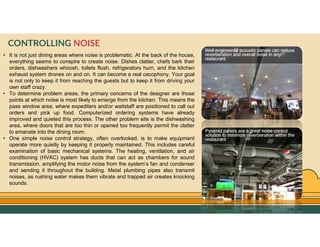
  • 16.
  • 17.
  • 18.
  • 19.
  • 20.
    GO TO CONTENTS PARKINGPLAN: 90 DEGREE PARKING . PARKING PLAN: 45 DEGREE PARKING AREA = 312 SQ.MTS. NO. OF STALLS = 10 PER CAR AREA = 31.2 SQ.MTS. AREA = 408.2 SQ.MTS. NO. OF STALLS = 16 PER CAR AREA = 25.5 SQ.MTS.
  • 21.
    GO TO CONTENTS PARKINGPLAN: 60 DEGREE PARKING . AREA = 293 SQ.MTS. NO. OF STALLS = 10 PER CAR AREA = 29.3 SQ.MTS.
  • 22.
    GO TO CONTENTS PARKINGAT 90 DEGREE PARKING AT 45 DEGREE PARKING AT 60 DEGREE PARKING AT 60 DEGREE
  • 23.
    GO TO CONTENTS RESTROOM FIXTUREMALE GUESTS FEMALE GUESTS Toilet 1 for every 100 2 for every 100 Urinal 1 for every 25 — Wash basin 1 for every toilet or 1 for every 5 urinals 1 for every toilet Source: Fred Lawson, Restaurants, Clubs and Bars, 2nd ed., (Oxford, UK: Architectural Press, 1995). • The size of restroom will depend on the seating capacity of the restaurant. Among experts, there are two very different schools of thought about restroom placement. One group thinks they should be located near the entrance, so that guests can freshen up before dining; the other thinks they should be nestled discreetly at the back of the dining area. • Restroom locations are most likely a function of where plumbing lines are, and these are usually near the bar and/or kitchen. • The requirements spell out the number of water closets, urinals for men’s rooms, and lavatories (washbasins) for handwashing. • For the small business, with up to 50 seats, a 35- to 40-square-foot area is the absolute minimum for a toilet and washbasin. RATIO OF RESTROOM FACILITIES PER GUEST
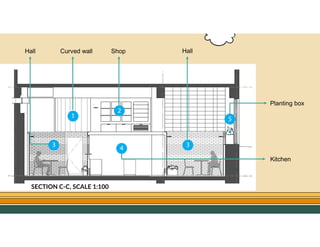
  • 24.
    GO TO CONTENTS RESTROOM Source:Bettermidmissourijobs.com Source: Juliavaconsin.com • The bathroom layout above provides ample facilities for close to 200 guests in a restaurant, • The only thing we would improve on is including a second sink (perhaps removing one urinal) in the men’s room. This provides three toilets and two sinks for each gender and prevents lines from forming near the restroom. • The above layout provides even more room for visiting guests. • The benches toward the bottom of the design and the vanity area in the women’s room (left side) including a separate mirror and counter space where ladies can freshen up prevents congestion at the sinks and makes moving around much easier.
  • 25.
    GO TO CONTENTS PLUMBINGFIXTURES AND ACCESSORIES HEIGHTS
  • 26.
    GO TO CONTENTS RESTROOMAREA : PLANS AND ELEVATIONS
  • 27.
  • 28.
    GO TO CONTENTS PATIODINING • In many areas, outdoor dining is permitted only if a restaurant have the parking to accommodate it, but the rules sometimes depend on whether (and how) the outdoor dining area is covered: with a tent or umbrella or a rolled or permanent awning. • The rule for creating an outdoor dining area is to blend it comfortably into the space that surrounds the restaurant. • We have to decide whether the existing doors of the building will work for outdoor service: Is there a separate entrance for the outdoor waitstaff, or must they use the front doors to deliver food to outdoor tables? When things get crowded, is it still workable? Do the indoor guests get blasted by the wind and rain because the doors are constantly swinging? • Outdoor dining also has unique space considerations such as; an additional outdoor service area, the purchase of outdoor furniture, and the means to secure it from theft or during inclement weather
  • 29.
    GO TO CONTENTS •A well-set-up patio can increase gross profits by an incredible 65%. • The ideal location for a patio is close to the kitchen and dining room, so servers don’t have to walk very far in between. • The example is from Acapulco’s Mexican Restaurant in Denver, CO has a patio in the back of the restaurant, with round seating. The patio has seven tables and is close to the dining room and the bathrooms.. PATIO DINING ACAPULCO’S MEXICAN RESTAURANT, DENVER This restaurant plan example represents the restaurant outdoor area equipment and furniture layout, as well as furniture and interior design elements layout inside this restaurant. The represented cafe includes an inside hall delimited on the zones - main hall, lounge zone and bar, and large outdoor area, which requires special attention - it is a patio with tables and lush greening. The open area is comfortable for seating in warm periods of the year and offers so popular places for the rest during the warm summer, spring and autumn evenings.
  • 30.
    GO TO CONTENTS SOMEEXAMPLES A mash-up of vintage mirrors, barbed-wire chandeliers, industrial-style chairs with a slate gray finish, patina-chic midcentury- modern lawn chairs, and furnishings born out of fallen branches makes dining at Jacoby feel timeless. This high-end Mexican-cuisine destination in Scottsdale’s Fashion Square (another one is in West Hollywood, California) keeps things cozy on the patio at night with marble-laid outdoor firepits and glowing wall sconces. Orbs suspended overhead contribute an elegant streak while greenery is elevated— hung above seating in wooden built-ins and backlit just right. TOCA MADERA (SCOTTSDALE, ARIZONA) JACOBY’S RESTAURANT & MERCANTILE (AUSTIN, TEXAS) TOWNHOUSE DETROIT (DETROIT, MICHIGAN) Inspired by Motor City’s industrious roots, the outdoor dining at Townhouse’s downtown Detroit location, surrounding a glass-enclosed atrium, features a plant wall, cherry red side chairs, and birdcage- like light fixtures. Mature trees and flower boxes add further warmth.
  • 31.
    GO TO CONTENTS SOMEEXAMPLES LA MERCERIE (NEW YORK CITY) The café’s outdoor dining features life-size “flower boxes” to safely divide diners. French-inspired pastries and cocktails are in perfect pitch with indigo blue exterior walls, and decorative columns, paired with woven bistro chairs. WOLFGANG PUCK AT HOTEL BEL- AIR (BEVERLY HILLS, CALIFORNIA) Blessed with year-round sunshine, this eatery rarely shutters its outdoor seating, snug in a lush garden setting and riffing on. Seating under the pergola bypasses casual for refined booths in a milk-chocolate hue and cane-back armchairs, under the glow of lattice-tubed pendant lighting. WHITE LIMOZEEN (NASHVILLE, TENNESSEE) This translates into ’60s-inspired florals and magenta hues, along with fringed umbrellas and pin-striped sofas. Petal pink walls with gold trim in the rooftop bar’s inside portion are paired with magenta velvet ottomans, pink-and-white tartan-print armchairs, and Asian rugs.
  • 32.
    GO TO CONTENTS •The kitchen is the heart of any foodservice business. Like a human heart, its job is to pump and circulate life-giving blood throughout the rest of the operation. Therefore, kitchen placement will affect the quality of the food, the number of guests who can dine at any particular time of day, the roles and workload of the servers as well as kitchen employees, utility costs, and even the atmosphere of the dining area. • A poorly designed kitchen can make food preparation and service more difficult than it should be, and it can even undermine staff morale. • Each of the next topics must be addressed to make the kitchen a “healthy heart.” • Sufficient space to perform the required tasks. 1. Space requirements are generally influenced by:  The number of persons who work in a specific area.  The amount and types of equipment required in the work area.  The amount of storage required for immediately accessible supplies.  The types of products being produced in the area.  The amount of clearance required for moving equipment, opening appliance doors, and so on. 2. Adequate aisle space.  If an aisle is not wide enough, employees will struggle to work comfortably in the space, If the aisle is too wide, employees add steps and fatigue to their workdays. In addition to foot traffic, there will be rolling carts and equipment around constantly. Overall, however, kitchen aisles should be at least 36 inches wide, and wider if they carry two-way traffic or mobile cart traffic. KITCHEN
  • 33.
    GO TO CONTENTS 3.Intelligent design to minimize injury risks. Most people have to do some reaching, twisting, lifting, and bending to perform their jobs, but if these motions are repetitive or excessive, they become unnecessarily strenuous and can prompt injuries, from back problems to carpal tunnel syndrome. For instance, most culinary tasks require the use of some type of surface space. It must be the correct height for the task, and located within easy reach of the employees who will use it. 4. Comfortable temperatures and humidity control. Many restaurant owners are concerned about making their guests comfortable—but what about the employees who spend entire workdays there? The ideal balance of fresh air, humidity, and air movement is to be maintained. 5. Adequate lighting for the required tasks. For kitchens, adequate lighting includes attention to glare and shadows as well as light levels. Fatigue sets in and errors multiply when lighting is insufficient; and good lighting also is necessary to monitor the sanitation of food, surfaces, and utensils. Ideal lighting conditions are discussed in the coming slides. 6. Noise control and abatement. Kitchens can be noisy places, from chefs barking orders to the whirring of appliances and the clatter of dish rooms. It is no longer sufficient just to keep the din from the kitchen from spilling into the dining area. Proper noise control measures are discussed in the coming slides. KITCHEN
  • 34.
    GO TO CONTENTS KITCHENSPACE FLOW The kitchen is located away from the entrance to allow for a large open seating area and there is good visual connection between the kitchen door, the ordering station, the take-out counter and all the dining room seating. For waiters, there are two entries to the kitchen for main dishes and a counter for desserts and coffee. There are multiple point- of-service stations within the seating areas. A point of service station is located at each end of the patron space for short service distances. The patron and staff flows are closer together. To help mitigate this potential problem, a counter to the kitchen is shielded with low partitions to allow for a staff- only area for easy retrieval and return of plates.
  • 35.
    GO TO CONTENTS SERVICESYSTEM • A major issue that must be addressed before deciding on a kitchen design is the way in which food will be delivered to guests. This is known as the service system. • Each service system has subsystems; together, they encompass every aspect of the progression of food from kitchen, to table, and back to the dishwashing area. This progression is called flow. • There are two types of flow to consider when planning your kitchen design: product flow and traffic flow. • Product flow is the movement of all food items, from their arrival at the receiving area, through the kitchen, to the guests. • Traffic flow is the movement of employees through the building as they go about their duties. • The ideal, in both types of flow systems, is to minimize backtracking and crossovers—again, to make sure the “streets” don’t get clogged. • There are three basic flow patterns in every foodservice operation: • The raw materials to create each dish have a back-to-front-to-back flow pattern. They arrive at the back of the restaurant, in the kitchen, where they are prepared. Then they travel to the front of the restaurant, to be served in the dining area. Finally, they return to the back again, as waste. • The third type of traffic pattern is the flow of the service staff as waiters pick up food, deliver it to the guests, and clear the tables. On a busy night, the whole system really does resemble a busy freeway.
  • 36.
    GO TO CONTENTS •A critical decision to be made early in the design process: Should the waitstaff come into the kitchen to pick up food, or should it be handed to them through a pass window between kitchen and dining area? Although the pass window is considered informal, it can be used in a fancier restaurant, perhaps masked from public view by a wall or partition. • Each of these items—distance and kitchen access—helps determine your flow patterns. In a perfect world, flow patterns would all be straight lines that do not intersect. However, this ideal is rarely achieved. One simple rule of thumb is that the faster you want your service to be, the more important it is that your flow patterns do not cross. • Food flow line: the path of raw materials from the time they enter the building to the time they become leftovers. • The receiving area is where the food is unloaded from delivery trucks and brought into the building. Most restaurants locate their receiving areas close to the back door. • Storage—dry storage, refrigerated storage, or freezer storage—where large quantities of food are held at the proper temperatures until needed. Food that emerges from storage goes to one of several preparation, or prep, areas for vegetables, meats, or salad items. Slicing and dicing take place here, to prepare the food for its next stop: the production area. • The size and function of the prep area varies widely, depending mostly on the style of service and type of kitchen. When most people think of a restaurant kitchen, what they imagine is the production line. Here the food is given its final form prior to serving: Boiling, sauteing, frying, baking, broiling, and steaming are the major activities of this area. The food is plated and garnished before it heads out the door on a serving tray. And that’s the end of the typical food flow line. SERVICE SYSTEM STORAGE AREA WORKING STAFF IN KITCHEN
  • 37.
    GO TO CONTENTS FLOWAND KITCHEN DESIGN • The most basic, and most desirable, flow plan is the straight line, also called the assembly-line flow. Materials move steadily from one process to another in a straight line. This type of design minimizes backtracking; it saves preparation time and confusion about what’s going out of the kitchen and what’s coming back in. The straight-line arrangement works well for small installations because it can be placed against a wall and adapted to the cooks’ duties. Straight-line arrangement In a straight-line or assembly-line kitchen, food and materials are passed from one work center to another in a straight line. Source: Robert A. Modlin, ed., Commercial Kitchens, 7th ed. (Arlington, VA: American Gas Association, 1989). • Where there is not enough space to arrange food preparation in a straight line, a popular and efficient choice is the parallel flow. • There are four variations of the parallel design: 1. Back to back 2. Face to face 3. L-shape 4. U-shape
  • 38.
    GO TO CONTENTS 1.Back to back. Equipment is arranged in a long, central counter or island in two straight lines that run parallel to each other. Sometimes a four or five-foot room divider or low wall is placed between the two lines. It’s primarily a safety precaution, which keeps noise and clutter to a minimum and prevents liquids spilled on one side from spreading onto the other. However, placement of a wall here also makes cleaning and sanitation more difficult. • The back-to-back arrangement centralizes plumbing and utilities; we may not have to install as many drains, sinks, or outlets, as both sides of the counter can share the same ones. A back-to-back arrangement in which the pass window is parallel to (and behind one of) the production areas is sometimes known as a California-style kitchen. • When the pass window is located perpendicular to the production line, it may be referred to as a European-style kitchen design. The advantage of the European design is that each cook on the line can see the progression of multiple dishes that make up one table’s order. FLOW AND KITCHEN DESIGN In a parallel flow configuration, equipment and work centers are arranged to save space and allow efficient movement of product and workers. Source: Robert A. Modlin, ed., Commercial Kitchens, 7th ed. (Arlington, VA: American Gas Association, 1989).
  • 39.
    GO TO CONTENTS 1.Face to face. In this kitchen configuration, a central aisle separates two straight lines of equipment on either side of the room. Sometimes the aisle is wide enough to add a straight line of worktables between the two rows of equipment. This setup works well for high volume feeding facilities like schools and hospitals, but it does not take advantage of single source utilities. Although it is a good layout for supervision of workers, it forces people to work with their backs to one another, in effect, separating the cooking of the food from the rest of the distribution process. Therefore, it’s probably not the best design for a restaurant. 2. L-shape. Where space is not sufficient for a straight-line or parallel arrangement, the L-shape kitchen design is well suited to access several groups of equipment, and is adaptable for table service restaurants. It gives you the ability to place more equipment in a smaller space. You’ll often find an L-shape design in dishwashing areas, with the dish machine placed at the center corner of the L. 3. U-shape. This arrangement is seldom used, but it is ideal for a small space with one or two employees, such as a salad preparation or pantry area. The L-shape kitchen layout works well in long, rectangular spaces and allows more equipment to be placed in a smaller area Source: Robert A. Modlin, ed., Commercial Kitchens, 7th ed. (Arlington, VA: American Gas Association, 1989)
  • 40.
    GO TO CONTENTS PREPARATIONAREAS • Preparation. In the preparation area, foods are sorted further into individual or batch servings. The loin trimmed in the fabrication area is cut into steaks, lettuce and tomatoes are diced for salad assembly, shrimp is battered or peeled. Ingredients are also mixed: meat loaves, salad dressings, casseroles. Salad and vegetable prep areas are found in almost every foodservice setting. They are busy places, and their focus must be on efficiency. When designing the layout, remember the need for worktables, compartment sinks, refrigerators, and mechanical equipment. Order some worktables with food and condiment wells that are cooled from beneath with ice, allowing easy accessibility, • Production. This area is divided into hot-food preparation, usually known as the hot line, and cold-food preparation, called the pantry. Production is the heart of the kitchen, and all the other areas are meant to support it. • Holding. As its name suggests, the holding area is the one in which either hot or cold foods are held until they are needed. The holding area takes on different degrees of importance in different types of foodservice operations. Basically, the larger the quantity of meals produced, the more critical the need for holding space. • Assembly. The final activity of the preparation area is assembly of each item in an order. At a fastfood place, the worktable is where burgers are dressed and wrapped and fries are bagged
  • 41.
    GO TO CONTENTS PRODUCTIONAREAS • Here are some of the “stations,” or sections, of the typical hot line. • Broiler Station. A single or double-deck broiler is found here. • Griddle Station. The width of the griddle determines its capacity. It can be either a floor-standing model or a tabletop griddle that sits atop a counter. • Saute Station. Here we find three types of ranges: the flat-top sectional range, with individual heat controls for each section; the ring-top range, with rings of various sizes that can be removed to bring flames into direct contact with the sauté pan; and the open-top range, also sectional, with two burners per section. Ovens can be placed tabletop in this area or they can be installed below the range. Above the range is often a mini-broiler known as a salamander, used for quick duties like melting butter or as a holding area. • Holding Station. Once again, we have an area designated for holding finished food before it is assembled on plates or put onto trays. Any of the individual stations can have their own holding areas, or there can be one central area. Either way, they often include a dry or wet steam table or hot-water baths for keeping sauces warm. The hot line, or battery of cooking appliances, in a typical foodservice kitchen. They are arranged together under an exhaust hood system Source: Carl R. Scriven and James W. Stevens, Manual of Equipment and Design for the Foodservice Industry (Albany, NY: Thomas Learning, 1989).
  • 42.
    GO TO CONTENTS PANTRY •The pantry is where cold foods are prepared for serving. Preparation responsibilities here may include salads, sandwiches, cold appetizers and entrées, and desserts. Sometimes it is referred to as the cold kitchen. The illustration on the right shows the components of this complete workstation. A two-compartment sink is a must for this area, since salad greens must be washed and drained here. Worktables with cutting boards should be adjacent to the sink, and it is helpful if the sink itself has corrugated drain boards. Refrigeration is also necessary, since cold storage is required for many ingredients, as well as a holding area for cold prepared foods. In restaurants, this could be a pass-through setup, with sliding glass doors on both sides so that pantry employees can slide finished items into the refrigerator and servers can remove them as needed from the other side. • When the pantry is also the site of dessert preparation, additional refrigeration and counter space are needed. You must find room for a freezer and an ice cream chest with its special waterwell to store scoops. The latter must meet local health ordinance requirements. Soft-serve machines may also be needed. Again, mobile carts equipped with shelf slides can be helpful, both to store and to transport products. A PANTRY AREA LAYOUT
  • 43.
    GO TO CONTENTS BAKERYAREA • Before designing a bakery area, we should ask ourself: What baked goods will we prepare here, and what baked goods will we purchase from outside sources? • Will we bake from scratch or use premixed items and/or frozen doughs? • Often, to bake or not to bake on site is strictly a business decision, since baking on site requires additional room, equipment, and skilled personnel. There are dozens of hybrid arrangements in foodservice: A restaurant may decide to purchase all breads but make desserts in house, or vice versa. Pizza operations must do baking on-site, but other than that, there are lots of variations. Within the kitchen, a bakery generally takes on one of two basic forms. It is either a compact area located next to the hot line, like the sample layout shown in Illustration on the top-right, or it is a distinct area of its own, like the larger bake shop shown in Illustration bottom- right. When it is a compact area, the setup may be as simple as a baker’s table with storage bins beneath, which shares ovens and mixers with other areas. The bakery area is an integral part of many kitchens. Here is a layout for a small, corner site. Source: Robert A. Modlin, ed., Commercial Kitchens, 7th ed. (Arlington, VA: American Gas Association, 1989). A layout for a large, high- volume bakery Source: Robert A. Modlin, ed., Commercial Kitchens, 7th ed. (Arlington, VA: American Gas Association, 1989)
  • 44.
    GO TO CONTENTS WAREWASHINGAREA • Warewashing is the term for collecting soiled dishes, glasses, flatware, pots, and pans and scraping, rinsing, sanitizing, and drying them. It is by far the most necessary, and least exciting, part of the foodservice business. Whether dishes are done by hand or by machine, or a combination of both, it’s a messy job with high temperatures, high humidity, and slippery floors that require constant caution. For the restaurant owner, this is also one of the most costly areas to operate. Labor (and high turnover), utilities, and equipment are all expensive, and breakage can account for 10 to 15 percent of dish room expenses. • A smooth, short flow pattern from dining room to dish room will keep breakage to a minimum and lower labor costs. You’ll need to find the shortest route that minimizes the natural noise and clatter of working with dishes, and also keeps them out of the guests’ sight as much as possible. In institutional settings, the dish room should be placed in the flow pattern of outgoing guests, so as not to interfere with the incoming ones. A conveyor belt or placement of walls or partitions can minimize contact with dish room sights and sounds. • In determining the size of your dish room, consider the size of the dining room. Remember that each person served will generate six to eight dirty dish items. Calculate how many full dish racks your dish machine can process in one hour. Finally, realize that the best dish rooms are, on average, working at 70 percent efficiency. • Nonslip floors and adequate drainage are necessities. Usually city ordinances also specify lighting requirements (70 to 100 foot-candles of brightness) and govern the ventilation system. Dish machines generate so much heat and humidity that proper ventilation is necessary for employee comfort; as a bonus, it also helps clean dishes dry faster. Acoustical tile for walls and ceilings is important in this area, to keep dish room noise from spilling into the dining area. DISH ROOM CONFIGURATIONS Source: Robert A. Modlin, ed., Commercial Kitchens, 7th ed. (Arlington, VA: American Gas Association, 1989)
  • 45.
  • 46.
  • 47.
  • 48.
    GO TO CONTENTS DININGAREA • When designing the dining area, a well-planned scheme carefully shapes the customer’s perception with these components: 1. Table shapes, sizes, and positions 2. Number of seats at each table 3. Multiple floors, steps, or elevated areas of seating 4. Paintings, posters, or murals 5. Type and intensity of lighting 6. Planters, partitions, or screens 7. Attention to sight lines, to block any undesirable view (restroom, kitchen, service areas) 8. Muffling of distracting noises (clattering dishes, outside traffic, or construction) 9. Placement of service areas (coffee stations, dirty dish bins, etc.) • Even though other facets of design can be out of the ordinary, when it comes to flow patterns, the simpler the better. Customer and employee safety should be paramount. Remember that most of us tend to walk to the right of other, oncoming persons. Think of the room as a neighborhood and the flow as the major streets in that neighborhood. Avoid traffic congestion, and everybody likes living there. Consider the maximum number of seats allowed in the space as well as the average time you want customers to spend at a table. Generally, the faster the turnover, the greater the need for clear flow patterns that do not cross. Conversely, if dining is to be leisurely, flow should be designed mostly to make the waitstaff seem as unobtrusive as possible. In terms of environmental psychology, most people would rather sit with some type of architectural fixture on at least one side of them—a wall or window or column—which helps them define their space. Another design rule is that tables of different shapes and sizes should be mixed to create visual harmony. A lineup that’s too orderly evokes more of a military mess hall image.
  • 49.
    GO TO CONTENTS TABLESAND SEATING • Successful layout of a dining area includes balancing multiple components: safety of guests and employees, efficiency of service, aesthetics, and financial implications. At first glance, it would appear that cost per square foot, and the potential revenue generated by each seat, would be the dominant consideration. In general, lower check averages require a greater density of seating, and higher check averages can translate to fewer seats, greater guest comfort, and slower turnover. However, the driving factor is not necessarily filling an empty space with as many tables as possible; rather, the goal is to achieve a balance between customer comfort and bottom-line profit, in a style that best suits the restaurant’s concept and image. • Popular types of seating include chairs, stools, booths, and banquettes. Booths offer a certain feeling of privacy or intimacy, but tables and chairs are more adaptable since they can be moved around as needed. A banquette is an upholstered couch fixed to the wall, with a table placed in front of it. Banquettes are a hybrid of booth and table—more adaptable than a booth, but they still must hug the wall. Banquettes happen to be very fashionable at the moment. Not only can they be upholstered in any number of stylish fabrics, but they maximize seating by filling up corners and allowing more guests to be seated than would fit at individual chairs. Bar stools, either at bars or taller cocktail-style tables, are the most casual seating option.
  • 50.
    GO TO CONTENTS CHAIRS •Chairs are part of the overall design of the room, so the style you select should be in line with the image and ambience of the room. You may hear the term “scale” used in seat selection. The scale of an object is your visual perception of its size. For instance, look at the two chairs in Illustration. When you compare the captain chair to the Windsor chair, they’re actually about the same size, but the Windsor chair appears lighter and more delicate. This illustrates the difference in scale between the two. • Once you’ve selected a style, hone in on the technical aspects of chair construction. Less expensive chairs may be glued or even stapled together—not the optimum for durability. Upkeep and maintenance are important, including whether the manufacturer will keep spare parts available over the years. Frames can be made of metal, wood, or plastic. They can be stained, dyed, painted, or lacquered; stained and dyed frames are the easiest to maintain, and dying allows for an endless choice of colors. Seats may or may not be upholstered. The chairs can have arms, but only if your tables are roomy enough to accommodate them. Ask about protective laminate finishes for wooden chairs, which would otherwise chip and dent easily. • Check for design flaws that would be troublesome in a public setting: Does clothing catch or snag on edges? Are any of the edges sharp enough for someone to scrape or cut themselves accidentally (guests or the waitstaff)? Are the legs wobbly? How will the chair hold up when someone quite overweight sits in it? If you have many female guests, can a handbag or jacket be slung over the chair back without sliding to the floor? Lancaster Seating Alloy Series Black Metal Indoor / Outdoor Industrial Cafe Arm Chair
  • 51.
    GO TO CONTENTS Hereare some specifics that may help in chair selection: • A 15-degree angle for the chair back is recommended. • The depth of the seat, from edge to chair back, should be 16 inches. • The height of the chair, from the floor to the top of the chair back, should be no more than 34 inches. • Anything higher impedes the servers. • The standard distance from the seat to the floor should be 18 inches. • The distance between the seat and the tabletop should be 12 inches. • Allow 24 to 26 inches of space for each chair at a table; 28 inches if they are armchairs. • For bar or countertop seating, allow 24 to 26 inches per stool. CHAIR SELECTION Consider how the chairs or stools work when empty too. Do they fit under the tables or the bar armrest? Can they be pushed in easily when not in use, to make the aisles roomier? Are they stackable? Are they easy to clean and easy to move when the floor needs cleaning? Booth seating is another common choice. You used to see booths only in bar lounges and casual restaurants, but they also look very smart in upscale eateries, where they afford a sense of privacy and romance. Booths can save space, taking up as little as eight square feet per person. However, booths are more labor- intensive than tables, since it’s harder to clean beneath and around them, and they can’t be moved to accommodate various sizes of dining parties. Lancaster Seating Black Cross Back Chair with 2 1/2" Padded Seat. This chair weighs less than 14 lb., making setup and cleanup quick and easy. Clear Frame Ladder Back Cafe Chair with Black Padded Seat. This chair's 2 1/2" vinyl padded seat ensures comfort for patrons. Capped with plastic glides to protect the floors from scratches and scuff marks.
  • 52.
    GO TO CONTENTS MetalSlat Back Chair with Mahogany Wood Grain Finish and Black Vinyl Seat. This chair has a sturdy metal construction, giving it a high weight capacity of 500 lbs. The frame’s mahogany finish is resistant to stains, scratches, and smudges, keeping the chair looking new. Boomerang Black Chair with Black Vinyl Seat and Antique Walnut Back. The Boomerang back is contoured specifically for the guests’ comfort while maintaining a modern, sleek style. The frame is also powder-coated to resist stains, scratches, and smudges to ensure longevity. Industrial Dining Side Chair with White Wash Finish. This chair's rectangular back is contoured to keep your guests comfortable as they enjoy the dishes. A durable metal frame provides unmatched durability. Along with its solid wood legs and supports under each seat, this chair provides a stable foundation that can hold up to 300 lb. Allegro Black Resin Side Chair. Its matte finish resin construction resists wear and will never rust, making this chair ideal for any outdoor space, it is also lightweight, so can be easily moved around the outdoor setting for the best view. This chair features an ergonomic backrest and even includes slats to add flexibility. CHAIRS SELECTION
  • 53.
    GO TO CONTENTS TABLESELECTION • Deciding on your overall dining atmosphere will help greatly in table selection. Space usually dictates how many tables you will need, and, in most cases, you can get more square tables than round ones in the same square footage. Research shows square tables also seem to produce faster turnover, while round ones prompt guests to linger a bit longer. Attention to aesthetics may require that you blend both square and round tables in your dining area, arranging them at different angles to avoid that mess hall look. The more upscale a restaurant is, the more elbow room you allocate for each customer. A fine-dining establishment should allow 15 to 18 square feet per guest; a moderately priced restaurant, 12 feet per guest; for banquets, a minimum of 10 square feet per person. When purchasing tables, check for sturdy construction. You want long use and solid service from them. Self-leveling legs or bases allow you to adjust for wobbles and also permit the table to glide easily along the floor if it needs to be moved. • Think about whether you will cover the tables with linens, butcher paper, or nothing at all. but you must make an early decision about the type of finish you want on your tables, especially if you won’t be using tablecloths. There’s a world of choices, from marble, wood, and ceramic to the durable plastic laminates such as Formica and Corian, which are stain-resistant and easy to maintain. Nowadays they come in many patterns, including faux marble, which would work even in an upscale restaurant setting. 36" x 36" Square Distressed Copper Dining Height Outdoor Table. This table is made of durable metal that's strong enough to resist weather and corrosion. This table is easy to assemble and can be quickly set up in its proper space and let the guests enjoy.
  • 54.
    GO TO CONTENTS •No matter what you decide, a table should have a waterproof top, and its base should be placed to give your customers a comfortable amount of legroom beneath. If lighting will be low and your tables will be draped, a simple pedestal-style base is appropriate. However, if the dining space is airy and open and the tables will not have cloths, the style of the table base can be part of your design. Tables should be chosen in tandem with chairs, since they will be used together. For example, tables that are 26 inches tall work best with chairs that measure 16 inches from seat to floor; 30-inch tall tables work best with chairs that measure 18 inches from seat to floor. • Table bases don’t just come in chrome, brass, or black enamel anymore. Today’s trends range from fire engine red and deep evergreen to plated finishes of copper, pewter, or bronze. Those little feet at the bottom of the base that hold the table steady also come in different styles. You’ll probably choose between the so-called four-pronged spider base and the cylindrical mushroom base. TABLE SELECTION 30" x 72" Solid Wood Live Edge Dining Height Table with Antique Slate Gray Finish. At 72" in length, it can comfortably seat 6-8 guests. Its underside includes V-shaped metal braces that prevent the wood from warping, which helps to maintain the smooth, sturdy surface. Thanks to its solid beech wood construction, this table is sturdy enough to handle the wear and tear of everyday use in the restaurant. It also features two live edges that create a rustic look and capture the natural beauty of the tree it was harvested from. 24" Square Antique Walnut Solid Wood Live Edge Dining Height Table. It features a matching solid wood post with a metal base plate and spider attachment. While the wide, square base plate helps to prevent the table from wobbling, the 200 lb. weight capacity guarantees it will stand up to heavy meals, dinnerware, and decor. The table top is sturdy enough to handle the wear and tear of everyday use in your restaurant.
  • 55.
    GO TO CONTENTS Thetable, from floor to tabletop, should be 30 inches in height. Here are some basic table sizes and uses: • For one or two guests: a 24-by-30-inch square table, also known as a two-top or deuce. • For three or four guests: a 36-by-36-inch square table; a 30-by-48-inch rectangular table, commonly called a four-top; or a 42-inch- diameter round table. (There are 36-inch- diameter round tables, but they’re a tight fit for four persons.) • For five or six guests: a two-top and four-top can be joined to create seating for up to six; or use a 48-inch-diameter or 54-inch-diameter round table. • For seven or eight guests: two four-top tables can be joined; or use a 72-inchdiameter round table. • For cocktail lounges: a 20-by-20-inch square table; or a 20-inch-diameter round table. 36" Round Dining Height Powder-Coated Steel Mesh Table with Modern Legs and 4 Side Chairs. Designed specifically for outdoor use, this table makes an excellent addition to restaurant and bar patios and other outdoor entertainment areas such as banquets and luaus. The tabletop features an umbrella hole, so you can attach an umbrella (sold separately) to enhance your venue's style and keep your guests comfortable on sunny days. 30" x 48" Antique Walnut Solid Wood Live Edge Dining Height Table. its slightly rough edge and natural, distinctive woodgrain pattern creates a rustic appearance. The table top is sturdy enough to handle the wear and tear of everyday use in your restaurant. Its underside includes v-shaped metal braces that prevent the wood from warping, ensuring long-lasting service. TABLE SELECTION
  • 56.
    GO TO CONTENTS Thepremium solid wood plank table top is an all-time favorite of restaurant owners. Made from solid maple the plank table top showcases the beauty of wood adding warmth and prestige to any interior. Available in a large number of wood stains, shapes and sizes this wood table top is a must for any high-end dining establishment. These resin table tops are a great choice for patios as well as indoors settings. With a light marble finish the resin table tops are as durable and weather resistant as granite or marble tables at a much lower price and less than half the weight! They are also extremely easy to maintain making them ideal for commercial use. The reclaimed wood look is gaining strength in recent years as the industrial becomes more popular than ever. This laminate table tops with a reclaimed wood look are highly durable as well as very attractive and are available in several reclaimed wood finishes making them easy to fit in with almost any interior. Perfect for patio use, this aluminum and plastic teak table is one of the most popular patio tables and no wonder. With weather resistant aluminum frame and plastic teak slats in natural finish this table will fit in with most patio styles and decors especially when paired with matching patio chairs.
  • 57.
    GO TO CONTENTS SEATINGFOR 2 PERSONS SEATING FOR 4 PERSONS TABLE SIZES
  • 58.
  • 59.
    GO TO CONTENTS SEATGROUPINGS AROUND RECTANGULAR, SQUAURE AND CIRCULAR TABLES
  • 60.
    GO TO CONTENTS SEATGROUPINGS AROUND RECTANGULAR, SQUAURE AND CIRCULAR TABLES
  • 61.
    GO TO CONTENTS TOTALAREA = 16.0 SQ. METRES TOTAL SEATS = 26 PER PERSON AREA = 0.62 SQ. METRES TOTAL AREA = 6.7 SQ. METRES TOTAL SEATS = 10 PER PERSON AREA = 0.67 SQ. METRES TOTAL AREA = 56.9 SQ. METRES TOTAL SEATS = 48 OR 51 PER PERSON AREA FOR 48 SEATS = 1.2 SQ. METRES PER PERSON AREA FOR 51 SEATS = 1.1 SQ. METRES
  • 62.
    GO TO CONTENTS TOTALAREA = 36.0 SQ. METRES TOTAL SEATS = 48 PER PERSON AREA = 0.75 SQ. METRES TOTAL AREA = 21.7 SQ. METRES TOTAL SEATS = 44 PER PERSON AREA = 0.5 SQ. METRES
  • 63.
  • 64.
    GO TO CONTENTS PERPERSON AREA = 19.5 SQ.FT. OR 1.81 SQ. METRES PER PERSON AREA = 30.25 SQ.FT. OR 2.81 SQ. METRES PER PERSON AREA = 18.0 SQ.FT. OR 1.67 SQ. METRES
  • 65.
    GO TO CONTENTS PERPERSON AREA = 28.0 SQ.FT. OR 2.60 SQ. METRES PER PERSON AREA = 25.7 SQ.FT. OR 2.39 SQ. METRES
  • 66.
    GO TO CONTENTS PERPERSON AREA = 14.25 SQ.FT. PER PERSON AREA = 11.9 SQ.FT.
  • 67.
    GO TO CONTENTS PERPERSON AREA = 10.6 SQ.FT. PER PERSON AREA = 16.7 SQ.FT.
  • 68.
  • 69.
  • 70.
    GO TO CONTENTS DESIGNINGTHE ENVIRONMENT • For the guest, a restaurant’s environment refers to the things that make him or her feel welcome, comfortable, and secure. For the employee, environment means a safe, comfortable, and productive work setting. And today’s foodservice business owner has yet another critical consideration: the environment of the planet. More attention than ever is being paid to energy conservation, waste reduction, and pollution control in our industry. In some cases, restaurants that don’t heed these important trends face legal penalties, or even closure. • Luckily, with some forethought and expert advice, every component of the dining environment can be designed with conservation in mind as well as safety and atmosphere. • In the coming slides we’ll discuss about the below listed considerations, their ideal ranges and importance in designing the ideal environment for a restaurant. 1. Lighting 2. Color 3. Noise levels 4. Temperature and humidity 5. Ventilation and indoor air quality 6. Air pollution control 7. Theme and interior design 8. Finishing materials
  • 71.
    GO TO CONTENTS LIGHTING •Lighting is the single most important environmental consideration in foodservice, but lighting rules are probably the most difficult to define. When lighting “works,” most of us don’t think much about it; when it doesn’t, we definitely notice. Correct lighting enhances the mood of a dining area, the appeal of the food, and the efficiency of a kitchen. And yet, in each of these situations, “correct” means an entirely different thing. • It’s a complex sensory challenge to illuminate a dining area. Lighting is an integral part of creating ambience, with artsy fixtures and new technology that allow smaller fixtures to do “bigger” lighting jobs. • The lighting environment should match the type of facility. A quick-service restaurant, for instance, is brightly lit to help move guests through the ordering and pickup process and to discourage lingering (sometimes given the unflattering term “camping” by restaurant folk). Big windows take advantage of daylight to lower utility bills and give customers the impression of a quick, casual meal, almost like eating on a patio. This type of restaurant typically spends from 12 to 15 percent of its annual budget on lighting. • An establishment that features fine artwork on the walls will want to play up its collection by spotlighting it. In most dining situations, experts try to think of each table as a single space and design the lighting accordingly. This results in more sources of light, but at lower levels. Light also can be used to cast shadows, adding texture to an otherwise dull or underutilized space.
  • 72.
    GO TO CONTENTS LIGHTING •The Daniel Boulud Brasserie in Las Vegas’ Wynn Resort shows how lighting design can be both beautiful and useful. The ceiling serves not only a decorative function, but as the source of downlights directed at individual tables. Wall sconces also add decorative touches. • Even within a dining room, light levels will vary. An entryway, waiting room, cocktail lounge, and dining room each require separate treatment. This may require lighting transition zones, the technical term for shifting people comfortably between two different types of lighting, giving their eyesight a moment to adjust to the change. A lighting transition zone is necessary in a lobby area, for example, when guests come from bright sunlight into a darker indoor space. • Another common lighting design term is sparkle, which refers to the pleasant glittering effect, not unlike a lit candle, of a lighting fixture. Sparkle is a must in creating a leisurely or elegant dining atmosphere. • Light sources and levels of intensity should cause both the guest and the food to look good. Although every design expert has a theory about how to accomplish this, all agree that the “look” of incandescent light is the best way to achieve this ideal. First, however, you must control any incoming natural light, which can affect utility bills as well as diner comfort. Locate windows to avoid the harshest daylight or even take advantage of daylight if it benefits a particular concept. Other types of external lighting also might be intrusive, from parking lots or exterior streetlights. Many problems can be remedied with window blinds, shades, curtains, or awnings. These should be carefully chosen to blend with the mood of the facility and for ease of cleaning. The lighting for Daniel Boulud Brasserie is an excellent example of the use of both direct and indirect lighting.
  • 73.
    GO TO CONTENTS LIGHTING •There are several different ways to use light. The most common are indirect and direct. • Indirect lighting washes a space with light instead of aiming the light at a specific spot. Indirect lighting minimizes shadows and is considered flattering in most cases. Wall sconces are one example of indirect lighting. Often the light fixture itself is concealed. • Direct lighting aims a certain light at a certain place, to accent an area such as a tabletop. When that area is directly beneath the light fixture, it is referred to as downlighting. A chandelier is an example of direct lighting. MEASURING LIGHT • Lumen is a measurement of light output; it is short for luminous flux. One lumen is the amount of light generated when 1 foot-candle of light shines from a single, uniform source. Illumination (also sometimes called illuminance) is the effect achieved as light strikes a surface. We measure illumination in foot-candles; 1 foot-candle is the light level of 1 lumen on 1 square foot of space. In the metric system, foot-candles are measured in terms of lux, or 1 lumen per square meter. A lux is about 1 10 th of a footcandle. • The color rendering index (CRI) is yet another measurement of light. The CRI is a numerical scale of 0 to 100, which indicates the effect of a light source on the color appearance of objects. It’s not as confusing as it sounds. The index measures the “naturalness” of artificial light compared to actual sunlight. A higher CRI (from 75 to 100) means a better color rendering. Simply put, things look more true to their natural color when the light on them is strong enough to get a good look at them. So a CRI of 75 to 100 is considered excellent, while 60 to 75 is good, and below 50 is poor. Incandescent and halogen lamps (bulbs) have the highest CRI ratings; clear mercury lights usually have the lowest CRI ratings.
  • 74.
  • 75.
    GO TO CONTENTS Thereare three different types of lighting one must consider: ambient lighting, task lighting, and accent lighting. • Ambient light provides the main source of light in a room, allowing people to see and move around comfortably throughout a space. This type of restaurant lighting can come from a natural light source such as large windows as well as artificially, from overhead fixtures. A restaurant’s ambient lighting helps set the overall mood. Bright lighting creates an energizing feel while low lighting creates an intimate ambiance, welcoming guests to sit closer together and feel more relaxed. • Task lighting allows people to perform tasks such as reading menus or preparing food. This is the most versatile of lighting types, as many different light fixtures can be used to create task lighting depending on the tasks at hand. • Accent lighting functions to provide focal points and artistic flare, guides the eye to dinner specials, art, or down a long hallway. Accent lighting is not vital to completing tasks, but it is beautiful and adds personality to any space. More decorative than functional, accent lighting can draw attention to beautiful paintings, sculptures, fountains or other special features. TYPES OF LIGHTING Ambient light Task lighting Accent lighting
  • 76.
    GO TO CONTENTS TYPESOF LIGHTING • Accent lighting will bring out the architectural highlights of your restaurant. This LED lighting technique is being used to highlight the wall fixtures, above mirrors and bathrooms, making the restaurant look practical as well as phenomenal. Accent lighting is currently popular lighting concept with interior designers and used across the world. • Chandeliers have a unique spark and widely deployed by exotic restaurants. Many food serving restaurants follow this lighting idea to create an elegant ambience. Replace conventional bulbs with LED lights and double the brightness of your eating house. • Illumination LED lighting idea has been adopted by many successful restaurants. By focusing on featured artwork, ornaments or objects, the combination of accent and ambient lighting works wonders. If you have a creative approach towards your restaurant’s lighting, chose LED fixtures to create the perfect ambience. Hanging chandeliers Illumination lighting
  • 77.
    GO TO CONTENTS •A parking area should convey a sense of safety, keeping criminals out as it draws customers in. From a legal liability standpoint, case law (about crimes committed in parking lots) shows that good security lighting is a positive attempt on the part of a business to provide a safe environment. There are three basic goals for parking lot lighting: 1. To provide a specified intensity throughout the lot 2. To provide good visibility (with minimal glare) for customers and employees 3. To accomplish the first two goals without annoying the neighbors • The biggest challenge in lighting a parking area is the corridors created by the parked cars. To minimize these corridors, it is recommended that illumination be provided from at least two, and preferably four, light poles that are at least 20 feet tall. • Then again, too much lighting creates another problem. Too much light—meant to create safety—may actually result in a hazard as drivers’ eyes adjust from nighttime conditions to the intense glare. LIGHTING IN PARKING AREA
  • 78.
    GO TO CONTENTS USEOF COLOR • In the dining room, the lighting system and color scheme must work together to enhance the environment. Colors depend on their light source because, as we know, the same color can look completely different when seen under different types or intensities of light. Color and light together can also be used to make space seem larger or smaller and more intimate. • Color can be used to convey a theme, a style, a geographic region, a way of life, or even a climate. • Color psychology is the study of color’s impact on people’s moods and buying habits, based on the principle that certain colors evoke certain feelings. Warm colors—orange and yellow tones, such as peach and terra cotta—are considered inviting; white denotes cleanliness and purity; black is sophisticated and dramatic; and so on. Some very basic color “rules” follows: 1. Use light tones and cool colors to make small spaces look larger. 2. Use darker tones and warm colors to “shrink” rooms, creating a greater sense of intimacy in a large space. 3. Dark colors also can be used to mask structural features, such as ductwork, that may otherwise interfere with the design of a room. 4. Bright, primary colors can be combined in contrasting combinations for a super modern feel. Think bright blue or lime green and white, or black and red. 5. Muted colors have a soothing effect on a room. 6. If more than one color is used for walls, one must be dominant and the other subordinate. Use of turmeric color in the interior
  • 79.
  • 80.
    GO TO CONTENTS PSYCHOLOGYOF COLOR In restaurant interior design, the color wheel can be divided into three sections, according to its effect on appetite: Strong Stimulants, Mild Stimulants, and Suppressants.
  • 81.
    GO TO CONTENTS STRONGAPPETITE STIMULANTS • Restaurants use red in some form or shade in their design scheme because It’s a well- established fact that red is the most effective color in stimulating the appetite. • Orange and yellow are also appetite stimulants. Yellow is associated with happiness, which is usually associated with a full stomach. When we see yellow, therefore, our brain secretes serotonin in anticipation of the food were about to eat. • Orange, on the other hand, elicits feelings of warmth and comfort — emotions that are also tied to the security of an abundant table. Blue Orange Restaurant, Dubai. Image: The Westin Dubai That couch, though. Image: Aubrie Pick
  • 82.
    GO TO CONTENTS MILDAPPETITE STIMULANTS Zona Restaurant, Budapest. Image: Position Collective • Green and turquoise are mild stimulants. We may think that green should be a strong stimulant because many leafy vegetables are green, and we’d be partly correct. Green signals edible, benign, non-poisonous plants. However, these plants are merely fibrous, not sugar-packed like most colorful fruit, which provide a jolt of energy. • These days, green is also associated with health. This is unsurprising, given that, again, most green things are fibrous and don’t have sugar.
  • 83.
    GO TO CONTENTS TheOpposite House Hotel, Beijing. Image: Kengo Kuma and Associates APPETITE SUPPRESSANTS • Black, brown, purple, and blue are appetite suppressants. Research suggests that this is because these colors don’t exist in nature — that is, not in the form of food. • Long ago, blue, black, and purple also signaled something that was either rotten or poisonous, which our ancestors learned to avoid by sight. Like our brains’ response to red, orange, and yellow, this is also a carryover from those days.
  • 84.
  • 85.
  • 86.
  • 87.
    GO TO CONTENTS USEOF ARTWORK • Making a real statement with your décor by using murals and other forms of art is an idea worth exploring. The walls aren’t going to be bare, are they? What you choose to put there will add personality and flair to your public areas. • A mural is a wall-size painting, often created directly on the wall itself. It’s a big, gutsy artistic statement that usually becomes the focal point of a room, and it can impact your overall design in several ways: 1. It can be a signature that communicates the restaurant’s concept. 2. It can be used to personalize a large dining space, adding color and motion to an area that might otherwise feel more like a warehouse than a restaurant. 3. Conversely, a mural may be used to open up small dining spaces, by adding extra dimension to the wall space. 4. A mural can add sophistication. It can be wild, vibrant, and ultramodern, or soft and subdued. Either way, it cannot help but make a statement. • Adding a mural is as big a step as the size of the mural itself, and the price tag for such a large original work can easily top $10,000, so it requires careful consideration. • A mural can be an impressive conversation piece, but if not properly planned and professionally painted, it can be distracting and downright annoying instead of mood enhancing. A really bright wall mural in this eclectic looking cafe A printed wallpaper mural designed by artists at Blacksheep Design.
  • 88.
    GO TO CONTENTS •A less permanent and less expensive way to add color to your dining area is to display the work of local artists, galleries, or art dealers. Depending on your arrangements with the art supplier, the works are priced and the restaurant may receive a small commission when one is sold. This allows you to change the décor with the seasons, by the month, or whenever you think the place needs a change. Whenever a new artist or selection is featured, you have a nice reason to invite guests and members of the local news media to an “opening” reception. • Showcasing local talent is not without risks, but it has a satisfying, community-minded spirit as a side benefit. It decorates your walls, boosts your business, and nurtures goodwill— all inexpensively. • Finally, when thinking about artwork, don’t forget the restrooms. Many restaurants decorate all other areas to the max but leave their restroom walls completely bare. The muted tones of these Italian-themed wall murals provides a warm and casual theme at Monical’s Pizza, a chain with more than 40 locations in Illinois, Indiana, Missouri and Wisconsin. The Magic Mural images, including an Antique Map of Italy, the Trevi Fountain, the Roman Colosseum and more, provide diners with a trip to Italy for the cost of a pizza. A classic black & white beach mural behind the service counter at the Hideaway Restaurant in Bethany Beach, DE
  • 89.
    GO TO CONTENTS PLANTERS The5 best plants for restaurant decor 1. Violas and Lady fern 2. Japanese maple 3. Tulips 4. Begonia 5. Pelargonium 6. Spider plants How to use plants in restaurants for effective results 1. Pick plants that complement your patio 2. Add romance, coziness and privacy 3. Add lighting for visual effect 4. Think big – think outside the box 5. Use planters to keep your display tidy Plants and lights combination Use of climbing plants Outdoor beautifully decorated with plants and flowers Planters can be used to create a theme
  • 90.
    GO TO CONTENTS NOISEAND SOUND CONTROL • Both the dining area and the kitchen pose numerous challenges when it comes to noise reduction. Unfortunately, the challenges usually are not obvious until the space is occupied and someone, either employees or guests, starts complaining. • Typical restaurant sounds are many and varied: people conversing; waiters reciting the day’s specials or picking up orders; cleaning of tables and bussing of dishes; kitchen equipment grinding, whirring, and sizzling; the hum of the lights or the HVAC system; the strains of background music or a live band. If you’re located on a busy street, add traffic noise; if it’s an airport—well, you get the point. • It’s interesting that, while too much noise can cause discomfort, an absence of noise is just as awkward. It feels strange to sit at a table and be able to hear every word of your neighbors’ conversation and to know that your own conversation is probably being eavesdropped on as well. In short, a restaurant’s noise level should never be accidental. It is an important component of the environment and mood. • Some restaurant owners pump up the sound system volume in hopes of creating a sense of “happening” in the dining area. The challenge here is not to have a loud restaurant but to achieve a sound level of high enough quality and volume that guests will notice and enjoy it yet can also comfortably converse through it. Juggling these priorities is harder than it sounds. Even if yours is a fabulous sound system, a stimulating noise level is bound to turn some customers away. Sound-absorbing panels for the acoustic comfort of restaurants
  • 91.
    GO TO CONTENTS •In controlling noise, we need first to be aware that it has two basic characteristics: intensity and frequency. Intensity, or loudness, is measured in decibels, abbreviated dB. The lowest noise an average person can hear close to his or her ear is assigned the level of 1 decibel, while a 150-decibel level would cause pain to the average ear. A “noisy” restaurant averages 70 to 80 decibels. • Frequency is the number of times per second that a sound vibration occurs. One vibration per second is a hertz (abbreviated Hz). Humans hear vibrations that range all the way from 20 per second (low frequency) to 20,000 per second (high frequency). In a restaurant setting, a high-frequency sound is more objectionable than a low-frequency sound. Even sounds that are low intensity may be objectionable to guests if they are also high frequency. Sound travels from the source to the listener and back again in very speedy fashion—about 1100 feet per second. • Inside a building, sound can be either absorbed or reflected by all the other things in that space: walls, ceilings, floors, furniture, or equipment. If it reflects or “bounces off” of surfaces (called reverberant sound), the area can build up a sound level that is much higher than if the space was not enclosed. UNDERSTANDING NOISE Sound-absorbing panels for the acoustic comfort of restaurants
  • 92.
    GO TO CONTENTS •It is not just dining areas where noise is problematic. At the back of the house, everything seems to conspire to create noise. Dishes clatter, chefs bark their orders, dishwashers whoosh, toilets flush, refrigerators hum, and the kitchen exhaust system drones on and on. It can become a real cacophony. Your goal is not only to keep it from reaching the guests but to keep it from driving your own staff crazy. • To determine problem areas, the primary concerns of the designer are those points at which noise is most likely to emerge from the kitchen. This means the pass window area, where expediters and/or waitstaff are positioned to call out orders and pick up food. Computerized ordering systems have already improved and quieted this process. The other problem site is the dishwashing area, where doors that are too thin or opened too frequently permit the clatter to emanate into the dining room. • One simple noise control strategy, often overlooked, is to make equipment operate more quietly by keeping it properly maintained. This includes careful examination of basic mechanical systems. The heating, ventilation, and air conditioning (HVAC) system has ducts that can act as chambers for sound transmission, amplifying the motor noise from the system’s fan and condenser and sending it throughout the building. Metal plumbing pipes also transmit noises, as rushing water makes them vibrate and trapped air creates knocking sounds. CONTROLLING NOISE
  • 93.
    GO TO CONTENTS NOISECONTROL MEASURES General sound control can be accomplished in two ways: Either suppress the sounds from their source, or reduce the amount of reverberant sound by cutting the travel direction of the sound waves. Sound engineers use hard concave surfaces to concentrate sound. The hard surface traps the sound, then sends it in the desired direction. If a soft convex surface is used, the sound is absorbed and deadened. These principles can be adapted to the ceilings, walls, and furnishings of any room. The ceiling of a room is a natural choice for sound control treatment, because there is not much on the ceiling that would get in the way. Spray-on acoustic surfaces, acoustical tile, fiberglass panels padded with fabric, wooden slats, or perforated metal facings are less noisy alternatives to plain plaster or concrete ceilings. Panels and slats should be at least [3 /4] inch to one inch thick and suspended instead of being directly attached to the ceiling. Be sure not to paint acoustical tile, or it will lose its sound-absorbent effect. Covering walls with padding, fabric, or carpet helps a great deal to muffle sound. Organizing the dining room on different levels also helps somewhat. And the use of movable partitions, which can be purchased up to 5 feet in height, can contain sound as well as create intimacy by breaking up a large dining area into smaller spaces. Walls and partitions can even be decorative and see-through, to maintain the open feeling of a room. CEILING WALLS
  • 94.
    GO TO CONTENTS KITCHENNOISE CONTROL • Controlling loudness in the kitchen begins with the idea of having doors that separate the kitchen from the dining room. Some kitchens don’t have doors, but passageways, making it especially important to have acoustical treatments on both walls and ceilings in these transition zones. • Of course, some restaurateurs believe that having customers witness kitchen sights, sounds, and smells is part of the mystique and excitement of eating out. In the open or display kitchen, noise levels are part of the atmosphere. • Inside a kitchen, consider these noise abatement options: 1. Installing acoustical tile ceilings 2. Undercoating all work surfaces 3. Putting the dishroom in an enclosed area 4. Installing all refrigerator compressors in a separate “mechanical room” or area outside the kitchen 5. Properly installing and maintaining exhaust fans to reduce humming and vibration 6. Using plastic or fiberglass dish carts and bus containers instead of metal ones Acoustic ceiling
  • 95.
    GO TO CONTENTS VENTILATIONAND AIR QUALITY • Ventilation is part of the overall ambience. At best, it’s hard to do perfectly. At worst, it may be jeopardizing the health of the workers and customers. Indoor air quality (IAQ) has become a huge concern, prompting lawsuits and legislation on the state level. • The ASHRAE standards for proper ventilation are shown in the table below. The ventilation rate is the amount of cubic feet of air per minute that must be replaced per person, and it varies somewhat with the function of the room itself. The four overall principles that can improve indoor air quality are: 1. Bring in a sufficient amount of outdoor air. 2. Manage the flow of air within your interior spaces. 3. Use high-quality filtration systems. 4. Keep the HVAC equipment clean and in good working order. • Demand control ventilation (DCV) is a technology option that allows you to adjust the amount of outdoor air that comes into your system, much like a thermostat allows you to control temperature. DCV systems are popular in foodservice, because the number of guests varies greatly at different times of the day. Computerized sensors vary the amounts of air supplied and exhausted, depending on the occupancy of the space. The sensors are stationed in each zone of the building, and they “sense” occupancy by detecting the carbon dioxide levels in the air. Other sensors monitor the air pressure of the system. Installing this type of ventilation system is expensive, and the sensors and controls must be calibrated on a regular basis, but it will save energy and money in the long run by freshening and exhausting air automatically, only as needed. Source: American Society of Heating, Refrigeration and Air Conditioning Engineers, Atlanta, Georgia.
  • 96.
    GO TO CONTENTS AIRPOLLUTION CONTROL • What exactly is air pollution? Smoke and gases, grease, airborne dirt, and germs begin as individual particles, too small to see until thousands of them are grouped together. One particle is measured in microns—one micron is 1/25,400 of an inch long—and that’s what air pollution control equipment must remove from the air system. • A single particle of restaurant kitchen smoke is 0.3 to 0.8 microns in size, so it is much easier to measure it in terms of its density or opacity—the degree to which the smoke blocks the flow of light in a room. An opacity level of 100 percent would be solid black; 0 percent would be completely smoke-free. The cities that have adopted smoke pollution ordinances usually require an opacity level of no more than 20 percent. • Cooking odors are molecules generated by the combustion of animal or vegetable products during the cooking process to make an extremely complex mixture of reactive organic gases (referred to by experts as ROGs). Grease absorbs a small percentage of odor ROGs, but most of them float around in the air, much too small to be removed by any type of filter. One popular method to remove odor ROGs is to push them through a layer of activated charcoal, which absorbs and retains them. Unfortunately, charcoal is highly flammable, and, when it becomes fully saturated, it begins to release odors—sometimes worse than the original odors! A second common method of odor removal is to use potassium permanganate, which oxidizes and actually solidifies the molecules, then retains them. Either charcoal or oxidation can remove 85 to 90 percent of odor molecules from the air
  • 97.
    GO TO CONTENTS THEMEDESIGN ECO THEME DESIGN • Eco theme design is particularly about backing to nature and contrasting with the work environment sharply, in order to provide diners with a simulated dining environment and help them enjoying the green plants, fresh air and textures of materials. • In this case, the designers used natural stones, wood and plants to create a unique dining environment, and applied plants and palms to separate the terrace dining area from the street. Lights, waterscape, green space, old plank and dark stones come together to create a natural dining atmosphere. • Green planters were added into some walls, as well as trees and palms to separate the main facade from the street. • The whole atmosphere provides an impression of light and dramatic context full of textures, light and shadows, in which the food becomes the natural focus of attention. • The ceiling is painted in black and by separating the perimeter from the walls, the light enters provoking a sense of continuity to the stone walls. • The wood has a look of old plank which very nicely contrasts with the dark stones. The stones provoke a changing texture; not only light and shadow emerge from their surface, but also natural vegetation grows and changes with time All the images are from D’Amico, Mexico
  • 98.
    GO TO CONTENTS THEMEDESIGN CEDAR THEME DESIGN • Cedar in the Semitic language means “white pine” which refers to the power of spirit and is considered as the faithful symbol of Sumerian. Historically, cedar is also one of the earliest used aromatic substances and is used in temples for burning incense, for which reason it has been given a mysterious impression. • In this case, the designers used hundreds of cedar planks to decorate the walls and together with the head-height lights behind the slats to create a warm dining space; what’s more, the texture of cedar as well as its organisation suggested the traditional culture of Japan. All the images are from Zama, Philadelphia, PA, USA
  • 99.
    GO TO CONTENTS INTERIORDESIGN CONCRETE SPACE THEME RESTAURANT The design like this is very modern yet simple and cosy since the majority of the style is using concrete with a little bit of touch with greenery and woods colours.The style like this is definitely suitable as the working space restaurant, really comfortable for hanging out with friends! MARBLE CHIC STYLE RESTAURANT Marble is the most well-known style in the interior design, it gives the elegant and temporary looks to the area. RESTAURANT LIKE PRISON DESIGN Another unique design for a unique restaurant. Make the customer experience the prison atmosphere while enjoying your food. .
  • 100.
    GO TO CONTENTS INTERIORDESIGN INDUSTRIAL DESIGN RESTAURANT Another manly vibe for your restaurant inspiration. The restaurant inspired by industrial style like this created by Luchetti Krelle. This style like this proves that the combination of woods and metal can also give the modern touch result ECLETIC STYLE RESTAURANT Bring art with a combination of colours for your restaurant design is also a very brilliant idea to have. Don’t be scared to play with plenty of colours to decorate your restaurant, People actually enjoy being in a unique area like this. The design that closes to manly vibe like a hipster is definitely a great style choice. To achieve the look like this all you need is an Aztec pattern for the rug and leather chairs. HIPSTER INSPIRED INTERIOR DESIGN RESTAURANT
  • 101.
    GO TO CONTENTS FINISHINGMATERIALS WALL FINISHES BAMBOO WALL FINISHES Bamboo has been a number one choice of commercial interior designer for its environmental qualities. It is also very strong and lasts forever and that is just a couple of reasons why we think bamboo proved to be an excellent wall finish material. 3D WALL TILES t is an ideal way to bring more texture and character to otherwise ordinary spaces. These concrete 3D tiles are ideal in places where the sun or artificial lighting will accent their pattern. LARGE PRINT WALLPAPER Applying large size prints on walls of any commercial interior will create an instant environment and bring out emotional responses. Large size flower prints can add a cozy feeling in any restaurant or a café interior design. It makes any wall look larger and more festive.
  • 102.
    GO TO CONTENTS FINISHINGMATERIALS FLOORING MATERIALS LAMINATE When it comes to laminate flooring, the benefits include strength and durability. The surface is smooth and level and resists stains, scratches, and wearing out. One of the other excellent benefits for a restaurant or bar is that it resists fading. This gives you a look that stays like new for longer. LUXURY VINYL TILE (LVT) STONE FLOORING Stone flooring is another more elegant choice. Each type of stone has its own durability level, but on average it is durable and provides a natural texture. This texture helps with a grip so it is ideal for kitchen areas or non-slip bar flooring where slips and falls can be prevalent. This is a type of flooring that is durable, yet allows for many aesthetic ideas. It’s ideal for spills, heavy foot traffic, and abrasions. It can even be placed to mimic other types of flooring and at a lower cost for some.
  • 103.
    GO TO CONTENTS FINISHINGMATERIALS CEILING DESIGN IKIBANA RESTAURANT IN BARCELONA A fusion of Japanese and Brazilian elements which applies to both the menu served and the interior décor. The ceiling’s design became the perfect compromise. It’s a design statement that symbolizes the landscapes of both regions in a simplified and abstract way. NOODLE RESTAURANT IN CHANGSHA Inspired by the traditional noodle- making technique, this restaurant in Changshau, China features a ceiling defined by a multitude of hanging lighting fixtures draped across to resemble noodle strands. TEDDY BEAR-THEMED RESTAURANT IN BANGKOK Villa de Bear is a restaurant in Bangkok. The main concept of its design is based on the idea of a European teddy bear factory. The ceiling in particular is eye-catching, mainly because of the contrast created by comparison with the simplistic furniture and decor in general.
  • 104.
    GO TO CONTENTS PSYCHOLOGYOF SCENT • Smell is the most primal of our five senses; that is, smell is the most basic and primitive method of collecting information from our surroundings. • The sense of smell is very closely linked to memory, probably more so than any of our other senses. • There are many scents that trigger similar responses in most people. Lavender, for example, relaxes the brain. Vanilla and chamomile reduce stress, anxiety, and depression. Citrus and peppermint increase alertness. • Those silver plate domes we often see in movies depicting fine dining restaurants? Not only do they keep the food clean and create a sense of mystery and surprise, they also allow the food’s smell to build up and concentrate. As soon as the waiter lifts that dome, the scent of the food hits us in the face with its full strength. • Kitchens also pump scents into the dining area through scent. • it’s worth noting that the right smells can increase food sales up to 300%. • According to a study by the University of Paderborn, scents increased impulse buying by 6%, buying intention by 14.8%, and the length of a customer’s stay by 15.9%.
  • 105.
    GO TO CONTENTS RESTAURANTFIRE SAFETY TIPS • Restaurants are some of the most fire hazardous places in the world, especially in the kitchen. The fact that a restaurant is usually a busy place with many costumers makes it even more dangerous. That’s why it’s very important to install fire extinguishing systems in all restaurants. • the way you design your restaurant seating layout, as well as the placement of the other restaurant furniture, could be a matter of life and death. First of all, to ensure a safe way out if a fire starts, make absolutely sure that the path to the restaurant’s main door isn’t blocked by anything! You must realize that when a fire breaks loose and the fire alarm starts ringing, people usually panic and seek the way out of the burning structure. Therefore you must ensure a clear, safe path for them to do so! • This doesn’t mean you shouldn’t have wood restaurant furniture it only means you need to be careful not to keep wooden furniture close to fire sources. If your layout and design are done properly this is easily achieved and in the long term it might save your restaurant and somebody’s life. • In kitchens there is always the risk of fire, and most of it is caused by food that was forgotten on the stove or in the oven and from kitchen towels and rags that were left near an open fire. The biggest risk though, is in the ventilation system of the kitchen. • And finally, make sure there is a clear path from the dining and working areas to the exits.
  • 106.
  • 107.
    GO TO CONTENTS TANGPALACE, HANGZHOUl, CHINA ARCHITECTS: ATELIER FEICHANG JIANZHU AREA: 2460 SQ.METRES YEAR: 2010
  • 108.
    GO TO CONTENTS •The restaurant is located on the 9m (291⁄2 ft) high sixth and top floor of a superstore in a new area of this rapidly expanding Chinese city. • Some of its private rooms, a traditional component of restaurants in China, are suspended from the roof of the original building shell. Detailing makes generous use of bamboo, traditionally in lengths of the natural material and, less familiarly, in the flat strips of reconstituted bamboo used to make up the serpentine wall and interwoven to make the perforated and continuous planes of screens and ceilings.
  • 109.
    GO TO CONTENTS •A staggered bank of banquette seating and tables makes a transition between the rectangular blocks of the reception desk and the freestanding tables in the middle of the floor, but the pervasive bamboo theme is already established in the curved walls of the entrance area and taken up comprehensively in the perforated curved walls that mask the rectilinear walls of the service core and the new kitchen. • This serpentine wall gives structure to the central dining spaces and evolves into the undulating mesh of the ceiling, which hangs between the two levels and permits appreciation of the full height of the original shell. Where straight walls, such as those to the kitchen are not softened by a mesh screen, their surfaces are broken by panelled surfaces that are illuminated, on their upper levels. • The entrance hall also follows the theme of bamboo. The wall is covered with bamboo material which follows the original outline of the wall, turning it into a wavy surface. In this way, the surface echoes the hall ceiling as well as performs a guiding function for customers.
  • 110.
    GO TO CONTENTS •The real drama of the interior, however, is provided by the private dining rooms, suspended from the existing structure and accessed by suspended walkways. Their circular soffits provide a light source for tables in the central space, which draws attention to their existence. Their circular plans are echoed in the curved screens that begin to enclose five tables in the lower central space. The bigger wholly enclosed and self-contained private rooms use the staggered plan motif of the banquettes, which effectively incorporates their service elements, to make the transition to the curved mesh that surrounds the central space. • The original building condition has a core column and several semi-oval blocks which essentially disorganized the space. Hence, the design wants to reshape the space with a large hollowed-out ceiling which is made from interweaved thin bamboo boards; and extending from the wall to the ceiling. The waved ceiling creates a dramatic visual expression within the hall. The hollowed-out bamboo net maintains the original story height and thereby creates an interactive relation between the levels. • Wrapped core column with light-transmitting bamboo boards to form a light-box, which transforms the previously heavy concrete block into a light and lively focus object.
  • 111.
    GO TO CONTENTS Amesh of reconstituted bamboo strips makes a perforated ceiling plane between the two levels and provides a smooth transition into the vertical screens that mask existing wall surfaces. The glass block wall to the bar servery offers a variation on the mesh pattern. The ceiling mesh allows views of the suspended rooms on the upper level and their illuminated soffits provide the principal light source to the central dining area. The mass of the wall to the stair and service area behind is broken by illuminated panels.
  • 112.
    GO TO CONTENTS •The different folding angles and engraved patterns make each room different from one another. • The rooms above on the south are smaller and feature a special waved ceiling pattern and simple bamboo wall surface, which creates interesting and spacious room features. • The key design concept of the space is that the suspended rooms are connected with suspended bridges and sideway aisles. • The semi-transparent wall provides a subtle relationship between the inner and outer spaces, bestowing people with a special spatial experience. • Usages of the new bamboo material can be seen, responding to the local culture while seeking intriguing spatial effects. • Structural elements like concrete column and block walls are made light by the parametric lattice, which was gently sourced and fastidiously erected.
  • 113.
    GO TO CONTENTS •The entrance first exposes the bamboo lattice as it rises from the floor and curls along the sweep of the wall. • Private rooms in the back are partitioned by vertical bamboo reeds, creating a separation from the large dining room but still allowing for an airy space. • A suspended stairway leads up to the second floor. • From above guest can see the lower floor and the top side of the bamboo lattice. • Small private dining rooms dot the upper recesses like glowing lanterns. • The rooms are suspended from the ceiling, providing a very unique experience while casting a faint glow over the spaces below.
  • 114.
    GO TO CONTENTS SUSPENDEDPRIVATE ROOMS SUPPORTING STRUCTURE STACKED PRIVATE ROOMS HORIZONTAL MESH BETWEEN FLOORS VOID FOR STACKED PRIVATE ROOMS PRIVATE ROOMS GLASS BALUSTRADE CIRCULATION AND SERVICE CORE
  • 115.
    GO TO CONTENTS PLAN,SCALE 1:400 1. ENTRANCE 2. RECEPTION 3. AQUARIUM 4. BAR 5. BANQUETTES 6. TABLES 7. PRIVATE ROOMS 8. LATTICE WALL 9. STAIR 10. LIGHTBOX 11. KITCHEN 12. WCS 13. CIRCULATION AND SERVICE CORE PLAN: LOWER LEVEL
  • 116.
    GO TO CONTENTS 1.SUSPENDED PRIVATE ROOMS 2. PRIVATE ROOM SUPPORTED ON ROOM BELOW 3. SUSPENDED WALKWAY 4. PRIVATE ROOM 5. STAIR 6. WCS 7. OFFICE 8. CIRCULATION AND SERVICE CORE PLAN, SCALE 1:400 PLAN: UPPER LEVEL
  • 117.
    GO TO CONTENTS SUSPENDEDPRIVATE ROOM STACKED PRIVATE ROOM PRIVATE ROOM TABLES SECTION A-A, SCALE 1:300
  • 118.
    GO TO CONTENTS +GREEN RESTAURANT, TOKYO ARCHITECTS:SINATO INC. PROJECT: +GREEN LOCATION: TOKYO, JAPAN AREA: 1153 sq. mts. YEAR: 2011
  • 119.
    GO TO CONTENTS •This organic restaurant, shop and takeaway is appropriately located close to Komazawa Park, one of the biggest outdoor spaces in the city. The site presents particular challenges. The overall height of the shell is 4.39m (14 ft 4 in), not quite enough to allow the insertion of two levels with conventional floor-to-ceiling heights, and this restriction radically influenced plans and sections. The takeaway and reception is at the street level. Three steps lead up to the shop, which is 0.56m (1 ft 8 in) above entrance level, and nine lead down 1.61m (5 ft 3 in) to the restaurant. • The designers have used clever partitioning, neutral materials and subdued colors to create a space that appears both intimate and large, and despite its underground location, has a refreshing, airy feel. • original floor, wall and ceiling are not decorated, so they are all skeleton and not so beautiful.
  • 120.
    GO TO CONTENTS •The choice of materials gives coherence to the complex organization. The existing smooth, poured concrete planes of walls, floor and ceiling, together with the service pipes they support, are left exposed. Insertions of rectangular brick boxes, which rise to the level of the shop floor and to knee height in the entrance, create small shared and some more private dining areas at the bottom level. The boxes also contain the kitchen, which is tucked beneath the shop, and are spaces for storage. Brick construction lends itself easily to, and prescribes dimensions for, the perforated pattern making • The 111.5 square meter (1,200 sq.ft.) space is exceptionally high (about 4.4 meters or 14.4 feet) and much of it is underground but customers — and light – can move freely between the three levels. • The hall space is divided into three places, but at the same time they are connected. • Plants are arranged here and there so that people can see them from anywhere.
  • 121.
    GO TO CONTENTS •A smooth white, steel-framed serpentine wall sits lightly on the brick rectangles, creating a central atrium, the upper part of which has a plan quite different from the lower. It also screens the existing concrete walls but is pierced with variously sized rectangular openings that frame views of the restaurant from the entrance level. The sides of the single, centrally located stair that connects the three levels are clad in horizontal timber strips that match the layering and colour of the brickwork but the quality of detailing and execution of junctions throughout the interior is such that all elements clearly retain their visual autonomy. • In upper space, brick wall looks like a knee-high base of white wall. • In upper space, white wall hides original wall and equipment like air conditioning system or piping. And the wall can serve as frames which show some graphic, plants and scenery of the restaurant. In addition, it surround stairs space and make big void. • In lower space, you can slightly feel the border (plan) of white wall above your head and it is quite different from the plan of the restaurant floor partitioned by brick wall.
  • 122.
  • 123.
    GO TO CONTENTS Thestair makes minimum contact with floor and wall. Its horizontal layering and colour relate to the brickwork and its curve to the white wall
  • 124.
    GO TO CONTENTS Aview from the landing at entrance level up to the shop. The brick threshold between takeaway space and stair illustrates how floor levels respond precisely to brick coursing. Translucent glass screens with glued joints in the takeaway and shop contrast with the brick’s solidity
  • 125.
    GO TO CONTENTS Themajor elements touch but remain visually intact. The white wall rests on but does not intersect the brickwork. Brick dimensions and construction techniques determine perforations in the brick wall Brick coursing determines variations in floor levels, here to a private room. The curved white wall ties private and communal spaces together. The timber strips that clad the walls to the stairs also form treads and risers.
  • 126.
  • 127.
  • 128.
    GO TO CONTENTS PLANAT ENTRANCE LEVEL 1. ENTRANCE 2. TERRACE 3. TAKEAWAY (PRIVATE ROOM UNDER) 4. STAIR 5. SHOP (KITCHEN UNDER) 6. MAIN RESTAURANT 7. PRIVATE ROOM (LOWER LEVEL) 8. PERFORATED BRICK WALL (LOWER LEVEL) 9. CURVED WALL 10. PLANTING BOXES 11. ORIGINAL CONCRETE WALLS PLAN, SCALE 1:200
  • 129.
    GO TO CONTENTS SECTIONTHROUGH CURVED WALL 1. EXISTING CONCRETE SLAB 2. STEEL EXPANSION ANCHOR AND 9MM (3 ⁄8 IN) BOLT 3. CURVED PAINTED TIMBER BOARD 4. TIMBER FRAMING 5. PAINTED FIBRE-REINFORCED GYPSUM BOARD 6. 9MM (3 ⁄8 IN) BOLT 7. TIMBER FRAMING 8. NEW BRICK WALL SECTION D-D, SCALE 1:200
  • 130.
    GO TO CONTENTS TerraceTakeaway Window Curved wall Planting box Private room Stair Hall Private room SECTION A-A, SCALE 1:100
  • 131.
    GO TO CONTENTS SECTIONB-B, SCALE 1:100 Takeaway Curved wall Window Hall Private room (restricted height) Store
  • 132.
    GO TO CONTENTS Curvedwall Shop Hall Kitchen Planting box Hall SECTION C-C, SCALE 1:100
  • 133.
    GO TO CONTENTS SECTIOND-D, SCALE 1:100 Curved wall Shop Hall Kitchen Planting box Store
  • 134.
    GO TO CONTENTS CONCLUSION Thisliterature study about restaurants illustrates and narrates the means and tactics required to successfully design a restaurant. Ranging from furniture selection to space planning and much more. Starting from the meaning of restaurant and why people go to a restaurant instead they can eat meals at home too, different types of restaurants and their parking area are discussed. It provides the information about how to design parking area so as to make full use of space without discomforting customers, staff and neighbours. Entrance designing is one of the most crucial part of designing as it gives the impression of overall space to customers. Restroom design is as essential as any other part of the restaurant, it must be designed keeping in mind the comfort of the users. Outdoor dining designing is as important as indoor dining, the type of furniture required, it is much spacious than indoor dining area and different decorating elements required for patios are also discussed. Kitchen design requires different areas such as cold and dry storage areas, dishwashing area, it is the busiest area in a restaurant as whole restaurant depends on the efficiency of kitchen, a short delay in food serving can cost a heavy loss to the owner, therefore we’ve discussed different layouts and flows and identified the efficient ones in this study. Dining area is where the customer spends most of his/her time, so it is thoroughly discussed in this study, how to choose furniture ranging from their dimensions to material, how to decorate the area with artwork and what particular arrangement of tables and chairs to follow and what their results are. The use of different lighting types and techniques to highlight or darken particular areas and the level and intensity of light required for the utmost comfort of the customers and staff in a particular area are also discussed. The importance of understanding and applying the psychology of colour and many examples of different colour schemes are also illustrated so as to give the reader an idea of the feeling one gets by seeing particular colours, whether they are giving a sense of hunger to a person and whether there is a colour in dining area which is appetite suppressant, such as black in large use. The use of plants in decorating patios and interiors, as well as their combination with lighting, though briefly, is also discussed. Air pollution being one of the major problems in our country and needs proper attention while designing.
  • 135.
    GO TO CONTENTS CONCLUSION Properventilation and desired air circulation importance and requirements are also discussed. Noise control and regulating measures, the use of sound-absorbing materials, and different ways of controlling noise are also discussed. Use of different finishing materials for walls, ceilings, and floors and fire safety measures are also discussed. Finally, a case study of +Green restaurant and Tang Palace restaurant is discussed.
  • 136.
    GO TO CONTENTS INFERENCE •From this literature and case study, it can be inferred that • Restaurants are much more than eating places. People associate memories with them. If the memories are pleasant, they'll visit again. If they aren't, they won't. • Restaurants are classified based on a variety of factors, including the type of food served, the style of operation, the type of service, etc. • The various spaces of the restaurant need to be connected properly. • The entrance way should be designed keeping in mind that it is where the guests will decide whether they are comfortable eating there. • The parking area is the first impression of a guest; therefore, it must be designed keeping in mind the area, suitable angle, and proper access width to minimise traffic in the parking area. • Restrooms should be designed according to the seating capacity of the restaurant, and there should be a sufficient number of toilets and washbasins for the guests. • A restaurant kitchen should be designed while considering many factors, such as the dining capacity of the restaurant, type of service, etc., and selecting the layout accordingly. The flow should be as simple as possible and should not cause problems for any staff member, because a bad flow means slow service, and slow service means customer anger, and it can cause a huge loss to the owner. The layout should be selected depending upon the area. The ware washing area needs proper ventilation and soundproofing. There should also be proper illumination in the kitchen (500 lux).
  • 137.
    GO TO CONTENTS INFERENCE •Because the dining room is where guests spend the most of their time, it needs to be carefully arranged. Everything from the seating arrangement to the furnishings to the colour scheme should be carefully considered. The type of furniture, the amount of space allocated to each table, the proper aisle width for staff and diners, and the lighting for each table, as well as selection of scent, floor finishing, ceiling selection, indoor air quality, colours, and so on, should all give diners the impression of being in a pleasant and appealing environment. Finally, we talked about Tang Palace, a Chinese restaurant, and +Green, a Japanese restaurant.
  • 138.
    GO TO CONTENTS SOURCESUSED • https://pos.toasttab.com/blog/on-the-line/restaurant-floor-plans • These Are the Most Beautifully Designed Outdoor Dining Experiences in America | Architectural Digest • Cafe and Restaurant Floor Plan Solution | ConceptDraw.com | Restaurant Furniture Layout • Restaurant Table and Chair Sets: Shop Dining Sets & More (webstaurantstore.com) • Restaurant Soundproofing - Bar Soundproofing (memtechacoustical.com) • Best Plants for Restaurants: Planter Decor And Patio Design (jayscotts.com) • 4 Styles of Restaurant Lighting and Modern Ideas - Seascape Lamps • The Psychology of Restaurant Interior Design, Part 3: Lighting | Fohlio • Wall Finishes Trends in Commercial Interior Design (mindfuldesignconsulting.com) • 10 Flooring Options for Your Restaurant | Modern Restaurant Management | The Business of Eating & Restaurant Management News • Best types of Flooring for a Restaurant or Bar (Ultimate Guide 2019) (expressflooring.com) • 17 Amazing Restaurant Interior Design Ideas (thedestinyformula.com) • What does restaurant mean? (definitions.net) • The Psychology of Restaurant Interior Design, Part 2: Scent | Fohlio • Restaurants With Striking Ceiling Designs (homedit.com) • Restaurant Safety Tips - Fire | Restaurant Seating Blog • https://rddmag.com/design/how-to/142-make-an-entrance • https://www.archdaily.com/442110/green-sinato • Restaurant Table Sizes & Dimensions - Seating Capacity Guide (restaurantfurniture.net)
  • 139.
    GO TO CONTENTS •Time-Saver Standards for Building Types Second Edition • Time-Saver Standards for Interior Design and Space Planning • Neufert Architect’s Data Fourth Edition • Detail in Contemporary Bar and Restaurant Design, Drew Plunkett and Olga Reid • Design and Equipment for Restaurants and Foodservice, Third Edition, Costas Katsigris and Chris Thomas • 100 Restaurant Design Principles • Restaurants, Clubs And Bars, Second Edition, Fred Lawson BOOKS USED
  • 140.
    GO TO CONTENTS •https://olsonkundig.com/wp-content/uploads/2015/06/08042_00_Mistral_Kitchen_BB_N2-1249x1440.jpg • https://www.decorationlove.com/wp-content/uploads/2016/07/Industrial-Kitchen-Design-Ideas-1-840x473.jpg • http://www.patriquinarchitects.com/wp-content/uploads/2016/11/FLOW-ZINC-PATHS.jpg • https://www.contemporist.com/wp-content/uploads/2010/08/vr_240810_01-630x502.jpg • http://www.patriquinarchitects.com/wp-content/uploads/2016/11/FLOW-ROIA-PATHS.jpg • https://igx.4sqi.net/img/general/600x600/WTV-jFQgpiuH50ROBvGrYYPl_Et8KS5REUViKjMPTEI.jpg • http://www.patriquinarchitects.com/wp-content/uploads/2016/11/FLOW-KITCHEN-ZINC-PATHS.jpg • https://1x12gs5mivd268ltk1c9vi3x-wpengine.netdna-ssl.com/wp-content/uploads/2013/07/208-duecento-otto-autoban-dpages-blog-0.png • http://www.patriquinarchitects.com/wp-content/uploads/2016/11/FLOW-SUBITO-PATHS.jpg • https://www.capriottis.com/wp-content/uploads/2018/05/05_3355NovatStreet_Ste150_2005_HiRes-768x512.jpg • https://i.pinimg.com/originals/20/88/c9/2088c91124be0854c70840d64411a727.jpg • https://media-cdn.tripadvisor.com/media/photo-s/1d/00/78/af/sikia-fine-dining-restaurant.jpg • https://media-cdn.tripadvisor.com/media/photo-s/1a/50/91/6a/dining-area.jpg • https://media-cdn.tripadvisor.com/media/photo-s/1c/12/29/a8/vive-l-ete.jpg • https://media-cdn.tripadvisor.com/media/photo-s/16/af/f9/d5/photo1jpg.jpg • https://media-cdn.tripadvisor.com/media/photo-s/07/a9/1a/1a/harbour-buffet-restaurant.jpg • https://media-us.camilyo.software/media-us/blog/10/10547/41152.jpg • https://media-us.camilyo.software/media-us/blog/10/10547/41151.jpg • https://media-us.camilyo.software/media-us/blog/10/10547/41149.jpg • https://thedestinyformula.com/wp-content/uploads/2019/01/restaurant-interior-design2.jpg • https://thedestinyformula.com/wp-content/uploads/2019/01/restaurant-interior-design.jpg • https://thedestinyformula.com/wp-content/uploads/2019/01/restaurant-interior-design4.jpg • https://thedestinyformula.com/wp-content/uploads/2019/01/Moscow-Bratya-Karavaevi-restaurant-5.png • https://cdn.newsapi.com.au/image/v1/1fa17626f00c859e8be7d55eb8f818ac?width=650 • https://thedestinyformula.com/wp-content/uploads/2019/01/Poczekalnia-restaurant-imagined-like-a-prison-by-Karina-Wiciak_dezeen_1.jpg IMAGES USED
  • 141.
    GO TO CONTENTS •https://media.architecturaldigest.com/photos/5fa9a38029dcfd6754c7dbba/master/w_1600%2Cc_limit/White%2520Limozeen%2520CommercialPhotograph y_DigitalLove_Nashville_GraduateHotel_WhiteLimousine-33%2520Photo%2520Credit%2520Digital%2520Love.jpg • https://media.architecturaldigest.com/photos/5fa9a3751985d5aebcf4b4b6/master/w_1600%2Cc_limit/Jacoby%25E2%2580%2599s%2520Restaurant%252 0Mercantile%2520-8.jpg • https://media.architecturaldigest.com/photos/5fa9a3b9813f69fae77d56a3/master/w_1600%2Cc_limit/Le%2520Farfelle%2520Patio%2520setup%2520Phot o%2520Credit%2520Rachel%2520Venter.jpg • https://media.architecturaldigest.com/photos/5fa9a3fb2c35d22a8ff82e0f/master/w_1600%2Cc_limit/Townhouse%2520Detroit_9348.jpg%2520Photo%2520 Credit%2520Aly%2520Sasson.jpg • https://media.architecturaldigest.com/photos/5fa9a51e3a27a2ea90ed3ae9/master/w_1600%2Cc_limit/Toca%2520Madera%2520Scottsdale%2520Patio%2 520Overview%2520Day.jpg • https://media.architecturaldigest.com/photos/5fa9a5a5dbb5682b8b2b4369/master/w_1600%2Cc_limit/LaMerceriexJoeThomas.jpg • https://img-aws.ehowcdn.com/600x400/cpi.studiod.com/www_ehow_com/photos.demandstudios.com/getty/article/103/113/94502417_XS.jpg • https://static.epermittest.com/media/filer_public/75/4d/754d246c-7521-40e4-93a1-a4923447deec/angle-parking.jpg • https://th.bing.com/th/id/OIP.-8w1qPNFiXLsArBFVmmodgHaEw?pid=ImgDet&rs=1 • https://imgix.ranker.com/user_node_img/50066/1001317407/original/60-degrees-the-middle-ground-photo-u1?w=650&q=50&fm=pjpg&fit=crop&crop=faces • https://static.epermittest.com/media/filer_public/29/e2/29e2acbb-f775-419f-b6b9-c1bcc0d10190/reverse-perpendicular-parking.jpg • https://www.conceptdraw.com/solution-park/resource/images/solutions/cafe-and-restaurant-plans/Building-Cafe-Restaurant-Plans-Restaurant-Outdoor- Area,-Patio-Plan.png • https://cdnimg.webstaurantstore.com//images/products/large/185371/643723.jpg • https://www.webstaurantstore.com/images/products/medium/557859/2087682.jpg • https://cdnimg.webstaurantstore.com/images/products/xxl/413388/2137989.jpg • https://cdnimg.webstaurantstore.com/images/products/large/503919/1931540.jpg • https://cdnimg.webstaurantstore.com/images/products/large/579107/2137852.jpg • https://cdnimg.webstaurantstore.com/images/products/extra_large/404728/1931927.jpg • https://cdnimg.webstaurantstore.com/images/products/large/460473/1786066.jpg IMAGES USED
  • 142.
    GO TO CONTENTS •https://data1.ibtimes.co.in/cache-img-640-0/en/full/534846/imgopen-fire-wood-burning-stove.jpg • https://www.aau.edu/sites/default/files/AAU-Images/Research-and-Scholarship/shutterstock_1066763171-chef-stirring-vegetables-in-wok-700x394.jpg • https://toiib.com/wp-content/uploads/2020/06/Restaurant-ventilation.jpeg • https://www.acustico.com/en/img/acoustic-comfort-restaurants/Officina-Mediterranea-Catania-Prisma-baffles.jpg • https://www.acustico.com/en/images/gallery/Acoustics-and-Design-Restaurant-Piattofondo-Lido-di-Camaiore-Aural.jpg • https://www.magicmurals.com/blog/wp-content/uploads/2020/03/Hideaway-Restaurant-Bethany-Beach-DE-by-Marnie-Oursler6.jpg • https://www.magicmurals.com/blog/wp-content/uploads/2020/03/SteveHeino_62119-3fix1.jpg • https://www.magicmurals.com/blog/wp-content/uploads/2020/03/jamiestrattoriarichmondsurreyengland-from-we-heart-dot-com.jpg • https://www.magicmurals.com/blog/wp-content/uploads/2020/03/RobinKoozer_101515-3.jpg • https://turf.design/wp-content/uploads/2017/06/01_crease_edit2.jpg • https://i.pinimg.com/originals/6c/de/b5/6cdeb5641dfc4609d32d176e0f10f3db.jpg • https://jayscotts.com/wp-content/uploads/2021/11/383112631.jpg.webp • https://jayscotts.com/wp-content/uploads/2021/11/538566358.jpg.webp • https://jayscotts.com/wp-content/uploads/2021/11/1672197700.jpg.webp • https://i.pinimg.com/originals/1d/2b/59/1d2b596314f106bf3869f03c2d0595de.jpg • https://i.pinimg.com/originals/ff/b1/a2/ffb1a2e4caea3eaa6b6727e61aa283fd.png • https://cdn.vox-cdn.com/thumbor/pFS2esKfdOHt0HELvxKm12YMMW8=/52x0:897x634/1200x800/filters:focal(52x0:897x634)/cdn.vox- cdn.com/uploads/chorus_image/image/38824112/db-brasserie-vegas-inside-0414.0.jpg • https://www.modern.place/wp-content/uploads/2018/01/bubble-light-fixture-dining.jpg • https://www.fohlio.com/blog/wp-content/uploads/2017/08/The-Psychology-of-Restaurant-Interior-Design-Part-2-Lighting-Fohlio-ZONA-wine-bar- restaurant-Budapest.jpg • https://www.fohlio.com/blog/wp-content/uploads/2017/08/The-Psychology-of-Restaurant-Interior-Design-Part-3-Lighting-Fohlio-ABC-Kitchen-and- Restaurant-restaurant-lighting-accent-lighting.jpg • https://www.ranjanpal.com/wp-content/uploads/2016/01/013.jpg • https://www.fohlio.com/blog/wp-content/uploads/2017/08/The-Psychology-of-Restaurant-Interior-Design-Part-2-Scent-Fohlio-scent-diagram.png IMAGES USED
  • 143.
    GO TO CONTENTS •https://www.fohlio.com/blog/wp-content/uploads/2017/08/The-Psychology-of-Restaurant-Interior-Design-Part-3-Lighting-Fohlio-Fera-London- restaurant-lighting-accent-lighting.jpg • https://spectrum-ny.com/wp-content/uploads/2019/08/Parking-Lot-Lighting-768x432.jpg • https://curcioenterprises.com/wp-content/uploads/2018/12/Curcio-Let-There-Be-Light-Parking-Lot-Lighting-Winter-Maintenance-.jpg • https://images.adsttc.com/media/images/5268/691f/e8e4/4e88/a000/0382/large_jpg/05.jpg?1382574339 • https://images.adsttc.com/media/images/5268/6a16/e8e4/4ee8/e100/03a1/slideshow/lower_floor_plan.jpg?1382574581 • https://images.adsttc.com/media/images/5268/6a12/e8e4/4ef4/c200/03a5/slideshow/diagram.jpg?1382574585 • https://th.bing.com/th/id/OIP.c24kjMcxSyllx4tEtjkM2gHaD3?w=294&h=180&c=7&r=0&o=5&pid=1.7 • https://th.bing.com/th/id/OIP.1QUSRBJmSh5rNNl2WoFhSAAAAA?w=204&h=157&c=7&r=0&o=5&pid=1.7 • https://i.pinimg.com/originals/00/34/48/003448614dbe143b839b14b60d8aa87f.jpg • https://th.bing.com/th/id/OIP.R1KZY6sEbc30xVZX8BxohwHaE7?w=302&h=180&c=7&r=0&o=5&pid=1.7 • https://th.bing.com/th/id/OIP.FzMdwvg2zj-iRnG-EiaqXAHaE8?w=244&h=180&c=7&r=0&o=5&pid=1.7 • https://i.pinimg.com/originals/81/96/97/819697677ae9c8a685a5b994ae636875.jpg • https://i.pinimg.com/originals/f0/ef/0e/f0ef0ec542bed2391ae6deaf609cc161.jpg • https://th.bing.com/th/id/OIP.-C31KwV7flvQ6GOQORcamQHaFj?w=233&h=180&c=7&r=0&o=5&pid=1.7 • https://th.bing.com/th/id/OIP.VfESJlSz0GVOKe6zWnKo_QAAAA?w=131&h=180&c=7&r=0&o=5&pid=1.7 • https://th.bing.com/th/id/OIP.26tusTzdw3RqTPvPZdhUHQHaFj?w=233&h=180&c=7&r=0&o=5&pid=1.7 • https://th.bing.com/th/id/OIP.C8keZbwlX4vfMuoI1pdodwHaJ3?w=128&h=180&c=7&r=0&o=5&pid=1.7 • https://images.adsttc.com/media/images/5268/69d9/e8e4/4e88/a000/0385/medium_jpg/PORTADA.jpg?1382574525 • https://th.bing.com/th/id/OIP.GPMKmN9Zqop9AnhoRIdVRgHaJ4?pid=ImgDet&w=2000&h=2667&rs=1 • https://mindfuldesignconsulting.com/wp-content/uploads/2019/01/Wall-finishes-trends-in-2019-1030x661.jpg • https://mindfuldesignconsulting.com/wp-content/uploads/2019/01/Wall-finish-bamboo-2-1030x773.jpg • https://mindfuldesignconsulting.com/wp-content/uploads/2019/01/Wall-finish-concrete-3d-tile-2.jpg • https://cdn.vox-cdn.com/thumbor/I6G7lklb1SCKAKiM96zPjvtczDE=/0x0:2000x1335/1400x1050/filters:focal(797x665:1117x985):no_upscale()/cdn.vox- cdn.com/uploads/chorus_image/image/59521309/avradiningroom.0.jpg IMAGES USED
  • 144.
    GO TO CONTENTS •https://cdn.homedit.com/wp-content/uploads/2015/11/Ikibana-Restaurant-by-El-Equipo-Creativo.jpg • https://cdn.homedit.com/wp-content/uploads/2015/11/Teddy-bear-themed-restaurant-in-Bangkok.jpg • https://cdn.homedit.com/wp-content/uploads/2015/11/dining-under-a-noodle-rack-in-this-Chinese-noodle-restaurant.jpg • https://uniquekiosk.com/wp-content/uploads/2019/06/5c164061e5f40.jpg • https://uniquekiosk.com/wp-content/uploads/2019/06/0401.jpg_wh1200.jpg • https://images.restaurantfurniture.net/dpr_1.0,f_auto,q_auto/h_600,w_600/rfnet/media/wysiwyg/guides/tmftl-12.jpg • https://images.restaurantfurniture.net/dpr_1.0,f_auto,q_auto/h_600,w_600/rfnet/media/wysiwyg/guides/AFTT-SET.jpg • https://images.restaurantfurniture.net/dpr_1.0,f_auto,q_auto/h_600,w_600/rfnet/media/wysiwyg/guides/swpl-1.jpg • https://images.restaurantfurniture.net/dpr_1.0,f_auto,q_auto/h_600,w_600/rfnet/media/wysiwyg/guides/oure-nv-1.jpg IMAGES USED
  • 145.
    GO TO CONTENTS CREDITS:This presentation template was created by Slidesgo, including icons by Flaticon, and infographics & images by Freepik SUBMITTED BY – SAUD AHMAD 20ARB566 B. ARCH. III – SEMESTER AMU , ALIGARH Edited and arranged by Saud Ahmad THANK YOU