Assignment
                      ON
    “Responsibility Accounting”
                           (Cost Accounting)


                            Submitted to:

                  Department of Management Studies
                  AMRAPALI INSTITUTE, SHIKSHA NAGAR
                        LAMACHAUR, HALDWANI
                   UTTRAKHAND TECHNICAL UNIVERSITY


Submitted to:                                         Submitted by:
MS. ARTI SHARMA                                       SAURBH BHANDARI
Lecturer,                                             MBA 4th Sem
AIMCA Deptt.
RESPONSIBILITY ACCOUNTING

DEFINITION: Responsibility accounting is a reporting system that compiles revenue, cost,
and profit information at the level of those individual managers most directly responsible for
them. The intent is to provide this information to those people most able to act upon it, as well as
to judge their performance with it.

Responsibility accounting is an internal system used to better control costs and performance. Its
main focus is making individual managers responsible for those elements of a company's
performance which they can control. In most cases, responsibility accounting does not affect a
company's public accounts.


WHAT IS RESPONSIBILITY ACCOUNTING?

Responsibility accounting refers to a company’s internal accounting and budgeting. The
objective is to assist in the planning and control of a company’s responsibility centers—such as
decentralized departments and divisions.
Responsibility accounting usually involves the preparation of annual and monthly budgets for
each responsibility center. Then the company’s actual transactions are classified by responsibility
center and a monthly report is prepared. The reports will present the actual amounts for each
budget line item and the variance between the budget and actual amounts.
Responsibility accounting allows the company and each manager of a responsibility center to
receive monthly feedback on the manager’s performance.

In responsibility accounting, each department will have stated goals. The relevant manager will
then be judged on how well he or she meets these goals. This is similar to most target systems,
but will usually work by measuring on a financial basis. The important distinction is that this
financial assessment will not necessarily be a pure profitability measure.
In most responsibility accounting systems, each department is classified into one of four
categories. A cost center will be judged purely on how low it keeps spending; the travel
department in the example above would fall into this category. A revenue department such as the
sales team will be judged purely on the revenue it generates. A profit center will be judged on a
standard profit or loss basis. This could apply to individual stores in a chain.
The final category is an investment center. This may literally involve financial investments, but
could also cover departments involved in long-term projects. Departments in such a category are
usually judged using a longer-term view that takes account of issues such as capital spending
where the resulting revenue will not all be gathered in the first year.
Generally, responsibility accounting is a purely internal measure. It is possible that details from
its operation and results could be included in a company report, for example as information to
detail changes a company has made. These details would only be used as a way of sharing
information with investors and potential investors. The details do not usually form a part of the
mandatory financial information that a company must include in its public accounts.


Responsibilities of an Accounting Department
Most people don’t realize the importance of the accounting department in keeping a business
operating without hitches and delays. That’s probably because accountants oversee many of the
back-office functions in a business — as opposed to sales, for example, which is front-line
activity, out in the open and in the line of fire.
Folks may not think much about these back-office activities, but they would sure notice if those
activities didn’t get done. On payday, a business had better not tell its employees, “Sorry, but the
accounting department is running a little late this month; you’ll get your checks later.”
  Typically, the accounting department is responsible for the following:
    Payroll: The total wages and salaries earned by every employee every pay period, which are
    called gross wages or gross earnings, have to be calculated. Based on detailed private
    information in personnel files and earnings-to-date information, the correct amounts of
    income tax, social security tax, and other deductions from gross wages have to be
    determined.
    Stubs, which report various information to employees each pay period, have to be attached
    to payroll checks. The total amounts of withheld income tax and social security taxes, plus
    the employment taxes imposed on the employer, have to be paid to federal and state
    government agencies on time. Retirement, vacation, sick pay, and other benefits earned by
    the employees have to be updated every pay period.
    In short, payroll is a complex and critical function that the accounting department performs.
    Many businesses outsource payroll functions to companies that specialize in this area.
    Cash collections: All cash received from sales and from all other sources has to be carefully
    identified and recorded, not only in the cash account but also in the appropriate account for
    the source of the cash received. The accounting department makes sure that the cash is
    deposited in the appropriate checking accounts of the business and that an adequate amount
    of coin and currency is kept on hand for making change for customers.
    Accountants balance the checkbook of the business and control who has access to incoming
    cash receipts. (In larger organizations, the treasurer may be responsible for some of
    these cashflow and cash-handling functions.)
    Cash payments (disbursements): In addition to payroll checks, a business writes many
    other checks during the course of a year — to pay for a wide variety of purchases, to pay
    property taxes, to pay on loans, and to distribute some of its profit to the owners of the
    business.
The accounting department prepares all these checks for the signatures of the business
       officers who are authorized to sign checks. The accounting department keeps all the
       supporting business documents and files to know when the checks should be paid, makes
       sure that the amount to be paid is correct, and forwards the checks for signature.
       Procurement and inventory: Accounting departments usually are responsible for keeping
       track of all purchase orders that have been placed for inventory (products to be sold by the
       business) and all other assets and services that the business buys — from postage to forklifts.
       A typical business makes many purchases during the course of a year, many of them on
       credit, which means that the items bought are received today but paid for later. So this area
       of responsibility includes keeping files on all liabilities that arise from purchases on credit so
       that cash payments can be processed on time.
       The accounting department also keeps detailed records on all products held for sale by the
       business and, when the products are sold, records the cost of the goods sold.
       Property accounting: A typical business owns many substantial long-term assets called
       property, plant, and equipment — including office furniture and equipment, retail display
       cabinets, computers, machinery and tools, vehicles (autos and trucks), buildings, and land.
       Except for small-cost items, such as screwdrivers and pencil sharpeners, a business
       maintains detailed records of its property, both for controlling the use of the assets and for
       determining personal property and real estate taxes. The accounting department keeps these
       records.
The accounting department may be assigned other functions as well, but this list gives you a pretty
clear idea of the back-office functions that the accounting department performs. Quite literally, a
business could not operate if the accounting department did not do these functions efficiently and on
time. To do these back-office functions well, the accounting department must design a good
bookkeeping system and make sure that it is accurate, complete, and timely.


   Advantages and Disadvantages

   Responsibility accounting has been an accepted part of traditional accounting control systems for
   many years because it provides an organization with a number of advantages. Perhaps the most
   compelling argument for the responsibility accounting approach is that it provides a way to
   manage an organization that would otherwise be unmanageable. In addition, assigning
   responsibility to lower level managers allows higher level managers to pursue other activities
   such as long term planning and policy making. It also provides a way to motivate lower level
   managers and workers. Managers and workers in an individualistic system tend to be motivated
   by measurements that emphasize their individual performances. However, this emphasis on the
performance of individuals and individual segments creates what some critics refer to as the
"stovepipe organization." Others have used the term "functional silos" to describe the same idea.
Consider 9-6 Exhibit below. Information flows vertically, rather than horizontally. Individuals in
the various segments and functional areas are separated and tend to ignore the interdependencies
within the organization. Segment managers and individual workers within segments tend to
compete to optimize their own performance measurements rather than working together to
optimize the performance of the system.
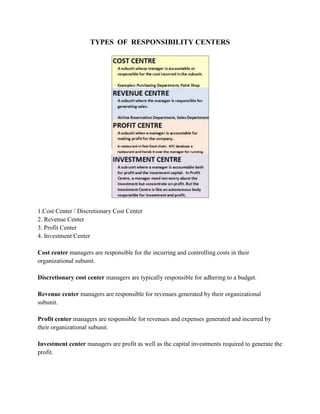
TYPES OF RESPONSIBILITY CENTERS


1.Cost Center / Discretionary Cost Center
2. Revenue Center
3. Profit Center
4. Investment Center

Cost center managers are responsible for the incurring and controlling costs in their
organizational subunit.

Discretionary cost center managers are typically responsible for adhering to a budget.

Revenue center managers are responsible for revenues generated by their organizational
subunit.

Profit center managers are responsible for revenues and expenses generated and incurred by
their organizational subunit.

Investment center managers are profit as well as the capital investments required to generate the
profit.
RESPONSIBILITY CENTRE AND THEIR EVALUATION

RESPONSIBILITY CENTRES                        EVALUATION METHODS
Revenue Centre                                Sale Price Variance
                                              Sale Quantity Variance
                                              Sale Mix Variance
Cost Centre                                   Raw Material Variances:
                                              Labor Variances
                                              Overhead Variances
Profit Centre                                 Gross Profit
                                              Contribution Margin
Investment Centre                             ROI
                                              Residual Income
                                              Economic Value Added
 ADVANTAGES                                   DISADVANTAGES
Helps manage a large and diversified
                                          May create conflicts between various divisions
organization
Motivate Manager to optimize their
                                          Undue competition may become dysfunctional
performance
                                          Narrows down vision as overall company
Provide manager freedom to make local
                                          prospective are not considered by individual
decisions
                                          managers.
Top management get more time for policy
                                          May prove costly due to duplication
making and strategic planning
Supports management and individual
specialisation   based    on  comparative Problem in coordination across divisions
Advantages


RESPONSIBILITY ACCOUNTING- PROFIT PLANNING & CONTROL

Planning & control are essential for achieving good results in any business. Firstly, a budget is
prepared and, secondly, actual results are compared with budgeted ones. Any difference is made
responsibility of the key individuals who were involved in (i) setting standards, (ii) given
necessary resources and (iii) powers to use them.

In order to streamline the process, the entire organization is broken into various types of centers
mainly cost centre, revenue centre, profit center and investment centre. The organizational
budget is divided on these lines and passed on to the concerned managers. Actual results are
collected and displayed in the same form for comparison. Difference, if any, are highlighted and
brought to the notice of the management. This process is called Responsibility Accounting.


CONTROLLABILITY CONCEPT

An underlying concept of responsibility accounting is referred to as controllability.
Conceptually, a manager should only be held responsible for those aspects of performance that
he or she can control. In my view, this concept is rarely, if ever, applied successfully in practice
because of the system variation present in all systems. Attempts to apply the controllability
concept produce responsibility reports where each layer of management is held responsible for
all subordinate management layers as illustrated below.

MANAGERIAL PERFORMANCE AND ECONOMIC PERFORMANCE


All businesses operate in a complex environment. The traditional approach of centralized control
is not possible. There is a shift towards decentralization. At the same time, the management
wants to retain some sort of control over activities of its managers.
When authority is decentralized and passed on to managers, there is a problem of goal-
congruence. This means that the management will constantly review all operations and activities
of individual divisions to insure that none of them is working against the overall objectives of the
company. Such a behavior is called dysfunctional and is damaging to the company.


While evaluating, performance of an individual manager, two factors have to be considered:

       Should the manager’s job be separated and a manager is rewarded or penalized only for
       those activities over which the manager has control.
       Should the manager’s decision be seen in a wider prospective and final judgment be
       given only after reviewing full impact of such decisions.

It is obvious that a manager's decisions should be evaluated after seeing their impact on the
bottom line i.e. profitablity of the comany. But such policy would not be motivational for the
individual manager and the good results may be nullified by the factors not under the control of
the particular manager. Hence, the company follows first appraoch i.e. managerial performance.
CONSOLIDATED P&L ACCOUNTS
An example to explain Responsibility Accounting


An integrated textile unit showed a net profit after tax of Rs.272 million. Its ROI (Return on
Investment), was 17.5% which is much above the supposed cost of capital of 12.5%.

The company was operating three divisions: (i) Spinning Unit, (ii) Weaving Unit and (iii) a
Finishing Unit. As of now, it is not apparent who earned what. So managers of the three
departments would be asking for bonuses or rewards.

Now suppose, the company asks its accountants to prepare Division-wise P&L account and
present the same to the management for performance appraisal of the three managers.

DIVISION WISE ACCOUNTS


After considering division-wise performance, who do you think deserve the bonus?

Only the manager, Spinning Division, deserves the bonus. Manager Weaving has just broken
even by earning profit equal to cost of capital. Manager Finishing was really a drag on the
company’s resources and its losses were only hidden in consolidated statements because of
substantial contribution made by Spinning Unit.

However, this is over-simplified example but it brings glaring facts to the notice of the
management and other users of the accounts.

Responsibility accounting

  • 1.
    Assignment ON “Responsibility Accounting” (Cost Accounting) Submitted to: Department of Management Studies AMRAPALI INSTITUTE, SHIKSHA NAGAR LAMACHAUR, HALDWANI UTTRAKHAND TECHNICAL UNIVERSITY Submitted to: Submitted by: MS. ARTI SHARMA SAURBH BHANDARI Lecturer, MBA 4th Sem AIMCA Deptt.
  • 2.
    RESPONSIBILITY ACCOUNTING DEFINITION: Responsibilityaccounting is a reporting system that compiles revenue, cost, and profit information at the level of those individual managers most directly responsible for them. The intent is to provide this information to those people most able to act upon it, as well as to judge their performance with it. Responsibility accounting is an internal system used to better control costs and performance. Its main focus is making individual managers responsible for those elements of a company's performance which they can control. In most cases, responsibility accounting does not affect a company's public accounts. WHAT IS RESPONSIBILITY ACCOUNTING? Responsibility accounting refers to a company’s internal accounting and budgeting. The objective is to assist in the planning and control of a company’s responsibility centers—such as decentralized departments and divisions. Responsibility accounting usually involves the preparation of annual and monthly budgets for each responsibility center. Then the company’s actual transactions are classified by responsibility center and a monthly report is prepared. The reports will present the actual amounts for each budget line item and the variance between the budget and actual amounts. Responsibility accounting allows the company and each manager of a responsibility center to receive monthly feedback on the manager’s performance. In responsibility accounting, each department will have stated goals. The relevant manager will then be judged on how well he or she meets these goals. This is similar to most target systems, but will usually work by measuring on a financial basis. The important distinction is that this financial assessment will not necessarily be a pure profitability measure. In most responsibility accounting systems, each department is classified into one of four categories. A cost center will be judged purely on how low it keeps spending; the travel department in the example above would fall into this category. A revenue department such as the sales team will be judged purely on the revenue it generates. A profit center will be judged on a standard profit or loss basis. This could apply to individual stores in a chain. The final category is an investment center. This may literally involve financial investments, but could also cover departments involved in long-term projects. Departments in such a category are usually judged using a longer-term view that takes account of issues such as capital spending where the resulting revenue will not all be gathered in the first year. Generally, responsibility accounting is a purely internal measure. It is possible that details from its operation and results could be included in a company report, for example as information to detail changes a company has made. These details would only be used as a way of sharing
  • 3.
    information with investorsand potential investors. The details do not usually form a part of the mandatory financial information that a company must include in its public accounts. Responsibilities of an Accounting Department Most people don’t realize the importance of the accounting department in keeping a business operating without hitches and delays. That’s probably because accountants oversee many of the back-office functions in a business — as opposed to sales, for example, which is front-line activity, out in the open and in the line of fire. Folks may not think much about these back-office activities, but they would sure notice if those activities didn’t get done. On payday, a business had better not tell its employees, “Sorry, but the accounting department is running a little late this month; you’ll get your checks later.” Typically, the accounting department is responsible for the following: Payroll: The total wages and salaries earned by every employee every pay period, which are called gross wages or gross earnings, have to be calculated. Based on detailed private information in personnel files and earnings-to-date information, the correct amounts of income tax, social security tax, and other deductions from gross wages have to be determined. Stubs, which report various information to employees each pay period, have to be attached to payroll checks. The total amounts of withheld income tax and social security taxes, plus the employment taxes imposed on the employer, have to be paid to federal and state government agencies on time. Retirement, vacation, sick pay, and other benefits earned by the employees have to be updated every pay period. In short, payroll is a complex and critical function that the accounting department performs. Many businesses outsource payroll functions to companies that specialize in this area. Cash collections: All cash received from sales and from all other sources has to be carefully identified and recorded, not only in the cash account but also in the appropriate account for the source of the cash received. The accounting department makes sure that the cash is deposited in the appropriate checking accounts of the business and that an adequate amount of coin and currency is kept on hand for making change for customers. Accountants balance the checkbook of the business and control who has access to incoming cash receipts. (In larger organizations, the treasurer may be responsible for some of these cashflow and cash-handling functions.) Cash payments (disbursements): In addition to payroll checks, a business writes many other checks during the course of a year — to pay for a wide variety of purchases, to pay property taxes, to pay on loans, and to distribute some of its profit to the owners of the business.
  • 4.
    The accounting departmentprepares all these checks for the signatures of the business officers who are authorized to sign checks. The accounting department keeps all the supporting business documents and files to know when the checks should be paid, makes sure that the amount to be paid is correct, and forwards the checks for signature. Procurement and inventory: Accounting departments usually are responsible for keeping track of all purchase orders that have been placed for inventory (products to be sold by the business) and all other assets and services that the business buys — from postage to forklifts. A typical business makes many purchases during the course of a year, many of them on credit, which means that the items bought are received today but paid for later. So this area of responsibility includes keeping files on all liabilities that arise from purchases on credit so that cash payments can be processed on time. The accounting department also keeps detailed records on all products held for sale by the business and, when the products are sold, records the cost of the goods sold. Property accounting: A typical business owns many substantial long-term assets called property, plant, and equipment — including office furniture and equipment, retail display cabinets, computers, machinery and tools, vehicles (autos and trucks), buildings, and land. Except for small-cost items, such as screwdrivers and pencil sharpeners, a business maintains detailed records of its property, both for controlling the use of the assets and for determining personal property and real estate taxes. The accounting department keeps these records. The accounting department may be assigned other functions as well, but this list gives you a pretty clear idea of the back-office functions that the accounting department performs. Quite literally, a business could not operate if the accounting department did not do these functions efficiently and on time. To do these back-office functions well, the accounting department must design a good bookkeeping system and make sure that it is accurate, complete, and timely. Advantages and Disadvantages Responsibility accounting has been an accepted part of traditional accounting control systems for many years because it provides an organization with a number of advantages. Perhaps the most compelling argument for the responsibility accounting approach is that it provides a way to manage an organization that would otherwise be unmanageable. In addition, assigning responsibility to lower level managers allows higher level managers to pursue other activities such as long term planning and policy making. It also provides a way to motivate lower level managers and workers. Managers and workers in an individualistic system tend to be motivated by measurements that emphasize their individual performances. However, this emphasis on the
  • 5.
    performance of individualsand individual segments creates what some critics refer to as the "stovepipe organization." Others have used the term "functional silos" to describe the same idea. Consider 9-6 Exhibit below. Information flows vertically, rather than horizontally. Individuals in the various segments and functional areas are separated and tend to ignore the interdependencies within the organization. Segment managers and individual workers within segments tend to compete to optimize their own performance measurements rather than working together to optimize the performance of the system.
  • 6.
    TYPES OF RESPONSIBILITYCENTERS 1.Cost Center / Discretionary Cost Center 2. Revenue Center 3. Profit Center 4. Investment Center Cost center managers are responsible for the incurring and controlling costs in their organizational subunit. Discretionary cost center managers are typically responsible for adhering to a budget. Revenue center managers are responsible for revenues generated by their organizational subunit. Profit center managers are responsible for revenues and expenses generated and incurred by their organizational subunit. Investment center managers are profit as well as the capital investments required to generate the profit.
  • 7.
    RESPONSIBILITY CENTRE ANDTHEIR EVALUATION RESPONSIBILITY CENTRES EVALUATION METHODS Revenue Centre Sale Price Variance Sale Quantity Variance Sale Mix Variance Cost Centre Raw Material Variances: Labor Variances Overhead Variances Profit Centre Gross Profit Contribution Margin Investment Centre ROI Residual Income Economic Value Added ADVANTAGES DISADVANTAGES Helps manage a large and diversified May create conflicts between various divisions organization Motivate Manager to optimize their Undue competition may become dysfunctional performance Narrows down vision as overall company Provide manager freedom to make local prospective are not considered by individual decisions managers. Top management get more time for policy May prove costly due to duplication making and strategic planning Supports management and individual specialisation based on comparative Problem in coordination across divisions Advantages RESPONSIBILITY ACCOUNTING- PROFIT PLANNING & CONTROL Planning & control are essential for achieving good results in any business. Firstly, a budget is prepared and, secondly, actual results are compared with budgeted ones. Any difference is made responsibility of the key individuals who were involved in (i) setting standards, (ii) given necessary resources and (iii) powers to use them. In order to streamline the process, the entire organization is broken into various types of centers mainly cost centre, revenue centre, profit center and investment centre. The organizational budget is divided on these lines and passed on to the concerned managers. Actual results are
  • 8.
    collected and displayedin the same form for comparison. Difference, if any, are highlighted and brought to the notice of the management. This process is called Responsibility Accounting. CONTROLLABILITY CONCEPT An underlying concept of responsibility accounting is referred to as controllability. Conceptually, a manager should only be held responsible for those aspects of performance that he or she can control. In my view, this concept is rarely, if ever, applied successfully in practice because of the system variation present in all systems. Attempts to apply the controllability concept produce responsibility reports where each layer of management is held responsible for all subordinate management layers as illustrated below. MANAGERIAL PERFORMANCE AND ECONOMIC PERFORMANCE All businesses operate in a complex environment. The traditional approach of centralized control is not possible. There is a shift towards decentralization. At the same time, the management wants to retain some sort of control over activities of its managers.
  • 9.
    When authority isdecentralized and passed on to managers, there is a problem of goal- congruence. This means that the management will constantly review all operations and activities of individual divisions to insure that none of them is working against the overall objectives of the company. Such a behavior is called dysfunctional and is damaging to the company. While evaluating, performance of an individual manager, two factors have to be considered: Should the manager’s job be separated and a manager is rewarded or penalized only for those activities over which the manager has control. Should the manager’s decision be seen in a wider prospective and final judgment be given only after reviewing full impact of such decisions. It is obvious that a manager's decisions should be evaluated after seeing their impact on the bottom line i.e. profitablity of the comany. But such policy would not be motivational for the individual manager and the good results may be nullified by the factors not under the control of the particular manager. Hence, the company follows first appraoch i.e. managerial performance.
  • 10.
    CONSOLIDATED P&L ACCOUNTS Anexample to explain Responsibility Accounting An integrated textile unit showed a net profit after tax of Rs.272 million. Its ROI (Return on Investment), was 17.5% which is much above the supposed cost of capital of 12.5%. The company was operating three divisions: (i) Spinning Unit, (ii) Weaving Unit and (iii) a Finishing Unit. As of now, it is not apparent who earned what. So managers of the three departments would be asking for bonuses or rewards. Now suppose, the company asks its accountants to prepare Division-wise P&L account and present the same to the management for performance appraisal of the three managers. DIVISION WISE ACCOUNTS After considering division-wise performance, who do you think deserve the bonus? Only the manager, Spinning Division, deserves the bonus. Manager Weaving has just broken even by earning profit equal to cost of capital. Manager Finishing was really a drag on the
  • 11.
    company’s resources andits losses were only hidden in consolidated statements because of substantial contribution made by Spinning Unit. However, this is over-simplified example but it brings glaring facts to the notice of the management and other users of the accounts.