HR Accounting
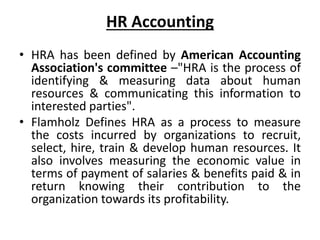
• HRA has been defined by American Accounting
Association's committee –"HRA is the process of
identifying & measuring data about human
resources & communicating this information to
interested parties".
• Flamholz Defines HRA as a process to measure
the costs incurred by organizations to recruit,
select, hire, train & develop human resources. It
also involves measuring the economic value in
terms of payment of salaries & benefits paid & in
return knowing their contribution to the
organization towards its profitability.
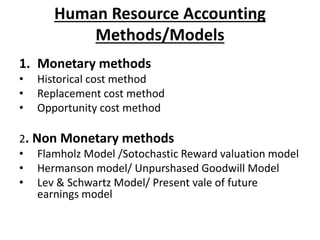
Human Resource Accounting
Methods/Models
1. Monetary methods
• Historical cost method
• Replacement cost method
• Opportunity cost method
2. Non Monetary methods
• Flamholz Model /Sotochastic Reward valuation model
• Hermanson model/ Unpurshased Goodwill Model
• Lev & Schwartz Model/ Present vale of future
earnings model
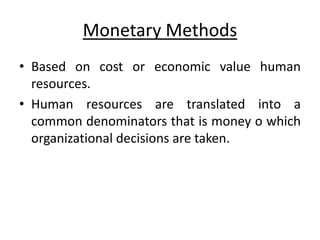
Monetary Methods
• Based on cost or economic value human
resources.
• Human resources are translated into a
common denominators that is money o which
organizational decisions are taken.
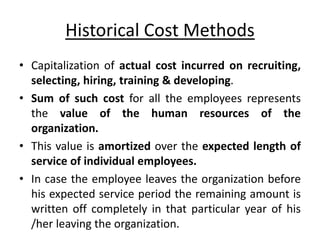
Historical Cost Methods
• Capitalization of actual cost incurred on recruiting,
selecting, hiring, training & developing.
• Sum of such cost for all the employees represents
the value of the human resources of the
organization.
• This value is amortized over the expected length of
service of individual employees.
• In case the employee leaves the organization before
his expected service period the remaining amount is
written off completely in that particular year of his
/her leaving the organization.
Replacement Cost Methods
• This method was suggested by Rensis Likert & was
developed by Eric G. Flamhaltz.
• Human resources of an organization are to be valued
on the assumptions that if a new similar
organization has to be created then what would be
the cost of the firm.
• If the existing resources were required to be replaced
with other persons of equivalent talent & experience
then all the cost involved in recruiting , hiring,
training & developing the replacement to the present
level.
Opportunity Cost Methods
• This method is used to value employees possessing
certain skills & thus rate in availability.
• Managers willing to acquire such scarce employees
offer bid price.
• One who finally acquires the scarce employees put
the bid price as his investment in such employees &
value becomes the value of human assets.
• Bid price is arrived at by calculating actual or
expected earning to be earned by such employees.
Non Monetary Methods
• Measures the human resources not in rupee
or money terms rather they rely on various
indices or ratings & rankings.
• This method may refer to a simple inventory
of skills & capabilities of people within an
organization.
• Application of some behavioural
measurement technique to access the
benefits gained from the human resources.
Flamholtz’s Model
• This model is also known as Stochastic model & introduced in
1971.
• Stochastic means having random probability.
• This model was published in an article ‘A model for human
resource valuation’.
• This model is improvement on Lev& Schwartz’s present value
of future earning model.
• It takes into account the possibility of an employee movement
from one organization to another organization and his leaving
the organization due to death or retirement.
• This model determines an individual’s value to an organisation
by the services he is expected to render to the organisation.
Flamholtz’s Model
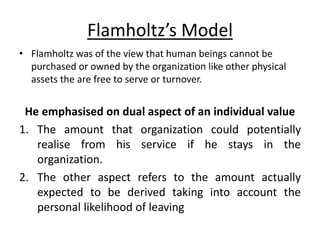
• Flamholtz was of the view that human beings cannot be
purchased or owned by the organization like other physical
assets the are free to serve or turnover.
He emphasised on dual aspect of an individual value
1. The amount that organization could potentially
realise from his service if he stays in the
organization.
2. The other aspect refers to the amount actually
expected to be derived taking into account the
personal likelihood of leaving
Flamholtz’s Model
Basically expected realisable value
His conditional value
• Promoability
•Productivity
•transferability
Probability of
maintaining organization
membership
• Satisfaction with organization
Flamholtz’s Model
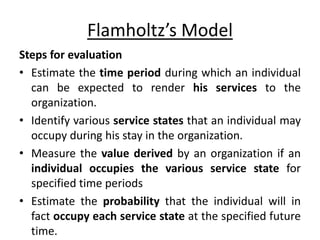
Steps for evaluation
• Estimate the time period during which an individual
can be expected to render his services to the
organization.
• Identify various service states that an individual may
occupy during his stay in the organization.
• Measure the value derived by an organization if an
individual occupies the various service state for
specified time periods
• Estimate the probability that the individual will in
fact occupy each service state at the specified future
time.
Flamholtz’s Model
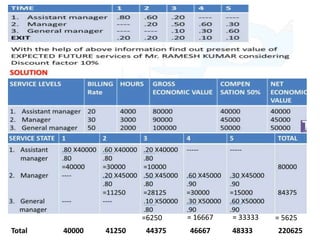
Eg:- Mr. Ramesh is working as an assistant professor in
an organization where he has 3 service levels, which
he can occupy during his tenure. His chargeable
hours along with billing rate are as under
Compensation rate is 50%. Table of probability is also
given showing probability of attaining the services
state.
=6250 = 5625
= 33333
= 16667
Total 40000 41250 44375 46667 48333 220625
Statement showing expected
realisable value
Hermanson’s Model
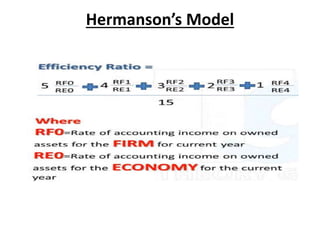
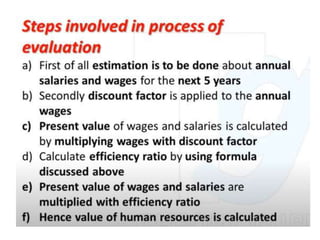
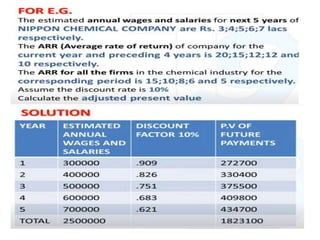
•The present value calculated is further adjusted by an efficiency
ratio
Hermanson’s Model
Lev and Schwartz Model
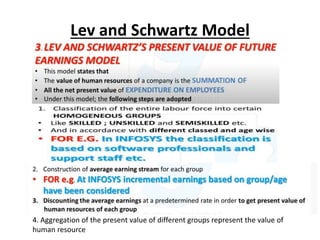
4. Aggregation of the present value of different groups represent the value of
human resource
PSYCHOLOGICAL CONTRACTS
• It refers to the relationship between an employer and its
employees, and specifically concerns with mutual
expectations of inputs and outcomes in an employment
relationship with trust.
• The contracting process begins before the employment and
develops throughout the course of employment.
• As the employment relationship grows the psychological
contract also grows.
• There are two types of contracts
1. Relational psychological contracts
2. Transactional psychological contracts.
Transactional Psychological contract
• Monetary base with clear expectations
that the organization will fairly
compensate the performance delivered
and punish the inadequate activities.
• Performance based salary increases.
• It is a short-term exchange of benefits.
RELATIONAL PSYCHOLOGICAL
CONTRACT
• It underlines expectations of shared ideas with
support and respect.
• It is a long term mutual commitment.
• This type of contract is more important than
the transactional psychological contract.

HRM III HRA models.ppt

  • 1.
    HR Accounting • HRAhas been defined by American Accounting Association's committee –"HRA is the process of identifying & measuring data about human resources & communicating this information to interested parties". • Flamholz Defines HRA as a process to measure the costs incurred by organizations to recruit, select, hire, train & develop human resources. It also involves measuring the economic value in terms of payment of salaries & benefits paid & in return knowing their contribution to the organization towards its profitability.
  • 2.
    Human Resource Accounting Methods/Models 1.Monetary methods • Historical cost method • Replacement cost method • Opportunity cost method 2. Non Monetary methods • Flamholz Model /Sotochastic Reward valuation model • Hermanson model/ Unpurshased Goodwill Model • Lev & Schwartz Model/ Present vale of future earnings model
  • 3.
    Monetary Methods • Basedon cost or economic value human resources. • Human resources are translated into a common denominators that is money o which organizational decisions are taken.
  • 4.
    Historical Cost Methods •Capitalization of actual cost incurred on recruiting, selecting, hiring, training & developing. • Sum of such cost for all the employees represents the value of the human resources of the organization. • This value is amortized over the expected length of service of individual employees. • In case the employee leaves the organization before his expected service period the remaining amount is written off completely in that particular year of his /her leaving the organization.
  • 5.
    Replacement Cost Methods •This method was suggested by Rensis Likert & was developed by Eric G. Flamhaltz. • Human resources of an organization are to be valued on the assumptions that if a new similar organization has to be created then what would be the cost of the firm. • If the existing resources were required to be replaced with other persons of equivalent talent & experience then all the cost involved in recruiting , hiring, training & developing the replacement to the present level.
  • 6.
    Opportunity Cost Methods •This method is used to value employees possessing certain skills & thus rate in availability. • Managers willing to acquire such scarce employees offer bid price. • One who finally acquires the scarce employees put the bid price as his investment in such employees & value becomes the value of human assets. • Bid price is arrived at by calculating actual or expected earning to be earned by such employees.
  • 7.
    Non Monetary Methods •Measures the human resources not in rupee or money terms rather they rely on various indices or ratings & rankings. • This method may refer to a simple inventory of skills & capabilities of people within an organization. • Application of some behavioural measurement technique to access the benefits gained from the human resources.
  • 8.
    Flamholtz’s Model • Thismodel is also known as Stochastic model & introduced in 1971. • Stochastic means having random probability. • This model was published in an article ‘A model for human resource valuation’. • This model is improvement on Lev& Schwartz’s present value of future earning model. • It takes into account the possibility of an employee movement from one organization to another organization and his leaving the organization due to death or retirement. • This model determines an individual’s value to an organisation by the services he is expected to render to the organisation.
  • 9.
    Flamholtz’s Model • Flamholtzwas of the view that human beings cannot be purchased or owned by the organization like other physical assets the are free to serve or turnover. He emphasised on dual aspect of an individual value 1. The amount that organization could potentially realise from his service if he stays in the organization. 2. The other aspect refers to the amount actually expected to be derived taking into account the personal likelihood of leaving
  • 10.
    Flamholtz’s Model Basically expectedrealisable value His conditional value • Promoability •Productivity •transferability Probability of maintaining organization membership • Satisfaction with organization
  • 11.
    Flamholtz’s Model Steps forevaluation • Estimate the time period during which an individual can be expected to render his services to the organization. • Identify various service states that an individual may occupy during his stay in the organization. • Measure the value derived by an organization if an individual occupies the various service state for specified time periods • Estimate the probability that the individual will in fact occupy each service state at the specified future time.
  • 12.
    Flamholtz’s Model Eg:- Mr.Ramesh is working as an assistant professor in an organization where he has 3 service levels, which he can occupy during his tenure. His chargeable hours along with billing rate are as under Compensation rate is 50%. Table of probability is also given showing probability of attaining the services state.
  • 13.
    =6250 = 5625 =33333 = 16667 Total 40000 41250 44375 46667 48333 220625
  • 14.
  • 15.
    Hermanson’s Model •The presentvalue calculated is further adjusted by an efficiency ratio
  • 16.
  • 20.
    Lev and SchwartzModel 4. Aggregation of the present value of different groups represent the value of human resource
  • 21.
  • 22.
    • It refersto the relationship between an employer and its employees, and specifically concerns with mutual expectations of inputs and outcomes in an employment relationship with trust. • The contracting process begins before the employment and develops throughout the course of employment. • As the employment relationship grows the psychological contract also grows. • There are two types of contracts 1. Relational psychological contracts 2. Transactional psychological contracts.
  • 23.
    Transactional Psychological contract •Monetary base with clear expectations that the organization will fairly compensate the performance delivered and punish the inadequate activities. • Performance based salary increases. • It is a short-term exchange of benefits.
  • 24.
    RELATIONAL PSYCHOLOGICAL CONTRACT • Itunderlines expectations of shared ideas with support and respect. • It is a long term mutual commitment. • This type of contract is more important than the transactional psychological contract.