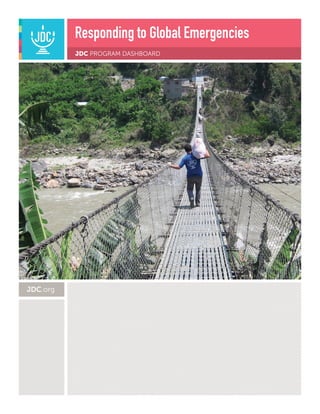
Responding to Global Emergencies
JDC PROGRAM DASHBOARD
JDC.org
Responding to Global Emergencies
An earthquake. A tsunami. A civil war. A public health crisis. Each year, the lives of millions of people
are irrevocably altered in an instant when natural disasters or other calamities strike. JDC responds
with expert, immediate humanitarian aid and longer-term development solutions, leveraging its
century of experience helping Jewish communities worldwide.
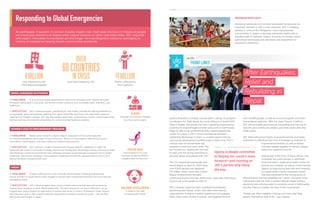
8MILLIONlives impacted by the
2015 Nepal Earthquake
OVER
60COUNTRIES
INCRISIShave been helped by JDC
14MILLIONFilipinos affected by
2013 Typhoon
50,000 CHILDREN
in Israel on the road
to healing with Hibuki
HIBUKI
Upama Shrestha is a Nepali woman with a calling. As program
coordinator for Tevel Nepal, the local offshoot of Israeli NGO
Tevel b’Tzedek, she spends her time organizing empowering
activities for disadvantaged women and youth in Kathmandu.
Eager to add to her professional skills, Upama applied last
winter for a spot in JDC’s Third International Women’s
Leadership Workshop in Israel—a coveted opportunity for
community development professionals to learn from JDC’s
century-plus of humanitarian aid
experience and from each other. But
as it turned out, Upama did not have
to wait until the spring workshop to
become better acquainted with JDC.
The 7.8-magnitude earthquake that
struck Nepal on April 25, 2015 killed
over 9,000 people and displaced
2.8 million others from their homes.
Weeks of aftershocks brought
continuing trauma and new destruction, especially following a
second full-scale quake on May 12.
JDC’s disaster response team mobilized immediately,
partnering with Nepali, Israeli, and other international
organizations to deliver medical equipment and supplies,
food, clean water, shelter materials, and hygiene items to
over 36,000 people, as well as to local hospitals and other
humanitarian agencies. With the Israel Trauma Coalition,
JDC also provided psychosocial counseling and training for
teachers and community leaders just three weeks after the
initial quake.
JDC field staff joined Tevel’s local professionals and Israeli
volunteers to distribute two tons of emergency food aid to
impoverished families, as well as deliver
critically needed supplies to remote villages
before the seasonal rains hit.
Upama was in the thick of these efforts. She
mobilized her youth groups to distribute
food and help in organizing health camps for
women and children, as well as Child Friendly
Spaces to keep young kids safe and creatively
occupied while schools remained closed.
She was sustained by the strong sense of
determination that has propelled her career—the same inner
calling that took her from a western Nepali village without
electricity and running water to university study in Kathmandu,
and the chance to better the lives of her countrymen.
“People are often capable of doing a lot more than they
believe themselves able to do,” says Upama.
PROGRAM SPOTLIGHT
Restoring livelihoods for the most vulnerable has become an
important element in JDC’s crisis response. JDC is enabling
families in some of the Philippines’ most impoverished
communities to regain or develop alternative livelihoods in
the aftermath of Typhoon Haiyan, focusing on climate-smart
agricultural techniques and new boats and equipment for
subsistence fishermen.
Upama is deeply committed
to helping her country move
forward—and counting on
JDC’s partnership along
the way.
// CHALLENGE Children suffering from post-traumatic stress disorder following calamities like
natural disasters or rocket attacks often struggle to process their complicated emotions and move past the
precipitating event.
// INNOVATION JDC’s Hibuki program helps young children overcome their fears and anxieties by
making them caretakers of plush Hibuki puppy dolls. The doll’s long arms can hug a child and it can be
hugged back, giving children an opportunity to restore their sense of control. Pioneered in Israel, Hibukis
have become a part of JDC’s expert toolkit for responding to disasters around the world — like the 2011
earthquake and tsunami in Japan.
OVER 600
mammograms in 12 rural
locations funded by WHEP’s
Sarajevo Race for the Cure
WOMEN’S HEALTH EMPOWERMENT PROGRAM
// CHALLENGE Breast cancer remains a stigma today in many parts of the world, especially
for minority populations like Europe’s Roma community. Women in these regions often lack access to
information, mammograms, and other medical procedures that save lives.
// INNOVATION JDC’s Women’s Health Empowerment Program (WHEP), established in 1995, has
partnered with Susan G. Komen® in Hungary, Bosnia and Herzegovina, Montenegro, Russia, and among Israeli
and Palestinian women to promote the early detection of breast cancer through increased access to health
screenings, educational campaigns, and awareness-building events like the signature Race for the Cure in
Bosnia that draws thousands each year.
2,000
Ethiopian lives forever changed
by critical spine surgery
SPINAL SURGERIES IN ETHIOPIA
// CHALLENGE In an economy heavily dependent on agriculture and plagued by frequent droughts,
Ethiopians, particularly in rural areas, lack access to basic resources such as potable water, education, and
healthcare.
// INNOVATION JDC’s medical program, directed by Dr. Rick Hodes, provides life-altering treatment to
young people, particularly patients suffering from spinal deformities and those who need heart surgery or
treatment for Hodgkin’s disease. JDC also digs potable water wells, builds primary schools, and provides small-
business training and university scholarships for women pursing healthcare degrees.
After Earthquakes,
Relief and
Rebuilding in
Nepal
FRONT LINES
on the
JDC.org
The American Jewish Joint Distribution Committee (JDC) is the
world’s leading Jewish humanitarian assistance organization. JDC
works in more than 70 countries and in Israel to alleviate hunger and
hardship, rescue Jews in danger, create lasting connections to Jewish
life, and provide immediate relief and long-term development support
for victims of natural and man-made disasters.
JDC is primarily funded through the Jewish Federations of North
America. Key JDC funders also include: The Harry and Jeanette Weinberg
Foundation, the Conference on Jewish Material Claims Against Germany,
the International Fellowship of Christians and Jews, the Maurice and
Vivienne Wohl Charitable Foundation, World Jewish Relief (UK), UIA
Federations Canada, and tens of thousands of individual donors.

Responding to Global Emergencies

  • 1.
    Responding to GlobalEmergencies JDC PROGRAM DASHBOARD JDC.org
  • 2.
    Responding to GlobalEmergencies An earthquake. A tsunami. A civil war. A public health crisis. Each year, the lives of millions of people are irrevocably altered in an instant when natural disasters or other calamities strike. JDC responds with expert, immediate humanitarian aid and longer-term development solutions, leveraging its century of experience helping Jewish communities worldwide. 8MILLIONlives impacted by the 2015 Nepal Earthquake OVER 60COUNTRIES INCRISIShave been helped by JDC 14MILLIONFilipinos affected by 2013 Typhoon 50,000 CHILDREN in Israel on the road to healing with Hibuki HIBUKI Upama Shrestha is a Nepali woman with a calling. As program coordinator for Tevel Nepal, the local offshoot of Israeli NGO Tevel b’Tzedek, she spends her time organizing empowering activities for disadvantaged women and youth in Kathmandu. Eager to add to her professional skills, Upama applied last winter for a spot in JDC’s Third International Women’s Leadership Workshop in Israel—a coveted opportunity for community development professionals to learn from JDC’s century-plus of humanitarian aid experience and from each other. But as it turned out, Upama did not have to wait until the spring workshop to become better acquainted with JDC. The 7.8-magnitude earthquake that struck Nepal on April 25, 2015 killed over 9,000 people and displaced 2.8 million others from their homes. Weeks of aftershocks brought continuing trauma and new destruction, especially following a second full-scale quake on May 12. JDC’s disaster response team mobilized immediately, partnering with Nepali, Israeli, and other international organizations to deliver medical equipment and supplies, food, clean water, shelter materials, and hygiene items to over 36,000 people, as well as to local hospitals and other humanitarian agencies. With the Israel Trauma Coalition, JDC also provided psychosocial counseling and training for teachers and community leaders just three weeks after the initial quake. JDC field staff joined Tevel’s local professionals and Israeli volunteers to distribute two tons of emergency food aid to impoverished families, as well as deliver critically needed supplies to remote villages before the seasonal rains hit. Upama was in the thick of these efforts. She mobilized her youth groups to distribute food and help in organizing health camps for women and children, as well as Child Friendly Spaces to keep young kids safe and creatively occupied while schools remained closed. She was sustained by the strong sense of determination that has propelled her career—the same inner calling that took her from a western Nepali village without electricity and running water to university study in Kathmandu, and the chance to better the lives of her countrymen. “People are often capable of doing a lot more than they believe themselves able to do,” says Upama. PROGRAM SPOTLIGHT Restoring livelihoods for the most vulnerable has become an important element in JDC’s crisis response. JDC is enabling families in some of the Philippines’ most impoverished communities to regain or develop alternative livelihoods in the aftermath of Typhoon Haiyan, focusing on climate-smart agricultural techniques and new boats and equipment for subsistence fishermen. Upama is deeply committed to helping her country move forward—and counting on JDC’s partnership along the way. // CHALLENGE Children suffering from post-traumatic stress disorder following calamities like natural disasters or rocket attacks often struggle to process their complicated emotions and move past the precipitating event. // INNOVATION JDC’s Hibuki program helps young children overcome their fears and anxieties by making them caretakers of plush Hibuki puppy dolls. The doll’s long arms can hug a child and it can be hugged back, giving children an opportunity to restore their sense of control. Pioneered in Israel, Hibukis have become a part of JDC’s expert toolkit for responding to disasters around the world — like the 2011 earthquake and tsunami in Japan. OVER 600 mammograms in 12 rural locations funded by WHEP’s Sarajevo Race for the Cure WOMEN’S HEALTH EMPOWERMENT PROGRAM // CHALLENGE Breast cancer remains a stigma today in many parts of the world, especially for minority populations like Europe’s Roma community. Women in these regions often lack access to information, mammograms, and other medical procedures that save lives. // INNOVATION JDC’s Women’s Health Empowerment Program (WHEP), established in 1995, has partnered with Susan G. Komen® in Hungary, Bosnia and Herzegovina, Montenegro, Russia, and among Israeli and Palestinian women to promote the early detection of breast cancer through increased access to health screenings, educational campaigns, and awareness-building events like the signature Race for the Cure in Bosnia that draws thousands each year. 2,000 Ethiopian lives forever changed by critical spine surgery SPINAL SURGERIES IN ETHIOPIA // CHALLENGE In an economy heavily dependent on agriculture and plagued by frequent droughts, Ethiopians, particularly in rural areas, lack access to basic resources such as potable water, education, and healthcare. // INNOVATION JDC’s medical program, directed by Dr. Rick Hodes, provides life-altering treatment to young people, particularly patients suffering from spinal deformities and those who need heart surgery or treatment for Hodgkin’s disease. JDC also digs potable water wells, builds primary schools, and provides small- business training and university scholarships for women pursing healthcare degrees. After Earthquakes, Relief and Rebuilding in Nepal FRONT LINES on the
  • 3.
    JDC.org The American JewishJoint Distribution Committee (JDC) is the world’s leading Jewish humanitarian assistance organization. JDC works in more than 70 countries and in Israel to alleviate hunger and hardship, rescue Jews in danger, create lasting connections to Jewish life, and provide immediate relief and long-term development support for victims of natural and man-made disasters. JDC is primarily funded through the Jewish Federations of North America. Key JDC funders also include: The Harry and Jeanette Weinberg Foundation, the Conference on Jewish Material Claims Against Germany, the International Fellowship of Christians and Jews, the Maurice and Vivienne Wohl Charitable Foundation, World Jewish Relief (UK), UIA Federations Canada, and tens of thousands of individual donors.