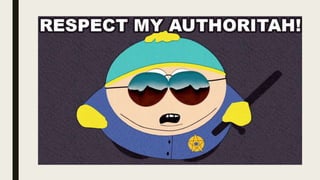
RESPECT MY AUTHORITY:
POSITIONING EXPERTISE,
AUTHORITY, AND
TRUSTWORTHINESS IN SOURCE
EVALUATION
Candice Benjes-Small, Radford University
Shaunna Hunter, Hampden-SydneyCollege
From Evaluation to Frame
■ Standard 3.2 The information literate student articulates and applies initial criteria for
evaluating both the information and its sources. Outcomes – “…evaluate reliability,
validity, accuracy, authority, timeliness, and point of view or bias”
■ The Standards described information as a commodity external to the learner –
something to be found and used. Book or journal article = information. Information
had inherent characteristics that could be evaluated, often without considering
disciplinary differences
■ The Frame avoids viewing information as a commodity and recognizes different
communities decide which voices have authority – or not, and evaluating information
doesn’t happen through a checklist of criteria but through better understanding of
different types of authority valued within communities
Authority Is Constructed and Contextual
Information resources reflect their creators’ expertise
and credibility, and are evaluated based on the
information need and the context in which the
information will be used. Authority is constructed in
that various communities may recognize different
types of authority. It is contextual in that the
information need may help to determine the level of
authority required.
OurTakeaways
■ Criteria needs to be contextualized
■ Consider what voices aren’t being heard
■ Be open to new perspectives
■ Recognize disciplinary differences
■ Acknowledge biases that privilege some authority over others
WHY IS EVALUATION
SO DIFFICULT FOR
PEOPLE?
Our perspective
■ True evaluation requires some level of expertise
■ Confirmation bias
■ Backfire effect
Shaunna’s lesson plan
■ News Evaluation – Beyond the Checklist (Project Cora, May 2017)
Students were asked to evaluate an article’s content, tone, and purpose in a large group
before they discussed the article in the context of two other articles on the same topic in a
smaller group. After these group discussions, the library instructor revealed the source of
each news article and highlighted resources and strategies for learning more about news
sources.Through the lesson, students were able to focus more on content, corroboration,
and source knowledge (rather than a mere checklist) to make decisions about an article’s
bias and level of accuracy.
Davidson Squibb, Sara . "News Evaluation – Beyond the Checklist." CORA (Community of Online Research Assignments), 2017.
https://www.projectcora.org/assignment/news-evaluation-%E2%80%93-beyond-checklist.
Short for time?Try Factitious
Developed by the American University Game
Lab/JOLT under a Knight Foundation grant.
On a phone, players swipe right if they think the
article is real or swipe left if they think the article
is fake. Factitious provides feedback about users’
choices after each answer - including
information about the source.
Candice’s lesson plan
■ September, 2016
We have a solid lesson plan for evaluatingWebsites but I’m looking for one that focuses on
news sites. For example, there were a lot of conflicting reports about what actually
happened duringTrump’s visit to Flint last week. How could the average person figure out
which story to trust? What can we teach in a one-shot that would help students to evaluate
the media?… My ideal lesson plan could be taught to freshmen in a 50-minute workshop,
would be very hands-on, and would not leave them thinking, “All media are biased, therefore
you can’t trust any of them.”
Tips for Evaluating News Sites
1. Avoid judgments based solely on the source
2. Assess whether the journalist is acting ethically
3. Differentiate between perspective and bias
4. Find the original source of the story
5. Check your passion
Comparing sources
WHAT DOYOU DO?
Questions
■ Candice Benjes-Small, cbsmall@radford.edu
■ Shaunna Hunter, shunter@hsc.edu
Libguide: http://libguides.hsc.edu/authority_vla2017
VLA evaluation: tinyurl.com/th2017vla

Respect My Authority

  • 1.
    RESPECT MY AUTHORITY: POSITIONINGEXPERTISE, AUTHORITY, AND TRUSTWORTHINESS IN SOURCE EVALUATION Candice Benjes-Small, Radford University Shaunna Hunter, Hampden-SydneyCollege
  • 3.
    From Evaluation toFrame ■ Standard 3.2 The information literate student articulates and applies initial criteria for evaluating both the information and its sources. Outcomes – “…evaluate reliability, validity, accuracy, authority, timeliness, and point of view or bias” ■ The Standards described information as a commodity external to the learner – something to be found and used. Book or journal article = information. Information had inherent characteristics that could be evaluated, often without considering disciplinary differences ■ The Frame avoids viewing information as a commodity and recognizes different communities decide which voices have authority – or not, and evaluating information doesn’t happen through a checklist of criteria but through better understanding of different types of authority valued within communities
  • 4.
    Authority Is Constructedand Contextual Information resources reflect their creators’ expertise and credibility, and are evaluated based on the information need and the context in which the information will be used. Authority is constructed in that various communities may recognize different types of authority. It is contextual in that the information need may help to determine the level of authority required.
  • 5.
    OurTakeaways ■ Criteria needsto be contextualized ■ Consider what voices aren’t being heard ■ Be open to new perspectives ■ Recognize disciplinary differences ■ Acknowledge biases that privilege some authority over others
  • 6.
    WHY IS EVALUATION SODIFFICULT FOR PEOPLE?
  • 7.
    Our perspective ■ Trueevaluation requires some level of expertise ■ Confirmation bias ■ Backfire effect
  • 8.
    Shaunna’s lesson plan ■News Evaluation – Beyond the Checklist (Project Cora, May 2017) Students were asked to evaluate an article’s content, tone, and purpose in a large group before they discussed the article in the context of two other articles on the same topic in a smaller group. After these group discussions, the library instructor revealed the source of each news article and highlighted resources and strategies for learning more about news sources.Through the lesson, students were able to focus more on content, corroboration, and source knowledge (rather than a mere checklist) to make decisions about an article’s bias and level of accuracy. Davidson Squibb, Sara . "News Evaluation – Beyond the Checklist." CORA (Community of Online Research Assignments), 2017. https://www.projectcora.org/assignment/news-evaluation-%E2%80%93-beyond-checklist.
  • 9.
    Short for time?TryFactitious Developed by the American University Game Lab/JOLT under a Knight Foundation grant. On a phone, players swipe right if they think the article is real or swipe left if they think the article is fake. Factitious provides feedback about users’ choices after each answer - including information about the source.
  • 10.
    Candice’s lesson plan ■September, 2016 We have a solid lesson plan for evaluatingWebsites but I’m looking for one that focuses on news sites. For example, there were a lot of conflicting reports about what actually happened duringTrump’s visit to Flint last week. How could the average person figure out which story to trust? What can we teach in a one-shot that would help students to evaluate the media?… My ideal lesson plan could be taught to freshmen in a 50-minute workshop, would be very hands-on, and would not leave them thinking, “All media are biased, therefore you can’t trust any of them.”
  • 11.
    Tips for EvaluatingNews Sites 1. Avoid judgments based solely on the source 2. Assess whether the journalist is acting ethically 3. Differentiate between perspective and bias 4. Find the original source of the story 5. Check your passion
  • 12.
  • 13.
  • 14.
    Questions ■ Candice Benjes-Small,cbsmall@radford.edu ■ Shaunna Hunter, shunter@hsc.edu Libguide: http://libguides.hsc.edu/authority_vla2017 VLA evaluation: tinyurl.com/th2017vla