ResourceSync


ResourceSyncis funded by The Sloan Foundation
               ResourceSync – March 6 2012
ResourceSync – WebEx Agenda


Problem Perspective – Herbert Van de Sompel (LANL)

Technical Directions – Robert Sanderson (LANL)

Joining the Effort – Nettie Lagace (NISO)

Q&A


                  ResourceSync – March 6 2012
ResourceSync – Problem Perspective


 Presenter – Herbert Van de Sompel
          ResourceSync – March 6 2012
ResourceSync Core Team


Cornell University & OAI:
   BerhardHaslhofer, Carl Lagoze, Simeon Warner

Old Dominion University & OAI:
   Michael L. Nelson

Los Alamos National Laboratory & OAI:
   Martin Klein, Robert Sanderson, Herbert Van de Sompel

NISO:
   Todd Carpenter, Nettie Lagace, Peter Murray


                 ResourceSync – March 6 2012
ResourceSync Problem

• Consideration:
   • Source (server) A has resources that change over time: they
     get created, modified, deleted, moved, …
   • Destination (servers) X, Y, and Z leverage (some) resources
     of Source A.
• Problem:
   • Destinations want to keep in step with the resource changes
     at Source A: resource synchronization.
• Task of ResourceSync effort:
   • Design an approach for resource synchronization aligned
     with the Web Architecture that has a fair chance of adoption
     by different communities.
       • The approach must scale better than recurrent HTTP
          HEAD/GET on resources.


                    ResourceSync – March 6 2012
ResourceSync Use Cases

• arXiv mirroring.
• Metadata and content transfer from Europeana partners to
  central Europeana hub.
• Synchronization of Linked Data content.
• Recurrently collecting Memento metadata from IIPC web
  archives to central aggregator.
• Keeping up-to-data with resources that reside on a Web server.

• Use cases have different requirements regarding synchronization
  accuracy:
   • Synchronization coverage: perfect …… good enough
   • Synchronization speed:      fast …….…. fast enough


                    ResourceSync – March 6 2012
Web Context

• The context in which resource synchronization will take place is
  the Web.
• Resources considered for synchronization:
   • Are identified by dereference-able URIs.
   • Are cache-able.

=> Caveat: It is understood that resources that require client-side
   processing (e.g. hashbangURIs) cause problems.


                     ResourceSync – March 6 2012
3 Synchronization Needs

• Overall, there are 3 distinct needs regarding resource
  synchronization. All 3 are considered in scope for the effort:

    1. Baseline matching: An approach to allow a Destination that
       wants to start synchronizing with a Source to perform an
       initial catch up – Dump.
    2. Incremental resource synchronization: An approach to allow
       a Destination to remain up-to-date regarding changes at the
       Source.
    3. Audit: An approach to allow checking whether a Destination
       is in sync with a Source – Inventory.


                     ResourceSync – March 6 2012
Change Notification – Content Transfer

• Distinguish between two aspects related to incremental resource
  synchronization:

   2.a. Change notification: An approach to allow a Destination to
      understand that a Source’s resource has changed; and what
      the nature of the change is.
   2.b. Content transfer: An approach to allow a Destination to
      update its holdings to reflect the change the resource
      underwent at the Source.

=> For both, PUSH or PULL approaches are conceivable.


                    ResourceSync – March 6 2012
Selective Synchronization

• There is a need to be able to synchronize with a limited set of a
  Source’s resources: selective synchronization.

    • This leads to the notion of channels for resource
      synchronization.
    • The need for channels is most apparent for resource
      synchronization but may have to be carried through in
      baseline matching and audit.

=> This raises an issue:
    • The definition of channels by the Source is straightforward,
       yet may not meet the Destination’s needs.
    • The definition of channels by a Destination is less
       straightforward.


                     ResourceSync – March 6 2012
Memory

• For robustness, both change notification and content transfer
  may need a memory function to allow for synchronization after a
  Destination has missed updates:

   • Catching up on change notifications - Digests.
   • Catching up on resource versions - Mementos.

  However, it would be beneficial if resource synchronization could
  operate in a memory-less mode in cases where less than perfect
  sync is acceptable.
  An important architectural consideration is where that memory
  should reside: Source, intermediary.


                    ResourceSync – March 6 2012
Changes Only – Entire Resource

• Two approaches for content transfer:

   2.b.1. Synchronization is achieved by transfer of the entire
       resource.
   2.b.2. Synchronization is achieved by transfer of resource
       changes only.

   Focus is on (2.b.1) because of complexities re content-type-
   specific resource segment description and re-assembly
   instructions involved in (2.b.2).
   Focus re (2.b.1) is on content transfer using a PULL, not PUSH,
   approach.


                    ResourceSync – March 6 2012
Event Types

• Event types to be considered for change notifications:

    •   Tier 1:
        • Regarding resources: create ; delete ; update ; new
            dump ; new inventory
        • Regarding channels: removed from channel ; added to
            channel
    •   Tier 2:
        • Regarding resources: move ; copy

    Focus is on Tier 1 and on events pertaining to single resources.
    Tier 2 and consideration of groups of resources (e.g. URI
    templates, URI regex) is postponed.


                     ResourceSync – March 6 2012
Resource Representations

• Resource representations are subject to synchronization:
   • But limited to those that can be requested using protocol
     parameters for the resource’s URI.

=> Caveats:
    • It is understood this causes problems in light of resource
      representation personalization, e.g. geo-dependent
      representations.
    • If the change notification function is provided by 3rd party
      instead of Source, change notifications may be subjective to
      the 3rd parties perspective.


                    ResourceSync – March 6 2012
Discovery

• Several Discovery needs arise:

   • Regarding change notification channels:
      • How to find channels that provide change notifications
        for a given Source Server?
      • How to find information about the nature of the changes
        that are communicated on such channels?
   • Regarding dumps and inventories:
      • Where to obtain the most recent dump?
      • Where to obtain the most recent inventory?
   • Regarding memory:
      • Where to obtain digests?
      • How to access Mementos?


                   ResourceSync – March 6 2012
And Also …

• Authorization: For baseline matching, resource synchronization
  (change notification, content transfer), and audit a distinction
  may be required between Destinations that are authorized or
  unauthorized to perform these functions.

• Embargo: How soon after a resource change are parties allowed
  to know about it, to act upon it?

• Trust in a change notification channel:
   • Can a change notification channel that provides information
      about a given Source Server be trusted?


                     ResourceSync – March 6 2012
ResourceSync – Technical Directions


   Presenter – Robert Sanderson
          ResourceSync – March 6 2012
ResourceSync Architectural Challenges


Major Research Areas:
   1. Initial Baseline Synchronization
       • Retrieve dump of data
   2. Incremental Synchronization
       • Main focus of research
   3. Audit to ensure Consistency
       • Not yet significantly investigated

Incremental Synchronization split into two separate aspects:
    1. Change Notification (CN)
       • Alert that something happened (create,update,delete)
    2. Content Transfer (CT)
       • Transfer of just the change or the full resource


                         ResourceSync – March 6 2012
Incremental Synchronization - Architectures


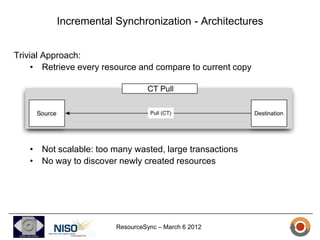
Trivial Approach:
     • Retrieve every resource and compare to current copy


   • Not scalable: too many wasted, large transactions
   • No way to discover newly created resources


                        ResourceSync – March 6 2012
Incremental Synchronization - Architectures


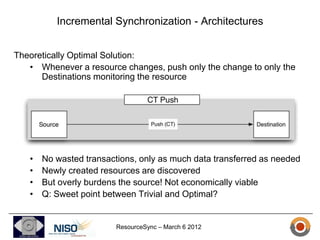
Theoretically Optimal Solution:
   • Whenever a resource changes, push only the change to only the
      Destinations monitoring the resource


   •   No wasted transactions, only as much data transferred as needed
   •   Newly created resources are discovered
   •   But overly burdens the source! Not economically viable
   •   Q: Sweet point between Trivial and Optimal?


                         ResourceSync – March 6 2012
Incremental Synchronization - Architectures


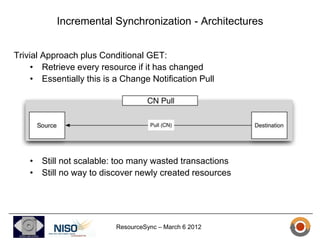
Trivial Approach plus Conditional GET:
     • Retrieve every resource if it has changed
     • Essentially this is a Change Notification Pull


    • Still not scalable: too many wasted transactions
    • Still no way to discover newly created resources


                           ResourceSync – March 6 2012
Incremental Synchronization - Architectures


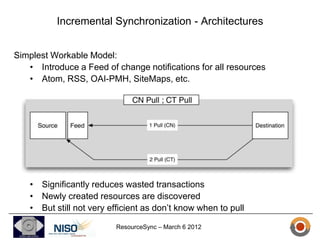
Simplest Workable Model:
   • Introduce a Feed of change notifications for all resources
   • Atom, RSS, OAI-PMH, SiteMaps, etc.


    • Significantly reduces wasted transactions
    • Newly created resources are discovered
    • But still not very efficient as don’t know when to pull

                          ResourceSync – March 6 2012
Incremental Synchronization - Architectures


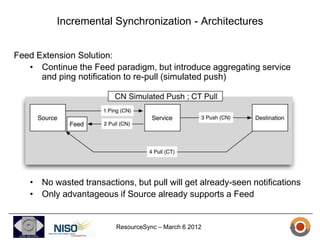
Feed Extension Solution:
   • Continue the Feed paradigm, but introduce aggregating service
      and ping notification to re-pull (simulated push)


   • No wasted transactions, but pull will get already-seen notifications
   • Only advantageous if Source already supports a Feed


                         ResourceSync – March 6 2012
Incremental Synchronization - Architectures


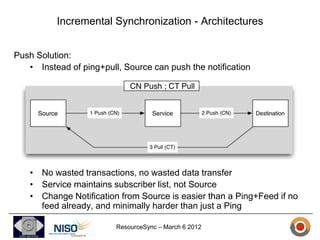
Push Solution:
   • Instead of ping+pull, Source can push the notification


   • No wasted transactions, no wasted data transfer
   • Service maintains subscriber list, not Source
   • Change Notification from Source is easier than a Ping+Feed if no
     feed already, and minimally harder than just a Ping

                         ResourceSync – March 6 2012
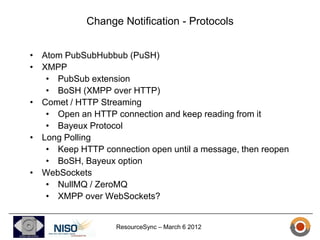
Change Notification - Protocols


• Atom PubSubHubbub (PuSH)
• XMPP
   • PubSub extension
   • BoSH (XMPP over HTTP)
• Comet / HTTP Streaming
   • Open an HTTP connection and keep reading from it
   • Bayeux Protocol
• Long Polling
   • Keep HTTP connection open until a message, then reopen
   • BoSH, Bayeux option
• WebSockets
   • NullMQ / ZeroMQ
   • XMPP over WebSockets?


                   ResourceSync – March 6 2012
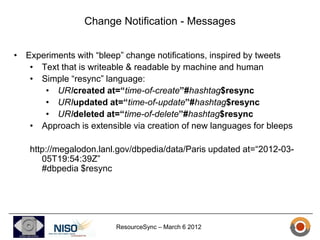
Change Notification - Messages


• Experiments with “bleep” change notifications, inspired by tweets
   • Text that is writeable & readable by machine and human
   • Simple “resync” language:
      • URIcreated at=“time-of-create”#hashtag$resync
      • URIupdated at=“time-of-update”#hashtag$resync
      • URIdeleted at=“time-of-delete”#hashtag$resync
   • Approach is extensible via creation of new languages for bleeps

   http://megalodon.lanl.gov/dbpedia/data/Paris updated at=“2012-03-
      05T19:54:39Z”
      #dbpedia $resync


                        ResourceSync – March 6 2012
Ongoing Investigations


• Change Notification - XMPP & XMPP PubSub& bleeps
   • LANL
   • Ongoing Experiment with Live DBPedia
• Change Notification - Comet / HTTP Streaming & bleeps
   • ODU
   • Bayeux Protocol via Faye Implementation
• Change Notification - Change Simulator
   • Cornell U
   • Generate configurable change notifications
   • Use as standardized input to different systems for testing
• Baseline Matching & Audit
   • Cornell U


                     ResourceSync – March 6 2012
ResourceSync


ResourceSyncis funded by The Sloan Foundation
               ResourceSync – March 6 2012

ResourceSync

  • 1.
    ResourceSync ResourceSyncis funded byThe Sloan Foundation ResourceSync – March 6 2012
  • 2.
    ResourceSync – WebExAgenda Problem Perspective – Herbert Van de Sompel (LANL) Technical Directions – Robert Sanderson (LANL) Joining the Effort – Nettie Lagace (NISO) Q&A ResourceSync – March 6 2012
  • 3.
    ResourceSync – ProblemPerspective Presenter – Herbert Van de Sompel ResourceSync – March 6 2012
  • 4.
    ResourceSync Core Team CornellUniversity & OAI: BerhardHaslhofer, Carl Lagoze, Simeon Warner Old Dominion University & OAI: Michael L. Nelson Los Alamos National Laboratory & OAI: Martin Klein, Robert Sanderson, Herbert Van de Sompel NISO: Todd Carpenter, Nettie Lagace, Peter Murray ResourceSync – March 6 2012
  • 5.
    ResourceSync Problem • Consideration: • Source (server) A has resources that change over time: they get created, modified, deleted, moved, … • Destination (servers) X, Y, and Z leverage (some) resources of Source A. • Problem: • Destinations want to keep in step with the resource changes at Source A: resource synchronization. • Task of ResourceSync effort: • Design an approach for resource synchronization aligned with the Web Architecture that has a fair chance of adoption by different communities. • The approach must scale better than recurrent HTTP HEAD/GET on resources. ResourceSync – March 6 2012
  • 6.
    ResourceSync Use Cases •arXiv mirroring. • Metadata and content transfer from Europeana partners to central Europeana hub. • Synchronization of Linked Data content. • Recurrently collecting Memento metadata from IIPC web archives to central aggregator. • Keeping up-to-data with resources that reside on a Web server. • Use cases have different requirements regarding synchronization accuracy: • Synchronization coverage: perfect …… good enough • Synchronization speed: fast …….…. fast enough ResourceSync – March 6 2012
  • 7.
    Web Context • Thecontext in which resource synchronization will take place is the Web. • Resources considered for synchronization: • Are identified by dereference-able URIs. • Are cache-able. => Caveat: It is understood that resources that require client-side processing (e.g. hashbangURIs) cause problems. ResourceSync – March 6 2012
  • 8.
    3 Synchronization Needs •Overall, there are 3 distinct needs regarding resource synchronization. All 3 are considered in scope for the effort: 1. Baseline matching: An approach to allow a Destination that wants to start synchronizing with a Source to perform an initial catch up – Dump. 2. Incremental resource synchronization: An approach to allow a Destination to remain up-to-date regarding changes at the Source. 3. Audit: An approach to allow checking whether a Destination is in sync with a Source – Inventory. ResourceSync – March 6 2012
  • 9.
    Change Notification –Content Transfer • Distinguish between two aspects related to incremental resource synchronization: 2.a. Change notification: An approach to allow a Destination to understand that a Source’s resource has changed; and what the nature of the change is. 2.b. Content transfer: An approach to allow a Destination to update its holdings to reflect the change the resource underwent at the Source. => For both, PUSH or PULL approaches are conceivable. ResourceSync – March 6 2012
  • 10.
    Selective Synchronization • Thereis a need to be able to synchronize with a limited set of a Source’s resources: selective synchronization. • This leads to the notion of channels for resource synchronization. • The need for channels is most apparent for resource synchronization but may have to be carried through in baseline matching and audit. => This raises an issue: • The definition of channels by the Source is straightforward, yet may not meet the Destination’s needs. • The definition of channels by a Destination is less straightforward. ResourceSync – March 6 2012
  • 11.
    Memory • For robustness,both change notification and content transfer may need a memory function to allow for synchronization after a Destination has missed updates: • Catching up on change notifications - Digests. • Catching up on resource versions - Mementos. However, it would be beneficial if resource synchronization could operate in a memory-less mode in cases where less than perfect sync is acceptable. An important architectural consideration is where that memory should reside: Source, intermediary. ResourceSync – March 6 2012
  • 12.
    Changes Only –Entire Resource • Two approaches for content transfer: 2.b.1. Synchronization is achieved by transfer of the entire resource. 2.b.2. Synchronization is achieved by transfer of resource changes only. Focus is on (2.b.1) because of complexities re content-type- specific resource segment description and re-assembly instructions involved in (2.b.2). Focus re (2.b.1) is on content transfer using a PULL, not PUSH, approach. ResourceSync – March 6 2012
  • 13.
    Event Types • Eventtypes to be considered for change notifications: • Tier 1: • Regarding resources: create ; delete ; update ; new dump ; new inventory • Regarding channels: removed from channel ; added to channel • Tier 2: • Regarding resources: move ; copy Focus is on Tier 1 and on events pertaining to single resources. Tier 2 and consideration of groups of resources (e.g. URI templates, URI regex) is postponed. ResourceSync – March 6 2012
  • 14.
    Resource Representations • Resourcerepresentations are subject to synchronization: • But limited to those that can be requested using protocol parameters for the resource’s URI. => Caveats: • It is understood this causes problems in light of resource representation personalization, e.g. geo-dependent representations. • If the change notification function is provided by 3rd party instead of Source, change notifications may be subjective to the 3rd parties perspective. ResourceSync – March 6 2012
  • 15.
    Discovery • Several Discoveryneeds arise: • Regarding change notification channels: • How to find channels that provide change notifications for a given Source Server? • How to find information about the nature of the changes that are communicated on such channels? • Regarding dumps and inventories: • Where to obtain the most recent dump? • Where to obtain the most recent inventory? • Regarding memory: • Where to obtain digests? • How to access Mementos? ResourceSync – March 6 2012
  • 16.
    And Also … •Authorization: For baseline matching, resource synchronization (change notification, content transfer), and audit a distinction may be required between Destinations that are authorized or unauthorized to perform these functions. • Embargo: How soon after a resource change are parties allowed to know about it, to act upon it? • Trust in a change notification channel: • Can a change notification channel that provides information about a given Source Server be trusted? ResourceSync – March 6 2012
  • 17.
    ResourceSync – TechnicalDirections Presenter – Robert Sanderson ResourceSync – March 6 2012
  • 18.
    ResourceSync Architectural Challenges MajorResearch Areas: 1. Initial Baseline Synchronization • Retrieve dump of data 2. Incremental Synchronization • Main focus of research 3. Audit to ensure Consistency • Not yet significantly investigated Incremental Synchronization split into two separate aspects: 1. Change Notification (CN) • Alert that something happened (create,update,delete) 2. Content Transfer (CT) • Transfer of just the change or the full resource ResourceSync – March 6 2012
  • 19.
    Incremental Synchronization -Architectures Trivial Approach: • Retrieve every resource and compare to current copy • Not scalable: too many wasted, large transactions • No way to discover newly created resources ResourceSync – March 6 2012
  • 20.
    Incremental Synchronization -Architectures Theoretically Optimal Solution: • Whenever a resource changes, push only the change to only the Destinations monitoring the resource • No wasted transactions, only as much data transferred as needed • Newly created resources are discovered • But overly burdens the source! Not economically viable • Q: Sweet point between Trivial and Optimal? ResourceSync – March 6 2012
  • 21.
    Incremental Synchronization -Architectures Trivial Approach plus Conditional GET: • Retrieve every resource if it has changed • Essentially this is a Change Notification Pull • Still not scalable: too many wasted transactions • Still no way to discover newly created resources ResourceSync – March 6 2012
  • 22.
    Incremental Synchronization -Architectures Simplest Workable Model: • Introduce a Feed of change notifications for all resources • Atom, RSS, OAI-PMH, SiteMaps, etc. • Significantly reduces wasted transactions • Newly created resources are discovered • But still not very efficient as don’t know when to pull ResourceSync – March 6 2012
  • 23.
    Incremental Synchronization -Architectures Feed Extension Solution: • Continue the Feed paradigm, but introduce aggregating service and ping notification to re-pull (simulated push) • No wasted transactions, but pull will get already-seen notifications • Only advantageous if Source already supports a Feed ResourceSync – March 6 2012
  • 24.
    Incremental Synchronization -Architectures Push Solution: • Instead of ping+pull, Source can push the notification • No wasted transactions, no wasted data transfer • Service maintains subscriber list, not Source • Change Notification from Source is easier than a Ping+Feed if no feed already, and minimally harder than just a Ping ResourceSync – March 6 2012
  • 25.
    Change Notification -Protocols • Atom PubSubHubbub (PuSH) • XMPP • PubSub extension • BoSH (XMPP over HTTP) • Comet / HTTP Streaming • Open an HTTP connection and keep reading from it • Bayeux Protocol • Long Polling • Keep HTTP connection open until a message, then reopen • BoSH, Bayeux option • WebSockets • NullMQ / ZeroMQ • XMPP over WebSockets? ResourceSync – March 6 2012
  • 26.
    Change Notification -Messages • Experiments with “bleep” change notifications, inspired by tweets • Text that is writeable & readable by machine and human • Simple “resync” language: • URIcreated at=“time-of-create”#hashtag$resync • URIupdated at=“time-of-update”#hashtag$resync • URIdeleted at=“time-of-delete”#hashtag$resync • Approach is extensible via creation of new languages for bleeps http://megalodon.lanl.gov/dbpedia/data/Paris updated at=“2012-03- 05T19:54:39Z” #dbpedia $resync ResourceSync – March 6 2012
  • 27.
    Ongoing Investigations • ChangeNotification - XMPP & XMPP PubSub& bleeps • LANL • Ongoing Experiment with Live DBPedia • Change Notification - Comet / HTTP Streaming & bleeps • ODU • Bayeux Protocol via Faye Implementation • Change Notification - Change Simulator • Cornell U • Generate configurable change notifications • Use as standardized input to different systems for testing • Baseline Matching & Audit • Cornell U ResourceSync – March 6 2012
  • 28.
    ResourceSync ResourceSyncis funded byThe Sloan Foundation ResourceSync – March 6 2012