A global initiative to catalyse resilience within and
between critical infrastructure sectors
www.resilienceshift.org
info@resilienceshift.org
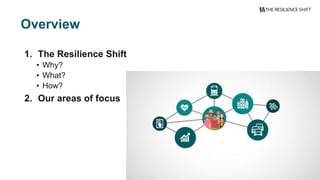
1. The Resilience Shift
• Why?
• What?
• How?
2. Our areas of focus
Overview
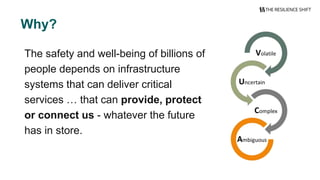
The safety and well-being of billions of
people depends on infrastructure
systems that can deliver critical
services … that can provide, protect
or connect us - whatever the future
has in store.
Why?
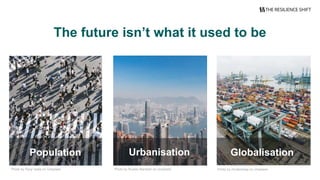
GlobalisationUrbanisationPopulation
The future isn’t what it used to be
Photo by chuttersnap on UnsplashPhoto by Ruslan Bardash on UnsplashPhoto by Ryoji Iwata on Unsplash
For many, the present isn’t so great
Kiberaslum,Nairobi,©NinaRonFlickr
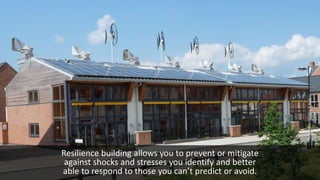
Resilience building allows you to prevent or mitigate
against shocks and stresses you identify and better
able to respond to those you can’t predict or avoid.
SustainableHousing©Arup
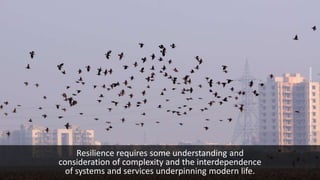
Resilience requires some understanding and
consideration of complexity and the interdependence
of systems and services underpinning modern life.
PhotoBasaiWetlandGurgaonWikimediaCommons
A global initiative to build resilience within and
between key critical infrastructure sectors.
Our vision is a safer and better world through
resilient infrastructure.
We want to shift how we design, deliver and operate
critical infrastructure, to make it more resilient, to
make sure the public gets the services it expects.
The ultimate benefit of a ‘resilience shift’ will be
greater security, and enhanced safety of life,
property, and the environment.
What is the Resilience Shift?
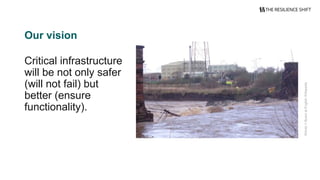
©AndyVByersatEnglishWikipedia
Our vision
Critical infrastructure
will be not only safer
(will not fail) but
better (ensure
functionality).
©Arup
Our vision
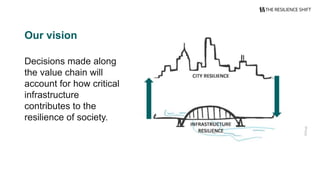
Decisions made along
the value chain will
account for how critical
infrastructure
contributes to the
resilience of society.
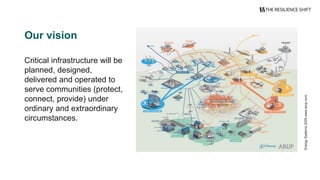
EnergySystems2035www.arup.com
Our vision
Critical infrastructure will be
planned, designed,
delivered and operated to
serve communities (protect,
connect, provide) under
ordinary and extraordinary
circumstances.
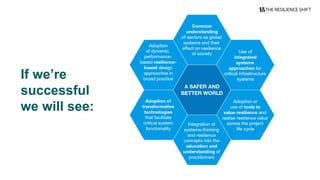
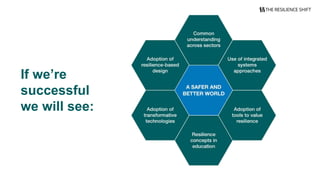
If we’re
successful
we will see:
If we’re
successful
we will see:
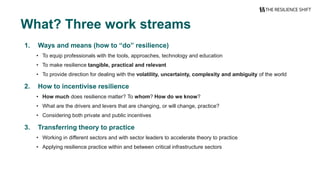
1. Ways and means (how to “do” resilience)
• To equip professionals with the tools, approaches, technology and education
• To make resilience tangible, practical and relevant
• To provide direction for dealing with the volatility, uncertainty, complexity and ambiguity of the world
2. How to incentivise resilience
• How much does resilience matter? To whom? How do we know?
• What are the drivers and levers that are changing, or will change, practice?
• Considering both private and public incentives
3. Transferring theory to practice
• Working in different sectors and with sector leaders to accelerate theory to practice
• Applying resilience practice within and between critical infrastructure sectors
What? Three work streams
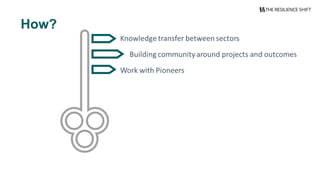
How?
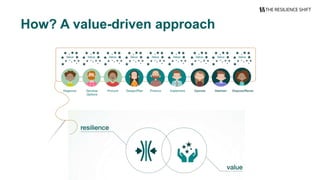
How? A value-driven approach
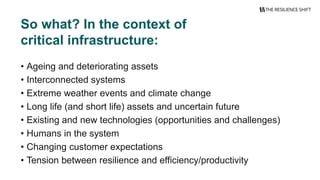
• Ageing and deteriorating assets
• Interconnected systems
• Extreme weather events and climate change
• Long life (and short life) assets and uncertain future
• Existing and new technologies (opportunities and challenges)
• Humans in the system
• Changing customer expectations
• Tension between resilience and efficiency/productivity
So what? In the context of
critical infrastructure:
Some areas of focus
Thanks to Igor Linkov
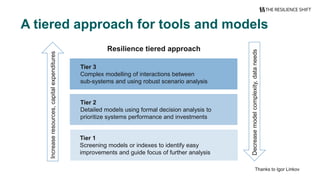
A tiered approach for tools and models
Resilience tiered approach
Increaseresources,capitalexpenditures
Decreasemodelcomplexity,dataneeds
Tier 3
Complex modelling of interactions between
sub-systems and using robust scenario analysis
Tier 2
Detailed models using formal decision analysis to
prioritize systems performance and investments
Tier 1
Screening models or indexes to identify easy
improvements and guide focus of further analysis
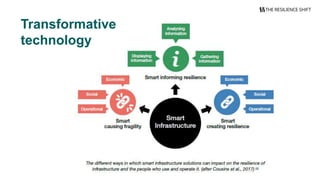
Transformative
technology
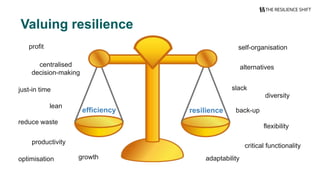
efficiency resilience
reduce waste
lean
just-in time
productivity
slack
diversity
back-up
flexibility
adaptability
alternatives
optimisation
centralised
decision-making
self-organisationprofit
growth
critical functionality
Valuing resilience
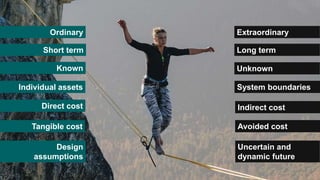
Extraordinary
Long term
Unknown
Indirect cost
Ordinary
Short term
Known
Design
assumptions
Uncertain and
dynamic future
System boundariesIndividual assets
Direct cost
Tangible cost Avoided cost
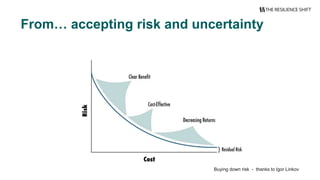
Buying down risk - thanks to Igor Linkov
From… accepting risk and uncertainty
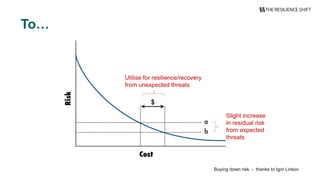
Buying down risk - thanks to Igor Linkov
Utilise for resilience/recovery
from unexpected threats
Slight increase
in residual risk
from expected
threats
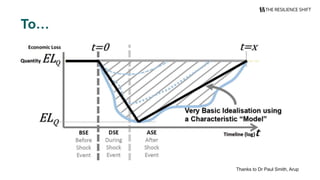
To…
Bostick et al., 2018
Thanks to Dr Paul Smith, Arup
To…
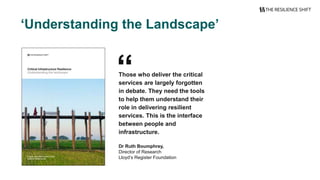
‘Understanding the Landscape’
“Those who deliver the critical
services are largely forgotten
in debate. They need the tools
to help them understand their
role in delivering resilient
services. This is the interface
between people and
infrastructure.
Dr Ruth Boumphrey,
Director of Research
Lloyd’s Register Foundation
Thank you
www.resilienceshift.org
info@resilienceshift.org
@resilienceshift
The Resilience Shift

Resilience Shift - overview of our programme

  • 1.
    A global initiativeto catalyse resilience within and between critical infrastructure sectors www.resilienceshift.org info@resilienceshift.org
  • 2.
    1. The ResilienceShift • Why? • What? • How? 2. Our areas of focus Overview
  • 3.
    The safety andwell-being of billions of people depends on infrastructure systems that can deliver critical services … that can provide, protect or connect us - whatever the future has in store. Why?
  • 4.
    GlobalisationUrbanisationPopulation The future isn’twhat it used to be Photo by chuttersnap on UnsplashPhoto by Ruslan Bardash on UnsplashPhoto by Ryoji Iwata on Unsplash
  • 5.
    For many, thepresent isn’t so great Kiberaslum,Nairobi,©NinaRonFlickr
  • 6.
    Resilience building allowsyou to prevent or mitigate against shocks and stresses you identify and better able to respond to those you can’t predict or avoid. SustainableHousing©Arup
  • 7.
    Resilience requires someunderstanding and consideration of complexity and the interdependence of systems and services underpinning modern life. PhotoBasaiWetlandGurgaonWikimediaCommons
  • 8.
    A global initiativeto build resilience within and between key critical infrastructure sectors. Our vision is a safer and better world through resilient infrastructure. We want to shift how we design, deliver and operate critical infrastructure, to make it more resilient, to make sure the public gets the services it expects. The ultimate benefit of a ‘resilience shift’ will be greater security, and enhanced safety of life, property, and the environment. What is the Resilience Shift?
  • 9.
    ©AndyVByersatEnglishWikipedia Our vision Critical infrastructure willbe not only safer (will not fail) but better (ensure functionality).
  • 10.
    ©Arup Our vision Decisions madealong the value chain will account for how critical infrastructure contributes to the resilience of society.
  • 11.
    EnergySystems2035www.arup.com Our vision Critical infrastructurewill be planned, designed, delivered and operated to serve communities (protect, connect, provide) under ordinary and extraordinary circumstances.
  • 13.
  • 14.
  • 15.
    1. Ways andmeans (how to “do” resilience) • To equip professionals with the tools, approaches, technology and education • To make resilience tangible, practical and relevant • To provide direction for dealing with the volatility, uncertainty, complexity and ambiguity of the world 2. How to incentivise resilience • How much does resilience matter? To whom? How do we know? • What are the drivers and levers that are changing, or will change, practice? • Considering both private and public incentives 3. Transferring theory to practice • Working in different sectors and with sector leaders to accelerate theory to practice • Applying resilience practice within and between critical infrastructure sectors What? Three work streams
  • 16.
  • 17.
  • 18.
    • Ageing anddeteriorating assets • Interconnected systems • Extreme weather events and climate change • Long life (and short life) assets and uncertain future • Existing and new technologies (opportunities and challenges) • Humans in the system • Changing customer expectations • Tension between resilience and efficiency/productivity So what? In the context of critical infrastructure:
  • 19.
  • 20.
    Thanks to IgorLinkov A tiered approach for tools and models Resilience tiered approach Increaseresources,capitalexpenditures Decreasemodelcomplexity,dataneeds Tier 3 Complex modelling of interactions between sub-systems and using robust scenario analysis Tier 2 Detailed models using formal decision analysis to prioritize systems performance and investments Tier 1 Screening models or indexes to identify easy improvements and guide focus of further analysis
  • 21.
  • 22.
    efficiency resilience reduce waste lean just-intime productivity slack diversity back-up flexibility adaptability alternatives optimisation centralised decision-making self-organisationprofit growth critical functionality Valuing resilience
  • 23.
    Extraordinary Long term Unknown Indirect cost Ordinary Shortterm Known Design assumptions Uncertain and dynamic future System boundariesIndividual assets Direct cost Tangible cost Avoided cost
  • 24.
    Buying down risk- thanks to Igor Linkov From… accepting risk and uncertainty
  • 25.
    Buying down risk- thanks to Igor Linkov Utilise for resilience/recovery from unexpected threats Slight increase in residual risk from expected threats To…
  • 26.
    Bostick et al.,2018 Thanks to Dr Paul Smith, Arup To…
  • 27.
    ‘Understanding the Landscape’ “Thosewho deliver the critical services are largely forgotten in debate. They need the tools to help them understand their role in delivering resilient services. This is the interface between people and infrastructure. Dr Ruth Boumphrey, Director of Research Lloyd’s Register Foundation
  • 28.

Editor's Notes

  • #2 Explain Lloyd’s Register Foundation and Arup The Resilience Shift (RS) was established in 2016 to address the recommendations of the Lloyd's Register Foundation's 'Foresight review of resilience engineering'. The initial 5 year programme is funded by Lloyd's Register Foundation, with Arup as host institution.
  • #4   Life relies on the resilience of critical infrastructure But presently we don’t design, deliver and operate for resilience. Moreover, the world is increasingly Volatile, Uncertain, Complex and Ambiguous So, knowing that -- what do we do? Across the value chain, but in today’s context, as Asset Managers… what different decisions should we make to ensure the resilience of our critical infrastructure?
  • #5 Trends of 21st Century: The future isn’t what it used to be. We stand at a time in of rapid change in population, urbanisation and globalisation. The scale of these changes is greater than humanity has ever had to deal with before and the drivers of change are accelerating, creating an uncertain future. Image credits: Population: metro.co.uk Urbanization: Tokyo skyline - markszelistowski.com Globalization: rnw.mn
  • #6 For many, the present is not great. Ongoing stresses persist for poor and vulnerable populations, outdated systems and poorly maintained infrastructure. Environmental and ecosystems threats, now and in the future. Image: Kibera slum, Nairobi, © Nina R on Flickr
  • #7 Resilient places take action against shocks and stresses they identify--and are better able to respond to those they can’t predict or avoid. Image: Sustainable Housing © Arup
  • #8 Resilience requires some understanding and consideration of complexity and the interdependence of systems and services underpinning modern life. If you’re only working narrowly within one field or with one perspective, you may not be in the best position to stay strong and prepared. No one has all the technical and social knowledge to address all the issues. The heart of good resilience practice is collaborative and inclusive processes that build capacity, and demonstrate to participants the ability to integrate long-term planning with short-term projects. Image: Photo by dattatreya patra on unsplash
  • #9 The Resilience Shift (RS) was established in 2016 to address the recommendations of the Lloyd's Register Foundation's 'Foresight review of resilience engineering'. The initial 5 year programme is funded by Lloyd's Register Foundation, with Arup as host institution.
  • #13 In our context we are focussing on critical infrastructure, which is water, transportation, communications and energy, and the critical industry sectors that rely on these lifelines – food, healthcare, housing, financial systems, government etc. Must never remove the people from any of these, or the natural environment – so socio-ecological-technical systems. When it comes down to it, everything is dependent on everything, but everything requires water, power, transportation and/or comms.
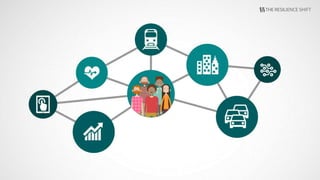
  • #15 Or, put more simply
  • #19 Resilience is not a binary state
  • #23 Note – we are using a fairly narrow definition of efficiency here to make the point that resilience and efficiency are at odds with one another if we don’t seek a balanced approach. In simple terms this slide is showing that if infrastructure was planned and designed only with efficiency in mind, we would not have redundancy, diversity, back-up etc.
  • #24 In order to help people make different decisions, we need to understand what drives their current decisions There are tensions challenging current practice. These reflect debate around the differences between the definitions and evaluation of risk and resilience. It is like a tight rope walk across different drivers for decisions, a balancing act between resilience and traditional risk management.  The challenge of managing risk to known hazards versus deep uncertainty and emerging risks. It is difficult to make the case for resilience, so we need to be clear about value. And this is what we will be exploring in our session.
  • #25 This is a traditional approach to ‘buying down risk’ which requires a degree of certainty about the risk in terms of its likelihood and impact.
  • #26 We may have to accept that the capacity to deal with known specific risks increases by a small amount (b to a) because we want to make sure we have the ability to recover from unexpected threats. However, this ability still helps us with the known risks, it is just that the approach is different to one of robustness and strengthening.
  • #27 We are looking to move towards an approach that characterises the time to recover and the reduced economic loss when ‘’x’ is shorter. Again, this is different to simply considering the financial cost of strengthening due to known risks.
  • #28 For more information.