Project Report
On
Ore Body Modeling & Comparison Between Different
Reserve Estimation Techniques with Datamine
Submitted By
Abhilash Chandrawat
Sushant Kumar
(B.Tech. Final Year)
Guided By
Dr. S.C Jain
Asstt. Professor
Dept. of Mining Engineering
Reduction in cost and time of reserve estimation
process.
To predict suitable mineral estimation tech. for
achieving efficient, tending towards more
precise and accurate computation .
Many of the mines are abandoned due to lack of
knowledge about structural geology and its
various techniques related to ore reserve
estimation.
To facilitate economic mining activity by
predicting appropriate estimation method.
Objectives of the project:
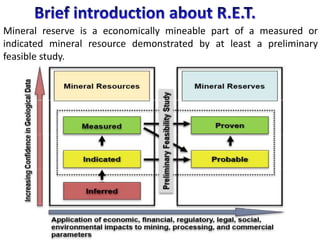
Mineral reserve is a economically mineable part of a measured or
indicated mineral resource demonstrated by at least a preliminary
feasible study.
Reserve Estimation Methods
Nearest Neighbour method
Inverse distance method
Ordinary krigging method
Nearest Neighbour Method(Proximal Interpolation) :
Interpolation is the method of approximation of the value
of a function for a given point in some space. The nearest
neighbor method selects the value of the nearest point in
the predefined space and does not consider the value of
other neighboring points.
Inverse Distance Method:
The inverse-distance weighted procedure is versatile, easy
to program and understand, and is fairly accurate under a
wide range of conditions. Using this method, the property
at each unknown location for which a solution is sought.
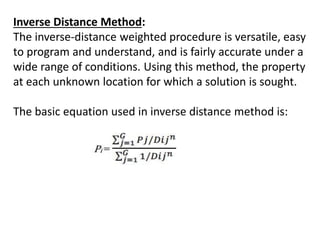
The basic equation used in inverse distance method is:
Ordinary Krigging Method :
Krigging is an estimating method that gives the minimum
variance unbiased linear estimates of point values or of
block averages. The accuracy of the estimates depends
on the several factors which are as follows:
The main venture in ordinary krigging is to build a
variogram from the dissipate point set to be interpolated.
A variogram comprises of two parts: an experimental
variogram and a model variogram.
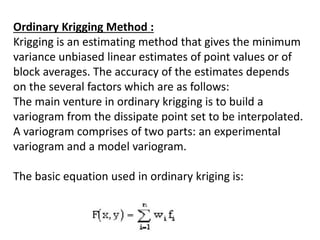
The basic equation used in ordinary kriging is:
World’s Leading integrated software for the natural industries.
Used for data capture & analysis, exploration, geology,
geochemistry, surveying, ore body modelling, UG & Open Pit
Mine Design and Production Planning and also in related
areas such as environmental studies.
Key Advantages:
1. Data entry & Validation
2. Geological Modelling
3. Mine Planning & Production Scheduling (NPV Scheduler)
4. Ramps and Haul Road Design
Brief Introduction Of CAE’s DATAMINE Software
METHODOLOGY
Conclusion
- The error in estimation in case of Ordinary Krigging was
computed and the efficiency of reserve estimation using
Nearest Neighbor and Inverse Distance (with power 2 & 3)
method was compared with Ordinary Krigging method
assuming it to be the best linear unbiased method.
- From the obtained estimation results it was concluded that
Nearest Neighbor method overestimates the Copper
percentage and underestimates the volume of the reserve
while Inverse distance (with power 2 & 3) method
overestimates both attributes in comparison to Ordinary
Krigging.
THANK YOU!

Reserve Estimation Using DATAMINE software

  • 1.
    Project Report On Ore BodyModeling & Comparison Between Different Reserve Estimation Techniques with Datamine Submitted By Abhilash Chandrawat Sushant Kumar (B.Tech. Final Year) Guided By Dr. S.C Jain Asstt. Professor Dept. of Mining Engineering
  • 2.
    Reduction in costand time of reserve estimation process. To predict suitable mineral estimation tech. for achieving efficient, tending towards more precise and accurate computation . Many of the mines are abandoned due to lack of knowledge about structural geology and its various techniques related to ore reserve estimation. To facilitate economic mining activity by predicting appropriate estimation method. Objectives of the project:
  • 3.
    Mineral reserve isa economically mineable part of a measured or indicated mineral resource demonstrated by at least a preliminary feasible study.
  • 4.
    Reserve Estimation Methods NearestNeighbour method Inverse distance method Ordinary krigging method Nearest Neighbour Method(Proximal Interpolation) : Interpolation is the method of approximation of the value of a function for a given point in some space. The nearest neighbor method selects the value of the nearest point in the predefined space and does not consider the value of other neighboring points.
  • 5.
    Inverse Distance Method: Theinverse-distance weighted procedure is versatile, easy to program and understand, and is fairly accurate under a wide range of conditions. Using this method, the property at each unknown location for which a solution is sought. The basic equation used in inverse distance method is:
  • 6.
    Ordinary Krigging Method: Krigging is an estimating method that gives the minimum variance unbiased linear estimates of point values or of block averages. The accuracy of the estimates depends on the several factors which are as follows: The main venture in ordinary krigging is to build a variogram from the dissipate point set to be interpolated. A variogram comprises of two parts: an experimental variogram and a model variogram. The basic equation used in ordinary kriging is:
  • 7.
    World’s Leading integratedsoftware for the natural industries. Used for data capture & analysis, exploration, geology, geochemistry, surveying, ore body modelling, UG & Open Pit Mine Design and Production Planning and also in related areas such as environmental studies. Key Advantages: 1. Data entry & Validation 2. Geological Modelling 3. Mine Planning & Production Scheduling (NPV Scheduler) 4. Ramps and Haul Road Design Brief Introduction Of CAE’s DATAMINE Software
  • 8.
  • 43.
    Conclusion - The errorin estimation in case of Ordinary Krigging was computed and the efficiency of reserve estimation using Nearest Neighbor and Inverse Distance (with power 2 & 3) method was compared with Ordinary Krigging method assuming it to be the best linear unbiased method. - From the obtained estimation results it was concluded that Nearest Neighbor method overestimates the Copper percentage and underestimates the volume of the reserve while Inverse distance (with power 2 & 3) method overestimates both attributes in comparison to Ordinary Krigging.
  • 44.