UWE UREC TRAINING DAY - Ethical
issues in Research with Children
The ethics of involvement: involving
children and young people in
research
Louca-Mai Brady
Postgraduate Researcher, HAS
Background
• PhD: embedding CYP’s participation in
health services and research
• Background in applied social research,
including NCB Research Centre and
Disability Rights Commission
• Member of INVOLVE
• Freelance researcher, including work on
public involvement in research
Overview
• Wider context
• Practical examples:
- Public involvement (incl involving a
‘seldom heard’ group of YP)
- Using social media
1. Protection from harm & ensuring
safeguarding /child protection
2. Making contact (working with ‘gatekeepers’)
3. Getting informed consent
4. Protecting confidentiality & anonymity
5. Minimising impact during the research/
evaluation and in how it is used
Minimising any detrimental impact
of the research process
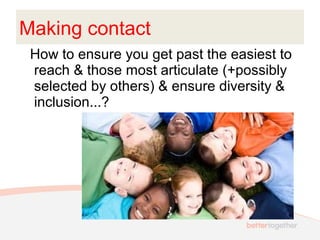
How to ensure you get past the easiest to
reach & those most articulate (+possibly
selected by others) & ensure diversity &
inclusion...?
Making contact
• Gatekeepers give you permission to
contact & seek consent from the CYP (not
consent obo CYP)
• Layers of consent
• Identifing relevant gatekeepers
• Who has parental responsibility if CYP are
not living with their parents?
• Providing accessible information
Working with gatekeepers
• Accessible information
• Competence?
• Parental consent?
• Freely given without coercion,
sanctions, loss of benefits or
inducements.........
• Not just a once-off: ongoing
process in fieldwork
• Recorded as well as verbal
Informed consent
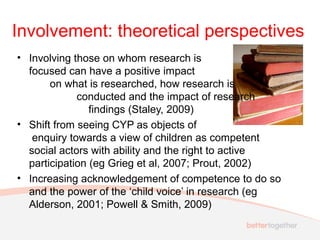
Involvement: theoretical perspectives
• Involving those on whom research is
focused can have a positive impact
on what is researched, how research is
conducted and the impact of research
findings (Staley, 2009)
• Shift from seeing CYP as objects of
enquiry towards a view of children as competent
social actors with ability and the right to active
participation (eg Grieg et al, 2007; Prout, 2002)
• Increasing acknowledgement of competence to do so
and the power of the ‘child voice’ in research (eg
Alderson, 2001; Powell & Smith, 2009)
INVOLVE definitions
• Involvement: Where members of the
public are actively involved in research
projects and in research organisations
• Participation: Where people take part in a
research study
• Engagement: Where information and
knowledge about research is provided and
disseminated
INVOLVE (2012). Briefing notes for researchers. www.invo.org.uk
• Consultation is the process by which
children and young people are asked their
opinions – on a specific issue or broader
agenda (eg as research participants)
• Involvement/participation is the process by
which individuals and groups of individuals
can influence decision-making and bring
about change (eg through involvement in the
planning and process of research)
*Participation Works
• Article 12 . Every child and young person has the
right to express his or her views freely in all matters
affecting them
• Article 13. CYP have the right to freedom of
expression, including the right to all kinds of
information and ideas
• Article 24: CYP have the right to good quality
health care and information to help them stay
healthy
UN Convention on the Rights
of the Child (UNCRC)
Involving a ‘seldom heard’ group
• The Y-SBNT project is funded by the
National Institute for Health Research
[HTA programme] (project number
11/60/01)
• Testing the feasibility of adapting an adult
intervention for young people
• 30 month study in which involvement of
young people in the research process is
central to whole project
Some emerging issues
• YP’s involvement has been extremely helpful
and has informed key elements of the
intervention
• Managing sensitive nature of topics discussed
• Relationship between researchers & YP
• Complex needs & range of services accessed
by this group of YP – e.g. mental health
problems
• This is a seldom heard group of YP who can
be difficult to access and to keep engaged
• Traditional advisory group model in one
location does not seem to be effective
Using social media
• Social media = interaction among people
within virtual communities and networks,
e.g. blogs, Facebook, Twitter, LinkedIn,
Wikipedia and YouTube
• Use of social media and digital methods
as research tools is an emerging area, so
there is as yet limited ethical guidance
Using social media
• Using Twitter to engage policymakers,
practitioners and young people with an
interest in my research
• Project blog
• Blogs as a source of data
• Using Facebook to engage with YP
• Part of steering group for INVOLVE work
on using SM for involvement in research
Further information
• ESRC/NatCen: ‘New social media, new social science?’
www.methodspace.com/group/nsmnss
• Social Research Association (incl presentations from annual ‘social
media in social research’ conference: www.the-sra.org.uk
• Young Digital website: www.youngdigital.net
• ESOMAR (2011). ESOMAR guidelines on social media research.
http://www.esomar.org/uploads/public/knowledge-and-
standards/codes-and-guidelines/ESOMAR-Guideline-on-Social-
Media-Research.pdf
• Jones, C. (2011) Ethical issues in online research, British
Educational Research Association:
http://www.bera.ac.uk/researchers-resources/publications/ethical-
issues-in-online-research
• Smee, H. (2008). Web 2.0 as a social sciences research tool.
London: British Library.
www.bl.uk/reshelp/bldept/socsci/socint/web2/web2.pdf
Some ethical issues to consider
• Children’s rights to have a say in matters that affect
them vs safeguarding and assessments of
competence and vulnerability
• Inclusive research – who gets heard, and who
doesn’t?
• Gatekeepers, consent and assent
• Issues of power
• Responsive but responsible ethical processes in
relation to changing modes of communication (eg
social media)
Blog: www.younghealthparticipation.com
@louca_mai
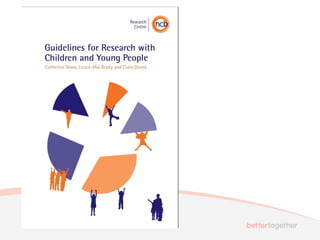
Guidelines for research with CYP:
http://www.participationworks.org.uk/resourc
es/guidelines-for-research-with-children-and-
young-people

The ethics of involvement

  • 1.
    UWE UREC TRAININGDAY - Ethical issues in Research with Children The ethics of involvement: involving children and young people in research Louca-Mai Brady Postgraduate Researcher, HAS
  • 2.
    Background • PhD: embeddingCYP’s participation in health services and research • Background in applied social research, including NCB Research Centre and Disability Rights Commission • Member of INVOLVE • Freelance researcher, including work on public involvement in research
  • 3.
    Overview • Wider context •Practical examples: - Public involvement (incl involving a ‘seldom heard’ group of YP) - Using social media
  • 5.
    1. Protection fromharm & ensuring safeguarding /child protection 2. Making contact (working with ‘gatekeepers’) 3. Getting informed consent 4. Protecting confidentiality & anonymity 5. Minimising impact during the research/ evaluation and in how it is used Minimising any detrimental impact of the research process
  • 6.
    How to ensureyou get past the easiest to reach & those most articulate (+possibly selected by others) & ensure diversity & inclusion...? Making contact
  • 7.
    • Gatekeepers giveyou permission to contact & seek consent from the CYP (not consent obo CYP) • Layers of consent • Identifing relevant gatekeepers • Who has parental responsibility if CYP are not living with their parents? • Providing accessible information Working with gatekeepers
  • 8.
    • Accessible information •Competence? • Parental consent? • Freely given without coercion, sanctions, loss of benefits or inducements......... • Not just a once-off: ongoing process in fieldwork • Recorded as well as verbal Informed consent
  • 9.
    Involvement: theoretical perspectives •Involving those on whom research is focused can have a positive impact on what is researched, how research is conducted and the impact of research findings (Staley, 2009) • Shift from seeing CYP as objects of enquiry towards a view of children as competent social actors with ability and the right to active participation (eg Grieg et al, 2007; Prout, 2002) • Increasing acknowledgement of competence to do so and the power of the ‘child voice’ in research (eg Alderson, 2001; Powell & Smith, 2009)
  • 10.
    INVOLVE definitions • Involvement:Where members of the public are actively involved in research projects and in research organisations • Participation: Where people take part in a research study • Engagement: Where information and knowledge about research is provided and disseminated INVOLVE (2012). Briefing notes for researchers. www.invo.org.uk
  • 11.
    • Consultation isthe process by which children and young people are asked their opinions – on a specific issue or broader agenda (eg as research participants) • Involvement/participation is the process by which individuals and groups of individuals can influence decision-making and bring about change (eg through involvement in the planning and process of research) *Participation Works
  • 12.
    • Article 12. Every child and young person has the right to express his or her views freely in all matters affecting them • Article 13. CYP have the right to freedom of expression, including the right to all kinds of information and ideas • Article 24: CYP have the right to good quality health care and information to help them stay healthy UN Convention on the Rights of the Child (UNCRC)
  • 13.
    Involving a ‘seldomheard’ group • The Y-SBNT project is funded by the National Institute for Health Research [HTA programme] (project number 11/60/01) • Testing the feasibility of adapting an adult intervention for young people • 30 month study in which involvement of young people in the research process is central to whole project
  • 14.
    Some emerging issues •YP’s involvement has been extremely helpful and has informed key elements of the intervention • Managing sensitive nature of topics discussed • Relationship between researchers & YP • Complex needs & range of services accessed by this group of YP – e.g. mental health problems • This is a seldom heard group of YP who can be difficult to access and to keep engaged • Traditional advisory group model in one location does not seem to be effective
  • 15.
    Using social media •Social media = interaction among people within virtual communities and networks, e.g. blogs, Facebook, Twitter, LinkedIn, Wikipedia and YouTube • Use of social media and digital methods as research tools is an emerging area, so there is as yet limited ethical guidance
  • 16.
    Using social media •Using Twitter to engage policymakers, practitioners and young people with an interest in my research • Project blog • Blogs as a source of data • Using Facebook to engage with YP • Part of steering group for INVOLVE work on using SM for involvement in research
  • 17.
    Further information • ESRC/NatCen:‘New social media, new social science?’ www.methodspace.com/group/nsmnss • Social Research Association (incl presentations from annual ‘social media in social research’ conference: www.the-sra.org.uk • Young Digital website: www.youngdigital.net • ESOMAR (2011). ESOMAR guidelines on social media research. http://www.esomar.org/uploads/public/knowledge-and- standards/codes-and-guidelines/ESOMAR-Guideline-on-Social- Media-Research.pdf • Jones, C. (2011) Ethical issues in online research, British Educational Research Association: http://www.bera.ac.uk/researchers-resources/publications/ethical- issues-in-online-research • Smee, H. (2008). Web 2.0 as a social sciences research tool. London: British Library. www.bl.uk/reshelp/bldept/socsci/socint/web2/web2.pdf
  • 18.
    Some ethical issuesto consider • Children’s rights to have a say in matters that affect them vs safeguarding and assessments of competence and vulnerability • Inclusive research – who gets heard, and who doesn’t? • Gatekeepers, consent and assent • Issues of power • Responsive but responsible ethical processes in relation to changing modes of communication (eg social media)
  • 19.
    Blog: www.younghealthparticipation.com @louca_mai Guidelines forresearch with CYP: http://www.participationworks.org.uk/resourc es/guidelines-for-research-with-children-and- young-people

Editor's Notes

  • #9 1. Information – challenge making it detailed, while not too long and boring. Essentials need to know – what’s involved, what’s required of them, what will happen to data and findings. 2. Competence in medicine reliance on ‘Gillick’ Competence for CYP under 16: = no ‘min age for being able to give valid consent (eg to medical tx) – will vary according to CYP’s cognitive abilities and to issue. Equally if someone is not competent – ie if not able to understand what is involved/ what is being asked of them broadly cannot be judged as ‘competent’. However also balance of harm – eg completing a questionnaire at school V painful medical procedure/ drugs trial with side effects. Judgement call, case by case – may need to adjust methods accordingly. 3.Parental/ guardian’s / carer’s consent normally required as gd practice with CYP under 16/18: even if not ‘legally’ required. Poss older if YP has very severe LD. On other hand, there may be some occasions where getting PC cd have harmful consequences – eg making it explicit that study is for gay YP or about STD (ie requiring disclosure) [You cd get around this by careful wording of publicity materials - eg holding a FG on ‘lifestyle’ . Within a school setting the school may be seen as locum parentis and therefore their explicit consent might be enough if the work can be seen as part of schooling – but best px would be to combine with an opt-out for parents. Again will depend on research methods, subject, length, degree of involvement required, age: a short questionnaire delivered in class about views on school sport, to long-term study / lots of interviews/ pictures / - e the 7 Up longitudinal study. Conversely can never just rely on parents’ consent and not also get CYP’s consent Crucial to respect decision given and reaffirm that is their right  future trust as well 4. Avoid coercion/ sanctions – threats. And ‘rewards’ as thank–you’s not bribes. g 5. Consent has to be ongoing – so keep reaffirming. Think at least: pre – start – during. Look out for non verbal cues – discomfort/ frustration. Be prepared to stop, without questions. Have methods – eg green / red cards; turn off recorder (1:1 only – used in oral hx) ; hands up; keep asking; observe. Will slightly depend on age and CYP confidence  Exercise practicing same in trios