Basic skills to help start your research
• Identify the meaning
of research questions
• Formulate strong
research questions
Choose an interesting topic. If you’re
interested in your topic, chances are that
others will be, too. Plus researching will be a
lot more fun!
Gather background information.
• For a general overview, reference sources may be
useful.
• The database OneSearch@IU is also a good place to
start narrowing your focus and finding resources
(libraries.iub.edu/onsearch).
• Ask yourself: - What subtopics relate to the broader
topic? - What questions do these sources raise? - What
do you find interesting about the topic?
Consider your audience. Who would be
interested in the issue?
Explore questions.
• Ask open-ended “how” and “why”
questions about your general topic.
• Consider the “so what” of your
topic.
• Reflect on the questions you have
considered
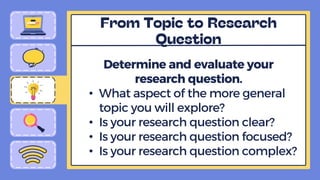
Determine and evaluate your
research question.
• What aspect of the more general
topic you will explore?
• Is your research question clear?
• Is your research question focused?
• Is your research question complex?
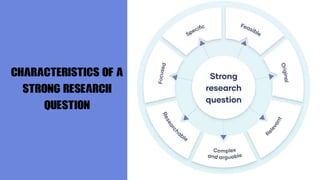
CHARACTERISTICS OF A
STRONG RESEARCH
QUESTION
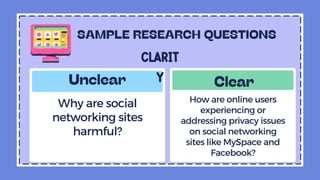
Why are social
networking sites
harmful?
How are online users
experiencing or
addressing privacy issues
on social networking
sites like MySpace and
Facebook?
CLARIT
Y
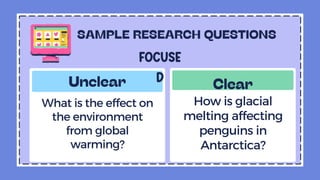
What is the effect on
the environment
from global
warming?
How is glacial
melting affecting
penguins in
Antarctica?
FOCUSE
D
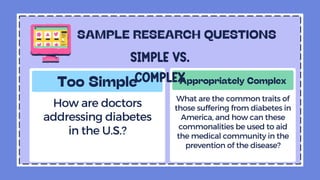
How are doctors
addressing diabetes
in the U.S.?
What are the common traits of
those suffering from diabetes in
America, and how can these
commonalities be used to aid
the medical community in the
prevention of the disease?
SIMPLE VS.
COMPLEX
Did you learn something new from
this seminar? What is it?
Adapted from: George Mason University Writing Center.
(2008). How to write a research question. Retrieved from
http://writingcenter.gmu.edu/?p=307

....Research Questions Presentation.pptx

  • 1.
    Basic skills tohelp start your research
  • 2.
    • Identify themeaning of research questions • Formulate strong research questions
  • 3.
    Choose an interestingtopic. If you’re interested in your topic, chances are that others will be, too. Plus researching will be a lot more fun!
  • 4.
    Gather background information. •For a general overview, reference sources may be useful. • The database OneSearch@IU is also a good place to start narrowing your focus and finding resources (libraries.iub.edu/onsearch). • Ask yourself: - What subtopics relate to the broader topic? - What questions do these sources raise? - What do you find interesting about the topic?
  • 5.
    Consider your audience.Who would be interested in the issue?
  • 6.
    Explore questions. • Askopen-ended “how” and “why” questions about your general topic. • Consider the “so what” of your topic. • Reflect on the questions you have considered
  • 7.
    Determine and evaluateyour research question. • What aspect of the more general topic you will explore? • Is your research question clear? • Is your research question focused? • Is your research question complex?
  • 8.
    CHARACTERISTICS OF A STRONGRESEARCH QUESTION
  • 9.
    Why are social networkingsites harmful? How are online users experiencing or addressing privacy issues on social networking sites like MySpace and Facebook? CLARIT Y
  • 10.
    What is theeffect on the environment from global warming? How is glacial melting affecting penguins in Antarctica? FOCUSE D
  • 11.
    How are doctors addressingdiabetes in the U.S.? What are the common traits of those suffering from diabetes in America, and how can these commonalities be used to aid the medical community in the prevention of the disease? SIMPLE VS. COMPLEX
  • 12.
    Did you learnsomething new from this seminar? What is it?
  • 13.
    Adapted from: GeorgeMason University Writing Center. (2008). How to write a research question. Retrieved from http://writingcenter.gmu.edu/?p=307