1 | P a g e 
Research Paper 
Title: Abortion in the light of Islam 
Prepared By 
Syed Nawaz 
FAST National University of Computer and emerging 
Sciences
2 | P a g e 
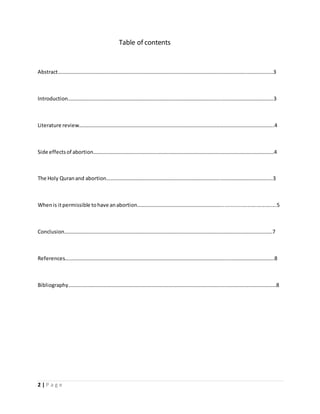
Table of contents 
Abstract………………………………………………………………………………………………………………………………………………..3 
Introduction………………………………………………………………………………………………………………………………………….3 
Literature review…………………………………………………………………………………………………………………………………..4 
Side effects of abortion…………………………………………………………………………………………………………………………4 
The Holy Quran and abortion……………………………………………………………………………………………………………….3 
When is it permissible to have an abortion………………………………………………………......................................5 
Conclusion……………………………………………………………………………………………………………………………………………7 
References…………………………………………………………………………………………………………………………………………….8 
Bibliography……………………………………………………………………………………………………………………………………………8
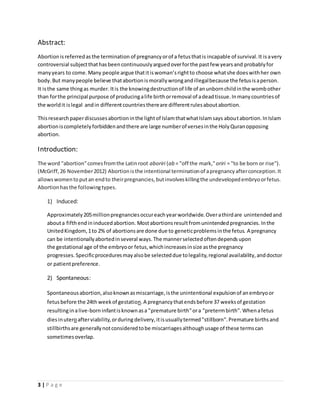
Abstract: 
Abortion is referred as the termination of pregnancy or of a fetus that is incapable of survival. It is a very 
controversial subject that has been continuously argued over for the past few years and probably for 
many years to come. Many people argue that it is woman’s right to choose what she does with her own 
body. But many people believe that abortion is morally wrong and illegal because the fetus is a person. 
It is the same thing as murder. It is the knowing destruction of life of an unborn child in the womb other 
than for the principal purpose of producing a life birth or removal of a dead tissue. In many countries of 
the world it is legal and in different countries there are different rules about abortion. 
This research paper discusses abortion in the light of Islam that what Islam says about abortion. In Islam 
abortion is completely forbidden and there are large number of verses in the Holy Quran opposing 
abortion. 
Introduction: 
The word "abortion" comes from the Latin root aboriri (ab = "off the mark," oriri = "to be born or rise"). 
(McGriff, 26 November 2012) Abortion is the intentional termination of a pregnancy after conception. It 
allows women to put an end to their pregnancies, but involves killing the undeveloped embryo or fetus. 
Abortion has the following types. 
1) Induced: 
Approximately 205 million pregnancies occur each year worldwide. Over a third are unintended and 
about a fifth end in induced abortion. Most abortions result from unintended pregnancies. In the 
United Kingdom, 1 to 2% of abortions are done due to genetic problems in the fetus. A pregnancy 
can be intentionally aborted in several ways. The manner selected often depends upon 
the gestational age of the embryo or fetus, which increases in size as the pregnancy 
progresses. Specific procedures may also be selected due to legality, regional availability, and doctor 
or patient preference. 
2) Spontaneous: 
Spontaneous abortion, also known as miscarriage, is the unintentional expulsion of an embryo or 
fetus before the 24th week of gestation. A pregnancy that ends before 37 weeks of gestation 
resulting in a live-born infant is known as a "premature birth" or a "preterm birth". When a fetus 
dies in utero after viability, or during delivery, it is usually termed "stillborn". Premature births and 
stillbirths are generally not considered to be miscarriages although usage of these terms can 
sometimes overlap. 
3 | P a g e
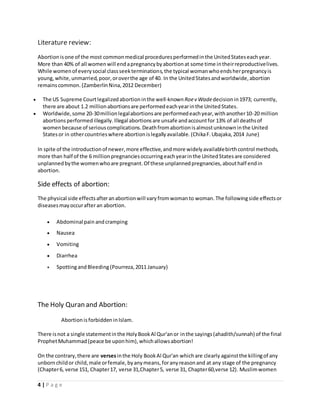
Literature review: 
Abortion is one of the most common medical procedures performed in the United States each year. 
More than 40% of all women will end a pregnancy by abortion at some time in their reproductive lives. 
While women of every social class seek terminations, the typical woman who ends her pregnancy is 
young, white, unmarried, poor, or over the age of 40. In the United States and worldwide, abortion 
remains common. (Zamberlin Nina, 2012 December) 
 The US Supreme Court legalized abortion in the well-known Roe v Wade decision in 1973; currently, 
there are about 1.2 million abortions are performed each year in the United States. 
 Worldwide, some 20-30 million legal abortions are performed each year, with another 10-20 million 
abortions performed illegally. Illegal abortions are unsafe and account for 13% of all deaths of 
women because of serious complications. Death from abortion is almost unknown in the United 
States or in other countries where abortion is legally available. (Chika F. Ubajaka, 2014 June) 
In spite of the introduction of newer, more effective, and more widely available birth control methods, 
more than half of the 6 million pregnancies occurring each year in the United States are considered 
unplanned by the women who are pregnant. Of these unplanned pregnancies, about half end in 
abortion. 
Side effects of abortion: 
The physical side effects after an abortion will vary from woman to woman. The following side effects or 
diseases may occur after an abortion. 
 Abdominal pain and cramping 
 Nausea 
 Vomiting 
 Diarrhea 
 Spotting and Bleeding (Pourreza, 2011 January) 
The Holy Quran and Abortion: 
Abortion is forbidden in Islam. 
There is not a single statement in the Holy Book Al Qur'an or in the sayings (ahadith/sunnah) of the final 
Prophet Muhammad (peace be upon him), which allows abortion! 
On the contrary, there are verses in the Holy Book Al Qur'an which are clearly against the killing of any 
unborn child or child, male or female, by any means, for any reason and at any stage of the pregnancy 
(Chapter 6, verse 151, Chapter 17, verse 31,Chapter 5, verse 31, Chapter 60,verse 12). Muslim women 
4 | P a g e
are described in the Al Qur'an as (amongst other things) those who "do not kill their children." (Chapter 
60, verse 12) 
In Islam we are asked to marry, conceive and maintain pregnancy till its natural end as fixed by GOD, 
and to produce many children. Every conception is legitimate and every pregnancy is desired and 
wanted. In Islam there is no such thing as an "unwanted pregnancy." Every child is regarded as a great 
gift from God. 
Many verses in Al Qur'an describe beautifully and scientifically all the different stages of development 
and growth of the unborn baby, producing great admiration for The Creator, the best of Designers! 
(Chapter 23, verses 12,13,14) 
Islam also has stated clearly the rights of the foetus; the right to life and protection from any harm, the 
right to lineage, the right to support from family, the right to legal status and inheritance. 
Al lah says in the Holy Quran Chapter 6 Surah Anaam verse 140: 
“Most surely they became l osers, who, i n their folly and i gnorance ki lled their own 
chi ldren; and made unlawful what Allah had provided them as sustenance, falsely ascribing 
prohibitions to Allah. Surely, they went astray and we re not at al l ri ghtly gui ded.” 
Al lah says in the Holy Quran Chapter 17 Surah Israa verse 31: 
“ Do not ki ll your children for fear of want; for it is We Who provide for them, and for you as 
wel l . Indeed, their ki lling i s a he inous crime!” 
In the Holy Quran Allah i s al so saying 
“On the Day you see it every nursing mother will be distracted from that [child] she was nursing, and 
every pregnant woman will abort her pregnancy, and you will see the people [appearing] intoxicated 
while they are not intoxicated; but the punishment of Allah is severe. ” 
When Is It Permitted to Have an Abortion? 
The Sharia’s ruling on abortion: 
Abortion can be divided into two stages: 
5 | P a g e
a) Abortion after the soul (Ruh) enters the foetus 
b) Abortion prior to the entry of the soul in to the foetus 
Before mentioning the ruling on abortion with regards to these two stages, it must be remembered 
here, that according to Shari’ah the soul (Ruh) enters the foetus at 120 days (4 months) from 
conception. 
The Jurists (Fuqaha) have based this duration upon a Quranic verse and a statement of the beloved of 
Allah (Allah bless him & give him peace). In the verse Allah states the stages of development of the 
embryo in the womb of the mother. Allah Almighty says: 
“And verily we did create man from a quintessence (of clay). Then we placed him (as a drop of sperm) 
in a place of rest, firmly fixed. Then we made the sperm into a clot of congealed blood. Then of that 
clot we made a (foetus) lump. Then we made out of that lump bones and clothed the bones with 
flesh. Then we developed out of it another creature (by breathing life into it). So blessed be Allah, the 
most marvellous creator.” (Surah al-Mu’minun, 12/13/14). 
In the Hadith recorded by the two most authentic authorities, Imam al -Bukhari and Imam Muslim in 
their respective Sahih collections, the Messenger of Allah (Allah bless him & give him peace) discussed in 
detail the periods elapsing between these stages, mentioned by the Qur’an. 
Abdullah ibn Mas’ud (Allah be pleased with him) narrates that the Messenger of Allah (Allah bless him & 
give him peace) said: 
“The seed of one of you remains in the womb of the mother for forty days in the form of a Nutfa. 
Then it remains like a clot for another forty days, and then for a same number of days like a lump of 
flesh" (when the formation of the limbs and the growth of the bones begin). (Sahih al-Bukhari & Sahih 
Muslim). 
The great Hanafi Faqeeh Ibn Abidin States in his Radd al-Muhtar: 
“The soul enters the foutus at one hundred & twenty days (4 months), as established by the Hadith” 
(Radd al-Muhtar, 1/202) 
The ruling on abortion in stage (a) i.e. after the entry of the soul into the foetus which is (as explained) 
120 days, is that, it is totally impermissible and tantamount to murder, as it results in the taking out of 
an innocent life. All the scholars have unanimously condemned such a ghastly act. 
In the following cases abortion is permissible. 
If the Mother's Life is in Danger 
Some Fuqaha and contemporary scholars have given a dispensation to abort the pregnancy after 120 
days, in the situation where the life of the mother is in certain and absolute danger. This is based on the 
Juristic principle stated in the books of Usul al-Fiqh: 
6 | P a g e
“If one is overtaken by two evils, one should choose the lesser of the two” (al -Ashbah wa al-Naza’ir, 
P.98) 
Abortion Before 120 Days 
With regards to stage (b) i.e. prior to the entry of the soul into the foetus (120 days), the ruling is 
that, even in this case it is unlawful (Haram) to abort the pregnancy. 
The reason why abortion prior to the soul entering the body will not be permitted is that, although there 
may not be life in the foetus, the foetus is considered to be part and parcel of the mother’s body as long 
as it remains in the womb. Thus, just as one’s very own life and also all the limbs and organs of the 
human body are trust given by the Almighty Creator, so too is the foetus also a trust given to the mother 
by Allah, and she will not have a right to abort it. 
Extreme Circumstances 
However, in certain extreme circumstances, it would be permitted to abort the pregnancy, before the 
entry of the soul (120 days), such as: when the woman conceives after being raped, the mothers life or 
health is in danger, or repeated pregnancies severely damages her health, etc… 
Imam al-Haskafi writes in Durr al-Mukhtar: 
“Aborting the pregnancy will be permissible due to a valid reason, provided the soul has not yet 
entered the foetus”. 
Conclusion: 
This research paper concludes that abortion is a wrong way to terminate pregnancy because it has many 
physical side effects and it is also forbidden in Islam. Allah Almighty is the only Creator of the universe 
and He knows better about its creatures. Abortion is a murder and committing a murder is a big sin in 
Islam. Although there are some cases discussed in research paper in which Islam is giving the permission 
of abortion. 
7 | P a g e
References: 
http://www.zawaj.com/articles/abortion_permitted_when.html 
http://quran.com/22 
https://www.spuc.org.uk/about/muslim-division/prohibit 
http://americanpregnancy.org/unplanned-pregnancy/abortion-side-effects/ 
http://www.healthcentre.org.uk/abortion/abortion-side-effects.html 
http://www.bpas.org/bpasyoungpeople/what-is-abortion 
http://www.guttmacher.org/pubs/fb_induced_abortion.html 
Bibliography 
Chika F. Ubajaka, P. O. ( 2014 June). Perception of Abortion and Abortion Laws by Lawyers in Anambra 
State Nigeria. United States: Scientific Research Publishing. 
McGriff, P. (26 November 2012). Brooke Morris. 
Pourreza, A. (2011 January). Psychology Consequences of Abortion Among The Post Abortion Care 
Seeking Women in Tehran. 
Zamberlin Nina. (2012 December). Latin American women’s experiences with medical abortion in 
settings where abortion is legally restricted. 
8 | P a g e

Abortion in the light of Islam

  • 1.
    1 | Pa g e Research Paper Title: Abortion in the light of Islam Prepared By Syed Nawaz FAST National University of Computer and emerging Sciences
  • 2.
    2 | Pa g e Table of contents Abstract………………………………………………………………………………………………………………………………………………..3 Introduction………………………………………………………………………………………………………………………………………….3 Literature review…………………………………………………………………………………………………………………………………..4 Side effects of abortion…………………………………………………………………………………………………………………………4 The Holy Quran and abortion……………………………………………………………………………………………………………….3 When is it permissible to have an abortion………………………………………………………......................................5 Conclusion……………………………………………………………………………………………………………………………………………7 References…………………………………………………………………………………………………………………………………………….8 Bibliography……………………………………………………………………………………………………………………………………………8
  • 3.
    Abstract: Abortion isreferred as the termination of pregnancy or of a fetus that is incapable of survival. It is a very controversial subject that has been continuously argued over for the past few years and probably for many years to come. Many people argue that it is woman’s right to choose what she does with her own body. But many people believe that abortion is morally wrong and illegal because the fetus is a person. It is the same thing as murder. It is the knowing destruction of life of an unborn child in the womb other than for the principal purpose of producing a life birth or removal of a dead tissue. In many countries of the world it is legal and in different countries there are different rules about abortion. This research paper discusses abortion in the light of Islam that what Islam says about abortion. In Islam abortion is completely forbidden and there are large number of verses in the Holy Quran opposing abortion. Introduction: The word "abortion" comes from the Latin root aboriri (ab = "off the mark," oriri = "to be born or rise"). (McGriff, 26 November 2012) Abortion is the intentional termination of a pregnancy after conception. It allows women to put an end to their pregnancies, but involves killing the undeveloped embryo or fetus. Abortion has the following types. 1) Induced: Approximately 205 million pregnancies occur each year worldwide. Over a third are unintended and about a fifth end in induced abortion. Most abortions result from unintended pregnancies. In the United Kingdom, 1 to 2% of abortions are done due to genetic problems in the fetus. A pregnancy can be intentionally aborted in several ways. The manner selected often depends upon the gestational age of the embryo or fetus, which increases in size as the pregnancy progresses. Specific procedures may also be selected due to legality, regional availability, and doctor or patient preference. 2) Spontaneous: Spontaneous abortion, also known as miscarriage, is the unintentional expulsion of an embryo or fetus before the 24th week of gestation. A pregnancy that ends before 37 weeks of gestation resulting in a live-born infant is known as a "premature birth" or a "preterm birth". When a fetus dies in utero after viability, or during delivery, it is usually termed "stillborn". Premature births and stillbirths are generally not considered to be miscarriages although usage of these terms can sometimes overlap. 3 | P a g e
  • 4.
    Literature review: Abortionis one of the most common medical procedures performed in the United States each year. More than 40% of all women will end a pregnancy by abortion at some time in their reproductive lives. While women of every social class seek terminations, the typical woman who ends her pregnancy is young, white, unmarried, poor, or over the age of 40. In the United States and worldwide, abortion remains common. (Zamberlin Nina, 2012 December)  The US Supreme Court legalized abortion in the well-known Roe v Wade decision in 1973; currently, there are about 1.2 million abortions are performed each year in the United States.  Worldwide, some 20-30 million legal abortions are performed each year, with another 10-20 million abortions performed illegally. Illegal abortions are unsafe and account for 13% of all deaths of women because of serious complications. Death from abortion is almost unknown in the United States or in other countries where abortion is legally available. (Chika F. Ubajaka, 2014 June) In spite of the introduction of newer, more effective, and more widely available birth control methods, more than half of the 6 million pregnancies occurring each year in the United States are considered unplanned by the women who are pregnant. Of these unplanned pregnancies, about half end in abortion. Side effects of abortion: The physical side effects after an abortion will vary from woman to woman. The following side effects or diseases may occur after an abortion.  Abdominal pain and cramping  Nausea  Vomiting  Diarrhea  Spotting and Bleeding (Pourreza, 2011 January) The Holy Quran and Abortion: Abortion is forbidden in Islam. There is not a single statement in the Holy Book Al Qur'an or in the sayings (ahadith/sunnah) of the final Prophet Muhammad (peace be upon him), which allows abortion! On the contrary, there are verses in the Holy Book Al Qur'an which are clearly against the killing of any unborn child or child, male or female, by any means, for any reason and at any stage of the pregnancy (Chapter 6, verse 151, Chapter 17, verse 31,Chapter 5, verse 31, Chapter 60,verse 12). Muslim women 4 | P a g e
  • 5.
    are described inthe Al Qur'an as (amongst other things) those who "do not kill their children." (Chapter 60, verse 12) In Islam we are asked to marry, conceive and maintain pregnancy till its natural end as fixed by GOD, and to produce many children. Every conception is legitimate and every pregnancy is desired and wanted. In Islam there is no such thing as an "unwanted pregnancy." Every child is regarded as a great gift from God. Many verses in Al Qur'an describe beautifully and scientifically all the different stages of development and growth of the unborn baby, producing great admiration for The Creator, the best of Designers! (Chapter 23, verses 12,13,14) Islam also has stated clearly the rights of the foetus; the right to life and protection from any harm, the right to lineage, the right to support from family, the right to legal status and inheritance. Al lah says in the Holy Quran Chapter 6 Surah Anaam verse 140: “Most surely they became l osers, who, i n their folly and i gnorance ki lled their own chi ldren; and made unlawful what Allah had provided them as sustenance, falsely ascribing prohibitions to Allah. Surely, they went astray and we re not at al l ri ghtly gui ded.” Al lah says in the Holy Quran Chapter 17 Surah Israa verse 31: “ Do not ki ll your children for fear of want; for it is We Who provide for them, and for you as wel l . Indeed, their ki lling i s a he inous crime!” In the Holy Quran Allah i s al so saying “On the Day you see it every nursing mother will be distracted from that [child] she was nursing, and every pregnant woman will abort her pregnancy, and you will see the people [appearing] intoxicated while they are not intoxicated; but the punishment of Allah is severe. ” When Is It Permitted to Have an Abortion? The Sharia’s ruling on abortion: Abortion can be divided into two stages: 5 | P a g e
  • 6.
    a) Abortion afterthe soul (Ruh) enters the foetus b) Abortion prior to the entry of the soul in to the foetus Before mentioning the ruling on abortion with regards to these two stages, it must be remembered here, that according to Shari’ah the soul (Ruh) enters the foetus at 120 days (4 months) from conception. The Jurists (Fuqaha) have based this duration upon a Quranic verse and a statement of the beloved of Allah (Allah bless him & give him peace). In the verse Allah states the stages of development of the embryo in the womb of the mother. Allah Almighty says: “And verily we did create man from a quintessence (of clay). Then we placed him (as a drop of sperm) in a place of rest, firmly fixed. Then we made the sperm into a clot of congealed blood. Then of that clot we made a (foetus) lump. Then we made out of that lump bones and clothed the bones with flesh. Then we developed out of it another creature (by breathing life into it). So blessed be Allah, the most marvellous creator.” (Surah al-Mu’minun, 12/13/14). In the Hadith recorded by the two most authentic authorities, Imam al -Bukhari and Imam Muslim in their respective Sahih collections, the Messenger of Allah (Allah bless him & give him peace) discussed in detail the periods elapsing between these stages, mentioned by the Qur’an. Abdullah ibn Mas’ud (Allah be pleased with him) narrates that the Messenger of Allah (Allah bless him & give him peace) said: “The seed of one of you remains in the womb of the mother for forty days in the form of a Nutfa. Then it remains like a clot for another forty days, and then for a same number of days like a lump of flesh" (when the formation of the limbs and the growth of the bones begin). (Sahih al-Bukhari & Sahih Muslim). The great Hanafi Faqeeh Ibn Abidin States in his Radd al-Muhtar: “The soul enters the foutus at one hundred & twenty days (4 months), as established by the Hadith” (Radd al-Muhtar, 1/202) The ruling on abortion in stage (a) i.e. after the entry of the soul into the foetus which is (as explained) 120 days, is that, it is totally impermissible and tantamount to murder, as it results in the taking out of an innocent life. All the scholars have unanimously condemned such a ghastly act. In the following cases abortion is permissible. If the Mother's Life is in Danger Some Fuqaha and contemporary scholars have given a dispensation to abort the pregnancy after 120 days, in the situation where the life of the mother is in certain and absolute danger. This is based on the Juristic principle stated in the books of Usul al-Fiqh: 6 | P a g e
  • 7.
    “If one isovertaken by two evils, one should choose the lesser of the two” (al -Ashbah wa al-Naza’ir, P.98) Abortion Before 120 Days With regards to stage (b) i.e. prior to the entry of the soul into the foetus (120 days), the ruling is that, even in this case it is unlawful (Haram) to abort the pregnancy. The reason why abortion prior to the soul entering the body will not be permitted is that, although there may not be life in the foetus, the foetus is considered to be part and parcel of the mother’s body as long as it remains in the womb. Thus, just as one’s very own life and also all the limbs and organs of the human body are trust given by the Almighty Creator, so too is the foetus also a trust given to the mother by Allah, and she will not have a right to abort it. Extreme Circumstances However, in certain extreme circumstances, it would be permitted to abort the pregnancy, before the entry of the soul (120 days), such as: when the woman conceives after being raped, the mothers life or health is in danger, or repeated pregnancies severely damages her health, etc… Imam al-Haskafi writes in Durr al-Mukhtar: “Aborting the pregnancy will be permissible due to a valid reason, provided the soul has not yet entered the foetus”. Conclusion: This research paper concludes that abortion is a wrong way to terminate pregnancy because it has many physical side effects and it is also forbidden in Islam. Allah Almighty is the only Creator of the universe and He knows better about its creatures. Abortion is a murder and committing a murder is a big sin in Islam. Although there are some cases discussed in research paper in which Islam is giving the permission of abortion. 7 | P a g e
  • 8.
    References: http://www.zawaj.com/articles/abortion_permitted_when.html http://quran.com/22 https://www.spuc.org.uk/about/muslim-division/prohibit http://americanpregnancy.org/unplanned-pregnancy/abortion-side-effects/ http://www.healthcentre.org.uk/abortion/abortion-side-effects.html http://www.bpas.org/bpasyoungpeople/what-is-abortion http://www.guttmacher.org/pubs/fb_induced_abortion.html Bibliography Chika F. Ubajaka, P. O. ( 2014 June). Perception of Abortion and Abortion Laws by Lawyers in Anambra State Nigeria. United States: Scientific Research Publishing. McGriff, P. (26 November 2012). Brooke Morris. Pourreza, A. (2011 January). Psychology Consequences of Abortion Among The Post Abortion Care Seeking Women in Tehran. Zamberlin Nina. (2012 December). Latin American women’s experiences with medical abortion in settings where abortion is legally restricted. 8 | P a g e