UNIVERSITY OF NIGERIA, NSUKKA
SCHOOL OF POSTGRADUATE STUDIES
Research Methods
Prof Ike Onyishi
Department of Psychology
Email: ernest.onyishi@unn.edu.ng
+2348037485355
OUTLINE
• Making Decisions about our research – Critical
Imagination
• The Research Process
• Developing a theoretical framework/model
• Research Questions and Hypotheses
• Research Methods
• Data Analysis
GOALS AND OBJECTIVES
At the end of the workshop participants
would be able to:
• Develop a researchable project topic
• Develop good research question
• Describe the various research methods
• Explain data analytical procedures
INTRODUCTION
• Conducting research is a major aspect of
postgraduate training.
• Most of us if not all would be required to
conduct and submit a research project in
the course of completing a postgraduate
programme
• Thus, the need for adequate training on
research methods
Making decisions about your
research
What should I research?
Why?
How to conduct the research
Where?
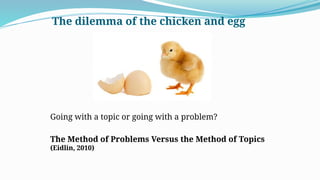
The dilemma of the chicken and egg
Going with a topic or going with a problem?
The Method of Problems Versus the Method of Topics
(Eidlin, 2010)
Important questions to reflect on as you develop your
research projects
 How does your research advance ongoing debate in the field?
 What will a researcher/reader learn from the research that she/he
does not know before?
 Why is the knowledge important?
 What positive impact does the research propose?
 If the research is completed what will it be cited for in the future?
Importance of critical imagination
 Critical imagination is a deliberate systematic decision
making about research. It requires:
 A need for careful design
 Understanding of the nature of science/research
 Overcoming some common challenges to critical
imagination
The Nature of Scientific Research (SR)
 SR is based on the systematic practice of disbelief
 Maintaining a sceptical attitude
 SR involves questioning stated and unstated
assumptions
 SR helps in pushing the boundaries of knowledge
 Good SR discoveries are concerned with
unintended consequences of human actions
Challenges to critical imagination
Common sense- untutored knowledge of the
social world (Hirschman, 1981)
Where lies the novelty? “An author is little to be valued
who tells us nothing but what we can learn from every
coffee house conversation” (Charles Hume 1985)
Trained incapacity*: specialisation that
promotes ignorance
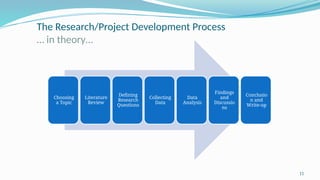
The Research/Project Development Process
… in theory…
11
Choosing
a Topic
Literature
Review
Defining
Research
Questions
Collecting
Data
Data
Analysis
Findings
and
Discussio
ns
Conclusio
n and
Write-up
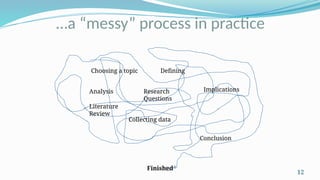
…a “messy” process in practice
12
Research
Questions
Collecting data
Defining
Conclusion
Finished
Implications
Choosing a topic
Analysis
Literature
Review
Developing a theoretical framework/model
Theory Defined
“A theory is a statement of relations among concepts within a set of
boundary assumptions and constraints” (Bacharach, 1989, p. 496)
 “A theoretical framework represents your beliefs on how certain
phenomena (variables or concepts) are related to each other (a
model) and an explanation of why you believe that these variables
are associated with each other (a theory)” (Sekaran & Bougie,
2013, p. 68)
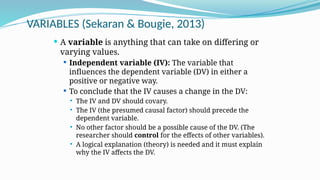
VARIABLES (Sekaran & Bougie, 2013)
 A variable is anything that can take on differing or
varying values.
 Independent variable (IV): The variable that
influences the dependent variable (DV) in either a
positive or negative way.
 To conclude that the IV causes a change in the DV:
 The IV and DV should covary.
 The IV (the presumed causal factor) should precede the
dependent variable.
 No other factor should be a possible cause of the DV. (The
researcher should control for the effects of other variables).
 A logical explanation (theory) is needed and it must explain
why the IV affects the DV.
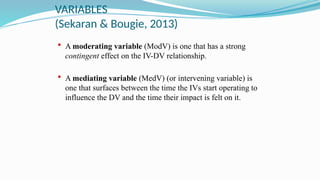
VARIABLES
(Sekaran & Bougie, 2013)
 A moderating variable (ModV) is one that has a strong
contingent effect on the IV-DV relationship.
 A mediating variable (MedV) (or intervening variable) is
one that surfaces between the time the IVs start operating to
influence the DV and the time their impact is felt on it.
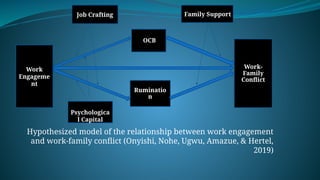
Hypothesized model of the relationship between work engagement
and work-family conflict (Onyishi, Nohe, Ugwu, Amazue, & Hertel,
2019)
Work
Engageme
nt
Job Crafting
Psychologica
l Capital
Family Support
Ruminatio
n
Work-
Family
Conflict
OCB
Research Questions and Hypotheses
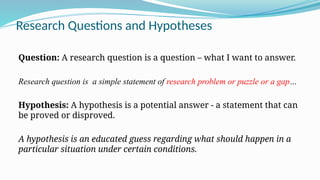
Question: A research question is a question – what I want to answer.
Research question is a simple statement of research problem or puzzle or a gap…
Hypothesis: A hypothesis is a potential answer - a statement that can
be proved or disproved.
A hypothesis is an educated guess regarding what should happen in a
particular situation under certain conditions.
Considerations for selecting a research question
 Researchers' interest/competence
 Is it researchable? (Literature)
 Importance, urgency and social relevance
 Novelty originality
 Feasibility (data, method, time , facilities, etc.)
Good hypotheses should…
 Have clear concepts/constructs
 Show relationships (is the direction of relationship clear?)
 Directly refer to what is being studied
 Be clear on whether the focus is on causality or description.
 Is composed of an independent variable (cause) and a dependent
variable (effect)
BUT DO WE NEED RESEARCH QUESTIONS/HYPOTHESES
FOR ALL RESEARCH PROJECTS?
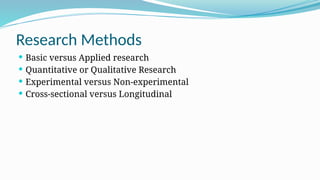
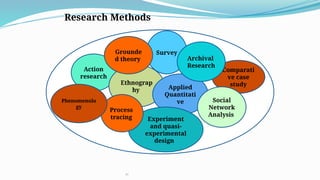
Research Methods
 Basic versus Applied research
 Quantitative or Qualitative Research
 Experimental versus Non-experimental
 Cross-sectional versus Longitudinal
Multimethods
Action
research
Survey
Ethnograp
hy Applied
Quantitati
ve
Experiment
and quasi-
experimental
design
Comparati
ve case
study
Research Methods
Social
Network
Analysis
Process
tracing
21
Archival
Research
Phenomenolo
gy
Grounde
d theory
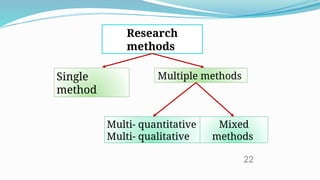
Single
method
Multiple methods
Research
methods
Multi- quantitative
Multi- qualitative
Mixed
methods
22
Typical analytical approaches in Quantitative
and Qualitative methods
Quantitative analysis:
 Statistical analysis/ models [descriptive
statistics and inferential statistics)
Qualitative:
 Case analysis, thematic, cluster, patterns,
mapping, process tracing, etc.
23
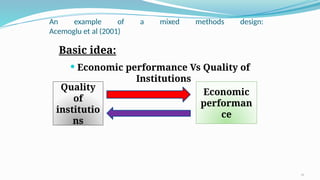
An example of a mixed methods design:
Acemoglu et al (2001)
Basic idea:
 Economic performance Vs Quality of
Institutions
Quality
of
institutio
ns
Economic
performan
ce
24
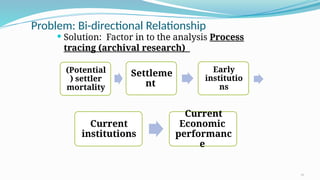
Problem: Bi-directional Relationship
 Solution: Factor in to the analysis Process
tracing (archival research)
Current
institutions
Current
Economic
performanc
e
(Potential
) settler
mortality
Settleme
nt
Early
institutio
ns
25
WHAT I HAVE LEARNT FROM THE WORKSHOP
Want to share?

Research-Methods-by-Prof.-I.-E.-Onyishi.pptx

  • 1.
    UNIVERSITY OF NIGERIA,NSUKKA SCHOOL OF POSTGRADUATE STUDIES Research Methods Prof Ike Onyishi Department of Psychology Email: ernest.onyishi@unn.edu.ng +2348037485355
  • 2.
    OUTLINE • Making Decisionsabout our research – Critical Imagination • The Research Process • Developing a theoretical framework/model • Research Questions and Hypotheses • Research Methods • Data Analysis
  • 3.
    GOALS AND OBJECTIVES Atthe end of the workshop participants would be able to: • Develop a researchable project topic • Develop good research question • Describe the various research methods • Explain data analytical procedures
  • 4.
    INTRODUCTION • Conducting researchis a major aspect of postgraduate training. • Most of us if not all would be required to conduct and submit a research project in the course of completing a postgraduate programme • Thus, the need for adequate training on research methods
  • 5.
    Making decisions aboutyour research What should I research? Why? How to conduct the research Where?
  • 6.
    The dilemma ofthe chicken and egg Going with a topic or going with a problem? The Method of Problems Versus the Method of Topics (Eidlin, 2010)
  • 7.
    Important questions toreflect on as you develop your research projects  How does your research advance ongoing debate in the field?  What will a researcher/reader learn from the research that she/he does not know before?  Why is the knowledge important?  What positive impact does the research propose?  If the research is completed what will it be cited for in the future?
  • 8.
    Importance of criticalimagination  Critical imagination is a deliberate systematic decision making about research. It requires:  A need for careful design  Understanding of the nature of science/research  Overcoming some common challenges to critical imagination
  • 9.
    The Nature ofScientific Research (SR)  SR is based on the systematic practice of disbelief  Maintaining a sceptical attitude  SR involves questioning stated and unstated assumptions  SR helps in pushing the boundaries of knowledge  Good SR discoveries are concerned with unintended consequences of human actions
  • 10.
    Challenges to criticalimagination Common sense- untutored knowledge of the social world (Hirschman, 1981) Where lies the novelty? “An author is little to be valued who tells us nothing but what we can learn from every coffee house conversation” (Charles Hume 1985) Trained incapacity*: specialisation that promotes ignorance
  • 11.
    The Research/Project DevelopmentProcess … in theory… 11 Choosing a Topic Literature Review Defining Research Questions Collecting Data Data Analysis Findings and Discussio ns Conclusio n and Write-up
  • 12.
    …a “messy” processin practice 12 Research Questions Collecting data Defining Conclusion Finished Implications Choosing a topic Analysis Literature Review
  • 13.
    Developing a theoreticalframework/model Theory Defined “A theory is a statement of relations among concepts within a set of boundary assumptions and constraints” (Bacharach, 1989, p. 496)  “A theoretical framework represents your beliefs on how certain phenomena (variables or concepts) are related to each other (a model) and an explanation of why you believe that these variables are associated with each other (a theory)” (Sekaran & Bougie, 2013, p. 68)
  • 14.
    VARIABLES (Sekaran &Bougie, 2013)  A variable is anything that can take on differing or varying values.  Independent variable (IV): The variable that influences the dependent variable (DV) in either a positive or negative way.  To conclude that the IV causes a change in the DV:  The IV and DV should covary.  The IV (the presumed causal factor) should precede the dependent variable.  No other factor should be a possible cause of the DV. (The researcher should control for the effects of other variables).  A logical explanation (theory) is needed and it must explain why the IV affects the DV.
  • 15.
    VARIABLES (Sekaran & Bougie,2013)  A moderating variable (ModV) is one that has a strong contingent effect on the IV-DV relationship.  A mediating variable (MedV) (or intervening variable) is one that surfaces between the time the IVs start operating to influence the DV and the time their impact is felt on it.
  • 16.
    Hypothesized model ofthe relationship between work engagement and work-family conflict (Onyishi, Nohe, Ugwu, Amazue, & Hertel, 2019) Work Engageme nt Job Crafting Psychologica l Capital Family Support Ruminatio n Work- Family Conflict OCB
  • 17.
    Research Questions andHypotheses Question: A research question is a question – what I want to answer. Research question is a simple statement of research problem or puzzle or a gap… Hypothesis: A hypothesis is a potential answer - a statement that can be proved or disproved. A hypothesis is an educated guess regarding what should happen in a particular situation under certain conditions.
  • 18.
    Considerations for selectinga research question  Researchers' interest/competence  Is it researchable? (Literature)  Importance, urgency and social relevance  Novelty originality  Feasibility (data, method, time , facilities, etc.)
  • 19.
    Good hypotheses should… Have clear concepts/constructs  Show relationships (is the direction of relationship clear?)  Directly refer to what is being studied  Be clear on whether the focus is on causality or description.  Is composed of an independent variable (cause) and a dependent variable (effect) BUT DO WE NEED RESEARCH QUESTIONS/HYPOTHESES FOR ALL RESEARCH PROJECTS?
  • 20.
    Research Methods  Basicversus Applied research  Quantitative or Qualitative Research  Experimental versus Non-experimental  Cross-sectional versus Longitudinal
  • 21.
    Multimethods Action research Survey Ethnograp hy Applied Quantitati ve Experiment and quasi- experimental design Comparati vecase study Research Methods Social Network Analysis Process tracing 21 Archival Research Phenomenolo gy Grounde d theory
  • 22.
  • 23.
    Typical analytical approachesin Quantitative and Qualitative methods Quantitative analysis:  Statistical analysis/ models [descriptive statistics and inferential statistics) Qualitative:  Case analysis, thematic, cluster, patterns, mapping, process tracing, etc. 23
  • 24.
    An example ofa mixed methods design: Acemoglu et al (2001) Basic idea:  Economic performance Vs Quality of Institutions Quality of institutio ns Economic performan ce 24
  • 25.
    Problem: Bi-directional Relationship Solution: Factor in to the analysis Process tracing (archival research) Current institutions Current Economic performanc e (Potential ) settler mortality Settleme nt Early institutio ns 25
  • 26.
    WHAT I HAVELEARNT FROM THE WORKSHOP Want to share?

Editor's Notes

  • #6 A well defined and a structured research problem is the heart of the research project. Vague research problem is the weakest point in your research.
  • #9 Examples of unintended conseqences of human actions
  • #18  Researchability i.e., (problems having solutions) Usefulness of the topic (importance, urgency and social relevance of the research problem Novelty or originality Feasibility Availability of data Suitable methodology Cooperation of organizations and individuals Available time Facilities /infrastructure
  • #24 Mortality of settlers determined the choice of settlement which then determined the nature of colonial institutions. These institutions can be used to mirror the kind of current institutions and subsequently the current economic performance