Introduction
Re (Again)+ Search (Find Out) = Research
According toAdvanced Learner’s Dictionary,‘research is a
careful investigation or inquiry specially to search for new
facts in any branch of knowledge’.
According to Creswell,‘research is a process of steps used to
collect and analyses information to increase our
understanding of a topic or issue’.
Cook has beautifully outlined research as an honest,
exhaustive, intelligent searching for facts and their meanings
or implications, with reference to a problem.
3.
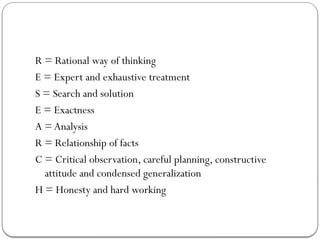
R = Rationalway of thinking
E = Expert and exhaustive treatment
S = Search and solution
E = Exactness
A = Analysis
R = Relationship of facts
C = Critical observation, careful planning, constructive
attitude and condensed generalization
H = Honesty and hard working
4.
Research Objectives
1. Gainfamiliarity with a new phenomenon or develop new
insight into a phenomenon.
2. Review and synthesize the existing knowledge.
3. Investigate some existing situation or problem.
4. Offer solutions to a problem.
5. Explore and analyze more general issues.
6. Construct or create a new procedure or system.
7. Generate new knowledge.
Scope of ResearchMethodology
Making Government Policies
Marketing research
Operation Research
Motivational Research
7.
Formulation of ResearchProblem
A research problem is a question that researcher wants to answer or a
problem that a researcher wants to solve
Identification & formulation of a research problem is the first step of the
research process.
Selection of research problem depends on several factors such as
researcher’s knowledge, skills, interest, expertise, motivation &
creativity with respect to the subject of inquiry.
It is like the identification of a destination before under taking a journey
Without a problem , research cannot proceed because there is nothing
to proceed to ward.
Research problem may take a number of forms , from the very simple to
the very complex
8.
The following pointsshould be kept in mind by a
researcher in selecting a research problem:
1.The problem should neither be too narrow nor too vague.
2.The topic of the research should be familiar and feasible so that the
researcher can easily have an access to related research materials or
source of research.
3.Controversial subject should be avoided while selecting a research
problem.
4.While selecting a research problem the researcher should also take
into account the various factors such as the importance of subject,
the qualifications , the training of researcher , the investment
elements in the research in terms of time, money and energy.
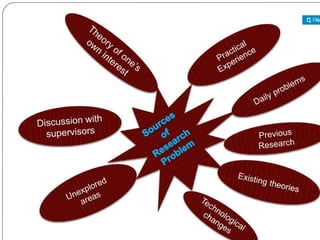
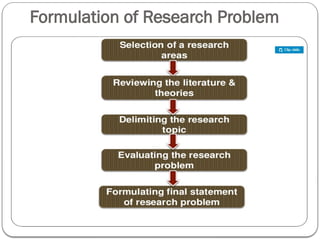
1. SELECTINGA RESEARCHAREA : Formulation of a research
problem begins with selection of a broad research topic from
personal experience, literature, previous research & theories.
2. REVIEWTHE LITERATURE :After obtaining a broad idea for
research, the researcher needs to review the literature and
theories.
• Literature is reviewed to know what has already been done in
this selected area of research.
• Therefore, a researcher can plan a research topic to further
expand the existing body of knowledge.
• Reviewing the theories provides an opportunity for the
researcher to plan a research problem to contribute towards
either testing or development of a theory conceptual model.
12.
3. DELIMITINGTHERESEARCHTOPIC : Here the researcher
proceeds from a general research area of interest to more specific
topic of research while conducting the study.
4. EVALUATINGTHE RESEARCH PROBLEM : Once the
researcher is clear about the research problem, the research
problem must be carefully evaluated for its significance,
researchability and feasibility.
• Feasibility refers to feasibility in terms of time, cost availability
of subjects, resources, administrative & peer support, ethical
consideration, researcher’s competence of the researcher and
interest.
5. FORMULATING FINAL STATEMENT OF RESEARCH
PROBLEM : Following the establishment of the significance,
researchability and feasibility the researcher finally formulates the
final problem statement.
13.
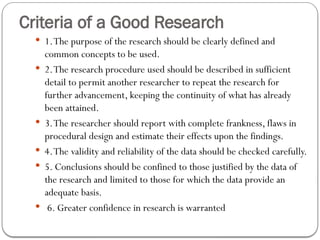
Criteria of aGood Research
1.The purpose of the research should be clearly defined and
common concepts to be used.
2.The research procedure used should be described in sufficient
detail to permit another researcher to repeat the research for
further advancement, keeping the continuity of what has already
been attained.
3.The researcher should report with complete frankness, flaws in
procedural design and estimate their effects upon the findings.
4.The validity and reliability of the data should be checked carefully.
5. Conclusions should be confined to those justified by the data of
the research and limited to those for which the data provide an
adequate basis.
6. Greater confidence in research is warranted
14.
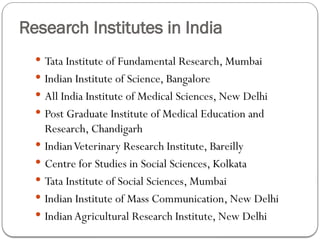
Research Institutes inIndia
Tata Institute of Fundamental Research, Mumbai
Indian Institute of Science, Bangalore
All India Institute of Medical Sciences, New Delhi
Post Graduate Institute of Medical Education and
Research, Chandigarh
IndianVeterinary Research Institute, Bareilly
Centre for Studies in Social Sciences, Kolkata
Tata Institute of Social Sciences, Mumbai
Indian Institute of Mass Communication, New Delhi
Indian Agricultural Research Institute, New Delhi
15.
Value and Costof Information
Research is definitely valuable for taking better decisions,
however, there is always a cost associated with research, and
thus, research should be undertaken only if the value of
information being collected is more than the cost incurred in
collecting the information.
16.
Value of information(research)
Decreased Uncertainty
Higher Likelihood of Correct Decisions
Better Business performance
Higher Profits
Better Reputation
17.
Cost of Information(Research)
Research Costs: The cost of conducting research including the cost of surveys,
analysis, report writing etc.
Delay in Making Business Decisions: At times, as research is a time
consuming process, conducting research might mean that we have to postpone a
decision till we have relevant facts and figures.This sometimes might prove to
costly as well.
Disclosure of Information to Rivals: Sometimes the information collected
by an organization could be sold to rivals or could be stolen by others and mis-
used as well.This could be dangerous from all fronts as it could not only damage
the reputation if something confidential is leaked but also reveal strategies or
plans of the firm.
Possibility of Error: Sometimes the research could prove to be misleading if
the procedures are not followed in a systematic manner and thus might also lead
to erroneous conclusions and decisions.
18.
Types of Research
Themain different types of research can be classified by its purpose, its
process and its outcome.These can in turn be broken down further:
The purpose of the research can be classified as:
Exploratory
Descriptive
Analytical
Predictive.
The process of the research can be classified as:
Quantitative
Qualitative.
The outcome of the research can be classified as:
Applied
Basic or pure
Action.
19.
Exploratory Research
Thisis conducted when there are few or no earlier studies to which
references can be made for information.
The aim is to look for patterns, ideas or hypotheses rather than
testing or confirming a hypothesis.
In exploratory research the focus is on gaining insights and
familiarity with the subject area for more rigorous investigation
later.
exploratory research, as the name suggests, is primarily an initial
inquiry into an area of investigation and at times it is possible that one
may carry out an initial survey to establish areas of concern and then
research these issues in more depth, perhaps through interviews, to
provide a deeper understanding
20.
Descriptive research
Themain purpose of descriptive research is to describe
the state of affairs as it exists at present.
Descriptive research studies, are concerned with finding
out "what is the state right now, and often are used in
cases such as:
Do teachers hold favorable attitudes toward using
computers inVITS?
What have been the reactions of College
administrators towards late-comers?
21.
Thus thistype of research describes phenomena as they
exist. It is used to identify and obtain information on the
characteristics of a particular issue. It may answer such
questions as:
What is the absentee rate amongst a particular group
of workers?
What are the feelings of workers faced with
redundancy?
Also called ex-post facto studies where researcher has no
control over the variables and simply reports the
happenings on as it is manner.
22.
Experimental research (Predictiveresearch)
Predictive research goes further by forecasting
the likelihood of a similar situation occurring
elsewhere.
It aims to generalise from the analysis by
predicting certain phenomena on the basis of
hypothesised, general relationships.
23.
It mayattempt to answer questions such as:
Will the introduction of an employee bonus scheme lead to
higher levels of productivity?
What type of packaging will improve our products?
Predictive research provides‘how’,‘why’, and‘where’
answers to current events as well as to similar events in
the future. It is also helpful in situations where‘What if?’
questions are being asked.
24.
2) Based onprocess of research:
a) Quantitative research
This approach typically concentrates on measuring or
counting and involves collecting and analyzing numerical data
and applying statistical tests.
In quantitative research, the researcher is ideally an
objective observer that neither participates in nor influences
what is being studied as the basic thrust is to know how many
of the participants in the survey saying what.
Thus, quantitative research is all about numbers and deals
with numeric data.
25.
In quantitativeresearch, while collecting data, direct,
structured questions are asked and generally large number of
people (large sample size) are contacted for collecting
information.
Thus, in quantitative research a pre-decided pattern in data
collection is followed and the facts collected are value-free
and unbiased
26.
b) Qualitative research
The alternative tradition is the qualitative approach.
Here the investigator views the phenomena to be
investigated as more personal and softer.
He or she will use methods such as personal accounts,
unstructured interviews and participant observation to gain
an understanding of the underlying reasons and motivations
for peoples’ attitudes, preferences or behaviours.
27.
Further, asthe main focus of qualitative research is to dig deep and
find out as to why something is happening the way it is happening
or to find out what could be done in a particular scenario to solve
a particular problem.
In qualitative research, the researcher can learn the most about a
situation by participating and/or being immersed in it.
Also, one must keep in mind that in qualitative research studies
the investigator relies on indirect, projective, open-ended
questions and such studies are conducted amongst a relatively
small number of respondents, interviewed at length.
28.
3) Based onOutcome of research:
a) Basic research
Basic research is also called fundamental or pure research,
and is conducted primarily to improve our understanding of
general issues, without any emphasis on its immediate
application.
It is regarded as the most academic form of research since
the principal aim is to make a contribution to knowledge,
usually for the general good, rather than to solve a specific
problem for one organisation.
29.
In basicresearch, general theories, ideas, and questions are
explored and tested, from where the universe comes from to
how animals communicate.
Some people have suggested that this type of research should
not have priority, because it doesn't always result in an
immediate benefit to humans, but without basic research, many
applied research programs would be hard-pressed to get the
start they need.
Doing basic research ensures that applied researchers don't need
to reinvent the wheel every time they start on a new project,
because the groundwork has been done.
30.
Applied research:
Appliedresearch is problem-oriented as the research is
carried out to solve a specific problem that requires a
decision.
for example, the improvement of safety in the workplace, or
market research.
Thus, we can say that applied research refers to scientific
study and research that seeks to solve practical problems and
that applied research is used to find solutions to everyday
problems, cure illness, and develop innovative technologies.