About
Research
Methods
Types
WELCOME
DESIGNED BY MARYAM FAROOQ
TO POWERPOINT PRESENTION
About
Research
Methods
Types
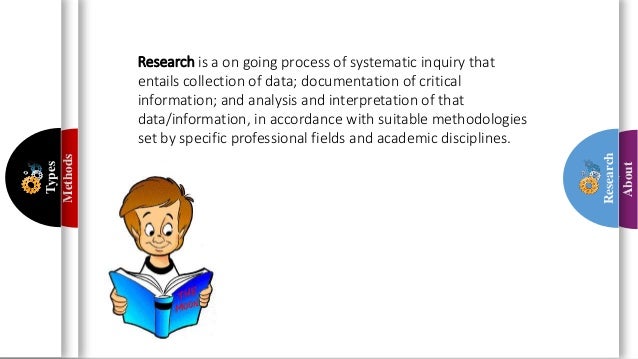
Research is a on going process of systematic inquiry that
entails collection of data; documentation of critical
information; and analysis and interpretation of that
data/information, in accordance with suitable methodologies
set by specific professional fields and academic disciplines.
About
Research
Methods
Types
Qualitative
Research
Quantitati
ve
Research
About
Research
Methods
Types
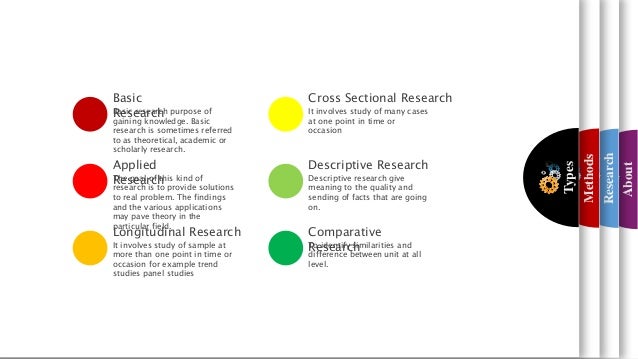
Basic
Research
Basic research purpose of
gaining knowledge. Basic
research is sometimes referred
to as theoretical, academic or
scholarly research.
Applied
Research
The goal of this kind of
research is to provide solutions
to real problem. The findings
and the various applications
may pave theory in the
particular field.
Longitudinal Research
It involves study of sample at
more than one point in time or
occasion for example trend
studies panel studies
Descriptive Research
Descriptive research give
meaning to the quality and
sending of facts that are going
on.
Comparative
Research
To identify similarities and
difference between unit at all
level.
Cross Sectional Research
It involves study of many cases
at one point in time or
occasion
About
Research
Methods
Types
Exploratory Research
It aims at gaining information
about an issue in hand
Explanatory
Research
It aims at explaining social
relations and event to build
test or revise a Theory
Casual Research
To obtain information
regarding cause and effect
relationship
Deductive
Research
Deductive research approaches
usually begin with theory
driven hypothesis which guide
data collection and analysis
Action Research
It is a process of studying
practical problems of Social
Studies the focus is to improve
and modify the current
practices
Inductive
Research
Inductive research begin with a
research question and the
collection of empirical data
which is used to generate
hypothesis and theory
Basic
Research
Applied
Research
Research
EXAMPLES OF
RESEARCH
TYPES
Basic
Research
Basic Research
Applied
Research
Basic research methods improve healthcare by providing different dimensions
to the understanding and interpretation of healthcare issues. For example, it
allows healthcare practitioners to gain more insight into the origin of diseases
which can help to provide cures to chronic medical conditions.
Many health researchers state that many vaccines are developed based on an
understanding of the causes of the disease such as in the case of the polio and
COVID-19 vaccine. Several medical breakthroughs have been attributed to the
wealth of knowledge provided through basic research.
Basic
Research
Basic Research
Research Summary & Methodology:
Research Type:
Applied
Research
Applied Research
Longitudinal
Research
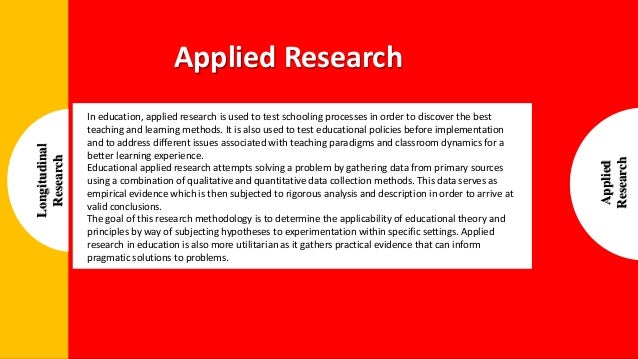
In education, applied research is used to test schooling processes in order to discover the best
teaching and learning methods. It is also used to test educational policies before implementation
and to address different issues associated with teaching paradigms and classroom dynamics for a
better learning experience.
Educational applied research attempts solving a problem by gathering data from primary sources
using a combination of qualitative and quantitative data collection methods. This data serves as
empirical evidence which is then subjected to rigorous analysis and description in order to arrive at
valid conclusions.
The goal of this research methodology is to determine the applicability of educational theory and
principles by way of subjecting hypotheses to experimentation within specific settings. Applied
research in education is also more utilitarian as it gathers practical evidence that can inform
pragmatic solutions to problems.
Basic
Research
Basic Research
Research Summary & Methodology:
Research Type:
Applied
Research
Applied Research
Research Summary & Methodology:
Research Type:
Longitudinal
Research
Longitudinal Research
Cross
Sectional
Research
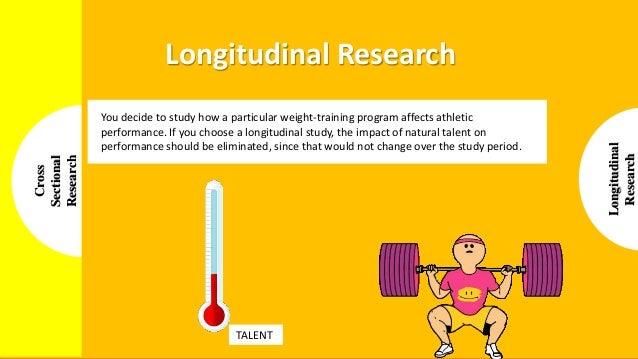
You decide to study how a particular weight-training program affects athletic
performance. If you choose a longitudinal study, the impact of natural talent on
performance should be eliminated, since that would not change over the study period.
TALENT
Basic
Research
Basic Research
Research Summary & Methodology:
Research Type:
Applied
Research
Applied Research
Research Summary & Methodology:
Research Type:
Longitudinal
Research
Longitudinal Research
Research Summary & Methodology:
Research Type:
Cross
Sectional
Research
Cross Sectional Research
Descriptive
Research
A cross-sectional study on the impact of police on crime might find that more police are
associated with greater crime and wrongly conclude that police cause crime when it is the
other way around. However, a longitudinal study would be able to observe the rise or fall
in crime some time after increasing the number of police in an area.
Basic
Research
Basic Research
Research Summary & Methodology:
Research Type:
Applied
Research
Applied Research
Research Summary & Methodology:
Research Type:
Longitudinal
Research
Longitudinal Research
Research Summary & Methodology:
Research Type:
Cross
Sectional
Research
Cross Sectional Research
Research Summary & Methodology:
Research Type:
Descriptive
Research
Descriptive Research
Comparative
Research
An academic institution may wish to compare the performances of its junior high
school students in English language and Mathematics. This may be used to classify
students based on 2 major groups, with one group going ahead to study while courses,
while the other study courses in the Arts & Humanities field. Students who are more
proficient in mathematics will be encouraged to go into STEM and vice versa.
Institutions may also use this data to identify student's weak points and work on ways
to assist them.
Basic
Research
Basic Research
Research Summary & Methodology:
Research Type:
Applied
Research
Applied Research
Research Summary & Methodology:
Research Type:
Longitudinal
Research
Longitudinal Research
Research Summary & Methodology:
Research Type:
Cross
Sectional
Research
Cross Sectional Research
Research Summary & Methodology:
Research Type:
Descriptive
Research
Descriptive Research
Research Summary & Methodology:
Research Type:
Comparative
Research
Comparative Research
Exploratory
Research
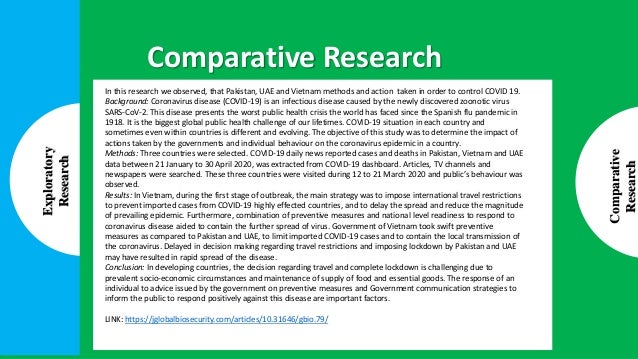
In this research we observed, that Pakistan, UAE and Vietnam methods and action taken in order to control COVID 19.
Background: Coronavirus disease (COVID-19) is an infectious disease caused by the newly discovered zoonotic virus
SARS-CoV-2. This disease presents the worst public health crisis the world has faced since the Spanish flu pandemic in
1918. It is the biggest global public health challenge of our lifetimes. COVID-19 situation in each country and
sometimes even within countries is different and evolving. The objective of this study was to determine the impact of
actions taken by the governments and individual behaviour on the coronavirus epidemic in a country.
Methods: Three countries were selected. COVID-19 daily news reported cases and deaths in Pakistan, Vietnam and UAE
data between 21 January to 30 April 2020, was extracted from COVID-19 dashboard. Articles, TV channels and
newspapers were searched. These three countries were visited during 12 to 21 March 2020 and public’s behaviour was
observed.
Results: In Vietnam, during the first stage of outbreak, the main strategy was to impose international travel restrictions
to prevent imported cases from COVID-19 highly effected countries, and to delay the spread and reduce the magnitude
of prevailing epidemic. Furthermore, combination of preventive measures and national level readiness to respond to
coronavirus disease aided to contain the further spread of virus. Government of Vietnam took swift preventive
measures as compared to Pakistan and UAE, to limit imported COVID-19 cases and to contain the local transmission of
the coronavirus. Delayed in decision making regarding travel restrictions and imposing lockdown by Pakistan and UAE
may have resulted in rapid spread of the disease.
Conclusion: In developing countries, the decision regarding travel and complete lockdown is challenging due to
prevalent socio-economic circumstances and maintenance of supply of food and essential goods. The response of an
individual to advice issued by the government on preventive measures and Government communication strategies to
inform the public to respond positively against this disease are important factors.
LINK: https://jglobalbiosecurity.com/articles/10.31646/gbio.79/
Basic
Research
Basic Research
Research Summary & Methodology:
Research Type:
Applied
Research
Applied Research
Research Summary & Methodology:
Research Type:
Longitudinal
Research
Longitudinal Research
Research Summary & Methodology:
Research Type:
Cross
Sectional
Research
Cross Sectional Research
Research Summary & Methodology:
Research Type:
Descriptive
Research
Descriptive Research
Research Summary & Methodology:
Research Type:
Comparative
Research
Comparative Research
Research Summary & Methodology:
Research Type:
Exploratory
Research
Exploratory Research
Explanatory
Research
Organizations conduct two major research when working on a new product or service. The
first one is conducted before developing the product while the second one is conducted
after product development.
Our focus will be on the exploratory research conducted after product development. For
tech products, it is called the beta testing stage of product development.
If a new feature is added to an existing app, for example, product researchers will want to
investigate whether the feature will be well received among the users. If the feature added
to the app is something that is already in existence, then the research is not exploratory.
For example, if telegram adds a status feature to its app, the beta research stage of the
app is not exploratory. This is because this feature is something that is already in existence,
and they can easily get enough information from WhatsApp. However, if it is a new feature
like the Snapchat filters when they just came out, the research is explanatory. In this case,
exploratory research is carried out using a focus group of beta testers.
Basic
Research
Basic Research
Research Summary & Methodology:
Research Type:
Applied
Research
Applied Research
Research Summary & Methodology:
Research Type:
Longitudinal
Research
Longitudinal Research
Research Summary & Methodology:
Research Type:
Cross
Sectional
Research
Cross Sectional Research
Research Summary & Methodology:
Research Type:
Descriptive
Research
Descriptive Research
Research Summary & Methodology:
Research Type:
Comparative
Research
Comparative Research
Research Summary & Methodology:
Research Type:
Exploratory
Research
Exploratory Research
Research Summary & Methodology:
Research Type:
Explanatory
Research
Explanatory Research
Casual
Research
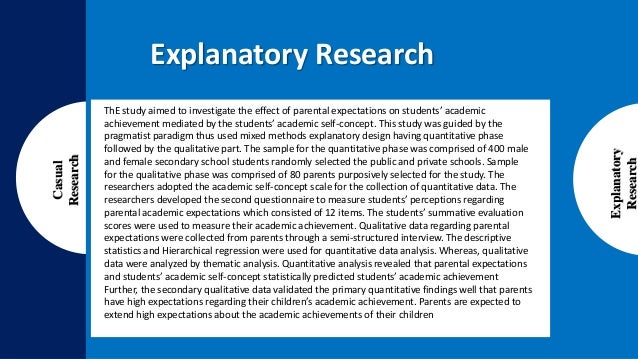
ThE study aimed to investigate the effect of parental expectations on students’ academic
achievement mediated by the students’ academic self-concept. This study was guided by the
pragmatist paradigm thus used mixed methods explanatory design having quantitative phase
followed by the qualitative part. The sample for the quantitative phase was comprised of 400 male
and female secondary school students randomly selected the public and private schools. Sample
for the qualitative phase was comprised of 80 parents purposively selected for the study. The
researchers adopted the academic self-concept scale for the collection of quantitative data. The
researchers developed the second questionnaire to measure students’ perceptions regarding
parental academic expectations which consisted of 12 items. The students’ summative evaluation
scores were used to measure their academic achievement. Qualitative data regarding parental
expectations were collected from parents through a semi-structured interview. The descriptive
statistics and Hierarchical regression were used for quantitative data analysis. Whereas, qualitative
data were analyzed by thematic analysis. Quantitative analysis revealed that parental expectations
and students’ academic self-concept statistically predicted students’ academic achievement
Further, the secondary qualitative data validated the primary quantitative findings well that parents
have high expectations regarding their children’s academic achievement. Parents are expected to
extend high expectations about the academic achievements of their children
Basic
Research
Basic Research
Research Summary & Methodology:
Research Type:
Applied
Research
Applied Research
Research Summary & Methodology:
Research Type:
Longitudinal
Research
Longitudinal Research
Research Summary & Methodology:
Research Type:
Cross
Sectional
Research
Cross Sectional Research
Research Summary & Methodology:
Research Type:
Descriptive
Research
Descriptive Research
Research Summary & Methodology:
Research Type:
Comparative
Research
Comparative Research
Research Summary & Methodology:
Research Type:
Exploratory
Research
Exploratory Research
Research Summary & Methodology:
Research Type:
Explanatory
Research
Explanatory Research
Research Summary & Methodology:
Research Type:
Casual
Research
Casual Research
Inductive
Research
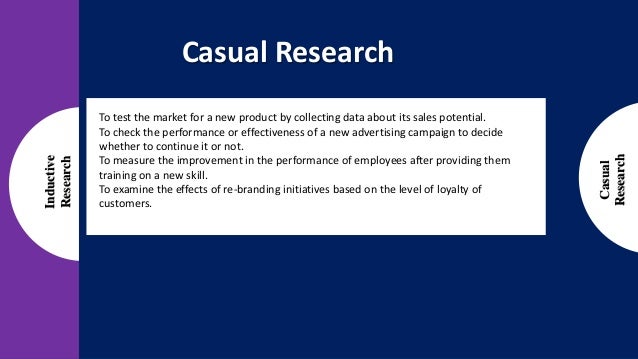
To test the market for a new product by collecting data about its sales potential.
To check the performance or effectiveness of a new advertising campaign to decide
whether to continue it or not.
To measure the improvement in the performance of employees after providing them
training on a new skill.
To examine the effects of re-branding initiatives based on the level of loyalty of
customers.
Basic
Research
Basic Research
Research Summary & Methodology:
Research Type:
Applied
Research
Applied Research
Research Summary & Methodology:
Research Type:
Longitudinal
Research
Longitudinal Research
Research Summary & Methodology:
Research Type:
Cross
Sectional
Research
Cross Sectional Research
Research Summary & Methodology:
Research Type:
Descriptive
Research
Descriptive Research
Research Summary & Methodology:
Research Type:
Comparative
Research
Comparative Research
Research Summary & Methodology:
Research Type:
Exploratory
Research
Exploratory Research
Research Summary & Methodology:
Research Type:
Explanatory
Research
Explanatory Research
Research Summary & Methodology:
Research Type:
Casual
Research
Casual Research
Research Summary & Methodology:
Research Type:
Inductive
Research
Inductive Research
Deductive
Research
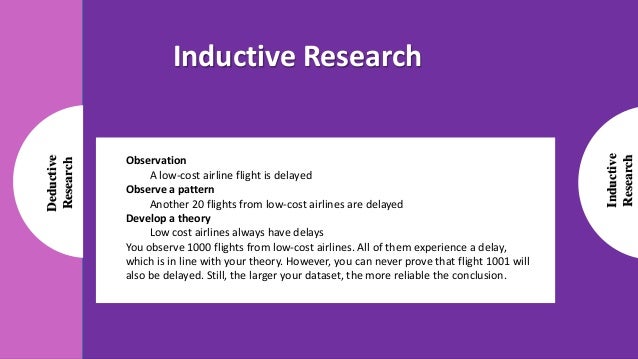
Observation
A low-cost airline flight is delayed
Observe a pattern
Another 20 flights from low-cost airlines are delayed
Develop a theory
Low cost airlines always have delays
You observe 1000 flights from low-cost airlines. All of them experience a delay,
which is in line with your theory. However, you can never prove that flight 1001 will
also be delayed. Still, the larger your dataset, the more reliable the conclusion.
Basic
Research
Basic Research
Research Summary & Methodology:
Research Type:
Applied
Research
Applied Research
Research Summary & Methodology:
Research Type:
Longitudinal
Research
Longitudinal Research
Research Summary & Methodology:
Research Type:
Cross
Sectional
Research
Cross Sectional Research
Research Summary & Methodology:
Research Type:
Descriptive
Research
Descriptive Research
Research Summary & Methodology:
Research Type:
Comparative
Research
Comparative Research
Research Summary & Methodology:
Research Type:
Exploratory
Research
Exploratory Research
Research Summary & Methodology:
Research Type:
Explanatory
Research
Explanatory Research
Research Summary & Methodology:
Research Type:
Casual
Research
Casual Research
Research Summary & Methodology:
Research Type:
Inductive
Research
Inductive Research
Research Summary & Methodology:
Research Type:
Deductive
Research
Deductive Research
Action
Research
The deductive research approach consists of four stages:
Start with an existing theory
Low cost airlines always have delays
Formulate a hypothesis based on existing theory
If passengers fly with a low cost airline, then they will always experience delays
Collect data to test the hypothesis
Collect flight data of low-cost airlines
Analyse the results: does the data reject or support the hypothesis?
5 out of 100 flights of low-cost airlines are not delayed = reject hypothesis
Basic
Research
Basic Research
Research Summary & Methodology:
Research Type:
Applied
Research
Applied Research
Research Summary & Methodology:
Research Type:
Longitudinal
Research
Longitudinal Research
Research Summary & Methodology:
Research Type:
Cross
Sectional
Research
Cross Sectional Research
Research Summary & Methodology:
Research Type:
Descriptive
Research
Descriptive Research
Research Summary & Methodology:
Research Type:
Comparative
Research
Comparative Research
Research Summary & Methodology:
Research Type:
Exploratory
Research
Exploratory Research
Research Summary & Methodology:
Research Type:
Explanatory
Research
Explanatory Research
Research Summary & Methodology:
Research Type:
Casual
Research
Casual Research
Research Summary & Methodology:
Research Type:
Inductive
Research
Inductive Research
Research Summary & Methodology:
Research Type:
Deductive
Research
Deductive Research
Research Summary & Methodology:
Research Type:
Action
Research
Action Research
It is a process in which participants examine their own educational practice systematically
and carefully, using the techniques of research. It is based on the following assumptions:
• Teachers and principals work best on problems they have identified for themselves
• Teachers and principals become more effective when encouraged to examine and
assess their own work and then consider ways of working differently
• Teachers and principals help each other by working collaboratively
• Working with colleagues helps teachers and principals in their professional
development
Research & Methods, and it's types

Research & Methods, and it's types

  • 1.
  • 2.
    About Research Methods Types Research is aon going process of systematic inquiry that entails collection of data; documentation of critical information; and analysis and interpretation of that data/information, in accordance with suitable methodologies set by specific professional fields and academic disciplines.
  • 3.
  • 4.
    About Research Methods Types Basic Research Basic research purposeof gaining knowledge. Basic research is sometimes referred to as theoretical, academic or scholarly research. Applied Research The goal of this kind of research is to provide solutions to real problem. The findings and the various applications may pave theory in the particular field. Longitudinal Research It involves study of sample at more than one point in time or occasion for example trend studies panel studies Descriptive Research Descriptive research give meaning to the quality and sending of facts that are going on. Comparative Research To identify similarities and difference between unit at all level. Cross Sectional Research It involves study of many cases at one point in time or occasion
  • 5.
    About Research Methods Types Exploratory Research It aimsat gaining information about an issue in hand Explanatory Research It aims at explaining social relations and event to build test or revise a Theory Casual Research To obtain information regarding cause and effect relationship Deductive Research Deductive research approaches usually begin with theory driven hypothesis which guide data collection and analysis Action Research It is a process of studying practical problems of Social Studies the focus is to improve and modify the current practices Inductive Research Inductive research begin with a research question and the collection of empirical data which is used to generate hypothesis and theory
  • 6.
  • 7.
    Basic Research Basic Research Applied Research Basic researchmethods improve healthcare by providing different dimensions to the understanding and interpretation of healthcare issues. For example, it allows healthcare practitioners to gain more insight into the origin of diseases which can help to provide cures to chronic medical conditions. Many health researchers state that many vaccines are developed based on an understanding of the causes of the disease such as in the case of the polio and COVID-19 vaccine. Several medical breakthroughs have been attributed to the wealth of knowledge provided through basic research.
  • 8.
    Basic Research Basic Research Research Summary& Methodology: Research Type: Applied Research Applied Research Longitudinal Research In education, applied research is used to test schooling processes in order to discover the best teaching and learning methods. It is also used to test educational policies before implementation and to address different issues associated with teaching paradigms and classroom dynamics for a better learning experience. Educational applied research attempts solving a problem by gathering data from primary sources using a combination of qualitative and quantitative data collection methods. This data serves as empirical evidence which is then subjected to rigorous analysis and description in order to arrive at valid conclusions. The goal of this research methodology is to determine the applicability of educational theory and principles by way of subjecting hypotheses to experimentation within specific settings. Applied research in education is also more utilitarian as it gathers practical evidence that can inform pragmatic solutions to problems.
  • 9.
    Basic Research Basic Research Research Summary& Methodology: Research Type: Applied Research Applied Research Research Summary & Methodology: Research Type: Longitudinal Research Longitudinal Research Cross Sectional Research You decide to study how a particular weight-training program affects athletic performance. If you choose a longitudinal study, the impact of natural talent on performance should be eliminated, since that would not change over the study period. TALENT
  • 10.
    Basic Research Basic Research Research Summary& Methodology: Research Type: Applied Research Applied Research Research Summary & Methodology: Research Type: Longitudinal Research Longitudinal Research Research Summary & Methodology: Research Type: Cross Sectional Research Cross Sectional Research Descriptive Research A cross-sectional study on the impact of police on crime might find that more police are associated with greater crime and wrongly conclude that police cause crime when it is the other way around. However, a longitudinal study would be able to observe the rise or fall in crime some time after increasing the number of police in an area.
  • 11.
    Basic Research Basic Research Research Summary& Methodology: Research Type: Applied Research Applied Research Research Summary & Methodology: Research Type: Longitudinal Research Longitudinal Research Research Summary & Methodology: Research Type: Cross Sectional Research Cross Sectional Research Research Summary & Methodology: Research Type: Descriptive Research Descriptive Research Comparative Research An academic institution may wish to compare the performances of its junior high school students in English language and Mathematics. This may be used to classify students based on 2 major groups, with one group going ahead to study while courses, while the other study courses in the Arts & Humanities field. Students who are more proficient in mathematics will be encouraged to go into STEM and vice versa. Institutions may also use this data to identify student's weak points and work on ways to assist them.
  • 12.
    Basic Research Basic Research Research Summary& Methodology: Research Type: Applied Research Applied Research Research Summary & Methodology: Research Type: Longitudinal Research Longitudinal Research Research Summary & Methodology: Research Type: Cross Sectional Research Cross Sectional Research Research Summary & Methodology: Research Type: Descriptive Research Descriptive Research Research Summary & Methodology: Research Type: Comparative Research Comparative Research Exploratory Research In this research we observed, that Pakistan, UAE and Vietnam methods and action taken in order to control COVID 19. Background: Coronavirus disease (COVID-19) is an infectious disease caused by the newly discovered zoonotic virus SARS-CoV-2. This disease presents the worst public health crisis the world has faced since the Spanish flu pandemic in 1918. It is the biggest global public health challenge of our lifetimes. COVID-19 situation in each country and sometimes even within countries is different and evolving. The objective of this study was to determine the impact of actions taken by the governments and individual behaviour on the coronavirus epidemic in a country. Methods: Three countries were selected. COVID-19 daily news reported cases and deaths in Pakistan, Vietnam and UAE data between 21 January to 30 April 2020, was extracted from COVID-19 dashboard. Articles, TV channels and newspapers were searched. These three countries were visited during 12 to 21 March 2020 and public’s behaviour was observed. Results: In Vietnam, during the first stage of outbreak, the main strategy was to impose international travel restrictions to prevent imported cases from COVID-19 highly effected countries, and to delay the spread and reduce the magnitude of prevailing epidemic. Furthermore, combination of preventive measures and national level readiness to respond to coronavirus disease aided to contain the further spread of virus. Government of Vietnam took swift preventive measures as compared to Pakistan and UAE, to limit imported COVID-19 cases and to contain the local transmission of the coronavirus. Delayed in decision making regarding travel restrictions and imposing lockdown by Pakistan and UAE may have resulted in rapid spread of the disease. Conclusion: In developing countries, the decision regarding travel and complete lockdown is challenging due to prevalent socio-economic circumstances and maintenance of supply of food and essential goods. The response of an individual to advice issued by the government on preventive measures and Government communication strategies to inform the public to respond positively against this disease are important factors. LINK: https://jglobalbiosecurity.com/articles/10.31646/gbio.79/
  • 13.
    Basic Research Basic Research Research Summary& Methodology: Research Type: Applied Research Applied Research Research Summary & Methodology: Research Type: Longitudinal Research Longitudinal Research Research Summary & Methodology: Research Type: Cross Sectional Research Cross Sectional Research Research Summary & Methodology: Research Type: Descriptive Research Descriptive Research Research Summary & Methodology: Research Type: Comparative Research Comparative Research Research Summary & Methodology: Research Type: Exploratory Research Exploratory Research Explanatory Research Organizations conduct two major research when working on a new product or service. The first one is conducted before developing the product while the second one is conducted after product development. Our focus will be on the exploratory research conducted after product development. For tech products, it is called the beta testing stage of product development. If a new feature is added to an existing app, for example, product researchers will want to investigate whether the feature will be well received among the users. If the feature added to the app is something that is already in existence, then the research is not exploratory. For example, if telegram adds a status feature to its app, the beta research stage of the app is not exploratory. This is because this feature is something that is already in existence, and they can easily get enough information from WhatsApp. However, if it is a new feature like the Snapchat filters when they just came out, the research is explanatory. In this case, exploratory research is carried out using a focus group of beta testers.
  • 14.
    Basic Research Basic Research Research Summary& Methodology: Research Type: Applied Research Applied Research Research Summary & Methodology: Research Type: Longitudinal Research Longitudinal Research Research Summary & Methodology: Research Type: Cross Sectional Research Cross Sectional Research Research Summary & Methodology: Research Type: Descriptive Research Descriptive Research Research Summary & Methodology: Research Type: Comparative Research Comparative Research Research Summary & Methodology: Research Type: Exploratory Research Exploratory Research Research Summary & Methodology: Research Type: Explanatory Research Explanatory Research Casual Research ThE study aimed to investigate the effect of parental expectations on students’ academic achievement mediated by the students’ academic self-concept. This study was guided by the pragmatist paradigm thus used mixed methods explanatory design having quantitative phase followed by the qualitative part. The sample for the quantitative phase was comprised of 400 male and female secondary school students randomly selected the public and private schools. Sample for the qualitative phase was comprised of 80 parents purposively selected for the study. The researchers adopted the academic self-concept scale for the collection of quantitative data. The researchers developed the second questionnaire to measure students’ perceptions regarding parental academic expectations which consisted of 12 items. The students’ summative evaluation scores were used to measure their academic achievement. Qualitative data regarding parental expectations were collected from parents through a semi-structured interview. The descriptive statistics and Hierarchical regression were used for quantitative data analysis. Whereas, qualitative data were analyzed by thematic analysis. Quantitative analysis revealed that parental expectations and students’ academic self-concept statistically predicted students’ academic achievement Further, the secondary qualitative data validated the primary quantitative findings well that parents have high expectations regarding their children’s academic achievement. Parents are expected to extend high expectations about the academic achievements of their children
  • 15.
    Basic Research Basic Research Research Summary& Methodology: Research Type: Applied Research Applied Research Research Summary & Methodology: Research Type: Longitudinal Research Longitudinal Research Research Summary & Methodology: Research Type: Cross Sectional Research Cross Sectional Research Research Summary & Methodology: Research Type: Descriptive Research Descriptive Research Research Summary & Methodology: Research Type: Comparative Research Comparative Research Research Summary & Methodology: Research Type: Exploratory Research Exploratory Research Research Summary & Methodology: Research Type: Explanatory Research Explanatory Research Research Summary & Methodology: Research Type: Casual Research Casual Research Inductive Research To test the market for a new product by collecting data about its sales potential. To check the performance or effectiveness of a new advertising campaign to decide whether to continue it or not. To measure the improvement in the performance of employees after providing them training on a new skill. To examine the effects of re-branding initiatives based on the level of loyalty of customers.
  • 16.
    Basic Research Basic Research Research Summary& Methodology: Research Type: Applied Research Applied Research Research Summary & Methodology: Research Type: Longitudinal Research Longitudinal Research Research Summary & Methodology: Research Type: Cross Sectional Research Cross Sectional Research Research Summary & Methodology: Research Type: Descriptive Research Descriptive Research Research Summary & Methodology: Research Type: Comparative Research Comparative Research Research Summary & Methodology: Research Type: Exploratory Research Exploratory Research Research Summary & Methodology: Research Type: Explanatory Research Explanatory Research Research Summary & Methodology: Research Type: Casual Research Casual Research Research Summary & Methodology: Research Type: Inductive Research Inductive Research Deductive Research Observation A low-cost airline flight is delayed Observe a pattern Another 20 flights from low-cost airlines are delayed Develop a theory Low cost airlines always have delays You observe 1000 flights from low-cost airlines. All of them experience a delay, which is in line with your theory. However, you can never prove that flight 1001 will also be delayed. Still, the larger your dataset, the more reliable the conclusion.
  • 17.
    Basic Research Basic Research Research Summary& Methodology: Research Type: Applied Research Applied Research Research Summary & Methodology: Research Type: Longitudinal Research Longitudinal Research Research Summary & Methodology: Research Type: Cross Sectional Research Cross Sectional Research Research Summary & Methodology: Research Type: Descriptive Research Descriptive Research Research Summary & Methodology: Research Type: Comparative Research Comparative Research Research Summary & Methodology: Research Type: Exploratory Research Exploratory Research Research Summary & Methodology: Research Type: Explanatory Research Explanatory Research Research Summary & Methodology: Research Type: Casual Research Casual Research Research Summary & Methodology: Research Type: Inductive Research Inductive Research Research Summary & Methodology: Research Type: Deductive Research Deductive Research Action Research The deductive research approach consists of four stages: Start with an existing theory Low cost airlines always have delays Formulate a hypothesis based on existing theory If passengers fly with a low cost airline, then they will always experience delays Collect data to test the hypothesis Collect flight data of low-cost airlines Analyse the results: does the data reject or support the hypothesis? 5 out of 100 flights of low-cost airlines are not delayed = reject hypothesis
  • 18.
    Basic Research Basic Research Research Summary& Methodology: Research Type: Applied Research Applied Research Research Summary & Methodology: Research Type: Longitudinal Research Longitudinal Research Research Summary & Methodology: Research Type: Cross Sectional Research Cross Sectional Research Research Summary & Methodology: Research Type: Descriptive Research Descriptive Research Research Summary & Methodology: Research Type: Comparative Research Comparative Research Research Summary & Methodology: Research Type: Exploratory Research Exploratory Research Research Summary & Methodology: Research Type: Explanatory Research Explanatory Research Research Summary & Methodology: Research Type: Casual Research Casual Research Research Summary & Methodology: Research Type: Inductive Research Inductive Research Research Summary & Methodology: Research Type: Deductive Research Deductive Research Research Summary & Methodology: Research Type: Action Research Action Research It is a process in which participants examine their own educational practice systematically and carefully, using the techniques of research. It is based on the following assumptions: • Teachers and principals work best on problems they have identified for themselves • Teachers and principals become more effective when encouraged to examine and assess their own work and then consider ways of working differently • Teachers and principals help each other by working collaboratively • Working with colleagues helps teachers and principals in their professional development