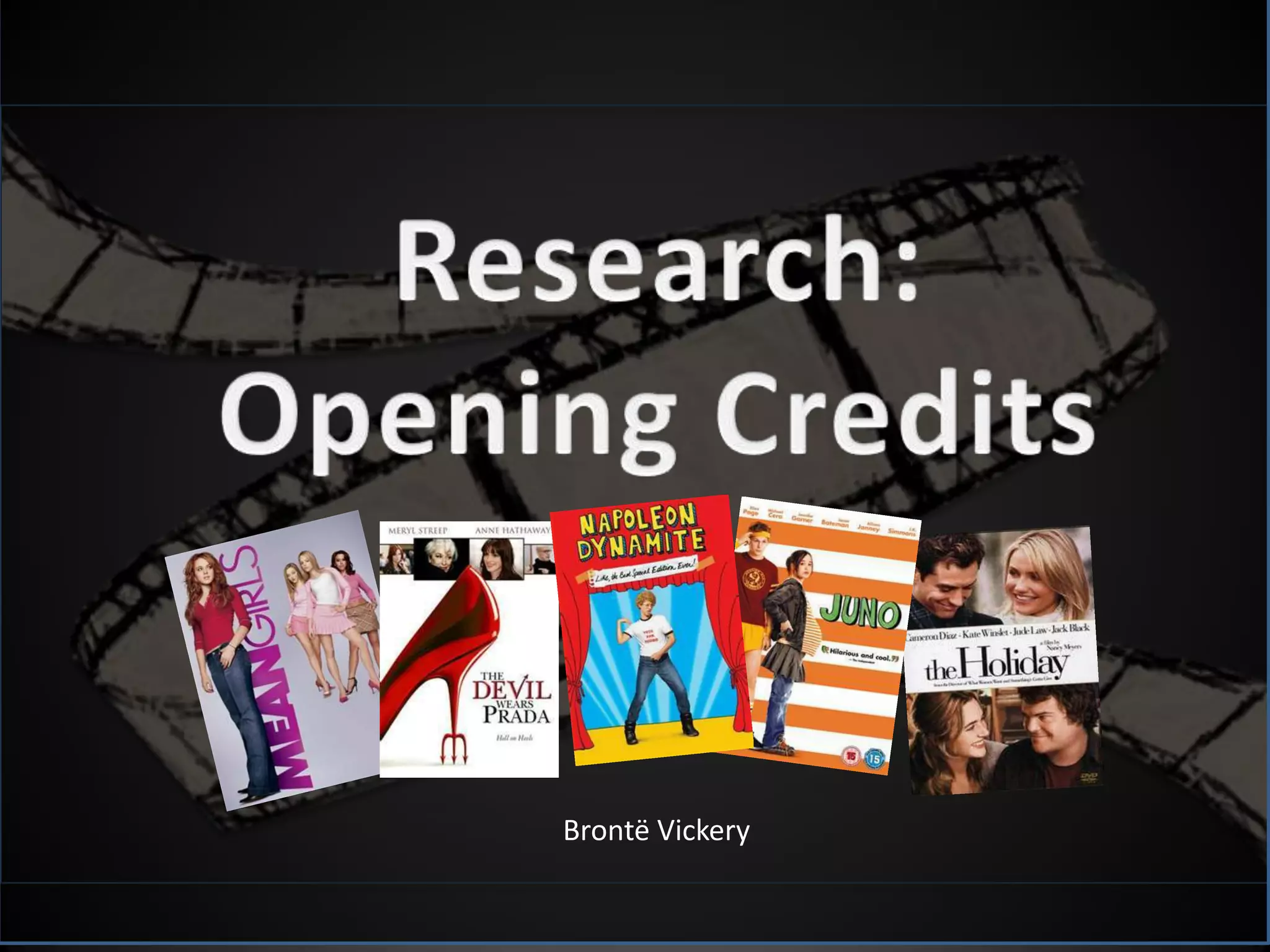
Brontë Vickery
The Devil wears Prada
• The credits are placed over moving footage.

• The credits are always at the bottom of the frame, in either corner.

• “suddenly I see”- a popular song for the target audience. Non diegetic sound.

• The main character is immediately introduced, with sharp cuts to scenes of different
  people in different places, each doing similar things.

• There is a strong contrast between the main character and the others, which makes her
  stand out.

• A sense of humour is introduced.

• The characters are getting ready for the day ahead- this draws the audience in as it
  leaves them with the question of where they are going and why.

• There is no dialogue
Napoleon Dynamite
• Some credits come up over moving footage

• The majority of the credits are literally written in or on props:
  - in sauce, on plates of rather unappealing food
  - inside library books
  -on a student card (alongside an image of the character)
  -on sweet packets
  -on a lip balm (‘iconic’ item in the film)
  -in a drawing

As well as being an interesting presentation, this gives us an insight into the main
character, and introduces him before we are able to see him, building interest for the
audience.

• There is no dialogue, but an unusual (banjo?) country style of music as the non diegetic
  backing track.
The Holiday
• The sequence begins with pixelated footage, with the name of the production
  company over the top of it.

• The camera zooms out of this footage and we see that it is part of a film on a screen
  watched by a character.

• There is narration from the main character, over scenes of other characters as well as
  those featuring her, an internal monologue. – this enables us to be introduced to her
  visually, as well as immediately see things from her point of view, as is continued
  throughout the film.

• The music is classical, and appears to be coming from one of the characters who is
  shown at the beginning to be playing the piano- this links the scenes and characters and
  is an interesting effect. If this is the case it would be diegetic sound in his scene but
  non-diegetic in the scenes of others.

• There are fast cuts to show the different characters in different places.

• The credits are at the bottom of the frame, usually in either corner.
Mean Girls
• There is narration from the main character- internal monologue.

• There is non diegetic background music, as well as some dialogue from the characters
  and diegetic sound in each scene.

• The credits begin with a point of view shot of the parents before we are introduced to
  the character.

• There are flashbacks to memories- giving us background information of the character.

• The opening credit sequence makes it clear that she is about to start a new school,
  intriguing the audience as it leaves us with questions of how this will go and what will
  happen.

•   The credits are in the top or bottom corners, over moving footage.
Juno
• There is an unusual song as the non diegetic backing track, which sets a cheerful and
  light mood.

• She is walking along, which leaves us to question where she is heading.

• The scene remains the same but the footage switches to animation, with the credits
  forming part of the image of her surroundings, on signs and buildings- this is a nice
  effect which adds interest.

• The credits also appear over the top of the footage.

• Attention is drawn to the title as it flashes in different colours.

• The credits are in all different positions within the frame.

Research into opening credits

  • 1.
  • 2.
    The Devil wearsPrada • The credits are placed over moving footage. • The credits are always at the bottom of the frame, in either corner. • “suddenly I see”- a popular song for the target audience. Non diegetic sound. • The main character is immediately introduced, with sharp cuts to scenes of different people in different places, each doing similar things. • There is a strong contrast between the main character and the others, which makes her stand out. • A sense of humour is introduced. • The characters are getting ready for the day ahead- this draws the audience in as it leaves them with the question of where they are going and why. • There is no dialogue
  • 3.
    Napoleon Dynamite • Somecredits come up over moving footage • The majority of the credits are literally written in or on props: - in sauce, on plates of rather unappealing food - inside library books -on a student card (alongside an image of the character) -on sweet packets -on a lip balm (‘iconic’ item in the film) -in a drawing As well as being an interesting presentation, this gives us an insight into the main character, and introduces him before we are able to see him, building interest for the audience. • There is no dialogue, but an unusual (banjo?) country style of music as the non diegetic backing track.
  • 4.
    The Holiday • Thesequence begins with pixelated footage, with the name of the production company over the top of it. • The camera zooms out of this footage and we see that it is part of a film on a screen watched by a character. • There is narration from the main character, over scenes of other characters as well as those featuring her, an internal monologue. – this enables us to be introduced to her visually, as well as immediately see things from her point of view, as is continued throughout the film. • The music is classical, and appears to be coming from one of the characters who is shown at the beginning to be playing the piano- this links the scenes and characters and is an interesting effect. If this is the case it would be diegetic sound in his scene but non-diegetic in the scenes of others. • There are fast cuts to show the different characters in different places. • The credits are at the bottom of the frame, usually in either corner.
  • 5.
    Mean Girls • Thereis narration from the main character- internal monologue. • There is non diegetic background music, as well as some dialogue from the characters and diegetic sound in each scene. • The credits begin with a point of view shot of the parents before we are introduced to the character. • There are flashbacks to memories- giving us background information of the character. • The opening credit sequence makes it clear that she is about to start a new school, intriguing the audience as it leaves us with questions of how this will go and what will happen. • The credits are in the top or bottom corners, over moving footage.
  • 6.
    Juno • There isan unusual song as the non diegetic backing track, which sets a cheerful and light mood. • She is walking along, which leaves us to question where she is heading. • The scene remains the same but the footage switches to animation, with the credits forming part of the image of her surroundings, on signs and buildings- this is a nice effect which adds interest. • The credits also appear over the top of the footage. • Attention is drawn to the title as it flashes in different colours. • The credits are in all different positions within the frame.