MEDIA THEORIES: MUSIC VIDEOS


           Brontë Vickery
• The Auteur Theory was established by Film Director and
  Critic, Francois Truffaut, in 1954.
• It states that the Director of a film (or here, a music video) is the
  main creative force behind it, much like the "author" of a text.
• The director oversees and “writes” both the film's audio and visual
  scenario and therefore is considered more responsible for its
  content than the screenwriter. Their influence would show through
  all other aspects of production.
• This would result in all of a certain producer's works recognisably
  bearing their distinctive mark and giving it a personal feel.
• The end product would therefore be highly creative.
Jake Nava:
• Jake Nava is an example of an Auteur. He is an English
  music video director who has won numerous awards
  and has worked with many of the top famous artists.
• He mostly focus on the genre of RnB, and so one would
  expect his videos to bare not only his personal mark
  but the conventions of music videos in that genre.
• Nava usually works with female artists.
• Here I will consider the similarities between two of his
  music videos, which portray his artistic vision and
  make the videos recognisable as his work.
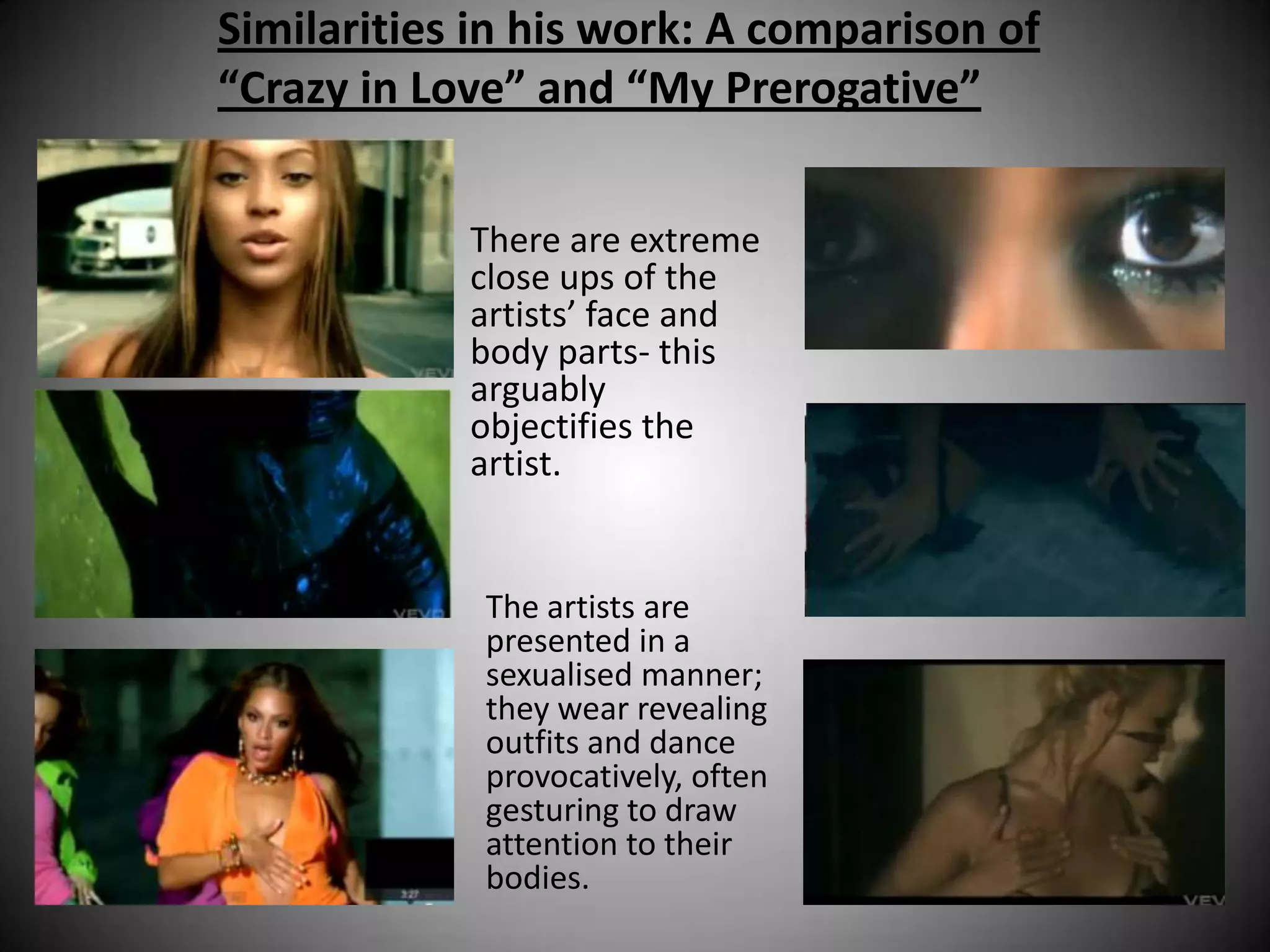
Similarities in his work: A comparison of
“Crazy in Love” and “My Prerogative”


            There are extreme
            close ups of the
            artists’ face and
            body parts- this
            arguably
            objectifies the
            artist.


             The artists are
             presented in a
             sexualised manner;
             they wear revealing
             outfits and dance
             provocatively, often
             gesturing to draw
             attention to their
             bodies.
Both videos begin with scenes involving cars- this suggests a “road trip” style narrative
and captures the attention of the audience who are made to wonder where the car
may be heading and why. The car is often used as a status symbol, suggesting that the
artists are successful.


The cars shown in each of the videos are later destroyed as part of the
narrative, which adds interest as it creates a dramatic and shocking scene, whilst
suggesting a rebellious attitude and extravagance reflective of the glamourized waste
often found in iconic action films such as James Bond.
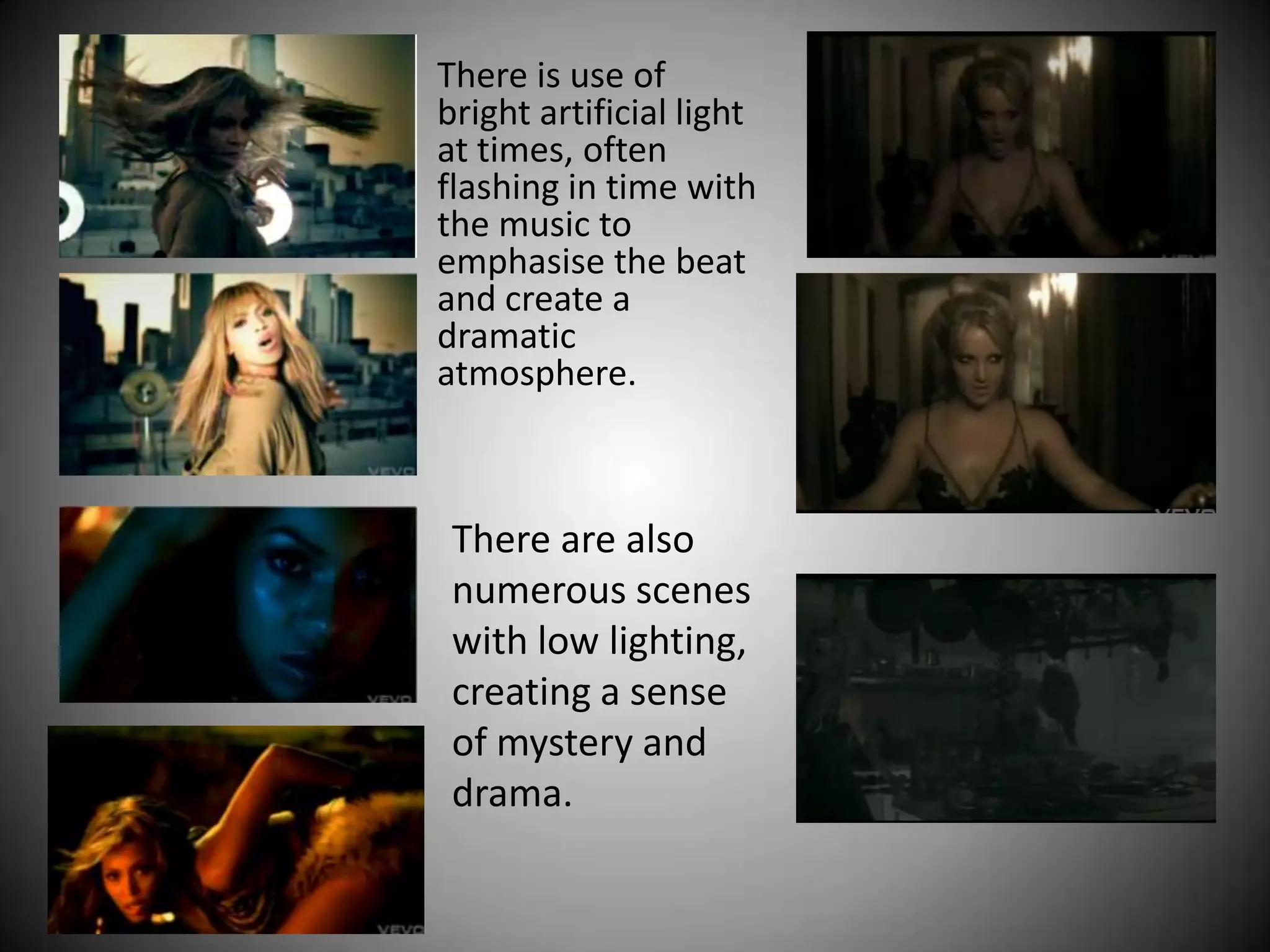
There is use of
bright artificial light
at times, often
flashing in time with
the music to
emphasise the beat
and create a
dramatic
atmosphere.


 There are also
 numerous scenes
 with low lighting,
 creating a sense
 of mystery and
 drama.
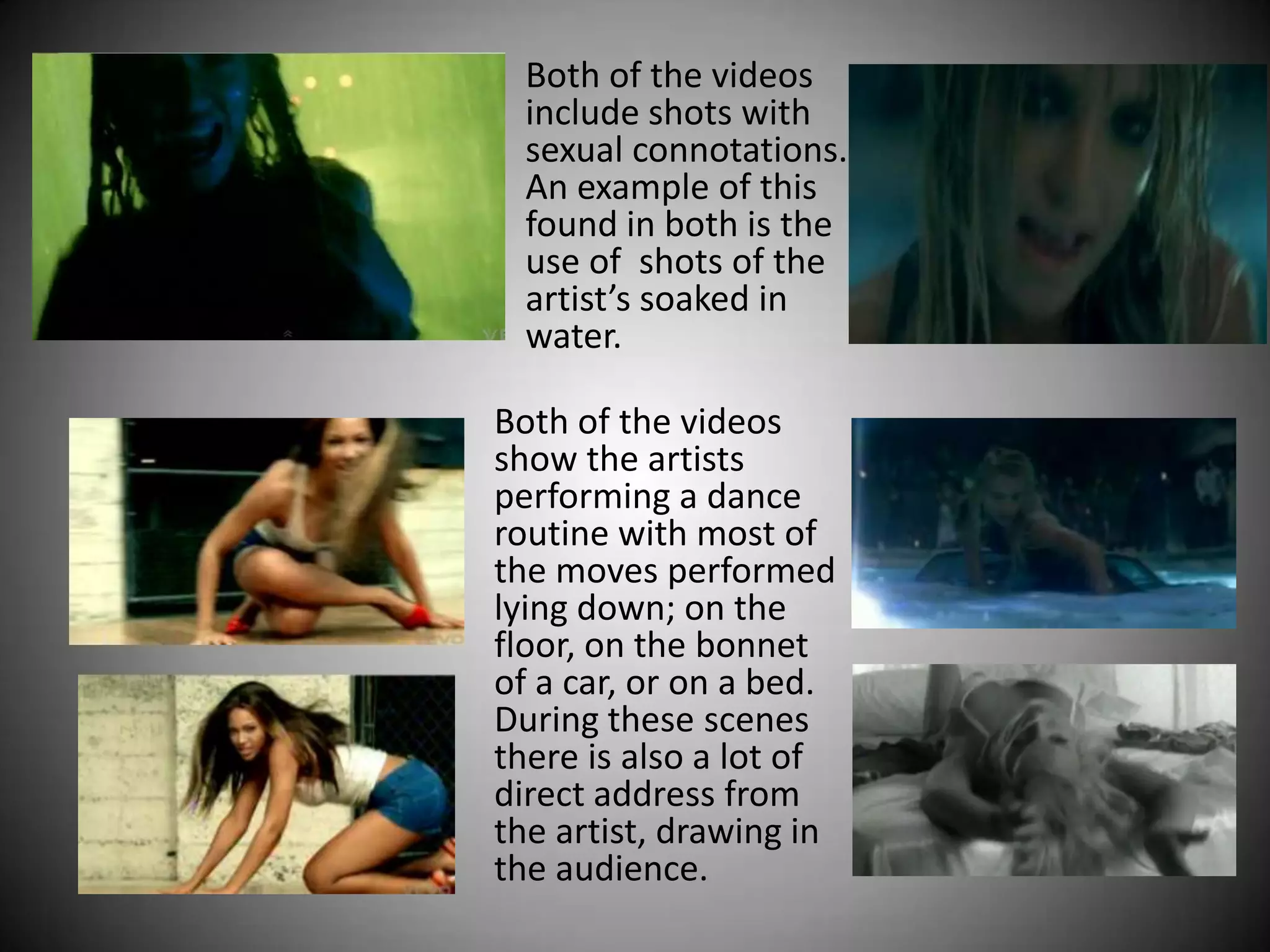
Both of the videos
  include shots with
  sexual connotations.
  An example of this
  found in both is the
  use of shots of the
  artist’s soaked in
  water.

Both of the videos
show the artists
performing a dance
routine with most of
the moves performed
lying down; on the
floor, on the bonnet
of a car, or on a bed.
During these scenes
there is also a lot of
direct address from
the artist, drawing in
the audience.
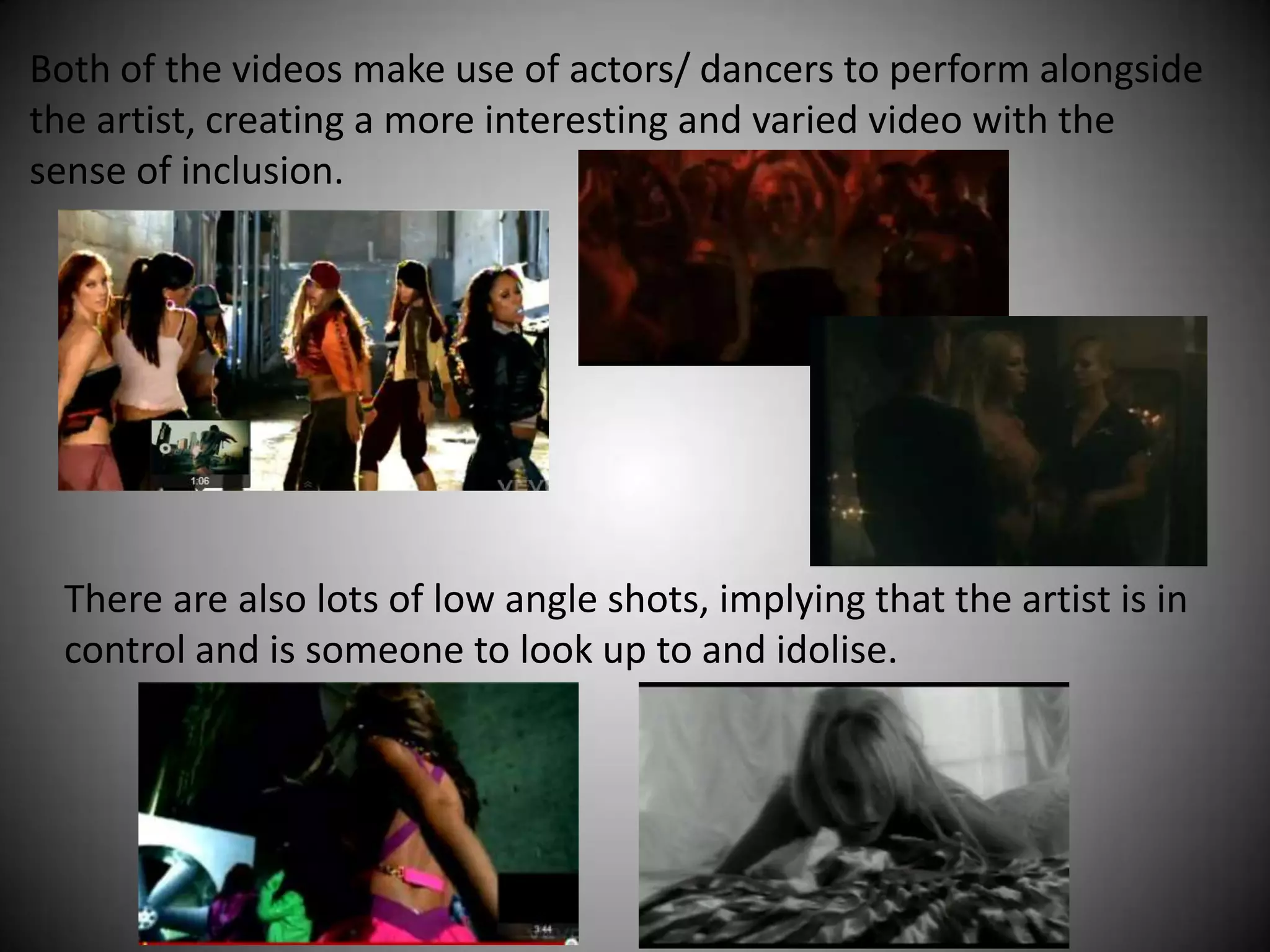
Both of the videos make use of actors/ dancers to perform alongside
the artist, creating a more interesting and varied video with the
sense of inclusion.


 There are also lots of low angle shots, implying that the artist is in
 control and is someone to look up to and idolise.
With regards to mise-en-scène, both of the videos are shot in an obviously
urban setting. A number of settings are used in each video, to add variation in
order to keep the video interesting. This is also achieved through numerous
costume changes.


Both videos also combine fast cuts (to emphasise the pace of the music
and hold audience interest) with some slow motion style shots (to draw
attention to the artist and create suspense).
• This is a theory on audience affect. It suggests that the audience
  passively accept what is presented to them through the media and
  are powerless to resist.
• This would allow the mass media to have a direct impact on our
  thoughts and behaviour.
• The model has sparked concerns about the or portrayal of violent
  or delinquent behaviour in the media, as these would be imitated
  and accepted as “normal”.

With this in mind, it is important to ensure that my music video does
not contain any behaviour which could negatively effect the audience.
• However, it has been argued that this is an outdated theory; rather, the
  audience’s reception of a media text would be shaped by their own
  personal background.
• Theories suggest that the audience effect will be different depending on the
  individual’s social, economic and cultural background, as well as their age,
  gender and sexuality.
• The audience’s reception of the media text can be put into one of three
  categories:
• A Hegemonic reading- wherein the audience shares the dominant
  embedded meaning and ideas in the text.
• A Negotiated reading- where the audience shares some of the encoded
  ideologies of the text.
• A Counter-Hegemonic reading- where the audience rejects the embedded
  ideologies of the text, rejecting the intended perspective.

  Therefore, I will need to keep my audience in mind whilst planning my video
   and consider their background as this will help me to produce a video that
   will be received positively by my target audience.
• The Gratification theory was developed by Blumer and Katz
  in 1974. It is useful to consider in the production of my
  music video as it provides a lists of aims that it must meet.
• It assumes that the audience are active and states that in
  order to be successful, a media text must enable the
  audience:
 To be informed and educated
 To be able to identify with characters and situations
 To be entertained
 To use it for social interaction with others
 To escape daily troubles
• Many music videos tell a story, to add interest or meaning to
  the song. If my music video is to present a narrative, I will also
  need to consider predominant narrative theory.
• Todorov said that narrative begins with equilibrium. There is
  then a rupture of verisimilitude or disruption, which is then
  sorted out; leaving the story to return back to
  equilibrium, producing variations on the typical “happy ever
  after”.
• Therefore, the possible narrative for my music video must
  either conform to this pattern, or deliberately subvert it.
• Propp said that the characters within the narrative will always be a
  variation on a certain character role. The possible roles for the characters
  according to Propp are:

 The Hero – a character that seeks something and protects the others
 The Villain – who opposes or actively blocks the hero’s quest
 The Donor – who provides an object with magical properties
 The Dispatcher – who sends the hero on his/her quest via a message
 The False Hero – who disrupts the hero’s success by making false claims
  and pretences of assistance
 The Helper – who aids the hero
 The Princess – she needs rescuing and acts as the reward for the hero and
  the object of the villain’s plots
 Her Father – who acts to reward the hero for his effort

• According to the theory, the character can also switch roles during the
  narrative; for example the hero may turn into a villain.
• So, if my video is used to tell a story, the “artist” must be portrayed as
  playing one or more of these character roles.

Theories for media

  • 1.
    MEDIA THEORIES: MUSICVIDEOS Brontë Vickery
  • 2.
    • The AuteurTheory was established by Film Director and Critic, Francois Truffaut, in 1954. • It states that the Director of a film (or here, a music video) is the main creative force behind it, much like the "author" of a text. • The director oversees and “writes” both the film's audio and visual scenario and therefore is considered more responsible for its content than the screenwriter. Their influence would show through all other aspects of production. • This would result in all of a certain producer's works recognisably bearing their distinctive mark and giving it a personal feel. • The end product would therefore be highly creative.
  • 3.
    Jake Nava: • JakeNava is an example of an Auteur. He is an English music video director who has won numerous awards and has worked with many of the top famous artists. • He mostly focus on the genre of RnB, and so one would expect his videos to bare not only his personal mark but the conventions of music videos in that genre. • Nava usually works with female artists. • Here I will consider the similarities between two of his music videos, which portray his artistic vision and make the videos recognisable as his work.
  • 4.
    Similarities in hiswork: A comparison of “Crazy in Love” and “My Prerogative” There are extreme close ups of the artists’ face and body parts- this arguably objectifies the artist. The artists are presented in a sexualised manner; they wear revealing outfits and dance provocatively, often gesturing to draw attention to their bodies.
  • 5.
    Both videos beginwith scenes involving cars- this suggests a “road trip” style narrative and captures the attention of the audience who are made to wonder where the car may be heading and why. The car is often used as a status symbol, suggesting that the artists are successful. The cars shown in each of the videos are later destroyed as part of the narrative, which adds interest as it creates a dramatic and shocking scene, whilst suggesting a rebellious attitude and extravagance reflective of the glamourized waste often found in iconic action films such as James Bond.
  • 6.
    There is useof bright artificial light at times, often flashing in time with the music to emphasise the beat and create a dramatic atmosphere. There are also numerous scenes with low lighting, creating a sense of mystery and drama.
  • 7.
    Both of thevideos include shots with sexual connotations. An example of this found in both is the use of shots of the artist’s soaked in water. Both of the videos show the artists performing a dance routine with most of the moves performed lying down; on the floor, on the bonnet of a car, or on a bed. During these scenes there is also a lot of direct address from the artist, drawing in the audience.
  • 8.
    Both of thevideos make use of actors/ dancers to perform alongside the artist, creating a more interesting and varied video with the sense of inclusion. There are also lots of low angle shots, implying that the artist is in control and is someone to look up to and idolise.
  • 9.
    With regards tomise-en-scène, both of the videos are shot in an obviously urban setting. A number of settings are used in each video, to add variation in order to keep the video interesting. This is also achieved through numerous costume changes. Both videos also combine fast cuts (to emphasise the pace of the music and hold audience interest) with some slow motion style shots (to draw attention to the artist and create suspense).
  • 10.
    • This isa theory on audience affect. It suggests that the audience passively accept what is presented to them through the media and are powerless to resist. • This would allow the mass media to have a direct impact on our thoughts and behaviour. • The model has sparked concerns about the or portrayal of violent or delinquent behaviour in the media, as these would be imitated and accepted as “normal”. With this in mind, it is important to ensure that my music video does not contain any behaviour which could negatively effect the audience.
  • 11.
    • However, ithas been argued that this is an outdated theory; rather, the audience’s reception of a media text would be shaped by their own personal background. • Theories suggest that the audience effect will be different depending on the individual’s social, economic and cultural background, as well as their age, gender and sexuality. • The audience’s reception of the media text can be put into one of three categories: • A Hegemonic reading- wherein the audience shares the dominant embedded meaning and ideas in the text. • A Negotiated reading- where the audience shares some of the encoded ideologies of the text. • A Counter-Hegemonic reading- where the audience rejects the embedded ideologies of the text, rejecting the intended perspective. Therefore, I will need to keep my audience in mind whilst planning my video and consider their background as this will help me to produce a video that will be received positively by my target audience.
  • 12.
    • The Gratificationtheory was developed by Blumer and Katz in 1974. It is useful to consider in the production of my music video as it provides a lists of aims that it must meet. • It assumes that the audience are active and states that in order to be successful, a media text must enable the audience:  To be informed and educated  To be able to identify with characters and situations  To be entertained  To use it for social interaction with others  To escape daily troubles
  • 13.
    • Many musicvideos tell a story, to add interest or meaning to the song. If my music video is to present a narrative, I will also need to consider predominant narrative theory. • Todorov said that narrative begins with equilibrium. There is then a rupture of verisimilitude or disruption, which is then sorted out; leaving the story to return back to equilibrium, producing variations on the typical “happy ever after”. • Therefore, the possible narrative for my music video must either conform to this pattern, or deliberately subvert it.
  • 14.
    • Propp saidthat the characters within the narrative will always be a variation on a certain character role. The possible roles for the characters according to Propp are:  The Hero – a character that seeks something and protects the others  The Villain – who opposes or actively blocks the hero’s quest  The Donor – who provides an object with magical properties  The Dispatcher – who sends the hero on his/her quest via a message  The False Hero – who disrupts the hero’s success by making false claims and pretences of assistance  The Helper – who aids the hero  The Princess – she needs rescuing and acts as the reward for the hero and the object of the villain’s plots  Her Father – who acts to reward the hero for his effort • According to the theory, the character can also switch roles during the narrative; for example the hero may turn into a villain. • So, if my video is used to tell a story, the “artist” must be portrayed as playing one or more of these character roles.