RESEARCH PRESENTATION
GROUP-2
SUBMITTED BY :
AMRESH KUMAR
B. Sc (N) 3rd year
Research guides:
DR. M. ABIRAMI,
VICE PRINCIPAL,
BCON.
MRS. P. PUNITHAVATHI,
ASSO. PROFESSOR,
BCON.
RESEARCH ADVOISERY
COMITIEE:
DR.S. VASANTHA,
PRINCIPAL,
BCON.
BHAARATH COLLEGE OF NURSING
CHAPTER 1
INTRODUCTION
Organ donation is the process of surgically removing an organ or tissue from a
donor, typically after death or with consent from a living donor, and transplanting it
into a recipient to restore or improve their bodily functions. Transplantation is the
actual process of engrafting the donated tissue or organ into the recipient's body,
with the goal of reestablishing normal bodily functions. This medical procedure has
revolutionized the treatment of various diseases and conditions, offering a second
chance at life for many individuals.
(Ajay k Israni 2021) reported that Organ transplantation is a medical
marvel that not only saves lives but also restores hope and vitality to
individuals with failing organs. By replacing diseased or damaged organs with
healthy ones, transplantation offers a second chance at life, improving the
quality of life and enabling patients to reclaim their health and well-being.
CONT.
NEED OF THE STUDY
• (According to WHO 2020 ) India’s deceased organ donation rate has remained less than
one donor per million population for over 10 years.- India needs to increase this to 65
donations per million population.- In 2021, India's deceased organ donation rate was
0.4 per million, far lower than the rates in the U.S. (41 per million), France (24.7 per
million), the UK (19.8 per million), Germany (11.1 per million), Japan (0.62 per million),
Brazil (13.8 per million), and China (3.63 per million)
• (According to Organ donor organization 2020) On an average about 106 people are
added to an organ waiting but every day and 18 people die such day waiting for an
organ. In many cases list answers is to replace the damaged organ with healthy one. So
that waiting list of organs for donation is increasing day by day. Transplantation is the
only area in all of health care that cannot exist without the participation of the public. To
encourage the students for giving life through donating organs for the needy to save lives
• (WHO 2020)Engineering students doesn’t have adequate knowledge on organ donation
CONT.
STATEMENT OF THE PROBLEM
• ‘’A study to assess the effectiveness of video assisted teaching programme on
knowledge regarding organ donation among Engineering students at selected a
Engineering college in Chennai’’
OBJECTIVE OF THE STUDY :
1. To assess the pre test level of knowledge on organ donation among engineering
students at a selected college Chennai
2. To assess the effectiveness of video assisted teaching programme on organ donation
among engineering students at selected college Chennai
3. To find out the association between pretest and posttest level of knowledge on organ
donation among engineering students with their selected demographic variables
CONT.
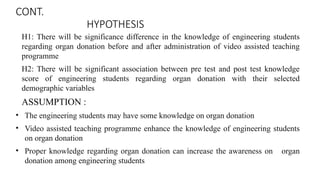
HYPOTHESIS
H1: There will be significance difference in the knowledge of engineering students
regarding organ donation before and after administration of video assisted teaching
programme
H2: There will be significant association between pre test and post test knowledge
score of engineering students regarding organ donation with their selected
demographic variables
ASSUMPTION :
• The engineering students may have some knowledge on organ donation
• Video assisted teaching programme enhance the knowledge of engineering students
on organ donation
• Proper knowledge regarding organ donation can increase the awareness on organ
donation among engineering students
CHAPTER-2
REVIEW OF LITERATURE
• Section I: studies related to knowledge regarding organ donation
• Section II: studies related to effectiveness of video assisted teaching programme
regarding organ donation
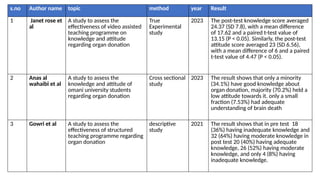
s.no Author name topic method year Result
1 Janet rose et
al
A study to assess the
effectiveness of video assisted
teaching programme on
knowledge and attitude
regarding organ donation
True
Experimental
study
2023 The post-test knowledge score averaged
24.37 (SD 7.8), with a mean difference
of 17.62 and a paired t-test value of
13.15 (P < 0.05). Similarly, the post-test
attitude score averaged 23 (SD 6.56),
with a mean difference of 6 and a paired
t-test value of 4.47 (P < 0.05).
2 Anas al
wahaibi et al
A study to assess the
knowledge and attitude of
omani university students
regarding organ donation
Cross sectional
study
2023 The result shows that only a minority
(34.1%) have good knowledge about
organ donation, majority (70.2%) held a
low attitude towards it. only a small
fraction (7.53%) had adequate
understanding of brain death
3 Gowri et al A study to assess the
effectiveness of structured
teaching programme regarding
organ donation
descriptive
study
2021 The result shows that in pre test 18
(36%) having inadequate knowledge and
32 (64%) having moderate knowledge in
post test 20 (40%) having adequate
knowledge, 26 (52%) having moderate
knowledge, and only 4 (8%) having
inadequate knowledge.
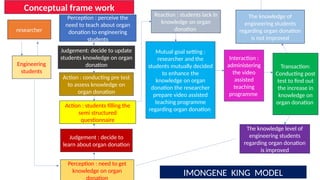
researcher
Engineering
students
Perception : perceive the
need to teach about organ
donation to engineering
students
Judgement: decide to update
students knowledge on organ
donation
Action : conducting pre test
to assess knowledge on
organ donation
Action : students filling the
semi structured
questionnaire
Perception : need to get
knowledge on organ
donation
Judgement : decide to
learn about organ donation
Reaction : students lack in
knowledge on organ
donation
Mutual goal setting :
researcher and the
students mutually decided
to enhance the
knowledge on organ
donation the researcher
prepare video assisted
teaching programme
regarding organ donation
The knowledge of
engineering students
regarding organ donation
is not improved
Transaction:
Conducting post
test to find out
the increase in
knowledge on
organ donation
The knowledge level of
engineering students
regarding organ donation
is improved
Interaction :
administering
the video
assisted
teaching
programme
IMONGENE KING MODEL
Conceptual frame work
CHAPTER-3
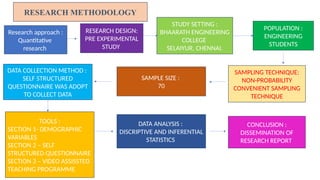
RESEARCH DESIGN:
PRE EXPERIMENTAL
STUDY
STUDY SETTING :
BHAARATH ENGINEERING
COLLEGE
SELAIYUR, CHENNAI.
POPULATION :
ENGINEERING
STUDENTS
DATA COLLECTION METHOD :
SELF STRUCTURED
QUESTIONNAIRE WAS ADOPT
TO COLLECT DATA
SAMPLE SIZE :
70
SAMPLING TECHNIQUE:
NON-PROBABILITY
CONVENIENT SAMPLING
TECHNIQUE
TOOLS :
SECTION 1- DEMOGRAPHIC
VARIABLES
SECTION 2 – SELF
STRUCTURED QUESTIONNAIRE
SECTION 3 – VIDEO ASSISSTED
TEACHING PROGRAMME
DATA ANALYSIS :
DISCRIPTIVE AND INFERENTIAL
STATISTICS
CONCLUSION :
DISSEMINATION OF
RESEARCH REPORT
RESEARCH METHODOLOGY
Research approach :
Quantitative
research
CHAPTER-4
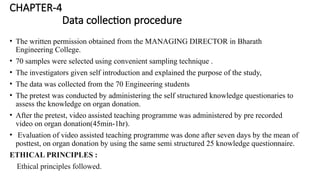
Data collection procedure
• The written permission obtained from the MANAGING DIRECTOR in Bharath
Engineering College.
• 70 samples were selected using convenient sampling technique .
• The investigators given self introduction and explained the purpose of the study,
• The data was collected from the 70 Engineering students
• The pretest was conducted by administering the self structured knowledge questionaries to
assess the knowledge on organ donation.
• After the pretest, video assisted teaching programme was administered by pre recorded
video on organ donation(45min-1hr).
• Evaluation of video assisted teaching programme was done after seven days by the mean of
posttest, on organ donation by using the same semi structured 25 knowledge questionnaire.
ETHICAL PRINCIPLES :
Ethical principles followed.
Data analysis and interpretation
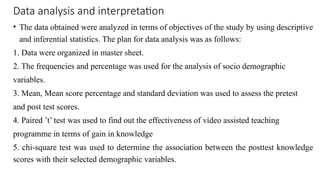
• The data obtained were analyzed in terms of objectives of the study by using descriptive
and inferential statistics. The plan for data analysis was as follows:
1. Data were organized in master sheet.
2. The frequencies and percentage was used for the analysis of socio demographic
variables.
3. Mean, Mean score percentage and standard deviation was used to assess the pretest
and post test scores.
4. Paired ’t’ test was used to find out the effectiveness of video assisted teaching
programme in terms of gain in knowledge
5. chi-square test was used to determine the association between the posttest knowledge
scores with their selected demographic variables.
CHAPTER-5
Result and discussion
The frequency and percentage distribution of demographic variables
• majority of the engineering students 34(49 %) were in age group of (21-23),
30 (43%) were in age group of 18-20 and only 6 (8%)were in age group of 23
above.
• The majority of the engineering students were boys 62 (89%) and 8 (11%)
were the girls.
• The majority of the engineering students were undergraduates 66 (94%) and
only 4 (6%) were post graduates
• The majority of the engineering students were hindu 55 (78%) , 11
(16%) were muslims and only 4 (6%) were Christians.
• The majority of the engineering students parents 57 (81%) were illiterate
and 13 (19%) were educated. .
• The majority of the engineering students were living in rural area 39
(56%) and few belongs to urban area 31 (44%).
• The majority of the engineering students previous knowledge on organ
donation were no 64 (91%) and only 6 (9%) were yes.
OBJECTIVE 1
Frequency and percentage distribution of pre test knowledge score:
the pretest level of knowledge of engineering students
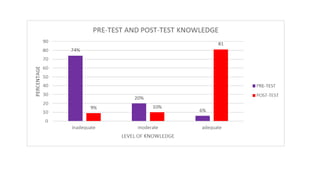
regarding organ donation 52 (74%) had inadequate level of knowledge 14
(20%) had moderate level of knowledge and 4 (6%) had adequate level of
knowledge .
Frequency and percentage distribution of post test knowledge score :
the posttest level of knowledge of engineering students.
Regarding organ donation 6 (9%) had inadequate level of knowledge ,
7(10%) had moderate level of knowledge and 57 (81%) had adequate level
of knowledge regarding organ donation
OBJECTIVE 2
Comparison of pre test and post test knowledge score regarding organ donation :
The mean Knowledge score of Engineering students in posttest was found to be 22, and
S.D 206.moreover , the pretest mean knowledge scores was 11, S.D 179. It reveals that the
posttest knowledge score were found higher than the pretest knowledge score. The
statistical paired ‘t’ test value is 16.21 is greater than the table value at 0.01 level of
significance. It means of statistical significance in the enhancement of knowledge score
indicating the effectiveness of video assisted teaching on organ donation among
Engineering students so H1 was accepted.
OBJECTIVE 2
Frequency and percentage distribution of pre test post test association table :
The demographic variables such as age, gender, education of individuals, and the
diet pattern has a significant association with pretest level of knowledge. In post test age
and gender has significant association with post test level of knowledge on organ donation
among engineering students at the 0.05 level so H2 was accepted.
NURSING IMPLICATIONS:
Nursing education:
Conference, works shop and seminar
Nursing administration :
 Policy Development and Implementation.
 Staff Training and Education.
Nursing research:
 The research should be done on improving the knowledge on organ donation
to improve the organ donation rate in society.
 The study motivates the other to conduct further study on organ donation
CONCLUSION:
The finding of the study shows that majority of the engineering students had
moderately adequate knowledge regarding organ donation. The video assisted
teaching programme was helpful to improve the knowledge level among
Engineering students. Thus, more awareness programme can be conducted in
large group widely in order to improve organ donation rate by conducting more
programme related to organ donation will save the lives of 10 member every day
so provide your organ and save others live .
RESEARCH FINAL PRESENTATION PPT GROUP-2.pptx

RESEARCH FINAL PRESENTATION PPT GROUP-2.pptx

  • 1.
    RESEARCH PRESENTATION GROUP-2 SUBMITTED BY: AMRESH KUMAR B. Sc (N) 3rd year Research guides: DR. M. ABIRAMI, VICE PRINCIPAL, BCON. MRS. P. PUNITHAVATHI, ASSO. PROFESSOR, BCON. RESEARCH ADVOISERY COMITIEE: DR.S. VASANTHA, PRINCIPAL, BCON. BHAARATH COLLEGE OF NURSING
  • 2.
    CHAPTER 1 INTRODUCTION Organ donationis the process of surgically removing an organ or tissue from a donor, typically after death or with consent from a living donor, and transplanting it into a recipient to restore or improve their bodily functions. Transplantation is the actual process of engrafting the donated tissue or organ into the recipient's body, with the goal of reestablishing normal bodily functions. This medical procedure has revolutionized the treatment of various diseases and conditions, offering a second chance at life for many individuals. (Ajay k Israni 2021) reported that Organ transplantation is a medical marvel that not only saves lives but also restores hope and vitality to individuals with failing organs. By replacing diseased or damaged organs with healthy ones, transplantation offers a second chance at life, improving the quality of life and enabling patients to reclaim their health and well-being.
  • 3.
    CONT. NEED OF THESTUDY • (According to WHO 2020 ) India’s deceased organ donation rate has remained less than one donor per million population for over 10 years.- India needs to increase this to 65 donations per million population.- In 2021, India's deceased organ donation rate was 0.4 per million, far lower than the rates in the U.S. (41 per million), France (24.7 per million), the UK (19.8 per million), Germany (11.1 per million), Japan (0.62 per million), Brazil (13.8 per million), and China (3.63 per million) • (According to Organ donor organization 2020) On an average about 106 people are added to an organ waiting but every day and 18 people die such day waiting for an organ. In many cases list answers is to replace the damaged organ with healthy one. So that waiting list of organs for donation is increasing day by day. Transplantation is the only area in all of health care that cannot exist without the participation of the public. To encourage the students for giving life through donating organs for the needy to save lives • (WHO 2020)Engineering students doesn’t have adequate knowledge on organ donation
  • 4.
    CONT. STATEMENT OF THEPROBLEM • ‘’A study to assess the effectiveness of video assisted teaching programme on knowledge regarding organ donation among Engineering students at selected a Engineering college in Chennai’’ OBJECTIVE OF THE STUDY : 1. To assess the pre test level of knowledge on organ donation among engineering students at a selected college Chennai 2. To assess the effectiveness of video assisted teaching programme on organ donation among engineering students at selected college Chennai 3. To find out the association between pretest and posttest level of knowledge on organ donation among engineering students with their selected demographic variables
  • 5.
    CONT. HYPOTHESIS H1: There willbe significance difference in the knowledge of engineering students regarding organ donation before and after administration of video assisted teaching programme H2: There will be significant association between pre test and post test knowledge score of engineering students regarding organ donation with their selected demographic variables ASSUMPTION : • The engineering students may have some knowledge on organ donation • Video assisted teaching programme enhance the knowledge of engineering students on organ donation • Proper knowledge regarding organ donation can increase the awareness on organ donation among engineering students
  • 6.
    CHAPTER-2 REVIEW OF LITERATURE •Section I: studies related to knowledge regarding organ donation • Section II: studies related to effectiveness of video assisted teaching programme regarding organ donation
  • 7.
    s.no Author nametopic method year Result 1 Janet rose et al A study to assess the effectiveness of video assisted teaching programme on knowledge and attitude regarding organ donation True Experimental study 2023 The post-test knowledge score averaged 24.37 (SD 7.8), with a mean difference of 17.62 and a paired t-test value of 13.15 (P < 0.05). Similarly, the post-test attitude score averaged 23 (SD 6.56), with a mean difference of 6 and a paired t-test value of 4.47 (P < 0.05). 2 Anas al wahaibi et al A study to assess the knowledge and attitude of omani university students regarding organ donation Cross sectional study 2023 The result shows that only a minority (34.1%) have good knowledge about organ donation, majority (70.2%) held a low attitude towards it. only a small fraction (7.53%) had adequate understanding of brain death 3 Gowri et al A study to assess the effectiveness of structured teaching programme regarding organ donation descriptive study 2021 The result shows that in pre test 18 (36%) having inadequate knowledge and 32 (64%) having moderate knowledge in post test 20 (40%) having adequate knowledge, 26 (52%) having moderate knowledge, and only 4 (8%) having inadequate knowledge.
  • 8.
    researcher Engineering students Perception : perceivethe need to teach about organ donation to engineering students Judgement: decide to update students knowledge on organ donation Action : conducting pre test to assess knowledge on organ donation Action : students filling the semi structured questionnaire Perception : need to get knowledge on organ donation Judgement : decide to learn about organ donation Reaction : students lack in knowledge on organ donation Mutual goal setting : researcher and the students mutually decided to enhance the knowledge on organ donation the researcher prepare video assisted teaching programme regarding organ donation The knowledge of engineering students regarding organ donation is not improved Transaction: Conducting post test to find out the increase in knowledge on organ donation The knowledge level of engineering students regarding organ donation is improved Interaction : administering the video assisted teaching programme IMONGENE KING MODEL Conceptual frame work
  • 9.
  • 10.
    RESEARCH DESIGN: PRE EXPERIMENTAL STUDY STUDYSETTING : BHAARATH ENGINEERING COLLEGE SELAIYUR, CHENNAI. POPULATION : ENGINEERING STUDENTS DATA COLLECTION METHOD : SELF STRUCTURED QUESTIONNAIRE WAS ADOPT TO COLLECT DATA SAMPLE SIZE : 70 SAMPLING TECHNIQUE: NON-PROBABILITY CONVENIENT SAMPLING TECHNIQUE TOOLS : SECTION 1- DEMOGRAPHIC VARIABLES SECTION 2 – SELF STRUCTURED QUESTIONNAIRE SECTION 3 – VIDEO ASSISSTED TEACHING PROGRAMME DATA ANALYSIS : DISCRIPTIVE AND INFERENTIAL STATISTICS CONCLUSION : DISSEMINATION OF RESEARCH REPORT RESEARCH METHODOLOGY Research approach : Quantitative research
  • 11.
    CHAPTER-4 Data collection procedure •The written permission obtained from the MANAGING DIRECTOR in Bharath Engineering College. • 70 samples were selected using convenient sampling technique . • The investigators given self introduction and explained the purpose of the study, • The data was collected from the 70 Engineering students • The pretest was conducted by administering the self structured knowledge questionaries to assess the knowledge on organ donation. • After the pretest, video assisted teaching programme was administered by pre recorded video on organ donation(45min-1hr). • Evaluation of video assisted teaching programme was done after seven days by the mean of posttest, on organ donation by using the same semi structured 25 knowledge questionnaire. ETHICAL PRINCIPLES : Ethical principles followed.
  • 12.
    Data analysis andinterpretation • The data obtained were analyzed in terms of objectives of the study by using descriptive and inferential statistics. The plan for data analysis was as follows: 1. Data were organized in master sheet. 2. The frequencies and percentage was used for the analysis of socio demographic variables. 3. Mean, Mean score percentage and standard deviation was used to assess the pretest and post test scores. 4. Paired ’t’ test was used to find out the effectiveness of video assisted teaching programme in terms of gain in knowledge 5. chi-square test was used to determine the association between the posttest knowledge scores with their selected demographic variables.
  • 13.
    CHAPTER-5 Result and discussion Thefrequency and percentage distribution of demographic variables • majority of the engineering students 34(49 %) were in age group of (21-23), 30 (43%) were in age group of 18-20 and only 6 (8%)were in age group of 23 above. • The majority of the engineering students were boys 62 (89%) and 8 (11%) were the girls. • The majority of the engineering students were undergraduates 66 (94%) and only 4 (6%) were post graduates
  • 14.
    • The majorityof the engineering students were hindu 55 (78%) , 11 (16%) were muslims and only 4 (6%) were Christians. • The majority of the engineering students parents 57 (81%) were illiterate and 13 (19%) were educated. . • The majority of the engineering students were living in rural area 39 (56%) and few belongs to urban area 31 (44%). • The majority of the engineering students previous knowledge on organ donation were no 64 (91%) and only 6 (9%) were yes.
  • 16.
    OBJECTIVE 1 Frequency andpercentage distribution of pre test knowledge score: the pretest level of knowledge of engineering students regarding organ donation 52 (74%) had inadequate level of knowledge 14 (20%) had moderate level of knowledge and 4 (6%) had adequate level of knowledge . Frequency and percentage distribution of post test knowledge score : the posttest level of knowledge of engineering students. Regarding organ donation 6 (9%) had inadequate level of knowledge , 7(10%) had moderate level of knowledge and 57 (81%) had adequate level of knowledge regarding organ donation
  • 17.
    OBJECTIVE 2 Comparison ofpre test and post test knowledge score regarding organ donation : The mean Knowledge score of Engineering students in posttest was found to be 22, and S.D 206.moreover , the pretest mean knowledge scores was 11, S.D 179. It reveals that the posttest knowledge score were found higher than the pretest knowledge score. The statistical paired ‘t’ test value is 16.21 is greater than the table value at 0.01 level of significance. It means of statistical significance in the enhancement of knowledge score indicating the effectiveness of video assisted teaching on organ donation among Engineering students so H1 was accepted. OBJECTIVE 2 Frequency and percentage distribution of pre test post test association table : The demographic variables such as age, gender, education of individuals, and the diet pattern has a significant association with pretest level of knowledge. In post test age and gender has significant association with post test level of knowledge on organ donation among engineering students at the 0.05 level so H2 was accepted.
  • 18.
    NURSING IMPLICATIONS: Nursing education: Conference,works shop and seminar Nursing administration :  Policy Development and Implementation.  Staff Training and Education. Nursing research:  The research should be done on improving the knowledge on organ donation to improve the organ donation rate in society.  The study motivates the other to conduct further study on organ donation
  • 19.
    CONCLUSION: The finding ofthe study shows that majority of the engineering students had moderately adequate knowledge regarding organ donation. The video assisted teaching programme was helpful to improve the knowledge level among Engineering students. Thus, more awareness programme can be conducted in large group widely in order to improve organ donation rate by conducting more programme related to organ donation will save the lives of 10 member every day so provide your organ and save others live .